

SIST EN 60068-2-17:2002
(Main)Environmental testing -- Part 2: Tests - Test Q: Sealing
General Information
- Abstract
Includes a number of tests which use different conditioning procedures appropriate for different application.
- Status
- Withdrawn
- Publication Date
- 30-Apr-2002
- Withdrawal Date
- 03-Aug-2026
- Technical Committee
- I09 - Imaginarni 09
- Current Stage
- 9900 - Withdrawal (Adopted Project)
- Start Date
- 04-Aug-2026
- Due Date
- 27-Aug-2026
- Completion Date
- 04-Aug-2026

Overview
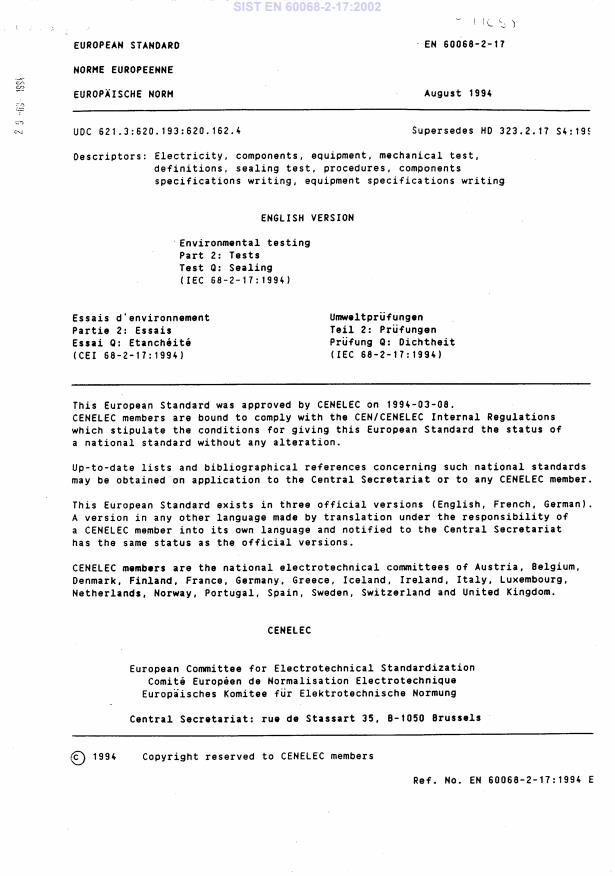
EN 60068-2-17:1994 (Test Q: Sealing) is part of the EN/IEC 60068 series on environmental testing. This standard addresses sealing tests for components and equipment and “includes a number of tests which use different conditioning procedures appropriate for different application[s].” It is intended to characterize the resistance of enclosures and sealed items to environmental factors that can compromise seals, hermeticity or ingress protection.
Key topics and technical focus
The standard focuses on practical aspects of sealing assessment and test conditioning. Key topics include:
- Scope of sealing tests and the types of sealed items covered (electronic enclosures, connectors, packaging).
- Conditioning procedures: test sequences and environmental conditioning adapted to different applications (e.g., temperature, humidity or other environmental stresses - as appropriate to the item under test).
- Test specimen preparation and handling prior to and after conditioning.
- Test execution and observations to determine whether sealing integrity has been preserved following conditioning.
- Reporting and documentation of test conditions, methods and results to support reproducibility and compliance.
Note: EN 60068-2-17 defines a suite of sealing tests and the conditioning approaches suitable for multiple use cases rather than prescribing a single universal procedure.
Applications
EN 60068-2-17 is used to evaluate and validate sealing performance across industries where enclosure integrity is critical:
- Consumer electronics (protecting circuits from moisture and dust)
- Automotive and transport (sensors, connectors exposed to environmental stress)
- Aerospace and defense (hermetic enclosures and avionics)
- Medical devices (sealed implantable or diagnostic housings)
- Telecommunications and industrial equipment (outdoor enclosures, junction boxes)
Using this standard helps manufacturers assess durability of seals under environment-specific conditioning, reduce field failures, and support quality and reliability claims.
Who should use this standard
- Product designers and R&D teams defining sealing requirements
- Test laboratories performing environmental qualification
- Quality, reliability and compliance engineers verifying product robustness
- Procurement and certification bodies reviewing test evidence
Related standards
- EN/IEC 60068 series (environmental testing)
- Standards for ingress protection and enclosure ratings (commonly referenced alongside sealing tests)
By applying EN 60068-2-17:1994 as part of a broader environmental-test program, organizations can select appropriate sealing tests and conditioning procedures tailored to their specific product applications, improving reliability and compliance.
Relations
- Effective Date
- 01-May-2024
- Effective Date
- 09-Feb-2026
- Effective Date
- 09-Feb-2026
- Effective Date
- 03-Feb-2026
- Effective Date
- 03-Feb-2026
- Effective Date
- 03-Feb-2026
- Effective Date
- 03-Feb-2026
- Effective Date
- 03-Feb-2026
- Refers
SIST EN 60695-2-2:1999 - Fire hazard testing -- Part 2: Test methods -- Section 2: Needle-flame test - Effective Date
- 03-Feb-2026
- Effective Date
- 03-Feb-2026
- Effective Date
- 09-Feb-2026
- Effective Date
- 03-Feb-2026
- Referred By
SIST EN 60044-8:2003 - Instrument transformers -- Part 8: Electronic current transformers - Effective Date
- 03-Feb-2026
- Referred By
SIST EN 60694:2001 - Common specifications for high-voltage switchgear and controlgear standards - Effective Date
- 03-Feb-2026
- Effective Date
- 03-Feb-2026
Get Certified
Connect with accredited certification bodies for this standard

IMP NDT d.o.o.
Non-destructive testing services. Radiography, ultrasonic, magnetic particle, penetrant, visual inspection.
Inštitut za kovinske materiale in tehnologije
Institute of Metals and Technology. Materials testing, metallurgical analysis, NDT.
Q Techna d.o.o.
NDT and quality assurance specialist. 30+ years experience. NDT personnel certification per ISO 9712, nuclear and thermal power plant inspections, QA/
Sponsored listings
Frequently Asked Questions
SIST EN 60068-2-17:2002 is a standard published by the Slovenian Institute for Standardization (SIST). Its full title is "Environmental testing -- Part 2: Tests - Test Q: Sealing". This standard covers: Includes a number of tests which use different conditioning procedures appropriate for different application.
Includes a number of tests which use different conditioning procedures appropriate for different application.
SIST EN 60068-2-17:2002 is classified under the following ICS (International Classification for Standards) categories: 19.040 - Environmental testing. The ICS classification helps identify the subject area and facilitates finding related standards.
SIST EN 60068-2-17:2002 has the following relationships with other standards: It is inter standard links to SIST EN IEC 60068-2-17:2024, SIST-TS CEN/TS 13126-8:2005, SIST EN ISO 7380:2001, SIST EN 60529:1997, SIST HD 323.2.20 S3:2003, SIST EN 61811-1:2001, SIST EN 61709:2002, SIST EN 61811-50:2003, SIST EN 60695-2-2:1999, SIST EN 60068-2-47:2001, SIST EN 1300:2014, SIST EN 60384-1:2010, SIST EN 60044-8:2003, SIST EN 60694:2001, SIST EN 60137:1997. Understanding these relationships helps ensure you are using the most current and applicable version of the standard.
SIST EN 60068-2-17:2002 is available in PDF format for immediate download after purchase. The document can be added to your cart and obtained through the secure checkout process. Digital delivery ensures instant access to the complete standard document.
Standards Content (Sample)
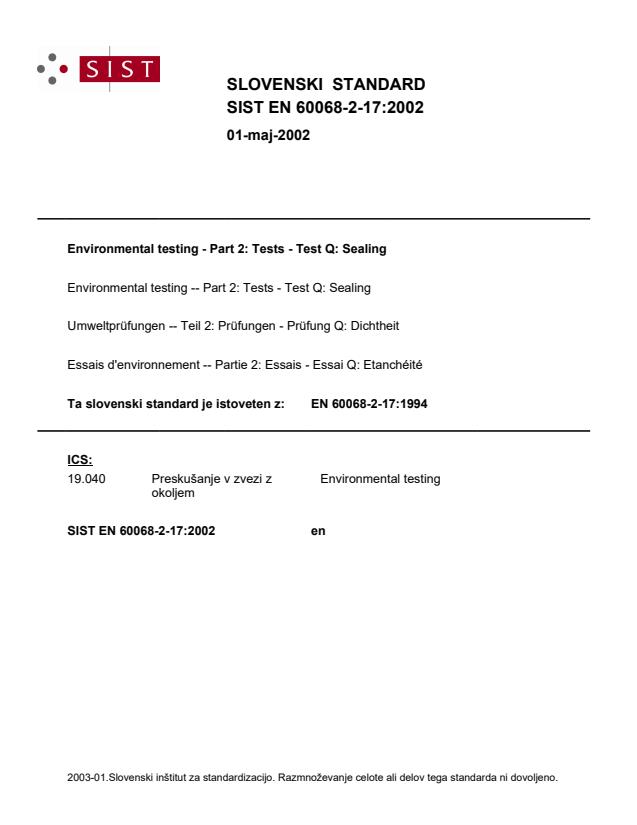
2003-01.Slovenski inštitut za standardizacijo. Razmnoževanje celote ali delov tega standarda ni dovoljeno.Environmental testing - Part 2: Tests - Test Q: SealingUmweltprüfungen -- Teil 2: Prüfungen - Prüfung Q: DichtheitEssais d'environnement -- Partie 2: Essais - Essai Q: EtanchéitéEnvironmental testing -- Part 2: Tests - Test Q: Sealing19.040Preskušanje v zvezi z okoljemEnvironmental testingICS:Ta slovenski standard je istoveten z:EN 60068-2-17:1994SIST EN 60068-2-17:2002en01-maj-2002SIST EN 60068-2-17:2002SLOVENSKI
STANDARD
SIST EN 6006
...