

oSIST prEN 16452:2025
(Main)Railway applications - Braking - Brake blocks
General Information
- Abstract
This document specifies the requirements for the design, dimensions, performance, and testing of a brake block that acts on the wheel tread as part of a tread brake system.
NOTE In the scope of Commission Regulation (EU) N° 321/2013 (TSI WAG) the brake block is a friction element for wheel tread brakes.
This document does not cover cast iron brake block requirements.
This document is applicable to brake blocks of various friction level designed to be fitted to tread braked rail vehicles.
This document contains the requirements for interfacing the brake block with the rail vehicle, the testing procedures in order to confirm that it satisfies the basic safety and technical interchangeability requirements, the material control procedures to ensure product quality, reliability and conformity and considers health and environmental needs.
- Status
- Not Published
- Public Enquiry End Date
- 30-Nov-2025
- Technical Committee
- IŽNP - Reilway applications
- Current Stage
- 4020 - Public enquire (PE) (Adopted Project)
- Start Date
- 08-Oct-2025
- Due Date
- 25-Feb-2026
- Completion Date
- 01-Dec-2025

Overview
oSIST prEN 16452:2025 sets the standardization requirements for brake blocks used in railway applications. Specifically, it covers brake blocks that interact with the wheel tread as part of a tread brake system, focusing on composite friction materials rather than traditional cast iron. Developed by the Slovenski inštitut za standardizacijo (SIST), this document ensures interoperability, safety, quality, and environmental compliance for tread braked rail vehicles in alignment with European and international rail standards.
Key Topics
Scope and Purpose
- Design and Performance: Specifies requirements for brake block design, dimensions, performance, and materials.
- Testing Procedures: Details comprehensive testing protocols to validate safety, reliability, durability, and technical interchangeability.
- Exclusions: Does not address cast iron brake blocks; focuses on various friction levels in composite materials.
- Health, Safety, Environment: Addresses requirements for environmental protection and occupational health.
- Regulatory Alignment: Aligns technical requirements with the Commission Regulation (EU) N° 321/2013 (TSI WAG).
Core Requirements
- Friction Material Properties: Brake blocks must deliver reliable stopping distances and consistent retardation across variable loads and speeds.
- Mechanical Strength: Definition of minimum standards for shear and flexural strength to ensure long-term durability.
- Performance Across Environments: Brake blocks must be tested under a range of real-life conditions, including extreme winter, humidity, and locked-brake scenarios.
- Compatibility and Interchangeability: Specifies requirements for interfacing brake blocks with vehicle components.
- Quality Assurance: Outlines conformity assessment processes, material controls, and in-service monitoring to demonstrate ongoing compliance.
- Signaling System Interference: Includes provisions to assess and minimize the impact of brake blocks on track circuit operations.
Applications
oSIST prEN 16452:2025 applies to composite brake blocks designed for a wide range of railway vehicles, including:
- Passenger Coaches and Locomotives: Brake blocks meeting this standard ensure safe and consistent braking performance at varying speeds and load conditions.
- Freight Wagons: Requirements include rigorous testing for performance, wear rates, and functionality in harsh climates (such as extreme winter conditions).
- High-Speed and Multiple-Unit Trains: Ensures compatibility and reliability for advanced applications where safety and efficiency are critical.
- Maintenance and Replacement: Supports interoperable, high-quality brake blocks for ongoing operational safety and simplified fleet maintenance.
Related Standards
oSIST prEN 16452:2025 references and complements several key railway standards to ensure cohesive application across the rail sector:
- EN 13452: Braking for mass transit systems
- EN 13715, EN 13979-1: Railway wheelsets and tread profiles
- EN 14198: Brake system requirements
- EN 15313: Wheelset maintenance
- EN 15663: Vehicle reference masses
- EN 15734, EN 16185: High-speed and multiple unit braking systems
- EN 16834: Brake performance
- EN ISO 24478: Railway braking vocabulary
- EN ISO 4287: Surface texture measurement
These related standards help unify technical, safety, and compatibility criteria for brake blocks, supporting safe rail operations and product conformity throughout Europe.
Using oSIST prEN 16452:2025 as a reference promotes safety, material consistency, and technology interchangeability for railway braking systems-essential for manufacturers, operators, and regulatory bodies engaged in rail vehicle maintenance, design, and procurement. For detailed requirements and procedures, always consult the latest version of the standard and its referenced documents.
Relations
- Effective Date
- 28-Jan-2026
- Effective Date
- 19-Jan-2023
- Effective Date
- 18-Jan-2023
- Effective Date
- 01-Dec-2021
Get Certified
Connect with accredited certification bodies for this standard

IRIS Certification (UNIFE)
International Railway Industry Standard certification.

TÜV SÜD Rail GmbH
TÜV SÜD railway certification services.

Bureau Veritas Railway Certification
Railway and transportation certification.
Sponsored listings
Frequently Asked Questions
oSIST prEN 16452:2025 is a draft published by the Slovenian Institute for Standardization (SIST). Its full title is "Railway applications - Braking - Brake blocks". This standard covers: This document specifies the requirements for the design, dimensions, performance, and testing of a brake block that acts on the wheel tread as part of a tread brake system. NOTE In the scope of Commission Regulation (EU) N° 321/2013 (TSI WAG) the brake block is a friction element for wheel tread brakes. This document does not cover cast iron brake block requirements. This document is applicable to brake blocks of various friction level designed to be fitted to tread braked rail vehicles. This document contains the requirements for interfacing the brake block with the rail vehicle, the testing procedures in order to confirm that it satisfies the basic safety and technical interchangeability requirements, the material control procedures to ensure product quality, reliability and conformity and considers health and environmental needs.
This document specifies the requirements for the design, dimensions, performance, and testing of a brake block that acts on the wheel tread as part of a tread brake system. NOTE In the scope of Commission Regulation (EU) N° 321/2013 (TSI WAG) the brake block is a friction element for wheel tread brakes. This document does not cover cast iron brake block requirements. This document is applicable to brake blocks of various friction level designed to be fitted to tread braked rail vehicles. This document contains the requirements for interfacing the brake block with the rail vehicle, the testing procedures in order to confirm that it satisfies the basic safety and technical interchangeability requirements, the material control procedures to ensure product quality, reliability and conformity and considers health and environmental needs.
oSIST prEN 16452:2025 is classified under the following ICS (International Classification for Standards) categories: 45.040 - Materials and components for railway engineering; 45.060.01 - Railway rolling stock in general. The ICS classification helps identify the subject area and facilitates finding related standards.
oSIST prEN 16452:2025 has the following relationships with other standards: It is inter standard links to SIST EN ISO 15156-3:2021, SIST EN 16452:2015+A1:2019, SIST EN 16452:2015+A1:2019, SIST EN 16452:2015+A1:2019. Understanding these relationships helps ensure you are using the most current and applicable version of the standard.
oSIST prEN 16452:2025 is associated with the following European legislation: EU Directives/Regulations: 2008/57/EC, 2016/797/EU, 2016/797/EU, 2016/797/EU, 2016/797/EU, 2016/797/EU, 2016/797/EU, 2016/797/EU, 2016/797/EU, 2016/797/EU, 2016/797/EU, 2016/797/EU, 2016/797/EU, 2016/797/EU; Standardization Mandates: M/483. When a standard is cited in the Official Journal of the European Union, products manufactured in conformity with it benefit from a presumption of conformity with the essential requirements of the corresponding EU directive or regulation.
oSIST prEN 16452:2025 is available in PDF format for immediate download after purchase. The document can be added to your cart and obtained through the secure checkout process. Digital delivery ensures instant access to the complete standard document.
Standards Content (Sample)
SLOVENSKI STANDARD
01-november-2025
Železniške naprave - Zavore - Zavorne ploščice
Railway applications - Braking - Brake blocks
Bahnanwendungen - Bremse - Bremsklötze
Applications ferroviaires - Freinage - Semelles de frein
Ta slovenski standard je istoveten z: prEN 16452
ICS:
45.040 Materiali in deli za železniško Materials and components
tehniko for railway engineering
2003-01.Slovenski inštitut za standardizacijo. Razmnoževanje celote ali delov tega standarda ni dovoljeno.
DRAFT
EUROPEAN STANDARD
NORME EUROPÉENNE
EUROPÄISCHE NORM
October 2025
ICS Will supersede EN 16452:2015+A1:2019
English Version
Railway applications - Braking - Brake blocks
Applications ferroviaires - Freinage - Semelles de frein Bahnanwendungen - Bremse - Bremsklötze
This draft European Standard is submitted to CEN members for enquiry. It has been drawn up by the Technical Committee
CEN/TC 256.
If this draft becomes a European Standard, CEN members are bound to comply with the CEN/CENELEC Internal Regulations
which stipulate the conditions for giving this European Standard the status of a national standard without any alteration.
This draft European Standard was established by CEN in three official versions (English, French, German). A version in any other
language made by translation under the responsibility of a CEN member into its own language and notified to the CEN-CENELEC
Management Centre has the same status as the official versions.
CEN members are the national standards bodies of Austria, Belgium, Bulgaria, Croatia, Cyprus, Czech Republic, Denmark, Estonia,
Finland, France, Germany, Greece, Hungary, Iceland, Ireland, Italy, Latvia, Lithuania, Luxembourg, Malta, Netherlands, Norway,
Poland, Portugal, Republic of North Macedonia, Romania, Serbia, Slovakia, Slovenia, Spain, Sweden, Switzerland, Türkiye and
United Kingdom.
Recipients of this draft are invited to submit, with their comments, notification of any relevant patent rights of which they are
aware and to provide supporting documentation.
Warning : This document is not a European Standard. It is distributed for review and comments. It is subject to change without
notice and shall not be referred to as a European Standard.
EUROPEAN COMMITTEE FOR STANDARDIZATION
COMITÉ EUROPÉEN DE NORMALISATION
EUROPÄISCHES KOMITEE FÜR NORMUNG
CEN-CENELEC Management Centre: Rue de la Science 23, B-1040 Brussels
© 2025 CEN All rights of exploitation in any form and by any means reserved Ref. No. prEN 16452:2025 E
worldwide for CEN national Members.
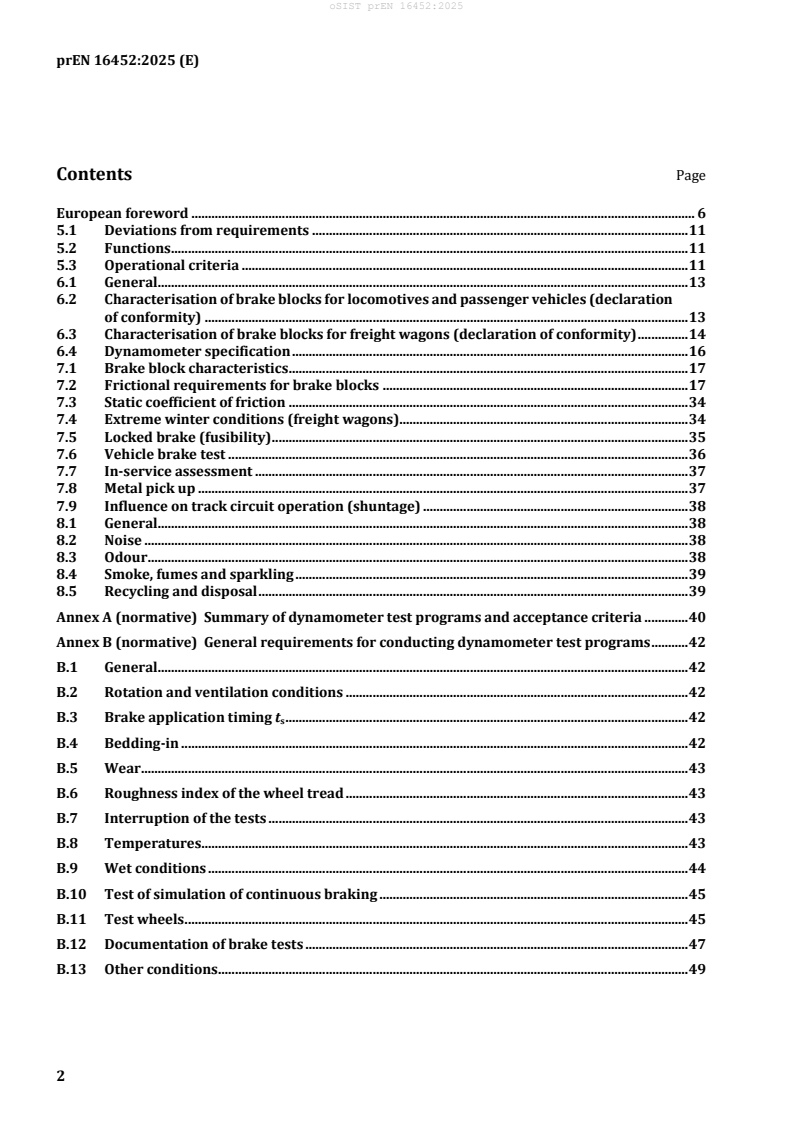
Contents Page
European foreword . 6
5.1 Deviations from requirements . 11
5.2 Functions . 11
5.3 Operational criteria . 11
6.1 General . 13
6.2 Characterisation of brake blocks for locomotives and passenger vehicles (declaration
of conformity) . 13
6.3 Characterisation of brake blocks for freight wagons (declaration of conformity) . 14
6.4 Dynamometer specification . 16
7.1 Brake block characteristics . 17
7.2 Frictional requirements for brake blocks . 17
7.3 Static coefficient of friction . 34
7.4 Extreme winter conditions (freight wagons). . 34
7.5 Locked brake (fusibility) . 35
7.6 Vehicle brake test . 36
7.7 In-service assessment . 37
7.8 Metal pick up . 37
7.9 Influence on track circuit operation (shuntage) . 38
8.1 General . 38
8.2 Noise . 38
8.3 Odour . 38
8.4 Smoke, fumes and sparkling . 39
8.5 Recycling and disposal . 39
Annex A (normative) Summary of dynamometer test programs and acceptance criteria . 40
Annex B (normative) General requirements for conducting dynamometer test programs . 42
B.1 General . 42
B.2 Rotation and ventilation conditions . 42
B.3 Brake application timing t . 42
s
B.4 Bedding-in . 42
B.5 Wear. 43
B.6 Roughness index of the wheel tread . 43
B.7 Interruption of the tests . 43
B.8 Temperatures . 43
B.9 Wet conditions . 44
B.10 Test of simulation of continuous braking . 45
B.11 Test wheels . 45
B.12 Documentation of brake tests . 47
B.13 Other conditions . 49
Annex C (normative) Composite brake blocks (K) (2 x Bg – 2 x Bgu – 1 x Bgu) –
demonstration of friction properties for S and SS (S/SS) -braked freight wagons
(v = 120 km/h) . 50
max
C.1 Test program – performance tests . 50
C.2 Test program for additional performance test . 54
C.3 Deviant conditions at the end of brake applications of performance test . 55
C.4 Test program – simulation braking performance assessment S-brakes (only
recommended) . 55
C.5 Test Program – simulation braking performance assessment SS-brakes (only
recommended) . 57
C.6 Deviant conditions for the bedding-in of program C.4 and C.5 . 58
C.7 Dispersion range of mean coefficient of frictions . 58
Annex D (normative) Composite brake blocks (LL) (2 x Bg – 2 x Bgu) – Demonstration of
friction properties for S and SS (S/SS) -braked freight wagons (v = 120 km/h) . 63
max
D.1 Test program – performance tests . 63
D.2 Test program for additional performance test . 66
D.3 Deviant conditions at the end of brake applications of performance test . 68
D.4 Test program – simulation of braking performance assessment S-brakes (only
recommended) . 68
D.5 Program – simulation of braking performance assessment SS-brakes (only
recommended) . 69
D.6 Deviant conditions for performance of program D.4 and D.5 . 70
D.7 Dispersion range of mean coefficient of frictions . 70
D.8 LL blocks (interchangeable) . 73
Annex E (normative) Composite brake blocks (K) (1 x Bg) – demonstration of friction
properties for S and SS (S/SS) -braked freight wagons (v = 120 km/h) . 77
max
E.1 Test program - performance test . 77
E.2 Deviant conditions for the performance of program E 1 . 81
E.3 Dispersion range of mean coefficient of frictions . 81
Annex F (normative) Generic program for composite brake blocks – demonstration of
friction properties . 83
Annex G (normative) Generic program for composite brake blocks for freight application –
demonstration of friction properties . 90
G.1 General . 90
G.2 Generic program – performance test for freight application . 90
G.3 Definitions . 93
G.4 Values to be determined in order to define the area of use . 93
Annex H (normative) Composite brake blocks – dynamometer test program to detect the
formation of metal pick-up at the brake block . 96
H.1 Test program for freight wagons with brake blocks type K and LL . 96
H.2 Deviant conditions for the performance of test Program H.1 . 98
H.3 Generic test program for vehicles tested according to Annex F . 98
Annex I (normative) Test run to demonstrate the extreme winter braking properties brake
blocks K – LL for freight wagons . 102
I.1 Test program to demonstrate the braking properties under severe snowy conditions . 102
I.2 Values to be determined in order to define the area of use . 105
I.3 Assessment of measurement data and pass/fail criteria . 105
Annex J (normative) Composite brake blocks – test program to simulate “locked brake” . 107
J.1 Test program for freight wagons with brake blocks type K and LL and coaches with
brake blocks type K . 107
J.2 Generic program for applications not covered by J.1 with brake blocks type K . 108
Annex K (normative) Composite brake blocks – dynamometer test program to demonstrate
the compatibility with track circuits . 109
K.1 General . 109
K.2 Short description of the measuring method used . 109
K.3 Schematic diagram of test set up . 110
K.4 Flow chart to perform test program . 110
K.5 Preparation of the disc and the rollers . 111
K.6 Preparation of the samples of brake block. 111
K.7 Contamination of disc . 112
K.8 Measurements . 112
K.9 Assessment of the results . 113
Annex L (informative) Composite brake blocks – dynamometer test program –
determination of static coefficient of friction . 116
Annex M (normative) Interchangeability, rejection lugs, critical dimensions, wear limit and
markings . 117
Annex N (normative) Brake block shear and flexural strength tests . 123
N.1 General . 123
N.2 Shear strength test . 123
N.3 Flexural strength test . 124
Annex O (normative) Limitation of permissible mechanical damage of brake blocks . 126
O.1 General for in-service test . 126
O.2 Cracked through to back-plate . 126
O.3 Crumbling of the friction material . 127
O.4 Metal pick-up . 127
O.5 Detachment from back-plate . 128
O.6 Cracks in the direction of wheel circumference . 128
O.7 Detachment of the friction material . 128
O.8 Interface with the brake block holder . 129
Annex P (normative) In-service assessment of brake block . 130
P.1 General . 130
P.2 Freight wagon . 130
P.3 Coach . 131
P.4 Locomotive . 131
P.5 EMU-DMU . 132
P.6 High-speed train. 132
P.7 Description of areas to be monitored and additional measures . 133
P.8 Pass/fail criteria . 134
Annex Q (informative) Complementary symbols and definitions . 135
Annex R (normative) Mechanical, physical and chemical characteristics . 137
Annex S (informative) Declaration of conformity . 139
Bibliography . 147
European foreword
This document (prEN 16452:2025) has been prepared by Technical Committee CEN/TC 256 “Railway
applications”, the secretariat of which is held by DIN.
This document is currently submitted to the CEN Enquiry.
This document will supersede EN 16452:2015+A1:2019.
EN 16452:2015+A1:2019:
— update of test procedure for freight wagons;
— introduction of a generic testing program;
— clarification of risk based approach for certification in the scope of Commission Regulation
(EU) No 321/2013.
1 Scope
This document specifies the requirements for the design, dimensions, performance, and testing of a brake
block that acts on the wheel tread as part of a tread brake system.
NOTE In the scope of Commission Regulation (EU) N° 321/2013 (TSI WAG) the brake block is a friction
element for wheel tread brakes.
This document does not cover cast iron brake block requirements.
This document is applicable to brake blocks of various friction level designed to be fitted to tread braked
rail vehicles.
This document contains the requirements for interfacing the brake block with the rail vehicle, the testing
procedures in order to confirm that it satisfies the basic safety and technical interchangeability
requirements, the material control procedures to ensure product quality, reliability and conformity and
considers health and environmental needs.
2 Normative references
The following documents are referred to in the text in such a way that some or all of their content
constitutes requirements of this document. For dated references, only the edition cited applies. For
undated references, the latest edition of the referenced document (including any amendments) applies.
EN 13452 (series), Railway applications — Braking — Mass transit brake systems
EN 13715, Railway applications — Wheelsets and bogies — Wheels — Tread profile
EN 13979-1, Railway applications — Wheelsets and bogies — Monobloc wheels — Technical approval
procedure — Part 1: Forged and rolled wheels
EN 14033-1, Railway applications — Track — Railbound construction and maintenance machines —
Part 1: Technical requirements for running
EN 14198, Railway applications — Braking — Requirements for the brake system of trains hauled by a
locomotive
EN 15179, Railway applications — Braking — Requirements for the brake system of coaches
EN 15313, Railway applications — In-service wheelset operation requirements — In-service and off-vehicle
wheelset maintenance
EN 15663, Railway applications — Vehicle reference masses
EN 15734 (series), Railway applications — Braking systems of high speed trains
EN 16185 (series), Railway applications — Braking systems of multiple unit
EN 16834, Railway applications — Braking — Brake performance
EN 50126-1, Railway applications — The specification and demonstration of Reliability, Availability,
Maintainability and Safety (RAMS) — Part 1: Basic requirements and generic process
EN ISO 24478, Railway applications — Braking — General vocabulary
EN ISO 4287, Geometrical product specifications (GPS) — Surface texture: Profile method — Terms,
definitions and surface texture parameters (ISO 4287)
3 Terms and definitions
For the purposes of this document, the following terms and definitions given in EN ISO 24478 and the
following apply.
ISO and IEC maintain terminology databases for use in standardization at the following addresses:
— ISO Online browsing platform: available at https://www.iso.org/obp/
— IEC Electropedia: available at https://www.electropedia.org/
3.1
application parameter
configuration parameter that refers to e.g. vehicle mass, operating speed, wheel diameter, braked mass,
brake block configuration, brake block force
3.2
Bg configuration
one brake block 320 mm per brake block holder
Note 1 to entry: Bg comes from UIC and means “Bremsklotzsohle geteilt”.
3.3
Bgu configuration
two brake blocks 250 mm per brake block holder
Note 1 to entry: Bgu comes from UIC and means “Bremsklotzsohle geteilt mit unterteilter Sohle”.
3.4
friction material
consumable portion of the brake block that acts on the wheel tread in order to provide the specified brake
performance
3.5 coefficient of friction
3.5.1
mean coefficient of friction
mean coefficient of friction µ which is determined from reaching 95 % of the nominal brake application
m
force F of the coefficient of friction µ for the braking distance S :
B m 2
𝑆2
𝜇 = ⋅ ∫ 𝜇 ⋅ 𝑑𝑠
m a
𝑠
3.5.2
instantaneous coefficient of friction
instantaneous coefficient of friction µ , which is determined in any moment of braking by the ratio of total
a
braking force F to total contact force F :
t b
𝐹
t
𝜇 =
a
𝐹
b
3.5.3
static coefficient of friction
coefficient of friction achieved by the friction couple where related movement between the brake block
friction face and wheel tread friction face begins
3.6
K material
friction material with a mean coefficient of friction of 0,25 to 0,30
3.7
L material
friction material with a mean coefficient of friction of 0,15 to 0,25
3.8
LL material
friction material with a mean coefficient of friction of 0,10 to 0,15
3.9
metal pick-up
metallic inclusion on brake block surface as a result of the interaction between the brake block and wheel
tread
3.10
brake block back plate
element onto which the friction material is fixed, acting as the interface between the brake block and
brake block holder
3.11
track circuit
integral part of certain signalling systems, the operation of which is essential to ensure the safe operation
of the signalling system
3.12
S-regime
regime with max. speed 100 km/h
3.13
SS-regime
regime with max speed 120 km/h
4 Symbols and abbreviated terms
Table 1 — Symbols and abbreviated terms
Symbol Definition Unit
m mass to be braked per wheel (inclusive of the rotational masses) t
F nominal brake application force per wheel kN
B
p specific surface pressure N/cm
spez
F instantaneous brake application force per wheel kN
b
F instantaneous tangential force at the circumference of the wheel kN
t
v theoretical initial speed at the brake application initiation km/h
V instantaneous speed km/h
v final speed at the end of braking km/h
v maximum service speed km/h
max
𝐹
tR
instantaneous coefficient of friction (brake block): The —
𝜇 =
a
𝐹
b
instantaneous coefficient of friction µ specified at every instant
a
of the braking time.
𝑆2
1 mean coefficient of friction: the mean coefficient of friction µ —
m
𝜇 = ⋅ ∫ 𝜇 ⋅ 𝑑𝑠
m a
integrated over the time from where 95 % of the nominal brake
𝑠
application force 𝐹 is reached over the stopping distance s
B
𝜃 mean initial temperature at the beginning of the brake °C
application
s stopping distance from the moment on when 𝐹 = 0,95 ⋅ 𝐹 to m
b B
standstill
R surface roughness refer to EN ISO 4287 µm
a
R refer to EN ISO 4287 µm
z
D diameter of wheel (EN 13979-1) mm
E flange thickness (EN 13979-1) mm
H flange height (EN 13979-1) mm
q distance between flange angle (EN 13979-1) mm
R
a back-to-back distance between wheels (EN 13979-1) mm
P brake mode – P = passenger —
G brake mode – G = goods —
R brake mode – R = rapid —
5 Overall requirements
5.1 Deviations from requirements
If deviating from some points of the requirements of this document for a particular assessment, these
deviations shall be reported and explained. The influence on the assessment of the brake block in terms
of the acceptance criteria shall be evaluated and recorded. The outcome of this study shall be considered
as an integral part of the requirements of this document when applied to the assessment process of the
brake block.
5.2 Functions
The brake block shall be used as part of the friction brake of a vehicle. It shall provide the performance
specified, in terms of stopping distance for instance, and in doing so it shall fulfil the following
requirements:
— create a brake torque;
— facilitate, by frictional engagement with a wheel tread, the conversion into heat of the kinetic and
potential energy involved in retarding the vehicle or vehicles which is/are attributed to the use of the
tread brake;
— act as part of a holding or parking brake by frictional engagement with a wheel tread.
In achieving the above requirements, the brake block and the wheel shall not suffer damage or
degradation other than normal wear and tear.
The brake block shall be considered along with the wheel tread as a friction pair.
5.3 Operational criteria
5.3.1 Friction material performance
The design and manufacture of the brake block shall, for all intended operating conditions and vehicle
rescue and recovery conditions, take into account the following criteria for friction material performance:
— all levels of stopping and slowing distances and immobilization braking specified;
— all levels of retardation specified;
— the initial speed of braking for the vehicle in question;
— the braked mass, in tare and laden conditions;
— the quantity of brake energy to be converted and its rate of conversion and dissipation;
— the range of specific pressure of the brake block friction surface on the wheel tread;
— the form and condition of the wheel tread;
— the type of material used in the manufacture of the wheel tread;
— the temperature of the wheel tread;
— the deformation of the wheel under thermal load;
— friction property variation as a function of brake block and wheel tread bedding and conditioning
thereafter;
— friction property variation as a function of brake block and wheel tread according to various climatic
conditions;
— signalling performance from the interaction of brake block, wheel and rail.
5.3.2 Service performance
The design and manufacture of the brake block shall, for the intended operating conditions and vehicle
rescue and recovery conditions, take into account the following criteria for service performance:
— the need to prevent the detachment of any part of the friction material from the brake block back
plate throughout its useable thickness;
— unless specifically permitted, the friction material shall be capable of being worn down to a thickness
of 10 mm at the thinnest point excluding the back plate, without mechanical degradation of the
friction material or the back plate coming into contact with the wheel tread. A higher value than
10 mm should be possible under reasonable circumstances (e. g. using special underlayer). In that
case the drawing and the wear mark on the block shall be adapted accordingly;
— the need to allow replacement by brake blocks of the same friction characteristics, and to avoid
accidentally replacement by brake blocks of different friction characteristics;
— the integrity and wear rate of the brake block friction material and wheel tread;
— the need to prevent from permanent deformation of the brake block back plate throughout the
useable thickness of the friction material;
— the need to comply with environmental and health requirements.
5.3.3 Brake block characteristics
In order to comply with the above requirements, the performance of the brake block shall be determined
using the test methods described below.
According to proven experience, past certification of the brake block being considered, and function of
the application being considered, test obligations and acceptance criteria are provided in Table 2, Table 3
and Table 4.
The main characteristics to be assessed are as follows:
— brake block design;
— instantaneous and mean dynamic coefficient of friction;
— static coefficient of friction;
— behaviour under the effect of humidity ;
— metal pickup formation behaviour;
The extract is copyright of the International Union of Railways (UIC), Paris, France. All rights reserved. Source:
th
UIC 541-4, 6 ed., Copyright © 2020 UIC, Paris, France
— behaviour under conditions simulating a locked brake, with an applied braking force;
— brake block and wheel tread wear at different loads and service braking conditions;
— friction behaviour under severe winter conditions;
— influence on signalling systems (shuntage);
— brake block material properties.
6 Acceptance procedure – brake block performance requirements
6.1 General
The tests defined in this clause shall be conducted and are intended to provide an evaluation of the
capability of the brake block to operate under the duty level applicable to the application being
considered.
Some specifications and requirements are applicable regardless of the final application. Other
specifications and tests are application-specific.
The following categories are differentiated:
a) locomotives and passenger vehicles, see 6.2;
1) locomotives, multiple units, see Commission Regulation (EU) N° 1302/2014, 2.2.2;
2) coaches, see Commission Regulation (EU) N° 1302/2014, 2.2.2;
b) freight wagons, see Commission Regulation (EU) N° 321/2013, 2.2 a, see also 6.3.
The approval procedure of brake blocks for locomotives and passenger vehicles is described in 6.2 and
the approval procedure for freight wagons in 6.3.
NOTE A declaration of conformity can be issued by the manufacturer on the basis of the tested parameters and
test results. An example of the declaration of conformity is given in Annex S.
6.2 Characterisation of brake blocks for locomotives and passenger vehicles (declaration
of conformity)
Table 2 shows the specifications and tests required to verify compliance with this document.
Within each major category compliance of a brake block with this document shall be declared for a given
application according to the following parameters:
— maximum speed;
— minimum and maximum masses to be braked;
— minimum and maximum brake application force;
— nominal wheel diameter;
— block configuration (1 x Bg, 1 x Bgu, 2 x Bg, 2 x Bgu).
To declare a brake block (defined by a design and a friction material) compliant for different applications,
application-specific tests shall be carried out for each of these applications.
Table 2 — Approval requirement for locomotives and passenger vehicles
Locomotives, multiple units and
Coaches
high-speed trains
Specification/ Acceptance Specification/ Acceptance
Requirements
test criteria test criteria
Standard design 7.1.1 and Annex M Annex M 7.1.1 and Annex M Annex M
Brake block
characterization 7.1.2 and Annex R Annex R 7.1.2 and Annex R Annex R
test
Brake block shear
and flexural 7.1.3 and Annex N Annex N 7.1.3 and Annex N Annex N
strength tests
Dynamic friction
7.2.1 and Annex F 7.2.1 7.2.1 and Annex F 7.2.1
performance
Static friction
7.3 7.3 7.3 7.3
performance
Locked brake 7.5 and Annex J 7.5 7.5 and Annex J 7.5
Metal pick-up 9.1 and Annex H 9.1 9.1 and Annex H 9.1
Influence on track
a a
circuit operation 9.2 and Annex K Annex K
(coaches)
a
This document does not cover requirements of vehicle brake performance tests and vehicle influence on
track circuit test in accordance with the regulation in force.
6.3 Characterisation of brake blocks for freight wagons (declaration of conformity)
Table 3 and Table 4 show the specifications and tests required to verify compliance with this document.
An extension of an existing certification to wheels with smaller nominal wheel diameters than previously
certified is carried out via an energy analysis. The kinetic braking energy to be dissipated is related to the
wheel rim volume. If the specific energies do not exceed those covered by the certification for a nominal
wheel diameter previously certified, the area of use may be extended.
The worst-case scenario, when the wheel is fully worn, shall be considered both for the certified nominal
wheel diameter and the nominal wheel diameter to which the certification is to be extended.
The maximum specific energy per wheel rim volume for fully worn wheel (braking from v ) [MJ/cm ]
max
shall be assessed.
NOTE 1 When using Table 3 for brake block certification an additional risk assessment on vehicle level can be
required.
NOTE 2 Tests carried out in accordance with Table 4 support the requirements of Commission Regulation
(EU) N° 321/2013, Appendix C.
Table 3 — Minimum requirements for interoperability assessment
Material NEW EXISTING
Application parameter (brake configuration) NEW NEW
Requirements Specification/test Acceptance criteria
a a
Standard design 7.1.1 and Annex M Annex M
Brake block characterization
a b
7.1.2, and Annex R Annex R
test
Brake block shear and flexural
a b
7.1.3 and Annex N Annex N
strength tests
a a
Dynamic friction performance 7.2.3.3 and Annex G Annex G
a b
Static friction performance 7.3 7.3
c e
Winter conditions 7.4, Annex I 7.4 and Annex I
d d
Locked brake (fusibility) 7.5 and Annex J 7.5
d d
Vehicle brake test 7.6 —
d d
In-service assessment 7.7 and Annex P 7.7 and Annex P
d d
Metal pickup 7.8 and Annex H 7.8
Influence on track circuit
c e
7.9 and Annex K Annex K
operation
NEW material = friction material not previously used in any application
EXISTING material = friction material previously approved for other applications
NEW application parameter = application parameter (e.g. Bg or Bgu, exceeding parameters from existing
certification) in which the friction material was not used previously
a
Required.
b
Required when no previous test results are available and transposable to confirm performance.
c
Required if friction element is intended to be suitable for scope of the test.
d
Required if indicated by risk assessment and associated risk is not controlled by other measures.
e
Required if friction element is intended to be suitable for scope of the test and when no previous test results
are available and transposable to confirm performance.
Table 4 — Comprehensive requirements for assessment
Material NEW EXISTING
Application parameter NEW NEW
Requirements Specification/test Acceptance criteria
Standard design a a
7.1.1 and Annex M Annex M
Brake block characterization
a b
7.1.2 and Annex R Annex R
test
Brake block shear and flexural
a b
7.1.3 and Annex N Annex N
strength tests
Dynamic friction performance 7.2.3 and Annex C, 7.2.3 and Annex C,
a a
Annex D, Annex E or Annex D, Annex E or
Annex G Annex G
Static friction performance
a b
7.3 7.3
a b
Winter conditions 7.4 and Annex I 7.4 and Annex I
Locked brake (fusibility)
a b
7.5 and Annex J 7.5
a a
Vehicle brake test
7.6 —
a a
In-service assessment
7.7 and Annex P 7.7 and Annex P
Metal pickup
a b
7.8 and Annex H 7.8
Influence on track circuit
a b
7.9 and Annex K Annex K
operation
NEW material = friction material not previously used in any application
EXISTING material = friction material previously approved for other applications
NEW application parameter = application parameter (e.g. Bg or Bgu, exceeding parameters from existing
certification)) in which the friction material was not used previously.
a
Required.
b
Required when no previous test results are available and transposable to confirm performance.
6.4 Dynamometer specification
The tests shall be performed by a competent laboratory.
NOTE 1 As an example, a test institute in accordance with EN ISO/IEC 17025.
NOTE 2 Existing document that defines the requirements of dynamometers for railway friction material testing
at the time of writing this document include IRS 50548 and can be used as reference document. General
requirements for conducting dynamometer test programs are detailed in Annex B.
7 Requirements
7.1 Brake block characteristics
7.1.1 Standard design
Brake blocks used in rolling stock shall be designed according to the dimensions and tolerances shown
in Annex M.
Brake blocks with a length of 320 mm are used in Bg configuration and with a length of 250 mm in Bgu
configuration.
Pass/fail criteria: conform to dimensions and tolerances.
For evaluation test these criteria shall be considered.
7.1.2 Brake block characterization test
Brake blocks used during evaluation and approval testing shall be type tested according to Annex R. The
results of these tests can be taken into consideration during any future series production batch testing of
these properties to confirm that these properties have not changed.
7.1.3 Brake block mechanical characteristics for service operation
7.1.3.1 Shear strength
In order to test the mechanical characteristics of the assembly between back plate and friction material,
the brake block is tested according to Clause N.2. At the end of the test there shall not be any indication
of detachment of the back plate from the friction material or any other visible mechanical damage.
7.1.3.2 Flexural strength
The brake block material behaviour under bending stress shall be assessed according to Clause N.3. At
the end of the test, the brake block shall not show any crack initiation within the friction material or and
fracture of the back plate. In the case of a brake block that has a groove or slot as shown in Clause N.3
cracking is permitted in the area where the friction material is at its thinnest where the groove meets the
back plate.
7.1.3.3 Limitation of permissible mechanical damage for the scope of in-service test
The limitation of permissible mechanical damage of the brake block during in-service assessment shall
be assessed in accordance with Annex O.
7.2 Frictional requirements for brake blocks
7.2.1 General
7.2.2 describes the general requirements for brake blocks used in coaches, locomotives, MUs, and high-
speed vehicles as well as the generic test program to determine the friction behaviour. 7.2.3 describes
the special requirements for freight wagons in the scope of Commission regulation (EU) 321/2013.
7.2.2 General requirements for coaches, locomotives, MUs, and high-speed vehicles and test
program
7.2.2.1 Evaluation of stop brake applications
7.2.2.1.1 Priority levels of stop brake applications
In the generic test program the brake applications are prioritized in accordance with a decreasing level
of importance as given in Table 5.
Brake applications with highest nominal brake application force (highest nominal deceleration) under
normal conditions
...