

SIST-TP CEN/TR 15378-2:2018
(Main)Energy performance of buildings - Heating systems and DHW in buildings - Part 2: Explanation and justification of EN 15378-1, Module M3-11 and M8-11
General Information
- Abstract
This Technical Report refers to FprEN 15378 1.
It contains information to support the correct understanding, use and national adaptation of FprEN 15378-1.
- Status
- Published
- Public Enquiry End Date
- 09-Jan-2017
- Publication Date
- 17-Apr-2018
- Technical Committee
- OGS - Heating for buildings
- Current Stage
- 6060 - National Implementation/Publication (Adopted Project)
- Start Date
- 05-Apr-2018
- Due Date
- 10-Jun-2018
- Completion Date
- 18-Apr-2018

Overview
SIST-TP CEN/TR 15378-2:2018 is a technical report that supports the effective application and national adaptation of EN 15378-1, which focuses on the inspection of heating systems and domestic hot water (DHW) systems in buildings. Developed by the Slovenian Institute for Standardization (SIST) within the European framework led by CEN/TC 228, this document serves as a guide for correct understanding, practical use, and harmonization of procedures for evaluating the energy performance of heating and DHW systems. By clarifying the requirements and methodology outlined in EN 15378-1 (Modules M3-11 and M8-11), the report helps stakeholders implement consistent approaches that comply with European energy performance of buildings (EPB) directives.
Key Topics
- Explanation of EN 15378-1: The report provides detailed explanations and justifications for each clause in EN 15378-1, ensuring users correctly interpret inspection procedures and adapt them to national regulations.
- Inspection Procedures: It describes step-by-step methods for inspecting heat generators (such as boilers) and entire heating systems, including identification, visual checks, operational assessments, and evaluation of controls, sensors, and performance.
- Inspection Levels: Introduces flexible inspection levels to accommodate various national demands, allowing member states to specify custom or default inspection depths depending on building type, system size, and legal requirements.
- Advice Categories: Outlines how inspectors should classify recommendations into immediate cost-effective actions, measures to consider during renovations or system replacements, and general maintenance notes.
- Reporting and Documentation: Emphasizes the importance of archiving inspection reports for future reference, enabling efficient follow-up on recommendations and systematic monitoring of building energy performance.
- National and Regional Adaptability: Ensures easy integration of EPB standards into national and regional legal frameworks, facilitating compliance with EU directives and supporting national adaptation.
Applications
SIST-TP CEN/TR 15378-2:2018 is invaluable for:
- Inspectors and Energy Auditors: Guiding the practical execution of heating system and DHW inspections, ensuring thorough and compliant assessment reports.
- Building Owners and Facility Managers: Understanding inspection outcomes and implementing cost-effective upgrades or maintenance strategies to achieve better energy efficiency.
- Policy Makers and Regulators: Defining or updating national regulations in line with the EPBD, leveraging harmonized European standards for consistency and transparency.
- Designers and Consultants: Integrating standardized inspection and reporting processes into building performance evaluation, audits, and renovation projects.
- Educational and Training Institutions: Using the document as a foundation for courses on building energy efficiency, inspection practices, and regulatory compliance.
The technical report addresses residential, commercial, and public buildings, aligning inspection routines and documentation with the evolving requirements of the EU Energy Performance of Buildings Directive (EPBD). By supporting quality control, repeatability, and objectivity, it helps accelerate energy efficiency improvements across the European building stock.
Related Standards
To ensure a holistic approach to building energy performance, refer to these complementary standards:
- EN 15378-1 – Energy performance of buildings - Heating systems and DHW in buildings - Inspection of boilers, heating systems, and DHW.
- EN ISO 52000-1: Energy performance of buildings - Overarching EPB assessment - General framework and procedures.
- EN ISO 7345: Thermal insulation - Physical quantities and definitions.
- CEN/TS 16628 & CEN/TS 16629: Basic principles and detailed technical rules for developing EPB standards.
Together, these documents provide a comprehensive framework for assessing, reporting, and improving the energy performance of heating and DHW systems, contributing to EU-wide goals for energy efficiency, cost reduction, and sustainability in the built environment.
Keywords: energy performance of buildings, heating systems inspection, domestic hot water, EN 15378-1, EPBD compliance, building energy efficiency, facility management, energy auditing, European building standards, SIST-TP
Relations
- Effective Date
- 28-Jan-2026
- Effective Date
- 28-Jan-2026
- Refers
SIST EN ISO 7345:1997 - Thermal insulation - Physical quantities and definitions (ISO 7345:1987) - Effective Date
- 28-Jan-2026
- Effective Date
- 28-Jan-2026
Get Certified
Connect with accredited certification bodies for this standard

DIBt (Deutsches Institut für Bautechnik)
German Institute for Building Technology.
DIN CERTCO
DIN Group product certification.

Aboma Certification B.V.
Specialized in construction, metal, and transport sectors.
Sponsored listings
Frequently Asked Questions
SIST-TP CEN/TR 15378-2:2018 is a technical report published by the Slovenian Institute for Standardization (SIST). Its full title is "Energy performance of buildings - Heating systems and DHW in buildings - Part 2: Explanation and justification of EN 15378-1, Module M3-11 and M8-11". This standard covers: This Technical Report refers to FprEN 15378 1. It contains information to support the correct understanding, use and national adaptation of FprEN 15378-1.
This Technical Report refers to FprEN 15378 1. It contains information to support the correct understanding, use and national adaptation of FprEN 15378-1.
SIST-TP CEN/TR 15378-2:2018 is classified under the following ICS (International Classification for Standards) categories: 91.120.10 - Thermal insulation of buildings; 91.140.10 - Central heating systems. The ICS classification helps identify the subject area and facilitates finding related standards.
SIST-TP CEN/TR 15378-2:2018 has the following relationships with other standards: It is inter standard links to SIST EN 15378-1:2018, SIST EN ISO 52000-1:2018, SIST EN ISO 7345:1997, SIST-TP CEN/TR 15378-4:2018. Understanding these relationships helps ensure you are using the most current and applicable version of the standard.
SIST-TP CEN/TR 15378-2:2018 is associated with the following European legislation: EU Directives/Regulations: 2010/31/EU; Standardization Mandates: M/480. When a standard is cited in the Official Journal of the European Union, products manufactured in conformity with it benefit from a presumption of conformity with the essential requirements of the corresponding EU directive or regulation.
SIST-TP CEN/TR 15378-2:2018 is available in PDF format for immediate download after purchase. The document can be added to your cart and obtained through the secure checkout process. Digital delivery ensures instant access to the complete standard document.
Standards Content (Sample)
SLOVENSKI STANDARD
01-maj-2018
Energijske lastnosti stavb - Sistemi za ogrevanje stavb in pripravo tople sanitarne
vode - 2. del: Razlaga in utemeljitev EN 15378-1 - Modula M3-11 in M8-11
Energy performance of buildings - Heating systems and DHW in buildings - Part 2:
Explanation and justification of EN 15378-1, Module M3-11 and M8-11
Gesamtenergieeffizienz von Gebäuden - Heizungsanlagen und
Trinkwarmwasseranlagen in Gebäuden - Teil 2: Begleitender TR zur EN 15378-1, Modul
M3-11 und M8-11
Performance énergétique des bâtiments - Systèmes de chauffage et production d’eau
chaude sanitaire dans les bâtiments - Partie 2 : Explication et justification de l’EN 15378-
1, Modules M3-11 et M8-11
Ta slovenski standard je istoveten z: CEN/TR 15378-2:2017
ICS:
91.120.10 Toplotna izolacija stavb Thermal insulation of
buildings
91.140.10 Sistemi centralnega Central heating systems
ogrevanja
2003-01.Slovenski inštitut za standardizacijo. Razmnoževanje celote ali delov tega standarda ni dovoljeno.
CEN/TR 15378-2
TECHNICAL REPORT
RAPPORT TECHNIQUE
April 2017
TECHNISCHER BERICHT
ICS 91.140.10; 91.120.10
English Version
Energy performance of buildings - Heating systems and
DHW in buildings - Part 2: Explanation and justification of
EN 15378-1, Module M3-11 and M8-11
Performance énergétique des bâtiments - Systèmes de Gesamtenergieeffizienz von Gebäuden -
chauffage et production d'eau chaude sanitaire dans les Heizungsanlagen und Trinkwarmwasseranlagen in
bâtiments - Partie 2 : Explication et justification de l'EN Gebäuden - Teil 2: Begleitender TR zur EN 15378-1,
15378-1, Modules M3-11 et M8-11 Modul M3-11 und M8-11
This Technical Report was approved by CEN on 27 February 2017. It has been drawn up by the Technical Committee CEN/TC
228.
CEN members are the national standards bodies of Austria, Belgium, Bulgaria, Croatia, Cyprus, Czech Republic, Denmark, Estonia,
Finland, Former Yugoslav Republic of Macedonia, France, Germany, Greece, Hungary, Iceland, Ireland, Italy, Latvia, Lithuania,
Luxembourg, Malta, Netherlands, Norway, Poland, Portugal, Romania, Serbia, Slovakia, Slovenia, Spain, Sweden, Switzerland,
Turkey and United Kingdom.
EUROPEAN COMMITTEE FOR STANDARDIZATION
COMITÉ EUROPÉEN DE NORMALISATION
EUROPÄISCHES KOMITEE FÜR NORMUNG
CEN-CENELEC Management Centre: Avenue Marnix 17, B-1000 Brussels
© 2017 CEN All rights of exploitation in any form and by any means reserved Ref. No. CEN/TR 15378-2:2017 E
worldwide for CEN national Members.
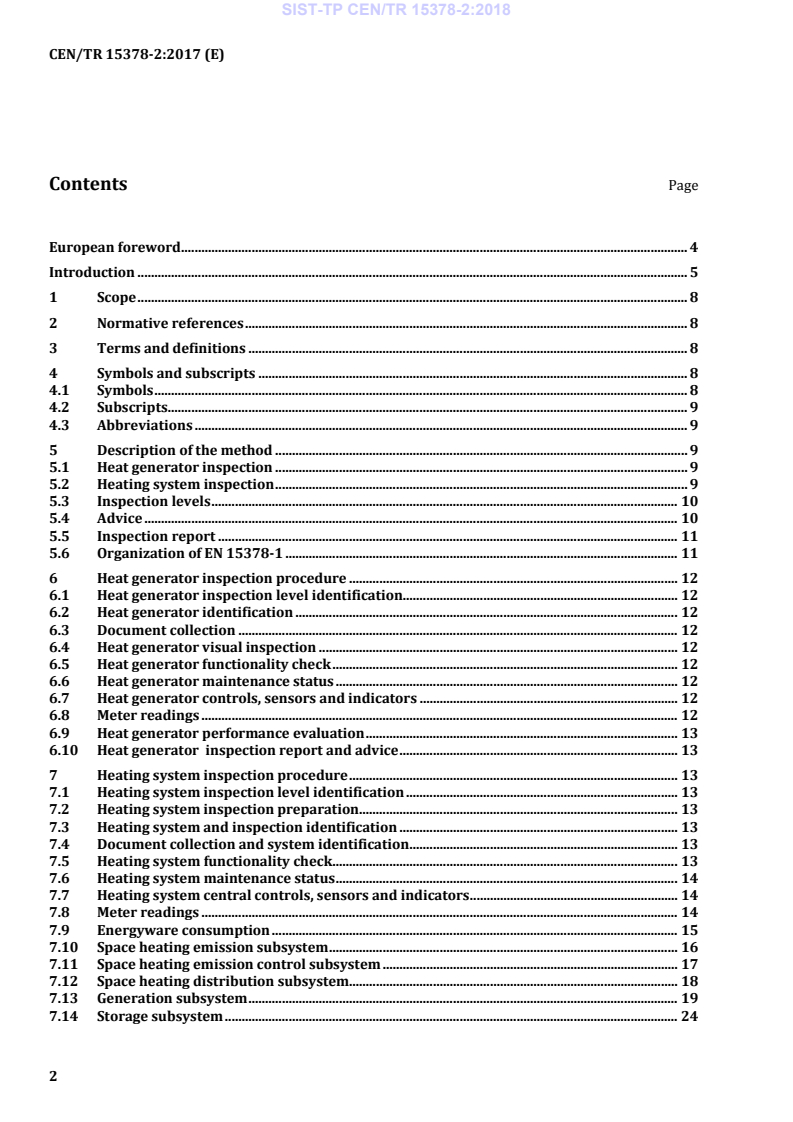
Contents Page
European foreword . 4
Introduction . 5
1 Scope . 8
2 Normative references . 8
3 Terms and definitions . 8
4 Symbols and subscripts . 8
4.1 Symbols . 8
4.2 Subscripts . 9
4.3 Abbreviations . 9
5 Description of the method . 9
5.1 Heat generator inspection . 9
5.2 Heating system inspection . 9
5.3 Inspection levels . 10
5.4 Advice . 10
5.5 Inspection report . 11
5.6 Organization of EN 15378-1 . 11
6 Heat generator inspection procedure . 12
6.1 Heat generator inspection level identification. 12
6.2 Heat generator identification . 12
6.3 Document collection . 12
6.4 Heat generator visual inspection . 12
6.5 Heat generator functionality check . 12
6.6 Heat generator maintenance status . 12
6.7 Heat generator controls, sensors and indicators . 12
6.8 Meter readings . 12
6.9 Heat generator performance evaluation . 13
6.10 Heat generator inspection report and advice . 13
7 Heating system inspection procedure . 13
7.1 Heating system inspection level identification . 13
7.2 Heating system inspection preparation . 13
7.3 Heating system and inspection identification . 13
7.4 Document collection and system identification . 13
7.5 Heating system functionality check . 13
7.6 Heating system maintenance status . 14
7.7 Heating system central controls, sensors and indicators . 14
7.8 Meter readings . 14
7.9 Energyware consumption . 15
7.10 Space heating emission subsystem . 16
7.11 Space heating emission control subsystem . 17
7.12 Space heating distribution subsystem. 18
7.13 Generation subsystem . 19
7.14 Storage subsystem . 24
7.15 Generation subsystem sizing . 24
7.16 Heating system global efficiency or rating . 27
7.17 Domestic hot water systems . 27
7.18 Heating system inspection report and advice . 28
8 Worked out examples . 29
9 Application range . 29
10 Regulation use . 29
11 Information on the accompanying spreadsheet . 29
12 Results of the validation tests . 29
13 Quality issues . 29
13.1 Reproducibility . 29
13.2 Usability . 30
13.3 Software proof . 30
13.4 Time required . 30
Annex A (informative) Template for the definition of inspection levels, choices, input data
and references . 33
Annex B (informative) Default inspection levels definition, choices, input data and
references . 34
B.1 Introduction. 34
B.2 References . 34
B.3 Heat generator inspection levels definition . 34
B.4 Heating system inspection levels definition . 34
B.5 Default application data . 36
Annex C (informative) Sample filled inspection report . 37
C.1 General . 37
C.2 Example of completed level 1 default heating system inspection report . 37
C.3 Example of level 2 default heating system inspection report . 42
Annex D (informative) Inspection flowchart . 49
Annex E (informative) Heizungs-check . 50
Bibliography . 51
European foreword
This document (CEN/TR 15378-2:2017) has been prepared by Technical Committee CEN/TC 228
“Heating systems and water based cooling systems in buildings”, the secretariat of which is held by DIN.
This document has been prepared under a mandate [11] given to CEN by the European Commission and
the European Free Trade Association.
This document is part of the set of standards and accompanying technical reports on the energy
performance of buildings (the set of EPB standards).
Attention is drawn to the possibility that some of the elements of this document may be the subject of
patent rights. CEN [and/or CENELEC] shall not be held responsible for identifying any or all such patent
rights.
Introduction
General
Directive 2010/31/EU recasting the Directive 2002/91/EC on energy performance of buildings (EPBD,
[11]) promotes the improvement of the energy performance of buildings within the European Union,
taking into account all types of energy uses (heating, lighting, cooling, air conditioning, ventilation) and
outdoor climatic and local conditions, as well as indoor climate requirements and cost effectiveness
(Article 1).
The directive requires Member States to adopt measures and tools to achieve the prudent and rational
use of energy resources. In order to achieve those goals, the EPBD requires increasing energy efficiency
and the enhanced use of renewable energies in both new and existing buildings. One tool for this is the
application by Member States of minimum requirements on the energy performance of new buildings
and for existing buildings that are subject to major renovation, as well as for minimum performance
requirements for the building envelope if energy-relevant parts are replaced or retrofitted. Other tools
are energy certification of buildings, inspection of boilers and air-conditioning systems.
The use of European standards increases the accessibility, transparency and objectivity of the energy
performance assessment in the Member States facilitating the comparison of best practices and
supporting the internal market for construction products. The use of EPB-standards for calculating
energy performance, as well as for energy performance certification and the inspection of heating
systems and boilers, ventilation and air-conditioning systems will reduce costs compared to developing
different standards at national level.
The first mandate to CEN to develop a set of CEN EPBD standards (M 343, [8]), to support the first
edition of the EPBD ([9]) resulted in the successful publication of all EPBD related CEN standards in
2007-2008.
The mandate M 480 was issued to review the mandate M 343 as the recast of the EPBD raised the need
to revisit the standards and reformulate and add standards so that they become on the one hand
unambiguous and compatible, and on the other hand a clear and explicit overview of the choices,
boundary conditions and input data that need to be defined at national or regional level. Such national
or regional choices remain necessary, due to differences in climate, culture and building tradition,
policy and legal frameworks. Consequently, the set of CEN-EPBD standards published in 2007-2008 had
to be improved and expanded on the basis of the recast of the EPBD.
The EPB standards are flexible enough to allow for necessary national and regional differentiation and
facilitate Member States implementation and the setting of requirements by the Member States.
In case the EPB standards are used in the context of national or regional legal requirements, mandatory
choices may be given at national or regional level for such specific applications, in particular for the
application within the context of EU Directives transposed into national legal requirements.
Further target groups are users of the voluntary common European Union certification scheme for the
energy performance of non-residential buildings (EPBD art.11.9) and any other regional (e.g. Pan
European) parties wanting to motivate their assumptions by classifying the building energy
performance for a dedicated building stock.
The set of EPB standards, technical reports and supporting tools
In order to facilitate the necessary overall consistency and coherence, in terminology, approach,
input/output relations and formats, for the whole set of EPB-standards, the following documents and
tools are available:
a) a document with basic principles to be followed in drafting EPB-standards: CEN/TS 16628:2014,
Energy Performance of Buildings - Basic Principles for the set of EPB standards [4];
b) a document with detailed technical rules to be followed in drafting EPB-standards;
CEN/TS 16629:2014, Energy Performance of Buildings - Detailed Technical Rules for the set of
EPB-standards [5];
c) the detailed technical rules are the basis for the following tools:
1) a common template for each EPB-standard, including specific drafting instructions for the
relevant clauses;
2) a common template for each technical report that accompanies a EPB standard or a cluster of
EPB standards, including specific drafting instructions for the relevant clauses;
3) a common template for the spreadsheet that accompanies each EPB standard, to demonstrate
the correctness of the EPB calculation procedures.
Each EPB-standards follows the basic principles and the detailed technical rules and relates to the
overarching EPB-standard, EN ISO 52000-1.
One of the main purposes of the revision of the EPB-standards is to enable that laws and regulations
directly refer to the EPB-standards and make compliance with them compulsory. This requires that the
set of EPB-standards consists of a systematic, clear, comprehensive and unambiguous set of energy
performance procedures. The number of options provided is kept as low as possible, taking into
account national and regional differences in climate, culture and building tradition, policy and legal
frameworks (subsidiarity principle). For each option, an informative default option is provided
(Annex B).
Rationale behind the EPB technical reports
There is a high risk that the purpose and limitations of the EPB standards will be misunderstood, unless
the background and context to their contents – and the thinking behind them – is explained in some
detail to readers of the standards. Consequently, various types of informative contents are recorded and
made available for users to properly understand, apply and nationally implement the EPB standards.
If this explanation would have been attempted in the standards themselves, the result is likely to be
confusing and cumbersome, especially if the standards are implemented or referenced in national or
regional building codes.
Therefore each EPB standard is accompanied by an informative technical report, like this one, where all
informative content is collected, to ensure a clear separation between normative and informative
contents (see CEN/TS 16629 [5]):
— to avoid flooding and confusing the actual normative part with informative content;
— to reduce the page count of the actual standard; and
— to facilitate understanding of the set of EPB standards.
This was also one of the main recommendations from the European CENSE project [9] that laid the
foundation for the preparation of the set of EPB standards.
This technical report
This technical report accompanies the standard on the inspection of heating and domestic hot water
systems.
The first part of this technical report, up to Clause 7 and all annexes up to Annex E have the same
numbering as EN 15378-1. Each clause in this FprCEN/TR 15378-2 is related to the same clause in
EN 15378-1.
The role and the positioning of the accompanied standard(s) in the set of EPB standards is defined in
the Introduction to the standard.
Accompanying spreadsheet(s)
Since no calculation method is defined in this inspection standard, no accompanying spreadsheet was
provided.
This Technical Report, includes an examples of compiled inspection report.
History of this technical report and the accompanied standard
The first version of the standard on the inspection of boilers and heating system was issued in 2008 as
part of the Mandate 343 of the EC to CEN to support the EPBD (2003).
The standard has been completely redrafted as part of Mandate 480 of the EC to CEN.
References in the text of the standard are given as module codes that are detailed in the annex. This
enables flexible references (e.g. to national documents where necessary for local application) and use
outside the CEN environment.
1 Scope
This technical report refers to EN 15378-1.
It contains information to support the correct understanding, use and national adaptation of
EN 15378-1.
2 Normative references
The following documents, in whole or in part, are normatively referenced in this document and are
indispensable for its application. For dated references, only the edition cited applies. For undated
references, the latest edition of the referenced document (including any amendments) applies.
EN ISO 52000-1:2017, Energy performance of buildings - Overarching EPB assessment - Part 1: General
framework and procedures (ISO 52000-1:2017)
EN 15378-1:2017, Energy performance of buildings — Heating systems and DHW in buildings — Part 1:
Inspection of boilers, heating systems and DHW, Module M3-11, M8-11
EN ISO 7345:1995, Thermal insulation - Physical quantities and definitions (ISO 7345:1987)
3 Terms and definitions
For the purposes of this document, the terms and definitions given in EN ISO 7345:1995,
EN ISO 52000-1:2017 and EN 15378-1:2017 apply.
NOTE There are no new terms in this Technical Report.
Most terms used in EN 15378-1, such as:
— space heating
— gross and net calorific value
— external temperature
— energy carrier
— delivered energy
and others are already given in EN ISO 52000-1:2017 and are not repeated.
The following definition is repeated for readability.
3.1
EPB standard
standard that complies with the requirements given in EN ISO 52000-1:2017, CEN/TS 16628 and
CEN/TS 16629
4 Symbols and subscripts
4.1 Symbols
For the purposes of this document, the symbols given in EN ISO 52000-1:2017, in EN 15378-1:2017,
Heating systems and water based cooling systems in buildings — Heating systems and DHW in buildings
— Part 1: Inspection of boilers, heating systems and DHW (the accompanied EPB standard) apply.
NOTE There are no new symbols in this technical report.
Symbols that are already defined in EN ISO 52000-1:2017, Clause 4 and Annex C, are not be repeated in each EPB
standard.
4.2 Subscripts
For the purposes of this document, the subscripts given in EN ISO 52000-1:2017, in EN 15378-1:2017,
Heating systems and water based cooling systems in buildings — Heating systems and DHW in buildings
— Part 1: Inspection of boilers, heating systems and DHW (the accompanied EPB standard) apply .
NOTE There are no new subscripts in this technical report.
Subscripts that are already defined in EN ISO 52000-1:2017, Clause 4 and Annex C, are not be repeated in each
EPB standard.
4.3 Abbreviations
4.3.1
EPBD
EPBD, Directive 2002/91/EC of the European Parliament and of the Council of 16 December 2002 on
the energy performance of buildings and Recast of the Directive on the energy performance of buildings
(2010/31/EU) of 14th December 2010
4.3.2
EPC
energy performance certificate
5 Description of the method
5.1 Heat generator inspection
The plain heat generator inspection, as described in Clause 6 and introduced in 5.1 of
EN 15378-1:2017, is not enough to comply with requirements of Directive 2010-31-EU “EPBD recast”.
In the previous version of EN 15378, it was intended to support “boiler inspection” that was a different
item than “heating system” inspection.
These clauses have been kept indeed for the following reasons:
— consistency with the previous standard;
— many EU member states already adopted inspection schemes limited to the boiler.
These schemes are often used in conjunction with compulsory periodic maintenance of the heat
generator which are not required by EPBD.
5.2 Heating system inspection
The inspection procedure described in Clause 7 and introduced in 5.2 is intended to support the heating
system inspection required by EPBD recast.
The normative text highlights a defined inspection procedure, specifying which aspects could be
inspected. However, many inspection items may be optionally included/excluded depending on the
inspection level.
— Annex A gives a template to specify choices.
— Annex B gives a default set of choices.
— Annex C gives the practical translation of the defined procedure into a checklist that can be also
used as a basis for the inspection report.
The definition of the procedure is organized in the following way to balance two opposite requirements:
— several Member States want to keep the possibility to modify the requirements for inspection;
— other Member States want to have a ready to use inspection procedure.
5.3 Inspection levels
Inspection levels have been introduced to guarantee adequate flexibility in the application of this
standard.
The default inspection levels and the corresponding required sections specified in Annex B to
EN 15378-1:2017, were determined taking into account the minimum requirements stated by article 14
of Directive 2010/31/EU of the European Parliament and of the council of 19 May 2010 on the energy
performance of buildings (recast) that is “a regular inspection of the accessible parts of systems used for
heating buildings, such as the heat generator, control system and circulation pump(s), with boilers of an
effective rated output for space heating purposes of more than 20 kW”.
The default inspection levels are defined in EN 15378-1:2017, Table B.2.
The list of parameters given under 5.3 is not a list of parameters that shall be taken into account. It is a
reminder of the possible criteria that can be used to specify custom inspection levels using
EN 15378-1:2017, Tables A.1 and B.1.
5.4 Advice
A distinction has been made between three levels of advice:
— recommendations of cost effective immediate actions (e.g. actions that will pay-back in a
reasonably short time which is significantly shorter that the expected lifetime of the installed
appliances and products);
— recommendation of actions to be performed in case of major renovation or replacement of
components due to aging or breakdown (e.g. action whose total cost would make them not cost
effective but that are indeed cost effective in the context of unavoidable equipment replacements);
— notes, including any other advice.
This classification is required because cost-effective immediate actions are not so frequent and
dependent on climatic conditions and building and/or system size.
EXAMPLE In the Mediterranean climate, it is not obvious to find cost-effective immediate actions on
individual heating systems.
A larger category of cost effective recommendations relates on possible improvements in case of
replacement of appliances, because of ageing or break-down. An example is a boiler in an individual
house. The immediate replacement is seldom convenient in the milder climates. In case of replacement,
the adoption of the best available technology (instead of installing again a simpler, less performant
technology) is very likely to be cost effective because only the cost difference between poor
performance and optimal performance appliances shall be recovered. It is very important that the
information on the possibility to select high performance appliances when replacing old ones is given to
the user otherwise, if a low performance appliance is installed again it will take many years before the
next opportunity of improvement occurs.
The “notes” category shall be used for remarks about:
— low or no-cost measures;
— use and maintenance recommendations.
that may be noted during inspection.
5.5 Inspection report
The inspection report is the fundamental communication tool with the user.
The information in the report should trigger actions by the user. Therefore the important part of the
message is presented on the first page.
The inspection report is intended also as a checklist to guide inspection and should be designed
together with the list of inspection items to be recorded. This will facilitate creation of an electronic
archive of reports.
See also the discussion on templates at Annex A.
The requirements to archive the inspection results and have them available for the next inspection is
very important. The inspection process defined by EPBD is not a “one shot”, it is a repetitive task. It is
therefore essential for the inspection process that the report and the information collected during the
inspection is archived and made available for the next inspection. How this is done and who is
responsible for it cannot be specified by this standard. However availability of previous reports allows:
— easier and faster inspection;
— to check if previous recommendations were followed and implemented;
— to compare readings of counters (if noted!) and get useful information about system operation.
Therefore this is considered an essential requirement for the inspection process. The decision on who
has to archive and keep the information (e.g. end user, official inspection database, etc.) is left to the
actual implementation process in each country.
5.6 Organization of EN 15378-1
The intended role of the parts of EN 15378-1 are the following:
— the normative text of Clause 7 defines the inspection procedure, specifying which aspects could be
inspected for each subsystem. However, many inspection items may be optionally
included/excluded depending on the desired inspection accuracy and effort.
— Annex A gives a template to specify choices about which inspection item shall be included or
excluded according to the inspection level;
— Annex B gives a default set of choices in connection with two predefined inspection levels;
— Annex C gives the practical translation of the default inspection levels into a checklist that can be
also used as a basis for the inspection report. There is one example for each defined inspection level
given in Annex B.
6 Heat generator inspection procedure
6.1 Heat generator inspection level identification
The first step is determining the inspection level because actual requirements for the individual
inspection are depending on it.
No detailed information is given for this level because heat generator inspection is not enough to
comply with EPBD directive. See Clause 7.
6.2 Heat generator identification
This should include the necessary data that allows to identify the generator under inspection. In many
countries there are systematic databases of existing installations with established unique coding.
6.3 Document collection
This section can be useful if there are regulations that ask for a documented maintenance of heating
systems.
6.4 Heat generator visual inspection
It is normal practice that the inspection starts with a visual inspection looking for evidence of potential
risk situations.
Visual inspection do not require mechanical actions on the system such as disassembling and
reassembling components and installation parts.
6.5 Heat generator functionality check
This check points to the evidence that the generator is really used for heating and domestic hot water
purpose and is supplying the intended services.
Evidence can be supplied by users, though this information may be inaccurate or biased. Operation and
maintenance personnel is another possible source of information.
Another technique is comparing the set-point with the actual values. But this is possible and useful only
if the system is in operation at a medium to high load.
6.6 Heat generator maintenance status
See information on 7.6.
6.7 Heat generator controls, sensors and indicators
See information on 7.7.
6.8 Meter readings
This is a potential source of simple and useful information.
EXAMPLE in case of periodic inspections, the difference in readings provide an indication about the system
operation between inspections.
The usefulness of this requirement depends on archiving the results and making historical readings
available. That's why it is asked that inspection results are archived. See also 5.5.
The list of possible meters from a) to h) is not a list of all meters that shall be read but a reminder of
which type of meters may be included in the inspection level specification.
6.9 Heat generator performance evaluation
This clause specifies a number of properties that may be inspected to estimate the boiler performance.
Most of the data for the estimation of the boiler seasonal efficiency can be obtained from tables.
Some items are relevant only for some types of heat generators (like combustion efficiency for boilers).
6.10 Heat generator inspection report and advice
The rationale is to have on the first page the main message to the reader. If the useful information
comes after several pages of non-interesting data, there is a high risk that the main message of the
inspection report is not read. See also 5.4.
7 Heating system inspection procedure
7.1 Heating system inspection level identification
The first step is determining the inspection level because actual requirements for the individual
inspection are depending on it.
The required inspection level shall depend on objective properties of the installation. A list of possible
such properties is given in EN 15378-1:2017, 5.3.
7.2 Heating system inspection preparation
This procedure assumes that there is a communication between the inspector and the responsible
person of the inspected system before the inspection. This has to happen at least to agree and organize
access on site. At that time it can be asked to gather useful documents or documents that have to be
available on site. Asking for documents when on site is too late and would cause unnecessary delays.
7.3 Heating system and inspection identification
This should include the data required to identify the heating systems under inspection.
In many countries there are databases of existing installations with established coding.
Which services are provided by the system, together with other information, is an essential information
e.g. for generator sizing.
7.4 Document collection and system identification
This clause doesn't actually require that any document is available.
If such documents as a functional diagram are available on site this helps, provided they are checked
against the real installation.
What is important is that the inspector understands the listed aspects (e.g. how is the system designed
to operate and how it operates really).
7.5 Heating system functionality check
This point aims to identify if the heating system is really used for heating and/or domestic hot water
purpose and is supplying the intended services.
Examples of malfunctioning and modified intended use:
— thermal solar system is not operating, only back-up heater is working
— system was designed for a block building but only few building units are still connected; individual
systems have been installed in the other building units.
Evidence can be supplied by users, though this information may be inaccurate or biased, so it has to be
checked. Operation and maintenance personnel is another possible source of information.
Some malfunctioning may be not possible to detect, just because the system is not operating. That's why
it is asked to report only “what is detected”.
7.6 Heating system maintenance status
Regulations may require that a periodic maintenance is performed and written records are kept on site
(“legal or statutory requirements”). If so:
— inspection may include a check of compliance with regulations on maintenance;
— inspection may take into account maintenance record and data.
EXAMPLE Italy requires that each installation has a standardized log-book where installation data,
maintenance results, efficiency assessments and results of inspection by public authorities are recorded.
7.7 Heating system central controls, sensors and indicators
Central control of the heating system means any control in the boiler room such as:
— flow temperature control;
— timing control;
— boiler sequence control.
Local indoor temperature controls are considered in 7.11.
Better controls setting may be an inexpensive energy efficiency measure. This includes both
temperature levels and timing controls.
Wrong control and inefficient operation may be caused by defective or badly installed sensors.
7.8 Meter readings
This is a potential source of simple and useful information.
EXAMPLE in case of periodic inspections, the difference in readings provide an indication about the system
operation and energy use between inspections.
The usefulness of this requirement depends on archiving the results and making historical readings
available. That's why it is asked that inspection results are archived. See 5.5.
Fuel meter gives obviously the most relevant information about energy consumption.
The domestic hot water meter tells the domestic hot water load and may detect leaks.
The feed water meter may reveal leaks of technical water. A leak of technical water causes a higher
energy use and also installation damage.
High count of on-off cycle counters reveal wrong setting or wrong design of generator control. Very
frequent start/stop cycles may cause significant energy losses because of frequent purging.
7.9 Energyware consumption
7.9.1 General
This aspect of the inspection is not mentioned directly by EPBD, therefore it is optional.
It is considered to be very important indeed because it is an indicator:
— of the potential savings;
— high energy use means that it is likely to find energy conservation measures;
— low energy use means that the building and systems are performing well or that the building is
partly used and/or occupied. There is little chance to find cost effective energy conservation
measures.
— of the required sizing of the boiler: given the building category and insulation level there is a
correlation between average power (heating needs) and required peak power (heat load and
required sizing).
7.9.2 Energyware consumption estimation
There are several possible estimation methods. it is difficult to find a simple method can fit all cases that
can be found in practice for a number of reasons:
— possibly even no metering and bill (wood);
— other services included in metering;
— no actual reading available.
Best compromise depends on the national context (example: type of fuel, from gas to wood). Some are
mentioned.
The sum of the fuel bills may not cover an exact year and it often includes other uses like cooking for
gas.
The energyware used since previous inspection is readily available for metered energyware but is
seasonal.
Methods specified in M3-10 are better defined and include techniques to separate other uses but are
time consuming.
Other relevant procedures may be the better choice to take into account national context and expected
effort for inspection.
This can be improved by smart metering programs and other dedicated provisions to allow easy
monitoring of energy use.
7.9.3 Reference values
No additional information.
See B.5 for information on suggested values
7.9.4 Advice criteria on energyware consumption
Advice should take into account that possible reasons for deviations in energy consumption might be:
— use of the building (occupancy);
— users behaviour;
— wrong room ventilation rates;
— high building envelope losses (missing or degraded insulation layer);
— actual climatic conditions, including degree days and solar radiation;
— heating system inefficiencies (e.g. poor balancing, poor insulation of distribution network,
extension of distribution network outside the heated space);
— oversizing of heat generators;
— wrong settings of heating system controls;
— losses of heating medium from concealed piping;
— losses of fuel.
To ease tracking of energyware consumption, the following actions should be recommended:
— collecting data on fuel supply and periodic reading of available meters and fuel level in tanks;
— collecting, measuring or finding an appropriate source of actual climatic data;
EXAMPLE Data of public air quality monitoring systems are often accessible and include external
temperature
— if missing, installing a counter for total domestic hot water supplied;
— if missing, installing an hour counter in parallel with burner fuel valve(s);
— if missing, installing independent electrical energy meters for high consuming appliances (example:
heat pump, oil heaters, distribution pumps, boiler room, etc.).
7.10 Space heating emission subsystem
7.10.1 General criteria
The type of emitters has an impact on potential efficiency of the heat generator (example: heat pumps
need emitters with a low flow temperature). The type of emitters and their possible control options
(including the type of hydraulic connection) shall be known to give correct recommendations on heat
generator replacement.
7.10.2 Stratification in high ceiling rooms
Stratification in high ceiling rooms (more than 4 m) can be estimated by measur
...