


SIST EN 60684-3-340 to 342:2004
(Main)Flexible insulating sleeving -- Part 3: Specifications for individual types of sleeving -- Sheets 340 to 342: Expandable braided polyethylene terephthalate textile sleeving
Flexible insulating sleeving -- Part 3: Specifications for individual types of sleeving -- Sheets 340 to 342: Expandable braided polyethylene terephthalate textile sleeving
Gives the requirements for sleeving having the property of expanding its internal diameter when compressed longitudinally and thereafter returning to its initial diameter after release of the compressing force. It is constructed of polyethylene terephthalate monofilament yarns suitably processed to provide the mechanical ability to conform in the manner described above. These sleevings have been found suitable for use at temperatures up to 130 °C.
Because of its open construction, this sleeving is normally used to provide air-space insulation. Therefore, no requirement for breakdown voltage is specified in this standard. (Any value for this property should be given in the purchase contract, but a typical value is 1,5 kV/mm wall thickness, although a linear relationship cannot be assumed.) However, it serves to provide mechanical protection to circuit components such as wires, sleeves, and flat cable over which it is applied as a containing wrap or harness.
Materials which conform to this specification meet established levels of performance. However, the selection of a material by a user for a specific application should be based on the actual requirements necessary for adequate performance in that application and not based on this specification alone.
This second edition has been aligned to reflect the changes made to the 2nd edition of IEC 60684-2, Test methods, and provides a more comprehensive list of resistance to test fluids.
Isolierschläuche -- Teil 3: Bestimmungen für einzelne Schlauchtypen -- Blätter 340 bis 342: Aufweitbare, geflochtene Polyethylenterephthalat-Textilschläuche
Gaines isolantes souples -- Partie 3: Spécifications pour types particuliers de gaines -- Feuilles 340 à 342: Gaines expansibles tressées de téréphtalate de polyéthylène
Donne les prescriptions relatives aux gaines ayant comme propriété d'agrandir leur diamètre intérieur quand elles sont compressées longitudi-nalement, pour revenir ensuite à leur diamètre initial après suppression de la force de compression. Elles sont faites de fibres monofilamentaires de téréphtalate de polyéthylène traitées de manière à assurer les aptitudes mécaniques au comportement exposées ci-dessus. Ces gaines ont été considérées comme adaptées à des températures allant jusqu'à 130 °C.
Du fait de leur constitution aérée, ces gaines sont normalement utilisées pour assurer une isolation par épaisseur d'air. Par suite, cette norme ne spécifie pas d'exigence pour la tension de claquage. (Il convient que toute valeur intéressant cette propriété soit indiquée dans le contrat d'achat, la valeur type étant de 1,5 kV/mm d'épaisseur de paroi, bien qu'un rapport linéaire ne puisse être assuré). Toutefois, ces gaines servent à procurer une protection mécanique à des composants de circuits, comme les conducteurs, les gaines et les câbles en nappe autour desquels ces gaines sont montées comme un enveloppement ou filet de maintien.
Les matériaux conformes à cette norme satisfont aux niveaux de performance établis. Cependant, il convient que la sélection d'un matériau par un utilisateur pour une application particulière soit basée sur les caractéristiques réelles nécessaires pour atteindre les performances appropriées dans cette application et pas uniquement basée sur la présente norme.
Cette deuxième édition a été alignée afin de tenir compte des changements effectués dans la deuxième édition de la CEI 60684-2, Méthode d'essai, et fournit une liste plus complète de résistance aux fluides d'essai.
Gibke izolacijske cevi - 3. del: Specifikacije za posamezne tipe cevi - Listi od 340 do 342: Razširljive pletene polietilen-tereftalat tekstilne cevi (IEC 60684-3-340 to 342:2003)
General Information
- Status
- Published
- Publication Date
- 31-Aug-2004
- Technical Committee
- IZO - Insulating materials
- Current Stage
- 6060 - National Implementation/Publication (Adopted Project)
- Start Date
- 01-Sep-2004
- Due Date
- 01-Sep-2004
- Completion Date
- 01-Sep-2004
Relations
- Effective Date
- 06-May-2014
Overview
SIST EN 60684-3-340 to 342:2004 is a European standard developed by CLC that specifies requirements for expandable braided polyethylene terephthalate (PET) textile sleeving used as flexible insulating sleeving. This standard covers sleeving types 340 to 342 which can expand their internal diameter upon longitudinal compression and return to their original size once the compressive force is released. The sleeving is constructed from PET monofilament yarns, designed for mechanical flexibility and protection in electrical applications, with suitability for continuous use at temperatures up to 130 °C.
This standard focuses specifically on sleeving variants with thin, medium, and thick wall thicknesses, typically supplied in a variety of colors and internal diameters ranging from 6 mm to 63 mm. Primarily, this sleeving provides mechanical protection and air-space insulation but does not specify requirements for electrical breakdown voltage due to its open construction.
Key Topics
Material and Construction: The sleeving is made from polyethylene terephthalate monofilament yarns, braided to allow expansion and contraction of internal diameter under mechanical stress.
Mechanical Properties:
- Ability to expand internally when compressed longitudinally.
- Return to initial internal diameter after decompression.
- Tensile strength varies by wall thickness and sleeving size, with values detailed in the standard.
- Mechanical protection for wires, cables, and circuit components.
Thermal Performance: Rated for use at temperatures up to 130 °C.
Dimensional Specifications:
- Internal diameters between 6 mm and 63 mm.
- Wall thicknesses specified as thin (≥ 0.30 mm), medium (≥ 0.50 mm), and thick (≥ 0.75 mm).
- Measurement procedures to ensure precise dimensional control per IEC 60684-2.
Resistance to Fluids: Defines minimum retention of mechanical properties after immersion in common fuels, hydraulic fluids, oils, and de-icing fluids, tested per ISO 1817 and other referenced methods.
Color Coding: Sleeving is available in multiple colors including black, white, brown, red, orange, yellow, green, blue, grey, and natural, following IEC 60757 color designation codes where applicable.
Test Methods and Compliance: Incorporates test methods and requirements from IEC 60684-1 and IEC 60684-2 for definitions, general requirements, and testing. The standard mandates conformance primarily based on the 32 mm sleeving size.
Applications
Expandable braided PET textile sleeving as defined in EN 60684-3-340 to 342 is extensively used in electrical, electronic, and mechanical industries for:
Cable and Wire Protection: Acting as protective harnessing wraps around wires and flat cables to guard against abrasion, mechanical damage, and stress.
Air-Space Insulation: Its open braided construction provides insulation through an air layer rather than solid dielectric resistance, suitable for components where electrical insulation is achieved by air gaps.
High-Temperature Environments: Suitable for applications requiring flexible sleeving able to withstand temperatures up to 130 °C, such as automotive, aerospace, and industrial machinery.
Chemical Resistance Contexts: Ideal for environments requiring resistance to petroleum-based fuels, oils, hydraulic fluids, and common cleaning solvents, aiding durability in challenging operational settings.
Color-Coded Wiring Systems: The variety of colors facilitates identification and organization of wiring and cables in complex installations.
Related Standards
- IEC 60684-1: Specifies definitions and general requirements for flexible insulating sleeving.
- IEC 60684-2: Provides methods of testing flexible insulating sleeving, including measurement techniques applicable to the dimensional and mechanical property testing of PET sleeving.
- IEC 60757: Code for designation of colors, ensuring consistent color coding for sleeving products.
- ISO 846: Covers testing the effect of microorganisms on plastics used in sleeving material.
- ISO 1817: Describes procedures for determining the effects of liquids on rubber, relevant for testing chemical resistance of sleeving materials.
Practical Value
Adhering to SIST EN 60684-3-340 to 342:2004 ensures that expandable braided PET textile sleeving manufactured or procured meets internationally recognized standards for mechanical flexibility, dimensional accuracy, chemical resistance, and thermal endurance. Selecting sleeving compliant with this standard improves product quality, reliability, and safety in applications where protectively harnessing cables and wires is critical.
For users and specifiers, this standard provides detailed performance criteria enabling informed material selection that matches the mechanical, thermal, and environmental requirements of specific applications, beyond relying solely on the standard’s baseline specifications.
Keywords: EN 60684-3-340 to 342, flexible insulating sleeving, expandable braided sleeving, polyethylene terephthalate sleeving, PET textile sleeving, mechanical protection sleeving, high-temperature sleeving, electrical cable protection, chemical resistance sleeving, cable harness sleeving standards.

Frequently Asked Questions
SIST EN 60684-3-340 to 342:2004 is a standard published by the Slovenian Institute for Standardization (SIST). Its full title is "Flexible insulating sleeving -- Part 3: Specifications for individual types of sleeving -- Sheets 340 to 342: Expandable braided polyethylene terephthalate textile sleeving". This standard covers: Gives the requirements for sleeving having the property of expanding its internal diameter when compressed longitudinally and thereafter returning to its initial diameter after release of the compressing force. It is constructed of polyethylene terephthalate monofilament yarns suitably processed to provide the mechanical ability to conform in the manner described above. These sleevings have been found suitable for use at temperatures up to 130 °C. Because of its open construction, this sleeving is normally used to provide air-space insulation. Therefore, no requirement for breakdown voltage is specified in this standard. (Any value for this property should be given in the purchase contract, but a typical value is 1,5 kV/mm wall thickness, although a linear relationship cannot be assumed.) However, it serves to provide mechanical protection to circuit components such as wires, sleeves, and flat cable over which it is applied as a containing wrap or harness. Materials which conform to this specification meet established levels of performance. However, the selection of a material by a user for a specific application should be based on the actual requirements necessary for adequate performance in that application and not based on this specification alone. This second edition has been aligned to reflect the changes made to the 2nd edition of IEC 60684-2, Test methods, and provides a more comprehensive list of resistance to test fluids.
Gives the requirements for sleeving having the property of expanding its internal diameter when compressed longitudinally and thereafter returning to its initial diameter after release of the compressing force. It is constructed of polyethylene terephthalate monofilament yarns suitably processed to provide the mechanical ability to conform in the manner described above. These sleevings have been found suitable for use at temperatures up to 130 °C. Because of its open construction, this sleeving is normally used to provide air-space insulation. Therefore, no requirement for breakdown voltage is specified in this standard. (Any value for this property should be given in the purchase contract, but a typical value is 1,5 kV/mm wall thickness, although a linear relationship cannot be assumed.) However, it serves to provide mechanical protection to circuit components such as wires, sleeves, and flat cable over which it is applied as a containing wrap or harness. Materials which conform to this specification meet established levels of performance. However, the selection of a material by a user for a specific application should be based on the actual requirements necessary for adequate performance in that application and not based on this specification alone. This second edition has been aligned to reflect the changes made to the 2nd edition of IEC 60684-2, Test methods, and provides a more comprehensive list of resistance to test fluids.
SIST EN 60684-3-340 to 342:2004 is classified under the following ICS (International Classification for Standards) categories: 29.035.20 - Plastics and rubber insulating materials. The ICS classification helps identify the subject area and facilitates finding related standards.
SIST EN 60684-3-340 to 342:2004 has the following relationships with other standards: It is inter standard links to SIST EN 60684-3-340 to 342:1998. Understanding these relationships helps ensure you are using the most current and applicable version of the standard.
SIST EN 60684-3-340 to 342:2004 is available in PDF format for immediate download after purchase. The document can be added to your cart and obtained through the secure checkout process. Digital delivery ensures instant access to the complete standard document.
Standards Content (Sample)
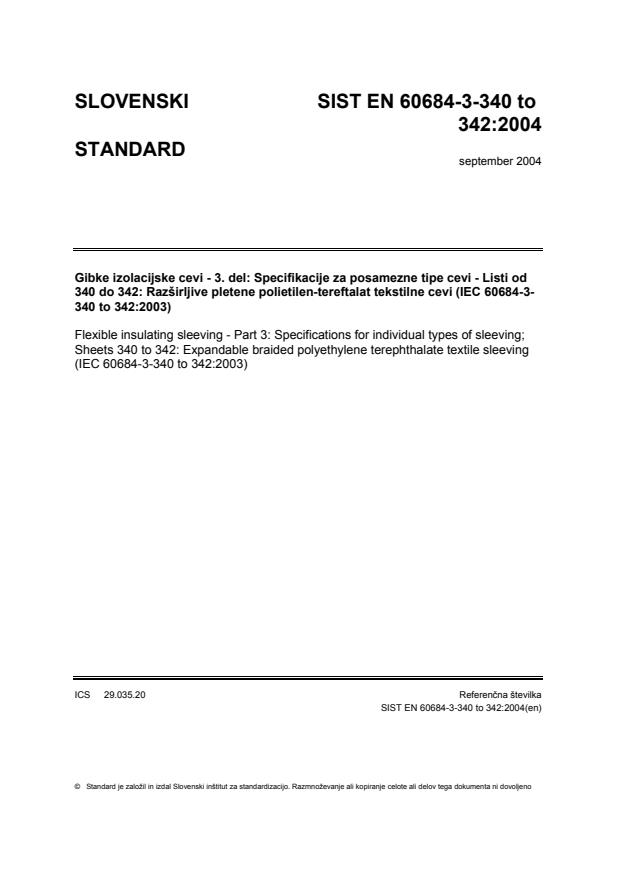
SLOVENSKI SIST EN 60684-3-340 to
342:2004
STANDARD
september 2004
Gibke izolacijske cevi - 3. del: Specifikacije za posamezne tipe cevi - Listi od
340 do 342: Razširljive pletene polietilen-tereftalat tekstilne cevi (IEC 60684-3-
340 to 342:2003)
Flexible insulating sleeving - Part 3: Specifications for individual types of sleeving;
Sheets 340 to 342: Expandable braided polyethylene terephthalate textile sleeving
(IEC 60684-3-340 to 342:2003)
ICS 29.035.20 Referenčna številka
© Standard je založil in izdal Slovenski inštitut za standardizacijo. Razmnoževanje ali kopiranje celote ali delov tega dokumenta ni dovoljeno
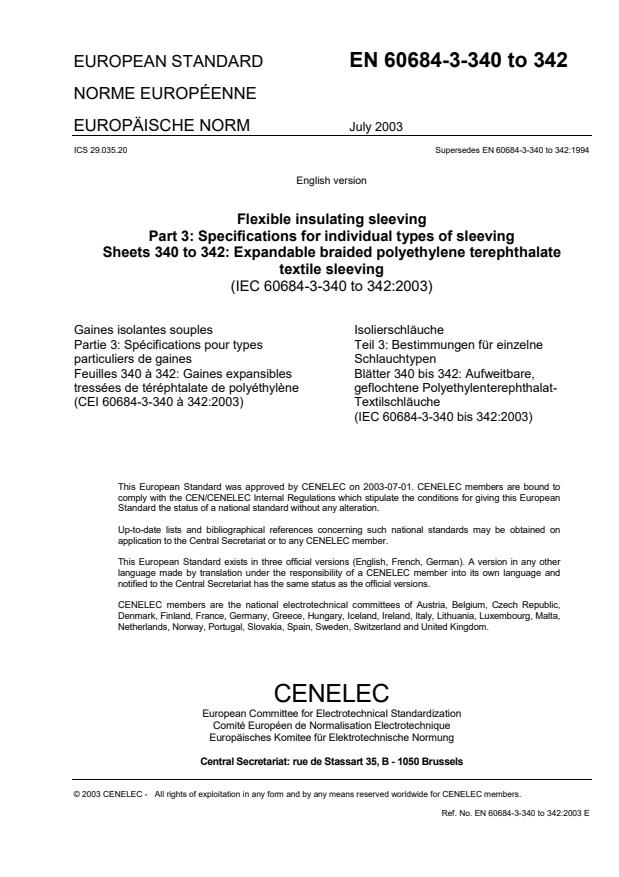
EUROPEAN STANDARD EN 60684-3-340 to 342
NORME EUROPÉENNE
EUROPÄISCHE NORM July 2003
ICS 29.035.20 Supersedes EN 60684-3-340 to 342:1994
English version
Flexible insulating sleeving
Part 3: Specifications for individual types of sleeving
Sheets 340 to 342: Expandable braided polyethylene terephthalate
textile sleeving
(IEC 60684-3-340 to 342:2003)
Gaines isolantes souples Isolierschläuche
Partie 3: Spécifications pour types Teil 3: Bestimmungen für einzelne
particuliers de gaines Schlauchtypen
Feuilles 340 à 342: Gaines expansibles Blätter 340 bis 342: Aufweitbare,
tressées de téréphtalate de polyéthylène geflochtene Polyethylenterephthalat-
(CEI 60684-3-340 à 342:2003) Textilschläuche
(IEC 60684-3-340 bis 342:2003)
This European Standard was approved by CENELEC on 2003-07-01. CENELEC members are bound to
comply with the CEN/CENELEC Internal Regulations which stipulate the conditions for giving this European
Standard the status of a national standard without any alteration.
Up-to-date lists and bibliographical references concerning such national standards may be obtained on
application to the Central Secretariat or to any CENELEC member.
This European Standard exists in three official versions (English, French, German). A version in any other
language made by translation under the responsibility of a CENELEC member into its own language and
notified to the Central Secretariat has the same status as the official versions.
CENELEC members are the national electrotechnical committees of Austria, Belgium, Czech Republic,
Denmark, Finland, France, Germany, Greece, Hungary, Iceland, Ireland, Italy, Lithuania, Luxembourg, Malta,
Netherlands, Norway, Portugal, Slovakia, Spain, Sweden, Switzerland and United Kingdom.
CENELEC
European Committee for Electrotechnical Standardization
Comité Européen de Normalisation Electrotechnique
Europäisches Komitee für Elektrotechnische Normung
Central Secretariat: rue de Stassart 35, B - 1050 Brussels
© 2003 CENELEC - All rights of exploitation in any form and by any means reserved worldwide for CENELEC members.
Ref. No. EN 60684-3-340 to 342:2003 E
Foreword
The text of document 15C/1466/FDIS, future edition 2 of IEC 60684-3-340 to 342, prepared by
SC 15C, Specifications, of IEC TC 15, Insulating materials, was submitted to the IEC-CENELEC
parallel vote and was approved by CENELEC as EN 60684-3-340 to 342 on 2003-07-01.
This European Standard supersedes EN 60684-3-340 to 342:1994.
The following dates were fixed:
– latest date by which the EN has to be implemented
at national level by publication of an identical
national standard or by endorsement (dop) 2004-04-01
– latest date by which the national standards conflicting
with the EN have to be withdrawn (dow) 2006-07-01
Annexes designated "normative" are part of the body of the standard.
In this standard, annex ZA is normative.
Annex ZA has been added by CENELEC.
__________
Endorsement notice
The text of the International Standard IEC 60684-3-340 to 342:2003 was approved by CENELEC as a
European Standard without any modification.
__________
- 3 - EN 60684-3-340 to 342:2003
Annex ZA
(normative)
Normative references to international publications
with their corresponding European publications
This European Standard incorporates by dated or undated reference, provisions from other
publications. These normative references are cited at the appropriate places in the text and the
publications are listed hereafter. For dated references, subsequent amendments to or revisions of any
of these publications apply to this European Standard only when incorporated in it by amendment or
revision. For undated references the latest edition of the publication referred to applies (including
amendments).
NOTE When an international publication has been modified by common modifications, indicated by (mod), the relevant
EN/HD applies.
Publication Year Title EN/HD Year
1)
IEC 60684-1 1980 Specification for flexible insulating EN 60684-1
sleeving
Part 1: Definitions and general
requirements
IEC 60684-2 1997 Flexible insulating sleeving EN 60684-2 1997
Part 2: Methods of test
IEC 60757 1983 Code for designation of colours HD 457 S1 1985
ISO 846 1997 Plastics - Evaluation of the action of EN ISO 846 1997
microorganisms
ISO 1817 1999 Rubber, vulcanized - Determination of - -
the effect of liquids
1)
EN 60684-1:1995 is superseded by EN 60684-1:2003, which is based on IEC 60684-1:2003.
NORME CEI
INTERNATIONALE IEC
60684-3-340
INTERNATIONAL
à/to 342
STANDARD
Deuxième édition
Second edition
2003-04
Gaines isolantes souples –
Partie 3:
Spécifications pour types particuliers de gaines –
Feuilles 340 à 342:
Gaines expansibles tressées de téréphtalate
de polyéthylène
Flexible insulating sleeving –
Part 3:
Specifications for individual types of sleeving –
Sheets 340 to 342:
Expandable braided polyethylene
terephthalate textile sleeving
IEC 2003 Droits de reproduction réservés Copyright - all rights reserved
Aucune partie de cette publication ne peut être reproduite ni No part of this publication may be reproduced or utilized in any
utilisée sous quelque forme que ce soit et par aucun procédé, form or by any means, electronic or mechanical, including
électronique ou mécanique, y compris la photocopie et les photocopying and microfilm, without permission in writing from
microfilms, sans l'accord écrit de l'éditeur. the publisher.
International Electrotechnical Commission, 3, rue de Varembé, PO Box 131, CH-1211 Geneva 20, Switzerland
Telephone: +41 22 919 02 11 Telefax: +41 22 919 03 00 E-mail: inmail@iec.ch Web: www.iec.ch
CODE PRIX
J
Commission Electrotechnique Internationale PRICE CODE
International Electrotechnical Commission
Международная Электротехническая Комиссия
Pour prix, voir catalogue en vigueur
For price, see current catalogue
60684-3-340 to 342 IEC:2003 – 3 –
CONTENTS
FOREWORD . 5
INTRODUCTION .7
1 Scope . 9
2 Normative references. 9
3 Designation.11
4 Requirements .11
4.1 Standard requirements.11
4.2 Special requirements .11
5 Product conformance .11
Table 1 – Dimensional requirements.13
Table 2 – Standard requirements.15
Table 3 – Requirements for tensile strength.15
Table 4 – Resistance to selected fluids .17
Table 5 – Special requirements .17
60684-3-340 to 342 IEC:2003 – 5 –
INTERNATIONAL ELECTROTECHNICAL COMMISSION
___________
FLEXIBLE INSULATING SLEEVING –
Part 3: Specifications for individual types of sleeving –
Sheets 340 to 342: Expandable braided polyethylene
terephthalate textile sleeving
FOREWORD
1) The IEC (International Electrotechnical Commission) is a worldwide organization for standardization comprising
all national electrotechnical committees (IEC National Committees). The object of the IEC is to promote
international co-operation on all questions concerning standardization in the electrical and electronic fields. To
this end and in addition to other activities, the IEC publishes International Standards. Their preparation is
entrusted to technical committees; any IEC National Committee interested in the subject dealt with may
participate in this preparatory work. International, governmental and non-governmental organizations liaising
with the IEC also participate in this preparation. The IEC collaborates closely with the International Organization
for Standardization (ISO) in accordance with conditions determined by agreement between the two
organizations.
2) The formal decisions or agreements of the IEC on technical
...
Questions, Comments and Discussion
Ask us and Technical Secretary will try to provide an answer. You can facilitate discussion about the standard in here.
Loading comments...