


oSIST prEN IEC 61300-3-3:2024
(Main)Fibre optic interconnecting devices and passive components - Basic test and measurement procedures - Part 3-3: Examinations and measurements - Active monitoring of changes in attenuation and return loss
Fibre optic interconnecting devices and passive components - Basic test and measurement procedures - Part 3-3: Examinations and measurements - Active monitoring of changes in attenuation and return loss
D133/C027: DOW = DOR + 12 months
Lichtwellenleiter - Verbindungselemente und passive Bauteile - Grundlegende Prüf- und Messverfahren - Teil 3-3: Untersuchungen und Messungen - Aufzeichnung der Änderung von Dämpfung und Rückflussdämpfung
Dispositifs d'interconnexion et composants passifs à fibres optiques - Méthodes fondamentales d'essais et de mesures - Partie 3-3: Examens et mesures - Contrôle actif des variations de l'affaiblissement et de l'affaiblissement de réflexion
Povezovalne naprave in pasivne komponente optičnih vlaken - Osnovni preskusni in merilni postopki - 3-3. del: Preiskovanje in meritve - Aktivno nadzorovanje sprememb pri zmanjševanju in povračilu izgube
General Information
- Status
- Not Published
- Public Enquiry End Date
- 13-Jun-2024
- Technical Committee
- MOC - Mobile Communications
- Current Stage
- 4020 - Public enquire (PE) (Adopted Project)
- Start Date
- 24-Apr-2024
- Due Date
- 11-Sep-2024
- Completion Date
- 18-Jun-2024
Buy Documents






Relations
- Effective Date
- 24-May-2022
Overview
The standard oSIST prEN IEC 61300-3-3:2024 from SIST outlines essential procedures for the active monitoring of changes in attenuation and return loss in fibre optic interconnecting devices and passive components. This document is a core part of the IEC 61300 series, which defines critical test and measurement methods for the optical communications industry. Active monitoring is essential for assessing the performance and reliability of devices such as connectors, fibre management systems, and protective housings under mechanical and environmental stress. This standard ensures that manufacturers and testing labs can reliably detect and evaluate changes in attenuation and return loss, supporting quality assurance and robust network performance.
Key Topics
- Active Monitoring Procedures: Describes how to monitor real-time changes in attenuation or return loss during environmental or mechanical testing.
- Test Configurations: Covers procedures for both single and multiple samples using branching devices, switches, and Optical Time Domain Reflectometers (OTDR).
- Measurement Stability: Outlines stability criteria for equipment, ensuring changes in optical performance are detected with high sensitivity and low measurement uncertainty.
- Precautions and Best Practices: Details measures for cladding mode control, sample handling, cleaning, and avoidance of extraneous influences to maintain measurement accuracy.
- Data Acquisition: Specifies the use of manual or automated data recording, emphasizing the importance of high-resolution, long-term stability in measurements.
- Sample and Reference Management: Recommends the use of monitor samples and reference fibres to compensate for external variations and to benchmark performance.
Applications
- Product Qualification and Reliability Testing: Enables manufacturers to certify that fibre optic devices meet performance standards under stress, aiding market acceptance and compliance.
- Quality Assurance in Production: Helps identify and minimize variability in optical performance during device manufacturing, contributing to consistent quality.
- Network Installation and Maintenance: Supports field engineers and network operators in diagnosing and predicting the long-term behavior of passive optical network components.
- Component Development and R&D: Assists laboratories in comparing new designs or materials, by providing consistent methodologies for measuring attenuation and return loss during simulated operational conditions.
- Environmental and Mechanical Stress Testing: Critical for evaluating how connectors, splitters, or other passive devices respond to temperature, humidity, mechanical vibration, or physical impact.
- Wavelength-Dependent Measurements: The standard accommodates single-wavelength and multi-wavelength monitoring, essential for devices such as Wavelength Division Multiplexing (WDM) components.
Related Standards
- IEC 61300-1: General and guidance for fibre optic interconnecting devices and passive components.
- IEC 61300-2 (all parts): Details various environmental and mechanical tests for optical components.
- IEC 61300-3-1: Visual examination methods.
- IEC 61300-3-2: Measurements of polarization dependent loss.
- IEC 61300-3-6: Specific procedures for return loss measurements.
- IEC 61300-3-28: Procedures for transient loss measurements during disruptive events.
- IEC 61300-3-35: Visual inspection methods for connectors and fibre-stub transceivers.
- IEC 61280-1-3: Measurements of central wavelength and spectral width.
Implementing oSIST prEN IEC 61300-3-3:2024 assures rigorous, repeatable, and accurate fibre optic component evaluations, directly contributing to the reliability of optical communication networks and supporting global harmonization of test methods within the telecommunication sector.
Buy Documents
Get Certified
Connect with accredited certification bodies for this standard

ANCE
Mexican certification and testing association.

Intertek Slovenia
Intertek testing, inspection, and certification services in Slovenia.

LNE (Laboratoire National de Métrologie et d'Essais)
French national laboratory for metrology and testing.
Sponsored listings
Frequently Asked Questions
oSIST prEN IEC 61300-3-3:2024 is a draft published by the Slovenian Institute for Standardization (SIST). Its full title is "Fibre optic interconnecting devices and passive components - Basic test and measurement procedures - Part 3-3: Examinations and measurements - Active monitoring of changes in attenuation and return loss". This standard covers: D133/C027: DOW = DOR + 12 months
D133/C027: DOW = DOR + 12 months
oSIST prEN IEC 61300-3-3:2024 is classified under the following ICS (International Classification for Standards) categories: 33.180.20 - Fibre optic interconnecting devices. The ICS classification helps identify the subject area and facilitates finding related standards.
oSIST prEN IEC 61300-3-3:2024 has the following relationships with other standards: It is inter standard links to SIST EN 61300-3-3:2009. Understanding these relationships helps ensure you are using the most current and applicable version of the standard.
oSIST prEN IEC 61300-3-3:2024 is available in PDF format for immediate download after purchase. The document can be added to your cart and obtained through the secure checkout process. Digital delivery ensures instant access to the complete standard document.
Standards Content (Sample)
SLOVENSKI STANDARD
oSIST prEN IEC 61300-3-3:2023
01-september-2023
Povezovalne naprave in pasivne komponente optičnih vlaken - Postopki
osnovnega preskušanja in merjenja - 3-3. del: Preiskovanje in meritve - Aktivno
nadzorovanje sprememb pri zmanjševanju in povračilu izgube
Fibre optic interconnecting devices and passive components - Basic test and
measurement procedures - Part 3-3: Examinations and measurements - Active
monitoring of changes in attenuation and return loss
Lichtwellenleiter - Verbindungselemente und passive Bauteile - Grundlegende Prüf- und
Messverfahren - Teil 3-3: Untersuchungen und Messungen - Aufzeichnung der
Änderung von Dämpfung und Rückflussdämpfung
Dispositifs d'interconnexion et composants passifs à fibres optiques - Méthodes
fondamentales d'essais et de mesures - Partie 3-3: Examens et mesures - Contrôle actif
des variations de l'affaiblissement et de l'affaiblissement de réflexion
Ta slovenski standard je istoveten z: prEN IEC 61300-3-3:2023
ICS:
33.180.20 Povezovalne naprave za Fibre optic interconnecting
optična vlakna devices
oSIST prEN IEC 61300-3-3:2023 en
2003-01.Slovenski inštitut za standardizacijo. Razmnoževanje celote ali delov tega standarda ni dovoljeno.
oSIST prEN IEC 61300-3-3:2023
oSIST prEN IEC 61300-3-3:2023
86B/4759/CDV
COMMITTEE DRAFT FOR VOTE (CDV)
PROJECT NUMBER:
IEC 61300-3-3 ED4
DATE OF CIRCULATION: CLOSING DATE FOR VOTING:
2023-06-23 2023-09-15
SUPERSEDES DOCUMENTS:
86B/4619/CD, 86B/4655A/CC
IEC SC 86B : FIBRE OPTIC INTERCONNECTING DEVICES AND PASSIVE COMPONENTS
SECRETARIAT: SECRETARY:
Japan Mr Shigeru Tomita
OF INTEREST TO THE FOLLOWING COMMITTEES: PROPOSED HORIZONTAL STANDARD:
Other TC/SCs are requested to indicate their interest, if
any, in this CDV to the secretary.
FUNCTIONS CONCERNED:
EMC ENVIRONMENT QUALITY ASSURANCE SAFETY
SUBMITTED FOR CENELEC PARALLEL VOTING NOT SUBMITTED FOR CENELEC PARALLEL VOTING
Attention IEC-CENELEC parallel voting
The attention of IEC National Committees, members of
CENELEC, is drawn to the fact that this Committee Draft
for Vote (CDV) is submitted for parallel voting.
The CENELEC members are invited to vote through the
CENELEC online voting system.
This document is still under study and subject to change. It should not be used for reference purposes.
Recipients of this document are invited to submit, with their comments, notification of any relevant patent rights of
which they are aware and to provide supporting documentation.
Recipients of this document are invited to submit, with their comments, notification of any relevant “In Some
Countries” clauses to be included should this proposal proceed. Recipients are reminded that the CDV stage is
the final stage for submitting ISC clauses. (SEE AC/22/2007 OR NEW GUIDANCE DOC).
TITLE:
Fibre optic interconnecting devices and passive components - Basic test and measurement
procedures - Part 3-3: Examinations and measurements - Active monitoring of changes in
attenuation and return loss
PROPOSED STABILITY DATE: 2029
NOTE FROM TC/SC OFFICERS:
download this electronic file, to make a copy and to print out the content for the sole purpose of preparing National
Committee positions. You may not copy or "mirror" the file or printed version of the document, or any part of it, for
any other purpose without permission in writing from IEC.
oSIST prEN IEC 61300-3-3:2023
IEC CDV 61300-3-3/Ed4 IEC:2023 – 2 – 86B/4759/CDV
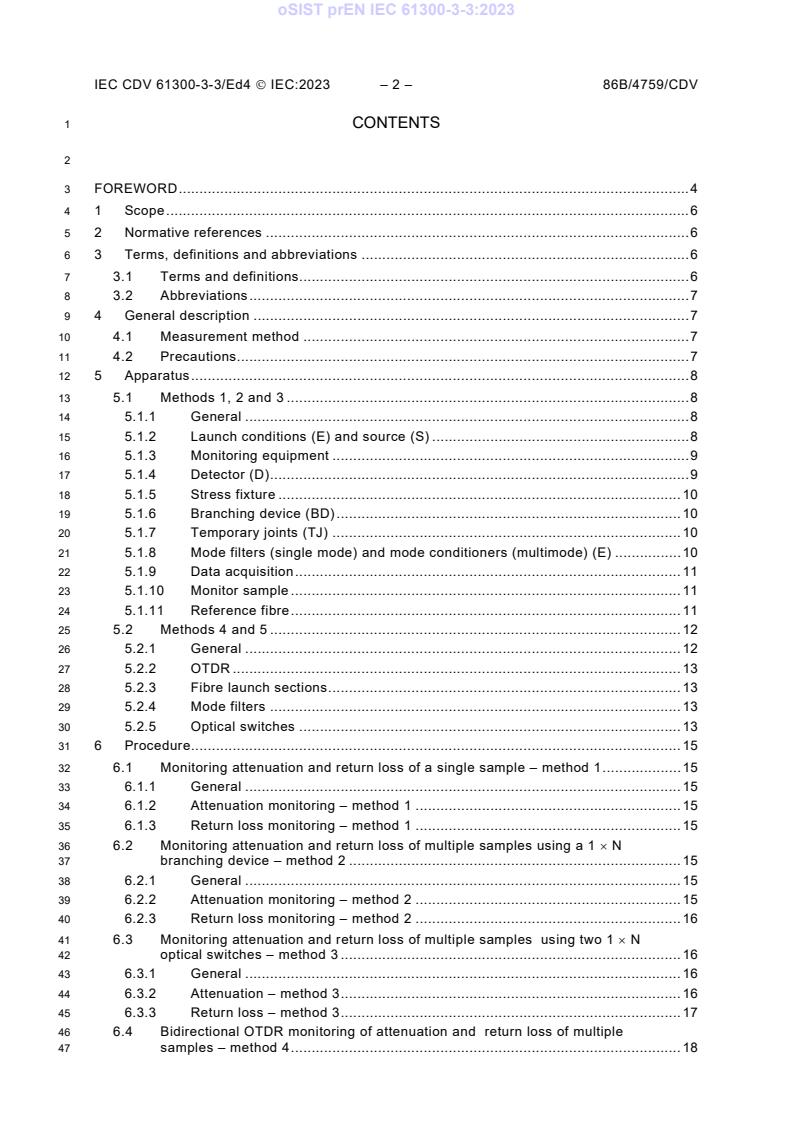
1 CONTENTS
3 FOREWORD . 4
4 1 Scope . 6
5 2 Normative references . 6
6 3 Terms, definitions and abbreviations . 6
7 3.1 Terms and definitions. 6
8 3.2 Abbreviations . 7
9 4 General description . 7
10 4.1 Measurement method . 7
11 4.2 Precautions. 7
12 5 Apparatus . 8
13 5.1 Methods 1, 2 and 3 . 8
14 5.1.1 General . 8
15 5.1.2 Launch conditions (E) and source (S) . 8
16 5.1.3 Monitoring equipment . 9
17 5.1.4 Detector (D) . 9
18 5.1.5 Stress fixture . 10
19 5.1.6 Branching device (BD) . 10
20 5.1.7 Temporary joints (TJ) . 10
21 5.1.8 Mode filters (single mode) and mode conditioners (multimode) (E) . 10
22 5.1.9 Data acquisition . 11
23 5.1.10 Monitor sample . 11
24 5.1.11 Reference fibre . 11
25 5.2 Methods 4 and 5 . 12
26 5.2.1 General . 12
27 5.2.2 OTDR . 13
28 5.2.3 Fibre launch sections . 13
29 5.2.4 Mode filters . 13
30 5.2.5 Optical switches . 13
31 6 Procedure . 15
32 6.1 Monitoring attenuation and return loss of a single sample – method 1 . 15
33 6.1.1 General . 15
34 6.1.2 Attenuation monitoring – method 1 . 15
35 6.1.3 Return loss monitoring – method 1 . 15
36 6.2 Monitoring attenuation and return loss of multiple samples using a 1 × N
37 branching device – method 2 . 15
38 6.2.1 General . 15
39 6.2.2 Attenuation monitoring – method 2 . 15
40 6.2.3 Return loss monitoring – method 2 . 16
41 6.3 Monitoring attenuation and return loss of multiple samples using two 1 × N
42 optical switches – method 3 . 16
43 6.3.1 General . 16
44 6.3.2 Attenuation – method 3 . 16
45 6.3.3 Return loss – method 3 . 17
46 6.4 Bidirectional OTDR monitoring of attenuation and return loss of multiple
47 samples – method 4 . 18
oSIST prEN IEC 61300-3-3:2023
IEC CDV 61300-3-3/Ed4 IEC:2023 – 3 – 86B/4759/CDV
48 6.4.1 General . 18
49 6.4.2 Attenuation – method 4 . 18
50 6.4.3 Return loss – method 4 . 20
51 6.5 Unidirectional OTDR monitoring of attenuation and return loss of multiple
52 samples – method 5 . 21
53 7 Details to be specified and reported . 21
54 7.1 Method 1 . 21
55 7.2 Methods 2 and 3 . 22
56 7.3 Methods 4 and 5 . 22
57 Bibligraphy. 23
59 Figure 1 – Method 1 – Monitoring attenuation and return loss of a single sample
60 undergoing stress testing . 11
61 Figure 2 – Method 2 – Monitoring attenuation and return loss of multiple samples
62 using a 1 × N branching device . 12
63 Figure 3 – Method 3 – Monitoring attenuation and return loss of multiple samples
64 using two 1 × N optical switches . 12
65 Figure 4 – Method 4 – Bidirectional OTDR monitoring of attenuation
66 and return loss of multiple samples . 14
67 Figure 5 – Method 5 – Unidirectional OTDR monitoring of attenuation and return loss
68 of multiple samples . 15
69 Figure 6 – Cut-back measurement location (transmission) . 17
70 Figure 7 – Typical OTDR trace caused by the reflection from a DUT . 19
71 Figure 8 – Cut-back measurement location (OTDR) . 20
73 Table 1 – Preferred source conditions . 8
74 Table 2 – Preferred power meter parameters . 10
75 Table 3 – Example values for Rayleigh backscatter coefficient. 21
oSIST prEN IEC 61300-3-3:2023
IEC CDV 61300-3-3/Ed4 IEC:2023 – 4 – 86B/4759/CDV
78 INTERNATIONAL ELECTROTECHNICAL COMMISSION
79 ____________
81 FIBRE OPTIC INTERCONNECTING DEVICES
82 AND PASSIVE COMPONENTS –
83 BASIC TEST AND MEASUREMENT PROCEDURES –
85 Part 3-3: Examinations and measurements –
86 Active monitoring of changes in attenuation and return loss
FOREWORD
89 1) The International Electrotechnical Commission (IEC) is a worldwide organization for standardization comprising
90 all national electrotechnical committees (IEC National Committees). The object of IEC is to promote international
91 co-operation on all questions concerning standardization in the electrical and electronic fields. To this end and
92 in addition to other activities, IEC publishes International Standards, Technical Specifications, Technical Reports,
93 Publicly Available Specifications (PAS) and Guides (hereafter referred to as “IEC Publication(s)”). Their
94 preparation is entrusted to technical committees; any IEC National Committee interested in the subject dealt with
95 may participate in this preparatory work. International, governmental and non-governmental organizations liaising
96 with the IEC also participate in this preparation. IEC collaborates closely with the International Organization for
97 Standardization (ISO) in accordance with conditions determined by agreement between the two organizations.
98 2) The formal decisions or agreements of IEC on technical matters express, as nearly as possible, an international
99 consensus of opinion on the relevant subjects since each technical committee has representation from all
100 interested IEC National Committees.
101 3) IEC Publications have the form of recommendations for international use and are accepted by IEC National
102 Committees in that sense. While all reasonable efforts are made to ensure that the technical content of IEC
103 Publications is accurate, IEC cannot be held responsible for the way in which they are used or for any
104 misinterpretation by any end user.
105 4) In order to promote international uniformity, IEC National Committees undertake to apply IEC Publications
106 transparently to the maximum extent possible in their national and regional publications. Any divergence between
107 any IEC Publication and the corresponding national or regional publication shall be clearly indicated in the latter.
108 5) IEC provides no marking procedure to indicate its approval and cannot be rendered responsible for any equipment
109 declared to be in conformity with an IEC Publication.
110 6) All users should ensure that they have the latest edition of this publication.
111 7) No liability shall attach to IEC or its directors, employees, servants or agents including individual experts and
112 members of its technical committees and IEC National Committees for any personal injury, property damage or
113 other damage of any nature whatsoever, whether direct or indirect, or for costs (including legal fees) and
114 expenses arising out of the publication, use of, or reliance upon, this IEC Publication or any other IEC
115 Publications.
116 8) Attention is drawn to the Normative references cited in this publication. Use of the referenced publications is
117 indispensable for the correct application of this publication.
118 9) Attention is drawn to the possibility that some of the elements of this IEC Publication may be the subject of patent
119 rights. IEC shall not be held responsible for identifying any or all such patent rights.
120 International Standard IEC 61300-3-3 has been prepared by subcommittee 86B: Fibre optic
121 interconnecting devices and passive components, of IEC technical committee 86: Fibre optics.
122 This fourth edition cancels and replaces the third edition published in 2009. This edition
123 constitutes a minor revision.
124 The changes with respect to the previous edition include harmonization with IEC 61300-3-4 and
125 61300-3-6 by revision of the requirements for the:
126 a) light source
127 b) launching condition
128 c) detector
129 d) temporary joint
130 e) as well as revision of normative references.
oSIST prEN IEC 61300-3-3:2023
IEC CDV 61300-3-3/Ed4 IEC:2023 – 5 – 86B/4759/CDV
132 The text of this standard is based on the following documents:
FDIS Report on voting
86B/xxxxFDIS 86B/xxxxRVD
134 Full information on the voting for the approval of this standard can be found in the report on
135 voting indicated in the above table.
136 The French version of this standard has not been voted upon.
137 This publication has been drafted in accordance with the ISO/IEC Directives, Part 2.
138 A list of all parts of IEC 61300 series, published under the general title Fibre optic
139 interconnecting devices and passive components – Basic test and measurement procedures,,
140 can be found on the IEC website.
141 The committee has decided that the contents of this publication will remain unchanged until the
142 maintenance result date indicated on the IEC web site under "http://webstore.iec.ch" in the data
143 related to the specific publication. At this date, the publication will be
144 • reconfirmed,
145 • withdrawn,
146 • replaced by a revised edition, or
147 • amended.
oSIST prEN IEC 61300-3-3:2023
IEC CDV 61300-3-3/Ed4 IEC:2023 – 6 – 86B/4759/CDV
150 FIBRE OPTIC INTERCONNECTING DEVICES
151 AND PASSIVE COMPONENTS –
152 BASIC TEST AND MEASUREMENT PROCEDURES –
154 Part 3-3: Examinations and measurements –
155 Active monitoring of changes in attenuation and return loss
159 1 Scope
160 This part of IEC 61300 describes the procedure to monitor changes in attenuation and/or return
161 loss of a component, an interconnecting device, a fibre management system, or a protective
162 housing, when subjected to an environmental or mechanical test. Such a procedure is
163 commonly referred to as active monitoring. The procedure to monitor temporary changes
164 (generally faster) during disruptive events is given in IEC 61300-3-28.
165 The procedure can be applied to measurements on single samples or to simultaneous
166 measurements on multiple samples, both at single wavelengths and multiple wavelengths, by
167 using branching devices and/or switches as appropriate.
168 2 Normative references
169 The following referenced documents are indispensable for the application of this document. For
170 dated references, only the edition cited applies. For undated references, the latest edition of
171 the referenced document (including any amendments) applies.
172 IEC 61300-1, Fibre optic interconnecting devices and passive components – Basic test and
173 measurement procedures – Part 1: General and guidance
174 IEC 61300-3-1, Fibre optic interconnecting devices and passive components – Basic test and
175 measurement procedures – Part 3-1: Examinations and measurements – Visual examination
176 IEC 61300-3-2, Fibre optic interconnecting devices and passive components – Basic test and
177 measurement procedures – Part 3-2: Examinations and measurements – Polarization
178 dependent loss in a single-mode fibre optic device
179 IEC 61300-3-28, Fibre optic interconnecting devices and passive components – Basic test and
180 measurement procedures – Part 3-6: Examinations and measurements – Transient loss
181 IEC 61300-3-35, Fibre optic interconnecting devices and passive components – Basic test and
182 measurement procedures – Part 3-35: Examinations and measurements – Visual inspection of
183 fibre optic connectorsl and fibre-stub transceivers
184 3 Terms, definitions and abbreviations
185 3.1 Terms and definitions
186 For the purposes of this document, the terms and definitions are given in IEC 60050-731 and
187 IEC 61300-1.
188 ISO and IEC maintain terminological databases for use in standardization at the following
189 addresses:
oSIST prEN IEC 61300-3-3:2023
IEC CDV 61300-3-3/Ed4 IEC:2023 – 7 – 86B/4759/CDV
190 • IEC Electropedia: available at http://www.electropedia.org/
191 • ISO Online browsing platform: available at http://www.iso.org/obp.
192 3.2 Abbreviations
193 BD branching device
194 DUT device under test
195 LED light emitting diode
196 OTDR optical time domain reflectometer
197 PDL polarization dependent loss
198 TJ temporary joint
199 WDM wavelength-division multiplexing
200 4 General description
201 4.1 Measurement method
202 The procedure describes a number of active monitoring measurement methods. Method 1
203 describes the situation where a single sample is subject to mechanical or environmental stress
204 testing. Methods 2 and 3 describe methods for monitoring changes in the optical performance
205 of multiple samples. Methods 4 and 5 measure changes in the optical performance of samples
206 using an OTDR. Methods 4 and 5 may be used only when the OTDR averaging time is much
207 less than the variation time of the test conditions. Where there is any form of uncertainty over
208 the measurement method used, method 1 shall be the reference method.
209 All methods are capable of being configured to monitor changes in attenuation and return loss
210 at the same time. The required optical test parameters shall be defined in the relevant
211 specification.
212 Where a group of samples is being monitored over a period of time, say several days or weeks,
213 it is usual to employ some form of automated data acquisition. Also, since the changes in optical
214 performance can be very small, it is important to ensure high measurement stability over time.
215 4.2 Precautions
216 The following requirements shall be met.
217 a) Precautions shall be taken to ensure that cladding modes do not affect the measurement as
218 advised in IEC 61300-1.
219 b) Precautions shall be taken to prevent movement in the position of the fibres between the
220 sample(s) and the test apparatus, to avoid changes in optical performance caused by
221 bending losses.
222 c) The stability performance of the test equipment shall be ≤ 0,05 dB or 10 % of the attenuation
223 to be measured, whichever is the lower value. The stability shall be maintained over the
224 measurement time. The required measurement resolution for attenuation shall be 0,01 dB
225 for both multimode and single-mode.
226 d) To achieve consistent results, clean and inspect all samples prior to measurement
227 in accordance with the manufacturer’s instructions. Visual examination shall be undertaken
228 in accordance with IEC 61300-3-1 and IEC 61300-3-35.
oSIST prEN IEC 61300-3-3:2023
IEC CDV 61300-3-3/Ed4 IEC:2023 – 8 – 86B/4759/CDV
229 e) The power in the fibre shall be at a level that does not generate non-linear scattering effects
230 (typically < 3 mW).
231 f) It is common to be monitoring changes in optical performance that are small in comparison
232 with the polarization dependence of the components under test (DUT) and of parts of the
233 test apparatus such as branching devices, switches and detectors. Since polarization along
234 the fibres often changes over time, either an unpolarized or polarization scrambled source
235 can be used to measure the polarization averaged attenuation, or the methods of
236 IEC 61300-3-2 should be used to measure polarization dependent loss (PDL) and
237 attenuation together.
238 g) Particularly, when measuring wavelength dependent components such as WDM devices, it
239 is necessary to use a light source that does not emit light at extraneous wavelengths at
240 levels that can affect the measurement uncertainty.
241 h) Reflected powers from the test apparatus shall be at a level that does not affect the
242 measurement uncertainty.
243 i) Care shall be taken when using switches or branching devices for multimode measurements.
244 In many cases, these devices will modify the launched mode power distribution or result in
245 modal detection non-uniformity, which will give rise to additional measurement uncertainty.
246 5 Apparatus
247 5.1 Methods 1, 2 and 3
248 5.1.1 General
249 The apparatus used for methods 1, 2 and 3 of this procedure is shown in Figures 1, 2 and 3.
250 The apparatus consists of elements listed in clauses 5.1.2 to 5.1.11.
251 5.1.2 Launch conditions (E) and source (S)
252 The launch conditions for light sources shall be in accordance with IEC 61300-1 and shall be
253 measured at the output of the launch reference connector. For multimode fibre sources, a mode-
254 conditioning device may be required to satisfy these conditions, as illustrated with device E in
255 Figure 1 and the launch reference connector where the launch conditions are verified is at the
256 temporary joint into the DUT.
257 The source unit consists of an optical emitter, the associated drive electronics and fibre pigtail
258 (if any). Preferred source conditions are given in Table 1. The stability of the single-mode fibre
259 source at 23 °C shall be ± 0,01 dB over the duration of the measurement. The stability of the
260 multimode fibre source at 23°C shall be ± 0,05 dB over the duration of the measurement. The
261 source output power shall be ≥ 20 dB above the minimum measurable power level.
262 There are a number of methods of performing measurements at multiple wavelengths. One
263 method, illustrated in Figure 3, shows independent light sources joined by optical Switch 3.
264 Table 1 – Preferred source conditions
No. Type Central wavelength Spectral width Source type
nm nm
S1 Multimode 660 ± 30 ≥10 Monochromator or LED
S2 Multimode Monochromator or LED
780 ± 30 ≥10
S3 Multimode Monochromator or LED
850 ± 30 ≥10
S4 Multimode 1 300 ± 30 ≥10 Monochromator or LED
S5 Single-mode 1 310 ± 30 To be reported Laser diode, monochromator or LED
S6 Single-mode To be reported Laser diode, monochromator or LED
1 550 ± 30
S7 Single-mode 1 625 ± 30 To be reported Laser diode, monochromator or LED
oSIST prEN IEC 61300-3-3:2023
IEC CDV 61300-3-3/Ed4 IEC:2023 – 9 – 86B/4759/CDV
NOTE 1 It is recognized that some components, e.g. for CWDM, can require the use of other source types such
as tunable lasers. In these cases, the preferred source characteristics are specified on the basis of the component
to be measured.
NOTE 2 Central wavelength and spectral width are defined in IEC 61280-1-3.
NOTE 3 The interference of modes from a coherent source will create speckle patterns in multimode fibre. These
speckle patterns give rise to speckle or modal noise and are observed as power fluctuations, since their
characteristic times are longer than the resolution time of the detector. As a result, it can be impossible to achieve
stable launch conditions using coherent sources for multimode measurements. Consequently, lasers are avoided
in favour of LEDs or other incoherent sources for measuring multimode components.
266 5.1.3 Monitoring equipment
267 Where multiple sample measurements are made, suitable apparatus is required to permit
268 monitoring of the light through the multiple paths.
269 In Figure 2, individual monitoring channels are established by dividing the light into N paths
270 using a 1 × N branching device (BD). This method is practical for a small number of DUTs, since
271 it requires a multiplicity of branching devices and detectors.
272 In Figure 3, active switching of the light paths through the DUTs is used. The apparatus consists
273 of a directional branching device and two 1 × N computer-controlled optical switches. The
274 channel number of these switches is sufficiently large to accommodate the DUTs under test,
275 one or more reference lines, and a reference reflectance channel.
276 The design of systems to test multiple samples requires the trade-off of a number of factors
277 s
...
SLOVENSKI STANDARD
01-junij-2024
Povezovalne naprave in pasivne komponente optičnih vlaken - Postopki
osnovnega preskušanja in merjenja - 3-3. del: Preiskovanje in meritve - Aktivno
nadzorovanje sprememb pri zmanjševanju in povračilu izgube
Fibre optic interconnecting devices and passive components - Basic test and
measurement procedures - Part 3-3: Examinations and measurements - Active
monitoring of changes in attenuation and return loss
Lichtwellenleiter - Verbindungselemente und passive Bauteile - Grundlegende Prüf- und
Messverfahren - Teil 3-3: Untersuchungen und Messungen - Aufzeichnung der
Änderung von Dämpfung und Rückflussdämpfung
Dispositifs d'interconnexion et composants passifs à fibres optiques - Méthodes
fondamentales d'essais et de mesures - Partie 3-3: Examens et mesures - Contrôle actif
des variations de l'affaiblissement et de l'affaiblissement de réflexion
Ta slovenski standard je istoveten z: prEN IEC 61300-3-3:2024
ICS:
33.180.20 Povezovalne naprave za Fibre optic interconnecting
optična vlakna devices
2003-01.Slovenski inštitut za standardizacijo. Razmnoževanje celote ali delov tega standarda ni dovoljeno.
86B/4885/CDV
COMMITTEE DRAFT FOR VOTE (CDV)
PROJECT NUMBER:
IEC 61300-3-3 ED4
DATE OF CIRCULATION: CLOSING DATE FOR VOTING:
2024-04-19 2024-06-14
SUPERSEDES DOCUMENTS:
86B/4759/CDV, 86B/4810A/RVC
IEC SC 86B : FIBRE OPTIC INTERCONNECTING DEVICES AND PASSIVE COMPONENTS
SECRETARIAT: SECRETARY:
Japan Mr Shigeru Tomita
OF INTEREST TO THE FOLLOWING COMMITTEES: PROPOSED HORIZONTAL STANDARD:
Other TC/SCs are requested to indicate their interest, if any, in
this CDV to the secretary.
FUNCTIONS CONCERNED:
EMC ENVIRONMENT QUALITY ASSURANCE SAFETY
SUBMITTED FOR CENELEC PARALLEL VOTING NOT SUBMITTED FOR CENELEC PARALLEL VOTING
Attention IEC-CENELEC parallel voting
The attention of IEC National Committees, members of
CENELEC, is drawn to the fact that this Committee Draft for
Vote (CDV) is submitted for parallel voting.
The CENELEC members are invited to vote through the
CENELEC online voting system.
This document is still under study and subject to change. It should not be used for reference purposes.
Recipients of this document are invited to submit, with their comments, notification of any relevant patent rights of which they
are aware and to provide supporting documentation.
Recipients of this document are invited to submit, with their comments, notification of any relevant “In Some Countries” clau ses
to be included should this proposal proceed. Recipients are reminded that the CDV stage is the final stage for submitting ISC
clauses. (SEE AC/22/2007 OR NEW GUIDANCE DOC).
TITLE:
Fibre optic interconnecting devices and passive components - Basic test and measurement procedures -
Part 3-3: Examinations and measurements - Active monitoring of changes in attenuation and return loss
PROPOSED STABILITY DATE: 2029
NOTE FROM TC/SC OFFICERS:
electronic file, to make a copy and to print out the content for the sole purpose of preparing National Committee positions.
You may not copy or "mirror" the file or printed version of the document, or any part of it, for any other purpose without
permission in writing from IEC.
86B/4885/CDV – 2 – IEC CDV 61300-3-3 © IEC 2023
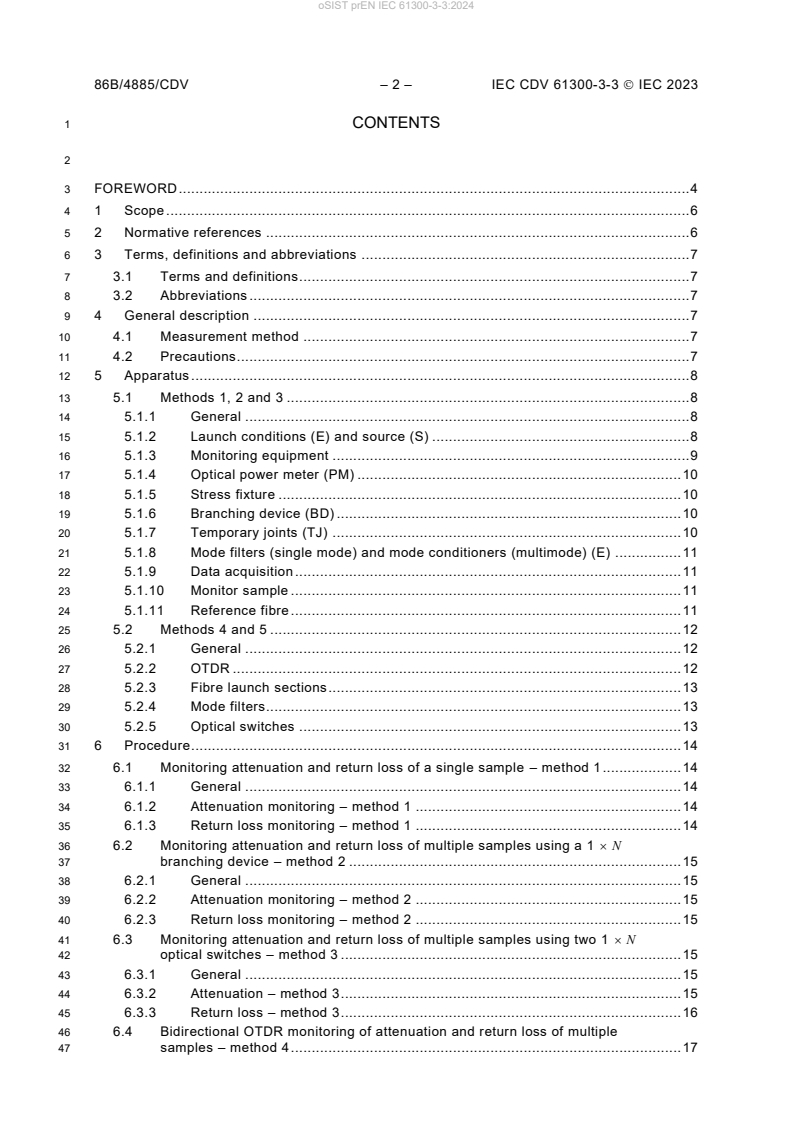
1 CONTENTS
3 FOREWORD . 4
4 1 Scope . 6
5 2 Normative references . 6
6 3 Terms, definitions and abbreviations . 7
7 3.1 Terms and definitions . 7
8 3.2 Abbreviations . 7
9 4 General description . 7
10 4.1 Measurement method . 7
11 4.2 Precautions . 7
12 5 Apparatus . 8
13 5.1 Methods 1, 2 and 3 . 8
14 5.1.1 General . 8
15 5.1.2 Launch conditions (E) and source (S) . 8
16 5.1.3 Monitoring equipment . 9
17 5.1.4 Optical power meter (PM) . 10
18 5.1.5 Stress fixture . 10
19 5.1.6 Branching device (BD) . 10
20 5.1.7 Temporary joints (TJ) . 10
21 5.1.8 Mode filters (single mode) and mode conditioners (multimode) (E) . 11
22 5.1.9 Data acquisition . 11
23 5.1.10 Monitor sample . 11
24 5.1.11 Reference fibre . 11
25 5.2 Methods 4 and 5 . 12
26 5.2.1 General . 12
27 5.2.2 OTDR . 12
28 5.2.3 Fibre launch sections . 13
29 5.2.4 Mode filters. 13
30 5.2.5 Optical switches . 13
31 6 Procedure . 14
32 6.1 Monitoring attenuation and return loss of a single sample – method 1 . 14
33 6.1.1 General . 14
34 6.1.2 Attenuation monitoring – method 1 . 14
35 6.1.3 Return loss monitoring – method 1 . 14
36 6.2 Monitoring attenuation and return loss of multiple samples using a 1 N
37 branching device – method 2 . 15
38 6.2.1 General . 15
39 6.2.2 Attenuation monitoring – method 2 . 15
40 6.2.3 Return loss monitoring – method 2 . 15
41 6.3 Monitoring attenuation and return loss of multiple samples using two 1 N
42 optical switches – method 3 . 15
43 6.3.1 General . 15
44 6.3.2 Attenuation – method 3 . 15
45 6.3.3 Return loss – method 3 . 16
46 6.4 Bidirectional OTDR monitoring of attenuation and return loss of multiple
47 samples – method 4 . 17
IEC CDV 61300-3-3 © IEC 2024 – 3 – 86B/4885/CDV
48 6.4.1 General . 17
49 6.4.2 Attenuation – method 4 . 17
50 6.4.3 Return loss – method 4 . 19
51 6.5 Unidirectional OTDR monitoring of attenuation and return loss of multiple
52 samples – method 5 . 20
53 7 Details to be specified and reported. 20
55 Figure 1 – Method 1 – Monitoring attenuation and return loss of a single sample
56 undergoing stress testing . 11
57 Figure 2 – Method 2 – Monitoring attenuation and return loss of multiple samples
58 using a 1 N branching device . 12
59 Figure 3 – Method 3 – Monitoring attenuation and return loss of multiple samples
60 using two 1 N optical switches . 12
61 Figure 4 – Method 4 – Bidirectional OTDR monitoring of attenuation
62 and return loss of multiple samples . 13
63 Figure 5 – Method 5 – Unidirectional OTDR monitoring of attenuation and return loss
64 of multiple samples . 14
65 Figure 6 – Cut-back measurement location (transmission) . 16
66 Figure 7 – Typical OTDR trace caused by the reflection from a DUT . 18
67 Figure 8 – Cut-back measurement location (OTDR) . 19
69 Table 1 – Preferred source conditions . 9
70 Table 2 – Preferred power meter parameters . 10
71 Table 3 – Example values for Rayleigh backscatter coefficient . 20
86B/4885/CDV – 4 – IEC CDV 61300-3-3 © IEC 2023
75 INTERNATIONAL ELECTROTECHNICAL COMMISSION
76 ____________
78 FIBRE OPTIC INTERCONNECTING DEVICES
79 AND PASSIVE COMPONENTS –
80 BASIC TEST AND MEASUREMENT PROCEDURES –
82 Part 3-3: Examinations and measurements –
83 Active monitoring of changes in attenuation and return loss
85 FOREWORD
86 1) The International Electrotechnical Commission (IEC) is a worldwide organization for standardization comprising
87 all national electrotechnical committees (IEC National Committees). The object of IEC is to promote international
88 co-operation on all questions concerning standardization in the electrical and electronic fields. To this end and
89 in addition to other activities, IEC publishes International Standards, Technical Specifications, Technical Reports,
90 Publicly Available Specifications (PAS) and Guides (hereafter referred to as “IEC Publication(s)”). Their
91 preparation is entrusted to technical committees; any IEC National Committee interested in the subject dealt with
92 may participate in this preparatory work. International, governmental and non-governmental organizations liaising
93 with the IEC also participate in this preparation. IEC collaborates closely with the International Organization for
94 Standardization (ISO) in accordance with conditions determined by agreement between the two organizations.
95 2) The formal decisions or agreements of IEC on technical matters express, as nearly as possible, an international
96 consensus of opinion on the relevant subjects since each technical committee has representation from all
97 interested IEC National Committees.
98 3) IEC Publications have the form of recommendations for international use and are accepted by IEC National
99 Committees in that sense. While all reasonable efforts are made to ensure that the technical content of IEC
100 Publications is accurate, IEC cannot be held responsible for the way in which they are used or for any
101 misinterpretation by any end user.
102 4) In order to promote international uniformity, IEC National Committees undertake to apply IEC Publications
103 transparently to the maximum extent possible in their national and regional publications. Any divergence between
104 any IEC Publication and the corresponding national or regional publication shall be clearly indicated in the latter.
105 5) IEC itself does not provide any attestation of conformity. Independent certification bodies provide conformity
106 assessment services and, in some areas, access to IEC marks of conformity. IEC is not responsible for any
107 services carried out by independent certification bodies.
108 6) All users should ensure that they have the latest edition of this publication.
109 7) No liability shall attach to IEC or its directors, employees, servants or agents including individual experts and
110 members of its technical committees and IEC National Committees for any personal injury, property damage or
111 other damage of any nature whatsoever, whether direct or indirect, or for costs (including legal fees) and
112 expenses arising out of the publication, use of, or reliance upon, this IEC Publication or any other IEC
113 Publications.
114 8) Attention is drawn to the Normative references cited in this publication. Use of the referenced publications is
115 indispensable for the correct application of this publication.
116 9) IEC draws attention to the possibility that the implementation of this document may involve the use of (a)
117 patent(s). IEC takes no position concerning the evidence, validity or applicability of any claimed patent rights in
118 respect thereof. As of the date of publication of this document, IEC had not received notice of (a) patent(s), which
119 may be required to implement this document. However, implementers are cautioned that this may not represent
120 the latest information, which may be obtained from the patent database available at https://patents.iec.ch. IEC
121 shall not be held responsible for identifying any or all such patent rights.
122 IEC 61300-3-3 has been prepared by subcommittee 86B: Fibre optic interconnecting devices
123 and passive components, of IEC technical committee 86: Fibre optics. It is an International
124 Standard.
125 This fourth edition cancels and replaces the third edition published in 2009. This edition
126 constitutes a minor revision.
127 The changes with respect to the previous edition include harmonization with IEC 61300-3-4 and
128 61300-3-6 by revision of the requirements for the:
129 a) light source,
130 b) launching condition,
IEC CDV 61300-3-3 © IEC 2024 – 5 – 86B/4885/CDV
131 c) detector,
132 d) temporary joint,
133 e) as well as revision of normative references.
134 The text of this International Standard is based on the following documents:
Draft Report on voting
86B/XX/FDIS 86B/XX/RVD
136 Full information on the voting for its approval can be found in the report on voting indicated in
137 the above table.
138 The language used for the development of this International Standard is.
139 This document was drafted in accordance with ISO/IEC Directives, Part 2, and developed in
140 accordance with ISO/IEC Directives, Part 1 and ISO/IEC Directives, IEC Supplement, available
141 at www.iec.ch/members_experts/refdocs. The main document types developed by IEC are
142 described in greater detail at www.iec.ch/publications.
143 A list of all parts of IEC 61300 series, published under the general title Fibre optic
144 interconnecting devices and passive components – Basic test and measurement procedures,
145 can be found on the IEC website.
146 The committee has decided that the contents of this document will remain unchanged until the
147 stability date indicated on the IEC website under webstore.iec.ch in the data related to the
148 specific document. At this date, the document will be
149 • reconfirmed,
150 • withdrawn, or
151 • revised.
86B/4885/CDV – 6 – IEC CDV 61300-3-3 © IEC 2023
155 FIBRE OPTIC INTERCONNECTING DEVICES
156 AND PASSIVE COMPONENTS –
157 BASIC TEST AND MEASUREMENT PROCEDURES –
159 Part 3-3: Examinations and measurements –
160 Active monitoring of changes in attenuation and return loss
164 1 Scope
165 This part of IEC 61300 describes the procedure to monitor changes in either attenuation or
166 return loss, or both, of a component, an interconnecting device, a fibre management system, or
167 a protective housing, when subjected to an environmental or mechanical test. Such a procedure
168 is commonly referred to as active monitoring. The procedure to monitor temporary changes
169 (generally faster) during disruptive events is given in IEC 61300-3-28.
170 The procedure can be applied to measurements on single samples or to simultaneous
171 measurements on multiple samples, both at single wavelengths and multiple wavelengths, by
172 using either branching devices or switches, or both, as appropriate.
173 2 Normative references
174 The following referenced documents are indispensable for the application of this document. For
175 dated references, only the edition cited applies. For undated references, the latest edition of
176 the referenced document (including any amendments) applies.
177 IEC 60050-731, International Electrotechnical Vocabulary (IEV) – Part 731: Optical fibre
178 communication
179 IEC 61300-1, Fibre optic interconnecting devices and passive components – Basic test and
180 measurement procedures – Part 1: General and guidance
181 IEC 61300-2 (all parts), Fibre optic interconnecting devices and passive components – Basic
182 test and measurement procedures – Part 2: Tests
183 IEC 61300-3-1, Fibre optic interconnecting devices and passive components – Basic test and
184 measurement procedures – Part 3-1: Examinations and measurements – Visual examination
185 IEC 61300-3-2, Fibre optic interconnecting devices and passive components – Basic test and
186 measurement procedures – Part 3-2: Examinations and measurements – Polarization
187 dependent loss in a single-mode fibre optic device
188 IEC 61300-3-6, Fibre optic interconnecting devices and passive components – Basic test and
189 measurement procedures – Part 3-6: Examinations and measurements – Return loss
190 IEC 61300-3-28, Fibre optic interconnecting devices and passive components – Basic test and
191 measurement procedures – Part 3-28: Examinations and measurements – Transient loss
192 IEC 61300-3-35, Fibre optic interconnecting devices and passive components – Basic test and
193 measurement procedures – Part 3-35: Examinations and measurements – Visual inspection of
194 fibre optic connectors and fibre-stub transceivers
IEC CDV 61300-3-3 © IEC 2024 – 7 – 86B/4885/CDV
195 IEC 61280-1-3, Fibre optic communication subsystem test procedures – Part 1-3: General
196 communication subsystems – Measurement of central wavelength, spectral width and additional
197 spectral characteristics
198 3 Terms, definitions and abbreviations
199 3.1 Terms and definitions
200 For the purposes of this document, the terms and definitions are given in IEC 60050-731 and
201 IEC 61300-1.
202 ISO and IEC maintain terminological databases for use in standardization at the following
203 addresses:
204 • IEC Electropedia: available at http://www.electropedia.org/
205 • ISO Online browsing platform: available at http://www.iso.org/obp.
206 3.2 Abbreviations
207 BD branching device
208 DUT device under test
209 LED light emitting diode
210 OTDR optical time domain reflectometer
211 PDL polarization dependent loss
212 TJ temporary joint
213 WDM wavelength-division multiplexing
214 4 General description
215 4.1 Measurement method
216 The procedure describes active monitoring measurement methods. Method 1 describes the
217 situation where a single sample is subject to mechanical or environmental stress testing.
218 Methods 2 and 3 describe methods for monitoring changes in the optical performance of multiple
219 samples. Methods 4 and 5 measure changes in the optical performance of samples using an
220 optical time domain reflectometer (OTDR). Methods 4 and 5 may be used only when the OTDR
221 averaging time is much less than the variation time of the test conditions. Where there is any
222 form of uncertainty over the measurement method used, method 1 shall be the reference
223 method.
224 All methods are capable of being configured to monitor changes in attenuation and return loss
225 at the same time. The required optical test parameters shall be defined in the relevant IEC
226 61753-series performance standard or IEC 62005-series reliability document.
227 Where a group of samples is being monitored over a period of time, say several days or weeks,
228 it is usual to employ some form of automated data acquisition. Since the changes in optical
229 performance can be very small, it is important to ensure high measurement stability over time.
230 4.2 Precautions
231 The following requirements shall be met.
232 a) Precautions shall be taken to ensure that cladding modes do not affect the measurement as
233 advised in IEC 61300-1.
86B/4885/CDV – 8 – IEC CDV 61300-3-3 © IEC 2023
234 b) Precautions shall be taken to prevent movement in the position of the fibres between the
235 sample(s) and the test apparatus, to avoid changes in optical performance caused by
236 bending losses.
237 c) The stability performance of the test equipment shall be 0,05 dB or 10 % of the attenuation
238 to be measured, whichever is the lower value. The stability shall be maintained over the
239 measurement time. The required measurement resolution for attenuation shall be 0,01 dB
240 for both multimode and single-mode fiber.
241 d) To achieve consistent results, all samples shall be cleaned and inspected prior to
242 measurement, in accordance with the manufacturer’s instructions. Visual examination shall
243 be undertaken in accordance with IEC 61300-3-1 and IEC 61300-3-35.
244 e) The power in the fibre shall be at a level that does not generate non-linear scattering effects
245 (typically < 3 mW).
246 f) It is common to be monitoring changes in optical performance that are small in comparison
247 with the polarization dependence of the device under test (DUT) and of parts of the test
248 apparatus such as branching devices, switches, and detectors. Since polarization along the
249 fibres often changes over time, either an unpolarized or polarization scrambled source can
250 be used to measure the polarization averaged attenuation, or the methods of IEC 61300-3-
251 2 should be used to measure polarization dependent loss (PDL) and attenuation together.
252 g) When measuring wavelength dependent components such as wavelength-division
253 multiplexing (WDM) devices, it is necessary to use a light source that does not emit light at
254 extraneous wavelengths at levels that can affect the measurement uncertainty.
255 h) Reflected powers from the test apparatus shall be at a level that does not affect the
256 measurement uncertainty.
257 i) When using switches or branching devices for multimode measurements, ensure that the
258 launch conditions to the DUT satisfy 5.1.2 and that these devices do not introduce
259 unacceptable measurement uncertainty due to modal detection non-uniformity,
260 5 Apparatus
261 5.1 Methods 1, 2 and 3
262 5.1.1 General
263 The apparatus used for methods 1, 2 and 3 of this procedure is shown in Figure 1, Figure 2 and
264 Figure 3. The apparatus consists of elements listed in 5.1.2 to 5.1.11.
265 5.1.2 Launch conditions (E) and source (S)
266 The launch conditions for light sources shall be in accordance with IEC 61300-1 and shall be
267 measured at the output of the launch reference connector. For multimode fibre sources, a mode-
268 conditioning device can be required to satisfy these conditions, as illustrated with device E in
269 Figure 1 and the launch reference connector where the launch conditions are verified is at the
270 temporary joint into the DUT.
271 The source unit consists of an optical emitter, the associated drive electronics and fibre pigtail
272 (if any). Preferred source conditions are given in Table 1. The stability of the single-mode fibre
273 source at 23 °C shall be ± 0,01 dB over the duration of the measurement. The stability of the
274 multimode fibre source at 23 °C shall be ± 0,05 dB over the duration of the measurement. The
275 source output power shall be ≥ 20 dB above the minimum measurable power level.
276 There are several methods of performing measurements at multiple wavelengths. One method,
277 illustrated in Figure 3, shows independent light sources joined by optical Switch 3.
IEC CDV 61300-3-3 © IEC 2024 – 9 – 86B/4885/CDV
278 Table 1 – Preferred source conditions
No. Type Central wavelength Spectral width Source type
(centroidal) nm (RMS) nm
S1 Multimode Monochromator or light emitting diode
660 30 10
(LED)
S2 Multimode 780 30 10 Monochromator or LED
S3 Multimode Monochromator or LED
850 30 10
S4 Multimode 1 300 30 10 Monochromator or LED
S5 Single mode 1 310 30 To be reported Laser diode, monochromator or LED
S6 Single mode To be reported Laser diode, monochromator or LED
1 550 30
S7 Single mode 1 625 30 To be reported Laser diode, monochromator or LED
NOTE 1 It is recognized that some components, e.g. for wavelength division multiplexing (WDM), can require the
...