

SIST-V ETSI/EG 202 057-1 V1.3.1:2009
(Main)Speech Processing, Transmission and Quality Aspects (STQ) - User related QoS parameter definitions and measurements - Part 1: General
- Abstract
The present document contains definitions and measurement methods for a range of user perceivable Quality of Service (QoS) parameters. The purpose of these parameters is to define objective and comparable measures of the QoS delivered to users/customers for use by users/customers. The present document applies to any telecommunication service, however, some parameters may have a limited application. The present document is intended to provide a menu from which individual items can be selected. There is no obligation to use any or all of the parameters. The QoS parameters are related primarily to services and service features and not to the technology used to provide the services. Therefore the parameters should be capable of use when the services are provided on new technologies such as IP and ATM or other packet switched technologies as well as on circuit switched technologies. The establishment of target values for QoS is beyond the scope of the present document. The QoS parameters listed in the present document are also not intended to assess the complete QoS of a telecommunication service. The present document provides a set of QoS parameters that covers specific user related QoS aspects rather than a complete list of QoS parameters. This set has been chosen to address areas where monitoring of QoS is likely to be most worthwhile, i.e. the areas that are most likely to be affected by any QoS problems. If stakeholders wish to examine other QoS aspects they are recommended to follow the general approach of the present document - as far as practicable - as a basis for the development of definitions and measurement methods for new specific QoS parameters. The set of QoS parameters is designed to be understood by the users of various telecommunications services. Sub-sets of these parameters can be selected for use in different circumstances. For example a specific parameter might be relevant for many users in some countries or markets but the same parameter might not be of relevance in others. Therefore stakeholders - users, customers, regulators, service providers, network operators and other parties interested in the use of QoS parameters - should decide in co-operation, which parameters and which measures should be used in their particular situation. This decision should take account of:
- The precise purpose for which they will be used.
- The general level of quality achieved by most operators.
- The degree to which the parameters will provide a reliable comparison of performance.
- The cost of measuring and reporting each parameter.
- Status
- Published
- Publication Date
- 05-Mar-2009
- Technical Committee
- SPN - Services and Protocols for Networks
- Current Stage
- 6060 - National Implementation/Publication (Adopted Project)
- Start Date
- 20-Feb-2009
- Due Date
- 27-Apr-2009
- Completion Date
- 06-Mar-2009
Buy Documents

ETSI EG 202 057-1 V1.3.0 (2008-05) - Speech Processing, Transmission and Quality Aspects (STQ); User related QoS parameter definitions and measurements; Part 1: General

ETSI EG 202 057-1 V1.3.1 (2008-07) - Speech Processing, Transmission and Quality Aspects (STQ); User related QoS parameter definitions and measurements; Part 1: General

SIST-V ETSI/EG 202 057-1 V1.3.1:2009 is the Slovenian version of ETSI Guide EG 202 057-1, published by SIST. It defines user-related Quality of Service (QoS) parameters and measurement methods for telecommunication services so that users, customers, regulators, service providers and network operators can compare service performance in a common way. The document is a menu of selectable parameters, focused on service outcomes and service features rather than the technology used to deliver them.
What does SIST-V ETSI/EG 202 057-1 V1.3.1:2009 specify?
SIST-V ETSI/EG 202 057-1 V1.3.1:2009 specifies objective, user-perceivable QoS parameters and how to measure them for telecommunication services. It applies to any telecommunication service and is written so the same measures can be used with fixed, mobile, IP, ATM, packet-switched and circuit-switched environments. The document also makes clear that it is a selectable set of parameters, not a mandatory checklist, and that target QoS values are outside its scope.
The document is organized around general considerations and a set of general user-related QoS parameters. Clause 4 explains how the measures are used, reported, compared and published. Clause 5 defines the individual parameters, their application and their measurement methods. Annexes A to D support calculation, interpretation and background information.
| Annex | What it covers |
|---|---|
| Annex A | Combining weekly or monthly results into quarterly statistics |
| Annex B | Explanation of the “fastest X %” statistic |
| Annex C | Method for calculating the number of observations needed for time measures |
| Annex D | Bibliography |
What are the key requirements of SIST-V ETSI/EG 202 057-1 V1.3.1:2009?
General use and reporting
Clause 4 says the QoS parameters are meant for contracts, comparisons between providers, comparisons between service offers and long-term studies. In practice, that means the same measure can be used in service terms, market reports or benchmarking, provided the user understands what the figure actually covers.
Clause 4 also allows statistics to be aggregated for all customer classes or split by class, such as residential and business. That matters because different customer groups can experience different service patterns, and a combined figure can hide that difference.
The document recommends reporting standard levels of QoS as published in the service terms and conditions. Where enhanced or lower QoS offers exist, the report should identify which service level is being measured.
Time-based provisioning and repair measures
Clause 5 defines supply time for fixed network access and supply time for Internet access as the elapsed time from a valid order to working service. Each uses two styles of statistics: the time by which the fastest 50 %, 95 % and 99 % of orders are completed, or the share completed by the agreed date plus the average delay for late orders when that share is below 80 %. In practice, this lets a buyer see both typical performance and the tail of slow orders.
For fixed network access, the document separates cases by technology and installation type, including narrowband PSTN or ISDN basic rate access with or without a physical change, xDSL over an existing line, and other technologies. That matters because the same service name can involve very different provisioning work.
For Internet access, separate statistics may be needed for physical access, logical access, and combined access. The document also notes that customer premises equipment can be excluded, which helps avoid mixing service provisioning with device delivery.
Clause 5 also covers fault repair time for fixed access lines. It uses the time by which the fastest 80 % and 95 % of valid faults are repaired, or the share repaired within an agreed time. The provider must also state the hours during which faults may be reported, because report access affects the measured repair time.
Operational service and complaint measures
Clause 5 measures response time for operator services, directory enquiry services and admin/billing enquiries. The core measures are mean time to answer or the share of calls answered within 20 seconds. For practice, this gives both an average and a service-level view of waiting time.
The document also covers frequency of customer complaints and customer complaints resolution time. Frequency is measured as complaints logged per customer per data collection period, while resolution time uses the fastest 80 % and 95 % of complaints or an agreed resolution target. These measures help track service friction and the speed of follow-up.
Clause 5 includes bill correctness complaints and prepaid account credit correctness complaints as complaint rates, not as direct billing accuracy checks. That is important because the document treats customer-reported billing problems as the practical indicator, rather than trying to prove every call record or tariff calculation.
Subjective service-quality surveys
Clause 5 also includes bill presentation quality, customer relations and professionalism of help line. These are survey-based measures using a Mean Opinion Score (MOS) scale, with sample sizes of at least 100 valid responses. In practice, these parameters capture how easy the bill is to use and how customers experience service interactions, not just whether the network works.
Annex B explains how to calculate “the time by which the fastest X %” of events occurred, and annex C gives the observation-count method for time measures. Annex A shows how weekly or monthly figures can be combined into quarterly results.
What terms does SIST-V ETSI/EG 202 057-1 V1.3.1:2009 define?
- Access line - The connection from the Network Termination Point (NTP) to the entry point to the local switch or remote concentrator.
- Direct service - A service where the same provider supplies the telecommunication service and the access network, or rents an unswitched local loop for that service.
- Indirect service - A service where the provider of the telecommunication service does not provide the access network and is selected by call-by-call carrier selection or carrier preselection.
- Network Termination Point (NTP) - The physical point where a user is given access to a public telecommunications network.
- Quality of Service (QoS) - The collective effect of service performance that determines user satisfaction with the service.
- Ported number - A subscriber number whose NTP location and/or service provider has changed after the number was first allocated.
- Internet Access Provider (IAP) - An organization that provides users with Internet access.
Who uses SIST-V ETSI/EG 202 057-1 V1.3.1:2009?
The document is used by users and customers who want understandable QoS figures, and by service providers and network operators who measure and publish them. It is also relevant to regulators, buyers and quality managers who need comparable performance data across offers and providers.
In practice, it is used across fixed telephony, mobile services, Internet access, billing operations, directory enquiry services, operator services and help lines. It is especially useful where a provider needs to report on provisioning times, fault handling, complaint handling or customer-experience surveys in a way that can be compared with another provider.
Which standards are used with SIST-V ETSI/EG 202 057-1 V1.3.1:2009?
| Reference | What it contributes |
|---|---|
| Directive 98/10/EC | Shared use of the term “subscriber” and the ONP voice telephony context |
| ITU-T E.105 | Definition of operator services used in the response-time measures |
| ITU-T E.800 | General QoS and network performance terminology |
| ITU-T I.210 | Principles for telecommunication services and supplementary services |
| ITU-T V.90 | Modem data service context for the companion QoS parts |
| ITU-T V.92 | Enhancement to V.90 for modem data service context |
| ETSI EG 202 057-2 | Service-specific QoS definitions and measurements for voice telephony, Group 3 fax, modem data services and SMS |
| ETSI EG 202 057-3 | Service-specific QoS definitions and measurements for PLMN |
| ETSI EG 202 057-4 | Service-specific QoS definitions and measurements for Internet access |
What does the SIST-V ETSI/EG 202 057-1 V1.3.1:2009 document contain?
The document contains clause 4 guidance on how to use, report, compare and publish QoS figures, including treatment of customer classes, direct and indirect services, data collection periods and measurement comparability. It also contains clause 5 parameter definitions, application notes and measurement/statistics guidance for provisioning, faults, response times, complaints, billing and survey-based quality measures.
It includes summary tables for the parameters and for who reports each measure, plus a table of candidate parameters that were considered but not included. The survey-based clauses provide the question sets and scoring scales for bill presentation quality, customer relations and professionalism of help line.
Annex A gives the method for combining weekly or monthly results into quarterly statistics, Annex B explains “fastest X %”, and Annex C gives the observation calculation for time measures. Annex D provides bibliography entries for related ETSI work.
Buy Documents
ETSI EG 202 057-1 V1.3.0 (2008-05) - Speech Processing, Transmission and Quality Aspects (STQ); User related QoS parameter definitions and measurements; Part 1: General
ETSI EG 202 057-1 V1.3.1 (2008-07) - Speech Processing, Transmission and Quality Aspects (STQ); User related QoS parameter definitions and measurements; Part 1: General
Get Certified
Connect with accredited certification bodies for this standard

ANCE
Mexican certification and testing association.

Intertek Slovenia
Intertek testing, inspection, and certification services in Slovenia.

LNE (Laboratoire National de Métrologie et d'Essais)
French national laboratory for metrology and testing.
Sponsored listings
Frequently Asked Questions
SIST-V ETSI/EG 202 057-1 V1.3.1:2009 is a standard published by the Slovenian Institute for Standardization (SIST). Its full title is "Speech Processing, Transmission and Quality Aspects (STQ) - User related QoS parameter definitions and measurements - Part 1: General". This standard covers: The present document contains definitions and measurement methods for a range of user perceivable Quality of Service (QoS) parameters. The purpose of these parameters is to define objective and comparable measures of the QoS delivered to users/customers for use by users/customers. The present document applies to any telecommunication service, however, some parameters may have a limited application. The present document is intended to provide a menu from which individual items can be selected. There is no obligation to use any or all of the parameters. The QoS parameters are related primarily to services and service features and not to the technology used to provide the services. Therefore the parameters should be capable of use when the services are provided on new technologies such as IP and ATM or other packet switched technologies as well as on circuit switched technologies. The establishment of target values for QoS is beyond the scope of the present document. The QoS parameters listed in the present document are also not intended to assess the complete QoS of a telecommunication service. The present document provides a set of QoS parameters that covers specific user related QoS aspects rather than a complete list of QoS parameters. This set has been chosen to address areas where monitoring of QoS is likely to be most worthwhile, i.e. the areas that are most likely to be affected by any QoS problems. If stakeholders wish to examine other QoS aspects they are recommended to follow the general approach of the present document - as far as practicable - as a basis for the development of definitions and measurement methods for new specific QoS parameters. The set of QoS parameters is designed to be understood by the users of various telecommunications services. Sub-sets of these parameters can be selected for use in different circumstances. For example a specific parameter might be relevant for many users in some countries or markets but the same parameter might not be of relevance in others. Therefore stakeholders - users, customers, regulators, service providers, network operators and other parties interested in the use of QoS parameters - should decide in co-operation, which parameters and which measures should be used in their particular situation. This decision should take account of: - The precise purpose for which they will be used. - The general level of quality achieved by most operators. - The degree to which the parameters will provide a reliable comparison of performance. - The cost of measuring and reporting each parameter.
The present document contains definitions and measurement methods for a range of user perceivable Quality of Service (QoS) parameters. The purpose of these parameters is to define objective and comparable measures of the QoS delivered to users/customers for use by users/customers. The present document applies to any telecommunication service, however, some parameters may have a limited application. The present document is intended to provide a menu from which individual items can be selected. There is no obligation to use any or all of the parameters. The QoS parameters are related primarily to services and service features and not to the technology used to provide the services. Therefore the parameters should be capable of use when the services are provided on new technologies such as IP and ATM or other packet switched technologies as well as on circuit switched technologies. The establishment of target values for QoS is beyond the scope of the present document. The QoS parameters listed in the present document are also not intended to assess the complete QoS of a telecommunication service. The present document provides a set of QoS parameters that covers specific user related QoS aspects rather than a complete list of QoS parameters. This set has been chosen to address areas where monitoring of QoS is likely to be most worthwhile, i.e. the areas that are most likely to be affected by any QoS problems. If stakeholders wish to examine other QoS aspects they are recommended to follow the general approach of the present document - as far as practicable - as a basis for the development of definitions and measurement methods for new specific QoS parameters. The set of QoS parameters is designed to be understood by the users of various telecommunications services. Sub-sets of these parameters can be selected for use in different circumstances. For example a specific parameter might be relevant for many users in some countries or markets but the same parameter might not be of relevance in others. Therefore stakeholders - users, customers, regulators, service providers, network operators and other parties interested in the use of QoS parameters - should decide in co-operation, which parameters and which measures should be used in their particular situation. This decision should take account of: - The precise purpose for which they will be used. - The general level of quality achieved by most operators. - The degree to which the parameters will provide a reliable comparison of performance. - The cost of measuring and reporting each parameter.
SIST-V ETSI/EG 202 057-1 V1.3.1:2009 is classified under the following ICS (International Classification for Standards) categories: 33.040.35 - Telephone networks. The ICS classification helps identify the subject area and facilitates finding related standards.
SIST-V ETSI/EG 202 057-1 V1.3.1:2009 is associated with the following European legislation: EU Directives/Regulations: TP163. When a standard is cited in the Official Journal of the European Union, products manufactured in conformity with it benefit from a presumption of conformity with the essential requirements of the corresponding EU directive or regulation.
SIST-V ETSI/EG 202 057-1 V1.3.1:2009 is available in PDF format for immediate download after purchase. The document can be added to your cart and obtained through the secure checkout process. Digital delivery ensures instant access to the complete standard document.
Standards Content (Sample)
Final draft ETSI EG 202 057-1 V1.3.0 (2008-05)
ETSI Guide
Speech Processing, Transmission and Quality Aspects (STQ);
User related QoS parameter definitions and measurements;
Part 1: General
2 Final draft ETSI EG 202 057-1 V1.3.0 (2008-05)
Reference
REG/STQ-00101-1
Keywords
QoS, quality, user
ETSI
650 Route des Lucioles
F-06921 Sophia Antipolis Cedex - FRANCE
Tel.: +33 4 92 94 42 00 Fax: +33 4 93 65 47 16
Siret N° 348 623 562 00017 - NAF 742 C
Association à but non lucratif enregistrée à la
Sous-Préfecture de Grasse (06) N° 7803/88
Important notice
Individual copies of the present document can be downloaded from:
http://www.etsi.org
The present document may be made available in more than one electronic version or in print. In any case of existing or
perceived difference in contents between such versions, the reference version is the Portable Document Format (PDF).
In case of dispute, the reference shall be the printing on ETSI printers of the PDF version kept on a specific network drive
within ETSI Secretariat.
Users of the present document should be aware that the document may be subject to revision or change of status.
Information on the current status of this and other ETSI documents is available at
http://portal.etsi.org/tb/status/status.asp
If you find errors in the present document, please send your comment to one of the following services:
http://portal.etsi.org/chaircor/ETSI_support.asp
Copyright Notification
No part may be reproduced except as authorized by written permission.
The copyright and the foregoing restriction extend to reproduction in all media.
© European Telecommunications Standards Institute 2008.
All rights reserved.
TM TM TM TM
DECT , PLUGTESTS , UMTS , TIPHON , the TIPHON logo and the ETSI logo are Trade Marks of ETSI registered
for the benefit of its Members.
TM
3GPP is a Trade Mark of ETSI registered for the benefit of its Members and of the 3GPP Organizational Partners.
ETSI
3 Final draft ETSI EG 202 057-1 V1.3.0 (2008-05)
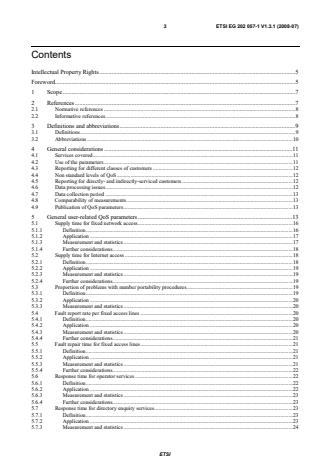
Contents
Intellectual Property Rights.5
Foreword.5
1 Scope.7
2 References.7
2.1 Normative references.8
2.2 Informative references.8
3 Definitions and abbreviations.9
3.1 Definitions.9
3.2 Abbreviations.10
4 General considerations .11
4.1 Services covered.11
4.2 Use of the parameters .11
4.3 Reporting for different classes of customers .12
4.4 Non standard levels of QoS.12
4.5 Reporting for directly- and indirectly-serviced customers .12
4.6 Data processing issues.12
4.7 Data collection period .13
4.8 Comparability of measurements.13
4.9 Publication of QoS parameters.13
5 General user-related QoS parameters.13
5.1 Supply time for fixed network access.16
5.1.1 Definition.16
5.1.2 Application.17
5.1.3 Measurement and statistics .17
5.1.4 Further considerations.18
5.2 Supply time for Internet access .18
5.2.1 Definition.18
5.2.2 Application.19
5.2.3 Measurement and statistics .19
5.2.4 Further considerations.19
5.3 Proportion of problems with number portability procedures.19
5.3.1 Definition.19
5.3.2 Application.20
5.3.3 Measurement and statistics .20
5.4 Fault report rate per fixed access lines .20
5.4.1 Definition.20
5.4.2 Application.20
5.4.3 Measurement and statistics .20
5.4.4 Further considerations.21
5.5 Fault repair time for fixed access lines.21
5.5.1 Definition.21
5.5.2 Application.21
5.5.3 Measurement and statistics .21
5.5.4 Further considerations.22
5.6 Response time for operator services.22
5.6.1 Definition.22
5.6.2 Application.22
5.6.3 Measurement and statistics .23
5.6.4 Further considerations.23
5.7 Response time for directory enquiry services.23
5.7.1 Definition.23
5.7.2 Application.23
5.7.3 Measurement and statistics .24
ETSI
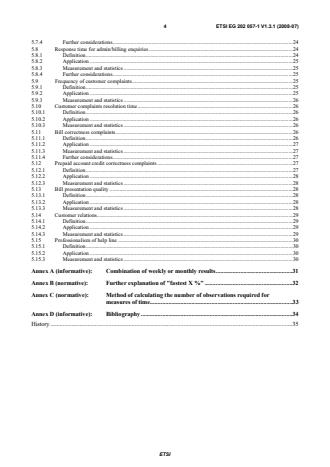
4 Final draft ETSI EG 202 057-1 V1.3.0 (2008-05)
5.7.4 Further considerations.24
5.8 Response time for admin/billing enquiries.24
5.8.1 Definition.24
5.8.2 Application.25
5.8.3 Measurement and statistics .25
5.8.4 Further considerations.25
5.9 Frequency of customer complaints.25
5.9.1 Definition.25
5.9.2 Application.25
5.9.3 Measurement and statistics .26
5.10 Customer complaints resolution time.26
5.10.1 Definition.26
5.10.2 Application.26
5.10.3 Measurement and statistics .26
5.11 Bill correctness complaints.26
5.11.1 Definition.26
5.11.2 Application.27
5.11.3 Measurement and statistics .27
5.11.4 Further considerations.27
5.12 Prepaid account credit correctness complaints .27
5.12.1 Definition.27
5.12.2 Application.28
5.12.3 Measurement and statistics .28
5.13 Bill presentation quality .28
5.13.1 Definition.28
5.13.2 Application.28
5.13.3 Measurement and statistics .28
5.14 Customer relations.29
5.14.1 Definition.29
5.14.2 Application.29
5.14.3 Measurement and statistics .29
5.15 Professionalism of help line .30
5.15.1 Definition.30
5.15.2 Application.30
5.15.3 Measurement and statistics .30
Annex A (informative): Combination of weekly or monthly results.31
Annex B (normative): Further explanation of "fastest X %" .32
Annex C (normative): Method of calculating the number of observations required for
measures of time.33
Annex D (informative): Bibliography.34
History .35
ETSI
5 Final draft ETSI EG 202 057-1 V1.3.0 (2008-05)
Intellectual Property Rights
IPRs essential or potentially essential to the present document may have been declared to ETSI. The information
pertaining to these essential IPRs, if any, is publicly available for ETSI members and non-members, and can be found
in ETSI SR 000 314: "Intellectual Property Rights (IPRs); Essential, or potentially Essential, IPRs notified to ETSI in
respect of ETSI standards", which is available from the ETSI Secretariat. Latest updates are available on the ETSI Web
server (http://webapp.etsi.org/IPR/home.asp).
Pursuant to the ETSI IPR Policy, no investigation, including IPR searches, has been carried out by ETSI. No guarantee
can be given as to the existence of other IPRs not referenced in ETSI SR 000 314 (or the updates on the ETSI Web
server) which are, or may be, or may become, essential to the present document.
Foreword
This ETSI Guide (EG) has been produced by ETSI Technical Committee Speech Processing, Transmission and Quality
Aspects (STQ), and is now submitted for the ETSI standards Membership Approval Procedure.
The present document is part 1 of a multi-part deliverable covering Speech Processing, Transmission and Quality
Aspects (STQ); User related QoS parameter definitions and measurements, as identified below:
Part 1: "General";
Part 2: "Voice telephony, Group 3 fax, modem data services and SMS";
Part 3: "QoS parameters specific to Public Land Mobile Networks (PLMN)";
Part 4: "Internet access".
EG 202 057-1 (the present document) contains general user related QoS parameter definitions and measurement
methods that can be applied to any service. Additional parts of the present document will contain service specific user
related QoS parameter definitions and measurement methods.
EG 202 057-2 [7] contains user related QoS parameter definitions and measurement methods for voice, Group 3 fax,
modem data services and SMS accessed via the public telecommunications network. The data parameters are specified
for the case where an ITU-T Recommendations V.90 [5] and V.92 [6], compliant modem is used since this kind of
modem is in common use.
EG 202 057-3 [8] contains user related QoS parameter definitions and measurement methods for public land mobile
networks (PLMN).
EG 202 057-4 [9] contains user related QoS parameter definitions and measurement methods specific to Internet access.
The present document has been written to provide a balanced approach taking into account as far as practicable the
following seven principles:
1) QoS parameters should be easily understood by the public, and be useful and important to them.
2) All network related parameters are applicable at the network termination point (where appropriate).
3) To be as realistic as possible, real traffic rather than test calls should be used as a basis of the measurements,
wherever possible.
4) Parameters should be capable of verification by independent organizations. This verification might be made by
direct measurements or by audit of service provider's measurements.
5) The accuracy of QoS values should be set to a level consistent with measurement methods being as simple as
possible with costs as low as possible.
6) The parameters are designed for both statistical and individual application. The statistical values should be
derived by the application of a simple statistical function to the individual values. The statistical function
should be specified in this multi-part deliverable. This multi-part deliverable should also contain guidelines on
how statistically significant samples should be selected.
ETSI
6 Final draft ETSI EG 202 057-1 V1.3.0 (2008-05)
7) The statistical functions should be designed so QoS figures from different service providers can be compared
easily by users and in particular consumers.
ETSI
7 Final draft ETSI EG 202 057-1 V1.3.0 (2008-05)
1 Scope
The present document contains definitions and measurement methods for a range of user perceivable Quality of Service
(QoS) parameters. The purpose of these parameters is to define objective and comparable measures of the QoS
delivered to users/customers for use by users/customers. The present document applies to any telecommunication
service, however, some parameters may have a limited application.
The present document is intended to provide a menu from which individual items can be selected. There is no
obligation to use any or all of the parameters.
The QoS parameters are related primarily to services and service features and not to the technology used to provide the
services. Therefore the parameters should be capable of use when the services are provided on new technologies such as
IP and ATM or other packet switched technologies as well as on circuit switched technologies.
The establishment of target values for QoS is beyond the scope of the present document. The QoS parameters listed in
the present document are also not intended to assess the complete QoS of a telecommunication service. The present
document provides a set of QoS parameters that covers specific user related QoS aspects rather than a complete list of
QoS parameters. This set has been chosen to address areas where monitoring of QoS is likely to be most worthwhile,
i.e. the areas that are most likely to be affected by any QoS problems.
If stakeholders wish to examine other QoS aspects they are recommended to follow the general approach of the present
document - as far as practicable - as a basis for the development of definitions and measurement methods for new
specific QoS parameters.
The set of QoS parameters is designed to be understood by the users of various telecommunications services. Sub-sets
of these parameters can be selected for use in different circumstances. For example a specific parameter might be
relevant for many users in some countries or markets but the same parameter might not be of relevance in others.
Therefore stakeholders - users, customers, regulators, service providers, network operators and other parties interested
in the use of QoS parameters - should decide in co-operation, which parameters and which measures should be used in
their particular situation. This decision should take account of:
• The precise purpose for which they will be used.
• The general level of quality achieved by most operators.
• The degree to which the parameters will provide a reliable comparison of performance.
• The cost of measuring and reporting each parameter.
2 References
References are either specific (identified by date of publication and/or edition number or version number) or non-
specific.
• For a specific reference, subsequent revisions do not apply.
• Non-specific reference may be made only to a complete document or a part thereof and only in the following
cases:
- if it is accepted that it will be possible to use all future changes of the referenced document for the
purposes of the referring document;
- for informative references.
Referenced documents which are not found to be publicly available in the expected location might be found at
http://docbox.etsi.org/Reference.
ETSI
8 Final draft ETSI EG 202 057-1 V1.3.0 (2008-05)
For online referenced documents, information sufficient to identify and locate the source shall be provided. Preferably,
the primary source of the referenced document should be cited, in order to ensure traceability. Furthermore, the
reference should, as far as possible, remain valid for the expected life of the document. The reference shall include the
method of access to the referenced document and the full network address, with the same punctuation and use of upper
case and lower case letters.
NOTE: While any hyperlinks included in this clause were valid at the time of publication ETSI cannot guarantee
their long term validity.
2.1 Normative references
The following referenced documents are indispensable for the application of the present document. For dated
references, only the edition cited applies. For non-specific references, the latest edition of the referenced document
(including any amendments) applies.
[1] Directive 98/10/EC of the European Parliament and of the Council of 26 February 1998 on the
application of open network provision (ONP) to voice telephony and on universal service for
telecommunications in a competitive environment.
[2] ITU-T Recommendation E.105: "International telephone service".
[3] ITU-T Recommendation E.800: "Terms and definitions related to quality of service and network
performance including dependability".
[4] ITU-T Recommendation I.210: "Principles of telecommunication services supported by an ISDN
and the means to describe them".
[5] ITU-T Recommendation V.90: "A digital modem and analogue modem pair for use on the Public
Switched Telephone Network (PSTN) at data signalling rates of up to 56 000 bit/s downstream
and up to 33 600 bit/s upstream".
[6] ITU-T Recommendation V.92: "Enhancements to Recommendation V.90".
2.2 Informative references
The following referenced documents are not essential to the use of the present document but they assist the user with
regard to a particular subject area. For non-specific references, the latest version of the referenced document (including
any amendments) applies.
[7] ETSI EG 202 057-2: "Speech Processing, Transmission and Quality Aspects (STQ); User related
QoS parameter definitions and measurements; Part 2: Voice telephony, Group 3 fax, modem data
services and SMS".
[8] ETSI EG 202 057-3: "Speech Processing, Transmission and Quality Aspects (STQ); User related
QoS parameter definitions and measurements; Part 3: QoS parameters specific to Public Land
Mobile Networks (PLMN)".
[9] ETSI EG 202 057-4: "Speech Processing, Transmission and Quality Aspects (STQ); User related
QoS parameter definitions and measurements; Part 4: Internet access".
ETSI
9 Final draft ETSI EG 202 057-1 V1.3.0 (2008-05)
3 Definitions and abbreviations
3.1 Definitions
For the purposes of the present document, the following terms and definitions apply:
access line: connection from the Network Termination Point (NTP) to the entry point to the local switch or remote
concentrator, whichever is the nearer
NOTE: In many cases this is the main distribution frame.
access network operator: organization that provides the access line
NOTE: In many cases the access network operator will be the direct service provider, but if the line is unbundled,
the direct service provider would be a separate organization.
call by call carrier selection: form of carrier selection where the user dials a carrier access code to indicate which
carrier is to route the call
carrier access code: code that the user may or must dial before the national (significant) number when dialling an
access line in another telecommunications network, so that the call is routed by the carrier of his choice
customer: party that pays for the telecommunication service(s) provided
NOTE: Customers can generally be categorized as business or residential; the definition of business and
residential customers is left to individual service providers. Service providers who receive interconnect
services from other service providers are not considered to be customers for the purpose of the present
document. The term "customer" is equivalent to "subscriber", which is used in Directive 98/10/EC [1].
direct service: service where the service provider that provides the telecommunication service(s) also provides the
access network or rents an unswitched local loop (unbundled local loop) to use for the provision of the service to the
customer
indirect service: service where the service provider that provides the telecommunication service(s) does not provide the
access network but is selected by the customer or user using a form of call by call carrier selection or carrier
preselection
Internet: computer network consisting of a worldwide network of computer networks that use the TCP/IP network
protocols to facilitate data transmission and exchange
Internet access: making available of facilities and/or services for the purpose of providing an access to the public
Internet in order to provide a user with access to services or resources of the Internet
NOTE 1: The Internet access can be separated in two parts, the physical and the logical access.
The physical access provides a connection form the user's premises to, but not including, the POP
(normally a dial-up circuit or broadband link or leased line) whereas the logical access consist of the
setting up of an account that later on enables the user by a login process with the ability to access to the
services and resources of the Internet (normally by assigning an IP address).
NOTE 2: The physical and logical access may be provided by different service providers.
NOTE 3: The function of the physical access may be provided by several interconnected networks.
Internet Access Provider (IAP): organization that provides users with an Internet access
login process: multi-step process which includes both authentication and authorization as well as other system start-up
tasks in order to provide a user with access to services or resources
network operator: organization that provides a network for the provision of a public telecommunication service
NOTE: If the same organization also offers services it also becomes a service provider.
Network Termination Point (NTP): physical point at which a user is provided with access to a public
telecommunications network
ETSI
10 Final draft ETSI EG 202 057-1 V1.3.0 (2008-05)
ported number: subscriber number (directory number) where the location of the NTP and/or the identity of the service
provider has changed after the number was originally allocated
preselection: form of carrier selection where the customer informs his access network operator which carrier is to route
all or a particular subset of his calls, unless call by call carrier selection is used
public Internet: part of the Internet that is available to the general public
NOTE: The access is normally provided by Internet access and Internet service providers.
Public Telecommunications Network (PTN): telecommunications network used wholly or partly for the provision of
publicly available telecommunications services
Quality of Service (QoS): collective effect of service performance which determines the degree of satisfaction of a user
of the service
NOTE: See ITU-T Recommendation E.800 [3].
service provider: organization that offers a telecommunication service to the customer and/or user
NOTE: A service provider need not be a network operator.
stakeholder: party having an interest in the level of quality of a service
supplementary service: additional service that modifies or supplements a basic telecommunication service
NOTE: Consequently, it cannot be offered to a customer as a stand-alone service; it has to be offered in
association with a basic telecommunication service. The same supplementary service may be common to
a number of basic telecommunication services (see ITU-T Recommendation I.210 [4]).
telecommunications: technical process of sending, transmitting and receiving any kind of message in the form of signs,
voice, images or sounds by means of telecommunications systems
telecommunication services: provision of telecommunications and the provision of other additional services that are
closely related to the provision of telecommunications
EXAMPLE: Billing, directory services.
telecommunications systems: technical equipment or systems capable of sending, transmitting, switching, receiving,
steering or controlling as messages identifiable electromagnetic signals
user: individuals, including consumers, or organizations using or requesting publicly available telecommunications
services
NOTE: See Directive 98/10/EC [1].
3.2 Abbreviations
For the purposes of the present document, the following abbreviations apply:
ACD Automatic Call Distribution
ACR Anonymous Call Rejection
AoC Advice of Charge
ATM Asynchronous Transfer Mode
CDR Call Detail Record
CLIP Calling Line Identification Presentation
CLIR Calling Line Identification Restriction
CPE Customer Premises Equipment
NOTE: Controlled and normally provided by the customer.
GSM Global Service for Mobile communication
IAP Internet Access Provider
ISDN Integrated Services Digital Network
IVR Interactive Voice Response
ETSI
11 Final draft ETSI EG 202 057-1 V1.3.0 (2008-05)
MOS Mean Opinion Score
NTP Network Termination Point
ONP Open Network Provision
POP Point of Presence
PSTN Public Switched Telephone Network
PTN Public Telecommunications Network
QoS Quality of Service
SMS Short Message Service
VAT Value Added Tax
xDSL generic Digital Subscriber Line
4 General considerations
4.1 Services covered
The QoS parameters of the present document cover aspects of telecommunications services which are typically
provided via the public telecommunications network such as voice, fax or data services. These services may be accessed
via terminals connected to fixed network termination points or via mobile accesses e.g. GSM.
The definitions and measurement methods of the QoS parameters were elaborated primarily in order to assess QoS
aspects of "standard" telecommunication services. Therefore mainly common aspects and applications of
telecommunication services were considered and are reflected in the present parameters. In principle the QoS
parameters may also be used for the investigation of special or non-standard telecommunication services but further
enhancements/additions to the definitions and measurements methods may be necessary.
Most parameters are in principle applicable to any service provided via the public telecommunications network. Some
parameters are however only applicable to specific services depending on technical aspects of the provision of those
services, e.g. mobile, data, fixed NTP. Depending on the set of QoS parameters used by the stakeholders the scope of
the services covered may vary.
The parameters are end-user/customer and end-to-end orientated and are not intended to address the quality of
interconnect services explicitly. Any dependence on interconnect services is included implicitly in the measures of QoS
provided to the end user. Separate Guides in this series deal with the QoS of interconnect arrangements.
In many cases the provider of telecommunications services to the customer may depend on other providers for part of
the service. An example is an international call where several service providers are normally involved. In such cases the
provider of the service to the customer is responsible for all elements for which it receives payment from the customer.
In order to provide satisfactory QoS, this service provider will need to ensure that adequate QoS is provided by the
other interconnected service providers. QoS figures for the responsible service provider will reflect both its own
capability and that of the interconnected service providers.
4.2 Use of the parameters
The parameters may be used for various purposes including:
• specifying the level of quality of service in customer telecommunication service contracts or in the description
or terms and conditions of the service;
• comparing the quality of service of different service providers;
• comparing the quality of service aspects of different service offers;
• preparing long term studies on the quality of service aspects of a specific service.
ETSI
12 Final draft ETSI EG 202 057-1 V1.3.0 (2008-05)
4.3 Reporting for different classes of customers
For each parameter, statistics may be produced or requested that are aggregated over all classes of customer or, where a
distinction between different classes is desired, e.g. residential and business, separate statistics may be used, or both.
This recognizes the voluntary nature of these measures and the fact that some stakeholders may only wish to target
specific sections or to provide a rough overview of the market.
NOTE: Due to the fact that a variety of different service offers is available at the market, it is not always possible
to clearly distinguish between classes of customers like residential or business. Furthermore it may not be
fair to compare different service offers on the basis of different classes of customers because the results
may be misleading. Also statistics may be falsified when aggregating over all classes of customers.
See also clause 4.9.
4.4 Non standard levels of QoS
Statistics produced should normally be based on the standard level of QoS for each telecommunication service. The
standard level is defined in the terms and conditions of the services as published by the service providers. Stakeholders
may choose to produce or request specific statistics for cases where customers are able to pay more for enhanced or less
for lower QoS. It is recommended to provide additional information on the kind and scope of services the QoS statistics
are referring to when covering non standard levels of QoS.
4.5 Reporting for directly- and indirectly-serviced customers
The principle used is that the service provider who charges the customer should be responsible for the quality of the
service and for providing QoS statistics relevant to the service provided. Thus, in the case of carrier selection, the
indirect service provider has the responsibility for QoS and provision of QoS statistics when it is selected to carry a call.
For each parameter in clause 5 a statement is made on whether it is applicable to indirect services.
Some service providers provide both direct and indirect services. Where there are likely to be significantly different
levels of performance for these two service types or where the services are understood as being two different not
comparable service offers (even though the same telecommunication service is offered), the production of separate
statistics for each service type is recommended.
The treatment of direct and indirect services is summarized in the last column of table 1.
NOTE: Where only a combined statistic for both types of service is specified, separate statistics for each service
type may be provided in addition if the stakeholders to do so.
4.6 Data processing issues
Where the measures are based on all actual occurrences rather than samples, the measuring party may prefer to process
data on a weekly or monthly basis, discard the detailed data and use a statistical method such as that specified in
annex A for combining the weekly or monthly results.
For several parameters the statistic required is "the time by which the fastest X % is.". This statistic is explained in
annex B.
In some cases disasters, freak weather, etc. may distort measured QoS figures. Such occurrences may not necessarily
damage a network, but could degrade QoS by inducing exceptional traffic levels etc. In these cases, service providers
should provide the measured QoS and may additionally provide a second figure which excludes the effects of the
exceptional circumstances. A note clearly explaining the difference should also be provided. Service providers covering
large geographical areas are likely to be more prone to these effects than service providers serving smaller areas. The
effect on the reported QoS of a service provider covering a small area is likely to be more severe, however, should such
an event occur.
ETSI
13 Final draft ETSI EG 202 057-1 V1.3.0 (2008-05)
4.7 Data collection period
Where the measurements are to be used for long term comparisons, it is recommended that QoS data should be
st st st st
collected and calculated on a quarterly basis starting on 1 January, 1 April, 1 July and 1 October.
Stakeholders may also decide to use longer or shorter data collection periods. For most QoS parameters a data
collection period on a quarterly basis is suitable, and will provide adequately up-to-date information. But there may also
be cases were a longer period is more practicable, e.g. extensive customer surveys. Shorter periods are advisable for
QoS aspects where frequent and fast changes in quality are likely to occur.
4.8 Comparability of measurements
The following issues may affect the comparability of the measurement results:
• where the parameters are measured based on the number of customer complaints; service providers may have
different strategies for handling customer complaints (e.g. call centres, ACD, trouble ticket systems) and these
strategies will have significant influence on resulting statistics (e.g. long delays in answering calls to a
customer complaint line will suppress the number of recorded complaints);
• different types of customer may react differently to quality of service problems and this will influence results
(e.g. business customers have different fault report behaviour, origins and destinations of call related
parameters may vary);
• fault report rates for direct and indirect services are likely to show significant differences because of the
different fault report behaviour for these services;
• service offers that claim to be similar may differ in terms of significant service features/aspects.
NOTE: The parameters were elaborated with respect to "standard" service offers and so special care should be
taken for non-standard services.
4.9 Publication of QoS parameters
Where measurements are made and published in accordance with the present document, it is recommended that an
explicit reference to the present document should be given so that readers can be made aware of the background of the
definitions and measurement methods. The reader should be enabled to understand the meaning, purpose and areas of
application of the QoS parameters.
It is important that the reader is aware of the scope of the parameters and with that of the correct application of the QoS
statistics, otherwise there is a high risk that the measurement results are misinterpreted. A fair and justified comparison
of the published data of different service offers, i.e. quality aspects of different telecommunication services, is only
possible if the data is strictly used according to the scope of the defined QoS parameters.
Stakeholders who publish QoS statistics in accordance with the present document should provide additional and
explanatory text in order to facilitate the understanding of the statistics. It may be assumed that a reader who is
interested in comparable QoS statistics and QoS parameters of different nature is willing and capable to understand
technical and operational background information on telecommunication services. A balanced approach should be used
taking into account on the one hand the need for easy understandable information and on the other hand the requirement
of correctly edited data derived from the measurements.
5 General user-related QoS parameters
Table 1 summarizes the QoS parameters defined in the present document.
NOTE: Many of the parameters have several subtleties associated with their definition, a
...
ETSI Guide
Speech Processing, Transmission and Quality Aspects (STQ);
User related QoS parameter definitions and measurements;
Part 1: General
2 ETSI EG 202 057-1 V1.3.1 (2008-07)
Reference
REG/STQ-00101-1
Keywords
QoS, quality, user
ETSI
650 Route des Lucioles
F-06921 Sophia Antipolis Cedex - FRANCE
Tel.: +33 4 92 94 42 00 Fax: +33 4 93 65 47 16
Siret N° 348 623 562 00017 - NAF 742 C
Association à but non lucratif enregistrée à la
Sous-Préfecture de Grasse (06) N° 7803/88
Important notice
Individual copies of the present document can be downloaded from:
http://www.etsi.org
The present document may be made available in more than one electronic version or in print. In any case of existing or
perceived difference in contents between such versions, the reference version is the Portable Document Format (PDF).
In case of dispute, the reference shall be the printing on ETSI printers of the PDF version kept on a specific network drive
within ETSI Secretariat.
Users of the present document should be aware that the document may be subject to revision or change of status.
Information on the current status of this and other ETSI documents is available at
http://portal.etsi.org/tb/status/status.asp
If you find errors in the present document, please send your comment to one of the following services:
http://portal.etsi.org/chaircor/ETSI_support.asp
Copyright Notification
No part may be reproduced except as authorized by written permission.
The copyright and the foregoing restriction extend to reproduction in all media.
© European Telecommunications Standards Institute 2008.
All rights reserved.
TM TM TM TM
DECT , PLUGTESTS , UMTS , TIPHON , the TIPHON logo and the ETSI logo are Trade Marks of ETSI registered
for the benefit of its Members.
TM
3GPP is a Trade Mark of ETSI registered for the benefit of its Members and of the 3GPP Organizational Partners.
ETSI
3 ETSI EG 202 057-1 V1.3.1 (2008-07)
Contents
Intellectual Property Rights.5
Foreword.5
1 Scope.7
2 References.7
2.1 Normative references.8
2.2 Informative references.8
3 Definitions and abbreviations.9
3.1 Definitions.9
3.2 Abbreviations.10
4 General considerations .11
4.1 Services covered.11
4.2 Use of the parameters .11
4.3 Reporting for different classes of customers .12
4.4 Non standard levels of QoS.12
4.5 Reporting for directly- and indirectly-serviced customers .12
4.6 Data processing issues.12
4.7 Data collection period .13
4.8 Comparability of measurements.13
4.9 Publication of QoS parameters.13
5 General user-related QoS parameters.13
5.1 Supply time for fixed network access.16
5.1.1 Definition.16
5.1.2 Application.17
5.1.3 Measurement and statistics .17
5.1.4 Further considerations.18
5.2 Supply time for Internet access .18
5.2.1 Definition.18
5.2.2 Application.19
5.2.3 Measurement and statistics .19
5.2.4 Further considerations.19
5.3 Proportion of problems with number portability procedures.19
5.3.1 Definition.19
5.3.2 Application.20
5.3.3 Measurement and statistics .20
5.4 Fault report rate per fixed access lines .20
5.4.1 Definition.20
5.4.2 Application.20
5.4.3 Measurement and statistics .20
5.4.4 Further considerations.21
5.5 Fault repair time for fixed access lines.21
5.5.1 Definition.21
5.5.2 Application.21
5.5.3 Measurement and statistics .21
5.5.4 Further considerations.22
5.6 Response time for operator services.22
5.6.1 Definition.22
5.6.2 Application.22
5.6.3 Measurement and statistics .23
5.6.4 Further considerations.23
5.7 Response time for directory enquiry services.23
5.7.1 Definition.23
5.7.2 Application.23
5.7.3 Measurement and statistics .24
ETSI
4 ETSI EG 202 057-1 V1.3.1 (2008-07)
5.7.4 Further considerations.24
5.8 Response time for admin/billing enquiries.24
5.8.1 Definition.24
5.8.2 Application.25
5.8.3 Measurement and statistics .25
5.8.4 Further considerations.25
5.9 Frequency of customer complaints.25
5.9.1 Definition.25
5.9.2 Application.25
5.9.3 Measurement and statistics .26
5.10 Customer complaints resolution time.26
5.10.1 Definition.26
5.10.2 Application.26
5.10.3 Measurement and statistics .26
5.11 Bill correctness complaints.26
5.11.1 Definition.26
5.11.2 Application.27
5.11.3 Measurement and statistics .27
5.11.4 Further considerations.27
5.12 Prepaid account credit correctness complaints .27
5.12.1 Definition.27
5.12.2 Application.28
5.12.3 Measurement and statistics .28
5.13 Bill presentation quality .28
5.13.1 Definition.28
5.13.2 Application.28
5.13.3 Measurement and statistics .28
5.14 Customer relations.29
5.14.1 Definition.29
5.14.2 Application.29
5.14.3 Measurement and statistics .29
5.15 Professionalism of help line .30
5.15.1 Definition.30
5.15.2 Application.30
5.15.3 Measurement and statistics .30
Annex A (informative): Combination of weekly or monthly results.31
Annex B (normative): Further explanation of "fastest X %" .32
Annex C (normative): Method of calculating the number of observations required for
measures of time.33
Annex D (informative): Bibliography.34
History .35
ETSI
5 ETSI EG 202 057-1 V1.3.1 (2008-07)
Intellectual Property Rights
IPRs essential or potentially essential to the present document may have been declared to ETSI. The information
pertaining to these essential IPRs, if any, is publicly available for ETSI members and non-members, and can be found
in ETSI SR 000 314: "Intellectual Property Rights (IPRs); Essential, or potentially Essential, IPRs notified to ETSI in
respect of ETSI standards", which is available from the ETSI Secretariat. Latest updates are available on the ETSI Web
server (http://webapp.etsi.org/IPR/home.asp).
Pursuant to the ETSI IPR Policy, no investigation, including IPR searches, has been carried out by ETSI. No guarantee
can be given as to the existence of other IPRs not referenced in ETSI SR 000 314 (or the updates on the ETSI Web
server) which are, or may be, or may become, essential to the present document.
Foreword
This ETSI Guide (EG) has been produced by ETSI Technical Committee Speech Processing, Transmission and Quality
Aspects (STQ).
The present document is part 1 of a multi-part deliverable covering Speech Processing, Transmission and Quality
Aspects (STQ); User related QoS parameter definitions and measurements, as identified below:
Part 1: "General";
Part 2: "Voice telephony, Group 3 fax, modem data services and SMS";
Part 3: "QoS parameters specific to Public Land Mobile Networks (PLMN)";
Part 4: "Internet access".
EG 202 057-1 (the present document) contains general user related QoS parameter definitions and measurement
methods that can be applied to any service. Additional parts of the present document will contain service specific user
related QoS parameter definitions and measurement methods.
EG 202 057-2 [i.1] contains user related QoS parameter definitions and measurement methods for voice, Group 3 fax,
modem data services and SMS accessed via the public telecommunications network. The data parameters are specified
for the case where an ITU-T Recommendations V.90 [5] and V.92 [6], compliant modem is used since this kind of
modem is in common use.
EG 202 057-3 [i.2] contains user related QoS parameter definitions and measurement methods for public land mobile
networks (PLMN).
EG 202 057-4 [i.3] contains user related QoS parameter definitions and measurement methods specific to Internet
access.
The present document has been written to provide a balanced approach taking into account as far as practicable the
following seven principles:
1) QoS parameters should be easily understood by the public, and be useful and important to them.
2) All network related parameters are applicable at the network termination point (where appropriate).
3) To be as realistic as possible, real traffic rather than test calls should be used as a basis of the measurements,
wherever possible.
4) Parameters should be capable of verification by independent organizations. This verification might be made by
direct measurements or by audit of service provider's measurements.
5) The accuracy of QoS values should be set to a level consistent with measurement methods being as simple as
possible with costs as low as possible.
ETSI
6 ETSI EG 202 057-1 V1.3.1 (2008-07)
6) The parameters are designed for both statistical and individual application. The statistical values should be
derived by the application of a simple statistical function to the individual values. The statistical function
should be specified in this multi-part deliverable. This multi-part deliverable should also contain guidelines on
how statistically significant samples should be selected.
7) The statistical functions should be designed so QoS figures from different service providers can be compared
easily by users and in particular consumers.
ETSI
7 ETSI EG 202 057-1 V1.3.1 (2008-07)
1 Scope
The present document contains definitions and measurement methods for a range of user perceivable Quality of Service
(QoS) parameters. The purpose of these parameters is to define objective and comparable measures of the QoS
delivered to users/customers for use by users/customers. The present document applies to any telecommunication
service, however, some parameters may have a limited application.
The present document is intended to provide a menu from which individual items can be selected. There is no
obligation to use any or all of the parameters.
The QoS parameters are related primarily to services and service features and not to the technology used to provide the
services. Therefore the parameters should be capable of use when the services are provided on new technologies such as
IP and ATM or other packet switched technologies as well as on circuit switched technologies.
The establishment of target values for QoS is beyond the scope of the present document. The QoS parameters listed in
the present document are also not intended to assess the complete QoS of a telecommunication service. The present
document provides a set of QoS parameters that covers specific user related QoS aspects rather than a complete list of
QoS parameters. This set has been chosen to address areas where monitoring of QoS is likely to be most worthwhile,
i.e. the areas that are most likely to be affected by any QoS problems.
If stakeholders wish to examine other QoS aspects they are recommended to follow the general approach of the present
document - as far as practicable - as a basis for the development of definitions and measurement methods for new
specific QoS parameters.
The set of QoS parameters is designed to be understood by the users of various telecommunications services. Sub-sets
of these parameters can be selected for use in different circumstances. For example a specific parameter might be
relevant for many users in some countries or markets but the same parameter might not be of relevance in others.
Therefore stakeholders - users, customers, regulators, service providers, network operators and other parties interested
in the use of QoS parameters - should decide in co-operation, which parameters and which measures should be used in
their particular situation. This decision should take account of:
• The precise purpose for which they will be used.
• The general level of quality achieved by most operators.
• The degree to which the parameters will provide a reliable comparison of performance.
• The cost of measuring and reporting each parameter.
2 References
References are either specific (identified by date of publication and/or edition number or version number) or non-
specific.
• For a specific reference, subsequent revisions do not apply.
• Non-specific reference may be made only to a complete document or a part thereof and only in the following
cases:
- if it is accepted that it will be possible to use all future changes of the referenced document for the
purposes of the referring document;
- for informative references.
Referenced documents which are not found to be publicly available in the expected location might be found at
http://docbox.etsi.org/Reference.
ETSI
8 ETSI EG 202 057-1 V1.3.1 (2008-07)
For online referenced documents, information sufficient to identify and locate the source shall be provided. Preferably,
the primary source of the referenced document should be cited, in order to ensure traceability. Furthermore, the
reference should, as far as possible, remain valid for the expected life of the document. The reference shall include the
method of access to the referenced document and the full network address, with the same punctuation and use of upper
case and lower case letters.
NOTE: While any hyperlinks included in this clause were valid at the time of publication ETSI cannot guarantee
their long term validity.
2.1 Normative references
The following referenced documents are indispensable for the application of the present document. For dated
references, only the edition cited applies. For non-specific references, the latest edition of the referenced document
(including any amendments) applies.
[1] Directive 98/10/EC of the European Parliament and of the Council of 26 February 1998 on the
application of open network provision (ONP) to voice telephony and on universal service for
telecommunications in a competitive environment.
[2] ITU-T Recommendation E.105: "International telephone service".
[3] ITU-T Recommendation E.800: "Terms and definitions related to quality of service and network
performance including dependability".
[4] ITU-T Recommendation I.210: "Principles of telecommunication services supported by an ISDN
and the means to describe them".
[5] ITU-T Recommendation V.90: "A digital modem and analogue modem pair for use on the Public
Switched Telephone Network (PSTN) at data signalling rates of up to 56 000 bit/s downstream
and up to 33 600 bit/s upstream".
[6] ITU-T Recommendation V.92: "Enhancements to Recommendation V.90".
2.2 Informative references
The following referenced documents are not essential to the use of the present document but they assist the user with
regard to a particular subject area. For non-specific references, the latest version of the referenced document (including
any amendments) applies.
[i.1] ETSI EG 202 057-2: "Speech Processing, Transmission and Quality Aspects (STQ); User related
QoS parameter definitions and measurements; Part 2: Voice telephony, Group 3 fax, modem data
services and SMS".
[i.2] ETSI EG 202 057-3: "Speech Processing, Transmission and Quality Aspects (STQ); User related
QoS parameter definitions and measurements; Part 3: QoS parameters specific to Public Land
Mobile Networks (PLMN)".
[i.3] ETSI EG 202 057-4: "Speech Processing, Transmission and Quality Aspects (STQ); User related
QoS parameter definitions and measurements; Part 4: Internet access".
ETSI
9 ETSI EG 202 057-1 V1.3.1 (2008-07)
3 Definitions and abbreviations
3.1 Definitions
For the purposes of the present document, the following terms and definitions apply:
access line: connection from the Network Termination Point (NTP) to the entry point to the local switch or remote
concentrator, whichever is the nearer
NOTE: In many cases this is the main distribution frame.
access network operator: organization that provides the access line
NOTE: In many cases the access network operator will be the direct service provider, but if the line is unbundled,
the direct service provider would be a separate organization.
call by call carrier selection: form of carrier selection where the user dials a carrier access code to indicate which
carrier is to route the call
carrier access code: code that the user may or must dial before the national (significant) number when dialling an
access line in another telecommunications network, so that the call is routed by the carrier of his choice
customer: party that pays for the telecommunication service(s) provided
NOTE: Customers can generally be categorized as business or residential; the definition of business and
residential customers is left to individual service providers. Service providers who receive interconnect
services from other service providers are not considered to be customers for the purpose of the present
document. The term "customer" is equivalent to "subscriber", which is used in Directive 98/10/EC [1].
direct service: service where the service provider that provides the telecommunication service(s) also provides the
access network or rents an unswitched local loop (unbundled local loop) to use for the provision of the service to the
customer
indirect service: service where the service provider that provides the telecommunication service(s) does not provide the
access network but is selected by the customer or user using a form of call by call carrier selection or carrier
preselection
Internet: computer network consisting of a worldwide network of computer networks that use the TCP/IP network
protocols to facilitate data transmission and exchange
Internet access: making available of facilities and/or services for the purpose of providing an access to the public
Internet in order to provide a user with access to services or resources of the Internet
NOTE 1: The Internet access can be separated in two parts, the physical and the logical access.
The physical access provides a connection form the user's premises to, but not including, the POP
(normally a dial-up circuit or broadband link or leased line) whereas the logical access consist of the
setting up of an account that later on enables the user by a login process with the ability to access to the
services and resources of the Internet (normally by assigning an IP address).
NOTE 2: The physical and logical access may be provided by different service providers.
NOTE 3: The function of the physical access may be provided by several interconnected networks.
Internet Access Provider (IAP): organization that provides users with an Internet access
login process: multi-step process which includes both authentication and authorization as well as other system start-up
tasks in order to provide a user with access to services or resources
network operator: organization that provides a network for the provision of a public telecommunication service
NOTE: If the same organization also offers services it also becomes a service provider.
Network Termination Point (NTP): physical point at which a user is provided with access to a public
telecommunications network
ETSI
10 ETSI EG 202 057-1 V1.3.1 (2008-07)
ported number: subscriber number (directory number) where the location of the NTP and/or the identity of the service
provider has changed after the number was originally allocated
preselection: form of carrier selection where the customer informs his access network operator which carrier is to route
all or a particular subset of his calls, unless call by call carrier selection is used
public Internet: part of the Internet that is available to the general public
NOTE: The access is normally provided by Internet access and Internet service providers.
Public Telecommunications Network (PTN): telecommunications network used wholly or partly for the provision of
publicly available telecommunications services
Quality of Service (QoS): collective effect of service performance which determines the degree of satisfaction of a user
of the service
NOTE: See ITU-T Recommendation E.800 [3].
service provider: organization that offers a telecommunication service to the customer and/or user
NOTE: A service provider need not be a network operator.
stakeholder: party having an interest in the level of quality of a service
supplementary service: additional service that modifies or supplements a basic telecommunication service
NOTE: Consequently, it cannot be offered to a customer as a stand-alone service; it has to be offered in
association with a basic telecommunication service. The same supplementary service may be common to
a number of basic telecommunication services (see ITU-T Recommendation I.210 [4]).
telecommunications: technical process of sending, transmitting and receiving any kind of message in the form of signs,
voice, images or sounds by means of telecommunications systems
telecommunication services: provision of telecommunications and the provision of other additional services that are
closely related to the provision of telecommunications
EXAMPLE: Billing, directory services.
telecommunications systems: technical equipment or systems capable of sending, transmitting, switching, receiving,
steering or controlling as messages identifiable electromagnetic signals
user: individuals, including consumers, or organizations using or requesting publicly available telecommunications
services
NOTE: See Directive 98/10/EC [1].
3.2 Abbreviations
For the purposes of the present document, the following abbreviations apply:
ACD Automatic Call Distribution
ACR Anonymous Call Rejection
AoC Advice of Charge
ATM Asynchronous Transfer Mode
CDR Call Detail Record
CLIP Calling Line Identification Presentation
CLIR Calling Line Identification Restriction
CPE Customer Premises Equipment
NOTE: Controlled and normally provided by the customer.
GSM Global Service for Mobile communication
IAP Internet Access Provider
ISDN Integrated Services Digital Network
IVR Interactive Voice Response
ETSI
11 ETSI EG 202 057-1 V1.3.1 (2008-07)
MOS Mean Opinion Score
NTP Network Termination Point
ONP Open Network Provision
POP Point of Presence
PSTN Public Switched Telephone Network
PTN Public Telecommunications Network
QoS Quality of Service
SMS Short Message Service
VAT Value Added Tax
xDSL generic Digital Subscriber Line
4 General considerations
4.1 Services covered
The QoS parameters of the present document cover aspects of telecommunications services which are typically
provided via the public telecommunications network such as voice, fax or data services. These services may be accessed
via terminals connected to fixed network termination points or via mobile accesses e.g. GSM.
The definitions and measurement methods of the QoS parameters were elaborated primarily in order to assess QoS
aspects of "standard" telecommunication services. Therefore mainly common aspects and applications of
telecommunication services were considered and are reflected in the present parameters. In principle the QoS
parameters may also be used for the investigation of special or non-standard telecommunication services but further
enhancements/additions to the definitions and measurements methods may be necessary.
Most parameters are in principle applicable to any service provided via the public telecommunications network. Some
parameters are however only applicable to specific services depending on technical aspects of the provision of those
services, e.g. mobile, data, fixed NTP. Depending on the set of QoS parameters used by the stakeholders the scope of
the services covered may vary.
The parameters are end-user/customer and end-to-end orientated and are not intended to address the quality of
interconnect services explicitly. Any dependence on interconnect services is included implicitly in the measures of QoS
provided to the end user. Separate Guides in this series deal with the QoS of interconnect arrangements.
In many cases the provider of telecommunications services to the customer may depend on other providers for part of
the service. An example is an international call where several service providers are normally involved. In such cases the
provider of the service to the customer is responsible for all elements for which it receives payment from the customer.
In order to provide satisfactory QoS, this service provider will need to ensure that adequate QoS is provided by the
other interconnected service providers. QoS figures for the responsible service provider will reflect both its own
capability and that of the interconnected service providers.
4.2 Use of the parameters
The parameters may be used for various purposes including:
• specifying the level of quality of service in customer telecommunication service contracts or in the description
or terms and conditions of the service;
• comparing the quality of service of different service providers;
• comparing the quality of service aspects of different service offers;
• preparing long term studies on the quality of service aspects of a specific service.
ETSI
12 ETSI EG 202 057-1 V1.3.1 (2008-07)
4.3 Reporting for different classes of customers
For each parameter, statistics may be produced or requested that are aggregated over all classes of customer or, where a
distinction between different classes is desired, e.g. residential and business, separate statistics may be used, or both.
This recognizes the voluntary nature of these measures and the fact that some stakeholders may only wish to target
specific sections or to provide a rough overview of the market.
NOTE: Due to the fact that a variety of different service offers is available at the market, it is not always possible
to clearly distinguish between classes of customers like residential or business. Furthermore it may not be
fair to compare different service offers on the basis of different classes of customers because the results
may be misleading. Also statistics may be falsified when aggregating over all classes of customers.
See also clause 4.9.
4.4 Non standard levels of QoS
Statistics produced should normally be based on the standard level of QoS for each telecommunication service. The
standard level is defined in the terms and conditions of the services as published by the service providers. Stakeholders
may choose to produce or request specific statistics for cases where customers are able to pay more for enhanced or less
for lower QoS. It is recommended to provide additional information on the kind and scope of services the QoS statistics
are referring to when covering non standard levels of QoS.
4.5 Reporting for directly- and indirectly-serviced customers
The principle used is that the service provider who charges the customer should be responsible for the quality of the
service and for providing QoS statistics relevant to the service provided. Thus, in the case of carrier selection, the
indirect service provider has the responsibility for QoS and provision of QoS statistics when it is selected to carry a call.
For each parameter in clause 5 a statement is made on whether it is applicable to indirect services.
Some service providers provide both direct and indirect services. Where there are likely to be significantly different
levels of performance for these two service types or where the services are understood as being two different not
comparable service offers (even though the same telecommunication service is offered), the production of separate
statistics for each service type is recommended.
The treatment of direct and indirect services is summarized in the last column of table 1.
NOTE: Where only a combined statistic for both types of service is specified, separate statistics for each service
type may be provided in addition if the stakeholders to do so.
4.6 Data processing issues
Where the measures are based on all actual occurrences rather than samples, the measuring party may prefer to process
data on a weekly or monthly basis, discard the detailed data and use a statistical method such as that specified in
annex A for combining the weekly or monthly results.
For several parameters the statistic required is "the time by which the fastest X % is.". This statistic is explained in
annex B.
In some cases disasters, freak weather, etc. may distort measured QoS figures. Such occurrences may not necessarily
damage a network, but could degrade QoS by inducing exceptional traffic levels etc. In these cases, service providers
should provide the measured QoS and may additionally provide a second figure which excludes the effects of the
exceptional circumstances. A note clearly explaining the difference should also be provided. Service providers covering
large geographical areas are likely to be more prone to these effects than service providers serving smaller areas. The
effect on the reported QoS of a service provider covering a small area is likely to be more severe, however, should such
an event occur.
ETSI
13 ETSI EG 202 057-1 V1.3.1 (2008-07)
4.7 Data collection period
Where the measurements are to be used for long term comparisons, it is recommended that QoS data should be
st st st st
collected and calculated on a quarterly basis starting on 1 January, 1 April, 1 July and 1 October.
Stakeholders may also decide to use longer or shorter data collection periods. For most QoS parameters a data
collection period on a quarterly basis is suitable, and will provide adequately up-to-date information. But there may also
be cases were a longer period is more practicable, e.g. extensive customer surveys. Shorter periods are advisable for
QoS aspects where frequent and fast changes in quality are likely to occur.
4.8 Comparability of measurements
The following issues may affect the comparability of the measurement results:
• where the parameters are measured based on the number of customer complaints; service providers may have
different strategies for handling customer complaints (e.g. call centres, ACD, trouble ticket systems) and these
strategies will have significant influence on resulting statistics (e.g. long delays in answering calls to a
customer complaint line will suppress the number of recorded complaints);
• different types of customer may react differently to quality of service problems and this will influence results
(e.g. business customers have different fault report behaviour, origins and destinations of call related
parameters may vary);
• fault report rates for direct and indirect services are likely to show significant differences because of the
different fault report behaviour for these services;
• service offers that claim to be similar may differ in terms of significant service features/aspects.
NOTE: The parameters were elaborated with respect to "standard" service offers and so special care should be
taken for non-standard services.
4.9 Publication of QoS parameters
Where measurements are made and published in accordance with the present document, it is recommended that an
explicit reference to the present document should be given so that readers can be made aware of the background of the
definitions and measurement methods. The reader should be enabled to understand the meaning, purpose and areas of
application of the QoS parameters.
It is important that the reader is aware of the scope of the parameters and with that of the correct application of the QoS
statistics, otherwise there is a high risk that the measurement results are misinterpreted. A fair and justified comparison
of the published data of different service offers, i.e. quality aspects of different telecommunication services, is only
possible if the data is strictly used according to the scope of the defined QoS parameters.
Stakeholders who publish QoS statistics in accordance with the present document should provide additional and
explanatory text in order to facilitate the understanding of the statistics. It may be assumed that a reader who is
interested in comparable QoS statistics and QoS parameters of different nature is willing and capable to understand
technical and operational background information on telecommunication services. A balanced approach should be used
taking into account on the one hand the need for easy understandable information and on the other hand the requirement
of correctly edited data derived from the measurements.
5 General user-related QoS parameters
Table 1 summarizes the QoS parameters defined in the present document.
NOTE: Many of the parameters have several subtleties associated with their definition, applicability and
measurement. The parameters are fully explained in the relevant clauses of clause 5.
ETSI
14 ETSI EG 202 057-1 V1.3.1 (2008-07)
Table 1: Summa
...
SLOVENSKI STANDARD
01-april-2009
Vidiki obdelave, prenosa in kakovosti govora (STQ) - Definicije in meritve
parametrov QoS, ki se nanašajo na uporabnika - 1. del: Splošno
Speech Processing, Transmission and Quality Aspects (STQ) - User related QoS
parameter definitions and measurements - Part 1: General
Ta slovenski standard je istoveten z: EG 202 057-1 Version 1.3.1
ICS:
33.040.35 Telefonska omrežja Telephone networks
2003-01.Slovenski inštitut za standardizacijo. Razmnoževanje celote ali delov tega standarda ni dovoljeno.
ETSI Guide
Speech Processing, Transmission and Quality Aspects (STQ);
User related QoS parameter definitions and measurements;
Part 1: General
2 ETSI EG 202 057-1 V1.3.1 (2008-07)
Reference
REG/STQ-00101-1
Keywords
QoS, quality, user
ETSI
650 Route des Lucioles
F-06921 Sophia Antipolis Cedex - FRANCE
Tel.: +33 4 92 94 42 00 Fax: +33 4 93 65 47 16
Siret N° 348 623 562 00017 - NAF 742 C
Association à but non lucratif enregistrée à la
Sous-Préfecture de Grasse (06) N° 7803/88
Important notice
Individual copies of the present document can be downloaded from:
http://www.etsi.org
The present document may be made available in more than one electronic version or in print. In any case of existing or
perceived difference in contents between such versions, the reference version is the Portable Document Format (PDF).
In case of dispute, the reference shall be the printing on ETSI printers of the PDF version kept on a specific network drive
within ETSI Secretariat.
Users of the present document should be aware that the document may be subject to revision or change of status.
Information on the current status of this and other ETSI documents is available at
http://portal.etsi.org/tb/status/status.asp
If you find errors in the present document, please send your comment to one of the following services:
http://portal.etsi.org/chaircor/ETSI_support.asp
Copyright Notification
No part may be reproduced except as authorized by written permission.
The copyright and the foregoing restriction extend to reproduction in all media.
© European Telecommunications Standards Institute 2008.
All rights reserved.
TM TM TM TM
DECT , PLUGTESTS , UMTS , TIPHON , the TIPHON logo and the ETSI logo are Trade Marks of ETSI registered
for the benefit of its Members.
TM
3GPP is a Trade Mark of ETSI registered for the benefit of its Members and of the 3GPP Organizational Partners.
ETSI
3 ETSI EG 202 057-1 V1.3.1 (2008-07)
Contents
Intellectual Property Rights.5
Foreword.5
1 Scope.7
2 References.7
2.1 Normative references.8
2.2 Informative references.8
3 Definitions and abbreviations.9
3.1 Definitions.9
3.2 Abbreviations.10
4 General considerations .11
4.1 Services covered.11
4.2 Use of the parameters .11
4.3 Reporting for different classes of customers .12
4.4 Non standard levels of QoS.12
4.5 Reporting for directly- and indirectly-serviced customers .12
4.6 Data processing issues.12
4.7 Data collection period .13
4.8 Comparability of measurements.13
4.9 Publication of QoS parameters.13
5 General user-related QoS parameters.13
5.1 Supply time for fixed network access.16
5.1.1 Definition.16
5.1.2 Application.17
5.1.3 Measurement and statistics .17
5.1.4 Further considerations.18
5.2 Supply time for Internet access .18
5.2.1 Definition.18
5.2.2 Application.19
5.2.3 Measurement and statistics .19
5.2.4 Further considerations.19
5.3 Proportion of problems with number portability procedures.19
5.3.1 Definition.19
5.3.2 Application.20
5.3.3 Measurement and statistics .20
5.4 Fault report rate per fixed access lines .20
5.4.1 Definition.20
5.4.2 Application.20
5.4.3 Measurement and statistics .20
5.4.4 Further considerations.21
5.5 Fault repair time for fixed access lines.21
5.5.1 Definition.21
5.5.2 Application.21
5.5.3 Measurement and statistics .21
5.5.4 Further considerations.22
5.6 Response time for operator services.22
5.6.1 Definition.22
5.6.2 Application.22
5.6.3 Measurement and statistics .23
5.6.4 Further considerations.23
5.7 Response time for directory enquiry services.23
5.7.1 Definition.23
5.7.2 Application.23
5.7.3 Measurement and statistics .24
ETSI
4 ETSI EG 202 057-1 V1.3.1 (2008-07)
5.7.4 Further considerations.24
5.8 Response time for admin/billing enquiries.24
5.8.1 Definition.24
5.8.2 Application.25
5.8.3 Measurement and statistics .25
5.8.4 Further considerations.25
5.9 Frequency of customer complaints.25
5.9.1 Definition.25
5.9.2 Application.25
5.9.3 Measurement and statistics .26
5.10 Customer complaints resolution time.26
5.10.1 Definition.26
5.10.2 Application.26
5.10.3 Measurement and statistics .26
5.11 Bill correctness complaints.26
5.11.1 Definition.26
5.11.2 Application.27
5.11.3 Measurement and statistics .27
5.11.4 Further considerations.27
5.12 Prepaid account credit correctness complaints .27
5.12.1 Definition.27
5.12.2 Application.28
5.12.3 Measurement and statistics .28
5.13 Bill presentation quality .28
5.13.1 Definition.28
5.13.2 Application.28
5.13.3 Measurement and statistics .28
5.14 Customer relations.29
5.14.1 Definition.29
5.14.2 Application.29
5.14.3 Measurement and statistics .29
5.15 Professionalism of help line .30
5.15.1 Definition.30
5.15.2 Application.30
5.15.3 Measurement and statistics .30
Annex A (informative): Combination of weekly or monthly results.31
Annex B (normative): Further explanation of "fastest X %" .32
Annex C (normative): Method of calculating the number of observations required for
measures of time.33
Annex D (informative): Bibliography.34
History .35
ETSI
5 ETSI EG 202 057-1 V1.3.1 (2008-07)
Intellectual Property Rights
IPRs essential or potentially essential to the present document may have been declared to ETSI. The information
pertaining to these essential IPRs, if any, is publicly available for ETSI members and non-members, and can be found
in ETSI SR 000 314: "Intellectual Property Rights (IPRs); Essential, or potentially Essential, IPRs notified to ETSI in
respect of ETSI standards", which is available from the ETSI Secretariat. Latest updates are available on the ETSI Web
server (http://webapp.etsi.org/IPR/home.asp).
Pursuant to the ETSI IPR Policy, no investigation, including IPR searches, has been carried out by ETSI. No guarantee
can be given as to the existence of other IPRs not referenced in ETSI SR 000 314 (or the updates on the ETSI Web
server) which are, or may be, or may become, essential to the present document.
Foreword
This ETSI Guide (EG) has been produced by ETSI Technical Committee Speech Processing, Transmission and Quality
Aspects (STQ).
The present document is part 1 of a multi-part deliverable covering Speech Processing, Transmission and Quality
Aspects (STQ); User related QoS parameter definitions and measurements, as identified below:
Part 1: "General";
Part 2: "Voice telephony, Group 3 fax, modem data services and SMS";
Part 3: "QoS parameters specific to Public Land Mobile Networks (PLMN)";
Part 4: "Internet access".
EG 202 057-1 (the present document) contains general user related QoS parameter definitions and measurement
methods that can be applied to any service. Additional parts of the present document will contain service specific user
related QoS parameter definitions and measurement methods.
EG 202 057-2 [i.1] contains user related QoS parameter definitions and measurement methods for voice, Group 3 fax,
modem data services and SMS accessed via the public telecommunications network. The data parameters are specified
for the case where an ITU-T Recommendations V.90 [5] and V.92 [6], compliant modem is used since this kind of
modem is in common use.
EG 202 057-3 [i.2] contains user related QoS parameter definitions and measurement methods for public land mobile
networks (PLMN).
EG 202 057-4 [i.3] contains user related QoS parameter definitions and measurement methods specific to Internet
access.
The present document has been written to provide a balanced approach taking into account as far as practicable the
following seven principles:
1) QoS parameters should be easily understood by the public, and be useful and important to them.
2) All network related parameters are applicable at the network termination point (where appropriate).
3) To be as realistic as possible, real traffic rather than test calls should be used as a basis of the measurements,
wherever possible.
4) Parameters should be capable of verification by independent organizations. This verification might be made by
direct measurements or by audit of service provider's measurements.
5) The accuracy of QoS values should be set to a level consistent with measurement methods being as simple as
possible with costs as low as possible.
ETSI
6 ETSI EG 202 057-1 V1.3.1 (2008-07)
6) The parameters are designed for both statistical and individual application. The statistical values should be
derived by the application of a simple statistical function to the individual values. The statistical function
should be specified in this multi-part deliverable. This multi-part deliverable should also contain guidelines on
how statistically significant samples should be selected.
7) The statistical functions should be designed so QoS figures from different service providers can be compared
easily by users and in particular consumers.
ETSI
7 ETSI EG 202 057-1 V1.3.1 (2008-07)
1 Scope
The present document contains definitions and measurement methods for a range of user perceivable Quality of Service
(QoS) parameters. The purpose of these parameters is to define objective and comparable measures of the QoS
delivered to users/customers for use by users/customers. The present document applies to any telecommunication
service, however, some parameters may have a limited application.
The present document is intended to provide a menu from which individual items can be selected. There is no
obligation to use any or all of the parameters.
The QoS parameters are related primarily to services and service features and not to the technology used to provide the
services. Therefore the parameters should be capable of use when the services are provided on new technologies such as
IP and ATM or other packet switched technologies as well as on circuit switched technologies.
The establishment of target values for QoS is beyond the scope of the present document. The QoS parameters listed in
the present document are also not intended to assess the complete QoS of a telecommunication service. The present
document provides a set of QoS parameters that covers specific user related QoS aspects rather than a complete list of
QoS parameters. This set has been chosen to address areas where monitoring of QoS is likely to be most worthwhile,
i.e. the areas that are most likely to be affected by any QoS problems.
If stakeholders wish to examine other QoS aspects they are recommended to follow the general approach of the present
document - as far as practicable - as a basis for the development of definitions and measurement methods for new
specific QoS parameters.
The set of QoS parameters is designed to be understood by the users of various telecommunications services. Sub-sets
of these parameters can be selected for use in different circumstances. For example a specific parameter might be
relevant for many users in some countries or markets but the same parameter might not be of relevance in others.
Therefore stakeholders - users, customers, regulators, service providers, network operators and other parties interested
in the use of QoS parameters - should decide in co-operation, which parameters and which measures should be used in
their particular situation. This decision should take account of:
• The precise purpose for which they will be used.
• The general level of quality achieved by most operators.
• The degree to which the parameters will provide a reliable comparison of performance.
• The cost of measuring and reporting each parameter.
2 References
References are either specific (identified by date of publication and/or edition number or version number) or non-
specific.
• For a specific reference, subsequent revisions do not apply.
• Non-specific reference may be made only to a complete document or a part thereof and only in the following
cases:
- if it is accepted that it will be possible to use all future changes of the referenced document for the
purposes of the referring document;
- for informative references.
Referenced documents which are not found to be publicly available in the expected location might be found at
http://docbox.etsi.org/Reference.
ETSI
8 ETSI EG 202 057-1 V1.3.1 (2008-07)
For online referenced documents, information sufficient to identify and locate the source shall be provided. Preferably,
the primary source of the referenced document should be cited, in order to ensure traceability. Furthermore, the
reference should, as far as possible, remain valid for the expected life of the document. The reference shall include the
method of access to the referenced document and the full network address, with the same punctuation and use of upper
case and lower case letters.
NOTE: While any hyperlinks included in this clause were valid at the time of publication ETSI cannot guarantee
their long term validity.
2.1 Normative references
The following referenced documents are indispensable for the application of the present document. For dated
references, only the edition cited applies. For non-specific references, the latest edition of the referenced document
(including any amendments) applies.
[1] Directive 98/10/EC of the European Parliament and of the Council of 26 February 1998 on the
application of open network provision (ONP) to voice telephony and on universal service for
telecommunications in a competitive environment.
[2] ITU-T Recommendation E.105: "International telephone service".
[3] ITU-T Recommendation E.800: "Terms and definitions related to quality of service and network
performance including dependability".
[4] ITU-T Recommendation I.210: "Principles of telecommunication services supported by an ISDN
and the means to describe them".
[5] ITU-T Recommendation V.90: "A digital modem and analogue modem pair for use on the Public
Switched Telephone Network (PSTN) at data signalling rates of up to 56 000 bit/s downstream
and up to 33 600 bit/s upstream".
[6] ITU-T Recommendation V.92: "Enhancements to Recommendation V.90".
2.2 Informative references
The following referenced documents are not essential to the use of the present document but they assist the user with
regard to a particular subject area. For non-specific references, the latest version of the referenced document (including
any amendments) applies.
[i.1] ETSI EG 202 057-2: "Speech Processing, Transmission and Quality Aspects (STQ); User related
QoS parameter definitions and measurements; Part 2: Voice telephony, Group 3 fax, modem data
services and SMS".
[i.2] ETSI EG 202 057-3: "Speech Processing, Transmission and Quality Aspects (STQ); User related
QoS parameter definitions and measurements; Part 3: QoS parameters specific to Public Land
Mobile Networks (PLMN)".
[i.3] ETSI EG 202 057-4: "Speech Processing, Transmission and Quality Aspects (STQ); User related
QoS parameter definitions and measurements; Part 4: Internet access".
ETSI
9 ETSI EG 202 057-1 V1.3.1 (2008-07)
3 Definitions and abbreviations
3.1 Definitions
For the purposes of the present document, the following terms and definitions apply:
access line: connection from the Network Termination Point (NTP) to the entry point to the local switch or remote
concentrator, whichever is the nearer
NOTE: In many cases this is the main distribution frame.
access network operator: organization that provides the access line
NOTE: In many cases the access network operator will be the direct service provider, but if the line is unbundled,
the direct service provider would be a separate organization.
call by call carrier selection: form of carrier selection where the user dials a carrier access code to indicate which
carrier is to route the call
carrier access code: code that the user may or must dial before the national (significant) number when dialling an
access line in another telecommunications network, so that the call is routed by the carrier of his choice
customer: party that pays for the telecommunication service(s) provided
NOTE: Customers can generally be categorized as business or residential; the definition of business and
residential customers is left to individual service providers. Service providers who receive interconnect
services from other service providers are not considered to be customers for the purpose of the present
document. The term "customer" is equivalent to "subscriber", which is used in Directive 98/10/EC [1].
direct service: service where the service provider that provides the telecommunication service(s) also provides the
access network or rents an unswitched local loop (unbundled local loop) to use for the provision of the service to the
customer
indirect service: service where the service provider that provides the telecommunication service(s) does not provide the
access network but is selected by the customer or user using a form of call by call carrier selection or carrier
preselection
Internet: computer network consisting of a worldwide network of computer networks that use the TCP/IP network
protocols to facilitate data transmission and exchange
Internet access: making available of facilities and/or services for the purpose of providing an access to the public
Internet in order to provide a user with access to services or resources of the Internet
NOTE 1: The Internet access can be separated in two parts, the physical and the logical access.
The physical access provides a connection form the user's premises to, but not including, the POP
(normally a dial-up circuit or broadband link or leased line) whereas the logical access consist of the
setting up of an account that later on enables the user by a login process with the ability to access to the
services and resources of the Internet (normally by assigning an IP address).
NOTE 2: The physical and logical access may be provided by different service providers.
NOTE 3: The function of the physical access may be provided by several interconnected networks.
Internet Access Provider (IAP): organization that provides users with an Internet access
login process: multi-step process which includes both authentication and authorization as well as other system start-up
tasks in order to provide a user with access to services or resources
network operator: organization that provides a network for the provision of a public telecommunication service
NOTE: If the same organization also offers services it also becomes a service provider.
Network Termination Point (NTP): physical point at which a user is provided with access to a public
telecommunications network
ETSI
10 ETSI EG 202 057-1 V1.3.1 (2008-07)
ported number: subscriber number (directory number) where the location of the NTP and/or the identity of the service
provider has changed after the number was originally allocated
preselection: form of carrier selection where the customer informs his access network operator which carrier is to route
all or a particular subset of his calls, unless call by call carrier selection is used
public Internet: part of the Internet that is available to the general public
NOTE: The access is normally provided by Internet access and Internet service providers.
Public Telecommunications Network (PTN): telecommunications network used wholly or partly for the provision of
publicly available telecommunications services
Quality of Service (QoS): collective effect of service performance which determines the degree of satisfaction of a user
of the service
NOTE: See ITU-T Recommendation E.800 [3].
service provider: organization that offers a telecommunication service to the customer and/or user
NOTE: A service provider need not be a network operator.
stakeholder: party having an interest in the level of quality of a service
supplementary service: additional service that modifies or supplements a basic telecommunication service
NOTE: Consequently, it cannot be offered to a customer as a stand-alone service; it has to be offered in
association with a basic telecommunication service. The same supplementary service may be common to
a number of basic telecommunication services (see ITU-T Recommendation I.210 [4]).
telecommunications: technical process of sending, transmitting and receiving any kind of message in the form of signs,
voice, images or sounds by means of telecommunications systems
telecommunication services: provision of telecommunications and the provision of other additional services that are
closely related to the provision of telecommunications
EXAMPLE: Billing, directory services.
telecommunications systems: technical equipment or systems capable of sending, transmitting, switching, receiving,
steering or controlling as messages identifiable electromagnetic signals
user: individuals, including consumers, or organizations using or requesting publicly available telecommunications
services
NOTE: See Directive 98/10/EC [1].
3.2 Abbreviations
For the purposes of the present document, the following abbreviations apply:
ACD Automatic Call Distribution
ACR Anonymous Call Rejection
AoC Advice of Charge
ATM Asynchronous Transfer Mode
CDR Call Detail Record
CLIP Calling Line Identification Presentation
CLIR Calling Line Identification Restriction
CPE Customer Premises Equipment
NOTE: Controlled and normally provided by the customer.
GSM Global Service for Mobile communication
IAP Internet Access Provider
ISDN Integrated Services Digital Network
IVR Interactive Voice Response
ETSI
11 ETSI EG 202 057-1 V1.3.1 (2008-07)
MOS Mean Opinion Score
NTP Network Termination Point
ONP Open Network Provision
POP Point of Presence
PSTN Public Switched Telephone Network
PTN Public Telecommunications Network
QoS Quality of Service
SMS Short Message Service
VAT Value Added Tax
xDSL generic Digital Subscriber Line
4 General considerations
4.1 Services covered
The QoS parameters of the present document cover aspects of telecommunications services which are typically
provided via the public telecommunications network such as voice, fax or data services. These services may be accessed
via terminals connected to fixed network termination points or via mobile accesses e.g. GSM.
The definitions and measurement methods of the QoS parameters were elaborated primarily in order to assess QoS
aspects of "standard" telecommunication services. Therefore mainly common aspects and applications of
telecommunication services were considered and are reflected in the present parameters. In principle the QoS
parameters may also be used for the investigation of special or non-standard telecommunication services but further
enhancements/additions to the definitions and measurements methods may be necessary.
Most parameters are in principle applicable to any service provided via the public telecommunications network. Some
parameters are however only applicable to specific services depending on technical aspects of the provision of those
services, e.g. mobile, data, fixed NTP. Depending on the set of QoS parameters used by the stakeholders the scope of
the services covered may vary.
The parameters are end-user/customer and end-to-end orientated and are not intended to address the quality of
interconnect services explicitly. Any dependence on interconnect services is included implicitly in the measures of QoS
provided to the end user. Separate Guides in this series deal with the QoS of interconnect arrangements.
In many cases the provider of telecommunications services to the customer may depend on other providers for part of
the service. An example is an international call where several service providers are normally involved. In such cases the
provider of the service to the customer is responsible for all elements for which it receives payment from the customer.
In order to provide satisfactory QoS, this service provider will need to ensure that adequate QoS is provided by the
other interconnected service providers. QoS figures for the responsible service provider will reflect both its own
capability and that of the interconnected service providers.
4.2 Use of the parameters
The parameters may be used for various purposes including:
• specifying the level of quality of service in customer telecommunication service contracts or in the description
or terms and conditions of the service;
• comparing the quality of service of different service providers;
• comparing the quality of service aspects of different service offers;
• preparing long term studies on the quality of service aspects of a specific service.
ETSI
12 ETSI EG 202 057-1 V1.3.1 (2008-07)
4.3 Reporting for different classes of customers
For each parameter, statistics may be produced or requested that are aggregated over all classes of customer or, where a
distinction between different classes is desired, e.g. residential and business, separate statistics may be used, or both.
This recognizes the voluntary nature of these measures and the fact that some stakeholders may only wish to target
specific sections or to provide a rough overview of the market.
NOTE: Due to the fact that a variety of different service offers is available at the market, it is not always possible
to clearly distinguish between classes of customers like residential or business. Furthermore it may not be
fair to compare different service offers on the basis of different classes of customers because the results
may be misleading. Also statistics may be falsified when aggregating over all classes of customers.
See also clause 4.9.
4.4 Non standard levels of QoS
Statistics produced should normally be based on the standard level of QoS for each telecommunication service. The
standard level is defined in the terms and conditions of the services as published by the service providers. Stakeholders
may choose to produce or request specific statistics for cases where customers are able to pay more for enhanced or less
for lower QoS. It is recommended to provide additional information on the kind and scope of services the QoS statistics
are referring to when covering non standard levels of QoS.
4.5 Reporting for directly- and indirectly-serviced customers
The principle used is that the service provider who charges the customer should be responsible for the quality of the
service and for providing QoS statistics relevant to the service provided. Thus, in the case of carrier selection, the
indirect service provider has the responsibility for QoS and provision of QoS statistics when it is selected to carry a call.
For each parameter in clause 5 a statement is made on whether it is applicable to indirect services.
Some service providers provide both direct and indirect services. Where there are likely to be significantly different
levels of performance for these two service types or where the services are understood as being two different not
comparable service offers (even though the same telecommunication service is offered), the production of separate
statistics for each service type is recommended.
The treatment of direct and indirect services is summarized in the last column of table 1.
NOTE: Where only a combined statistic for both types of service is specified, separate statistics for each service
type may be provided in addition if the stakeholders to do so.
4.6 Data processing issues
Where the measures are based on all actual occurrences rather than samples, the measuring party may prefer to process
data on a weekly or monthly basis, discard the detailed data and use a statistical method such as that specified in
annex A for combining the weekly or monthly results.
For several parameters the statistic required is "the time by which the fastest X % is.". This statistic is explained in
annex B.
In some cases disasters, freak weather, etc. may distort measured QoS figures. Such occurrences may not necessarily
damage a network, but could degrade QoS by inducing exceptional traffic levels etc. In these cases, service providers
should provide the measured QoS and may additionally provide a second figure which excludes the effects of the
exceptional circumstances. A note clearly explaining the difference should also be provided. Service providers covering
large geographical areas are likely to be more prone to these effects than service providers serving smaller areas. The
effect on the reported QoS of a service provider covering a small area is likely to be more severe, however, should such
an event occur.
ETSI
13 ETSI EG 202 057-1 V1.3.1 (2008-07)
4.7 Data collection period
Where the measurements are to be used for long term comparisons, it is recommended that QoS data should be
st st st st
collected and calculated on a quarterly basis starting on 1 January, 1 April, 1 July and 1 October.
Stakeholders may also decide to use longer or shorter data collection periods. For most QoS parameters a data
collection period on a quarterly basis is suitable, and will provide adequately up-to-date information. But there may also
be cases were a longer period is more practicable, e.g. extensive customer surveys. Shorter periods are advisable for
QoS aspects where frequent and fast changes in quality are likely to occur.
4.8 Comparability of measurements
The following issues may affect the comparability of the measurement results:
• where the parameters are measured based on the number of customer complaints; service providers may have
different strategies for handling customer complaints (e.g. call centres, ACD, trouble ticket systems) and these
strategies will have significant influence on resulting statistics (e.g. long delays in answering calls to a
customer complaint line will suppress the number of recorded complaints);
• different types of customer may react differently to quality of service problems and this will influence results
(e.g. business customers have different fault report behaviour, origins and destinations of call related
parameters may vary);
• fault report rates for direct and indirect services are likely to show significant differences because of the
different fault report behaviour for these services;
• service offers that claim to be similar may differ in terms of significant service features/aspects.
NOTE: The parameters were elaborated with respect to "standard" service offers and so special care should be
taken for non-standard services.
4.9 Publication of QoS parameters
Where measurements are made and published in accordance with the present document, it is recommended that an
explicit reference to the present document should be given so that readers can be made aware of the background of the
definitions and measurement methods. The reader should be enabled to understand the meaning, purpose and areas of
application of the QoS parameters.
It is important that the reader is aware of the scope of the parameters and with that of the correct application of the QoS
statistics, otherwise there is a high risk that the measurement results are misinterpreted. A fair
...