

SIST EN 1254-6:2021+A1:2025
(Main + Amendment)Copper and copper alloys - Plumbing fittings - Part 6: Push-fit fittings for use with metallic tubes, plastics and multilayer pipes
General Information
- Abstract
This document specifies product characteristics, assessment methods, compliance criteria of test results and a designation system for push-fit fittings for the purpose of joining tubes of copper, plated copper, multilayer pipes and plastics pipes. The fitting ends have a nominal diameter from 6 mm to 63 mm. The fittings are designed for a service lifetime up to fifty years.
This document is applicable to push-fit fittings for joining one or more of the following tubes or pipes:
- copper tubes according to EN 1057.
- plastics and multilayer pipes.
The fittings are used up to the operating temperatures and corresponding maximum operating pressures as indicated in Annex A.
This document applies to copper alloy fittings. A non-exhaustive list of these copper alloys is given in CEN/TS 13388.
Adaptor fittings can combine push-fit ends with fitting ends defined in the other parts of EN 1254.
Push-fit fittings for metallic tubes can also have flanged end connections according to EN 1092 3.
Push-fit fittings can also have a plated or other decorative surface coating.
Fittings can be produced by machining, metal forming, casting, or fabrication.
Products covered by this document are intended to be used in liquid applications:
- hot, cold or combined hot and cold water, including systems according to the EN 806 series;
- closed heating systems according to EN 12828;
- cooling systems;
- drainage systems;
- fire protection systems including sprinkler systems according to EN 12845.
- Status
- Published
- Publication Date
- 26-Feb-2025
- Technical Committee
- INEK - Nonferrous metals
- Current Stage
- 6060 - National Implementation/Publication (Adopted Project)
- Start Date
- 20-Feb-2025
- Due Date
- 27-Apr-2025
- Completion Date
- 27-Feb-2025

Overview
SIST EN 1254-6:2021+A1:2025 specifies requirements for copper and copper alloy push-fit fittings used to join copper tubes, plated copper, multilayer pipes, and plastics pipes within plumbing and heating systems. The standard defines product characteristics, assessment methods, compliance criteria, and a designation system for push-fit fittings with nominal diameters from 6 mm to 63 mm, designed for a service lifetime of up to fifty years. This standard is applicable to fittings used in various liquid applications, including hot and cold water, closed heating systems, cooling, drainage, and fire protection systems.
Key Topics
The principal focus areas and technical requirements of SIST EN 1254-6:2021+A1:2025 include:
- Scope and Application: Specifies fittings for copper tubes (EN 1057) and a broad range of plastics and multilayer pipes.
- Product Characteristics:
- Internal pressure resistance and tightness to ensure leak-free operation.
- Resistance to high temperatures, primarily relying on the properties of elastomeric sealing elements.
- Durability requirements, including resistance to stress corrosion, pressure cycling, and dezincification.
- Criteria for plated or coated surfaces without impairing performance.
- Assessment and Testing:
- Procedures for hydrostatic pressure, pull-out resistance, vibration, flexural force, and vacuum integrity.
- Conformity evaluation through type testing, production control, and sampling protocols.
- Fitting Properties:
- Minimum wall thickness, bore dimensions, alignment tolerance, and abutment for secure jointing.
- Marking, labeling, and packaging requirements, including identification of dezincification-resistant alloys.
Applications
Push-fit copper and copper alloy fittings covered by SIST EN 1254-6:2021+A1:2025 are widely used in:
- Potable Water Distribution: Suitable for hot, cold, or combined water supply systems, installed according to the EN 806 series.
- Heating and Cooling Systems: Used in closed heating circuits (EN 12828), cooling circuits, and systems where temperature and pressure resistance are critical.
- Drainage and Wastewater: Applicable in drainage and sanitary discharge pipelines due to high integrity and corrosion-resistant properties.
- Fire Protection Systems: Suitable for use in fire sprinkler networks, including those complying with EN 12845.
- Adaptable Networks: Adaptor fittings allow connection between push-fit ends and other piping interfaces or flanged connections as per EN 1092-3.
These fittings support rapid, reliable installation, minimizing leakage risks and facilitating maintenance through disconnectable and reusable connections (where applicable).
Related Standards
SIST EN 1254-6:2021+A1:2025 is part of the broader EN 1254 series, which addresses a wide variety of plumbing and pipe fitting types:
- EN 1057: Seamless copper tubes for water and gas in sanitary and heating applications
- EN 1254-1 to EN 1254-5: Capillary and compression fittings for copper tubes, including threads and short ends
- EN 1254-7 & EN 1254-8: Press fittings for use with metallic, plastic, and multilayer pipes
- EN 1254-20: Definitions, thread dimensions, test methods, and supporting data for plumbing fittings
- EN 12828: Heating systems in buildings - Design for water-based systems
- EN 12845: Fixed firefighting systems - Automatic sprinkler systems
- CEN/TS 13388: Reference for copper alloys used in fittings
Other referenced documents include standards for plastics pipes (EN ISO 15874, EN ISO 21003, EN ISO 22391), sealing materials (EN 681-1), and test methodologies for mechanical joints and pressure durability.
By adhering to SIST EN 1254-6:2021+A1:2025, manufacturers, specifiers, and installers ensure the quality, reliability, and safety of push-fit plumbing fittings within diverse system infrastructures, meeting both European and local compliance needs for copper and copper alloy installations.
Relations
- Effective Date
- 27-Nov-2024
- Effective Date
- 27-Nov-2024
- Effective Date
- 04-Mar-2026
- Effective Date
- 04-Mar-2026
- Effective Date
- 04-Mar-2026
- Effective Date
- 28-Jan-2026
- Effective Date
- 28-Jan-2026
- Effective Date
- 28-Jan-2026
- Effective Date
- 28-Jan-2026
- Effective Date
- 28-Jan-2026
- Effective Date
- 28-Jan-2026
- Effective Date
- 28-Jan-2026
- Effective Date
- 28-Jan-2026
- Effective Date
- 28-Jan-2026
- Effective Date
- 28-Jan-2026
Get Certified
Connect with accredited certification bodies for this standard

Element Materials Technology
Materials testing and product certification.

Inštitut za kovinske materiale in tehnologije
Institute of Metals and Technology. Materials testing, metallurgical analysis, NDT.
Institut za varilstvo d.o.o. (Welding Institute)
Slovenia's leading welding institute since 1952. ISO 3834, EN 1090, pressure equipment certification, NDT personnel, welder qualification. Only IIW Au
Sponsored listings
Frequently Asked Questions
SIST EN 1254-6:2021+A1:2025 is a standard published by the Slovenian Institute for Standardization (SIST). Its full title is "Copper and copper alloys - Plumbing fittings - Part 6: Push-fit fittings for use with metallic tubes, plastics and multilayer pipes". This standard covers: This document specifies product characteristics, assessment methods, compliance criteria of test results and a designation system for push-fit fittings for the purpose of joining tubes of copper, plated copper, multilayer pipes and plastics pipes. The fitting ends have a nominal diameter from 6 mm to 63 mm. The fittings are designed for a service lifetime up to fifty years. This document is applicable to push-fit fittings for joining one or more of the following tubes or pipes: - copper tubes according to EN 1057. - plastics and multilayer pipes. The fittings are used up to the operating temperatures and corresponding maximum operating pressures as indicated in Annex A. This document applies to copper alloy fittings. A non-exhaustive list of these copper alloys is given in CEN/TS 13388. Adaptor fittings can combine push-fit ends with fitting ends defined in the other parts of EN 1254. Push-fit fittings for metallic tubes can also have flanged end connections according to EN 1092 3. Push-fit fittings can also have a plated or other decorative surface coating. Fittings can be produced by machining, metal forming, casting, or fabrication. Products covered by this document are intended to be used in liquid applications: - hot, cold or combined hot and cold water, including systems according to the EN 806 series; - closed heating systems according to EN 12828; - cooling systems; - drainage systems; - fire protection systems including sprinkler systems according to EN 12845.
This document specifies product characteristics, assessment methods, compliance criteria of test results and a designation system for push-fit fittings for the purpose of joining tubes of copper, plated copper, multilayer pipes and plastics pipes. The fitting ends have a nominal diameter from 6 mm to 63 mm. The fittings are designed for a service lifetime up to fifty years. This document is applicable to push-fit fittings for joining one or more of the following tubes or pipes: - copper tubes according to EN 1057. - plastics and multilayer pipes. The fittings are used up to the operating temperatures and corresponding maximum operating pressures as indicated in Annex A. This document applies to copper alloy fittings. A non-exhaustive list of these copper alloys is given in CEN/TS 13388. Adaptor fittings can combine push-fit ends with fitting ends defined in the other parts of EN 1254. Push-fit fittings for metallic tubes can also have flanged end connections according to EN 1092 3. Push-fit fittings can also have a plated or other decorative surface coating. Fittings can be produced by machining, metal forming, casting, or fabrication. Products covered by this document are intended to be used in liquid applications: - hot, cold or combined hot and cold water, including systems according to the EN 806 series; - closed heating systems according to EN 12828; - cooling systems; - drainage systems; - fire protection systems including sprinkler systems according to EN 12845.
SIST EN 1254-6:2021+A1:2025 is classified under the following ICS (International Classification for Standards) categories: 23.040.40 - Metal fittings; 77.150.30 - Copper products. The ICS classification helps identify the subject area and facilitates finding related standards.
SIST EN 1254-6:2021+A1:2025 has the following relationships with other standards: It is inter standard links to SIST EN 1254-6:2021/oprA1:2024, SIST EN 1254-6:2021, SIST ISO 7-2:2001, SIST ISO 2859-1:2003, SIST ISO 228-2:2001, SIST EN ISO 21003-5:2009, SIST EN 14989-1:2007, SIST EN 10226-3:2005, SIST EN ISO 15876-2:2017, SIST EN ISO 19893:2018, SIST EN ISO 6507-1:2023, SIST EN ISO 15877-5:2009, SIST EN 12502-2:2005, SIST EN 1254-20:2021+A1:2025, SIST EN ISO 21003-2:2009. Understanding these relationships helps ensure you are using the most current and applicable version of the standard.
SIST EN 1254-6:2021+A1:2025 is available in PDF format for immediate download after purchase. The document can be added to your cart and obtained through the secure checkout process. Digital delivery ensures instant access to the complete standard document.
Standards Content (Sample)
SLOVENSKI STANDARD
01-april-2025
Baker in bakrove zlitine - Fitingi - 6. del: Fitingi s priključki "push-fit" za spajanje s
kovinskimi, plastičnimi in večplastnimi cevmi (vključno z dopolnilom A1)
Copper and copper alloys - Plumbing fittings - Part 6: Push-fit fittings for use with metallic
tubes, plastics and multilayer pipes
Kupfer und Kupferlegierungen - Fittings - Teil 6: Einsteckfittings für den Einsatz mit
Metall-, Kunststoff- und Mehrschichtverbundrohren
Cuivre et alliages de cuivre - Raccords - Partie 6 : Raccords instantanés pour tubes
métalliques, en matières plastiques et multicouches
Ta slovenski standard je istoveten z: EN 1254-6:2021+A1:2025
ICS:
23.040.40 Kovinski fitingi Metal fittings
77.150.30 Bakreni izdelki Copper products
2003-01.Slovenski inštitut za standardizacijo. Razmnoževanje celote ali delov tega standarda ni dovoljeno.
EN 1254-6:2021+A1
EUROPEAN STANDARD
NORME EUROPÉENNE
February 2025
EUROPÄISCHE NORM
ICS 23.040.40 Supersedes EN 1254-6:2021
English Version
Copper and copper alloys - Plumbing fittings - Part 6:
Push-fit fittings for use with metallic tubes, plastics and
multilayer pipes
Cuivre et alliages de cuivre - Raccords - Partie 6 : Kupfer und Kupferlegierungen - Fittings - Teil 6:
Raccords instantanés pour tubes métalliques, en Einsteckfittings für den Einsatz mit Metall-, Kunststoff-
matières plastiques et multicouches und Mehrschichtverbundrohren
This European Standard was approved by CEN on 23 November 2020 and includes Amendment 1 approved by CEN on 5
December 2024.
CEN members are bound to comply with the CEN/CENELEC Internal Regulations which stipulate the conditions for giving this
European Standard the status of a national standard without any alteration. Up-to-date lists and bibliographical references
concerning such national standards may be obtained on application to the CEN-CENELEC Management Centre or to any CEN
member.
This European Standard exists in three official versions (English, French, German). A version in any other language made by
translation under the responsibility of a CEN member into its own language and notified to the CEN-CENELEC Management
Centre has the same status as the official versions.
CEN members are the national standards bodies of Austria, Belgium, Bulgaria, Croatia, Cyprus, Czech Republic, Denmark, Estonia,
Finland, France, Germany, Greece, Hungary, Iceland, Ireland, Italy, Latvia, Lithuania, Luxembourg, Malta, Netherlands, Norway,
Poland, Portugal, Republic of North Macedonia, Romania, Serbia, Slovakia, Slovenia, Spain, Sweden, Switzerland, Türkiye and
United Kingdom.
EUROPEAN COMMITTEE FOR STANDARDIZATION
COMITÉ EUROPÉEN DE NORMALISATION
EUROPÄISCHES KOMITEE FÜR NORMUNG
CEN-CENELEC Management Centre: Rue de la Science 23, B-1040 Brussels
© 2025 CEN All rights of exploitation in any form and by any means reserved Ref. No. EN 1254-6:2021+A1:2025 E
worldwide for CEN national Members.
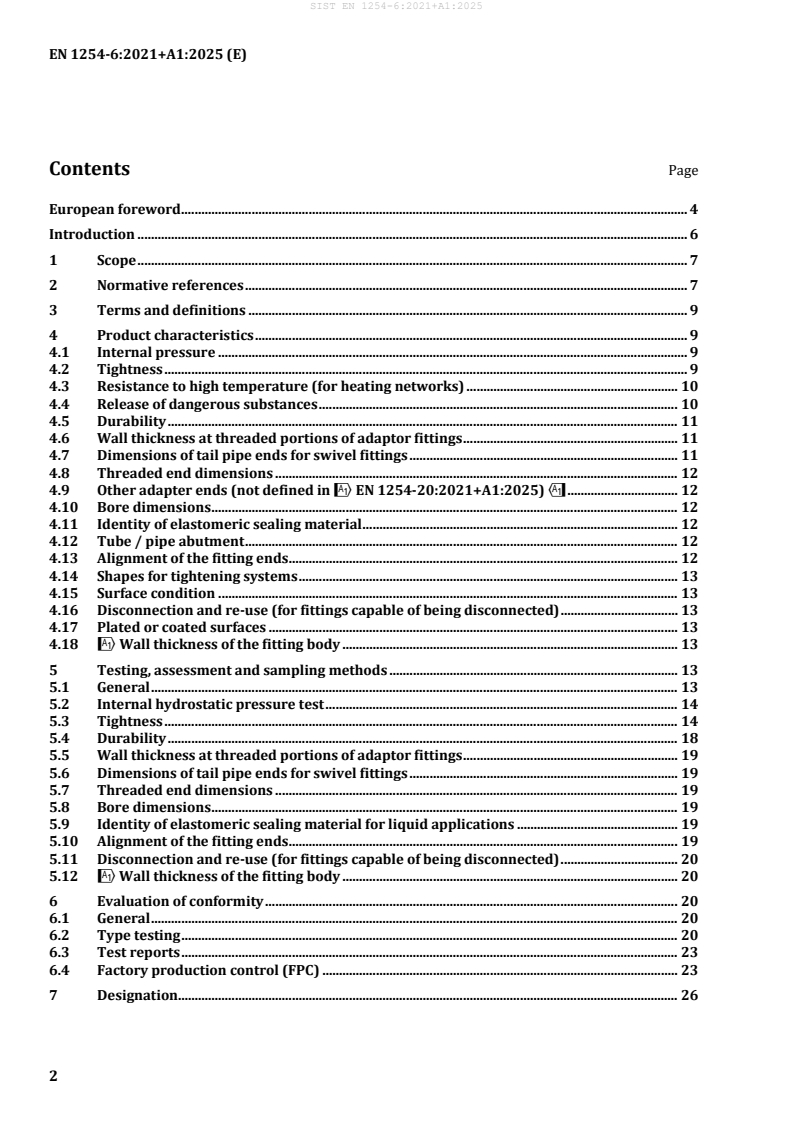
Contents Page
European foreword . 4
Introduction . 6
1 Scope . 7
2 Normative references . 7
3 Terms and definitions . 9
4 Product characteristics . 9
4.1 Internal pressure . 9
4.2 Tightness . 9
4.3 Resistance to high temperature (for heating networks) . 10
4.4 Release of dangerous substances . 10
4.5 Durability . 11
4.6 Wall thickness at threaded portions of adaptor fittings . 11
4.7 Dimensions of tail pipe ends for swivel fittings . 11
4.8 Threaded end dimensions . 12
4.9 Other adapter ends (not defined in !EN 1254-20:2021+A1:2025)" . 12
4.10 Bore dimensions . 12
4.11 Identity of elastomeric sealing material . 12
4.12 Tube / pipe abutment . 12
4.13 Alignment of the fitting ends . 12
4.14 Shapes for tightening systems . 13
4.15 Surface condition . 13
4.16 Disconnection and re-use (for fittings capable of being disconnected) . 13
4.17 Plated or coated surfaces . 13
4.18 !Wall thickness of the fitting body . 13
5 Testing, assessment and sampling methods . 13
5.1 General . 13
5.2 Internal hydrostatic pressure test . 14
5.3 Tightness . 14
5.4 Durability . 18
5.5 Wall thickness at threaded portions of adaptor fittings . 19
5.6 Dimensions of tail pipe ends for swivel fittings . 19
5.7 Threaded end dimensions . 19
5.8 Bore dimensions . 19
5.9 Identity of elastomeric sealing material for liquid applications . 19
5.10 Alignment of the fitting ends . 19
5.11 Disconnection and re-use (for fittings capable of being disconnected) . 20
5.12 !Wall thickness of the fitting body . 20
6 Evaluation of conformity . 20
6.1 General . 20
6.2 Type testing . 20
6.3 Test reports . 23
6.4 Factory production control (FPC) . 23
7 Designation. 26
8 Marking, labelling and packaging . 26
8.1 General . 26
8.2 Dezincification resistant copper zinc alloys . 26
Annex A (normative) Operating temperatures and design pressures . 27
Bibliography . 29
European foreword
This document (EN 1254-6:2021+A1:2025) has been prepared by Technical Committee CEN/TC 133
“Copper and copper alloys”, the secretariat of which is held by DIN.
This European Standard shall be given the status of a national standard, either by publication of an
identical text or by endorsement, at the latest by August 2025, and conflicting national standards shall be
withdrawn at the latest by August 2025.
Attention is drawn to the possibility that some of the elements of this document may be the subject of
patent rights. CEN shall not be held responsible for identifying any or all such patent rights.
This document includes Amendment 1 approved by CEN on 5 December 2024.
This document supersedes !EN 1254-6:2021".
The start and finish of text introduced or altered by amendment is indicated in the text by tags !".
The main changes to EN 1254-6:2012 are:
— improved alignment with plastic and multilayer pipe standards for hot and cold water applicartions;
— separation of test methods into part 20.
!The need for an amendment was based on the following points:
— Extend the scope to 63 mm fittings and add a reference to plastics and multilayer pipes.
— Include a wall thickness requirement for copper alloy fittings used in systems according to
EN ISO 15874, EN ISO 15875, EN ISO 15876, EN ISO 15877, EN ISO 21003 and EN ISO 22391."
This part of the standard (EN 1254-6) should be read in conjunction with !EN 1254-
20:2021+A1:2025".
EN 1254 comprises the following parts under the general title “Copper and copper alloys — Plumbing
fittings”:
— Part 1: Capillary fittings for soldering or brazing to copper tubes
— Part 2: Compression fittings for use with copper tubes
— Part 3: Compression fittings for use with plastics and multilayer pipes
— Part 4: Threaded fittings
— Part 5: Capillary fittings with short ends for brazing to copper tubes
— Part 6: Push-fit fittings for use with metallic tubes, plastics and multilayer pipes
— Part 7: Press fittings for use with metallic tubes
— Part 8: Press fittings for use with plastics and multilayer pipes
— Part 20: Definitions, thread dimensions, test methods, reference data and supporting information
According to the CEN-CENELEC Internal Regulations, the national standards organisations of the
following countries are bound to implement this European Standard: Austria, Belgium, Bulgaria, Croatia,
Cyprus, Czech Republic, Denmark, Estonia, Finland, France, Germany, Greece, Hungary, Iceland, Ireland,
Italy, Latvia, Lithuania, Luxembourg, Malta, Netherlands, Norway, Poland, Portugal, Republic of North
Macedonia, Romania, Serbia, Slovakia, Slovenia, Spain, Sweden, Switzerland, Turkey and the United
Kingdom.
Introduction
Products complying with this document may be used for several fluids including the transport of water
intended for human consumption if they comply with the relevant national, regional or local regulatory
provisions applicable in the place of use.
1 Scope
!This document specifies product characteristics, assessment methods, compliance criteria of test
results and a designation system for push-fit fittings for the purpose of joining tubes of copper, plated
copper, multilayer pipes and plastics pipes. The fitting ends have a nominal diameter from 6 mm to
63 mm. The fittings are designed for a service lifetime up to fifty years.
This document is applicable to push-fit fittings for joining one or more of the following tubes or pipes:
— copper tubes according to EN 1057.
— plastics and multilayer pipes.
The fittings are used up to the operating temperatures and corresponding maximum operating pressures
as indicated in Annex A.
This document applies to copper alloy fittings. A non-exhaustive list of these copper alloys is given in
CEN/TS 13388.
Adaptor fittings can combine push-fit ends with fitting ends defined in the other parts of EN 1254.
Push-fit fittings for metallic tubes can also have flanged end connections according to EN 1092-3.
Push-fit fittings can also have a plated or other decorative surface coating.
Fittings can be produced by machining, metal forming, casting, or fabrication.
Products covered by this document are intended to be used in liquid applications:
— hot, cold or combined hot and cold water, including systems according to the EN 806 series;
— closed heating systems according to EN 12828;
— cooling systems;
— drainage systems;
— fire protection systems including sprinkler systems according to EN 12845."
2 Normative references
The following documents are referred to in the text in such a way that some or all of their content
constitutes requirements of this document. For dated references, only the edition cited applies. For
undated references, the latest edition of the referenced document (including any amendments) applies.
EN 681-1:1996, Elastomeric seals - Materials requirements for pipe joint seals used in water and drainage
applications - Part 1: Vulcanized rubber
EN 1057:2006+A1:2010, Copper and copper alloys - Seamless, round copper tubes for water and gas in
sanitary and heating applications
!EN 1254-20:2021+A1:2025, Copper and copper alloys - Plumbing fittings - Part 20: Definitions, thread
dimensions, test methods, reference data and supporting information"
EN 10226-3, Pipes threads where pressure tight joint are made on the threads - Part 3: Verification by
means of limit gauges
EN 12201-2, Plastics piping systems for water supply, and for drainage and sewerage under pressure -
Polyethylene (PE) - Part 2: Pipes
EN 12201-5, Plastics piping systems for water supply, and for drainage and sewerage under pressure -
Polyethylene (PE) - Part 5: Fitness for purpose of the system
EN 12502-2, Protection of metallic materials against corrosion - Guidance on the assessment of corrosion
likelihood in water distribution and storage systems - Part 2: Influencing factors for copper and copper alloys
EN ISO 3501, Plastics piping systems - Mechanical joints between fittings and pressure pipes - Test method
for resistance to pull-out under constant longitudinal force (ISO 3501)
EN ISO 3503, Plastics piping systems - Mechanical joints between fittings and pressure pipes - Test method
for leaktightness under internal pressure of assemblies subjected to bending (ISO 3503)
EN ISO 6506-1, Metallic materials - Brinell hardness test - Part 1: Test method (ISO 6506-1)
EN ISO 6507-1, Metallic materials - Vickers hardness test - Part 1: Test method (ISO 6507-1)
EN ISO 13056, Plastics piping systems - Pressure systems for hot and cold water - Test method for
leaktightness under vacuum (ISO 13056)
EN ISO 15874-2, Plastics piping systems for hot and cold water installations - Polypropylene (PP) - Part 2:
Pipes (ISO 15874-2)
EN ISO 15874-5, Plastics piping systems for hot and cold water installations - Polypropylene (PP) - Part 5:
Fitness for purpose of the system (ISO 15874-5)
EN ISO 15875-2, Plastics piping systems for hot and cold water installations - Crosslinked polyethylene (PE-
X) - Part 2: Pipes (ISO 15875-2)
EN ISO 15875-5, Plastics piping systems for hot and cold water installations - Crosslinked polyethylene (PE-
X) - Part 5: Fitness for purpose of the system (ISO 15875-5)
EN ISO 15876-2, Plastics piping systems for hot and cold water installations - Polybutene (PB) - Part 2: Pipes
(ISO 15876-2)
EN ISO 15876-5, Plastics piping systems for hot and cold water installations - Polybutene (PB) - Part 5:
Fitness for purpose of the system (ISO 15876-5)
EN ISO 15877-2, Plastics piping systems for hot and cold water installations - Chlorinated poly(vinyl
chloride) (PVC-C) - Part 2: Pipes (ISO 15877-2)
EN ISO 15877-5, Plastics piping systems for hot and cold water installations - Chlorinated poly(vinyl
chloride) (PVC-C) - Part 5: Fitness for purpose of the system (ISO 15877-5)
EN ISO 19892, Plastics piping systems - Thermoplastics pipes and fittings for hot and cold water - Test
method for the resistance of joints to pressure cycling (ISO 19892)
EN ISO 19893, Plastics piping systems - Thermoplastics pipes and fittings for hot and cold water - Test
method for the resistance of mounted assemblies to temperature cycling (ISO 19893)
EN ISO 21003-2, Multilayer piping systems for hot and cold water installations inside buildings - Part 2:
Pipes (ISO 21003-2)
EN ISO 21003-5, Multilayer piping systems for hot and cold water installations inside buildings - Part 5:
Fitness for purpose of the system (ISO 21003-5)
EN ISO 22391-2, Plastics piping systems for hot and cold water installations - Polyethylene of raised
temperature resistance (PE-RT) - Part 2: Pipes (ISO 22391-2)
EN ISO 22391-5, Plastics piping systems for hot and cold water installations - Polyethylene of raised
temperature resistance (PE-RT) - Part 5: Fitness for purpose of the system (ISO 22391-5)
ISO 7-2, Pipe threads where pressure-tight joints are made on the threads - Part 2: Verification by means of
limit gauges
ISO 228-2, Pipe threads where pressure-tight joints are not made on the threads - Part 2: Verification by
means of limit gauges
ISO 2859-1:1999, Sampling procedures for inspection by attributes - Part 1: Sampling schemes indexed by
acceptance quality limit (AQL) for lot-by-lot inspection
ISO 9080, Plastics piping and ducting systems - Determination of the long-term hydrostatic strength of
thermoplastics materials in pipe form by extrapolation
ISO 9924-1, Rubber and rubber products - Determination of the composition of vulcanizates and uncured
compounds by thermogravimetry - Part 1: Butadiene, ethylene-propylene copolymer and terpolymer,
isobutene-isoprene, isoprene and styrene-butadiene rubbers
ISO 10508, Plastics piping systems for hot and cold water installations - Guidance for classification and
design
3 Terms and definitions
For the purposes of this document, the terms and definitions given in !EN 1254-20:2021+A1:2025"
apply.
ISO and IEC maintain terminological databases for use in standardization at the following addresses:
— IEC Electropedia: available at http://www.electropedia.org/
— ISO Online browsing platform: available at https://www.iso.org/obp
4 Product characteristics
4.1 Internal pressure
When tested according to the method in 5.2 fittings shall show no signs of leakage or permanent
distortion.
4.2 Tightness
4.2.1 Integrity of fabricated fitting bodies or having an 'as cast' microstructure
This requirement only applies to fitting bodies with an 'as cast' microstructure (excluding continuously
cast materials) or fabricated by welding or brazing.
When tested according to the method in 5.3.1 fitting bodies shall show no visual indication of leakage.
4.2.2 Leak tightness under internal hydrostatic pressure
Fittings assessed as indicated in 4.1 are considered to be leak tight under internal hydrostatic pressure.
4.2.3 Resistance to pull-out
When tested according to the method in 5.3.2 the joint assemblies shall withstand the pull-out force
without being separated and when subsequently tested according to the internal hydrostatic pressure
test described in 5.2 fittings shall show no signs of leakage or permanent distortion.
4.2.4 Leak tightness under vibration
This requirement only applies for jointing with metallic tubes.
When tested according to the method in 5.3.3 fittings shall show no signs of leakage.
4.2.5 Leak tightness under static flexural force
This requirement only applies for jointing with metallic tubes and is not applicable on threaded ends.
When tested according to the method in 5.3.4 fittings shall show no signs of leakage or permanent
distortion.
4.2.6 Leak tightness under internal hydrostatic pressure while subject to bending
This requirement only applies for jointing with multilayer or plastics pipes.
When tested according to the method in 5.3.5 fittings shall show no signs of leakage or permanent
distortion.
4.2.7 Leak tightness under vacuum.
When tested according to the method in 5.3.6 the change in pressure shall not be greater than 0,05 bar at
the conclusion of the test.
4.2.8 Leak tightness under temperature cycling
When tested according to the method in 5.3.7 fittings shall show no signs of leakage.
4.3 Resistance to high temperature (for heating networks)
The main aspect for the resistance to high temperature depends on the elastomeric sealing element.
Therefore the elastomer shall have the appropriate characteristics as specified in EN 681-1. The
elastomeric sealing elements shall conform to the requirements of EN 681-1:1996, Table 3 for continuous
hot water supply up to 110 °C except for Isoprene-Isobutylene Copolymer (IIR) where a volume change
in water up to and including 15 % is permitted.
4.4 Release of dangerous substances
National regulations on dangerous substances may require verification and declaration on release, and
sometimes content, when construction products covered by this document are placed on those markets.
In the absence of European harmonized test methods, verification and declaration on release/content
should be done taking into account national provisions in the place of use.
NOTE An informative database covering European and national provisions on dangerous substances is
http://ec.europa.eu/growth/tools-
available at the Construction website on EUROPA accessed through:
databases/cp-ds.
4.5 Durability
4.5.1 Durability of internal pressure: Resistance to stress corrosion
Fittings manufactured from copper and copper-tin-zinc alloys (CuSnZnPb) shall be considered to be
resistant to stress corrosion according to EN 12502-2 and copper-zinc-silicon alloys containing ≥ 2 % Si
are also considered to be resistant.
Fittings manufactured from CuZn-alloys shall be considered to be resistant to stress corrosion when the
product has a hardness HBW 2,5/62,5 ≤ 110 measured according to EN ISO 6506-1 or a hardness
HV ≤ 134 measured according to EN ISO 6507-1.
Fittings manufactured from copper alloys with a zinc content of 10 % or greater not mentioned above
shall be tested and assessed according to 5.4.1, and shall show no evidence of cracking.
4.5.2 Durability of tightness
4.5.2.1 Resistance to dezincification
The resistance to dezincification of alloy fittings can be obtained by the correct material selection and
processing of that material.
Alloys containing 15 % or less zinc provide a good resistance to dezincification and don't need to be
tested.
Representative material samples, prior to machining, shall be tested. When tested according to 5.4.2.1,
the mean and maximum depth of dezincification in any direction shall be expressed in µm and shall meet
the acceptance criteria listed below for resistance to dezincification:
— for grade A: maximum 200 µm;
— for grade B: mean not to exceed 200 µm and maximum not to exceed 400 µm.
If any of the test pieces do not meet the criteria for the chosen grade, a second lot of test samples from
the same batch shall be selected and the test repeated. If any of the second lot of test pieces fails, then the
batch represented shall be deemed not to conform to the requirements of this document.
4.5.2.2 Resistance to pressure cycling
When tested according to the method in 5.4.2.2 fittings shall show no signs of leakage.
4.5.3 Durability of resistance to high temperature (for heating networks)
When tested according to the method in 5.4.3 to one or more of the specified test durations, the
compression set of the sealing element shall be expressed as a percentage.
4.6 Wall thickness at threaded portions of adaptor fittings
This requirement only applies to adaptor fittings with an interface thread.
When assessed according to the method specified in 5.5 the minimum wall thickness at the interface
thread shall be as expressed in !EN 1254-20:2021+A1:2025, 4.1" for the relevant diameters.
4.7 Dimensions of tail pipe ends for swivel fittings
This requirement only applies to tail pipe ends for swivel fittings.
When assessed according to the method specified in 5.6 the dimensions shall be as expressed in
!EN 1254-20:2021+A1:2025, 4.2" for the thread size.
4.8 Threaded end dimensions
This requirement only applies to fitting bodies with threaded ends.
When assessed according to the method specified in 5.7 the thread shall be in accordance with
!EN 1254-20:2021+A1:2025, 4.4."
4.9 Other adapter ends (not defined in !EN 1254-20:2021+A1:2025)"
Other adapter ends, when assembled in accordance with the manufacturer's instructions and pressure
tested according to the method in 5.2 shall show no signs of leakage or permanent distortion. When re-
tested in accordance with the test method in 5.2 after disconnection and reconnection, it shall again show
no signs of leakage or permanent distortion. If after disconnection the sealing element shows signs of
damage, it shall be replaced before the second test.
4.10 Bore dimensions
To minimize flow resistance, minimum bore dimensions are required.
When assessed according to the method in 5.8, the minimum bore, including any internal tube support,
shall be greater or equal to the values expressed in !EN 1254-20:2021+A1:2025, 4.5", for the
relevant nominal diameters.
Where an internal support is not required, the minimum bore of the fitting shall be greater than or equal
to the min bore of the corresponding pipe.
For unequal ended or adaptor fittings, the smallest diameter shall apply provided that this diameter does
not restrict other outlets.
4.11 Identity of elastomeric sealing material
During type testing, the method in 5.9 shall be used to establish the master reference thermogram for the
chosen sealing material.
The results of subsequent tests of the sealing material, carried out according to the method in 5.9, shall
be compared to the master reference thermogram to establish that the material is the same; any
differences shall be investigated. Results shall be retained for future comparison.
The identity relates to the elastomeric material and is independent of the fitting type, size or pattern.
4.12 Tube / pipe abutment
This requirement does not apply to threaded ends.
Fitting ends are usually manufactured with an abutment to limit tube or pipe insertion and to retain a
loose supporting sleeve, if used.
Fittings may be produced for special purposes, particularly useful for repairs, where the fitting ends do
not incorporate abutments, allowing the fitting to slide along the tube or pipe.
The dimensions of the abutment shall be such that it will stop the smallest possible tube according to
EN 1057:2006+A1:2010, Table 4 or pipe. The abutment shall also satisfy the minimum bore requirement
as stated in 4.10.
4.13 Alignment of the fitting ends
When tested according to the method in 5.10, the alignment of the fitting ends with reference to the
specified axis shall be within ± 2°.
...