

oSIST prEN IEC 61755-3-7:2025
(Main)Fibre optic interconnecting devices and passive components - Connector optical interfaces - Part 3-7: Connector parameters of non-dispersion shifted single mode physically contacting fibres - Non-angled 2,5 mm and 1,25 mm diameter cylindrical composite ferrules using titanium as fibre surrounding material
General Information
- Abstract
D133/C027: for all CLC/TC 86BXA revisions of standards, the dow is set to dow= dor + 12 months
- Status
- Not Published
- Public Enquiry End Date
- 18-Sep-2025
- Technical Committee
- MOC - Mobile Communications
- Current Stage
- 4020 - Public enquire (PE) (Adopted Project)
- Start Date
- 01-Jul-2025
- Due Date
- 18-Nov-2025
- Completion Date
- 11-Sep-2025

Overview
The oSIST prEN IEC 61755-3-7:2025 standard specifies the connector parameters for non-dispersion shifted single mode fibres using non-angled cylindrical composite ferrules of diameters 2.5 mm and 1.25 mm. These ferrules uniquely incorporate titanium as the fibre surrounding material, combined with zirconia in other ferrule zones, to enhance performance and durability. This document is part of the IEC 61755 series focused on fibre optic interconnecting devices and passive components, defining optical interfaces for physically contacting fibres on high-precision connectors.
The standard applies globally in the fibre optic industry, targeting manufacturers and users of connectors requiring stable, low-attenuation connections in various environmental categories defined by IEC 61753-1. It provides dimensional limits, mechanical parameters, and guidelines that ensure consistent physical contact quality and optimal optical coupling with minimal attenuation.
Key Topics
Ferrule Design and Materials
The ferrules are composite structures using titanium around the fibre core for the end-face contact zone and zirconia (ZrO₂) for the ferrule-to-sleeve contact area. This hybrid design combines mechanical durability with precise optical alignment properties.Connector Dimensional Requirements
Detailed dimensional limits for 2.5 mm and 1.25 mm diameter ferrules include bore diameter, concentricity, end-face radius, apex offset, and fibre undercut. These values are defined for achieving specified connector performance grades (A, B, C, D), where each grade corresponds to tolerance ranges influencing attenuation.Optical Interface Parameters
Parameters affecting lateral offset, angular offset, and end-face deformation are critical for maintaining physical contact and reducing coupling losses. The standard quantifies parameters such as fibre core eccentricity, fibre tilt angle, bore angle, and alignment sleeve inner diameter to set performance benchmarks.Performance Grades and Attenuation
Ratings from Grade A (reserved for future use) to Grade D define strict limits on attributes such as fibre core location and fibre tilt to guarantee minimal optical attenuation. Annexes B and C provide informative guidance on expected attenuation performance when mated with reference connectors and simulation methodologies.Physical Contact and Mechanical Forces
The standard specifies minimum axial forces (e.g., 4.9 N) to maintain effective ferrule end-face contact and consider mechanical properties like Young's modulus and Poisson's ratio for titanium ferrules. These factors affect the tolerance to end-face deformation under operating conditions.
Applications
Telecommunications Networks
Ensures high-precision optical connections in fiber-optic communication systems using single-mode fibres where non-dispersion shifted characteristics are required.Data Centers and High-Speed Computing
Provides reliable interconnecting ferrules minimizing insertion loss and back reflections, essential for maintaining signal integrity in high-data-rate environments.Industrial and Harsh Environment Deployments
Titanium-based ferrules offer robustness against mechanical stress, temperature variations, and other environmental challenges consistent with IEC 61753-1 classifications.Test and Measurement Equipment
Enables repeatable, stable coupling for optical testing devices requiring low and consistent attenuation performance.Connector Manufacturing and Quality Control
Serves as a reference for manufacturers to produce ferrules and assemblies meeting strict dimensional and performance criteria, facilitating interoperability and product standardization.
Related Standards
IEC 61755-2-1 – Defines connection parameters of dispersion unshifted physically contacting fibres, with which the ferrules in this standard must be compatible for optical attenuation performance.
IEC 61753-1 – Establishes performance standards and environmental categories for fibre optic interconnecting devices and passive components that this ferrule design complies with.
IEC 61755-3 Series – Other parts focusing on connector parameters of single mode fibres with various geometries and materials, ensuring harmonized specifications across fibre optic connector types.
ISO/IEC Directives, Part 2 – Governs the drafting rules ensuring this standard meets international criteria for technical content and consistency.
This standard supports the advancement of fibre optic component interoperability and reliability by providing precise geometrical and mechanical parameters for titanium-based composite ferrules. Adhering to oSIST prEN IEC 61755-3-7:2025 enables manufacturers and users to achieve low optical attenuation, repeatable connector performance, and enhanced operational stability across diverse single mode applications.
Relations
- Effective Date
- 24-Jan-2023
- Effective Date
- 26-Jan-2021
Get Certified
Connect with accredited certification bodies for this standard

ANCE
Mexican certification and testing association.

Intertek Slovenia
Intertek testing, inspection, and certification services in Slovenia.

LNE (Laboratoire National de Métrologie et d'Essais)
French national laboratory for metrology and testing.
Sponsored listings
Frequently Asked Questions
oSIST prEN IEC 61755-3-7:2025 is a draft published by the Slovenian Institute for Standardization (SIST). Its full title is "Fibre optic interconnecting devices and passive components - Connector optical interfaces - Part 3-7: Connector parameters of non-dispersion shifted single mode physically contacting fibres - Non-angled 2,5 mm and 1,25 mm diameter cylindrical composite ferrules using titanium as fibre surrounding material". This standard covers: D133/C027: for all CLC/TC 86BXA revisions of standards, the dow is set to dow= dor + 12 months
D133/C027: for all CLC/TC 86BXA revisions of standards, the dow is set to dow= dor + 12 months
oSIST prEN IEC 61755-3-7:2025 is classified under the following ICS (International Classification for Standards) categories: 33.180.20 - Fibre optic interconnecting devices. The ICS classification helps identify the subject area and facilitates finding related standards.
oSIST prEN IEC 61755-3-7:2025 has the following relationships with other standards: It is inter standard links to SIST EN 61755-3-7:2009, SIST EN 61755-3-7:2009. Understanding these relationships helps ensure you are using the most current and applicable version of the standard.
oSIST prEN IEC 61755-3-7:2025 is available in PDF format for immediate download after purchase. The document can be added to your cart and obtained through the secure checkout process. Digital delivery ensures instant access to the complete standard document.
Standards Content (Sample)
SLOVENSKI STANDARD
01-september-2025
Optični spojni elementi in pasivne komponente - Vmesniki optičnih konektorjev - 3
-7. del: Nekotne cilindrične kompozitne tulke s premerom 2,5 mm in 1,25 mm, pri
katerih je titan uporabljen kot material za obod vlaken
Fibre optic interconnecting devices and passive components - Connector optical
interfaces - Part 3-7: Connector parameters of non-dispersion shifted single mode
physically contacting fibres - Non-angled 2,5 mm and 1,25 mm diameter cylindrical
composite ferrules using titanium as fibre surrounding material
Dispositifs d'interconnexion et composants passifs à fibres optiques- Interfaces optiques
de connecteurs - Partie 3-7: Paramètres de connecteurs pour fibres unimodales à
dispersion non décalée en contact physique - Férules composites cylindriques de
diamètre non incliné de 2,5 mm et 1,25 mm, utilisant le titane comme matériau entourant
les fibres
Ta slovenski standard je istoveten z: prEN IEC 61755-3-7:2025
ICS:
33.180.20 Povezovalne naprave za Fibre optic interconnecting
optična vlakna devices
2003-01.Slovenski inštitut za standardizacijo. Razmnoževanje celote ali delov tega standarda ni dovoljeno.
86B/5069/CDV
COMMITTEE DRAFT FOR VOTE (CDV)
PROJECT NUMBER:
IEC 61755-3-7 ED2
DATE OF CIRCULATION: CLOSING DATE FOR VOTING:
2025-06-27 2025-09-19
SUPERSEDES DOCUMENTS:
86B/4975/CD, 86B/5018A/CC
IEC SC 86B : FIBRE OPTIC INTERCONNECTING DEVICES AND PASSIVE COMPONENTS
SECRETARIAT: SECRETARY:
Japan Mr Ryo Koyama
OF INTEREST TO THE FOLLOWING COMMITTEES: HORIZONTAL FUNCTION(S):
ASPECTS CONCERNED:
SUBMITTED FOR CENELEC PARALLEL VOTING NOT SUBMITTED FOR CENELEC PARALLEL VOTING
Attention IEC-CENELEC parallel voting
The attention of IEC National Committees, members of
CENELEC, is drawn to the fact that this Committee Draft
for Vote (CDV) is submitted for parallel voting.
The CENELEC members are invited to vote through the
CENELEC online voting system.
This document is still under study and subject to change. It should not be used for reference purposes.
Recipients of this document are invited to submit, with their comments, notification of any relevant patent rights of
which they are aware and to provide supporting documentation.
Recipients of this document are invited to submit, with their comments, notification of any relevant “In Some
Countries” clauses to be included should this proposal proceed. Recipients are reminded that the CDV stage is
the final stage for submitting ISC clauses. (SEE AC/22/2007 OR NEW GUIDANCE DOC).
TITLE:
Fibre optic interconnecting devices and passive components - Connector optical interfaces -
Part 3-7: Connector parameters of non-dispersion shifted single mode physically contacting
fibres - non-angled 2,5 mm and 1,25 mm diameter cylindrical composite ferrules using titanium
as fibre surrounding material
PROPOSED STABILITY DATE: 2033
NOTE FROM TC/SC OFFICERS:
download this electronic file, to make a copy and to print out the content for the sole purpose of preparing National
Committee positions. You may not copy or "mirror" the file or printed version of the document, or any part of it, for
any other purpose without permission in writing from IEC.
IEC CDV 61755-3-7 © IEC 2025
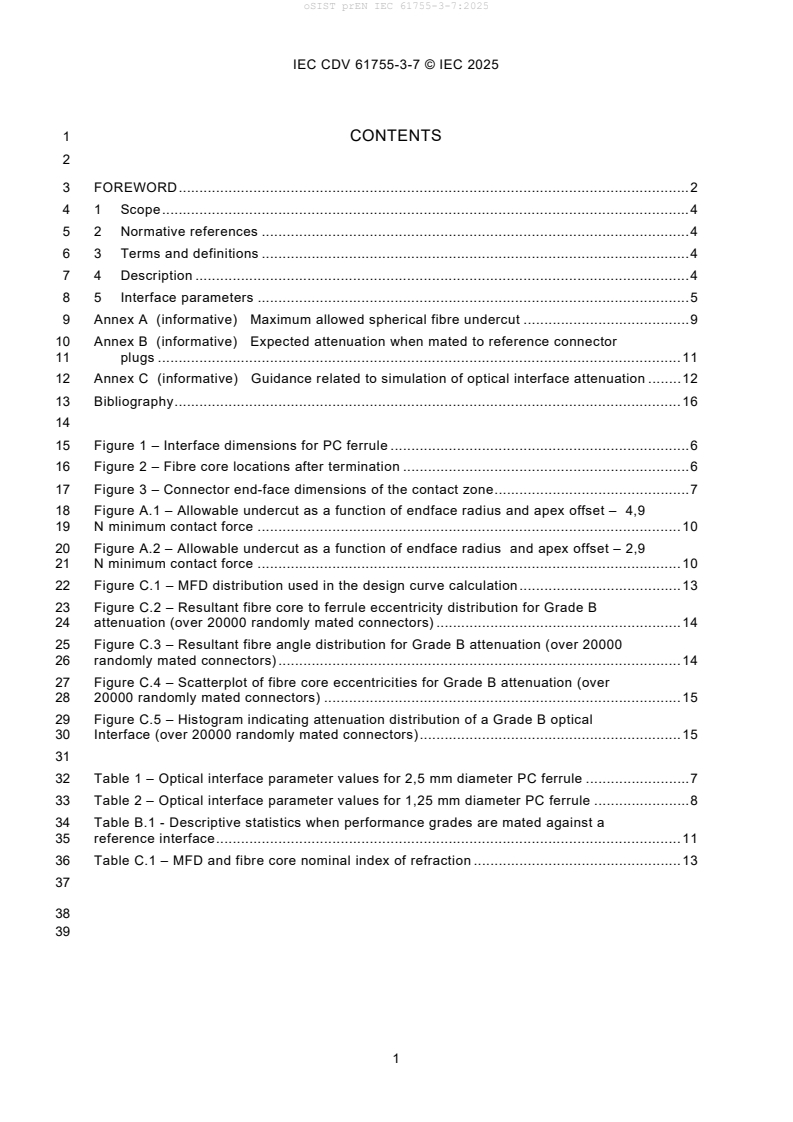
1 CONTENTS
3 FOREWORD . 2
4 1 Scope . 4
5 2 Normative references . 4
6 3 Terms and definitions . 4
7 4 Description . 4
8 5 Interface parameters . 5
9 Annex A (informative) Maximum allowed spherical fibre undercut . 9
10 Annex B (informative) Expected attenuation when mated to reference connector
11 plugs . 11
12 Annex C (informative) Guidance related to simulation of optical interface attenuation . 12
13 Bibliography . 16
15 Figure 1 – Interface dimensions for PC ferrule . 6
16 Figure 2 – Fibre core locations after termination . 6
17 Figure 3 – Connector end-face dimensions of the contact zone . 7
18 Figure A.1 – Allowable undercut as a function of endface radius and apex offset – 4,9
19 N minimum contact force . 10
20 Figure A.2 – Allowable undercut as a function of endface radius and apex offset – 2,9
21 N minimum contact force . 10
22 Figure C.1 – MFD distribution used in the design curve calculation . 13
23 Figure C.2 – Resultant fibre core to ferrule eccentricity distribution for Grade B
24 attenuation (over 20000 randomly mated connectors) . 14
25 Figure C.3 – Resultant fibre angle distribution for Grade B attenuation (over 20000
26 randomly mated connectors) . 14
27 Figure C.4 – Scatterplot of fibre core eccentricities for Grade B attenuation (over
28 20000 randomly mated connectors) . 15
29 Figure C.5 – Histogram indicating attenuation distribution of a Grade B optical
30 Interface (over 20000 randomly mated connectors) . 15
32 Table 1 – Optical interface parameter values for 2,5 mm diameter PC ferrule . 7
33 Table 2 – Optical interface parameter values for 1,25 mm diameter PC ferrule . 8
34 Table B.1 - Descriptive statistics when performance grades are mated against a
35 reference interface . 11
36 Table C.1 – MFD and fibre core nominal index of refraction . 13
IEC CDV 61755-3-7 © IEC 2025
40 INTERNATIONAL ELECTROTECHNICAL COMMISSION
41 ____________
43 FIBRE OPTIC INTERCONNECTING DEVICES AND PASSIVE COMPONENTS
44 – CONNECTOR OPTICAL INTERFACES –
46 Part 3-7: Connector parameters of non-dispersion shifted single mode
47 physically contacting fibres - non-angled 2,5 mm and 1,25 mm diameter
48 cylindrical composite ferrules using titanium as fibre surrounding
49 material
52 FOREWORD
53 1) The International Electrotechnical Commission (IEC) is a worldwide organization for standardization comprising
54 all national electrotechnical committees (IEC National Committees). The object of IEC is to promote international
55 co-operation on all questions concerning standardization in the electrical and electronic fields. To this end and
56 in addition to other activities, IEC publishes International Standards, Technical Specifications, Technical Reports,
57 Publicly Available Specifications (PAS) and Guides (hereafter referred to as “IEC Publication(s)”). Their
58 preparation is entrusted to technical committees; any IEC National Committee interested in the subject dealt with
59 may participate in this preparatory work. International, governmental and non-governmental organizations liaising
60 with the IEC also participate in this preparation. IEC collaborates closely with the International Organization for
61 Standardization (ISO) in accordance with conditions determined by agreement between the two organizations.
62 2) The formal decisions or agreements of IEC on technical matters express, as nearly as possible, an international
63 consensus of opinion on the relevant subjects since each technical committee has representation from all
64 interested IEC National Committees.
65 3) IEC Publications have the form of recommendations for international use and are accepted by IEC National
66 Committees in that sense. While all reasonable efforts are made to ensure that the technical content of IEC
67 Publications is accurate, IEC cannot be held responsible for the way in which they are used or for any
68 misinterpretation by any end user.
69 4) In order to promote international uniformity, IEC National Committees undertake to apply IEC Publications
70 transparently to the maximum extent possible in their national and regional publications. Any divergence between
71 any IEC Publication and the corresponding national or regional publication shall be clearly indicated in the latter.
72 5) IEC itself does not provide any attestation of conformity. Independent certification bodies provide conformity
73 assessment services and, in some areas, access to IEC marks of conformity. IEC is not responsible for any
74 services carried out by independent certification bodies.
75 6) All users should ensure that they have the latest edition of this publication.
76 7) No liability shall attach to IEC or its directors, employees, servants or agents including individual experts and
77 members of its technical committees and IEC National Committees for any personal injury, property damage or
78 other damage of any nature whatsoever, whether direct or indirect, or for costs (including legal fees) and
79 expenses arising out of the publication, use of, or reliance upon, this IEC Publication or any other IEC Publications.
80 8) Attention is drawn to the Normative references cited in this publication. Use of the referenced publications is
81 indispensable for the correct application of this publication.
82 9) Attention is drawn to the possibility that some of the elements of this IEC Publication may be the subject of patent
83 rights. IEC shall not be held responsible for identifying any or all such patent rights.
84 International Standard IEC 61755-3-7 has been prepared by subcommittee SC86B: Fibre optic
85 interconnecting devices and passive components, of IEC technical committee 86: Fibre optics.
86 This second edition cancels and replaces the first edition published in 2009. It constitutes a technical
87 revision. The changes with respect to the previous edition are:
89 a) harmonization with the other level 3 optical interface documents (IEC 61755-3-1);
90 b) addition of the reference grades in Table 1 and Table 2;
91 c) addition of the Annex B and C.
92 The text of this standard is based on the following documents:
FDIS Report on voting
XX/XX/FDIS XX/XX/RVD
IEC CDV 61755-3-7 © IEC 2025
94 Full information on the voting for the approval of this standard can be found in the report on
95 voting indicated in the above table.
96 This publication has been drafted in accordance with the ISO/IEC Directives, Part 2.
97 The committee has decided that the contents of this publication will remain unchanged until the
98 stability date indicated on the IEC web site under "http://webstore.iec.ch" in the data related to
99 the specific publication. At this date, the publication will be
100 • reconfirmed,
101 • withdrawn,
102 • replaced by a revised edition, or
103 • amended.
105 The National Committees are requested to note that for this publication the stability date is .
106 THIS TEXT IS INCLUDED FOR THE INFORMATION OF THE NATIONAL COMMITTEES AND WILL BE DELETED
107 AT THE PUBLICATION STAGE.
IEC CDV 61755-3-7 © IEC 2025
111 FIBRE OPTIC INTERCONNECTING DEVICES AND PASSIVE COMPONENTS
112 – CONNECTOR OPTICAL INTERFACES –
114 Part 3-7: Connectors parameters of non-dispersion shifted single mode
115 physically contacting fibres - non-angled 2,5 mm and 1,25 mm diameter
116 cylindrical composite ferrules using titanium as fibre surrounding
117 material
119 1 Scope
120 This part of IEC 61755 defines dimensional limits of an optical connector with a 2,5 mm and a
121 1,25 mm diameter cylindrical composite ferrule using titanium as fibre surrounding material for
122 optical interface to meet specific requirements for PC fibre-to-fibre interconnection as defined
123 in IEC 61755-2-1. The composite ferrule uses different materials in the end-face contact zone
124 and in ferrule to sleeve contact zone. The specified materials for each zone are zirconia (ZrO )
125 for the ferrule to sleeve contact zone and titanium for the end-face contact zone. Ferrules made
126 from the material specified in this standard are suitable for use in all operating service
127 environments categories defined in IEC 61753-1.
128 NOTE If mated within the same family (cylindrical PC ferrule), the ferrules specified in this standard are intended to
129 have the same optical attenuation performance grade for connections with all ferrules described in IEC 61755-3
130 series documents.
132 2 Normative references
133 The following documents, in whole or in part, are normatively referenced in this document and
134 are indispensable for its application. For dated references, only the edition cited applies. For
135 undated references, the latest edition of the referenced document (including any amendments)
136 applies.
137 IEC 61753-1, Fibre optic interconnecting devices and passive components - Performance
138 standard - Part 1: General and guidance
139 IEC 61755-2-1, Fibre optic interconnecting devices and passive components - Connector optical
140 interfaces for single-mode fibres - Part 2-1: Connection parameters of dispersion unshifted
141 physically contacting fibres - Non-angled
142 3 Terms and definitions
143 No terms and definitions are listed in this document.
144 ISO and IEC maintain terminological databases for use in standardization at the following
145 addresses:
146 • IEC Electropedia: available at https://www.electropedia.org/
147 • ISO Online browsing platform: available at https://www.iso.org/obp
148 4 Description
149 The performance of a cylindrical ferrule optical interface is determined by the accuracy with
150 which the optical datum targets of two mating ferrules are aligned with each other. There are
151 three conditions affecting the alignment of two optical datum targets, lateral offset, angular
152 offset and longitudinal offset.
153 Parameters influencing the lateral and angular offset of the optical fibre axes include the
154 following:
155 • ferrule outside diameter;
156 • ferrule bore concentricity relative to the ferrule outside diameter;
157 • ferrule bore angle relative to outside diameter axis;
IEC CDV 61755-3-7 © IEC 20
...