

SIST EN 50341-2-15:2019
(Main)Overhead electrical lines exceeding AC 1 kV - Part 2-15: National Normative Aspects (NNAs) for the Netherlands (based on EN 50341-1:2012)
General Information
- Abstract
EN 50341-2-15 is applicable for new high-voltage overhead lines only, not for existing lines in the Netherlands. This NNA includes the requirements for application of plastic cables, with metal or without (ADSS) metal, for telecommunication, as well as for conductor/earthwire (groundwire) systems (e.g. wraparound,....). This NNA is applicable for fixing of structural elements for telecommunication (e.g. dishes), if mounted on power line supports (towers), especially regarding the wind forces and ice loads on such fixed elements. To overhead electrical lines exceeding 1 kV (A.C.) but lower than 45 kV (A.C.) Part 1 is applicable without special national conditions (snc) or national complements (ncpt).
- Status
- Published
- Publication Date
- 11-Nov-2019
- Technical Committee
- NVV - Overhead lines and overhead electrical conductors
- Current Stage
- 6060 - National Implementation/Publication (Adopted Project)
- Start Date
- 30-May-2019
- Due Date
- 04-Aug-2019
- Completion Date
- 12-Nov-2019

Overview
SIST EN 50341-2-15:2019 - “Overhead electrical lines exceeding AC 1 kV - Part 2-15: National Normative Aspects (NNAs) for the Netherlands” - is the Dutch national annex to EN 50341-1:2012. It sets national requirements and Nationally Determined Parameters for the design of new high-voltage overhead lines in the Netherlands. This NNA is normative in the Netherlands and must be used together with EN 50341‑1. It applies to new lines only (not existing lines) and complements Part 1 on structural safety, load cases, electrical clearances and material requirements.
Key topics and technical requirements
- Scope limitation: Applicable to new high-voltage overhead lines in the Netherlands; existing lines are excluded (assessment of existing lines refers to NEN 8700 / NEN 8701).
- Nationally Determined Parameters: Specifies Dutch values and complementary requirements to demonstrate compliance with national building regulations and safety philosophy.
- Telecommunication cables: Requirements for application of plastic telecommunication cables, including metal‑reinforced or non‑metal (ADSS) types, when installed on power line structures.
- Conductor and earthwire systems: Guidance for conductor/earthwire arrangements (e.g., wraparound systems) and their mechanical/electrical interactions.
- Fixed structural elements on supports: Rules for mounting telecommunication hardware (dishes, antennas) on towers/poles, focusing on wind forces and ice loads applied to these attachments.
- Actions on lines: National guidance on wind loads, turbulence, ice accumulation, combined wind-and-ice scenarios, temperature effects, security and safety loads.
- Clearances and electrical requirements: Application notes on internal and external clearances, representative overvoltages and criteria for avoiding flashover.
- Supports, foundations and materials: National aspects for design of lattice towers, steel/concrete poles, geotechnical foundation basis and corrosion protection.
- Earthing and safety: Dimensioning of earthing systems for human safety, lightning protection and permissible touch voltages.
- Quality assurance: Requirements for checks, testing and taking-over procedures.
Practical applications and users
Who uses EN 50341-2-15 in practice:
- Transmission/distribution utilities and grid operators designing new overhead lines in the Netherlands
- Power line structural and electrical engineers performing design verifications
- Geotechnical and civil engineers for foundation and support design
- Telecom installers mounting ADSS or metal‑reinforced cables on power structures
- Manufacturers of conductors, insulators, hardware and towers seeking compliance
- Standards bodies and regulators assessing conformity with Dutch national rules
Use cases:
- Structural design and verification of new HV line supports and conductors
- Determination of wind/ice load cases and electrical clearances for new routes
- Specifying mountings for telecom dishes on power-line supports
- Preparing project specifications consistent with Dutch NNAs
Related standards
- EN 50341‑1 (Part 1 - general design rules) - to be read in conjunction with this NNA
- NEN 8700 / NEN 8701 - assessment rules for existing structures in the Netherlands
- Eurocodes referenced for structural/geotechnical design (as indicated in the NNA)
Get Certified
Connect with accredited certification bodies for this standard

IMQ S.p.A. (Certification)
Italian electrical product certification.

SLG Prüf- und Zertifizierungs GmbH
German testing and certification body.

UL Solutions
Global safety science company with testing, inspection and certification.
Sponsored listings
Frequently Asked Questions
SIST EN 50341-2-15:2019 is a standard published by the Slovenian Institute for Standardization (SIST). Its full title is "Overhead electrical lines exceeding AC 1 kV - Part 2-15: National Normative Aspects (NNAs) for the Netherlands (based on EN 50341-1:2012)". This standard covers: EN 50341-2-15 is applicable for new high-voltage overhead lines only, not for existing lines in the Netherlands. This NNA includes the requirements for application of plastic cables, with metal or without (ADSS) metal, for telecommunication, as well as for conductor/earthwire (groundwire) systems (e.g. wraparound,....). This NNA is applicable for fixing of structural elements for telecommunication (e.g. dishes), if mounted on power line supports (towers), especially regarding the wind forces and ice loads on such fixed elements. To overhead electrical lines exceeding 1 kV (A.C.) but lower than 45 kV (A.C.) Part 1 is applicable without special national conditions (snc) or national complements (ncpt).
EN 50341-2-15 is applicable for new high-voltage overhead lines only, not for existing lines in the Netherlands. This NNA includes the requirements for application of plastic cables, with metal or without (ADSS) metal, for telecommunication, as well as for conductor/earthwire (groundwire) systems (e.g. wraparound,....). This NNA is applicable for fixing of structural elements for telecommunication (e.g. dishes), if mounted on power line supports (towers), especially regarding the wind forces and ice loads on such fixed elements. To overhead electrical lines exceeding 1 kV (A.C.) but lower than 45 kV (A.C.) Part 1 is applicable without special national conditions (snc) or national complements (ncpt).
SIST EN 50341-2-15:2019 is classified under the following ICS (International Classification for Standards) categories: 29.240.20 - Power transmission and distribution lines. The ICS classification helps identify the subject area and facilitates finding related standards.
SIST EN 50341-2-15:2019 is available in PDF format for immediate download after purchase. The document can be added to your cart and obtained through the secure checkout process. Digital delivery ensures instant access to the complete standard document.
Standards Content (Sample)
SLOVENSKI STANDARD
01-december-2019
Nadzemni električni vodi za izmenične napetosti nad 1 kV - 2-15. del: Nacionalna
normativna določila (NNA) za Nizozemsko (na podlagi EN 50341-1:2012)
Overhead electrical lines exceeding AC 1 kV - Part 2-15: National Normative Aspects
(NNAs) for the Netherlands (based on EN 50341-1:2012)
Ta slovenski standard je istoveten z: EN 50341-2-15:2019
ICS:
29.240.20 Daljnovodi Power transmission and
distribution lines
2003-01.Slovenski inštitut za standardizacijo. Razmnoževanje celote ali delov tega standarda ni dovoljeno.
EUROPEAN STANDARD EN 50341-2-15
NORME EUROPÉENNE
EUROPÄISCHE NORM
May 2019
ICS 29.240.20
English Version
Overhead electrical lines exceeding AC 1 kV - Part 2-15:
National Normative Aspects (NNAs) for the Netherlands (based
on EN 50341-1:2012)
This European Standard was approved by CENELEC on 2019-05-22.
CENELEC members are the national electrotechnical committees of Austria, Belgium, Bulgaria, Croatia, Cyprus, the Czech Republic,
Denmark, Estonia, Finland, Former Yugoslav Republic of Macedonia, France, Germany, Greece, Hungary, Iceland, Ireland, Italy, Latvia,
Lithuania, Luxembourg, Malta, the Netherlands, Norway, Poland, Portugal, Romania, Serbia, Slovakia, Slovenia, Spain, Sweden,
Switzerland, Turkey and the United Kingdom.
European Committee for Electrotechnical Standardization
Comité Européen de Normalisation Electrotechnique
Europäisches Komitee für Elektrotechnische Normung
CEN-CENELEC Management Centre: Rue de la Science 23, B-1040 Brussels
© 2019 CENELEC All rights of exploitation in any form and by any means reserved worldwide for CENELEC Members.
Ref. No. EN 50341-2-15:2019 E
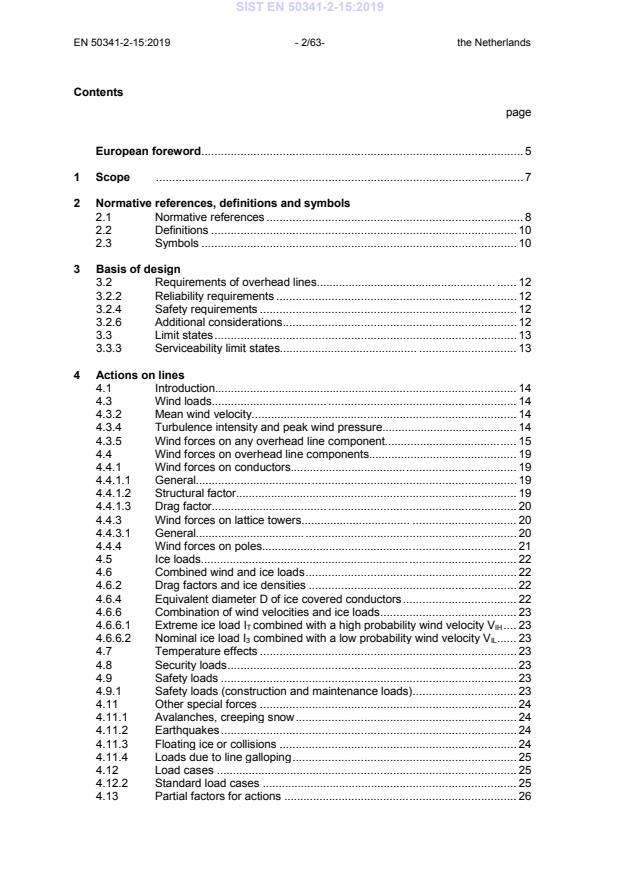
Contents
page
European foreword . 5
1 Scope . 7
2 Normative references, definitions and symbols
2.1 Normative references . 8
2.2 Definitions . 10
2.3 Symbols . 10
3 Basis of design
3.2 Requirements of overhead lines. . 12
3.2.2 Reliability requirements . 12
3.2.4 Safety requirements . 12
3.2.6 Additional considerations . 12
3.3 Limit states . 13
3.3.3 Serviceability limit states. . 13
4 Actions on lines
4.1 Introduction. . 14
4.3 Wind loads. . 14
4.3.2 Mean wind velocity. . 14
4.3.4 Turbulence intensity and peak wind pressure. 14
4.3.5 Wind forces on any overhead line component. . 15
4.4 Wind forces on overhead line components. . 19
4.4.1 Wind forces on conductors. . 19
4.4.1.1 General. . 19
4.4.1.2 Structural factor. . 19
4.4.1.3 Drag factor. . 20
4.4.3 Wind forces on lattice towers. . 20
4.4.3.1 General. . 20
4.4.4 Wind forces on poles. . 21
4.5 Ice loads. . 22
4.6 Combined wind and ice loads . 22
4.6.2 Drag factors and ice densities . 22
4.6.4 Equivalent diameter D of ice covered conductors . 22
4.6.6 Combination of wind velocities and ice loads . 23
4.6.6.1 Extreme ice load I combined with a high probability wind velocity V . 23
T IH
4.6.6.2 Nominal ice load I combined with a low probability wind velocity V . 23
3 IL
4.7 Temperature effects . 23
4.8 Security loads . 23
4.9 Safety loads . 23
4.9.1 Safety loads (construction and maintenance loads) . 23
4.11 Other special forces . 24
4.11.1 Avalanches, creeping snow . 24
4.11.2 Earthquakes . 24
4.11.3 Floating ice or collisions . 24
4.11.4 Loads due to line galloping . 25
4.12 Load cases . . 25
4.12.2 Standard load cases . . 25
4.13 Partial factors for actions . . 26
the Netherlands - 3/63 - EN 50341-2-15:2019
5 Electrical requirements
5.2 Currents . 28
5.2.1 Normal current . 28
5.2.2 Short-circuit current . 28
5.4 Classification of voltages and overvoltages . 28
5.4.5 Representative fast-front overvoltages . 28
5.5 Minimum air clearance distances to avoid flashover . 28
5.5.2 Application of the theoretical method in annex E . 28
5.6 Load cases for calculation of clearances . . 30
5.6.2 Maximum conductor temperature . . 30
5.6.3 Wind loads for determination of electrical clearances . . 30
5.6.3.2 Nominal wind loads for determination of internal and external
electrical clearances . 30
5.6.3.3 Extreme wind loads for determination of internal clearances . 31
5.6.4 Ice load for determination of electrical clearances . 31
5.6.5 Combined wind and ice loads . 31
5.8 Internal clearances within the span and the top of the support . 31
5.9 External clearances . 32
5.9.1 General . 32
5.9.2 External clearances to ground in areas remote from buildings,
roads, etc. . 33
5.9.3 External clearances to residential and other buildings . 33
5.9.4 External clearances to crossing traffic routes . 35
5.9.5 External clearances to adjacent traffic routes . 36
5.9.6 External clearances to other powerlines or overhead
telecommunication lines . 36
5.10 Corona effect . 37
5.10.1 Radio noise . 37
5.10.1.3 Noise limits . 37
5.10.2 Audible noise . 37
5.10.2.3 Noise limit. 37
5.11 Electric and magnetic fields . 37
5.11.2 Electric and magnetic field induction . 37
6 Earthing systems
6.1 Introduction . 38
6.1.2 Requirements for dimensioning of earthing systems . 38
6.1.3 Earthing measures against lightning effects . 38
6.4 Dimensioning with regard to human safety . 38
6.4.1 Permissible values for touch values. 38
6.4.2 Touch voltage limits at different locations . 39
6.4.3 Basic design of earthing systems with regard to permissible touch voltage 40
6.4.4 Measures in systems with isolated neutral or resonant earthing . 40
7 Supports
7.1 Initial design considerations . 41
7.1.2 Structural design resistance of a pole . 41
7.1.3 Buckling resistance . 41
7.2 Materials . 41
7.2.3 Requirements for steel grades subject to galvanising . 41
7.2.7 Guy materials . 41
7.2.8 Other materials . 41
7.3 Lattice steel towers . 41
7.3.5 Structural analysis . 41
7.3.6 Ultimate limit states . 44
7.3.7 Serviceability limit states . 44
7.3.8 Resistance of connections . 44
7.3.9 Design assisted by testing . 45
7.4 Steel poles . 46
7.4.6 Ultimate limit states (EN 1993-1-1:2005 – Chapter 6) . 46
7.4.6.2 Resistance of cross section areas . 46
7.4.7 Serviceability limit states (EN 1993-1-1:2005 – Chapter 7) . 46
7.4.10 Fatigue . 46
7.6 Concrete poles . 47
7.6.4 Ultimate limit states . 47
7.6.5 Serviceability limit states . 47
7.9 Corrosion protection and finishes . 47
7.10 Maintenance facilities . 47
8 Foundations
8.2 Basis of geotechnical design (EN 1997-1:2004 – Section 2) . 48
8.2.2 Geotechnical design by calculation. 48
9 Conductors and earthwires
9.1 Introduction . 49
9.6 General requirements . 49
9.6.2 Partial factor for conductors . 49
10 Insulators
10.2 Standard electrical requirements . 50
10.4 Pollution performance requirements . 50
10.5 Power arc requirements . 50
10.7 Mechanical requirements . 50
11 Hardware
11.5 Short circuit current and power arc requirements . 51
11.6 Mechanical requirements . 51
11.8 Material selection and specification . 51
12 Quality assurance, checks and taking-over . 52
Annex NA Safety measures for supports . 53
the Netherlands - 5/63 - EN 50341-2-15:2019
European foreword
1 The Netherlands National Committee (NC) is identified by the following address:
Koninklijk Nederlands Elektrotechnisch Comité (NEC)
Vlinderweg 6,
PO Box 5059
2600 GB DELFT
the Netherlands
Tel.: +31 15 2690 390
Email: nec@nen.nl
Relevant standards committee: NEC 11/36 “Hoogspanningslijnen en isolatoren”
(Overhead high-voltage lines and insulators)
2 The Netherlands NC has prepared this Part 2-15 of EN 50341, listing the Netherlands
National Normative Aspects (NNA), under its sole responsibility, and duly passed it
through the CENELEC and CLC/TC 11 procedures. This NNA to EN 50341 has been
accepted by the Dutch standards Committee 351001 “Technische Grondslagen voor
Bouwconstructies”, responsible for the structural and geotechnical design standards in
the Netherlands, as being in accordance with the safety philosophy for structures in the
Netherlands.
NOTE: The Netherlands NC also takes sole responsibility for the technically correct co-ordination of this
NNA with EN 50341-1. It has performed the necessary checks in the frame of quality assurance/control.
However, it is noted that this quality check has been made in the framework of the general responsibility of
a standards committee under the national laws/regulations.
This Part 2-15 specifies the values of the Nationally Determined Parameters for use in
the Netherlands. Herewith it can be demonstrated that a construction work achieves
the level of structural safety as required by Dutch building regulations. This NNA also
includes complementary requirements which are non-conflicting with NEN-EN 1990
and the Dutch National Annex to EN 1990. This complementary text may be of
normative nature, but also of informative nature (e.g. notes). Also decisions on the
application (normative or informative) in the Netherlands of the informative Annexes to
the standard itself are specified in the National Annex.
3 This NNA is normative in the Netherlands and informative for other countries.
4 This NNA has to be read in conjunction with Part 1 (EN 50341-1). All clause numbers
used in this NNA correspond to those of Part 1. Specific subclauses, which are prefixed
“NL”, are to be read as amendments to the relevant text in Part 1. Any necessary
clarification regarding the application of NNA in conjunction with Part 1 shall be referred
to the Netherlands NC who will, in co-operation with CLC/TC 11, clarify the
requirements.
When no reference is made in this NNA to a specific subclause, then Part 1 applies.
5 In the case of “boxed values” defined in Part 1, amended values (if any) which are
defined in this NNA shall be taken into account in the Netherlands.
However any boxed value, whether in Part 1 or in this NNA, shall not be amended in
the direction of greater risk in a Project Specification.
6 The national Netherlands standards/regulations related to overhead electrical lines
exceeding 45 kV (A.C.) are identified/listed in subclauses 2.1/NL.1 and 2.1/NL.2.
NOTE: All national standards referred to in this NNA will be replaced by the relevant European Standards
as soon as they become available and are declared by the Netherlands NC to be applicable and thus
reported to the secretary of CLC/TC 11.
the Netherlands - 7/63 - EN 50341-2-15:2019
1 Scope
(ncpt) NL.1 Application to existing overhead lines
This NNA is applicable for new high-voltage overhead lines only, not for existing
lines in the Netherlands.
NOTE: If some planning/design or modification works on existing lines in the Netherlands has to be
performed, the structural integrity shall be assessed based on the following generic building
standards:
− NEN 8700 “Assessment of existing structures in case of reconstruction and disapproval – Basic
Rules” and
− NEN 8701 “Assessment of existing structures in case of reconstruction and disapproval –
Actions
NEN 8700 and NEN 8701 shall be used in conjunction with EN 50341 part 1 and this NNA.
NEN 8700 and NEN 8701 are based on NEN-EN 1990.
EN 50341-1 “Overhead electrical lines exceeding 1 kV” is based on EN 1990.
Where in NEN-EN 1990 and NEN-EN 50341 is referred to 'design' that term should be read in the
context of the applying this standard to a review or assessment, by an analysis, as 'verification'. In
case of construction re-design this must be understood as referring only to the part of the structure
that is subject of the re-design.
(ncpt) NL.2 Application to cables for telecommunication
This NNA includes the requirements for application of plastic cables, with metal or
without (ADSS) metal, for telecommunication, as well as for conductor/earthwire
(groundwire) systems (e.g. wraparound,.).
(ncpt) NL.3 Application to mounting of telecommunication equipment
This NNA is applicable for fixing of structural elements for telecommunication (e.g.
dishes), if mounted on power line supports (towers), especially regarding the wind
forces and ice loads on such fixed elements.
(ncpt) NL.4 Applicability
This NNA is applicable to overhead electrical lines exceeding 45 kV (A.C.).
To overhead electrical lines exceeding 1 kV (A.C.) but lower than 45 kV (A.C.)
Part 1 is applicable without special national conditions (snc) or national
complements (ncpt).
2 Normative references , definitions and symbols
2.1 Normative references
The following referenced documents are indispensable for the application of this
document. For dated references, only the edition cited applies. For undated
references, the latest edition of the referenced document (including any
amendments, corrigenda and national annexes) applies.
(ncpt) NL.1 National normative standards
NEN-EN 1090-2 Het vervaardigen van staal- en aluminiumconstructies - Deel 2:
Technische eisen voor staalconstructies
Execution of steel structures and aluminium structures - Part 2: Technical
requirements for steel structures
NEN-EN 1990 Eurocode - Grondslagen van het constructief ontwerp (nationale
bijlage)
Eurocode - Basis of structural design
NEN-EN 1991-1-4 Eurocode 1: Belastingen op constructies - Deel 1-4: Algemene
belastingen – Windbelasting
Eurocode 1: Actions on structures - Part 1-4: General actions - Wind actions
NEN-EN 1991-1-7 Eurocode 1: Belastingen op constructies -Deel 1-7: Algemene
belastingen – Buitengewone belastingen: stootbelastingen en ontploffingen
Eurocode 1: Actions on structures – Part 1-7: General actions - Accidental actions
NEN-EN 1992-1-1 Eurocode 2: Ontwerp en berekening van betonconstructies -
Deel 1-1: Algemene regels en regels voor gebouwen
Eurocode 2: Design of concrete structures - Part 1-1: General rules and rules for
buildings
NEN-EN 1993-1-1 Eurocode 3: Ontwerp en berekening van staalconstructies -
Deel 1-1: Algemene regels en regels voor gebouwen.
Eurocode 3: Design of steel structures - Part 1-1: General rules and rules for
buildings
NEN-EN 1993-1-6 Eurocode 3: Ontwerp en berekening van staalconstructies -
Deel 1-6: Algemene regels - Sterkte en Stabiliteit van Schaalconstructies
Eurocode 3: Design of steel structures – Part 1-6: General - Strength and Stability
of Shell Structures
NEN-EN 1993-1-8 Eurocode 3: Ontwerp en berekening van staalconstructies -
Deel 1-8: Ontwerp en berekening van verbindingen
Eurocode 3: Design of steel structures - Part 1-8: Design of joints
NEN-EN 1993-1-9 Eurocode 3: Ontwerp en berekening van staalconstructies -
Deel 1-9: Vermoeiing
Eurocode 3: Design of steel structures -Part 1-9: Fatigue
NEN-EN 1993-1-10 Eurocode 3: Ontwerp en berekening van staalconstructies –
Deel 1-10: Materiaaltaaiheid en eigenschappen in de dikterichting
Eurocode 3: Design of steel structures – Part 1-10: Material toughness and
throughthickness properties
the Netherlands - 9/63 - EN 50341-2-15:2019
NEN-EN 1993-1-11 Eurocode 3: Ontwerp en berekening van staalconstructies -
Deel 1-11: Ontwerp en berekening van op trek belaste componenten
Eurocode 3: Design of steel structures - Part 1-11: Design of structures with
tension components
NEN-EN 1993-3-1 Eurocode 3: Ontwerp en berekening van staalconstructies -
Deel 3-1: Torens, masten en schoorstenen - Torens en masten
Eurocode 3: Design of steel structures - Part 3-1: Towers, masts and chimneys –
Towers and masts
NEN-EN 1997-1 Eurocode 7: Geotechnisch ontwerp - Deel 1: Algemene regels
Eurocode 7: Geotechnical design - Part 1: General rules
NEN-EN 1998-1 Eurocode 8: Ontwerp en berekening van aardbevingsbestendige
constructies – Deel 1: Algemene regels, seismische belastingen en regels voor
gebouwen
Eurocode 8: Design of structures for earthquake resistance - Part 1: General rules,
seismic actions and rules for buildings
NEN-EN 1999-1-1 Eurocode 9: Ontwerp en berekening van aluminium-
constructies - Deel 1-1: Algemene regels
Eurocode 9: Design of aluminium structures - Part 1-1: General structural rules
NEN-EN 50341-1:2013 Bovengrondse hoogspanningslijnen voor wisselspanning
hoger dan 1 kV - Deel 1: Algemene eisen - Gemeenschappelijke specificaties
Overhead electrical lines exceeding AC 1 kV - Part 1: General equirements –
Common specifications
NEN-EN-ISO 14713-2 Zinken deklagen - Richtlijnen en aanbevelingen voor de
bescherming van ijzer en staal in constructies tegen corrosie - Deel 2: Thermisch
verzinken
Zinc coatings - Guidelines and recommendations for the protection against
corrosion of iron and steel in structures - Part 2: Hot dip galvanising
NEN 1010 Elektrische installaties voor laagspanning - Nederlandse implementatie
van de HD-IEC 60364-reeks
Electrical installations for low-voltage - Dutch implementation of the HD-IEC
60364-series
NEN 3011:2015 Veiligheidskleuren en -tekens in de werkomgeving en in de
openbare ruimte
Safety colours and safety signs in workplaces and in public areas
NEN 3654 Wederzijdse beïnvloeding van buisleidingen en
hoogspanningssystemen
Mutual influence of pipelines and high-voltage circuits
NPR 9998 Beoordeling van de constructieve veiligheid van een gebouw bij
nieuwbouw, verbouw en afkeuren – Grondslagen voor aardbevingsbelastingen:
geïnduceerde aardbevingen
Assessment of buildings in case of erection, reconstruction and disapproval –
Basic rules for seismic actions: induced earthquakes
NEN-EN-IEC 60071-2:2018 Insulation co-ordination - Part 2: Application guidelines
NPR-IEC/TS 60479-series Gevolgen van stroom voor mensen en levende have
Effects of current on human beings and livestock
NPR-IEC/TS 60815-1 Selectie en dimensionering van hoogspanningsisolatoren
bedoeld voor het gebruik in vervuilde omstandigheden - Deel 1: Definities,
informatie en algemene uitgangspunten
Selection and dimensioning of high-voltage insulators intended for use in polluted
conditions - Part 1: Definitions, information and general principles
NPR-IEC/TS 60815-2 Selectie en dimensionering van hoogspanningsisolatoren
bedoeld voor het gebruik in vervuilde omstandigheden - Deel 2: Keramische en
glazen isolatoren voor wisselspanning
Selection and dimensioning of high-voltage insulators intended for use in polluted
conditions - Part 2: Ceramic and glass insulators for a.c. systems
NPR-IEC/TS 60815-3 Selectie en dimensionering van hoogspanningsisolatoren
bedoeld voor het gebruik in vervuilde omstandigheden - Deel 3:
Polymeerisolatoren voor wisselspanning
Selection and dimensioning of high-voltage insulators intended for use in polluted
conditions - Part 3: Polymer insulators for a.c. systems
(ncpt) NL.2 Informative documents
API Recommended Practice RP2A-WSD Planning, Designing, and Constructing
Fixed Offshore Platforms—Working Stress Design
CIGRE-paper 322 State of the art of conductor galloping
CUR Aanbeveling 96 Vezelversterkte kunststoffen in civiele draagconstructies.
Recommendation 96 FRP Composite structures
IRPA/INERC Guidelines, Interim guidelines of limits of exposure to 50/60 Hz
electric and magnetic field, Health Physics, Vol. 58 No 1, January 1990
2.2 Definitions
(ncpt) NL.1 Every Day Stress (EDS) loads
o
Loads under no wind conditions and 10 C ambient temperature, without load
factors.
2.3 List of symbols
(ncpt) NL.1
c wind directional factor
dir
c reliability factor
prob
D the sag in each span at maximum conductor temperature
max
F the minimum tensile force in the conductor in [N] at the maximum
min
conductor temperature
g characteristic ice load on conductors in [N/m]
R
G structural resonance factor for lattice towers
T
G structural resonance factor for steel poles
pol
p the lowest value of the catenary constant, for which the line has been
min
designed.
sag the biggest midspan sag at 0 ºC without wind
0ºC
the Netherlands - 11/63 - EN 50341-2-15:2019
sag the biggest midspan sag at 10 ºC without wind
10ºC
w the unit weight of the conductor in [N/m]
γ partial factor fatigue strength
Mf
3 Basis of design
3.2 Requirements of overhead lines
3.2.2 Reliability requirements
(ncpt) NL.1 Consequence Class CC2 according to NEN-EN 1990 has to be used.
NOTE: The reliability level of CC2 is slighly higher than level 3 in Part 1.
(ncpt) NL.2 For overhead lines with design life of less than 50 years the wind load may
be reduced by using the following formula (according to
NEN-EN 1991-1-4+A1+C2:2011/NB:2011, clause 4.2):
c = [1 - 0,2 ln(-ln(1-1/t))]/[1 - 0,2 ln(-ln(1-1/t ))]
prob 50
For overhead lines with design life of less than 50 years the ice load may be
reduced by using the following formula:
c = [1 + 0,33 (1-a) ln(t/t )]
prob 50
where:
t = the value of the design life in years, but not less than 15 years
t = 50
a = 0,1 for ice region A
a = 0,28 for ice region B.
(ncpt) NL.3 For temporary lines a reduced return period of 15 years may be applied.
The duration of a temporary line shall be less than 12 months. For wind loads the
season coefficient c is equal to 1,0. The combination of wind and ice loading
season
shall be considered when the temporary line is installed in the months November,
December, January, February and March. For temporary lines the standard load
cases, clause 4.13, shall be applied.
(ncpt) NL.4 Specific circumstances at permanent lines are considered temporary when
they exist for a period of maximum 1 year. The load factors as mentioned under
Special Limit States (table 4.13.b) shall be used.
3.2.4 Safety requirements
(ncpt) NL.1 Safety measures for supports.
All supports in an overhead transmission line shall also fulfill the requirements in
Annex NA.
NOTE: Annex NA specifies safety measures such as warning signs, climbing facilities and measures
to be taken within the structure and in cross-arms.
3.2.6 Additional considerations
(ncpt) NL.1 In order to reduce the impact of possible failures the maximum distance
between tension towers shall not be more than approximately 5.000 m.
the Netherlands - 13/63 - EN 50341-2-15:2019
3.3 Limit states
3.3.3 Serviceability limit states
(ncpt) NL.1 In addition to Part 1 it is required that (see Figure 3.3/NL.1):
− the total translation of the top of the supports shall be ≤ 5,5% of the height of
the support in case of serviceability limit state loading (see table 4.13/NL.3) and
shall be ≤ 1,25% of the height of the support in case of EDS (Every Day Stress);
− the deflection of supports relative to the reference shall be ≤ 0,7% of the height
of the support in case of serviceability limit state loading (see table 4.13/NL.2)
and shall be ≤ 0,3% of the height of the support in case of EDS (Every Day
Stress).
δh; tot ≤ 5,5% height (Serv.LS)
≤ 1,25% height (EDS)
≤ 0,7% height (Serv.LS)
height
≤ 0,3% height (EDS)
elastic line
reference line
top of foundation
Figure 3.3/NL.1 Maximum permissible deflection of supports
4 Actions on lines
4.1 Introduction
(ncpt) NL.1 Numerical values for actions should be determined according to
approach 1.
NOTE: The reference climatic data as given in NEN-EN 1991-1-4 are used and included in this NNA.
The reference ice load is based on specific statistical meteorological studies and used in this NNA.
(ncpt) NL.2 The standard load cases defined in paragraph 4.12 shall be applied as a
minimum and the dimensioning of the overhead line is not limited to these
standard load cases. However, all possible loads and load combinations that may
be determining for the overhead line including tower structure, tower components
and foundation shall be taken into consideration.
(ncpt) NL.3 The partial factors γ and combination factors ψ for the different limit states
are given in clause 4.13.
4.3 Wind loads
NOTE: In this NNA the wind loads as given in NEN-EN 1991-1-4+A1+C2:2011/NB:2011 are used.
4.3.2 Mean wind velocity
(snc) NL.1 For area category 0 “coast” (see Figure 4.3/NL.3) the wind directional factor
c may be taken into account:
dir
- for wind direction (degrees) 315 - 360 and 0 - 195 (North is 0 and 360 degrees,
East is 90 degrees and so on): c = 0,85;
dir
- for wind direction (degrees) 195 - 225: c = 0,9;
dir
- for wind direction (degrees) 225 - 315: c = 1,0.
dir
4.3.4 Turbulence intensity and peak wind pressure
(snc) NL.1 The Netherlands is divided in 3 zones (see Figure 4.3/NL.2) and 2 area
categories with related basic dynamic wind pressures (see Figure 4.3/NL.3).
In table 4.3/NL.1 the values for q on components or segments of structures from
h
directions corresponding to a sector,depending on the height are given for:
• Area category 0 “coast” (see Figure 4.3/NL.3) when if the following three
conditions are met:
- for at least half of the wind directions within the relevant sector, the
distance from the structure to open water with a stroke length of at least 2
km is less than ten times the height at which the member to be considered
is located,
- the structure has a height that is at least twice the average height of the
buildings and other obstacles in the sector concerned between the
structure and the open water, and
- the structure is not located in wind area III.
• Area category 1 “non urban”.
the Netherlands - 15/63 - EN 50341-2-15:2019
NOTE: For urban areas (in contrast with NEN-EN 1991-1-4+A1+C2:2011/NB:2011) the dynamic
wind pressures for non urban area’s (table 4.3/NL.1) shall be taken into account.
(snc) NL.2 For area category 0 “coast” (see Figure 4.3/NL.2) c shall be taken in
dir
account. The directional peak wind pressure is:
q = c ∙ q .
hdir dir h
(snc) NL.3 The wind sector boundaries must be chosen mutually perpendicular. The
direction of the sector boundaries shall have a 45 ° angle with the main direction of
the overhead line (see Figure 4.3/NL.1).
NOTE: Within a sector, the direction of the wind varies between the two area boundaries.
1 Area boundary
2 Tower structure
3 Sector boundary
Figure 4.3/NL.1 Wind sector boundaries
4.3.5 Windforces on any overhead line component
(ncpt) NL.1 The relation between high probability wind with a return period of 3 year
(Q ) as used for the determination of internal and external clearances in clause
w3
5.6.3 and extreme wind with a return period of 50 year (Q ) is:
w50
Q = 0,66 ∙ Q
w3 w50
NOTE: See also the formula in NEN-EN 1991-1-4+A1+C2:2011/NB:2011 clause 4.2 principle (2)P.
Figure 4.3/NL.2 Wind zone I, II and III
the Netherlands - 17/63 - EN 50341-2-15:2019
Figure 4.3/NL.3 Area category 0 “Coast” (specified by the bold line)
Table 4.3/NL.1 Values of qh (peak wind pressure) in [kN/m ] as
function of the height (z) and the wind zone
Height Zone I Zone II Zone III
2 2 2
(z) [kN/m ] [kN/m ] [kN/m ]
m coast non urban coast non urban non urban
1 0,93 0,71 0,78 0,60 0,49
2 1,11 0,71 0,93 0,60 0,49
3 1,22 0,71 1,02 0,60 0,49
4 1,30 0,71 1,09 0,60 0,49
5 1,37 0,78 1,14 0,66 0,54
6 1,42 0,84 1,19 0,71 0,58
7 1,47 0,89 1,23 0,75 0,62
8 1,51 0,94 1,26 0,79 0,65
9 1,55 0,98 1,29 0,82 0,68
10 1,58 1,02 1,32 0,85 0,70
15 1,71 1,16 1,43 0,98 0,80
20 1,80 1,27 1,51 1,07 0,88
25 1,88 1,36 1,57 1,14 0,94
30 1,94 1,43 1,63 1,20 0,99
35 2,00 1,50 1,67 1,25 1,03
40 2,04 1,55 1,71 1,30 1,07
45 2,09 1,60 1,75 1,34 1,11
50 2,12 1,65 1,78 1,38 1,14
55 2,16 1,69 1,81 1,42 1,17
60 2,19 1,73 1,83 1,45 1,19
65 2,22 1,76 1,86 1,48 1,22
70 2,25 1,80 1,88 1,50 1,24
75 2,27 1,83 1,90 1,53 1,26
80 2,30 1,86 1,92 1,55 1,28
85 2,32 1,88 1,94 1,58 1,30
90 2,34 1,91 1,96 1,60 1,32
95 2,36 1,93 1,98 1,62 1,33
100 2,38 1,96 1,99 1,64 1,35
110 2,42 2,00 2,03 1,68 1,38
120 2,45 2,04 2,05 1,71 1,41
130 2,48 2,08 2,08 1,74 1,44
140 2,51 2,12 2,10 1,77 1,46
150 2,54 2,15 2,13 1,80 1,48
160 2,56 2,18 2,15 1,83 1,50
170 2,59 2,21 2,17 1,85 1,52
180 2,61 2,24 2,19 1,88 1,54
190 2,63 2,27 2,20 1,90 1,56
200 2,65 2,29 2,22 1,92 1,58
Values derived from NEN-EN 1991-1-4+A1+C2/NB:2011.
the Netherlands - 19/63 - EN 50341-2-15:2019
4.4 Wind forces on overhead line components
4.4.1 Wind forces on conductors
4.4.1.1 General
(ncpt) NL.1 The reference height above ground, h, to be considered for calculation of
wind forces on conductors shall be determined following method 3 of clause 4.4.1.1
(Table 4.3).
NOTE: It is recommended to use 1/3 of the sag to determine the centre of gravity of the conductor.
(ncpt) NL.2 Ruling span
For calculation of the conductor tension in a section, the length of the ruling span
L of that span section shall be taken into account.
r
�(∑ ⁄∑ )
Ruling span 𝐿𝐿 = 𝐿𝐿 𝐿𝐿 in which L are the spans in the section.
n
𝑟𝑟 𝑛𝑛 𝑛𝑛
4.4.1.2 Structural factor
(ncpt) NL.1 Structural resonance factor G (span factor)
C
The structural resonance factor G for non-urban areas is given in Figure 4.4/NL.1.
C
The structural resonance factor G for coastal areas is given in Figure 4.4/NL.2.
C
Figure 4.4/NL.1 G values for non-urban areas
C
Figure 4.4/NL.2 G values for coastal areas
C
NOTE 1: The structural resonance factor G has been calculated with the formula of clause 4.4.1.2
C
using the following values for Lm:
L = L is the sum of the two adjacent spans for the wind effect on the support;
m
L = L is the wind span for the insulator swing;
m
Lm = L is the section length between two angle/tension supports for the conductor tension.
NOTE 2: The structural resonance factor G has been calculated with the formula of clause 4.4.1.2
C
using the following values for kp, z0, C0 and R :
k = 3,5, according NEN-EN 1991-1-4 clause 4.5 note 3
p
z0 = 0,2, corresponding with the main terrain category II in the Netherlands
C0 = 1, according the recommended value in clause 4.3.2 (orography factor due to slopes)
R = 0, according the recommended value in clause 4.4.1.2
NOTE 3: G is equal to c c in EN 1991-1-4+A1+C2:2011/NB:2011.
x s d
4.4.1.3 Drag factor
(ncpt) NL.1 The drag factor C for the conductor shall be determined following
c
method 3.
4.4.3 Wind forces on lattice towers
4.4.3.1 General
(ncpt) NL.1 Only method 1 shall be used.
(ncpt) NL.2 Structural resonance factor G
T
The structural resonance factor G for lattice towers is equal to:
T
the Netherlands - 21/63 - EN 50341-2-15:2019
GT = cs ∙ cd
where: c = dimension factor = (1 + 2 ∙ k ∙ I (z ) ∙ √(B ) / (1 + 7 ∙ I (z ))
s p v s v s
c = dynamic response factor;
d
c = 1,0 for lattice towers with height < 60 m , otherwise
d
2 2 2
c = (1 + 2 ∙ k ∙ I (z ) ∙ √(B +R ) / (1 + 7 ∙ I (z ) ∙ √(B ))
d p v s v s
k = 3,5
p
I (z ) = 1 / C ∙ ln(z /z )
v s 0 s 0
C = orography factor = 1
z = terrain roughness = 0,2 for non-urban, or
= 0,005 for coast
2 2 2
B = 1 / (1 + 3/2 ∙ √( (b/L(z )) + (h/L(z )) + (b/L(z ) ∙ (h/L(z ) ) )
s s s s
b = average width of the tower (m)
h = tower height (m)
0,67 + 0,05 ln(z0)
where: L(z ) = 300 ∙ ( z / 200 )
s s
R shall be calculated according
NEN-EN 1991-1-4+A1+C2:2011/NB:2011, Annex C,
formula C.2
NOTE 1:This structural resonance factor G is fully equal to the dimension factor c ∙∙c according to
T s d
NEN-EN 1991-1-4 clause 6.3.1 and annex C. The dynamic response factor c is considered to be
d
negligible if the lattice tower height is less than 60 m (equal to 1,0), due to the relatively high stiffness
according to clause 4.4.3.2, Method 1 of Part 1.
NOTE 2: This structural resonance factor G differs from factor G in clause 4.4.3.2 by the value of
T T
kp = 3,5 instead of 3 and by taking the width of the tower into account in determining the value of B.
(ncpt) NL.3 The drag factor C for climbing facilities is 1,2 for circular parts and 2,0 for
x
parts with other shapes.
4.4.4 Wind forces on poles
(ncpt) NL.1 The reference height h to take in account to evaluate wind forces on poles
should determined according to method 1.
(ncpt) NL.2 Structural resonance factor G
POL
The structural resonance factor G for poles is equal to:
POL
G = c ∙ c
POL s d
where: c = dimension factor = (1 + 2 ∙ k ∙ I (z ) ∙ √(B ) / (1 + 7 ∙ I (z ))
s p v s v s
c = dynamic response factor =
d
2 2 2
(1 + 2 ∙ k ∙ I (z ) ∙ √(B +R ) / (1 + 7 ∙ I (z ) ∙ √(B ))
p v s v s
where: R shall be calculated according
NEN-EN 1991-1-4+A1+C2:2011/NB;2011, Annex C, formula C.2.
For k , I (z ) and B reference is made to clause 4.4.3.1/NL.2 of this NNA.
p v s
NOTE: This structural resonance factor GPOL is fully equal to the “bouwwerkfactor” cs*cd according to
NEN-EN 1991-1-4+A1+C2:2011/NB:2011, clause 6.3.1 and Annex C although the notification 2*kp with
kp = 3,5, differs from 7. This notification has been used to show the similarity with the structural
resonance factor for lattice towers.
(ncpt) NL.3 Drag factor C
POL
The drag factor C for poles is given in table 4.4/NL.1.
POL
Table 4.4/NL.1 Drag factor Cpol for poles
Number of sides EN-1991-1-4+A1+C2:2011/NB:2011, table 7.11
4 – 5 1,8
6 1,6
8 1,1 – 1,45 (Re and Roughness dependent)
10 1,3
12 1,1 -1,3 (Re dependant)
>16 (circular) 0,7 (Re > 2E5.
By calculation, (Re < 2E5)
NOTE: This drag factor C for poles is fully according to NEN-EN 1991-1-4+A1+C2:2011/NB:2011,
POL
table 7.11.
(ncpt) NL.4 Vortex shedding
The occurrence of vortex shedding on poles shall be considered, independent on
the shape of the cross-section, according the method defined in Annex E of
NEN-EN 1991-1-4+A1+C2:2011/NB:2011. The effect of vortex shedding on the
design life of the poles shall be determined. In case vortex shedding results in
structural life less than the design life, measures against vortex shedding shall be
taken to extend the structural life to at least the design life.
4.5 Ice loads
(snc) NL.1 Characteristic ice load (including wet snow)
The characteristic ice load (including wet snow) g in [N/m] is specified for two
R
different regions:
Region A The provinces Groningen en Drenthe
and the part of Friesland, east of 6° E.L.,
with a characteristic ice load of: g = 15,0 + 0,4∙d N/m
R
Region B: The rest of the Netherlands with a
characteristic ice load of: g = 4,0 + 0,2∙d N/m
R
where: d = diameter of the conductor (mm)
3 3
NOTE: The ice load applies only to conductors. The ice density r = 0,9 ∙ 10 kg/m
i
4.6 Combined wind and ice loads
4.6.2 Drag factors and ice densities
(ncpt) NL.1 The drag factor C on iced conductors and conductors with wet snow is 1,2.
Ic
4.6.4 Equivalent diameter D of ice covered conductors
(ncpt) NL.1 In accordance with NEN-EN 1990 for calculation of the wind area the
determination of the equivalent diameter D of ice covered conductors should be
based on the characteristic ice load as given in 4.5/NL.1.
-
...