


oSIST prEN IEC 61254:2025
(Main)Electric shavers for household use - Evaluation of experience and user satisfaction
Electric shavers for household use - Evaluation of experience and user satisfaction
IEC 61254:2026 applies to men's electric shavers and their trimmers for household use.
This document deals with the methods for evaluating user experience and user satisfaction, in a subjective way, for men's electric shavers and their trimmers with a rated voltage not greater than 250 V.
This document does not specify safety or performance requirements.
This second edition cancels and replaces the first edition published in 1993. This edition constitutes a technical revision.
This edition includes the following significant technical changes with respect to the previous edition:
a) change in standard title and scope (Title and Clause 1);
b) addition of the definition of user experience and user satisfaction (3.5, 3.6);
c) modification of the list of evaluations (Clause 4);
d) introduction of evaluation of user satisfaction for a particular electric shaver (Clause 6);
e) removal of testing measurement in objective way, such as measuring methods for dimensions, operation time and gravimetric analysis of the difference in closeness of shave;
f) modification of questionnaires in Annex A.
Elektrische Rasierapparate für den Hausgebrauch - Bewertung der Erfahrungen und der Nutzerzufriedenheit
Rasoirs électriques à usage domestique - évaluation de l'expérience et de la satisfaction des utilisateurs
L'IEC 61254:2026 s'applique aux rasoirs électriques pour hommes et à leurs tondeuses destinés à une utilisation domestique.
Le présent document traite des méthodes d'évaluation de l'expérience de l'utilisateur et de la satisfaction de l'utilisateur, de manière subjective, pour les rasoirs électriques pour hommes et leurs tondeuses dont la tension nominale n'est pas supérieure à 250 V.
Le présent document ne spécifie pas d'exigences en matière de sécurité ou de performances.
Cette deuxième édition annule et remplace la première édition publiée en 1993. Cette édition constitue une révision technique.
Cette édition inclut les modifications techniques majeures suivantes par rapport à l'édition précédente:
a) modification du titre et du champ d'application de la norme (Domaine d'application et Article 1);
b) ajout de la définition de l'expérience et de la satisfaction de l'utilisateur (3.5, 3.6);
c) modification de la liste des évaluations (Article 4)
d) introduction de l'évaluation de la satisfaction de l'utilisateur pour un rasoir électrique donné (Article 6);
e) élimination des mesures de contrôle de manière objective, telles que les méthodes de mesure des dimensions, du temps de fonctionnement et l'analyse gravimétrique de la différence de proximité du rasage;
f) modification des questionnaires à l'Annexe A.
Električni brivniki za uporabo v gospodinjstvu - ocena izkušenj in zadovoljstva uporabnikov
General Information
- Status
- Not Published
- Public Enquiry End Date
- 30-Jul-2025
- Technical Committee
- FGA - Consumer information related to household electrical appliances
- Current Stage
- 4020 - Public enquire (PE) (Adopted Project)
- Start Date
- 29-May-2025
- Due Date
- 16-Oct-2025
- Completion Date
- 05-Aug-2025
Relations
- Revises
SIST EN 61254:1998 - Electric shavers for household use - Methods for measuring the performance - Effective Date
- 22-Jan-2023
Overview
oSIST prEN IEC 61254:2025 (Electric shavers for household use - Evaluation of user experience and user satisfaction) is an international standard developed by CLC and the IEC for evaluating the subjective satisfaction and experience of men's electric shavers and their trimmers intended for household use. The standard applies to products with a rated voltage not greater than 250 V. Rather than specifying safety or mechanical performance requirements, oSIST prEN IEC 61254:2025 outlines methodologies for assessing user experience via representative user panels, systematic questionnaires, and statistical analyses. This second edition introduces updated definitions, revised evaluation methods, and improved questionnaires, reflecting the evolving needs and expectations of end-users.
Key Topics
- Scope of Assessment: The standard focuses on subjective aspects of user experience and satisfaction for men's electric shavers and associated trimmers.
- Panel-Based Evaluation: Instructs on forming representative test panels comprising adult male users to ensure broad and realistic feedback.
- User Experience Evaluation: Details how to compare different electric shaver models by evaluating criteria such as cleanness, shaving time, and skin irritation over a structured period.
- User Satisfaction Measurement: Guides assessment of satisfaction with a specific shaver, covering aspects like brand perception, handling, performance, ease of use, maintenance, and after-sales service.
- Data Analysis: Uses statistical tools such as analysis of variance (ANOVA) to interpret user feedback and rank products.
- Questionnaire Design: Provides standardized forms for capturing detailed information about user perceptions related to shaving performance, comfort, product features, and more.
Applications
The methodologies and frameworks defined in oSIST prEN IEC 61254:2025 are valuable for:
- Manufacturers: Product developers and quality teams can employ these guidelines to refine product design, enhance user satisfaction, and support marketing claims based on valid user feedback.
- Consumer Testing Organizations: Test labs and consumer agencies can apply the standard’s panel-based methods to deliver credible, comparable results in independent product reviews of electric shavers and trimmers.
- Market Research: Helps researchers gather structured feedback on product usability and satisfaction to track market trends and identify new consumer needs.
- Retailers: Assists in selecting and recommending electric shavers that consistently perform well in terms of user experience and satisfaction metrics, supporting customer confidence.
- Regulatory and Standards Bodies: Provides a harmonized approach to assessing the subjective aspects of electric grooming product usage, facilitating international trade and harmonization efforts.
Related Standards
- IEC 60335 Series: General safety requirements for household appliances, complementing EN IEC 61254’s focus on subjective evaluation with safety and performance aspects.
- ISO 9241-210: Guidance on user-centered design and human-system interaction, referenced within EN IEC 61254 for defining user experience and satisfaction criteria.
- EN 60601 Series: Addresses electrical safety and essential performance for similar electrically operated devices, useful for broader household appliance compliance.
- EN 60704 Series: Concerns measurement of appliance noise, paralleling noise satisfaction aspects in shaver evaluations.
By following oSIST prEN IEC 61254:2025, stakeholders in the electric shaver market can systematically evaluate and compare products, centering the voice of the user in design, testing, and marketing. This results in closer alignment with user expectations, ultimately driving innovation and customer loyalty in the household grooming sector.

Frequently Asked Questions
oSIST prEN IEC 61254:2025 is a draft published by the Slovenian Institute for Standardization (SIST). Its full title is "Electric shavers for household use - Evaluation of experience and user satisfaction". This standard covers: IEC 61254:2026 applies to men's electric shavers and their trimmers for household use. This document deals with the methods for evaluating user experience and user satisfaction, in a subjective way, for men's electric shavers and their trimmers with a rated voltage not greater than 250 V. This document does not specify safety or performance requirements. This second edition cancels and replaces the first edition published in 1993. This edition constitutes a technical revision. This edition includes the following significant technical changes with respect to the previous edition: a) change in standard title and scope (Title and Clause 1); b) addition of the definition of user experience and user satisfaction (3.5, 3.6); c) modification of the list of evaluations (Clause 4); d) introduction of evaluation of user satisfaction for a particular electric shaver (Clause 6); e) removal of testing measurement in objective way, such as measuring methods for dimensions, operation time and gravimetric analysis of the difference in closeness of shave; f) modification of questionnaires in Annex A.
IEC 61254:2026 applies to men's electric shavers and their trimmers for household use. This document deals with the methods for evaluating user experience and user satisfaction, in a subjective way, for men's electric shavers and their trimmers with a rated voltage not greater than 250 V. This document does not specify safety or performance requirements. This second edition cancels and replaces the first edition published in 1993. This edition constitutes a technical revision. This edition includes the following significant technical changes with respect to the previous edition: a) change in standard title and scope (Title and Clause 1); b) addition of the definition of user experience and user satisfaction (3.5, 3.6); c) modification of the list of evaluations (Clause 4); d) introduction of evaluation of user satisfaction for a particular electric shaver (Clause 6); e) removal of testing measurement in objective way, such as measuring methods for dimensions, operation time and gravimetric analysis of the difference in closeness of shave; f) modification of questionnaires in Annex A.
oSIST prEN IEC 61254:2025 is classified under the following ICS (International Classification for Standards) categories: 97.170 - Body care equipment. The ICS classification helps identify the subject area and facilitates finding related standards.
oSIST prEN IEC 61254:2025 has the following relationships with other standards: It is inter standard links to SIST EN 61254:1998. Understanding these relationships helps ensure you are using the most current and applicable version of the standard.
oSIST prEN IEC 61254:2025 is available in PDF format for immediate download after purchase. The document can be added to your cart and obtained through the secure checkout process. Digital delivery ensures instant access to the complete standard document.
Standards Content (Sample)
SLOVENSKI STANDARD
01-julij-2025
Električni brivniki za uporabo v gospodinjstvu - ocena izkušenj in zadovoljstva
uporabnikov
Electric shavers for household use - Evaluation of experience and user satisfaction
Rasoirs électriques à usage domestique - évaluation de l'expérience et de la satisfaction
des utilisateurs
Ta slovenski standard je istoveten z: prEN IEC 61254:2025
ICS:
97.170 Oprema za nego telesa Body care equipment
2003-01.Slovenski inštitut za standardizacijo. Razmnoževanje celote ali delov tega standarda ni dovoljeno.
59L/290/CDV
COMMITTEE DRAFT FOR VOTE (CDV)
PROJECT NUMBER:
IEC 61254 ED2
DATE OF CIRCULATION: CLOSING DATE FOR VOTING:
2025-05-16 2025-08-08
SUPERSEDES DOCUMENTS:
59L/260/CD, 59L/267A/CC
IEC SC 59L : SMALL HOUSEHOLD APPLIANCES
SECRETARIAT: SECRETARY:
Italy Mr Davide Pietrosemoli
OF INTEREST TO THE FOLLOWING COMMITTEES: HORIZONTAL FUNCTION(S):
ASPECTS CONCERNED:
SUBMITTED FOR CENELEC PARALLEL VOTING NOT SUBMITTED FOR CENELEC PARALLEL VOTING
Attention IEC-CENELEC parallel voting
The attention of IEC National Committees, members of
CENELEC, is drawn to the fact that this Committee Draft for
Vote (CDV) is submitted for parallel voting.
The CENELEC members are invited to vote through the
CENELEC online voting system.
This document is still under study and subject to change. It should not be used for reference purposes.
Recipients of this document are invited to submit, with their comments, notification of any relevant patent rights of which they
are aware and to provide supporting documentation.
Recipients of this document are invited to submit, with their comments, notification of any relevant “In Some Countries”
clauses to be included should this proposal proceed. Recipients are reminded that the CDV stage is the final stage for
submitting ISC clauses. (SEE AC/22/2007 OR NEW GUIDANCE DOC).
TITLE:
Electric shavers for household use - Evaluation of experience and user satisfaction
PROPOSED STABILITY DATE: 2029
NOTE FROM TC/SC OFFICERS:
electronic file, to make a copy and to print out the content for the sole purpose of preparing National Committee positions.
You may not copy or "mirror" the file or printed version of the document, or any part of it, for any other purpose without
permission in writing from IEC.
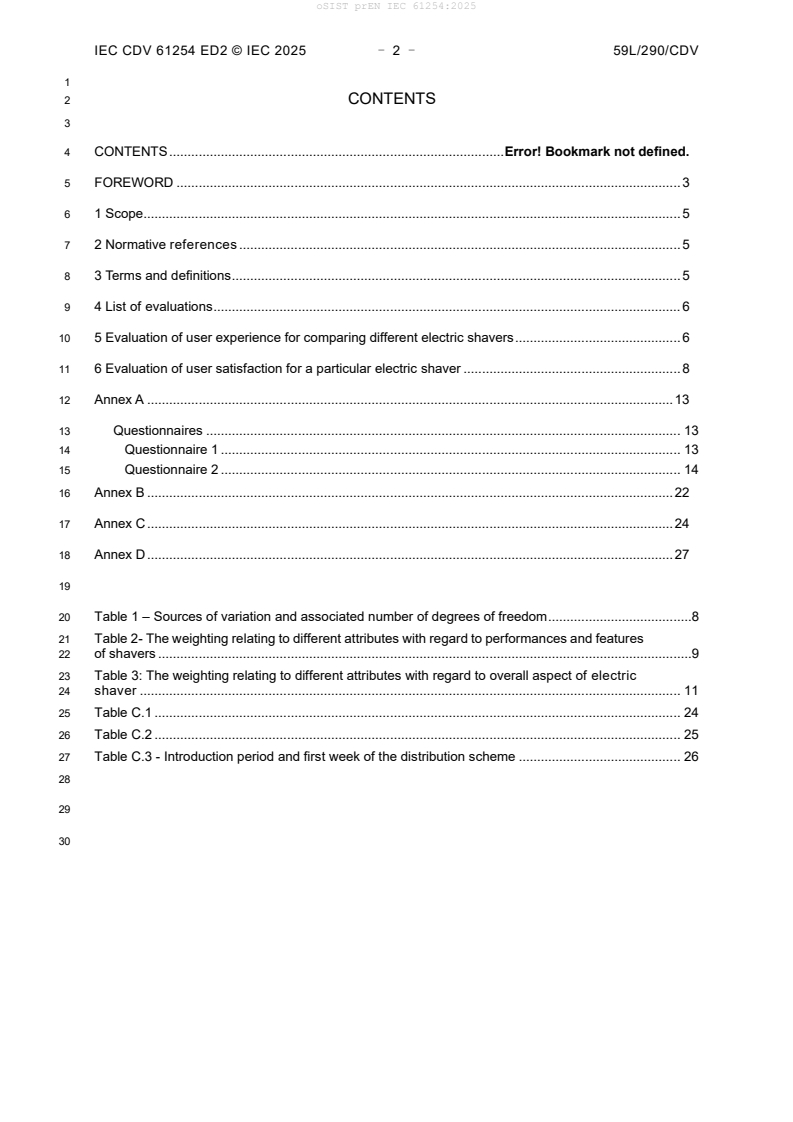
IEC CDV 61254 ED2 © IEC 2025 - 2 - 59L/290/CDV
2 CONTENTS
4 CONTENTS . Error! Bookmark not defined.
5 FOREWORD . 3
6 1 Scope. 5
7 2 Normative references . 5
8 3 Terms and definitions . 5
9 4 List of evaluations . 6
10 5 Evaluation of user experience for comparing different electric shavers . 6
11 6 Evaluation of user satisfaction for a particular electric shaver . 8
12 Annex A . 13
13 Questionnaires . 13
14 Questionnaire 1 . 13
15 Questionnaire 2 . 14
16 Annex B . 22
17 Annex C . 24
18 Annex D . 27
20 Table 1 – Sources of variation and associated number of degrees of freedom .8
21 Table 2- The weighting relating to different attributes with regard to performances and features
22 of shavers .9
23 Table 3: The weighting relating to different attributes with regard to overall aspect of electric
24 shaver . 11
25 Table C.1 . 24
26 Table C.2 . 25
27 Table C.3 - Introduction period and first week of the distribution scheme . 26
IEC CDV 61254 ED2 © IEC 2025 - 3 - 59L/290/CDV
31 INTERNATIONAL ELECTROTECHNICAL COMMISSION
32 ____________
34 ELECTRIC SHAVERS FOR HOUSEHOLD USE – EVALUATION OF USER
35 EXPERIENCE AND USER SATISFACTION
37 FOREWORD
39 1) The International Electrotechnical Commission (IEC) is a worldwide organization for
40 standardization comprising all national electrotechnical committees (IEC National
41 Committees). The object of IEC is to promote international co-operation on all questions
42 concerning standardization in the electrical and electronic fields. To this end and in addition to
43 other activities, IEC publishes International Standards, Technical Specifications, Technical
44 Reports, Publicly Available Specifications (PAS) and Guides (hereafter referred to as “IEC
45 Publication(s)”). Their preparation is entrusted to technical committees; any IEC National
46 Committee interested in the subject dealt with may participate in this preparatory work.
47 International, governmental and non-governmental organizations liaising with the IEC also
48 participate in this preparation. IEC collaborates closely with the International Organization for
49 Standardization (ISO) in accordance with conditions determined by agreement between the
50 two organizations.
51 2)The formal decisions or agreements of IEC on technical matters express, as nearly as
52 possible, an international consensus of opinion on the relevant subjects since each technical
53 committee has representation from all interested IEC National Committees.
54 3)IEC Publications have the form of recommendations for international use and are accepted
55 by IEC National Committees in that sense. While all reasonable efforts are made to ensure that
56 the technical content of IEC Publications is accurate, IEC cannot be held responsible for the
57 way in which they are used or for any misinterpretation by any end user.
58 4)In order to promote international uniformity, IEC National Committees undertake to apply
59 IEC Publications transparently to the maximum extent possible in their national and regional
60 publications. Any divergence between any IEC Publication and the corresponding national or
61 regional publication shall be clearly indicated in the latter.
62 5)IEC itself does not provide any attestation of conformity. Independent certification bodies
63 provide conformity assessment services and, in some areas, access to IEC marks of
64 conformity. IEC is not responsible for any services carried out by independent certification
65 bodies.
66 6)All users should ensure that they have the latest edition of this publication.
67 7)No liability shall attach to IEC or its directors, employees, servants or agents including
68 individual experts and members of its technical committees and IEC National Committees for
69 any personal injury, property damage or other damage of any nature whatsoever, whether
70 direct or indirect, or for costs (including legal fees) and expenses arising out of the publication,
71 use of, or reliance upon, this IEC Publication or any other IEC Publications.
72 8)Attention is drawn to the Normative references cited in this publication. Use of the
73 referenced publications is indispensable for the correct application of this publication.
74 9)Attention is drawn to the possibility that some of the elements of this IEC Publication may
75 be the subject of patent rights. IEC shall not be held responsible for identifying any or all such
76 patent rights.
77 International Standard IEC 61254 has been prepared by subcommittee 59L: Small household
78 appliances, of IEC technical committee Performance of household and similar electrical
79 appliances:
80 The text of this standard is based on the following documents:
IEC CDV 61254 ED2 © IEC 2025 - 4 - 59L/290/CDV
59L/XXX/FDIS 59L/XXX/RVD
83 Full information on the voting for the approval of this standard can be found in the report on
84 voting indicated in the above table.
85 This publication has been drafted in accordance with the ISO/IEC Directives, Part 2.
86 The committee has decided that the contents of this publication will remain unchanged until
87 the stability date indicated on the IEC website under "http://webstore.iec.ch" in the data
88 related to the specific publication. At this date, the publication will be
89 • reconfirmed,
90 • withdrawn,
91 • replaced by a revised edition, or
92 • amended.
93 The National Committees are requested to note that for this publication the stability date is
94 XXXX.
95 THIS TEXT IS INCLUDED FOR THE INFORMATION OF THE NATIONAL COMMITTEES AND WILL BE DELETED
96 AT THE PUBLICATION STAGE.
IEC CDV 61254 ED2 © IEC 2025 - 5 - 59L/290/CDV
100 ELECTRIC SHAVERS FOR HOUSEHOLD USE – EVALUATION OF USER
101 EXPERIENCE AND USER SATISFACTION
103 1 Scope
104 This document applies to men’s electric shavers and their trimmers for household use.
105 This document deals with the methods of evaluating user experience and user
106 satisfaction, in subjective way, for men’s electric shavers and their trimmers with a rated
107 voltage not greater than 250V.
108 This document does not specify safety or performance requirements.
109 2 Normative references
110 The following referenced documents are indispensable for the application of this
111 document. For dated references, only the edition cited applies. For undated references,
112 the latest edition of the referenced document (including any amendments) applies.
113 ISO 9241-210 Ergonomics of human-system interaction- Part 210: Human-centred design
114 for interactive systems.
115 3 Terms and definitions
116 For the purpose of this document, the following definitions apply.
117 ISO and IEC maintain terminology databases for use in standardization at the following
118 addresses:
119 IEC Electropedia: available at https://www.electropedia.org/.
120 ISO Online browsing platform: available at https://www.iso.org/obp.
121 3.1
122 electric shaver
123 appliance that uses electric energy to drive shaving head for shaving
124 3.2
125 rotary electric shaver
126 electric shaver with round shaving head(s) and usually rotating cutters
127 3.3
128 vibratory electric shaver
129 electric shaver with linear shaving head(s) and usually vibrating cutters
130 3.4
131 trimmer
132 accessory that is incorporated into the electric shaver and used to groom particular facial hair
133 Note Examples of particular facial hair are moustache, beard or side whiskers, etc.
134 3.5
135 user experience
136 person's perceptions and responses resulting from the use of a product
137 [IS0 9241-210:2010,AMD]
IEC CDV 61254 ED2 © IEC 2025 - 6 - 59L/290/CDV
138 3.6
139 user satisfaction
140 freedom from negative and positive attitudes towards the use of the product.
141 [IS0 9241-210:2010,AMD]
142 4 List of evaluations
143 Depending on the appliance, the following evaluations shall be carried out, as appropriate:
144 4.1 User experience for comparing different electric shavers
145 4.2 User satisfaction for a particular electric shaver
146 --User satisfaction with regard to performances and features of a particular electric shaver;
147 --User satisfaction with regard to overall aspects of a particular electric shaver.
148 5 Evaluation of user experience for comparing different electric shavers
149 5.1 Composition of the test panels
150 Each panel is to be composed so that it is reasonably representative of the adult male population
151 of the country in which the test is performed, with particular attention being paid to hair density,
152 rate of beard growth, toughness of the beard, sensitivity towards skin irritation, and the time
153 taken to shave.
154 Each panel tester shall have no pains or injuries on the face and have no allergic skin.
155 Each panel tester shall be the potential user and have a positive attitude towards the functions
156 and not be influenced by preconceived ideas.
157 The test panel is divided into subpanels with equal size. Each subpanel represents one of the
158 two basic electric shaver systems:
159 -- rotary electric shaver testers.
160 -- vibratory electric shaver testers.
161 For statistical reasons, the number of testers in each of the above subpanels should be at least
162 12.
163 Note 1 Whereas some deviation of the test panel composition from the real situation in a country will not have a
164 noticeable influence on the results, it is essential that subpanels have comparable compositions.
165 Note 2 Test can be conducted when there’s only one type of electric shaver. For example, evaluation among
166 three rotary electric shavers with different brands or models or three vibratory electric shavers with different
167 brands or models.
168 Note 3 A subpanel composed of testers who use wet shavers (razor blades) can be considered when necessary.
169 5.2 Test duration and test procedure
170 5.2.1 Test duration
171 The test duration depends on the number of types/modes of electric shavers and testers, but
172 generally contains with introduction period and test period.
173 The test period is preceded by a two week introduction period in which the testers familiarize
174 themselves with the other shaving system, i.e. rotary electric shaver users shave with
175 vibratory electric shavers, and vibratory electric shaver users shave with rotary electric
176 shavers.
177 The test period for each electric shaver, which should start within a week after the introduction
178 period, has three shaving days. On the first day of each test period, the tester uses his own
179 shaver (see scheme A in Annex D).
IEC CDV 61254 ED2 © IEC 2025 - 7 - 59L/290/CDV
180 If a small number of electric shaver models are to be tested, the test period of three days for
181 each electric shaver can be extended to six days. On day 7 the tester uses his own shaver (see
182 scheme B in Annex D).
183 For testers with a low density of beard hairs or light beards, each test day may be preceded by a
184 non-shaving day (see scheme C in Annex D).
185 5.2.2 Test procedure
186 Day 1
187 On the first shaving day, each tester shaves with his own shaver, which is used as a reference.
188 Questionnaire 1 (see Annex A) is to be completed immediately after shaving.
189 Note Questionnaire 1 is not included in the final analysis. It allows for the test institute to characterize the test
190 panels, particularly with respect to the average level of judgment scores.
191 Day 2 and Day 3
192 On the second and third shaving days, the tester shaves with one of the test shavers. On both
193 days the tester records the shaving time with a stopwatch, and immediately after shaving fills in
194 Questionnaire 2 (see Annex A) relating to shaving time, cleanness, and skin irritation.
195 Note Possible variations in the testing scheme are given in Annex D.
196 5.2.3 Handling, convenience and storage, etc.
197 For each test period, the handling, convenience, storage, etc. of the tested shaver are assessed
198 and Questionnaire 3 is completed on the last day of the test period (see Annex A).
199 The test is continued until each tester has tested each shaver once.
200 The instruction for the testers is given in Annex B.
201 5.3 Distribution of electric shavers
202 The electric shavers are distributed so that each tester:
203 -- shaves with each shaver in turn;
204 -- uses each shaver an equal number of times.
205 The following should be observed as far as possible:
206 -- For each tester, the sequence of distribution of the electric shavers should be different.
207 Note This procedure avoids possible interaction between shavers.
208 -- The first electric shaver to be tested shall not be the same as that used in the introduction
209 period.
210 --The number of electric shavers in each model should be as small as possible.
211 Note The method proposed by Kraitchik (1953) can be used as an efficient tool to produce a distribution scheme.
212 The method is illustrated by the example shown in Annex C.
213 5.4 Statistical analysis
214 A ten-point scale, shown in Annex A, is used and the results are analyzed by using an analysis of
215 variance. The following sources of variation are included:
216 --variation due to subpanels p;
IEC CDV 61254 ED2 © IEC 2025 - 8 - 59L/290/CDV
217 --variation due to testers t (within subpanels p);
218 --variation due to types of electric shaver n;
219 --variation due to the interaction p x n;
220 --variation due to the interaction t(p)x n;
221 --variation due to experimental error (residual variation).
222 As an example, Table 1 shows the sources of variation and the associated numbers of degrees
223 of freedom (df), for the case : p=2, t(p)=18, n=9, k(number of the repetitions)=2.
225 Table 1 – Sources of variation and associated number of degrees of freedom
Source of variation df
Grand mean 1
Subpanels p 1
Testers (within panels) t(p) 34
Types of electric shaver n 8
Interaction p x n 8
Interaction t (p)×n
Residual
227 The homogeneity of the types of electric shavers can be assessed with an F-test. Given a
228 significant difference between types, it is possible to establish clusters of types.
229 5.5 Final ranking
230 If the statistical analysis shows a significant interaction between subpanels and types of electric
231 shavers (p x n), results for each subpanel have to be presented separately.
232 For each result, for example, cleanness on the cheek, chin, and under the nose (see Annex A);
233 the analysis leads to a result which can be shown schematically. An example for nine electric
234 shavers, X1 to X9 is given below:
236 The horizontal bars below the characters X , X , etc., represent the results of the analysis of
5 1
237 variance. Types of electric shaver X and X form the first statistical group, showing that the
5 1
238 difference between X and X does not differ significantly from zero. The second statistical group
5 1
239 is formed by electric shavers X1, X4, X3 and X2, the third by X2, X7 and X6 and the fourth by X6,
240 X8 and X9.
241 Differences in average scores should only be identified if the relevant types of electric shavers
242 belong to different statistical groups.
244 6 Evaluation of user satisfaction for a particular electric shaver
245 6.1 User Satisfaction with regard to performances and features of a particular electric
246 shaver
247 The purpose of evaluation of user satisfaction with regard to performances and features of
248 shavers is to help the public know about how satisfied that consumers feel towards a particular
IEC CDV 61254 ED2 © IEC 2025 - 9 - 59L/290/CDV
249 electric shaver.
250 6.1.1 Evaluation panels
251 Each evaluator shall be an adult male who has/had used the electric shaver and have positive
252 attitudes towards its brand and functions.
253 For statistical reasons, the number of evaluators in the evaluation panel shall be at least 30.
254 6.1.2 Evaluation attributes
255 The electric shaver shall be evaluated for user satisfaction with regard to performances and
256 features on the following attributes:
257 (a) three attributes with regard to shaving performance are cleanness, shaving time, and skin
258 irritation.
259 (b) nine attributes with regard to features of shavers are noise, vibration, shaved-beard
260 collection, shaver-head cleaning, trimmer, working time, comfort of handling, operation of
261 functional switch, and instructions for use.
262 6.1.3 Evaluation mode
263 The evaluation panel is asked to answer Questionnaire 4 (see Annex A).
264 6.1.4 Point allocation
265 6.1.4.1 Each attribute shall be allocated for 10 points. The points from all attributes shall be
266 added together to produce a total score. An electric shaver can achieve a maximum score of
267 120 points from the sum of points when evaluated against the required 12 attributes.
268 6.1.4.2 The points from each attribute are awarded by the points from evaluator multiplying the
269 weighting of the attribute, expressed by the following formula (1)
270 P = P w………………….(1)
a 0 X
271 where:
272 P : the points from each attribute;
a
273 P : the points that each evaluator gave for the particular attribute;
274 w: weighting relating to the particular attribute.
275 6.1.4.3 The weighting relating to different attributes is shown in Table 2.
276 Table 2- The weighting relating to different attributes with regard to performances and
277 features of shavers
aspect attributes weighting (w)
cleanness 30%
shaving performance
shaving time 15%
(60%)
skin irritation 15%
noise 4%
vibration 3%
features of shaver (40%)
hair-stubbles collection 3%
shaver-head cleaning 5%
IEC CDV 61254 ED2 © IEC 2025 - 10 - 59L/290/CDV
trimmer 5%
working time 10%
comfort of handling 5%
operation of functional switch 3%
instructions for use 2%
279 6.1.4.4 The total evaluated score for an evaluator shall be the sum of the points from all
280 attributes, expressed by the following formula (2)
281 S = P + P +…… + P + P ……….(2)
0 (a1) (a2) (a11) (a12)
282 where:
283 S : the total evaluated score for an evaluator;
284 P ~ P : the points from 12 attributes: cleanness, shaving time…. instructions for use.
(a1) (a12)
285 6.1.4.5 The user satisfaction with regard to performance and features of electric shavers shall
286 be the arithmetic mean value of the evaluated score of the evaluation panel, expressed by the
287 following formula (3):
288 S = (S01 + SO2 + S03 +……….+S0n )/n ……….(3)
289 where:
290 S : the user satisfaction with regard to performance and features of electric shavers;
291 S ~ S : the total evaluated score for all evaluators.
(01) (0n)
292 n: the number of evaluators.
293 6.2 User satisfaction with regard to overall aspects of a particular electric shaver
294 The purpose of evaluation of user satisfaction with regard to overall aspects of the electric
295 shaver is to help the public know how satisfied that consumers feel towards a particular electric
296 shaver, taking into account the overall aspects including pre-purchase stage, purchase stage,
297 and after-purchase stage.
298 6.2.1 Evaluation panels
299 Each evaluator shall be the adult male who has/had used the electric shaver and have a
300 positive attitude towards its brand and functions.
301 For statistical reasons, the number of evaluators of each panel shall be at least 30.
302 6.2.2 Evaluation attributes
303 The electric shaver shall be evaluated for overall satisfaction on the following attributes:
304 (a) three attributes with regard to the pre-purchase stage are brand awareness, brand
305 advertising effect and brand reputation.
306 (b) seven attributes with regard to the purchase stage are inquiry response time, expertise of
307 inquiry response, feature requirement s
...
Questions, Comments and Discussion
Ask us and Technical Secretary will try to provide an answer. You can facilitate discussion about the standard in here.
Loading comments...