

SIST EN 10219-1:2006
(Main)Cold formed welded structural hollow sections of non-alloy and fine grain steels - Part 1: Technical delivery conditions
General Information
- Abstract
This part of this European Standard specifies the technical delivery conditions for cold formed welded structural hollow sections of circular, square or rectangular forms and applies to structural hollow sections formed cold without subsequent heat treatment.
Requirements for tolerances, dimensions and sectional properties are contained in EN 10219-2.
NOTE A range of steel grades is specified in this European Standard and the user should select the grade appropriate to the intended use and service conditions. The grades and mechanical properties of the finished hollow sections are compatible with those in EN 10025-2 and EN 10025-3.
- Status
- Published
- Publication Date
- 30-Jun-2006
- Technical Committee
- IFEK - Ferrous metals
- Current Stage
- 6060 - National Implementation/Publication (Adopted Project)
- Start Date
- 01-Jul-2006
- Due Date
- 01-Jul-2006
- Completion Date
- 01-Jul-2006
- Directive
- 305/2011 - Regulation (eu) No 305/2011 of the European Parliament and of the Council of 9 march 2011 laying down harmonised conditions for the marketing of construction products and repealing council directive 89/106/eecOJ Ref: C 259 OJ Date: 08-Aug-2014
89/106/EEC - Construction productsOJ Ref: C 304 OJ Date: 13-Dec-2006


Overview
EN 10219-1:2006 - Cold formed welded structural hollow sections of non-alloy and fine grain steels - Part 1: Technical delivery conditions defines the technical delivery requirements for cold-formed, welded structural hollow sections (circular, square, rectangular) manufactured without subsequent heat treatment. It sets requirements for steel grades, delivery condition, chemical and mechanical properties, testing, inspection, marking and conformity assessment. (Tolerances, dimensions and sectional properties are covered in EN 10219-2.)
Key Topics
- Scope and product types: Applies to cold-formed welded structural hollow sections of circular, square or rectangular cross-sections formed at ambient temperature and delivered without heat treatment.
- Steel grades and designation: Specifies non-alloy and fine-grain steels with designation rules (examples: EN 10219-S275J0H, EN 10219-S355NLH). Guidance on selecting grades appropriate to service conditions is provided; finished properties are compatible with EN 10025-2 and EN 10025-3.
- Delivery conditions: Defines feedstock conditions (normalized, thermomechanically rolled), and delivery state designations (e.g., N, M, L).
- Chemical and mechanical requirements: Specifies required chemical composition limits and mechanical properties for the listed grades (see normative annexes).
- Testing and inspection: Covers types and frequency of inspection, sampling procedures, preparation of test pieces, tensile and impact tests, and non-destructive testing (NDT) of welds.
- Non-destructive testing: References automated eddy-current, magnetic flux leakage and ultrasonic or radiographic methods for weld inspection (see EN 10246 series).
- Documentation and marking: Defines inspection documents, marking requirements and conformity evaluation procedures.
- Terms and symbols: Aligns terminology with EN 10020, EN 10266 and other relevant EN/ISO vocabularies.
Applications
EN 10219-1:2006 is intended for manufacturers, fabricators, specifiers and quality/inspection personnel involved with structural hollow sections used in:
- Building frames, columns and beams
- Bridge components and lattice structures
- Steel trusses, façades and cladding supports
- Mechanical and industrial frames, supports and conveyors
- Prefabricated modular structures and structural connectors
Who uses it:
- Steel producers and tube manufacturers for product specification and quality control
- Structural engineers and architects for material selection and procurement specs
- Fabricators and welders for conformity and acceptance testing
- Purchasing and certification bodies for compliance and CE marking support
Related Standards
- EN 10219-2 (tolerances, dimensions, sectional properties)
- EN 10025-2 / EN 10025-3 (steel grade compatibility)
- EN 10246 series (NDT of steel tubes)
- EN 10204 (inspection documents)
- EN ISO 9001 (quality management)
- EN ISO 377, EN ISO 15614-1, EN 10045-1 (sampling, welding procedure tests, impact testing)
EN 10219-1:2006 provides the technical baseline for safe, consistent supply and acceptance of cold formed welded structural hollow sections in construction and industrial applications.
Relations
- Effective Date
- 01-Jul-2006
- Effective Date
- 28-Jan-2026
- Effective Date
- 28-Jan-2026
- Effective Date
- 28-Jan-2026
- Effective Date
- 28-Jan-2026
- Refers
SIST EN ISO 643:2024 - Steels - Micrographic determination of the apparent grain size (ISO 643:2024) - Effective Date
- 28-Jan-2026
- Effective Date
- 28-Jan-2026
- Effective Date
- 28-Jan-2026
- Effective Date
- 28-Jan-2026
- Effective Date
- 28-Jan-2026
- Refers
SIST EN 10168:2004 - Steel products - Inspection documents - List of information and description - Effective Date
- 28-Jan-2026
- Effective Date
- 28-Jan-2026
- Effective Date
- 28-Jan-2026
- Effective Date
- 28-Jan-2026
- Effective Date
- 28-Jan-2026
Get Certified
Connect with accredited certification bodies for this standard

Element Materials Technology
Materials testing and product certification.

Inštitut za kovinske materiale in tehnologije
Institute of Metals and Technology. Materials testing, metallurgical analysis, NDT.
Sponsored listings
Frequently Asked Questions
SIST EN 10219-1:2006 is a standard published by the Slovenian Institute for Standardization (SIST). Its full title is "Cold formed welded structural hollow sections of non-alloy and fine grain steels - Part 1: Technical delivery conditions". This standard covers: This part of this European Standard specifies the technical delivery conditions for cold formed welded structural hollow sections of circular, square or rectangular forms and applies to structural hollow sections formed cold without subsequent heat treatment. Requirements for tolerances, dimensions and sectional properties are contained in EN 10219-2. NOTE A range of steel grades is specified in this European Standard and the user should select the grade appropriate to the intended use and service conditions. The grades and mechanical properties of the finished hollow sections are compatible with those in EN 10025-2 and EN 10025-3.
This part of this European Standard specifies the technical delivery conditions for cold formed welded structural hollow sections of circular, square or rectangular forms and applies to structural hollow sections formed cold without subsequent heat treatment. Requirements for tolerances, dimensions and sectional properties are contained in EN 10219-2. NOTE A range of steel grades is specified in this European Standard and the user should select the grade appropriate to the intended use and service conditions. The grades and mechanical properties of the finished hollow sections are compatible with those in EN 10025-2 and EN 10025-3.
SIST EN 10219-1:2006 is classified under the following ICS (International Classification for Standards) categories: 77.140.45 - Non-alloyed steels; 77.140.70 - Steel profiles. The ICS classification helps identify the subject area and facilitates finding related standards.
SIST EN 10219-1:2006 has the following relationships with other standards: It is inter standard links to SIST EN 10219-1:1998, SIST EN 10027-1:2016, SIST EN ISO 377:2017, SIST EN ISO 10893-11:2011, SIST EN ISO 15614-1:2017, SIST EN ISO 643:2024, SIST EN ISO 14284:2023, SIST EN ISO 10893-2:2011, SIST-TP CEN/TR 10261:2023, SIST EN ISO 9001:2000, SIST EN 10168:2004, SIST EN 10020:2000, SIST EN ISO 10893-3:2011, SIST EN ISO 6892-1:2020, SIST EN ISO 9606-1:2018. Understanding these relationships helps ensure you are using the most current and applicable version of the standard.
SIST EN 10219-1:2006 is associated with the following European legislation: EU Directives/Regulations: 305/2011, 89/106/EEC; Standardization Mandates: M/120, M/BC/CEN/89/10. When a standard is cited in the Official Journal of the European Union, products manufactured in conformity with it benefit from a presumption of conformity with the essential requirements of the corresponding EU directive or regulation.
SIST EN 10219-1:2006 is available in PDF format for immediate download after purchase. The document can be added to your cart and obtained through the secure checkout process. Digital delivery ensures instant access to the complete standard document.
Standards Content (Sample)
2003-01.Slovenski inštitut za standardizacijo. Razmnoževanje celote ali delov tega standarda ni dovoljeno.Kaltgefertigte geschweißte Hohlprofile für den Stahlbau aus unlegierten Baustählen und aus Feinkornbaustählen - Teil 1: Technische LieferbedingungenProfils creux de construction soudés formés a froid en aciers non alliés et a grains fins - Partie 1 : Conditions techniques de livraisonCold formed welded structural hollow sections of non-alloy and fine grain steels - Part 1: Technical delivery conditions77.140.70Jekleni profiliSteel profiles77.140.45Nelegirana jeklaNon-alloyed steelsICS:Ta slovenski standard je istoveten z:EN 10219-1:2006SIST EN 10219-1:2006en01-julij-2006SIST EN 10219-1:2006SLOVENSKI
STANDARDSIST EN 10219-1:19981DGRPHãþD
EUROPEAN STANDARDNORME EUROPÉENNEEUROPÄISCHE NORMEN 10219-1April 2006ICS 77.140.75Supersedes EN 10219-1:1997
English VersionCold formed welded structural hollow sections of non-alloy andfine grain steels - Part 1: Technical delivery conditionsProfils creux pour la construction soudés, formés à froid enaciers non alliés et à grains fins - Partie 1 : Conditionstechniques de livraisonKaltgefertigte geschweißte Hohlprofile für den Stahlbau ausunlegierten Baustählen und aus Feinkornbaustählen - Teil1: Technische LieferbedingungenThis European Standard was approved by CEN on 16 March 2006.CEN members are bound to comply with the CEN/CENELEC Internal Regulations which stipulate the conditions for giving this EuropeanStandard the status of a national standard without any alteration. Up-to-date lists and bibliographical references concerning such nationalstandards may be obtained on application to the Central Secretariat or to any CEN member.This European Standard exists in three official versions (English, French, German). A version in any other language made by translationunder the responsibility of a CEN member into its own language and notified to the Central Secretariat has the same status as the officialversions.CEN members are the national standards bodies of Austria, Belgium, Cyprus, Czech Republic, Denmark, Estonia, Finland, France,Germany, Greece, Hungary, Iceland, Ireland, Italy, Latvia, Lithuania, Luxembourg, Malta, Netherlands, Norway, Poland, Portugal, Romania,Slovakia, Slovenia, Spain, Sweden, Switzerland and United Kingdom.EUROPEAN COMMITTEE FOR STANDARDIZATIONCOMITÉ EUROPÉEN DE NORMALISATIONEUROPÄISCHES KOMITEE FÜR NORMUNGManagement Centre: rue de Stassart, 36
B-1050 Brussels© 2006 CENAll rights of exploitation in any form and by any means reservedworldwide for CEN national Members.Ref. No. EN 10219-1:2006: ESIST EN 10219-1:2006
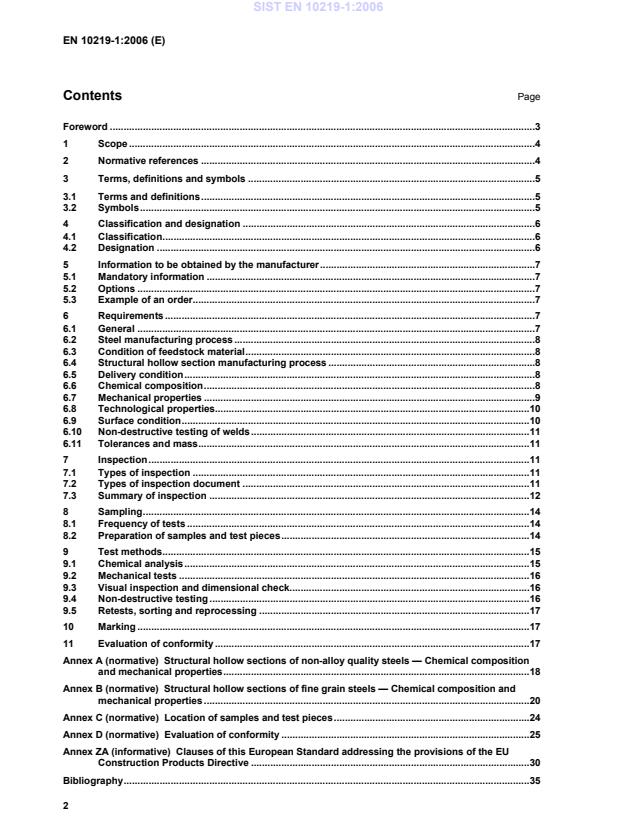
Structural hollow sections of non-alloy quality steels — Chemical composition and mechanical properties.18 Annex B (normative)
Structural hollow sections of fine grain steels — Chemical composition and mechanical properties.20 Annex C (normative)
Location of samples and test pieces.24 Annex D (normative)
Evaluation of conformity.25 Annex ZA (informative)
Clauses of this European Standard addressing the provisions of the EU Construction Products Directive.30 Bibliography.35
EN 10020:2000, Definition and classification of grades of steel EN 10021:1993, General technical delivery requirements for steel and iron products EN 10027-1, Designation systems for steels
— Part 1: Steel names EN 10027-2, Designation systems for steels - Part 2: Numerical system EN 10045-1, Metallic materials — Charpy impact test — Part 1: Test method EN 10052:1993, Vocabulary of heat treatment terms for ferrous products EN 10168, Steel products - Inspection documents - List of information and description EN 10204, Metallic products — Types of inspection documents EN 10219-2:2006, Cold formed welded structural hollow sections of non-alloy and fine grain steels — Part 2: Tolerances, dimensions and sectional properties EN 10246-3, Non-destructive testing of steel tubes — Part 3: Automatic eddy current testing of seamless and welded (except submerged arc welded) steel tubes for the detection of imperfections EN 10246-5, Non-destructive testing of steel tubes — Part 5: Automatic full peripheral magnetic transducer/flux leakage testing of seamless and welded (except submerged arc welded) ferromagnetic steel tubes for the detection of longitudinal imperfections EN 10246-8, Non-destructive testing of steel tubes — Part 8: Automatic ultrasonic testing of the weld seam of electric welded steel tubes for the detection of longitudinal imperfections EN 10246-9, Non-destructive testing of steel tubes — Part 9: Automatic ultrasonic testing of the weld seam of submerged arc-welded steel tubes for the detection of longitudinal and/or transverse imperfections EN 10246-10, Non-destructive testing of steel tubes — Part 10: Radiographic testing of the weld seam of automatic fusion arc welded steel tubes for the detection of imperfections EN 10256, Non-destructive testing of steel tubes - Qualification and competence of level 1 and 2 non-destructive testing personnel SIST EN 10219-1:2006
3 Terms, definitions and symbols 3.1 Terms and definitions For the purpose of this European Standard, the following terms and definitions apply in addition to or where different from those in EN 10020:2000, EN 10021:1993, EN 10052:1993 and EN 10266:2003.
3.1.1 cold forming process where the main forming is done at ambient temperature 3.1.2 normalizing rolling rolling process in which the final deformation is carried out in a certain temperature range leading to a material condition equivalent to that obtained after normalizing so that the specified values of the mechanical properties are retained even after subsequent normalizing 3.1.3 thermomechanical rolling rolling process in which the final deformation is carried out in a certain temperature range leading to a material condition with certain properties which cannot be achieved or repeated by heat treatment alone NOTE 1 Subsequent heating above 580 °C may lower the strength values. NOTE 2 Thermomechanical rolling, leading to the delivery condition M, can include processes with an accelerated cooling rate, with or without tempering including self-tempering, but excluding direct quenching and quenching and tempering. 3.2 Symbols For the purposes of this European Standard, the symbols defined in EN 10266:2003 apply. SIST EN 10219-1:2006
1) 1 MPa = 1 N/mm2 SIST EN 10219-1:2006
5 Information to be obtained by the manufacturer 5.1 Mandatory information The following information shall be obtained by the manufacturer at the time of enquiry and order: a) the quantity (mass or total length); b) the type of length, length range or length (see EN 10219-2); c) details of the product form:
CFCHS = cold formed circular hollow section;
CFRHS = cold formed square or rectangular hollow section; d) the steel designation (see 4.2); e) the dimensions (see EN 10219-2). 5.2 Options A number of options are specified in this part of this European Standard. These are listed below with appropriate clause references. In the event that the purchaser does not indicate a wish to implement any of these options at the time of enquiry and order, the hollow sections shall be supplied in accordance with the basic specification. 1.1 Product analysis (see 6.6.1). 1.2 Cr, Cu, Mo, Ni, Ti and V cast analysis contents to be reported (see 6.6.2). 1.3 Verification of impact properties for qualities J0 and JR (see 6.7.4). 1.4 Suitability for hot dip galvanizing (see 6.8.2). 1.5 Weld repairs to the body of non-alloy structural steel hollow sections not permitted (see 6.9.4). 1.6 Specific inspection and testing for non-alloy quality grades JR and J0 (see 7.1.1). 1.7 Inspection document other than the standard document (see 7.2.2). 5.3 Example of an order 10 t of 8 m to 10 m random length cold finished square hollow sections in accordance with EN 10219, made from non-alloy quality structural steel S355NH, with specified outside dimensions 100 mm × 100 mm and wall thickness of 8 mm, supplied with product analysis (Option 1.1) and suitable for hot dip galvanising (Option 1.4).
10 t, 8-10m Random lengths – CFRHS – EN 10219 – S355NH – 100 x 100 x 8 – Options 1.1, 1.4 6 Requirements 6.1 General Structural hollow sections of non-alloy steels shall conform to the requirements of Annex A. Structural hollow sections of fine grain steels shall conform to the requirements of Annex B.
% by mass % by mass
≤ 0,20 + 0,02 C a
> 0,20 + 0,03 Si
≤ 0,60 + 0,05 non-alloy ≤ 1,60 + 0,10 Mn fine grain ≤ 1,70 - 0,05 + 0,10 non-alloy ≤ 0,040 + 0,010 P fine grain ≤ 0,035 + 0,005 non-alloy ≤ 0,040 + 0,010 S fine grain ≤ 0,030 + 0,005 Nb
≤ 0,050 + 0,010 V
≤ 0,20 + 0,02 Ti
≤ 0,05 + 0,01 Cr
≤ 0,30 + 0,05 Ni
≤ 0,80 + 0,05 Mo
≤ 0,20 + 0,03
≤ 0,35 + 0,04 Cu
0,35 < Cu ≤ 0,70 + 0,07 N
≤ 0,025 + 0,002 AlTotal
≥ 0,020 - 0,005 a For S235JRH in thicknesses ≤ 16 mm, the permissible deviation = 0,4 % C, and for thicknesses >16 mm and ≤ 40 mm the permissible deviation = 0,05 % C.
6.6.2 For non-alloy steel products supplied with specific inspection and testing the following option may be specified (see 7.1): Option 1.2 the recording on the inspection certificate of the Cr, Cu, Mo, Ni, Ti and V content (cast analysis). 6.7 Mechanical properties 6.7.1 Under the inspection and testing conditions as specified in Clause 7 and in the delivery condition specified in 6.5, the mechanical properties shall conform to the relevant requirements of Tables A.3, B.4 or B.5. NOTE Stress relief annealing at more than 580 °C or for over one hour may lead to deterioration of the mechanical properties.
6.7.2 For impact tests, standard V-notch test pieces in accordance with EN 10045-1 shall be used. If the nominal product thickness is not sufficient for the preparation of standard test pieces, the test shall be carried out using test pieces of width less than 10 mm, but not less than 5 mm. The minimum average values given in Tables A.3, B.4 and B.5 shall be reduced in direct proportion of the actual width of the test piece compared to that of the standard test piece. Impact tests are not required for specified thicknesses < 6 mm. SIST EN 10219-1:2006
b) the impact properties of structural hollow sections of steel qualities JR and J0 are not verified unless otherwise specified by the purchaser at the time of enquiry and order. Option 1.3 for products in qualities JR and J0 supplied with specific inspection and testing (see Option 1.6), the verification of the impact properties is specified. 6.8 Technological properties 6.8.1 Weldability The steels specified in this European Standard are weldable.
General requirements for welding the products in accordance with this European Standard are given in EN 1011-1 and EN 1011-2. NOTE 1 When welding these products, as product thickness, strength level and CEV increase, the occurrence of cold cracking in the welded zone forms the main risk. Cold cracking is caused by a combination of the following factors: high levels of diffusible hydrogen in the weld metal; a brittle structure in the heat affected zone; significant tensile stress concentrations in the welded joint. NOTE 2 By using guidelines, specified for example in EN 1011-1, EN 1011-2 or any other relevant standard, the recommended welding conditions and the various welding ranges for the steel grades can be determined. These will vary depending on the product thickness, the applied welding energy, the design requirements, the electrode efficiency, the welding process and the weld metal properties. 6.8.2 Suitability for hot dip galvanizing Option 1.4 the products shall be suitable for hot dip galvanizing. 6.9 Surface condition 6.9.1 The hollow sections shall have a smooth surface corresponding to the manufacturing method used; bumps, cavities or shallow longitudinal grooves resulting from the manufacturing process are permissible, provided the remaining thickness is within tolerance. Surface defects may be removed by the manufacturer by grinding, provided that the thickness of the hollow section after the repair is not less than the minimum permissible thickness in accordance with EN 10219-2. 6.9.2 The ends of the hollow section shall be cut nominally square to the axis of the product. 6.9.3 For both non-alloy and fine grain hollow sections, repair of the weld shall be permitted. 6.9.4 For non-alloy hollow sections, repair of the body by welding shall be permitted unless otherwise specified. The conditions under which, and the extent to which, welding repair to the body may be carried out shall be agreed between the manufacturer and the purchaser. Option 1.5 repair of the body by welding shall not be carried out. SIST EN 10219-1:2006
C40-C43 — Impact test — Test piece type and test results, if applicable; C71-C92 — Cast analysis and, if applicable, product analysis. Z — Validation. 7.3 Summary of inspection The requirements for inspection are given in Table 2 for hollow sections of non-alloy steels and in Table 3 for hollow sections of fine grain steels. SIST EN 10219-1:2006
Specific inspection
1 Cast analysis 6.6 9.1 One result per delivery item One per cast
2 Tensile test 6.7 9.2 One result per delivery item One per test unit a b
Mandatory tests 3 Impact test for qualities J2 and K2 only 6.7 9.2 Not applicable One set per test unit a b
4 Surface condition and dimensions 6.9 6.11 9.3 See 9.3 See 9.3
5 NDT of the weld 6.10 9.4 Not applicable All products, full length
6 Product analysis (Option 1.1) 6.6 9.1 Not applicable One per test unit a Optional tests 7 Cast analysis additional elements (Option 1.2) 6.6 9.1 Not applicable See Option 1.2
8 Impact test for qualities JR and J0 (Option 1.3) 6.7 9.2 Not applicable One set per test unit a b
a For test units see 8.1.3. b Longitudinal or transverse samples at the discretion of the manufacturer.
Table 3 — Inspection programme for hollow sections of fine grain steels Inspection requirements Inspection programme Type of test Subclause reference(s) Specific inspection
1 Cast analysis 6.6 9.1 One per cast
2 Tensile test 6.7 9.2 One per test unit a b
Mandatory tests 3 Impact test 6.7 9.2 One set per test unit a b
4 Surface condition and dimensions 6.9 6.11 9.3 See 9.3
5 NDT of the weld 6.10 9.4 All products, full length Optional tests 6 Product analysis (Option 1.1) 6.6 9.1 One per test unit a a For test units see 8.1.3.
b Longitudinal or transverse samples at the discretion of the manufacturer. SIST EN 10219-1:2006
maximum mm mm t ≤ 114,3 ≤ 400 40 > 114,3 ≤ 323,9 > 400 ≤ 800 50 > 323,9 > 800 75
8.2 Preparation of samples and test pieces 8.2.1 Selection and preparation of samples for chemical analysis
Samples for product analysis, when required, shall be taken from the sample product or alternatively from test pieces used for mechanical testing or from the full thickness of the hollow section at the same location as for the mechanical test samples. The preparation of samples shall be in accordance with EN ISO 14284.
8.2.2 Preparation of test pieces for mechanical tests 8.2.2.1 General The requirements of EN ISO 377 shall apply in conjunction with the test piece location specified in 8.2.3. 8.2.2.2 Tensile test pieces The requirements of EN 10002-1, as appropriate, shall apply. SIST EN 10219-1:2006
The choice of a suitable physical or chemical analytical method for the analysis shall be at the discretion of the manufacturer. In case of dispute, the method used shall be agreed taking into account CR 10261. SIST EN 10219-1:2006
9.2.3 Impact tests The impact test shall be carried out in accordance with EN 10045-1. In addition, the following requirements shall apply: a) The average value of a set of three test pieces shall be equal to or greater than the specified value. One individual value may be below the specified value, provided that it is not less than 70 % of that value; b) If the conditions under a) are not satisfied then an additional set of three test pieces may be taken, at the discretion of the manufacturer, from the same sample and tested. To consider the test unit as conforming after testing the second set, the following conditions shall all be satisfied simultaneously: 1) The average value of the six tests shall be equal to or greater than the minimum specified value; 2) Not more than two of the six individual values may be lower than the minimum specified value; 3) Not more than one of the six individual values may be lower than 70 % of the minimum specified value. c) If these conditions are not satisfied, the sample product is rejected and retests shall be carried out on the remainder of the test unit (see 9.5). 9.3 Visual inspection and dimensional check 9.3.1 Visual inspection The hollow sections shall be visually inspected for compliance with the requirements of 6.9.
9.3.2 Dimensional check The dimensions of the hollow sections shall be checked for compliance with the requirements of EN 10219-2. 9.4 Non-destructive testing 9.4.1 General When the welds of structural hollow sections are to be subjected to non-destructive testing, the method shall be in accordance with 9.4.2 or 9.4.3. At the manufacturer's discretion, the non-destructive testing may be carried out SIST EN 10219-1:2006
an identification number, e.g. order number, which permits the correlation of the product or delivery unit to the related document; the mark of the external inspection representative (where applicable). 10.2 Where the products are supplied bundled, the marking required in 10.1 shall be on a label, which shall be securely attached to the bundle. 11 Evaluation of conformity Where evaluation of conformity is required for regulatory purposes Annex D shall apply.
Structural hollow sections of non-alloy quality steels — Ch
...