


SIST EN 61595-1:1999
(Main)Multichannel digital audio tape recorder (DATR), reel-to-reel system, for professional use -- Part 1: Format A
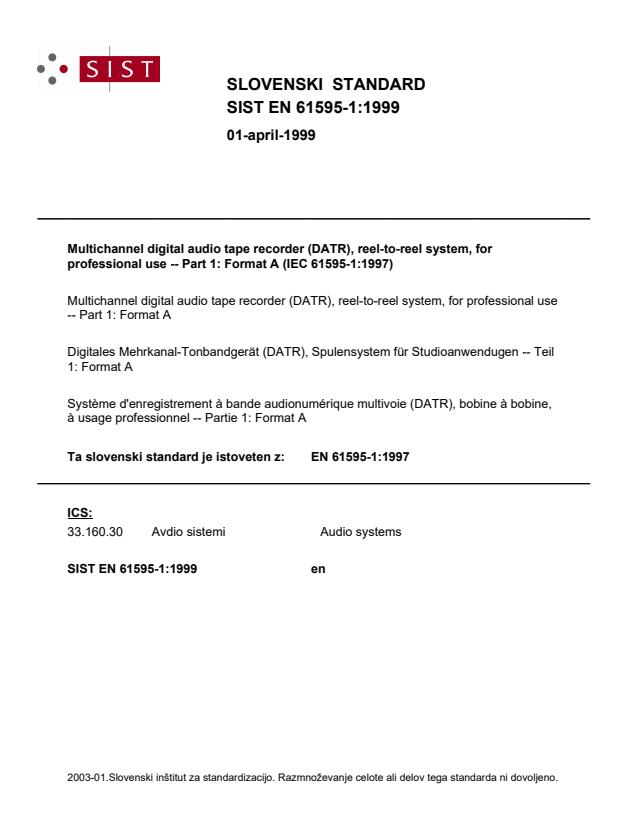
Multichannel digital audio tape recorder (DATR), reel-to-reel system, for professional use -- Part 1: Format A
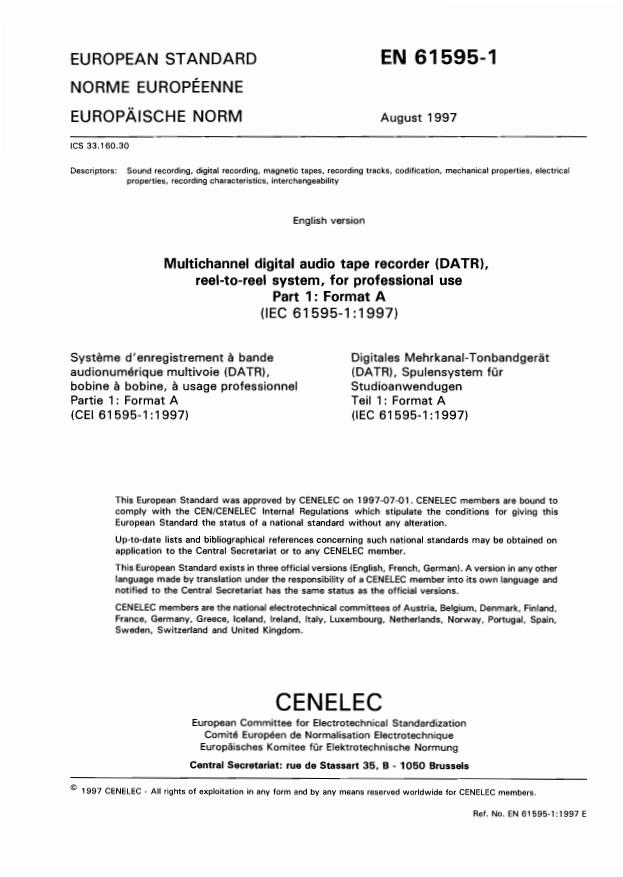
Applies to 8 to 64 channel digital audio recording on 12,7 mm or 25,4 mm wide tape, with stationary heads, for professional use. Defines the mechanical and electrical characteristics necessary to ensure the interchangeability of programmes, recorded as digital audio signals on magnetic tape in professional industries.
Digitales Mehrkanal-Tonbandgerät (DATR), Spulensystem für Studioanwendugen -- Teil 1: Format A
Système d'enregistrement à bande audionumérique multivoie (DATR), bobine à bobine, à usage professionnel -- Partie 1: Format A
S'applique à l'enregistrement audionumérique de 8 à 64 voies, sur des bandes d'une largeur de 12,7 mm ou 25,4 mm, avec des têtes fixes, pour un usage professionel. Définit les caractéristiques mécaniques et électriques nécessaires pour assurer, entre professionnels, l'interchangeabilité des programmes et des signaux audionumériques enregistrés sur bandes magnétiques.
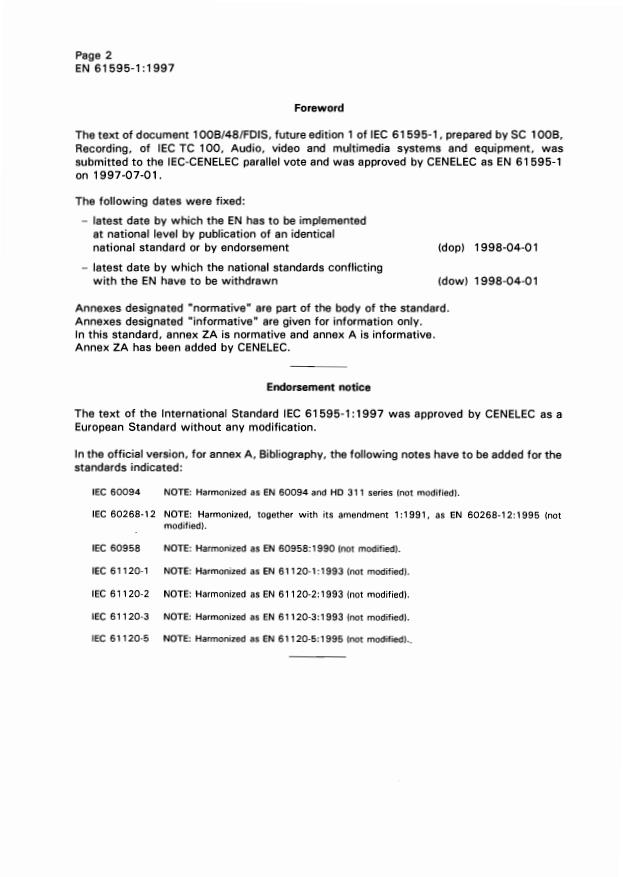
Multichannel digital audio tape recorder (DATR), reel-to-reel system, for professional use -- Part 1: Format A (IEC 61595-1:1997)
General Information
- Status
- Published
- Publication Date
- 31-Mar-1999
- Technical Committee
- AVM - Audio, video and multimedia systems and equipment
- Current Stage
- 6060 - National Implementation/Publication (Adopted Project)
- Start Date
- 01-Apr-1999
- Due Date
- 01-Apr-1999
- Completion Date
- 01-Apr-1999
Overview
EN 61595-1:1997 (CLC adoption of IEC 61595-1:1997) specifies the mechanical and electrical characteristics for multichannel digital audio tape recorders (DATR) - reel-to-reel systems for professional use, Part 1: Format A. The standard governs interchangeability of programmes recorded as digital audio on magnetic tape and applies to 8 to 64 channel recording using stationary heads on nominal tape widths of 12.7 mm or 25.4 mm.
Key topics and technical requirements
- Audio encoding
- Sampling frequency: 48 kHz (accuracy tolerance specified in the standard).
- Quantization: 16-bit, two’s-complement samples, MSB-first word format.
- Tape and transport
- Nominal tape speeds: 76.20 cm/s (speed I) and 38.10 cm/s (speed II) with a specified tolerance (0.2% for tape speeds).
- Tape widths: 25.37 mm (nominal 25.4 mm) and 12.66 mm (nominal 12.7 mm).
- Supports multiple track configurations to cover 8–64 channels (track assignment and layout detailed in figures/tables).
- Recording modulation and format
- Recording code: NRZI with the 4/6M modulation system (run-length constrained conversion ensuring between 1 and 6 zeros between ones).
- Word slots are 16 bits; frame/block structures and synchronization patterns are defined for reliable demodulation and decoding.
- Error protection and interleave
- Error-protection methods and interleaving strategies are specified to maximize data integrity on magnetic tape (normative references include ITU‑T V.41).
- Auxiliary tracks
- Definitions and locations for time code, auxiliary data, and cue audio subtracks; alignment rules for sync and subtrack signals.
- Optional emphasis
- Pre-emphasis/de-emphasis characteristics (first-order) are defined but their use is not generally recommended.
Applications and users
- Broadcast and recording studios requiring multichannel reel-to-reel recording for mixing, mastering and archiving.
- Film and post-production facilities that need standardized multitrack magnetic-tape interchange.
- Equipment manufacturers and maintenance/service engineers designing, testing or repairing professional DATR hardware.
- Archival organizations and media preservation specialists ensuring long-term compatibility of recorded programmes.
Related standards
- IEC 60461 - Time and control code for video tape recorders
- IEC 61120-4 - Digital audio tape recorder (6.3 mm tape) - magnetic tape properties
- ITU‑T V.41 - Code‑independent error‑control system
EN 61595-1:1997 remains a technical reference for ensuring interoperability, consistent track allocation, and reliable digital multichannel recording on professional reel‑to‑reel magnetic-tape systems.

Frequently Asked Questions
SIST EN 61595-1:1999 is a standard published by the Slovenian Institute for Standardization (SIST). Its full title is "Multichannel digital audio tape recorder (DATR), reel-to-reel system, for professional use -- Part 1: Format A". This standard covers: Applies to 8 to 64 channel digital audio recording on 12,7 mm or 25,4 mm wide tape, with stationary heads, for professional use. Defines the mechanical and electrical characteristics necessary to ensure the interchangeability of programmes, recorded as digital audio signals on magnetic tape in professional industries.
Applies to 8 to 64 channel digital audio recording on 12,7 mm or 25,4 mm wide tape, with stationary heads, for professional use. Defines the mechanical and electrical characteristics necessary to ensure the interchangeability of programmes, recorded as digital audio signals on magnetic tape in professional industries.
SIST EN 61595-1:1999 is classified under the following ICS (International Classification for Standards) categories: 33.160.30 - Audio systems. The ICS classification helps identify the subject area and facilitates finding related standards.
SIST EN 61595-1:1999 is available in PDF format for immediate download after purchase. The document can be added to your cart and obtained through the secure checkout process. Digital delivery ensures instant access to the complete standard document.
Standards Content (Sample)
SLOVENSKI STANDARD
01-april-1999
Multichannel digital audio tape recorder (DATR), reel-to-reel system, for
professional use -- Part 1: Format A (IEC 61595-1:1997)
Multichannel digital audio tape recorder (DATR), reel-to-reel system, for professional use
-- Part 1: Format A
Digitales Mehrkanal-Tonbandgerät (DATR), Spulensystem für Studioanwendugen -- Teil
1: Format A
Système d'enregistrement à bande audionumérique multivoie (DATR), bobine à bobine,
à usage professionnel -- Partie 1: Format A
Ta slovenski standard je istoveten z: EN 61595-1:1997
ICS:
33.160.30 Avdio sistemi Audio systems
2003-01.Slovenski inštitut za standardizacijo. Razmnoževanje celote ali delov tega standarda ni dovoljeno.
NORME
CEI
INTERNATIONALE
IEC
61595-1
INTERNATIONAL
Première édition
STANDARD
First edition
1997-05
Système d'enregistrement à bande
audionumérique multivoie (DATR),
bobine à bobine, à usage professionnel –
Partie 1:
Format A
Multichannel digital audio tape recorder (DATR),
reel-to-reel system, for professional use –
Part 1:
Format A
IEC 1997 Droits de reproduction réservés Copyright - all rights reserved
Aucune partie de cette publication ne peut être reproduite ni No part of this publication may be reproduced or utilized in
utilisée sous quelque forme que ce soit et par aucun any form or by any means, electronic or mechanical,
procédé, électronique ou mécanique, y compris la photo- including photocopying and microfilm, without permission in
copie et les microfilms, sans l'accord écrit de l'éditeur. writing from the publisher.
International Electrotechnical Commission 3, rue de Varembé Geneva, Switzerland
Telefax: +41 22 919 0300 e-mail: inmail@iec.ch IEC web site http: //www.iec.ch
CODE PRIX
Commission Electrotechnique Internationale
U
PRICE CODE
International Electrotechnical Commission
Pour prix, voir catalogue en vigueur
For price, see current catalogue
61595-1 © IEC:1997 – 3 –
CONTENTS
Page
FOREWORD . 7
Clause
1 Scope . 9
2 Normative references . 9
3 Definitions . 9
3.1 Data flow of a digital audio tape recorder . 9
4 Digital encoding . 13
4.1 Sampling frequency . 13
4.2 Sampling timing . 13
4.3 Quantization . 13
5 Tape speed . 13
6 Tape width and number of digital audio channels. 13
7 Tape winding . 15
8 Reel and hub . 15
9 Allocation and dimension of magnetic tracks . 15
10 Assignment of magnetic tracks. 15
11 Emphasis. 25
12 Main track recording . 25
12.1 Recording modulation method. 25
12.2 Signal block structure. 27
12.2.1 The word format. 27
12.2.2 The frame and block structure. 27
12.2.3 Synchronization pattern. 29
12.3 Signal word distribution to tracks. 29
12.4 Error protection method . 31
12.4.1 The error correction code . 33
12.4.2 Interleave sequence . 37
12.5 Recording and reproducing characteristics . 53
12.5.1 Reference tape . 53
13 Subtrack recording. 53
13.1 Auxiliary channels . 53
13.1.1 Time code channel (time code track) . 53
13.1.2 Auxiliary data channel (auxiliary data track) . 53
13.1.3 Auxiliary analogue channels (cue audio-1 track and cue audio-2 track) . 53
13.2 Alignment of digital audio signals and subtrack signals. 53
13.2.1 Alignment of cue audio-1 and cue audio-2 track signals. 53
13.2.2 Alignment of time code track signals . 53
Annex A – Bibliography. 55
61595-1 © IEC:1997 – 5 –
Tables Page
1 Tape width and number of digital audio channels. 15
2 Track assignment. 15
3 4/6M conversion table . 27
4 Track interleave (20 main tracks with 12,7 mm tape width) . 45
5 Track interleave (40 main tracks with 12,7 mm tape width) . 47
6 Track interleave (40 main tracks with 25,4 mm tape width) . 49
7 Track interleave (80 main tracks with 25,4 mm tape width) . 51
Figures
1 Recording channels of a DATR (digital audio tape recorder) . 11
2 Data flow of the main audio channels of a DATR (digital audio tape recorder) . 11
3 Reproducing channels of a DATR (digital audio tape recorder) . 13
4 Track pattern for DATR on magnetic tape (24 tracks with 12,7 mm tape width) . 17
5 Track pattern for DATR on magnetic tape (47 tracks with 12,7 mm tape width) . 19
6 Track pattern for DATR on magnetic tape (45 tracks with 25,4 mm tape width) . 21
7 Track pattern for DATR on magnetic tape (89 tracks with 25,4 mm tape width) . 23
8 Emphasis characteristics. 25
9 Frame and block structure. 29
10 Synchronization pattern. 29
11 Signal word distribution to tracks . 31
12 Symbol and word structure . 35
13 Example of input data V . 37
14 Main-frame interleave (tape speed I) . 39
15 Main-frame interleave (tape speed II) . 41
16 Code interleave. 43
61595-1 © IEC:1997 – 7 –
INTERNATIONAL ELECTROTECHNICAL COMMISSION
_________
MULTICHANNEL DIGITAL AUDIO TAPE RECORDER (DATR),
REEL-TO-REEL SYSTEM, FOR PROFESSIONAL USE –
Part 1: Format A
FOREWORD
1) The IEC (International Electrotechnical Commission) is a worldwide organization for standardization comprising
all national electrotechnical committees (IEC National Committees). The object of the IEC is to promote
international co-operation on all questions concerning standardization in the electrical and electronic fields. To
this end and in addition to other activities, the IEC publishes International Standards. Their preparation is
entrusted to technical committees; any IEC National Committee interested in the subject dealt with may
participate in this preparatory work. International, governmental and non-governmental organizations liaising
with the IEC also participate in this preparation. The IEC collaborates closely with the International Organization
for Standardization (ISO) in accordance with conditions determined by agreement between the two
organizations.
2) The formal decisions or agreements of the IEC on technical matters express, as nearly as possible, an
international consensus of opinion on the relevant subjects since each technical committee has representation
from all interested National Committees.
3) The documents produced have the form of recommendations for international use and are published in the form
of standards, technical reports or guides and they are accepted by the National Committees in that sense.
4) In order to promote international unification, IEC National Committees undertake to apply IEC International
Standards transparently to the maximum extent possible in their national and regional standards. Any
divergence between the IEC Standard and the corresponding national or regional standard shall be clearly
indicated in the latter.
5) The IEC provides no marking procedure to indicate its approval and cannot be rendered responsible for any
equipment declared to be in conformity with one of its standards.
6) Attention is drawn to the possibility that some of the elements of this International Standard may be the subject
of patent rights. The IEC shall not be held responsible for identifying any or all such patent rights.
International Standard IEC 61595-1 has been prepared by subcommittee 100B: Recording, of
IEC technical committee 100: Audio, video and multimedia systems and equipment.
The text of this standard is based on the following documents:
FDIS Report on voting
100B/48/FDIS 100B/63/RVD
Full information on the voting for the approval of this standard can be found in the report on
voting indicated in the above table.
IEC 61595 consists of the following parts, under the general title: Multichannel digital audio
tape recorder (DATR), reel-to-reel system, for professional use:
– Part 1: Format A
– Part 2: Format B
– Part 3: 24 bit operation for 16 bit media
Annex A is for information only.
61595-1 © IEC:1997 – 9 –
MULTICHANNEL DIGITAL AUDIO TAPE RECORDER (DATR),
REEL-TO-REEL SYSTEM, FOR PROFESSIONAL USE –
Part 1: Format A
1 Scope
This part of IEC 61595 applies to 8 to 64 channel digital audio recording on 12,7 mm or
25,4 mm wide tape (hereafter called tape), with stationary heads, for professional use. It
defines the mechanical and electrical characteristics necessary to ensure the interchangeability
of programmes, recorded as digital audio signals on magnetic tape in professional industries.
2 Normative references
The following normative documents contain provisions which, through reference in this text,
constitute provisions of this part of IEC 61595. At the time of publication, the editions indicated
were valid. All normative documents are subject to revision, and parties to agreements based
on this part of IEC 61595 are encouraged to investigate the possibility of applying the most
recent editions of the normative documents indicated below. Members of IEC and ISO maintain
registers of currently valid International Standards.
IEC 60461: 1986, Time and control code for video tape recorders
IEC 61120-4: 1992, Digital audio tape recorder reel-to-reel system, using 6,3 mm magnetic
tape, for professional use – Part 4: Magnetic tape properties: definitions and methods of
measurement
ITU-T V.41: 1988, Code-independent error-control system
3 Definitions
For the purpose of this part of IEC 61595, the following definitions apply.
3.1 Data flow of a digital audio tape recorder
Figure 1 shows, within a block diagram, the main data flow of a DATR (digital audio tape
recorder).
Figure 2 shows the recording channels of a DATR.
Figure 3 shows the reproducing channels of a DATR.
61595-1 © IEC:1997 – 11 –
Analogue input
A/D
Encoder Modulator
converter
Write
Digital input
amplifier
Digital
+ head
audio
interface
Digital output
Tape
D/A
Decoder
Read head
converter
+ amplifier
Analogue output
Time
base Demodulator
corrector
IEC 467/97
Figure 1 – Recording channels of a DATR (digital audio tape recorder)
Digital
Digital audio
audio input
interface Digital Modulator
audio and write
Main tracks
processing amplifier
Analogue A/D
audio input converter
Auxiliary channels for audio
Analogue
cueing modulator
audio input
Auxiliary
Auxiliary data channels modulator Subtracks
data input
Time code
Time code channel modulator
input
IEC 468/97
Figure 2 – Data flow of the main audio channels of a DATR (digital audio tape recorder)
61595-1 © IEC:1997 – 13 –
Digital audio
Digital audio
Demodulator Digital
interface
output
read audio
Main tracks
D/A
amplifier processing Analogue audio
converter
output
Auxiliary channels for audio Analogue audio
output
cueing demodulator
Auxiliary data
Subtracks
Auxiliary data channels
output
Time code
Time code channel demodulator
output
IEC 469/97
Figure 3 – Reproducing channels of a DATR (digital audio tape recorder)
4 Digital encoding
4.1 Sampling frequency
The sampling frequency shall be 48 kHz, and the accuracy of the sampling frequency at
-6
encoding shall be ± 50 × 10 .
4.2
Sampling timing
It is recommended that all channels are sampled simultaneously.
4.3 Quantization
Each audio sample shall be quantized uniformly and be expressed in 16 bits, 2s complement
code. Positive numbers correspond to positive analogue voltages at the input.
5 Tape speed
The tape speed shall be nominal 76,20 cm/s (hereafter called speed I) and 38,10 cm/s
(hereafter called speed II). The tolerance on tape speeds shall be within 0,2 %.
6 Tape width and number of digital audio channels
The tape width shall be 25,37 mm (nominal 25,4 mm) or 12,66 mm (nominal 12,7 mm).
−0,03 −0,02
Table 1 shows tape width and number of digital audio channels.
61595-1 © IEC:1997 – 15 –
Table 1 – Tape width and number of digital audio channels
Items Contents
Tape width (mm) 25,4 12,7
Number of audio channels 64 32 16 32 16 8
Main 80 40 40 40 40 20
Number of tracks Sub 9 5 5 7 7 4
Total 8945 454747 24
Main tracks/audio channels 10/8 10/8 10/4 10/8 10/8 10/4
Tape speed I I II I I II
7 Tape winding
The magnetic coating faces the centre of the reel.
8 Reel and hub
Under consideration.
9 Allocation and dimension of magnetic tracks
The figures 4, 5, 6 and 7 show the track allocations on magnetic tape.
10 Assignment of magnetic tracks
If the tape moves from the left to right with the magnetic coating facing away from the observer
and with the leader to the right, the bottom track is designated track 1, the next upper track is
designated track 2 and so on. Table 2 shows the assignment of magnetic tracks.
Table 2 – Track assignment
Track number
Tape width (mm) 25,4 12,7
Main Digital audio 4.83 3.42 4.43 3.22
Time code 32 32
Type of track Cue audio-1 85 43 1 1
Sub Cue audio-2 87 44 47 24
1, 2, 84, 86,
Auxiliary data 1, 45 2, 44, 45, 46 23
88, 89
61595-1 © IEC:1997 – 17 –
IEC 470/97
Figure 4 – Track pattern for DATR on magnetic tape (24 tracks with 12,7 mm tape width)
61595-1 © IEC:1997 – 19 –
IEC 471/97
...
Questions, Comments and Discussion
Ask us and Technical Secretary will try to provide an answer. You can facilitate discussion about the standard in here.
Loading comments...