

SIST-TP CEN/TR 17611:2021
(Main)Algae and algae products - Specifications for cosmetic sector applications
General Information
- Abstract
This document gives an overview of recommendations on product specifications, and other relevant information, for algae and algae products for cosmetics industry.
This document does not apply to food and feed applications.
This document does not provide instructions on handling of technical requirements in existing legislations.
- Status
- Published
- Public Enquiry End Date
- 30-Nov-2020
- Publication Date
- 04-Feb-2021
- Technical Committee
- I13 - Imaginarni 13
- Current Stage
- 6060 - National Implementation/Publication (Adopted Project)
- Start Date
- 04-Feb-2021
- Due Date
- 11-Apr-2021
- Completion Date
- 05-Feb-2021


Overview
CEN/TR 17611:2021 - "Algae and algae products - Specifications for cosmetic sector applications" - is a CEN Technical Report providing guidance and recommendations for the specification, quality control and documentation of algae and algae-derived ingredients used in cosmetics. It focuses on product characteristics, purity, contamination, documentation and sustainability for cosmetic applications. This document does not cover food or feed uses and does not replace legal obligations or provide instructions for handling legislative requirements.
Key topics and technical requirements
- Product characteristics and purity
- Purity is defined as the mass/volume or cell fraction of the specified algal component; impurities (including GMO or non‑organic material where relevant) must be declared.
- Methods to assess purity include macroscopical/microscopical examination, chromatographic and physicochemical analyses, and emerging nucleic‑acid based tests (e.g., barcoding, NGS). Limitations and current gaps are noted.
- Contamination
- Addresses physical (microplastics, fishing gear fragments), biological (other algae, toxin‑producing cyanobacteria, bacteria) and chemical contaminants.
- Recommends routine monitoring and appropriate analytical methods where available.
- Documentation and labelling
- Recommends production of RMS (Raw Material Specification), TDS (Technical Data Sheet), CoA (Certificate of Analysis) and MSDS/SDS for each batch.
- Advises on information to include: origin, extract type, safety data, and links to Cosmetic Product Safety Report (CPSR).
- Sustainability and traceability
- Discusses sustainable development aspects for macro‑ and microalgae production and alignment with UN Sustainable Development Goals.
- Recommends Chain of Custody systems and traceability mechanisms from harvest/production to final cosmetic use.
- Standards and normative references
- Cross‑references relevant CEN standards (e.g., EN 16751, EN 16760, EN 16848, EN 16935, EN 17399).
- Supporting material
- Informative annexes include regulatory framework, RMS/TDS examples, origin of algae products, algae extracts and a gap analysis of purity identification methods.
Practical applications and target users
- Who uses it
- Cosmetic ingredient suppliers, algae biomass producers (macroalgae and microalgae), cosmetic formulators, quality assurance teams, and regulatory affairs professionals.
- How it’s used
- To prepare supplier RMS/TDS and CoA, define acceptance criteria for algae ingredients, design testing and sampling programs, implement traceability and Chain of Custody, and support sustainability claims.
- Useful for selecting analytical approaches (microscopy, nucleic‑acid tests, isotopic markers) and documenting origin and safety information required by cosmetic product safety assessments.
Related standards (if applicable)
- EN 17399 - Terms and definitions for algae and algae products
- EN 16751, EN 16760, EN 16848, EN 16935 - Bio‑based products, LCA and business communication requirements
CEN/TR 17611:2021 is a practical reference to ensure algae‑derived cosmetic ingredients meet defined quality, safety and sustainability expectations while identifying gaps where further standardization or analytical method development is needed.
Relations
- Effective Date
- 28-Jan-2026
- Effective Date
- 28-Jan-2026
- Effective Date
- 28-Jan-2026
- Effective Date
- 28-Jan-2026
- Refers
SIST EN 16935:2017 - Bio-based products - B2C reporting and communication - Requirements for claims - Effective Date
- 28-Jan-2026
Get Certified
Connect with accredited certification bodies for this standard

ECOCERT
Organic and sustainability certification.

Eurofins Food Testing Global
Global leader in food, environment, and pharmaceutical product testing.

Intertek Bangladesh
Intertek certification and testing services in Bangladesh.
Sponsored listings
Frequently Asked Questions
SIST-TP CEN/TR 17611:2021 is a technical report published by the Slovenian Institute for Standardization (SIST). Its full title is "Algae and algae products - Specifications for cosmetic sector applications". This standard covers: This document gives an overview of recommendations on product specifications, and other relevant information, for algae and algae products for cosmetics industry. This document does not apply to food and feed applications. This document does not provide instructions on handling of technical requirements in existing legislations.
This document gives an overview of recommendations on product specifications, and other relevant information, for algae and algae products for cosmetics industry. This document does not apply to food and feed applications. This document does not provide instructions on handling of technical requirements in existing legislations.
SIST-TP CEN/TR 17611:2021 is classified under the following ICS (International Classification for Standards) categories: 71.100.70 - Cosmetics. Toiletries. The ICS classification helps identify the subject area and facilitates finding related standards.
SIST-TP CEN/TR 17611:2021 has the following relationships with other standards: It is inter standard links to SIST EN 16760:2016, SIST EN 16751:2016, SIST EN 17399:2024, SIST EN 16848:2017, SIST EN 16935:2017. Understanding these relationships helps ensure you are using the most current and applicable version of the standard.
SIST-TP CEN/TR 17611:2021 is associated with the following European legislation: Standardization Mandates: M/547. When a standard is cited in the Official Journal of the European Union, products manufactured in conformity with it benefit from a presumption of conformity with the essential requirements of the corresponding EU directive or regulation.
SIST-TP CEN/TR 17611:2021 is available in PDF format for immediate download after purchase. The document can be added to your cart and obtained through the secure checkout process. Digital delivery ensures instant access to the complete standard document.
Standards Content (Sample)
SLOVENSKI STANDARD
01-marec-2021
Alge in izdelki iz alg - Specifikacije za uporabo v kozmetiki
Algae and algae products - Specifications for cosmetic sector applications
Algen und Algenprodukte - Spezifikationen für Anwendungen im Kosmetikbereich
Algues et produits d’algues - Spécifications pour les applications dans le secteur de la
cosmétique
Ta slovenski standard je istoveten z: CEN/TR 17611:2021
ICS:
71.100.70 Kozmetika. Toaletni Cosmetics. Toiletries
pripomočki
2003-01.Slovenski inštitut za standardizacijo. Razmnoževanje celote ali delov tega standarda ni dovoljeno.
CEN/TR 17611
TECHNICAL REPORT
RAPPORT TECHNIQUE
January 2021
TECHNISCHER BERICHT
ICS 13.020.55; 71.100.70
English Version
Algae and algae products - Specifications for cosmetic
sector applications
Algues et produits d'algues - Spécifications pour les Algen und Algenprodukte - Spezifikationen für
applications dans le secteur de la cosmétique Anwendungen im Kosmetikbereich
This Technical Report was approved by CEN on 4 January 2021. It has been drawn up by the Technical Committee CEN/TC 454.
CEN members are the national standards bodies of Austria, Belgium, Bulgaria, Croatia, Cyprus, Czech Republic, Denmark, Estonia,
Finland, France, Germany, Greece, Hungary, Iceland, Ireland, Italy, Latvia, Lithuania, Luxembourg, Malta, Netherlands, Norway,
Poland, Portugal, Republic of North Macedonia, Romania, Serbia, Slovakia, Slovenia, Spain, Sweden, Switzerland, Turkey and
United Kingdom.
EUROPEAN COMMITTEE FOR STANDARDIZATION
COMITÉ EUROPÉEN DE NORMALISATION
EUROPÄISCHES KOMITEE FÜR NORMUNG
CEN-CENELEC Management Centre: Rue de la Science 23, B-1040 Brussels
© 2021 CEN All rights of exploitation in any form and by any means reserved Ref. No. CEN/TR 17611:2021 E
worldwide for CEN national Members.
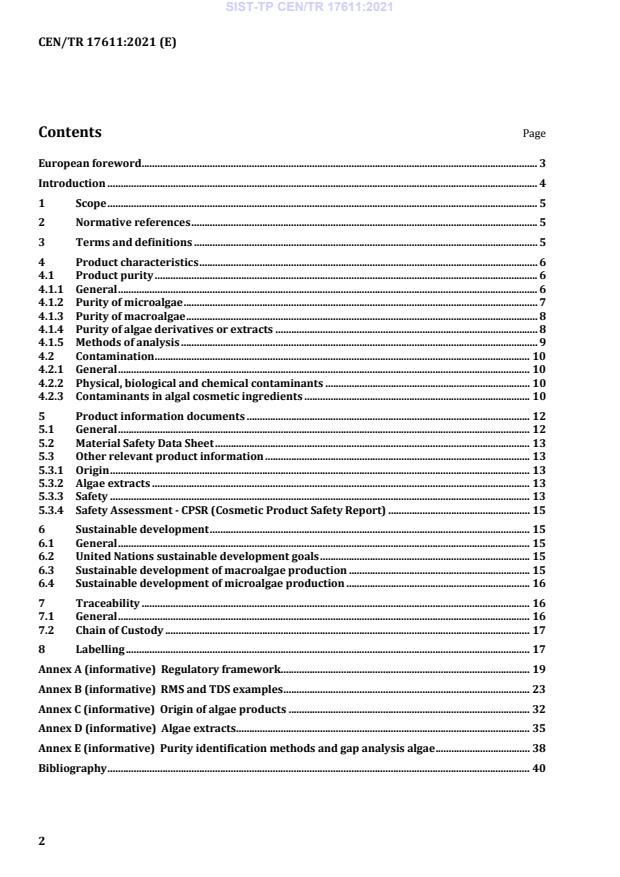
Contents Page
European foreword . 3
Introduction . 4
1 Scope . 5
2 Normative references . 5
3 Terms and definitions . 5
4 Product characteristics . 6
4.1 Product purity . 6
4.1.1 General . 6
4.1.2 Purity of microalgae . 7
4.1.3 Purity of macroalgae . 8
4.1.4 Purity of algae derivatives or extracts . 8
4.1.5 Methods of analysis . 9
4.2 Contamination . 10
4.2.1 General . 10
4.2.2 Physical, biological and chemical contaminants . 10
4.2.3 Contaminants in algal cosmetic ingredients . 10
5 Product information documents . 12
5.1 General . 12
5.2 Material Safety Data Sheet . 13
5.3 Other relevant product information . 13
5.3.1 Origin . 13
5.3.2 Algae extracts . 13
5.3.3 Safety . 13
5.3.4 Safety Assessment - CPSR (Cosmetic Product Safety Report) . 15
6 Sustainable development . 15
6.1 General . 15
6.2 United Nations sustainable development goals . 15
6.3 Sustainable development of macroalgae production . 15
6.4 Sustainable development of microalgae production . 16
7 Traceability . 16
7.1 General . 16
7.2 Chain of Custody . 17
8 Labelling . 17
Annex A (informative) Regulatory framework. 19
Annex B (informative) RMS and TDS examples . 23
Annex C (informative) Origin of algae products . 32
Annex D (informative) Algae extracts . 35
Annex E (informative) Purity identification methods and gap analysis algae . 38
Bibliography . 40
European foreword
This document (CEN/TR 17611:2021) has been prepared by Technical Committee CEN/TC 454 “Algae
and algae products”, the secretariat of which is held by NEN.
Attention is drawn to the possibility that some of the elements of this document may be the subject of
patent rights. CEN shall not be held responsible for identifying any or all such patent rights.
The European committee for Standardization (CEN) was requested by the European Commission (EC) to
draft European standards or European standardization deliverables to support the implementation of
Article 3 of Directive 2009/28/EC for algae and algae products or intermediates. The request presented
as Mandate M/547, also contributes to the Communication on “Innovating for Sustainable Growth: A Bio
economy for Europe”.
The former working group CEN Technical Board Working Group 218 ”Algae” was created in 2016 to
develop a work programme as part of the Mandate. The technical committee CEN/TC 454 ”Algae and
algae products” was established to carry out the work program the secretariat of which is held by NEN.
CEN/TC 454 set up a number of topic specific working Groups listed below to develop standards for algae
and algae products.
This document has been prepared by Working Group 5 “Specifications for non-food/feed sector
applications” with the support of UNI as the secretariat, in close collaboration with the other CEN/TC 454
working groups:
CEN/TC 454/WG 1 “Terminology”;
CEN/TC 454/WG 2 “Identification”;
CEN/TC 454/WG 3 “Productivity”;
CEN/TC 454/WG 4 “Specifications for food/feed sectors applications”;
CEN/TC 454/WG 6 “Product test methods”.
Introduction
The interest in algae and algae-based products or intermediates as a renewable and sustainable source
of carbohydrates, proteins, lipids and pigments has increased significantly in Europe.
The purpose of this document prepared by WG 5 is to provide an overview on how quality indicating
parameters for algae and algae-based products and intermediates relevant for cosmetic applications can
be handled and to identify the need for any future standard developments for cosmetic applications.
Macroalgae are highly available and used in many Countries as fertiliser, biostimulant, animal feed,
medicine, cosmetic and food ingredients, and have different compounds depending on species.
1 Scope
This document gives an overview of recommendations on product specifications, and other relevant
information, for algae and algae products for cosmetics industry.
This document does not apply to food and feed applications.
This document does not provide instructions on handling of technical requirements in existing
legislations.
2 Normative references
The following documents are referred to in the text in such a way that some or all of their content
constitutes requirements of this document. For dated references, only the edition cited applies. For
undated references, the latest edition of the referenced document (including any amendments) applies.
EN 16751, Bio-based products - Sustainability criteria
EN 16760, Bio-based products - Life Cycle Assessment
EN 16848, Bio-based products - Requirements for Business to Business communication of characteristics
using a Data Sheet
EN 16935, Bio-based products - Requirements for Business-to-Consumer communication and claims
EN 17399, Algae and algae products - Terms and definitions
3 Terms and definitions
For the purposes of this document, the terms and definitions given in EN 17399 and the following apply.
ISO and IEC maintain terminological databases for use in standardization at the following addresses:
— IEC Electropedia: available at http://www.electropedia.org/
— ISO Online browsing platform: available at https://www.iso.org/obp
3.1
algae and algae products
functional group of organisms consisting of microalgae, macroalgae, cyanobacteria, labyrinthulomycetes
and products derived thereof
3.2
Raw Material Specification
RMS
several pages technical dossier about the product, usually prepared by manufacturer, directed to provide
all product approval information to the customer and usually attached to commercial contract
Note 1 to entry: Models of RMS for some algae categories are attached as Annex B.
3.3
Technical Data Sheet
TDS
one (few) page technical document showing the technical (biochemical) parameters adopted to
characterize the product and therefore being the paradigm of the Certificate of Analysis (CoA)
Note 1 to entry: It includes ranges of different parameters used to define the product characteristics or applicable
regulatory limits.
Note 2 to entry: Models of TDS for some algae categories are attached as Annex B.
3.4
Certificate of Analysis
CoA
one (few) page document issued from laborator(ies) and reporting test results for a specific lot, usually
in front of TDS parameters, including references to test method
Note 1 to entry: It may have legal status.
3.5
Material Safety Data Sheet
MSDS or SDS
document issued with the aim of providing information about product compliance in respect of human
health and safety at the workplace and protection of the environment
3.6
sustainable development
development that meets the environmental, social and economic needs of the present without
compromising the ability of future generations to meet their own needs
[SOURCE: ISO Guide 82:2019, 3.2]
4 Product characteristics
4.1 Product purity
4.1.1 General
The product purity is defined by the percentage of specific component in the total amount of product or,
in case of whole algal biomass, by species/strain amount as percentage of the total dry weight of the
product. Any other substances should be specified in the technical data sheet.
The purity percentage is specified by mass fraction (kg/kg). When this is not possible according to the
3 3
state in which the product is presented, it can be expressed by volume fraction (m /m ) or cell fraction
(cell counts/all cell counts) or their corresponding concentrations if more appropriate.
The presence of GMO material in algae and algae products is to be considered as impurity (ref to EU Reg
on GMO).
The presence of not organic material in organic algae and algae products is to be considered as impurity
(ref to EU Reg on Organic production).
NOTE 1 Purity is referred to contractual limits. Purity is generally not directly related to contamination since the
latter is often of small extent and does not affect the amount of required substance.
NOTE 2 Purity is affected by the accidental presence or the fraudulent addition of any organism, part or product
of an organism, other than that named in the product specification and description of the algae concerned; or any
foreign substances with the same composition as dry algae, even in the absence of contamination.
NOTE 3 Purity is related to species identification and test methods. For methods on the identification of species
refer to prEN 17477:2020.
When a product is not pure, this impurity can be detected by different types of detection methods listed
in Table 1.
Macroscopical/microscopical characterization includes features, which distinguish the algae material
from potential non-specified substances. Identification tests need to be specifically validated for algae
and are usually a combination of methods depending on the algae species. Identification tests include
macroscopical characters, microscopical characters, chromatographic procedures and physicochemical
analysis. Automated tools might help like cell counters or cell flow cytometers.
The development of tests based on nucleic acids characteristics (microsatellites, NGS (Next Generation
Sequencing), barcoding, RAPD (Random Amplification of Polymorphic DNA), AFLP (Amplified
Frangement Length Polymorphism), etc.) to be sequenced from product samples would provide simple
and fast tools for the identification of multiple targeted species and would help to indicate the presence
of other nucleic acids than those of the algal material. In general there is a lack of algae databases for the
identification of foreign matter.
Currently these tests are not yet standardized and available for routine testing. Therefore quality
assurance methods aimed at reduction / prevention of risk of impurity like good farming practices (GFP),
good manufacturing practices (GMP), traceability and Chain of Custody systems are essential to monitor
the level of purity for algae and algae products.
An overview of the currently available methods for qualitative and quantitative determination of algae
purity is shown in Table 1. The reliability of these different methods depends on the complexity of the
species and impurities and are not necessarily sufficient for each case.
The following substances affecting the purity of a product can be addressed:
— Physical foreign matter (i.e. (micro) plastic fragments, wires from fishing nets and ropes, feathers
from birds, shells);
— Other algae (including toxin-producing cyanobacteria), bacteria or organic materials (i.e. grass,
proteins or oils from other species);
— Algae from other location then stated (e.g. from Asia instead of Europe). Most promising test to detect
the presence of algae from other regions then stated, is the use of stable isotopes. However, first
databases with the characterization of isotopes from different regions need to be established.
Macroscopic examination is suitable for determining the presence of particles of foreign matter in whole
or cut (macro)algae. Foreign matter are all materials which are not part of the (macro)algae biomass.
Additional aids (like UV-light, sieving, centrifugation) might be helpful to find the foreign matter.
The algae harvesting and farming organization should provide the purity on a CoA for each batch of algae.
4.1.2 Purity of microalgae
Microscopy is a suitable tool for microalgae, cyanobacteria and all powdered materials. Reduction of
particle size or powdering materials can hide the presence of non-specified substances and make it more
difficult to detect. Also diluted samples cannot be qualified and need a quantification step.
Specifically for cyanobacteria, some guidance for the numeration of phytoplankton is available in
EN 15204.
The determination of purity in fresh sample can be possible using inverted microscopy (Utermöhl
technique according to EN 15204) to determine the microalgae and cyanobacteria biovolume. This
document describes the necessary methods for measuring cell dimensions and for the calculation of cell
or counting unit volumes to estimate the biovolume (wet weight biomass) in phytoplankton samples.
This method has been successfully used by French spirulina producers to monitor the quality and purity
of their biomass.
Where available, methods based on nucleic acid analysis of specific species, fingerprinting or
metabarcoding (using 1 or 2 markers) may provide information on purity of any algae powder.
Currently these methods are not yet available for routine tests.
4.1.3 Purity of macroalgae
By their very nature, macroalgae growing in the wild may be found to grow interspersed with other
species. Therefore, it is not always practical to obtain a harvest of macroalgae that is 100 % pure.
Macroscopic examination is suitable for determining the presence of foreign matter in whole or cut
macroalgae. This applies also to algae cultivated in tanks.
Visual inspection is suitable for freshly harvested algae as the intact cells can be recognized as a whole.
When the holdfast is removed, or when epiphytic organisms are present on the surface visual inspection
may not be sufficient to identify the species after harvesting. For ground algae, cells are disrupted and
algae type can no longer be recognized nor be quantified.
Microscopy is indispensable for all powdered materials. Reduction of particle size or powdering
materials can hide the presence of non-specified substances and make it more difficult to detect. Also
diluted samples cannot be qualified and need a quantification step.
The most reliable way to monitor the purity of macroalgae is for companies to assess the freshly
harvested raw material by visual, macroscopic means. Purity should be expressed as the percentage of
the target macroalgae of interest over the total weight of the harvested biomass. In case the growth of
other algae/bacteria on the macroalgae is noticed, some follow-up test may be needed (microscopical for
instance) in order to check for potential impurities from hazardous organisms and to verify if the product
is safe for the purpose of the product.
It is noted that macroalgae harvested from the wild may contain up to 10 % of other species that grow
alongside and co-occur with the main species that is harvested; of course, if the composition of such
products is fit for use, it can still be considered a single ingredient product, defined by its 90 %
component, because the presence of other macroalgae is not regulated by specific limits provided all the
macroalgae is safe for intended use.
4.1.4 Purity of algae derivatives or extracts
Pure algae extract can include a range of compounds present in the algae and/or it may refer to a pure
fraction containing one or more compounds. Purified extracts with single components or a small number
of components can be responsible for the product efficacy. In complex mixtures of natural origin
(extracts) the efficacy may be related to synergistic effects of several components of the raw material and
not to a single molecule.
Table 1 — Types of impurities and detection methods
Impurity Fresh materials Dry materials or powders
Qualitative Quantitative Qualitative Quantitative
Physical foreign Visual Visual Visual Visual
matter inspection inspection inspection inspection
Microscopical Microscopical Microscopical Microscopical
inspection inspection inspection inspection
Additional tools Additional tools Additional tools Additional tools
Other algae, Visual Visual Visual Visual
bacteria and inspection inspection inspection inspection
organic materials
Microscopical Microscopical Microscopical Microscopical
inspection inspection inspection inspection
Nucleic acid –- Nucleic acid –-
analysis analysis
Chemical –- Chemical –-
a a
fingerprinting fingerprinting
Regional identity Isotopic analysis Isotopic Isotopic analysis Isotopic
b b
analysis analysis
a
Chemical fingerprinting includes different techniques, for example: IR spectra, NMR, TLC, Mass
Spectrometry, fatty acid profile.
b
methods to be developed.
4.1.5 Methods of analysis
The inventory of available methods and recommendation for prioritizing future method development on
purity of algae and algae products are listed in Tables E.1 and E.2.
Specific gaps to use these methods are lack of respectively [1]:
— sampling strategies for visual inspection and microscopy;
— quantification method for microscopy;
— databases, algae selective primers and protocols for nucleic acid identification; and
— databases for molecular and chemical fingerprinting and isotope analysis (see Annex E).
In addition to the gap per analysis methodology, methods are lacking for the quantification of the found
foreign matter. Furthermore, protocols describing what to do with the product if the presence of a foreign
matter is detected, are lacking.
It is recommended to further develop and standardize the following protocols [1]:
— sample strategies for quality control of fresh materials and of dry/powdered materials;
— quality control protocols describing which other checks have to be done when foreign matter is
found;
— visual inspection protocols for fresh materials and for dry/powdered materials;
— microscopical inspection protocols for fresh materials and for dry/powdered materials;
— protocol for molecular biological quality control taking into account the most important criteria;
— study the applicability of isotope analysis for specification of the region of origin.
4.2 Contamination
4.2.1 General
Macroalgae and also microalgae can accumulate certain minerals and also heavy metals [5] and other
compounds if present in the surrounding environment. Therefore, this form of contamination should be
monitored.
Contamination can occur in the open waters (macroalgae) or in the closed or semi-closed cultivation
system (micro and macroalgae). Copper can be found if the macroalgae is cultivated in close vicinity to
fish production, since fish pens/nets can be impregnated with copper as a mean of antifouling.
Heavy metals can come from salts or nutrients supplied to microalgae systems with the growth medium.
Volatile contaminants can be borne by CO used for algae carbonation or air used for oxygen degassing
or directly by atmospheric pollution in open systems.
4.2.2 Physical, biological and chemical contaminants
Physical, biological and chemical contamination may be found in algae caused by past and current
activities in the area.
Examples of physical contamination can include, but is not limited to, plastic fragments, wires from
fishing nets and ropes, feathers from birds, shells.
Algae can be contaminated by toxin-producing cyanobacteria. These cyanotoxins include microcystins,
anatoxins, cylindrospermopsin, saxitoxins, palytoxins, nodularin and ciguatoxins. Cadmium, mercury and
lead can occur and these elements can be released and taken up by the algae or come through the culture
media.
Microbiological contamination is a very important parameter in raw materials and ingredients for
cosmetic producers. It can include, but not limited to, total of gram-negative, gram-positive bacteria and
the presence of Candida albicans and Aspergillus brasiliensis. Routine testing is generally required
because the microbial contamination is linked to production and storage of algal products and to
mycotoxin contamination.
4.2.3 Contaminants in algal cosmetic ingredients
4.2.3.1 General
Particular attention is needed for long-term safety aspects, since cosmetic products may be used
extensively over a large part of the human lifespan and sensitive groups of the population may be
involved.
4.2.3.2 Toxicological profile of the ingredients
During the safety evaluation of a finished cosmetic product, the available toxicological data for all
ingredients should be taken into consideration by the safety assessor. The data sources used should be
clearly indicated and may consist of one or more of the following possibilities:
— in vitro tests using validated or valid alternative methods;
— human data from clinical observations and compatibility tests in human volunteers;
— data from data banks, published literature, “in house” experience and data obtained from raw
material suppliers, including QSAR (Quantitative Structure-Activity Relationship) structural alerts;
— relevant data on analogous compounds.
The general toxicological requirements for cosmetic substances are described in detail in the
SCCS/1602/18 document. [6]
For cosmetic products, focus lays in particular on local toxicity evaluation being skin and eye irritation,
skin sensitization, and in the case of UV absorption photo-induced toxicity. In case of significant
dermal/percutaneous absorption, systemic effects will also be examined in detail. When certain test
results are not available, a scientific justification should be included.
It is essential to mention here that for each substance the toxicological data given should be derived from
tests with the same substance as that used in the finished cosmetic product (same degree of purity, same
impurity profile, same additives, etc).
4.2.3.3 Dioxin and related xenobiotes
Macroalgae, like land plants, are not known to concentrate dioxins. However, if following a hazard
analysis there is a risk that dioxins are present, the product should be tested for dioxins.
NOTE Dioxins have been found in harvested coastal macroalgae originating from local processing or
environmental conditions.
Plants do not concentrate dioxin in the food web, as seen in e.g. fish. In most cases the dioxin is not taken
up by the plant, but is adsorbed in the form of e.g. particles. This means that the dioxin concentration of
plants is generally low compared to foods with a high level of animal fat or fat fish from contaminated
areas.
As far as the hazard of dioxin in microalgae is concerned, the microalgae are first in the food chain and
will mirror the level of dioxin and PCB in the water- dissolved or adsorbed to particles. The concentration
of fresh weight will not be high, but due to the relatively high concentration of lipids the threshold values
may be exceeded on dry weight basis.
Concentrations of dioxins in microalgae as raw materials can be reached and also for the threshold values
of the sum of dioxin and PCBs similar to dioxin. When plankton from the open oceans have these high
concentrations, then the concentration of these compounds of the microalgae can be even higher close to
the coast and in areas with local pollution.
Note the authors (Morales et al., 2015) [7] mix the TEF (Toxic Equivalency Factor)-values so that the
calculated TEQ (Toxic Equivalent Quantity) PCB values are up to 600 times too high.
4.2.3.4 PAHs
Polycyclic aromatic hydrocarbons (PAHs) are a large group of chemical contaminants, generally
occurring in complex mixtures consisting of hundreds of compounds. They are produced by natural and
anthropogenic processes, mainly by incomplete combustion of organic matter.
Generally, PAH might be expected in natural source raw materials that underwent improper processing
(thermal treatment, improper drying process), or in which PAHs accumulated from the environment (e.g.
propolis extracts).
There is an additional risk for PAH’s in any system (open or closed) that doses additional gas flows into
the medium to enhance biomass growth. If this gas flow originates from combustion engine exhaust or
other burning processes (flue gases), there are residues of unburnt or partially burned fuel or other
oxidative products thereof, that will become present to detectable (or even accumulative) concentrations
within the culture medium and the harvested product.
Therefore, for any algae product cultured in a CO flow enhanced system, in addition to risk limitation by
defining the nature and quality of the gas input, an effective post-harvest control by appropriate analyses
of the presence and concentrations of these substances should be mandatory.
4.2.3.5 Uranium
Uranium can also be a potential contamination in algae biomass (here the nephrotoxic properties of
uranium as heavy metal are considered and not as potential source of radioactivity). The main intake of
uranium in the crops chain is of geogenic origin, mainly via tap water coming from groundwater and
plant-based stuff via Uranium containing phosphate fertilizer. The medium values of this element in the
mentioned compartments are in the lowest ppb-level, with the exception of mineral water (EFSA Journal,
2009). The TDI (Tolerable Daily Intake)-value for adults, proposed by the WHO is 0,6 µg/kg body weight
and day. In Germany the tolerated maximum level of uranium in tap water is 10 µg/l. As mentioned, some
algae have the capability to accumulate heavy metals to extreme values. Especially uranium can be
enriched till 20 mg/kg to 30 mg/kg algae dry weight. This could be a major problem in case of the usage
of uranium containing groundwater and phosphate fertilizer during the cultivation process.
The threshold value of uranium in legislation is very high. This threshold value should be re-evaluated.
Furthermore, the uranium concentration should be given in ppm to facilitate commonly used ICP-MS
(Inductive Coupled Plasma-Mass Spectrometry) test methods.
4.2.3.6 Iodine
Iodine content in algae and algae products is often an issue because of high values naturally present in
marine algae [8].
It can be relevant to check for radioactive iodine isotope in certain risk area.
Iodine is included in Annex II (prohibited substances) of Cosmetics products Reg No 1223/2009 [9] and
this can be a severe limit to algae applications as raw materials if iodine is transferred to a significant
extent from raw material to finished product.
4.2.3.7 Pesticides
Several pesticides (DDT, Thiram, Pyrethrum, Alachlor, Thyophanate-methyl, etc.) are listed in Annex II to
Reg No 1223/2009.
In the List of commodities for which MRLs (Maximum Residue Limit) are set are specified some algae.
Algae are cited as category “0290000 Algae and prokaryotes organism” (in Annex I, A) and mentioned as
(in part B): Carrageen mosses/Irish mosses Chondrus crispus (0290000-001), Kombu Saccharina
japonica (0290000-002), Spirulina Arthrospira maxima (0290000-003), Arthrospira platensis (0290000-
004), Rockweed /knotted kelp Ascophyllum nodosum (0290000-005), Other algae (0290000-990), Other
procaryotes organisms (0290000-991).
Maximum residue limits (MRL) for pesticides in food are found in Annex II (Regulation 396/2005). A
general default MRL of 0,01 mg/kg applies where a pesticide is not specifically mentioned. Even if these
limits are given for food and feed sector, nevertheless their meaning is useful also for cosmetic raw
materials since Reg No 1223/2009 holds only for finished cosmetic products.
5 Product information documents
5.1 General
For multi-constituent natural ingredients, with variable composition, it is essential that the producers
provide clearly defined specifications in view of the range of variability of the components.
The variability should not change significantly and minimum levels of active ingredients should be
specified.
In cases where the producer wants to make statements regarding the algal product as a bio-based product
EN 16848 and EN 16935 shall be used.
5.2 Material Safety Data Sheet
A Material Safety Data Sheet is issued by the manufacturer of hazardous substances and mixtures and not
for all products or articles, e.g (generally) not for foodstuff or natural raw material such as algae;
nonetheless it has become a habit of many professional customers to ask for MSDS even when not
applicable. It is the algae manufacturer's responsibility to cope with regulations case by case, e.g. algae
biomass or its derivatives could or could not be under the SDS obligation.
5.3 Other relevant product information
5.3.1 Origin
NOTE See also Annex C.
5.3.1.1 Strain origin
The strain origin in case of microorganisms (microalgae, cyanobacteria and labyrinthulomycetes) or
cultivated macroalgae may be traced back to a strain collection or to the wild (natural environment), and
may or not be object of the provisions of the Nagoya protocol [10]. In macroalgae harvested in the wild
the strain, e.g. the variety origin, can be the same of the biomass. In the latter origin is related to
geographical place, and in case of products of sea-fishing and other products taken from the sea outside
a country's territorial sea, to the flag hoisted by vessels.
5.3.1.2 Product origin
Country of origin is to be reported on the label of imported cosmetic products (Reg (EC) 1223/2009).
This does not apply to raw materials e.g. algae and algae extracts.
Often the cosmetic market requires, as basic in trade contracts, origin specification of the goods and this
is not specific of algae. General trade rules are in place providing custom seizure in case of false origin
declarations. Origin of algal products can be traced according GMP and GFP documents.
Macroalgae is a rich source of compounds, which makes it a valuable raw material and ingredient.
However, even same species of macroalgae can have different content, depending on the Country, area,
climate, and environment where they grow, especially because of possible contamination, radioactive
pollution and other possible factors.
5.3.2 Algae extracts
Most of cosmetic ingredients of algal origin are biomass extracts. Annex D gives an overview of
technology tailored to algae raw materials.
5.3.3 Safety
5.3.3.1 General
When placing a new product in the market, the information reported in 5.3.3.2 and 5.3.3.3 should be
provided (see [6]).
5.3.3.2 Complex substances of botanical origin
Information to be provided include:
— common or usual names of alga;
— name of variety/strain, species, genus, and family;
— in case more than one variety of source of a given species is used, each should be specified;
— organoleptic, macroscopic and microscopic evaluation;
— morphological and anatomical description (including gender, if applicable) and a photograph of the
alga;
— natural habitat and geographical distribution of the plant, alga, or macroscopic fungus;
— current sources of the plant, alga, or macroscopic fungus, including its geographical location and
whether it is cultivated or harvested from the wild;
— description of:
i) preparation process: collection, washing, drying, extraction, distillation, destructive distillation,
possible purification, preservation procedures;
ii) handling, transportation, storage;
iii) commercial form: powder, solution, suspension;
iv) characteristic elements of the composition: identification of characteristic components, toxic
components (%);
— physical and chemical specifications;
— microbiological quality including relevant fungi;
— additional external contamination;
— preservatives and/or other additives added.
5.3.3.3 Complex substances derived from biotechnology
For special biotechnologically derived substances, where a modified micro-organism or a potential toxic
substance has not been fully removed, specific data are available, which can comprise:
— description of organisms involved: donor organisms, recipient organisms, modified micro-
organisms;
— host pathogenicity;
— toxicity, and when possible, identity of metabolites, toxins produced by the organisms;
— fate of viable organisms in the environment-survival-potential for transfer of characteristics to e.g.
natural bacteria;
— physical and chemical specifications;
— microbiological quality;
— additional external contamination;
— preservatives and/or other additives added.
5.3.4 Safety Assessment - CPSR (Cosmetic Product Safety Report)
Written by an expert (medical doctor/pharmacist or similar).
Contains a description of the product composition, ingredients and their physical/chemical properties.
The toxicological profile of the substances is also described.
Preservation and microbial quality are also described.
Conclusion and summary of the cosmetic product and any product warnings and limitations as a result
of the above. For example: The product should not be used by children or avoid eye contact.
In case of non-compliance with a cosmetic product, the responsible person should take steps to withdraw
the product from the market. If the responsible person does not take all necessary measures, the
competent authorities may intervene.
The responsible person shall also notify the product in the EU database CPNP (Cosmetic Products
Notification Portal) [11].
This database helps the competent authorities in the member states in monitoring compliance with the
regulation. The Poison Control Centers in the EU member states also have access to the CPNP database.
In case of an accident occurring, for example: a small child has drunk something from “exciting” bottle of
a cosmetic product. The staff at the Poison Control Centers has access to extended product information
compared to the information on the product label. With this information the staff can determine whether
the situation is dangerous or not. In case of a dangerous situation the staff can advise on the proper
medical treatment at the hospital.
6 Sustainable development
6.1 General
The sustainable development pillars (social, economic and environmental) related to the production and
processing of biomass are considered in different EU level initiatives, aiming at promoting the
development of an innovative, resource-efficient and competitive economy. The main objective of these
initiative is to combine the sustainable use of renewable biological resources (including the increase in
production and use of biomass for various applications and sometimes competing purposes) and the
protection of ecosystems and the services they provide, thus ensuring the sustainability of exploitation
methods.
In order to identify sustainability aspects applicable to biomass production and all bio-based products
the standard EN 16751 should be consulted.
6.2 United Nations sustainable development goals
The EU commitment to incorporate the United Nations sustainable development Goal 14 refers to the
conservation and sustainable use of the oceans, seas and marine resources for sustainable development,
addressing marine pollution and the sustainable management of fisheries and aquaculture. The potential
of the algae biomass production sector to support the development of a EU sustainable biobased economy
contributing to global food security and innovation in biotechnology is widely recognized. As the sector
expands in Europe it is recommended to consider the sustainable development of the exploitation
methods for macroalgae or microalgae biomass production.
6.3 Sustainable development of macroalgae production
Macroalgae biomass can be supplied by harvesting of wild stocks or aquaculture.
Harvesting of wild stocks, either done manually or mechanically, can impact coastal communities and the
negative effects of over-harvesting have been documented for different species at different areas of the
world. Licensing arrangements that include management plans for macroalgae harvesting are in force in
some European countries (e.g. Norway and France) and in order to identify sustainability aspects
applicable to biomass production and all bio-based products the standard EN 16751 should be consulted.
The carrying capability of macroalgae wild stocks of commercial interest to harvesting practices should
be evaluated at the national level. Guidelines should be drafted (coordinating EU and national level) to
establish management plans ensuring the sustainability of the macroalgae harvesting.
Aquaculture, seen as a potential solution to supply the increasing demand for seaweed biomass at the EU
level, although with proven environmental benefits (e.g. Integrated Multi- Trophic Aquaculture
approach), might affect the environment by changing sedimentation rates, increasing the risk of
introduction of foreign species and diseases and changing the structure of local communities.
Additionally, some aquaculture methods are associated to a high demand of energy and potential visual
pollution. This potentially environmental footprint should be evaluated and mitigated by adopting an
ecosystem approach framework. European guidelines for the development of sustainable seaweed
aquaculture i
...