

SIST IEC 60364-4-43:2006
(Main)Low-voltage electrical installations - Part 4-43: Protection for safety - Protection against overcurrent
General Information
- Abstract
Part 4-43 of IEC 60364 describes how live conductors are protected by one or more devices for
automatic interruption of the supply in the event of overload (see clause 433) and short-circuits
(see clause 434) except in cases where the overcurrent is limited in accordance with
clause 436 or by the conditions described in 433.3, 433.5 or 434.3 are met. Further, protection
against overload and against short-circuits shall be co-ordinated in accordance with
clause 435. NOTE 1 Live conductors protected against overload in accordance with clause 433 are considered to be protected also against faults likely to cause overcurrents of a magnitude similar to overload currents. NOTE 2 The requirements of this standard do not take account of external influences. For the application of protective measures in relation to conditions of external influences, see 410.3.4 of IEC 60364-4-41 and clause 422 of IEC 60364-4-42. NOTE 3 Protection of conductors according to this standard does not necessarily protect the equipment connected to the conductors.
- Status
- Withdrawn
- Publication Date
- 31-Aug-2006
- Withdrawal Date
- 10-May-2009
- Technical Committee
- ELI - Electrical and communication installations
- Current Stage
- 9900 - Withdrawal (Adopted Project)
- Start Date
- 04-May-2009
- Due Date
- 27-May-2009
- Completion Date
- 11-May-2009

Overview
SIST IEC 60364-4-43:2006 is an international standard issued by the International Electrotechnical Commission (IEC) that focuses on low-voltage electrical installations, specifically detailing the requirements for protection against overcurrent to ensure safety. This part of IEC 60364 provides comprehensive guidance on how live conductors must be protected in electrical installations of buildings against overload and short-circuit currents through automatic disconnection devices. The standard aims to prevent damage to conductors and reduce risks related to overheating, electrical fires, or equipment failures caused by excessive current.
Key Topics
Protection against Overload Currents
Devices must detect and interrupt overcurrents before the temperature rise damages insulation or other components. This includes coordination between cables and protective devices to ensure proper functioning and safety.Protection against Short-Circuit Currents
The standard defines short-circuit protective measures, including selection and positioning of devices capable of breaking prospective short-circuit currents. It emphasizes the need to analyze short-circuit conditions for safe circuit design.Types of Protective Devices
- Devices that protect against both overload and short-circuit currents, such as circuit-breakers and fuses compliant with IEC 60898, IEC 60947 series, and IEC 61009.
- Devices protecting only against overload, typically inverse-time-lag devices where interrupting capacity may be lower than prospective short-circuits.
- Devices exclusively for short-circuit protection where overload protection is provided by other means.
Protection of Neutral and Phase Conductors
Specific rules exist for detecting overcurrents on phase conductors and, depending on the system type (TT, TN, IT), on neutral conductors. Proper disconnection sequencing for neutral and phase conductors is detailed to guarantee safety during disconnection and reconnection.Coordination of Protective Devices
Guidelines to ensure combined protection against overload and short-circuit currents operate effectively without interference, supporting reliable and selective disconnection.Special Conditions and Exemptions
Situations where overcurrent protective devices might be omitted under controlled conditions, such as limited overcurrents or special IT system arrangements, are addressed.
Applications
SIST IEC 60364-4-43:2006 is essential for design engineers, electricians, contractors, and safety inspectors involved in:
Residential Electrical Installations
Ensuring protection against overloads and short-circuits in homes and apartment buildings to prevent fire hazards and electrocution risks.Commercial and Industrial Electrical Systems
Designing and maintaining safe electrical supply circuits in offices, factories, and plants where high current loads are common and safety is paramount.Electrical Safety Compliance
Aligning electrical installations with internationally recognized safety standards to satisfy regulatory requirements and reduce liability.Circuit Protection Device Selection
Guiding specification and installation of appropriate circuit-breakers, fuses, and residual current devices based on type and rated capacity to achieve safe disconnection during faults.
Related Standards
SIST IEC 60364-4-43:2006 links with and complements other international standards such as:
- IEC 60364 Series - General electrical installation standards, including Parts 4-41 (Protection against Electric Shock), 5-52 (Wiring Systems), and others ensuring comprehensive safety.
- IEC 60269 Series - Low-voltage fuses standards specifying fuse requirements for industrial and household applications.
- IEC 60898 and IEC 60947 Series - Standards for circuit-breakers and switchgear used in overcurrent protection.
- IEC 61009 - Standard for residual current operated circuit-breakers with integral overcurrent protection (RCBOs).
- IEC 60724 - Guide to short-circuit temperature limits of electric cables for safe current carrying capacity.
Summary
SIST IEC 60364-4-43:2006 is a foundational standard for ensuring safe, reliable protection against overcurrents in low-voltage electrical installations. It provides internationally accepted criteria for selecting, applying, and coordinating circuit protective devices, mitigating risks related to overloads and short circuits. Adherence to this standard is critical for safety, preventing equipment damage, and ensuring compliance in modern electrical installation projects worldwide.
Keywords: SIST IEC 60364-4-43:2006, overcurrent protection, low-voltage electrical installations, circuit protection, overload current, short-circuit current, electrical safety, circuit-breakers, fuses, electrical standards, IEC standards, protective devices, building electrical installations.
Relations
- Effective Date
- 01-Jun-2009
Get Certified
Connect with accredited certification bodies for this standard

DIBt (Deutsches Institut für Bautechnik)
German Institute for Building Technology.
DIN CERTCO
DIN Group product certification.

IMQ S.p.A. (Certification)
Italian electrical product certification.
Sponsored listings
Frequently Asked Questions
SIST IEC 60364-4-43:2006 is a standard published by the Slovenian Institute for Standardization (SIST). Its full title is "Low-voltage electrical installations - Part 4-43: Protection for safety - Protection against overcurrent". This standard covers: Part 4-43 of IEC 60364 describes how live conductors are protected by one or more devices for automatic interruption of the supply in the event of overload (see clause 433) and short-circuits (see clause 434) except in cases where the overcurrent is limited in accordance with clause 436 or by the conditions described in 433.3, 433.5 or 434.3 are met. Further, protection against overload and against short-circuits shall be co-ordinated in accordance with clause 435. NOTE 1 Live conductors protected against overload in accordance with clause 433 are considered to be protected also against faults likely to cause overcurrents of a magnitude similar to overload currents. NOTE 2 The requirements of this standard do not take account of external influences. For the application of protective measures in relation to conditions of external influences, see 410.3.4 of IEC 60364-4-41 and clause 422 of IEC 60364-4-42. NOTE 3 Protection of conductors according to this standard does not necessarily protect the equipment connected to the conductors.
Part 4-43 of IEC 60364 describes how live conductors are protected by one or more devices for automatic interruption of the supply in the event of overload (see clause 433) and short-circuits (see clause 434) except in cases where the overcurrent is limited in accordance with clause 436 or by the conditions described in 433.3, 433.5 or 434.3 are met. Further, protection against overload and against short-circuits shall be co-ordinated in accordance with clause 435. NOTE 1 Live conductors protected against overload in accordance with clause 433 are considered to be protected also against faults likely to cause overcurrents of a magnitude similar to overload currents. NOTE 2 The requirements of this standard do not take account of external influences. For the application of protective measures in relation to conditions of external influences, see 410.3.4 of IEC 60364-4-41 and clause 422 of IEC 60364-4-42. NOTE 3 Protection of conductors according to this standard does not necessarily protect the equipment connected to the conductors.
SIST IEC 60364-4-43:2006 is classified under the following ICS (International Classification for Standards) categories: 29.120.50 - Fuses and other overcurrent protection devices; 91.140.50 - Electricity supply systems. The ICS classification helps identify the subject area and facilitates finding related standards.
SIST IEC 60364-4-43:2006 has the following relationships with other standards: It is inter standard links to SIST IEC 60364-4-43:2009. Understanding these relationships helps ensure you are using the most current and applicable version of the standard.
SIST IEC 60364-4-43:2006 is available in PDF format for immediate download after purchase. The document can be added to your cart and obtained through the secure checkout process. Digital delivery ensures instant access to the complete standard document.
Standards Content (Sample)
SLOVENSKI SIST IEC 60364-4-43:2006
STANDARD
september 2006
Električne inštalacije zgradb – 4-43. del: Zaščitni ukrepi – Zaščita pred nadtoki
Electrical installations of buildings - Part 4-43: Protection for safety - Protection
against overcurrent
ICS 29.120.50; 91.140.50 Referenčna številka
© Standard je založil in izdal Slovenski inštitut za standardizacijo. Razmnoževanje ali kopiranje celote ali delov tega dokumenta ni dovoljeno
NORME CEI
INTERNATIONALE IEC
60364-4-43
INTERNATIONAL
Deuxième édition
STANDARD
Second edition
2001-08
Installations électriques des bâtiments –
Partie 4-43:
Protection pour assurer la sécurité –
Protection contre les surintensités
Electrical installations of buildings –
Part 4-43:
Protection for safety –
Protection against overcurrent
IEC 2001 Droits de reproduction réservés Copyright - all rights reserved
Aucune partie de cette publication ne peut être reproduite ni No part of this publication may be reproduced or utilized in
utilisée sous quelque forme que ce soit et par aucun procédé, any form or by any means, electronic or mechanical,
électronique ou mécanique, y compris la photocopie et les including photocopying and microfilm, without permission in
microfilms, sans l'accord écrit de l'éditeur. writing from the publisher.
International Electrotechnical Commission 3, rue de Varembé Geneva, Switzerland
Telefax: +41 22 919 0300 e-mail: inmail@iec.ch IEC web site http://www.iec.ch
CODE PRIX
Commission Electrotechnique Internationale
S
PRICE CODE
International Electrotechnical Commission
Pour prix, voir catalogue en vigueur
For price, see current catalogue
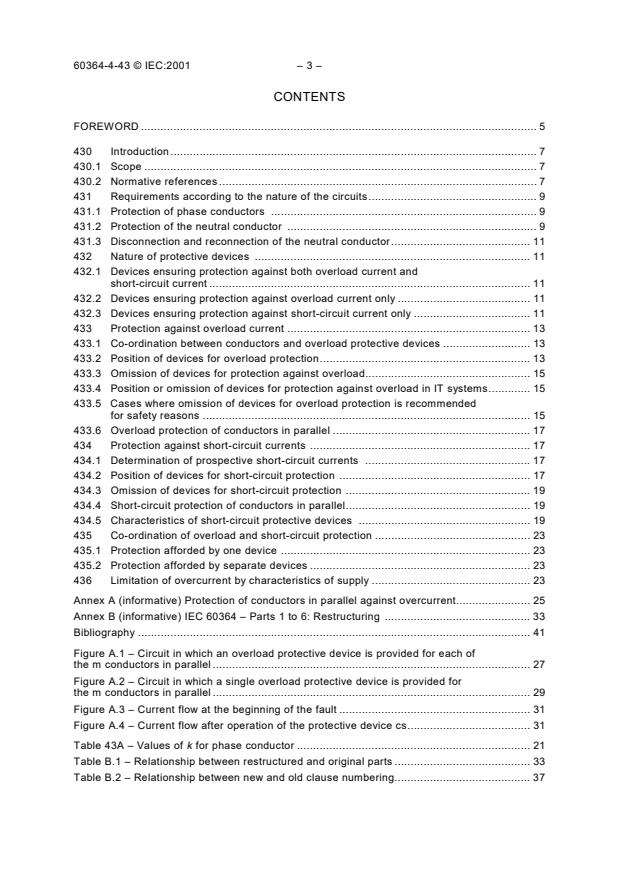
60364-4-43 © IEC:2001 – 3 –
CONTENTS
FOREWORD . 5
430 Introduction.7
430.1 Scope . 7
430.2 Normative references . 7
431 Requirements according to the nature of the circuits. 9
431.1 Protection of phase conductors . 9
431.2 Protection of the neutral conductor . 9
431.3 Disconnection and reconnection of the neutral conductor. 11
432 Nature of protective devices . 11
432.1 Devices ensuring protection against both overload current and
short-circuit current . 11
432.2 Devices ensuring protection against overload current only . 11
432.3 Devices ensuring protection against short-circuit current only . 11
433 Protection against overload current . 13
433.1 Co-ordination between conductors and overload protective devices . 13
433.2 Position of devices for overload protection. 13
433.3 Omission of devices for protection against overload. 15
433.4 Position or omission of devices for protection against overload in IT systems. 15
433.5 Cases where omission of devices for overload protection is recommended
for safety reasons . 15
433.6 Overload protection of conductors in parallel . 17
434 Protection against short-circuit currents . 17
434.1 Determination of prospective short-circuit currents . 17
434.2 Position of devices for short-circuit protection . 17
434.3 Omission of devices for short-circuit protection . 19
434.4 Short-circuit protection of conductors in parallel. 19
434.5 Characteristics of short-circuit protective devices . 19
435 Co-ordination of overload and short-circuit protection . 23
435.1 Protection afforded by one device . 23
435.2 Protection afforded by separate devices . 23
436 Limitation of overcurrent by characteristics of supply . 23
Annex A (informative) Protection of conductors in parallel against overcurrent. 25
Annex B (informative) IEC 60364 – Parts 1 to 6: Restructuring . 33
Bibliography . 41
Figure A.1 – Circuit in which an overload protective device is provided for each of
the m conductors in parallel . 27
Figure A.2 – Circuit in which a single overload protective device is provided for
the m conductors in parallel . 29
Figure A.3 – Current flow at the beginning of the fault . 31
Figure A.4 – Current flow after operation of the protective device cs. 31
Table 43A – Values of k for phase conductor . 21
Table B.1 – Relationship between restructured and original parts . 33
Table B.2 – Relationship between new and old clause numbering. 37
60364-4-43 © IEC:2001 – 5 –
INTERNATIONAL ELECTROTECHNICAL COMMISSION
____________
ELECTRICAL INSTALLATIONS OF BUILDINGS –
Part 4-43: Protection for safety –
Protection against overcurrent
FOREWORD
1) The IEC (International Electrotechnical Commission) is a worldwide organization for standardization comprising
all national electrotechnical committees (IEC National Committees). The object of the IEC is to promote
international co-operation on all questions concerning standardization in the electrical and electronic fields. To
this end and in addition to other activities, the IEC publishes International Standards. Their preparation is
entrusted to technical committees; any IEC National Committee interested in the subject dealt with may
participate in this preparatory work. International, governmental and non-governmental organizations liaising
with the IEC also participate in this preparation. The IEC collaborates closely with the International Organization
for Standardization (ISO) in accordance with conditions determined by agreement between the two
organizations.
2) The formal decisions or agreements of the IEC on technical matters express, as nearly as possible, an
international consensus of opinion on the relevant subjects since each technical committee has representation
from all interested National Committees.
3) The documents produced have the form of recommendations for international use and are published in the form
of standards, technical specifications, technical reports or guides and they are accepted by the National
Committees in that sense.
4) In order to promote international unification, IEC National Committees undertake to apply IEC International
Standards transparently to the maximum extent possible in their national and regional standards. Any
divergence between the IEC Standard and the corresponding national or regional standard shall be clearly
indicated in the latter.
5) The IEC provides no marking procedure to indicate its approval and cannot be rendered responsible for any
equipment declared to be in conformity with one of its standards.
6) Attention is drawn to the possibility that some of the elements of this International Standard may be the subject
of patent rights. The IEC shall not be held responsible for identifying any or all such patent rights.
International Standard IEC 60364-4-43 has been prepared by IEC technical committee 64:
Electrical installations and protection against electric shock.
The IEC 60364 series (parts 1 to 6), is currently being restructured, without any technical
changes, into a more simple form (see annex B).
According to a unanimous decision by the Committee of Action (CA/1720/RV (2000-03-21)),
the restructured parts of IEC 60364 have not been submitted to National Committees for
approval.
The text of this second edition of IEC 60364-4-43 is compiled from and replaces
– part 4-43, first edition (1977) and its amendment 1 (1997),
– part 4-473, first edition (1977) and its amendment 1 (1998).
This publication has been drafted, as close as possible, in accordance with the ISO/IEC
Directives, Part 3.
Annexes A and B are for information only.
The committee has decided that the contents of this publication will remain unchanged
until 2006. At this date, the publication will be
• reconfirmed;
• withdrawn;
• replaced by a revised edition, or
• amended.
The contents of the corrigendum of August 2002 have been included in this copy.
60364-4-43 © IEC:2001 – 7 –
ELECTRICAL INSTALLATIONS OF BUILDINGS –
Part 4-43: Protection for safety –
Protection against overcurrent
430 Introduction
430.1 (431) Scope
Part 4-43 of IEC 60364 describes how live conductors are protected by one or more devices for
automatic interruption of the supply in the event of overload (see clause 433) and short-circuits
(see clause 434) except in cases where the overcurrent is limited in accordance with
clause 436 or by the conditions described in 433.3, 433.5 or 434.3 are met. Further, protection
against overload and against short-circuits shall be co-ordinated in accordance with
clause 435.
NOTE 1 Live conductors protected against overload in accordance with clause 433 are considered to be protected
also against faults likely to cause overcurrents of a magnitude similar to overload currents.
NOTE 2 The requirements of this standard do not take account of external influences. For the application of
protective measures in relation to conditions of external influences, see 410.3.4 of IEC 60364-4-41 and clause 422
of IEC 60364-4-42.
NOTE 3 Protection of conductors according to this standard does not necessarily protect the equipment connected
to the conductors.
(433.1 and 434.1)
Protective devices shall be provided to break any overcurrent flowing in the circuit conductors
before such a current could cause a danger due to thermal and mechanical effects or a
temperature rise detrimental to insulation, joints, terminations, or surroundings of the conductors.
430.2 Normative references
The following normative documents contain provisions which, through reference in this text,
constitute provisions of this part of IEC 60364. For dated references, subsequent amendments
to, or revisions of, any of these publications do not apply. However, parties to agreements
based on this part of IEC 60364 are encouraged to investigate the possibility of applying the
most recent editions of the normative documents indicated below. For undated references, the
latest edition of the normative document referred to applies. Members of IEC and ISO maintain
registers of currently valid International Standards.
IEC 60269-1:1998, Low-voltage fuses – Part 1: General requirements
IEC 60269-2:1986, Low-voltage fuses – Part 2: Supplementary requirements for fuses for use
by authorized persons (fuses mainly for industrial application)
IEC 60269-3:1987, Low-voltage fuses – Part 3: Supplementary requirements for fuses used by
unskilled persons (fuses mainly for household and similar applications)
IEC 60364-4-41: Electrical installations of buildings – Part 4-41: Protection for safety –
Protection against electric shock
IEC 60364-5-52: Electrical installations of buildings – Part 5-52: Selection and erection of
electrical equipment – Wiring systems
________
In this standard, references in brackets refer to the previous numbering system.
60364-4-43 © IEC:2001 – 9 –
IEC 60724:1984, Guide to the short-circuit temperature limits of electric cables with a rated
voltage not exceeding 0,6/1,0 kV
IEC 60898:1995, Electrical accessories – Circuit-breakers for overcurrent protection for
household and similar installations
IEC 60947-1:1999, Low-voltage switchgear and controlgear – Part 1: General rules
IEC 60947-2:1995, Low-voltage switchgear and controlgear – Part 2: Circuit-breakers
IEC 60947-4-1:1990, Low-voltage switchgear and controlgear – Part 4-1: Contactors and
motor-starters – Electromechanical contactors and motor-starters
IEC 61009 (all parts), Residual current operated circuit-breakers with integral overcurrent
protection for household and similar uses (RCBOs)
431 (473.3) Requirements according to the nature of the circuits
431.1 (473.3.1) Protection of phase conductors
431.1.1 (473.3.1.1) Detection of overcurrent shall be provided for all phase conductors; it
shall cause the disconnection of the conductor in which the overcurrent is detected, but not
necessarily the disconnection of other live conductors, except where 431.1.2 applies.
431.1.2 (473.3.1.2) In TT systems, for circuits supplied between phases and in which the
neutral conductor is not distributed, overcurrent detection need not be provided for one of
the phase conductors, provided that the following conditions are simultaneously fulfilled:
a) there exists, in the same circuit or on the supply side, differential protection intended to
cause disconnection of all the phase conductors;
b) the neutral conductor is not distributed from an artificial neutral point of the circuits situated
on the load side of the differential protective device mentioned in a).
NOTE If disconnection of a single phase may cause danger, for example in the case of three-phase motors,
appropriate precautions should be taken.
431.2 (473.3.2) Protection of the neutral conductor
431.2.1 (473.3.2.1) TT or TN systems
Where the cross-sectional area of the neutral conductor is at least equal or equivalent to that
of the phase conductors, it is not necessary to provide overcurrent detection for the neutral
conductor or a disconnecting device for that conductor.
Where the cross-sectional area of the neutral conductor is less than that of the phase
conductors, it is necessary to provide overcurrent detection for the neutral conductor,
appropriate to the cross-sectional area of that conductor; this detection shall cause the
disconnection of the phase conductors, but not necessarily of the neutral conductor.
However, overcurrent detection need not be provided for the neutral conductor if the two
following conditions are simultaneously fulfilled:
• the neutral conductor is protected against short-circuit by the protective device for the
phase conductors of the circuit, and
• the maximum current likely to be carried by the neutral conductor is, in normal service,
clearly less than the value of the current-carrying capacity of that conductor.
NOTE This second condition is satisfied if the power carried is shared as evenly as possible between the different
phases, for example if the sum of the powers absorbed by current-using equipment supplied from each phase and
neutral (such as lighting and socket-outlets) is much less than the total power carried by the circuit concerned. The
cross-sectional area of the neutral conductor should be not less than the appropriate value prescribed in
IEC 60364-5-52.
60364-4-43 © IEC:2001 – 11 –
431.2.2 (473.3.2.2) IT systems
In IT systems it is strongly recommended that the neutral conductor should not be distributed.
However, where the neutral conductor is distributed, it is generally necessary to provide
overcurrent detection for the neutral conductor of every circuit, which will cause the
disconnection of all the live conductors of the corresponding circuit, including the neutral
conductor. This measure is not necessary if
• the particular neutral conductor is effectively protected against short-circuit by a protective
device placed on the supply side, for example at the origin of the installation, in accordance
with the rules stated in 434.5; or if
• the particular circuit is protected by a residual current-operated protective device with a
rated residual current not exceeding 0,15 times the current-carrying capacity of the
corresponding neutral conductor. This device shall disconnect all the live conductors of
the corresponding circuit, including the neutral conductor.
431.3 (473.3.3) Disconnection and reconnection of the neutral conductor
Where disconnection of the neutral conductor is required, disconnection and reconnection shall
be such that the neutral conductor shall not be disconnected before the phase conductors and
shall be reconnected at the same time as or before the phase conductors.
432 Nature of protective devices
The protective devices shall be of the appropriate types indicated by 432.1 to 432.3.
432.1 Devices ensuring protection against both overload current and
short-circuit current
These protective devices shall be capable of breaking any overcurrent up to and including the
prospective short-circuit current at the point where the device is installed. They shall satisfy
the requirements of clause 433 and 434.5.1. Such protective devices may be:
• circuit-breakers incorporating overload release complying with IEC 60898, IEC 60947-1,
IEC 60947-2 or IEC 61009;
• circuit-breakers in conjunction with fuses;
• fuses having fuse-links with gG characteristics complying with IEC 60269-1 and IEC 60269-2
or IEC 60269-3.
NOTE 1 The fuse comprises all the parts that form the complete protective device.
NOTE 2 The use of a protective device having a breaking capacity below the value of the prospective short-circuit
current at its place of installation is subject to the requirements of 434.5.1.
432.2 Devices ensuring protection against overload current only
These are generally inverse-time-lag protective devices whose interrupting capacity may be
below the value of the prospective short-circuit current at the point where the devices are
installed. They shall satisfy the requirements of clause 433.
432.3 Devices ensuring protection against short-circuit current only
These devices shall be installed where overload protection is achieved by other means or
where clause 433 allows overload protection to be dispensed with. The devices shall be
capable of breaking the short-circuit current up to and including the prospective short-circuit
current. They shall satisfy the requirements of clause 434.
60364-4-43 © IEC:2001 – 13 –
Such devices may be
• circuit-breakers with short-circuit release complying with IEC 60898, IEC 60947-1, IEC 60947-
2 or IEC 61009,
• fuses complying with IEC 60269-1 and IEC 60269-2 or IEC 60269-3.
433 Protection against overload current
433.1 (433.2) Co-ordination between conductors and overload protective devices
The operating characteristics of a device protecting a cable against overload shall satisfy the
two following conditions:
I ≤ I ≤ I (1)
B n z
I ≤ 1,45 × I (2)
2 z
where
I is the current for which the circuit is designed;
B
I is the continuous current-carrying capacity of the cable (see clause 523);
z
I is the nominal current of the protective device;
n
NOTE For adjustable protective devices, the nominal current I is the current setting selected.
n
I is the current ensuring effective operation in the conventional time of the protective device.
The current I ensuring effective operation of the protective device is given in the product
standard or may be provided by the manufacturer.
NOTE Protection in accordance with this clause does not ensure complete protection in certain cases, for example
against sustained overcurrent less than I , nor will it necessarily result in an economical solution. Therefore it is
assumed that the circuit is so designed that small overloads of long duration will not frequently occur.
433.2 (473.1.1) Position of devices for overload protection
433.2.1 (473.1.1.1) A device ensuring protection against overload shall be placed at the point
where a change, such as a change in cross-sectional area, nature, method of installation or in
constitution, causes a reduction in the value of current-carrying capacity of the conductors,
except where 433.2.2 and 433.3 apply.
433.2.2 (473.1.1.2) The device protecting the conductor against overload may be placed
along the run of that conductor if the part of the run between the point where a change occurs
(in cross-sectional area, nature, method of installation or constitution) and the position of the
protective device has neither branch circuits nor socket-outlets and fulfils one of the following
two conditions:
a) it is protected against short-circuit current in accordance with the requirements stated in
clause 434;
b) its length does not exceed 3 m, it is carried out in such a manner as to reduce the risk of
short-circuit to a minimum, and it is not placed near combustible material (see 434.2.1).
60364-4-43 © IEC:2001 – 15 –
433.3 (473.1.2) Omission of devices for protection against overload
The various cases stated in this subclause shall not be applied to installations situated in
locations presenting a fire risk or risk of explosion and where the requirements for special
installations and locations specify different conditions.
Devices for protection against overload need not be provided for
a) a conductor situated on the load side of a change in cross-sectional area, nature, method
of installation or in constitution, which is effectively protected against overload by a
protective device placed on the supply side,
b) a conductor which is not likely to carry overload current, provided that this conductor is
protected against short-circuit in accordance with the requirements of clause 434 and that it
has neither branch circuits nor socket-outlets,
c) installations for telecommunications, control, signalling and the like,
d) distribution circuits comprising cables laid in the ground or overhead lines where over-
loading of the circuits will not cause danger.
NOTE Conditions for overload protection for the installations mentioned in item c) are under consideration.
433.4 (473.1.3) Position or omission of devices for protection against overload
in IT systems
433.4.1 (473.1.3) The provisions in 433.2.2 and 433.3 for an alternative position or omission
of devices for protection against overload are not applicable to IT systems unless each circuit
not protected against overload is protected by one of the following means:
a) use of the protective measures described in 413.2 of IEC 60364-4-41,
b) protection of each circuit by a residual current protective device which will operate
immediately on the second fault,
c) use of an insulation monitoring device which either
• causes the disconnection of the circuit when the first fault occurs, or
• gives a signal indicating the presence of a fault. The fault shall be rectified according to
the operational requirements and recognizing the risk from a second fault.
433.4.2 (473.3.1.3) In IT systems without a neutral conductor the overload protective device
may be omitted in one of the phase conductors if a residual current protective device is
installed in each circuit.
433.5 (473.1.4) Cases where omission of devices for overload protection is
recommended for safety reasons
The omission of devices for protection against overload is recommended for circuits supplying
current-using equipment where unexpected opening of the circuit could cause danger.
Examples of such cases are
• exciter circuits of rotating machines,
• supply circuits of lifting magnets,
• secondary circuits of current transformers.
NOTE In such cases consideration should be given to the provision of an overload alarm.
60364-4-43 © IEC:2001 – 17 –
433.6 (473.1.5) Overload protection of conductors in parallel
Where a single protective device protects several conductors in parallel there shall be no
branch circuits or devices for isolation or switching in the parallel conductors.
This subclause does not preclude the use of ring circuits.
433.6.1 (473.1.5.1) Equal current sharing between parallel conductors
Where a single device protects conductors in parallel sharing currents equally, the value of I
z
to be used in 433.1 is the sum of the current-carrying capacities of the various conductors.
It is deemed that current sharing is equal if the requirements of the first indent of 523.7 a) of
IEC 60364-5-52 are satisfied.
433.6.2 (473.1.5.2) Unequal current sharing between parallel conductors
Where the use of a single conductor, per phase, is impractical and the currents in the parallel
conductors are unequal, the design current and requirements for overload protection for each
conductor shall be considered individually.
NOTE Currents in parallel conductors are considered to be unequal if the difference between any currents is more
than 10 % of the design current for each conductor. Guidance is given in annex A (see clause A.2).
434 Protection against short-circuit currents
434.1 (434.2) Determination of prospective short-circuit currents
The prospective short-circuit current at every relevant point of the installation shall be
d
...