

SIST ES 282 003 V3.5.1:2011
(Main)Telecommunications and Internet converged Services and Protocols for Advanced Networking (TISPAN) - Resource and Admission Control Sub-System (RACS) - Functional Architecture
- Abstract
The present document describes the functional architecture of the Resource and Admission Control Subsystem (RACS), for TISPAN NGN Release 3, in line with the service requirements described in TS 181 005 [1], in line with the QoS Requirements described in TS 181 018 [13] and its role in the TISPAN NGN architecture as defined in ES 282 001 [2]. It specifies as well high level stage 2 requirements that are also considered when describing its functional operation.
- Status
- Published
- Publication Date
- 05-Jun-2011
- Technical Committee
- SPN - Services and Protocols for Networks
- Current Stage
- 6060 - National Implementation/Publication (Adopted Project)
- Start Date
- 03-May-2011
- Due Date
- 08-Jul-2011
- Completion Date
- 06-Jun-2011
Buy Documents

es_282003v030403m - Telecommunications and Internet converged Services and Protocols for Advanced Networking (TISPAN); Resource and Admission Control Sub-System (RACS): Functional Architecture

es_282003v030501p - Telecommunications and Internet converged Services and Protocols for Advanced Networking (TISPAN); Resource and Admission Control Sub-System (RACS): Functional Architecture



SIST ES 282 003 V3.5.1:2011 is SIST’s version of ETSI ES 282 003 V3.5.1, the specification for the Functional Architecture of the Resource and Admission Control Sub-System (RACS) in TISPAN NGN Release 3. It describes how RACS supports resource admission control, QoS handling, policy enforcement and related interactions for application, access network and core network functions. In practice, it is a design and integration reference for operators and vendors working with SPDF, x-RACF, BGF, RCEF and AF roles.
What does SIST ES 282 003 V3.5.1:2011 specify?
SIST ES 282 003 V3.5.1:2011 specifies the functional architecture of RACS for TISPAN NGN Release 3, aligned with the service requirements in TS 181 005, the QoS requirements in TS 181 018, and the NGN architecture in ES 282 001. It also sets out high-level stage 2 requirements that shape the functional operation of the subsystem.
The document is organized around the scope, references, definitions and abbreviations, a general description of RACS, the basis for the architecture derivation, the architecture definition itself, and the interaction procedures. The annexes then expand the architecture with policy terminology, scenarios, use cases, multicast support and session modification examples.
| Annex | What it covers |
|---|---|
| B | Policy terminology and types of policy |
| C | Admission control scenarios |
| D | Network deployment scenarios |
| E | Topology and resource management use cases, functions and models |
| F | Architectural scenarios for supporting unicast and multicast |
| G | Information flows for supporting unicast and multicast |
| H | Session modification procedure and connection status |
| I | Change history |
| J | Bibliography |
What are the key requirements of SIST ES 282 003 V3.5.1:2011?
SIST ES 282 003 V3.5.1:2011 defines how RACS makes admission decisions, applies policies and coordinates resource use across functional entities. The most important requirements are concentrated in clauses 4, 5 and 6, where the document moves from service-level behavior to architecture and signaling.
Resource control and reservation
Clause 4.2.1.2 states that RACS services may be selected by an Application Function (AF) at the time they are needed, or triggered by a transfer processing function. It also requires support for at least eight priority types that may be active at the same time. In practice, that means the implementation must be able to distinguish traffic classes such as emergency handling and keep several priorities live at once.
Clause 4.2.1.3 requires explicit modification of previously established resource reservations, and support for segmented resource management as described by RFC 3312. This matters when a session changes after setup, especially for multi-party SIP-based sessions where each participant may need a separate resource decision.
Clause 5.4 adds QoS downgrading as a controlled mechanism for adjusting an existing session without terminating it. That is important when a new session arrives and the operator chooses to reduce the QoS of an existing one instead of rejecting the new request.
QoS, policy and charging
Clause 5.3 distinguishes guaranteed QoS from relative QoS. Guaranteed QoS is tied to absolute bounds on parameters such as throughput, latency, jitter and loss, while relative QoS relies on differentiation between traffic classes without fixed numerical bounds. The clause also says that Best Effort networks and statically provisioned QoS differentiation do not require RACS functions, so the architecture is aimed at dynamic QoS control.
Clause 5.2 limits RACS charging support to offline charging and lists the information that SPDF, A-RACF and AF may need to provide for charging purposes, including Charging Correlation Information (CCI), request type, requestor information, subscriber information, service priority, media description, Commit ID, timestamp and reason. The practical point is that the standard defines what charging data must be made available, but not the transfer mechanism itself.
Clause 6.3.1.1 defines several Rq resource management models: single-stage resource management, two-stage reserve-commit, and authorize-reserve-commit. Clause 6.3.1.1.4 says synchronization on Rq uses soft-state reservation, and clause 6.3.1.1.5 requires support for unsolicited events such as revocation of established reservations. That means implementations must manage reservation state carefully and react to changes without relying on an audit mechanism.
Functional entities and reference points
Clause 6.2.2 requires the generic Resource Admission Control Function to authenticate resource requests and either grant or reject them. It also says the x-RACF can be involved in unicast, multicast, or both, and can coordinate with other x-RACFs through Rr to avoid overbooking or to reserve resources across multiple transport segments. In practice, that is the core admission-control behavior of the architecture.
Clause 6.2.3 defines the Border Gateway Function (BGF) as a policy enforcement function that operates on micro-flows. It uses a dynamic gate to block or allow individual packet flows and can manage IP addresses, ports and bit rate. That matters when the operator needs session-level gateway control rather than only coarse network admission.
Clause 6.2.5 requires the AF to provide media-flow information, bandwidth needs, class-based service information and resource priority. It must also indicate whether media should be enabled as soon as resources are allocated, or only after resources are committed. This tells implementers how the application side drives reservation behavior.
Clause 6.3.3.1.6 requires the Ia reference point to support BGF state-change reporting and the request and reporting of current BGF resource state. That supports recovery after reboot, network failure or hardware failure, so the control plane can resynchronize with the gateway.
Clause 6.3.7 says x-RACF shall deal with both L2 and L3 policies, and that policy handling may use explicit policy descriptions or predefined policy rules. Clause 6.3.7 also defines install, modification, query and release exchanges with the RCEF. This is the policy enforcement path that turns admission decisions into concrete traffic behavior.
Clause 6.3.8 defines the Rr reference point for coordination between x-RACF instances. It supports a request model and a delegated model, and it allows reservation, release and modification for one or several media flows as a group. For operators, that is the mechanism that lets multiple access or aggregation segments work together without inconsistent resource accounting.
What terms does SIST ES 282 003 V3.5.1:2011 define?
SIST ES 282 003 V3.5.1:2011 defines the main RACS building blocks and the policy language it uses. These terms are central to reading the architecture correctly.
- Resource and Admission Control Sub-System (RACS) - the subsystem that decides whether requested transport resources and related QoS can be admitted and controlled.
- Service based Policy Decision Function (SPDF) - the functional entity that applies service-based policy and provides a single point of contact for the AF.
- Access-Resource and Admission Control Function (A-RACF) - the x-RACF specialization that operates in the access network and uses access and subscriber information.
- Core-Resource and Admission Control Function (C-RACF) - the x-RACF specialization that operates in the core network.
- Border Gateway Function (BGF) - the gateway function that enforces policy on micro-flows by opening or closing gates.
- Resource Control and Enforcement Function (RCEF) - the function that receives and applies traffic policies on transport resources.
- Application Function (AF) - the application-side entity that describes media flows, bandwidth needs and QoS expectations to RACS.
- traffic policies - policies triggered by packet arrival whose actions process a packet before forwarding it to another device.
Who uses SIST ES 282 003 V3.5.1:2011?
SIST ES 282 003 V3.5.1:2011 is used by TISPAN NGN operators, transport and access network designers, policy architects, and vendors implementing RACS functions. It is also relevant to teams working on IMS-based services, IPTV, multicast support, resource reservation, and customer-network interconnection.
In practice, the document helps people who need to decide how SPDF, x-RACF, BGF, RCEF, NASS and AF interact in a fixed access or NGN environment. Quality and operations teams can also use it when checking admission-control behavior, policy installation, state synchronization and session modification handling.
Which standards are used with SIST ES 282 003 V3.5.1:2011?
SIST ES 282 003 V3.5.1:2011 relies on several ETSI and IETF documents to define its architecture and behavior.
| Reference | Contribution |
|---|---|
| ETSI TS 181 005 | Service and capability requirements that frame RACS behavior |
| ETSI ES 282 001 | NGN functional architecture and the role of RACS within it |
| IETF RFC 3312 | Segmented resource management for SIP-based sessions |
| IETF RFC 2475 | Differentiated Services architecture for relative QoS |
| ETSI ES 282 004 | Network Attachment Sub-System (NASS), including access profile support |
| ETSI TS 185 005 | Service requirements and capabilities for customer networks connected to TISPAN NGN |
| ETSI TS 123 228 | IMS stage 2 context for IP multimedia services |
| ETSI TS 182 027 | IPTV architecture and IPTV functions supported by IMS |
| ETSI ES 283 026 | QoS reservation information exchange between SPDF and A-RACF |
| TR 180 000 | General terminology used for definitions in the document |
What does the SIST ES 282 003 V3.5.1:2011 document contain?
SIST ES 282 003 V3.5.1:2011 contains an architectural figure for RACS, detailed descriptions of functional elements, and tables of information elements for the main reference points. Clause 6.3 covers exchanges on Rq, Ia, Gq', Ri', Rd', Re, Rr and Rf, including requests, confirmations, modification messages, audits, notifications and release procedures.
Clause 6.4 provides interaction procedures such as subscriber attach, resource request and release in push and pull modes, commit resources, resource modification, access profile retrieval from NASS, subscriber detach, and abnormal events from RCEF and BGF. The annexes then add scenario material, including multicast support, topology and resource management use cases, and an example session modification procedure.
For implementers, the most useful parts are the message tables, the signaling sequences, and the annex scenarios, because they show how the architecture is expected to behave in real network setups.
Buy Documents
es_282003v030403m - Telecommunications and Internet converged Services and Protocols for Advanced Networking (TISPAN); Resource and Admission Control Sub-System (RACS): Functional Architecture
es_282003v030501p - Telecommunications and Internet converged Services and Protocols for Advanced Networking (TISPAN); Resource and Admission Control Sub-System (RACS): Functional Architecture
Get Certified
Connect with accredited certification bodies for this standard

ANCE
Mexican certification and testing association.

Intertek Slovenia
Intertek testing, inspection, and certification services in Slovenia.

LNE (Laboratoire National de Métrologie et d'Essais)
French national laboratory for metrology and testing.
Sponsored listings
Frequently Asked Questions
SIST ES 282 003 V3.5.1:2011 is a standard published by the Slovenian Institute for Standardization (SIST). Its full title is "Telecommunications and Internet converged Services and Protocols for Advanced Networking (TISPAN) - Resource and Admission Control Sub-System (RACS) - Functional Architecture". This standard covers: The present document describes the functional architecture of the Resource and Admission Control Subsystem (RACS), for TISPAN NGN Release 3, in line with the service requirements described in TS 181 005 [1], in line with the QoS Requirements described in TS 181 018 [13] and its role in the TISPAN NGN architecture as defined in ES 282 001 [2]. It specifies as well high level stage 2 requirements that are also considered when describing its functional operation.
The present document describes the functional architecture of the Resource and Admission Control Subsystem (RACS), for TISPAN NGN Release 3, in line with the service requirements described in TS 181 005 [1], in line with the QoS Requirements described in TS 181 018 [13] and its role in the TISPAN NGN architecture as defined in ES 282 001 [2]. It specifies as well high level stage 2 requirements that are also considered when describing its functional operation.
SIST ES 282 003 V3.5.1:2011 is classified under the following ICS (International Classification for Standards) categories: 33.040.01 - Telecommunication systems in general; 33.080 - Integrated Services Digital Network (ISDN). The ICS classification helps identify the subject area and facilitates finding related standards.
SIST ES 282 003 V3.5.1:2011 is available in PDF format for immediate download after purchase. The document can be added to your cart and obtained through the secure checkout process. Digital delivery ensures instant access to the complete standard document.
Standards Content (Sample)
Final draft ETSI ES 282 003 V3.4.3 (2011-02)
ETSI Standard
Telecommunications and Internet converged Services and
Protocols for Advanced Networking (TISPAN);
Resource and Admission Control Sub-System (RACS):
Functional Architecture
2 Final draft ETSI ES 282 003 V3.4.3 (2011-02)
Reference
RES/TISPAN-02084-NGN-R3
Keywords
architecture, control, system
ETSI
650 Route des Lucioles
F-06921 Sophia Antipolis Cedex - FRANCE
Tel.: +33 4 92 94 42 00 Fax: +33 4 93 65 47 16
Siret N° 348 623 562 00017 - NAF 742 C
Association à but non lucratif enregistrée à la
Sous-Préfecture de Grasse (06) N° 7803/88
Important notice
Individual copies of the present document can be downloaded from:
http://www.etsi.org
The present document may be made available in more than one electronic version or in print. In any case of existing or
perceived difference in contents between such versions, the reference version is the Portable Document Format (PDF).
In case of dispute, the reference shall be the printing on ETSI printers of the PDF version kept on a specific network drive
within ETSI Secretariat.
Users of the present document should be aware that the document may be subject to revision or change of status.
Information on the current status of this and other ETSI documents is available at
http://portal.etsi.org/tb/status/status.asp
If you find errors in the present document, please send your comment to one of the following services:
http://portal.etsi.org/chaircor/ETSI_support.asp
Copyright Notification
No part may be reproduced except as authorized by written permission.
The copyright and the foregoing restriction extend to reproduction in all media.
© European Telecommunications Standards Institute 2011.
All rights reserved.
TM TM TM TM
DECT , PLUGTESTS , UMTS , TIPHON , the TIPHON logo and the ETSI logo are Trade Marks of ETSI registered
for the benefit of its Members.
TM
3GPP is a Trade Mark of ETSI registered for the benefit of its Members and of the 3GPP Organizational Partners.
LTE™ is a Trade Mark of ETSI currently being registered
for the benefit of its Members and of the 3GPP Organizational Partners.
GSM® and the GSM logo are Trade Marks registered and owned by the GSM Association.
ETSI
3 Final draft ETSI ES 282 003 V3.4.3 (2011-02)
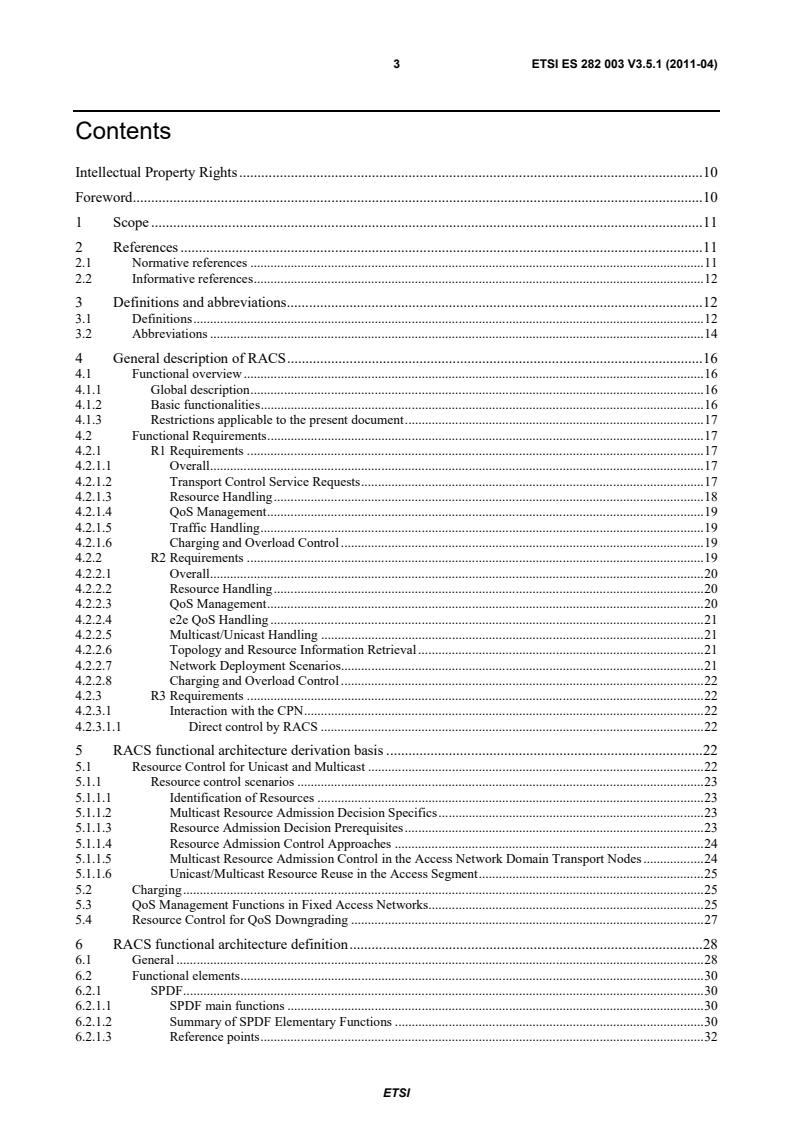
Contents
Intellectual Property Rights . 10
Foreword . 10
1 Scope . 11
2 References . 11
2.1 Normative references . 11
2.2 Informative references . 12
3 Definitions and abbreviations . 12
3.1 Definitions . 12
3.2 Abbreviations . 14
4 General description of RACS . 16
4.1 Functional overview . 16
4.1.1 Global description . 16
4.1.2 Basic functionalitie s . 16
4.1.3 Restrictions applicable to the present document . 17
4.2 Functional Requirements . 17
4.2.1 R1 Requirements . 17
4.2.1.1 Overall . 17
4.2.1.2 Transport Control Service Requests . 17
4.2.1.3 Resource Handling . 18
4.2.1.4 QoS Management . 19
4.2.1.5 Traffic Handling . 19
4.2.1.6 Charging and Overload Control . 19
4.2.2 R2 Requirements . 19
4.2.2.1 Overall . 20
4.2.2.2 Resource Handling . 20
4.2.2.3 QoS Management . 20
4.2.2.4 e2e QoS Handling . 21
4.2.2.5 Multicast/Unicast Handling . 21
4.2.2.6 Topology and Resource Information Retrieval . 21
4.2.2.7 Network Deployment Scenarios . 21
4.2.2.8 Charging and Overload Control . 22
4.2.3 R3 Requirements . 22
4.2.3.1 Interaction with the CPN . 22
4.2.3.1.1 Direct control by RACS . 22
5 RACS functional architecture derivation basis . 22
5.1 Resource Control for Unicast and Multicast . 22
5.1.1 Resource control scenarios . 23
5.1.1.1 Identification of Resources . 23
5.1.1.2 Multicast Resource Admission Decision Specifics . 23
5.1.1.3 Resource Admission Decision Prerequisites . 23
5.1.1.4 Resource Admission Control Approaches . 24
5.1.1.5 Multicast Resource Admission Control in the Access Network Domain Transport Nodes . 24
5.1.1.6 Unicast/Multicast Resource Reuse in the Access Segment . 25
5.2 Charging . 25
5.3 QoS Management Functions in Fixed Access Networks. 25
5.4 Resource Control for QoS Downgrading . 27
6 RACS functional architecture definition . 28
6.1 General . 28
6.2 Functional elements . 30
6.2.1 SPDF . 30
6.2.1.1 SPDF main functions . 30
6.2.1.2 Summary of SPDF Elementary Functions . 30
6.2.1.3 Reference points . 32
ETSI
4 Final draft ETSI ES 282 003 V3.4.3 (2011-02)
6.2.1.4 User profile . 32
6.2.1.5 Priority . 32
6.2.1.6 Service request . 33
6.2.1.7 Coordination function . 33
6.2.1.8 Charging . 34
6.2.1.9 Deployment considerations . 34
6.2.1.10 Overload control . 34
6.2.1.11 Discovery mechanism . 34
6.2.2 Generic Resource Admission Control Function . 34
6.2.2.1 Main functions . 34
6.2.2.1.1 Specializations of x-RACF . 35
6.2.2.1.2 Reference points applicable to different specializations of x-RACF . 35
6.2.2.1.3 Multiple instantiations of x-RACF . 35
6.2.2.2 Summary of generic Resource Admission Control Function Elementary Functions . 36
6.2.2.3 A-RACF . 38
6.2.2.3.1 A-RACF main functions . 38
6.2.2.3.2 Reference points . 38
6.2.2.4 C-RACF . 39
6.2.2.4.1 C-RACF main functions . 39
6.2.2.4.2 Reference points . 39
6.2.2.5 Admission control process . 39
6.2.2.5.1 A-RACF . 39
6.2.2.5.2 C-RACF. 41
6.2.2.6 Installation of policies . 41
6.2.2.7 Charging . 42
6.2.2.8 Abnormal condition handling. 42
6.2.2.9 Deployment considerations . 42
6.2.2.10 Overload control . 42
6.2.2.11 Discovery Mechanism . 42
6.2.3 BGF . 42
6.2.3.1 BGF main functions . 42
6.2.3.2 BGF parameters . 43
6.2.3.3 Reference points . 43
6.2.3.4 Addressing latching . 43
6.2.3.5 Abnormal conditions handling . 43
6.2.3.6 Overload control . 43
6.2.4 RCEF . 44
6.2.4.1 RCEF main functions . 44
6.2.4.2 Reference points . 44
6.2.4.3 RCEF parameters . 44
6.2.5 Application Function (AF) . 44
6.2.5.1 AF main functions . 44
6.2.5.2 Reference points . 45
6.2.5.3 Charging . 46
6.2.5.4 Abnormal conditions handling . 46
6.2.6 BTF . 46
6.3 RACS reference points . 46
6.3.1 Rq reference point (SPDF - x-RACF). 46
6.3.1.1 Functional requirements . 46
6.3.1.1.1 Resource management mechanisms . 46
6.3.1.1.2 Service model . 47
6.3.1.1.3 Duration semantics . 47
6.3.1.1.4 Audit and synchronization support . 48
6.3.1.1.5 Report facilities for unsolicited events . 48
6.3.1.2 Non-functional requirements. 48
6.3.1.2.1 Reliability requirements . 48
6.3.1.2.2 Security requirements . 48
6.3.1.3 Information exchanged over the Rq Reference Point . 48
6.3.1.3.1 Resource Reservation Request . 48
6.3.1.3.2 Resource Modification Request . 50
6.3.1.3.3 Resource Request/Modification Confirmation . 51
6.3.1.3.4 Resource Release Request . 51
ETSI
5 Final draft ETSI ES 282 003 V3.4.3 (2011-02)
6.3.1.3.5 Abort Resource Reservation . 51
6.3.2 e4 reference point (A-RACF - NASS) . 52
6.3.3 Ia Reference Point (SPDF - BGF) . 52
6.3.3.1 Functional Requirements . 52
6.3.3.1.1 Control of NAT, Hosted NAT traversal and Gating . 52
6.3.3.1.2 Transport Protocol Type Policing . 52
6.3.3.1.3 Bandwidth control . 52
6.3.3.1.4 QoS marking . 52
6.3.3.1.5 Usage metering and statistics reporting . 52
6.3.3.1.6 Resource state synchronization . 53
6.3.3.2 Non-Functional Requirements . 53
6.3.3.2.1 Reliability requirements . 53
6.3.3.2.2 Security requirements . 53
6.3.3.3 Information exchanged over the Ia Reference Point . 53
6.3.3.3.1 BGF Service Request . 53
6.3.3.3.2 BGF Service Confirmation . 56
6.3.3.3.3 BGF Service Modify Request . 57
6.3.3.3.4 BGF Service Modify Confirmation . 58
6.3.3.3.5 BGF Service Audit Request . 59
6.3.3.3.6 BGF Service Audit Response . 60
6.3.3.3.7 BGF Service Notify Request . 61
6.3.3.3.8 BGF Service Notify Indication . 62
6.3.3.3.9 BGF Service Release Request . 62
6.3.3.3.10 BGF Service Release Confirmation. 63
6.3.4 Gq' Reference Point (AF - SPDF) . 64
6.3.4.1 Functional Requirements . 64
6.3.4.2 Non-Functional Requirements . 64
6.3.4.3 Information exchanged over the Gq' Reference Point . 64
6.3.5 Ri' Reference Point (SPDF-SPDF inter-domain) . 65
6.3.5.1 Functional Requirements . 65
6.3.5.1.1 Resource management mechanisms . 65
6.3.5.1.2 Service model . 65
6.3.5.1.3 Duration semantics . 65
6.3.5.1.4 Audit and Synchronization support . 66
6.3.5.1.5 Report facilities for unsolicited events . 66
6.3.5.2 Non-Functional Requirements . 66
6.3.5.2.1 Reliability requirements . 66
6.3.5.2.2 Security requirements . 66
6.3.5.3 Information exchanged over the Ri' Reference Point . 66
6.3.6 Rd' Reference Point (SPDF-SPDF intra-domain) . 66
6.3.6.1 Functional Requirements . 66
6.3.6.1.1 Resource management mechanisms . 66
6.3.6.1.2 Service model . 66
6.3.6.1.3 Duration semantics . 67
6.3.6.1.4 Audit and Synchronization support . 67
6.3.6.1.5 Report facilities for unsolicited events . 67
6.3.6.2 Non-Functional Requirements . 67
6.3.6.2.1 Reliability requirements . 67
6.3.6.2.2 Security requirements . 67
6.3.6.3 Information exchanged over the Rd' Reference Point . 67
6.3.7 Re Reference Point (x-RACF - RCEF) . 67
6.3.7.1 Functional Requirements . 67
6.3.7.1.1 Policy Enforcement Management. 67
6.3.7.2 Non-functional requirements. 68
6.3.7.2.1 Reliability requirements . 68
6.3.7.2.2 Security requirements . 68
6.3.7.3 Information exchanged over the Re Reference Point . 69
6.3.7.3.1 Information exchanged by using the push mode . 69
6.3.7.3.2 Information exchanged by using the pull mode . 74
6.3.7.3.3 Information exchanged by using both QoS mechanisms . 80
6.3.8 Rr Reference Point (x-RACF - x-RACF intra-domain) . 81
6.3.8.1 Functional Requirements . 81
ETSI
6 Final draft ETSI ES 282 003 V3.4.3 (2011-02)
6.3.8.1.1 Overall features . 82
6.3.8.1.2 Resource management mechanisms . 82
6.3.8.1.3 Service model . 83
6.3.8.1.4 Duration semantics . 83
6.3.8.1.5 Audit and Synchronization support . 83
6.3.8.1.6 Report facilities for unsolicited events . 84
6.3.8.2 Non-Functional Requirements . 84
6.3.8.2.1 Reliability requirements . 84
6.3.8.2.2 Security requirements . 84
6.3.8.3 Information exchanged over the Rr Reference Point . 84
6.3.8.3.1 Information exchanged over the Rr Reference Point for request model . 84
6.3.8.3.2 Information exchanged over the Rr Reference Point for delegated model . 87
6.3.9 Rf Reference Point (SPDF-Charging Functions and x-RACF-Charging Functions) . 91
6.4 RACS Flows: Interaction Procedures . 91
6.4.1 Subscriber Attaches to the Access Network . 92
6.4.2 Request Resource . 92
6.4.2.1 Request Resource by using the push mode . 92
6.4.2.1.1 Admission control using push mode when only one x-RACF is involved . 92
6.4.2.1.2 Admission control using push mode when multiple x-RACFs are involved . 94
6.4.2.2 Request Resource by using the pull mode . 97
6.4.2.2.1 Admission control using pull mode when only one x-RACF is involved . 97
6.4.2.2.2 Admission control using pull mode when multiple x-RACFs are involved . 98
6.4.2.3 Request resource by combining push and pull mode . 99
6.4.3 Request Resource Wholesale/Retail Scenario . 102
6.4.3.1 Request Resource with access to the A-RACF in the retail domain . 102
6.4.3.2 Request Resource without access to the A-RACF in the retail domain . 104
6.4.4 Release Resource . 105
6.4.4.1 Release Resource Request by using the push mode . 105
6.4.4.2 Release Resource Request by using the pull mode . 106
6.4.4.2.1 Resource Release using pull mode when only one x-RACF is involved . 106
6.4.4.2.2 Resource release using pull mode when multiple x-RACFs are involved . 107
6.4.5 Commit Resources procedure . 109
6.4.6 Resource Modification Request . 110
6.4.6.1 Resource Modification Request by using the push mode. 110
6.4.6.2 Resource Modification Request by using the pull mode . 111
6.4.7 RACS Retrieves Access Profile from NASS . 111
6.4.8 Subscriber Detaches from the access network . 112
6.4.9 Abnormal event from the RCEF . 114
6.4.10 Report of BGF Events. 114
6.4.11 Indication of a BGF Service Failure (Autonomous Release of BGF) . 115
Annex A (informative): Binding Information in RACS, NASS and AF . 117
Annex B (informative): Policy nomenclature for RACS . 118
B.1 Overview . . 118
B.2 Policy Terminology . 118
B.2.1 Policy . 118
B.2.2 Conditions . 118
B.2.3 Actions . 118
B.2.4 Events . 118
B.3 Types of Policy . 119
B.3.1 Authorization Policy. 119
B.3.2 Obligation Polic y . 119
B.3.3 Traffic Policy . 119
B.3.4 Control Policy . 119
Annex C (informative): Admission control scenarios . 120
C.1 Example of the handling of Connection Oriented network in the aggregation segment . 120
Annex D (informative): Network deployment scenarios . 121
ETSI
7 Final draft ETSI ES 282 003 V3.4.3 (2011-02)
D.1 Resource control scenarios according to distribution of Service-based Policy Decision and
Admission Control Functions . 121
D.1.1 Single NGN operator performs Service-based Policy Decision and Admission Control Functions . 121
D.1.1.1 Scenario Overview . 121
D.1.1.2 Business Need . 121
D.1.1.3 Mapping to TISPAN Architecture: RACS requirements . 122
D.1.1.4 Technical Analysis . 122
D.1.1.4.1 Functional Element Analysis . 122
D.1.1.4.2 Elementary Functions Analysis . 122
D.1.1.4.3 Reference Point Analysis . 122
D.1.2 Service-based Policy Decision function handled in two domains . 122
D.1.2.1 Scenario Overview . 122
D.1.2.2 Business Need . 123
D.1.2.3 Mapping to TISPAN Architecture: RACS requirements . 123
D.1.2.4 Technical Analysis . 123
D.1.2.4.1 Functional Element Analysis . 123
D.1.2.4.2 Elementary Functions Analysis . 123
D.1.2.4.3 Reference Point Analysis . 123
D.1.3 Service-based Policy Decision and Admission Control functions distributed across two domains . 124
D.1.3.1 Scenario Overview . 124
D.1.3.2 Business Need . 124
D.1.3.3 Mapping to TISPAN Architecture: RACS requirements . 124
D.1.3.4 Technical Analysis . 125
D.1.3.4.1 Functional Element Analysis . 125
D.1.3.4.2 Elementary Functions Analysis . 125
D.1.3.4.3 Reference Point Analysis . 125
D.2 Resource control scenarios for Multicast and Unicast . 125
D.2.1 Independent scenario - Unicast and Multicast admission control are separated . 125
D.2.1.1 Scenario Overview . 125
D.2.1.2 Business Need . 125
D.2.1.3 Mapping to TISPAN Architecture: RACS requirements . 125
D.2.1.4 Technical Analysis . 126
D.2.1.4.1 Functional Element Analysis . 126
D.2.1.4.2 Elementary Functions Analysis . 126
D.2.1.4.3 Reference Point Analysis . 126
D.2.2 Synchronized Scenario . 126
D.2.2.1 Scenario Overview . 126
D.2.2.2 Business Need . 126
D.2.2.3 Mapping to TISPAN Architecture: RACS requirements . 126
D.2.2.4 Technical Analysis . 126
D.2.2.4.1 Functional Element Analysis . 126
D.2.2.4.2 Elementary Functions Analysis . 126
D.2.2.4.3 Reference Point Analysis . 127
D.2.3 Integrated scenario - Integrated Unicast and Multicast Admission Control . 127
D.2.3.1 Scenario Overview .
...
ETSI Standard
Telecommunications and Internet converged Services and
Protocols for Advanced Networking (TISPAN);
Resource and Admission Control Sub-System (RACS):
Functional Architecture
2 ETSI ES 282 003 V3.5.1 (2011-04)
Reference
RES/TISPAN-02084-NGN-R3
Keywords
architecture, control, system
ETSI
650 Route des Lucioles
F-06921 Sophia Antipolis Cedex - FRANCE
Tel.: +33 4 92 94 42 00 Fax: +33 4 93 65 47 16
Siret N° 348 623 562 00017 - NAF 742 C
Association à but non lucratif enregistrée à la
Sous-Préfecture de Grasse (06) N° 7803/88
Important notice
Individual copies of the present document can be downloaded from:
http://www.etsi.org
The present document may be made available in more than one electronic version or in print. In any case of existing or
perceived difference in contents between such versions, the reference version is the Portable Document Format (PDF).
In case of dispute, the reference shall be the printing on ETSI printers of the PDF version kept on a specific network drive
within ETSI Secretariat.
Users of the present document should be aware that the document may be subject to revision or change of status.
Information on the current status of this and other ETSI documents is available at
http://portal.etsi.org/tb/status/status.asp
If you find errors in the present document, please send your comment to one of the following services:
http://portal.etsi.org/chaircor/ETSI_support.asp
Copyright Notification
No part may be reproduced except as authorized by written permission.
The copyright and the foregoing restriction extend to reproduction in all media.
© European Telecommunications Standards Institute 2011.
All rights reserved.
TM TM TM TM
DECT , PLUGTESTS , UMTS , TIPHON , the TIPHON logo and the ETSI logo are Trade Marks of ETSI registered
for the benefit of its Members.
TM
3GPP is a Trade Mark of ETSI registered for the benefit of its Members and of the 3GPP Organizational Partners.
LTE™ is a Trade Mark of ETSI currently being registered
for the benefit of its Members and of the 3GPP Organizational Partners.
GSM® and the GSM logo are Trade Marks registered and owned by the GSM Association.
ETSI
3 ETSI ES 282 003 V3.5.1 (2011-04)
Contents
Intellectual Property Rights . 10
Foreword . 10
1 Scope . 11
2 References . 11
2.1 Normative references . 11
2.2 Informative references . 12
3 Definitions and abbreviations . 12
3.1 Definitions . 12
3.2 Abbreviations . 14
4 General description of RACS . 16
4.1 Functional overview . 16
4.1.1 Global description . 16
4.1.2 Basic functionalitie s . 16
4.1.3 Restrictions applicable to the present document . 17
4.2 Functional Requirements . 17
4.2.1 R1 Requirements . 17
4.2.1.1 Overall . 17
4.2.1.2 Transport Control Service Requests . 17
4.2.1.3 Resource Handling . 18
4.2.1.4 QoS Management . 19
4.2.1.5 Traffic Handling . 19
4.2.1.6 Charging and Overload Control . 19
4.2.2 R2 Requirements . 19
4.2.2.1 Overall . 20
4.2.2.2 Resource Handling . 20
4.2.2.3 QoS Management . 20
4.2.2.4 e2e QoS Handling . 21
4.2.2.5 Multicast/Unicast Handling . 21
4.2.2.6 Topology and Resource Information Retrieval . 21
4.2.2.7 Network Deployment Scenarios . 21
4.2.2.8 Charging and Overload Control . 22
4.2.3 R3 Requirements . 22
4.2.3.1 Interaction with the CPN . 22
4.2.3.1.1 Direct control by RACS . 22
5 RACS functional architecture derivation basis . 22
5.1 Resource Control for Unicast and Multicast . 22
5.1.1 Resource control scenarios . 23
5.1.1.1 Identification of Resources . 23
5.1.1.2 Multicast Resource Admission Decision Specifics . 23
5.1.1.3 Resource Admission Decision Prerequisites . 23
5.1.1.4 Resource Admission Control Approaches . 24
5.1.1.5 Multicast Resource Admission Control in the Access Network Domain Transport Nodes . 24
5.1.1.6 Unicast/Multicast Resource Reuse in the Access Segment . 25
5.2 Charging . 25
5.3 QoS Management Functions in Fixed Access Networks. 25
5.4 Resource Control for QoS Downgrading . 27
6 RACS functional architecture definition . 28
6.1 General . 28
6.2 Functional elements . 30
6.2.1 SPDF . 30
6.2.1.1 SPDF main functions . 30
6.2.1.2 Summary of SPDF Elementary Functions . 30
6.2.1.3 Reference points . 32
ETSI
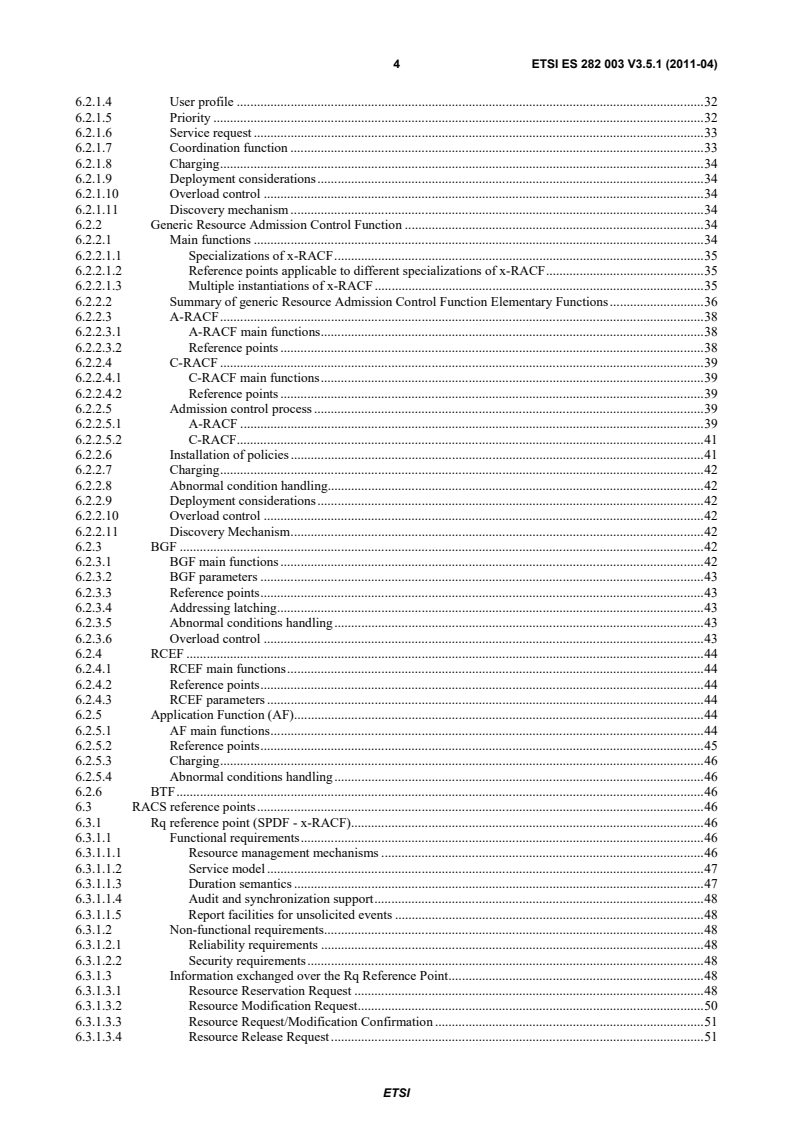
4 ETSI ES 282 003 V3.5.1 (2011-04)
6.2.1.4 User profile . 32
6.2.1.5 Priority . 32
6.2.1.6 Service request . 33
6.2.1.7 Coordination function . 33
6.2.1.8 Charging . 34
6.2.1.9 Deployment considerations . 34
6.2.1.10 Overload control . 34
6.2.1.11 Discovery mechanism . 34
6.2.2 Generic Resource Admission Control Function . 34
6.2.2.1 Main functions . 34
6.2.2.1.1 Specializations of x-RACF . 35
6.2.2.1.2 Reference points applicable to different specializations of x-RACF . 35
6.2.2.1.3 Multiple instantiations of x-RACF . 35
6.2.2.2 Summary of generic Resource Admission Control Function Elementary Functions . 36
6.2.2.3 A-RACF . 38
6.2.2.3.1 A-RACF main functions . 38
6.2.2.3.2 Reference points . 38
6.2.2.4 C-RACF . 39
6.2.2.4.1 C-RACF main functions . 39
6.2.2.4.2 Reference points . 39
6.2.2.5 Admission control process . 39
6.2.2.5.1 A-RACF . 39
6.2.2.5.2 C-RACF. 41
6.2.2.6 Installation of policies . 41
6.2.2.7 Charging . 42
6.2.2.8 Abnormal condition handling. 42
6.2.2.9 Deployment considerations . 42
6.2.2.10 Overload control . 42
6.2.2.11 Discovery Mechanism . 42
6.2.3 BGF . 42
6.2.3.1 BGF main functions . 42
6.2.3.2 BGF parameters . 43
6.2.3.3 Reference points . 43
6.2.3.4 Addressing latching . 43
6.2.3.5 Abnormal conditions handling . 43
6.2.3.6 Overload control . 43
6.2.4 RCEF . 44
6.2.4.1 RCEF main functions . 44
6.2.4.2 Reference points . 44
6.2.4.3 RCEF parameters . 44
6.2.5 Application Function (AF) . 44
6.2.5.1 AF main functions . 44
6.2.5.2 Reference points . 45
6.2.5.3 Charging . 46
6.2.5.4 Abnormal conditions handling . 46
6.2.6 BTF . 46
6.3 RACS reference points . 46
6.3.1 Rq reference point (SPDF - x-RACF). 46
6.3.1.1 Functional requirements . 46
6.3.1.1.1 Resource management mechanisms . 46
6.3.1.1.2 Service model . 47
6.3.1.1.3 Duration semantics . 47
6.3.1.1.4 Audit and synchronization support . 48
6.3.1.1.5 Report facilities for unsolicited events . 48
6.3.1.2 Non-functional requirements. 48
6.3.1.2.1 Reliability requirements . 48
6.3.1.2.2 Security requirements . 48
6.3.1.3 Information exchanged over the Rq Reference Point . 48
6.3.1.3.1 Resource Reservation Request . 48
6.3.1.3.2 Resource Modification Request . 50
6.3.1.3.3 Resource Request/Modification Confirmation . 51
6.3.1.3.4 Resource Release Request . 51
ETSI
5 ETSI ES 282 003 V3.5.1 (2011-04)
6.3.1.3.5 Abort Resource Reservation . 51
6.3.2 e4 reference point (A-RACF - NASS) . 52
6.3.3 Ia Reference Point (SPDF - BGF) . 52
6.3.3.1 Functional Requirements . 52
6.3.3.1.1 Control of NAT, Hosted NAT traversal and Gating . 52
6.3.3.1.2 Transport Protocol Type Policing . 52
6.3.3.1.3 Bandwidth control . 52
6.3.3.1.4 QoS marking . 52
6.3.3.1.5 Usage metering and statistics reporting . 52
6.3.3.1.6 Resource state synchronization . 53
6.3.3.2 Non-Functional Requirements . 53
6.3.3.2.1 Reliability requirements . 53
6.3.3.2.2 Security requirements . 53
6.3.3.3 Information exchanged over the Ia Reference Point . 53
6.3.3.3.1 BGF Service Request . 53
6.3.3.3.2 BGF Service Confirmation . 56
6.3.3.3.3 BGF Service Modify Request . 57
6.3.3.3.4 BGF Service Modify Confirmation . 58
6.3.3.3.5 BGF Service Audit Request . 59
6.3.3.3.6 BGF Service Audit Response . 60
6.3.3.3.7 BGF Service Notify Request . 61
6.3.3.3.8 BGF Service Notify Indication . 62
6.3.3.3.9 BGF Service Release Request . 62
6.3.3.3.10 BGF Service Release Confirmation. 63
6.3.4 Gq' Reference Point (AF - SPDF) . 64
6.3.4.1 Functional Requirements . 64
6.3.4.2 Non-Functional Requirements . 64
6.3.4.3 Information exchanged over the Gq' Reference Point . 64
6.3.5 Ri' Reference Point (SPDF-SPDF inter-domain) . 65
6.3.5.1 Functional Requirements . 65
6.3.5.1.1 Resource management mechanisms . 65
6.3.5.1.2 Service model . 65
6.3.5.1.3 Duration semantics . 65
6.3.5.1.4 Audit and Synchronization support . 66
6.3.5.1.5 Report facilities for unsolicited events . 66
6.3.5.2 Non-Functional Requirements . 66
6.3.5.2.1 Reliability requirements . 66
6.3.5.2.2 Security requirements . 66
6.3.5.3 Information exchanged over the Ri' Reference Point . 66
6.3.6 Rd' Reference Point (SPDF-SPDF intra-domain) . 66
6.3.6.1 Functional Requirements . 66
6.3.6.1.1 Resource management mechanisms . 66
6.3.6.1.2 Service model . 66
6.3.6.1.3 Duration semantics . 67
6.3.6.1.4 Audit and Synchronization support . 67
6.3.6.1.5 Report facilities for unsolicited events . 67
6.3.6.2 Non-Functional Requirements . 67
6.3.6.2.1 Reliability requirements . 67
6.3.6.2.2 Security requirements . 67
6.3.6.3 Information exchanged over the Rd' Reference Point . 67
6.3.7 Re Reference Point (x-RACF - RCEF) . 67
6.3.7.1 Functional Requirements . 67
6.3.7.1.1 Policy Enforcement Management. 67
6.3.7.2 Non-functional requirements. 68
6.3.7.2.1 Reliability requirements . 68
6.3.7.2.2 Security requirements . 68
6.3.7.3 Information exchanged over the Re Reference Point . 69
6.3.7.3.1 Information exchanged by using the push mode . 69
6.3.7.3.2 Information exchanged by using the pull mode . 74
6.3.7.3.3 Information exchanged by using both QoS mechanisms . 81
6.3.8 Rr Reference Point (x-RACF - x-RACF intra-domain) . 82
6.3.8.1 Functional Requirements . 82
ETSI
6 ETSI ES 282 003 V3.5.1 (2011-04)
6.3.8.1.1 Overall features . 82
6.3.8.1.2 Resource management mechanisms . 83
6.3.8.1.3 Service model . 84
6.3.8.1.4 Duration semantics . 84
6.3.8.1.5 Audit and Synchronization support . 84
6.3.8.1.6 Report facilities for unsolicited events . 85
6.3.8.2 Non-Functional Requirements . 85
6.3.8.2.1 Reliability requirements . 85
6.3.8.2.2 Security requirements . 85
6.3.8.3 Information exchanged over the Rr Reference Point . 85
6.3.8.3.1 Information exchanged over the Rr Reference Point for request model . 85
6.3.8.3.2 Information exchanged over the Rr Reference Point for delegated model . 88
6.3.9 Rf Reference Point (SPDF-Charging Functions and x-RACF-Charging Functions) . 92
6.4 RACS Flows: Interaction Procedures . 92
6.4.1 Subscriber Attaches to the Access Network . 93
6.4.2 Request Resource . 93
6.4.2.1 Request Resource by using the push mode . 93
6.4.2.1.1 Admission control using push mode when only one x-RACF is involved . 93
6.4.2.1.2 Admission control using push mode when multiple x-RACFs are involved . 95
6.4.2.2 Request Resource by using the pull mode . 98
6.4.2.2.1 Admission control using pull mode when only one x-RACF is involved . 98
6.4.2.2.2 Admission control using pull mode when multiple x-RACFs are involved . 99
6.4.2.3 Request resource by combining push and pull mode . 100
6.4.3 Request Resource Wholesale/Retail Scenario . 103
6.4.3.1 Request Resource with access to the A-RACF in the retail domain . 103
6.4.3.2 Request Resource without access to the A-RACF in the retail domain . 105
6.4.4 Release Resource . 106
6.4.4.1 Release Resource Request by using the push mode . 106
6.4.4.2 Release Resource Request by using the pull mode . 107
6.4.4.2.1 Resource Release using pull mode when only one x-RACF is involved . 107
6.4.4.2.2 Resource release using pull mode when multiple x-RACFs are involved . 108
6.4.5 Commit Resources procedure . 110
6.4.6 Resource Modification Request . 111
6.4.6.1 Resource Modification Request by using the push mode. 111
6.4.6.2 Resource Modification Request by using the pull mode . 112
6.4.7 RACS Retrieves Access Profile from NASS . 112
6.4.8 Subscriber Detaches from the access network . 113
6.4.9 Abnormal event from the RCEF . 115
6.4.10 Report of BGF Events. 116
6.4.11 Indication of a BGF Service Failure (Autonomous Release of BGF) . 116
Annex A (informative): Binding Information in RACS, NASS and AF . 118
Annex B (informative): Policy nomenclature for RACS . 119
B.1 Overview . . 119
B.2 Policy Terminology . 119
B.2.1 Policy . 119
B.2.2 Conditions . 119
B.2.3 Actions . 119
B.2.4 Events . 119
B.3 Types of Policy . 120
B.3.1 Authorization Policy. 120
B.3.2 Obligation Polic y . 120
B.3.3 Traffic Policy . 120
B.3.4 Control Policy . 120
Annex C (informative): Admission control scenarios . 121
C.1 Example of the handling of Connection Oriented network in the aggregation segment . 121
Annex D (informative): Network deployment scenarios . 122
ETSI
7 ETSI ES 282 003 V3.5.1 (2011-04)
D.1 Resource control scenarios according to distribution of Service-based Policy Decision and
Admission Control Functions . 122
D.1.1 Single NGN operator performs Service-based Policy Decision and Admission Control Functions . 122
D.1.1.1 Scenario Overview . 122
D.1.1.2 Business Need . 122
D.1.1.3 Mapping to TISPAN Architecture: RACS requirements . 123
D.1.1.4 Technical Analysis . 123
D.1.1.4.1 Functional Element Analysis . 123
D.1.1.4.2 Elementary Functions Analysis . 123
D.1.1.4.3 Reference Point Analysis . 123
D.1.2 Service-based Policy Decision function handled in two domains . 123
D.1.2.1 Scenario Overview . 123
D.1.2.2 Business Need . 124
D.1.2.3 Mapping to TISPAN Architecture: RACS requirements . 124
D.1.2.4 Technical Analysis . 124
D.1.2.4.1 Functional Element Analysis . 124
D.1.2.4.2 Elementary Functions Analysis . 124
D.1.2.4.3 Reference Point Analysis . 124
D.1.3 Service-based Policy Decision and Admission Control functions distributed across two domains . 125
D.1.3.1 Scenario Overview . 125
D.1.3.2 Business Need . 125
D.1.3.3 Mapping to TISPAN Architecture: RACS requirements . 125
D.1.3.4 Technical Analysis . 126
D.1.3.4.1 Functional Element Analysis . 126
D.1.3.4.2 Elementary Functions Analysis . 126
D.1.3.4.3 Reference Point Analysis . 126
D.2 Resource control scenarios for Multicast and Unicast . 126
D.2.1 Independent scenario - Unicast and Multicast admission control are separated . 126
D.2.1.1 Scenario Overview . 126
D.2.1.2 Business Need . 126
D.2.1.3 Mapping to TISPAN Architecture: RACS requirements . 126
D.2.1.4 Technical Analysis . 127
D.2.1.4.1 Functional Element Analysis . 127
D.2.1.4.2 Elementary Functions Analysis . 127
D.2.1.4.3 Reference Point Analysis . 127
D.2.2 Synchronized Scenario . 127
D.2.2.1 Scenario Overview . 127
D.2.2.2 Business Need . 127
D.2.2.3 Mapping to TISPAN Architecture: RACS requirements . 127
D.2.2.4 Technical Analysis . 127
D.2.2.4.1 Functional Element Analysis . 127
D.2.2.4.2 Elementary Functions Analysis . 127
D.2.2.4.3 Reference Point Analysis . 128
D.2.3 Integrated scenario - Integrated Unicast and Multicast Admission Control . 128
D.2.3.1 Scenario Overview . 128
D.2.3.2 Business Need .
...
SLOVENSKI STANDARD
01-julij-2011
Zlite telekomunikacijske in internetne storitve ter protokoli za napredno omreženje
(TISPAN) - Podsistem za krmiljenje vira in pristopa (RACS) - Funkcijska arhitektura
Telecommunications and Internet converged Services and Protocols for Advanced
Networking (TISPAN) - Resource and Admission Control Sub-System (RACS) -
Functional Architecture
Ta slovenski standard je istoveten z: ES 282 003
ICS:
33.040.01 Telekomunikacijski sistemi Telecommunication systems
na splošno in general
33.080 Digitalno omrežje z Integrated Services Digital
integriranimi storitvami Network (ISDN)
(ISDN)
2003-01.Slovenski inštitut za standardizacijo. Razmnoževanje celote ali delov tega standarda ni dovoljeno.
ETSI Standard
Telecommunications and Internet converged Services and
Protocols for Advanced Networking (TISPAN);
Resource and Admission Control Sub-System (RACS):
Functional Architecture
2 ETSI ES 282 003 V3.5.1 (2011-04)
Reference
RES/TISPAN-02084-NGN-R3
Keywords
architecture, control, system
ETSI
650 Route des Lucioles
F-06921 Sophia Antipolis Cedex - FRANCE
Tel.: +33 4 92 94 42 00 Fax: +33 4 93 65 47 16
Siret N° 348 623 562 00017 - NAF 742 C
Association à but non lucratif enregistrée à la
Sous-Préfecture de Grasse (06) N° 7803/88
Important notice
Individual copies of the present document can be downloaded from:
http://www.etsi.org
The present document may be made available in more than one electronic version or in print. In any case of existing or
perceived difference in contents between such versions, the reference version is the Portable Document Format (PDF).
In case of dispute, the reference shall be the printing on ETSI printers of the PDF version kept on a specific network drive
within ETSI Secretariat.
Users of the present document should be aware that the document may be subject to revision or change of status.
Information on the current status of this and other ETSI documents is available at
http://portal.etsi.org/tb/status/status.asp
If you find errors in the present document, please send your comment to one of the following services:
http://portal.etsi.org/chaircor/ETSI_support.asp
Copyright Notification
No part may be reproduced except as authorized by written permission.
The copyright and the foregoing restriction extend to reproduction in all media.
© European Telecommunications Standards Institute 2011.
All rights reserved.
TM TM TM TM
DECT , PLUGTESTS , UMTS , TIPHON , the TIPHON logo and the ETSI logo are Trade Marks of ETSI registered
for the benefit of its Members.
TM
3GPP is a Trade Mark of ETSI registered for the benefit of its Members and of the 3GPP Organizational Partners.
LTE™ is a Trade Mark of ETSI currently being registered
for the benefit of its Members and of the 3GPP Organizational Partners.
GSM® and the GSM logo are Trade Marks registered and owned by the GSM Association.
ETSI
3 ETSI ES 282 003 V3.5.1 (2011-04)
Contents
Intellectual Property Rights . 10
Foreword . 10
1 Scope . 11
2 References . 11
2.1 Normative references . 11
2.2 Informative references . 12
3 Definitions and abbreviations . 12
3.1 Definitions . 12
3.2 Abbreviations . 14
4 General description of RACS . 16
4.1 Functional overview . 16
4.1.1 Global description . 16
4.1.2 Basic functionalitie s . 16
4.1.3 Restrictions applicable to the present document . 17
4.2 Functional Requirements . 17
4.2.1 R1 Requirements . 17
4.2.1.1 Overall . 17
4.2.1.2 Transport Control Service Requests . 17
4.2.1.3 Resource Handling . 18
4.2.1.4 QoS Management . 19
4.2.1.5 Traffic Handling . 19
4.2.1.6 Charging and Overload Control . 19
4.2.2 R2 Requirements . 19
4.2.2.1 Overall . 20
4.2.2.2 Resource Handling . 20
4.2.2.3 QoS Management . 20
4.2.2.4 e2e QoS Handling . 21
4.2.2.5 Multicast/Unicast Handling . 21
4.2.2.6 Topology and Resource Information Retrieval . 21
4.2.2.7 Network Deployment Scenarios . 21
4.2.2.8 Charging and Overload Control . 22
4.2.3 R3 Requirements . 22
4.2.3.1 Interaction with the CPN . 22
4.2.3.1.1 Direct control by RACS . 22
5 RACS functional architecture derivation basis . 22
5.1 Resource Control for Unicast and Multicast . 22
5.1.1 Resource control scenarios . 23
5.1.1.1 Identification of Resources . 23
5.1.1.2 Multicast Resource Admission Decision Specifics . 23
5.1.1.3 Resource Admission Decision Prerequisites . 23
5.1.1.4 Resource Admission Control Approaches . 24
5.1.1.5 Multicast Resource Admission Control in the Access Network Domain Transport Nodes . 24
5.1.1.6 Unicast/Multicast Resource Reuse in the Access Segment . 25
5.2 Charging . 25
5.3 QoS Management Functions in Fixed Access Networks. 25
5.4 Resource Control for QoS Downgrading . 27
6 RACS functional architecture definition . 28
6.1 General . 28
6.2 Functional elements . 30
6.2.1 SPDF . 30
6.2.1.1 SPDF main functions . 30
6.2.1.2 Summary of SPDF Elementary Functions . 30
6.2.1.3 Reference points . 32
ETSI
4 ETSI ES 282 003 V3.5.1 (2011-04)
6.2.1.4 User profile . 32
6.2.1.5 Priority . 32
6.2.1.6 Service request . 33
6.2.1.7 Coordination function . 33
6.2.1.8 Charging . 34
6.2.1.9 Deployment considerations . 34
6.2.1.10 Overload control . 34
6.2.1.11 Discovery mechanism . 34
6.2.2 Generic Resource Admission Control Function . 34
6.2.2.1 Main functions . 34
6.2.2.1.1 Specializations of x-RACF . 35
6.2.2.1.2 Reference points applicable to different specializations of x-RACF . 35
6.2.2.1.3 Multiple instantiations of x-RACF . 35
6.2.2.2 Summary of generic Resource Admission Control Function Elementary Functions . 36
6.2.2.3 A-RACF . 38
6.2.2.3.1 A-RACF main functions . 38
6.2.2.3.2 Reference points . 38
6.2.2.4 C-RACF . 39
6.2.2.4.1 C-RACF main functions . 39
6.2.2.4.2 Reference points . 39
6.2.2.5 Admission control process . 39
6.2.2.5.1 A-RACF . 39
6.2.2.5.2 C-RACF. 41
6.2.2.6 Installation of policies . 41
6.2.2.7 Charging . 42
6.2.2.8 Abnormal condition handling. 42
6.2.2.9 Deployment considerations . 42
6.2.2.10 Overload control . 42
6.2.2.11 Discovery Mechanism . 42
6.2.3 BGF . 42
6.2.3.1 BGF main functions . 42
6.2.3.2 BGF parameters . 43
6.2.3.3 Reference points . 43
6.2.3.4 Addressing latching . 43
6.2.3.5 Abnormal conditions handling . 43
6.2.3.6 Overload control . 43
6.2.4 RCEF . 44
6.2.4.1 RCEF main functions . 44
6.2.4.2 Reference points . 44
6.2.4.3 RCEF parameters . 44
6.2.5 Application Function (AF) . 44
6.2.5.1 AF main functions . 44
6.2.5.2 Reference points . 45
6.2.5.3 Charging . 46
6.2.5.4 Abnormal conditions handling . 46
6.2.6 BTF . 46
6.3 RACS reference points . 46
6.3.1 Rq reference point (SPDF - x-RACF). 46
6.3.1.1 Functional requirements . 46
6.3.1.1.1 Resource management mechanisms . 46
6.3.1.1.2 Service model . 47
6.3.1.1.3 Duration semantics . 47
6.3.1.1.4 Audit and synchronization support . 48
6.3.1.1.5 Report facilities for unsolicited events . 48
6.3.1.2 Non-functional requirements. 48
6.3.1.2.1 Reliability requirements . 48
6.3.1.2.2 Security requirements . 48
6.3.1.3 Information exchanged over the Rq Reference Point . 48
6.3.1.3.1 Resource Reservation Request . 48
6.3.1.3.2 Resource Modification Request . 50
6.3.1.3.3 Resource Request/Modification Confirmation . 51
6.3.1.3.4 Resource Release Request . 51
ETSI
5 ETSI ES 282 003 V3.5.1 (2011-04)
6.3.1.3.5 Abort Resource Reservation . 51
6.3.2 e4 reference point (A-RACF - NASS) . 52
6.3.3 Ia Reference Point (SPDF - BGF) . 52
6.3.3.1 Functional Requirements . 52
6.3.3.1.1 Control of NAT, Hosted NAT traversal and Gating . 52
6.3.3.1.2 Transport Protocol Type Policing . 52
6.3.3.1.3 Bandwidth control . 52
6.3.3.1.4 QoS marking . 52
6.3.3.1.5 Usage metering and statistics reporting . 52
6.3.3.1.6 Resource state synchronization . 53
6.3.3.2 Non-Functional Requirements . 53
6.3.3.2.1 Reliability requirements . 53
6.3.3.2.2 Security requirements . 53
6.3.3.3 Information exchanged over the Ia Reference Point . 53
6.3.3.3.1 BGF Service Request . 53
6.3.3.3.2 BGF Service Confirmation . 56
6.3.3.3.3 BGF Service Modify Request . 57
6.3.3.3.4 BGF Service Modify Confirmation . 58
6.3.3.3.5 BGF Service Audit Request . 59
6.3.3.3.6 BGF Service Audit Response . 60
6.3.3.3.7 BGF Service Notify Request . 61
6.3.3.3.8 BGF Service Notify Indication . 62
6.3.3.3.9 BGF Service Release Request . 62
6.3.3.3.10 BGF Service Release Confirmation. 63
6.3.4 Gq' Reference Point (AF - SPDF) . 64
6.3.4.1 Functional Requirements . 64
6.3.4.2 Non-Functional Requirements . 64
6.3.4.3 Information exchanged over the Gq' Reference Point . 64
6.3.5 Ri' Reference Point (SPDF-SPDF inter-domain) . 65
6.3.5.1 Functional Requirements . 65
6.3.5.1.1 Resource management mechanisms . 65
6.3.5.1.2 Service model . 65
6.3.5.1.3 Duration semantics . 65
6.3.5.1.4 Audit and Synchronization support . 66
6.3.5.1.5 Report facilities for unsolicited events . 66
6.3.5.2 Non-Functional Requirements . 66
6.3.5.2.1 Reliability requirements . 66
6.3.5.2.2 Security requirements . 66
6.3.5.3 Information exchanged over the Ri' Reference Point . 66
6.3.6 Rd' Reference Point (SPDF-SPDF intra-domain) . 66
6.3.6.1 Functional Requirements . 66
6.3.6.1.1 Resource management mechanisms . 66
6.3.6.1.2 Service model . 66
6.3.6.1.3 Duration semantics . 67
6.3.6.1.4 Audit and Synchronization support . 67
6.3.6.1.5 Report facilities for unsolicited events . 67
6.3.6.2 Non-Functional Requirements . 67
6.3.6.2.1 Reliability requirements . 67
6.3.6.2.2 Security requirements . 67
6.3.6.3 Information exchanged over the Rd' Reference Point . 67
6.3.7 Re Reference Point (x-RACF - RCEF) . 67
6.3.7.1 Functional Requirements . 67
6.3.7.1.1 Policy Enforcement Management. 67
6.3.7.2 Non-functional requirements. 68
6.3.7.2.1 Reliability requirements . 68
6.3.7.2.2 Security requirements . 68
6.3.7.3 Information exchanged over the Re Reference Point . 69
6.3.7.3.1 Information exchanged by using the push mode . 69
6.3.7.3.2 Information exchanged by using the pull mode . 74
6.3.7.3.3 Information exchanged by using both QoS mechanisms . 81
6.3.8 Rr Reference Point (x-RACF - x-RACF intra-domain) . 82
6.3.8.1 Functional Requirements . 82
ETSI
6 ETSI ES 282 003 V3.5.1 (2011-04)
6.3.8.1.1 Overall features . 82
6.3.8.1.2 Resource management mechanisms . 83
6.3.8.1.3 Service model . 84
6.3.8.1.4 Duration semantics . 84
6.3.8.1.5 Audit and Synchronization support . 84
6.3.8.1.6 Report facilities for unsolicited events . 85
6.3.8.2 Non-Functional Requirements . 85
6.3.8.2.1 Reliability requirements . 85
6.3.8.2.2 Security requirements . 85
6.3.8.3 Information exchanged over the Rr Reference Point . 85
6.3.8.3.1 Information exchanged over the Rr Reference Point for request model . 85
6.3.8.3.2 Information exchanged over the Rr Reference Point for delegated model . 88
6.3.9 Rf Reference Point (SPDF-Charging Functions and x-RACF-Charging Functions) . 92
6.4 RACS Flows: Interaction Procedures . 92
6.4.1 Subscriber Attaches to the Access Network . 93
6.4.2 Request Resource . 93
6.4.2.1 Request Resource by using the push mode . 93
6.4.2.1.1 Admission control using push mode when only one x-RACF is involved . 93
6.4.2.1.2 Admission control using push mode when multiple x-RACFs are involved . 95
6.4.2.2 Request Resource by using the pull mode . 98
6.4.2.2.1 Admission control using pull mode when only one x-RACF is involved . 98
6.4.2.2.2 Admission control using pull mode when multiple x-RACFs are involved . 99
6.4.2.3 Request resource by combining push and pull mode . 100
6.4.3 Request Resource Wholesale/Retail Scenario . 103
6.4.3.1 Request Resource with access to the A-RACF in the retail domain . 103
6.4.3.2 Request Resource without access to the A-RACF in the retail domain . 105
6.4.4 Release Resource . 106
6.4.4.1 Release Resource Request by using the push mode . 106
6.4.4.2 Release Resource Request by using the pull mode . 107
6.4.4.2.1 Resource Release using pull mode when only one x-RACF is involved . 107
6.4.4.2.2 Resource release using pull mode when multiple x-RACFs are involved . 108
6.4.5 Commit Resources procedure . 110
6.4.6 Resource Modification Request . 111
6.4.6.1 Resource Modification Request by using the push mode. 111
6.4.6.2 Resource Modification Request by using the pull mode . 112
6.4.7 RACS Retrieves Access Profile from NASS . 112
6.4.8 Subscriber Detaches from the access network . 113
6.4.9 Abnormal event from the RCEF . 115
6.4.10 Report of BGF Events. 116
6.4.11 Indication of a BGF Service Failure (Autonomous Release of BGF) . 116
Annex A (informative): Binding Information in RACS, NASS and AF . 118
Annex B (informative): Policy nomenclature for RACS . 119
B.1 Overview . . 119
B.2 Policy Terminology . 119
B.2.1 Policy . 119
B.2.2 Conditions . 119
B.2.3 Actions . 119
B.2.4 Events . 119
B.3 Types of Policy . 120
B.3.1 Authorization Policy. 120
B.3.2 Obligation Polic y . 120
B.3.3 Traffic Policy . 120
B.3.4 Control Policy . 120
Annex C (informative): Admission control scenarios . 121
C.1 Example of the handling of Connection Oriented network in the aggregation segment . 121
Annex D (informative): Network deployment scenarios . 122
ETSI
7 ETSI ES 282 003 V3.5.1 (2011-04)
D.1 Resource control scenarios according to distribution of Service-based Policy Decision and
Admission Control Functions . 122
D.1.1 Single NGN operator performs Service-based Policy Decision and Admission Control Functions . 122
D.1.1.1 Scenario Overview . 122
D.1.1.2 Business Need . 122
D.1.1.3 Mapping to TISPAN Architecture: RACS requirements . 123
D.1.1.4 Technical Analysis . 123
D.1.1.4.1 Functional Element Analysis . 123
D.1.1.4.2 Elementary Functions Analysis . 123
D.1.1.4.3 Reference Point Analysis . 123
D.1.2 Service-based Policy Decision function handled in two domains . 123
D.1.2.1 Scenario Overview . 123
D.1.2.2 Business Need . 124
D.1.2.3 Mapping to TISPAN Architecture: RACS requirements . 124
D.1.2.4 Technical Analysis . 124
D.1.2.4.1 Functional Element Analysis . 124
D.1.2.4.2 Elementary Functions Analysis . 124
D.1.2.4.3 Reference Point Analysis . 124
D.1.3 Service-based Policy Decision and Admission Control functions distributed across two domains . 125
D.1.3.1 Scenario Overview . 125
D.1.3.2 Business Need . 125
D.1.3.3 Mapping to TISPAN Architecture: RACS requirements . 125
D.1.3.4 Technical Analysis . 126
D.1.3.4.1 Functional Element Analysis . 126
D.1.3.4.2 Elementary Functions Analysis . 126
D.1.3.4.3 Reference Point Analysis . 126
D.2 Resource control scenarios for Multicast and Unicast . 126
D.2.1 Independent scenario - Unicast and Multicast admission control are separated . 126
D.2.1.1 Scenario Overview . 126
D.2.1.2 Business Need . 126
D.2.1.3 Mapping to TISPAN Architecture: RACS requirements . 126
D.2.1.4 Technical Analysis . 127
D.2.1.4.1 Functional Element Analysis . 127
D.2.1.4.2 Elementary Functions Analysis . 127
D.2.1.4.3 Reference Point Analysis . 127
D.2.2 Synchronized Scenario . 127
D.2.2.1 Scenario Overview . 127
D.2.2.2 Business Need .
...