

ISO/IEC TS 20071-25:2017
(Main)Information technology — User interface component accessibility — Part 25: Guidance on the audio presentation of text in videos, including captions, subtitles and other on-screen text
General Information
- Abstract
ISO/IEC TS 20071-25:2017 provides recommendations on the audio presentation of captions/subtitles and other on-screen text for use in all type of videos regardless of the language and technology being used to transmit and present the recorded or live video. ISO/IEC TS 20071-25:2017 applies to making captions/subtitles and other on-screen text accessible to users with various needs, including but not limited to people with learning and reading disabilities, people with cognitive disabilities, people who are blind or have low vision, older people, and non-native language speakers. It does not apply to captions/subtitles or other on-screen text whose content is already provided in the soundtrack in a language and a way users can access. ISO/IEC TS 20071-25:2017 provides guidance on spoken captions/subtitles as a stand-alone access service but it also provides guidance on how to integrate spoken captions/subtitles, other spoken on-screen text and audio description, if needed, in different types of videos. NOTE 1 Extensive guidance on audio description is provided in ISO/IEC/TS 20071‑21. ISO/IEC TS 20071-25:2017 does not consider the devices or transmission mechanisms used to deliver and play the content or the audio presentation of text in videos. These devices include, but are not limited to televisions, computers, wireless devices, projection equipment, DVD and home cinema equipment, cinema equipment and other forms of user interfaces technology. Therefore, this document does not consider transcoding files for the various video and audio outputs. NOTE 2 Technical matters of transmission and distribution are covered by other documents (e.g. MPEG standards and other technical standards such as IEC 62731:2013). ISO/IEC TS 20071-25:2017 acknowledges the various needs and preferences of users, as well as the different approaches to the audio presentation of text in videos. It applies to audio presentations intended to be heard simultaneously along with the original video.
- Status
- Published
- Publication Date
- 23-Feb-2017
- Technical Committee
- ISO/IEC JTC 1/SC 35 - User interfaces
- Drafting Committee
- ISO/IEC JTC 1/SC 35/WG 6 - User interfaces accessibility
- Current Stage
- 9093 - International Standard confirmed
- Start Date
- 16-Dec-2024
- Completion Date
- 29-Aug-2026
Buy Documents

ISO/IEC TS 20071-25:2017 - Information technology — User interface component accessibility — Part 25: Guidance on the audio presentation of text in videos, including captions, subtitles and other on-screen text Released:2/24/2017

ISO/IEC TS 20071-25:2017 - Information technology — User interface component accessibility — Part 25: Guidance on the audio presentation of text in videos, including captions, subtitles and other on-screen text/24/2017
Overview
ISO/IEC TS 20071-25:2017 provides guidance on the audio presentation of text in videos, including spoken captions, spoken subtitles and other on‑screen text. Intended to improve user interface component accessibility, the technical specification covers recommendations for making captions/subtitles and visual text accessible via an audio modality. It applies to all types of videos (live and recorded) and to audiences such as people who are blind or have low vision, people with cognitive or reading disabilities, older viewers and non‑native speakers. The document focuses on audio presentation heard simultaneously with the original video and does not cover device‑level transmission, file transcoding or content already present in the soundtrack.
Key Topics
- Scope and user needs
- Recommendations for accessibility of captions/subtitles and other on‑screen text across languages and presentation technologies.
- Excludes text already conveyed in the soundtrack in an accessible form.
- Types of audio presentations
- Live vs recorded spoken captions/subtitles and spoken on‑screen text.
- Pre‑mixed (delivered as a single audio track) vs receiver‑mixed (separate streams mixed at the user device).
- Narration and production
- Narrator preparation, clarity, appropriate volume and audio quality guidance.
- Strategies for reading/delivering text so it’s intelligible and unobtrusive.
- Synchronization and timing
- Guidance on synchronizing spoken text with on‑screen appearance to support comprehension.
- Text management
- Use of text‑files, integration with existing captions/subtitles and ensuring consistency across episodes/series.
- Usability and inclusion
- Advice to involve target users in creation and evaluation to match diverse preferences and needs.
- Content-level guidance
- Identifying characters, text/speech adjustments, and prioritizing levels of importance for what to voice.
Applications
This technical specification is practical for:
- Video producers, post‑production teams and content creators implementing accessible audio services.
- Broadcasters and streaming platforms that provide alternative audio tracks (pre‑mixed or receiver‑mixed).
- Accessibility specialists and UX designers designing accessible multimedia experiences.
- Exhibitors and live event producers deploying spoken captions/subtitles for audiences with accessibility needs.
Benefits include improved accessibility compliance, better audience reach, and consistent user experiences for viewers relying on audio alternatives to on‑screen text.
Related Standards
- ISO/IEC/TS 20071‑21 - extensive guidance on audio description (related access service).
- MPEG standards and IEC 62731:2013 - cover technical transmission and distribution aspects referenced but not addressed in this TS.
Keywords: ISO/IEC TS 20071-25:2017, audio presentation of text in videos, spoken captions, spoken subtitles, user interface component accessibility, captions accessibility, video accessibility.
Relations
- Consolidated By
ISO 10545-20:2022 - Ceramic tiles — Part 20: Determination of deflection of ceramic tiles for calculating their radius of curvature - Effective Date
- 06-Jun-2022
Buy Documents
ISO/IEC TS 20071-25:2017 - Information technology — User interface component accessibility — Part 25: Guidance on the audio presentation of text in videos, including captions, subtitles and other on-screen text Released:2/24/2017
ISO/IEC TS 20071-25:2017 - Information technology — User interface component accessibility — Part 25: Guidance on the audio presentation of text in videos, including captions, subtitles and other on-screen text/24/2017
Get Certified
Connect with accredited certification bodies for this standard

BSI Group
BSI (British Standards Institution) is the business standards company that helps organizations make excellence a habit.

NYCE
Mexican standards and certification body.
Sponsored listings
Frequently Asked Questions
ISO/IEC TS 20071-25:2017 is a technical specification published by the International Organization for Standardization (ISO). Its full title is "Information technology — User interface component accessibility — Part 25: Guidance on the audio presentation of text in videos, including captions, subtitles and other on-screen text". This standard covers: ISO/IEC TS 20071-25:2017 provides recommendations on the audio presentation of captions/subtitles and other on-screen text for use in all type of videos regardless of the language and technology being used to transmit and present the recorded or live video. ISO/IEC TS 20071-25:2017 applies to making captions/subtitles and other on-screen text accessible to users with various needs, including but not limited to people with learning and reading disabilities, people with cognitive disabilities, people who are blind or have low vision, older people, and non-native language speakers. It does not apply to captions/subtitles or other on-screen text whose content is already provided in the soundtrack in a language and a way users can access. ISO/IEC TS 20071-25:2017 provides guidance on spoken captions/subtitles as a stand-alone access service but it also provides guidance on how to integrate spoken captions/subtitles, other spoken on-screen text and audio description, if needed, in different types of videos. NOTE 1 Extensive guidance on audio description is provided in ISO/IEC/TS 20071‑21. ISO/IEC TS 20071-25:2017 does not consider the devices or transmission mechanisms used to deliver and play the content or the audio presentation of text in videos. These devices include, but are not limited to televisions, computers, wireless devices, projection equipment, DVD and home cinema equipment, cinema equipment and other forms of user interfaces technology. Therefore, this document does not consider transcoding files for the various video and audio outputs. NOTE 2 Technical matters of transmission and distribution are covered by other documents (e.g. MPEG standards and other technical standards such as IEC 62731:2013). ISO/IEC TS 20071-25:2017 acknowledges the various needs and preferences of users, as well as the different approaches to the audio presentation of text in videos. It applies to audio presentations intended to be heard simultaneously along with the original video.
ISO/IEC TS 20071-25:2017 provides recommendations on the audio presentation of captions/subtitles and other on-screen text for use in all type of videos regardless of the language and technology being used to transmit and present the recorded or live video. ISO/IEC TS 20071-25:2017 applies to making captions/subtitles and other on-screen text accessible to users with various needs, including but not limited to people with learning and reading disabilities, people with cognitive disabilities, people who are blind or have low vision, older people, and non-native language speakers. It does not apply to captions/subtitles or other on-screen text whose content is already provided in the soundtrack in a language and a way users can access. ISO/IEC TS 20071-25:2017 provides guidance on spoken captions/subtitles as a stand-alone access service but it also provides guidance on how to integrate spoken captions/subtitles, other spoken on-screen text and audio description, if needed, in different types of videos. NOTE 1 Extensive guidance on audio description is provided in ISO/IEC/TS 20071‑21. ISO/IEC TS 20071-25:2017 does not consider the devices or transmission mechanisms used to deliver and play the content or the audio presentation of text in videos. These devices include, but are not limited to televisions, computers, wireless devices, projection equipment, DVD and home cinema equipment, cinema equipment and other forms of user interfaces technology. Therefore, this document does not consider transcoding files for the various video and audio outputs. NOTE 2 Technical matters of transmission and distribution are covered by other documents (e.g. MPEG standards and other technical standards such as IEC 62731:2013). ISO/IEC TS 20071-25:2017 acknowledges the various needs and preferences of users, as well as the different approaches to the audio presentation of text in videos. It applies to audio presentations intended to be heard simultaneously along with the original video.
ISO/IEC TS 20071-25:2017 is classified under the following ICS (International Classification for Standards) categories: 35.240.20 - IT applications in office work. The ICS classification helps identify the subject area and facilitates finding related standards.
ISO/IEC TS 20071-25:2017 has the following relationships with other standards: It is inter standard links to ISO 10545-20:2022. Understanding these relationships helps ensure you are using the most current and applicable version of the standard.
ISO/IEC TS 20071-25:2017 is available in PDF format for immediate download after purchase. The document can be added to your cart and obtained through the secure checkout process. Digital delivery ensures instant access to the complete standard document.
Standards Content (Sample)
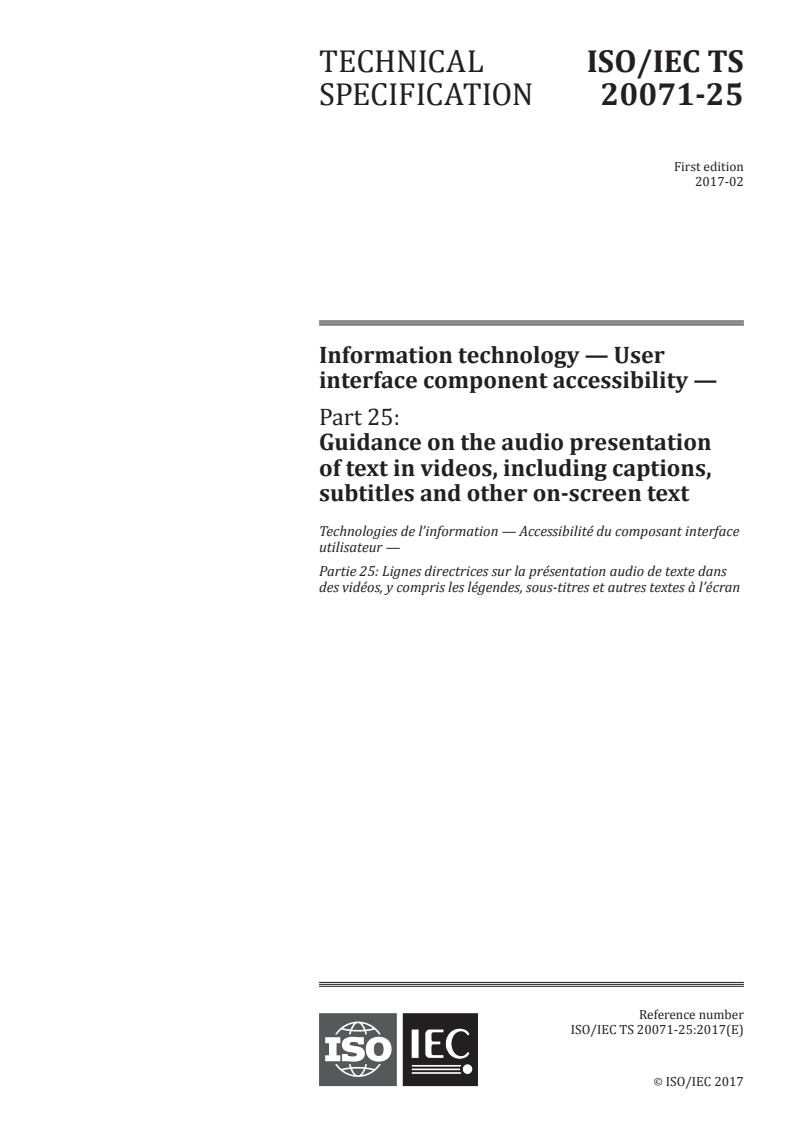
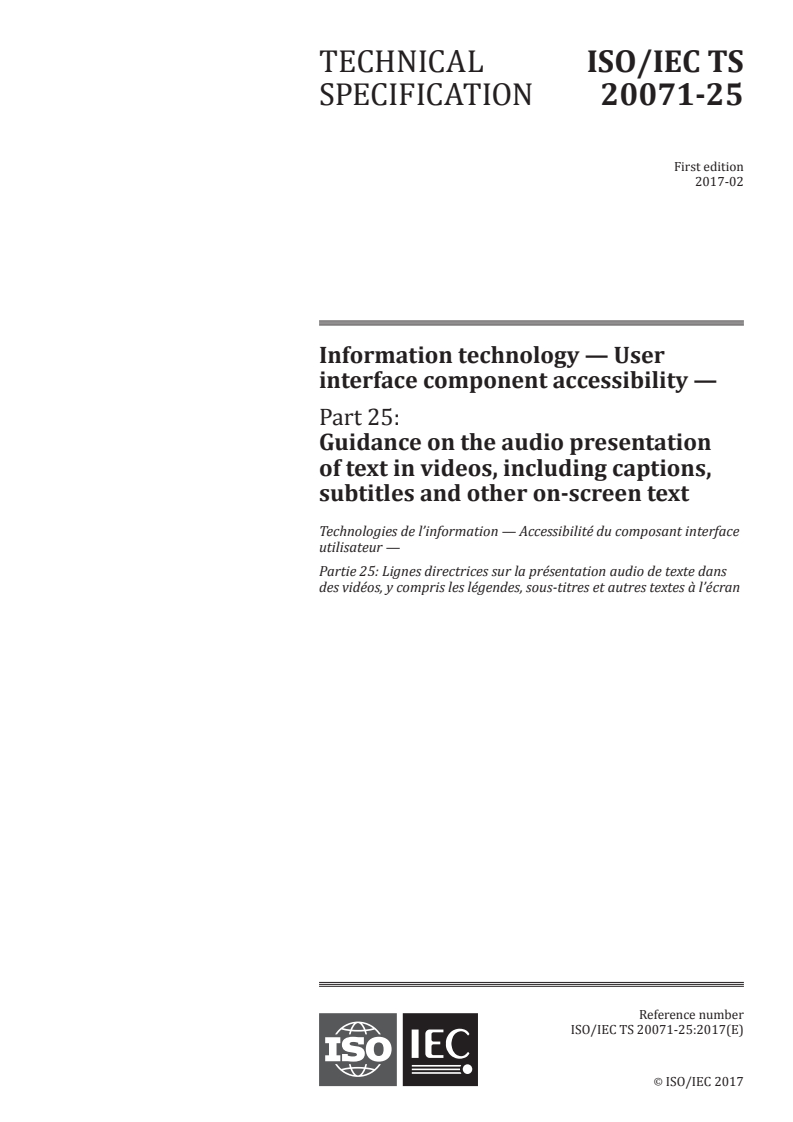
TECHNICAL ISO/IEC TS
SPECIFICATION 20071-25
First edition
2017-02
Information technology — User
interface component accessibility —
Part 25:
Guidance on the audio presentation
of text in videos, including captions,
subtitles and other on-screen text
Technologies de l’information — Accessibilité du composant interface
utilisateur —
Partie 25: Lignes directrices sur la présentation audio de texte dans
des vidéos, y compris les légendes, sous-titres et autres textes à l’écran
Reference number
©
ISO/IEC 2017
© ISO/IEC 2017, Published in Switzerland
All rights reserved. Unless otherwise specified, no part of this publication may be reproduced or utilized otherwise in any form
or by any means, electronic or mechanical, including photocopying, or posting on the internet or an intranet, without prior
written permission. Permission can be requested from either ISO at the address below or ISO’s member body in the country of
the requester.
ISO copyright office
Ch. de Blandonnet 8 • CP 401
CH-1214 Vernier, Geneva, Switzerland
Tel. +41 22 749 01 11
Fax +41 22 749 09 47
copyright@iso.org
www.iso.org
ii © ISO/IEC 2017 – All rights reserved
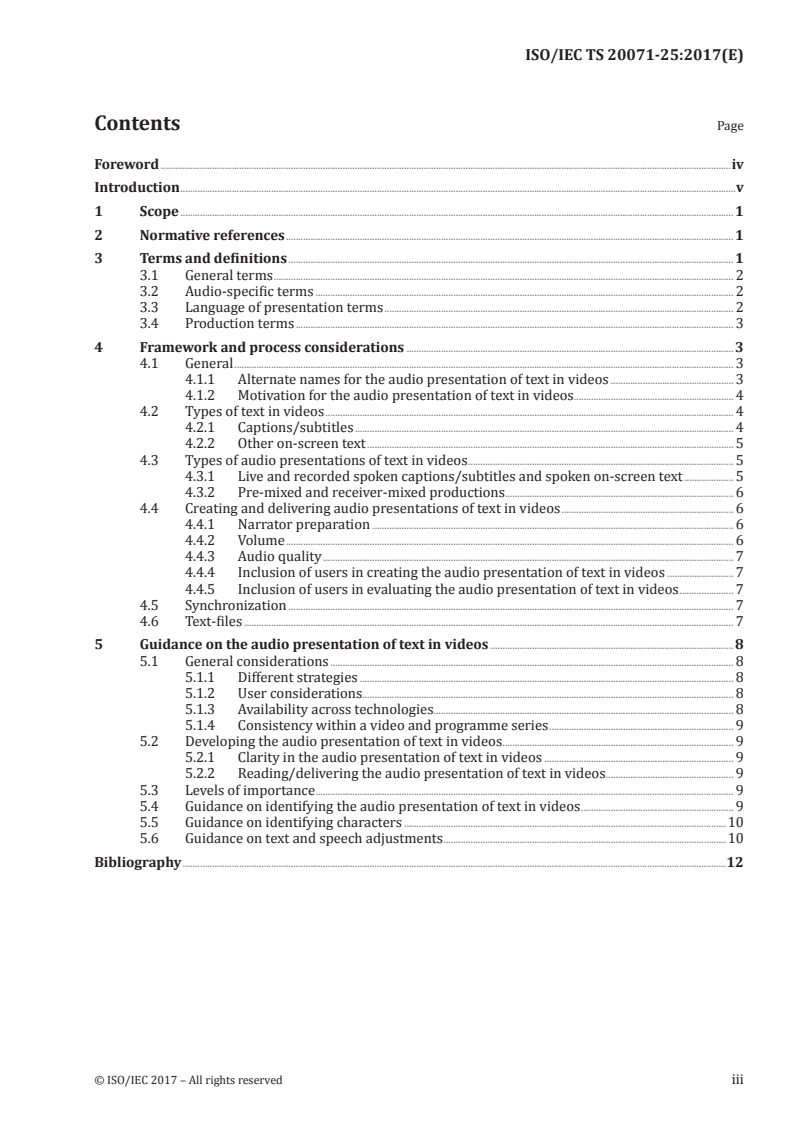
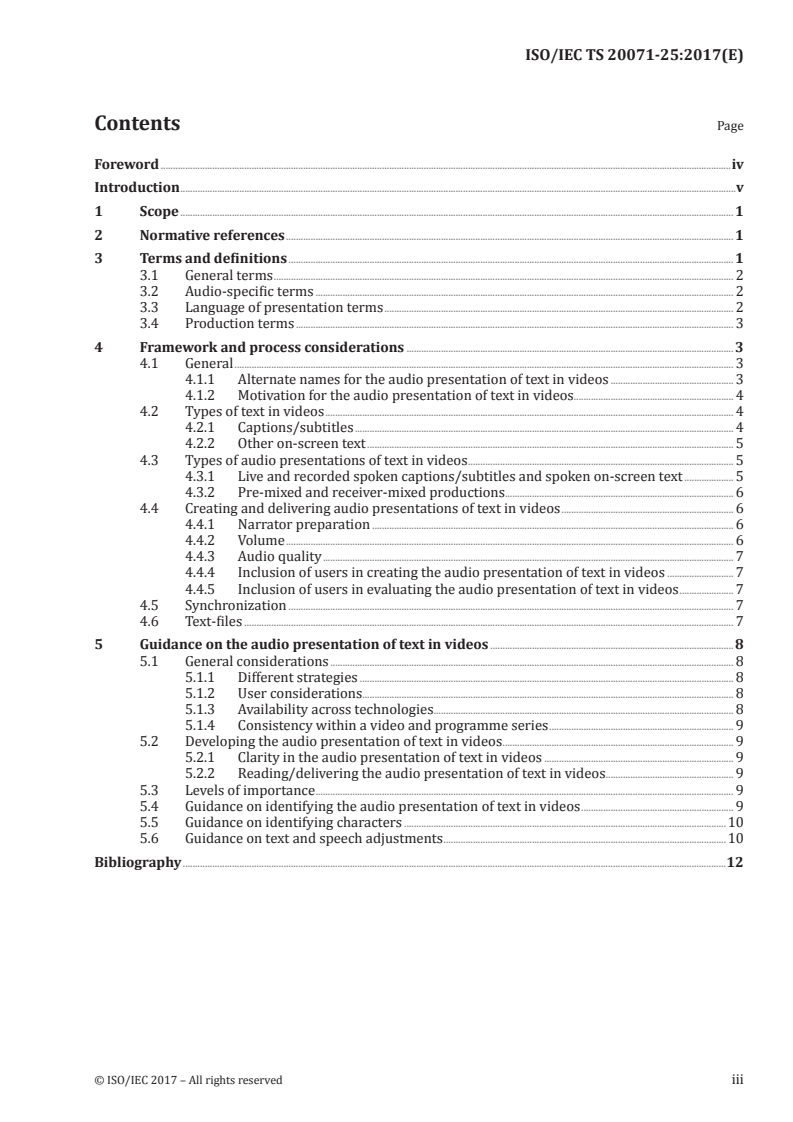
Contents Page
Foreword .iv
Introduction .v
1 Scope . 1
2 Normative references . 1
3 Terms and definitions . 1
3.1 General terms . 2
3.2 Audio-specific terms . 2
3.3 Language of presentation terms . 2
3.4 Production terms . 3
4 Framework and process considerations . 3
4.1 General . 3
4.1.1 Alternate names for the audio presentation of text in videos . 3
4.1.2 Motivation for the audio presentation of text in videos. 4
4.2 Types of text in videos . 4
4.2.1 Captions/subtitles . 4
4.2.2 Other on-screen text . 5
4.3 Types of audio presentations of text in videos . 5
4.3.1 Live and recorded spoken captions/subtitles and spoken on-screen text . 5
4.3.2 Pre-mixed and receiver-mixed productions. 6
4.4 Creating and delivering audio presentations of text in videos . 6
4.4.1 Narrator preparation . 6
4.4.2 Volume . 6
4.4.3 Audio quality . 7
4.4.4 Inclusion of users in creating the audio presentation of text in videos . 7
4.4.5 Inclusion of users in evaluating the audio presentation of text in videos . 7
4.5 Synchronization . 7
4.6 Text-files . 7
5 Guidance on the audio presentation of text in videos . 8
5.1 General considerations . 8
5.1.1 Different strategies . 8
5.1.2 User considerations. 8
5.1.3 Availability across technologies . 8
5.1.4 Consistency within a video and programme series . 9
5.2 Developing the audio presentation of text in videos . 9
5.2.1 Clarity in the audio presentation of text in videos . 9
5.2.2 Reading/delivering the audio presentation of text in videos . 9
5.3 Levels of importance . 9
5.4 Guidance on identifying the audio presentation of text in videos . 9
5.5 Guidance on identifying characters .10
5.6 Guidance on text and speech adjustments .10
Bibliography .12
© ISO/IEC 2017 – All rights reserved iii
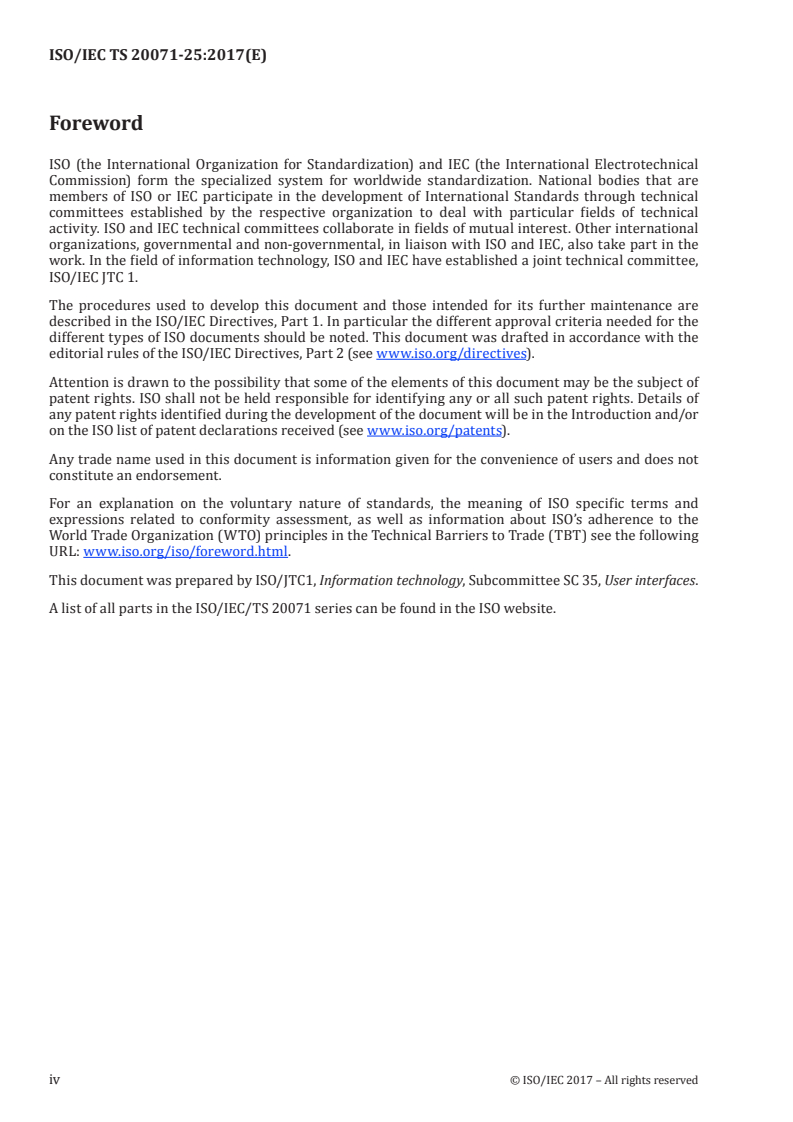
Foreword
ISO (the International Organization for Standardization) and IEC (the International Electrotechnical
Commission) form the specialized system for worldwide standardization. National bodies that are
members of ISO or IEC participate in the development of International Standards through technical
committees established by the respective organization to deal with particular fields of technical
activity. ISO and IEC technical committees collaborate in fields of mutual interest. Other international
organizations, governmental and non-governmental, in liaison with ISO and IEC, also take part in the
work. In the field of information technology, ISO and IEC have established a joint technical committee,
ISO/IEC JTC 1.
The procedures used to develop this document and those intended for its further maintenance are
described in the ISO/IEC Directives, Part 1. In particular the different approval criteria needed for the
different types of ISO documents should be noted. This document was drafted in accordance with the
editorial rules of the ISO/IEC Directives, Part 2 (see www .iso .org/ directives).
Attention is drawn to the possibility that some of the elements of this document may be the subject of
patent rights. ISO shall not be held responsible for identifying any or all such patent rights. Details of
any patent rights identified during the development of the document will be in the Introduction and/or
on the ISO list of patent declarations received (see www .iso .org/ patents).
Any trade name used in this document is information given for the convenience of users and does not
constitute an endorsement.
For an explanation on the voluntary nature of standards, the meaning of ISO specific terms and
expressions related to conformity assessment, as well as information about ISO’s adherence to the
World Trade Organization (WTO) principles in the Technical Barriers to Trade (TBT) see the following
URL: w w w . i s o .org/ iso/ foreword .html.
This document was prepared by ISO/JTC1, Information technology, Subcommittee SC 35, User interfaces.
A list of all parts in the ISO/IEC/TS 20071 series can be found in the ISO website.
iv © ISO/IEC 2017 – All rights reserved
Introduction
Videos are omnipresent in our digital society and are used to inform, educate and entertain audiences.
Videos often contain text, which cannot be easily accessed by a wide section of the audience. This text
includes captions/subtitles and other on-screen text that is part of the visual content.
Captions/subtitles provide text alternatives to audio elements. Other on-screen text may have various
functions. It can be part of the story, as a message written on a piece of paper by one of the characters. It
can also provide additional information, such as graphs, emergency alerts or superimposed titles.
Persons who, for different reasons, cannot access on-screen text will benefit from an audio presentation.
This oral rendering is often part of audio description (see ISO/IEC/TS 20071-21), an access service
providing a description of audiovisual content auditorily, including captions/subtitles and other on-
screen text if present. However, some users may only require captions/subtitles and other on-screen
text to be made accessible because they already have access to other visual content such as the images.
This document provides guidance for video producers, distributors and exhibitors on the audio
presentation of captions/subtitles and other on-screen text. It acknowledges the relationship with
existing access services such as audio description. While considering current implementations, as well
as future possibilities suggested by research, and bearing in mind possible trade-offs between quantity
and quality, this document positions itself for situations in which various access services coexist and
users are given the choice to select those best suited to their needs.
© ISO/IEC 2017 – All rights reserved v
TECHNICAL SPECIFICATION ISO/IEC TS 20071-25:2017(E)
Information technology — User interface component
accessibility —
Part 25:
Guidance on the audio presentation of text in videos,
including captions, subtitles and other on-screen text
1 Scope
This document provides recommendations on the audio presentation of captions/subtitles and other
on-screen text for use in all type of videos regardless of the language and technology being used to
transmit and present the recorded or live video.
This document applies to making captions/subtitles and other on-screen text accessible to users with
various needs, including but not limited to people with learning and reading disabilities, people with
cognitive disabilities, people who are blind or have low vision, older people, and non-native language
speakers. It does not apply to captions/subtitles or other on-screen text whose content is already
provided in the soundtrack in a language and a way users can access.
This document provides guidance on spoken captions/subtitles as a stand-alone access service but it
also provides guidance on how to integrate spoken captions/subtitles, other spoken on-screen text and
audio description, if needed, in different types of videos.
NOTE 1 Extensive guidance on audio description is provided in ISO/IEC/TS 20071-21.
This document does not consider the devices or transmission mechanisms used to deliver and play
the content or the audio presentation of text in videos. These devices include, but are not limited to
televisions, computers, wireless devices, projection equipment, DVD and home cinema equipment,
cinema equipment and other forms of user interfaces technology. Therefore, this document does not
consider transcoding files for the various video and audio outputs.
NOTE 2 Technical matters of transmission and distribution are covered by other documents (e.g. MPEG
standards and other technical standards such as IEC 62731:2013).
This document acknowledges the various needs and preferences of users, as well as the different
approaches to the audio presentation of text in videos.
It applies to audio presentations intended to be heard simultaneously along with the original video.
2 Normative references
There are no normative references in this document.
3 Terms and definitions
For the purposes of this document, the following terms and definitions apply.
ISO and IEC maintain terminological databases for use in standardization at the following addresses:
— IEC Electropedia: available at http:// www .electropedia .org/
— ISO Online browsing platform: available at http:// www .iso .org/ obp
© ISO/IEC 2017 – All rights reserved 1
3.1 General terms
3.1.1
video
combination of audio and visual content presented together in a synchronized manner via ICT
Note 1 to entry: While the visual content is often presented using a screen, it might also be presented via other
technologies, e.g. a projected hologram.
3.1.2
programme
complete unit of a recorded or live video
3.1.3
programme category
classification of programmes
Note 1 to entry: Programme categories are not necessarily mutually exclusive.
EXAMPLE Programme categories include documentary, news and information, and drama.
3.2 Audio-specific terms
3.2.1
spoken captions/subtitles
audio captions/subtitles
captions/subtitles that are voiced over the audiovisual content
Note 1 to entry: In this document, the term “spoken captions/subtitles” will be used.
3.2.2
spoken on-screen text
text, other than captions/subtitles, that is voiced over the audiovisual content
3.2.3
audio description
descriptive audio
audiovisual content described in an audio modality
Note 1 to entry: Audio description can also be used to describe locations, directions, and objects.
Note 2 to entry: Audio description can be used to describe sound not easily identified or coming from an unknown
source or location.
3.2.4
narrator
person(s) and/or technology which voices the alternative audio information
Note 1 to entry: Alternative audio information includes audio description and/or spoken captions/subtitles
and/or spoken on-screen text.
Note 2 to entry: In audio description, narrators are also referred to as describers or audio describers.
3.3 Language of presentation terms
3.3.1
original language
language in which audiovisual content is produced
2 © ISO/IEC 2017 – All rights reserved
3.3.2
dubbing
secondary audio version of a video produced in a language other than the original language of the video
and timed to match the voicing of the original actors
Note 1 to entry: The secondary audio version is lip-synchronized and replaces the original dialogue, which
cannot be heard.
3.3.3
voice-over
secondary audio version of a video produced in a language other than the original language of the video
which overlaps with the voicing of the original actors
Note 1 to entry: The secondary audio version is not lip-synchronized and does not replace the original dialogue,
which can still be heard.
3.3.4
captions/subtitles
transcription or translation of audio content visually presented together with the content
Note 1 to entry: Transcriptions or translations include speech and/or non-speech information.
Note 2 to entry: Transcriptions or translations are often suitable for use as an alternative or a complement to the
audio content.
3.4 Production terms
3.4.1
pre-mixed production
process that involves delivering alternative audio information together with the audio stream of the
video as one single audio track
Note 1 to entry: Although pre-mixed is used in the definition to refer to the audio mix, it can also refer to a
production process in which the original audio (including both the soundtrack and the dialogues), the alternative
audio information in the video and the original visual content are delivered together.
Note 2 to entry: Pre-mixed productions are also referred to as broadcast-mixed productions.
3.4.2
receiver-mixed production
process that involves delivering alternative audio information separately from the audio stream of the
video and having them mixed in a device controlled by the user
Note 1 to entry: Alternative audio information can be delivered to the user or be downloaded or streamed from
the Internet as separate services or as services mixed in different combinations.
4 Framework and process considerations
4.1 General
4.1.1 Alternate names for the audio presentation of text in videos
Terms used in this document vary according to country, language, region, video content and type of text
in videos.
They include audio subtitles, spoken subtitles, spoken captions, audio captions, to refer to the audio
presentation of captions/subtitles. For the purpose of this document, these terms are synonymous, as
defined in Clause 3.
© ISO/IEC 2017 – All rights reserved 3
They include audio text, to refer to the audio presentation of all text in videos.
NOTE In some jurisdictions, there are precise usages defined for one or more of these terms. Individuals can
consult their own country’s regulations for the locally appropriate terminology.
4.1.2 Motivation for the audio presentation of text in videos
Videos are everywhere in our society and they often contain text such as captions/subtitles and other
on-screen text.
This is particularly the case in countries or regions where captions/subtitles are used to translate
content into another language.
All these texts share two features: they are visual and at the same time they are verbal. Users who
might not be able to fully access the content include:
— users who cannot access the visual elements: persons with sensorial disabilities such as blind and
visually impaired audiences, and also persons who for other reasons (for instance, not being in front
of the video display) cannot see the visuals; and
— users with difficulties to access the written verbal content.
NOTE 1 Reading is a complex cognitive process and, very often, the coexistence of visual stimuli and the speed
at which written text is presented makes it difficult for certain users to access writte
...
TECHNICAL ISO/IEC TS
SPECIFICATION 20071-25
First edition
2017-02
Information technology — User
interface component accessibility —
Part 25:
Guidance on the audio presentation
of text in videos, including captions,
subtitles and other on-screen text
Technologies de l’information — Accessibilité du composant interface
utilisateur —
Partie 25: Lignes directrices sur la présentation audio de texte dans
des vidéos, y compris les légendes, sous-titres et autres textes à l’écran
Reference number
©
ISO/IEC 2017
© ISO/IEC 2017, Published in Switzerland
All rights reserved. Unless otherwise specified, no part of this publication may be reproduced or utilized otherwise in any form
or by any means, electronic or mechanical, including photocopying, or posting on the internet or an intranet, without prior
written permission. Permission can be requested from either ISO at the address below or ISO’s member body in the country of
the requester.
ISO copyright office
Ch. de Blandonnet 8 • CP 401
CH-1214 Vernier, Geneva, Switzerland
Tel. +41 22 749 01 11
Fax +41 22 749 09 47
copyright@iso.org
www.iso.org
ii © ISO/IEC 2017 – All rights reserved
Contents Page
Foreword .iv
Introduction .v
1 Scope . 1
2 Normative references . 1
3 Terms and definitions . 1
3.1 General terms . 2
3.2 Audio-specific terms . 2
3.3 Language of presentation terms . 2
3.4 Production terms . 3
4 Framework and process considerations . 3
4.1 General . 3
4.1.1 Alternate names for the audio presentation of text in videos . 3
4.1.2 Motivation for the audio presentation of text in videos. 4
4.2 Types of text in videos . 4
4.2.1 Captions/subtitles . 4
4.2.2 Other on-screen text . 5
4.3 Types of audio presentations of text in videos . 5
4.3.1 Live and recorded spoken captions/subtitles and spoken on-screen text . 5
4.3.2 Pre-mixed and receiver-mixed productions. 6
4.4 Creating and delivering audio presentations of text in videos . 6
4.4.1 Narrator preparation . 6
4.4.2 Volume . 6
4.4.3 Audio quality . 7
4.4.4 Inclusion of users in creating the audio presentation of text in videos . 7
4.4.5 Inclusion of users in evaluating the audio presentation of text in videos . 7
4.5 Synchronization . 7
4.6 Text-files . 7
5 Guidance on the audio presentation of text in videos . 8
5.1 General considerations . 8
5.1.1 Different strategies . 8
5.1.2 User considerations. 8
5.1.3 Availability across technologies . 8
5.1.4 Consistency within a video and programme series . 9
5.2 Developing the audio presentation of text in videos . 9
5.2.1 Clarity in the audio presentation of text in videos . 9
5.2.2 Reading/delivering the audio presentation of text in videos . 9
5.3 Levels of importance . 9
5.4 Guidance on identifying the audio presentation of text in videos . 9
5.5 Guidance on identifying characters .10
5.6 Guidance on text and speech adjustments .10
Bibliography .12
© ISO/IEC 2017 – All rights reserved iii
Foreword
ISO (the International Organization for Standardization) and IEC (the International Electrotechnical
Commission) form the specialized system for worldwide standardization. National bodies that are
members of ISO or IEC participate in the development of International Standards through technical
committees established by the respective organization to deal with particular fields of technical
activity. ISO and IEC technical committees collaborate in fields of mutual interest. Other international
organizations, governmental and non-governmental, in liaison with ISO and IEC, also take part in the
work. In the field of information technology, ISO and IEC have established a joint technical committee,
ISO/IEC JTC 1.
The procedures used to develop this document and those intended for its further maintenance are
described in the ISO/IEC Directives, Part 1. In particular the different approval criteria needed for the
different types of ISO documents should be noted. This document was drafted in accordance with the
editorial rules of the ISO/IEC Directives, Part 2 (see www .iso .org/ directives).
Attention is drawn to the possibility that some of the elements of this document may be the subject of
patent rights. ISO shall not be held responsible for identifying any or all such patent rights. Details of
any patent rights identified during the development of the document will be in the Introduction and/or
on the ISO list of patent declarations received (see www .iso .org/ patents).
Any trade name used in this document is information given for the convenience of users and does not
constitute an endorsement.
For an explanation on the voluntary nature of standards, the meaning of ISO specific terms and
expressions related to conformity assessment, as well as information about ISO’s adherence to the
World Trade Organization (WTO) principles in the Technical Barriers to Trade (TBT) see the following
URL: w w w . i s o .org/ iso/ foreword .html.
This document was prepared by ISO/JTC1, Information technology, Subcommittee SC 35, User interfaces.
A list of all parts in the ISO/IEC/TS 20071 series can be found in the ISO website.
iv © ISO/IEC 2017 – All rights reserved
Introduction
Videos are omnipresent in our digital society and are used to inform, educate and entertain audiences.
Videos often contain text, which cannot be easily accessed by a wide section of the audience. This text
includes captions/subtitles and other on-screen text that is part of the visual content.
Captions/subtitles provide text alternatives to audio elements. Other on-screen text may have various
functions. It can be part of the story, as a message written on a piece of paper by one of the characters. It
can also provide additional information, such as graphs, emergency alerts or superimposed titles.
Persons who, for different reasons, cannot access on-screen text will benefit from an audio presentation.
This oral rendering is often part of audio description (see ISO/IEC/TS 20071-21), an access service
providing a description of audiovisual content auditorily, including captions/subtitles and other on-
screen text if present. However, some users may only require captions/subtitles and other on-screen
text to be made accessible because they already have access to other visual content such as the images.
This document provides guidance for video producers, distributors and exhibitors on the audio
presentation of captions/subtitles and other on-screen text. It acknowledges the relationship with
existing access services such as audio description. While considering current implementations, as well
as future possibilities suggested by research, and bearing in mind possible trade-offs between quantity
and quality, this document positions itself for situations in which various access services coexist and
users are given the choice to select those best suited to their needs.
© ISO/IEC 2017 – All rights reserved v
TECHNICAL SPECIFICATION ISO/IEC TS 20071-25:2017(E)
Information technology — User interface component
accessibility —
Part 25:
Guidance on the audio presentation of text in videos,
including captions, subtitles and other on-screen text
1 Scope
This document provides recommendations on the audio presentation of captions/subtitles and other
on-screen text for use in all type of videos regardless of the language and technology being used to
transmit and present the recorded or live video.
This document applies to making captions/subtitles and other on-screen text accessible to users with
various needs, including but not limited to people with learning and reading disabilities, people with
cognitive disabilities, people who are blind or have low vision, older people, and non-native language
speakers. It does not apply to captions/subtitles or other on-screen text whose content is already
provided in the soundtrack in a language and a way users can access.
This document provides guidance on spoken captions/subtitles as a stand-alone access service but it
also provides guidance on how to integrate spoken captions/subtitles, other spoken on-screen text and
audio description, if needed, in different types of videos.
NOTE 1 Extensive guidance on audio description is provided in ISO/IEC/TS 20071-21.
This document does not consider the devices or transmission mechanisms used to deliver and play
the content or the audio presentation of text in videos. These devices include, but are not limited to
televisions, computers, wireless devices, projection equipment, DVD and home cinema equipment,
cinema equipment and other forms of user interfaces technology. Therefore, this document does not
consider transcoding files for the various video and audio outputs.
NOTE 2 Technical matters of transmission and distribution are covered by other documents (e.g. MPEG
standards and other technical standards such as IEC 62731:2013).
This document acknowledges the various needs and preferences of users, as well as the different
approaches to the audio presentation of text in videos.
It applies to audio presentations intended to be heard simultaneously along with the original video.
2 Normative references
There are no normative references in this document.
3 Terms and definitions
For the purposes of this document, the following terms and definitions apply.
ISO and IEC maintain terminological databases for use in standardization at the following addresses:
— IEC Electropedia: available at http:// www .electropedia .org/
— ISO Online browsing platform: available at http:// www .iso .org/ obp
© ISO/IEC 2017 – All rights reserved 1
3.1 General terms
3.1.1
video
combination of audio and visual content presented together in a synchronized manner via ICT
Note 1 to entry: While the visual content is often presented using a screen, it might also be presented via other
technologies, e.g. a projected hologram.
3.1.2
programme
complete unit of a recorded or live video
3.1.3
programme category
classification of programmes
Note 1 to entry: Programme categories are not necessarily mutually exclusive.
EXAMPLE Programme categories include documentary, news and information, and drama.
3.2 Audio-specific terms
3.2.1
spoken captions/subtitles
audio captions/subtitles
captions/subtitles that are voiced over the audiovisual content
Note 1 to entry: In this document, the term “spoken captions/subtitles” will be used.
3.2.2
spoken on-screen text
text, other than captions/subtitles, that is voiced over the audiovisual content
3.2.3
audio description
descriptive audio
audiovisual content described in an audio modality
Note 1 to entry: Audio description can also be used to describe locations, directions, and objects.
Note 2 to entry: Audio description can be used to describe sound not easily identified or coming from an unknown
source or location.
3.2.4
narrator
person(s) and/or technology which voices the alternative audio information
Note 1 to entry: Alternative audio information includes audio description and/or spoken captions/subtitles
and/or spoken on-screen text.
Note 2 to entry: In audio description, narrators are also referred to as describers or audio describers.
3.3 Language of presentation terms
3.3.1
original language
language in which audiovisual content is produced
2 © ISO/IEC 2017 – All rights reserved
3.3.2
dubbing
secondary audio version of a video produced in a language other than the original language of the video
and timed to match the voicing of the original actors
Note 1 to entry: The secondary audio version is lip-synchronized and replaces the original dialogue, which
cannot be heard.
3.3.3
voice-over
secondary audio version of a video produced in a language other than the original language of the video
which overlaps with the voicing of the original actors
Note 1 to entry: The secondary audio version is not lip-synchronized and does not replace the original dialogue,
which can still be heard.
3.3.4
captions/subtitles
transcription or translation of audio content visually presented together with the content
Note 1 to entry: Transcriptions or translations include speech and/or non-speech information.
Note 2 to entry: Transcriptions or translations are often suitable for use as an alternative or a complement to the
audio content.
3.4 Production terms
3.4.1
pre-mixed production
process that involves delivering alternative audio information together with the audio stream of the
video as one single audio track
Note 1 to entry: Although pre-mixed is used in the definition to refer to the audio mix, it can also refer to a
production process in which the original audio (including both the soundtrack and the dialogues), the alternative
audio information in the video and the original visual content are delivered together.
Note 2 to entry: Pre-mixed productions are also referred to as broadcast-mixed productions.
3.4.2
receiver-mixed production
process that involves delivering alternative audio information separately from the audio stream of the
video and having them mixed in a device controlled by the user
Note 1 to entry: Alternative audio information can be delivered to the user or be downloaded or streamed from
the Internet as separate services or as services mixed in different combinations.
4 Framework and process considerations
4.1 General
4.1.1 Alternate names for the audio presentation of text in videos
Terms used in this document vary according to country, language, region, video content and type of text
in videos.
They include audio subtitles, spoken subtitles, spoken captions, audio captions, to refer to the audio
presentation of captions/subtitles. For the purpose of this document, these terms are synonymous, as
defined in Clause 3.
© ISO/IEC 2017 – All rights reserved 3
They include audio text, to refer to the audio presentation of all text in videos.
NOTE In some jurisdictions, there are precise usages defined for one or more of these terms. Individuals can
consult their own country’s regulations for the locally appropriate terminology.
4.1.2 Motivation for the audio presentation of text in videos
Videos are everywhere in our society and they often contain text such as captions/subtitles and other
on-screen text.
This is particularly the case in countries or regions where captions/subtitles are used to translate
content into another language.
All these texts share two features: they are visual and at the same time they are verbal. Users who
might not be able to fully access the content include:
— users who cannot access the visual elements: persons with sensorial disabilities such as blind and
visually impaired audiences, and also persons who for other reasons (for instance, not being in front
of the video display) cannot see the visuals; and
— users with difficulties to access the written verbal content.
NOTE 1 Reading is a complex cognitive process and, very often, the coexistence of visual stimuli and the speed
at which written text is presented makes it difficult for certain users to access writte
...