


ISO/FDIS 24825
(Main)Traditional Chinese medicine — General principles for the establishment of herbal reference substances
Traditional Chinese medicine — General principles for the establishment of herbal reference substances
This document specifies the general principles for the establishment of herbal reference substances, covering the technical requirements of terms and definitions, production, quality control, report, instruction and labelling, packaging, storage and transportation. This document applies to herbal reference substances that is sold and used as reference standards for the quality control of herbal medicines in international trade, including raw materials and finished products.
Médecine traditionnelle chinoise — Principes généraux pour l'établissement de substances de référence à base de plantes médicinales
General Information
- Status
- Not Published
- Technical Committee
- ISO/TC 249 - Traditional Chinese medicine
- Drafting Committee
- ISO/TC 249/WG 2 - Quality and safety of manufactured TCM products
- Current Stage
- 5020 - FDIS ballot initiated: 2 months. Proof sent to secretariat
- Start Date
- 17-Dec-2025
- Completion Date
- 17-Dec-2025
Overview
ISO/FDIS 24825:2025 sets forth general principles for establishing herbal reference substances used in Traditional Chinese Medicine (TCM). This international standard covers the essential technical requirements for the production, quality control, labelling, packaging, storage, and transportation of these reference materials. It is applicable to herbal reference substances utilized as quality control benchmarks in the global trade of herbal medicines, including both raw materials and finished products.
The standard aligns with requirements from major pharmacopoeias such as the Chinese Pharmacopoeia (ChP), European Pharmacopoeia (EP), Japanese Pharmacopoeia (JP), Korean Pharmacopoeia (KP), and United States Pharmacopoeia (USP). It integrates guidance from relevant ISO guides and standards to promote harmonization and ensure the reliability, safety, and consistency of herbal medicinal products in international markets.
Key Topics
Definition and Classification
The document defines three main categories of herbal reference substances:- Herbal Reference Material: Powdered herbal medicine with certified origin and identification
- Herbal Reference Extract: Extract containing main active and representative ingredients prepared by standardized processes
- Herbal Chemical Reference Substance: Purified single chemical components extracted from herbal medicines
Raw Material Requirements
Specifies sourcing criteria including correct species/subspecies, plant parts, botanical and DNA identification. It also requires documentation of collection details such as harvest time, cultivation status, and geographic origin.Preparation and Homogenization
Details production methods tailored to the characteristics of each herbal material, including pre-treatment and homogenization techniques (e.g., crushing, mixing, sieving for materials; dissolution, lyophilization for extracts). Homogeneity testing following ISO Guide 35 ensures batch consistency.Testing and Identification
Establishes testing protocols based on material type, focused on physicochemical, macroscopic, microscopic, and biological identifiers. Assay or purity determinations are required primarily for chemical reference substances and extracts used for quantitative purposes.Stability Assessment
Emphasizes conducting long-term and accelerated stability studies with attention to packaging and storage conditions, guaranteeing the integrity of reference substances over time.Reporting, Labelling, and Packaging
Includes guidelines for documenting test results and quality control reports, providing clear instructions and labels, and ensuring secure packaging to maintain quality during transportation.
Applications
ISO/FDIS 24825:2025 is essential for manufacturers, quality control laboratories, regulatory agencies, and trade organizations involved in the production and international commerce of herbal medicinal products (HMPs). Its adoption facilitates:
- Standardized quality evaluation and dispute resolution related to HMPs
- Enhanced traceability and safety of herbal raw materials and finished products
- Harmonization of quality control criteria across different countries and regions
- Increased confidence among consumers and regulatory authorities regarding TCM products
- Support for research, innovation, and continuous improvement in herbal medicine quality standards
This standard is particularly valuable for enterprises establishing robust supply chain management systems to comply with international trade regulations and pharmacopoeial requirements.
Related Standards
ISO/FDIS 24825:2025 references and complements the following key standards and guides to provide a comprehensive framework for herbal reference substances:
- ISO 17034: General requirements for the competence of reference material producers
- ISO Guide 30: Terms and definitions related to reference materials
- ISO Guide 31: Reference materials – Contents of certificates and labels
- ISO Guide 33: Uses of certified reference materials
- ISO Guide 35: Characterization and assessment of homogeneity and stability of reference materials
- ISO/IEC 17025: General requirements for the competence of testing and calibration laboratories
- ISO 3864-2: Safety labels and graphical symbols design principles
By integrating these standards, ISO/FDIS 24825:2025 ensures a harmonized and reliable approach to the establishment and application of herbal reference substances in Traditional Chinese Medicine globally.

ISO/FDIS 24825 - Traditional Chinese medicine — General principles for the establishment of herbal reference substances Released:12/3/2025
REDLINE ISO/FDIS 24825 - Traditional Chinese medicine — General principles for the establishment of herbal reference substances Released:12/3/2025
Frequently Asked Questions
ISO/FDIS 24825 is a draft published by the International Organization for Standardization (ISO). Its full title is "Traditional Chinese medicine — General principles for the establishment of herbal reference substances". This standard covers: This document specifies the general principles for the establishment of herbal reference substances, covering the technical requirements of terms and definitions, production, quality control, report, instruction and labelling, packaging, storage and transportation. This document applies to herbal reference substances that is sold and used as reference standards for the quality control of herbal medicines in international trade, including raw materials and finished products.
This document specifies the general principles for the establishment of herbal reference substances, covering the technical requirements of terms and definitions, production, quality control, report, instruction and labelling, packaging, storage and transportation. This document applies to herbal reference substances that is sold and used as reference standards for the quality control of herbal medicines in international trade, including raw materials and finished products.
ISO/FDIS 24825 is classified under the following ICS (International Classification for Standards) categories: 11.120.10 - Medicaments. The ICS classification helps identify the subject area and facilitates finding related standards.
ISO/FDIS 24825 is available in PDF format for immediate download after purchase. The document can be added to your cart and obtained through the secure checkout process. Digital delivery ensures instant access to the complete standard document.
Standards Content (Sample)
FINAL DRAFT
International
Standard
ISO/TC 249/SC 1
Traditional Chinese medicine —
Secretariat: SAC
General principles for the
Voting begins on:
establishment of herbal reference
2025-12-17
substances
Voting terminates on:
2026-02-11
RECIPIENTS OF THIS DRAFT ARE INVITED TO SUBMIT,
WITH THEIR COMMENTS, NOTIFICATION OF ANY
RELEVANT PATENT RIGHTS OF WHICH THEY ARE AWARE
AND TO PROVIDE SUPPOR TING DOCUMENTATION.
IN ADDITION TO THEIR EVALUATION AS
BEING ACCEPTABLE FOR INDUSTRIAL, TECHNO
LOGICAL, COMMERCIAL AND USER PURPOSES, DRAFT
INTERNATIONAL STANDARDS MAY ON OCCASION HAVE
TO BE CONSIDERED IN THE LIGHT OF THEIR POTENTIAL
TO BECOME STAN DARDS TO WHICH REFERENCE MAY BE
MADE IN NATIONAL REGULATIONS.
Reference number
FINAL DRAFT
International
Standard
ISO/TC 249/SC 1
Traditional Chinese medicine —
Secretariat: SAC
General principles for the
Voting begins on:
establishment of herbal reference
substances
Voting terminates on:
RECIPIENTS OF THIS DRAFT ARE INVITED TO SUBMIT,
WITH THEIR COMMENTS, NOTIFICATION OF ANY
RELEVANT PATENT RIGHTS OF WHICH THEY ARE AWARE
AND TO PROVIDE SUPPOR TING DOCUMENTATION.
© ISO 2025
IN ADDITION TO THEIR EVALUATION AS
All rights reserved. Unless otherwise specified, or required in the context of its implementation, no part of this publication may
BEING ACCEPTABLE FOR INDUSTRIAL, TECHNO
LOGICAL, COMMERCIAL AND USER PURPOSES, DRAFT
be reproduced or utilized otherwise in any form or by any means, electronic or mechanical, including photocopying, or posting on
INTERNATIONAL STANDARDS MAY ON OCCASION HAVE
the internet or an intranet, without prior written permission. Permission can be requested from either ISO at the address below
TO BE CONSIDERED IN THE LIGHT OF THEIR POTENTIAL
or ISO’s member body in the country of the requester.
TO BECOME STAN DARDS TO WHICH REFERENCE MAY BE
MADE IN NATIONAL REGULATIONS.
ISO copyright office
CP 401 • Ch. de Blandonnet 8
CH-1214 Vernier, Geneva
Phone: +41 22 749 01 11
Email: copyright@iso.org
Website: www.iso.org
Published in Switzerland Reference number
ii
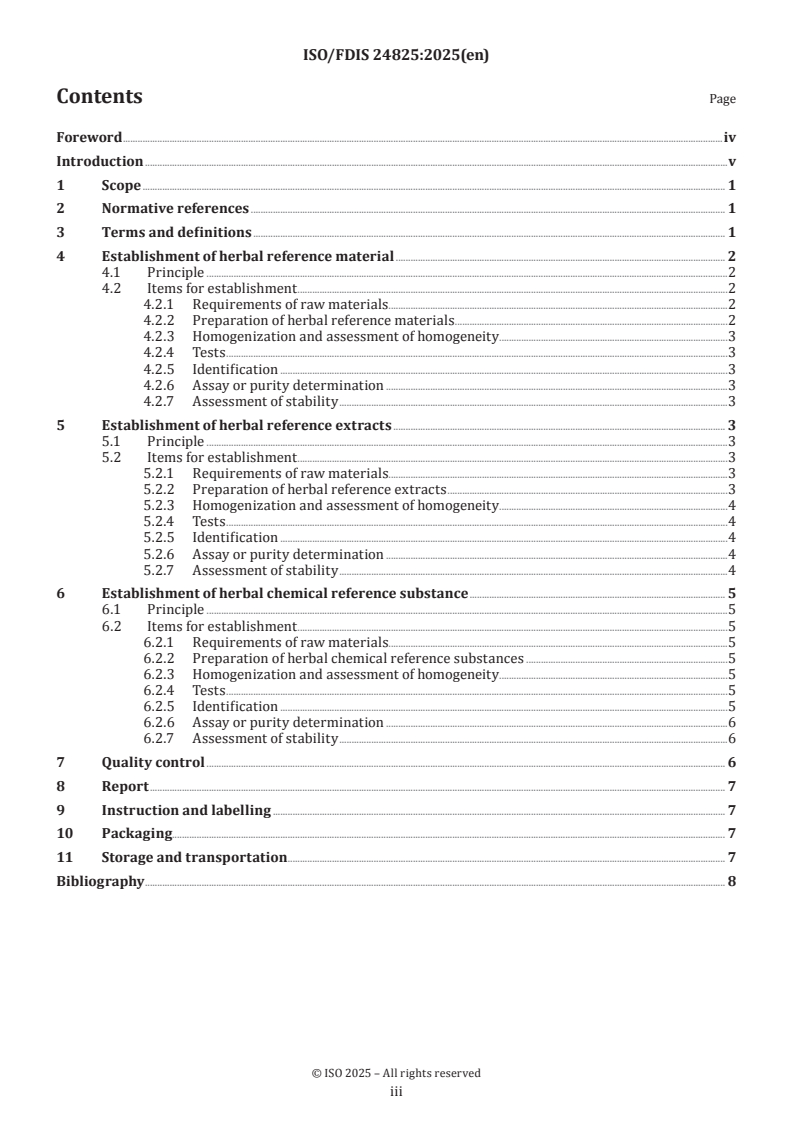
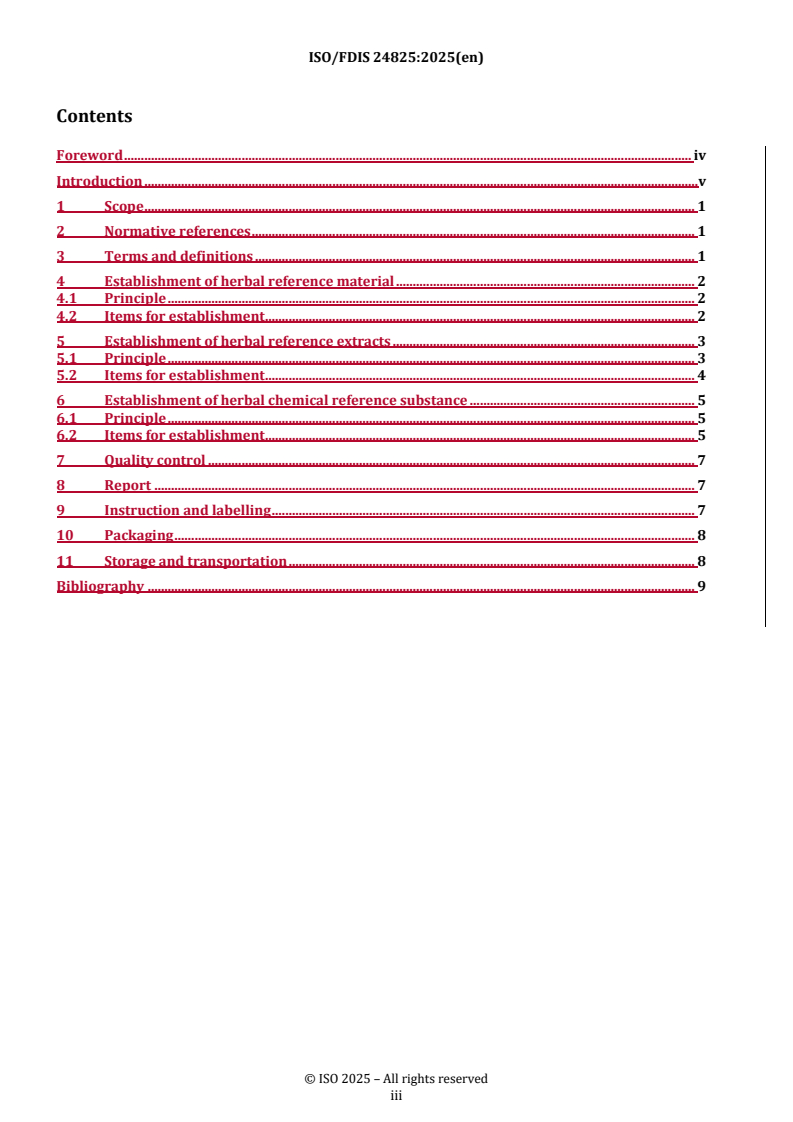
Contents Page
Foreword .iv
Introduction .v
1 Scope . 1
2 Normative references . 1
3 Terms and definitions . 1
4 Establishment of herbal reference material . 2
4.1 Principle .2
4.2 Items for establishment .2
4.2.1 Requirements of raw materials.2
4.2.2 Preparation of herbal reference materials .2
4.2.3 Homogenization and assessment of homogeneity.3
4.2.4 Tests .3
4.2.5 Identification .3
4.2.6 Assay or purity determination .3
4.2.7 Assessment of stability .3
5 Establishment of herbal reference extracts . 3
5.1 Principle .3
5.2 Items for establishment .3
5.2.1 Requirements of raw materials.3
5.2.2 Preparation of herbal reference extracts .3
5.2.3 Homogenization and assessment of homogeneity.4
5.2.4 Tests .4
5.2.5 Identification .4
5.2.6 Assay or purity determination .4
5.2.7 Assessment of stability .4
6 Establishment of herbal chemical reference substance . 5
6.1 Principle .5
6.2 Items for establishment .5
6.2.1 Requirements of raw materials.5
6.2.2 Preparation of herbal chemical reference substances .5
6.2.3 Homogenization and assessment of homogeneity.5
6.2.4 Tests .5
6.2.5 Identification .5
6.2.6 Assay or purity determination .6
6.2.7 Assessment of stability .6
7 Quality control . 6
8 Report . 7
9 Instruction and labelling . 7
10 Packaging. 7
11 Storage and transportation . 7
Bibliography . 8
iii
Foreword
ISO (the International Organization for Standardization) is a worldwide federation of national standards
bodies (ISO member bodies). The work of preparing International Standards is normally carried out through
ISO technical committees. Each member body interested in a subject for which a technical committee
has been established has the right to be represented on that committee. International organizations,
governmental and non-governmental, in liaison with ISO, also take part in the work. ISO collaborates closely
with the International Electrotechnical Commission (IEC) on all matters of electrotechnical standardization.
The procedures used to develop this document and those intended for its further maintenance are described
in the ISO/IEC Directives, Part 1. In particular, the different approval criteria needed for the different types
of ISO document should be noted. This document was drafted in accordance with the editorial rules of the
ISO/IEC Directives, Part 2 (see www.iso.org/directives).
ISO draws attention to the possibility that the implementation of this document may involve the use of (a)
patent(s). ISO takes no position concerning the evidence, validity or applicability of any claimed patent
rights in respect thereof. As of the date of publication of this document, ISO had not received notice of (a)
patent(s) which may be required to implement this document. However, implementers are cautioned that
this may not represent the latest information, which may be obtained from the patent database available at
www.iso.org/patents. ISO shall not be held responsible for identifying any or all such patent rights.
Any trade name used in this document is information given for the convenience of users and does not
constitute an endorsement.
For an explanation of the voluntary nature of standards, the meaning of ISO specific terms and expressions
related to conformity assessment, as well as information about ISO's adherence to the World Trade
Organization (WTO) principles in the Technical Barriers to Trade (TBT), see www.iso.org/iso/foreword.html.
This document was prepared by Technical Committee ISO/TC 249, Traditional medicine, SC1 Traditional
Chinese medicine.
Any feedback or questions on this document should be directed to the user’s national standards body. A
complete listing of these bodies can be found at www.iso.org/members.html.
iv
Introduction
The herbal reference substance serves as a benchmark for resolving disputes related to the quality of
herbal medicinal products (HMPs). This document outlines the principles for establishing herbal reference
substances, considering the requirements of Chinese, European, Japanese, Korean and United States
pharmacopoeia. Additionally, this document incorporates insights from ISO 17034, ISO Guide 30, ISO 33401,
ISO 33403 and ISO 33405.
This document seeks to promote confidence among manufacturers, regulators and consumers by providing
a common basis for evaluating and verifying the quality of HMPs. It ensures that the herbal reference
substances used in quality inspections and dispute resolutions meet recognized standards, enhancing
fairness and reliability. This document intends to ensure consistent quality and safe usage of HMPs. The aim
of this document is to help enterprises establish comprehensive production and supply chain management
systems, enhancing product safety and traceability. Moreover, this document seeks to play a significant role
in harmonizing the different requirements to overcome the barriers to international trade, fostering the
sustainable growth and positive reputation of the global HMPs market.
This document provides comprehensive guidance for herbal reference substances and encourages ongoing
research, innovation and collaboration among stakeholders to iteratively refine the quality control and
evaluation of herbal medicines.
v
FINAL DRAFT International Standard ISO/FDIS 24825:2025(en)
Traditional Chinese medicine — General principles for the
establishment of herbal reference substances
1 Scope
This document specifies the general principles for the establishment of herbal reference substances, covering
production, quality control, report, instruction and labelling, packaging, storage and transportation.
This document applies to herbal reference substances that are sold and used as reference standards for the
quality control of herbal medicines in international trade, including raw materials and finished products.
2 Normative references
The following documents are referred to in the text in such a way that some or all of their content constitutes
requirements of this document. For dated references, only the edition cited applies. For undated references,
the latest edition of the referenced document (including any amendments) applies.
ISO 3864-2, Graphical symbols — Safety colours and safety signs — Part 2: Design principles for product safety
labels
ISO 17034, General requirements for the competence of reference material producers
ISO 33405, Reference materials — Approaches for characterization and assessment of homogeneity and stability
ISO/IEC 17025, General requirements for the competence of testing and calibration laboratories
3 Terms and definitions
For the purposes of this document, the following terms and definitions apply.
ISO and IEC maintain terminology databases for use in standardization at the following addresses:
— ISO Online browsing platform: available at https:// www .iso .org/ obp
— IEC Electropedia: available at https:// www .electropedia .org/
3.1
herbal reference substance
substance that is derived from herbal medicinal plants and used as a reference standard in the
physicochemical tests for the identification and qualification of raw materials and finished products of
herbal medicines
Note 1 to entry: The physicochemical properties of an herbal reference substance are well established. The herbal
reference substance is divided into three types: herbal reference material, herbal reference extract and herbal
chemical reference substance.
3.2
herbal reference material
certified and homogeneous substance containing powdered herbal medicine with clear origin and
identification
3.3
herbal reference extract
certified and homogeneous substance containing a mixture of
...
ISO/TC 249/SC 1
Secretariat: SAC
Date: 2025-12-03
Traditional Chinese medicine — General principles for the
establishment of herbal reference substances
FDIS stage
All rights reserved. Unless otherwise specified, or required in the context of its implementation, no part of this publication
may be reproduced or utilized otherwise in any form or by any means, electronic or mechanical, including photocopying,
or posting on the internet or an intranet, without prior written permission. Permission can be requested from either ISO
at the address below or ISO’s member body in the country of the requester.
ISO copyright office
CP 401 • Ch. de Blandonnet 8
CH-1214 Vernier, Geneva
Phone: + 41 22 749 01 11
E-mail: copyright@iso.org
Website: www.iso.org
Published in Switzerland
ii
Contents
Foreword . iv
Introduction . v
1 Scope . 1
2 Normative references . 1
3 Terms and definitions . 1
4 Establishment of herbal reference material . 2
4.1 Principle . 2
4.2 Items for establishment . 2
5 Establishment of herbal reference extracts . 3
5.1 Principle . 3
5.2 Items for establishment . 4
6 Establishment of herbal chemical reference substance . 5
6.1 Principle . 5
6.2 Items for establishment . 5
7 Quality control . 7
8 Report . 7
9 Instruction and labelling . 7
10 Packaging . 8
11 Storage and transportation . 8
Bibliography . 9
iii
Foreword
ISO (the International Organization for Standardization) is a worldwide federation of national standards
bodies (ISO member bodies). The work of preparing International Standards is normally carried out through
ISO technical committees. Each member body interested in a subject for which a technical committee has been
established has the right to be represented on that committee. International organizations, governmental and
non-governmental, in liaison with ISO, also take part in the work. ISO collaborates closely with the
International Electrotechnical Commission (IEC) on all matters of electrotechnical standardization.
The procedures used to develop this document and those intended for its further maintenance are described
in the ISO/IEC Directives, Part 1. In particular, the different approval criteria needed for the different types of
ISO document should be noted. This document was drafted in accordance with the editorial rules of the
ISO/IEC Directives, Part 2 (see www.iso.org/directives).
ISO draws attention to the possibility that the implementation of this document may involve the use of (a)
patent(s). ISO takes no position concerning the evidence, validity or applicability of any claimed patent rights
in respect thereof. As of the date of publication of this document, ISO had not received notice of (a) patent(s)
which may be required to implement this document. However, implementers are cautioned that this may not
represent the latest information, which may be obtained from the patent database available at
www.iso.org/patents. ISO shall not be held responsible for identifying any or all such patent rights.
Any trade name used in this document is information given for the convenience of users and does not
constitute an endorsement.
For an explanation of the voluntary nature of standards, the meaning of ISO specific terms and expressions
related to conformity assessment, as well as information about ISO's adherence to the World Trade
Organization (WTO) principles in the Technical Barriers to Trade (TBT), see www.iso.org/iso/foreword.html.
This document was prepared by Technical Committee ISO/TC 249, Traditional medicine, SC1 Traditional
Chinese medicine.
Any feedback or questions on this document should be directed to the user’s national standards body. A
complete listing of these bodies can be found at www.iso.org/members.html.
iv
Introduction
The herbal reference substance serves as a benchmark for resolving disputes related to the quality of herbal
medicinal products (HMPs). This document outlines the principles for establishing herbal reference
substances, considering the requirements of Chinese pharmacopoeia, European pharmacopoeia, Japanese
pharmacopoeia, Korean pharmacopoeia, and United States pharmacopoeia. InsightsAdditionally, this
document incorporates insights from ISO 17034, ISO Guide 30, ISO Guide 31 33401, ISO Guide 33, 33403 and
ISO Guide 35 are also incorporated 33405.
This document promotesseeks to promote confidence among manufacturers, regulators, and consumers by
providing a common basis for evaluating and verifying the quality of HMPs. It ensures that the herbal reference
substances used in quality inspections and dispute resolutions meet recognized standards, enhancing fairness
and reliability. Adherence to thisThis document aimsintends to ensure consistent quality and safe usage of
HMPs. ThisThe aim of this document is intended to help enterprises establish comprehensive production and
supply chain management systems, enhancing product safety and traceability. Moreover, this document
playsseeks to play a significant role in harmonizing the different requirements to overcome the barriers to
international trade, ensuringfostering the sustainable growth and positive reputation of the global HMPs
market.
It is important to note that thisThis document not only provides comprehensive guidance for herbal reference
substances but alsoand encourages ongoing research, innovation, and collaboration among stakeholders to
continuously improve iteratively refine the quality standards in the fieldcontrol and evaluation of herbal
medicinemedicines.
v
DRAFT International Standard ISO/FDIS 24825:2025(en)
Traditional Chinese medicine — General principles for the
establishment of herbal reference substances
1 Scope
This document specifies the general principles for the establishment of herbal reference substances, covering
terms and definitions, production, quality control, report, instruction and labelling, packaging, storage and
transportation.
This document applies to herbal reference substances that are sold and used as reference standards for the
quality control of herbal medicines in international trade, including raw materials and finished products.
2 Normative references
The following documents are referred to in the text in such a way that some or all of their content constitutes
requirements of this document. For dated references, only the edition cited applies. For undated references,
the latest edition of the referenced document (including any amendments) applies.
ISO 3864--2, Graphical symbols — Safety colours and safety signs — Part 2: Design principles for product safety
labels
ISO 17034, General requirements for the competence of reference material producers
ISO Guide 3533405, Reference materials — Guidance — Approaches for characterization and assessment of
homogeneity and stability
ISO/IEC 17025, General requirements for the competence of testing and calibration laboratories
3 Terms and definitions
For the purposes of this document, the following terms and definitions apply.
ISO and IEC maintain terminology databases for use in standardization at the following addresses:
— ISO Online browsing platform: available at https://www.iso.org/obp
— IEC Electropedia: available at https://www.electropedia.org/
3.1
herbal reference substance
substance that is derived from herbal medicinal plants and used as a reference standardsstandard in the
physicochemical tests for the identification and qualification of raw materials and finished products of herbal
medicines
Note 1 to entry: The physicochemical properties of an herbal reference substance isare well established. HerbalThe
herbal reference substance is divided into three types: herbal reference material, herbal reference extract, and herbal
chemical reference substance.
3.2
herbal reference material
certified and homogeneous substance containing powdered herbal medicine with clear origin and
identification
3.3
herbal reference extract
certified and homogeneous substance containing a mixture of main effective ingredients or representative
ingredients and unknown chemical components that is prepared by extracting herbal medicine with a specific
process
3.4
herbal chemical reference substance
certified and homogeneous substance containing a single chemical component that is extracted, separated and
purified from herbal medicine
3.5
stability
characteristic of a reference substance, when stored under the specified time interval, packaging form and
storage conditions, to maintain its property values within a specified content or composition
[SOURCE: ISO Guide 30:2015, 2.1.15, modified - Term and — The definition has been revised and noteNote 1
to entry has been removed.]
3.6
homogeneity
state in which one or more properties of a reference substance have the same composition or structure
[SOURCE: ISO Guide 30:2015, 2.1.12, modified - Term and definition revised and notes to entry removed.]
4 Establishment of herbal reference material
4.1 Principle
The establishment of herbal reference materials includes: requirements offor raw materials, preparation of
herbal reference materials, homogenization and assessment of homogeneity, tests, identification, assay or
purity determination, and an assessment of stability. In addition, more information such as analytical results
obtained based on the requirements of national and regional pharmacopoeias (like ChP, EP, JP, KP, USP and
others) should be made available. by the manufacturer.
4.2 Items for establishment
4.2.1 Requirements of raw materials
The raw materials should be herbs of the right species or subspecies and the right herbal parts, which should
be clearly defined in phyto-taxonomy.
Information on raw materials shall be included as follows:
a) collection: including specimen photographs of raw plants, harvest time, growing year and region, and
cultivated or wild;
b) origin identification: including identification of botany and DNA;
c) part selection: including selected parts, cleaning, cutting, and drying;
d) storage: including storage conditions, and packaging form;
e) quality evaluation.
4.2.2 Preparation of herbal reference materials
Herbal reference materials generally should be made by equipment and methods selected according to the
characteristics of the individual raw material. Some raw materials need tocan be pre-treated to ensure the
homogeneity and keep the original constituents to the maximum extent.
4.2.3 Homogenization and assessment of homogeneity
If necessary, measuresMeasures of the produced batches should be taken for homogenization. Commonly used
homogenization methods include crushing, mixing, and sieving.
A homogeneity test should be completed before qualification by testing, identification, assay and value
assignment. Requirements for homogeneity assessment according to, in accordance with ISO Guide 35 33405,
shall apply.
4.2.4 Tests
According to the properties of herbal reference materials, the corresponding test items and the necessary
limits should be stipulated based on the test results of appropriate numbers of batches of samples.
4.2.5 Identification
Appropriate identification methods should be selected according to the properties of herbal reference
materials, and thevalidated for specificity and reproducibility of the methods should be paid attention to.
The identification items should include, but are not limited to, macroscopic identification, microscopic
identification, physicochemical identificati
...
Questions, Comments and Discussion
Ask us and Technical Secretary will try to provide an answer. You can facilitate discussion about the standard in here.
Loading comments...