

ISO 19307:2026
(Main)Graphic technology — Measurement and one-parameter representation of translucency
General Information
- Abstract
This document specifies the procedure for the measurement of a one-dimensional parameter approximating the translucency magnitude of flat materials that absorb and scatter light. This one-dimensional material property is called ‘translucency alpha’ and can be used in appearance-based 3D reproduction workflows ensuring accurate translucency. While the measurement conditions and virtual reference materials used to define translucency alpha are designed for 3D printing workflows, the use of translucency alpha is not limited to reproducing objects with additive manufacturing technologies.
- Status
- Published
- Publication Date
- 18-May-2026
- Technical Committee
- ISO/TC 130 - Graphic technology
- Drafting Committee
- ISO/TC 130 - Graphic technology
- Current Stage
- 6060 - International Standard published
- Start Date
- 19-May-2026
- Due Date
- 24-Jul-2026
- Completion Date
- 19-May-2026


Overview
ISO 19307:2026, published by the International Organization for Standardization (ISO), establishes a standardized procedure for the measurement and one-parameter representation of translucency in flat materials that both absorb and scatter light. The standard introduces the concept of translucency alpha (α), a one-dimensional parameter designed to quantify and communicate translucency magnitude objectively. Translucency alpha provides a robust and reproducible way to represent material translucency, supporting accurate appearance reproduction in 3D workflows, particularly in graphic technology and 3D printing.
While ISO 19307:2026 is tailored for 3D printing scenarios, its methods and the α parameter have broad relevance across any application requiring the representation or comparison of material translucency, regardless of manufacturing or reproduction technology.
Key Topics
Definition of Translucency Alpha (α):
- Translucency alpha quantifies the magnitude of light scattering and absorption, offering a standardized material property for describing translucency.
- Enables consistent communication of material translucency across digital workflows and devices.
Measurement Procedures:
- The standard specifies detailed sample preparation requirements (flat and smooth surfaces, set dimensions).
- Relies on colorimetric reflectance and transmittance measurements under controlled lighting (CIE D50) and observer conditions, as outlined in ISO 13655.
Lateral & Vertical Light Transport:
- Distinguishes between how light is diffused within materials (lateral light transport: blurring of textures; vertical light transport: transmission revealing occluded objects).
- These two phenomena fundamentally determine perceived translucency and are integral to the measurement procedure.
Virtual Reference Materials:
- Translucency alpha is referenced to a set of wavelength-independent virtual materials with defined absorption and scattering properties.
- The right reference is selected by matching actual measurements to simulated outcomes, ensuring repeatability and comparability.
Adjusting for Scale:
- ISO 19307:2026 provides guidance for scaling translucency alpha when reproducing the same object at different sizes-critical for 3D printing applications to ensure visual consistency regardless of model scaling.
Applications
ISO 19307:2026 enhances reliability and consistency for a wide range of practical applications:
- 3D Printing & Additive Manufacturing: Ensures accurate material appearance reproduction, supporting color and translucency matching in digital fabrication workflows.
- Digital Graphic Arts: Facilitates exchange and standardization of translucency information in design files (e.g., RGBA formats), improving color management and visual consistency across devices and media.
- Quality Control: Supports objective, repeatable measurement of translucency for flat materials in production or research, aiding material selection and product specification.
- Simulation and Rendering: Enables better input parameters for rendering engines and physical-based path tracing, leading to more faithful digital representations of real-world translucent materials.
Related Standards
Professionals implementing ISO 19307:2026 may also reference the following standards for comprehensive workflows in graphic technology and color measurement:
- ISO 13655: Graphic technology - Spectral measurement and colorimetric computation for graphic arts images. Provides the underlying measurement protocols used in ISO 19307:2026.
- ISO 20795-1: Dentistry - Base polymers - Part 1: Denture base polymers. Offers definitions and context for translucency as it applies to polymers.
- 3D File Format Standards: Many common 3D file formats (e.g., those supporting RGBA channels) can utilize translucency alpha to ensure consistency between digital and physical renderings.
Aligning with ISO 19307:2026 promotes standardized communication of translucency values, boosts reproducibility in 3D printing and graphic arts, and enables higher fidelity in the visual and tactile representation of translucent materials.
Frequently Asked Questions
ISO 19307:2026 is a standard published by the International Organization for Standardization (ISO). Its full title is "Graphic technology — Measurement and one-parameter representation of translucency". This standard covers: This document specifies the procedure for the measurement of a one-dimensional parameter approximating the translucency magnitude of flat materials that absorb and scatter light. This one-dimensional material property is called ‘translucency alpha’ and can be used in appearance-based 3D reproduction workflows ensuring accurate translucency. While the measurement conditions and virtual reference materials used to define translucency alpha are designed for 3D printing workflows, the use of translucency alpha is not limited to reproducing objects with additive manufacturing technologies.
This document specifies the procedure for the measurement of a one-dimensional parameter approximating the translucency magnitude of flat materials that absorb and scatter light. This one-dimensional material property is called ‘translucency alpha’ and can be used in appearance-based 3D reproduction workflows ensuring accurate translucency. While the measurement conditions and virtual reference materials used to define translucency alpha are designed for 3D printing workflows, the use of translucency alpha is not limited to reproducing objects with additive manufacturing technologies.
ISO 19307:2026 is classified under the following ICS (International Classification for Standards) categories: 37.100.01 - Graphic technology in general. The ICS classification helps identify the subject area and facilitates finding related standards.
ISO 19307:2026 is available in PDF format for immediate download after purchase. The document can be added to your cart and obtained through the secure checkout process. Digital delivery ensures instant access to the complete standard document.
Standards Content (Sample)
International
Standard
ISO 19307
First edition
Graphic technology — Measurement
2026-05
and one-parameter representation
of translucency
Technologie graphique — Mesurage et représentation à un
paramètre de la translucidité
Reference number
© ISO 2026
All rights reserved. Unless otherwise specified, or required in the context of its implementation, no part of this publication may
be reproduced or utilized otherwise in any form or by any means, electronic or mechanical, including photocopying, or posting on
the internet or an intranet, without prior written permission. Permission can be requested from either ISO at the address below
or ISO’s member body in the country of the requester.
ISO copyright office
CP 401 • Ch. de Blandonnet 8
CH-1214 Vernier, Geneva
Phone: +41 22 749 01 11
Email: copyright@iso.org
Website: www.iso.org
Published in Switzerland
ii
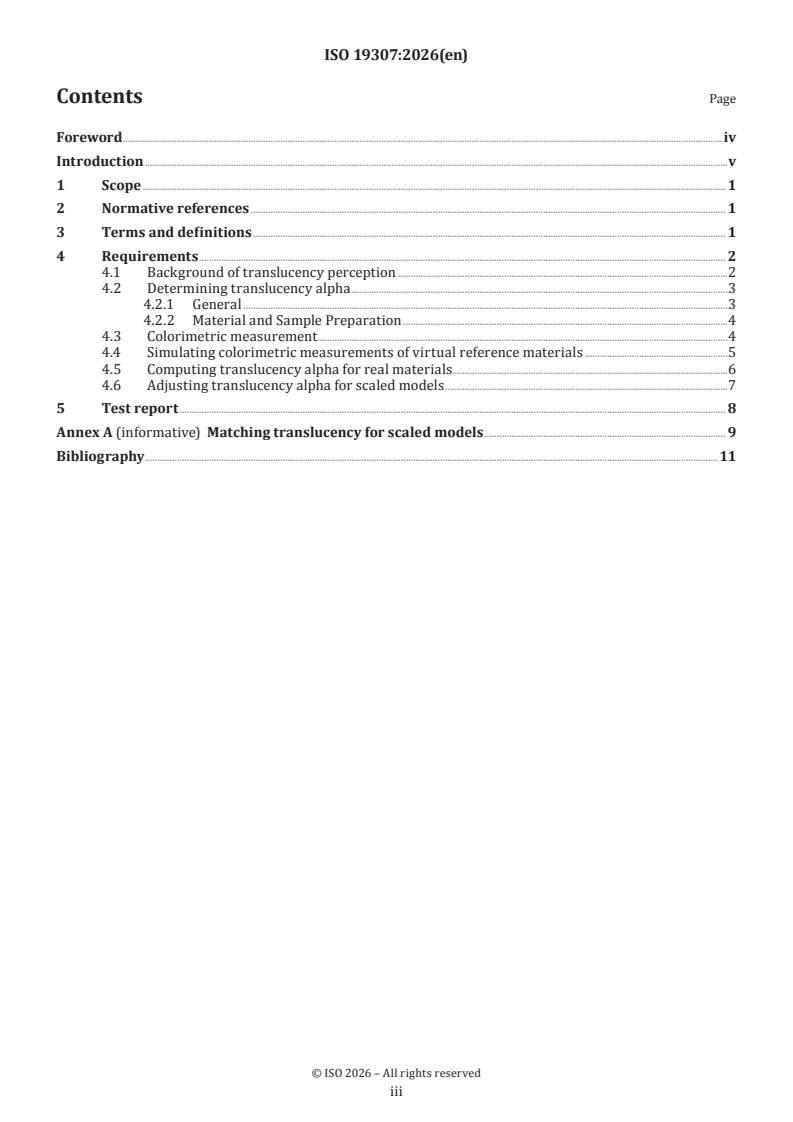
Contents Page
Foreword .iv
Introduction .v
1 Scope . 1
2 Normative references . 1
3 Terms and definitions . 1
4 Requirements . 2
4.1 Background of translucency perception .2
4.2 Determining translucency alpha .3
4.2.1 General .3
4.2.2 Material and Sample Preparation .4
4.3 Colorimetric measurement.4
4.4 Simulating colorimetric measurements of virtual reference materials .5
4.5 Computing translucency alpha for real materials.6
4.6 Adjusting translucency alpha for scaled models .7
5 Test report . 8
Annex A (informative) Matching translucency for scaled models . 9
Bibliography .11
iii
Foreword
ISO (the International Organization for Standardization) is a worldwide federation of national standards
bodies (ISO member bodies). The work of preparing International Standards is normally carried out through
ISO technical committees. Each member body interested in a subject for which a technical committee
has been established has the right to be represented on that committee. International organizations,
governmental and non-governmental, in liaison with ISO, also take part in the work. ISO collaborates closely
with the International Electrotechnical Commission (IEC) on all matters of electrotechnical standardization.
The procedures used to develop this document and those intended for its further maintenance are described
in the ISO/IEC Directives, Part 1. In particular, the different approval criteria needed for the different types
of ISO document should be noted. This document was drafted in accordance with the editorial rules of the
ISO/IEC Directives, Part 2 (see www.iso.org/directives).
ISO draws attention to the possibility that the implementation of this document may involve the use of (a)
patent(s). ISO takes no position concerning the evidence, validity or applicability of any claimed patent
rights in respect thereof. As of the date of publication of this document, ISO had not received notice of (a)
patent(s) which may be required to implement this document. However, implementers are cautioned that
this may not represent the latest information, which may be obtained from the patent database available at
www.iso.org/patents. ISO shall not be held responsible for identifying any or all such patent rights.
Any trade name used in this document is information given for the convenience of users and does not
constitute an endorsement.
For an explanation of the voluntary nature of standards, the meaning of ISO specific terms and expressions
related to conformity assessment, as well as information about ISO's adherence to the World Trade
Organization (WTO) principles in the Technical Barriers to Trade (TBT), see www.iso.org/iso/foreword.html.
This document was prepared by Technical Committee ISO/TC 130, Graphic technology.
Any feedback or questions on this document should be directed to the user’s national standards body. A
complete listing of these bodies can be found at www.iso.org/members.html.
iv
Introduction
Advances in 3D printing allow the combination of multiple printing materials with different optical
properties into a single object at a very high resolution. This allows the reproduction of not only the object's
shape but also its visual appearance attributes, in particular colour and translucency.
Many existing 3D file formats encode spatially resolved information of (albedo) colour and opacity of an
object as a RGBA texture mapped to its 3D geometry. This information is widely used in rendering, where
the RGB colour information is typically interpreted as device independent standard RGB and A (also called α)
as a blending or mixing parameter to produce transparent overlays in image composition assuming additive
colour mixture.
Using an additive colour mixture model is simple, computationally efficient and robust for on-screen display,
but it has severe shortcomings, i.e. light is altered by matter subtractively, not additively, i.e. many real
transparent materials cannot be described by this interpretation. As a result, renderings employing α as
an additive mixture parameter are suitable for illustrative purposes rather than accurately simulating the
appearance of real objects.
Therefore, it is highly desirable to capture perceived translucency of real objects within a single parameter,
foremost because it allows the seamless continued use of existing image and 3D file formats, and it is
supported by various existing 3D design and image manipulation tools.
For the purpose of reproducing translucent objects by 3D printing, a few properties of α are desired.
— α is linked to a measurable quantity. Only then, can α be assigned to real materials via measurements
and print material arrangements can be adjusted to match this quantity.
— For print reproductions, a perceptually uniform scale for α is important, allowing the minimization
of perceived errors rather than physical ones. The viewing conditions for this scale agree with the
RGB conditions to ensure consistency of colour and translucency. In colour printing, the viewing/
illuminating geometry is specified by the International Color Consortium and is supported by colour
and spectrophotometric measurement devices employed in graphic arts, which are used to calibrate the
printers.
— If an object made of a translucent material is scaled (most commonly shrunk) for printing, it is desirable
that average light transport distances can be adjusted accordingly to preserve perceptual translucency
cues. This is demonstrated in Annex A. Therefore, α should be adjustable to the print size in relation to
the original object size in an intuitive, predictable and computationally efficient way.
— For design purposes, the absence of cross-contamination between the chromatic channels (chroma and
hue) and α is important, i.e. that changing the chromatic channels has no effect on perceived translucency
and vice versa, for the specified viewing conditions.
Translucency alpha is a one-dimensional parameter defined for all materials, without imposing constraints
on their spectral refractive index, absorption and scattering properties, or phase functions. Translucency
alpha is assigned to a material by selecting a virtual reference material matching in transmittance and edge
loss when measured as described on a 4 mm flat tile (reference thickness). The virtual reference materials
are defined by wavelength-independent scattering, absorption and refractive indices as well as an isotropic
phase function.
The bigger the intrinsic optical properties deviate from the optical properties of the virtual reference
material the bigger will be the deviation of perceived translucency for samples with thicknesses other
than 4 mm. Real material can change in scattering phase function and can possess wavelength-dependent
scattering and absorption (the virtual reference materials are defined by an isotropic phase function and
wavelength independent absorption and scattering). This is the limitation of using just one parameter to
describe the magnitude of translucency.
It is worth mentioning that various publications show that the degree of perceived translucency is judged
[2],[3]
predominantly at thin structures, i.e. it is plausible that the virtual reference material that best mimics
v
translucency cues caused by lateral and vertical light transport within a real material is selected based on
measurements on thin structures.
vi
International Standard ISO 19307:2026(en)
Graphic technology — Measurement and one-parameter
representation of translucency
1 Scope
This document specifies the procedure for the measurement of a one-dimensional parameter approximating
the translucency magnitude of flat materials that absorb and scatter light. This one-dimensional material
property is called ‘translucency alpha’ and can be used in appearance-based 3D reproduction workflows
ensuring accurate translucency.
While the measurement conditions and virtual reference materials used to define translucency alpha are
designed for 3D printing workflows, the use of translucency alpha is not limited to reproducing objects with
additive manufacturing technologies.
2 Normative references
The following documents are referred to in the text in such a way that some or all of their content constitutes
requirements of this document. For dated references, only the edition cited applies. For undated references,
the latest edition of the referenced document (including any amendments) applies.
ISO 13655, Graphic technology — Spectral measurement and colorimetric computation for graphic arts images
3 Terms and definitions
For the purposes of this document, the following terms and definitions apply.
ISO and IEC maintain terminology databases for use in standardization at the following addresses:
— ISO Online browsing platform: available at https:// www .iso .org/ obp
— IEC Electropedia: available at https:// www .electropedia .org/
3.1
translucency
capacity of a body of material to allow the passage of light, yet diffusing the light so as not to render objects
lying beyond the body clearly visible
[4]
[SOURCE: ISO 20795-1:2013, 3.15]
3.2
translucency alpha
α
one-dimensional parameter approximating the translucency magnitude of a flat material that absorbs and
scatters light
Note 1 to entry: It should be noted that the Alpha channel (A) in RGBA is not defined in any standard. It is often used as
a weighting parameter between image overlays which has no precise physical correlate. Translucency alpha α can be
used as the Alpha channel (A) in RGBA.
3.3
physical-based path tracer
Monte Carlo method for numerically solving the radiative transfer equation (RTE)
Note 1 to entry: The radiative transfer equation (RTE) describes the change in radiance along a path due to refraction,
absorption, emission, and scattering in participating media
3.4
lateral light transport
transport of light within an object responsible for radiance emitted from a surface with normal n �facing
T
the observer in a direction p satisfying np>0 due to incident radiance R arriving from a direction g
1 1 1
T
with ng <0.
T
No
...