


ISO/FDIS 21315
(Main)Traditional Chinese medicine - Ganoderma lucidum fruiting body
Traditional Chinese medicine - Ganoderma lucidum fruiting body
This document specifies minimum requirements and test methods for Ganoderma lucidum fruiting body that is derived from Ganoderma lucidum (Leyss. ex Fr.) Karst. It is applicable to Ganoderma lucidum fruiting body that is sold and used as Chinese materia medica (whole medicinal materials) and decoction pieces derived from this fungus.
Médecine traditionnelle chinoise — Organe fructifère de Ganoderma lucidum
General Information
- Status
- Not Published
- Technical Committee
- ISO/TC 249 - Traditional Chinese medicine
- Current Stage
- 5020 - FDIS ballot initiated: 2 months. Proof sent to secretariat
- Start Date
- 20-Nov-2025
- Completion Date
- 20-Nov-2025
Relations
- Effective Date
- 15-Jun-2024
Overview
ISO/FDIS 21315:2025 is an international standard developed by ISO Technical Committee ISO/TC 249, Subcommittee SC 1, focusing on Traditional Chinese Medicine. This standard specifies the minimum requirements and test methods for the Ganoderma lucidum fruiting body, widely known as Lingzhi or Reishi mushroom. Derived from Ganoderma lucidum (Leyss. ex Fr.) Karst., the dried fruiting body is used extensively as Chinese materia medica, including whole medicinal materials and decoction pieces.
Ganoderma lucidum has been used in Asia for over 2,000 years for its medicinal properties such as tonifying Qi, treating fatigue, cough, and insomnia. Modern research highlights its potential in tumor treatment and immuno-enhancement. However, challenges like adulteration and quality consistency remain, creating a strong demand for harmonized, internationally recognized quality and safety requirements.
Key Topics
Quality and Safety Requirements
- General characteristics: Fruiting bodies must be clean, free from foreign matter, and free of visible insects or molds.
- Morphological features: The fruiting body has an umbrella shape with specific size and color ranges, including a reniform pileus and cylindrical stipe with distinctive color and texture.
- Identification methods: Thin-layer chromatography (TLC) and high-performance liquid chromatography (HPLC) are prescribed for verifying authenticity and quality.
- Moisture content: Measurement is mandatory to ensure product stability.
- Total ash: Should not exceed 4.0% to confirm purity.
- Water-soluble extractives: Quantification is required for assessing the quality of active constituents.
- Marker compounds: Concentrations of key bioactive substances like polysaccharides and ganoderic acid A must be determined.
- Heavy metals and pesticide residues: Levels of arsenic, cadmium, lead, mercury, and pesticide residues require testing to ensure safety according to relevant ISO methods.
Sampling and Testing
- Sampling aligns with ISO 23723 to ensure representative analysis.
- Detailed testing methods for moisture, ash, extractives, marker compounds, heavy metals, and pesticide residues are included.
- Test reports must include identification, sampling method, test procedures, results, and any anomalies to maintain traceability and transparency.
Packaging, Storage, and Labelling
- Packaging must prevent contamination, flavor or odor transfer, and health risks.
- Storage recommendations follow ISO 22217, with protection against moisture, light, pollution, and foreign substances during transport.
- Labelling must include product and scientific names, quality attributes, origin, production date, batch number, and expiry date, adhering to ISO 21371 guidelines.
Applications
ISO/FDIS 21315:2025 is essential for manufacturers, distributors, quality control laboratories, and regulatory agencies involved in the production and trade of Ganoderma lucidum fruiting bodies. Key applications include:
- Quality assurance: Establishing consistent quality benchmarks for raw materials sold as traditional Chinese medicine or herbal products.
- Safety compliance: Ensuring finished products meet safety standards for heavy metals and pesticide contamination.
- Authenticity verification: Utilizing TLC and HPLC techniques to prevent adulteration and mislabeling in the global marketplace.
- Harmonization of standards: Aligning national and regional pharmacopoeia requirements to facilitate international trade and consumer protection.
- Research and development: Supporting scientific studies on Ganoderma lucidum composition and therapeutic efficacy through standardized testing protocols.
Related Standards
ISO/FDIS 21315:2025 refers to and complements several key ISO standards to ensure a comprehensive framework for quality and safety:
- ISO 18664 – Determination of heavy metals in traditional Chinese medicine herbal materials.
- ISO 19609-2 – Identity testing of herbal constituents by macroscopic and microscopic methods.
- ISO 21371 – Labelling requirements for traditional Chinese medicine products.
- ISO 22217 – Storage requirements for raw materials and decoction pieces.
- ISO 22258 – Pesticide residue determination by gas chromatography.
- ISO 23723 – General requirements for herbal raw materials and materia medica, including sampling and moisture analysis.
This integrated suite of standards supports robust regulatory and quality systems for Ganoderma lucidum fruiting bodies used in traditional Chinese medicine globally.
Adopting ISO/FDIS 21315:2025 ensures that Ganoderma lucidum products meet internationally recognized quality, safety, and authenticity standards, promoting consumer confidence and fostering sustainable growth in traditional Chinese medicine markets worldwide.
ISO/FDIS 21315 - Traditional Chinese medicine — Ganoderma lucidum fruiting body Released:6. 11. 2025
REDLINE ISO/FDIS 21315 - Traditional Chinese medicine — Ganoderma lucidum fruiting body Released:6. 11. 2025
Frequently Asked Questions
ISO/FDIS 21315 is a draft published by the International Organization for Standardization (ISO). Its full title is "Traditional Chinese medicine - Ganoderma lucidum fruiting body". This standard covers: This document specifies minimum requirements and test methods for Ganoderma lucidum fruiting body that is derived from Ganoderma lucidum (Leyss. ex Fr.) Karst. It is applicable to Ganoderma lucidum fruiting body that is sold and used as Chinese materia medica (whole medicinal materials) and decoction pieces derived from this fungus.
This document specifies minimum requirements and test methods for Ganoderma lucidum fruiting body that is derived from Ganoderma lucidum (Leyss. ex Fr.) Karst. It is applicable to Ganoderma lucidum fruiting body that is sold and used as Chinese materia medica (whole medicinal materials) and decoction pieces derived from this fungus.
ISO/FDIS 21315 is classified under the following ICS (International Classification for Standards) categories: 11.120.10 - Medicaments. The ICS classification helps identify the subject area and facilitates finding related standards.
ISO/FDIS 21315 has the following relationships with other standards: It is inter standard links to ISO 21315:2018. Understanding these relationships helps ensure you are using the most current and applicable version of the standard.
You can purchase ISO/FDIS 21315 directly from iTeh Standards. The document is available in PDF format and is delivered instantly after payment. Add the standard to your cart and complete the secure checkout process. iTeh Standards is an authorized distributor of ISO standards.
Standards Content (Sample)
FINAL DRAFT
International
Standard
ISO/TC 249/SC 1
Traditional Chinese medicine —
Secretariat: SAC
Ganoderma lucidum fruiting body
Voting begins on:
Médecine traditionnelle chinoise — Organe fructifère de 2025-11-20
Ganoderma lucidum
Voting terminates on:
2026-01-15
RECIPIENTS OF THIS DRAFT ARE INVITED TO SUBMIT,
WITH THEIR COMMENTS, NOTIFICATION OF ANY
RELEVANT PATENT RIGHTS OF WHICH THEY ARE AWARE
AND TO PROVIDE SUPPOR TING DOCUMENTATION.
IN ADDITION TO THEIR EVALUATION AS
BEING ACCEPTABLE FOR INDUSTRIAL, TECHNO
LOGICAL, COMMERCIAL AND USER PURPOSES, DRAFT
INTERNATIONAL STANDARDS MAY ON OCCASION HAVE
TO BE CONSIDERED IN THE LIGHT OF THEIR POTENTIAL
TO BECOME STAN DARDS TO WHICH REFERENCE MAY BE
MADE IN NATIONAL REGULATIONS.
Reference number
FINAL DRAFT
International
Standard
ISO/TC 249/SC 1
Traditional Chinese medicine —
Secretariat: SAC
Ganoderma lucidum fruiting body
Voting begins on:
Médecine traditionnelle chinoise — Organe fructifère de
Ganoderma lucidum
Voting terminates on:
RECIPIENTS OF THIS DRAFT ARE INVITED TO SUBMIT,
WITH THEIR COMMENTS, NOTIFICATION OF ANY
RELEVANT PATENT RIGHTS OF WHICH THEY ARE AWARE
AND TO PROVIDE SUPPOR TING DOCUMENTATION.
© ISO 2025
IN ADDITION TO THEIR EVALUATION AS
All rights reserved. Unless otherwise specified, or required in the context of its implementation, no part of this publication may
BEING ACCEPTABLE FOR INDUSTRIAL, TECHNO
LOGICAL, COMMERCIAL AND USER PURPOSES, DRAFT
be reproduced or utilized otherwise in any form or by any means, electronic or mechanical, including photocopying, or posting on
INTERNATIONAL STANDARDS MAY ON OCCASION HAVE
the internet or an intranet, without prior written permission. Permission can be requested from either ISO at the address below
TO BE CONSIDERED IN THE LIGHT OF THEIR POTENTIAL
or ISO’s member body in the country of the requester.
TO BECOME STAN DARDS TO WHICH REFERENCE MAY BE
MADE IN NATIONAL REGULATIONS.
ISO copyright office
CP 401 • Ch. de Blandonnet 8
CH-1214 Vernier, Geneva
Phone: +41 22 749 01 11
Email: copyright@iso.org
Website: www.iso.org
Published in Switzerland Reference number
ii
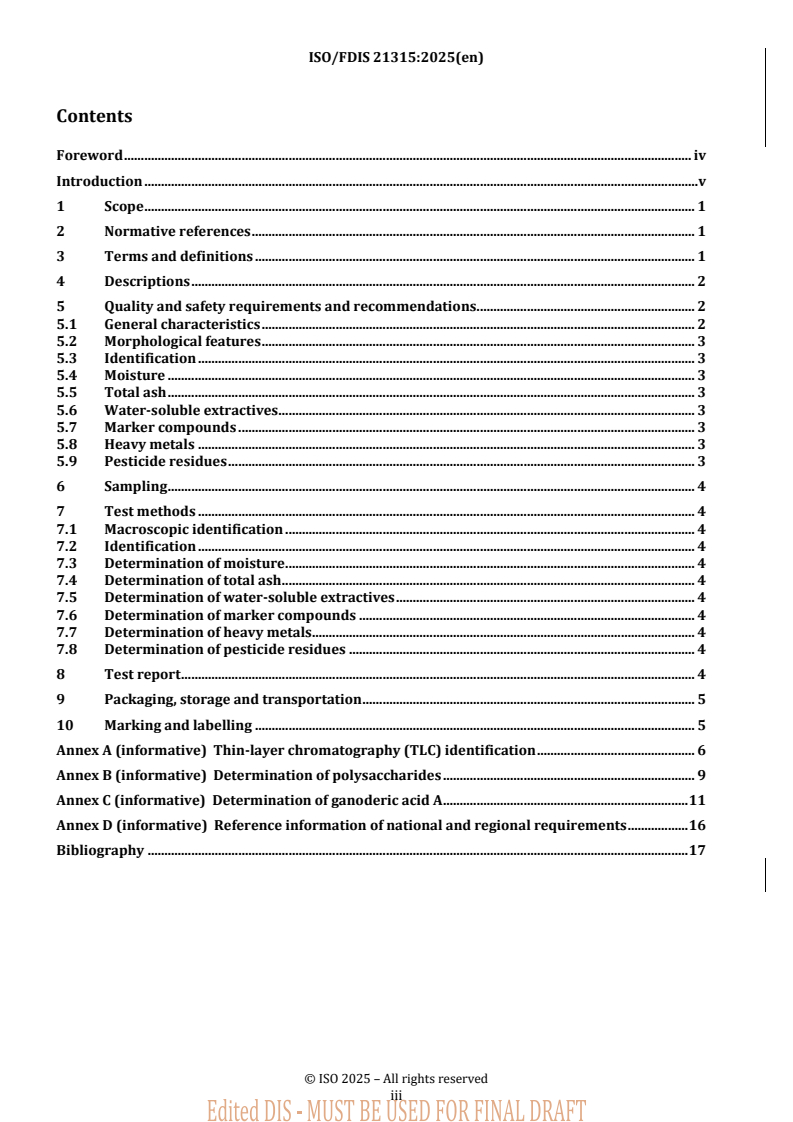
Contents Page
Foreword .iv
Introduction .v
1 Scope . 1
2 Normative references . 1
3 Terms and definitions . 1
4 Descriptions . 2
5 Quality and safety requirements and recommendations . 2
5.1 General characteristics .2
5.2 Morphological features .2
5.3 Identification .3
5.3.1 Thin-layer chromatography (TLC) identification .3
5.3.2 High performance liquid chromatography (HPLC) identification .3
5.4 Moisture .3
5.5 Total ash .3
5.6 Water-soluble extractives .3
5.7 Marker compounds .3
5.8 Heavy metals .3
5.9 Pesticide residues .3
6 Sampling . 3
7 Test methods . 3
7.1 Macroscopic identification .3
7.2 Identification .4
7.2.1 Thin-layer chromatography (TLC) identification .4
7.2.2 High performance liquid chromatography (HPLC) identification .4
7.3 Determination of moisture .4
7.4 Determination of total ash .4
7.5 Determination of water-soluble extractives .4
7.6 Determination of marker compounds .4
7.7 Determination of heavy metals .4
7.8 Determination of pesticide residues .4
8 Test report . 4
9 Packaging, storage and transportation . 5
10 Marking and labelling . 5
Annex A (informative) Thin-layer chromatography (TLC) identification . 6
Annex B (informative) Determination of polysaccharides . 8
Annex C (informative) Determination of ganoderic acid A . 10
Annex D (informative) Reference information of national and regional requirements . 14
Bibliography .15
iii
Foreword
ISO (the International Organization for Standardization) is a worldwide federation of national standards
bodies (ISO member bodies). The work of preparing International Standards is normally carried out through
ISO technical committees. Each member body interested in a subject for which a technical committee
has been established has the right to be represented on that committee. International organizations,
governmental and non-governmental, in liaison with ISO, also take part in the work. ISO collaborates closely
with the International Electrotechnical Commission (IEC) on all matters of electrotechnical standardization.
The procedures used to develop this document and those intended for its further maintenance are described
in the ISO/IEC Directives, Part 1. In particular, the different approval criteria needed for the different types
of ISO document should be noted. This document was drafted in accordance with the editorial rules of the
ISO/IEC Directives, Part 2 (see www.iso.org/directives).
ISO draws attention to the possibility that the implementation of this document may involve the use of (a)
patent(s). ISO takes no position concerning the evidence, validity or applicability of any claimed patent
rights in respect thereof. As of the date of publication of this document, ISO had not received notice of (a)
patent(s) which may be required to implement this document. However, implementers are cautioned that
this may not represent the latest information, which may be obtained from the patent database available at
www.iso.org/patents. ISO shall not be held responsible for identifying any or all such patent rights.
Any trade name used in this document is information given for the convenience of users and does not
constitute an endorsement.
For an explanation of the voluntary nature of standards, the meaning of ISO specific terms and expressions
related to conformity assessment, as well as information about ISO's adherence to the World Trade
Organization (WTO) principles in the Technical Barriers to Trade (TBT), see www.iso.org/iso/foreword.html.
This document was prepared by Technical Committee ISO/TC 249, Traditional medicine, Subcommittee SC 1,
Traditional Chinese medicine.
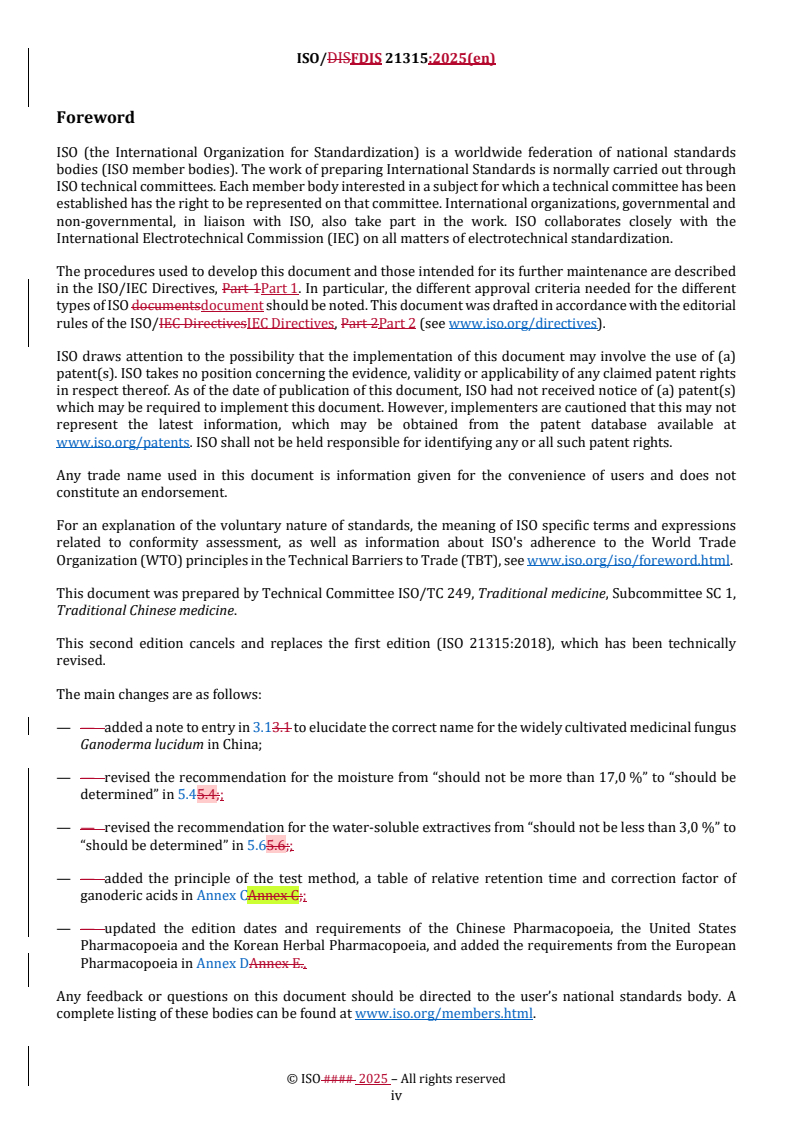
This second edition cancels and replaces the first edition (ISO 21315:2018), which has been technically
revised.
The main changes are as follows:
— added a note to entry in 3.1 to elucidate the correct name for the widely cultivated medicinal fungus
Ganoderma lucidum in China;
— revised the recommendation for the moisture from “should not be more than 17,0 %” to “should be
determined” in 5.4;
— revised the recommendation for the water-soluble extractives from “should not be less than 3,0 %” to
“should be determined” in 5.6;
— added the principle of the test method, a table of relative retention time and correction factor of ganoderic
acids in Annex C;
— updated the edition dates and requirements of the Chinese Pharmacopoeia, the United States
Pharmacopoeia and the Korean Herbal Pharmacopoeia, and added the requirements from the European
Pharmacopoeia in Annex D.
Any feedback or questions on this document should be directed to the user’s national standards body. A
complete listing of these bodies can be found at www.iso.org/members.html.
iv
Introduction
Ganoderma lucidum fruiting body is the dried fruiting body of Ganoderma lucidum (Leyss. ex Fr.) Karst., which
is also known as Lingzhi or Reishi. It has been used as a medicinal mushroom in many Asian countries for
more than 2 000 years, such as China, Japan and the Republic of Korea. This fungus can tonify Qi, and is used
to treat fatigue, cough and insomnia in traditional Chinese medicine. Modern pharmacological studies also
demonstrate its great potential in tumour treatment and immuno-enhancement. The market of Ganoderma
lucidum has developed rapidly, with increases in yield, production output and trade volume.
However, there remain many challenges, such as adulteration of similar species and lack of suitable testing
methods for quality assessment. Though Ganoderma lucidum has been recorded in several pharmacopoeias,
[1] [2] [3]
such as Chinese Pharmacopoeia , the Korean Herbal Pharmacopoeia , the European Pharmacopoeia ,
[4]
and the United States Pharmacopoeia , the specifications and quality requirements in these standards
vary. Therefore, there is a clear and urgent need to develop an International Standard for harmonizing the
existing standards, as well as ensuring the safety and effectiveness of Ganoderma lucidum fruiting body.
As national implementation can differ, national standards bodies are invited to modify the values given in
5.5 in their national standards. Examples of national and regional values are given in Annex D.
v
FINAL DRAFT International Standard ISO/FDIS 21315:2025(en)
Traditional Chinese medicine — Ganoderma lucidum
fruiting body
1 Scope
This document specifies minimum requirements and test methods for Ganoderma lucidum fruiting body that
is derived from Ganoderma lucidum (Leyss. ex Fr.) Karst.
It is applicable to Ganoderma lucidum fruiting body that is sold and used as Chinese materia medica (whole
medicinal materials) and decoction pieces derived from this fungus.
2 Normative references
The following documents are referred to in the text in such a way that some or all of their content constitutes
requirements of this document. For dated references, only the edition cited applies. For undated references,
the latest edition of the referenced document (including any amendments) applies.
ISO 18664, Traditional Chinese Medicine — Determination of heavy metals in herbal medicines used in
Traditional Chinese Medicine
ISO 19609-2, Traditional Chinese medicine — Quality and safety of raw materials and finished products made
with raw materials — Part 2: Identity testing of constituents of herbal origin
ISO 21371, Traditional Chinese medicine — Labelling requirements of products intended for oral or topical use
ISO 22217, Traditional Chinese medicine —Storage requirements for raw materials and decoction pieces
ISO 22258, Traditional Chinese medicine — Determination of pesticide residues in natural products by gas
chromatography
ISO 23723, Traditional Chinese medicine — General requirements for herbal raw material and materia medica
3 Terms and definitions
For the purposes of this document, the following terms and definitions apply.
ISO and IEC maintain terminology databases for use in standardization at the following addresses:
— ISO Online browsing platform: available at https:// www .iso .org/ obp
— IEC Electropedia: available at https:// www .electropedia .org/
3.1
Ganoderma lucidum fruiting body
dried sporocarp of Ganoderma lucidum (Leyss. ex Fr.) Karst.
Note 1 to entry: Based on recent taxonomic research, the correct name for the widely cultivated medicinal fungus
[5]
Ganoderma lucidum in China is Ganoderma lingzhi Sheng H.Wu, Y.Cao & Y.C.Dai (= Ganoderma sichuanense J.D.Zhao &
[6]
X.Q. Zhang ).
3.2
marker compound
chemical constituent within a medicinal herb that can be used to verify its quality
3.3
reference substance
authentic substance used as a measurement base for TLC identification or marker compound quantification
4 Descriptions
Ganoderma lucidum fruiting body is the dried fruiting body of Ganoderma lucidum (Leyss. ex Fr.) Karst. in the
family of Ganodermataceae shown in Figure 1.
a) Fruiting body of Ganoderma lucidum b) Vertical section of Ganoderma lucidum
Key
1 pileus
2 stipe
3 tubular pores
4 spore
Figure 1 — Structure of Ganoderma lucidum
5 Quality and safety requirements and recommendations
5.1 General characteristics
The following requirements shall be met before sampling.
a) Ganoderma lucidum fruiting body shall be clean and free from foreign matter.
b) The presence of living insects, moulds and external contaminants which are visible to the
...
ISO/TC 249/SC 1/WG 1
Secretariat: SAC
Date: 2025-09-2311-06
Traditional Chinese medicine — Ganoderma lucidum fruiting body
Médecine traditionnelle chinoise — Organe fructifère de Ganoderma lucidum
FDIS stage
ISO/DISFDIS 21315:2025(en)
All rights reserved. Unless otherwise specified, or required in the context of its implementation, no part of this publication
may be reproduced or utilized otherwise in any form or by any means, electronic or mechanical, including photocopying,
or posting on the internet or an intranet, without prior written permission. Permission can be requested from either ISO
at the address below or ISO’s member body in the country of the requester.
ISO copyright office
CP 401 • Ch. de Blandonnet 8
CH-1214 Vernier, Geneva
Phone: + 41 22 749 01 11
EmailE-mail: copyright@iso.org
Website: www.iso.org
Published in Switzerland
© ISO #### 2025 – All rights reserved
ii
Contents
Foreword . iv
Introduction . v
1 Scope . 1
2 Normative references . 1
3 Terms and definitions . 1
4 Descriptions . 2
5 Quality and safety requirements and recommendations . 2
5.1 General characteristics . 2
5.2 Morphological features . 3
5.3 Identification . 3
5.4 Moisture . 3
5.5 Total ash . 3
5.6 Water-soluble extractives . 3
5.7 Marker compounds . 3
5.8 Heavy metals . 3
5.9 Pesticide residues . 3
6 Sampling . 4
7 Test methods . 4
7.1 Macroscopic identification . 4
7.2 Identification . 4
7.3 Determination of moisture . 4
7.4 Determination of total ash . 4
7.5 Determination of water-soluble extractives . 4
7.6 Determination of marker compounds . 4
7.7 Determination of heavy metals . 4
7.8 Determination of pesticide residues . 4
8 Test report . 4
9 Packaging, storage and transportation . 5
10 Marking and labelling . 5
Annex A (informative) Thin-layer chromatography (TLC) identification . 6
Annex B (informative) Determination of polysaccharides . 9
Annex C (informative) Determination of ganoderic acid A . 11
Annex D (informative) Reference information of national and regional requirements . 16
Bibliography . 17
iii
ISO/DISFDIS 21315:2025(en)
Foreword
ISO (the International Organization for Standardization) is a worldwide federation of national standards
bodies (ISO member bodies). The work of preparing International Standards is normally carried out through
ISO technical committees. Each member body interested in a subject for which a technical committee has been
established has the right to be represented on that committee. International organizations, governmental and
non-governmental, in liaison with ISO, also take part in the work. ISO collaborates closely with the
International Electrotechnical Commission (IEC) on all matters of electrotechnical standardization.
The procedures used to develop this document and those intended for its further maintenance are described
in the ISO/IEC Directives, Part 1Part 1. In particular, the different approval criteria needed for the different
types of ISO documentsdocument should be noted. This document was drafted in accordance with the editorial
rules of the ISO/IEC DirectivesIEC Directives, Part 2Part 2 (see www.iso.org/directives).
ISO draws attention to the possibility that the implementation of this document may involve the use of (a)
patent(s). ISO takes no position concerning the evidence, validity or applicability of any claimed patent rights
in respect thereof. As of the date of publication of this document, ISO had not received notice of (a) patent(s)
which may be required to implement this document. However, implementers are cautioned that this may not
represent the latest information, which may be obtained from the patent database available at
www.iso.org/patents. ISO shall not be held responsible for identifying any or all such patent rights.
Any trade name used in this document is information given for the convenience of users and does not
constitute an endorsement.
For an explanation of the voluntary nature of standards, the meaning of ISO specific terms and expressions
related to conformity assessment, as well as information about ISO's adherence to the World Trade
Organization (WTO) principles in the Technical Barriers to Trade (TBT), see www.iso.org/iso/foreword.html.
This document was prepared by Technical Committee ISO/TC 249, Traditional medicine, Subcommittee SC 1,
Traditional Chinese medicine.
This second edition cancels and replaces the first edition (ISO 21315:2018), which has been technically
revised.
The main changes are as follows:
— — added a note to entry in 3.13.1 to elucidate the correct name for the widely cultivated medicinal fungus
Ganoderma lucidum in China;
— — revised the recommendation for the moisture from “should not be more than 17,0 %” to “should be
determined” in 5.45.4;;
— — revised the recommendation for the water-soluble extractives from “should not be less than 3,0 %” to
“should be determined” in 5.65.6;;
— — added the principle of the test method, a table of relative retention time and correction factor of
ganoderic acids in Annex CAnnex C;;
— — updated the edition dates and requirements of the Chinese Pharmacopoeia, the United States
Pharmacopoeia and the Korean Herbal Pharmacopoeia, and added the requirements from the European
Pharmacopoeia in Annex DAnnex E.
Any feedback or questions on this document should be directed to the user’s national standards body. A
complete listing of these bodies can be found at www.iso.org/members.html.
© ISO #### 2025 – All rights reserved
iv
Introduction
Ganoderma lucidum fruiting body is the dried fruiting body of Ganoderma lucidum (Leyss. ex Fr.) Karst., which
is also known as Lingzhi or Reishi. It has been used as a medicinal mushroom in many Asian countries for
more than 20002 000 years, such as China, Japan and the Republic of Korea. This fungus can tonify Qi, and is
used to treat fatigue, cough and insomnia in traditional Chinese medicine. Modern pharmacological studies
also demonstrate its great potential in tumour treatment and immuno-enhancement. The market of
Ganoderma lucidum has developed rapidly, with increases in yield, production output and trade volume.
However, there remain many challenges, such as adulteration of similar species and lack of suitable testing
methods for quality assessment. Though Ganoderma lucidum has been recorded in several pharmacopoeias,
[ [1]] [ [2]]
such as Chinese Pharmacopoeia 1, , the Korean Herbal Pharmacopoeia 2, , the European
[ [3]] [ [4]]
Pharmacopoeia 3, , and the United States Pharmacopoeia 4, , the specifications and quality requirements
in these standards vary. Therefore, there is a clear and urgent need to develop an International Standard for
harmonizing the existing standards, as well as ensuring the safety and effectiveness of Ganoderma lucidum
fruiting body.
As national implementation can differ, national standards bodies are invited to modify the values given in
5.55.5 in their national standards. Examples of national and regional values are given in Annex DAnnex D.
v
FINAL DRAFT International Standard ISO/FDIS 21315:2025(en)
Traditional Chinese medicine — Ganoderma lucidum fruiting body
1 Scope
This document specifies minimum requirements and test methods for Ganoderma lucidum fruiting body that
is derived from Ganoderma lucidum (Leyss. ex Fr.) Karst.
It is applicable to Ganoderma lucidum fruiting body that is sold and used as Chinese materia medica (whole
medicinal materials) and decoction pieces derived from this fungus.
2 Normative references
The following documents are referred to in the text in such a way that some or all of their content constitutes
requirements of this document. For dated references, only the edition cited applies. For undated references,
the latest edition of the referenced document (including any amendments) applies.
ISO 18664, Traditional Chinese Medicine — Determination of heavy metals in herbal medicines used in
Traditional Chinese Medicine
ISO 19609--2, Traditional Chinese medicine — Quality and safety of raw materials and finished products made
with raw materials — Part 2: Identity testing of constituents of herbal origin
ISO 21371, Traditional Chinese medicine — Labelling requirements of products intended for oral or topical use
ISO 22217, Traditional Chinese medicine —Storage requirements for raw materials and decoction pieces
ISO 22258, Traditional Chinese medicine — Determination of pesticide residues in natural products by gas
chromatography
ISO 23723, Traditional Chinese medicine — General requirements for herbal raw material and materia medica
3 Terms and definitions
For the purposes of this document, the following terms and definitions apply.
ISO and IEC maintain terminology databases for use in standardization at the following addresses:
— — ISO Online browsing platform: available at https://www.iso.org/obp
— — IEC Electropedia: available at https://www.electropedia.org/
3.1 3.1
Ganoderma lucidum fruiting body
dried sporocarp of Ganoderma lucidum (Leyss. ex Fr.) Karst.
Note 1 to entry: Based on recent taxonomic research, the correct name for the widely cultivated medicinal fungus
[ [5]]
Ganoderma lucidum in China is Ganoderma lingzhi Sheng H.Wu, Y.Cao & Y.C.Dai 5 (= Ganoderma sichuanense J.D.Zhao
[ [6] ]
& X.Q. Zhang 6 ). ).
3.2 3.2
marker compound
chemical constituent within a medicinal herb that can be used to verify its quality
3.3 3.3
reference substance
authentic substance used as a measurement base for TLC identification or marker compound quantification
4 Descriptions
Ganoderma lucidum fruiting body is the dried fruiting body of Ganoderma lucidum (Leyss. ex Fr.) Karst. in the
family of Ganodermataceae shown in Figure 1Figure 1.
a) Fruiting body of Ganoderma lucidum b) Vertical section of Ganoderma lucidum
Key
1 pileus
2 stipe
3 tubular pores
4 spore
Figure 1 — Structure of Ganoderma lucidum
5 Quality and safety requirements and recommendations
5.1 General characteristics
The following requirements shall be met before sampling.
a) a) Ganoderma lucidum fruiting body shall be clean and free from foreign matter.
b) b) The presence of living insects, moulds and external contaminants which are visible to the
naked eye shall not be permitted.
5.2 Morphological features
a) a) The fruiting body is umbrella-shaped in outline. The pileus is reniform, semi-rounded or
suborbicular, with a diameter ranging from 10 cm to 30 cm and a thickness from 1 cm to 4 cm.
b) b) The colour of the pileus varies, ranging from yellowish-brown to reddish-brown, with a
lustrous appearance. It features circular stripes and radiating wrinkles.
c) c) The stipe is cylindrical, typically ranging in length from 4 cm to 15 cm and in diameter from
1 cm to 3,5 cm. It exhibits a reddish-brown hue with a luminous quality. The attachment of the stipe to
the pileus can vary, ranging from lateral to nearly central.
d) d) The spores are small and fine, displaying a yellowish-brown colour.
e) e) The odour is slightly aromatic, with a taste that is slightly bitter.
5.3 Identification
5.3.1 Thin-layer chromatography (TLC) identification
When thin-layer chromatography (TLC) is performed for the identification of Ganoderma lucidum fruiting
body, the thin-layer chromatogram should present the spots or bands with the same colour and position
corresponding to those of reference solution.
5.3.2 High performance liquid chromatography (HPLC) identification
When TLC bands are not clearly identified, HPLC identification can be applied. The chromatogram of the test
solution should exhibit characteristic peaks (such as ganoderic acid A), corresponding in the retention times
to those in chromatogram of the reference solution.
5.4 Moisture
The mass fraction of moisture should be determined.
5.5 Total ash
The mass fraction of total ash should not be more than 4,0 %.
5.6 Water-soluble extractives
The mass fraction of water-soluble extractives should be determined.
5.7 Marker compounds
The mass fractions of marker compounds such as polysaccharides and ganoderic acid A should be determined.
5.8 Heavy metals
The mass fractions of heavy metals such as arsenic, cadmium, lead and mercury should be determined.
5.9 Pesticide residues
The mass fractions of pesticide residues should
...
Questions, Comments and Discussion
Ask us and Technical Secretary will try to provide an answer. You can facilitate discussion about the standard in here.
Loading comments...