

ISO 19901-6:2009
(Main)Petroleum and natural gas industries — Specific requirements for offshore structures — Part 6: Marine operations
- Abstract
ISO 19901-6:2009 provides requirements and guidance for the planning and engineering of marine operations, encompassing the design and analysis of the components, systems, equipment and procedures required to perform marine operations, as well as the methods or procedures developed to carry them out safely. This part of ISO 19901 is applicable to marine operations for offshore structures, including steel and concrete gravity-base structures (GBS); piled steel structures and compliant towers; tension leg platforms (TLP); deep-draught floaters (DDF), including spars or deep-draught caisson vessels (DDCV); floating production semi-submersibles (FPSS); floating production, storage and offloading vessels (FPSO); other types of floating production systems (FPS); mobile offshore units (MOU); topsides and components of any of the above; subsea templates and similar structures; gravity, piled, drag-embedded and suction or other anchors; tendon foundations; and associated mooring systems. This document is also applicable to modifications of existing structures, e.g. installation of additional topsides modules. This part of ISO 19901 is not applicable to the following marine operations: — construction activities, e.g. in a fabrication yard onshore, where there is no exposure to the marine — environment; — drilling, processing and petrochemical activities; — routine marine activities during the service life of the structure; — drilling from mobile offshore drilling units (MODU); — installation of pipelines, flowlines, risers and umbilicals; — diving.
- Status
- Published
- Publication Date
- 02-Dec-2009
- Technical Committee
- ISO/TC 67/SC 7 - Offshore structures
- Drafting Committee
- ISO/TC 67/SC 7/WG 9 - Marine operations
- Current Stage
- 9092 - International Standard to be revised
- Start Date
- 06-Oct-2026
- Completion Date
- 10-Oct-2026
Buy Documents
ISO 19901-6:2009 - Petroleum and natural gas industries — Specific requirements for offshore structures — Part 6: Marine operations Released:12/3/2009
ISO 19901-6:2009 - Industries du pétrole et du gaz naturel — Exigences spécifiques relatives aux structures en mer — Partie 6: Opérations marines Released:3/28/2012
Overview
ISO 19901-6:2009 - "Petroleum and natural gas industries - Specific requirements for offshore structures - Part 6: Marine operations" - is an international standard that provides requirements and guidance for planning, engineering and execution of marine operations for offshore structures. It covers the design, analysis, equipment, procedures and documentation needed to carry out safe marine operations for a wide range of offshore systems, including fixed platforms, floating production systems (FPS, FPSO, FPSS, TLP, DDF), mobile offshore units (MOU), gravity-base structures (GBS), subsea templates, anchors, tendon foundations and associated moorings. The standard also applies to modifications of existing structures (for example, additional topsides modules).
ISO 19901-6:2009 explicitly excludes onshore fabrication activities without marine exposure, routine in-service marine activities, drilling/processing/petrochemical operations, MODU drilling, pipeline/risers/umbilical installation, and diving operations.
Key topics and requirements
The standard addresses technical and procedural aspects required for safe marine operations, including:
- Organization, documentation and planning: roles, communication, quality assurance, technical procedures and certification.
- Metocean and earthquake considerations: defining environmental criteria, weather windows, forecasts and operational duration.
- Risk management and HSE: job safety analysis, incident reporting, environmental impact studies and personnel qualifications.
- Weight control and stability: classes of weight control, center-of-gravity (CoG) management, intact and damage stability, inclining tests.
- Ballasting and ballast system design: pumps, valves, venting, protection and testing to support float-on/float-off and transportation.
- Loadout and transportation: loadout methods, barge and quay considerations, towing arrangements, sea-fastening and transport manuals.
- Temporary mooring and stationkeeping: mooring sizing, anchor selection, attachments and tensioning for transient operations.
- Construction and outfitting afloat and float‑over topsides installation: structural strength, clearances, guidance systems and operational controls.
Applications and practical value
ISO 19901-6 is used to plan and execute critical marine activities such as loadout, tow-out, float-over installations, heavy-lift operations, temporary mooring and transportation of topsides and hull modules. Practical benefits include:
- Improved safety through standardized risk controls and HSE documentation.
- Consistent technical requirements for stability, ballasting and metocean criteria.
- Clear guidance for contractors and owners on documentation, testing and certification needs.
- Support for regulatory approval and coordination with classification societies and national authorities.
Who should use this standard
- Offshore structural and marine engineers
- Project managers and contractors executing loadout, transport or installation operations
- Owners/operators of offshore platforms and FPSOs
- Marine contractors, tow and salvage operators
- HSE and risk management teams, and regulatory reviewers
Related standards
- Other parts of the ISO 19901 series (offshore structure-specific standards) and applicable classification society rules and national regulatory requirements for offshore marine operations.
Relations
- Effective Date
- 25-Aug-2026
- Effective Date
- 25-Aug-2026
- Effective Date
- 25-Aug-2026
- Effective Date
- 25-Aug-2026
- Effective Date
- 25-Aug-2026
- Effective Date
- 25-Aug-2026
- Effective Date
- 25-Aug-2026
- Effective Date
- 25-Aug-2026
- Effective Date
- 25-Aug-2026
- Effective Date
- 25-Aug-2026
- Effective Date
- 25-Aug-2026
- Effective Date
- 25-Aug-2026
- Effective Date
- 25-Aug-2026
- Effective Date
- 25-Aug-2026
- Effective Date
- 25-Aug-2026
Buy Documents
ISO 19901-6:2009 - Petroleum and natural gas industries — Specific requirements for offshore structures — Part 6: Marine operations Released:12/3/2009
ISO 19901-6:2009 - Industries du pétrole et du gaz naturel — Exigences spécifiques relatives aux structures en mer — Partie 6: Opérations marines Released:3/28/2012
Get Certified
Connect with accredited certification bodies for this standard

Element Materials Technology
Materials testing and product certification.

ABS Group Brazil
ABS Group certification services in Brazil.

ABS Quality Evaluations Inc.
American Bureau of Shipping quality certification.
Sponsored listings
Frequently Asked Questions
ISO 19901-6:2009 is a standard published by the International Organization for Standardization (ISO). Its full title is "Petroleum and natural gas industries — Specific requirements for offshore structures — Part 6: Marine operations". This standard covers: ISO 19901-6:2009 provides requirements and guidance for the planning and engineering of marine operations, encompassing the design and analysis of the components, systems, equipment and procedures required to perform marine operations, as well as the methods or procedures developed to carry them out safely. This part of ISO 19901 is applicable to marine operations for offshore structures, including steel and concrete gravity-base structures (GBS); piled steel structures and compliant towers; tension leg platforms (TLP); deep-draught floaters (DDF), including spars or deep-draught caisson vessels (DDCV); floating production semi-submersibles (FPSS); floating production, storage and offloading vessels (FPSO); other types of floating production systems (FPS); mobile offshore units (MOU); topsides and components of any of the above; subsea templates and similar structures; gravity, piled, drag-embedded and suction or other anchors; tendon foundations; and associated mooring systems. This document is also applicable to modifications of existing structures, e.g. installation of additional topsides modules. This part of ISO 19901 is not applicable to the following marine operations: — construction activities, e.g. in a fabrication yard onshore, where there is no exposure to the marine — environment; — drilling, processing and petrochemical activities; — routine marine activities during the service life of the structure; — drilling from mobile offshore drilling units (MODU); — installation of pipelines, flowlines, risers and umbilicals; — diving.
ISO 19901-6:2009 provides requirements and guidance for the planning and engineering of marine operations, encompassing the design and analysis of the components, systems, equipment and procedures required to perform marine operations, as well as the methods or procedures developed to carry them out safely. This part of ISO 19901 is applicable to marine operations for offshore structures, including steel and concrete gravity-base structures (GBS); piled steel structures and compliant towers; tension leg platforms (TLP); deep-draught floaters (DDF), including spars or deep-draught caisson vessels (DDCV); floating production semi-submersibles (FPSS); floating production, storage and offloading vessels (FPSO); other types of floating production systems (FPS); mobile offshore units (MOU); topsides and components of any of the above; subsea templates and similar structures; gravity, piled, drag-embedded and suction or other anchors; tendon foundations; and associated mooring systems. This document is also applicable to modifications of existing structures, e.g. installation of additional topsides modules. This part of ISO 19901 is not applicable to the following marine operations: — construction activities, e.g. in a fabrication yard onshore, where there is no exposure to the marine — environment; — drilling, processing and petrochemical activities; — routine marine activities during the service life of the structure; — drilling from mobile offshore drilling units (MODU); — installation of pipelines, flowlines, risers and umbilicals; — diving.
ISO 19901-6:2009 is classified under the following ICS (International Classification for Standards) categories: 75.180.10 - Exploratory, drilling and extraction equipment. The ICS classification helps identify the subject area and facilitates finding related standards.
ISO 19901-6:2009 has the following relationships with other standards: It is inter standard links to EN ISO 19906:2019, EN ISO 19901-3:2014, EN ISO 19901-4:2016, EN ISO 18647:2019, EN ISO 35102:2021, EN ISO 19901-3:2010, EN ISO 19900:2013, EN ISO 19904-1:2019, EN ISO 19901-3:2024, EN ISO 35106:2019, EN ISO 19902:2020, EN ISO 19906:2010, EN ISO 19903:2019, EN ISO 35104:2020, EN ISO 19903:2006. Understanding these relationships helps ensure you are using the most current and applicable version of the standard.
ISO 19901-6:2009 is available in PDF format for immediate download after purchase. The document can be added to your cart and obtained through the secure checkout process. Digital delivery ensures instant access to the complete standard document.
Standards Content (Sample)
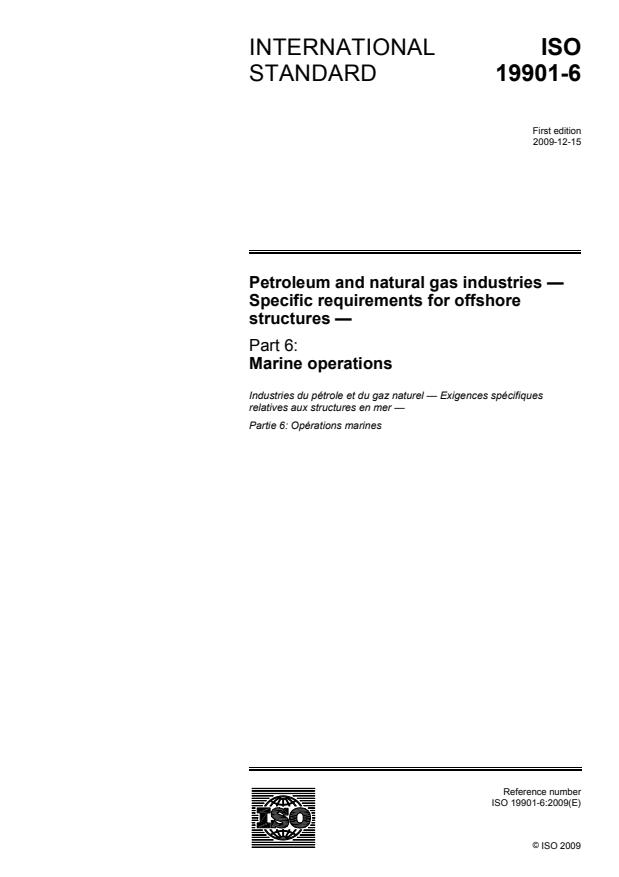
INTERNATIONAL ISO
STANDARD 19901-6
First edition
2009-12-15
Petroleum and natural gas industries —
Specific requirements for offshore
structures —
Part 6:
Marine operations
Industries du pétrole et du gaz naturel — Exigences spécifiques
relatives aux structures en mer —
Partie 6: Opérations marines
Reference number
©
ISO 2009
PDF disclaimer
This PDF file may contain embedded typefaces. In accordance with Adobe's licensing policy, this file may be printed or viewed but
shall not be edited unless the typefaces which are embedded are licensed to and installed on the computer performing the editing. In
downloading this file, parties accept therein the responsibility of not infringing Adobe's licensing policy. The ISO Central Secretariat
accepts no liability in this area.
Adobe is a trademark of Adobe Systems Incorporated.
Details of the software products used to create this PDF file can be found in the General Info relative to the file; the PDF-creation
parameters were optimized for printing. Every care has been taken to ensure that the file is suitable for use by ISO member bodies. In
the unlikely event that a problem relating to it is found, please inform the Central Secretariat at the address given below.
© ISO 2009
All rights reserved. Unless otherwise specified, no part of this publication may be reproduced or utilized in any form or by any means,
electronic or mechanical, including photocopying and microfilm, without permission in writing from either ISO at the address below or
ISO's member body in the country of the requester.
ISO copyright office
Case postale 56 • CH-1211 Geneva 20
Tel. + 41 22 749 01 11
Fax + 41 22 749 09 47
E-mail copyright@iso.org
Web www.iso.org
Published in Switzerland
ii © ISO 2009 – All rights reserved
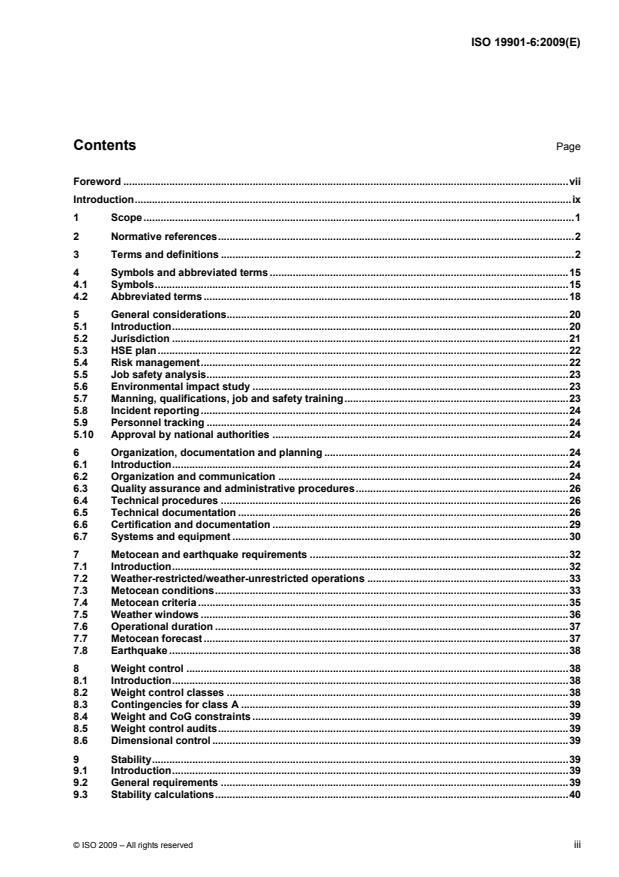
Contents Page
Foreword .vii
Introduction.ix
1 Scope.1
2 Normative references.2
3 Terms and definitions .2
4 Symbols and abbreviated terms .15
4.1 Symbols.15
4.2 Abbreviated terms .18
5 General considerations.20
5.1 Introduction.20
5.2 Jurisdiction .21
5.3 HSE plan.22
5.4 Risk management.22
5.5 Job safety analysis.23
5.6 Environmental impact study .23
5.7 Manning, qualifications, job and safety training.23
5.8 Incident reporting .24
5.9 Personnel tracking .24
5.10 Approval by national authorities .24
6 Organization, documentation and planning .24
6.1 Introduction.24
6.2 Organization and communication .24
6.3 Quality assurance and administrative procedures.26
6.4 Technical procedures .26
6.5 Technical documentation .26
6.6 Certification and documentation .29
6.7 Systems and equipment .30
7 Metocean and earthquake requirements .32
7.1 Introduction.32
7.2 Weather-restricted/weather-unrestricted operations .33
7.3 Metocean conditions.33
7.4 Metocean criteria .35
7.5 Weather windows .36
7.6 Operational duration .37
7.7 Metocean forecast .37
7.8 Earthquake .38
8 Weight control .38
8.1 Introduction.38
8.2 Weight control classes .38
8.3 Contingencies for class A .39
8.4 Weight and CoG constraints .39
8.5 Weight control audits.39
8.6 Dimensional control .39
9 Stability.39
9.1 Introduction.39
9.2 General requirements .39
9.3 Stability calculations.40
9.4 Intact stability.40
9.5 Damage stability .42
9.6 Single-barge transports .45
9.7 Multi-barge transports.45
9.8 Classed vessels .45
9.9 Self-floating structures .45
9.10 Loadout operations .47
9.11 Watertight integrity and temporary closures.48
9.12 Inclining tests.48
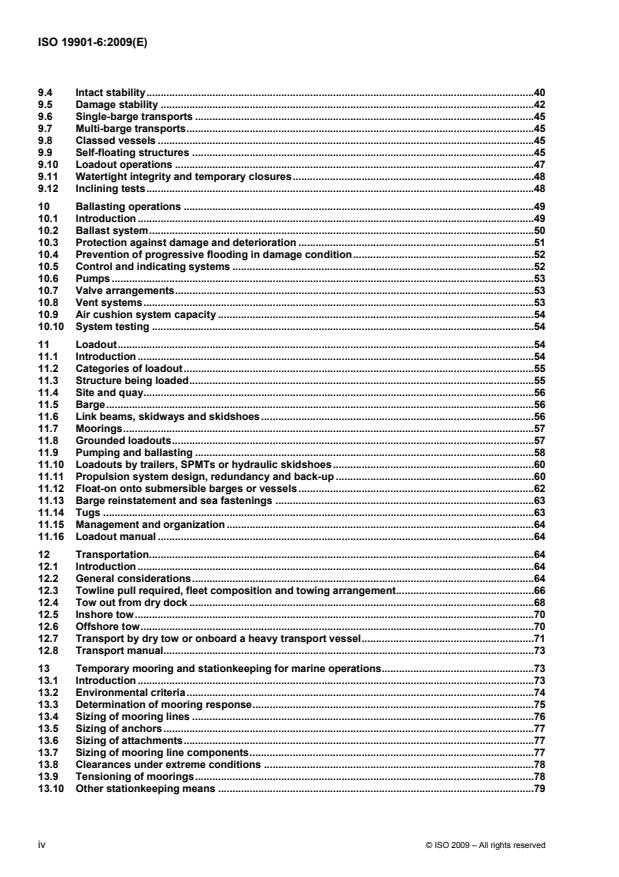
10 Ballasting operations .49
10.1 Introduction.49
10.2 Ballast system.50
10.3 Protection against damage and deterioration .51
10.4 Prevention of progressive flooding in damage condition.52
10.5 Control and indicating systems .52
10.6 Pumps .53
10.7 Valve arrangements.53
10.8 Vent systems.53
10.9 Air cushion system capacity .54
10.10 System testing .54
11 Loadout.54
11.1 Introduction.54
11.2 Categories of loadout.55
11.3 Structure being loaded.55
11.4 Site and quay.56
11.5 Barge.56
11.6 Link beams, skidways and skidshoes.56
11.7 Moorings.57
11.8 Grounded loadouts.57
11.9 Pumping and ballasting .58
11.10 Loadouts by trailers, SPMTs or hydraulic skidshoes.60
11.11 Propulsion system design, redundancy and back-up .60
11.12 Float-on onto submersible barges or vessels .62
11.13 Barge reinstatement and sea fastenings .63
11.14 Tugs .63
11.15 Management and organization.64
11.16 Loadout manual .64
12 Transportation.64
12.1 Introduction.64
12.2 General considerations.64
12.3 Towline pull required, fleet composition and towing arrangement.66
12.4 Tow out from dry dock .68
12.5 Inshore tow.70
12.6 Offshore tow.70
12.7 Transport by dry tow or onboard a heavy transport vessel.71
12.8 Transport manual.73
13 Temporary mooring and stationkeeping for marine operations.73
13.1 Introduction.73
13.2 Environmental criteria.74
13.3 Determination of mooring response.75
13.4 Sizing of mooring lines .76
13.5 Sizing of anchors.77
13.6 Sizing of attachments.77
13.7 Sizing of mooring line components.77
13.8 Clearances under extreme conditions .78
13.9 Tensioning of moorings.78
13.10 Other stationkeeping means .79
iv © ISO 2009 – All rights reserved
14 Construction and outfitting afloat .79
14.1 Introduction.79
14.2 Structural strength and stresses .80
14.3 Construction spread .81
14.4 Welding.82
15 Float-over topsides installation .82
15.1 Introduction.82
15.2 Environmental considerations.82
15.3 Structural considerations.82
15.4 Clearances .83
15.5 Guidance systems for topsides set-down .84
15.6 Operational aspects .85
15.7 Float-over manual.87
16 Pre-laid mooring including foundation .87
16.1 Introduction.87
16.2 Installation planning.88
16.3 Fluke anchor installation .90
16.4 Plate anchor installation.91
16.5 Suction anchor installation .91
16.6 Anchor pile installation.93
16.7 Gravity anchor installation .94
16.8 Mooring system connectors .95
16.9 Chain.95
16.10 Steel wire rope .96
16.11 Synthetic fibre rope.97
16.12 TLP tendons.98
16.13 Mooring installation manual.99
17 Offshore installation operations .99
17.1 Introduction.99
17.2 Installation site .99
17.3 Actions on and motions of floating units .99
17.4 Systems and equipment .100
17.5 Launching.100
17.6 Float-off .102
17.7 Upending .103
17.8 Ballasting.104
17.9 Lifting and lowering by external means.104
17.10 Lowering by ballasting.105
17.11 Precise positioning on the sea floor by active and passive means.106
17.12 Skirt penetration .107
17.13 Underbase grouting .108
17.14 Piling.109
17.15 Attachment to pre-laid mooring system .111
17.16 Connection to a tendon system.112
17.17 Offshore completion .113
17.18 Installation manual .114
18 Lifting operations .114
18.1 Introduction.114
18.2 Rigging geometry .115
18.3 Actions and action effects.115
18.4 Strengths of slings, grommets and shackles.124
18.5 Design verifications .132
18.6 Lift point design.136
18.7 Clearances .137
18.8 Bumpers and guides .139
18.9 Heave compensated lifts .141
18.10 Lifts using DP .141
18.11 Practical considerations.141
18.12 Lifting operation manual.142
19 Decommissioning and removal.143
19.1 Introduction.143
19.2 Removal planning.143
19.3 Preparation for removal .146
19.4 Removal .147
19.5 Transportation and disposal .149
19.6 Site clearance.149
Annex A (informative) Additional information and guidance .150
A.1 General.150
A.2 Guidance for 6.6.2: Required or recommended documentation .150
A.3 Guidance for 11.16: Loadout manual .152
A.4 Guidance for 12.8: Transport manual.154
A.5 Guidance for 17.18: Installation manual.155
A.6 Guidance for 18.8.4: Bumper and guide loads .156
Annex B (informative) Regional information .160
B.1 Introduction.160
B.2 Canada .160
Bibliography .164
vi © ISO 2009 – All rights reserved
Foreword
ISO (the International Organization for Standardization) is a worldwide federation of national standards bodies
(ISO member bodies). The work of preparing International Standards is normally carried out through ISO
technical committees. Each member body interested in a subject for which a technical committee has been
established has the right to be represented on that committee. International organizations, governmental and
non-governmental, in liaison with ISO, also take part in the work. ISO collaborates closely with the
International Electrotechnical Commission (IEC) on all matters of electrotechnical standardization.
International Standards are drafted in accordance with the rules given in the ISO/IEC Directives, Part 2.
The main task of technical committees is to prepare International Standards. Draft International Standards
adopted by the technical committees are circulated to the member bodies for voting. Publication as an
International Standard requires approval by at least 75 % of the member bodies casting a vote.
Attention is drawn to the possibility that some of the elements of this document may be the subject of patent
rights. ISO shall not be held responsible for identifying any or all such patent rights.
ISO 19901-6 was prepared by Technical Committee ISO/TC 67, Materials, equipment and offshore structures
for petroleum, petrochemical and natural gas industries, Subcommittee SC 7, Offshore structures.
ISO 19901 consists of the following parts, under the general title Petroleum and natural gas industries —
Specific requirements for offshore structures:
⎯ Part 1: Metocean design and operating considerations
⎯ Part 2: Seismic design procedures and criteria
⎯ Part 4: Geotechnical and foundation design considerations
⎯ Part 5: Weight control during engineering and construction
⎯ Part 6: Marine operations
⎯ Part 7: Stationkeeping systems for floating offshore structures and mobile offshore units
The following part is under preparation:
⎯ Part 3: Topsides structure
ISO 19901 is one of a series of International Standards for offshore structures. The full series consists of the
following:
⎯ ISO 19900, Petroleum and natural gas industries — General requirements for offshore structures
⎯ ISO 19901 (all parts), Petroleum and natural gas industries — Specific requirements for offshore
structures
⎯ ISO 19902, Petroleum and natural gas industries — Fixed steel offshore structures
⎯ ISO 19903, Petroleum and natural gas industries — Fixed concrete offshore structures
⎯ ISO 19904-1, Petroleum and natural gas industries — Floating offshore structures — Part 1: Monohulls,
semi-submersibles and spars
⎯ ISO 19905-1, Petroleum and natural gas industries — Site-specific assessment of mobile offshore
1)
units — Part 1: Jack-ups
⎯ ISO/TR 19905-2, Petroleum and natural gas industries — Site-specific assessment of mobile offshore
1)
units — Part 2: Jack-ups commentary
1)
⎯ ISO 19906, Petroleum and natural gas industries — Arctic offshore structures
1) Under preparation.
viii © ISO 2009 – All rights reserved
Introduction
The series of International Standards applicable to types of offshore structure, ISO 19900 to ISO 19906,
constitutes a common basis covering those aspects that address design requirements and assessments of all
offshore structures used by the petroleum, petrochemical and natural gas industries worldwide. Through their
application, the intention is to achieve reliability levels appropriate for manned and unmanned offshore
structures, whatever the type of structure and the nature or combination of materials used.
It is important to recognize that structural integrity is an overall concept comprising models for describing
actions, structural analysis, design rules, safety elements, workmanship, quality control procedures and
national requirements, all of which are mutually dependent. The modification of one aspect of design in
isolation can disturb the balance of reliability inherent in the overall concept or structural system. It is
necessary, therefore, to consider the implications involved in modifications in relation to the overall reliability of
offshore structural systems.
The series of International Standards applicable to types of offshore structure is intended to provide a wide
latitude in the choice of structural configuration, material and techniques without hindering innovation. Sound
engineering judgment is, therefore, necessary in the use of these International Standards.
This part of ISO 19901 was developed to provide requirements and guidance for the planning, engineering
and safe execution of marine operations for all types of offshore structures except for drilling rigs, pipe-laying
barges and diving support vessels. Marine operations for offshore structures are parts of the construction,
transportation and installation phases when the structure is at risk from the marine environment. Marine
operations can extend to decommissioning, redeployment, removal, etc.
This part of ISO 19901 describes the principles of and provides requirements and guidance for marine
operations associated with fixed and floating offshore structures, from the point of view of planning,
engineering, implementation and documentation. Alternative requirements, methods and provisions can fulfil
the intention of this part of ISO 19901 and may be applied, provided it can be demonstrated that they achieve
at least the same level of confidence. The overall objective of this part of ISO 19901 is to ensure that marine
operations are conducted within defined and recognized safety/confidence levels, wherever they are
performed. Additional standards, codes and guidelines should also be taken into account, where applicable.
Special attention should be paid to national regulations governing the area in which the marine operations are
performed.
It is not the intent of this part of ISO 19901 to govern the design of structures, systems and components used
in marine operations, beyond the principles given. Recognized codes and standards are normally accepted as
the basis for the detailed design and the fabrication requirements of such components.
Annex A provides some background and some additional information to the main body of the document and it
is intended that it be read in conjunction with the main body of the document.
Annex B provides regional information on the application of the document to certain specific offshore areas.
INTERNATIONAL STANDARD ISO 19901-6:2009(E)
Petroleum and natural gas industries — Specific requirements
for offshore structures —
Part 6:
Marine operations
1 Scope
This part of ISO 19901 provides requirements and guidance for the planning and engineering of marine
operations, encompassing the design and analysis of the components, systems, equipment and procedures
required to perform marine operations, as well as the methods or procedures developed to carry them out
safely.
This part of ISO 19901 is applicable to marine operations for offshore structures including
⎯ steel and concrete gravity base structures (GBS);
⎯ piled steel structures and compliant towers;
⎯ tension leg platforms (TLP);
⎯ deep draught floaters (DDF), including spars or deep draught caisson vessels (DDCV);
⎯ floating production semi-submersibles (FPSS);
⎯ floating production, storage and offloading vessels (FPSO);
⎯ other types of floating production systems (FPS);
⎯ mobile offshore units (MOU);
⎯ topsides and components of any of the above;
⎯ subsea templates and similar structures;
⎯ gravity, piled, drag embedded and suction or other anchors;
⎯ tendon foundations;
⎯ associated mooring systems.
This document is also applicable to modifications of existing structures, e.g. installation of additional topsides
modules.
This part of ISO 19901 is not applicable to the following marine operations:
a) construction activities, e.g. in a fabrication yard onshore, where there is no exposure to the marine
environment;
b) drilling, processing and petrochemical activities;
c) routine marine activities during the service life of the structure;
d) drilling from mobile offshore drilling units (MODU);
e) installation of pipelines, flowlines, risers and umbilicals;
f) diving.
2 Normative references
The following referenced documents are indispensable for the application of this document. For dated
references, only the edition cited applies. For undated references, the latest edition of the referenced
document (including any amendments) applies.
ISO 19900:2002, Petroleum and natural gas industries — General requirements for offshore structures
ISO 19901-1:2005, Petroleum and natural gas industries — Specific requirements for offshore structures —
Part 1: Metocean design and operating considerations
ISO 19901-4:2003, Petroleum and natural gas industries — Specific requirements for offshore structures —
Part 4: Geotechnical and foundation design considerations
ISO 19901-7:2005, Petroleum and natural gas industries — Specific requirements for offshore structures —
Part 7: Stationkeeping systems for floating offshore structures and mobile offshore units
ISO 15544, Petroleum and natural gas industries — Offshore production installations — Requirements and
guidelines for emergency response
ISO 17776, Petroleum and natural gas industries — Offshore production installations — Guidelines on tools
and techniques for hazard identification and risk assessment
IMCA M 179, Guidance on the Use of Cable Laid Slings and Grommets. The International Marine Contractors
Association
3 Terms and definitions
For the purposes of this document, the terms and definitions given in ISO 19900, ISO 19901-1, ISO 19901-4,
ISO 19901-7 and ISO 19904-1 and the following apply.
[28]
NOTE Other terms and definitions relevant for the use of this part of 19901 are also found in ISO 19901-5 ,
[29] [35] [30]
ISO 19902 , ISO 19903 and ISO 19904-1 .
3.1
action
external load applied to the structure (direct action) or an imposed deformation or acceleration (indirect action)
EXAMPLE An imposed deformation can be caused by fabrication tolerances, settlement, temperature change or
moisture variation.
NOTE An earthquake typically generates imposed accelerations.
[ISO 19900:2002, 2.1]
3.2
action effect
effect of actions on structural components
EXAMPLE Internal forces, moments, stresses, strains, rigid body motions or elastic deformations.
[ISO 19904-1:2006, 3.5]
2 © ISO 2009 – All rights reserved
3.3
air cushion
air pumped into underbase compartments of the structure
NOTE Normally applied in order to reduce the draught and increase the freeboard and/or to alter the structural
loading.
[ISO 19903:2006, 3.10]
3.4
assembly
designed and fabricated group of bulk and equipment items that form one unit
[ISO 19901-5:2003, 3.1.1]
3.5
ballast
variable solid or fluid content in order to change the draught, stability, trim and/or heel of a structure afloat
NOTE Adapted from ISO 19901-5:2003, 3.1.2.
3.6
ballast system
system used to change the draught, stability, trim and/or heel of a structure afloat
3.7
barge
simple floating vessel, normally non-propelled, on which a structure is transported
3.8
basic variable
one of a specified set of variables representing physical quantities that characterize actions, environmental
influences, geometrical quantities or material properties, including soil properties
[ISO 19900:2002, 2.5]
3.9
bending efficiency factor
factor by which the calculated breaking strength of a rope is reduced to take account of the reduction in
strength caused by bending around a shackle, trunnion, padear or crane hook
3.10
bollard pull
towing or manoeuvring action that can be generated by a tug for an indefinite period of time with its propulsion
system running at operational, as opposed to maximum revolutions per minute
NOTE Bollard pull is expressed in kilonewtons.
3.11
bridging document
document that aligns and co-ordinates the requirements and responses of various parties in relation to a
specific aspect of a project
NOTE Commonly used to align and co-ordinate the emergency response procedures for owner and contractors.
3.12
bumper
temporary structure designed to protect structures or modules during the initial fitting stage of an installation
operation
3.13
characteristic value
value assigned to a basic variable associated with a prescribed probability of not being violated by
unfavourable values during some reference period
NOTE The characteristic value is the main representative value. In some design situations, a variable can have two
characteristic values, an upper and a lower value.
[ISO 19900:2002, 2.7]
3.14
CoG envelope
defined constraint volume within which the centre of gravity (CoG) of an assembly or a module shall remain
NOTE Adapted from ISO 19901-5:2003, 3.1.8.
3.15
consequence factor
factor applied to critical structural components in the design of lifting operations to ensure that these
components have an increased factor of safety in relation to the consequence of their failure
NOTE Consequence factors are additional safety factors, applied to critical structural components of the lifted object
over and above the normal safety factors used in a WSD analysis of the lifted object. They are, accordingly, applied to lift
points, their attachments to the object and components in the object supporting lift points. They are not intended for
application to slings, grommets and shackles.
3.16
construction afloat
addition of material or outfitting to the structure while afloat
NOTE Adapted from ISO 19903:2006, 3.17.
3.17
crane vessel
vessel, ship or barge on which lifting equipment is mounted
NOTE For the purpose of this document, this term includes crane barges, crane ships, derrick barges, shear-leg
barges and semi-submersible crane vessels.
3.18
cribbing
arrangement of timber baulks, secured to the deck of the barge or vessel, designed to support the cargo
NOTE Cribbing is generally arranged at strong points of the deck and/or cargo.
3.19
deadweight
total carrying capacity of a floating structure
NOTE 1 This includes cargo weight, deck cargo, snow and ice, marine growth, ballast water, consumables and crew
onboard a floating unit.
NOTE 2 Adapted from ISO 19901-5:2003, 3.1.11.
3.20
deck mating
marine operation in which the platform topsides is floated into position and connected to the support structure
NOTE This operation is normally conducted by ballasting and deballasting of the support structure.
[ISO 19903:2006, 3.18]
4 © ISO 2009 – All rights reserved
----
...
NORME ISO
INTERNATIONALE 19901-6
Première édition
2009-12-15
Industries du pétrole et du gaz naturel —
Exigences spécifiques relatives aux
structures en mer —
Partie 6:
Opérations marines
Petroleum and natural gas industries — Specific requirements for
offshore structures —
Part 6: Marine operations
Numéro de référence
©
ISO 2009
DOCUMENT PROTÉGÉ PAR COPYRIGHT
© ISO 2009
Droits de reproduction réservés. Sauf prescription différente, aucune partie de cette publication ne peut être reproduite ni utilisée sous
quelque forme que ce soit et par aucun procédé, électronique ou mécanique, y compris la photocopie et les microfilms, sans l'accord écrit
de l'ISO à l'adresse ci-après ou du comité membre de l'ISO dans le pays du demandeur.
ISO copyright office
Case postale 56 CH-1211 Geneva 20
Tel. + 41 22 749 01 11
Fax + 41 22 749 09 47
E-mail copyright@iso.org
Web www.iso.org
Version française parue en 2012
Publié en Suisse
ii © ISO 2009 – Tous droits réservés
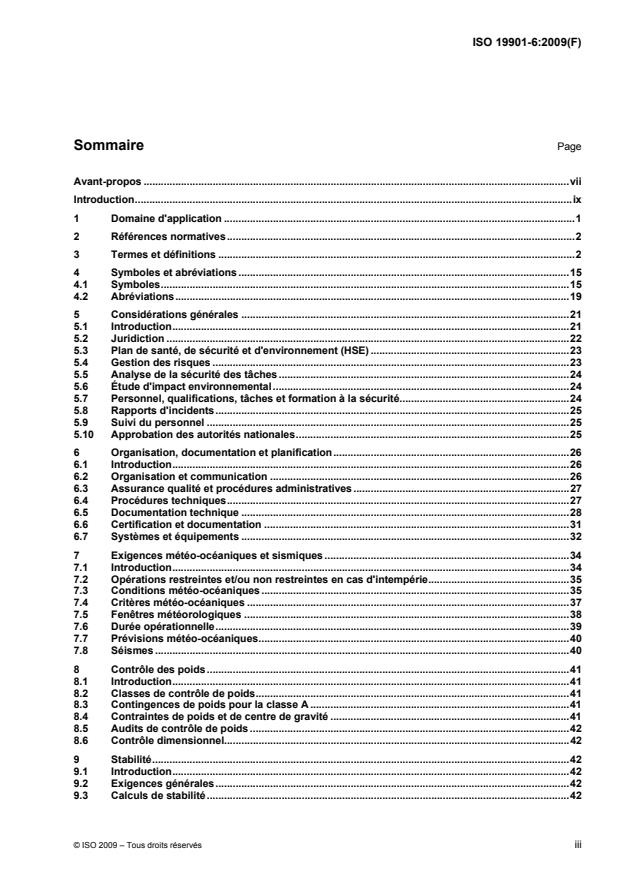
Sommaire Page
Avant-propos . vii
Introduction . ix
1 Domaine d'application . 1
2 Références normatives . 2
3 Termes et définitions . 2
4 Symboles et abréviations . 15
4.1 Symboles . 15
4.2 Abréviations . 19
5 Considérations générales . 21
5.1 Introduction . 21
5.2 Juridiction . 22
5.3 Plan de santé, de sécurité et d'environnement (HSE) . 23
5.4 Gestion des risques . 23
5.5 Analyse de la sécurité des tâches . 24
5.6 Étude d'impact environnemental . 24
5.7 Personnel, qualifications, tâches et formation à la sécurité . 24
5.8 Rapports d'incidents . 25
5.9 Suivi du personnel . 25
5.10 Approbation des autorités nationales . 25
6 Organisation, documentation et planification . 26
6.1 Introduction . 26
6.2 Organisation et communication . 26
6.3 Assurance qualité et procédures administratives . 27
6.4 Procédures techniques . 27
6.5 Documentation technique . 28
6.6 Certification et documentation . 31
6.7 Systèmes et équipements . 32
7 Exigences météo-océaniques et sismiques . 34
7.1 Introduction . 34
7.2 Opérations restreintes et/ou non restreintes en cas d'intempérie . 35
7.3 Conditions météo-océaniques . 35
7.4 Critères météo-océaniques . 37
7.5 Fenêtres météorologiques . 38
7.6 Durée opérationnelle . 39
7.7 Prévisions météo-océaniques . 40
7.8 Séismes . 40
8 Contrôle des poids . 41
8.1 Introduction . 41
8.2 Classes de contrôle de poids . 41
8.3 Contingences de poids pour la classe A . 41
8.4 Contraintes de poids et de centre de gravité . 41
8.5 Audits de contrôle de poids . 42
8.6 Contrôle dimensionnel . 42
9 Stabilité . 42
9.1 Introduction . 42
9.2 Exigences générales . 42
9.3 Calculs de stabilité . 42
9.4 Stabilité intacte .43
9.5 Stabilité après avarie .45
9.6 Transports sur barges simples .48
9.7 Transports sur barges multiples .48
9.8 Navires classés .48
9.9 Structures auto-flottantes .48
9.10 Opérations de chargement .50
9.11 Fermetures temporaires et fermetures d'intégrité étanches à l'eau .51
9.12 Essais d'inclinaison .51
10 Opérations de ballastage .52
10.1 Introduction .52
10.2 Système de ballast .53
10.3 Protection contre les avaries et les détériorations .55
10.4 Prévention de l'envahissement progressif en condition d'avarie .55
10.5 Systèmes de commande et d'indication .55
10.6 Pompes .56
10.7 Disposition des vannes .57
10.8 Systèmes d'évent .57
10.9 Capacité du système de coussin d'air .57
10.10 Essais de systèmes .58
11 Chargement .58
11.1 Introduction .58
11.2 Catégories de chargement .59
11.3 Structure en cours de chargement .59
11.4 Site et quai .59
11.5 Barge .60
11.6 Poutres de liaison, voies et patins de berceau .60
11.7 Ancrages .61
11.8 Chargements par échouage .61
11.9 Pompage et ballastage .62
11.10 Chargement par remorques, SPMT ou patins hydrauliques .64
11.11 Conception, redondance et secours du système de propulsion .64
11.12 Chargement par flottaison sur des barges submersibles ou des navires .66
11.13 Renouvellement de la certification des barges et saisines .68
11.14 Remorqueurs .68
11.15 Gestion et organisation .68
11.16 Manuel de chargement .69
12 Transport .69
12.1 Introduction .69
12.2 Considérations générales .69
12.3 Traction requise du câble de remorque, composition de la flotte et installation de
remorquage .71
12.4 Remorque à partir d'une cale sèche .74
12.5 Remorquage côtier .75
12.6 Remorquage en mer .76
12.7 Transport par remorquage à sec ou à bord d'un navire de transport .77
12.8 Manuel de transport .79
13 Ancrage temporaire et maintien en position pendant les opérations maritimes .79
13.1 Introduction .79
13.2 Critères environnementaux .80
13.3 Détermination de la réponse des ancrages .81
13.4 Dimensionnement des lignes d'ancrage .82
13.5 Dimensionnement des ancres .83
13.6 Dimensionnement des attaches .83
13.7 Dimensionnement des composants des lignes d'ancrage .84
13.8 Dégagements en conditions extrêmes .84
13.9 Mise sous tension des ancrages .85
13.10 Autres moyens de maintien en position .85
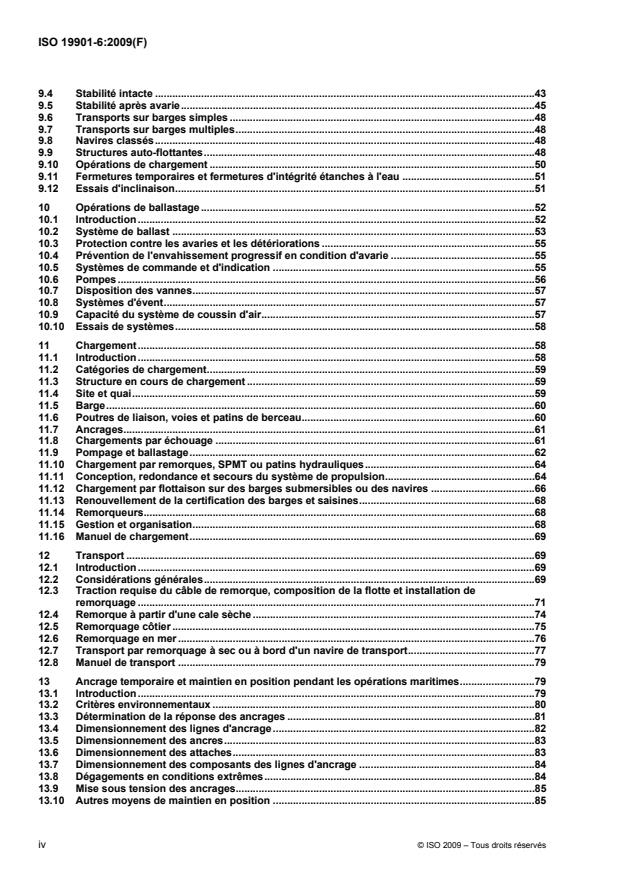
iv © ISO 2009 – Tous droits réservés
14 Construction et armement à flot . 86
14.1 Introduction . 86
14.2 Résistance et contraintes structurelles . 87
14.3 Tronçon de construction . 88
14.4 Soudage . 89
15 Installation des superstructures à flot . 89
15.1 Introduction . 89
15.2 Aspects environnementaux . 89
15.3 Considérations structurelles . 89
15.4 Dégagements . 90
15.5 Systèmes de guidage pour la dépose des superstructures . 91
15.6 Aspects opérationnels . 92
15.7 Manuel de transfert par flottaison . 94
16 Ancrage pré-posé incluant les fondations . 94
16.1 Introduction . 94
16.2 Planification de l'installation . 95
16.3 Installation des ancres à pattes . 98
16.4 Installation des plaques d'ancrage . 98
16.5 Installation des ancres à succion . 99
16.6 Installation des pieux d'ancrage . 100
16.7 Installation des ancres gravitaires . 102
16.8 Connecteurs du système d'ancrage . 102
16.9 Chaîne . 103
16.10 Câbles en acier . 104
16.11 Câbles en fibres synthétiques . 105
16.12 Tendons de TLP . 106
16.13 Manuel d'installation des ancrages . 107
17 Opération d'installation en mer . 107
17.1 Introduction . 107
17.2 Site d'installation . 107
17.3 Actions sur les unités flottantes et mouvements . 108
17.4 Systèmes et équipements . 108
17.5 Lancement . 109
17.6 Déchargement par flottaison . 110
17.7 Redressement . 111
17.8 Ballastage . 112
17.9 Levage et descente par des moyens externes . 113
17.10 Descente par ballastage . 114
17.11 Positionnement précis sur le fond marin par des moyens actifs et passifs . 115
17.12 Pénétration des jupes . 116
17.13 Cimentage au-dessous de la base . 117
17.14 Réalisation des pieux . 118
17.15 Attache au système d'ancrage pré-posé . 120
17.16 Connexion à un système de tendons . 121
17.17 Achèvement de l'installation en mer . 122
17.18 Manuel d’installation . 123
18 Opérations de levage . 123
18.1 Introduction . 123
18.2 Géométrie du gréement . 125
18.3 Actions et effets des actions . 125
18.4 Résistances des élingues, estropes et manilles . 134
18.5 Vérifications de la conception . 144
18.6 Conception des points de levage . 147
18.7 Dégagements . 149
18.8 Butoirs et guides . 151
18.9 Levages compensés par le pilonnement . 153
18.10 Levage utilisant le positionnement dynamique . 154
18.11 Considérations d’ordre pratique . 154
18.12 Manuel de l'opération de levage. 155
19 Mise hors service et enlèvement . 155
19.1 Introduction . 155
19.2 Planification de l'enlèvement . 156
19.3 Préparation à l'enlèvement . 159
19.4 Enlèvement . 160
19.5 Transport et évacuation . 162
19.6 Dégagement du site . 162
Annex A (informative) Additional information and guidance . 163
A.1 General . 163
A.2 Guidance for 6.6.2: Required or recommended documentation . 163
A.3 Guidance for 11.16: Loadout manual. 165
A.4 Guidance for 12.8: Transport manual . 167
A.5 Guidance for 17.18: Installation manual . 168
A.6 Guidance for 18.8.4: Bumper and guide loads . 169
Annex B (informative) Regional information . 173
B.1 Introduction . 173
B.2 Canada . 173
Bibliographie . 177
vi © ISO 2009 – Tous droits réservés
Avant-propos
L'ISO (Organisation internationale de normalisation) est une fédération mondiale d'organismes nationaux de
normalisation (comités membres de l'ISO). L'élaboration des Normes internationales est en général confiée
aux comités techniques de l'ISO. Chaque comité membre intéressé par une étude a le droit de faire partie du
comité technique créé à cet effet. Les organisations internationales, gouvernementales et non
gouvernementales, en liaison avec l'ISO participent également aux travaux. L'ISO collabore étroitement avec
la Commission électrotechnique internationale (CEI) en ce qui concerne la normalisation électrotechnique.
Les Normes internationales sont rédigées conformément aux règles données dans les Directives ISO/CEI,
Partie 2.
La tâche principale des comités techniques est d'élaborer les Normes internationales. Les projets de Normes
internationales adoptés par les comités techniques sont soumis aux comités membres pour vote. Leur
publication comme Normes internationales requiert l'approbation de 75 % au moins des comités membres
votants.
L'attention est appelée sur le fait que certains des éléments du présent document peuvent faire l'objet de
droits de propriété intellectuelle ou de droits analogues. L'ISO ne saurait être tenue pour responsable de ne
pas avoir identifié de tels droits de propriété et averti de leur existence.
L'ISO 19901-6 a été élaborée par le comité technique ISO/TC 67, Matériel, équipement et structures en mer
pour les industries pétrolière, pétrochimique et du gaz naturel, sous-comité SC 7, Structures en mer.
L'ISO 19901 comprend les parties suivantes, présentées sous le titre général Industries du pétrole et du gaz
naturel — Exigences spécifiques relatives aux structures en mer:
Partie 1 : Dispositions océano-météorologiques pour la conception et l'exploitation
Partie 2 : Procédures de conception et critères sismiques
Partie 4 : Bases conceptuelles des fondations
Partie 5 : Contrôles des poids durant la conception et la fabrication
Partie 6 : Opérations maritimes
Partie 7 : Systèmes de maintien en position des structures en mer flottantes et des unités mobiles en mer
La partie suivante est en cours de préparation :
Partie 3 : Superstructures
L’ISO 19901 fait partie d’une série de Normes internationales sur les structures en mer. La série comprend les
normes suivantes :
ISO 19900, Industries du pétrole et du gaz naturel — Exigences générales pour les structures en mer
ISO 19901 (toutes les parties), Industries du pétrole et du gaz naturel — Exigences spécifiques relatives
aux structures en mer
ISO 19902, Industries du pétrole et du gaz naturel — Structures en mer fixes en acier
ISO 19903, Industries du pétrole et du gaz naturel — Structures en mer fixes en béton
ISO 19904-1, Industries du pétrole et du gaz naturel — Structures en mer flottantes — Partie 1 : Unités
monocoques, unités semi-submersibles et unités spars
ISO 19905-1, Industries du pétrole et du gaz naturel – Évaluation spécifique au site d'unités mobiles en
1)
mer — Partie 1 : Plates-formes auto-élévatrices
ISO/TR 19905-2, Industries du pétrole et du gaz naturel — Évaluation spécifique au site d'unités mobiles
1)
en mer — Partie 2 : Compléments sur les plates-formes auto-élévatrices
1)
ISO 19906, Industries du pétrole et du gaz naturel — Structures arctiques en mer
1) En préparation.
viii © ISO 2009 – Tous droits réservés
Introduction
La série de Normes internationales applicables aux types de structures en mer, de l’ISO 19900 à l’ISO 19906,
constitue une base commune couvrant les aspects traitant des exigences de conception et de l’évaluation de
l’ensemble des structures en mer utilisées par les industries du pétrole, de la pétrochimie et du gaz naturel
dans le monde entier. Par leur application, l’objectif est d’obtenir des niveaux de fiabilité adaptés aux
structures en mer habitées et non habitées, quels que soient le type de structure et la nature ou la
combinaison de matériaux utilisés.
Il est important d’admettre que l’intégrité structurelle représente un concept global comprenant des modèles
de description d’actions, des analyses structurelles, des règles de conception, des éléments de sécurité, la
réalisation, des procédures de contrôle qualité et des exigences nationales qui sont interdépendants. La
modification isolée d’un aspect de conception peut perturber l’équilibre de fiabilité inhérent au concept global
ou au système structurel. Il est donc nécessaire de considérer les implications des modifications par rapport à
la fiabilité globale des systèmes de structures en mer.
La série de Normes internationales applicables aux types de structures en mer a pour objectif de donner toute
latitude en ce qui concerne le choix des configurations structurelles, des matériaux et des techniques sans
entraver l'innovation. L'utilisation de ces normes internationales nécessite donc une bonne appréciation en
matière d’ingénierie.
La présente partie de l'ISO 19901 a été élaborée pour fournir des exigences et des lignes directrices pour la
planification, l'ingénierie et l'exécution sûre des opérations maritimes pour tous les types de structures en mer,
à l'exception des appareils de forage, des barges de pose et des navires de soutien à la plongée. Les
opérations maritimes sur les structures en mer font partie intégrante des phases de construction, de transport
et d'installation lorsque la structure présente un risque pour l'environnement marin. Les opérations maritimes
peuvent s'étendre à la mise hors service, au redéploiement, à l'enlèvement, etc.
La présente partie de l'ISO 19901 décrit les principes et fournit les exigences et les lignes directrices
concernant les opérations maritimes associées aux structures en mer flottantes et fixes, du point de vue de la
planification, de l'ingénierie, de la mise en œuvre et de la documentation. D'autres exigences, méthodes et
dispositions peuvent atteindre l'objectif de la présente partie de l'ISO 19901 et être appliquées, à condition de
pouvoir démontrer qu'elles atteignent le même niveau de confiance. L'objectif global de la présente partie de
l'ISO 19901 est de s'assurer que les opérations maritimes sont exécutées à des niveaux de confiance/sécurité
définis et reconnus, quel que soit leur lieu d'exécution. Le cas échéant, il convient également de tenir compte
de normes, codes et lignes directrices complémentaires. Il convient de prêter une attention particulière à la
règlementation nationale régissant la zone d'exécution des opérations maritimes.
La présente partie de l'ISO 19901 n'a pas pour but de régir la conception des structures, systèmes et
composants utilisés dans les opérations maritimes, au-delà des principes énoncés. Les normes et codes
reconnus servent normalement de base pour les exigences de conception et de fabrication détaillées de ces
composants.
L'Annexe A fournit un contexte et des informations complémentaires qui sont destinées à être lues
conjointement au corps principal du document.
L'Annexe B fournit des informations régionales relatives à l'application du document à certaines zones
spécifiques en mer.
NORME INTERNATIONALE ISO 19901-6:2009(F)
Industries du pétrole et du gaz naturel — Exigences spécifiques
relatives aux structures en mer —
Partie 6:
Opérations marines
1 Domaine d'application
La présente partie de l'ISO 19901 fournit des exigences et des lignes directrices pour la planification et
l'ingénierie des opérations maritimes, englobant la conception et l'analyse des composants, systèmes,
équipements et modes opératoires requis pour les opérations maritimes, ainsi que les méthodes et modes
opératoires développés pour les exécuter en toute sécurité.
La présente partie de l'ISO 19901 est applicable aux opératoires maritimes sur les structures en mer incluant :
les structures gravitaires (GBS) en acier et en béton ;
les structures en béton sur pieux et les tours flexibles ;
les plates-formes à ancrage tendu (TLP) ;
les flotteurs à tirant d'eau profond (DDF), y compris les spars ou les structures en caisson à tirant d'eau
profond (DDCV) ;
les unités semi-submersibles flottantes de production (FPSS) ;
les unités flottantes de production, de stockage et de déchargement (FPSO) ;
les autres types de systèmes de production flottants (FPS) ;
les unités mobiles en mer (MOU) ;
les superstructures et les composants des unités et systèmes susmentionnés ;
les châssis de guidage immergés et les structures similaires ;
les ancres gravitaires, à pieux, flottantes, à succion et autres ;
les fondations à lignes d'ancrage ;
les systèmes d'ancrage associés.
Ce document est également applicable aux modifications apportées aux structures existantes (installation de
modules de superstructure supplémentaires, par exemple).
La présente partie de l'ISO 19901 n'est pas applicable aux opérations maritimes suivantes :
a) les activités de construction (dans un chantier à terre, par exemple) au cours desquelles il n'y a aucune
exposition à l'environnement marin ;
b) les activités de forage, de traitement et pétrochimiques ;
c) les activités maritimes de routine pendant la durée de vie en service de la structure ;
d) les forages réalisés à partir d'unités mobiles de forage en mer (MODU) ;
e) l'installation de pipelines, de lignes de production, de tubes prolongateurs et d'ombilicaux ;
f) la plongée.
2 Références normatives
Les documents de référence suivants sont indispensables pour l'application du présent document. Pour les
références datées, seule l’édition citée s’applique. Pour les références non datées, la dernière édition du
document de référence (y compris les éventuels amendements) s'applique.
ISO 19900:2002, Industries du pétrole et du gaz naturel — Exigences générales pour les structures en mer.
ISO 19901-1:2005, Industries du pétrole et du gaz naturel — Exigences spécifiques relatives aux structures
en mer — Partie 1 : Dispositions océano-météorologiques pour la conception et l'exploitation.
ISO 19901-4:2003, Industries du pétrole et du gaz naturel — Exigences spécifiques relatives aux structures
en mer — Partie 4 : Bases conceptuelles des fondations.
ISO 19901-7:2005, Industries du pétrole et du gaz naturel — Exigences spécifiques relatives aux structures
en mer — Partie 7 : Systèmes de maintien en position des structures en mer flottantes et des unités mobiles
en mer.
ISO 15544, Industries du pétrole et du gaz naturel — Installations de production en mer — Exigences et
lignes directrices en matière d'intervention d'urgence.
ISO 17776, Industries du pétrole et du gaz naturel — Installations des plate-formes en mer — Lignes
directrices relatives aux outils et techniques pour l'identification et l'évaluation des risques.
IMCA M 179, Guidance on the Use of Cable Laid Slings and Grommets. The International Marine Contractors
Association
3 Termes et définitions
Pour les besoins du présent document, les termes et définitions donnés dans l'ISO 19900, l'ISO 19901-1,
l'ISO 19901-4, l'ISO 19901-7 et l'ISO 19904-1 ainsi que les suivants s'appliquent.
NOTE D'autres termes et définitions pertinents pour l'utilisation de la présente partie de l'19901 sont également
[28] [29] [35] [30]
donnés dans l'ISO 19901-5 , l'ISO 19902 , l'ISO 19903 et l'ISO 19904-1 .
3.1
action
charge extérieure appliquée à la structure (action directe) ou déformation ou accélération imposée (action
indirecte)
EXEMPLE Une déformation imposée peut être causée par des tolérances de fabrication, un tassement, ou des
variations de température ou d’humidité.
NOTE Un tremblement de terre génère typiquement des accélérations imposées.
[ISO 19900:2002, 2.1]
2 © ISO 2009 – Tous droits réservés
3.2
effet d'une action
effet d’actions sur des composants structurels
EXEMPLE Forces internes, moments, contraintes, déformations, mouvements de corps rigide ou déformations
élastiques.
[ISO 19904-1:2006, 3.5]
3.3
coussin d'air
air pompé dans les compartiments sous la base de la structure
NOTE Normalement appliqué de manière à réduire le tirant d'eau et à augmenter le franc-bord de la structure et/ou à
modifier la charge structurelle.
[ISO 19903:2006, 3.10]
3.4
ensemble
groupe d'éléments en vrac et d'équipements conçus et fabriqués pour ne former qu'une seule unité
[ISO 19901-5:2003, 3.1.1]
3.5
ballast
quantité variable de matière fluide ou solide utilisée pour faire varier le tirant d'eau, la stabilité, l'assiette et/ou
la gîte d'une structure à flot
NOTE Adapté de l'ISO 19901-5:2003, 3.1.2.
3.6
système de ballast
système servant à faire varier le tirant d'eau, la stabilité, l'assiette et/ou la gîte d'une structure à flot
3.7
barge
support flottant simple, normalement non propulsé, sur lequel est transportée une structure
3.8
variable de base
ensemble de variables pouvant se rapporter aux grandeurs physiques qui caractérisent les actions, les
incidences de l’environnement, les quantités géométriques ou les propriétés des matériaux, y compris les
propriétés des sols
[ISO 19900:2002, 2.5]
3.9
coefficient d'efficacité de flexion
coefficient utilisé pour réduire la résistance à la rupture calculée d'un câble afin de tenir compte de la baisse
de résistance due à la flexion autour d'une manille, d'un tourillon, d'une oreille ou d'un crochet de grue
3.10
capacité de traction
action de remorquage ou de manœuvre qui peut être générée sur une période indéfinie par un remorqueur
dont le système de propulsion fonctionne à la vitesse opérationnelle, par opposition au régime maximal
NOTE La capacité de traction est exprimée en kilonewtons.
3.11
document de synthèse
document utilisé pour aligner et coordonner les exigences et réponses des différentes parties concernant un
aspect spécifique d'un projet
NOTE Couramment utilisé pour aligner et coordonner les procédures de réponse aux situations d'urgence du
propriétaire et des sous-traitants.
3.12
butoir
structure temporaire destinée à protéger les structures ou modules lors de la phase de montage initiale d'une
opération d'installation
3.13
valeur caractéristique
valeur donnée à une variable de base respectant une probabilité prédéfinie pour les valeurs défavorables
susceptibles d'être rencontrées pendant une certaine période de référence
NOTE La valeur caractéristique à retenir est la valeur la plus représentative. Pour certaines situations rencontrées,
une variable peut avoir deux valeurs caractéristiques, une valeur haute et une valeur basse.
[ISO 19900:2002, 2.7]
3.14
enveloppe de CG
volume contraint défini dans lequel doit rester le centre de gravité (CG) d'un ensemble ou d'un module
NOTE Adapté de l'ISO 19901-5:2003, 3.1.8.
3.15
coefficient de conséquence
facteur appliqué aux composants structurels critiques lors de la conception des opérations de levage pour
s'assurer que ces composants ont un coefficient de sécurité accru par rapport à la conséquence de leur
défaillance
NOTE Les coefficients de conséquence sont des coefficients de sécurité supplémentaires, appliqués aux
composants structurels critiques de l'objet levé, et supérieurs aux coefficients de sécurité normalement utilisés dans une
analyse WSD de l'objet levé. Ils sont donc appliqués aux points de levage, à leurs attaches à l'objet et aux composants
des points de levage supportant l'objet. Ils ne sont pas destinés à être appliqués aux élingues, aux estropes et aux
manilles.
3.16
construction à flot
ajout de matériel ou armement de la structure qui est à flot
NOTE Adapté de l'ISO 19903:2006, 3.17.
3.17
navire-grue
navire, bâtiment ou barge sur lequel sont montés les équipements d
...