

ISO/IEC 25041:2012
(Main)Systems and software engineering — Systems and software Quality Requirements and Evaluation (SQuaRE) — Evaluation guide for developers, acquirers and independent evaluators
General Information
- Abstract
ISO/IEC 25041:2012 provides requirements, recommendations and guidelines for system and software product quality evaluation, for the application of ISO/IEC 25040. Intended audiences of ISO/IEC 25041:2012 are developers, acquirers and independent evaluators of the system and software product. ISO/IEC 25041:2012 is part of ISO/IEC 250nn SQuaRE series of International Standards. It is not limited to any specific application area, and can be used for quality evaluation of any type of system and software product.
- Status
- Published
- Publication Date
- 08-Oct-2012
- Technical Committee
- ISO/IEC JTC 1/SC 7 - Software and systems engineering
- Drafting Committee
- ISO/IEC JTC 1/SC 7 - Software and systems engineering
- Current Stage
- 9093 - International Standard confirmed
- Start Date
- 09-Aug-2024
- Completion Date
- 29-Aug-2026

Overview
ISO/IEC 25041:2012 is an international standard in the SQuaRE family that provides guidance for systems and software quality evaluation. Intended for developers, acquirers and independent evaluators, it supplies requirements, recommendations and practical guidelines to support the application of ISO/IEC 25040 (general evaluation concepts). ISO/IEC 25041:2012 is application‑area neutral and can be used to evaluate the quality of any type of system or software product.
Key Topics
- Evaluation roles and responsibilities: Clarifies expectations for developers, acquirers and independent evaluators, including organizational support and role‑specific activities.
- Evaluation lifecycle: Describes processes to establish evaluation requirements, specify and design evaluations, execute measurements, apply decision criteria, conclude evaluations and report results.
- Quality measures and decision criteria: Guidance on selecting appropriate quality measures (evaluation modules) and defining decision criteria to judge product quality objectively.
- Organization-level requirements: Recommends documentation, process governance and evidence management to support credible, repeatable software quality evaluations.
- Documentation and reporting: Emphasizes structured evaluation records and reports to communicate findings to stakeholders and support disposition of evaluation data.
Keywords: ISO/IEC 25041:2012, SQuaRE, software quality evaluation, evaluation process, quality measures.
Applications
ISO/IEC 25041:2012 is practical for organizations and professionals who need systematic, defensible assessment of product quality:
- Developers: Integrate evaluation planning and measurement into development workflows to validate that software meets quality requirements.
- Acquirers and purchasers: Define evaluation requirements, specify acceptance criteria and verify that procured software satisfies contractual quality obligations.
- Independent evaluators and auditors: Establish impartial evaluation procedures, perform measurements, apply decision criteria and produce formal evaluation reports.
- Quality assurance teams and program managers: Use the standard to standardize evaluation practices across projects, support risk assessment for safety‑ or mission‑critical systems, and improve traceability of quality evidence.
Practical value
Using ISO/IEC 25041:2012 helps organizations achieve consistent, repeatable and transparent software quality evaluations-reducing procurement risk, improving supplier accountability and supporting regulatory or contractual compliance. The standard aligns evaluation activity with the broader SQuaRE framework for requirements, measurement and evaluation.
Related standards
- ISO/IEC 25040 - General requirements and concepts for product quality evaluation (primary companion).
- ISO/IEC 250nn SQuaRE series - Other standards covering quality models, measurement and requirement specification.
Relations
- Effective Date
- 06-Jun-2022
- Revises
ISO/IEC 14598-3:2000 - Software engineering — Product evaluation — Part 3: Process for developers - Effective Date
- 03-Dec-2011
- Effective Date
- 03-Dec-2011
- Revises
ISO/IEC 14598-4:1999 - Software engineering — Product evaluation — Part 4: Process for acquirers - Effective Date
- 03-Dec-2011
- Effective Date
- 07-May-2011
Get Certified
Connect with accredited certification bodies for this standard

BSI Group
BSI (British Standards Institution) is the business standards company that helps organizations make excellence a habit.

BSCIC Certifications Pvt. Ltd.
Established 2006, accredited by NABCB, JAS-ANZ, EIAC, IAS. CDSCO Notified Body.

Intertek India Pvt. Ltd.
Delivers Assurance, Testing, Inspection & Certification since 1993 with 26 labs and 32 offices.
Sponsored listings
Frequently Asked Questions
ISO/IEC 25041:2012 is a standard published by the International Organization for Standardization (ISO). Its full title is "Systems and software engineering — Systems and software Quality Requirements and Evaluation (SQuaRE) — Evaluation guide for developers, acquirers and independent evaluators". This standard covers: ISO/IEC 25041:2012 provides requirements, recommendations and guidelines for system and software product quality evaluation, for the application of ISO/IEC 25040. Intended audiences of ISO/IEC 25041:2012 are developers, acquirers and independent evaluators of the system and software product. ISO/IEC 25041:2012 is part of ISO/IEC 250nn SQuaRE series of International Standards. It is not limited to any specific application area, and can be used for quality evaluation of any type of system and software product.
ISO/IEC 25041:2012 provides requirements, recommendations and guidelines for system and software product quality evaluation, for the application of ISO/IEC 25040. Intended audiences of ISO/IEC 25041:2012 are developers, acquirers and independent evaluators of the system and software product. ISO/IEC 25041:2012 is part of ISO/IEC 250nn SQuaRE series of International Standards. It is not limited to any specific application area, and can be used for quality evaluation of any type of system and software product.
ISO/IEC 25041:2012 is classified under the following ICS (International Classification for Standards) categories: 35.080 - Software. The ICS classification helps identify the subject area and facilitates finding related standards.
ISO/IEC 25041:2012 has the following relationships with other standards: It is inter standard links to ISO 3759:2011, ISO/IEC 14598-3:2000, ISO/IEC 14598-5:1998, ISO/IEC 14598-4:1999, ISO/IEC 14598-6:2001. Understanding these relationships helps ensure you are using the most current and applicable version of the standard.
ISO/IEC 25041:2012 is available in PDF format for immediate download after purchase. The document can be added to your cart and obtained through the secure checkout process. Digital delivery ensures instant access to the complete standard document.
Standards Content (Sample)
INTERNATIONAL ISO/IEC
STANDARD 25041
First edition
2012-10-15
Systems and software engineering —
Systems and software Quality
Requirements and Evaluation
(SQuaRE) — Evaluation guide for
developers, acquirers and independent
evaluators
Ingénierie des systèmes et du logiciel — Exigences de qualité et
évaluation des systèmes et du logiciel (SQuaRE) — Guide d'évaluation
pour les développeurs, les acquéreurs et les évaluateurs indépendants
Reference number
©
ISO/IEC 2012
© ISO/IEC 2012
All rights reserved. Unless otherwise specified, no part of this publication may be reproduced or utilized in any form or by any means,
electronic or mechanical, including photocopying and microfilm, without permission in writing from either ISO at the address below or
ISO's member body in the country of the requester.
ISO copyright office
Case postale 56 CH-1211 Geneva 20
Tel. + 41 22 749 01 11
Fax + 41 22 749 09 47
E-mail copyright@iso.org
Web www.iso.org
Published in Switzerland
ii © ISO/IEC 2012 – All rights reserved
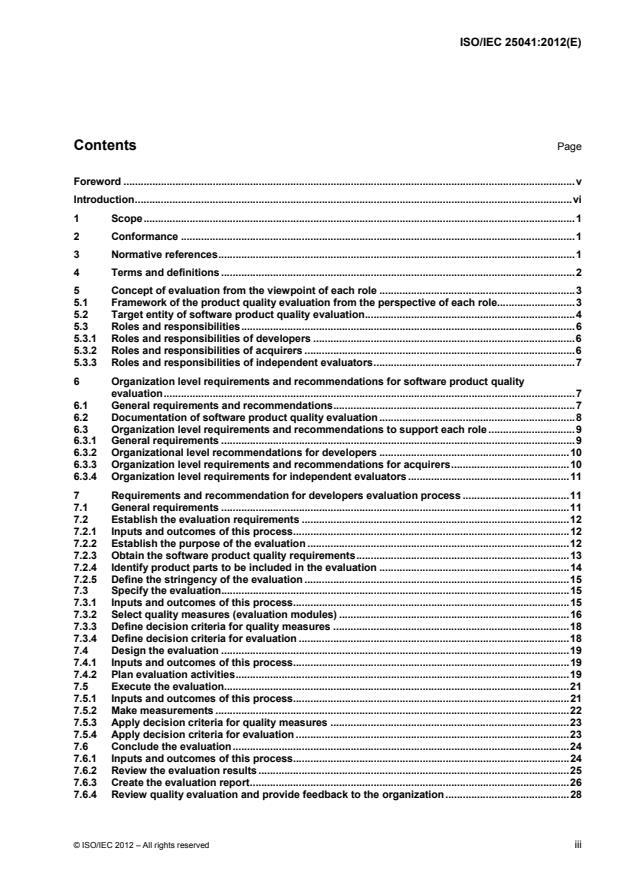
Contents Page
Foreword . v
Introduction . vi
1 Scope . 1
2 Conformance . 1
3 Normative references . 1
4 Terms and definitions . 2
5 Concept of evaluation from the viewpoint of each role . 3
5.1 Framework of the product quality evaluation from the perspective of each role. 3
5.2 Target entity of software product quality evaluation . 4
5.3 Roles and responsibilities . 6
5.3.1 Roles and responsibilities of developers . 6
5.3.2 Roles and responsibilities of acquirers . 6
5.3.3 Roles and responsibilities of independent evaluators . 7
6 Organization level requirements and recommendations for software product quality
evaluation . 7
6.1 General requirements and recommendations . 7
6.2 Documentation of software product quality evaluation . 8
6.3 Organization level requirements and recommendations to support each role . 9
6.3.1 General requirements . 9
6.3.2 Organizational level recommendations for developers . 10
6.3.3 Organization level requirements and recommendations for acquirers . 10
6.3.4 Organization level requirements for independent evaluators . 11
7 Requirements and recommendation for developers evaluation process . 11
7.1 General requirements . 11
7.2 Establish the evaluation requirements . 12
7.2.1 Inputs and outcomes of this process . 12
7.2.2 Establish the purpose of the evaluation . 12
7.2.3 Obtain the software product quality requirements . 13
7.2.4 Identify product parts to be included in the evaluation . 14
7.2.5 Define the stringency of the evaluation . 15
7.3 Specify the evaluation . 15
7.3.1 Inputs and outcomes of this process . 15
7.3.2 Select quality measures (evaluation modules) . 16
7.3.3 Define decision criteria for quality measures . 18
7.3.4 Define decision criteria for evaluation . 18
7.4 Design the evaluation . 19
7.4.1 Inputs and outcomes of this process . 19
7.4.2 Plan evaluation activities . 19
7.5 Execute the evaluation. 21
7.5.1 Inputs and outcomes of this process . 21
7.5.2 Make measurements . 22
7.5.3 Apply decision criteria for quality measures . 23
7.5.4 Apply decision criteria for evaluation . 23
7.6 Conclude the evaluation . 24
7.6.1 Inputs and outcomes of this process . 24
7.6.2 Review the evaluation results . 25
7.6.3 Create the evaluation report . 26
7.6.4 Review quality evaluation and provide feedback to the organization . 28
© ISO/IEC 2012 – All rights reserved iii
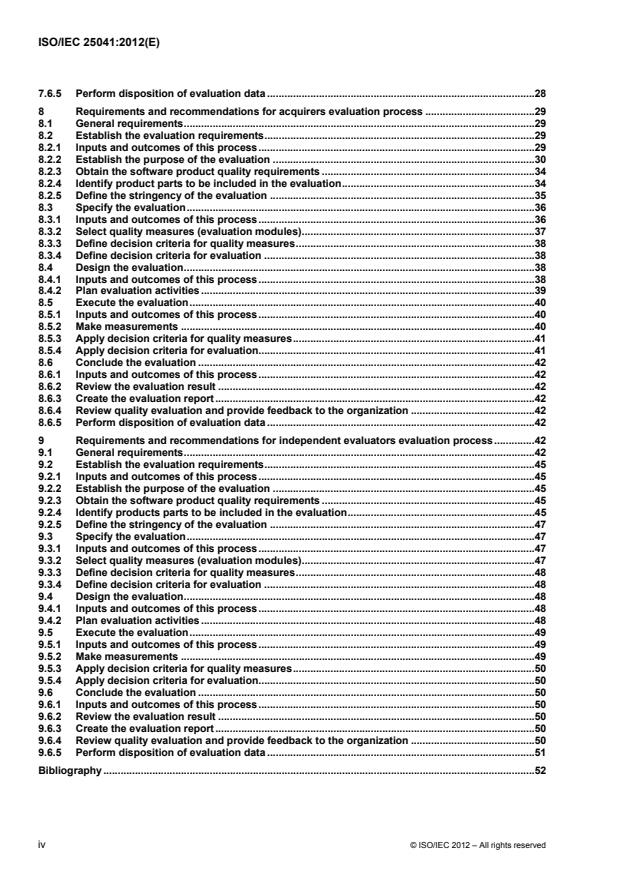
7.6.5 Perform disposition of evaluation data .28
8 Requirements and recommendations for acquirers evaluation process .29
8.1 General requirements .29
8.2 Establish the evaluation requirements .29
8.2.1 Inputs and outcomes of this process .29
8.2.2 Establish the purpose of the evaluation .30
8.2.3 Obtain the software product quality requirements .34
8.2.4 Identify product parts to be included in the evaluation .34
8.2.5 Define the stringency of the evaluation .35
8.3 Specify the evaluation .36
8.3.1 Inputs and outcomes of this process .36
8.3.2 Select quality measures (evaluation modules) .37
8.3.3 Define decision criteria for quality measures .38
8.3.4 Define decision criteria for evaluation .38
8.4 Design the evaluation .38
8.4.1 Inputs and outcomes of this process .38
8.4.2 Plan evaluation activities .39
8.5 Execute the evaluation .40
8.5.1 Inputs and outcomes of this process .40
8.5.2 Make measurements .40
8.5.3 Apply decision criteria for quality measures .41
8.5.4 Apply decision criteria for evaluation.41
8.6 Conclude the evaluation .42
8.6.1 Inputs and outcomes of this process .42
8.6.2 Review the evaluation result .42
8.6.3 Create the evaluation report .42
8.6.4 Review quality evaluation and provide feedback to the organization .42
8.6.5 Perform disposition of evaluation data .42
9 Requirements and recommendations for independent evaluators evaluation process .42
9.1 General requirements .42
9.2 Establish the evaluation requirements .45
9.2.1 Inputs and outcomes of this process .45
9.2.2 Establish the purpose of the evaluation .45
9.2.3 Obtain the software product quality requirements .45
9.2.4 Identify products parts to be included in the evaluation .45
9.2.5 Define the stringency of the evaluation .47
9.3 Specify the evaluation .47
9.3.1 Inputs and outcomes of this process .47
9.3.2 Select quality measures (evaluation modules) .47
9.3.3 Define decision criteria for quality measures .48
9.3.4 Define decision criteria for evaluation .48
9.4 Design the evaluation .48
9.4.1 Inputs and outcomes of this process .48
9.4.2 Plan evaluation activities .48
9.5 Execute the evaluation .49
9.5.1 Inputs and outcomes of this process .49
9.5.2 Make measurements .49
9.5.3 Apply decision criteria for quality measures .50
9.5.4 Apply decision criteria for evaluation.50
9.6 Conclude the evaluation .50
9.6.1 Inputs and outcomes of this process .50
9.6.2 Review the evaluation result .50
9.6.3 Create the evaluation report .50
9.6.4 Review quality evaluation and provide feedback to the organization .50
9.6.5 Perform disposition of evaluation data .51
Bibliography .52
iv © ISO/IEC 2012 – All rights reserved
Foreword
ISO (the International Organization for Standardization) and IEC (the International Electrotechnical
Commission) form the specialized system for worldwide standardization. National bodies that are members of
ISO or IEC participate in the development of International Standards through technical committees
established by the respective organization to deal with particular fields of technical activity. ISO and IEC
technical committees collaborate in fields of mutual interest. Other international organizations, governmental
and non-governmental, in liaison with ISO and IEC, also take part in the work. In the field of information
technology, ISO and IEC have established a joint technical committee, ISO/IEC JTC 1.
International Standards are drafted in accordance with the rules given in the ISO/IEC Directives, Part 2.
The main task of the joint technical committee is to prepare International Standards. Draft International
Standards adopted by the joint technical committee are circulated to national bodies for voting. Publication as
an International Standard requires approval by at least 75 % of the national bodies casting a vote.
Attention is drawn to the possibility that some of the elements of this document may be the subject of patent
rights. ISO and IEC shall not be held responsible for identifying any or all such patent rights.
ISO/IEC 25041 was prepared by Joint Technical Committee ISO/IEC JTC 1, Information technology,
Subcommittee SC 7, Software and systems engineering.
This first edition of ISO/IEC 25041 cancels and replaces ISO/IEC 14598-3:2000, ISO/IEC 14598-4:1999 and
ISO/IEC 14598-5:1998.
© ISO/IEC 2012 – All rights reserved v
Introduction
As the use of information technology grows, the number of critical systems also grows. Such systems include,
for example, security critical, life critical, economically critical and safety critical systems. The quality of
systems and software product of such critical systems is particularly important because software faults may
lead to serious consequences.
Evaluation is the systematic determination of the extent to which an entity meets its specified criteria. The
evaluation of product quality is vital to both the acquisition and development of software. The relative
importance of the various characteristics of software quality depends on the intended usage or objectives of
the system of which the software is a part; products need to be evaluated to decide whether relevant quality
characteristics meet the requirements of the system.
This International Standard is part of the ISO/IEC 250nn SQuaRE series of standards. ISO/IEC 25040
contains general requirements and recommendations for product quality evaluation as well as associated
general concepts. This International Standard provides specific issues related to the developers, acquirers
and independent evaluators based on ISO/IEC 25040.
The general goal of creating the SQuaRE set of standards is to move to a logically organized, enriched and
unified series covering two main processes: software quality requirements specification and software quality
evaluation, supported by a software quality measurement process. The purpose of the SQuaRE set of
standards is to assist those developing and acquiring products with the specification and evaluation of quality
requirements. It establishes criteria for the specification of product quality requirements, their measurement,
and evaluation. It includes a quality model for aligning customer definitions of quality with properties of the
development process. In addition, the series provides recommended measures of product properties that can
be used by developers, acquirers, and independent evaluators.
SQuaRE provides:
terms and definitions;
reference models;
general guide;
individual division guides, and
standards for requirements specification, planning and management, measurement and evaluation
purposes.
SQuaRE includes International Standards on quality modes and measures, as well as on quality requirements
and evaluation.
SQuaRE replaces the current ISO/IEC 9126 series and the ISO/IEC 14598 series.
The SQuaRE series of standards consists of the following divisions under the general title Systems and
software Quality Requirements and Evaluation:
ISO/IEC 2500n - Quality Management Division,
ISO/IEC 2501n - Quality Model Division,
ISO/IEC 2502n - Quality Measurement Division,
vi © ISO/IEC 2012 – All rights reserved
ISO/IEC 2503n - Quality Requirements Division, and
ISO/IEC 2504n - Quality Evaluation Division.
This International Standard is intended to be used in conjunction with the other parts of the SQuaRE series of
standards, and with the ISO/IEC 14598 series and ISO/IEC 9126 series until superseded by the
ISO/IEC 250nn series of standards.
The descriptions in this International Standard are mainly based on the descriptions in ISO/IEC 14598-3,
ISO/IEC 14598-4, and ISO/IEC 14598-5, which will be replaced by this International Standard.
Figure 1 illustrates the organization of the SQuaRE series representing families of standards, further called
Divisions.
Figure 1-Organization of SQuaRE series of International Standards
The Divisions within the SQuaRE model are:
・ISO/IEC 2500n - Quality Management Division. The International Standards that form this division define
all common models, terms and definitions referred to by all other standards from the SQuaRE series.
Referring paths (guidance through SQuaRE documents) and high level practical suggestions in applying
proper standards to specific application cases offer help to all types of users. The division also provides
requirements and guidance for a supporting function which is responsible for the management of product
requirements specification and evaluation.
・ISO/IEC 2501n - Quality Model Division. The International Standard that forms this division presents
detailed quality models for software, quality in use and data. Practical guidance on the use of the quality
model is also provided.
・ISO/IEC 2502n - Quality Measurement Division. The International Standards that form this division include
a product quality measurement reference model, mathematical definitions of quality measures, and practical
© ISO/IEC 2012 – All rights reserved vii
guidance for their application. This division presents internal measures of software quality, external measures
of software product quality and quality in use measures. Measurement primitives forming foundations for the
latter measures are defined and presented.
・ISO/IEC 2503n - Quality Requirements Division. The International Standard that forms this division helps
specifying quality requirements. These quality requirements can be used in the process of quality
requirements elicitation for a product to be developed or as inputs for an evaluation process. The
requirements definition process is mapped to technical processes defined in ISO/IEC 15288:2008.
・ISO/IEC 2504n - Quality Evaluation Division. The International Standards that form this division provide
requirements, recommendations and guidelines for product evaluation, whether performed by independent
evaluators, acquirers or developers. The support for documenting a measure as an Evaluation Module is also
presented.
ISO/IEC 25050 to ISO/IEC 25099 are reserved to be used for SQuaRE extension International Standards
and/or Technical Reports.
This International Standard is part of the 2504n - Quality Evaluation Division that currently consists of the
following International Standards:
・ISO/IEC 25040 - Evaluation process: contains general requirements for specification and evaluation of
software quality and clarifies the general concepts. It provides a process description for evaluating quality of
product and states the requirements for the application of this process. The evaluation process is the basis for
product quality evaluation for different purposes and approaches. Therefore the process can be used for the
evaluation of quality in use, the external measure of software product quality and the internal measure of
software product quality, as well as for the evaluation of the quality of pre-developed software product or
custom software product during its development process.
・ISO/IEC 25041 - Evaluation guide for developers, acquirers and independent evaluators: contains
specific requirements and recommendations for developers, acquirers and independent evaluators.
・ISO/IEC 25045 - Evaluation module for recoverability: provides the specification to evaluate the
subcharacteristics of recoverability defined under the characteristic of reliability of the quality model.
It determines the external measures of software product quality of resiliency and autonomic recovery index
when the information system composed of one or more software products’ execution transactions is subjected
to a series of disturbances. A disturbance could be an operational fault (e.g. an abrupt shutdown of an OS
process that brings down a system) or an event (e.g. a significant increase of users to the system).
ISO/IEC 25040 is a revised version and replaces ISO/IEC 14598-1.
ISO/IEC 25041 is a revised version and replaces ISO/IEC 14598-3, ISO/IEC 14598-4 and
ISO/IEC 14598-5.
The term “product” is used as a simplified term for “systems and software product” throughout this
International Standard.
The term “evaluation process” is used as a simplified term for “product quality evaluation process” throughout
this International Standard.
The term “evaluation report” is used as a simplified term for “product quality evaluation report” and the term
“evaluation plan” is used as a simplified term for “product quality evaluation plan” throughout this International
Standard.
viii © ISO/IEC 2012 – All rights reserved
INTERNATIONAL STANDARD ISO/IEC 25041:2012(E)
Systems and software engineering — Systems and software
Quality Requirements and Evaluation (SQuaRE) — Evaluation
guide for developers, acquirers and independent evaluators
1 Scope
This International Standard provides requirements, recommendations and guidelines for product quality
evaluation specifically for developers, acquirers and independent evaluators. It is not restricted to any specific
application area and can be used for quality evaluation of any type of products.
This International Standard provides a process description for evaluating product quality and states the
specific requirements for the application of the evaluation process from the viewpoint of developers, acquirers
and independent evaluators. The evaluation process can be used for different purposes and approaches. The
process can be used for the evaluation of the quality of pre-developed software, commercial-off-the-shelf
software or custom software and can be used during or after the development process.
This International Standard is intended for those who are responsible for product quality evaluation and is
appropriate for developers, acquirers and independent evaluators of products.
This International Standard is not intended for evaluation of other aspects of products (functional
requirements, process requirements, business requirements, etc.).
2 Conformance
Evaluation of product quality conforms to this International Standard if developers conform to requirements of
Clauses 6 and 7, if acquirers conform to requirements of Clauses 6 and 8, and if independent evaluators
conform to requirements of Clauses 6 and 9.
3 Normative references
The following referenced documents are indispensable for the application of this document. For dated
references, only the edition cited applies. For undated references, the latest edition of the referenced
document (including any amendments) applies.
ISO/IEC 25000, Software Engineering — Software product Quality Requirements and Evaluation
(SQuaRE) — Guide to SQuaRE
ISO/IEC 25001, Software engineering — Software product Quality Requirements and Evaluation
(SQuaRE) — Planning and management
ISO/IEC 25030, Software engineering — Software product Quality Requirements and Evaluation
(SQuaRE) — Quality requirements
ISO/IEC 25040, Systems and software engineering — Systems and software Quality Requirements and
Evaluation (SQuaRE) — Evaluation process
© ISO/IEC 2012 – All rights reserved 1
4 Terms and definitions
For the purposes of this document, the terms and definitions given in ISO/IEC 25000 and the following apply.
4.1
deliverable product
any unique and verifiable system or software product to perform a service, that is subject to approval by the
project sponsor or customer
4.2
dynamic product
system or software product that is measurable during execution in testing and/or operational environment
4.3
evaluation
systematic determination of the extent to which an entity meets its specified criteria
[ISO/IEC 12207:2008]
4.4
evaluation level
rigour to be applied during the evaluation that defines the depth or thoroughness of the evaluation in terms of
evaluation techniques to be applied and evaluation results to be achieved
4.5
evaluation records
documented objective evidence of all activities performed and of all results achieved within the evaluation
process
4.6
evaluation requester
person or organization that requests an evaluation
4.7
evaluation tool
instrument that can be used during evaluation to collect data, to perform interpretation of data or to automate
part of the evaluation
NOTE Examples of such tools are source code analysers to compute code metrics, CASE tools to produce
formalized models, test environment to run the executable programs, checklists to collect inspection data or spreadsheets
to produce syntheses of measures.
4.8
evaluation stringency
degree required for the product quality characteristics and subcharacteristics to fulfil the expected use
criticality of the product
4.9
independent evaluator
individual or organization that performs an evaluation independently from developers and acquirers
NOTE The individual or organization who performs as developer or acquirer for the target system to be evaluated
may not become the independent evaluator for the system. The independent evaluator may be an organization. The
independent evaluator may belong to the same organization as the developer as long as they are independent from
developers and acquirers.
4.10
intermediate product
system or software product of the development process that is used as inputs to other stages of the
development process
2 © ISO/IEC 2012 – All rights reserved
4.11
product quality
degree to which the product satisfies stated and implied needs when used under specified conditions
NOTE This definition differs from the ISO 9000:2005 quality definition because the software quality definition refers to
the satisfaction of stated and implied needs, while the ISO 9000 quality definition refers to the satisfaction of requirements.
[ISO/IEC 25000:2005 definition, rephrased as “degree to which”]
4.12
static product
non-executable system or software product for reviewing
5 Concept of evaluation from the viewpoint of each role
5.1 Framework of the product quality evaluation from the perspective of each role
Developers, acquirers and independent evaluators perform different activities during system product quality
evaluation according to each specific role and the category of the evaluation target entity.
Basically, product quality evaluation process of each role is the same, but the target entity of evaluation is
different according to purposes of the evaluation depending on the requester’s needs.
Figure 2 is the general framework of the product quality evaluation process.
Product quality evaluation is regarded as a system, which is composed of inputs for, outcomes of, constraints
and resources of the evaluation process. They are different for each role and evaluations purpose.
Constraints for
the evaluation
Inputs for
the evaluation
Outcomes of
Evaluation
the evaluation
needs
Evaluation
process
Static
Evaluation
product
report
Dynamic
product
Resources for
the evaluation
Figure 2 — General framework of the product quality evaluation process
The following are the examples of inputs for and outcomes of an evaluation process.
© ISO/IEC 2012 – All rights reserved 3
Inputs for the evaluation process:
-evaluation needs for developers, acquirers and independent evaluators;
-target entities of evaluation such as static products and dynamic products.
NOTE Product quality evaluation needs of each stakeholder, such as developers, acquirers and independent
evaluators, are decided from the viewpoint of each role.
Outcomes of the evaluation are the evaluation report, results of improvement of the evaluation process and
profit.
In this figure, SQuaRE (ISO/IEC 25010, ISO/IEC 25020, ISO/IEC 2502n, ISO/IEC 25030, ISO/IEC 2504n) are
included as resources for the evaluation.
Constraints for the product quality evaluation process can include the following:
a) specific user needs for the evaluation;
b) the evaluation project schedule;
c) the evaluation project budget;
d) the environment used for the evaluation project;
e) the tools and the methods used for the evaluation project;
f) specific requirements for reporting of the evaluation.
Resources for the product quality evaluation process can include the following:
a) applicable measurement tools and method;
b) applicable SQuaRE series of international standard;
c) human resources used for the evaluation;
d) financial resources used for the evaluation;
e) information systems used for the evaluation;
f) knowledge data base used for the quality evaluation.
The software product quality evaluation reference model can be applicable to those responsible for product
quality evaluation. It is intended and appropriate for such organizations, in their role, but not limited to,
developers, acquirers and independent evaluators.
Product quality evaluation can be performed during or after the development process or acquisition process.
5.2 Target entity of software product quality evaluation
The evaluation purpose is different depending on the role of developers, acquirers and independent
evaluators.
The target entity of the evaluation is defined depending on the evaluation purpose.
The target entity of the evaluation is categorized as static products and dynamic products.
Static products, which are either intermediate products or deliverable products, can include the following:
-specification of quality requirements;
-software design specifications;
-program source codes;
4 © ISO/IEC 2012 – All rights reserved
-specification of the test planning;
-specification of result of the testing report;
-explanation of the product;
-operation manuals.
Dynamic products can include the following:
-executable intermediate products, which are being executed during dynamic testing in a testing
environment;
-deliverable products, which are being executed during operation by an operational environment.
Developers review static products at each development stage of the software life cycle, such as design stage,
implementation stage and testing stage in order to evaluate quality of the intermediate product to achieve its
role.
Developers test intermediate dynamic products during unit testing stage and deliverable dynamic products
during system integration testing stage.
NOTE 1 The target entities of the evaluation according to the developer’s viewpoint are static and dynamic
intermediate and/or deliverable products.
Acquirers review the static products at the design stage and testing stage for the purpose of product
acquisition in order to achieve their role.
Acquirers test the dynamic product at the acceptance or operational testing stage.
Acquirers evaluate both the static and dynamic products in order to compare the quality of some candidate
products and to select the higher quality product based on their role.
NOTE 2 The target entities of the evaluation according to the acquirer’s viewpoint are static and dynamic intermediate
and/or deliverable products.
Independent evaluators may review the static products and test the dynamic products in order to evaluate the
quality of the product and make an evaluation report based on their contract with the quality evaluation
requesters.
NOTE 3 The target entities of the evaluation according to the independent evaluator’s viewpoint are static and
dynamic intermediate and/or deliverable products based on the contract with requesters.
Table 1 — Example of target entity of each role
Target entity of the evaluation
Role
Static product Dynamic product
Developers Intermediate and deliverable products for Intermediate and deliverable products for
reviewing testing
Acquirers Quality requirements and design Deliverable products for selection and
documents for reviewing acceptation
deliverable product
Independent Intermediate or deliverable products for Intermediate or deliverable products for
Evaluators reviewing testing
Every kind of evaluation activities can be performed from the viewpoint of both static and dynamic product
quality evaluation based on the role of developers, acquirers and independent evaluators according to their
purpose of evaluation.
© ISO/IEC 2012 – All rights reserved 5
5.3 Roles and responsibilities
5.3.1 Roles and responsibilities of developers
.Responsibility of developers concerning product quality evaluation can include the following:
-to assure the quality of developed deliverable product;
-to accept the custom-made software product with a required quality from subcontractors;
-to select suitable off-the-shelf software product with a required quality from vendors;
-to improve the productivity of testing process;
-to train the personnel for product quality evaluation.
When implementing a custom-made software product, developers evaluate the intermediate and deliverable
products in order to ensure the quality of the developed software product including the following:
-quality requirements documents in the early stages of development;
-intermediate products, such as design documents and program source codes during implementation;
-deliverable software products that are included in the target system during testing.
When buying an off-the-shelf software product in order to adapt it to the deliverable system, developers
evaluate and compare the candidate products, then select a product that satisfies the required quality.
Developers can use the results of product quality evaluation to ensure that products meet required quality
criteria, which can be set by the acquirers, or by comparison with other products.
5.3.2 Roles and responsibilities of acquirers
Responsibility of acquirers in charge of quality evaluation includes the following:
-to accept the custom-made software products that satisfy quality requirements;
-to select an off-the-shelf software product of acceptable quality;
-to improve the effectiveness of dynamic products included in the operational target system;
-to improve the productivity of the acquisition process;
-to train the personnel for quality evaluation.
When acquiring a custom-made software product, acquirers evaluate the intermediate or deliverable products
in order to ensure the quality of the acquired product.
When acquiring a custom-made software product, acquirers establish quality in use requirements, product
quality requirements, specify the requirements to the supplier, and evaluate potential suppliers against these
requirements before acquisition.
When acquiring a custom-made software product, the objective of specifying the quality requirements is to
ensure that the product meets the stated and implied needs of the users. Possible activities include:
-to review the design documents before requesting a software development;
-to review and test the deliverable products before accepting a custom-made software product.
When acquiring an off-the-shelf software product, acquirers evaluate the candidate deliverable products in
order to compare and select the product.
When acquiring an off-the-shelf software product, evaluation can be used to compare the alternative products
and to ensure that the selected product meets the quality requirements. Possible activities include the
following:
-to review the documents of deliverable products before selecting the product to be acquired;
-to test the deliverable products in order to select the product to be acquired that best fit the quality
requirements.
In the acceptance testing stage, acquirers test the products in order to accept a high quality product.
6 © ISO/IEC 2012 – All rights reserved
When improving an operational product included in a target system, acquirers evaluate the dynamic product in
order to improve the quality of the product. Possible activities include:
-to review the quality of static deliverable product during operation stage;
-to test the quality of dynamic deliverable product during operation stage.
When evaluating an operational product included in a target system, the product is tested and measured by
using quality in use measures.
NOTE 1 The operator can be a part of acquirers. The individual or organization, which operates a target system of
which the product is a part, can perform software product quality evaluation to validate that the product meets the quality
requirements under variable operating conditions, and to specify needs for changes to those responsible for maintenance.
NOTE 2 The maintainer can be a part of acquirers. An individual or an organization, who maintains a target system of
which the product is a part, can perform software evaluation to validate whether the product quality still meet quality
requirements, and especially requirements for maintainability and portability.
5.3.3 Roles and responsibilities of independent evaluators
Responsibilities of independent evaluators are defined by the contract with the requesters.
The evaluation process can be performed from the viewpoint of either developers or acquirers.
Responsibility of independent evaluators concerning quality evaluation can include the following:
-to evaluate the target product based on the contract with requesters;
-to assure the quality of the product quality evaluation report;
-to improve the quality of the evaluation result;
-to improve the productivity of the evaluation process;
-to improve information systems, which support the quality evaluation process;
-to train the personnel for evaluation.
The independent evaluators review the scope of evaluation based on the contract before performing the
evaluation and provide the suitable solution and environment for evaluation.
When evaluating a target product, the independent evaluators evaluate the intermediate or deliverable
products in order to ensure the product quality.
This evaluation can be performed by the request from developers, acquirers or some other parties.
6 Organization level requirements and recommendations for software product
quality evaluation
6.1 General requirements and recommendations
The software product quality evaluation process reference model describes the process and details the
activities and tasks providing their purposes and complementary information that can be used to guide a
product quality evaluation (see ISO/IEC 25040).
It is appropriate for organizations in their role as developers, acquirers and independent evaluators.
It is intended but not limited to, developers, acquirers and independent evaluators of products.
The software product quality evaluation process reference model intends that the
...