

ISO/IEC/IEEE 26516:2026
(Main)Systems and software engineering — Development and production of instructional videos
General Information
- Abstract
This document provides requirements and guidance for the effective planning, design, and development of instructional videos for information technology systems, products, and services. This document includes the use of video, interactive video or hypervideo, animation, and virtual or augmented reality to explain how to use software and systems including hardware. This document covers both standalone videos and the use of video segments in larger information products. This document specifies content elements, structure, and use of media, including music, narration, captions, titles, subtitles, and graphics. This document does not include specifications of output media formats, content management for videos, or archiving. This document does not cover learning technology systems for recording and administering training programs. This document is applicable to instructional video developers, including a variety of specialists, such as: information architects who plan the structure and format of information products; user experience specialists, customer experience specialists and business analysts who identify the tasks that the intended users can perform; reviewers or testers of instructional videos; graphic designers with expertise in electronic media; experts who design the usage and presentation of the system or service. This document is also a reference for those with other roles and interests in the process of developing instructional videos.
- Status
- Published
- Publication Date
- 16-Feb-2026
- Technical Committee
- ISO/IEC JTC 1/SC 7 - Software and systems engineering
- Drafting Committee
- ISO/IEC JTC 1/SC 7 - Software and systems engineering
- Current Stage
- 6060 - International Standard published
- Start Date
- 17-Feb-2026
- Due Date
- 24-Apr-2027
- Completion Date
- 17-Feb-2026

Overview
ISO/IEC/IEEE 26516:2026 is an international standard that outlines the best practices and requirements for the planning, design, and development of instructional videos related to information technology systems, products, and services. Developed by ISO, IEC, and IEEE, this standard supports professionals involved in producing video-based user instructions, including both standalone instructional videos and those integrated into broader information products.
Instructional videos, including formats such as interactive videos, hypervideo, animation, and virtual or augmented reality, are crucial for effectively communicating how to use software, hardware, and other IT solutions. This standard addresses essential content elements, structure, integration of media components (such as music, narration, captions, and graphics), and user accessibility, ensuring that instructional videos enhance usability and user engagement.
Key Topics
- Project Planning and Management
- Guidance on creating project plans that incorporate accessibility, project team roles, and required media resources.
- Emphasis on defining requirements, objectives, constraints, and scheduling for video projects.
- Roles and Responsibilities
- Defines specific roles involved in instructional video projects: production managers, project managers, producers, video developers, directors, camera operators, animators, designers, editors, sound designers, lighting technicians, reviewers, narrators, and actors.
- Process Stages
- Covers pre-production (planning, scriptwriting, storyboarding), production (filming, animation), and post-production (editing, adding sound and captions, quality assurance).
- Content Elements and Structure
- Specifies structural components such as titles, preliminary/preview information, instructional steps, task demonstrations, review segments, and completion information.
- Addresses the use of captions, music, voiceover narration, subtitles, and graphics to ensure clarity and inclusiveness.
- Accessibility and Usability
- Prioritizes accessibility, with requirements for captions, contrast, and clear visual/audio presentation.
- Guidance on usability testing and compliance with accessibility standards.
- Legal and Ethical Considerations
- Includes requirements for permissions, copyright, and participant consent during video production.
Applications
ISO/IEC/IEEE 26516:2026 has wide-ranging applications for organizations and professionals working on information technology documentation and user training. Key use cases include:
- User Onboarding and Product Tutorials
- Creating engaging “getting started” and onboarding video guides for new users of systems or software.
- Workflow Demonstrations and Task Training
- Developing tutorials that illustrate common or critical workflows, assisting users in performing technical tasks efficiently.
- Software Updates and Feature Releases
- Explaining new features or updates to software and hardware systems via concise, accessible video segments.
- Integration with Documentation Portals
- Using video segments within larger help systems or portals, enhancing traditional documentation with rich media.
- Regulatory and Compliance Training
- Supporting compliance initiatives by providing clear, standardized video-based procedures and instruction.
The standard can be adopted by project managers, instructional designers, information architects, user experience specialists, technical writers, graphic designers, video editors, accessibility consultants, and anyone involved in producing instructional media for IT systems.
Related Standards
To ensure alignment and best practices, ISO/IEC/IEEE 26516:2026 references several related standards, including:
- IEC/IEEE 82079-1:2019
- Preparation of information for use (instructions for use) of products - principles and general requirements.
- ISO/IEC/IEEE 26514:2022
- Systems and software engineering - Design and development of information for users.
- ISO/IEC/IEEE 12207
- Systems and software engineering - Software life cycle processes (for contextual project management).
- ISO 9241-112:2017
- Guidance on accessibility of user interfaces.
- ISO/IEC/IEEE 24765
- Software and Systems Engineering Vocabulary for terms and definitions.
By adhering to ISO/IEC/IEEE 26516:2026, organizations can enhance the effectiveness, quality, and accessibility of instructional videos, supporting better user experiences and lowering support costs in IT environments.
Get Certified
Connect with accredited certification bodies for this standard

BSI Group
BSI (British Standards Institution) is the business standards company that helps organizations make excellence a habit.

BSCIC Certifications Pvt. Ltd.
Established 2006, accredited by NABCB, JAS-ANZ, EIAC, IAS. CDSCO Notified Body.

Intertek India Pvt. Ltd.
Delivers Assurance, Testing, Inspection & Certification since 1993 with 26 labs and 32 offices.
Sponsored listings
Frequently Asked Questions
ISO/IEC/IEEE 26516:2026 is a standard published by the International Organization for Standardization (ISO). Its full title is "Systems and software engineering — Development and production of instructional videos". This standard covers: This document provides requirements and guidance for the effective planning, design, and development of instructional videos for information technology systems, products, and services. This document includes the use of video, interactive video or hypervideo, animation, and virtual or augmented reality to explain how to use software and systems including hardware. This document covers both standalone videos and the use of video segments in larger information products. This document specifies content elements, structure, and use of media, including music, narration, captions, titles, subtitles, and graphics. This document does not include specifications of output media formats, content management for videos, or archiving. This document does not cover learning technology systems for recording and administering training programs. This document is applicable to instructional video developers, including a variety of specialists, such as: information architects who plan the structure and format of information products; user experience specialists, customer experience specialists and business analysts who identify the tasks that the intended users can perform; reviewers or testers of instructional videos; graphic designers with expertise in electronic media; experts who design the usage and presentation of the system or service. This document is also a reference for those with other roles and interests in the process of developing instructional videos.
This document provides requirements and guidance for the effective planning, design, and development of instructional videos for information technology systems, products, and services. This document includes the use of video, interactive video or hypervideo, animation, and virtual or augmented reality to explain how to use software and systems including hardware. This document covers both standalone videos and the use of video segments in larger information products. This document specifies content elements, structure, and use of media, including music, narration, captions, titles, subtitles, and graphics. This document does not include specifications of output media formats, content management for videos, or archiving. This document does not cover learning technology systems for recording and administering training programs. This document is applicable to instructional video developers, including a variety of specialists, such as: information architects who plan the structure and format of information products; user experience specialists, customer experience specialists and business analysts who identify the tasks that the intended users can perform; reviewers or testers of instructional videos; graphic designers with expertise in electronic media; experts who design the usage and presentation of the system or service. This document is also a reference for those with other roles and interests in the process of developing instructional videos.
ISO/IEC/IEEE 26516:2026 is classified under the following ICS (International Classification for Standards) categories: 35.080 - Software. The ICS classification helps identify the subject area and facilitates finding related standards.
ISO/IEC/IEEE 26516:2026 is available in PDF format for immediate download after purchase. The document can be added to your cart and obtained through the secure checkout process. Digital delivery ensures instant access to the complete standard document.
Standards Content (Sample)
International
Standard
ISO/IEC/IEEE 26516
First edition
Systems and software
2026-02
engineering — Development and
production of instructional videos
Systèmes et ingénierie du logiciel — Développement et
production de vidéos pédagogiques
Reference number © ISO/IEC 2026
© ISO/IEC 2026
© IEEE 2026
All rights reserved. Unless otherwise specified, or required in the context of its implementation, no part of this publication may
be reproduced or utilized otherwise in any form or by any means, electronic or mechanical, including photocopying, or posting
on the internet or an intranet, without prior written permission. Permission can be requested from either ISO or IEEE at the
respective address below or ISO’s member body in the country of the requester.
ISO copyright office Institute of Electrical and Electronics Engineers, Inc
CP 401 • Ch. de Blandonnet 8 3 Park Avenue, New York
CH-1214 Vernier, Geneva NY 10016-5997, USA
Phone: +41 22 749 01 11
Email: copyright@iso.org Email: stds.ipr@ieee.org
Website: www.iso.org Website: www.ieee.org
Published in Switzerland
© ISO/IEC 2026, © IEEE 2026 – All rights reserved
ii
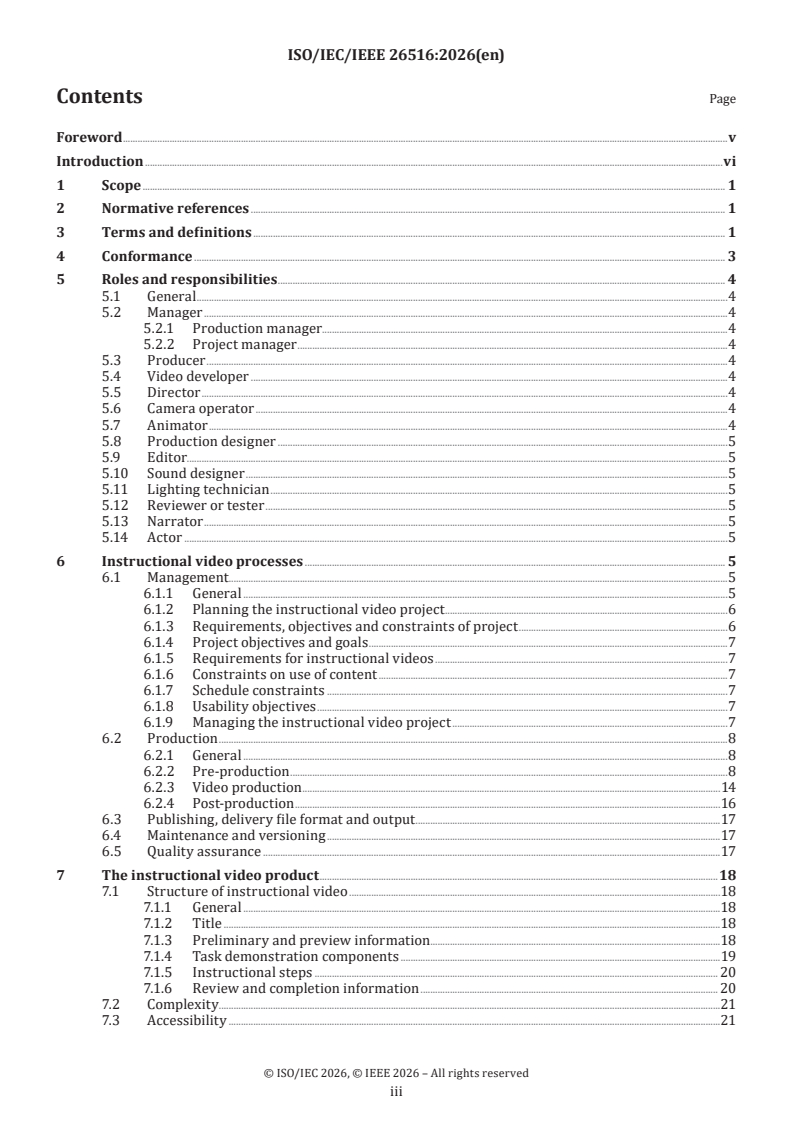
Contents Page
Foreword .v
Introduction .vi
1 Scope . 1
2 Normative references . 1
3 Terms and definitions . 1
4 Conformance . 3
5 Roles and responsibilities . 4
5.1 General .4
5.2 Manager .4
5.2.1 Production manager.4
5.2.2 Project manager .4
5.3 Producer .4
5.4 Video developer .4
5.5 Director .4
5.6 Camera operator .4
5.7 Animator .4
5.8 Production designer .5
5.9 Editor.5
5.10 Sound designer .5
5.11 Lighting technician .5
5.12 Reviewer or tester .5
5.13 Narrator .5
5.14 Actor .5
6 Instructional video processes . 5
6.1 Management . . .5
6.1.1 General .5
6.1.2 Planning the instructional video project .6
6.1.3 Requirements, objectives and constraints of project .6
6.1.4 Project objectives and goals .7
6.1.5 Requirements for instructional videos .7
6.1.6 Constraints on use of content .7
6.1.7 Schedule constraints .7
6.1.8 Usability objectives .7
6.1.9 Managing the instructional video project .7
6.2 Production .8
6.2.1 General .8
6.2.2 Pre-production .8
6.2.3 Video production .14
6.2.4 Post-production .16
6.3 Publishing, delivery file format and output .17
6.4 Maintenance and versioning .17
6.5 Quality assurance .17
7 The instructional video product .18
7.1 Structure of instructional video .18
7.1.1 General .18
7.1.2 Title .18
7.1.3 Preliminary and preview information.18
7.1.4 Task demonstration components .19
7.1.5 Instructional steps . 20
7.1.6 Review and completion information . 20
7.2 Complexity.21
7.3 Accessibility .21
© ISO/IEC 2026, © IEEE 2026 – All rights reserved
iii
7.4 User control . 22
7.5 Content of transitions within and between steps . 23
7.6 Segmentation . 23
7.6.1 General . 23
7.6.2 Segments . 23
7.6.3 Pausing . 23
7.7 Visual presentation of information . 23
7.8 Visual pointing elements .24
7.9 Combination of oral and written information .24
7.10 Translation .24
7.11 Narration .24
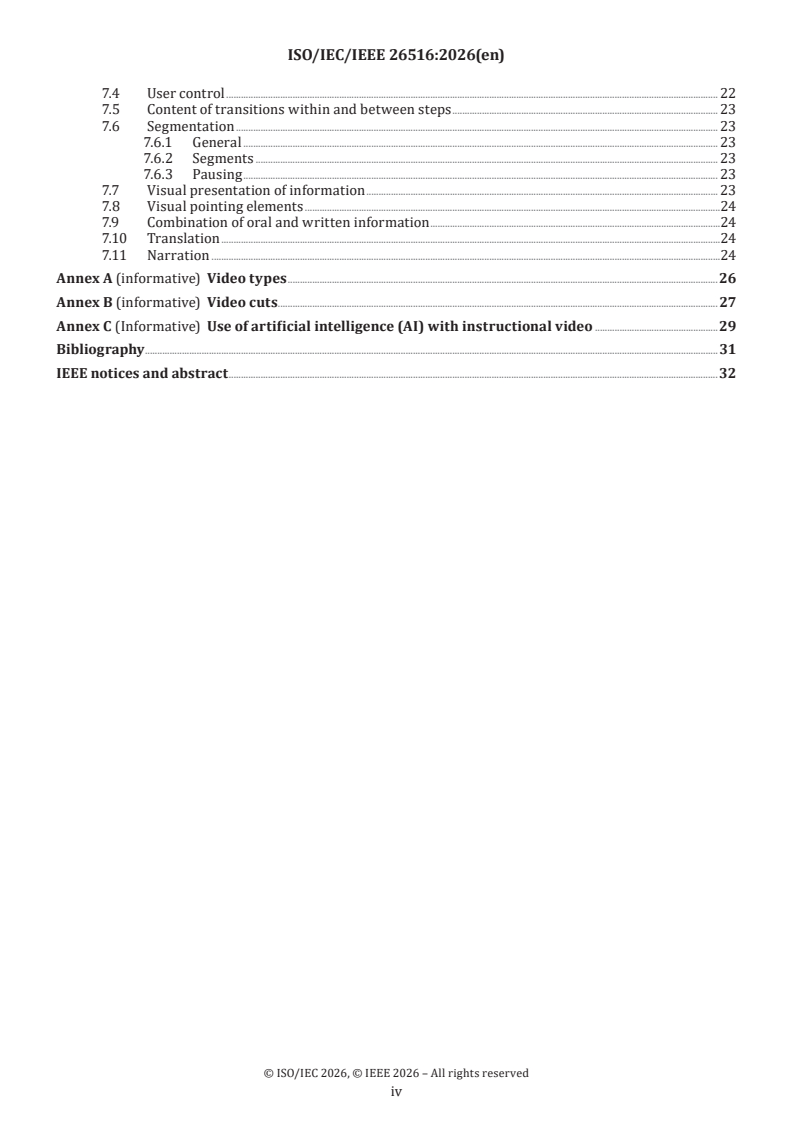
Annex A (informative) Video types .26
Annex B (informative) Video cuts .27
Annex C (Informative) Use of artificial intelligence (AI) with instructional video .29
Bibliography .31
IEEE notices and abstract .32
© ISO/IEC 2026, © IEEE 2026 – All rights reserved
iv
Foreword
ISO (the International Organization for Standardization) and IEC (the International Electrotechnical
Commission) form the specialized system for worldwide standardization. National bodies that are
members of ISO or IEC participate in the development of International Standards through technical
committees established by the respective organization to deal with particular fields of technical activity.
ISO and IEC technical committees collaborate in fields of mutual interest. Other international organizations,
governmental and non-governmental, in liaison with ISO and IEC, also take part in the work.
The procedures used to develop this document and those intended for its further maintenance are described
in the ISO/IEC Directives, Part 1. In particular, the different approval criteria needed for the different types
of document should be noted. This document was drafted in accordance with the editorial rules of the ISO/
IEC Directives, Part 2 (see www.iso.org/directives or www.iec.ch/members_experts/refdocs).
IEEE Standards documents are developed within IEEE societies and subcommittees of IEEE Standards
Association (IEEE SA) Board of Governors. IEEE develops its standards through an accredited consensus
development process, which brings together volunteers representing varied viewpoints and interests to
achieve the final product. IEEE standards are documents developed by volunteers with scientific, academic,
and industry-based expertise in technical working groups. Volunteers are not necessarily members of
IEEE or IEEE SA and participate without compensation from IEEE. While IEEE administers the process and
establishes rules to promote fairness in the consensus development process, IEEE does not independently
evaluate, test, or verify the accuracy of any of the information or the soundness of any judgments contained
in its standards.
ISO and IEC draw attention to the possibility that the implementation of this document may involve the
use of (a) patent(s). ISO and IEC take no position concerning the evidence, validity or applicability of any
claimed patent rights in respect thereof. As of the date of publication of this document, ISO and IEC had not
received notice of (a) patent(s) which may be required to implement this document. However, implementers
are cautioned that this may not represent the latest information, which may be obtained from the patent
database available at www.iso.org/patents and https://patents.iec.ch. ISO and IEC shall not be held
responsible for identifying any or all such patent rights.
Any trade name used in this document is information given for the convenience of users and does not
constitute an endorsement.
For an explanation of the voluntary nature of standards, the meaning of ISO specific terms and expressions
related to conformity assessment, as well as information about ISO's adherence to the World Trade
Organization (WTO) principles in the Technical Barriers to Trade (TBT), see www.iso.org/iso/foreword.html.
In the IEC, see www.iec.ch/understanding-standards.
This document was prepared by Joint Technical Committee ISO/IEC/JTC 1, Information technology,
Subcommittee SC 7, Software and systems engineering, in cooperation with the Systems and Software
Engineering Standards Committee of the IEEE Computer Society, under the Partner Standards Development
Organization cooperation agreement between ISO and IEEE.
Any feedback or questions on this document should be directed to the user’s national standards
body. A complete listing of these bodies can be found at www.iso.org/members.html and
www.iec.ch/national-committees.
© ISO/IEC 2026, © IEEE 2026 – All rights reserved
v
Introduction
Instructional videos are dynamic audio-visual media that can be controlled by the user. These media
motivate users to learn with scenarios that provide realistic simulations of products and services. Typical
use cases for instructional videos are getting-started or onboarding, learning the general use of a product or
service, learning the most common workflows and tasks in the software, or providing news about software
and system updates.
Ineffective videos can frustrate system users and prevent them from performing their tasks fast, safely, and
successfully. Existing standards (IEC/IEEE 82079-1 and ISO/IEC/IEEE 26514) cover the technical means of
producing videos and the design and development of information for use but do not go into detail regarding
instructional video as an effective means of providing information for users. Videos can present instructions
for installation, operation, maintenance, and disposal for skilled or unskilled users. Instructional videos
can include concepts, instructional steps, and reference material. This document does not cover learning
methodology and principles governing effective learning.
Instructional videos are an integral part of the product or service. Therefore, producers, managers,
specialists, and developers work within the life cycle processes of the software product, which are defined
in ISO/IEC/IEEE 12207. In the context of instructional videos, "user" and "viewer" are equivalent; both forms
are used in this document.
While the requirements and guidance on the design and development of information for users are fully
applicable, instructional videos have specific requirements and are managed throughout the specific
processes (Figure 1). The purpose of this document is to provide requirements and guidance on instructional
video processes as well as the structure, content. and media suitable for instructional videos.
Figure 1 — Instructional video processes
© ISO/IEC 2026, © IEEE 2026 – All rights reserved
vi
International Standard ISO/IEC/IEEE 26516:2026(en)
Systems and software engineering — Development and
production of instructional videos
1 Scope
This document provides requirements and guidance for the effective planning, design, and development of
instructional videos for information technology systems, products, and services. This document includes
the use of video, interactive video or hypervideo, animation, and virtual or augmented reality to explain
how to use software and systems including hardware. This document covers both standalone videos and the
use of video segments in larger information products. This document specifies content elements, structure,
and use of media, including music, narration, captions, titles, subtitles, and graphics.
This document does not include specifications of output media formats, content management for videos,
or archiving. This document does not cover learning technology systems for recording and administering
training programs.
This document is applicable to instructional video developers, including a variety of specialists, such as:
— information architects who plan the structure and format of information products;
— user experience specialists, customer experience specialists and business analysts who identify the
tasks that the intended users can perform;
— reviewers or testers of instructional videos;
— graphic designers with expertise in electronic media;
— experts who design the usage and presentation of the system or service.
This document is also a reference for those with other roles and interests in the process of developing
instructional videos.
2 Normative references
The following documents are referred to in the text in such a way that some or all of their content constitutes
requirements of this document. For dated references, only the edition cited applies. For undated references,
the latest edition of the referenced document (including any amendments) applies.
IEC/IEEE 82079-1:2019, Preparation of information for use (instructions for use) of products – Part 1: Principles
and general requirements
ISO/IEC/IEEE 26514:2022, Systems and software engineering — Design and development of information for
users
3 Terms and definitions
For the purposes of this document, the terms and definitions given in ISO/IEC/IEEE 26514 and the following
apply.
ISO, IEC and IEEE maintain terminology databases for use in standardization at the following addresses:
— ISO Online browsing platform: available at https:// www .iso .org/ obp
— IEC Electropedia: available at https:// www .electropedia .org/
© ISO/IEC 2026, © IEEE 2026 – All rights reserved
— IEEE Standards Dictionary Online: available at http:// dictionary .ieee .org
NOTE For additional terms and definitions in the field of systems and software engineering, see
ISO/IEC/IEEE 24765, which is published periodically as a “snapshot” of the SEVOCAB (Software and Systems
Engineering Vocabulary) database and is publicly accessible at www .computer .org/ sevocab.
3.1
accessibility
extent to which products, systems, services, environments and facilities can be used by people from a
population with the widest range of user needs, characteristics and capabilities to achieve identified goals in
identified contexts of use
Note 1 to entry: Although “accessibility” typically addresses users who have disabilities, the concept is not limited to
disability issues.
[SOURCE: ISO 9241-112:2017, 3.15, modified — The original note 1 to entry has been replaced by a new one.]
3.2
animatic
series of images played in sequence, often with a soundtrack
Note 1 to entry: In essence, an animatic is an animated storyboard (3.16).
3.3
callout
short string of text connected by a line, arrow or similar graphic to a feature of an image giving information
about that feature
3.4
clip
part of a scene (3.13)
3.5
close-miked
with a microphone placed very close to the source sound to capture more direct sound and minimize pickup
of ambience and sounds from other sources
3.6
close-up
high level of detail on specific elements or actions, emphasising their importance in completing tasks
EXAMPLE In an instructional video, a close-up can focus on a specific step of a task, such as a close-up of hands
performing a complex assembly, or a detailed view of a specific software feature being used.
3.7
contrast ratio
relative luminance of the lighter and darker of the colours
Note 1 to entry: A definition of this metric can be found in W3C Web Content Accessibility Guidelines (WCAG) 2.0.
3.8
cut
omitted action or compressed time and space to create connections between actions that are otherwise
difficult to show
EXAMPLE In an instructional video, a cut can be used to skip repetitive or unnecessary parts of a process and
focus on the essential actions needed to complete the task.
3.9
footage
section of a video that has been shot (3.15) or recorded
© ISO/IEC 2026, © IEEE 2026 – All rights reserved
3.10
life cycle
evolution of a system, product, service, project, or other human-made entity from conception through
retirement
[SOURCE: ISO/IEC/IEEE 12207:—, 3.1.34]
3.11
match cut
link between two different settings with the same action that gives the impression of a continuous movement
over two or more shots (3.15)
3.12
onion skinning
animation function allowing successive frames of an animation to be overlaid or viewed together for smooth
transition (3.17) of moving objects
3.13
scene
part of a video with a focus on a single task or action
3.14
script
document describing the narrative and dialogue of the instructional video in detail
Note 1 to entry: It is the equivalent of a film screenplay.
3.15
shot
video sequence recorded continuously by one camera
3.16
storyboard
graphic organizer that consists of illustrations, images or text displayed in sequence for the purpose of pre-
visualizing a video sequence
3.17
transition
cut (3.8) between alternative sequences
3.18
voiceover
spoken words or narration in an instructional video communicated by an unseen narrator or an onscreen
character not seen speaking
4 Conformance
An organization may claim conformance to the requirements in this document for its instructional video
development processes, or for its instructional videos, or for both. Full conformance to processes is achieved
by demonstrating that all the requirements in Clause 6 have been achieved. Full conformance of products is
achieved by demonstrating that all the requirements of Clause 7 have been achieved.
This document is meant to be tailored so that only necessary and cost-effective requirements are applied to
instructional videos. Tailoring may take the form of specifying approaches to conform to its requirements or
altering its recommendations and approaches to reflect the instructional videos more explicitly.
NOTE The tailoring process is described in ISO/IEC/IEEE 12207:—, Annex A.
This document may be included or referenced in contracts or similar agreements when the parties (called the
acquirer and the supplier) agree that the supplier is required to deliver instructional videos in accordance
with this document. It may also be adopted as an in-house standard by a project or organization that decides
© ISO/IEC 2026, © IEEE 2026 – All rights reserved
to produce instructional videos in accordance with this document. Tailoring decisions made by an acquirer
should be specified in the agreement with the supplier.
5 Roles and responsibilities
5.1 General
Video development and production involves a variety of roles, each with specific responsibilities to support
the creation of a high-quality video product. The list of roles in 5.2 to 5.14 does not imply organizational
structure. A single person can take on one or more of the roles in 5.2 to 5.14.
5.2 Manager
5.2.1 Production manager
The production manager oversees the entire video production process. The production manager is
responsible for planning, organizing, and executing all aspects of the production, including budgeting,
scheduling, and coordinating different departments and resources.
5.2.2 Project manager
The project manager, in larger productions, focuses on managing specific aspects of the production, such as
post-production or visual effects.
5.3 Producer
The producer handles the business and financial aspects, secures funding, obtains key personnel, and makes
important creative decisions. There can be several types of producers, such as executive producers, line
producers or associate producers, each with specific duties.
Producers are involved in all stages, from concept to completion.
5.4 Video developer
The video developer develops the concept and script for the video. Video developers work closely with
the client or stakeholders to understand their vision and goals. They create the storyline, plan the visual
elements, and confirm that the video effectively communicates the intended message.
5.5 Director
The director is responsible for translating the script into visuals. The director works closely with the camera
crew, actors, and others to bring the story to life on screen.
5.6 Camera operator
The camera operator is the person who shoots the video. The camera operator operates the camera, frames
the shots, and works closely with the video developer to achieve the desired result. The camera operator can
specialize in various types of cameras.
5.7 Animator
The animator is responsible for screen captures and graphics and creating animated content. Images can be
made up of digital or hand-drawn pictures, models, or puppets. Animators work in 2D, 3D model-making,
stop-frame, computer-generated animation and other software.
© ISO/IEC 2026, © IEEE 2026 – All rights reserved
5.8 Production designer
The production designer is responsible for the overall visual look of the video. Production designers work on
set design, costumes, and visual elements to create the desired atmosphere and aesthetic.
5.9 Editor
The editor assembles the raw footage into a coherent, engaging story. Editors work closely with the director
and use specialized software to cut scenes and add special effects, sound, and other elements to create the
final product.
5.10 Sound designer
The sound designer is responsible for the audio aspects of the production. Sound designers work on
recording, mixing, and adding sound effects and music to enhance the overall user experience.
5.11 Lighting technician
The lighting technician sets up and controls the lights on the set or location.
5.12 Reviewer or tester
The reviewer and the tester check the instructional video against explicit and implicit requirements.
The roles of reviewers and testers are crucial for ensuring the quality and reliability of the instructional
video. Their efforts contribute to delivering instruction that meets user expectations and complies with
requirements.
5.13 Narrator
The narrator reads the text of the voiceover when present in the instructional video. Narrators review and
understand the script before recording and provide a clear and engaging voiceover narration.
5.14 Actor
The actor, when present in instructional videos, makes the content more engaging and relatable. The actor is
responsible for clearly and confidently presenting the information or instructions.
6 Instructional video processes
6.1 Management
6.1.1 General
The main objective of instructional video management is production of instructions and assurance of
compliance with legal (e.g. intellectual property law) and other constraints. Typical outputs from this
process are a project plan and schedule, a video development plan, lists of general requirements, acceptance
criteria, the project team members, and supporting documents. Although many of the activities related to
instructional video management are completed before starting the video production, others run through
the whole project or take place at specific production milestones.
NOTE One possible way for an organization to deal with clauses that cite “the video development plan” is to
specify that the clauses are interpreted in the project plans for any video development project.
The activities specified in 6.1.2 to 6.1.9 describe the set of actions that can be required, recommended or
permissible or are typically undertaken to achieve or execute the instructional video management process.
© ISO/IEC 2026, © IEEE 2026 – All rights reserved
6.1.2 Planning the instructional video project
The preparation of an instructional video project plan is the responsibility of the manager or producer and
is defined in planning an information-development project in ISO/IEC/IEEE 26514:2022, 5.2. The following
aspects should be considered:
— Accessibility requirements: Accessibility requirements include the use of optional captions. The defined
details can be summarized in a media guide. This moment in planning is crucial for making an initial
assessment of the accessibility resources that the video should incorporate. It is necessary to analyse both
the conditions of the images themselves (such as brightness and contrast) and those of the accompanying
elements (such as audio description and captions).
NOTE ISO/IEC TS 20071-21, ISO/IEC 20071-23 and ISO/IEC TS 20071-25 cover the applicable aspects of user
interface component accessibility.
— Project team members: The instructional video development project team members should be identified
along with their precise roles.
Other activities are specific to instructional videos such as setting up the storyboard and script or
considering time constraints imposed by distribution platforms should be planned together with the video
developer.
The instructional video project management plan should be an integral part of the instructional video
production plan (see Figure 1). The video developers should estimate how much information is required, so
that the estimate can be used in making choices about delivery methods, delivery media, production costs
and timing.
During the whole instructional video development process, management shall be responsible for selection,
deployment, maintenance, and retirement of all the required infrastructure and tools. Based on the project’s
requirements, a software portfolio analysis should be conducted early. This analysis should:
— determine if online work is preferred or if the necessary hardware requirements are met for working on
personal devices;
— decide whether screen capture is required;
— choose between voiceover narration during the capture or added afterwards;
— determine if artificial intelligence (AI) narration is the preferred option;
— explore methods for correcting voice tracks;
— identify the process for combining voice tracks with visuals.
6.1.3 Requirements, objectives and constraints of project
The job of managing requirements, objectives and constraints of the project is the responsibility of the
manager of the information-development project and is described in ISO/IEC/IEEE 26511:2018, Clauses 7
and 8. However, to understand the requirements for the development of instructional videos, the manager
shall gather or receive information about the wider context of the whole project, as set out below:
a) the primary or intended purpose of the product or service;
b) the primary or intended requirements and objectives for the product or service;
c) the primary or intended requirements and constraints for instructional video, such as the policy,
standard formats, and styles for instructional videos set by the product or service producer;
d) the intended usability requirements.
© ISO/IEC 2026, © IEEE 2026 – All rights reserved
If the stated requirements limit the design options so that users cannot be given a suitable instructional
video, the video developer should:
— question the requirements, explaining the reasons for the discrepancy;
— suggest alternative solutions.
The organization should keep a record of the source of each requirement, so that it can be tracked back to its
origins and its validity reaffirmed.
6.1.4 Project objectives and goals
The manager and video developer should expect that the objectives and goals of the project can change at
some stage, which can affect video design.
6.1.5 Requirements for instructional videos
Instructional videos shall follow the requirements on information for users in ISO/IEC/IEEE 26514:2022,
6.1.3.
6.1.6 Constraints on use of content
Video developers should be aware of legal and regulatory requirements. Constraints on instructional videos
are defined as constraints on information for users in ISO/IEC/IEEE 26514:2022, 6.1.4.
Copyright status requires special attention when content is generated using AI.
NOTE Annex C lists several possible applications of AI in relation to instructional videos.
Recordings at indoor locations in buildings, even if they are public, create additional constraints. Written
authorization should be obtained. When requesting permission, clear and precise information shall be
provided about:
a) the purpose of the recording;
b) the specific recordings that are intended;
c) the intended use of the footage and its relevance;
d) the times when access to the spaces is desired.
The consent of participants involved in on-screen recording shall be obtained before recording.
6.1.7 Schedule constraints
Instructional video developers should be familiar with the product or service development schedule. A list of
schedule constraints is defined in in ISO/IEC/IEEE 26514:2022, 6.1.6.
6.1.8 Usability objectives
The usability of instructional video is an integral part of the product or service. The instructional video
developers and product developers should work together to support usability. ISO/IEC/IEEE 26514:2022,
6.1.7 provides detailed information for development and ISO/IEC/IEEE 26513:2017, 7.4 provides information
on how these objectives can be tested.
6.1.9 Managing the instructional video project
Throughout the instructional video development project, the information project manager is responsible
for the activities that support project quality and adherence to the schedule. Instructional videos are a
specific form of information for users. In addition to the provisions in ISO/IEC/IEEE 26514:2022, 5.3, the
© ISO/IEC 2026, © IEEE 2026 – All rights reserved
following aspects should also be managed: provision of the necessary technical equipment and resources
and provision of the required environment for video recording.
6.2 Production
6.2.1 General
The instructional video production process has as its main objective the creation of the instructional video.
Typical outputs from this process are a version of the instructional video and supporting information. As
shown in Figure 1, the production process is typically divided into pre-production, production, and post-
production processes.
6.2.2 Pre-production
6.2.2.1 General
The instructional video pre-production process has the main objective of creating a definition that is
aligned with the defined requirements and the specific needs of the audience that are expected to execute
the tasks covered in the video. Typical outputs from the pre-production are audience analysis, task analysis
and the development of an audience-task matrix. These activities can be completed before starting the video
production process or can require several iterations during the production process.
6.2.2.2 Knowledge of the products or services
As with other types of procedural supporting information, the first step in the development process requires
learning about the product including:
— specific terminology that describes the product;
— the product’s aim: the problem it solves for users, the benefits users gain from using it, the tasks users
can perform using it;
— prior or competing products or services, which can influence customer expectations;
— how the product works: the product’s main and secondary functions (tasks), the way tasks are carried
out, the tasks’ subtasks, the order in which subtasks should be performed.
The pre-production team may work out the tasks on their own or to have someone familiar with the product
to demonstrate them.
Video content can become dated. Designers should understand and promote the reuse of content that is
likely to be correct.
6.2.2.3 Audience task and context of use analysis
Knowing the audience allows the development team to best match the video content to their viewers’ needs.
At the beginning of the development phase, viewers’ needs and expectations should be defined.
Most instructional videos are viewed by multiple audiences, reflecting the diverse nature of the product’s
users. Many viewers require task-oriented training on how to use the product; other viewers require
conceptual information. To make informed decisions about video content and organization, audience and
task analysis should be carried out at the beginning of the instructional video development process. This
analysis determines who will be viewing the videos and what their tasks are.
6.2.2.4 Audience analysis
Information about an instructional video’s audiences can be obtained from various sources. The users that
are intended to be trained on the product are one such source. Useful methods to reach these users are
© ISO/IEC 2026, © IEEE 2026 – All rights reserved
surveys, interviews, focus groups, site visits and user support groups. Additional sources of information can
be various departments within the product's manufacturing company.
The instructional video development team shall list the intended types of video viewers and classify those
types into audiences. Each audience consists of a group of viewers whose product use and tasks are similar.
In addition to the considerations established in ISO/IEC/IEEE 26514:2022, 6.2.2, the classification should
consider:
a) the product or service and its purpose in terms of intended users and their tasks;
b) the viewers’ equipment to hear the audio information;
c) the viewers’ cultural background;
d) the viewers’ reasons for using the videos;
EXAMPLE To enable them to carry out product-related tasks for business, job, personal work, or pleasure.
e) whether and how viewers use the video while using the product (e.g. use only the audio);
f) the actions viewers will take with the product;
g) how the product or service will integrate into their work activities.
For each audience, the development team should construct a profile that records the relevant information.
Information and requirements related to audience analysis and examples can be found in
ISO/IEC/IEEE 26514:2022, 6.2.2.
6.2.2.5 Task analysis
To create relevant instructional videos, the development team should:
— visualize the vi
...