

ISO 9335:2025
(Main)Optics and photonics — Optical transfer function — Principles and procedures of measurement
General Information
- Abstract
This document gives general guidance for the construction and use of equipment for measurement of the optical transfer function (OTF) of imaging systems. This document specifies important factors that can influence the measurement of the OTF and gives general rules for equipment performance requirements and environmental controls. It specifies important precautions that should be taken to ensure accurate measurements and correction factors to be applied to the collected data. The OTF measuring equipment described in this document is restricted to that which analyses the radiation distribution in the image plane of the optical imaging system under test. Interferometer-based instruments are outside the scope of this document.
- Status
- Published
- Publication Date
- 11-Feb-2025
- Technical Committee
- ISO/TC 172/SC 1 - Fundamental standards
- Drafting Committee
- ISO/TC 172/SC 1 - Fundamental standards
- Current Stage
- 6060 - International Standard published
- Start Date
- 12-Feb-2025
- Due Date
- 28-Oct-2025
- Completion Date
- 12-Feb-2025

Overview
ISO 9335:2025 - Optics and photonics - Optical transfer function - Principles and procedures of measurement - provides practical guidance for measuring the optical transfer function (OTF) of imaging systems. The standard describes the construction and use of OTF measuring equipment that analyses the radiation distribution in the image plane of an optical system, specifies factors that influence OTF measurement, and defines rules for equipment performance, environmental controls, data correction and presentation. Interferometer-based instruments are outside the scope of this document.
Key topics and technical requirements
- Measuring conditions and I‑state: Identify and fix the imaging state (I‑state) parameters - focus, magnification, aperture, spectral content - so measurements are reproducible.
- Measurement uncertainty: Equipment and environment must support the prescribed measuring conditions to achieve the declared uncertainty of measurement.
- Environmental controls: Requirements and recommendations for temperature, humidity, vibration isolation and electromagnetic disturbances to minimise measurement bias.
- Measuring equipment and system components:
- Optical mounts and benches, defocusing tolerances, and measuring scales
- Test target units and mounting of the specimen
- Image evaluation systems and auxiliary imaging systems
- Measurement procedures: Guidance on setting conditions (spectral characteristics, angular distribution, aperture, image scale, focusing), handling isoplanatic regions, veiling glare, fixed pattern noise, analysed area selection, and signal‑to‑noise considerations.
- Data corrections and presentation:
- Normalization, frequency‑scale corrections, and modulation corrections
- Treatment of auxiliary imaging systems and graphical/numerical presentation of OTF data
- Uncertainty checks: Procedures for verifying and documenting uncertainty contributions and measurement repeatability.
Applications and users
ISO 9335:2025 is intended for professionals and organizations involved in objective image‑quality assessment and optical metrology, including:
- Optical engineers designing lenses, camera modules and imaging optics
- Test and calibration laboratories performing OTF characterization
- Manufacturing quality control teams validating imaging performance
- R&D in optics, photonics and electro‑optical systems
- Standards bodies and consultants preparing measurement protocols
Practical applications include lens qualification, sensor and camera module testing, production acceptance tests, benchmarking imaging system performance, and supporting product specifications and compliance.
Related standards
- ISO 9334 - Optics and photonics - Optical transfer function - Definitions and mathematical relationships (normative reference for terminology and definitions)
- ISO/IEC Guides referenced for expressing measurement uncertainty and terms (GUM and VIM concepts are aligned in the 2025 edition)
Keywords: ISO 9335:2025, optical transfer function, OTF measurement, optics and photonics, image quality, measurement uncertainty, test target, image evaluation system.
Relations
- Effective Date
- 05-Nov-2022
Get Certified
Connect with accredited certification bodies for this standard

BSMI (Bureau of Standards, Metrology and Inspection)
Taiwan's standards and inspection authority.
Sponsored listings
Frequently Asked Questions
ISO 9335:2025 is a standard published by the International Organization for Standardization (ISO). Its full title is "Optics and photonics — Optical transfer function — Principles and procedures of measurement". This standard covers: This document gives general guidance for the construction and use of equipment for measurement of the optical transfer function (OTF) of imaging systems. This document specifies important factors that can influence the measurement of the OTF and gives general rules for equipment performance requirements and environmental controls. It specifies important precautions that should be taken to ensure accurate measurements and correction factors to be applied to the collected data. The OTF measuring equipment described in this document is restricted to that which analyses the radiation distribution in the image plane of the optical imaging system under test. Interferometer-based instruments are outside the scope of this document.
This document gives general guidance for the construction and use of equipment for measurement of the optical transfer function (OTF) of imaging systems. This document specifies important factors that can influence the measurement of the OTF and gives general rules for equipment performance requirements and environmental controls. It specifies important precautions that should be taken to ensure accurate measurements and correction factors to be applied to the collected data. The OTF measuring equipment described in this document is restricted to that which analyses the radiation distribution in the image plane of the optical imaging system under test. Interferometer-based instruments are outside the scope of this document.
ISO 9335:2025 is classified under the following ICS (International Classification for Standards) categories: 17.180.01 - Optics and optical measurements in general. The ICS classification helps identify the subject area and facilitates finding related standards.
ISO 9335:2025 has the following relationships with other standards: It is inter standard links to ISO 9335:2012. Understanding these relationships helps ensure you are using the most current and applicable version of the standard.
ISO 9335:2025 is available in PDF format for immediate download after purchase. The document can be added to your cart and obtained through the secure checkout process. Digital delivery ensures instant access to the complete standard document.
Standards Content (Sample)
International
Standard
ISO 9335
Third edition
Optics and photonics — Optical
2025-02
transfer function — Principles and
procedures of measurement
Optique et photonique — Fonction de transfert optique —
Principes et procédures de mesure
Reference number
© ISO 2025
All rights reserved. Unless otherwise specified, or required in the context of its implementation, no part of this publication may
be reproduced or utilized otherwise in any form or by any means, electronic or mechanical, including photocopying, or posting on
the internet or an intranet, without prior written permission. Permission can be requested from either ISO at the address below
or ISO’s member body in the country of the requester.
ISO copyright office
CP 401 • Ch. de Blandonnet 8
CH-1214 Vernier, Geneva
Phone: +41 22 749 01 11
Email: copyright@iso.org
Website: www.iso.org
Published in Switzerland
ii
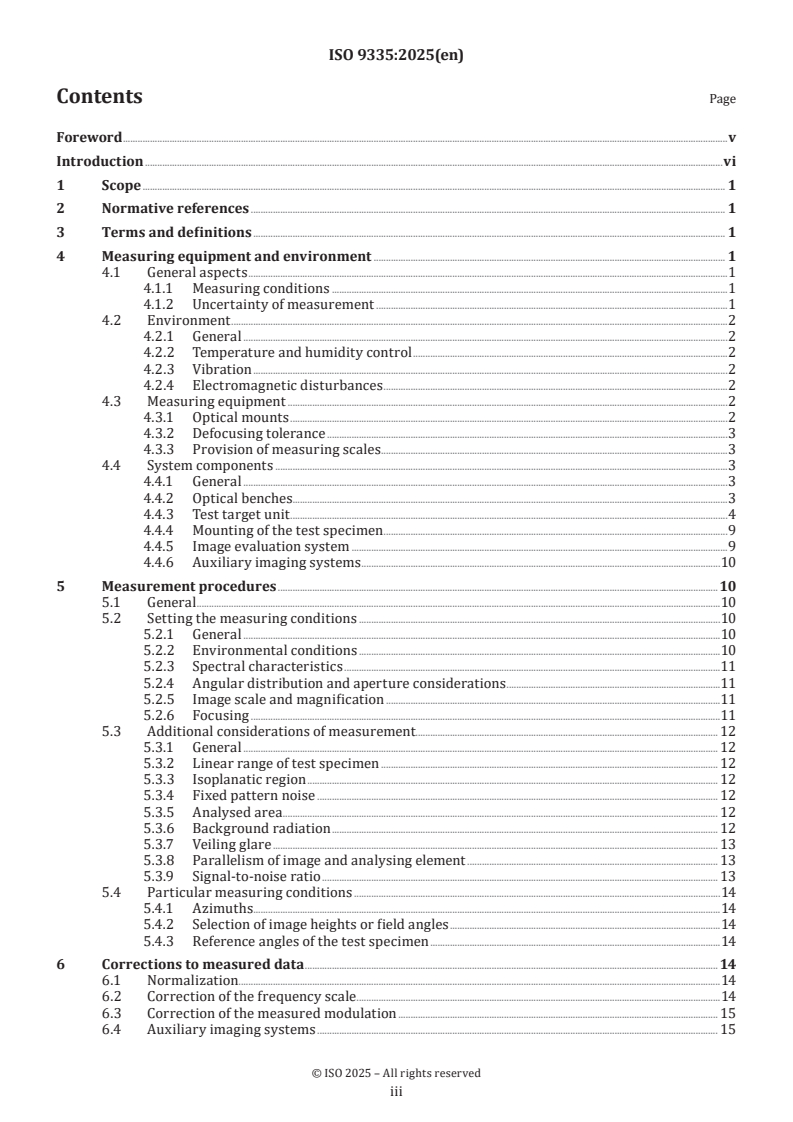
Contents Page
Foreword .v
Introduction .vi
1 Scope . 1
2 Normative references . 1
3 Terms and definitions . 1
4 Measuring equipment and environment . 1
4.1 General aspects .1
4.1.1 Measuring conditions .1
4.1.2 Uncertainty of measurement .1
4.2 Environment .2
4.2.1 General .2
4.2.2 Temperature and humidity control .2
4.2.3 Vibration .2
4.2.4 Electromagnetic disturbances .2
4.3 Measuring equipment .2
4.3.1 Optical mounts .2
4.3.2 Defocusing tolerance .3
4.3.3 Provision of measuring scales .3
4.4 System components .3
4.4.1 General .3
4.4.2 Optical benches . .3
4.4.3 Test target unit .4
4.4.4 Mounting of the test specimen .9
4.4.5 Image evaluation system .9
4.4.6 Auxiliary imaging systems .10
5 Measurement procedures .10
5.1 General .10
5.2 Setting the measuring conditions .10
5.2.1 General .10
5.2.2 Environmental conditions .10
5.2.3 Spectral characteristics .11
5.2.4 Angular distribution and aperture considerations .11
5.2.5 Image scale and magnification .11
5.2.6 Focusing .11
5.3 Additional considerations of measurement. 12
5.3.1 General . 12
5.3.2 Linear range of test specimen . 12
5.3.3 Isoplanatic region . 12
5.3.4 Fixed pattern noise . 12
5.3.5 Analysed area . 12
5.3.6 Background radiation . 12
5.3.7 Veiling glare . 13
5.3.8 Parallelism of image and analysing element . 13
5.3.9 Signal-to-noise ratio . 13
5.4 Particular measuring conditions .14
5.4.1 Azimuths.14
5.4.2 Selection of image heights or field angles .14
5.4.3 Reference angles of the test specimen .14
6 Corrections to measured data . 14
6.1 Normalization.14
6.2 Correction of the frequency scale .14
6.3 Correction of the measured modulation . 15
6.4 Auxiliary imaging systems . 15
iii
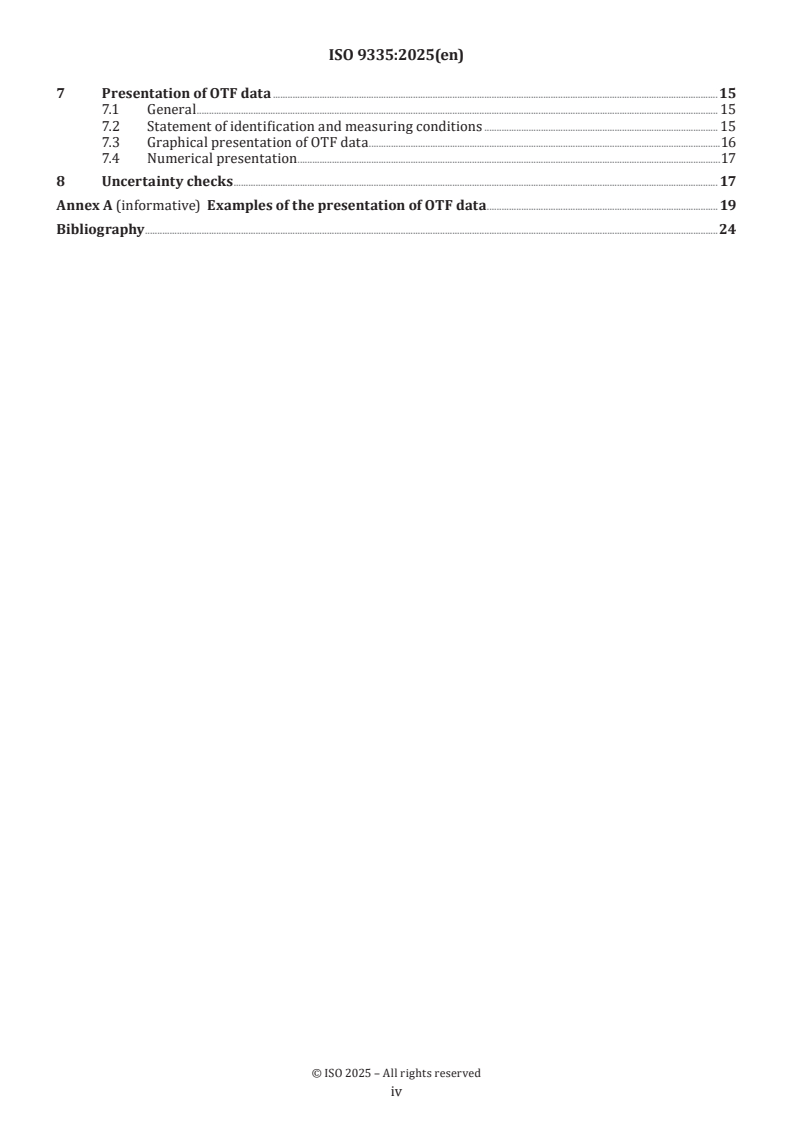
7 Presentation of OTF data .15
7.1 General . 15
7.2 Statement of identification and measuring conditions . 15
7.3 Graphical presentation of OTF data .16
7.4 Numerical presentation .17
8 Uncertainty checks . 17
Annex A (informative) Examples of the presentation of OTF data . 19
Bibliography .24
iv
Foreword
ISO (the International Organization for Standardization) is a worldwide federation of national standards
bodies (ISO member bodies). The work of preparing International Standards is normally carried out through
ISO technical committees. Each member body interested in a subject for which a technical committee
has been established has the right to be represented on that committee. International organizations,
governmental and non-governmental, in liaison with ISO, also take part in the work. ISO collaborates closely
with the International Electrotechnical Commission (IEC) on all matters of electrotechnical standardization.
The procedures used to develop this document and those intended for its further maintenance are described
in the ISO/IEC Directives, Part 1. In particular, the different approval criteria needed for the different types
of ISO document should be noted. This document was drafted in accordance with the editorial rules of the
ISO/IEC Directives, Part 2 (see www.iso.org/directives).
ISO draws attention to the possibility that the implementation of this document may involve the use of (a)
patent(s). ISO takes no position concerning the evidence, validity or applicability of any claimed patent
rights in respect thereof. As of the date of publication of this document, ISO had not received notice of (a)
patent(s) which may be required to implement this document. However, implementers are cautioned that
this may not represent the latest information, which may be obtained from the patent database available at
www.iso.org/patents ISO shall not be held responsible for identifying any or all such patent rights.
Any trade name used in this document is information given for the convenience of users and does not
constitute an endorsement.
For an explanation of the voluntary nature of standards, the meaning of ISO specific terms and expressions
related to conformity assessment, as well as information about ISO's adherence to the World Trade
Organization (WTO) principles in the Technical Barriers to Trade (TBT), see www.iso.org/iso/foreword.html.
This document was prepared by Technical Committee ISO/TC 172, Optics and photonics, Subcommittee SC 1,
Fundamental standards.
This third edition cancels and replaces the second edition (ISO 9335:2012), which has been technically
revised.
The main changes are as follows:
— text was added concerned with distortion effects in 4.4.6;
— a note was added concerned with the notation tangential/sagittal in 7.2.
— the document has been revised to be in agreement with the terms and definitions of ISO/IEC Guide 98-3
(GUM) and ISO/IEC Guide 99 (VIM) regarding the expression of measurement uncertainties.”
Any feedback or questions on this document should be directed to the user’s national standards body. A
complete listing of these bodies can be found at www.iso.org/members.html.
v
Introduction
The optical transfer function is an important aid to objective evaluation of the image-forming capability of
optical, electro-optical and photographic systems.
In order that optical transfer function measurements achieved using different measuring principles or
obtained from measuring instruments in different laboratories can be compared, it is necessary to ensure
equivalence of measurement parameters such as focus setting and spatial frequency range. For this reason,
an agreed terminology has been defined in order for the measurement parameters used in this document to
be understood by all users. This document gives guidance for the construction and operation of equipment
for optical transfer function measurement.
The specifications in this document form the basic requirements of measurement instrumentation and
procedures for guaranteeing a defined uncertainty of measurement of the optical transfer function.
vi
International Standard ISO 9335:2025(en)
Optics and photonics — Optical transfer function —
Principles and procedures of measurement
1 Scope
This document gives general guidance for the construction and use of equipment for measurement of the
optical transfer function (OTF) of imaging systems.
This document specifies important factors that can influence the measurement of the OTF and gives
general rules for equipment performance requirements and environmental controls. It specifies important
precautions that should be taken to ensure accurate measurements and correction factors to be applied to
the collected data.
The OTF measuring equipment described in this document is restricted to that which analyses the radiation
distribution in the image plane of the optical imaging system under test. Interferometer-based instruments
are outside the scope of this document.
2 Normative references
The following documents are referred to in the text in such a way that some or all of their content constitutes
requirements of this document. For dated references, only the edition cited applies. For undated references,
the latest edition of the referenced document (including any amendments) applies.
ISO 9334, Optics and photonics — Optical transfer function — Definitions and mathematical relationships
3 Terms and definitions
For the purposes of this document, the terms and definitions given in ISO 9334 apply.
ISO and IEC maintain terminology databases for use in standardization at the following addresses:
— ISO Online browsing platform: available at https:// www .iso .org/ obp/ ui
— IEC Electropedia: available at https:// www .electropedia .org/
4 Measuring equipment and environment
4.1 General aspects
4.1.1 Measuring conditions
Any measured OTF depends on the imaging state (I-state) of the imaging system. Thus, before making
measurements, those parameters which form the I-state of the system shall be identified and the degree
to which the I-state depends on those parameters determined. The complete set of parameters that form
the I-state shall be set to fixed values. The fixed values represent a particular I-state and are called the
measuring conditions.
4.1.2 Uncertainty of measurement
The measuring equipment and the environment in which it is used, shall allow the prescribed measuring
conditions to be set and maintained to a precision which is consistent with the required uncertainty
of measurement (see ISO 11421, which describes the various parameters which have an impact on
the uncertainty of measurement). The uncertainty of an OTF measurement may be considered as the
combination of measurement uncertainties arising from the many separate parameters in the I-state. When
a required uncertainty of OTF measurement is stated, it shall be apportioned among the known contributing
parameters such that a tolerance can be set for each parameter of the I-state. Thus, an overall requirement
to an uncertainty of measurement of 0,05 of the modulation transfer function (MTF) may require, among
other factors, a temperature stability of the measuring equipment of ±1 °C and focal plane setting to ±5 µm.
The discussion of instrumental and environmental settings in the following subclauses relates to tolerances
apportioned from the required OTF measurement uncertainty in this manner.
4.2 Environment
4.2.1 General
The ambient conditions of the OTF equipment shall be kept sufficiently free from influences that can lead to
climatic, mechanical or electromagnetic disturbances. The measuring equipment and the atmosphere in the
measuring room shall be kept free from dust, moisture and smoke. All optical surfaces shall be protected
from the incidence of scratches and finger prints.
Environmental influences like temperature and vibrations cause alignment and positioning errors in the
system and thus their impact on the measurement uncertainty is specimen specific. Generally, the impact
of a source of measurement uncertainty on the overall measurement uncertainty may be experimentally
determined by varying the parameter within its defined tolerance and observing the associated rate of
change in the measured OTF.
4.2.2 Temperature and humidity control
The temperature shall be kept constant within a stated tolerance and at a suitable value. Humidity shall
also be kept within acceptable limits. Both temperature and humidity shall be recorded. Air turbulence and
stratification may affect the measurement and shall be minimized through the use of shielding.
4.2.3 Vibration
Vibration shall be kept to a minimum and the use of basement space is recommended if vibration, caused
for example by machinery, cannot otherwise be avoided. The degree of vibration isolation for a given
measurement uncertainty depends on the characteristics of the vibration, the measuring method, and the
spatial frequency range. If the method consists of measuring the line spread function, a suitable tolerance
may be that the movement of the image and the analyser caused by vibrations should not exceed, for example,
1/20 of the width at half the maximum intensity of the test slit image.
4.2.4 Electromagnetic disturbances
For some systems, it can be necessary to monitor power supply vibrations and keep these to a tolerable
minimum. The influence of external electromagnetic fields and the level of ambient light shall be reduced
until they do not affect the measured OTF significantly.
4.3 Measuring equipment
4.3.1 Optical mounts
The basis of any measuring equipment shall be a sturdy optical bench or plate, to which mountings for the
test target unit, test specimen, image analyser and other auxiliary units can be attached and brought into
position, with respect to each other, to the required uncertainty.
Depending on the imaging systems to be tested, different requirements can arise regarding the linearity of
adjustments and/or the parallelism of equipment slideways. Deviations from ideal linearity and parallelism
requirements shall not cause a greater change of the measured MTF than 1/3 of the permitted or specified
measurement uncertainty.
4.3.2 Defocusing tolerance
For photographic lenses, the defocusing effects caused by bench misalignment result in errors in the
measured MTF which increase with rising spatial frequency or with decreasing f-number and reduced
wavefront aberration. Table 1 gives the defocusing tolerances in µm of a diffraction-limited lens with
circular pupil and incoherent illumination that leads to a ±0,05 MTF change. The wavelength of the light is
assumed to be 500 nm.
Table 1 — Defocusing tolerances in µm
−1
Spatial frequency/mm
f-number
1 5 10 20 50 100
1 45 9 4,5 2,3 1,0 0,5
1,4 62 12,5 6,3 3,2 1,4 0,8
2 89 18 9 4,7 2,0 1,1
4 180 36,5 18,8 9,8 4,6 3
8 360 74 39 21,5 12 12,2
16 720 157 86 54 49 46,8
NOTE For a change of 0,10 in MTF, defocusing tolerances are twice those shown in this table.
4.3.3 Provision of measuring scales
The measuring equipment shall provide adequate means for determining the positions of test target, system
or device under test (test specimen), image analyser and auxiliary systems. These include scales, spindles
and dial gauges. Furthermore, means shall be provided to monitor, set or determine all other parameters
that form the I-state of the specimen.
4.4 System components
4.4.1 General
The following subclauses give details concerning the measuring arrangement and its basic elements
including the test target unit, test specimen, image analyser and auxiliary imaging systems.
4.4.2 Optical benches
4.4.2.1 General
Several arrangements of the measuring equipment are possible, but those in 4.4.2.2 to 4.4.2.5 are
recommended.
4.4.2.2 Object and image at finite distances
For tests in which object and image are at finite distances from the test specimen, the configurations shown
in Figure 1 or Figure 2 shall be used. In these arrangements, two of the three basic units (test specimen, test
target unit and image analyser) are moved along slideways parallel to one another and perpendicular to the
reference axis. Usually, the test specimen is fixed and the other two units moved as shown in Figure 1 and
Figure 2.
When electro-optical components such as image intensifiers are to be tested, auxiliary imaging systems are
used to produce an image of the test pattern at the input of the test specimen. The image at the output of the
test specimen is then relayed to the image analyser. The corresponding arrangement is shown in Figure 2.
4.4.2.3 Nominal infinite object distance
For tests in which the object distance is infinite (i.e. the test target is at the principal focus of a collimator),
arrangements similar to that shown in Figure 3 shall be used. When off-axis measurements are to be made,
the collimator may be rotated by an angle ω about an axis passing through the entrance pupil of the test
specimen and perpendicular to the reference axis (see Figure 3).
Alternatively, the collimator may be fixed and the test specimen and image analyser rotated together about
the entrance pupil. In this case, the mounting fixture for the test specimen and the image analyser slideway
are both rigidly fixed to a rotating baseplate (this arrangement is consequently often referred to as the
“rotary table” type).
4.4.2.4 Nominal infinite image distance
The same arrangement as described in 4.4.2.3 (see Figure 3) shall be used, with the image analyser and test
target unit interchanged.
4.4.2.5 Object and image at nominal infinite distances
For systems which are tested with both the object and image at infinite distances, arrangements similar
to those shown in Figure 4 shall be used. When off-axis measurements are to be made, the object side
collimator with the test target unit should be rotated by an angle ω about an axis passing through the
entrance pupil and perpendicular to the reference axis of the test specimen. The image side decollimator,
together with the image analyser, shall be rotated by an angle ω′ about an axis passing through the exit pupil
and perpendicular to the reference axis and shall be refocused according to the test criteria.
4.4.3 Test target unit
4.4.3.1 General
The test target unit shall consist of a source of radiation and a test target.
4.4.3.2 Test target
Depending on the characteristics of the test specimen, several different types of test target may be used.
Circular apertures, slits, edges, gratings and self-luminous test targets such as incandescent wires are
commonly used. The spatial frequency spectrum of the test target used for the OTF measurement shall be
known with an uncertainty that is determined by the required measuring uncertainty. The actual frequency
spectrum of the test target usually differs from its ideal (geometrically predicted) spectrum. If the actual
spectrum cannot be measured, precautions shall be taken to ensure that the target is as close as necessary
to the specified geometry.
a) On-axis
b) Off-axis
Key
1 test target unit (TTU)
2 TTU slideway
3 fixture for test specimen
4 test specimen
5 image analyser slideway
6 image analyser
Z reference axis
h, h′ object, image heights
Figure 1 — Schematic test setup: object and image at finite distances
a) On-axis
b) Off-axis
Key
1 TTU
2 TTU slideway
3 relay lenses
4 fixture for test specimen
5 test specimen
6 image analyser slideway
7 image analyser
Z reference axis
h, h′ object, image heights
Figure 2 — Schematic setup for image intensifiers
a) On-axis
b) Off-axis
Key
1 TTU
2 collimator
3 fixture for test specimen
4 test specimen
5 image analyser slideway
6 image analyser
Z reference axis
ω object field angle
h′ image height
Figure 3 — Schematic test setup: object at infinity
a) On-axis
b) Off-axis
Key
1 TTU
2 collimator
3 fixture for test specimen
4 test specimen
5 image-side decollimator
6 image analyser slideway
7 image analyser
Z reference axis
ω, ω′ object and image field angles
Figure 4 — Schematic test setup: object and image at infinity
EXAMPLE Consider a slit, whose width is not constant over its effective length. A typical tolerance on the
parallelism of the edges of the slit is 2 % of its average width and its edge roughness does typically not exceed 10 % of
its average width. Additionally, to the tolerances of the slit itself, the transmittance of the surroundings of the slit is
specified. The ratio of the total radiant flux from the open slit area to the total radiant flux from the dark surrounds
is limited by a specified factor in dependence of the required measurement uncertainty. A factor of 1 000 is usually
sufficient for most optical systems.
In order to be able to perform OTF measurements in different azimuths, it shall be possible to alter the
direction of non-rotationally symmetric test targets. Some imaging systems rotate the image of the test
targets, therefore a fine adjustment can be necessary in order to turn the image of the test target or the
analysing element to the proper azimuth for analysis.
The extent of the test target shall be controllable in order that the condition for an isoplanatic region can be
checked and satisfied.
4.4.3.3 Irradiation
The spectral emission and the overall spatial radiation distribution of the source shall be kept constant and
free from ripple during the period of measurement.
The test target shall be irradiated or radiate uniformly.
Filters may be used to obtain the desired spectral distribution and to prevent the test target being damaged
by overheating.
Radiating screens, diffusers, limiting apertures or other components can be used to obtain the required
angular distribution of the radiation.
The radiation from the test target shall be sufficiently incoherent. Adequate incoherence is in most cases
obtained when the numerical aperture of the condenser, on the test target side, is twice as large as that of
the test specimen. In addition, incoherence may also be achieved by inserting a diffuser between the source
and the test target in close proximity to the target. If the test target is self-luminous (e.g. an incandescent
wire), the incoherence condition will always be fulfilled.
One test to determine whether the irradiation of the target is sufficiently incoherent is to insert a phase
plate between the light source and the test target in close proximity to the target and verify that it does not
alter the measured MTF or PTF.
4.4.4 Mounting of the test specimen
The test specimen shall be rotatable to the test target so that it can be checked at different reference angles.
The alignment of the test specimen with the mounting fixture shall also be checked, especially where
adaptors are used between the mounting face of the specimen and the face of the fixture.
4.4.5 Image evaluation system
The image evaluation system comprises the
...