

ISO/IEC TR 21221:2025
(Main)Information technology — Artificial intelligence — Beneficial AI systems
General Information
- Abstract
This document describes the delivery of functional, economic, environmental, social, societal, cultural, intellectual and personal benefits by AI systems as perceived by their stakeholders. The document includes illustrative use cases of AI systems.
- Status
- Published
- Publication Date
- 04-Sep-2025
- Technical Committee
- ISO/IEC JTC 1/SC 42 - Artificial intelligence
- Drafting Committee
- ISO/IEC JTC 1/SC 42 - Artificial intelligence
- Current Stage
- 6060 - International Standard published
- Start Date
- 05-Sep-2025
- Due Date
- 16-Mar-2025
- Completion Date
- 05-Sep-2025


Overview
ISO/IEC TR 21221:2025 - Information technology - Artificial intelligence - Beneficial AI systems provides a conceptual framework for articulating and evaluating the benefits delivered by AI systems. The Technical Report focuses on how AI can generate functional, economic, environmental, social, societal, cultural, intellectual and personal value as perceived by different stakeholders. It also includes illustrative use cases and guidance for integrating benefit assessment with trustworthiness, purposefulness and sustainability (including links to the UN Sustainable Development Goals).
Key topics and technical focus
- Scope and definitions: Clear definitions for terms such as AI system, AI customer, AI user, value proposition, relevant interested party and sustainability.
- Conceptual framework: Attributes that make an AI system “beneficial” - functioning as designed, trustworthy, purposefully and responsibly applied, and able to create sustainable net positive value.
- Stakeholder perspectives: Roles and viewpoints of make (developers, producers, data providers), use (customers, users) and impact (community, regulators, civil society) stakeholders; models for mapping expectations and impacts (see Annex C).
- Trustworthiness considerations: Factors affecting stakeholder trust (explainability, robustness, transparency, ethics, data quality) and their influence on perceived benefits.
- Measuring AI value: Benefit components, automation effects, timeliness of benefits evaluation and cost‑benefit analysis approaches referenced for AI customers (Annex B).
- Positive impact and sustainability: Guidance on designing AI value propositions that support sustainable, net positive outcomes and contribute to the UN SDGs (Annex D).
- Use cases and modelling: Informative examples of beneficial AI system use cases (Annex A) and methods to model customer value.
Practical applications - who should use this standard
- AI developers and providers - to align system design with stakeholder value, trustworthiness and responsible-use criteria.
- Product managers and AI application providers - to craft compelling value propositions and business models that demonstrate measurable benefits.
- Procurement teams and AI customers - to perform cost‑benefit analyses and assess timeliness and sustainability of AI investments.
- Policy makers, regulators and civil society - to evaluate societal impacts, governance needs and contribution to public goals (e.g., UN SDGs).
- Quality, risk and ethics officers - to integrate benefit assessment with trust, explainability and lifecycle risk management.
Related standards
- ISO/IEC 22989:2022 - AI concepts and terminology
- ISO/IEC 5339:2024 - Guidance for AI applications
- ISO/IEC TR 24028 - Trustworthiness-related considerations (referenced for vulnerability and risk factors)
ISO/IEC TR 21221:2025 is a practical resource for organizations seeking to demonstrate and measure the real-world value of AI systems while embedding trustworthiness, responsibility and sustainability into AI strategy and governance. Keywords: ISO/IEC TR 21221:2025, beneficial AI systems, AI trustworthiness, AI stakeholders, AI value proposition, AI sustainability, UN SDGs, AI use cases.
Get Certified
Connect with accredited certification bodies for this standard

BSI Group
BSI (British Standards Institution) is the business standards company that helps organizations make excellence a habit.

NYCE
Mexican standards and certification body.
Sponsored listings
Frequently Asked Questions
ISO/IEC TR 21221:2025 is a technical report published by the International Organization for Standardization (ISO). Its full title is "Information technology — Artificial intelligence — Beneficial AI systems". This standard covers: This document describes the delivery of functional, economic, environmental, social, societal, cultural, intellectual and personal benefits by AI systems as perceived by their stakeholders. The document includes illustrative use cases of AI systems.
This document describes the delivery of functional, economic, environmental, social, societal, cultural, intellectual and personal benefits by AI systems as perceived by their stakeholders. The document includes illustrative use cases of AI systems.
ISO/IEC TR 21221:2025 is classified under the following ICS (International Classification for Standards) categories: 35.240.01 - Application of information technology in general. The ICS classification helps identify the subject area and facilitates finding related standards.
ISO/IEC TR 21221:2025 is available in PDF format for immediate download after purchase. The document can be added to your cart and obtained through the secure checkout process. Digital delivery ensures instant access to the complete standard document.
Standards Content (Sample)
Technical
Report
ISO/IEC TR 21221
First edition
Information technology — Artificial
2025-09
intelligence — Beneficial AI systems
Reference number
© ISO/IEC 2025
All rights reserved. Unless otherwise specified, or required in the context of its implementation, no part of this publication may
be reproduced or utilized otherwise in any form or by any means, electronic or mechanical, including photocopying, or posting on
the internet or an intranet, without prior written permission. Permission can be requested from either ISO at the address below
or ISO’s member body in the country of the requester.
ISO copyright office
CP 401 • Ch. de Blandonnet 8
CH-1214 Vernier, Geneva
Phone: +41 22 749 01 11
Email: copyright@iso.org
Website: www.iso.org
Published in Switzerland
© ISO/IEC 2025 – All rights reserved
ii
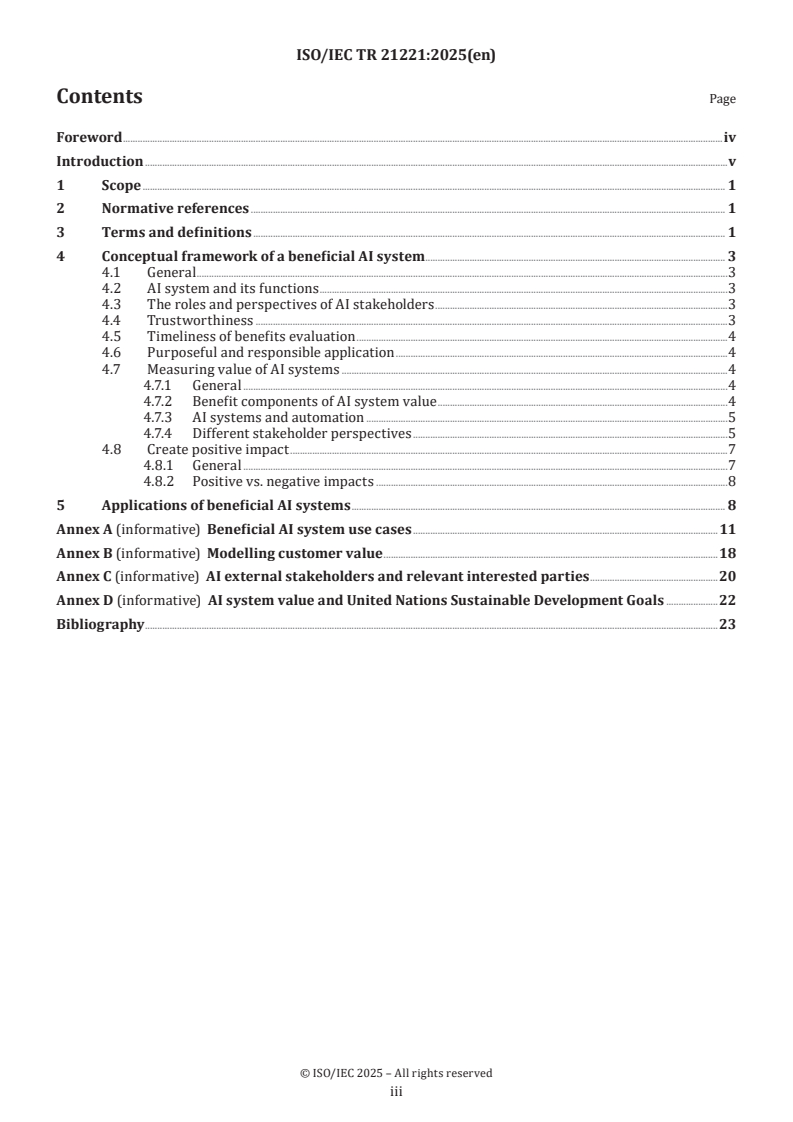
Contents Page
Foreword .iv
Introduction .v
1 Scope . 1
2 Normative references . 1
3 Terms and definitions . 1
4 Conceptual framework of a beneficial AI system . 3
4.1 General .3
4.2 AI system and its functions .3
4.3 The roles and perspectives of AI stakeholders .3
4.4 Trustworthiness .3
4.5 Timeliness of benefits evaluation .4
4.6 Purposeful and responsible application .4
4.7 Measuring value of AI systems .4
4.7.1 General .4
4.7.2 Benefit components of AI system value .4
4.7.3 AI systems and automation .5
4.7.4 Different stakeholder perspectives .5
4.8 Create positive impact .7
4.8.1 General .7
4.8.2 Positive vs. negative impacts .8
5 Applications of beneficial AI systems . 8
Annex A (informative) Beneficial AI system use cases .11
Annex B (informative) Modelling customer value .18
Annex C (informative) AI external stakeholders and relevant interested parties .20
Annex D (informative) AI system value and United Nations Sustainable Development Goals .22
Bibliography .23
© ISO/IEC 2025 – All rights reserved
iii
Foreword
ISO (the International Organization for Standardization) and IEC (the International Electrotechnical
Commission) form the specialized system for worldwide standardization. National bodies that are
members of ISO or IEC participate in the development of International Standards through technical
committees established by the respective organization to deal with particular fields of technical activity.
ISO and IEC technical committees collaborate in fields of mutual interest. Other international organizations,
governmental and non-governmental, in liaison with ISO and IEC, also take part in the work.
The procedures used to develop this document and those intended for its further maintenance are described
in the ISO/IEC Directives, Part 1. In particular, the different approval criteria needed for the different types
of document should be noted. This document was drafted in accordance with the editorial rules of the ISO/
IEC Directives, Part 2 (see www.iso.org/directives or www.iec.ch/members_experts/refdocs).
ISO and IEC draw attention to the possibility that the implementation of this document may involve the
use of (a) patent(s). ISO and IEC take no position concerning the evidence, validity or applicability of any
claimed patent rights in respect thereof. As of the date of publication of this document, ISO and IEC had not
received notice of (a) patent(s) which may be required to implement this document. However, implementers
are cautioned that this may not represent the latest information, which may be obtained from the patent
database available at www.iso.org/patents and https://patents.iec.ch. ISO and IEC shall not be held
responsible for identifying any or all such patent rights.
Any trade name used in this document is information given for the convenience of users and does not
constitute an endorsement.
For an explanation of the voluntary nature of standards, the meaning of ISO specific terms and expressions
related to conformity assessment, as well as information about ISO's adherence to the World Trade
Organization (WTO) principles in the Technical Barriers to Trade (TBT) see www.iso.org/iso/foreword.html.
In the IEC, see www.iec.ch/understanding-standards.
This document was prepared by Joint Technical Committee ISO/IEC JTC 1, Information technology,
Subcommittee SC 42, Artificial intelligence.
Any feedback or questions on this document should be directed to the user’s national standards
body. A complete listing of these bodies can be found at www.iso.org/members.html and
www.iec.ch/national-committees.
© ISO/IEC 2025 – All rights reserved
iv
Introduction
At present government, commercial and not-for-profit organizations are increasing their investment and
adoption of artificial intelligence (AI) technology in systems and applications for business processes,
products and services. As with other innovations, the adoption of AI comes with risks potentially resulting
in negative impacts. In some cases, the legal requirements governing the use of the technology have already
been imposed to mitigate these risks. To prevent unjustified negative societal attitude towards the AI, there
is a need to clearly articulate the benefits of AI for all the stakeholders, comparing the benefits with relevant
costs and risks. This can foster transparency and trustworthiness of AI, ensuring better governance, trust,
understanding and appreciation of the value of the AI technology.
This document describes a conceptual framework for the articulation of benefits of AI as one of the non-
functional characteristics of AI systems. This framework incorporates the make, use and impact perspectives
of the stakeholders. It can help to initiate meaningful discussion among the stakeholders and to formulate
appropriate business models and value propositions along the AI value chain.
This document also shows how the United Nations Sustainable Goals (UN SDGs) can be incorporated into
the benefit components of AI system value (Annex D). Examples are provided to how an AI system with the
proper benefit components in its value proposition can potentially contribute to and help accelerate the UN
[1]
SDGs and lend support to the ISO’s London Declaration .
© ISO/IEC 2025 – All rights reserved
v
Technical Report ISO/IEC TR 21221:2025(en)
Information technology — Artificial intelligence — Beneficial
AI systems
1 Scope
This document describes the delivery of functional, economic, environmental, social, societal, cultural,
intellectual and personal benefits by AI systems as perceived by their stakeholders. The document includes
illustrative use cases of AI systems.
2 Normative references
The following documents are referred to in the text in such a way that some or all of their content constitutes
requirements of this document. For dated references, only the edition cited applies. For undated references,
the latest edition of the referenced document (including any amendments) applies.
ISO/IEC 5339:2024, Information technology — Artificial intelligence — Guidance for AI applications
ISO/IEC 22989:2022, Information technology — Artificial intelligence — Artificial intelligence concepts and
terminology
3 Terms and definitions
For the purposes of this document, the terms and definitions given in ISO/IEC 22989, ISO/IEC 5339 and the
following apply.
ISO and IEC maintain terminology databases for use in standardization at the following addresses:
— ISO Online browsing platform: available at https:// www .iso .org/ obp
— IEC Electropedia: available at https:// www .electropedia .org/
3.1
consumer
individual member of the general public purchasing or using goods, property or services for private purposes
[SOURCE: ISO 14025:2006, 3.16]
3.2
AI customer
organization or entity that uses an AI product or service either directly or by its provision to AI users
Note 1 to entry: In the context of this document, an AI customer has a business relationship with the AI provider that
provides platforms, products or services that uses AI systems (see ISO/IEC 22989:2022, 5.19.2).
3.3
AI user
organization or entity that uses AI products or services
Note 1 to entry: An AI user can be an individual from the general public (consumer) or a member of the customer
organization or entity. An AI user is not required to have a business relationship with the AI provider or AI customer.
© ISO/IEC 2025 – All rights reserved
3.4
artificial intelligence system
AI system
engineered system that generates outputs such as content, forecasts, recommendations or decisions for a
given set of human-defined objectives.
[SOURCE: ISO/IEC 22989:2022, 3.1.4, modified — Notes to entry deleted.]
3.5
community
group of people with an arrangement of responsibilities, activities and relationships
Note 1 to entry: In the context of this document, community members do not have to reside in the same geographical areas.
[SOURCE: ISO 37153:2024, 3.9, modified — Notes to entry replaced.]
3.6
value proposition
promise of measurable benefits resulting from the collaboration
[SOURCE: ISO 44001:2017, 3.30]
3.7
civil society
wide range of individuals, groups of people, networks, movements, associations and organizations that
manifest and advocate for the interests of their members and others
Note 1 to entry: It can be based on philanthropic, cultural, religious, environmental or political values and convictions.
Note 2 to entry: This definition excludes for-profit companies and businesses, academia and all government-dependent
entities.
Note 3 to entry: In the context of this document, society is used as a synonym to civil society.
[SOURCE: ISO/TR 22370:2020, 3.5, modified — Note 3 to entry added.]
3.8
relevant interested party
person or organization that can affect, be affected by or perceive itself to be affected by a decision or activity
Note 1 to entry: In the context of this document, relevant interested parties are those stakeholders that are not inside
the context of an AI application.
3.9
cost-benefit analysis
decision aiding tool using a systematic evaluation of the positive effects (benefits) and negative effects
(disbenefits) of undertaking an action, integrating technical, time-schedule, management, financial, societal,
environmental issues
[SOURCE: ISO 18557:2017, 3.6]
3.10
sustainability
state of the global system, including environmental, social and economic aspects, in which the needs of the
present are met without compromising the ability of future generations to meet their own needs
Note 1 to entry: The environmental, social and economic aspects interact, are interdependent and are often referred
to as the three dimensions of sustainability.
[SOURCE: ISO Guide 82:2019, 3.1, modified— Note 2 to entry deleted.]
© ISO/IEC 2025 – All rights reserved
4 Conceptual framework of a beneficial AI system
4.1 General
The conceptual framework of a beneficial AI system is based on the following premise: an AI system is
perceived as beneficial when it functions as designed per its requirements, is trustworthy and is purposefully
and responsibly applied to create sustainable net positive value and impact for its stakeholders.
The attributes of this conceptual framework are defined in this clause. The benefits of using AI systems are
discussed in 4.7.2. The role AI systems play in automation is discussed in 4.7.3. The different stakeholder
perspectives are discussed in 4.7.4 with a more detailed model in Annex C. The creation of AI system value
is illustrated with multiple steps in Figure 1. The step involving a cost-benefit analysis as performed by an
AI customer is introduced in 4.7.4.5 together with a more detailed model with sample business models and
value propositions in Annex B. Taken together, these subclauses illustrate how the conceptual framework
of a beneficial AI system can be used to generate meaningful discussion among the stakeholders and help
formulate appropriate business models and value propositions along the AI value chain.
4.2 AI system and its functions
An AI system’s capabilities depend on the configuration and construction of the AI model and the domain
involved, e.g. computer vision, image recognition, natural language processing, machine translation, speech
synthesis, data mining and planning (see ISO/IEC 5339:2024, 5.3.4.2). Ensuring the system functions
as designed per its requirements is the necessary condition for the AI system to be considered by its
stakeholders.
External customers and users of the AI system usually interact with the AI system via a deployed AI
application (see ISO/IEC 5339).
4.3 The roles and perspectives of AI stakeholders
The AI stakeholders in an AI system environment (see ISO/IEC 22989:2022, 5.17 and ISO/IEC 5339) can be
grouped by their roles and perspectives in the context of an AI application (see ISO/IEC 5339:2024, 6). The
AI producers, AI developers, AI application providers and AI partners such as data providers typically have
roles and perspectives based on "making" the AI system (i.e. make stakeholders). The AI customers and
AI users typically have roles and perspectives based on "using" the AI system (i.e. use stakeholders). The
community, advocates, regulators and policy makers typically have their roles and perspectives based on
the "impact" of the AI system (i.e. impact stakeholders). The perspectives of each group of AI stakeholders
can be different and they form their own opinions and expectations of the benefits of the AI system based on
their own environment and value systems (see 4.7.4 and Annex C).
4.4 Trustworthiness
Trustworthiness of an AI system is an important factor that stakeholders use in determining the benefits of
an AI system. If the AI system is perceived as not trustworthy, then the system will probably not be used or
used in unintended ways resulting in suboptimal benefits.
There are many factors that contribute to the trustworthiness of an AI system (see ISO/IEC TR 24028),
[3] [4][5][6] [7] [8]
including explainability, robustness, transparency, ethical alignment and data quality
[9][10][11][12][13][14]
considerations .
To derive benefits from the AI system, the make stakeholders intentionally seek to understand the value
systems of the use and impact stakeholders to produce ethical and responsible AI systems that can be
perceived as trustworthy. There are many vulnerability and risk factors associated with AI systems that
can lead to the erosion of trust. These factors are discussed in ISO/IEC TR 24028 together with possible
measures that the make stakeholders can take to mitigate these vulnerability and risk factors across the AI
system’s life cycle.
© ISO/IEC 2025 – All rights reserved
4.5 Timeliness of benefits evaluation
The term “when” in the conceptual framework (4.1) is used to qualify the temporal perception of a beneficial AI
system. AI customers invest time evaluating and implementing AI systems. Accordingly, in their assessment,
users can also consider when they would benefit from the deployment of the AI system in the future.
4.6 Purposeful and responsible application
A purposeful AI system is one that is meaningfully designed and constructed to serve a particular useful and
responsible purpose in the intended context (ISO/IEC 42005:2025, 5.2.3 and ISO/IEC 5339:2024, Clause 5).
Purposeful and responsible application in the conceptual framework means that such an AI system is used
as intended. Otherwise, less than optimal benefits or even unintended negative consequences can result in
drawbacks and perverse outcomes. See 4.7.4.4 for more about responsible use of AI systems.
4.7 Measuring value of AI systems
4.7.1 General
Benefit is defined as a created advantage, value or other positive effect (see ISO 21506). One way to articulate
the benefit is to use a cost-benefit analysis in the form of value equals benefit minus cost. Simply put, the
created value is positive if the benefit is greater than cost.
In many cases, benefit and cost components do not have commensurate metrics. This can make the
measurement and determination of value difficult. For example, how can the cultural benefit of using
an AI system to preserve a near-lost language compare with the respective costs of model development,
operation, storage, deployment and tutoring? It is thus practical to treat the value of an AI system not as a
single measure but based on a set of benefit components.
Furthermore, benefit and cost components can be quantitative or qualitative as well as measurable or
unmeasurable (or at least not apparent or easily measurable). These further complicate the measurement
and determination of value of AI systems. A detailed example of measuring value from the customer’s
perspective is presented in Annex B. Discussion about dealing with incommensurate measures can be found
[18]
in .
4.7.2 Benefit components of AI system value
Benefits can be composed of multi-dimensional components, and so are values and costs. The following is a
non-exhaustive list of benefit components that can contribute to creating sustainable net positive value and
impact of AI systems:
— Functional benefits: enables the performance of certain new functions or enhances the efficiency and
effectiveness of existing ones such as improved accuracy in decision making;
— Personal benefits: promotes physical and psychological health and well-being personally and in
relationship with family, friends and community for different age groups;
— Societal benefits: provides benefits to society on a grander scale including governance and social order;
— Cultural benefits: preserves and promotes the language, practices, customs, behavioral and psychological
[8]
traits , literature, arts and artefacts of cultural groups;
— Intellectual benefits: extends the scope of an individual’s knowledge, comprehension, skills and
capabilities through education and other means.
The benefit components that drive sustainability include:
— Economic benefits: provides gains in revenue, reduction in costs, or enables innovative and competitive
offerings of products and services;
© ISO/IEC 2025 – All rights reserved
— Environmental benefits: facilitates the protection of the environment and mitigates negative
environmental changes or enables sustainable practices;
— Social benefits: promotes community cohesion, equity, peaceful interaction, or reductions in bias and
discrimination.
NOTE Some of these benefit components are aligned with the domains that can contribute to human well-
being as described in IEEE 7010-2020. These domains include satisfaction with life, affect, psychological well-being,
community, culture, education, economy, environment, health, human settlement and work.
It is important to note that these benefit components all have costs associated with them and they can have
effects at different stages of the AI system life cycle system (see ISO/IEC 5338).
A useful approach to conceptualize potential sustainable net positive value and impact from AI systems is to
[39]
consider the incorporation of the UN SDGs and other sustainability issues in the formulation of AI system
value. See Annex D for a more detailed description of UN SDGs and how the benefit components described
can be aligned with them in creating value.
4.7.3 AI systems and automation
AI systems have been employed to extend the spectrum of automation by improving the performance of
[21]
existing tasks. For example, they can be faster, more accurate, more availability and less biased. The extent
of automation spans from providing assistance to users to full automation. In certain cases, an AI system can
even function autonomously (ISO/IEC 22989:2022, Table 1) or can be designed to collaborate with humans
in a human-machine teaming setting (ISO/IEC 22989:2022, 5.13). AI systems are also taking on tasks
that were not practical, safe or commercially viable before (e.g. medical diagnostics, new drug discovery,
operating in hazardous environments). Some of these functional capabilities include using machine learning
on large datasets to formulate recommendations, predictions, natural language processing, computer vision,
robotics, generating contents such as text and video.
Tasks, including decision-making tasks, can be described as structured, semi-structured or unstructured.
Structured tasks are those whose rules are well-understood and can be programmed for automation (e.g.
operational tasks automated by expert systems). Semi-structured tasks are those that have structured
components that can be automated together with unstructured components that are human controlled (e.g.
digital assistants for tactical decisions). Unstructured tasks are difficult to define for automation purposes.
They are best performed by humans, who use their intelligence, experience, values, education and training
[20]
to understand, analyse, communicate and decide (e.g. strategic decisions, tasks that require empathy and
[21]
wisdom ). AI systems can be designed to automate structured tasks and augment human decision making
in semi-structured tasks. Advances in AI systems have also made augmentation of some unstructured tasks
[22]
possible. For example, some companies are enhancing customer care with AI-enabled affective computing
[23]
techniques implemented with robots and chatbots employed in unstructured conversations, leading to
[24][25]
better understanding and management of customer needs, care and connections .
4.7.4 Different stakeholder perspectives
4.7.4.1 General
As mentioned in 4.3, different groups of stakeholders (make, use, impact) have different perspectives on
the value of the AI system. For example, the AI producer’s goal would likely be to gain economic benefits in
offering the service of an AI system while the AI customer and user of the service want to gain functional
benefits in performing new and existing tasks more efficiently and effectively.
An example of the stakeholders and their roles in the creation of AI system value from inception to realization
processes are shown in Figure 1 and the steps are explained in 4.7.4.2 through 4.7.4.8. Some of the steps can
[14]
be performed in a different order during the different stages of the AI system life cycle .
© ISO/IEC 2025 – All rights reserved
Figure 1 — Creation of AI system value
4.7.4.2 Market demand analysis
Step 1 of the inception of the AI system (ISO/IEC 5338) can involve a market demand analysis conducted by
the AI producer to ascertain whether the AI system under consideration is a viable product in current or a
future economic environment. Market demand analysis studies the expectations of potential customers and
users in terms of functional requirements, desire for trustworthiness, risk appetite, etc.
4.7.4.3 Decision of the AI producer
Given the results of the market demand analysis, the AI producer can then decide whether to go ahead with
the product based on the AI producer’s internal criteria such as responsible AI principles, corporate ethical
guidelines, applicable regulations, documentation requirements, risk assessment and management. Part
of these considerations can include a potential impact analysis of the AI system on its stakeholders (see
4.7.4.8). The decision can also be motivated by the producer’s well-intentioned desire for creating “AI for
[24]
Good” by designing AI solutions which have the potential to advance the UN SDGs (Annex D). If the AI
producer decides to go ahead, then step 2 in the process can be for the AI producer to make the system with
AI technology by designing, developing, validating and verifying the system capabilities and working with
AI developers, data providers and other partners as needed.
4.7.4.4 Marketing the AI system
Once the AI system is ready for introduction into use, step 3 is to market the product to potential
customers and users. This can involve the presentation (e.g. demonstration) of the AI system’s features and
functional capabilities together with a value proposition expounding the cost and potential benefit (4.7),
trustworthiness, risks mitigation and management features to the stakeholders, etc. This value proposition
is initiated by the AI producer and directed at the recipients who are potential customers and users. There
© ISO/IEC 2025 – All rights reserved
are other forms of value propositions initiated and received by different pairs of stakeholders in this
environment. They are discussed in 4.7.4.5 to 4.7.4.8 and presented in the context of a customer value model
in Annex B.
The value proposition presented to the potential customers and users can include a licence for use of
[25]
the AI system. An example of such a licence is the Responsible AI Licence (RAIL) which can specify
the agreement among the producer, customer and users about the functionality of the AI system and
behavioural-use clauses of the licensed artefacts. This type of licence is conducive to responsible use of AI
systems in purposeful applications (4.6).
4.7.4.5 Cost-benefit analysis
Once the customer or user receives the value proposition and gains an understanding of the functional
capabilities of the AI system (e.g. through a demonstration), they can then (step 4) perform a cost-benefit
analysis. The purpose of the cost-benefit analysis is to determine whether the customer or user can use
(adopt) the proffered AI system. The input to the cost-benefit analysis can include the customer’s or user’s
expectations (4.7.3) in matching with the offerings by the AI producer together with the entity’s own internal
decision criteria (e.g. budget, reputation, competitive environment, value potential, risks of negative impacts
and other considerations). A more detailed example is presented in Annex B.
4.7.4.6 Decision by customer or user
The results of the cost-benefit analysis can provide the basis and support for the evaluating entity to decide
(step 5) whether to acquire the use of the AI system, that is, whether to accept the value proposition and license
agreement from the AI producer and enter into a relationship with the AI producer. In the case of customers,
this involves a business relationship which can also be a consent-based agreement with some users.
4.7.4.7 Value creation and assessment
Once the customers and users start to use the AI system (step 6), then the enterprise can ascertain whether
net positive value is created through this use (as promised in the AI producer’s value proposition) with an
assessment process (step 7, see Annex B). The AI producer can also assess the value co-produced from the
business relationship.
4.7.4.8 Impact on AI stakeholders
On one hand, the results from using the AI system can generate value for the customers, users and the AI
producer. On the other hand, the results can also impact (step 8) other AI stakeholders who are not in the
context of applying the AI system. These other AI stakeholders can be consumers in the community or society
on a grander scale. Whether or not the use of the AI system can positively impact other AI stakeholders can
be assessed at this point (step 9) (see 4.5 about timeliness of this evaluation).
4.8 Create positive impact
4.8.1 General
The AI stakeholders, their roles and perspectives within an AI application’s context are identified in 4.3.
Once the AI application is deployed and used, there are other relevant interested parties such as individuals
and groups representing them (for example advocates), vulnerable citizens and workers in societies that
can be impacted (ISO/IEC 42005:2025, 5.7). Even though these relevant interested parties are not within
the context of the AI application, they are in the AI system’s environment and can still be impacted directly
or indirectly by the use of the AI system. The determination of positive or negative impact of the AI system
very much depends on the diversity of context and environmental factors of its deployment and use. It also
depends on where the AI system is deployed and used (e.g. in different geographical, national, regional,
cultural, organizational and industry sectors). These relevant interested parties can be consulted together
with the AI stakeholders as part of an assessment of potential and actual impacts by the AI producer (e.g.
step 1 in 4.7.4.2) (see ISO/IEC 42005). An instance of the relationship among the AI external stakeholders
and some of the relevant interested parties are illustrated and discussed in Annex C.
© ISO/IEC 2025 – All rights reserved
4.8.2 Positive vs. negative impacts
The impact of the AI system on the AI stakeholders and relevant interested parties can be positive if they are
the direct or indirect recipients of the positive value or enrichment derived from the deployment and use of
a beneficial AI system (see Annex C also). On the other hand, the impact on them can be negative if the use
of an AI system that is not beneficial results in harms or detriment. The negative impact can be the result
of a maliciously designed AI system, an AI system that was tampered with, or the intended or unintended
irresponsible use of a well-intended design. Some examples of negative impacts include the perpetuation of
1)
bias and discrimination by classification (such as redlining ), cultural replacement (reduction in dignity
of the cultural group), disinformation, anti-competitive practices, harm to the environment or food source,
missed or misdiagnosis of medical conditions. Impacts are not easily measured (as with values, see 4.7.1).
An approach can be to assign a high or prohibitive cost to the negative impacts related to certain benefit
components (4.7.2) in the cost-benefit analysis such that the positive impacts (benefits) are negated resulting
in the AI system being perceived as not beneficial.
5 Applications of beneficial AI systems
The use of AI systems can produce positive value and impact in many application areas and sectors in
society. As AI technology becomes more and more popular, there are too many examples of beneficial
[24]
applications to be enumerated in this document . To illustrate, some examples of AI applications based
on the conceptual framework of beneficial AI system are shown in Table 1. The AI applications are denoted
with their functional capabilities, their application areas and their benefit components to generate value
and their impact as potential contribution to UN SDGs. To reduce redundancy, each example in Table 1 is not
shown with a potential contribution to UN SDG 17 “Partnership for the goals”.
Table 1 — Examples of applications based on the conceptual framework of beneficial AI system
Benefit
Functional capabilities of AI sys- Potential contribu-
Application area
tems tion to UN SDGs
components
Structured, semi-structured to Functional, economic,
Automation of tasks and decision
unstructured tasks and deci- cultural, personal, intel- 3,4,8,9
making
sion making lectual
Assistive technology, chatbots,
Natural Language Processing empathetic service robots. Functional, economic,
(NLP), speech recognition and Voice controlled devices and cultural, personal, intel- 3,4,8,9
generation, translation applications can provide a lectual
more inclusive user experience
Perform repetitive tasks, reduce
Functional, economic,
human errors and risks of acci-
Factory automation cultural, personal, intel- 3,8,9
dents due to boredom and inatten-
lectual
tiveness
Organize, store and process data Functional, economic,
Big data processing 4,8,9
efficiently personal, intellectual
Real-time applications, smart- Economic, environmen-
Timely decision making 7,9,11,12,13
grid energy management tal, societal
Knowledge engineering, ma-
Knowledge acquisition and pro- Functional, economic,
chine learning, develop into AI 3,4,8,9
cessing personal, intellectual
applications
Machine learning for making Functional, economic,
Making inferences, predictions,
inferences, predictions, recom- personal, intellectual, 3,4,8,9,12
recommendations
mendations environmental
NOTE Columns are keyed to concepts in the framework.
1) A financial institution declines to offer a loan or insurance to someone because they live in an area deemed to be a
high financial risk.
© ISO/IEC 2025 – All rights reserved
TTabablele 1 1 ((ccoonnttiinnueuedd))
Benefit
Functional capabilities of AI sys- Potential contribu-
Application area
tems tion to UN SDGs
components
Solving complex problems such as Production, supply-chain plan-
Functional, economic,
optimization, planning and moni- ning and operations, workflow 8,9,11,12,13
environmental
toring performance enhancement
Assistive diagnostics, early
screening and detection of dis-
Medical applications, review of eases, personalized medicine, Functional, economic,
scans, biometric applications, brain-activated technology. Can personal, cultural, social, 3,4,9,10,11
assistive technology help in personalized medicine environmental
based on unique characteris-
tics of patients
Drug discovery based on analy-
sis of large datasets to identify
potential drug candidates. Can Functional, economic,
Pharmacology applications 3,8,9,12
result in reduced costs and personal, environmental
increased chances of finding
effective treatments of diseases
In smart grids, AI is used to
optimize energy distribution,
predict power outages and
manage renewable energy Economic, societal, envi-
Energy management 7,9,11,12,13
sources more effectively. This ronmental
can result in a more resilient
and sustainable energy infra-
structure
Functional, economic,
Service availability 24/7 Enhance customer service social, cultural, environ- 3,8,9,10,11
mental
Functional, economic,
Patterns, videos, images recogni- Personal identification, video
social, societal, environ- 3,5,9,10,11,16
tion tagging
mental
Factory, logistics automation,
surgery robots that offer
precision and control beyond Functional, economic,
Robotics 3,8,9,11,12
human capabilities. Can lead environmental
to reduced recovery times and
improved patient outcomes
Assisted driving, autonomous
vehicles. Can enhance road
safety, reduce human errors Functional, economic,
Robot vehicles 3,8,9,10,11,13
that cause accidents. Can in- social, environmental
crease accessibility for people
with disabilities
Environmental monitoring to
analyse data from satellites,
sensors and other sources for
Pervasive scanning and odour tracking climate change, mon-
Environmental 6,11,12,13,14
detection itor deforestation, predicting
natural disasters, contribute
to more effective conservation
efforts
NOTE Columns are keyed to concepts in the framework.
© ISO/IEC 2025 – All rights reserved
TTabablele 1 1 ((ccoonnttiinnueuedd))
Benefit
Functional capabilities of AI sys- Potential contribu-
Application area
tems tion to UN SDGs
components
Financial applications used to
detect unusual patterns and
anomalies in transactions.
Fraud detection Prevent fraudulent activities Economic, societal 1,8,9,10,16
especially those targeting part
of the population with vulnera-
bilities (such as older persons)
Personal assistant. Can pro-
Perform as assistant, critic, sec- vide an AI-driven educational Functional, economic,
ond opinion, expert consultant, platform that can be adapted to intellectual, personal, 3,4,8,10
tutor individual student needs and social
provide targeted assistance
Economical, intellectual,
Game playing Entertainment, teaching 9,16
social, societal
Privacy protection and asset Functional, economic,
Spam and hacking detection 3,8,9,11,16
loss prevention societal, environmental
Increase in crop production
with suggested composition of
Agricultural and Food applica- applied fertilizer. Monitoring Economic, personal, envi-
2,12,15
tions and management of liver stock ronmental
production with risk mitiga-
tions
NOTE Columns are keyed to concepts in the framework.
Annex D shows a useful way of associating the benefit of an AI system. It does this by looking at the offered
value based on the benefit components (4.7.2), as aligned with the UN SDGs, and the extent of their impact at
the micro, meso and macro level of analysis. More examples of beneficial AI system use cases with their UN
SDGs potential contributions can be found in ISO/IEC TR 24030. Some additional beneficial AI system use
cases are described in more detail in Annex A.
© ISO/IEC 2025 – All rights reserved
Annex A
(informative)
Beneficial AI system use cases
A.1 General
The following use cases were suggested by experts associated with ISO/IEC TR 24030 and others submitted
specifically for this project.
A.2 Beneficial AI system use case 1: Identify defects on wind turbine blades
This use case describes a solution to quickly identify defects during quality assurance process on wind
turbine blades (ISO/IEC TR 24030). The attributes of this use case are shown in Table A.1.
The AI system automatically detects defects from ultrasonic testing scanning data through deep learning
capabilities. It achieves high coverage (more than 95 %) of various defects. As a result, human inspectors
only need to examine the parts of the blade that are flagged by the AI system (less than 20 %). This solution
means the same inspector can process 4 to 5 blades per day instead of just 1 previously. This solution can
increase operational efficiency as well as potentially contribute to UN SDG 7 – Affordable and Clean Energy
and UN SDG 9 – Industry, Innovation and Infrastructure.
Table A.1 — Beneficial AI systems use case 1 — Attributes
TMa
Producer (make): Fujitsu Limited
Stakeholders Customer (use): wind turbine manufacturers
Community (impact): Area residents, utility companies, energy customers
Trustworthiness Explainability, reputation of the enterprise
Reduce costs and labour for manufacturer – human-machine teaming
Value
Higher quality product
(economic,
Reduce chance of product failure
societal, etc.)
Prolong product life and energy production
Reduce probability of harm and detriment to manufacturers
Impact Reduce probability of harm and detriment to the community
Reduce liability
a TM
Fujitsu is a trademark of Fujitsu Limited. This information is given for the convenience of users of this
document and does not constitute an endorsement by ISO or IEC of this product.
A.3 Beneficial AI system use case 2: Deep learning for identifying metastatic
breast cancer
The International Symposium on Biomedical Imaging (ISBI) held a grand challenge to evaluate computational
systems for the automated detection of metastatic breast cancer in whole slide images of sentinel lymph
node biopsies.
The winning team reported: “To evaluate the top-ranking deep learning systems against a human
pathologist, the Camelyon16 organizers had a pathologist examine the test images used in the competition.
For the slide-based classification task, the human pathologist achieved an AUC [Area Under the Curve] of
0,9664, reflecting a 3,4 % error rate. When the predictions of our deep learning system were combined with
© ISO/IEC 2025 – All rights reserved
the predictions of the human pathologist, the AUC was raised to 0,9948 reflecting a drop in the error rate to
[27]
0,52 percent” .
The AI system has the potential to contribute to UN SDG 3 – Good Health and Well-being. The attributes of
this use case are shown in Table A.2.
Table A.2 — Beneficial AI systems use case 2 — attributes
Producer (make): Medical team, human in charge, AI in the loop
Stakeholders Customer (use): pathologists, healthcare
...