

ISO/IEC TS 18661-1:2014
(Main)Information technology — Programming languages, their environments, and system software interfaces — Floating-point extensions for C — Part 1: Binary floating-point arithmetic
General Information
- Abstract
ISO/IEC TS 18661-1:2014 extends programming language C to support binary floating-point arithmetic conforming to ISO/IEC/IEEE 60559:2011. It covers all requirements of IEC 60559 as they pertain to C floating types that use IEC 60559 binary formats. ISO/IEC TS 18661-1:2014 does not cover decimal floating-point arithmetic, nor does it cover most optional features of IEC 60559. ISO/IEC TS 18661-1:2014 is primarily an update to IEC 9899:2011 (C11), normative Annex F (IEC 60559 floating-point arithmetic). However, it proposes that the new interfaces that are suitable for general implementations be added in the Library clauses of C11. Also it includes a few auxiliary changes in C11 where the specification is problematic for IEC 60559 support.
- Status
- Withdrawn
- Publication Date
- 20-Jul-2014
- Technical Committee
- ISO/IEC JTC 1/SC 22 - Programming languages, their environments and system software interfaces
- Drafting Committee
- ISO/IEC JTC 1/SC 22/WG 14 - C
- Current Stage
- 9599 - Withdrawal of International Standard
- Start Date
- 09-Sep-2025
- Completion Date
- 29-Aug-2026
Buy Documents

ISO/IEC TS 18661-1:2014 - Information technology — Programming languages, their environments, and system software interfaces — Floating-point extensions for C — Part 1: Binary floating-point arithmetic/21/2014


ISO/IEC TS 18661-1:2014 - Information technology -- Programming languages, their environments, and system software interfaces -- Floating-point extensions for C
Overview
ISO/IEC TS 18661-1:2014 - Floating‑point extensions for C (Part 1: Binary floating‑point arithmetic) updates the C language (based on C11 / ISO/IEC 9899:2011) to provide a language binding for binary floating‑point arithmetic that conforms to ISO/IEC/IEEE 60559:2011 (the IEEE‑754‑2008 model). The Technical Specification extends Annex F of C11, specifies required behavior for C floating types that use IEC 60559 binary formats, and proposes library interfaces suitable for general implementations. It explicitly does not cover decimal floating‑point arithmetic or most optional IEC 60559 features.
Key topics and requirements
ISO/IEC TS 18661-1:2014 focuses on making C support the mandatory elements of the IEC 60559 binary model. Major topics include:
- Conformance and C standard integration - updates to C11 conformance clauses, macros, and headers for IEC 60559 support.
- Types and canonical representation - terminology and canonical forms for binary floating types that conform to IEC 60559.
- Operation binding and conversions - clear rules for floating‑to‑integer, conversions to/from character sequences, and conversion correctness.
- Rounding and reproducibility - support for constant rounding directions and runtime rounding control to improve reproducibility.
- NaN and special values - comprehensive NaN handling and classification consistent with IEC 60559.
- Mathematical and utility functions (<math.h>, <fenv.h>, <tgmath.h>) - additions and refinements such as nearest‑integer functions, llogb family, max/min magnitude, nextup/nextdown, total order and canonicalize functions, and NaN utilities.
- Floating‑point environment - functions and control modes for exception flags and environment manipulation (fesetexcept, fetestexceptflag, etc.).
- Auxiliary changes to C11 - small fixes where C11 was problematic for IEC 60559 support.
Keywords naturally related to the standard: ISO/IEC TS 18661-1:2014, C11, IEC 60559, IEEE 754, binary floating-point arithmetic, rounding modes, NaN support, <math.h>, <fenv.h>, reproducible floating-point.
Practical applications and users
This Technical Specification is intended for groups that need consistent, portable, and well‑specified floating‑point behavior in C programs:
- Compiler and runtime/library implementers - to provide IEC 60559‑conforming floating types and math/environment functions.
- Numerical software developers - for scientific computing, signal processing, and HPC where reproducibility and precise exception semantics matter.
- Embedded and safety‑critical systems - where deterministic FP behavior, exception handling, and portability are required.
- Tooling and verification teams - for debugging, testing, and certification of numerical code that depends on IEC 60559 semantics.
Benefits include improved portability of numerical programs, clearer semantics for exceptions and special values (NaNs, infinities), and mechanisms to achieve reproducible results across conforming implementations.
Related standards
- ISO/IEC/IEEE 60559:2011 (IEEE‑754‑2008) - floating‑point arithmetic model this TS binds to C.
- ISO/IEC 9899:2011 (C11) - base C standard that TS 18661-1 updates (Annex F and library clauses).
- Other parts of TS 18661 (Parts 2–5) cover decimal floating‑point, interchange/extended types, supplementary functions, and attributes.
Buy Documents
ISO/IEC TS 18661-1:2014 - Information technology — Programming languages, their environments, and system software interfaces — Floating-point extensions for C — Part 1: Binary floating-point arithmetic/21/2014
ISO/IEC TS 18661-1:2014 - Information technology -- Programming languages, their environments, and system software interfaces -- Floating-point extensions for C
Get Certified
Connect with accredited certification bodies for this standard

BSI Group
BSI (British Standards Institution) is the business standards company that helps organizations make excellence a habit.

NYCE
Mexican standards and certification body.
Sponsored listings
Frequently Asked Questions
ISO/IEC TS 18661-1:2014 is a technical specification published by the International Organization for Standardization (ISO). Its full title is "Information technology — Programming languages, their environments, and system software interfaces — Floating-point extensions for C — Part 1: Binary floating-point arithmetic". This standard covers: ISO/IEC TS 18661-1:2014 extends programming language C to support binary floating-point arithmetic conforming to ISO/IEC/IEEE 60559:2011. It covers all requirements of IEC 60559 as they pertain to C floating types that use IEC 60559 binary formats. ISO/IEC TS 18661-1:2014 does not cover decimal floating-point arithmetic, nor does it cover most optional features of IEC 60559. ISO/IEC TS 18661-1:2014 is primarily an update to IEC 9899:2011 (C11), normative Annex F (IEC 60559 floating-point arithmetic). However, it proposes that the new interfaces that are suitable for general implementations be added in the Library clauses of C11. Also it includes a few auxiliary changes in C11 where the specification is problematic for IEC 60559 support.
ISO/IEC TS 18661-1:2014 extends programming language C to support binary floating-point arithmetic conforming to ISO/IEC/IEEE 60559:2011. It covers all requirements of IEC 60559 as they pertain to C floating types that use IEC 60559 binary formats. ISO/IEC TS 18661-1:2014 does not cover decimal floating-point arithmetic, nor does it cover most optional features of IEC 60559. ISO/IEC TS 18661-1:2014 is primarily an update to IEC 9899:2011 (C11), normative Annex F (IEC 60559 floating-point arithmetic). However, it proposes that the new interfaces that are suitable for general implementations be added in the Library clauses of C11. Also it includes a few auxiliary changes in C11 where the specification is problematic for IEC 60559 support.
ISO/IEC TS 18661-1:2014 is classified under the following ICS (International Classification for Standards) categories: 35.060 - Languages used in information technology. The ICS classification helps identify the subject area and facilitates finding related standards.
ISO/IEC TS 18661-1:2014 is available in PDF format for immediate download after purchase. The document can be added to your cart and obtained through the secure checkout process. Digital delivery ensures instant access to the complete standard document.
Standards Content (Sample)
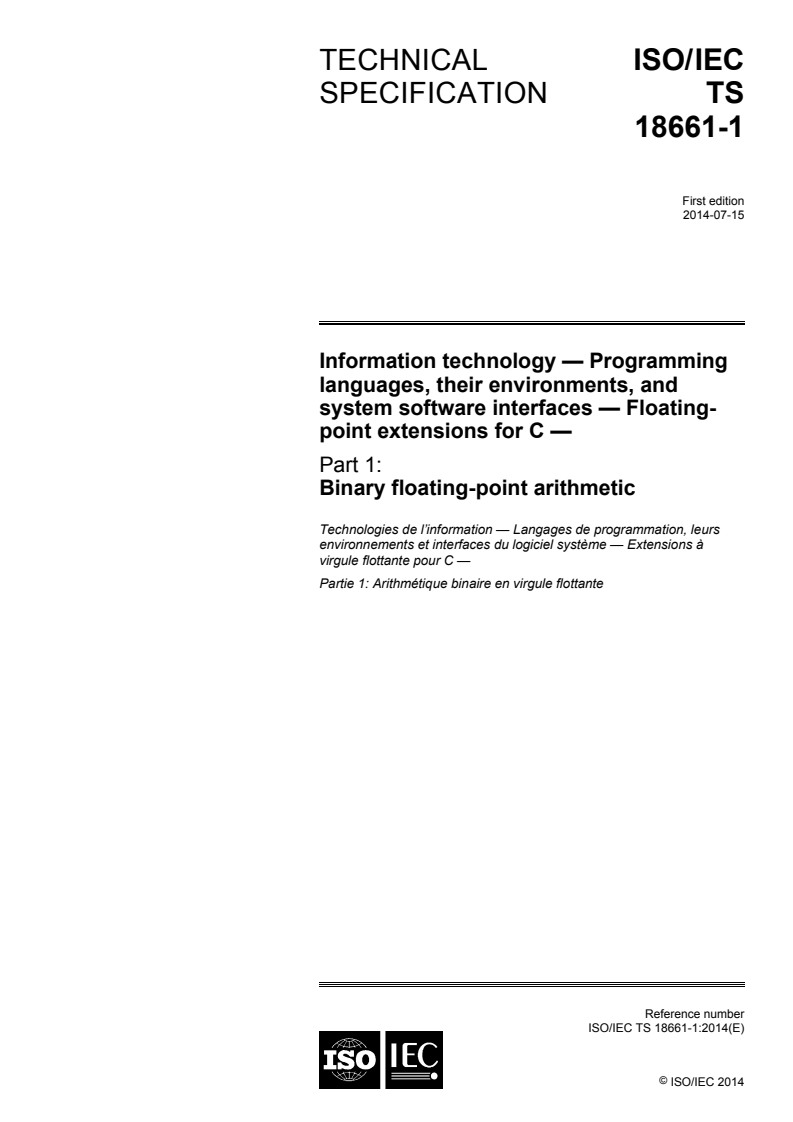
TECHNICAL ISO/IEC
SPECIFICATION TS
18661-1
First edition
2014-07-15
Information technology — Programming
languages, their environments, and
system software interfaces — Floating-
point extensions for C —
Part 1:
Binary floating-point arithmetic
Technologies de l’information — Langages de programmation, leurs
environnements et interfaces du logiciel système — Extensions à
virgule flottante pour C —
Partie 1: Arithmétique binaire en virgule flottante
Reference number
©
ISO/IEC 2014
© ISO/IEC 2014
All rights reserved. Unless otherwise specified, no part of this publication may be reproduced or utilized otherwise in any form or by any
means, electronic or mechanical, including photocopying, or posting on the internet or an intranet, without prior written permission.
Permission can be requested from either ISO at the address below or ISO’s member body in the country of the requester.
ISO copyright office
Case postale 56 CH-1211 Geneva 20
Tel. + 41 22 749 01 11
Fax + 41 22 749 09 47
E-mail copyright@iso.org
Web www.iso.org
Published in Switzerland
ii © ISO/IEC 2014 – All rights reserved
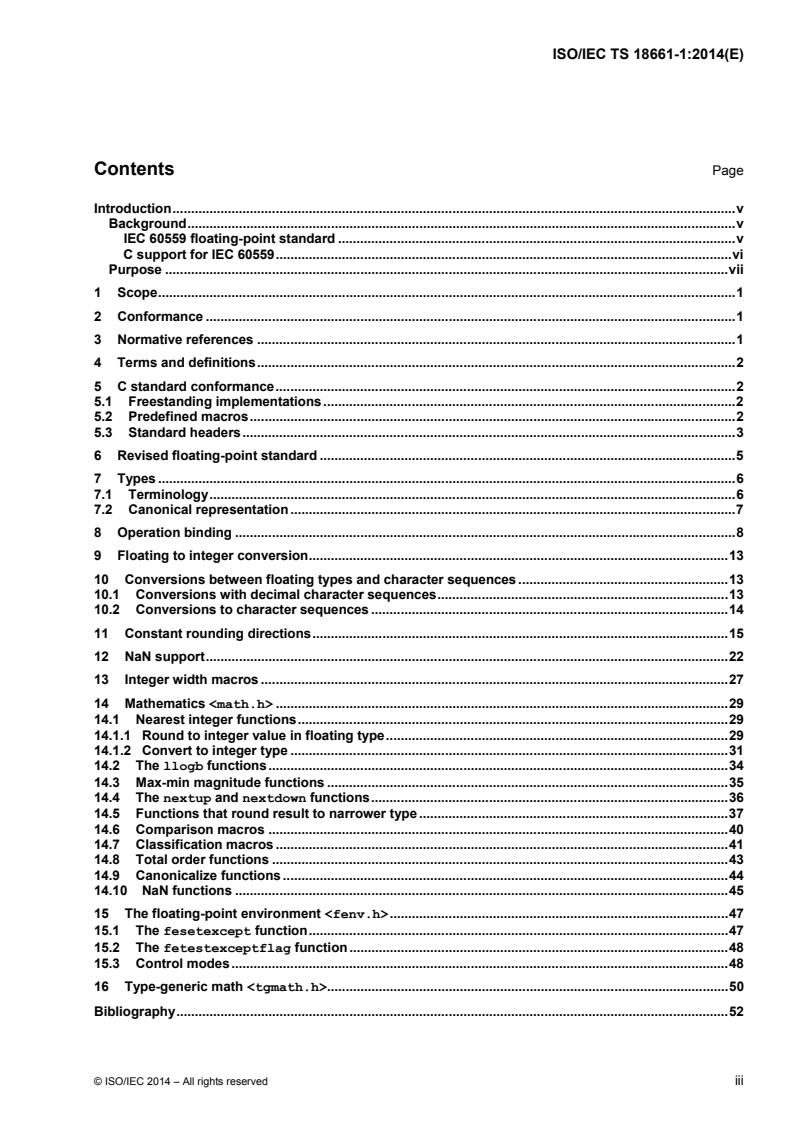
Contents Page
Introduction . v
Background . v
IEC 60559 floating-point standard . v
C support for IEC 60559 . vi
Purpose . vii
1 Scope . 1
2 Conformance . 1
3 Normative references . 1
4 Terms and definitions . 2
5 C standard conformance . 2
5.1 Freestanding implementations . 2
5.2 Predefined macros . 2
5.3 Standard headers . 3
6 Revised floating-point standard . 5
7 Types . 6
7.1 Terminology . 6
7.2 Canonical representation . 7
8 Operation binding . 8
9 Floating to integer conversion . 13
10 Conversions between floating types and character sequences . 13
10.1 Conversions with decimal character sequences . 13
10.2 Conversions to character sequences . 14
11 Constant rounding directions . 15
12 NaN support . 22
13 Integer width macros . 27
14 Mathematics . 29
14.1 Nearest integer functions . 29
14.1.1 Round to integer value in floating type . 29
14.1.2 Convert to integer type . 31
14.2 The llogb functions . 34
14.3 Max-min magnitude functions . 35
14.4 The nextup and nextdown functions . 36
14.5 Functions that round result to narrower type . 37
14.6 Comparison macros . 40
14.7 Classification macros . 41
14.8 Total order functions . 43
14.9 Canonicalize functions . 44
14.10 NaN functions . 45
15 The floating-point environment . 47
15.1 The fesetexcept function . 47
15.2 The fetestexceptflag function . 48
15.3 Control modes . 48
16 Type-generic math . 50
Bibliography . 52
© ISO/IEC 2014 – All rights reserved iii
Foreword
ISO (the International Organization for Standardization) and IEC (the International Electrotechnical
Commission) form the specialized system for worldwide standardization. National bodies that are members of
ISO or IEC participate in the development of International Standards through technical committees
established by the respective organization to deal with particular fields of technical activity. ISO and IEC
technical committees collaborate in fields of mutual interest. Other international organizations, governmental
and non-governmental, in liaison with ISO and IEC, also take part in the work. In the field of information
technology, ISO and IEC have established a joint technical committee, ISO/IEC JTC 1.
The procedures used to develop this document and those intended for its further maintenance are described
in the ISO/IEC Directives, Part 1. In particular the different approval criteria needed for the different types of
document should be noted. This document was drafted in accordance with the editorial rules of the
ISO/IEC Directives, Part 2 (see www.iso.org/directives).
Attention is drawn to the possibility that some of the elements of this document may be the subject of patent
rights. ISO and IEC shall not be held responsible for identifying any or all such patent rights. Details of any
patent rights identified during the development of the document will be in the Introduction and/or on the ISO
list of patent declarations received (see www.iso.org/patents).
Any trade name used in this document is information given for the convenience of users and does not
constitute an endorsement.
For an explanation on the meaning of ISO specific terms and expressions related to conformity assessment,
as well as information about ISO's adherence to the WTO principles in the Technical Barriers to Trade (TBT)
see the following URL: Foreword - Supplementary information
The committee responsible for this document is ISO/IEC JTC 1, Information technology, SC 22, Programming
languages, their environments, and system software interfaces.
ISO/IEC TS 18661 consists of the following parts, under the general title Information technology —
Programming languages, their environments, and system software interfaces — Floating-point extensions
for C:
Part 1: Binary floating-point arithmetic
Part 2: Decimal floating-point arithmetic
Part 3: Interchange and extended types
Part 4: Supplementary functions
Part 5: Supplementary attributes
Part 1 updates ISO/IEC 9899:2011, Information technology — Programming languages — C, Annex F in
particular, to support all required features of ISO/IEC/IEEE 60559:2011, Information technology —
Microprocessor Systems — Floating-point arithmetic.
Part 2 supersedes ISO/IEC TR 24732:2009, Information technology — Programming languages, their
environments and system software interfaces — Extension for the programming language C to support
decimal floating-point arithmetic.
Parts 3-5 specify extensions to ISO/IEC 9899:2011 for features recommended in ISO/IEC/IEEE 60559:2011.
iv © ISO/IEC 2014 – All rights reserved
Introduction
Background
IEC 60559 floating-point standard
The IEEE 754-1985 standard for binary floating-point arithmetic was motivated by an expanding diversity in
floating-point data representation and arithmetic, which made writing robust programs, debugging, and moving
programs between systems exceedingly difficult. Now the great majority of systems provide data formats and
arithmetic operations according to this standard. The IEC 60559:1989 international standard was equivalent to
the IEEE 754-1985 standard. Its stated goals were:
1 Facilitate movement of existing programs from diverse computers to those that adhere to this
standard.
2 Enhance the capabilities and safety available to programmers who, though not expert in
numerical methods, may well be attempting to produce numerically sophisticated programs.
However, we recognize that utility and safety are sometimes antagonists.
3 Encourage experts to develop and distribute robust and efficient numerical programs that are
portable, by way of minor editing and recompilation, onto any computer that conforms to this
standard and possesses adequate capacity. When restricted to a declared subset of the
standard, these programs should produce identical results on all conforming systems.
4 Provide direct support for
a. Execution-time diagnosis of anomalies
b. Smoother handling of exceptions
c. Interval arithmetic at a reasonable cost
5 Provide for development of
a. Standard elementary functions such as exp and cos
b. Very high precision (multiword) arithmetic
c. Coupling of numerical and symbolic algebraic computation
6 Enable rather than preclude further refinements and extensions.
To these ends, the standard specified a floating-point model comprising:
formats – for binary floating-point data, including representations for Not-a-Number (NaN) and signed
infinities and zeros
operations – basic arithmetic operations (addition, multiplication, etc.) on the format data to compose a
well-defined, closed arithmetic system; also conversions between floating-point formats and decimal
character sequences, and a few auxiliary operations
context – status flags for detecting exceptional conditions (invalid operation, division by zero, overflow,
underflow, and inexact) and controls for choosing different rounding methods
The ISO/IEC/IEEE 60559:2011 international standard is equivalent to the IEEE 754-2008 standard for
floating-point arithmetic, which is a major revision to IEEE 754-1985.
The revised standard specifies more formats, including decimal as well as binary. It adds a 128-bit binary
format to its basic formats. It defines extended formats for all of its basic formats. It specifies data interchange
© ISO/IEC 2014 – All rights reserved v
formats (which may or may not be arithmetic), including a 16-bit binary format and an unbounded tower of
wider formats. To conform to the floating-point standard, an implementation must provide at least one of the
basic formats, along with the required operations.
The revised standard specifies more operations. New requirements include – among others – arithmetic
operations that round their result to a narrower format than the operands (with just one rounding), more
conversions with integer types, more classifications and comparisons, and more operations for managing
flags and modes. New recommendations include an extensive set of mathematical functions and seven
reduction functions for sums and scaled products.
The revised standard places more emphasis on reproducible results, which is reflected in its standardization
of more operations. For the most part, behaviors are completely specified. The standard requires conversions
between floating-point formats and decimal character sequences to be correctly rounded for at least three
more decimal digits than is required to distinguish all numbers in the widest supported binary format; it fully
specifies conversions involving any number of decimal digits. It recommends that transcendental functions be
correctly rounded.
The revised standard requires a way to specify a constant rounding direction for a static portion of code, with
details left to programming language standards. This feature potentially allows rounding control without
incurring the overhead of runtime access to a global (or thread) rounding mode.
Other features recommended by the revised standard include alternate methods for exception handling,
controls for expression evaluation (allowing or disallowing various optimizations), support for fully reproducible
results, and support for program debugging.
The revised standard, like its predecessor, defines its model of floating-point arithmetic in the abstract. It
neither defines the way in which operations are expressed (which might vary depending on the computer
language or other interface being used), nor does it define the concrete representation (specific layout in
storage, or in a processor's register, for example) of data or context, except that it does define specific
encodings that are to be used for data that may be exchanged between different implementations that
conform to the specification.
IEC 60559 does not include bindings of its floating-point model for particular programming languages.
However, the revised standard does include guidance for programming language standards, in recognition of
the fact that features of the floating-point standard, even if well supported in the hardware, are not available to
users unless the programming language provides a commensurate level of support. The implementation’s
combination of both hardware and software determines conformance to the floating-point standard.
C support for IEC 60559
The C standard specifies floating-point arithmetic using an abstract model. The representation of a floating-
point number is specified in an abstract form where the constituent components (sign, exponent, significand)
of the representation are defined but not the internals of these components. In particular, the exponent range,
significand size, and the base (or radix) are implementation-defined. This allows flexibility for an
implementation to take advantage of its underlying hardware architecture. Furthermore, certain behaviors of
operations are also implementation-defined, for example in the area of handling of special numbers and in
exceptions.
The reason for this approach is historical. At the time when C was first standardized, before the floating-point
standard was established, there were various hardware implementations of floating-point arithmetic in
common use. Specifying the exact details of a representation would have made most of the existing
implementations at the time not conforming.
Beginning with ISO/IEC 9899:1999 (C99), C has included an optional second level of specification for
implementations supporting the floating-point standard. C99, in conditionally normative Annex F, introduced
nearly complete support for the IEC 60559:1989 standard for binary floating-point arithmetic. Also, C99’s
informative Annex G offered a specification of complex arithmetic that is compatible with IEC 60559:1989.
vi © ISO/IEC 2014 – All rights reserved
ISO/IEC 9899:2011 (C11) includes refinements to the C99 floating-point specification, though is still based on
IEC 60559:1989. C11 upgrades Annex G from “informative” to “conditionally normative”.
ISO/IEC TR 24732:2009 introduced partial C support for the decimal floating-point arithmetic in
ISO/IEC/IEEE 60559:2011. ISO/IEC TR 24732, for which technical content was completed while IEEE 754-
2008 was still in the later stages of development, specifies decimal types based on ISO/IEC/IEEE 60559:2011
decimal formats, though it does not include all of the operations required by ISO/IEC/IEEE 60559:2011.
Purpose
The purpose of ISO/IEC TS 18661 is to provide a C language binding for ISO/IEC/IEEE 60559:2011, based
on the C11 standard, that delivers the goals of ISO/IEC/IEEE 60559 to users and is feasible to implement. It is
organized into five Parts.
Part 1, this document, provides changes to C11 that cover all the requirements, plus some basic
recommendations, of ISO/IEC/IEEE 60559:2011 for binary floating-point arithmetic. C implementations
intending to support ISO/IEC/IEEE 60559:2011 are expected to conform to conditionally normative Annex F
as enhanced by the changes in Part 1.
Part 2 enhances ISO/IEC TR 24732 to cover all the requirements, plus some basic recommendations, of
ISO/IEC/IEEE 60559:2011 for decimal floating-point arithmetic. C implementations intending to provide an
extension for decimal floating-point arithmetic supporting ISO/IEC/IEEE 60559:2011 are expected to conform
to Part 2.
Part 3 (Interchange and extended types), Part 4 (Supplementary functions), and Part 5 (Supplementary
attributes) cover recommended features of ISO/IEC/IEEE 60559:2011. C implementations intending to provide
extensions for these features are expected to conform to the corresponding Parts.
© ISO/IEC 2014 – All rights reserved vii
TECHNICAL SPECIFICATION ISO/IEC TS 18661-1:2014(E)
Information technology — Programming languages, their
environments, and system software interfaces — Floating-point
extensions for C —
Part 1:
Binary floating-point arithmetic
1 Scope
This part of ISO/IEC TS 18661 extends programming language C to support binary floating-point arithmetic
conforming to ISO/IEC/IEEE 60559:2011. It covers all requirements of IEC 60559 as they pertain to C floating
types that use IEC 60559 binary formats.
This part of ISO/IEC TS 18661 does not cover decimal floating-point arithmetic, nor does it cover most
optional features of IEC 60559.
This part of ISO/IEC TS 18661 is primarily an update to IEC 9899:2011 (C11), normative Annex F (IEC 60559
floating-point arithmetic). However, it proposes that the new interfaces that are suitable for general
implementations be added in the Library clauses of C11. Also it includes a few auxiliary changes in C11 where
the specification is problematic for IEC 60559 support.
2 Conformance
An implementation conforms to this part of ISO/IEC TS 18661 if
a) It meets the requirements for a conforming implementation of C11 with all the changes to C11 specified in
this part of ISO/IEC TS 18661; and
b) It defines __STDC_IEC_60559_BFP__ to 201404L.
3 Normative references
The following documents, in whole or in part, are normatively referenced in this document and are
indispensable for its application. For dated references, only the edition cited applies. For undated references,
the latest edition of the referenced document (including any amendments) applies.
ISO/IEC 9899:2011, Information technology — Programming languages — C
ISO/IEC 9899:2011/Cor.1:2012, Technical Corrigendum 1
ISO/IEC/IEEE 60559:2011, Information technology — Microprocessor Systems — Floating-point arithmetic
(with identical content to IEEE 754-2008, IEEE Standard for Floating-Point Arithmetic. The Institute of
Electrical and Electronic Engineers, Inc., New York, 2008)
© ISO/IEC 2014 – All rights reserved 1
4 Terms and definitions
For the purposes of this document, the terms and definitions given in ISO/IEC 9899:2011,
ISO/IEC/IEEE 60559:2011 and the following apply.
4.1
C11
standard ISO/IEC 9899:2011, Information technology — Programming Languages — C, including Technical
Corrigendum 1 (ISO/IEC 9899:2011/Cor.1:2012)
5 C standard conformance
5.1 Freestanding implementations
The following change to C11 expands the conformance requirements for freestanding implementations so that
they might conform to this part of ISO/IEC TS 18661.
Change to C11:
Insert after the third sentence of 4#6:
The strictly conforming programs that shall be accepted by a conforming freestanding implementation
that defines __STDC_IEC_60559_BFP__ may also use features in the contents of the standard
headers and and the numeric conversion functions (7.22.1) of the standard
header . All identifiers that are reserved when is included in a hosted
implementation are reserved when it is included in a freestanding implementation.
5.2 Predefined macros
The following changes to C11 obsolesce __STDC_IEC_559__, the current conformance macro for Annex F,
in favor of __STDC_IEC_60559_BFP__, for consistency with other conformance macros and to distinguish its
application to binary floating-point arithmetic. The macro __STDC_IEC_559__ is retained as obsolescent, for
compatibility with existing programs.
Changes to C11:
In 6.10.8.3#1, before:
__STDC_IEC_559__ The integer constant 1, intended to indicate conformance to Annex F (IEC
60559 binary floating-point arithmetic).
insert:
__STDC_IEC_60559_BFP__ The integer constant 201404L, intended to indicate conformance to
Annex F (IEC 60559 binary floating-point arithmetic).
In 6.10.8.3#1, append to the __STDC_IEC_559__ item:
Use of this macro is an obsolescent feature.
The following changes to C11 obsolesce __STDC_IEC_559_COMPLEX__, the current conformance macro for
Annex G, in favor of __STDC_IEC_60559_COMPLEX__, for consistency with other conformance macros.
2 © ISO/IEC 2014 – All rights reserved
Changes to C11:
In 6.10.8.3#1, after the __STDC_IEC_559__ item, insert the item:
__STDC_IEC_60559_COMPLEX__ The integer constant 201404L, intended to indicate conformance
to the specifications in annex G (IEC 60559 compatible complex arithmetic).
In 6.10.8.3#1, append to the __STDC_IEC_559_COMPLEX__ item:
Use of this macro is an obsolescent feature.
5.3 Standard headers
The new identifiers added to C11 library headers by this part of ISO/IEC TS 18661 are defined or declared by
their respective headers only if __STDC_WANT_IEC_60559_BFP_EXT__ is defined as a macro at the point
in the source file where the appropriate header is first included. The following changes to C11 list these
identifiers in each applicable library subclause.
Changes to C11:
After 5.2.4.2.1#1, insert the paragraph:
[1a] The following identifiers are defined only if __STDC_WANT_IEC_60559_BFP_EXT__ is defined
as a macro at the point in the source file where is first included:
CHAR_WIDTH USHRT_WIDTH ULONG_WIDTH
SCHAR_WIDTH INT_WIDTH LLONG_WIDTH
UCHAR_WIDTH UINT_WIDTH ULLONG_WIDTH
SHRT_WIDTH LONG_WIDTH
After 5.2.4.2.2#6, insert the paragraph:
[6a] The following identifier is defined only if __STDC_WANT_IEC_60559_BFP_EXT__ is defined as a
macro at the point in the source file where is first included:
CR_DECIMAL_DIG
After 7.6#3, insert the paragraph:
[3a] The following identifiers are defined or declared only if __STDC_WANT_IEC_60559_BFP_EXT__
is defined as a macro at the point in the source file where is first included:
femode_t fetestexceptflag
FE_DFL_MODE fegetmode
FE_SNANS_ALWAYS_SIGNAL fesetmode
fesetexcept
After 7.12#1, insert the paragraph:
[1a] The following identifiers are defined or declared only if __STDC_WANT_IEC_60559_BFP_EXT__
is defined as a macro at the point in the source file where is first included:
© ISO/IEC 2014 – All rights reserved 3
FP_INT_UPWARD FP_FAST_FSUBL
FP_INT_DOWNWARD FP_FAST_DSUBL
FP_INT_TOWARDZERO FP_FAST_FMUL
FP_INT_TONEARESTFROMZERO FP_FAST_FMULL
FP_INT_TONEAREST FP_FAST_DMULL
FP_LLOGB0 FP_FAST_FDIV
FP_LLOGBNAN FP_FAST_FDIVL
SNANF FP_FAST_DDIVL
SNAN FP_FAST_FFMA
SNANL FP_FAST_FFMAL
FP_FAST_FADD FP_FAST_DFMAL
FP_FAST_FADDL FP_FAST_FSQRT
FP_FAST_DADDL FP_FAST_FSQRTL
FP_FAST_FSUB FP_FAST_DSQRTL
iseqsig fmaxmagf ffmal
iscanonical fmaxmagl dfmal
issignaling fminmag fsqrt
issubnormal fminmagf fsqrtl
iszero fminmagl dsqrtl
fromfp nextup totalorder
fromfpf nextupf totalorderf
fromfpl nextupl totalorderl
ufromfp nextdown totalordermag
ufromfpf nextdownf totalordermagf
ufromfpl nextdownl totalordermagl
fromfpx fadd canonicalize
fromfpxf faddl canonicalizef
fromfpxl daddl canonicalizel
ufromfpx fsub getpayload
ufromfpxf fsubl getpayloadf
ufromfpxl dsubl getpayloadl
roundeven fmul setpayload
roundevenf fmull setpayloadf
roundevenl dmull setpayloadl
llogb fdiv setpayloadsig
llogbf fdivl setpayloadsigf
llogbl ddivl setpayloadsigl
fmaxmag ffma
After 7.20#4, insert the paragraph:
[4a] The following identifiers are defined only if __STDC_WANT_IEC_60559_BFP_EXT__ is defined
as a macro at the point in the source file where is first included:
INTN_WIDTH UINT_FASTN_WIDTH PTRDIFF_WIDTH
UINTN_WIDTH INTPTR_WIDTH SIG_ATOMIC_WIDTH
INT_LEASTN_WIDTH UINTPTR_WIDTH SIZE_WIDTH
UINT_LEASTN_WIDTH INTMAX_WIDTH WCHAR_WIDTH
INT_FASTN_WIDTH UINTMAX_WIDTH WINT_WIDTH
After 7.22#1, insert the paragraph:
[1a] The following identifiers are declared only if __STDC_WANT_IEC_60559_BFP_EXT__ is defined
as a macro at the point in the source file where is first included:
strfromd strfromf strfroml
4 © ISO/IEC 2014 – All rights reserved
After 7.25#1, insert the paragraph:
[1a] The following identifiers are defined as type-generic macros only if
__STDC_WANT_IEC_60559_BFP_EXT__ is defined as a macro at the point in the source file where
is first included:
roundeven fromfpx fmul
llogb ufromfpx dmul
fmaxmag totalorder fdiv
fminmag totalordermag ddiv
nextup fadd ffma
nextdown dadd dfma
fromfp fsub fsqrt
ufromfp dsub dsqrt
6 Revised floating-point standard
C11 Annex F specifies C language support for the floating-point arithmetic of IEC 60559:1989. This document
proposes changes to C11 to bring Annex F into alignment with ISO/IEC/IEEE 60559:2011. The changes to
C11 below update the introduction to Annex F to acknowledge the revision to IEC 60559.
Changes to C11:
Change F.1 from:
F.1 Introduction
[1] This annex specifies C language support for the IEC 60559 floating-point standard. The IEC
60559 floating-point standard is specifically Binary floating-point arithmetic for microprocessor
systems, second edition (IEC 60559:1989), previously designated IEC 559:1989 and as IEEE
Standard for Binary Floating-Point Arithmetic (ANSI/IEEE 754−1985). IEEE Standard for Radix-
Independent Floating-Point Arithmetic (ANSI/IEEE 854−1987) generalizes the binary standard to
remove dependencies on radix and word length. IEC 60559 generally refers to the floating-point
standard, as in IEC 60559 operation, IEC 60559 format, etc. An implementation that defines
__STDC_IEC_559__ shall conform to the specifications in this annex.356) Where a binding between
the C language and IEC60559 is indicated, the IEC 60559-specified behavior is adopted by
reference, unless stated otherwise. Since negative and positive infinity are representable in IEC
60559 formats, all real numbers lie within the range of representable values.
to:
F.1 Introduction
[1] This annex specifies C language support for the IEC 60559 floating-point standard. The IEC
60559 floating-point standard is specifically Floating-point arithmetic (ISO/IEC/IEEE 60559:2011),
also designated as IEEE Standard for Floating-Point Arithmetic (IEEE 754−2008). The IEC 60559
floating-point standard supersedes the IEC 60559:1989 binary arithmetic standard, also designated
as IEEE Standard for Binary Floating-Point Arithmetic (IEEE 754−1985). IEC 60559 generally refers
to the floating-point standard, as in IEC 60559 operation, IEC 60559 format, etc.
[2] The IEC 60559 floating-point standard specifies decimal, as well as binary, floating-point
arithmetic. It supersedes IEEE Standard for Radix-Independent Floating-Point Arithmetic (ANSI/IEEE
854−1987), which generalized the binary arithmetic standard (IEEE 754-1985) to remove
dependencies on radix and word length.
[3] An implementation that defines __STDC_IEC_60559_BFP__ to 201404L shall conform to the
specifications in this annex.356) Where a binding between the C language and IEC 60559 is
indicated, the IEC 60559-specified behavior is adopted by reference, unless stated otherwise.
© ISO/IEC 2014 – All rights reserved 5
In footnote 356), change “__STDC_IEC_559__” to “__STDC_IEC_60559_BFP__”.
Note that the last sentence of F.1 which is removed above is inserted into a more appropriate place by a later
change (see 12 below).
7 Types
7.1 Terminology
IEC 60559 now includes a 128-bit binary format as one of its three binary basic formats: binary32, binary64,
and binary128. The binary128 format continues to meet the less specific requirements for a binary64-
extended format, as in the previous IEC 60559. The changes to C11 below reflect the new terminology in IEC
60559; these changes are not substantive.
Changes to C11:
In F.2#1, change the three bullets from:
— The float type matches the IEC 60559 single format.
— The double type matches the IEC 60559 double format,
— The long double type matches an IEC 60559 extended format,357) else a non-IEC 60559
extended format, else the IEC 60559 double format.
to:
— The float type matches the IEC 60559 binary32 format.
— The double type matches the IEC 60559 binary64 format.
— The long double type matches the IEC 60559 binary128 format, else an IEC 60559 binary64-
extended format,357) else a non-IEC 60559 extended format, else the IEC 60559 binary64 format.
In F.2#1, change the sentence after the bullet from:
Any non-IEC 60559 extended format used for the long double type shall have more precision than
IEC 60559 double and at least the range of IEC 60559 double.358)
to:
Any non-IEC 60559 extended format used for the long double type shall have more precision than
IEC 60559 binary64 and at least the range of IEC 60559 binary64.358)
Change footnote 357) from:
357) ‘‘Extended’’ is IEC 60559’s double-extended data format. Extended refers to both the common
80-bit and quadruple 128-bit IEC 60559 formats.
to:
357) IEC 60559 binary64-extended formats include the common 80-bit IEC 60559 format.
In F.2, change the recommended practice from:
Recommended practice
[2] The long double type should match an IEC 60559 extended format.
6 © ISO/IEC 2014 – All rights reserved
to:
Recommended practice
[2] The long double type should match the IEC 60559 binary128 format, else an IEC 60559
binary64-extended format.
Change footnote 361) from:
361) If the minimum-width IEC60559 extended format (64 bits of precision) is supported,
DECIMAL_DIG shall be at least 21. If IEC 60559 double (53 bits of precision) is the widest IEC 60559
format supported, then DECIMAL_DIG shall be at least 17. (By contrast, LDBL_DIG and DBL_DIG are
18 and 15, respectively, for these formats.)
to:
361) If the minimum-width IEC 60559 binary64-extended format (64 bits of precision) is supported,
DECIMAL_DIG shall be at least 21. If IEC 60559 binary64 (53 bits of precision) is the widest IEC
60559 format supported, then DECIMAL_DIG shall be at least 17. (By contrast, LDBL_DIG and
DBL_DIG are 18 and 15, respectively, for these formats.)
7.2 Canonical representation
IEC 60559 refers to preferred encodings in a format – or, in C terminology, preferred representations of a type
– as canonical. Some types also contain redundant or ill-specified representations, which are non-canonical.
All representations of types with IEC 60559 binary interchange formats are canonical; however, types with IEC
60559 extended formats may have non-canonical encodings. (Types with IEC 60559 decimal interchange
formats, covered in ISO/IEC TS 18661-2, contain non-canonical redundant representations.)
Changes to C11:
In 5.2.4.2.2#3, change the sentence:
A NaN is an encoding signifying Not-a-Number.
to:
A NaN is a value signifying Not-a-Number.
In 5.2.4.2.2 footnote 22, change:
… the terms quiet NaN and signaling NaN are intended to apply to encodings with similar behavior.
to:
… the terms quiet NaN and signaling NaN are intended to apply to values with similar behavior.
After 5.2.4.2.2#5, add:
[5a] An implementation may prefer particular representations of values that have multiple
representations in a floating type, 6.2.6.1 not withstanding. The preferred representations of a floating
type, including unique representations of values in the type, are called canonical. A floating type may
also contain non-canonical representations, for example, redundant representations of some or all of
its values, or representations that are extraneous to the floating-point model. Typically, floating-point
operations deliver results with canonical representations.
© ISO/IEC 2014 – All rights reserved 7
In 5.2.4.2.2#5a, attach a footnote to the wording:
An implementation may prefer particular representations of values that have multiple representations
in a floating type, 6.2.6.1 not withstanding.
where the footnote is:
*) The library operations iscanonical and canonicalize distinguish canonical (preferred)
representations, but this distinction alone does not imply that canonical and non-canonical
representations are of different values.
In 5.2.4.2.2#5a, attach a footnote to the wording:
A floating type may also contain non-canonical representations, for example, redundant
representations of some or all of its values, or representations that are extraneous to the floating-
point model.
where the footnote is:
*) Some of the values in the IEC 60559 decimal formats have non-canonical representations (as well
as a canonical representation).
8 Operation binding
IEC 60559 includes several new required operations. The change to C11 below shows the complete mapping
of IEC 60559 operations to C operators, functions, and function-like macros. The new IEC 60559 operations
map to C functions and function-like macros; no new C operators are proposed.
Change to C11:
Replace F.3:
F.3 Operators and functions
[1] C operators and functions provide IEC 60559 required and recommended facilities as listed below.
— The +, −, *, and / operators provide the IEC 60559 add, subtract, multiply, and divide
operations.
— The sqrt functions in provide the IEC 60559 square root operation.
— The remainder functions in provide the IEC 60559 remainder operation. The
remquo functions in provide the same operation but with additional information.
— The rint functions in provide the IEC 60559 operation that rounds a floating-point
number to an integer value (in the same precision). The nearbyint functions in
provide the nearbyinteger function recommended in the Appendix to ANSI/IEEE 854.
— The conversions for floating types provide the IEC 60559 conversions between floating-point
precisions.
— The conversions from integer to floating types provide the IEC 60559 conversions from
integer to floating point.
— The conversions from floating to integer types provide IEC 60559-like conversions but always
round toward zero.
8 © ISO/IEC 2014 – All rights reserved
— The lrint and llrint functions in provide the IEC 60559 conversions, which
honor the directed rounding mode, from floating point to the long int and long long int
integer formats. The lrint and llrint functions can be used to implement IEC 60559
conversions from floating to other integer formats.
— The translation time conversion of floating constants and the strtod, strtof, strtold,
fprintf, fscanf, and related library functions in , , and
provide IEC 60559 binary-decimal conversions. The strtold function in
provides the conv function recommended in the Appendix to ANSI/IEEE 854.
— The relational and equality operators provide IEC 60559 comparisons. IEC 60559 identifies a
need for additional comparison predicates to facilitate writing code that accounts for NaNs.
The comparison macros (isgreater, isgreaterequal, isless, islessequal,
islessgreater, and isunordered) in supplement the language operators to
address this need. The islessgreater and isunordered macros provide respectively a
quiet version of the <> predicate and the unordered predicate recommended in the Appendix
to IEC 60559.
— The feclearexcept, feraiseexcept, and fetestexcept functions in
provide the facility to test and alter the IEC 60559 floating-point exception status flags. The
fegetexceptflag and fesetexceptflag functions in provide the facility to
save and restore all five status flags at one time. These functions are used in conjunction with
the type fexcept_t and the floating-point exception macros (FE_INEXACT,
FE_DIVBYZERO, FE_UNDERFLOW, FE_OVERFLOW, FE_INVALID) also in .
— The fegetround and fesetround functions in provide the facility to select
among the IEC 60559 directed rounding modes represented by the rounding direction
macros in (FE_TONEAREST, FE_UPWARD, FE_DOWNWARD, FE_TOWARDZERO) and
the values 0, 1, 2, and 3 of FLT_ROUNDS are the IEC 60559 directed rounding modes.
— The fegetenv, feholdexcept, fesetenv, and feupdateenv functions in
provide a facility to manage the floating-point environment, comprising the IEC 60559 status
flags and control modes.
— The copysign functions in provide the copysign function recommended in the
Appendix to IEC 60559.
— The fabs functions in provide the abs function recommended in the Appendix to
IEC 60559.
— The unary minus (−) operator provides the unary minus (−) operation recommended in the
Appendix to IEC 60559.
— The scalbn and scalbln functions in provide the scalb function recommended
in the Appendix to IEC 60559.
— The logb functions in provide the logb function recommended in the Appendix to
IEC 60559, but following the newer specifications in ANSI/IEEE 854.
— The nextafter and nexttoward functions in provide the nextafter function
recommended in the Appendix to IEC 60559 (but with a minor change to better handle signed
zeros).
— The isfinite macro in provides the finite function recommended in the
Appendix to IEC 60559.
© ISO/IEC 2014 – All rights reserved 9
— The isnan macro in provides the isnan function recommended in the Appendix
to IEC 60559.
— The signbit macro and the fpclassify macro in , used in conjunction with the
number classification macros (FP_NAN, FP_INFINITE, FP_NORMAL, FP_SUBNORMAL,
FP_ZERO), provide the facility of the class function recommended in the Appendix to IEC
60559 (except that the classification macros defined in 7.12.3 do not distinguish signaling
from quiet NaNs).
with:
F.3 Operations
[1] C operators, functions, and function-like macros provide the operations required by IEC 60559 as
shown in the following table. Specifications for the C facilities are provided in the listed clauses.
Operation binding
IEC 60559 operation C operation Clauses - C11
roundeven
roundToIntegralTiesToEven 7.12.9.7a, F.10.6.7a
round
roundToIntegralTiesAway 7.12.9.6, F.10.6.6
trunc
roundToIntegralTowardZero 7.12.9.8, F.10.6.8
ceil
roundToIntegralTowardPositive 7.12.9.1, F.10.6.1
floor
roundToIntegralTowardNegative 7.12.9.2, F.10.6.2
rint
roundToIntegralExact 7.12.9.4, F.10.6.4
nextup
nextUp 7.12.11.5, F.10.8.5
nextdown
nextDown 7.12.11.6, F.10.8.6
remainder remainder, remquo 7.12.10.2, F.10.7.2,
7.12.10.3, F.10.7.3
fmin
minNum 7.12.12.3, F.10.9.3
fmax
maxNum 7.12.12.2, F.10.9.2
fminmag
minNumMag 7.12.12.5, F.10.9.5
fmaxmag
maxNumMag 7.12.12.4, F.10.9.4
scaleB scalbn, scalbln 7.12.6.13, F.10.3.13
logB logb, ilogb, llogb 7.12.6.11, F.10.3.11,
7.12.6.5, F.10.3.5
7.12.6.6a, F.10.3.6a
addition +, fadd, faddl, daddl 6.5.6, 7.12.13a.1,
F.10.10a
subtraction -, fsub, fsubl, dsubl 6.5.6, 7.12.13a.2,
F.10.10a
multiplication *, fmul, fmull, dmull 6.5.5, 7.12.13a.3,
F.10.10a
division /, fdiv, fdivl, ddivl 6.5.5, 7.12.13a.4,
F.10.10a
squareRoot sqrt, fsqrt, fsqrtl, 7.12.13a.6, F.10.10a
dsqrtl
fusedMultiplyAdd 7.12.13.1, F.10.10.1,
fma, ffma, ffmal, dfmal
7.12.13a.5, F.10.10a
convertFromInt cast and implicit conversion 6.3.1.4, 6.5.4
convertToIntegerTiesToEven fromfp, ufromfp 7.12.9.9, F.10.6.9
convertToIntegerTowardZero fromfp, ufromfp 7.12.9.9, F.10.6.9
convertToIntegerTowardPositive fromfp, ufromfp 7.12.9.9, F.10.6.9
convertToIntegerTowardNegative fromfp, ufromfp 7.12.9.9, F.10.6.9
convertToIntegerTiesToAway fromfp, ufromfp, lround, 7.12.9.9, F.10.6.9,
llround 7.12.9.7, F.10.6
...
TECHNICAL ISO/IEC
SPECIFICATION TS
18661-1
First edition
2014-07-15
Information technology — Programming
languages, their environments, and
system software interfaces — Floating-
point extensions for C —
Part 1:
Binary floating-point arithmetic
Technologies de l’information — Langages de programmation, leurs
environnements et interfaces du logiciel système — Extensions à
virgule flottante pour C —
Partie 1: Arithmétique binaire en virgule flottante
Reference number
©
ISO/IEC 2014
© ISO/IEC 2014
All rights reserved. Unless otherwise specified, no part of this publication may be reproduced or utilized otherwise in any form or by any
means, electronic or mechanical, including photocopying, or posting on the internet or an intranet, without prior written permission.
Permission can be requested from either ISO at the address below or ISO’s member body in the country of the requester.
ISO copyright office
Case postale 56 CH-1211 Geneva 20
Tel. + 41 22 749 01 11
Fax + 41 22 749 09 47
E-mail copyright@iso.org
Web www.iso.org
Published in Switzerland
ii © ISO/IEC 2014 – All rights reserved
Contents Page
Introduction . v
Background . v
IEC 60559 floating-point standard . v
C support for IEC 60559 . vi
Purpose . vii
1 Scope . 1
2 Conformance . 1
3 Normative references . 1
4 Terms and definitions . 2
5 C standard conformance . 2
5.1 Freestanding implementations . 2
5.2 Predefined macros . 2
5.3 Standard headers . 3
6 Revised floating-point standard . 5
7 Types . 6
7.1 Terminology . 6
7.2 Canonical representation . 7
8 Operation binding . 8
9 Floating to integer conversion . 13
10 Conversions between floating types and character sequences . 13
10.1 Conversions with decimal character sequences . 13
10.2 Conversions to character sequences . 14
11 Constant rounding directions . 15
12 NaN support . 22
13 Integer width macros . 27
14 Mathematics . 29
14.1 Nearest integer functions . 29
14.1.1 Round to integer value in floating type . 29
14.1.2 Convert to integer type . 31
14.2 The llogb functions . 34
14.3 Max-min magnitude functions . 35
14.4 The nextup and nextdown functions . 36
14.5 Functions that round result to narrower type . 37
14.6 Comparison macros . 40
14.7 Classification macros . 41
14.8 Total order functions . 43
14.9 Canonicalize functions . 44
14.10 NaN functions . 45
15 The floating-point environment . 47
15.1 The fesetexcept function . 47
15.2 The fetestexceptflag function . 48
15.3 Control modes . 48
16 Type-generic math . 50
Bibliography . 52
© ISO/IEC 2014 – All rights reserved iii
Foreword
ISO (the International Organization for Standardization) and IEC (the International Electrotechnical
Commission) form the specialized system for worldwide standardization. National bodies that are members of
ISO or IEC participate in the development of International Standards through technical committees
established by the respective organization to deal with particular fields of technical activity. ISO and IEC
technical committees collaborate in fields of mutual interest. Other international organizations, governmental
and non-governmental, in liaison with ISO and IEC, also take part in the work. In the field of information
technology, ISO and IEC have established a joint technical committee, ISO/IEC JTC 1.
The procedures used to develop this document and those intended for its further maintenance are described
in the ISO/IEC Directives, Part 1. In particular the different approval criteria needed for the different types of
document should be noted. This document was drafted in accordance with the editorial rules of the
ISO/IEC Directives, Part 2 (see www.iso.org/directives).
Attention is drawn to the possibility that some of the elements of this document may be the subject of patent
rights. ISO and IEC shall not be held responsible for identifying any or all such patent rights. Details of any
patent rights identified during the development of the document will be in the Introduction and/or on the ISO
list of patent declarations received (see www.iso.org/patents).
Any trade name used in this document is information given for the convenience of users and does not
constitute an endorsement.
For an explanation on the meaning of ISO specific terms and expressions related to conformity assessment,
as well as information about ISO's adherence to the WTO principles in the Technical Barriers to Trade (TBT)
see the following URL: Foreword - Supplementary information
The committee responsible for this document is ISO/IEC JTC 1, Information technology, SC 22, Programming
languages, their environments, and system software interfaces.
ISO/IEC TS 18661 consists of the following parts, under the general title Information technology —
Programming languages, their environments, and system software interfaces — Floating-point extensions
for C:
Part 1: Binary floating-point arithmetic
Part 2: Decimal floating-point arithmetic
Part 3: Interchange and extended types
Part 4: Supplementary functions
Part 5: Supplementary attributes
Part 1 updates ISO/IEC 9899:2011, Information technology — Programming languages — C, Annex F in
particular, to support all required features of ISO/IEC/IEEE 60559:2011, Information technology —
Microprocessor Systems — Floating-point arithmetic.
Part 2 supersedes ISO/IEC TR 24732:2009, Information technology — Programming languages, their
environments and system software interfaces — Extension for the programming language C to support
decimal floating-point arithmetic.
Parts 3-5 specify extensions to ISO/IEC 9899:2011 for features recommended in ISO/IEC/IEEE 60559:2011.
iv © ISO/IEC 2014 – All rights reserved
Introduction
Background
IEC 60559 floating-point standard
The IEEE 754-1985 standard for binary floating-point arithmetic was motivated by an expanding diversity in
floating-point data representation and arithmetic, which made writing robust programs, debugging, and moving
programs between systems exceedingly difficult. Now the great majority of systems provide data formats and
arithmetic operations according to this standard. The IEC 60559:1989 international standard was equivalent to
the IEEE 754-1985 standard. Its stated goals were:
1 Facilitate movement of existing programs from diverse computers to those that adhere to this
standard.
2 Enhance the capabilities and safety available to programmers who, though not expert in
numerical methods, may well be attempting to produce numerically sophisticated programs.
However, we recognize that utility and safety are sometimes antagonists.
3 Encourage experts to develop and distribute robust and efficient numerical programs that are
portable, by way of minor editing and recompilation, onto any computer that conforms to this
standard and possesses adequate capacity. When restricted to a declared subset of the
standard, these programs should produce identical results on all conforming systems.
4 Provide direct support for
a. Execution-time diagnosis of anomalies
b. Smoother handling of exceptions
c. Interval arithmetic at a reasonable cost
5 Provide for development of
a. Standard elementary functions such as exp and cos
b. Very high precision (multiword) arithmetic
c. Coupling of numerical and symbolic algebraic computation
6 Enable rather than preclude further refinements and extensions.
To these ends, the standard specified a floating-point model comprising:
formats – for binary floating-point data, including representations for Not-a-Number (NaN) and signed
infinities and zeros
operations – basic arithmetic operations (addition, multiplication, etc.) on the format data to compose a
well-defined, closed arithmetic system; also conversions between floating-point formats and decimal
character sequences, and a few auxiliary operations
context – status flags for detecting exceptional conditions (invalid operation, division by zero, overflow,
underflow, and inexact) and controls for choosing different rounding methods
The ISO/IEC/IEEE 60559:2011 international standard is equivalent to the IEEE 754-2008 standard for
floating-point arithmetic, which is a major revision to IEEE 754-1985.
The revised standard specifies more formats, including decimal as well as binary. It adds a 128-bit binary
format to its basic formats. It defines extended formats for all of its basic formats. It specifies data interchange
© ISO/IEC 2014 – All rights reserved v
formats (which may or may not be arithmetic), including a 16-bit binary format and an unbounded tower of
wider formats. To conform to the floating-point standard, an implementation must provide at least one of the
basic formats, along with the required operations.
The revised standard specifies more operations. New requirements include – among others – arithmetic
operations that round their result to a narrower format than the operands (with just one rounding), more
conversions with integer types, more classifications and comparisons, and more operations for managing
flags and modes. New recommendations include an extensive set of mathematical functions and seven
reduction functions for sums and scaled products.
The revised standard places more emphasis on reproducible results, which is reflected in its standardization
of more operations. For the most part, behaviors are completely specified. The standard requires conversions
between floating-point formats and decimal character sequences to be correctly rounded for at least three
more decimal digits than is required to distinguish all numbers in the widest supported binary format; it fully
specifies conversions involving any number of decimal digits. It recommends that transcendental functions be
correctly rounded.
The revised standard requires a way to specify a constant rounding direction for a static portion of code, with
details left to programming language standards. This feature potentially allows rounding control without
incurring the overhead of runtime access to a global (or thread) rounding mode.
Other features recommended by the revised standard include alternate methods for exception handling,
controls for expression evaluation (allowing or disallowing various optimizations), support for fully reproducible
results, and support for program debugging.
The revised standard, like its predecessor, defines its model of floating-point arithmetic in the abstract. It
neither defines the way in which operations are expressed (which might vary depending on the computer
language or other interface being used), nor does it define the concrete representation (specific layout in
storage, or in a processor's register, for example) of data or context, except that it does define specific
encodings that are to be used for data that may be exchanged between different implementations that
conform to the specification.
IEC 60559 does not include bindings of its floating-point model for particular programming languages.
However, the revised standard does include guidance for programming language standards, in recognition of
the fact that features of the floating-point standard, even if well supported in the hardware, are not available to
users unless the programming language provides a commensurate level of support. The implementation’s
combination of both hardware and software determines conformance to the floating-point standard.
C support for IEC 60559
The C standard specifies floating-point arithmetic using an abstract model. The representation of a floating-
point number is specified in an abstract form where the constituent components (sign, exponent, significand)
of the representation are defined but not the internals of these components. In particular, the exponent range,
significand size, and the base (or radix) are implementation-defined. This allows flexibility for an
implementation to take advantage of its underlying hardware architecture. Furthermore, certain behaviors of
operations are also implementation-defined, for example in the area of handling of special numbers and in
exceptions.
The reason for this approach is historical. At the time when C was first standardized, before the floating-point
standard was established, there were various hardware implementations of floating-point arithmetic in
common use. Specifying the exact details of a representation would have made most of the existing
implementations at the time not conforming.
Beginning with ISO/IEC 9899:1999 (C99), C has included an optional second level of specification for
implementations supporting the floating-point standard. C99, in conditionally normative Annex F, introduced
nearly complete support for the IEC 60559:1989 standard for binary floating-point arithmetic. Also, C99’s
informative Annex G offered a specification of complex arithmetic that is compatible with IEC 60559:1989.
vi © ISO/IEC 2014 – All rights reserved
ISO/IEC 9899:2011 (C11) includes refinements to the C99 floating-point specification, though is still based on
IEC 60559:1989. C11 upgrades Annex G from “informative” to “conditionally normative”.
ISO/IEC TR 24732:2009 introduced partial C support for the decimal floating-point arithmetic in
ISO/IEC/IEEE 60559:2011. ISO/IEC TR 24732, for which technical content was completed while IEEE 754-
2008 was still in the later stages of development, specifies decimal types based on ISO/IEC/IEEE 60559:2011
decimal formats, though it does not include all of the operations required by ISO/IEC/IEEE 60559:2011.
Purpose
The purpose of ISO/IEC TS 18661 is to provide a C language binding for ISO/IEC/IEEE 60559:2011, based
on the C11 standard, that delivers the goals of ISO/IEC/IEEE 60559 to users and is feasible to implement. It is
organized into five Parts.
Part 1, this document, provides changes to C11 that cover all the requirements, plus some basic
recommendations, of ISO/IEC/IEEE 60559:2011 for binary floating-point arithmetic. C implementations
intending to support ISO/IEC/IEEE 60559:2011 are expected to conform to conditionally normative Annex F
as enhanced by the changes in Part 1.
Part 2 enhances ISO/IEC TR 24732 to cover all the requirements, plus some basic recommendations, of
ISO/IEC/IEEE 60559:2011 for decimal floating-point arithmetic. C implementations intending to provide an
extension for decimal floating-point arithmetic supporting ISO/IEC/IEEE 60559:2011 are expected to conform
to Part 2.
Part 3 (Interchange and extended types), Part 4 (Supplementary functions), and Part 5 (Supplementary
attributes) cover recommended features of ISO/IEC/IEEE 60559:2011. C implementations intending to provide
extensions for these features are expected to conform to the corresponding Parts.
© ISO/IEC 2014 – All rights reserved vii
TECHNICAL SPECIFICATION ISO/IEC TS 18661-1:2014(E)
Information technology — Programming languages, their
environments, and system software interfaces — Floating-point
extensions for C —
Part 1:
Binary floating-point arithmetic
1 Scope
This part of ISO/IEC TS 18661 extends programming language C to support binary floating-point arithmetic
conforming to ISO/IEC/IEEE 60559:2011. It covers all requirements of IEC 60559 as they pertain to C floating
types that use IEC 60559 binary formats.
This part of ISO/IEC TS 18661 does not cover decimal floating-point arithmetic, nor does it cover most
optional features of IEC 60559.
This part of ISO/IEC TS 18661 is primarily an update to IEC 9899:2011 (C11), normative Annex F (IEC 60559
floating-point arithmetic). However, it proposes that the new interfaces that are suitable for general
implementations be added in the Library clauses of C11. Also it includes a few auxiliary changes in C11 where
the specification is problematic for IEC 60559 support.
2 Conformance
An implementation conforms to this part of ISO/IEC TS 18661 if
a) It meets the requirements for a conforming implementation of C11 with all the changes to C11 specified in
this part of ISO/IEC TS 18661; and
b) It defines __STDC_IEC_60559_BFP__ to 201404L.
3 Normative references
The following documents, in whole or in part, are normatively referenced in this document and are
indispensable for its application. For dated references, only the edition cited applies. For undated references,
the latest edition of the referenced document (including any amendments) applies.
ISO/IEC 9899:2011, Information technology — Programming languages — C
ISO/IEC 9899:2011/Cor.1:2012, Technical Corrigendum 1
ISO/IEC/IEEE 60559:2011, Information technology — Microprocessor Systems — Floating-point arithmetic
(with identical content to IEEE 754-2008, IEEE Standard for Floating-Point Arithmetic. The Institute of
Electrical and Electronic Engineers, Inc., New York, 2008)
© ISO/IEC 2014 – All rights reserved 1
4 Terms and definitions
For the purposes of this document, the terms and definitions given in ISO/IEC 9899:2011,
ISO/IEC/IEEE 60559:2011 and the following apply.
4.1
C11
standard ISO/IEC 9899:2011, Information technology — Programming Languages — C, including Technical
Corrigendum 1 (ISO/IEC 9899:2011/Cor.1:2012)
5 C standard conformance
5.1 Freestanding implementations
The following change to C11 expands the conformance requirements for freestanding implementations so that
they might conform to this part of ISO/IEC TS 18661.
Change to C11:
Insert after the third sentence of 4#6:
The strictly conforming programs that shall be accepted by a conforming freestanding implementation
that defines __STDC_IEC_60559_BFP__ may also use features in the contents of the standard
headers and and the numeric conversion functions (7.22.1) of the standard
header . All identifiers that are reserved when is included in a hosted
implementation are reserved when it is included in a freestanding implementation.
5.2 Predefined macros
The following changes to C11 obsolesce __STDC_IEC_559__, the current conformance macro for Annex F,
in favor of __STDC_IEC_60559_BFP__, for consistency with other conformance macros and to distinguish its
application to binary floating-point arithmetic. The macro __STDC_IEC_559__ is retained as obsolescent, for
compatibility with existing programs.
Changes to C11:
In 6.10.8.3#1, before:
__STDC_IEC_559__ The integer constant 1, intended to indicate conformance to Annex F (IEC
60559 binary floating-point arithmetic).
insert:
__STDC_IEC_60559_BFP__ The integer constant 201404L, intended to indicate conformance to
Annex F (IEC 60559 binary floating-point arithmetic).
In 6.10.8.3#1, append to the __STDC_IEC_559__ item:
Use of this macro is an obsolescent feature.
The following changes to C11 obsolesce __STDC_IEC_559_COMPLEX__, the current conformance macro for
Annex G, in favor of __STDC_IEC_60559_COMPLEX__, for consistency with other conformance macros.
2 © ISO/IEC 2014 – All rights reserved
Changes to C11:
In 6.10.8.3#1, after the __STDC_IEC_559__ item, insert the item:
__STDC_IEC_60559_COMPLEX__ The integer constant 201404L, intended to indicate conformance
to the specifications in annex G (IEC 60559 compatible complex arithmetic).
In 6.10.8.3#1, append to the __STDC_IEC_559_COMPLEX__ item:
Use of this macro is an obsolescent feature.
5.3 Standard headers
The new identifiers added to C11 library headers by this part of ISO/IEC TS 18661 are defined or declared by
their respective headers only if __STDC_WANT_IEC_60559_BFP_EXT__ is defined as a macro at the point
in the source file where the appropriate header is first included. The following changes to C11 list these
identifiers in each applicable library subclause.
Changes to C11:
After 5.2.4.2.1#1, insert the paragraph:
[1a] The following identifiers are defined only if __STDC_WANT_IEC_60559_BFP_EXT__ is defined
as a macro at the point in the source file where is first included:
CHAR_WIDTH USHRT_WIDTH ULONG_WIDTH
SCHAR_WIDTH INT_WIDTH LLONG_WIDTH
UCHAR_WIDTH UINT_WIDTH ULLONG_WIDTH
SHRT_WIDTH LONG_WIDTH
After 5.2.4.2.2#6, insert the paragraph:
[6a] The following identifier is defined only if __STDC_WANT_IEC_60559_BFP_EXT__ is defined as a
macro at the point in the source file where is first included:
CR_DECIMAL_DIG
After 7.6#3, insert the paragraph:
[3a] The following identifiers are defined or declared only if __STDC_WANT_IEC_60559_BFP_EXT__
is defined as a macro at the point in the source file where is first included:
femode_t fetestexceptflag
FE_DFL_MODE fegetmode
FE_SNANS_ALWAYS_SIGNAL fesetmode
fesetexcept
After 7.12#1, insert the paragraph:
[1a] The following identifiers are defined or declared only if __STDC_WANT_IEC_60559_BFP_EXT__
is defined as a macro at the point in the source file where is first included:
© ISO/IEC 2014 – All rights reserved 3
FP_INT_UPWARD FP_FAST_FSUBL
FP_INT_DOWNWARD FP_FAST_DSUBL
FP_INT_TOWARDZERO FP_FAST_FMUL
FP_INT_TONEARESTFROMZERO FP_FAST_FMULL
FP_INT_TONEAREST FP_FAST_DMULL
FP_LLOGB0 FP_FAST_FDIV
FP_LLOGBNAN FP_FAST_FDIVL
SNANF FP_FAST_DDIVL
SNAN FP_FAST_FFMA
SNANL FP_FAST_FFMAL
FP_FAST_FADD FP_FAST_DFMAL
FP_FAST_FADDL FP_FAST_FSQRT
FP_FAST_DADDL FP_FAST_FSQRTL
FP_FAST_FSUB FP_FAST_DSQRTL
iseqsig fmaxmagf ffmal
iscanonical fmaxmagl dfmal
issignaling fminmag fsqrt
issubnormal fminmagf fsqrtl
iszero fminmagl dsqrtl
fromfp nextup totalorder
fromfpf nextupf totalorderf
fromfpl nextupl totalorderl
ufromfp nextdown totalordermag
ufromfpf nextdownf totalordermagf
ufromfpl nextdownl totalordermagl
fromfpx fadd canonicalize
fromfpxf faddl canonicalizef
fromfpxl daddl canonicalizel
ufromfpx fsub getpayload
ufromfpxf fsubl getpayloadf
ufromfpxl dsubl getpayloadl
roundeven fmul setpayload
roundevenf fmull setpayloadf
roundevenl dmull setpayloadl
llogb fdiv setpayloadsig
llogbf fdivl setpayloadsigf
llogbl ddivl setpayloadsigl
fmaxmag ffma
After 7.20#4, insert the paragraph:
[4a] The following identifiers are defined only if __STDC_WANT_IEC_60559_BFP_EXT__ is defined
as a macro at the point in the source file where is first included:
INTN_WIDTH UINT_FASTN_WIDTH PTRDIFF_WIDTH
UINTN_WIDTH INTPTR_WIDTH SIG_ATOMIC_WIDTH
INT_LEASTN_WIDTH UINTPTR_WIDTH SIZE_WIDTH
UINT_LEASTN_WIDTH INTMAX_WIDTH WCHAR_WIDTH
INT_FASTN_WIDTH UINTMAX_WIDTH WINT_WIDTH
After 7.22#1, insert the paragraph:
[1a] The following identifiers are declared only if __STDC_WANT_IEC_60559_BFP_EXT__ is defined
as a macro at the point in the source file where is first included:
strfromd strfromf strfroml
4 © ISO/IEC 2014 – All rights reserved
After 7.25#1, insert the paragraph:
[1a] The following identifiers are defined as type-generic macros only if
__STDC_WANT_IEC_60559_BFP_EXT__ is defined as a macro at the point in the source file where
is first included:
roundeven fromfpx fmul
llogb ufromfpx dmul
fmaxmag totalorder fdiv
fminmag totalordermag ddiv
nextup fadd ffma
nextdown dadd dfma
fromfp fsub fsqrt
ufromfp dsub dsqrt
6 Revised floating-point standard
C11 Annex F specifies C language support for the floating-point arithmetic of IEC 60559:1989. This document
proposes changes to C11 to bring Annex F into alignment with ISO/IEC/IEEE 60559:2011. The changes to
C11 below update the introduction to Annex F to acknowledge the revision to IEC 60559.
Changes to C11:
Change F.1 from:
F.1 Introduction
[1] This annex specifies C language support for the IEC 60559 floating-point standard. The IEC
60559 floating-point standard is specifically Binary floating-point arithmetic for microprocessor
systems, second edition (IEC 60559:1989), previously designated IEC 559:1989 and as IEEE
Standard for Binary Floating-Point Arithmetic (ANSI/IEEE 754−1985). IEEE Standard for Radix-
Independent Floating-Point Arithmetic (ANSI/IEEE 854−1987) generalizes the binary standard to
remove dependencies on radix and word length. IEC 60559 generally refers to the floating-point
standard, as in IEC 60559 operation, IEC 60559 format, etc. An implementation that defines
__STDC_IEC_559__ shall conform to the specifications in this annex.356) Where a binding between
the C language and IEC60559 is indicated, the IEC 60559-specified behavior is adopted by
reference, unless stated otherwise. Since negative and positive infinity are representable in IEC
60559 formats, all real numbers lie within the range of representable values.
to:
F.1 Introduction
[1] This annex specifies C language support for the IEC 60559 floating-point standard. The IEC
60559 floating-point standard is specifically Floating-point arithmetic (ISO/IEC/IEEE 60559:2011),
also designated as IEEE Standard for Floating-Point Arithmetic (IEEE 754−2008). The IEC 60559
floating-point standard supersedes the IEC 60559:1989 binary arithmetic standard, also designated
as IEEE Standard for Binary Floating-Point Arithmetic (IEEE 754−1985). IEC 60559 generally refers
to the floating-point standard, as in IEC 60559 operation, IEC 60559 format, etc.
[2] The IEC 60559 floating-point standard specifies decimal, as well as binary, floating-point
arithmetic. It supersedes IEEE Standard for Radix-Independent Floating-Point Arithmetic (ANSI/IEEE
854−1987), which generalized the binary arithmetic standard (IEEE 754-1985) to remove
dependencies on radix and word length.
[3] An implementation that defines __STDC_IEC_60559_BFP__ to 201404L shall conform to the
specifications in this annex.356) Where a binding between the C language and IEC 60559 is
indicated, the IEC 60559-specified behavior is adopted by reference, unless stated otherwise.
© ISO/IEC 2014 – All rights reserved 5
In footnote 356), change “__STDC_IEC_559__” to “__STDC_IEC_60559_BFP__”.
Note that the last sentence of F.1 which is removed above is inserted into a more appropriate place by a later
change (see 12 below).
7 Types
7.1 Terminology
IEC 60559 now includes a 128-bit binary format as one of its three binary basic formats: binary32, binary64,
and binary128. The binary128 format continues to meet the less specific requirements for a binary64-
extended format, as in the previous IEC 60559. The changes to C11 below reflect the new terminology in IEC
60559; these changes are not substantive.
Changes to C11:
In F.2#1, change the three bullets from:
— The float type matches the IEC 60559 single format.
— The double type matches the IEC 60559 double format,
— The long double type matches an IEC 60559 extended format,357) else a non-IEC 60559
extended format, else the IEC 60559 double format.
to:
— The float type matches the IEC 60559 binary32 format.
— The double type matches the IEC 60559 binary64 format.
— The long double type matches the IEC 60559 binary128 format, else an IEC 60559 binary64-
extended format,357) else a non-IEC 60559 extended format, else the IEC 60559 binary64 format.
In F.2#1, change the sentence after the bullet from:
Any non-IEC 60559 extended format used for the long double type shall have more precision than
IEC 60559 double and at least the range of IEC 60559 double.358)
to:
Any non-IEC 60559 extended format used for the long double type shall have more precision than
IEC 60559 binary64 and at least the range of IEC 60559 binary64.358)
Change footnote 357) from:
357) ‘‘Extended’’ is IEC 60559’s double-extended data format. Extended refers to both the common
80-bit and quadruple 128-bit IEC 60559 formats.
to:
357) IEC 60559 binary64-extended formats include the common 80-bit IEC 60559 format.
In F.2, change the recommended practice from:
Recommended practice
[2] The long double type should match an IEC 60559 extended format.
6 © ISO/IEC 2014 – All rights reserved
to:
Recommended practice
[2] The long double type should match the IEC 60559 binary128 format, else an IEC 60559
binary64-extended format.
Change footnote 361) from:
361) If the minimum-width IEC60559 extended format (64 bits of precision) is supported,
DECIMAL_DIG shall be at least 21. If IEC 60559 double (53 bits of precision) is the widest IEC 60559
format supported, then DECIMAL_DIG shall be at least 17. (By contrast, LDBL_DIG and DBL_DIG are
18 and 15, respectively, for these formats.)
to:
361) If the minimum-width IEC 60559 binary64-extended format (64 bits of precision) is supported,
DECIMAL_DIG shall be at least 21. If IEC 60559 binary64 (53 bits of precision) is the widest IEC
60559 format supported, then DECIMAL_DIG shall be at least 17. (By contrast, LDBL_DIG and
DBL_DIG are 18 and 15, respectively, for these formats.)
7.2 Canonical representation
IEC 60559 refers to preferred encodings in a format – or, in C terminology, preferred representations of a type
– as canonical. Some types also contain redundant or ill-specified representations, which are non-canonical.
All representations of types with IEC 60559 binary interchange formats are canonical; however, types with IEC
60559 extended formats may have non-canonical encodings. (Types with IEC 60559 decimal interchange
formats, covered in ISO/IEC TS 18661-2, contain non-canonical redundant representations.)
Changes to C11:
In 5.2.4.2.2#3, change the sentence:
A NaN is an encoding signifying Not-a-Number.
to:
A NaN is a value signifying Not-a-Number.
In 5.2.4.2.2 footnote 22, change:
… the terms quiet NaN and signaling NaN are intended to apply to encodings with similar behavior.
to:
… the terms quiet NaN and signaling NaN are intended to apply to values with similar behavior.
After 5.2.4.2.2#5, add:
[5a] An implementation may prefer particular representations of values that have multiple
representations in a floating type, 6.2.6.1 not withstanding. The preferred representations of a floating
type, including unique representations of values in the type, are called canonical. A floating type may
also contain non-canonical representations, for example, redundant representations of some or all of
its values, or representations that are extraneous to the floating-point model. Typically, floating-point
operations deliver results with canonical representations.
© ISO/IEC 2014 – All rights reserved 7
In 5.2.4.2.2#5a, attach a footnote to the wording:
An implementation may prefer particular representations of values that have multiple representations
in a floating type, 6.2.6.1 not withstanding.
where the footnote is:
*) The library operations iscanonical and canonicalize distinguish canonical (preferred)
representations, but this distinction alone does not imply that canonical and non-canonical
representations are of different values.
In 5.2.4.2.2#5a, attach a footnote to the wording:
A floating type may also contain non-canonical representations, for example, redundant
representations of some or all of its values, or representations that are extraneous to the floating-
point model.
where the footnote is:
*) Some of the values in the IEC 60559 decimal formats have non-canonical representations (as well
as a canonical representation).
8 Operation binding
IEC 60559 includes several new required operations. The change to C11 below shows the complete mapping
of IEC 60559 operations to C operators, functions, and function-like macros. The new IEC 60559 operations
map to C functions and function-like macros; no new C operators are proposed.
Change to C11:
Replace F.3:
F.3 Operators and functions
[1] C operators and functions provide IEC 60559 required and recommended facilities as listed below.
— The +, −, *, and / operators provide the IEC 60559 add, subtract, multiply, and divide
operations.
— The sqrt functions in provide the IEC 60559 square root operation.
— The remainder functions in provide the IEC 60559 remainder operation. The
remquo functions in provide the same operation but with additional information.
— The rint functions in provide the IEC 60559 operation that rounds a floating-point
number to an integer value (in the same precision). The nearbyint functions in
provide the nearbyinteger function recommended in the Appendix to ANSI/IEEE 854.
— The conversions for floating types provide the IEC 60559 conversions between floating-point
precisions.
— The conversions from integer to floating types provide the IEC 60559 conversions from
integer to floating point.
— The conversions from floating to integer types provide IEC 60559-like conversions but always
round toward zero.
8 © ISO/IEC 2014 – All rights reserved
— The lrint and llrint functions in provide the IEC 60559 conversions, which
honor the directed rounding mode, from floating point to the long int and long long int
integer formats. The lrint and llrint functions can be used to implement IEC 60559
conversions from floating to other integer formats.
— The translation time conversion of floating constants and the strtod, strtof, strtold,
fprintf, fscanf, and related library functions in , , and
provide IEC 60559 binary-decimal conversions. The strtold function in
provides the conv function recommended in the Appendix to ANSI/IEEE 854.
— The relational and equality operators provide IEC 60559 comparisons. IEC 60559 identifies a
need for additional comparison predicates to facilitate writing code that accounts for NaNs.
The comparison macros (isgreater, isgreaterequal, isless, islessequal,
islessgreater, and isunordered) in supplement the language operators to
address this need. The islessgreater and isunordered macros provide respectively a
quiet version of the <> predicate and the unordered predicate recommended in the Appendix
to IEC 60559.
— The feclearexcept, feraiseexcept, and fetestexcept functions in
provide the facility to test and alter the IEC 60559 floating-point exception status flags. The
fegetexceptflag and fesetexceptflag functions in provide the facility to
save and restore all five status flags at one time. These functions are used in conjunction with
the type fexcept_t and the floating-point exception macros (FE_INEXACT,
FE_DIVBYZERO, FE_UNDERFLOW, FE_OVERFLOW, FE_INVALID) also in .
— The fegetround and fesetround functions in provide the facility to select
among the IEC 60559 directed rounding modes represented by the rounding direction
macros in (FE_TONEAREST, FE_UPWARD, FE_DOWNWARD, FE_TOWARDZERO) and
the values 0, 1, 2, and 3 of FLT_ROUNDS are the IEC 60559 directed rounding modes.
— The fegetenv, feholdexcept, fesetenv, and feupdateenv functions in
provide a facility to manage the floating-point environment, comprising the IEC 60559 status
flags and control modes.
— The copysign functions in provide the copysign function recommended in the
Appendix to IEC 60559.
— The fabs functions in provide the abs function recommended in the Appendix to
IEC 60559.
— The unary minus (−) operator provides the unary minus (−) operation recommended in the
Appendix to IEC 60559.
— The scalbn and scalbln functions in provide the scalb function recommended
in the Appendix to IEC 60559.
— The logb functions in provide the logb function recommended in the Appendix to
IEC 60559, but following the newer specifications in ANSI/IEEE 854.
— The nextafter and nexttoward functions in provide the nextafter function
recommended in the Appendix to IEC 60559 (but with a minor change to better handle signed
zeros).
— The isfinite macro in provides the finite function recommended in the
Appendix to IEC 60559.
© ISO/IEC 2014 – All rights reserved 9
— The isnan macro in provides the isnan function recommended in the Appendix
to IEC 60559.
— The signbit macro and the fpclassify macro in , used in conjunction with the
number classification macros (FP_NAN, FP_INFINITE, FP_NORMAL, FP_SUBNORMAL,
FP_ZERO), provide the facility of the class function recommended in the Appendix to IEC
60559 (except that the classification macros defined in 7.12.3 do not distinguish signaling
from quiet NaNs).
with:
F.3 Operations
[1] C operators, functions, and function-like macros provide the operations required by IEC 60559 as
shown in the following table. Specifications for the C facilities are provided in the listed clauses.
Operation binding
IEC 60559 operation C operation Clauses - C11
roundeven
roundToIntegralTiesToEven 7.12.9.7a, F.10.6.7a
round
roundToIntegralTiesAway 7.12.9.6, F.10.6.6
trunc
roundToIntegralTowardZero 7.12.9.8, F.10.6.8
ceil
roundToIntegralTowardPositive 7.12.9.1, F.10.6.1
floor
roundToIntegralTowardNegative 7.12.9.2, F.10.6.2
rint
roundToIntegralExact 7.12.9.4, F.10.6.4
nextup
nextUp 7.12.11.5, F.10.8.5
nextdown
nextDown 7.12.11.6, F.10.8.6
remainder remainder, remquo 7.12.10.2, F.10.7.2,
7.12.10.3, F.10.7.3
fmin
minNum 7.12.12.3, F.10.9.3
fmax
maxNum 7.12.12.2, F.10.9.2
fminmag
minNumMag 7.12.12.5, F.10.9.5
fmaxmag
maxNumMag 7.12.12.4, F.10.9.4
scaleB scalbn, scalbln 7.12.6.13, F.10.3.13
logB logb, ilogb, llogb 7.12.6.11, F.10.3.11,
7.12.6.5, F.10.3.5
7.12.6.6a, F.10.3.6a
addition +, fadd, faddl, daddl 6.5.6, 7.12.13a.1,
F.10.10a
subtraction -, fsub, fsubl, dsubl 6.5.6, 7.12.13a.2,
F.10.10a
multiplication *, fmul, fmull, dmull 6.5.5, 7.12.13a.3,
F.10.10a
division /, fdiv, fdivl, ddivl 6.5.5, 7.12.13a.4,
F.10.10a
squareRoot sqrt, fsqrt, fsqrtl, 7.12.13a.6, F.10.10a
dsqrtl
fusedMultiplyAdd 7.12.13.1, F.10.10.1,
fma, ffma, ffmal, dfmal
7.12.13a.5, F.10.10a
convertFromInt cast and implicit conversion 6.3.1.4, 6.5.4
convertToIntegerTiesToEven fromfp, ufromfp 7.12.9.9, F.10.6.9
convertToIntegerTowardZero fromfp, ufromfp 7.12.9.9, F.10.6.9
convertToIntegerTowardPositive fromfp, ufromfp 7.12.9.9, F.10.6.9
convertToIntegerTowardNegative fromfp, ufromfp 7.12.9.9, F.10.6.9
convertToIntegerTiesToAway fromfp, ufromfp, lround, 7.12.9.9, F.10.6.9,
llround 7.12.9.7, F.10.6
...