

ISO 3944:1992
(Main)Fertilizers — Determination of bulk density (loose)
General Information
- Abstract
The method is applicable to solid, but not powder fertilizers, dry only. It is not suitable for fertilizers which contain a large proportion of particles exceeding 5 mm in diameter. Its principle is pouring the fertilizer from a specified funnel into a specified measuring cylinder of known volume and weighing the contents of the cylinder. If the fertilizer has absorbed moisture during transport or storage, it is necessary to dry it in an environmental chamber.
- Status
- Withdrawn
- Publication Date
- 08-Jul-1992
- Technical Committee
- ISO/TC 134 - Fertilizers, soil conditioners and beneficial substances
- Drafting Committee
- ISO/TC 134 - Fertilizers, soil conditioners and beneficial substances
- Current Stage
- 9599 - Withdrawal of International Standard
- Start Date
- 20-Feb-2026
- Completion Date
- 29-Aug-2026
Buy Documents

ISO 3944:1992 - Fertilizers -- Determination of bulk density (loose)


ISO 3944:1992 - Fertilizers — Determination of bulk density (loose)/9/1992
ISO 3944:1992 - Engrais -- Détermination de la masse volumique sans tassement

ISO 3944:1992 - Engrais -- Détermination de la masse volumique sans tassement

ISO 3944:1992 - Engrais — Détermination de la masse volumique sans tassement/9/1992


ISO 3944:1992 - Engrais — Détermination de la masse volumique sans tassement/9/1992
Overview
ISO 3944:1992 is an international standard specifying the method for determining the bulk density (loose) of solid, dry fertilizers, excluding powder forms. This standard is crucial for assessing packaging and storage requirements by measuring how much space a given weight of fertilizer occupies in its loose state. It applies particularly to fertilizers with particle sizes predominantly under 5 mm and requires drying of samples if moisture has been absorbed during transport or storage.
Key Topics
Scope
The method applies exclusively to solid fertilizers that are dry and free-flowing, not suitable for powders or fertilizers with large particles above 5 mm in diameter.Principle
The bulk density is determined by pouring the fertilizer from a specified funnel into a calibrated measuring cylinder of known volume and then weighing the contents to calculate density.Apparatus
Key tools include:- A balance capable of precise weighing (nearest 1 g)
- A removable measuring cylinder without a spout and known volume
- A firmly mounted funnel designed for consistent sample pouring
- A spatula or scraper for leveling excess fertilizer
Sample Preparation
Test samples should be prepared following ISO 7742 and ISO 8358 standards, ensuring representative and adequate sample size. Fertilizers that have absorbed moisture must be dried in an environmental chamber with controlled humidity prior to testing.Procedure
- Pour fertilizer into the funnel, then release it into the measuring cylinder over 6 to 12 seconds to fill it loosely.
- Clear blockages carefully if the fertilizer doesn’t flow freely.
- Level off surplus fertilizer without compacting the sample.
- Weigh the filled cylinder and record the mass.
- Repeat the process for duplicate determinations to ensure accuracy.
Result Calculation and Repeatability
Bulk density (loose) is calculated as the mass of fertilizer divided by the cylinder volume, expressed in grams per cubic centimeter (g/cm³). Two measurements must be conducted, and their results should not differ by more than 0.01 g/cm³ to meet repeatability requirements.Reporting
The test report should include sample identification, reference to ISO 3944:1992, the bulk density results, any observed anomalies during testing, and details of any optional or additional procedures performed.
Applications
Packaging Design
Bulk density data helps in designing appropriate packaging sizes and materials, optimizing transport efficiency and reducing costs.Storage Management
Knowing the loose bulk density aids in planning storage space within warehouses or stockrooms by estimating the volume requirements for different fertilizer batches.Quality Control
Manufacturers use this standard method to maintain consistent physical properties of fertilizer products, ensuring bulk density specifications meet customer or regulatory demands.Transport Logistics
Proper assessment of fertilizer bulk density prevents overloading and ensures safe handling and shipping practices.
Related Standards
ISO 7742:1988
Solid fertilizers - Reduction of samples for analysis, ensuring test samples are representative.ISO 8358:1991
Solid fertilizers - Preparation of samples for chemical and physical analysis, establishing standardized sample preparation methods essential for accurate testing.
Keywords
Fertilizer bulk density, loose bulk density determination, ISO 3944 standard, fertilizer testing methods, solid fertilizer density, fertilizer packaging, sample preparation fertilizers, fertilizer handling and storage, dry fertilizer density measurement.
Relations
- Effective Date
- 16-Aug-2025
- Effective Date
- 15-Apr-2008
Buy Documents
ISO 3944:1992 - Fertilizers -- Determination of bulk density (loose)
ISO 3944:1992 - Fertilizers — Determination of bulk density (loose)/9/1992
ISO 3944:1992 - Engrais -- Détermination de la masse volumique sans tassement
ISO 3944:1992 - Engrais -- Détermination de la masse volumique sans tassement
ISO 3944:1992 - Engrais — Détermination de la masse volumique sans tassement/9/1992
ISO 3944:1992 - Engrais — Détermination de la masse volumique sans tassement/9/1992
Get Certified
Connect with accredited certification bodies for this standard

Control Union Certifications
Global certification for agriculture and sustainability.

ECOCERT
Organic and sustainability certification.

FSC International
Forest Stewardship Council certification.
Sponsored listings
Frequently Asked Questions
ISO 3944:1992 is a standard published by the International Organization for Standardization (ISO). Its full title is "Fertilizers — Determination of bulk density (loose)". This standard covers: The method is applicable to solid, but not powder fertilizers, dry only. It is not suitable for fertilizers which contain a large proportion of particles exceeding 5 mm in diameter. Its principle is pouring the fertilizer from a specified funnel into a specified measuring cylinder of known volume and weighing the contents of the cylinder. If the fertilizer has absorbed moisture during transport or storage, it is necessary to dry it in an environmental chamber.
The method is applicable to solid, but not powder fertilizers, dry only. It is not suitable for fertilizers which contain a large proportion of particles exceeding 5 mm in diameter. Its principle is pouring the fertilizer from a specified funnel into a specified measuring cylinder of known volume and weighing the contents of the cylinder. If the fertilizer has absorbed moisture during transport or storage, it is necessary to dry it in an environmental chamber.
ISO 3944:1992 is classified under the following ICS (International Classification for Standards) categories: 65.080 - Fertilizers. The ICS classification helps identify the subject area and facilitates finding related standards.
ISO 3944:1992 has the following relationships with other standards: It is inter standard links to ISO 3944:2026, ISO 3944:1980. Understanding these relationships helps ensure you are using the most current and applicable version of the standard.
ISO 3944:1992 is available in PDF format for immediate download after purchase. The document can be added to your cart and obtained through the secure checkout process. Digital delivery ensures instant access to the complete standard document.
Standards Content (Sample)
INTERNATIONAL
STANDARD
Third edi tion
1992-07-01
-_~--_-_--- ---- ~--~-
_-_~_---.~-------~~-
Fertilizers - Determination of bulk density
(loose) -
Engr-ais I_ D6terminatior~ de la masse volumique sans tassemenf
--.--- _---.--_----- --_p--- w----m.- --__
_1_1_--
~- ----
--
Reference number
-- .--. ----_----. _ -_ ISO 3944: 1992(E)
_. ~.
Fo rew ‘ord
ISO (the international Organization for Standardization) is a worldwide
federation of national Standards bodies (ISO member bodies). The work
of preparing International Standards is normally carried out through ISO
technical committees. Esch member body interested in a subject for
which a technical committee has been established has the right to be
International organizations, govern-
represented on that committee.
mental and non-governmental, in liaison with ISO, also take part in the
work. ISO collaborates closely with the International Electrotechnical
Commission (IEC) on all matters of electrotechnical standardization.
Draft International Standards adopted by the technical committees are
circulated to the member bodies for voting. Publication as an Inter-
national Standard requires approval by at least 75 % of the member
bodies casting a vote.
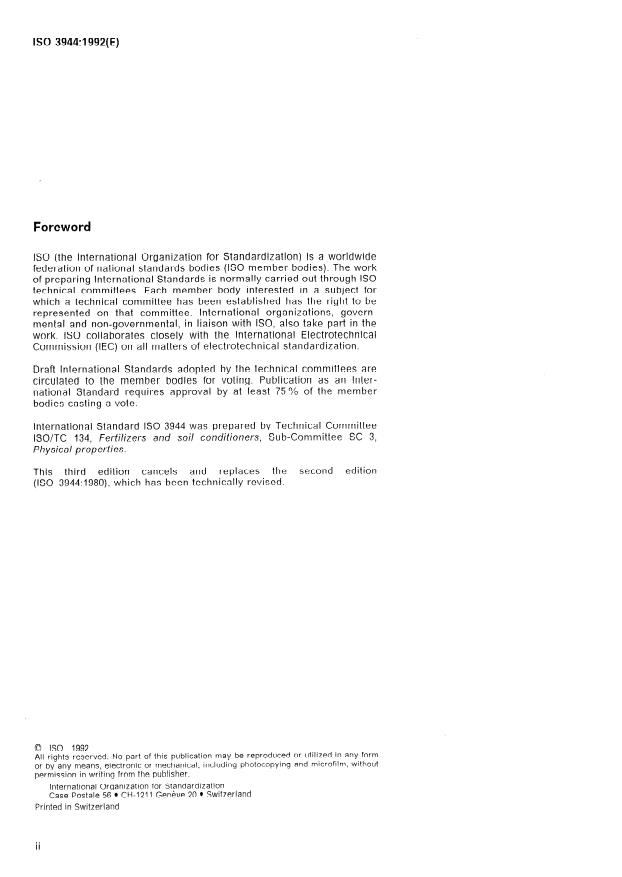
International Standard ISO 3944 was prepared by Technical Committee
ISO/TC 134, Fertilizer-s and seil conditioners, Sub-Committee SC 3,
Physicai properfies.
This third edition cancels and replaces the second edition
(ISO 3944:1980), which has been technically revised.
0 ISO 1992
All rights reserved. No part of this publication may be reproduced or utilized in any form
or by any means, electronie or mechanical, including photocopying and microfilm, witbout
Permission in writing from the publisher.
International Organization for Standardization
Case Postale 56 l CH-1211 Geneve 20 l Switzerland
Printed in Switzerland
ii
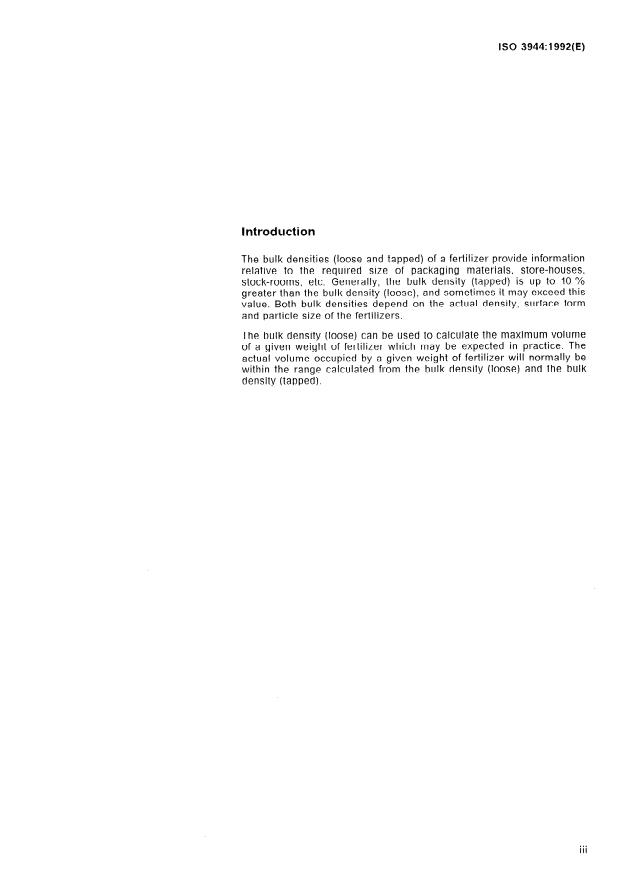
Introduction
The bulk densities (loose and tapped) of a fertilizer provide information
relative to the required size of packaging materials, store-houses,
stock-rooms, etc. Generally, the bulk density (tapped) is up to 10 %
greater than the bulk density (loose), and sometimes it may exceed this
value. Both bulk densities depend on the actual density, surface form
and particle size of the fertilizers.
The bulk density (loose) tan be used to calculate the maximum volume
of a given weight of fevtilizer which may be expected in practice. The
actual volume occupied by a given weight of fertilizer will normally be
within the range calculated from the bulk density (loose) and the bulk
density (tapped).
. . .
Ill
This page intentionally left blank
INTERNATIONAL STANDARD ISO 3944:1992(E)
Fertilizers - Determination of bulk density (loose)
1 Scope 4 Principle
This International Standard specifies a method for Pouring of the fertilizer from a specified funnel into
the determination of the bulk density (loose) of solid a specified measuring cylinder of known votume and
fertilizers, except powder fertilizers. weighing of the contents of the cylinder.
The method is applicable to dry fertilizers only. If the
fertilizer has absorbed moisture during transpor-t or
5 Apparatus
storage, it is necessary to dry it in an environmental
chamber, with constant low humidity, Prior to the
5.1 Balance, capable of weighing to the nearest
determination.
1 9
The method is not suitable for materials which con-
tain a large proportion of particles exceeding 5 mm
5.2 Apparatus for determination of bulk density
in diameter.
(loose), having the approximate dimensions given in
figure 1 and consisting of the following.
2 Normative references
52.1 Removable measuring cylinder, witho
...
INTERNATIONAL
STANDARD
Third edi tion
1992-07-01
-_~--_-_--- ---- ~--~-
_-_~_---.~-------~~-
Fertilizers - Determination of bulk density
(loose) -
Engr-ais I_ D6terminatior~ de la masse volumique sans tassemenf
--.--- _---.--_----- --_p--- w----m.- --__
_1_1_--
~- ----
--
Reference number
-- .--. ----_----. _ -_ ISO 3944: 1992(E)
_. ~.
Fo rew ‘ord
ISO (the international Organization for Standardization) is a worldwide
federation of national Standards bodies (ISO member bodies). The work
of preparing International Standards is normally carried out through ISO
technical committees. Esch member body interested in a subject for
which a technical committee has been established has the right to be
International organizations, govern-
represented on that committee.
mental and non-governmental, in liaison with ISO, also take part in the
work. ISO collaborates closely with the International Electrotechnical
Commission (IEC) on all matters of electrotechnical standardization.
Draft International Standards adopted by the technical committees are
circulated to the member bodies for voting. Publication as an Inter-
national Standard requires approval by at least 75 % of the member
bodies casting a vote.
International Standard ISO 3944 was prepared by Technical Committee
ISO/TC 134, Fertilizer-s and seil conditioners, Sub-Committee SC 3,
Physicai properfies.
This third edition cancels and replaces the second edition
(ISO 3944:1980), which has been technically revised.
0 ISO 1992
All rights reserved. No part of this publication may be reproduced or utilized in any form
or by any means, electronie or mechanical, including photocopying and microfilm, witbout
Permission in writing from the publisher.
International Organization for Standardization
Case Postale 56 l CH-1211 Geneve 20 l Switzerland
Printed in Switzerland
ii
Introduction
The bulk densities (loose and tapped) of a fertilizer provide information
relative to the required size of packaging materials, store-houses,
stock-rooms, etc. Generally, the bulk density (tapped) is up to 10 %
greater than the bulk density (loose), and sometimes it may exceed this
value. Both bulk densities depend on the actual density, surface form
and particle size of the fertilizers.
The bulk density (loose) tan be used to calculate the maximum volume
of a given weight of fevtilizer which may be expected in practice. The
actual volume occupied by a given weight of fertilizer will normally be
within the range calculated from the bulk density (loose) and the bulk
density (tapped).
. . .
Ill
This page intentionally left blank
INTERNATIONAL STANDARD ISO 3944:1992(E)
Fertilizers - Determination of bulk density (loose)
1 Scope 4 Principle
This International Standard specifies a method for Pouring of the fertilizer from a specified funnel into
the determination of the bulk density (loose) of solid a specified measuring cylinder of known votume and
fertilizers, except powder fertilizers. weighing of the contents of the cylinder.
The method is applicable to dry fertilizers only. If the
fertilizer has absorbed moisture during transpor-t or
5 Apparatus
storage, it is necessary to dry it in an environmental
chamber, with constant low humidity, Prior to the
5.1 Balance, capable of weighing to the nearest
determination.
1 9
The method is not suitable for materials which con-
tain a large proportion of particles exceeding 5 mm
5.2 Apparatus for determination of bulk density
in diameter.
(loose), having the approximate dimensions given in
figure 1 and consisting of the following.
2 Normative references
52.1 Removable measuring cylinder, witho
...
NORME
INTERNATIONALE
Troisième édition
1992-07-O 1
-----
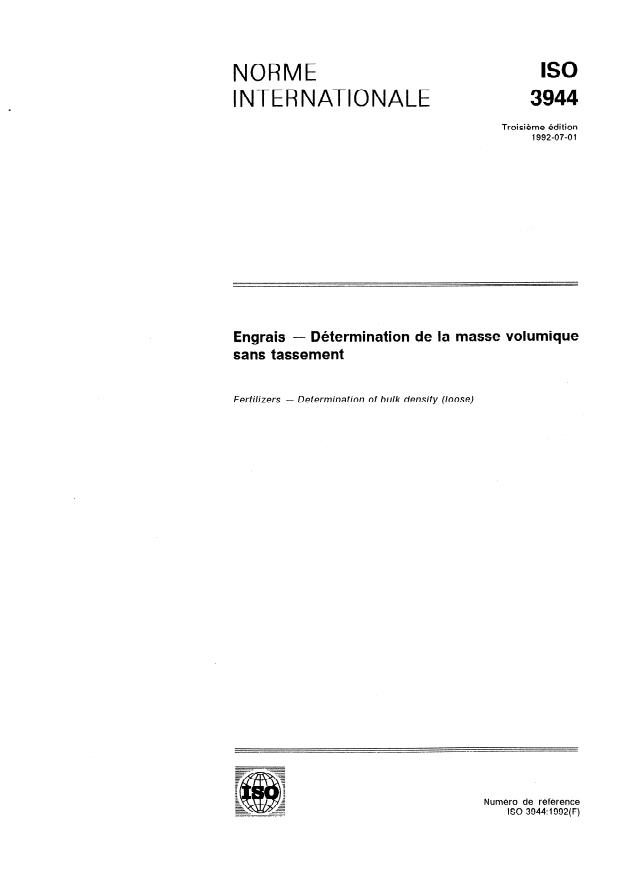
Engrais - Détermination de la masse volumique
sans tassement
Fertilizers - Uetermination of bulk density (loose)
---
-_------
p--.--p
--.-
~-
--
Numéro de référence
ISO 3944: 1992(F)
-.-
~~zzz?T~-.--‘TT .
Avant-propos
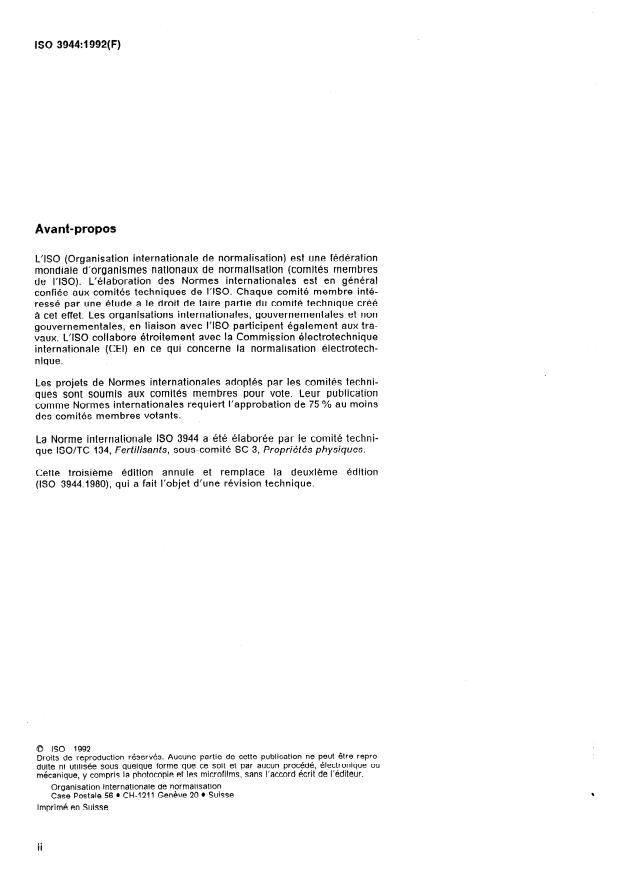
L’ISO (Organisation internationale de normalisation) est une fédération
mondiale d’organismes nationaux de normalisation (comités membres
de I’ISO). L’élaboration des Normes internationales est en général
confiée aux comités techniques de I’ISO. Chaque comité membre inté-
ressé par une étude a le droit de faire partie du comité technique créé
à cet effet. Les organisations internationales, gouvernementales et non
gouvernementales, en liaison avec I’ISO participent également aux tra-
vaux. LIS0 collabore étroitement avec la Commission électrotechnique
internationale (CEI) en ce qui concerne la normalisation électrotech-
nique.
Les projets de Normes internationales adoptés par les comités techni-
ques sont soumis aux comités membres pour vote. Leur publication
comme Normes internationales requiert l’approbation de 75 % au moins
des comités membres votants.
La Norme internationale ISO 3944 a été élaborée par le comité techni-
que ISO/TC 134, Fertilisants, sous-comité SC 3, Propriétés physiques.
Cet-te troisième édition annule et remplace la deuxième edition
(ISO 3944:1980), qui a fait l’objet d’une révision technique.
0 ISO 1992
Droits de reproduction réservés. Aucune partie de cette publication ne peut être repro-
duite ni utilisée sous quelque forme que ce soit et par aucun procédé, électronique ou
mécanique, y compris la photocopie et les microfilms, sans l’accord écrit de l’éditeur.
de normalisation
Organisation internationale
Geneve 20 l Suisse
Case Postale 56 l CH-121 1
Imprimé en Suisse
ii
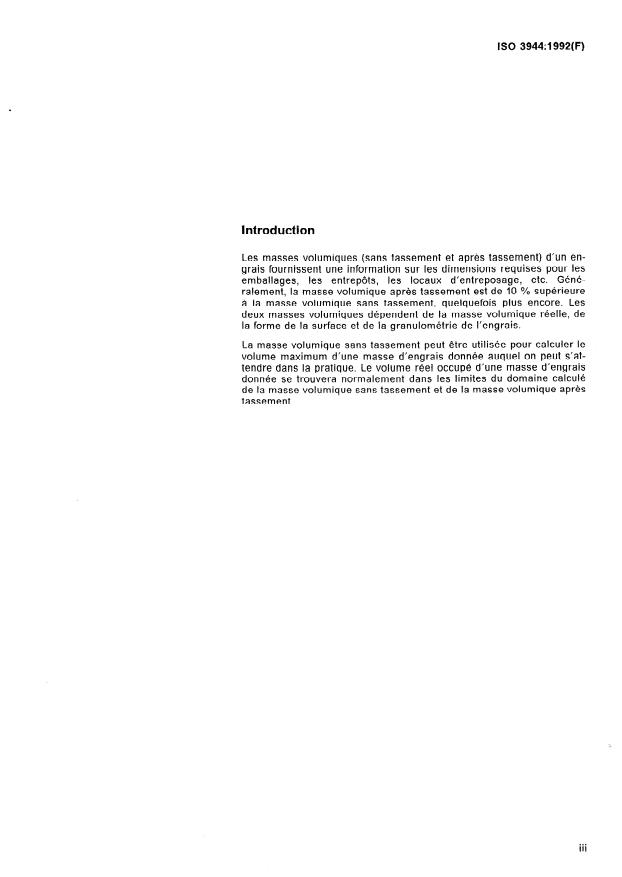
Introduction
Les masses volumiques (sans tassement et après tassement) d’un en-
grais fournissent une information sur les dimensions requises pour les
emballages, les entrepôts, les locaux d’entreposage, etc. Géné-
ralement, la masse volumique après tassement est de 10 % supérieure
à la masse volumique sans tassement, quelquefois plus encore. Les
deux masses volumiques dépendent de la masse volumique réelle, de
la forme de la surface et de la granulométrie de l’engrais.
La masse volumique sans tassement peut être utilisée pour calculer le
volume maximum d’une masse d’engrais donnée auquel on peut s’at-
tendre dans la pratique. Le volume réel occupé d’une masse d’engrais
donnée se trouvera normalement dans les limites du domaine calculé
de la masse volumique sans tassement et de la masse volumique après
tassement.
. . .
Ill
Page blanche
- ~---
NORME INTERNATIONALE
- Détermination de la masse volumique sans
Engrais
tassement
3.1 masse volumique sans tassement d’un
1 Domaine d’application
engrais: Masse d’un volume d’un produit, après
qu’elle s’est déversée librement dans un récipient,
La présente Norme internationale prescrit une mé-
dans des conditions bien définies.
thode de détermination de la masse volumique sans
tassement des engrais solides, à l’exclusion des
La masse volumique sans tassement est exprimée
engrais en poudre.
en grammes par centimètre cube (g/cm3).
La méthode est applicable uniquement aux engrais
secs. Si l’engrais a pris de l’humidité pendant le
4 Principe
transport ou le stockage, il est nécessaire de le sé-
cher, avant la détermination, dans une chambre
Versement de l’engrais d’un entonnoir déterminé
d’ambiance avec perte constante d’humidité.
dans un cylindre gradué de volume connu, et pesée
du contenu du cylindre.
Cette méthode n’est pas applicable aux matériaux
contenant une grande proportion de particules dé-
passant 5 mm de diamètre. 5 Appareillage
5.1 Balance, capable de peser à 1 g près.
2 Références normatives
5.2 Appareillage pour la détermi
...
NORME
INTERNATIONALE
Troisième édition
1992-07-O 1
Engrais - Détermination de la masse volumique
sans tassement
Fertilizers - Uetermination of bulk density (loose)
---
-_------
p--.--p
--.-
~-
--
Numéro de référence
Avant-propos
L’ISO (Organisation internationale de normalisation) est une fédération
mondiale d’organismes nationaux de normalisation (comités membres
de I’ISO). L’élaboration des Normes internationales est en général
confiée aux comités techniques de I’ISO. Chaque comité membre inté-
ressé par une étude a le droit de faire partie du comité technique créé
à cet effet. Les organisations internationales, gouvernementales et non
gouvernementales, en liaison avec I’ISO participent également aux tra-
vaux. LIS0 collabore étroitement avec la Commission électrotechnique
internationale (CEI) en ce qui concerne la normalisation électrotech-
nique.
Les projets de Normes internationales adoptés par les comités techni-
ques sont soumis aux comités membres pour vote. Leur publication
comme Normes internationales requiert l’approbation de 75 % au moins
des comités membres votants.
La Norme internationale ISO 3944 a été élaborée par le comité techni-
que ISO/TC 134, Fertilisants, sous-comité SC 3, Propriétés physiques.
Cet-te troisième édition annule et remplace la deuxième edition
(ISO 3944:1980), qui a fait l’objet d’une révision technique.
0 ISO 1992
Droits de reproduction réservés. Aucune partie de cette publication ne peut être repro-
duite ni utilisée sous quelque forme que ce soit et par aucun procédé, électronique ou
mécanique, y compris la photocopie et les microfilms, sans l’accord écrit de l’éditeur.
Organisation internationale de normalisation
Case Postale 56 l CH-121 1 Geneve 20 l Suisse
Imprimé en Suisse
ii
Introduction
Les masses volumiques (sans tassement et après tassement) d’un en-
grais fournissent une information sur les dimensions requises pour les
emballages, les entrepôts, les locaux d’entreposage, etc. Géné-
ralement, la masse volumique après tassement est de 10 % supérieure
à la masse volumique sans tassement, quelquefois plus encore. Les
deux masses volumiques dépendent de la masse volumique réelle, de
la forme de la surface et de la granulométrie de l’engrais.
La masse volumique sans tassement peut être utilisée pour calculer le
volume maximum d’une masse d’engrais donnée auquel on peut s’at-
tendre dans la pratique. Le volume réel occupé d’une masse d’engrais
donnée se trouvera normalement dans les limites du domaine calculé
de la masse volumique sans tassement et de la masse volumique après
tassement.
. . .
Ill
Page blanche
NORME INTERNATIONALE
- Détermination de la masse volumique sans
Engrais
tassement
3.1 masse volumique sans tassement d’un
1 Domaine d’application
engrais: Masse d’un volume d’un produit, après
qu’elle s’est déversée librement dans un récipient,
La présente Norme internationale prescrit une mé-
dans des conditions bien définies.
thode de détermination de la masse volumique sans
tassement des engrais solides, à l’exclusion des
La masse volumique sans tassement est exprimée
engrais en poudre.
en grammes par centimètre cube (g/cm3).
La méthode est applicable uniquement aux engrais
secs. Si l’engrais a pris de l’humidité pendant le
4 Principe
transport ou le stockage, il est nécessaire de le sé-
cher, avant la détermination, dans une chambre
Versement de l’engrais d’un entonnoir déterminé
d’ambiance avec perte constante d’humidité.
dans un cylindre gradué de volume connu, et pesée
du contenu du cylindre.
Cette méthode n’est pas applicable aux matériaux
contenant une grande proportion de particules dé-
passant 5 mm de diamètre. 5 Appareillage
5.1 Balance, capable de peser à 1 g près.
2 Références normatives
5.2 Appareillage pour la détermination de la masse
Les normes suivantes contiennent des dispositions
volumique sans ta
...
NORME
INTERNATIONALE
Troisième édition
1992-07-O 1
Engrais - Détermination de la masse volumique
sans tassement
Fertilizers - Uetermination of bulk density (loose)
---
-_------
p--.--p
--.-
~-
--
Numéro de référence
Avant-propos
L’ISO (Organisation internationale de normalisation) est une fédération
mondiale d’organismes nationaux de normalisation (comités membres
de I’ISO). L’élaboration des Normes internationales est en général
confiée aux comités techniques de I’ISO. Chaque comité membre inté-
ressé par une étude a le droit de faire partie du comité technique créé
à cet effet. Les organisations internationales, gouvernementales et non
gouvernementales, en liaison avec I’ISO participent également aux tra-
vaux. LIS0 collabore étroitement avec la Commission électrotechnique
internationale (CEI) en ce qui concerne la normalisation électrotech-
nique.
Les projets de Normes internationales adoptés par les comités techni-
ques sont soumis aux comités membres pour vote. Leur publication
comme Normes internationales requiert l’approbation de 75 % au moins
des comités membres votants.
La Norme internationale ISO 3944 a été élaborée par le comité techni-
que ISO/TC 134, Fertilisants, sous-comité SC 3, Propriétés physiques.
Cet-te troisième édition annule et remplace la deuxième edition
(ISO 3944:1980), qui a fait l’objet d’une révision technique.
0 ISO 1992
Droits de reproduction réservés. Aucune partie de cette publication ne peut être repro-
duite ni utilisée sous quelque forme que ce soit et par aucun procédé, électronique ou
mécanique, y compris la photocopie et les microfilms, sans l’accord écrit de l’éditeur.
Organisation internationale de normalisation
Case Postale 56 l CH-121 1 Geneve 20 l Suisse
Imprimé en Suisse
ii
Introduction
Les masses volumiques (sans tassement et après tassement) d’un en-
grais fournissent une information sur les dimensions requises pour les
emballages, les entrepôts, les locaux d’entreposage, etc. Géné-
ralement, la masse volumique après tassement est de 10 % supérieure
à la masse volumique sans tassement, quelquefois plus encore. Les
deux masses volumiques dépendent de la masse volumique réelle, de
la forme de la surface et de la granulométrie de l’engrais.
La masse volumique sans tassement peut être utilisée pour calculer le
volume maximum d’une masse d’engrais donnée auquel on peut s’at-
tendre dans la pratique. Le volume réel occupé d’une masse d’engrais
donnée se trouvera normalement dans les limites du domaine calculé
de la masse volumique sans tassement et de la masse volumique après
tassement.
. . .
Ill
Page blanche
NORME INTERNATIONALE
- Détermination de la masse volumique sans
Engrais
tassement
3.1 masse volumique sans tassement d’un
1 Domaine d’application
engrais: Masse d’un volume d’un produit, après
qu’elle s’est déversée librement dans un récipient,
La présente Norme internationale prescrit une mé-
dans des conditions bien définies.
thode de détermination de la masse volumique sans
tassement des engrais solides, à l’exclusion des
La masse volumique sans tassement est exprimée
engrais en poudre.
en grammes par centimètre cube (g/cm3).
La méthode est applicable uniquement aux engrais
secs. Si l’engrais a pris de l’humidité pendant le
4 Principe
transport ou le stockage, il est nécessaire de le sé-
cher, avant la détermination, dans une chambre
Versement de l’engrais d’un entonnoir déterminé
d’ambiance avec perte constante d’humidité.
dans un cylindre gradué de volume connu, et pesée
du contenu du cylindre.
Cette méthode n’est pas applicable aux matériaux
contenant une grande proportion de particules dé-
passant 5 mm de diamètre. 5 Appareillage
5.1 Balance, capable de peser à 1 g près.
2 Références normatives
5.2 Appareillage pour la détermination de la masse
Les normes suivantes contiennent des dispositions
volumique sans ta
...
NORME
INTERNATIONALE
Troisième édition
1992-07-O 1
-----
Engrais - Détermination de la masse volumique
sans tassement
Fertilizers - Uetermination of bulk density (loose)
---
-_------
p--.--p
--.-
~-
--
Numéro de référence
ISO 3944: 1992(F)
-.-
~~zzz?T~-.--‘TT .
Avant-propos
L’ISO (Organisation internationale de normalisation) est une fédération
mondiale d’organismes nationaux de normalisation (comités membres
de I’ISO). L’élaboration des Normes internationales est en général
confiée aux comités techniques de I’ISO. Chaque comité membre inté-
ressé par une étude a le droit de faire partie du comité technique créé
à cet effet. Les organisations internationales, gouvernementales et non
gouvernementales, en liaison avec I’ISO participent également aux tra-
vaux. LIS0 collabore étroitement avec la Commission électrotechnique
internationale (CEI) en ce qui concerne la normalisation électrotech-
nique.
Les projets de Normes internationales adoptés par les comités techni-
ques sont soumis aux comités membres pour vote. Leur publication
comme Normes internationales requiert l’approbation de 75 % au moins
des comités membres votants.
La Norme internationale ISO 3944 a été élaborée par le comité techni-
que ISO/TC 134, Fertilisants, sous-comité SC 3, Propriétés physiques.
Cet-te troisième édition annule et remplace la deuxième edition
(ISO 3944:1980), qui a fait l’objet d’une révision technique.
0 ISO 1992
Droits de reproduction réservés. Aucune partie de cette publication ne peut être repro-
duite ni utilisée sous quelque forme que ce soit et par aucun procédé, électronique ou
mécanique, y compris la photocopie et les microfilms, sans l’accord écrit de l’éditeur.
de normalisation
Organisation internationale
Geneve 20 l Suisse
Case Postale 56 l CH-121 1
Imprimé en Suisse
ii
Introduction
Les masses volumiques (sans tassement et après tassement) d’un en-
grais fournissent une information sur les dimensions requises pour les
emballages, les entrepôts, les locaux d’entreposage, etc. Géné-
ralement, la masse volumique après tassement est de 10 % supérieure
à la masse volumique sans tassement, quelquefois plus encore. Les
deux masses volumiques dépendent de la masse volumique réelle, de
la forme de la surface et de la granulométrie de l’engrais.
La masse volumique sans tassement peut être utilisée pour calculer le
volume maximum d’une masse d’engrais donnée auquel on peut s’at-
tendre dans la pratique. Le volume réel occupé d’une masse d’engrais
donnée se trouvera normalement dans les limites du domaine calculé
de la masse volumique sans tassement et de la masse volumique après
tassement.
. . .
Ill
Page blanche
- ~---
NORME INTERNATIONALE
- Détermination de la masse volumique sans
Engrais
tassement
3.1 masse volumique sans tassement d’un
1 Domaine d’application
engrais: Masse d’un volume d’un produit, après
qu’elle s’est déversée librement dans un récipient,
La présente Norme internationale prescrit une mé-
dans des conditions bien définies.
thode de détermination de la masse volumique sans
tassement des engrais solides, à l’exclusion des
La masse volumique sans tassement est exprimée
engrais en poudre.
en grammes par centimètre cube (g/cm3).
La méthode est applicable uniquement aux engrais
secs. Si l’engrais a pris de l’humidité pendant le
4 Principe
transport ou le stockage, il est nécessaire de le sé-
cher, avant la détermination, dans une chambre
Versement de l’engrais d’un entonnoir déterminé
d’ambiance avec perte constante d’humidité.
dans un cylindre gradué de volume connu, et pesée
du contenu du cylindre.
Cette méthode n’est pas applicable aux matériaux
contenant une grande proportion de particules dé-
passant 5 mm de diamètre. 5 Appareillage
5.1 Balance, capable de peser à 1 g près.
2 Références normatives
5.2 Appareillage pour la détermi
...