


ISO/IEC 15026-3:2011
(Main)Systems and software engineering — Systems and software assurance — Part 3: System integrity levels
Systems and software engineering — Systems and software assurance — Part 3: System integrity levels
ISO/IEC 15026-3:2011 specifies the concept of integrity levels with corresponding integrity level requirements that are required to be met in order to show the achievement of the integrity level. It places requirements on and recommends methods for defining and using integrity levels and their integrity level requirements, including the assignment of integrity levels to systems, software products, their elements, and relevant external dependences. ISO/IEC 15026-3:2011 is applicable to systems and software and is intended for use by: definers of integrity levels such as industry and professional organizations, standards organizations, and government agencies; users of integrity levels such as developers and maintainers, suppliers and acquirers, users, and assessors of systems or software and for the administrative and technical support of systems and/or software products. One important use of integrity levels is by suppliers and acquirers in agreements; for example, to aid in assuring safety, economic, or security characteristics of a delivered system or product. ISO/IEC 15026-3:2011 does not prescribe a specific set of integrity levels or their integrity level requirements. In addition, it does not prescribe the way in which integrity level use is integrated with the overall system or software engineering life cycle processes. ISO/IEC 15026-3:2011 can be used alone or with other parts of ISO/IEC 15026. It can be used with a variety of technical and specialized risk analysis and development approaches. ISO/IEC TR 15026-1 provides additional information and references to aid users of ISO/IEC 15026-3:2011. Assurance cases are covered by ISO/IEC 15026-2. ISO/IEC 15026-3:2011 does not require the use of assurance cases but describes how integrity levels and assurance cases can work together, especially in the definition of specifications for integrity levels or by using integrity levels within a portion of an assurance case.
Ingénierie du logiciel et des systèmes — Assurance du logiciel et des systèmes — Partie 3: Niveaux d'intégrité du système
General Information
- Status
- Withdrawn
- Publication Date
- 15-Dec-2011
- Withdrawal Date
- 15-Dec-2011
- Technical Committee
- ISO/IEC JTC 1/SC 7 - Software and systems engineering
- Drafting Committee
- ISO/IEC JTC 1/SC 7 - Software and systems engineering
- Current Stage
- 9599 - Withdrawal of International Standard
- Start Date
- 20-Nov-2015
- Completion Date
- 12-Feb-2026
Relations
- Effective Date
- 24-Aug-2013
- Effective Date
- 14-Aug-2010
Get Certified
Connect with accredited certification bodies for this standard

BSI Group
BSI (British Standards Institution) is the business standards company that helps organizations make excellence a habit.

BSCIC Certifications Pvt. Ltd.
Established 2006, accredited by NABCB, JAS-ANZ, EIAC, IAS. CDSCO Notified Body.

Intertek India Pvt. Ltd.
Delivers Assurance, Testing, Inspection & Certification since 1993 with 26 labs and 32 offices.
Sponsored listings
Frequently Asked Questions
ISO/IEC 15026-3:2011 is a standard published by the International Organization for Standardization (ISO). Its full title is "Systems and software engineering — Systems and software assurance — Part 3: System integrity levels". This standard covers: ISO/IEC 15026-3:2011 specifies the concept of integrity levels with corresponding integrity level requirements that are required to be met in order to show the achievement of the integrity level. It places requirements on and recommends methods for defining and using integrity levels and their integrity level requirements, including the assignment of integrity levels to systems, software products, their elements, and relevant external dependences. ISO/IEC 15026-3:2011 is applicable to systems and software and is intended for use by: definers of integrity levels such as industry and professional organizations, standards organizations, and government agencies; users of integrity levels such as developers and maintainers, suppliers and acquirers, users, and assessors of systems or software and for the administrative and technical support of systems and/or software products. One important use of integrity levels is by suppliers and acquirers in agreements; for example, to aid in assuring safety, economic, or security characteristics of a delivered system or product. ISO/IEC 15026-3:2011 does not prescribe a specific set of integrity levels or their integrity level requirements. In addition, it does not prescribe the way in which integrity level use is integrated with the overall system or software engineering life cycle processes. ISO/IEC 15026-3:2011 can be used alone or with other parts of ISO/IEC 15026. It can be used with a variety of technical and specialized risk analysis and development approaches. ISO/IEC TR 15026-1 provides additional information and references to aid users of ISO/IEC 15026-3:2011. Assurance cases are covered by ISO/IEC 15026-2. ISO/IEC 15026-3:2011 does not require the use of assurance cases but describes how integrity levels and assurance cases can work together, especially in the definition of specifications for integrity levels or by using integrity levels within a portion of an assurance case.
ISO/IEC 15026-3:2011 specifies the concept of integrity levels with corresponding integrity level requirements that are required to be met in order to show the achievement of the integrity level. It places requirements on and recommends methods for defining and using integrity levels and their integrity level requirements, including the assignment of integrity levels to systems, software products, their elements, and relevant external dependences. ISO/IEC 15026-3:2011 is applicable to systems and software and is intended for use by: definers of integrity levels such as industry and professional organizations, standards organizations, and government agencies; users of integrity levels such as developers and maintainers, suppliers and acquirers, users, and assessors of systems or software and for the administrative and technical support of systems and/or software products. One important use of integrity levels is by suppliers and acquirers in agreements; for example, to aid in assuring safety, economic, or security characteristics of a delivered system or product. ISO/IEC 15026-3:2011 does not prescribe a specific set of integrity levels or their integrity level requirements. In addition, it does not prescribe the way in which integrity level use is integrated with the overall system or software engineering life cycle processes. ISO/IEC 15026-3:2011 can be used alone or with other parts of ISO/IEC 15026. It can be used with a variety of technical and specialized risk analysis and development approaches. ISO/IEC TR 15026-1 provides additional information and references to aid users of ISO/IEC 15026-3:2011. Assurance cases are covered by ISO/IEC 15026-2. ISO/IEC 15026-3:2011 does not require the use of assurance cases but describes how integrity levels and assurance cases can work together, especially in the definition of specifications for integrity levels or by using integrity levels within a portion of an assurance case.
ISO/IEC 15026-3:2011 is classified under the following ICS (International Classification for Standards) categories: 35.080 - Software. The ICS classification helps identify the subject area and facilitates finding related standards.
ISO/IEC 15026-3:2011 has the following relationships with other standards: It is inter standard links to ISO/IEC 15026-3:2015, ISO/IEC 15026:1998. Understanding these relationships helps ensure you are using the most current and applicable version of the standard.
ISO/IEC 15026-3:2011 is available in PDF format for immediate download after purchase. The document can be added to your cart and obtained through the secure checkout process. Digital delivery ensures instant access to the complete standard document.
Standards Content (Sample)
INTERNATIONAL ISO/IEC
STANDARD 15026-3
First edition
2011-12-15
Systems and software engineering —
Systems and software assurance —
Part 3:
System integrity levels
Ingénierie du logiciel et des systèmes — Assurance du logiciel et des
systèmes —
Partie 3: Niveaux d'intégrité du système
Reference number
©
ISO/IEC 2011
© ISO/IEC 2011
All rights reserved. Unless otherwise specified, no part of this publication may be reproduced or utilized in any form or by any means,
electronic or mechanical, including photocopying and microfilm, without permission in writing from either ISO at the address below or
ISO's member body in the country of the requester.
ISO copyright office
Case postale 56 • CH-1211 Geneva 20
Tel. + 41 22 749 01 11
Fax + 41 22 749 09 47
E-mail copyright@iso.org
Web www.iso.org
Published in Switzerland
ii © ISO/IEC 2011 – All rights reserved
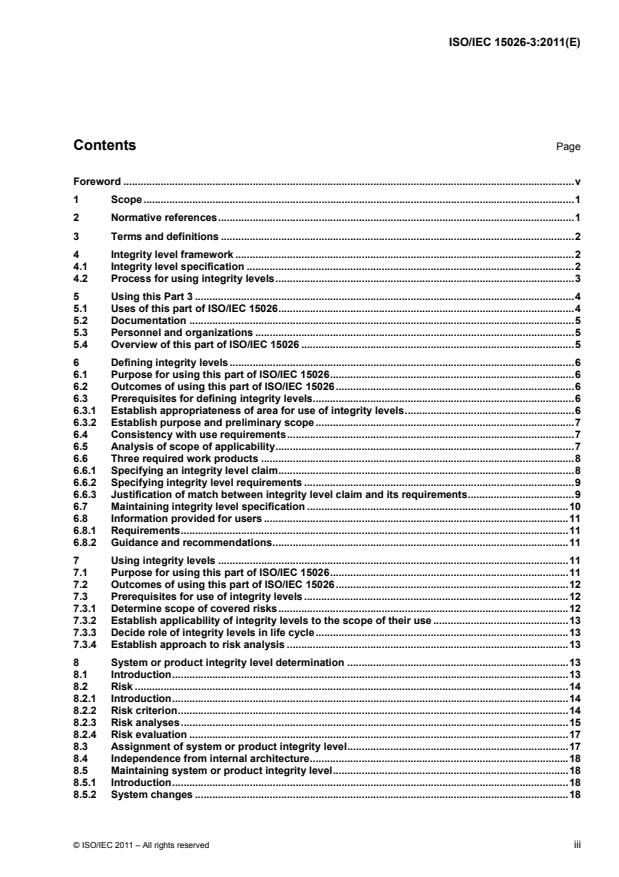
Contents Page
Foreword .v
1 Scope.1
2 Normative references.1
3 Terms and definitions .2
4 Integrity level framework .2
4.1 Integrity level specification .2
4.2 Process for using integrity levels.3
5 Using this Part 3 .4
5.1 Uses of this part of ISO/IEC 15026.4
5.2 Documentation .5
5.3 Personnel and organizations .5
5.4 Overview of this part of ISO/IEC 15026 .5
6 Defining integrity levels.6
6.1 Purpose for using this part of ISO/IEC 15026.6
6.2 Outcomes of using this part of ISO/IEC 15026.6
6.3 Prerequisites for defining integrity levels.6
6.3.1 Establish appropriateness of area for use of integrity levels.6
6.3.2 Establish purpose and preliminary scope.7
6.4 Consistency with use requirements.7
6.5 Analysis of scope of applicability.7
6.6 Three required work products .8
6.6.1 Specifying an integrity level claim.8
6.6.2 Specifying integrity level requirements .9
6.6.3 Justification of match between integrity level claim and its requirements.9
6.7 Maintaining integrity level specification .10
6.8 Information provided for users .11
6.8.1 Requirements.11
6.8.2 Guidance and recommendations.11
7 Using integrity levels .11
7.1 Purpose for using this part of ISO/IEC 15026.11
7.2 Outcomes of using this part of ISO/IEC 15026.12
7.3 Prerequisites for use of integrity levels .12
7.3.1 Determine scope of covered risks.12
7.3.2 Establish applicability of integrity levels to the scope of their use .13
7.3.3 Decide role of integrity levels in life cycle.13
7.3.4 Establish approach to risk analysis .13
8 System or product integrity level determination .13
8.1 Introduction.13
8.2 Risk .14
8.2.1 Introduction.14
8.2.2 Risk criterion.14
8.2.3 Risk analyses.15
8.2.4 Risk evaluation .17
8.3 Assignment of system or product integrity level.17
8.4 Independence from internal architecture.18
8.5 Maintaining system or product integrity level.18
8.5.1 Introduction.18
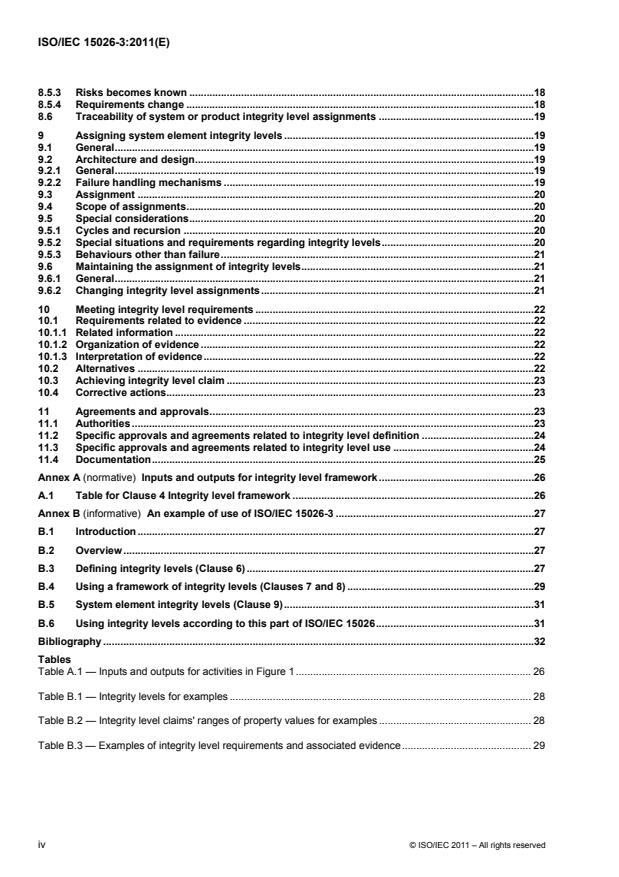
8.5.2 System changes .18
© ISO/IEC 2011 – All rights reserved iii
8.5.3 Risks becomes known .18
8.5.4 Requirements change .18
8.6 Traceability of system or product integrity level assignments .19
9 Assigning system element integrity levels .19
9.1 General.19
9.2 Architecture and design.19
9.2.1 General.19
9.2.2 Failure handling mechanisms .19
9.3 Assignment .20
9.4 Scope of assignments.20
9.5 Special considerations.20
9.5.1 Cycles and recursion .20
9.5.2 Special situations and requirements regarding integrity levels.20
9.5.3 Behaviours other than failure.21
9.6 Maintaining the assignment of integrity levels.21
9.6.1 General.21
9.6.2 Changing integrity level assignments.21
10 Meeting integrity level requirements .22
10.1 Requirements related to evidence .22
10.1.1 Related information .22
10.1.2 Organization of evidence .22
10.1.3 Interpretation of evidence.22
10.2 Alternatives .22
10.3 Achieving integrity level claim .23
10.4 Corrective actions.23
11 Agreements and approvals.23
11.1 Authorities .23
11.2 Specific approvals and agreements related to integrity level definition .24
11.3 Specific approvals and agreements related to integrity level use .24
11.4 Documentation.25
Annex A (normative) Inputs and outputs for integrity level framework.26
A.1 Table for Clause 4 Integrity level framework .26
Annex B (informative) An example of use of ISO/IEC 15026-3 .27
B.1 Introduction.27
B.2 Overview.27
B.3 Defining integrity levels (Clause 6).27
B.4 Using a framework of integrity levels (Clauses 7 and 8) .29
B.5 System element integrity levels (Clause 9).31
B.6 Using integrity levels according to this part of ISO/IEC 15026.31
Bibliography .32
Tables
Table A.1 — Inputs and outputs for activities in Figure 1. 26
Table B.1 — Integrity levels for examples . 28
Table B.2 — Integrity level claims' ranges of property values for examples . 28
Table B.3 — Examples of integrity level requirements and associated evidence. 29
iv © ISO/IEC 2011 – All rights reserved
Foreword
ISO (the International Organization for Standardization) and IEC (the International Electrotechnical
Commission) form the specialized system for worldwide standardization. National bodies that are members of
ISO or IEC participate in the development of International Standards through technical committees
established by the respective organization to deal with particular fields of technical activity. ISO and IEC
technical committees collaborate in fields of mutual interest. Other international organizations, governmental
and non-governmental, in liaison with ISO and IEC, also take part in the work. In the field of information
technology, ISO and IEC have established a joint technical committee, ISO/IEC JTC 1.
International Standards are drafted in accordance with the rules given in the ISO/IEC Directives, Part 2.
The main task of the joint technical committee is to prepare International Standards. Draft International
Standards adopted by the joint technical committee are circulated to national bodies for voting. Publication as
an International Standard requires approval by at least 75 % of the national bodies casting a vote.
Attention is drawn to the possibility that some of the elements of this document may be the subject of patent
rights. ISO and IEC shall not be held responsible for identifying any or all such patent rights.
ISO/IEC 15026-3 was prepared by Joint Technical Committee ISO/IEC JTC 1, Information technology,
Subcommittee SC 7, Software and systems engineering.
This first edition of ISO/IEC 15026-3 cancels and replaces ISO/IECI 15026:1998, which has been technically
revised.
ISO/IEC 15026 consists of the following parts, under the general title Systems and software engineering —
Systems and software assurance:
⎯ Part 1: Concepts and vocabulary [Technical Report]
⎯ Part 2: Assurance case
⎯ Part 3: System integrity levels
The following part is under preparation:
⎯ Part 4: Assurance in the life cycle
© ISO/IEC 2011 – All rights reserved v
INTERNATIONAL STANDARD ISO/IEC 15026-3:2011(E)
Systems and software engineering — Systems and software
assurance —
Part 3:
System integrity levels
1 Scope
This part of ISO/IEC 15026 specifies the concept of integrity levels with corresponding integrity level
requirements that are required to be met in order to show the achievement of the integrity level. It places
requirements on and recommends methods for defining and using integrity levels and their integrity level
requirements. It covers systems, software products, and their elements, as well as relevant external
dependences.
This part of ISO/IEC 15026 is applicable to systems and software and is intended for use by:
a) definers of integrity levels such as industry and professional organizations, standards organizations, and
government agencies;
b) users of integrity levels such as developers and maintainers, suppliers and acquirers, users, and
assessors of systems or software and for the administrative and technical support of systems and/or
software products.
One important use of integrity levels is by suppliers and acquirers in agreements; for example, to aid in
assuring safety, economic, or security characteristics of a delivered system or product.
This part of ISO/IEC 15026 does not prescribe a specific set of integrity levels or their integrity level
requirements. In addition, it does not prescribe the way in which integrity level use is integrated with the
overall system or software engineering life cycle processes. It does, however, provide an example of use of
this part of ISO/IEC 15026 in Annex B.
2 Normative references
The following referenced documents are indispensable for the application of this document. For dated
references, only the edition cited applies. For undated references, the latest edition of the referenced
document (including any amendments) applies.
ISO/IEC TR 15026-1 Systems and software engineering — Systems and software assurance — Concepts
and vocabulary
© ISO/IEC 2011 – All rights reserved 1
3 Terms and definitions
For the purposes of this document, the terms and definitions given in ISO/IEC TR 15026-1 apply.
NOTE While a definition is included for “integrity level”, existing definitions and the relevant communities do not agree
on a definition of “integrity” consistent with its use in “integrity level”. Hence, no separate definition of “integrity” is included
in this part of ISO/IEC 15026. For the definition of “integrity” used in ISO/IEC JTC 1 SC 7, see ISO/IEC 25010:2011,
Systems and software engineering — Systems and software Quality Requirements and Evaluation (SQuaRE) — System
and software quality models.
4 Integrity level framework
4.1 Integrity level specification
An integrity level specification includes two kinds of related requirements defined as follows:
a) “Integrity level”—A claim of a system, product, or element. This claim includes limitations on a
property's values, the claim's scope of applicability, and the allowable uncertainty regarding the claim's
achievement. A label designated for an integrity level is called an integrity level’s label.
b) “Integrity level requirements”—A set of specified requirements imposed on aspects related to a system,
product, or element and associated activities in order to show the achievement of the assigned integrity
level (that is, meeting its claim) within the required limitations on uncertainty. This includes the evidence
to be obtained.
Definers of integrity levels need to justify explicitly the assertion that meeting an integrity level's corresponding
integrity level requirements suffices to achieve the integrity level within its allowable uncertainty. This
justification can be reflected in, but not necessarily included in, a source for users (e.g., a standard).
NOTE 1 In ISO/IEC 15026:1998, a) and b) are referred to as the “integrity level” and “integrity requirements”
respectively. The latter has been changed to “integrity level requirements” both for increased clarity and because this is
common usage in safety.
NOTE 2 “Integrity level” is sometimes referred as “integrity level claim” to distinguish it from “integrity level requirement”.
NOTE 3 See 8.2 and 8.2.4 for a detailed explanation of “required limitations.”
NOTE 4 See ISO/IEC TR 15026-1 for further explanation of the use of evidence.
NOTE 5 IEEE Std 1012:2004 defines “integrity level” as “a value representing project-unique characteristics (e.g.,
software complexity, criticality, risk, safety level, security level, desired performance, reliability) that define the importance
of the software to the user.” That is, an integrity level is a value of a property of the target software. Since both a claim and
a value can be regarded as a proposition of a system or software, the two definitions of integrity levels have significantly
the same meaning.
NOTE 6 Integrity level claims in this part of ISO/IEC 15026 can cover behaviours or conditions of the system or product
or values of a property, in which case they can play roles of both “requirements” and “measures”. For an acquisition of a
system or product, an integrity level claim can be used for representing an agreement between the acquirer and the
supplier. In this case the integrity level claim plays the role of a requirement. In the activity of accepting a system or
product in the acquisition process, the integrity level claim is used for confirming that the delivered system or product
complies with the agreement, i.e., the delivered system or product is measured by an integrity level claim.
NOTE 7 Integrity levels and standards utilizing them have a significant history especially in safety. Integrity levels in
safety-related standards are defined in multi-level sets addressing varying degrees of stringency and/or uncertainty of their
achievement with higher levels providing higher stringency and lower uncertainty. One example safety standard is
IEC 61508 Functional safety of electrical/electronic/programmable electronic safety-related systems. Elsewhere, similar
schemes are used with different labels, e.g., “conformance classes.”
To complete the integrity level framework, the next clause describes a process for using integrity levels that
also provides the background for understanding the needs and motivations addressed during their definition.
2 © ISO/IEC 2011 – All rights reserved
4.2 Process for using integrity levels
A risk-based approach is used within this part of ISO/IEC 15026 to determine the integrity level assigned to
the system or product. From this system or product integrity level, integrity levels are derived for elements of
the system or product. Figure 1 shows an overview of the activities required to use integrity levels. Inputs and
outputs for each activity are shown in Table A.1 in Annex A. In addition to the main feedback loops shown in
Figure 1, feedback can occur among all these activities.
NOTE 1 ISO/IEC 16085:2006 defines “risk” as “The combination of the probability of an event and its consequence.”
In this part of 15026, a system is assumed to have the following structure in order to introduce the process for
assigning an integrity level to a system. First, a system has several interfaces, each of which is a boundary
between the system and its environment. Any influence on the system and from the system is represented by
this concept, e.g., operations by users, interactions with other systems, and attacks by malicious persons.
A system consists of system elements, which are units associated with an integrity level for purposes of this
part of ISO/IEC 15026. Several ways exist to choose what parts of the system are system elements.
Decomposing a system into elements is accomplished before or during the assignment of integrity levels
described in this part of ISO/IEC 15026. A system element can be seen as a system and thus a system-
element relation can be found at each layer of system decomposition.
NOTE 2 A “system element” is sometimes referred to as an “element” if the context is understood.
Figure 1 — Overview of activities for integrity level determination
© ISO/IEC 2011 – All rights reserved 3
In order to determine the system or product integrity level, a risk criterion measure for the target system is
established to determine which factor (i.e., event, condition of the system, situation of the environment, etc.) is
considered as a risk. Based on the criterion, risks related to the system or product are analyzed and evaluated
to establish limitations on the timing and occurrence of adverse consequences and the conditions that lead to
them. These limitations are preferably established by limiting the occurrence of the initiating events for these
conditions. Once these limitations are established, limitations on behaviours of the system or product are
derived that, if met, would meet the limitations on adverse consequences, conditions, and initiating events
within limitations on allowable uncertainties.
NOTE 3 As it is the more common context in which integrity levels are used, this part of ISO/IEC 15026 speaks in
terms of limiting losses (e.g. adverse consequences, dangers, or risks) but is equally applicable in terms of achieving
benefits.
NOTE 4 An “adverse consequence” is a consequence associated with a loss.
NOTE 5 The phrase “initiating event” and related concepts are explained in ISO/IEC TR15026 Part 1.
For systems with behaviours that can lead to adverse consequences, limitations on the values of the
properties reflect the required limitations on the occurrence, timing, and/or allowable uncertainties regarding
these behaviours. For example, for systems, products, or their elements that perform a mitigating function, the
properties of interest include their being invoked reliably and the availability and reliability of their services.
To assign an integrity level to a system, product, or element is in effect to assign integrity levels to the system,
product, or element interfaces related to the consequences of interest. Different behaviours of the system or
product can result in different severities of risk as can behaviours associated with each external interface, e.g.,
as a result of interfacing with different entities. The same is true for interfaces between internal system
elements.
NOTE 6 Different integrity levels may be assigned to different interfaces. External interfaces of a system or product are
accessible on its boundary and are implemented by the system or product elements. Likewise, integrity levels can be
assigned to an element of an external system upon which the system or product depends and mechanisms connecting
external system elements.
NOTE 7 In this part of ISO/IEC 15026, elements of external systems upon which the system or product depends are
sometimes referred to more briefly as “external elements” and included when “elements” are referred to unless otherwise
indicated. “External elements” include external services and external mechanisms for connection or service delivery.
The integrity levels for internal elements as well as for external elements upon which the system or product
integrity level(s) depend derive from the integrity levels assigned to system or product interfaces. Each
integrity level has a corresponding set of integrity level requirements that must be met regarding the system
and related aspects and activities as well as regarding related evidence. This evidence is obtained in order to
justify that the integrity levels are met within allowable uncertainty.
5 Using this Part 3
5.1 Uses of this part of ISO/IEC 15026
The intended uses of this part of ISO/IEC 15026 are for the definition of an integrity level or a set of integrity
levels, the use of integrity levels during the system or product life cycle, and the assignment of integrity levels
to a system or product and its elements. Integrity levels are used most commonly during design,
implementation, verification, and maintenance processes in order to assure the system or product has
property values that limit related risks during operations, e.g., a certain degree of reliability.
NOTE 1 The term “design” in this part of ISO/IEC 15026 includes designs from all the system or software life-cycle
processes, e.g., architectural design in ISO/IEC 15288:2008 and system architectural design, software architectural
design, and software detailed design in ISO/IEC 12207:2008.
NOTE 2 If this part of ISO/IEC is applied to software only, the system integrity level and the integrity levels of the non-
software elements are only required in order to determine the integrity levels of the software elements.
4 © ISO/IEC 2011 – All rights reserved
Although the definition, determination, and application of integrity levels is accomplished within the context of
applying risk management, this part of ISO/IEC 15026 covers risk analysis and evaluation only at a high level
and does not cover technical and specialized risk analyses. Additional information is needed to augment the
high-level requirements on risk analyses included in this part of ISO/IEC 15026 and can be found in items in
the Bibliography.
Users of this part of ISO/IEC 15026 should read all its clauses because understanding the definition of
integrity levels and understanding the use of integrity levels require an understanding of each other. Aspects
of defining integrity levels map to their use and the needs of their users. Knowing their use can provide
clarifying motivations for defining them and the resulting work products. Understanding the requirements for
their use requires understanding their definition.
This part of ISO/IEC 15026 can be used alone or with other parts of ISO/IEC 15026. It can be used with a
variety of technical and specialized risk analysis and development approaches such as those referenced in
ISO/IEC 15026-1. ISO/IEC 15026-1 provides additional information and references to aid users of this part of
ISO/IEC 15026.
Assurance cases are covered by ISO/IEC 15026-2. This part of ISO/IEC 15026 does not require the use of
assurance cases but describes how integrity levels and assurance cases can work together, especially in the
definition of specifications for integrity levels or by using integrity levels within a portion of an assurance case.
If the risks or the risk treatment are not well understood or if the dependency structure of the whole system or
the choice of suitable claims is unclear, then an assurance case is the better choice. This particularly is the
case when facing new kinds of risks or using a new kind of risk treatment. In these situations, justifying the
choice of the top-level claim for the assurance case is important.
When the risks and their treatment are well understood, however, developers need not justify the choice of the
top-level claim and need only select the proper claims for their context from a known set—an integrity level
from a set of integrity levels. In these situations, the generic arguments created by the definers of the integrity
level provide the justification that meeting the integrity level requirements will adequately show the meeting of
the integrity level. Such a justification (e.g., a generalized assurance case) is usually created one time by a
separate organization and used by multiple projects.
5.2 Documentation
Results, artefacts, and the performance of activities covered by this part of ISO/IEC 15026 shall be
documented and this documentation's integrity preserved. Requirements for documentation of attempted and
actual agreements and approvals are included in 11.4.
5.3 Personnel and organizations
The personnel and organizations performing activities covered in this part of ISO/IEC 15026 shall be
competent, and organizations shall be properly concerned with the intentions and trustworthiness of their
personnel. Organizations should ensure these requirements are met by taking actions corresponding to the
severity of the risks involved and by following any governing requirements. Evidence of competency may be
part of an assurance case.
5.4 Overview of this part of ISO/IEC 15026
Clauses 5, 5.4, and 11 relate to the definition of integrity levels. Clauses 5, 7, 8, 9, 10, and 11 relate to the use
of integrity levels. The purpose and outcomes for using this part of ISO/IEC 15026 appear in 6.1 and 6.2 for
defining integrity levels and 7.1 and 7.2 for using integrity levels. Prerequisites for defining and using integrity
levels are covered in 6.3 and 7.3, respectively. The authorities to be identified and their agreements and
approvals are covered in Clause 11. Annex A contains the inputs and outputs for the integrity level framework
illustrated in Figure 1. Annex B provides a notional example covering aspects of Clauses 5.4, 7, 8, and 9.
© ISO/IEC 2011 – All rights reserved 5
6 Defining integrity levels
6.1 Purpose for using this part of ISO/IEC 15026
A set of integrity levels is defined for use within a specified scope of applicability for assigning integrity levels
to a system or product and to internal and external elements upon which the system or product claim
depends. Each integrity level has corresponding integrity level requirements that, if met, would show the
acheivement of the integrity level's claim for the system, product, or element to within the allowed uncertainty.
Given that the set of integrity levels is used correctly and that the integrity level claim concerning the system or
product behaviours is true; the applicable risks are limited or managed acceptably.
6.2 Outcomes of using this part of ISO/IEC 15026
In order to show conformance to this part of ISO/IEC 15026, documentation shall exist that is accurate,
available as required, controlled, traceable, and reviewable, whose integrity is preserved, and that covers the
following:
a) An analysis showing the suitability of a hierarchical set of integrity levels within its specified scope of
applicability.
b) For each integrity level defined, unambiguous:
1) Designation of its claim, i.e., limitations on property values, scope of applicability, and allowable
uncertainty of achievement.
2) Justification that:
i) Meeting its integrity level requirements shows the achievement of its claim within the allowable
uncertainty.
ii) Obtaining the required evidence shows the meeting of the integrity level requirements within the
allowable uncertainty.
c) Unambiguous specifications and usable requirements and guidance for ensuring the proper use of the set
of integrity levels within its scope of applicability. Such use includes activities performed regarding
associated uncertainties and their results, the initial assignment of the system or product integrity level,
and the assignment of integrity levels to system elements.
d) Identification of the approval authority for integrity level definition and outcomes of the agreement and
approval activities for preceding and current agreements.
e) Records showing conformance to the normative requirements of this part of ISO/IEC 15026 for defining
integrity levels including clause 5.4.
f) Relevant work products including their history and rationale that can be maintained and revised as
needed.
6.3 Prerequisites for defining integrity levels
6.3.1 Establish appropriateness of area for use of integrity levels
6.3.1.1 General
Not all areas are suitable for definition and use of integrity levels. Integrity levels shall be defined for an area
only if a substantial body of relevant experience exists for the area that is well understood by those performing
the definition.
6 © ISO/IEC 2011 – All rights reserved
6.3.1.2 Risks
The following information about risks shall be well understood within a substantial body of relevant experience:
a) Risk-related concerns—potential adverse consequences and their occurrence as well as preconditions for
them.
b) Property of interest (which could be a composite property) and limits on its values (across allowable
degrees of risk and corresponding integrity levels).
c) Required limitations on the uncertainties involved across allowable degrees of risk and the set of integrity
levels.
NOTE Throughout this part of ISO/IEC 15026, use of the word “allowable” is meant to include “acceptable” and
“tolerable.” Likewise, “unallowable” includes “unacceptable” and “intolerable.”
6.3.1.3 Environment of the system or product
The following information about the environment of the system or product shall be well understood within a
substantial body of relevant experience:
a) Conditions and activities in which the system or product is involved (over the relevant portion of the life
cycle).
b) Constraints on the system or product operation and maintenance.
c) Dependence structure of the system or product including its elements and interactions with its
environment.
d) Methods of design, implementation, test and evaluation, transition, operation, maintenance, and disposal.
e) Relevant behaviours of the environment, including influences on the system and interactions among
system elements.
6.3.1.4 Relevant evidence
A substantial body of evidence should be available so that low enough degrees of uncertainty exist for
evidence-based definition to be performed. Knowledge should exist regarding both normal and abnormal
situations within the scope of applicability and the immediate or otherwise relevant environment.
NOTE While based on evidence from the past, a definition should satisfy the purpose of future use.
6.3.2 Establish purpose and preliminary scope
An intended purpose and preliminary scope for the integrity levels shall be established in order to ensure the
involvement of the needed persons, organizations, expertise, and experience.
6.4 Consistency with use requirements
All the parts of the definition of an integrity level or set of integrity levels shall be consistent with the
requirements on their use as covered in Clauses 5, 7, 8 9, 10, and 11. Any accompanying material that does
not meet these requirements shall provide documented justification for and be clearly labelled as being
otherwise. Related agreements and approvals are obtained in accord with Clause 11.
6.5 Analysis of scope of applicability
The benefit from integrity levels is based, in part, on the applicability allowed by their generality. The scope of
applicability depends on the generality of the justification of the corresponding integrity level requirements.
© ISO/IEC 2011 – All rights reserved 7
This justification in turn results from a thorough understanding of the scope of applicability and accompanying
analysis. Analysis is performed in order to produce specifications for integrity levels and to ensure their
needed applicability, suitability, accuracy, completeness, and allowable uncertainty that will be associated with
their use. This includes addressing the aspects listed in 6.3.1.
Any risk analyses should conform to the requirements of 8.2.3 Risk analyses.
NOTE Use of integrity levels can contribute to providing grounds for confidence with stakeholders and limitations on
uncertainty. However, this part of ISO/IEC 15026 specifies neither the requirements to be met in order to achieve the
grounds for a stated degree of confidence nor specific limitations on uncertainty.
6.6 Three required work products
Integrity levels are usually defined once and used many times. As explained in 4.1, integrity level
specifications include two kinds of related requirements and the justification relating these two requirements.
Thus, three unambiguous work products consistent with the framework in 4.1 shall be documented for each
integrity level.
a) “Integrity level”—What the integrity level fulfils or claims: namely a requirement or claim that the system,
product, or element meets:
1) A range of target values for a property, e.g., a quality characteristic such as reliability or occurrences
of dangerous failures.
2) A limit on scope of applicability—typically, within a specified scope under specified conditions.
3) Specified limitations on uncertainty.
b) “Integrity level requirements”—What the integrity level imposes on:
1) What is done and how, when, etc., including requirements related to organization, processes,
activities, tasks, methods, means and resources including personnel and tools, work environment,
communication, management or coordination, record keeping, and other aspects of performance.
2) The system, product or element, including requirements on associated material, services, and
artefacts including any software.
3) The obtained evidence, which may include limitations on allowable remaining uncertainty associated
with evidence, e.g., uncertainty remaining after a test is passed.
c) Justification of “integrity level requirements”—A justification showing that meeting the integrity level
requirements supports meeting the integrity level claim within the required limitations on uncertainty.
The following three clauses further explain these work products.
6.6.1 Specifying an integrity level claim
Specifying an integrity level claim is essential to defining its meaning and thus should be unambiguous.
To ensure the coverage of conditions of use, the scope of applicability of an integrity level shall include the
potential presence for a system, product, or element of:
a) Random failures and dangerous behaviours and events.
b) Systematic failures unless documented justification is provided for doing otherwise.
c) Failures and dangerous events and behaviours resulting from maliciousness, including treating these
failures as systematic failures unless documented justification is provided for doing otherwise,
8 © ISO/IEC 2011 – All rights reserved
6.6.2 Specifying integrity level requirements
Meeting an integrity level requirement shows the achievement of limitations on the values of a property, under
certain conditions, and within a particular uncertainty.
Evidence required by each integrity level's corresponding integrity level requirements is essential to defining
and specifying them and evaluating their achievement. To have an acceptably established specification,
integrity level requirements shall:
a) Be consistent with the justification or source relating the integrity level to its integrity level requirements
(6.6.3). This includes assuring the integrity level's use is within the scope of applicability supported by the
justification including the dependencies involved and the method for assigning integrity levels to system or
product elements.
b) Require evidence imposed by the integrity level requirements to show the meeting of all the integrity level
requirements including the achievement of any limitations on uncertainty.
NOTE 1 In some situations, user justifications can be required of their interpretation and application of the integrity level
requirements (particularly if selection among alternatives is possible) and of their evidence showing the meeting of integrity
level requirements. This is also relevant in 6.8 Information provided for users.
c) Cover relevant aspects of the characteristics and behaviour of infrastructure upon which achievement of
the claim depends including any mechanism implementing a connection with external elements (or
entities).
d) Cover the integration of subord
...
Questions, Comments and Discussion
Ask us and Technical Secretary will try to provide an answer. You can facilitate discussion about the standard in here.
Loading comments...