


ISO/FDIS 19901-7
(Main)Oil and gas industries including lower carbon energy — Specific requirements for offshore structures — Part 7: Stationkeeping systems for floating offshore structures and mobile offshore units
Oil and gas industries including lower carbon energy — Specific requirements for offshore structures — Part 7: Stationkeeping systems for floating offshore structures and mobile offshore units
ISO 19901-7:2013 specifies methodologies for - the design, analysis and evaluation of stationkeeping systems for floating structures used by the oil and gas industries to support production, storage, drilling, well intervention and production, production and storage, drilling, well intervention, production and storage, and - the assessment of stationkeeping systems for site-specific applications of mobile offshore units (e.g. mobile offshore drilling units, construction units, and pipelay units). ISO 19901-7:2013 is applicable to the following types of stationkeeping systems, which are either covered directly in ISO 19901-7:2013 or through reference to other guidelines: - spread moorings (catenary, taut-line and semi-taut-line moorings); - single point moorings, anchored by spread mooring arrangements; - dynamic positioning systems; - thruster-assisted moorings. Descriptions of the characteristics and of typical components of these systems are given in an informative annex. The requirements of ISO 19901-7:2013 mainly address spread mooring systems and single point mooring systems with mooring lines composed of steel chain and wire rope. ISO 19901-7:2013 also provides guidance on the application of the methodology to synthetic fibre rope mooring systems, and includes additional requirements related to the unique properties of synthetic fibre ropes. ISO 19901-7:2013 is applicable to single anchor leg moorings (SALMs) and other single point mooring systems (e.g. tower soft yoke systems) only to the extent to which the requirements are relevant. ISO 19901-7:2013 is not applicable to the vertical moorings of tension leg platforms (TLPs).
Industries du pétrole et du gaz, y compris les énergies à faible teneur en carbone — Exigences spécifiques relatives aux structures en mer — Partie 7: Systèmes de maintien en position des structures en mer flottantes et des unités mobiles en mer
La présente partie de l'ISO 19901 a été élaborée en réponse à la demande exprimée par l'industrie offshore mondiale d'une définition cohérente et pertinente des méthodologies d'analyse, de conception et d'évaluation des systèmes de maintien en position utilisés pour les plates-formes de production et/ou de stockage flottantes de différents types (par exemple les unités semi-submersibles, les plates-formes spars, les structures en forme de navires), ainsi que des méthodologies d'appréciation des applications spécifiques au site des unités mobiles en mer (telles que les unités mobiles de forage en mer et les hôtels flottants) et des unités de construction (telles que les navires pour charges lourdes et les unités de pose de conduites).
General Information
- Status
- Not Published
- Technical Committee
- ISO/TC 67/SC 7 - Offshore structures
- Drafting Committee
- ISO/TC 67/SC 7 - Offshore structures
- Current Stage
- 5020 - FDIS ballot initiated: 2 months. Proof sent to secretariat
- Start Date
- 09-Mar-2026
- Completion Date
- 09-Mar-2026
Relations
- Effective Date
- 12-Feb-2026
- Effective Date
- 27-Aug-2022
- Effective Date
- 13-Aug-2022
Overview
ISO/FDIS 19901-7:2024 sets out essential methodologies for the design, analysis, and evaluation of stationkeeping systems for floating offshore structures and mobile offshore units used in the oil and gas industries, including lower carbon energy projects. Developed by ISO Technical Committee 67, this updated international standard addresses the need for reliable and robust stationkeeping solutions, encompassing production, storage, offloading, drilling, and well intervention applications. The standard highlights requirements for both permanent mooring systems and mobile mooring systems and applies to a wide range of floating platforms such as semi-submersibles, spar platforms, and ship-shaped structures.
Stationkeeping systems are critical for ensuring that floating structures can maintain their position and orientation under the influence of environmental factors like wind, waves, currents, and ice. This standard provides a globally harmonized framework to ensure operational safety, structural integrity, and compliance with regional and international regulations throughout the lifecycle of offshore projects.
Key Topics
Scope and Applicability
- Covers design, analysis, evaluation, and integrity management for stationkeeping systems of floating offshore structures and mobile offshore units.
- Applicable to spread moorings (catenary, taut-line, semi-taut-line), single point moorings, dynamic positioning (DP) systems, and thruster-assisted mooring systems.
- Excludes tension leg platform (TLP) tendons and non-redundant systems such as single anchor leg moorings (SALMs).
Mooring Hardware and Components
- Guidance on selection of mooring lines using steel chain, steel wire, or synthetic fibre ropes.
- Details on anchors, buoys, connectors, fairleads, and tensioning equipment.
Design and Site Assessment
- Specifies methodologies to assess stationkeeping performance for site-specific conditions.
- Outlines requirements for safety factors, fatigue analysis, environmental loading, and installation procedures.
- Includes independent verification, integrity management, and performance monitoring.
Analysis and Operational Considerations
- Comprehensive analysis approaches for ultimate, serviceability, fatigue, and accidental limit states.
- Integration of dynamic positioning and thruster-assisted systems for improved redundancy and operational flexibility.
- Emphasizes operator performance expectations and documentation of as-installed system capacities.
Applications
ISO/FDIS 19901-7:2024 has wide-ranging applications relevant to the offshore energy sector, particularly in the following areas:
Floating Production and Storage Systems
- Design and operation of floating production, storage, and offloading (FPSO) units.
- Assessment and maintenance of mooring integrity for long-term deployments.
Mobile Offshore Drilling Units (MODUs)
- Site-specific evaluation and configuration of mooring systems for drilling, well intervention, and temporary installations.
Construction and Pipelay Vessels
- Stationkeeping requirements for specialized floating construction units and pipelay barges during complex marine operations.
Transition to Lower Carbon Energy
- Applicability to offshore renewable energy structures and hybrid oil and gas developments with an emphasis on reducing environmental impact.
Ensuring compliance with ISO/FDIS 19901-7:2024 enables organizations to achieve higher safety standards, minimize operational risks, and facilitate international project approvals.
Related Standards
ISO/FDIS 19901-7:2024 is part of the broader ISO 19900 series on offshore structures. Key related standards include:
- ISO 19900 - General requirements for offshore structures
- ISO 19901-1 - Metocean design and operating considerations
- ISO 19901-3 - Topsides structure
- ISO 19901-4 - Geotechnical and foundation design (includes anchor design guidance)
- ISO 19903 - Concrete offshore structures
- ISO 19904-1 - Floating structures
These standards together form a comprehensive framework for the safe, efficient, and sustainable design and operation of offshore oil, gas, and renewable energy facilities. Alignment with ISO/FDIS 19901-7 ensures compatibility with international best practices and facilitates regulatory compliance in global markets.
Keywords: ISO 19901-7, stationkeeping systems, offshore structures, mobile offshore units, mooring design, oil and gas standards, dynamic positioning, offshore energy, marine engineering, lower carbon energy, floating platforms, FPSO, MODUs, international standardization
Buy Documents
ISO/FDIS 19901-7 - Oil and gas industries including lower carbon energy — Specific requirements for offshore structures — Part 7: Stationkeeping systems for floating offshore structures and mobile offshore units/21/2024
ISO/FDIS 19901-7 - Oil and gas industries including lower carbon energy — Specific requirements for offshore structures — Part 7: Stationkeeping systems for floating offshore structures and mobile offshore units
REDLINE ISO/FDIS 19901-7 - Oil and gas industries including lower carbon energy — Specific requirements for offshore structures — Part 7: Stationkeeping systems for floating offshore structures and mobile offshore units
ISO/FDIS 19901-7 - Industries du pétrole et du gaz naturel incluant les énergies bas carbone — Exigences spécifiques pour les structures en mer — Partie 7: Systèmes de maintien en position des structures en mer flottantes et des unités mobiles en mer/15/2024
ISO/FDIS 19901-7 - Industries du pétrole et du gaz, y compris les énergies à faible teneur en carbone — Exigences spécifiques relatives aux structures en mer — Partie 7: Systèmes de maintien en position des structures en mer flottantes et des unités mobiles en mer
Get Certified
Connect with accredited certification bodies for this standard

ABS Quality Evaluations Inc.
American Bureau of Shipping quality certification.

Element Materials Technology
Materials testing and product certification.

ABS Group Brazil
ABS Group certification services in Brazil.
Sponsored listings
Frequently Asked Questions
ISO/FDIS 19901-7 is a draft published by the International Organization for Standardization (ISO). Its full title is "Oil and gas industries including lower carbon energy — Specific requirements for offshore structures — Part 7: Stationkeeping systems for floating offshore structures and mobile offshore units". This standard covers: ISO 19901-7:2013 specifies methodologies for - the design, analysis and evaluation of stationkeeping systems for floating structures used by the oil and gas industries to support production, storage, drilling, well intervention and production, production and storage, drilling, well intervention, production and storage, and - the assessment of stationkeeping systems for site-specific applications of mobile offshore units (e.g. mobile offshore drilling units, construction units, and pipelay units). ISO 19901-7:2013 is applicable to the following types of stationkeeping systems, which are either covered directly in ISO 19901-7:2013 or through reference to other guidelines: - spread moorings (catenary, taut-line and semi-taut-line moorings); - single point moorings, anchored by spread mooring arrangements; - dynamic positioning systems; - thruster-assisted moorings. Descriptions of the characteristics and of typical components of these systems are given in an informative annex. The requirements of ISO 19901-7:2013 mainly address spread mooring systems and single point mooring systems with mooring lines composed of steel chain and wire rope. ISO 19901-7:2013 also provides guidance on the application of the methodology to synthetic fibre rope mooring systems, and includes additional requirements related to the unique properties of synthetic fibre ropes. ISO 19901-7:2013 is applicable to single anchor leg moorings (SALMs) and other single point mooring systems (e.g. tower soft yoke systems) only to the extent to which the requirements are relevant. ISO 19901-7:2013 is not applicable to the vertical moorings of tension leg platforms (TLPs).
ISO 19901-7:2013 specifies methodologies for - the design, analysis and evaluation of stationkeeping systems for floating structures used by the oil and gas industries to support production, storage, drilling, well intervention and production, production and storage, drilling, well intervention, production and storage, and - the assessment of stationkeeping systems for site-specific applications of mobile offshore units (e.g. mobile offshore drilling units, construction units, and pipelay units). ISO 19901-7:2013 is applicable to the following types of stationkeeping systems, which are either covered directly in ISO 19901-7:2013 or through reference to other guidelines: - spread moorings (catenary, taut-line and semi-taut-line moorings); - single point moorings, anchored by spread mooring arrangements; - dynamic positioning systems; - thruster-assisted moorings. Descriptions of the characteristics and of typical components of these systems are given in an informative annex. The requirements of ISO 19901-7:2013 mainly address spread mooring systems and single point mooring systems with mooring lines composed of steel chain and wire rope. ISO 19901-7:2013 also provides guidance on the application of the methodology to synthetic fibre rope mooring systems, and includes additional requirements related to the unique properties of synthetic fibre ropes. ISO 19901-7:2013 is applicable to single anchor leg moorings (SALMs) and other single point mooring systems (e.g. tower soft yoke systems) only to the extent to which the requirements are relevant. ISO 19901-7:2013 is not applicable to the vertical moorings of tension leg platforms (TLPs).
ISO/FDIS 19901-7 is classified under the following ICS (International Classification for Standards) categories: 75.180.10 - Exploratory, drilling and extraction equipment. The ICS classification helps identify the subject area and facilitates finding related standards.
ISO/FDIS 19901-7 has the following relationships with other standards: It is inter standard links to FprEN ISO 19901-7, ISO 23646:2022, ISO 19901-7:2013. Understanding these relationships helps ensure you are using the most current and applicable version of the standard.
ISO/FDIS 19901-7 is available in PDF format for immediate download after purchase. The document can be added to your cart and obtained through the secure checkout process. Digital delivery ensures instant access to the complete standard document.
Standards Content (Sample)
DRAFT
International
Standard
ISO/DIS 19901-7
ISO/TC 67/SC 7
Oil and gas industries including
Secretariat: BSI
lower carbon energy — Specific
Voting begins on:
requirements for offshore
2024-10-16
structures —
Voting terminates on:
2025-01-08
Part 7:
Station-keeping systems for floating
offshore structures and mobile
offshore units
ICS: 75.180.10
THIS DOCUMENT IS A DRAFT CIRCULATED
FOR COMMENTS AND APPROVAL. IT
IS THEREFORE SUBJECT TO CHANGE
AND MAY NOT BE REFERRED TO AS AN
INTERNATIONAL STANDARD UNTIL
PUBLISHED AS SUCH.
This document is circulated as received from the committee secretariat.
IN ADDITION TO THEIR EVALUATION AS
BEING ACCEPTABLE FOR INDUSTRIAL,
TECHNOLOGICAL, COMMERCIAL AND
USER PURPOSES, DRAFT INTERNATIONAL
STANDARDS MAY ON OCCASION HAVE TO
ISO/CEN PARALLEL PROCESSING
BE CONSIDERED IN THE LIGHT OF THEIR
POTENTIAL TO BECOME STANDARDS TO
WHICH REFERENCE MAY BE MADE IN
NATIONAL REGULATIONS.
RECIPIENTS OF THIS DRAFT ARE INVITED
TO SUBMIT, WITH THEIR COMMENTS,
NOTIFICATION OF ANY RELEVANT PATENT
RIGHTS OF WHICH THEY ARE AWARE AND TO
PROVIDE SUPPORTING DOCUMENTATION.
Reference number
ISO/DIS 19901-7:2024(en)
DRAFT
ISO/DIS 19901-7:2024(en)
International
Standard
ISO/DIS 19901-7
ISO/TC 67/SC 7
Oil and gas industries including
Secretariat: BSI
lower carbon energy — Specific
Voting begins on:
requirements for offshore
structures —
Voting terminates on:
Part 7:
Station-keeping systems for floating
offshore structures and mobile
offshore units
ICS: 75.180.10
THIS DOCUMENT IS A DRAFT CIRCULATED
FOR COMMENTS AND APPROVAL. IT
IS THEREFORE SUBJECT TO CHANGE
AND MAY NOT BE REFERRED TO AS AN
INTERNATIONAL STANDARD UNTIL
PUBLISHED AS SUCH.
This document is circulated as received from the committee secretariat.
IN ADDITION TO THEIR EVALUATION AS
BEING ACCEPTABLE FOR INDUSTRIAL,
© ISO 2024
TECHNOLOGICAL, COMMERCIAL AND
USER PURPOSES, DRAFT INTERNATIONAL
All rights reserved. Unless otherwise specified, or required in the context of its implementation, no part of this publication may
STANDARDS MAY ON OCCASION HAVE TO
ISO/CEN PARALLEL PROCESSING
be reproduced or utilized otherwise in any form or by any means, electronic or mechanical, including photocopying, or posting on
BE CONSIDERED IN THE LIGHT OF THEIR
the internet or an intranet, without prior written permission. Permission can be requested from either ISO at the address below
POTENTIAL TO BECOME STANDARDS TO
WHICH REFERENCE MAY BE MADE IN
or ISO’s member body in the country of the requester.
NATIONAL REGULATIONS.
ISO copyright office
RECIPIENTS OF THIS DRAFT ARE INVITED
CP 401 • Ch. de Blandonnet 8
TO SUBMIT, WITH THEIR COMMENTS,
CH-1214 Vernier, Geneva
NOTIFICATION OF ANY RELEVANT PATENT
Phone: +41 22 749 01 11
RIGHTS OF WHICH THEY ARE AWARE AND TO
PROVIDE SUPPORTING DOCUMENTATION.
Email: copyright@iso.org
Website: www.iso.org
Published in Switzerland Reference number
ISO/DIS 19901-7:2024(en)
ii
ISO/DIS 19901-7:2024(en)
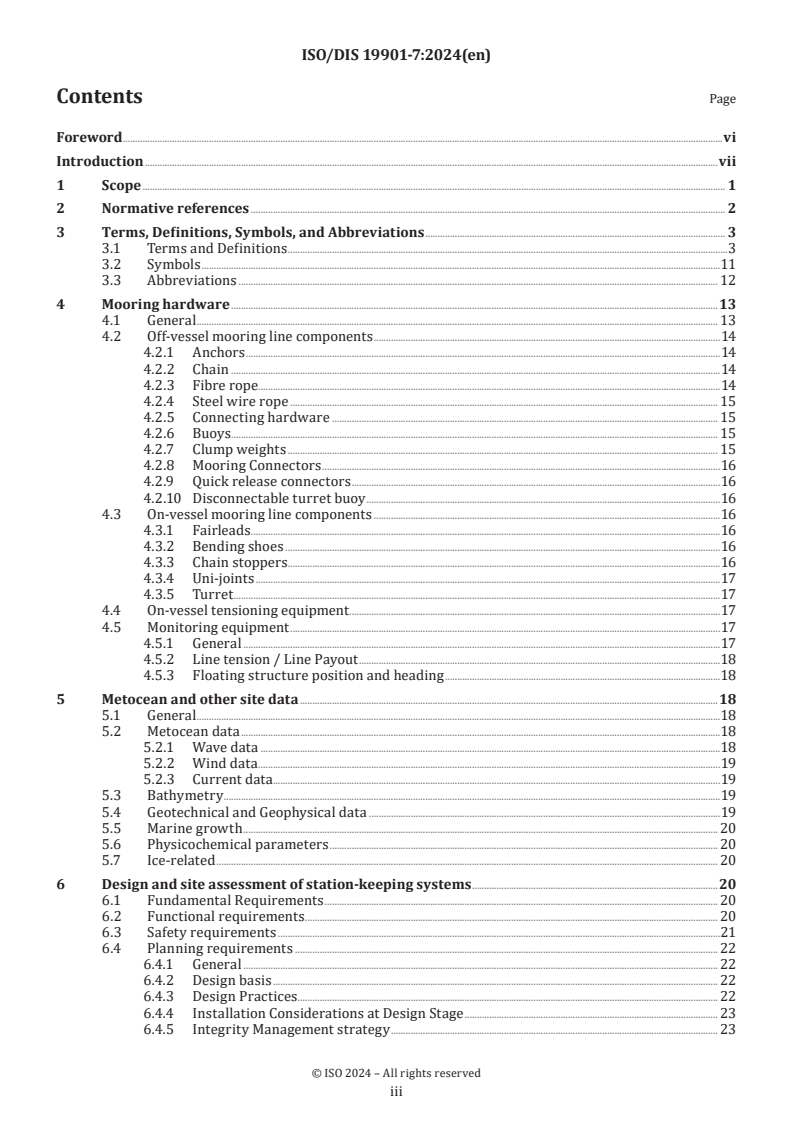
Contents Page
Foreword .vi
Introduction .vii
1 Scope . 1
2 Normative references . 2
3 Terms, Definitions, Symbols, and Abbreviations . 3
3.1 Terms and Definitions .3
3.2 Symbols .11
3.3 Abbreviations . 12
4 Mooring hardware .13
4.1 General . 13
4.2 Off-vessel mooring line components .14
4.2.1 Anchors .14
4.2.2 Chain .14
4.2.3 Fibre rope.14
4.2.4 Steel wire rope . 15
4.2.5 Connecting hardware . 15
4.2.6 Buoys . . 15
4.2.7 Clump weights . 15
4.2.8 Mooring Connectors .16
4.2.9 Quick release connectors .16
4.2.10 Disconnectable turret buoy .16
4.3 On-vessel mooring line components .16
4.3.1 Fairleads .16
4.3.2 Bending shoes .16
4.3.3 Chain stoppers .16
4.3.4 Uni-joints .17
4.3.5 Turret .17
4.4 On-vessel tensioning equipment .17
4.5 Monitoring equipment .17
4.5.1 General .17
4.5.2 Line tension / Line Payout .18
4.5.3 Floating structure position and heading .18
5 Metocean and other site data .18
5.1 General .18
5.2 Metocean data .18
5.2.1 Wave data .18
5.2.2 Wind data .19
5.2.3 Current data.19
5.3 Bathymetry .19
5.4 Geotechnical and Geophysical data .19
5.5 Marine growth . 20
5.6 Physicochemical parameters . 20
5.7 Ice-related . 20
6 Design and site assessment of station-keeping systems .20
6.1 Fundamental Requirements . 20
6.2 Functional requirements . 20
6.3 Safety requirements .21
6.4 Planning requirements . 22
6.4.1 General . 22
6.4.2 Design basis . 22
6.4.3 Design Practices . . 22
6.4.4 Installation Considerations at Design Stage . 23
6.4.5 Integrity Management strategy . 23
iii
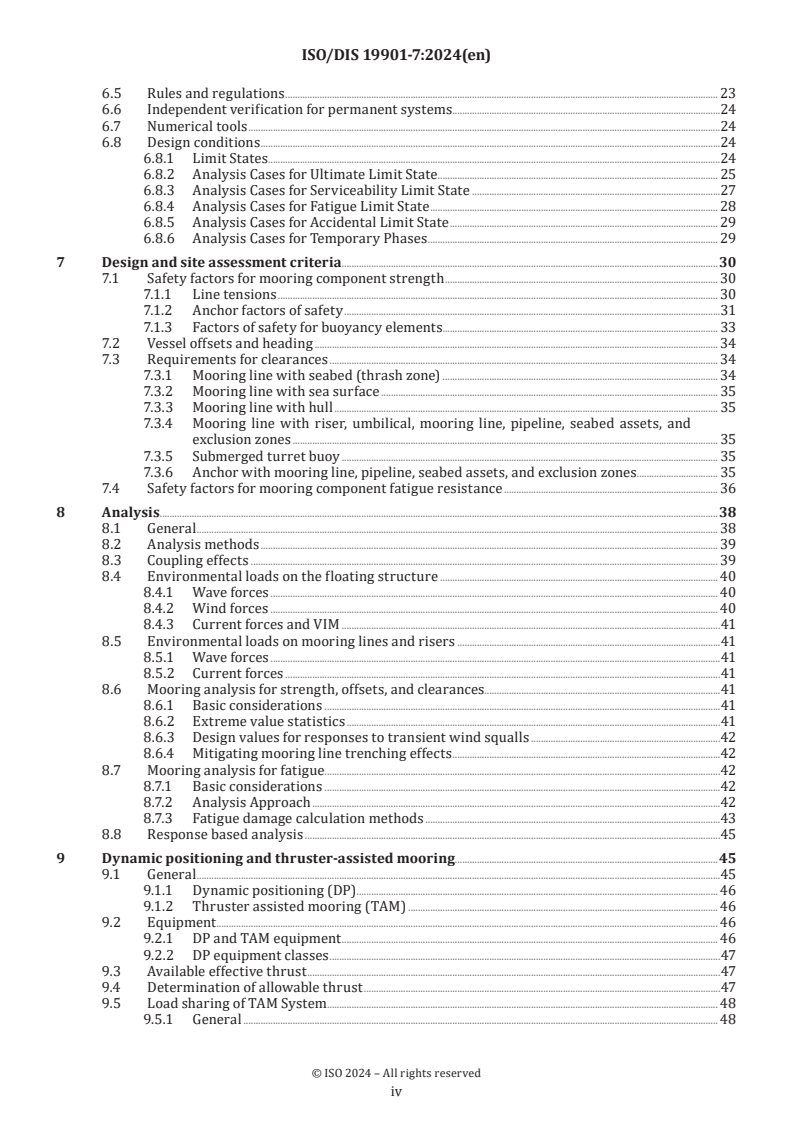
ISO/DIS 19901-7:2024(en)
6.5 Rules and regulations . 23
6.6 Independent verification for permanent systems .24
6.7 Numerical tools .24
6.8 Design conditions .24
6.8.1 Limit States.24
6.8.2 Analysis Cases for Ultimate Limit State. 25
6.8.3 Analysis Cases for Serviceability Limit State .27
6.8.4 Analysis Cases for Fatigue Limit State . 28
6.8.5 Analysis Cases for Accidental Limit State . 29
6.8.6 Analysis Cases for Temporary Phases . 29
7 Design and site assessment criteria . .30
7.1 Safety factors for mooring component strength . 30
7.1.1 Line tensions . 30
7.1.2 Anchor factors of safety .31
7.1.3 Factors of safety for buoyancy elements . . 33
7.2 Vessel offsets and heading . 34
7.3 Requirements for clearances . 34
7.3.1 Mooring line with seabed (thrash zone) . 34
7.3.2 Mooring line with sea surface . 35
7.3.3 Mooring line with hull . 35
7.3.4 Mooring line with riser, umbilical, mooring line, pipeline, seabed assets, and
exclusion zones . 35
7.3.5 Submerged turret buoy . 35
7.3.6 Anchor with mooring line, pipeline, seabed assets, and exclusion zones . 35
7.4 Safety factors for mooring component fatigue resistance . 36
8 Analysis . .38
8.1 General . 38
8.2 Analysis methods . 39
8.3 Coupling effects . 39
8.4 Environmental loads on the floating structure . 40
8.4.1 Wave forces . 40
8.4.2 Wind forces . 40
8.4.3 Current forces and VIM .41
8.5 Environmental loads on mooring lines and risers .41
8.5.1 Wave forces .41
8.5.2 Current forces .41
8.6 Mooring analysis for strength, offsets, and clearances.41
8.6.1 Basic considerations .41
8.6.2 Extreme value statistics .41
8.6.3 Design values for responses to transient wind squalls .42
8.6.4 Mitigating mooring line trenching effects .42
8.7 Mooring analysis for fatigue.42
8.7.1 Basic considerations .42
8.7.2 Analysis Approach .42
8.7.3 Fatigue damage calculation methods .43
8.8 Response based analysis .45
9 Dynamic positioning and thruster-assisted mooring.45
9.1 General .45
9.1.1 Dynamic positioning (DP) . 46
9.1.2 Thruster assisted mooring (TAM) . 46
9.2 Equipment . 46
9.2.1 DP and TAM equipment . 46
9.2.2 DP equipment classes .47
9.3 Available effective thrust .47
9.4 Determination of allowable thrust .47
9.5 Load sharing of TAM System . 48
9.5.1 General . 48
iv
ISO/DIS 19901-7:2024(en)
9.5.2 Mean load reduction method . 48
9.5.3 Weathervaning Units . . 48
9.5.4 System dynamic analysis . 49
9.6 Failure mode and effects analysis . 49
9.7 Design, test and maintenance . 49
9.8 Operating personnel . 49
9.9 Determination of station-keeping capability . 50
10 Installation, test load and as-installed survey .50
10.1 General . 50
10.2 Installation considerations and storm-safe criteria . 50
10.3 Mooring line handling and installation procedure . 50
10.4 Test loading requirements .51
10.4.1 Anchor test load for permanent mooring .51
10.4.2 Anchor test load for mobile mooring .51
10.5 Installation Tolerances .52
10.6 Traceability Records .52
10.7 As-installed survey and establishment of as-installed capacity .52
11 Integrity Management, Survey & Inspection, and Monitoring .53
11.1 Integrity management . 53
11.2 Surveys & Inspections . 54
11.3 Mobile moorings. 55
11.4 Permanent moorings . 55
11.4.1 Annual surveys . 55
11.4.2 Complete surveys. 55
11.5 Evaluation & acceptance/discard criteria. 56
11.6 Monitoring . 56
Annex A (informative) Mooring systems .58
Annex B (informative) Regional information .146
Bibliography .192
v
ISO/DIS 19901-7:2024(en)
Foreword
ISO (the International Organization for Standardization) is a worldwide federation of national standards
bodies (ISO member bodies). The work of preparing International Standards is normally carried out through
ISO technical committees. Each member body interested in a subject for which a technical committee
has been established has the right to be represented on that committee. International organizations,
governmental and non-governmental, in liaison with ISO, also take part in the work. ISO collaborates closely
with the International Electrotechnical Commission (IEC) on all matters of electrotechnical standardization.
The procedures used to develop this document and those intended for its further maintenance are described
in the ISO/IEC Directives, Part 1. In particular, the different approval criteria needed for the different types
of ISO documents should be noted. This document was drafted in accordance with the editorial rules of the
ISO/IEC Directives, Part 2 (see www.iso.org/directives).
ISO draws attention to the possibility that the implementation of this document may involve the use of (a)
patent(s). ISO takes no position concerning the evidence, validity or applicability of any claimed patent
rights in respect thereof. As of the date of publication of this document, ISO [had/had not] received notice of
(a) patent(s) which may be required to implement this document. However, implementers are cautioned that
this may not represent the latest information, which may be obtained from the patent database available at
www.iso.org/patents. ISO shall not be held responsible for identifying any or all such patent rights.
Any trade name used in this document is information given for the convenience of users and does not
constitute an endorsement.
For an explanation of the voluntary nature of standards, the meaning of ISO specific terms and expressions
related to conformity assessment, as well as information about ISO's adherence to the World Trade
Organization (WTO) principles in the Technical Barriers to Trade (TBT), see www.iso.org/iso/foreword.html.
This document was prepared by Technical Committee ISO/TC 67, Oil and gas industries including lower carbon
energy, Subcommittee SC 7, Offshore structures.
This third edition cancels and replaces the second edition (ISO 19901-7:2013), which has been technically
revised.
The main changes are as follows:
— Reorganisation of the table of contents for a more logical flow of requirements from material and
equipment selection, site survey, design considerations, criteria and associated analysis methods to
integrity management during station-keeping system installation and along the system service life.
— Addition of requirements for a formal mooring integrity management system;
— Emphasis on Operator performance standard expectations definition;
— Inclusion of fibre ropes as a standard material such as chain and steel wire ropes;
— Extensive transfer of information material into the informative Annex A;
— Deletion of informative sections related to geotechnical design of anchors to incorporate the same in
19901-4;
— Inclusion of OPB fatigue guidance and Squall design cases guidance;
— Some minor corrections.
A list of all parts in the ISO series 19901 can be found on the ISO website.
Any feedback or questions on this document should be directed to the user’s national standards body. A
complete listing of these bodies can be found at www.iso.org/members.html.
vi
ISO/DIS 19901-7:2024(en)
Introduction
The series of International Standards applicable to offshore structures, ISO 19900 to ISO 19906, constitutes
a common basis covering those aspects that address design requirements and assessments of offshore
structures used by the petroleum, petrochemical and natural gas industries worldwide. The intention in
their application is to achieve reliability levels appropriate for manned and unmanned offshore structures,
irrespective type of structure and the nature or combination of materials used.
It is important to recognize that structural integrity is a concept comprised of models that describe actions,
structural analyses, design rules, safety elements, workmanship, quality control procedures and national
requirements, all of which are mutually dependent. The modification of one aspect of design in isolation
can disturb the balance of reliability inherent in the overall design or structural system. The implications
involved in modifications therefore need to be considered in relation to the overall reliability of all offshore
structural systems.
The series of International Standards applicable to types of offshore structures are intended to provide a
wide breadth of choice for structural configurations, materials and techniques without hindering innovation.
Informed engineering judgement is therefore necessary in the use of these International Standards.
This part of ISO 19901 was developed in response to the worldwide offshore industry’s demand for a coherent
and consistent definition of methodologies to analyse, design and evaluate station-keeping systems used for
floating production and/or storage platforms of various types (e.g. semi-submersibles, spar platforms, ship-
shaped structures) and to assess site-specific applications of mobile offshore units (such as mobile offshore
drilling units and flotels) and construction units (such as heavy lift vessels and pipelay units).
For permanent production systems operating procedures for station-keeping systems assume as a minimum
the ability to shut-in wells and the facility in case of emergency (e.g., emergency shut-down valves on the
seabed), otherwise the consequence of mooring failure could be significantly different.
Station-keeping is a generic term covering systems for keeping a floating structure, which is under the
constant influence of external actions, at a pre-defined location and/or heading with limited excursions.
Station-keeping systems resist external actions by means of any of the following:
— mooring systems (e.g., spread moorings or single point moorings),
— dynamic positioning systems (generally consisting of thrusters), and
— a combination of mooring system and thrusters (thruster assisted moorings).
The external actions generally consist of wind, wave, current and ice actions on the floating structure,
mooring and/or risers.
Some background to, and guidance on, the use of this part of ISO 19901 is provided in informative Annex A.
The clause numbering in Annex A is the same as in the normative text to facilitate cross-referencing.
Regional information, where available, is provided in informative Annex B.
vii
DRAFT International Standard ISO/DIS 19901-7:2024(en)
Oil and gas industries including lower carbon energy —
Specific requirements for offshore structures —
Part 7:
Station-keeping systems for floating offshore structures and
mobile offshore units
1 Scope
This part of ISO 19901 specifies methodologies for:
a) the design, analysis and evaluation of station-keeping systems for floating structures used by the oil
and gas industries to support any combination of:
1) production,
2) storage,
3) offloading,
4) drilling and well intervention.
b) the assessment of station-keeping systems for site-specific applications of mobile offshore units and
construction units.
Most station-keeping systems used with the class of floating structures covered by a) are termed “permanent
mooring systems”, for which this part of ISO 19901 is applicable to all aspects of the life cycle and includes
requirements relating to the manufacture of mooring components, as well as considerations for in-service
inspections. Most station-keeping systems used with mobile offshore units, the class covered by b), are termed
“mobile mooring systems”. Throughout this part of ISO 19901, the term “floating structure”, sometimes
shortened to “structure”, is used as a generic term to indicate any member of the two classes, a) and b).
This part of ISO 19901 is applicable to the following types of station-keeping systems, which are either
covered directly in this part of ISO 19901 or through reference to other guidelines:
i) spread moorings,
ii) single point moorings
iii) dynamic positioning systems,
iv) thruster-assisted moorings.
This part of ISO 19901 is not applicable to:
— station keeping systems which do not have redundancy against failure of any single component (e.g.,
single anchor leg moorings (SALMs)),
— station keeping systems which use any means other than mooring lines or thrusters such as tower soft
yoke systems, or tension leg platforms (TLPs) that are using tendons.
The requirements for this part of ISO 19901 address spread mooring systems and single point mooring
systems with mooring lines composed of steel chain, steel wire or synthetic fibre rope.
ISO/DIS 19901-7:2024(en)
Descriptions of characteristics and typical components found in these systems are given in Annex A.
This document includes requirements relating to the selection of mooring components, mooring system
configuration and performance, components design, installation, post-installation survey, and as-installed
assessments as needed for mooring integrity management.
The procedures for the design of permanent or site assessment of mobile mooring systems specified in this
document are based on a deterministic approach where mooring system responses (such as line tensions,
vessel offsets, and anchor loads) are evaluated for a design environment defined by an annual probability
of exceedance or return period. Mooring system responses are then checked against acceptance criteria for
mooring strength, offsets and orientation, clearances, anchor capacity, fatigue resistance, etc. The minimum
acceptance criteria are either defined in this document or are to be specified by the Operator.
NOTE 1 Station-keeping systems designed based on this deterministic approach might have differing levels of
reliability.
For moored structures (vessels), system responses are calculated and compared to minimum acceptance
criteria for:
— Ultimate limit states (ULS): Mooring component strength. Vessel offset, orientation, and clearance
constraints. Herein the ULS includes both intact and single failure condition for station-keeping systems.
— Serviceability limit states (SLS): Vessel offset, orientation, and clearance constraints. For mooring
components this includes clearances with the vessel, risers, umbilicals, seabed, water surface, field
infrastructure, exclusion zones, etc.
— Fatigue limit states (FLS) : Cumulative mooring component fatigue damage.
— Accidental limit state (ALS): no criteria are given for accidental or abnormal limit state which are left
to owner decision or local Authorities requirements.
The methodology described in this part of ISO 19901 identifies a set of coherent analysis techniques that,
combined with an understanding of the site-specific metocean conditions, the characteristics of the floating
structure under consideration, and other factors, can be used to determine the adequacy of the station-
keeping system to meet the functional requirements of this document.
NOTE 2 For moorings deployed in ice-prone environments, additional requirements are given in ISO 19906
subclause 13.7.
2 Normative references
The following documents are referred to in the text in such a way that some or all of their content constitutes
requirements of this document. For dated references, only the edition cited applies. For undated references,
the latest edition of the referenced document (including any amendments) applies.
ISO 9089, Marine structures — Mobile offshore units — Mooring positioning windlasses and winches
ISO 18692-1:2018, Fibre ropes for offshore stationkeeping — Part 1: General specification
ISO 19900, Petroleum and natural gas industries — General requirements for offshore structures
ISO 19901-1, Petroleum and natural gas industries — Specific requirements for offshore structures — Part 1:
Metocean design and operating considerations
ISO 19901-3, Oil and gas industries including lower carbon energy — Specific requirements for offshore
structures — Part 3: Topsides structure
ISO 19901-4, Petroleum and natural gas industries — Specific requirements for offshore structures — Part 4:
Geotechnical and foundation design considerations
ISO 19901-6, Petroleum and natural gas industries — Specific requirements for offshore structures — Part 6:
Marine operations
ISO/DIS 19901-7:2024(en)
ISO 19901-8, Oil and gas industries including lower carbon energy — Offshore structures — Part 8: Marine soil
investigations
ISO 19901-9, Petroleum and natural gas industries — Specific requirements for offshore structures — Part 9:
Structural integrity management
ISO 19905-3, Petroleum and natural gas industries — Site-specific assessment of mobile offshore units — Part
3: Floating units
ISO 19906, Petroleum and natural gas industries — Arctic offshore structures
ISO 20438, Ships and marine technology — Offshore mooring chains
IACS UR W22, Offshore Mooring Chains
API RP 2MET, “Derivation of Metocean Design and Operating Conditions” Second Edition – January 2021
API RP 2I, “In-service Inspection of Mooring Hardware for Floating Structures”, 3rd Edition, 2007
st
API RP 2MIM, “Mooring Integrity Management”, 1 Edition, September 2019
API RP 2SK, “Design and Analysis of Station-keeping Systems for Floating Structures” Fourth Edition – July 2024
API RP 2SM, “Recommended Practice for Design, Manufacture, Installation, and Maintenance of Synthetic Fiber
Ropes for Offshore Mooring” Second Edition – July 2014
API SPEC 9A, “Specification for Wire Rope” 27th Edition, August 2020 -
IMO MSC.1/Circ.1580, Guidelines for vessels and units with Dynamic Positioning (DP) systems, 16 June
2017, International Maritime Organization.
3 Terms, Definitions, Symbols, and Abbreviations
3.1 Terms and Definitions
For the purposes of this document, the following terms and definitions apply.
ISO and IEC maintain terminological databases for use in standardization at the following addresses:
— ISO Online browsing platform: available at https:// www .iso .org/ obp
— IEC Electropedia: available
...
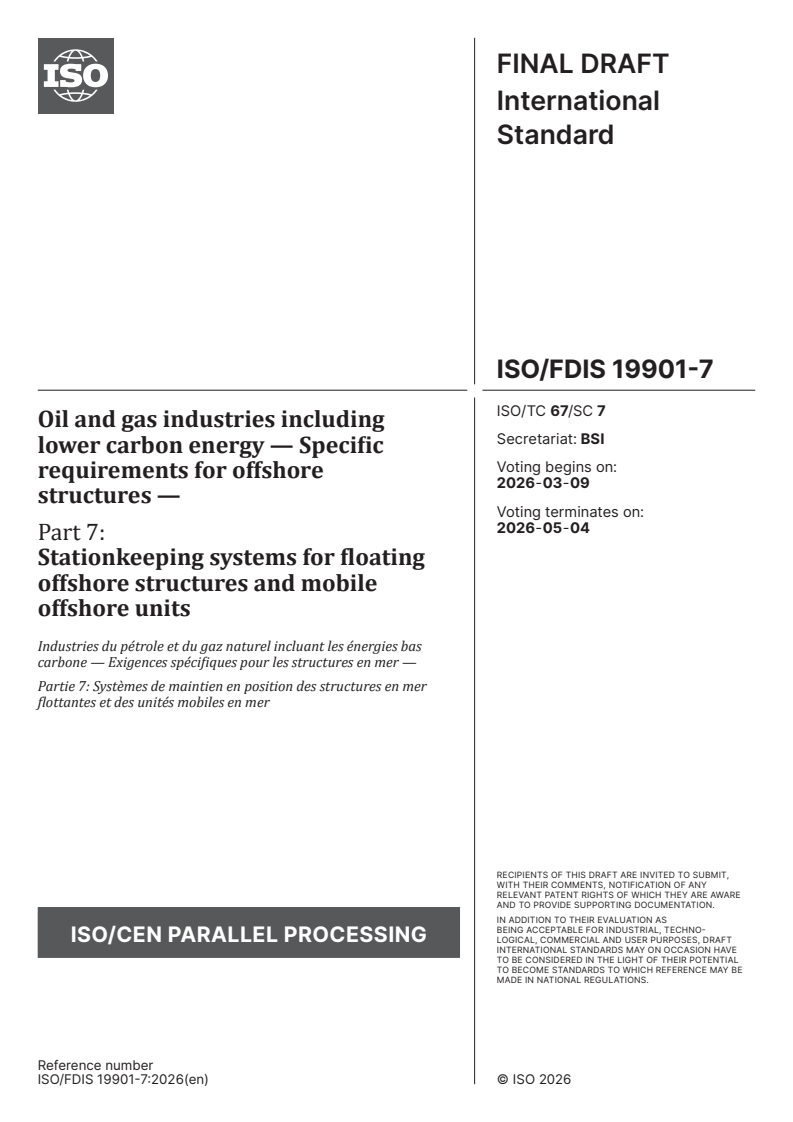
FINAL DRAFT
International
Standard
ISO/TC 67/SC 7
Oil and gas industries including
Secretariat: BSI
lower carbon energy — Specific
Voting begins on:
requirements for offshore
2026-03-09
structures —
Voting terminates on:
2026-05-04
Part 7:
Stationkeeping systems for floating
offshore structures and mobile
offshore units
Industries du pétrole et du gaz naturel incluant les énergies bas
carbone — Exigences spécifiques pour les structures en mer —
Partie 7: Systèmes de maintien en position des structures en mer
flottantes et des unités mobiles en mer
RECIPIENTS OF THIS DRAFT ARE INVITED TO SUBMIT,
WITH THEIR COMMENTS, NOTIFICATION OF ANY
RELEVANT PATENT RIGHTS OF WHICH THEY ARE AWARE
AND TO PROVIDE SUPPOR TING DOCUMENTATION.
IN ADDITION TO THEIR EVALUATION AS
BEING ACCEPTABLE FOR INDUSTRIAL, TECHNO-
ISO/CEN PARALLEL PROCESSING LOGICAL, COMMERCIAL AND USER PURPOSES, DRAFT
INTERNATIONAL STANDARDS MAY ON OCCASION HAVE
TO BE CONSIDERED IN THE LIGHT OF THEIR POTENTIAL
TO BECOME STAN DARDS TO WHICH REFERENCE MAY BE
MADE IN NATIONAL REGULATIONS.
Reference number
FINAL DRAFT
International
Standard
ISO/TC 67/SC 7
Oil and gas industries including
Secretariat: BSI
lower carbon energy — Specific
Voting begins on:
requirements for offshore
structures —
Voting terminates on:
Part 7:
Stationkeeping systems for floating
offshore structures and mobile
offshore units
Industries du pétrole et du gaz naturel incluant les énergies bas
carbone — Exigences spécifiques pour les structures en mer —
Partie 7: Systèmes de maintien en position des structures en mer
flottantes et des unités mobiles en mer
RECIPIENTS OF THIS DRAFT ARE INVITED TO SUBMIT,
WITH THEIR COMMENTS, NOTIFICATION OF ANY
RELEVANT PATENT RIGHTS OF WHICH THEY ARE AWARE
AND TO PROVIDE SUPPOR TING DOCUMENTATION.
© ISO 2026
IN ADDITION TO THEIR EVALUATION AS
All rights reserved. Unless otherwise specified, or required in the context of its implementation, no part of this publication may
BEING ACCEPTABLE FOR INDUSTRIAL, TECHNO-
ISO/CEN PARALLEL PROCESSING
LOGICAL, COMMERCIAL AND USER PURPOSES, DRAFT
be reproduced or utilized otherwise in any form or by any means, electronic or mechanical, including photocopying, or posting on
INTERNATIONAL STANDARDS MAY ON OCCASION HAVE
the internet or an intranet, without prior written permission. Permission can be requested from either ISO at the address below
TO BE CONSIDERED IN THE LIGHT OF THEIR POTENTIAL
or ISO’s member body in the country of the requester.
TO BECOME STAN DARDS TO WHICH REFERENCE MAY BE
MADE IN NATIONAL REGULATIONS.
ISO copyright office
CP 401 • Ch. de Blandonnet 8
CH-1214 Vernier, Geneva
Phone: +41 22 749 01 11
Email: copyright@iso.org
Website: www.iso.org
Published in Switzerland Reference number
ii
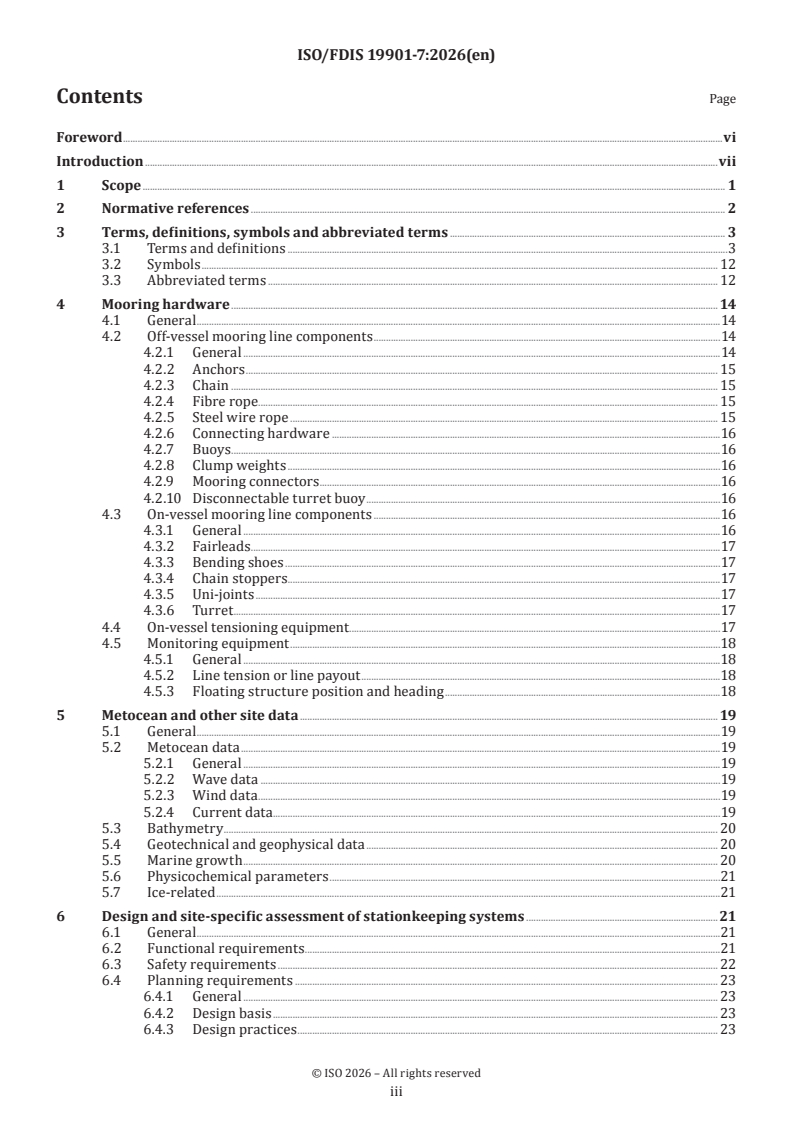
Contents Page
Foreword .vi
Introduction .vii
1 Scope . 1
2 Normative references . 2
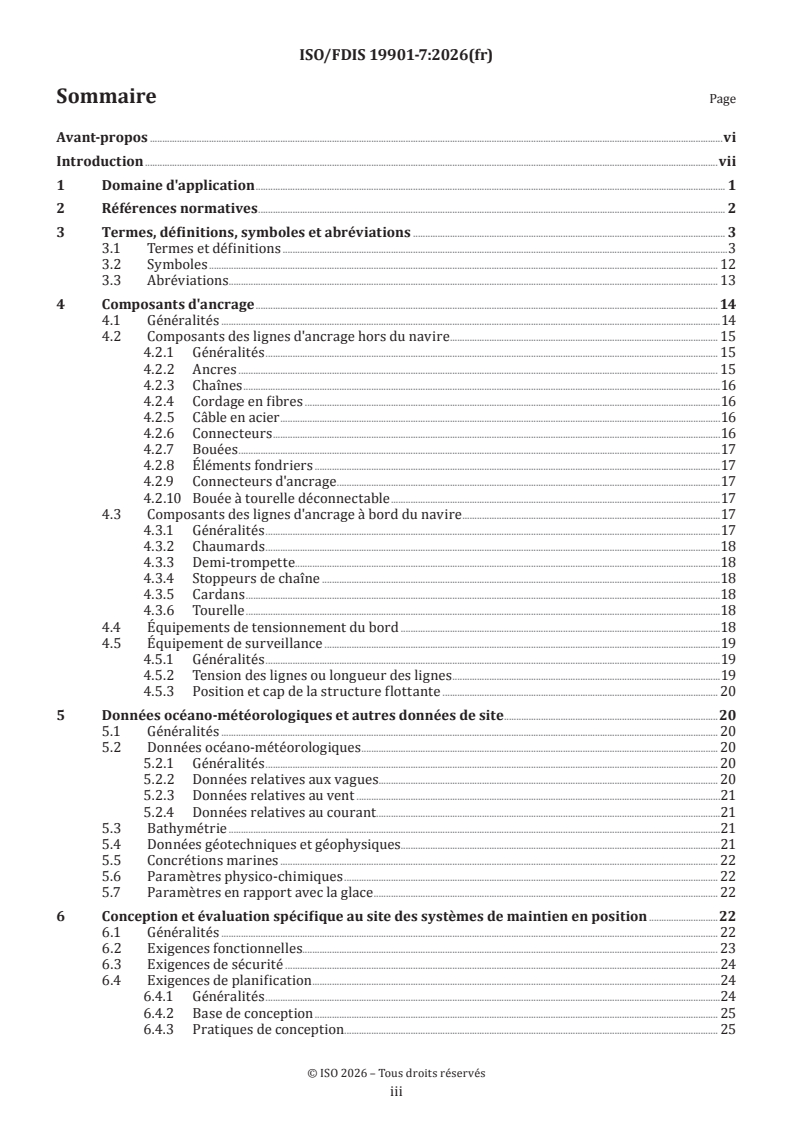
3 Terms, definitions, symbols and abbreviated terms . 3
3.1 Terms and definitions .3
3.2 Symbols . 12
3.3 Abbreviated terms . 12
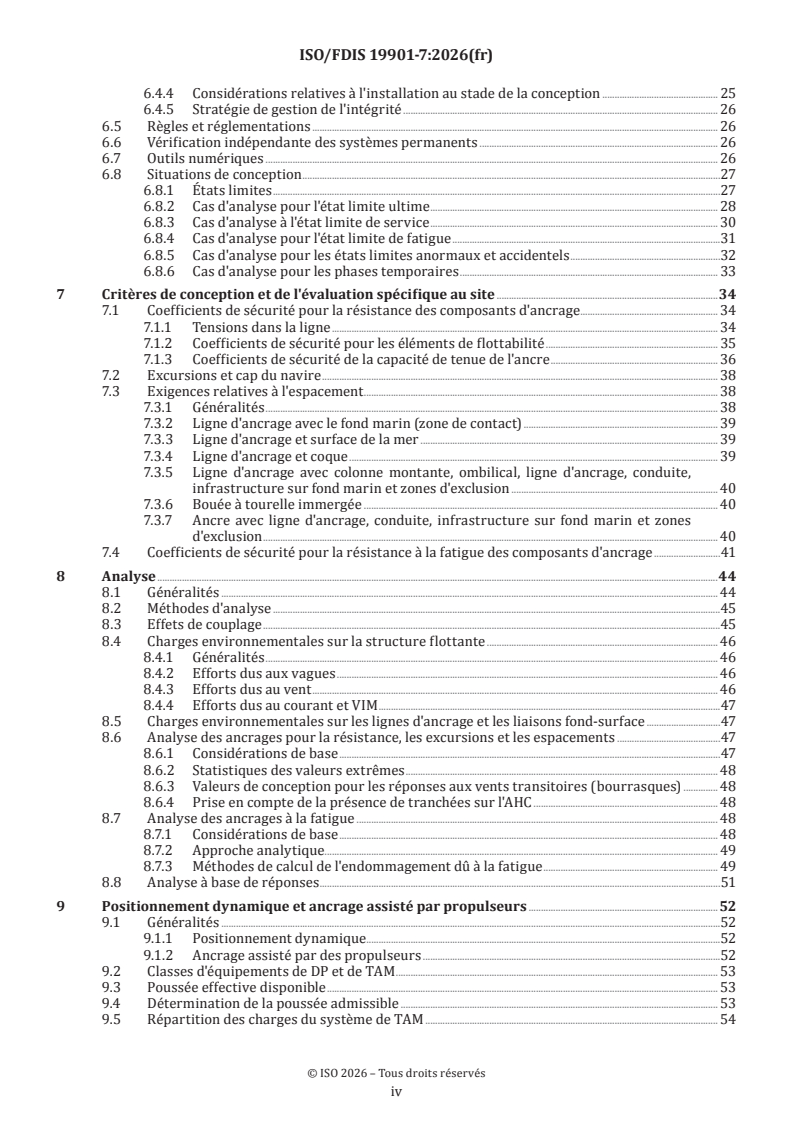
4 Mooring hardware . 14
4.1 General .14
4.2 Off-vessel mooring line components .14
4.2.1 General .14
4.2.2 Anchors . 15
4.2.3 Chain . 15
4.2.4 Fibre rope. 15
4.2.5 Steel wire rope . 15
4.2.6 Connecting hardware .16
4.2.7 Buoys . .16
4.2.8 Clump weights .16
4.2.9 Mooring connectors . .16
4.2.10 Disconnectable turret buoy .16
4.3 On-vessel mooring line components .16
4.3.1 General .16
4.3.2 Fairleads . .17
4.3.3 Bending shoes .17
4.3.4 Chain stoppers .17
4.3.5 Uni-joints .17
4.3.6 Turret .17
4.4 On-vessel tensioning equipment .17
4.5 Monitoring equipment .18
4.5.1 General .18
4.5.2 Line tension or line payout .18
4.5.3 Floating structure position and heading .18
5 Metocean and other site data . 19
5.1 General .19
5.2 Metocean data .19
5.2.1 General .19
5.2.2 Wave data .19
5.2.3 Wind data .19
5.2.4 Current data.19
5.3 Bathymetry . 20
5.4 Geotechnical and geophysical data . 20
5.5 Marine growth . 20
5.6 Physicochemical parameters .21
5.7 Ice-related .21
6 Design and site-specific assessment of stationkeeping systems .21
6.1 General .21
6.2 Functional requirements .21
6.3 Safety requirements . 22
6.4 Planning requirements . 23
6.4.1 General . 23
6.4.2 Design basis . 23
6.4.3 Design practices . 23
iii
6.4.4 Installation considerations at design stage . 23
6.4.5 Integrity management strategy .24
6.5 Rules and regulations .24
6.6 Independent verification for permanent systems .24
6.7 Numerical tools . 25
6.8 Design situations . 25
6.8.1 Limit states . 25
6.8.2 Analysis cases for ultimate limit state . 26
6.8.3 Analysis cases for serviceability limit state . 28
6.8.4 Analysis cases for fatigue limit state. 29
6.8.5 Analysis cases for abnormal and accidental limit states . 30
6.8.6 Analysis cases for temporary phases . 30
7 Design and site-specific assessment criteria .31
7.1 Safety factors for mooring component strength .31
7.1.1 Line tensions .31
7.1.2 Safety factors for buoyancy elements .32
7.1.3 Anchor holding capacity safety factors . 33
7.2 Vessel offsets and heading . 35
7.3 Requirements for clearances . 35
7.3.1 General . 35
7.3.2 Mooring line with seabed (thrash zone) . 35
7.3.3 Mooring line with sea surface . 36
7.3.4 Mooring line with hull . 36
7.3.5 Mooring line with riser, umbilical, mooring line, pipeline, seabed assets and
exclusion zones . 36
7.3.6 Submerged turret buoy . 36
7.3.7 Anchor with mooring line, pipeline, seabed assets and exclusion zones . 36
7.4 Safety factors for mooring component fatigue resistance .37
8 Analysis . .39
8.1 General . 39
8.2 Analysis methods . 40
8.3 Coupling effects .41
8.4 Environmental loads on the floating structure .41
8.4.1 General .41
8.4.2 Wave forces .41
8.4.3 Wind forces .42
8.4.4 Current forces and VIM .42
8.5 Environmental loads on mooring lines and risers .42
8.6 Mooring analysis for strength, offsets and clearances .42
8.6.1 Basic considerations .42
8.6.2 Extreme value statistics .43
8.6.3 Design values for responses to transient wind squalls .43
8.6.4 Mitigating mooring line trenching effects on AHC .43
8.7 Mooring analysis for fatigue.43
8.7.1 Basic considerations .43
8.7.2 Analysis approach . 44
8.7.3 Fatigue damage calculation methods . 44
8.8 Response based analysis . 46
9 Dynamic positioning and thruster-assisted mooring. 47
9.1 General .47
9.1.1 Dynamic positioning .47
9.1.2 Thruster assisted mooring.47
9.2 DP and TAM equipment classes .47
9.3 Available effective thrust . 48
9.4 Determination of allowable thrust . 48
9.5 Load sharing of TAM system . 48
9.5.1 General . 48
iv
9.5.2 Mean load reduction method . 49
9.5.3 Weathervaning structures . 49
9.5.4 System dynamic analysis . 49
9.6 Failure mode and effects analysis . 49
9.7 Design, test and maintenance . 50
9.8 Operating personnel . 50
9.9 Determination of stationkeeping capability . 50
10 Installation, test load and as-installed survey . 51
10.1 General .51
10.2 Installation considerations and storm-safe criteria .51
10.3 Mooring line handling and installation procedure .51
10.4 Test loading requirements .52
10.4.1 General .52
10.4.2 Anchor test load for permanent mooring systems .52
10.4.3 Anchor test load for mobile mooring systems .52
10.5 Installation tolerances . 53
10.6 Traceability records . 53
10.7 As-installed survey and establishment of as-installed capacity . 53
11 Integrity management, survey and inspection, and monitoring .54
11.1 Integrity management . 54
11.2 Surveys and inspections . 54
11.2.1 In-service inspection program . 54
11.2.2 As-built inspection . 55
11.2.3 Annual survey . 55
11.2.4 5-year survey . 56
11.3 Conformity assessment .57
11.4 Monitoring .57
11.4.1 Position and heading monitoring .57
11.4.2 Line failure detection .57
Annex A (informative) Additional information and guidance .58
Annex B (normative) Regional requirements and supporting information .138
Bibliography .183
v
Foreword
ISO (the International Organization for Standardization) is a worldwide federation of national standards
bodies (ISO member bodies). The work of preparing International Standards is normally carried out through
ISO technical committees. Each member body interested in a subject for which a technical committee
has been established has the right to be represented on that committee. International organizations,
governmental and non-governmental, in liaison with ISO, also take part in the work. ISO collaborates closely
with the International Electrotechnical Commission (IEC) on all matters of electrotechnical standardization.
The procedures used to develop this document and those intended for its further maintenance are described
in the ISO/IEC Directives, Part 1. In particular, the different approval criteria needed for the different types
of ISO document should be noted. This document was drafted in accordance with the editorial rules of the
ISO/IEC Directives, Part 2 (see www.iso.org/directives).
ISO draws attention to the possibility that the implementation of this document may involve the use of (a)
patent(s). ISO takes no position concerning the evidence, validity or applicability of any claimed patent
rights in respect thereof. As of the date of publication of this document, ISO had not received notice of (a)
patent(s) which may be required to implement this document. However, implementers are cautioned that
this may not represent the latest information, which may be obtained from the patent database available at
www.iso.org/patents. ISO shall not be held responsible for identifying any or all such patent rights.
Any trade name used in this document is information given for the convenience of users and does not
constitute an endorsement.
For an explanation of the voluntary nature of standards, the meaning of ISO specific terms and expressions
related to conformity assessment, as well as information about ISO's adherence to the World Trade
Organization (WTO) principles in the Technical Barriers to Trade (TBT), see www.iso.org/iso/foreword.html.
This document was prepared by Technical Committee ISO/TC 67, Oil and gas industries including lower
carbon energy, Subcommittee SC 7, Offshore structures, in collaboration with the European Committee for
Standardization (CEN) Technical Committee CEN/TC 12, Oil and gas industries including lower carbon energy,
in accordance with the Agreement on technical cooperation between ISO and CEN (Vienna Agreement).
This third edition cancels and replaces the second edition (ISO 19901-7:2013), which has been technically
revised.
The main changes are as follows:
— addition of requirements for a mooring integrity management system;
— emphasis on the definition of the operator's expectations on the performance standard;
— inclusion of fibre ropes as a standard material such as chain and steel wire ropes;
— alignment of text relating to the geotechnical design of anchors with ISO 19901-4;
— inclusion of guidance on OPB (out of plane bending) fatigue and squall design cases.
A list of all parts in the ISO 19901 series can be found on the ISO website.
Any feedback or questions on this document should be directed to the user’s national standards body. A
complete listing of these bodies can be found at www.iso.org/members.html.
vi
Introduction
The International Standards on offshore structures prepared by TC 67 (i.e. ISO 19900, the ISO 19901 series,
ISO 19902, ISO 19903, ISO 19904-1, the ISO 19905 series, ISO 19906) constitute a common basis covering
those aspects that address design requirements and assessments of offshore structures used by the oil and
gas industries worldwide. The intention in their application is to achieve reliability levels appropriate for
manned and unmanned offshore structures, irrespective type of structure and the nature or combination of
materials used.
It is important to recognize that structural integrity is a concept comprised of models that describe actions,
structural analyses, design rules, safety elements, workmanship, quality control procedures and national
requirements, all of which are mutually dependent. The modification of one aspect of design in isolation
can disturb the balance of reliability inherent in the overall design or structural system. The implications
involved in modifications therefore should be considered in relation to the overall reliability of all offshore
structural systems.
The International Standards on offshore structures prepared by TC 67 are intended to provide a wide
breadth of choice for structural configurations, materials and techniques without hindering innovation.
Informed engineering judgement is therefore necessary in the use of these International Standards.
This document was developed in response to the worldwide offshore industry’s demand for a coherent and
consistent definition of methodologies to analyse, design and evaluate stationkeeping systems used for
floating energy production platforms (with and without storage) of various types (e.g. semi-submersibles,
spar platforms, ship-shaped structures) and to assess site-specific applications of mobile offshore units
(such as mobile offshore drilling units and flotels) and construction units (such as heavy lift vessels and
pipelay units).
This document assumes that permanently moored hydrocarbon production systems that are equipped
with stationkeeping systems as a minimum have the ability to both shut-in wells and the facility in case of
emergency (e.g. emergency shut-down valves on the seabed), otherwise the consequence of mooring failure
can be significantly different.
Stationkeeping is a generic term covering systems for keeping a floating structure, which is under the
constant influence of external actions, either at a pre-defined location or at a pre-defined heading or both
with limited excursions. Stationkeeping systems resist external actions by means of any of the following:
— mooring systems (e.g. spread mooring systems or single point mooring systems);
— dynamic positioning systems (generally consisting of thrusters)
— a combination of mooring system and thrusters (thruster assisted mooring systems).
The external actions generally consist of wind, wave, current and ice actions on the floating structure,
mooring and risers.
The procedures for the design of permanent or site-specific assessment of mobile mooring systems specified
in this document are based on a deterministic approach where mooring system responses (such as line
tensions, vessel offsets, and anchor loads) are evaluated for a design environment defined by an annual
probability of exceedance or return period. Mooring system responses are then checked against specified
requirements for mooring strength, offsets and orientation, clearances, anchor capacity, fatigue resistance,
etc. The minimum specified requirements are defined either in this document or by the operator if more
stringent.
NOTE Stationkeeping systems designed based on this deterministic approach can have differing levels of
reliability.
For moored structures (vessels), system responses are calculated and compared to minimum specified
requirements for:
— Ultimate limit states (ULS): mooring component strength. Vessel offset, orientation, and clearance
constraints. Herein the ULS includes both intact and single failure condition for stationkeeping systems.
vii
— Serviceability limit states (SLS): vessel offset, orientation, and clearance constraints. For mooring
components this includes clearances with the vessel, risers, umbilicals, seabed, water surface, field
infrastructure, exclusion zones, etc.
— Fatigue limit states (FLS) : cumulative mooring component fatigue damage.
— Accidental and abnormal limit state (ALS): no criteria are given for accidental or abnormal limit state
which are left to operator decision or local authorities requirements.
The methodology described in this document identifies a set of coherent analysis techniques that, combined
with an understanding of the site-specific metocean conditions, the characteristics of the floating structure
under consideration, and other factors, can be used to determine the adequacy of the stationkeeping system
to meet the functional requirements specified in this document.
Descriptions of characteristics and typical components found in these systems are given in Annex A.
Some background to, and guidance on, the use of this document is provided in Annex A. The clause numbering
in Annex A is the same as in the main text to facilitate cross-referencing.
Regional information, where available, is provided in Annex B.
viii
FINAL DRAFT International Standard ISO/FDIS 19901-7:2026(en)
Oil and gas industries including lower carbon energy —
Specific requirements for offshore structures —
Part 7:
Stationkeeping systems for floating offshore structures and
mobile offshore units
1 Scope
This document specifies methodologies for:
a) the design, analysis and evaluation of stationkeeping systems for floating offshore structures.
b) the assessment of stationkeeping systems for site-specific applications of mobile offshore units and
construction units.
Originally developed for floating structures used in the oil and gas industry, this document is now also used
in the renewable energy sector. The extent of application of this standard to floating structures used in other
[10]
industries is at the discretion of the relevant standard entity and its users. For example, IEC 61400-3-2
for floating wind applies this document to determine stationkeeping system responses while incorporating
its own load conditions, safety factors, and environmental return periods.
This document is applicable to the following types of stationkeeping systems, which are either covered
directly in this document or through reference to other guidelines:
— spread mooring systems,
— single point mooring systems
— dynamic positioning systems,
— thruster-assisted mooring systems.
This document is not applicable to:
— stationkeeping systems which do not have redundancy against failure of any single component, e.g.,
single anchor leg moorings (SALMs);
— stationkeeping systems which use any means other than mooring lines or thrusters such as tower soft
yoke systems, or tension leg platforms (TLPs) that use tendons.
The requirements for this document address spread mooring systems and single point mooring systems
with mooring lines composed of steel chain, steel wire or synthetic fibre rope.
This document is applicable to all aspects of the life cycle of mooring systems. It includes requirements
relating to the selection of mooring components, mooring system configuration and performance,
components design, installation, post-installation survey, and as-installed assessments as needed for
mooring integrity management.
For mooring systems deployed in ice-prone environments, additional requirements in ISO 19906 apply.
2 Normative references
The following documents are referred to in the text in such a way that some or all of their content constitutes
requirements of this document. For dated references, only the edition cited applies. For undated references,
the latest edition of the referenced document (including any amendments) applies.
ISO 18692-1, Fibre ropes for offshore stationkeeping — Part 1: General specification
ISO 19900, Petroleum and natural gas industries — General requirements for offshore structures
ISO 19901-1, Petroleum and natural gas industries — Specific requirements for offshore structures — Part 1:
Metocean design and operating considerations
ISO 19901-4, Oil and gas industries including lower carbon energy — Specific requirements for offshore
structures — Part 4: Geotechnical design considerations
ISO 19901-6, Petroleum and natural gas industries — Specific requirements for offshore structures — Part 6:
Marine operations
ISO 19901-8, Oil and gas industries including lower carbon energy — Offshore structures — Part 8: Marine soil
investigations
ISO 19901-10, Petroleum and natural gas industries — Specific requirements for offshore structures — Part 10:
Marine geophysical investigations
ISO 19904-1, Petroleum and natural gas industries — Floating offshore structures — Part 1: Ship-shaped, semi-
submersible, spar and shallow-draught cylindrical structures
ISO 19905-3, Petroleum and natural gas industries — Site-specific assessment of mobile offshore units — Part
3: Floating units
ISO 19906, Petroleum and natural gas industries — Arctic offshore structures
ISO 20438, Ships and marine technology — Offshore mooring chains
ISO 31000, Risk management — Guidelines
IMO MSC.1/Circ.1580, Guidelines for vessels and units with dynamic positioning (DP) systems, International
Maritime Organization, 16 June 2017
IACS Unified Requirement UR W22 — Offshore mooring chains, International Association of Classification.
Societies
API RP 2I, In-service inspection of mooring hardware for floating structures, American Petroleum Institute
API RP 2MIM, Mooring Integrity Management, American Petroleum Institute
API SPEC 9A, Specification for wire rope, American Petroleum Institute
ASME Section VIII, Division 1 Boiler and Pressure Vessel Code — Rules for Construction of Pressure Vessels,
American Society of Mechanical Engineers
DNV-OS-E301:2024, Position mooring, DNV Offshore Standard
DNV-RP-E301:2021, Design and installation of fluke anchors, DNV Recommended Practice
DNV-RP-E302:2021, Design and installation of plate anchors in clay, DNV Recommended Practice
DNV-RP-E303:2021, Geotechnical design and installation of suction anchors in clay, DNV Recommended Practice
MTS, DP operations guidance, Marine Technology Socie
...
ISO/TC 67/SC 7/WG 5
Secretariat: BSI
Date: 2025-112026-02-20
Oil and gas industries including lower carbon energy — Specific
requirements for offshore structures — Part 7: Stationkeeping
systems for floating offshore structures and mobile offshore units
Part 7:
Stationkeeping systems for floating offshore structures and mobile
offshore units
Industries du pétrole et du gaz naturel incluant les énergies bas carbone — Exigences spécifiques pour les
structures en mer — Partie 7: Systèmes de maintien en position des structures offshore flottantes et des unités
offshore mobiles
Partie 7: Systèmes de maintien en position des structures en mer flottantes et des unités mobiles en mer
FDIS stage
TTTTTThhhhhhiisiiiisssss dr dr dr dr drdraaaaaafffffftttttt i i i i iissssss susususususubbbbbbmmmmmmiiiiiitttttttttttteeeeeed d d d d d ttttttoooooo aaaaaa ppppppaaaaaarrrrrraaaaaallellellellellellel l l l l l vvvvvvooooootttttteeeeee i i i i i innnnnn IIIIIISSSSSSOOOOOO,,,,,, CCCCCCEEEEEEN.N.N.N.N.N.
All rights reserved. Unless otherwise specified, or required in the context of its implementation, no part of this publication
may be reproduced or utilized otherwise in any form or by any means, electronic or mechanical, including photocopying,
or posting on the internet or an intranet, without prior written permission. Permission can be requested from either ISO
at the address below or ISO'sISO’s member body in the country of the requester.
ISO Copyright Officecopyright office
CP 401 • Ch. de Blandonnet 8
CH-1214 Vernier, Geneva
Phone: + 41 22 749 01 11
Email: E-mail: copyright@iso.org
Website: www.iso.org
Published in Switzerland.
ii
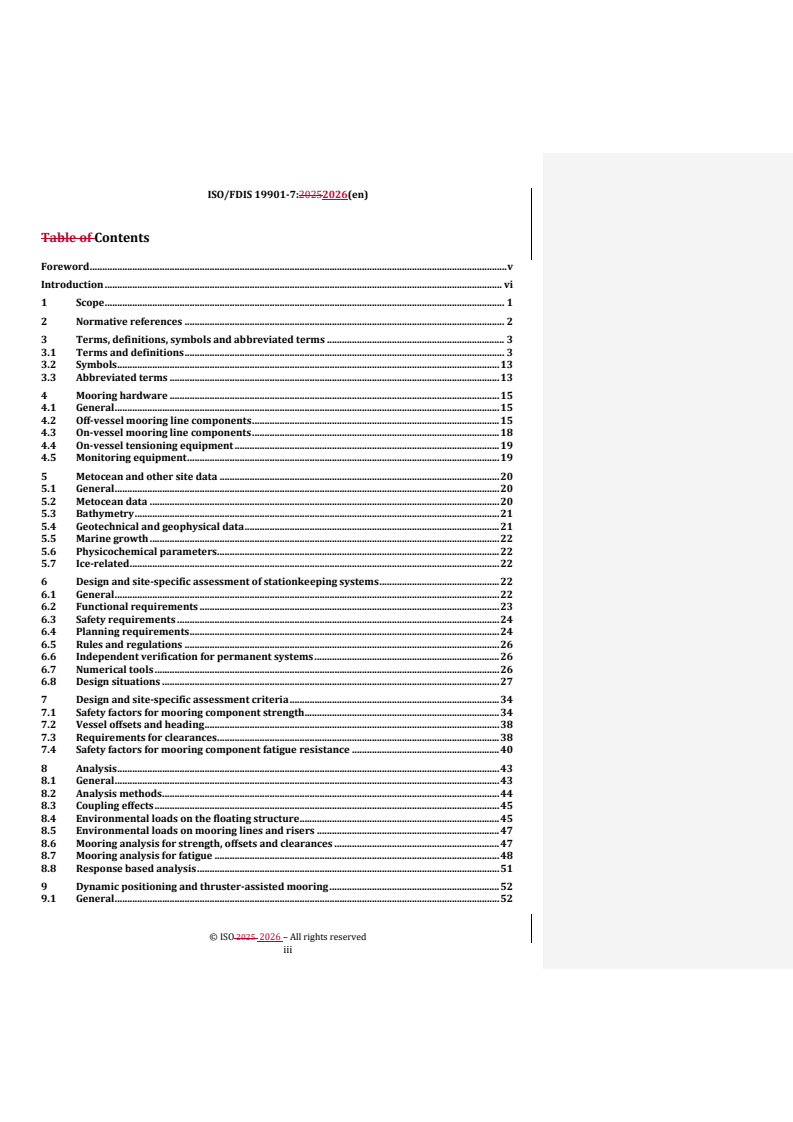
Table of Contents
Foreword . v
Introduction . vi
1 Scope . 1
2 Normative references . 2
3 Terms, definitions, symbols and abbreviated terms . 3
3.1 Terms and definitions . 3
3.2 Symbols . 13
3.3 Abbreviated terms . 13
4 Mooring hardware . 15
4.1 General . 15
4.2 Off-vessel mooring line components . 15
4.3 On-vessel mooring line components . 18
4.4 On-vessel tensioning equipment . 19
4.5 Monitoring equipment . 19
5 Metocean and other site data . 20
5.1 General . 20
5.2 Metocean data . 20
5.3 Bathymetry . 21
5.4 Geotechnical and geophysical data . 21
5.5 Marine growth . 22
5.6 Physicochemical parameters . 22
5.7 Ice-related . 22
6 Design and site-specific assessment of stationkeeping systems . 22
6.1 General . 22
6.2 Functional requirements . 23
6.3 Safety requirements . 24
6.4 Planning requirements . 24
6.5 Rules and regulations . 26
6.6 Independent verification for permanent systems . 26
6.7 Numerical tools . 26
6.8 Design situations . 27
7 Design and site-specific assessment criteria . 34
7.1 Safety factors for mooring component strength . 34
7.2 Vessel offsets and heading . 38
7.3 Requirements for clearances . 38
7.4 Safety factors for mooring component fatigue resistance . 40
8 Analysis . 43
8.1 General . 43
8.2 Analysis methods . 44
8.3 Coupling effects . 45
8.4 Environmental loads on the floating structure . 45
8.5 Environmental loads on mooring lines and risers . 47
8.6 Mooring analysis for strength, offsets and clearances . 47
8.7 Mooring analysis for fatigue . 48
8.8 Response based analysis . 51
9 Dynamic positioning and thruster-assisted mooring . 52
9.1 General . 52
iii
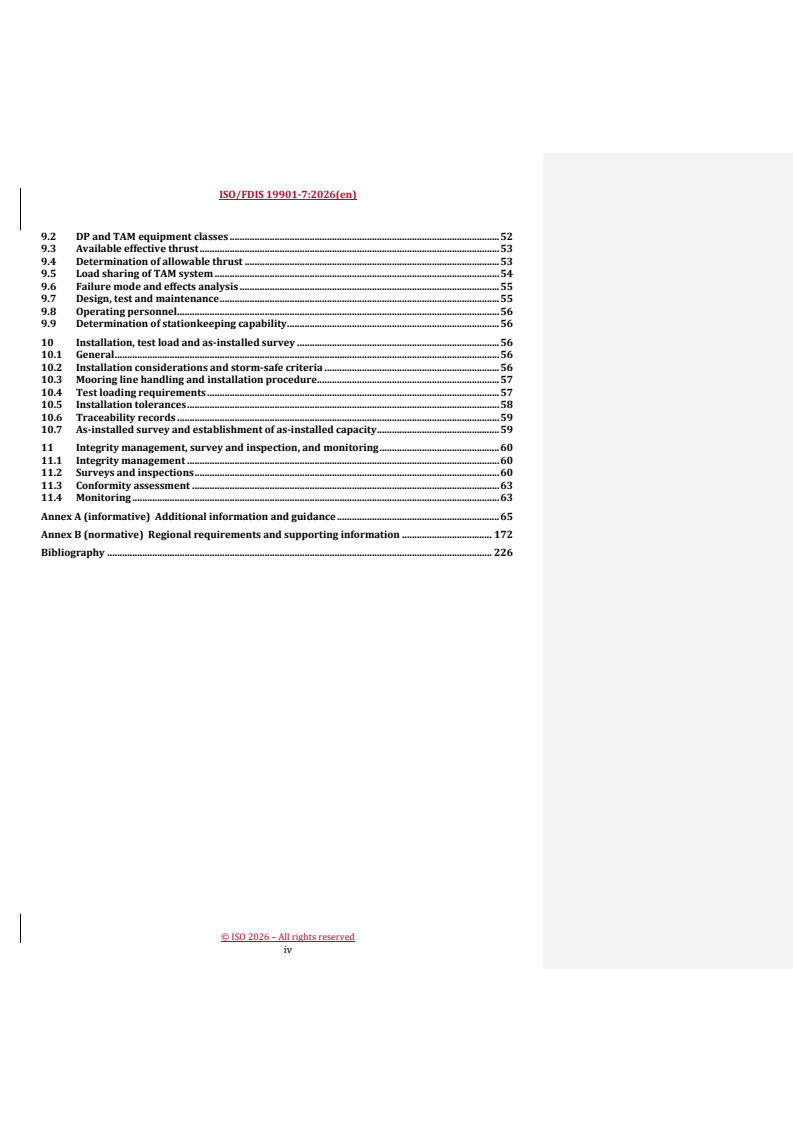
9.2 DP and TAM equipment classes . 52
9.3 Available effective thrust . 53
9.4 Determination of allowable thrust . 53
9.5 Load sharing of TAM system . 54
9.6 Failure mode and effects analysis . 55
9.7 Design, test and maintenance . 55
9.8 Operating personnel . 56
9.9 Determination of stationkeeping capability . 56
10 Installation, test load and as-installed survey . 56
10.1 General . 56
10.2 Installation considerations and storm-safe criteria . 56
10.3 Mooring line handling and installation procedure. 57
10.4 Test loading requirements . 57
10.5 Installation tolerances . 58
10.6 Traceability records . 59
10.7 As-installed survey and establishment of as-installed capacity . 59
11 Integrity management, survey and inspection, and monitoring . 60
11.1 Integrity management . 60
11.2 Surveys and inspections . 60
11.3 Conformity assessment . 63
11.4 Monitoring . 63
Annex A (informative) Additional information and guidance . 65
Annex B (normative) Regional requirements and supporting information . 172
Bibliography . 226
iv
Foreword
ISO (the International Organization for Standardization) is a worldwide federation of national standards
bodies (ISO member bodies). The work of preparing International Standards is normally carried out through
ISO technical committees. Each member body interested in a subject for which a technical committee has been
established has the right to be represented on that committee. International organizations, governmental and
non-governmental, in liaison with ISO, also take part in the work. ISO collaborates closely with the
International Electrotechnical Commission (IEC) on all matters of electrotechnical standardization.
The procedures used to develop this document and those intended for its further maintenance are described
in the ISO/IEC Directives, Part 1. In particular, the different approval criteria needed for the different types of
ISO documentsdocument should be noted. This document was drafted in accordance with the editorial rules
of the ISO/IEC Directives, Part 2 (see www.iso.org/directives).
ISO draws attention to the possibility that the implementation of this document may involve the use of (a)
patent(s). ISO takes no position concerning the evidence, validity or applicability of any claimed patent rights
in respect thereof. As of the date of publication of this document, ISO had not received notice of (a) patent(s)
which may be required to implement this document. However, implementers are cautioned that this may not
represent the latest information, which may be obtained from the patent database available at
www.iso.org/patents. ISO shall not be held responsible for identifying any or all such patent rights.
Any trade name used in this document is information given for the convenience of users and does not
constitute an endorsement.
For an explanation of the voluntary nature of standards, the meaning of ISO specific terms and expressions
related to conformity assessment, as well as information about ISO's adherence to the World Trade
Organization (WTO) principles in the Technical Barriers to Trade (TBT), see www.iso.org/iso/foreword.html.
This document was prepared by Technical Committee ISO/TC 67, Oil and gas industries including lower carbon
energy, Subcommittee SC 7, Offshore structures., in collaboration with the European Committee for
Standardization (CEN) Technical Committee CEN/TC 12, Oil and gas industries including lower carbon energy,
in accordance with the Agreement on technical cooperation between ISO and CEN (Vienna Agreement).
This third edition cancels and replaces the second edition (ISO 19901-7:2013), which has been technically
revised.
The main changes are as follows:
— — addition of requirements for a mooring integrity management system;
— — emphasis on the definition of the operator's expectations on the performance standard;
— — inclusion of fibre ropes as a standard material such as chain and steel wire ropes;
— — alignment of text relating to the geotechnical design of anchors with ISO 19901-4;
— — inclusion of guidance on OPB (out of plane bending) fatigue and squall design cases.
A list of all parts in the ISO 19901 series can be found on the ISO website.
Any feedback or questions on this document should be directed to the user’s national standards body. A
complete listing of these bodies can be found at www.iso.org/members.html.
v
Introduction
The International Standards on offshore structures prepared by TC 67 (i.e.,. ISO 19900, the ISO 19901 series,
ISO 19902, ISO 19903, ISO 19904-1, the ISO 19905 series, ISO 19906) constitute a common basis covering
those aspects that address design requirements and assessments of offshore structures used by the oil and
gas industries worldwide. The intention in their application is to achieve reliability levels appropriate for
manned and unmanned offshore structures, irrespective type of structure and the nature or combination of
materials used.
It is important to recognize that structural integrity is a concept comprised of models that describe actions,
structural analyses, design rules, safety elements, workmanship, quality control procedures and national
requirements, all of which are mutually dependent. The modification of one aspect of design in isolation can
disturb the balance of reliability inherent in the overall design or structural system. The implications involved
in modifications therefore should be considered in relation to the overall reliability of all offshore structural
systems.
The International Standards on offshore structures prepared by TC 67 are intended to provide a wide breadth
of choice for structural configurations, materials and techniques without hindering innovation. Informed
engineering judgement is therefore necessary in the use of these International Standards.
This document was developed in response to the worldwide offshore industry’s demand for a coherent and
consistent definition of methodologies to analyse, design and evaluate stationkeeping systems used for
floating energy production platforms (with and without storage) of various types (e.g. semi-submersibles,
spar platforms, ship-shaped structures) and to assess site-specific applications of mobile offshore units (such
as mobile offshore drilling units and flotels) and construction units (such as heavy lift vessels and pipelay
units).
This document assumes that permanently moored hydrocarbon production systems, that are equipped with
stationkeeping systems as a minimum have the ability to both shut-in wells and the facility in case of
emergency (e.g.,. emergency shut-down valves on the seabed), otherwise the consequence of mooring failure
can be significantly different.
Stationkeeping is a generic term covering systems for keeping a floating structure, which is under the constant
influence of external actions, either at a pre-defined location or at a pre-defined heading or both with limited
excursions. Stationkeeping systems resist external actions by means of any of the following:
— — mooring systems (e.g. spread mooring systems or single point mooring systems);
— — dynamic positioning systems (generally consisting of thrusters)
— — a combination of mooring system and thrusters (thruster assisted mooring systems).
The external actions generally consist of wind, wave, current and ice actions on the floating structure, mooring
and risers.
The procedures for the design of permanent or site-specific assessment of mobile mooring systems specified
in this document are based on a deterministic approach where mooring system responses (such as line
tensions, vessel offsets, and anchor loads) are evaluated for a design environment defined by an annual
probability of exceedance or return period. Mooring system responses are then checked against specified
requirements for mooring strength, offsets and orientation, clearances, anchor capacity, fatigue resistance,
etc. The minimum specified requirements are either defined either in this document or by the operator if more
stringent.
NOTE 1 Stationkeeping systems designed based on this deterministic approach can have differing levels of reliability.
vi
For moored structures (vessels), system responses are calculated and compared to minimum specified
requirements for:
— — Ultimate limit states (ULS): mooring component strength. Vessel offset, orientation, and clearance
constraints. Herein the ULS includes both intact and single failure condition for stationkeeping systems.
— — Serviceability limit states (SLS): vessel offset, orientation, and clearance constraints. For mooring
components this includes clearances with the vessel, risers, umbilicals, seabed, water surface, field
infrastructure, exclusion zones, etc.
— — Fatigue limit states (FLS) : cumulative mooring component fatigue damage.
— — Accidental and abnormal limit state (ALS): no criteria are given for accidental or abnormal limit state
which are left to operator decision or local authorities requirements.
The methodology described in this document identifies a set of coherent analysis techniques that, combined
with an understanding of the site-specific metocean conditions, the characteristics of the floating structure
under consideration, and other factors, can be used to determine the adequacy of the stationkeeping system
to meet the functional requirements specified in this document.
Descriptions of characteristics and typical components found in these systems are given in Annex AAnnex A.
Some background to, and guidance on, the use of this document is provided in Annex AAnnex A. The clause
numbering in Annex AAnnex A is the same as in the main text to facilitate cross-referencing.
Regional information, where available, is provided in Annex BAnnex B.
vii
DRAFT International Standard ISO/FDIS 19901-7:2025(en)
Oil and gas industries including lower carbon energy — Specific
requirements for offshore structures —
Part 7:
Stationkeeping systems for floating offshore structures and mobile
offshore units
1 Scope
This document specifies methodologies for:
a) a) the design, analysis and evaluation of stationkeeping systems for floating offshore structures.
b) b) the assessment of stationkeeping systems for site-specific applications of mobile offshore units
and construction units.
Originally developed for floating structures used in the oil and gas industry, this document is now also used in
the renewable energy sector. The extent of application of this standard to floating structures used in other
[10][10]
industries is at the discretion of the relevant standard entity and its users. For example, IEC 61400-3-2
for floating wind applies this document to determine stationkeeping system responses while incorporating its
own load conditions, safety factors, and environmental return periods.
This document is applicable to the following types of stationkeeping systems, which are either covered directly
in this document or through reference to other guidelines:
— — spread mooring systems,
— — single point mooring systems
— — dynamic positioning systems,
— — thruster-assisted mooring systems.
This document is not applicable to:
— — stationkeeping systems which do not have redundancy against failure of any single component, e.g.,
single anchor leg moorings (SALMs);
— — stationkeeping systems which use any means other than mooring lines or thrusters such as tower soft
yoke systems, or tension leg platforms (TLPs) that use tendons.
The requirements for this document address spread mooring systems and single point mooring systems with
mooring lines composed of steel chain, steel wire or synthetic fibre rope.
This document is applicable to all aspects of the life cycle of mooring systems. It includes requirements relating
to the selection of mooring components, mooring system configuration and performance, components design,
installation, post-installation survey, and as-installed assessments as needed for mooring integrity
management.
For mooring systems deployed in ice-prone environments, additional requirements in ISO 19906 apply.
2 Normative references
The following documents are referred to in the text in such a way that some or all of their content constitutes
requirements of this document. For dated references, only the edition cited applies. For undated references,
the latest edition of the referenced document (including any amendments) applies.
ISO 18692--1, Fibre ropes for offshore stationkeeping — Part 1: General specification
ISO 19900, Petroleum and natural gas industries — General requirements for offshore structures
ISO 19901-1, Petroleum and natural gas industries — Specific requirements for offshore structures — Part 1:
Metocean design and operating considerations
ISO 19901-4, Oil and gas industries including lower carbon energy — Specific requirements for offshore
structures — Part 4: Geotechnical design considerations
ISO 19901-6, Petroleum and natural gas industries — Specific requirements for offshore structures — Part 6:
Marine operations
ISO 19901--8, Oil and gas industries including lower carbon energy — Specific requirements for offshoreOffshore
structures — Part 8: Marine soil investigations
ISO 19901-10, Petroleum and natural gas industries — Specific requirements for offshore structures — Part 10:
Marine geophysical investigations
ISO 19904--1, Petroleum and natural gas industries — Floating offshore structures — Part 1: Ship-shaped, semi-
submersible, spar and shallow-draught cylindrical structures
ISO 19905--3, Petroleum and natural gas industries — Site-specific assessment of mobile offshore units — Part
3: Floating units
ISO 19906, Petroleum and natural gas industries — Arctic offshore structures
ISO 20438, Ships and marine technology — Offshore mooring chains
ISO 31000, Risk management — Guidelines
IMO MSC.1/Circ.1580, Guidelines for vessels and units with dynamic positioning (DP) systems, International
Maritime Organization, 16 June 2017
IACS Unified Requirement UR W22 — Offshore mooring chains, International Association of Classification.
Societies
API RP 2I, In-service inspection of mooring hardware for floating structures, American Petroleum Institute
API RP 2MIM, Mooring Integrity Management, American Petroleum Institute
API SPEC 9A, Specification for wire rope, American Petroleum Institute
ASME Section VIII, Division 1 Boiler and Pressure Vessel Code — Rules for Construction of Pressure Vessels,
American Society of Mechanical Engineers
DNV-OS-E301:2024, Position mooring, DNV Offshore Standard
DNV-RP-E301:2021, Design and installation of fluke anchors, DNV Recommended Practice
DNV-RP-E302:2021, Design and installation of plate anchors in clay, DNV Recommended Practice,
DNV-RP-E303:2021, Geotechnical design and installation of suction anchors in clay, DNV Recommended Practice
MTS, DP operations guidance, Marine Technology Society
NORSOK N-003: 2017, Action and action effects
3 Terms, definitions, symbols and abbreviated terms
3.1 Terms and definitions
For the purposes of this document, the following terms and definitions apply.
ISO and IEC maintain terminology databases for use in standardization at the following addresses:
— — ISO Online browsing platform: available at https://www.iso.org/obp
— — IEC Electropedia: available at https://www.electropedia.org/
3.1.1 3.1.1
action
external load applied to the structure (3.1.59(3.1.60)) (direct action) or an imposed deformation or
acceleration (indirect action)
EXAMPLE An imposed deformation can be caused by fabrication tolerances, settlement, temperature change or
moisture variation. An imposed acceleration can be caused by an earthquake
[SOURCE: ISO 19900:2019, 3.3]
3.1.2 3.1.2
action effect
result of actions (3.1.1(3.1.1)) on a structural component (3.1.57(3.1.58)) (e.g. internal force, moment, stress,
strain) or on the structure (3.1.59(3.1.60)) (e.g. deflection, rotation)
[SOURCE: ISO 19900:2019, 3.4]
3.1.3 3.1.3
active stationkeeping system
stationkeeping system (3.1.55(3.1.56)) that make use of dynamic positioning (3.1.15(3.1.16),), thruster
assistance, line length or pretension adjustments, planned changes in vessel draught, winching (kedging) off
location, or disconnection, as opposed to a passive mooring system (3.1.34(3.1.35))
3.1.4 3.1.4
catenary mooring system
mooring system (3.1.30(3.1.31)) where the restoring action (3.1.1(3.1.1)) is provided by both distributed
weight and strain deformation of mooring lines (3.1.29(3.1.30))
3.1.5 3.1.5
close proximity
when any part of another surface facility lies within a contour described by the set of offsets coinciding with
each mooring line (3.1.29(3.1.30)) reaching 100 % minimum break strength (3.1.24(3.1.25)) in the intact or
redundancy (3.1.37(3.1.38)) check condition, whichever is larger
3.1.6 3.1.6
clump weight
heavy component typically used in shallow water where the restoring of a chain-only catenary mooring system
(3.1.4(3.1.4)) is not sufficient to meet the specified offsets
Note 1 to entry: These components are generally fastened to a large diameter chain segment.
Note 2 to entry: This segment is usually around the touch down zone or on the seabed.
3.1.7 3.1.7
common mode failure
failures of similar components on different mooring lines (3.1.29(3.1.30)) resulting from the same direct cause,
where these failures are not consequences of each other
Note 1 to entry: The potential for common mode failures reduces the effectiveness of system redundancy (3.1.37.).
Note 2 to entry: It is generally accepted that the failures occur simultaneously or within a short time of each other.
3.1.8 3.1.8
cyclic action
repetitive environmental action (3.1.1(3.1.1)) that can cause cumulative damage of the structure
(3.1.59(3.1.59),), structural component (3.1.57(3.1.57),), or resistance (3.1.39(3.1.39)) of materials including
soils
Note 1 to entry: cyclic action causes no significant acceleration of the structure or structural members.
3.1.9 3.1.9
damaged condition
state of the stationkeeping system (3.1.55(3.1.55)) with a weakened or missing mooring line (3.1.29(3.1.29))
or a failure of the thruster system or a combination of both
Note 1 to entry: A missing line can have either failed or been weakened by external damage (e.g., cut in synthetic ropes
or corroded chain) or been removed for maintenance (3.1.23) or inspection.
Note 2 to entry: A total or partial loss of a buoyancy or weight element is also a damaged condition.
Note 3 to entry: For thruster assisted mooring systems (3.1.30,), the damaged condition includes the most critical case
with one leg damaged or the single worst failure of the integrated thruster control system as identified by the failure
mode (3.1.18) and effect analysis.
3.1.10 3.1.10
degradation mechanism
time-based physical or chemical mechanism or process resulting in reduced functionality or capacity
EXAMPLE Corrosion, wear, fatigue.
3.1.11 3.1.11
design criteria
quantitative formulations that describe the conditions to be fulfilled for each design situation (3.1.13(3.1.13))
3.1.12 3.1.12
design service life
design life
planned period for which a structure (3.1.59(3.1.59)) is used for its intended purpose with anticipated
maintenance (3.1.23(3.1.23),), but without substantial repair being necessary
3.1.13 3.1.13
design situation
design condition
set of physical conditions for which the structure (3.1.59(3.1.59)) or its components are verified
EXAMPLE A defined combination of one environmental condition, one vessel loading condition, one water depth,
riser (3.1.41) configuration, intact or one-line missing
[SOURCE: ISO 19900/DIS:2025:2019, 3.1816, modified — ExampleThe preferred term has been changed from
"design/assessment situation" to "design situation"; the admitted term "design condition" has been added];
EXAMPLE has been added.]
3.1.14 3.1.14
dynamic action
external action (3.1.1(3.1.1)) that induces acceleration of a structural component (3.1.57(3.1.57),), normally
specified by a spectrum and associated parameters for wind and waves or by time series of wind speed and
direction for squalls (3.1.54(3.1.54))
3.1.15 3.1.15
dynamic positioning
DP
stationkeeping technique consisting primarily of a system of automatically controlled on-board thrusters,
which generate appropriate thrust vectors to counter the mean and slowly varying induced actions
(3.1.1(3.1.1))
[SOURCE: ISO 19904-1:2019, 3.17, modified — "automatically controlled" has been added.]
3.1.16 3.1.16
end-of-life break strength
ELBS
break strength of a mooring component (3.1.28(3.1.28)) at the end of the design service life (3.1.12(3.1.11))
that accounts for the reduction of minimum break strength (3.1.24(3.1.24)) due to degradation during service
3.1.17 3.1.17
expected value
first-order statistical moment of the probability density function for the considered variable that, in the case
of a time-dependent parameter, can be associated with a specific reference period
3.1.18 3.1.18
failure mode
manifestation of loss of functionality of a mooring component (3.1.28(3.1.28)) and manner by which a failure
is observed
3.1.19 3.1.19
fitness-for-service assessment
engineering evaluations to demonstrate that a structure (3.1.59(3.1.59)) or a structural component
(3.1.57(3.1.57)) which deviates from its design basis fulfills defined structural integrity (3.1.58(3.1.58)) and
performance requirements
Note 1 to entry: Deviations can include deterioration or damage, life extension, and other changes and modifications to
the structure or to the design basis.
[SOURCE: ISO 19900:2019, 3.23, modified — with ISO 19900/DIS:2025, 3.27 definition of—"is fit-for-service
incorporated]" has been replaced by "fulfills defined structural integrity and performance requirements".]
3.1.20 3.1.20
floating structure
floating facility
floating unit
ship
vessel
structure (3.1.59(3.1.59)) where the full weight is supported by buoyancy
Note 1 to entry: The full weight includes lightship weight, mooring system (3.1.30) pre-tension, riser (3.1.41) pre-tension,
operating weight, etc.
Note 2 to entry: this definition encompasses any structure using permanent or mobile mooring systems (3.1.25.).
Sometimes shortened to structure.
[SOURCE: ISO 19900:2019, 3.25, modified — Note 1 to entry hasThe abbreviated terms have been added.];
notes 1 and 2 to entry have been added.]
3.1.21 3.1.21
integrated thruster control system
ITCS
complete propulsion system consisting of thrusters, and control, power generation and distribution systems
3.1.22 3.1.22
limit state
state beyond which the structure (3.1.59(3.1.59)) or structural component (3.1.57(3.1.57)) no longer satisfies
the design criteria (3.1.11(3.1.11))
[SOURCE: ISO 19900:2019, 3.31]
3.1.23 3.1.23
maintenance
combination of all technical, administrative and managerial tasks during the life of a facility, intended to retain
it in, or restore it to, a state in which it can perform the required function
[SOURCE: ISO 50007:2017, 3.21, modified — ‘tasks’ replaces ‘actions’; actions are defined in 3.1.1 to have a
different meaning in this document]"actions" has been replaced by "tasks"; "asset" has been replaced by
"facility".]
3.1.24 3.1.24
minimum break strength
MBS
minimum break load
MBL
break test load
BTL
catalogue break strength
CBS
hardware component’s certified break strength meeting requirements of an industry standard
3.1.25 3.1.25
mobile mooring system
mooring system (3.1.30(3.1.30),), generally retrievable, intended for deployment at a specific location for a
short-term operation, such as those for mobile offshore units (3.1.27(3.1.27))
Note 1 to entry: Some components of a mobile mooring system can be irretrievable and thus are designed following the
requirements for a permanent mooring system (3.1.35.).
Note 2 to entry: Mobile mooring systems that cannot follow the nominal inspection schedule are categorised as
permanent mooring systems.
3.1.26 3.1.26
mobile offshore drilling unit
MODU
mobile offshore unit (3.1.27(3.1.27)) capable of engaging in drilling and well intervention operations for
exploration or exploitation of subseafloor energy related fluid and gas resources
3.1.27 3.1.27
mobile offshore unit
MOU
offshore structure (3.1.59(3.1.59)) intended to be frequently relocated to perform a particular function
EXAMPLE Pipelaying vessel or barge, offshore construction structure, accommodation structure (flotel), service
structure, or mobile offshore drilling units (3.1.26.).
Note 1 to entry: Those units can be either in operating condition (when intended operation is ongoing), in standby
condition (when intended operation is temporarily stopped) or in survival condition (when intended operation is
stopped and unit is not adjacent to another unit).
[SOURCE: ISO 19904-1:2019, 3.33, modified — In the definition, "offshore" and "frequently" have been added;
EXAMPLE and note 1 to entry hashave been added.]
3.1.28 3.1.28
mooring component
component used in the mooring of floating structures (3.1.20(3.1.20))
EXAMPLE Chain, steel wire rope, synthetic fibre rope, connector, clump weight (3.1.6,), buoy, winch, windlass,
fairlead or anchor.
3.1.29 3.1.29
mooring line
mooring leg
anchor leg
assembly of connected mooring components (3.1.28,), including the anchor up to and including the weld (or
bolted joint) connecting the on-vessel mooring equipment to the floating structure (3.1.20(3.1.20))
3.1.30 3.1.30
mooring system
stationkeeping system (3.1.55(3.1.55)) consisting of one or more mooring lines (3.1.29(3.1.29),), including
their associated on-vessel mooring equipment
3.1.31 3.1.31
natural frequency
frequency at which a mechanical oscillator has its maximum response when subjected to a white noise
excitation
3.1.32 3.1.32
natural period
period at which a mechanical oscillator has its maximum response when subjected to a white noise excitation
3.1.33 3.1.33
operator
representative of the company or companies leasing the site
Note 1 to entry: The operator is normally the energy company acting on behalf of co-licensees.
Note 2 to entry: The operator can be termed the owner or the duty holder.
Note 3 to entry: Operator is the entity responsible for the definition of the design basis for the stationkeeping system
(3.1.55.).
EXAMPLE The operator owns the development while the MODU is owned by the drilling contractor.
[SOURCE: ISO 19900:2019, 3.35, modified — NoteIn note 1 to entry, "oil company" has been replaced by
"energy company"; note 3 to entry and exampleEXAMPLE have been added]
3.1.34 3.1.34
passive mooring system
mooring system (3.1.30(3.1.30)) that responds to changes in floating structure (3.1.20(3.1.20)) draught, trim,
and environmental actions without any intervention or adjustment of the mooring lines (3.1.29(3.1.29),), and
does not use thrusters
3.1.35 3.1.35
permanent mooring systemssystem
mooring system (3.1.30(3.1.30)) normally used to moor floating structures (3.1.20(3.1.20)) deployed for long-
term operations, such as those for a floating production system
3.1.36 3.1.36
recognized classification society
RCS
member of the international association of classification societies (IACS), with established rules and
procedures for classification and certification of floating structures (3.1.20(3.1.20)) used in energy activities,
located at a specific site, for an extended period of time
[SOURCE: ISO 19900/DIS:2025, 3.45]
3.1.37 3.1.37
redundancy
ability of the structure (3.1.59(3.1.59)) to find alternative load paths following structural failure of one or more
components, thus limiting the consequences of such failures
[SOURCE: ISO 19902:2020, 3.38, modified — Note 1 to entry has been removed.]
3.1.38 3.1.38
representative value
value assigned to a basic variable for limit state (3.1.22(3.1.22) )verification (3.1.66) in a design situation
(3.1.13(3.1.13))
EXAMPLE Representative strength or representative excursions are typical variables used in limit state
verifications.
[SOURCE: ISO 19900/DIS:2025, 3.48, modified — Note 1 to entry has been removed.]
3.1.39 3.1.39
resistance
ability of a structure (3.1.59(3.1.59),), or a structural component (3.1.57(3.1.57),), to withstand action effects
(3.1.2(3.1.2) )
[SOURCE: ISO 19900:2019, 3.41]
3.1.40 3.1.40
return period
average period between occurrences of an event being exceeded
Note 1 to entry: The offshore industry commonly uses a return period measured in years for environmental events. The
return period is equal to the reciprocal of the annual probability of exceedance of the event.
Note 2 to entry: For the purpose of this definition, events include both discrete hazardous events as well as exceedances
of a threshold value of a relevant variable.
[SOURCE: ISO 19900:2019, 3.42], modified — The words "being exceeded" have been added.]
3.1.41 3.1.41
riser
piping connecting the process facilities or drilling equipment on the floating structure (3.1.20) with the subsea
facilities or pipelines, or with a reservoir
Note 1 to entry: Possible functions include drilling and well intervention, production, injection, subsea systems control
and export of produced fluids.
Note 2 to entry: Risers are meant to include a single (drilling) riser, multiple risers or umbilicals.
[SOURCE: ISO 19904-1:2019, 3.44, modified — Note 2 to entry has been added.]
3.1.42 3.1.42
risk assessment
overall process of risk identification, risk analysis and risk evaluation
[SOURCE: ISO 31073:2022, 3.3.8]
3.1.43 3.1.43
robustness
ability of a structure (3.1.59(3.1.59)) to withstand hazardous events without being damaged to an extent
disproportionate to the cause
[SOURCE: ISO 19900:2019, 3.44]
3.1.44 3.1.44
safety factor
value of the design resistance (3.1.39(3.1.39)) divided by the total design action (3.1.1(3.1.1))
EXAMPLE For the assessment of mooring line (3.1.29) strength, the safety factor is the representative strength
divided by the characteristic load. For fatigue assessment, the safety factor is 1 divided by the representative cumulative
fatigue damage during the design service life (3.1.12.).
3.1.45 3.1.45
sea state
condition of the sea during a period in which its statistics remain approximately stationary
Note 1 to entry: In a statistical sense the sea state does not change markedly within the period. The period during which
the condition exists is often assumed to be three hours, although it depends on the particular weather situation at any
given time.
[SOURCE: ISO 19901-1:2015, 3.31]
3.1.46 3.1.46
semi-submersible
floating structure (3.1.20(3.1.20)) normally consisting of a deck structure (3.1.59(3.1.59)) with, typically, three
or more widely spaced, large cross-section, supporting columns connected to submerged pontoons
Note 1 to entry: Pontoon/column geometry is usually chosen to reduce global motions in a broad range of wave
frequencies.
[SOURCE: ISO 19904-1:2019, 3.46]
3.1.47 3.1.47
serviceability
ability of a structure (3.1.59(3.1.59)) or structural component (3.1.57(3.1.57)) to perform adequately underfor
a normal use under all expected actions
[SOURCE: ISO 2394:2015, 2.1.32] , modified — The words "structural member" have been replaced by
"structural component".]
3.1.48 3.1.48
significant value
statistical measure of a zero-mean random variable equal to the mean of the one third highest extrema during
...
PROJET
Norme
internationale
ISO/DIS 19901-7
ISO/TC 67/SC 7
Industries du pétrole et du gaz, y
Secrétariat: BSI
compris les énergies à faible teneur
Début de vote:
en carbone — Exigences spécifiques
2024-10-16
relatives aux structures en mer —
Vote clos le:
2025-01-08
Partie 7:
Systèmes de maintien en position
des structures en mer flottantes et
des unités mobiles en mer
Oil and gas industries including lower carbon energy — Specific
requirements for offshore structures —
Part 7: Station-keeping systems for floating offshore structures
and mobile offshore units
ICS: 75.180.10
CE DOCUMENT EST UN PROJET DIFFUSÉ
POUR OBSERVATIONS ET APPROBATION. IL
EST DONC SUSCEPTIBLE DE MODIFICATION
ET NE PEUT ÊTRE CITÉ COMME NORME
INTERNATIONALE AVANT SA PUBLICATION EN
TANT QUE TELLE.
Le présent document est distribué tel qu’il est parvenu du secrétariat
du comité. OUTRE LE FAIT D’ÊTRE EXAMINÉS POUR
ÉTABLIR S’ILS SONT ACCEPTABLES À DES
FINS INDUSTRIELLES, TECHNOLOGIQUES ET
COMMERCIALES, AINSI QUE DU POINT DE VUE
DES UTILISATEURS, LES PROJETS DE NORMES
INTERNATIONALES DOIVENT PARFOIS ÊTRE
TRAITEMENT PARALLÈLE ISO/CEN
CONSIDÉRÉS DU POINT DE VUE DE LEUR
POSSIBILITÉ DE DEVENIR DES NORMES
POUVANT SERVIR DE RÉFÉRENCE DANS LA
RÉGLEMENTATION NATIONALE.
LES DESTINATAIRES DU PRÉSENT PROJET
SONT INVITÉS À PRÉSENTER, AVEC LEURS
OBSERVATIONS, NOTIFICATION DES DROITS
DE PROPRIÉTÉ DONT ILS AURAIENT
ÉVENTUELLEMENT CONNAISSANCE
ET À FOURNIR UNE DOCUMENTATION
EXPLICATIVE.
Numéro de référence
ISO/DIS 19901-7:2024(fr)
ISO/DIS 19901-7:2024(fr)
ISO/TC 67/SC 7
Date : 2024-08-20
ISO/DIS19901‐7:2024(F)
ISO/TC 67/SC 7
Secrétariat : BSI
Industriesdupétroleetdugaz,ycomprislesénergiesàfaibleteneur
encarbone—Exigencesspécifiquesrelativesauxstructuresenmer—
Partie7:Systèmesdemaintienenpositiondesstructuresenmer
flottantesetdesunitésmobilesenmer
Oilandgasindustriesincludinglowercarbonenergy—Specificrequirementsforoffshorestructures—
Part7:Station‐keepingsystemsforfloatingoffshorestructuresandmobileoffshoreunits
Avertissement
Ce document n'est pas une Norme internationale de l'ISO. Il est distribué pour examen et observations.
Il est susceptible de modification sans préavis et ne peut être cité comme Norme internationale.
Les destinataires du présent projet sont invités à présenter, avec leurs observations, notification des
droits de propriété dont ils auraient éventuellement connaissance et à fournir une documentation
explicative.
DOCUMENT PROTÉGÉ PAR COPYRIGHT
© ISO 2024
Tous droits réservés. Sauf prescription différente ou nécessité dans le contexte de sa mise en œuvre, aucune partie de cette
publication ne peut être reproduite ni utilisée sous quelque forme que ce soit et par aucun procédé, électronique ou mécanique,
y compris la photocopie, ou la diffusion sur l’internet ou sur un intranet, sans autorisation écrite préalable. Une autorisation peut
être demandée à l’ISO à l’adresse ci-après ou au comité membre de l’ISO dans le pays du demandeur.
ISO copyright office
Case postale 401 • Ch. de Blandonnet 8
CH-1214 Vernier, Genève
Tél.: +41 22 749 01 11
Type du document : Projet de Norme internationale
E-mail: copyright@iso.org
Sous-type du document :
Web: www.iso.org
Stade du document : (40) Enquête
Publié en Suisse
Langue du document : F
ii
ISO/DIS 19901‐7:2024(fr)
Sommaire Page
Avant‐propos . vii
Introduction . ix
Domaine d'application . .1
Références normatives .3
Termes, définitions, symboles et abréviations. 4
3.1 Termes et définitions . 4
3.2 Symboles . 13
3.3 Abréviations . 14
4 Matériel d'ancrage . 16
4.1 Généralités . 16
4.2 Composants des lignes d'ancrage hors du navire . 17
4.2.1 Ancres . 17
4.2.2 Chaîne . 17
4.2.3 Cordage en fibres . 18
4.2.4 Câble en acier . 18
4.2.5 Matériel de jonction . 18
4.2.6 Bouées . 19
4.2.7 Crapauds . 19
4.2.8 Connecteurs d'ancrage . 19
4.2.9 Connecteurs rapides . 19
4.2.10 Bouée à tourelle déconnectable . 20
4.3 Composants des lignes d'ancrage à bord du navire . 20
4.3.1 Chaumards . 20
4.3.2 Sabots de flexion . 20
4.3.3 Arrêts de chaîne . 20
4.3.4 Jonctions universelles . 21
4.3.5 Tourelle. 21
4.4 Équipement de tension à bord du navire . 21
4.5 Équipement de surveillance . 22
4.5.1 Généralités . 22
4.5.2 Tension des lignes/mouvement libre des lignes . 22
4.5.3 Position et cap de la structure flottante . 22
5 Données océano‐météorologiques et autres données relatives au site . 23
5.1 Généralités . 23
5.2 Données océano‐météorologiques . 23
5.2.1 Données relatives aux vagues . 23
5.2.2 Données relatives au vent . 23
5.2.3 Données actuelles . 23
5.3 Bathymétrie . 24
5.4 Données géotechniques et géophysiques . 24
5.5 Concrétions marines . 25
iii
ISO/DIS 19901‐7:2024(fr)
5.6 Paramètres physico‐chimiques . 25
5.7 Paramètres en rapport avec la glace . 25
6 Conception et évaluation des systèmes de maintien en position . 25
6.1 Exigences fondamentales . 25
6.2 Exigences fonctionnelles . 25
6.3 Exigences de sécurité . 27
6.4 Exigences de planification . 27
6.4.1 Généralités . 27
6.4.2 Base de conception . 28
6.4.3 Pratiques de conception . 28
6.4.4 Considérations relatives à l'installation au stade de la conception . 28
6.4.5 Stratégie de gestion de l'intégrité . 29
6.5 Règles et réglementations. 29
6.6 Vérification indépendante des systèmes permanents . 30
6.7 Outils numériques . 30
6.8 Conditions de calcul . 30
6.8.1 États limites . 30
6.8.2 Cas d'analyse pour l'état limite ultime . 31
6.8.3 Cas d'analyse à l'état limite de service . 35
6.8.4 Cas d'analyse pour l'état limite de fatigue . 35
6.8.5 Cas d'analyse pour l'état limite accidentel . 36
6.8.6 Cas d'analyse pour les phases temporaires . 37
7 Critères d'évaluation de la conception et du site . 38
7.1 Coefficients de sécurité pour la résistance des composants d'ancrage. 38
7.1.1 Tensions de ligne . 38
7.1.2 Coefficients de sécurité des ancres . 40
7.1.3 Coefficients de sécurité pour les éléments de flottabilité . 42
7.2 Déports et cap du navire . 43
7.3 Exigences relatives à l'espacement. 43
7.3.1 Ligne d'ancrage avec le fond marin (zone de marnage) . 43
7.3.2 Ligne d'ancrage et surface de la mer . 44
7.3.3 Ligne d'ancrage et coque . 44
7.3.4 Ligne d'ancrage avec tube prolongateur, ombilical, ligne d'ancrage, conduite, actifs de
fond marin et zones d'exclusion . 45
7.3.5 Bouée à tourelle immergée . 45
7.3.6 Ancre avec ligne d'ancrage, conduite, actifs du fond marin et zones d'exclusion . 45
7.4 Coefficients de sécurité pour la résistance à la fatigue des composants d'ancrage . 46
8 Analyse . 49
8.1 Généralités . 49
8.2 Méthodes d'analyse . 50
8.3 Effets de couplage . 51
8.4 Charges environnementales sur la structure flottante . 51
8.4.1 Forces des vagues . 51
8.4.2 Forces du vent . 52
8.4.3 Forces du courant et VIM . 52
8.5 Charges environnementales sur les lignes d'ancrage et les tubes prolongateurs . 53
8.5.1 Forces des vagues . 53
8.5.2 Forces du courant . 53
iv
ISO/DIS 19901‐7:2024(fr)
8.6 Analyse des ancrages pour la résistance, les déports et les espacements . 53
8.6.1 Considérations de base . 53
8.6.2 Statistiques des valeurs extrêmes . 53
8.6.3 Valeurs de conception pour les réponses aux rafales de vent transitoires . 54
8.6.4 Atténuation des effets de tranchée des lignes d'ancrage . 54
8.7 Analyse des ancrages à la fatigue . 54
8.7.1 Considérations de base . 54
8.7.2 Approche analytique . 55
8.7.3 Méthodes de calcul de l'endommagement dû à la fatigue . 55
8.8 Analyse à base de réponses . 58
9 Positionnement dynamique et ancrage assisté par des propulseurs . 58
9.1 Généralités . 58
9.1.1 Positionnement dynamique (DP) . 59
9.1.2 Ancrage assisté par des propulseurs (TAM) . 59
9.2 Équipement . 59
9.2.1 Équipements de DP et de TAM . 60
9.2.2 Classe d'équipements de DP . 60
9.3 Poussée effective disponible . 61
9.4 Détermination de la poussée admissible . 61
9.5 Répartition des charges du système de TAM . 61
9.5.1 Généralités . 61
9.5.2 Méthode de réduction des charges moyennes . 62
9.5.3 Unités d'évitage . 62
9.5.4 Analyse dynamique du système . 63
9.6 Analyse des modes de défaillance et de leurs effets . 63
9.7 Conception, essai et entretien . 63
9.8 Personnel exploitant . 64
9.9 Détermination de la capacité de maintien en position . 64
10 Installation, charge d'essai et examen en condition installée . 64
10.1 Généralités . 64
10.2 Considérations relatives à l'installation et critères de sécurité en cas de tempête . 65
10.3 Procédure de manipulation et d'installation de la ligne d'ancrage . 65
10.4 Exigences relatives à la charge d'essai . 66
10.4.1 Charge d'essai de l'ancre pour l'ancrage permanent . 66
10.4.2 Charge d'essai de l'ancre pour l'ancrage mobile . 66
10.5 Tolérances d'installation . 67
10.6 Enregistrements relatifs à la traçabilité . 67
10.7 Examen en condition installée et détermination de la capacité en condition installée . 68
11 Gestion de l'intégrité, examen et inspection, surveillance . 69
11.1 Gestion de l'intégrité . 69
11.2 Examens et inspections . 70
11.3 Ancrages mobiles . 71
11.4 Ancrages permanents . 71
11.4.1 Études annuelles . 71
11.4.2 Inspections complètes . 72
11.5 Critères d'évaluation et d'acceptation/de mise au rebut . 73
11.6 Surveillance . 73
Annexe A (informative) Mooring systems . 75
v
ISO/DIS 19901‐7:2024(fr)
Annexe B (informative) Regional information . 174
Bibliographie . 230
vi
ISO/DIS 19901‐7:2024(fr)
Avant‐propos
L'ISO (Organisation internationale de normalisation) est une fédération mondiale d'organismes nationaux
de normalisation (comités membres de l'ISO). L'élaboration des Normes internationales est en général
confiée aux comités techniques de l'ISO. Chaque comité membre intéressé par une étude a le droit de faire
partie du comité technique créé à cet effet. Les organisations internationales, gouvernementales et non
gouvernementales, en liaison avec l'ISO participent également aux travaux. L'ISO collabore étroitement avec
la Commission électrotechnique internationale (IEC) en ce qui concerne la normalisation électrotechnique.
Les procédures utilisées pour élaborer le présent document et celles destinées à sa mise à jour sont décrites
dans les Directives ISO/IEC, Partie 1. Il convient, en particulier, de prendre note des différents critères
d'approbation requis pour les différents types de documents ISO. Le présent document a été rédigé
conformément aux règles de rédaction données dans les Directives ISO/IEC, Partie 2
(voir www.iso.org/directives).
L'ISO attire l'attention sur le fait que la mise en application du présent document peut entraîner l'utilisation
d'un ou de plusieurs brevets. L'ISO ne prend pas position quant à la preuve, à la validité et à l'applicabilité
de tout droit de propriété revendiqué à cet égard. À la date de publication du présent document, l'ISO
[avait/n'avait pas] reçu notification qu'un ou plusieurs brevets pouvaient être nécessaires à sa mise en
application. Toutefois, il y a lieu d'avertir les responsables de la mise en application du présent document
que des informations plus récentes sont susceptibles de figurer dans la base de données de brevets,
disponible à l'adresse www.iso.org/brevets. L'ISO ne saurait être tenue pour responsable de ne pas avoir
identifié tout ou partie de tels droits de brevet.
Les appellations commerciales éventuellement mentionnées dans le présent document sont données pour
information, par souci de commodité, à l'intention des utilisateurs et ne sauraient constituer un engagement.
Pour une explication de la nature volontaire des normes, la signification des termes et expressions
spécifiques de l'ISO liés à l'évaluation de la conformité, ou pour toute information au sujet de l'adhésion de
l'ISO aux principes de l'Organisation mondiale du commerce (OMC) concernant les obstacles techniques au
commerce (OTC), voir www.iso.org/avant-propos.
Le présent document a été élaboré par le comité technique ISO/TC 67, Industries du pétrole et du gaz, y
compris les énergies à faible teneur en carbone, sous‐comité SC 7, Structures en mer.
Cette troisième édition annule et remplace la deuxième édition (ISO 19901-7:2013), qui a fait l'objet d'une
révision technique.
Les principales modifications sont les suivantes :
— réorganisation de la table des matières pour un cheminement plus logique des exigences depuis la
sélection des matériaux et des équipements, les mesurages sur site, les bases conceptuelles, les critères
et les méthodes d'analyse associées jusqu'à la gestion de l'intégrité pendant l'installation du système de
maintien en position et tout au long de la durée de vie du système ;
— ajout d'exigences relatives à un système formel de gestion de l'intégrité des ancrages ;
— accent mis sur la définition des attentes en matière de normes de performance des exploitants ;
— inclusion des cordages en fibres dans les matériaux normalisés, tels que les chaînes et les câbles en
acier ;
vii
ISO/DIS 19901‐7:2024(fr)
— transfert d'un nombre important d'informations dans l'Annexe A informative ;
— suppression des sections informatives relatives au calcul géotechnique des ancrages afin d'incorporer
le même contenu dans le document 19901-4 ;
— inclusion de recommandations relatives à la fatigue à la flexion en dehors du plan et de
recommandations relatives aux cas de conception pour résister aux bourrasques ;
— quelques corrections mineures.
Une liste de toutes les parties de la série ISO 19901 se trouve sur le site web de l'ISO.
Il convient que l'utilisateur adresse tout retour d'information ou toute question concernant le présent
document à l'organisme national de normalisation de son pays. Une liste exhaustive desdits organismes se
trouve à l'adresse www.iso.org/fr/members.html.
viii
ISO/DIS 19901‐7:2024(fr)
Introduction
La série de Normes internationales applicables aux structures en mer, ISO 19900 à ISO 19906, constitue une
base commune couvrant les aspects traitant des exigences de conception et des évaluations des structures
en mer utilisées par les industries du pétrole, de la pétrochimie et du gaz naturel dans le monde entier.
L'objectif de leur application est d'obtenir des niveaux de fiabilité adaptés aux structures en mer habitées et
non habitées, indépendamment du type de structure et de la nature ou de la combinaison de matériaux
utilisés.
Il est important de savoir que l'intégrité structurelle est un concept global comprenant des modèles qui
décrivent des actions, des analyses structurelles, des règles de conception, des éléments de sécurité, la mise
en œuvre, les procédures de contrôle de la qualité et les exigences nationales, tous ces éléments étant
interdépendants. La modification d'un aspect isolé des bases conceptuelles peut perturber l'équilibre de
fiabilité inhérent à la conception globale ou au système structurel. Par conséquent, les implications des
modifications doivent être considérées par rapport à la fiabilité globale de l'ensemble des systèmes de
structures en mer.
La série de Normes internationales applicables aux types de structures en mer a pour objectif de donner un
large choix en ce qui concerne les configurations structurelles, les matériaux et les techniques sans entraver
l'innovation. Une capacité de jugement éclairé en termes d'ingénierie est donc nécessaire pour l'utilisation
de ces Normes internationales.
La présente partie de l'ISO 19901 a été élaborée en réponse à la demande exprimée par l'industrie offshore
mondiale d'une définition cohérente et pertinente des méthodologies d'analyse, de conception et
d'évaluation des systèmes de maintien en position utilisés pour les plates-formes de production et/ou de
stockage flottantes de différents types (par exemple les unités semi-submersibles, les plates-formes spars,
les structures en forme de navires), ainsi que des méthodologies d'appréciation des applications spécifiques
au site des unités mobiles en mer (telles que les unités mobiles de forage en mer et les hôtels flottants) et
des unités de construction (telles que les navires pour charges lourdes et les unités de pose de conduites).
Pour les systèmes de production permanents, les procédures d'exploitation des systèmes de maintien en
position supposent au minimum la possibilité de fermer les puits et l'installation en cas d'urgence (par
exemple, des vannes d'arrêt d'urgence sur le fond marin), faute de quoi les conséquences d'une défaillance
de l'ancrage pourraient être sensiblement différentes.
Le terme générique « maintien en position » couvre les systèmes destinés à maintenir une structure
flottante, constamment soumise à l'influence d'actions externes, à une position et/ou à un cap prédéfini avec
des excursions limitées. Les systèmes de maintien en position résistent aux actions externes par les moyens
suivants :
— systèmes d'ancrage (ancrages étalés ou en un seul point, par exemple) ;
— systèmes de positionnement dynamique (généralement constitués de propulseurs) ; et
— une combinaison de système d'ancrage et de propulseurs (ancrages assistés par des propulseurs).
Les actions externes comprennent généralement les actions du vent, des vagues, des courants et de la glace
sur la structure flottante, le système d'ancrage et/ou les tubes prolongateurs.
ix
ISO/DIS 19901‐7:2024(fr)
L'Annexe A (informative) fournit un contexte et des recommandations pour l'utilisation de la présente partie
de l'ISO 19901. La numérotation des paragraphes de l'Annexe A est identique à celle du texte normatif afin
de faciliter le repérage.
L'Annexe B (informative) livre des informations régionales, le cas échéant.
x
PROJET de Norme internationale ISO/DIS 19901‐7:2024(fr)
Industries du pétrole et du gaz, y compris les énergies à faible
teneur en carbone — Exigences spécifiques relatives aux
structures en mer — Partie 7: Systèmes de maintien en position
des structures en mer flottantes et des unités mobiles en mer
1 Domaine d'application
La présente partie de l'ISO 19901 spécifie des méthodologies pour :
a) la conception, l'analyse et l'évaluation des systèmes de maintien en position des structures flottantes
que les industries du pétrole et du gaz utilisent pour prendre en charge toute combinaison des
activités suivantes :
1) la production,
2) le stockage,
3) le déchargement,
4) le forage et l'intervention sur un puits ;
b) l'évaluation des systèmes de maintien en position pour les applications spécifiques aux sites des
unités mobiles en mer et des unités de construction.
La plupart des systèmes de maintien en position utilisés avec la classe de structures flottantes couverte
par a) sont appelés « systèmes d'ancrage permanents », pour lesquels la présente partie de l'ISO 19901
est applicable à tous les aspects du cycle de vie et inclut des exigences relatives à la fabrication des
composants d'ancrage, ainsi que des considérations liées aux inspections en service. La plupart des
systèmes de maintien en position utilisés avec la classe d'unités mobiles en mer couverte par b) sont
appelés « systèmes d'ancrage mobiles ». Tout au long de la présente partie de l'ISO 19901, le terme
« structure flottante », parfois raccourci en « structure », sert de terme générique pour désigner un
élément quelconque des deux classes a) et b).
La présente partie de l'ISO 19901 est applicable aux types de systèmes de maintien en position suivants
qui sont couverts soit directement dans de la présente partie de l'ISO 19901, soit par référence à d'autres
lignes directrices :
i) ancrages étalés ;
ii) ancrages en un seul point ;
iii) systèmes de positionnement dynamique ;
iv) ancrages assistés par des propulseurs.
La présente partie de l'ISO 19901 n'est pas applicable aux opérations maritimes suivantes :
— les systèmes de maintien en position qui n'ont pas de redondance contre la défaillance d'un seul
composant (par exemple, les ancrages sur point unique avec une seule tige (SALM)) ;
ISO/DIS 19901‐7:2024(fr)
— les systèmes de maintien en position qui utilisent d'autres moyens que les lignes d'ancrage ou les
propulseurs, tels que les systèmes d'ancrage souple pour tours fixes ou les plates-formes à ancrage
tendu (TLP, tension leg platforms) qui utilisent des tendons.
Les exigences de la présente partie de l'ISO 19901 concernent les systèmes d'ancrage étalés et en un seul
point dont les lignes d'ancrage sont composées de chaînes en acier, de câbles en acier ou de cordages en
fibres synthétiques.
L'Annexe A décrit les caractéristiques et les composants classiques présents dans ces systèmes.
Le présent document inclut les exigences relatives à la sélection des composants d'ancrage, à la
configuration et aux performances du système d'ancrage, à la conception des composants, à l'installation,
à l'inspection après l'installation et à l'évaluation à l'état installé, selon les besoins de la gestion de
l'intégrité des ancrages.
Les procédures de conception des systèmes d'ancrage permanents ou d'évaluation des sites des systèmes
d'ancrage mobiles spécifiées dans le présent document sont basées sur une approche déterministe dans
laquelle les réponses du système d'ancrage (telles que les tensions des lignes, les déports du navire et les
charges d'ancrage) sont évaluées pour un environnement de conception défini par une probabilité
annuelle de dépassement ou une période de retour. Les réponses du système d'ancrage sont ensuite
vérifiées par rapport aux critères d'acceptation concernant la résistance des ancrages, les déports et
l'orientation, les espacements, la capacité de l'ancre, la résistance à la fatigue, etc. Les critères
d'acceptation minimaux sont définis dans le présent document ou il est nécessaire qu'ils soient spécifiés
par l'exploitant.
NOTE 1 Les systèmes de maintien en position conçus selon cette approche déterministe peuvent présenter des
niveaux de fiabilité différents.
Dans le cas de structures ancrées (navires), les réponses du système sont calculées et comparées aux
critères d'acceptation minimaux pour :
— les états limites ultimes (ULS) : résistance des composants d'ancrage. Déport du navire, orientation
et contraintes d'espacement. Ici, l'état ULS inclut à la fois des conditions intactes et des conditions de
défaillance unique pour les systèmes de maintien en position ;
— les états limites de service (SLS) : déport du navire, orientation et contraintes d'espacement. Pour
les composants d'ancrage, il s'agit des espacements par rapport au navire, aux tubes prolongateurs,
aux ombilicaux, au fond marin, à la surface de l'eau, à l'infrastructure du champ, aux zones
d'exclusion, etc. ;
— les états limites de fatigue (FLS) : endommagements cumulés dus à la fatigue des composants
d'ancrage ;
— l'état limite accidentel (ALS) : aucun critère n'est donné pour l'état limite accidentel ou anormal,
qui est laissé à la décision du propriétaire ou aux exigences des autorités locales.
La méthodologie décrite dans la présente partie de l'ISO 19901 identifie un ensemble de techniques
d'analyse cohérentes qui, combiné avec la compréhension des conditions océano-météorologiques
spécifiques au site, les caractéristiques de la structure flottante en question et d'autres facteurs, peut
servir à déterminer l'aptitude du système de maintien en position à satisfaire aux exigences fonctionnelles
du présent document.
ISO/DIS 19901‐7:2024(fr)
NOTE 2 Pour les ancrages déployés dans des environnements sujets au gel, des exigences supplémentaires sont
données dans l'ISO 19906 paragraphe 13.7.
2 Références normatives
Les documents suivants sont cités dans le texte de sorte qu'ils constituent, pour tout ou partie de leur
contenu, des exigences du présent document. Pour les références datées, seule l'édition citée s'applique.
Pour les références non datées, la dernière édition du document de référence s'applique (y compris les
éventuels amendements).
ISO 9089, Structures maritimes — Unités mobiles au large — Treuils d'ancrage
ISO 18692-1:2018, Cordages en fibres pour le maintien en position des structures marines — Partie 1 :
Spécification générale
ISO 19900, Industries du pétrole et du gaz naturel — Exigences générales relatives aux structures en mer
ISO 19901-1, Industries du pétrole et du gaz naturel — Exigences spécifiques relatives aux structures en
mer — Partie 1 : Dispositions océano‐météorologiques pour la conception et l'exploitation
ISO 19901-3, Industries du pétrole et du gaz, y compris les énergies à faible teneur en carbone — Exigences
spécifiques relatives aux structures en mer — Partie 3 : Structures Top Sides
ISO 19901-4, Industries du pétrole et du gaz naturel — Exigences spécifiques relatives aux structures en
mer — Partie 4 : Bases conceptuelles des fondations
ISO 19901-6, Industries du pétrole et du gaz naturel — Exigences spécifiques relatives aux structures en
mer — Partie 6 : Opérations marines
ISO 19901-8, Industries du pétrole et du gaz, y compris les énergies à faible teneur en carbone — Exigences
spécifiques relatives aux structures en mer — Partie 8 : Investigations des sols en mer
ISO 19901-9, Industries du pétrole et du gaz naturel — Exigences spécifiques relatives aux structures en
mer — Partie 9 : Gestion de l'intégrité structurelle
ISO 19905-3, Industries du pétrole et du gaz naturel — Évaluation spécifique au site d'unités mobiles en
mer — Partie 3 : Unités flottantes
ISO 19906, Industries du pétrole et du gaz naturel — Structures arctiques en mer
ISO 20438, Navires et technologie maritime — Chaînes d'amarrage en haute mer
IACS UR W22 — Offshore Mooring Chains.
API RP 2MET “Derivation of Metocean Design and Operating Conditions” seconde édition – janvier 2021.
API RP 2I “In-service Inspection of Mooring Hardware for Floating Structures”, 3e édition, 2007.
re
API RP 2MIM “Mooring Integrity Management”, 1 édition, septembre 2019
API RP 2SK “Design and Analysis of Station-keeping Systems for Floating Structures” quatrième édition –
juillet 2024.
ISO/DIS 19901‐7:2024(fr)
API RP 2SM “Recommended Practice for Design, Manufacture, Installation, and Maintenance of Synthetic
Fiber Ropes for Offshore Mooring” seconde édition – juillet 2014.
e
API SPEC 9A “Specification for Wire Rope” 27 édition, août 2020 ‐
IMO MSC.1/Circ.1580, Guidelines for vessels and units with Dynamic Positioning (DP) systems, 16 juin
2017, International Maritime Organization.
3 Termes, définitions, symboles et abréviations
3.1 Termes et définitions
Pour les besoins du présent document, les termes et définitions suivants s'appliquent.
L'ISO et l'IEC tiennent à jour des bases de données terminologiques destinées à être utilisées en
normalisation, consultables aux adresses suivantes :
— ISO Online browsing platform : disponible à l'adresse https://www.iso.org/obp
— IEC Electropedia : disponible à l'adresse https://www.electropedia.org/
3.1.1
action
charge extérieure appliquée à la structure (action directe) ou déformation ou accélération imposée
(action indirecte)
Note 1 à l'article : Un tremblement de terre génère typiquement des accélérations imposées.
EXEMPLE : Une déformation imposée peut être causée par des tolérances de fabrication, un tassement ou des
variations de température ou d'humidité.
[SOURCE : ISO 19900:2019, 3.3]
3.1.2
effet des actions
effet d'actions sur des éléments de structure
EXEMPLE : Forces internes, moments, contraintes, déformations, mouvements de corps rigide ou déformations
élastiques.
[SOURCE : ISO 19900:2019, 3.4]
3.1.3
système de maintien en position actif
systèmes de maintien en position qui utilisent le positionnement dynamique, l'assistance des
propulseurs, les ajustements de longueur ou de précontrainte de la ligne, les changements planifiés dans
le tirant d'eau du navire, le treuillage (kedging) hors de l'emplacement, la déconnexion, etc. ; par
opposition à un système d'ancrage passif (3.1.33)
3.1.4
ancrage caténaire
système d'ancrage qui fait intervenir le poids des lignes d'ancrage pour équilibrer les actions
ISO/DIS 19901‐7:2024(fr)
Note 1 à l'article : Les forces de réaction du système d'ancrage sont dues à la fois aux déformations caténaires et aux
déformations des lignes d'ancrage.
3.1.5
valeur caractéristique
valeur attribuée à une variable de base, une action ou une résistance à partir de laquelle la valeur
conceptuelle peut être déterminée en appliquant un coefficient partiel
Note 1 à l'article : Cette valeur a généralement une probabilité prédéfinie de ne pas être enfreinte qui, dans le cas
d'une a
...
PROJET FINAL
Norme
internationale
ISO/TC 67/SC 7
Industries du pétrole et du gaz, y
Secrétariat: BSI
compris les énergies à faible teneur
Début de vote:
en carbone — Exigences spécifiques
2026-03-09
relatives aux structures en mer —
Vote clos le:
2026-05-04
Partie 7:
Systèmes de maintien en position
des structures en mer flottantes et
des unités mobiles en mer
Oil and gas industries including lower carbon energy — Specific
requirements for offshore structures —
Part 7: Stationkeeping systems for floating offshore structures
and mobile offshore units
LES DESTINATAIRES DU PRÉSENT PROJET SONT
INVITÉS À PRÉSENTER, AVEC LEURS OBSERVATIONS,
NOTIFICATION DES DROITS DE PROPRIÉTÉ DONT ILS
AURAIENT ÉVENTUELLEMENT CONNAISSANCE ET À
FOURNIR UNE DOCUMENTATION EXPLICATIVE.
OUTRE LE FAIT D’ÊTRE EXAMINÉS POUR
ÉTABLIR S’ILS SONT ACCEPTABLES À DES FINS
INDUSTRIELLES, TECHNOLOGIQUES ET COM-MERCIALES,
AINSI QUE DU POINT DE VUE DES UTILISATEURS, LES
PROJETS DE NORMES
TRAITEMENT PARALLÈLE ISO/CEN
INTERNATIONALES DOIVENT PARFOIS ÊTRE CONSIDÉRÉS
DU POINT DE VUE DE LEUR POSSI BILITÉ DE DEVENIR DES
NORMES POUVANT
SERVIR DE RÉFÉRENCE DANS LA RÉGLEMENTATION
NATIONALE.
Numéro de référence
PROJET FINAL
Norme
internationale
ISO/TC 67/SC 7
Industries du pétrole et du gaz, y
Secrétariat: BSI
compris les énergies à faible teneur
Début de vote:
en carbone — Exigences spécifiques
2026-03-09
relatives aux structures en mer —
Vote clos le:
2026-05-04
Partie 7:
Systèmes de maintien en position
des structures en mer flottantes et
des unités mobiles en mer
Oil and gas industries including lower carbon energy — Specific
requirements for offshore structures —
Part 7: Stationkeeping systems for floating offshore structures
and mobile offshore units
LES DESTINATAIRES DU PRÉSENT PROJET SONT
INVITÉS À PRÉSENTER, AVEC LEURS OBSERVATIONS,
NOTIFICATION DES DROITS DE PROPRIÉTÉ DONT ILS
AURAIENT ÉVENTUELLEMENT CONNAISSANCE ET À
FOURNIR UNE DOCUMENTATION EXPLICATIVE.
DOCUMENT PROTÉGÉ PAR COPYRIGHT
OUTRE LE FAIT D’ÊTRE EXAMINÉS POUR
ÉTABLIR S’ILS SONT ACCEPTABLES À DES FINS
© ISO 2026 INDUSTRIELLES, TECHNOLOGIQUES ET COM-MERCIALES,
AINSI QUE DU POINT DE VUE DES UTILISATEURS, LES
Tous droits réservés. Sauf prescription différente ou nécessité dans le contexte de sa mise en œuvre, aucune partie de cette
PROJETS DE NORMES
TRAITEMENT PARALLÈLE ISO/CEN
INTERNATIONALES DOIVENT PARFOIS ÊTRE CONSIDÉRÉS
publication ne peut être reproduite ni utilisée sous quelque forme que ce soit et par aucun procédé, électronique ou mécanique,
DU POINT DE VUE DE LEUR POSSI BILITÉ DE DEVENIR DES
y compris la photocopie, ou la diffusion sur l’internet ou sur un intranet, sans autorisation écrite préalable. Une autorisation peut
NORMES POUVANT
être demandée à l’ISO à l’adresse ci-après ou au comité membre de l’ISO dans le pays du demandeur.
SERVIR DE RÉFÉRENCE DANS LA RÉGLEMENTATION
NATIONALE.
ISO copyright office
Case postale 401 • Ch. de Blandonnet 8
CH-1214 Vernier, Genève
Tél.: +41 22 749 01 11
E-mail: copyright@iso.org
Web: www.iso.org
Publié en Suisse Numéro de référence
ii
Sommaire Page
Avant-propos .vi
Introduction .vii
1 Domaine d'application . 1
2 Références normatives . 2
3 Termes, définitions, symboles et abréviations . 3
3.1 Termes et définitions .3
3.2 Symboles . 12
3.3 Abréviations. 13
4 Composants d'ancrage . 14
4.1 Généralités .14
4.2 Composants des lignes d'ancrage hors du navire . 15
4.2.1 Généralités . 15
4.2.2 Ancres . 15
4.2.3 Chaînes .16
4.2.4 Cordage en fibres .16
4.2.5 Câble en acier .16
4.2.6 Connecteurs .16
4.2.7 Bouées .17
4.2.8 Éléments fondriers .17
4.2.9 Connecteurs d'ancrage .17
4.2.10 Bouée à tourelle déconnectable .17
4.3 Composants des lignes d'ancrage à bord du navire .17
4.3.1 Généralités .17
4.3.2 Chaumards .18
4.3.3 Demi-trompette.18
4.3.4 Stoppeurs de chaîne .18
4.3.5 Cardans .18
4.3.6 Tourelle .18
4.4 Équipements de tensionnement du bord .18
4.5 Équipement de surveillance .19
4.5.1 Généralités .19
4.5.2 Tension des lignes ou longueur des lignes .19
4.5.3 Position et cap de la structure flottante . 20
5 Données océano-météorologiques et autres données de site .20
5.1 Généralités . 20
5.2 Données océano-météorologiques . 20
5.2.1 Généralités . 20
5.2.2 Données relatives aux vagues . 20
5.2.3 Données relatives au vent .21
5.2.4 Données relatives au courant . .21
5.3 Bathymétrie .21
5.4 Données géotechniques et géophysiques.21
5.5 Concrétions marines . 22
5.6 Paramètres physico-chimiques . 22
5.7 Paramètres en rapport avec la glace . 22
6 Conception et évaluation spécifique au site des systèmes de maintien en position .22
6.1 Généralités . 22
6.2 Exigences fonctionnelles. 23
6.3 Exigences de sécurité .24
6.4 Exigences de planification .24
6.4.1 Généralités .24
6.4.2 Base de conception . 25
6.4.3 Pratiques de conception. 25
iii
6.4.4 Considérations relatives à l'installation au stade de la conception . 25
6.4.5 Stratégie de gestion de l'intégrité . 26
6.5 Règles et réglementations . 26
6.6 Vérification indépendante des systèmes permanents . 26
6.7 Outils numériques . 26
6.8 Situations de conception .27
6.8.1 États limites .27
6.8.2 Cas d'analyse pour l'état limite ultime . 28
6.8.3 Cas d'analyse à l'état limite de service . 30
6.8.4 Cas d'analyse pour l'état limite de fatigue .31
6.8.5 Cas d'analyse pour les états limites anormaux et accidentels .32
6.8.6 Cas d'analyse pour les phases temporaires . 33
7 Critères de conception et de l'évaluation spécifique au site .34
7.1 Coefficients de sécurité pour la résistance des composants d'ancrage . 34
7.1.1 Tensions dans la ligne . 34
7.1.2 Coefficients de sécurité pour les éléments de flottabilité . 35
7.1.3 Coefficients de sécurité de la capacité de tenue de l'ancre . 36
7.2 Excursions et cap du navire . 38
7.3 Exigences relatives à l'espacement . 38
7.3.1 Généralités . 38
7.3.2 Ligne d'ancrage avec le fond marin (zone de contact) . 39
7.3.3 Ligne d'ancrage et surface de la mer . 39
7.3.4 Ligne d'ancrage et coque . 39
7.3.5 Ligne d'ancrage avec colonne montante, ombilical, ligne d'ancrage, conduite,
infrastructure sur fond marin et zones d'exclusion . 40
7.3.6 Bouée à tourelle immergée . 40
7.3.7 Ancre avec ligne d'ancrage, conduite, infrastructure sur fond marin et zones
d'exclusion . 40
7.4 Coefficients de sécurité pour la résistance à la fatigue des composants d'ancrage .41
8 Analyse .44
8.1 Généralités . 44
8.2 Méthodes d'analyse .45
8.3 Effets de couplage .45
8.4 Charges environnementales sur la structure flottante . 46
8.4.1 Généralités . 46
8.4.2 Efforts dus aux vagues . 46
8.4.3 Efforts dus au vent . 46
8.4.4 Efforts dus au courant et VIM .47
8.5 Charges environnementales sur les lignes d'ancrage et les liaisons fond-surface .47
8.6 Analyse des ancrages pour la résistance, les excursions et les espacements .47
8.6.1 Considérations de base .47
8.6.2 Statistiques des valeurs extrêmes . 48
8.6.3 Valeurs de conception pour les réponses aux vents transitoires (bourrasques) . 48
8.6.4 Prise en compte de la présence de tranchées sur l'AHC . 48
8.7 Analyse des ancrages à la fatigue . 48
8.7.1 Considérations de base . 48
8.7.2 Approche analytique . . 49
8.7.3 Méthodes de calcul de l'endommagement dû à la fatigue . 49
8.8 Analyse à base de réponses .51
9 Positionnement dynamique et ancrage assisté par propulseurs .52
9.1 Généralités .52
9.1.1 Positionnement dynamique .52
9.1.2 Ancrage assisté par des propulseurs .52
9.2 Classes d'équipements de DP et de TAM . 53
9.3 Poussée effective disponible . 53
9.4 Détermination de la poussée admissible . 53
9.5 Répartition des charges du système de TAM . 54
iv
9.5.1 Généralités . 54
9.5.2 Méthode de réduction des charges moyennes . 54
9.5.3 Structures libres en rotation . 54
9.5.4 Analyse dynamique du système . 55
9.6 Analyse des modes de défaillance et de leurs effets . 55
9.7 Conception, essai et entretien . 55
9.8 Personnel exploitant . . 56
9.9 Détermination de la capacité de maintien en position . 56
10 Installation, charge d'essai et inspection en condition installée .56
10.1 Généralités . 56
10.2 Considérations relatives à l'installation et État résistant aux tempêtes .57
10.3 Procédure de manutention et d'installation de la ligne d'ancrage .57
10.4 Exigences relatives à la charge d'epreuve . 58
10.4.1 Généralités . 58
10.4.2 Charge d'épreuve de l'ancre pour les systèmes d'ancrage permanents . 58
10.4.3 Charge d'épreuve de l'ancre pour les systèmes d'ancrage mobiles . 58
10.5 Tolérances d'installation.59
10.6 Enregistrements relatifs à la traçabilité.59
10.7 Inspection en condition installée et détermination de la capacité en condition installée .59
11 Gestion de l'intégrité, examen et inspection, surveillance .60
11.1 Gestion de l'intégrité . 60
11.2 Visites d'inspections .61
11.2.1 Programme d'inspection en service .61
11.2.2 Inspection à l'état construit . .61
11.2.3 Inspection annuelle .61
11.2.4 Inspection des 5 ans .62
11.3 Évaluation de la conformité . 63
11.4 Surveillance . 64
11.4.1 Surveillance de la position et du cap . 64
11.4.2 Détection des défaillances de ligne . 64
Annexe A (informative) Additional information and guidance .65
Annexe B (normative) Exigences régionales et informations à l'appui .146
Bibliographie .198
v
Avant-propos
L'ISO (Organisation internationale de normalisation) est une fédération mondiale d'organismes nationaux
de normalisation (comités membres de l'ISO). L'élaboration des Normes internationales est en général
confiée aux comités techniques de l'ISO. Chaque comité membre intéressé par une étude a le droit de faire
partie du comité technique créé à cet effet. Les organisations internationales, gouvernementales et non
gouvernementales, en liaison avec l'ISO participent également aux travaux. L'ISO collabore étroitement avec
la Commission électrotechnique internationale (IEC) en ce qui concerne la normalisation électrotechnique.
Les procédures utilisées pour élaborer le présent document et celles destinées à sa mise à jour sont
décrites dans les Directives ISO/IEC, Partie 1. Il convient, en particulier, de prendre note des différents
critères d'approbation requis pour les différents types de documents ISO. Le présent document
a été rédigé conformément aux règles de rédaction données dans les Directives ISO/IEC, Partie 2
(voir www.iso.org/directives).
L'ISO attire l'attention sur le fait que la mise en application du présent document peut entraîner l'utilisation
d'un ou de plusieurs brevets. L'ISO ne prend pas position quant à la preuve, à la validité et à l'applicabilité de
tout droit de propriété revendiqué à cet égard. À la date de publication du présent document, l'ISO n'avait pas
reçu notification qu'un ou plusieurs brevets pouvaient être nécessaires à sa mise en application. Toutefois,
il y a lieu d'avertir les responsables de la mise en application du présent document que des informations
plus récentes sont susceptibles de figurer dans la base de données de brevets, disponible à l'adresse
www.iso.org/brevets. L'ISO ne saurait être tenue pour responsable de ne pas avoir identifié tout ou partie de
tels droits de brevet.
Les appellations commerciales éventuellement mentionnées dans le présent document sont données pour
information, par souci de commodité, à l'intention des utilisateurs et ne sauraient constituer un engagement.
Pour une explication de la nature volontaire des normes, la signification des termes et expressions
spécifiques de l'ISO liés à l'évaluation de la conformité, ou pour toute information au sujet de l'adhésion de
l'ISO aux principes de l'Organisation mondiale du commerce (OMC) concernant les obstacles techniques au
commerce (OTC), voir www.iso.org/avant-propos.
Le présent document a été élaboré par le comité technique ISO/TC 67, Industries du pétrole et du gaz, y
compris les énergies à faible teneur en carbone, sous-comité SC 7, Structures en mer, en collaboration avec le
comité technique CEN/TC 12, Industries du pétrole et du gaz, y compris les énergies à faible teneur en carbone
du Comité européen de normalisation (CEN), conformément à l'Accord de coopération technique entre l'ISO
et le CEN (Accord de Vienne).
Cette troisième édition annule et remplace la deuxième édition (ISO 19901-7:2013), qui a fait l'objet d'une
révision technique.
Les principales modifications sont les suivantes:
— ajout d'exigences relatives à un système de gestion de l'intégrité des ancrages;
— accent mis sur la définition des attentes de l'exploitant en matière de normes de performance;
— inclusion des cordages en fibres parmi les composants classiques, tels que chaînes et câbles en acier;
— alignement du texte relatif au calcul géotechnique des ancrages sur l'ISO 19901-4;
— inclusion de recommandations relatives à la fatigue en flexion hors plan et aux cas de conception avec
bourrasques.
Une liste de toutes les parties de la série ISO 19901 se trouve sur le site web de l'ISO.
Il convient que l'utilisateur adresse tout retour d'information ou toute question concernant le présent
document à l'organisme national de normalisation de son pays. Une liste exhaustive desdits organismes se
trouve à l'adresse www.iso.org/fr/members.html.
vi
Introduction
Les Normes internationales pour les structures en mer élaborées par le TC 67 (c'est-à-dire l'ISO 19900, la
série ISO 19901, l'ISO 19902, l'ISO 19903, l'ISO 19904-1, la série ISO 19905, et l'ISO 19906) constituent une
base commune qui couvre les aspects traitant des exigences de conception et des évaluations des structures
en mer utilisées par les industries du pétrole et du gaz dans le monde. L'objectif de leur application est
d'obtenir des niveaux de fiabilité adaptés aux structures en mer habitées et non habitées, indépendamment
du type de structure et de la nature ou de la combinaison de matériaux utilisés.
Il est important de savoir que l'intégrité structurelle est un concept global comprenant des modèles qui
décrivent des actions, des analyses structurelles, des règles de conception, des éléments de sécurité, la
mise en œuvre, les procédures de contrôle de la qualité et les exigences nationales, tous ces éléments étant
interdépendants. La modification d'un aspect isolé des bases conceptuelles peut perturber l'équilibre de
fiabilité inhérent à la conception globale ou au système structurel. Par conséquent, il convient de considérer
les implications d'une telle modification par rapport à la fiabilité globale de l'ensemble des systèmes de
structures en mer.
Les Normes internationales pour les structures en mer préparées par le TC 67 ont pour objectif de donner un
large choix en ce qui concerne les configurations structurelles, les matériaux et les techniques sans entraver
l'innovation. Une capacité de jugement éclairé en termes d'ingénierie est donc nécessaire pour l'utilisation
de ces Normes internationales.
Le présent document a été élaboré en réponse à la demande exprimée par l'industrie offshore mondiale
d'une définition cohérente et pertinente des méthodologies d'analyse, de conception et d'évaluation des
systèmes de maintien en position utilisés pour les plates-formes de production d'énergie flottantes (avec
et sans stockage) de différents types (par exemple les unités semi-submersibles, les plates-formes spars,
les structures en forme de navires), ainsi que des méthodologies d'appréciation de l'utilisation des unités
mobiles en mer sur un site donné (telles que les unités mobiles de forage en mer et les hôtels flottants) et des
unités de construction (telles que les navires de levage à haute capacité et les unités de pose de conduites).
Le présent document suppose que les systèmes de production d'hydrocarbures ancrés en permanence
qui sont équipés de systèmes de maintien en position ont au minimum la possibilité de fermer les puits et
d'arrêter l'installation en cas d'urgence (par exemple, des vannes d'arrêt d'urgence sur le fond marin), faute
de quoi les conséquences d'une défaillance de l'ancrage peuvent être sensiblement différentes.
Le terme générique «maintien en position» couvre les systèmes destinés à maintenir une structure flottante,
constamment soumise à l'influence d'actions externes, soit à une position prédéfinie, soit à un cap prédéfini,
ou dans ces deux cas, avec des excursions limitées. Les systèmes de maintien en position résistent aux
actions externes par les moyens suivants:
— systèmes d'ancrage (systèmes d'ancrage multipoint ou point unique, par exemple);
— systèmes de positionnement dynamique (généralement constitués de propulseurs);
— une combinaison de système d'ancrage et de propulseurs (systèmes d'ancrage assistés par des
propulseurs).
Les actions externes comprennent généralement les actions du vent, des vagues, de courants et de glace sur
la structure flottante, le système d'ancrage et les liaisons fond-surface.
Les procédures de conception des systèmes d'ancrage permanents ou d'évaluation de l'adéquation des
systèmes d'ancrage mobiles spécifique au site dans le présent document sont basées sur une approche
déterministe dans laquelle les réponses du système d'ancrage (telles que les tensions des lignes, les déports
du navire et les charges d'ancrage) sont évaluées pour un environnement de conception défini par une
probabilité annuelle de dépassement ou une période de retour. Les réponses du système d'ancrage sont
ensuite vérifiées par rapport aux exigences spécifiées concernant la résistance des lignes d'ancrage, les
excursions et l'orientation, les distances, la capacité de l'ancre, la résistance à la fatigue, etc. Les exigences
vii
spécifiées minimales sont définies soit dans le présent document, soit par l'exploitant dans le cas où elles
seraient plus strictes.
NOTE Les systèmes de maintien en position conçus selon cette approche déterministe peuvent présenter des
niveaux de fiabilité différents.
Dans le cas de structures ancrées (flotteurs), les réponses du système sont calculées et comparées aux
exigences spécifiées minimales pour:
— des états limites ultimes (ULS): résistance des composants d'ancrage, excursion du flotteur, orientation
et contraintes de distance. Ici, les états ULS incluent à la fois des conditions intactes et des conditions
avec défaillance unique pour les systèmes de maintien en position;
— des états limites de service (SLS): excursions du flotteur, orientation et contraintes de distance. Pour
les composants d'ancrage, il s'agit des distances par rapport au flotteur, aux liaisons fond-surface, aux
ombilicaux, au fond marin, à la surface de l'eau, aux infrastructures du champ, à des zones d'exclusion,
etc.;
— des états limites de fatigue (FLS): dommages cumulés dus à la fatigue des composants d'ancrage;
— des états limites accidentels et anormaux (ALS): aucun critère n'est donné pour un état limite accidentel
ou anormal, qui est laissé à la décision de l'exploitant ou aux exigences des autorités locales.
La méthodologie décrite dans le présent document identifie un ensemble de techniques d'analyse cohérentes
qui, combiné avec la compréhension des conditions océano-météorologiques spécifiques au site, les
caractéristiques de la structure flottante en question et d'autres facteurs, peut servir à déterminer l'aptitude
du système de maintien en position à satisfaire aux exigences fonctionnelles spécifiées dans le présent
document.
L'Annexe A décrit les caractéristiques et les composants classiques présents dans ces systèmes.
L'Annexe A fournit un contexte et des recommandations relatifs à l'utilisation du présent document.
La numérotation des articles dans l'Annexe A est la même que dans le corps de texte afin de faciliter les
références croisées.
L'Annexe B livre des informations régionales, le cas échéant.
viii
PROJET FINAL Norme internationale ISO/FDIS 19901-7:2026(fr)
Industries du pétrole et du gaz, y compris les énergies à faible
teneur en carbone — Exigences spécifiques relatives aux
structures en mer —
Partie 7:
Systèmes de maintien en position des structures en mer
flottantes et des unités mobiles en mer
1 Domaine d'application
Le présent document spécifie des méthodologies pour:
a) la conception, l'analyse et l'évaluation des systèmes de maintien en position des structures en mer
flottantes;
b) l'évaluation des systèmes de maintien en position pour une application à un site spécifique des unités
mobiles en mer et des unités de construction.
Initialement élaboré pour les structures flottantes utilisées dans l'industrie du pétrole et du gaz, le
présent document est désormais également utilisé dans le secteur des énergies renouvelables. L'étendue de
l'application de la présente norme aux structures flottantes utilisées dans d'autres industries est laissée à
[10]
la discrétion de l'entité de normalisation concernée et de ses utilisateurs. Par exemple, l'IEC 61400-3-2
relative aux éoliennes flottantes applique le présent document pour déterminer les réponses du système
de maintien en position tout en incorporant ses propres conditions de charge, coefficients de sécurité et
conditions d’environnement
Le présent document est applicable aux types de systèmes de maintien en position suivants qui sont couverts
soit directement dans le présent document, soit par référence à d'autres publications:
— systèmes d'ancrage multipoint;
— systèmes d'ancrage sur point unique;
— systèmes de positionnement dynamique;
— systèmes d'ancrage assistés par propulseurs.
Le présent document n'est pas applicable aux:
— systèmes de maintien en position qui n'ont pas de redondance contre la défaillance d'un seul composant
(par exemple, les ancrages sur point unique à une seule ligne(SALM));
— systèmes de maintien en position qui utilisent d'autres moyens que des lignes d'ancrage ou des
propulseurs, tels que les systèmes d'ancrage sur plate-forme fixe à palanche souple ou les plates-formes
à lignes tendues (TLP, tension leg platforms) qui utilisent des tendons.
Les exigences du présent document concernent les systèmes d'ancrage multipoint et sur point unique
dont les lignes d'ancrage sont composées de chaînes en acier, de câbles en acier ou de cordages en fibres
synthétiques.
Le présent document s'applique à tous les aspects du cycle de vie des systèmes d'ancrage. Il inclut les
exigences relatives à la sélection des composants d'ancrage, à la configuration et aux performances du
système d'ancrage, à la conception des composants, à l'installation, à l'inspection après l'installation et à
l'évaluation à l'état installé, selon les besoins de la gestion de l'intégrité des ancrages.
Pour les systèmes d'ancrage déployés dans des environnements sujets aux glaces, des exigences
supplémentaires de l'ISO 19906 s'appliquent.
2 Références normatives
Les documents suivants sont cités dans le texte de sorte qu'ils constituent, pour tout ou partie de leur
contenu, des exigences du présent document. Pour les références datées, seule l'édition citée s'applique. Pour
les références non datées, la dernière édition du document de référence s'applique (y compris les éventuels
amendements).
ISO 18692-1, Cordages en fibres pour le maintien en position des structures marines — Partie 1: Spécification
générale
ISO 19900, Industries du pétrole et du gaz naturel — Exigences générales relatives aux structures en mer
ISO 19901-1, Industries du pétrole et du gaz naturel — Exigences spécifiques relatives aux structures en mer —
Partie 1: Dispositions océano-météorologiques pour la conception et l’exploitation
ISO 19901-4, Industries du pétrole et du gaz y compris les énergies à faible teneur en carbone — Exigences
spécifiques relatives aux structures en mer — Partie 4: Bases conceptuelles géotechniques
ISO 19901-6, Industries du pétrole et du gaz naturel — Exigences spécifiques relatives aux structures en mer —
Partie 6: Opérations marines
ISO 19901-8, Industries du pétrole et du gaz y compris les énergies à faible teneur en carbone — Structures en
mer — Partie 8: Investigations des sols en mer
ISO 19901-10, Industries du pétrole et du gaz natur
...
Questions, Comments and Discussion
Ask us and Technical Secretary will try to provide an answer. You can facilitate discussion about the standard in here.
Loading comments...