

ISO/TS 11899-1:2023
(Main)Fine bubble technology — Transportation and dispensing systems for agro- and aqua-cultural applications — Part 1: Ultrafine bubble concentration loss in ultrafine bubble water passing through long-distance plastic pipes
General Information
- Abstract
This document specifies a test procedure, equipment and environment for evaluating the concentration loss of ultrafine bubbles (UFB) due to long-distance transfer of ultrafine bubble water in a plastic pipe. The test results are analysed and expressed in terms of a formula with the flow parameters, pipe length, flow velocity and number of circulations through the pipe. The formula is intended to be used for designing long-distance transport system for industrial applications including agro- and aqua- farming.
- Status
- Published
- Publication Date
- 16-Nov-2023
- Technical Committee
- ISO/TC 281 - Fine bubble technology
- Drafting Committee
- ISO/TC 281 - Fine bubble technology
- Current Stage
- 6060 - International Standard published
- Start Date
- 17-Nov-2023
- Due Date
- 15-Mar-2025
- Completion Date
- 17-Nov-2023
Buy Documents
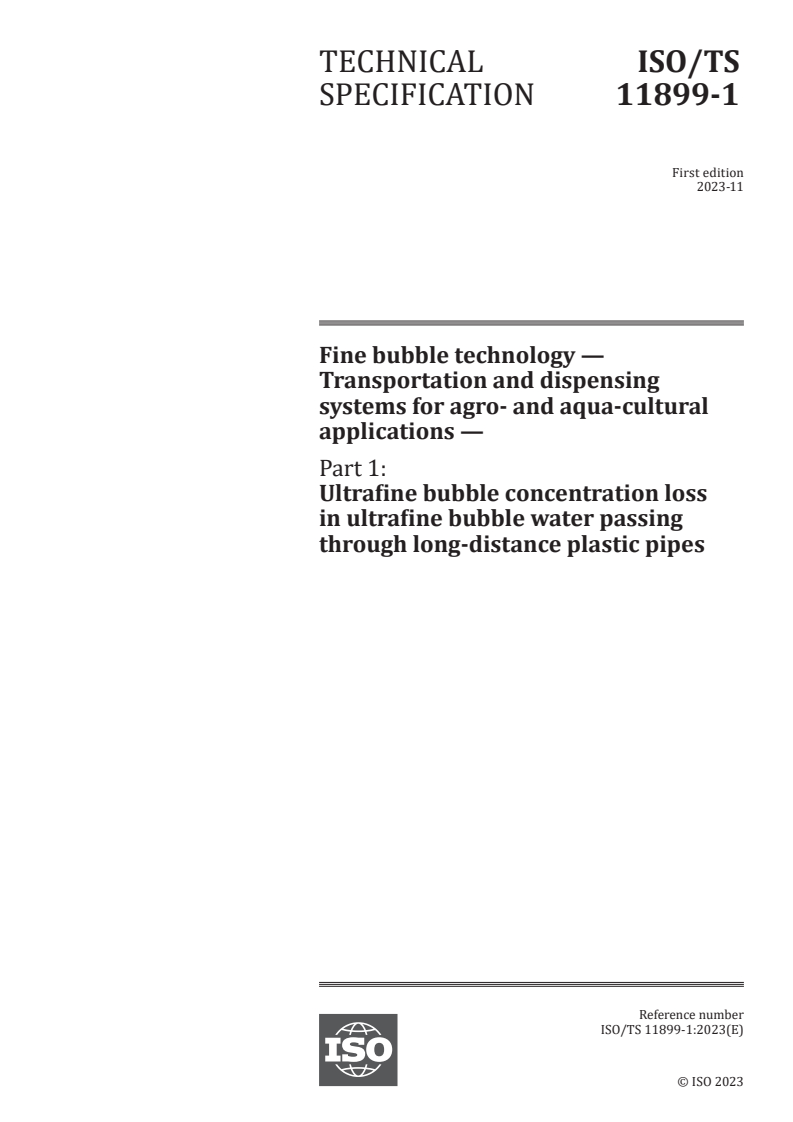
ISO/TS 11899-1:2023 - Fine bubble technology — Transportation and dispensing systems for agro- and aqua-cultural applications — Part 1: Ultrafine bubble concentration loss in ultrafine bubble water passing through long-distance plastic pipes Released:17. 11. 2023
Overview
ISO/TS 11899-1:2023 specifies a laboratory test method to evaluate ultrafine bubble (UFB) concentration loss that occurs when ultrafine-bubble water is conveyed through long-distance plastic pipes. The Technical Specification defines the required test setup, equipment, environment, sampling and measurement procedures, and data-analysis approach. Test outcomes are analysed and expressed as an empirical formula linking UFB concentration loss to flow parameters, pipe length, flow velocity and number of circulations - information intended to support the design of long-distance transport systems for industrial agro- and aqua-cultural applications. The document is informative and is not intended for conformity assessment.
Key topics and technical requirements
- Scope and objective: Measure reduction in the number concentration index of UFBs during circulation through a long winding plastic pipe and derive an empirical predictive equation.
- Test system components:
- Reservoir for stagnant/mixed UFB water with sampling access and transparent observation window.
- Long winding plastic pipe (small inner diameter, wound on a bobbin) to simulate long-distance pipeline behaviour.
- Gear pump with controllable flow velocity and pressure (document cites operating range examples: 5–120 m/min flow velocity and 5–250 kPa pressure drop).
- Flow meter, pressure gauges, needle valve, thermometer, stopwatch, sampling pipette and airtight glass bottles.
- Measurement method: Particle-tracking analysis to determine the UFB number concentration index and size distribution (measurement method aligned with referenced ISO measurement standards).
- Test parameters: Inner diameter (d), pipe length (L), flow velocity (ud), number of circulations (np), and elapsed time. The standard defines the surviving rate (Φ) and a loss factor (k) used in data analysis.
- Procedure and data analysis: Homogenize reservoir, baseline sampling, controlled circulation, timed sampling at planned circulation counts, sealing and labeling samples, measurement of concentration and size indices, and empirical model derivation from aggregated results. Annex A provides an illustrative example.
Applications and users
- System designers and engineers developing long-distance UFB transport and dispensing systems for agriculture and aquaculture.
- Equipment manufacturers (pumps, piping, UFB generators) validating design impacts on UFB stability.
- Testing laboratories and researchers studying UFB stability under flow, mass transport loss and pipeline effects.
- Farm operators and consultants planning distribution networks where maintaining UFB concentration is critical for effectiveness (e.g., irrigation, nutrient delivery, sterilization). Practical outcome: use empirically derived formulas from the standard to predict UFB loss and size system capacity, flow rates and pipe layouts accordingly.
Related standards
- ISO 20298-1 and ISO 21255 - referenced for UFB generation and handling procedures.
- ISO 20480-2 and ISO 19430 - referenced for particle tracking analysis and measurement principles used to determine UFB number concentration and size.
Buy Documents
ISO/TS 11899-1:2023 - Fine bubble technology — Transportation and dispensing systems for agro- and aqua-cultural applications — Part 1: Ultrafine bubble concentration loss in ultrafine bubble water passing through long-distance plastic pipes Released:17. 11. 2023
Frequently Asked Questions
ISO/TS 11899-1:2023 is a technical specification published by the International Organization for Standardization (ISO). Its full title is "Fine bubble technology — Transportation and dispensing systems for agro- and aqua-cultural applications — Part 1: Ultrafine bubble concentration loss in ultrafine bubble water passing through long-distance plastic pipes". This standard covers: This document specifies a test procedure, equipment and environment for evaluating the concentration loss of ultrafine bubbles (UFB) due to long-distance transfer of ultrafine bubble water in a plastic pipe. The test results are analysed and expressed in terms of a formula with the flow parameters, pipe length, flow velocity and number of circulations through the pipe. The formula is intended to be used for designing long-distance transport system for industrial applications including agro- and aqua- farming.
This document specifies a test procedure, equipment and environment for evaluating the concentration loss of ultrafine bubbles (UFB) due to long-distance transfer of ultrafine bubble water in a plastic pipe. The test results are analysed and expressed in terms of a formula with the flow parameters, pipe length, flow velocity and number of circulations through the pipe. The formula is intended to be used for designing long-distance transport system for industrial applications including agro- and aqua- farming.
ISO/TS 11899-1:2023 is classified under the following ICS (International Classification for Standards) categories: 07.030 - Physics. Chemistry. The ICS classification helps identify the subject area and facilitates finding related standards.
ISO/TS 11899-1:2023 is available in PDF format for immediate download after purchase. The document can be added to your cart and obtained through the secure checkout process. Digital delivery ensures instant access to the complete standard document.
Standards Content (Sample)
TECHNICAL ISO/TS
SPECIFICATION 11899-1
First edition
2023-11
Fine bubble technology —
Transportation and dispensing
systems for agro- and aqua-cultural
applications —
Part 1:
Ultrafine bubble concentration loss
in ultrafine bubble water passing
through long-distance plastic pipes
Reference number
© ISO 2023
All rights reserved. Unless otherwise specified, or required in the context of its implementation, no part of this publication may
be reproduced or utilized otherwise in any form or by any means, electronic or mechanical, including photocopying, or posting on
the internet or an intranet, without prior written permission. Permission can be requested from either ISO at the address below
or ISO’s member body in the country of the requester.
ISO copyright office
CP 401 • Ch. de Blandonnet 8
CH-1214 Vernier, Geneva
Phone: +41 22 749 01 11
Email: copyright@iso.org
Website: www.iso.org
Published in Switzerland
ii
Contents Page
Foreword .iv
Introduction .v
1 Scope . 1
2 Normative references . 1
3 Terms and definitions . 1
4 Testing method and data analysis . 2
4.1 Basic testing method . 2
4.2 Equipment and environment . 3
4.2.1 Reservoir . 3
4.2.2 Ultrafine bubble water . 3
4.2.3 Pumping . 4
4.2.4 Long winding pipe. 4
4.2.5 Flow meter . 4
4.2.6 Measuring instrument of number concentration index of ultrafine bubble . 4
4.2.7 Sampling pipette and glass bottle . 4
4.2.8 Thermometer . 4
4.2.9 Stop watch . 4
4.3 Test procedure . 4
4.4 Data analysis . 5
5 Test report . 6
Annex A (informative) Example of test and data analysis . 7
Bibliography .13
iii
Foreword
ISO (the International Organization for Standardization) is a worldwide federation of national standards
bodies (ISO member bodies). The work of preparing International Standards is normally carried out
through ISO technical committees. Each member body interested in a subject for which a technical
committee has been established has the right to be represented on that committee. International
organizations, governmental and non-governmental, in liaison with ISO, also take part in the work.
ISO collaborates closely with the International Electrotechnical Commission (IEC) on all matters of
electrotechnical standardization.
The procedures used to develop this document and those intended for its further maintenance are
described in the ISO/IEC Directives, Part 1. In particular, the different approval criteria needed for the
different types of ISO document should be noted. This document was drafted in accordance with the
editorial rules of the ISO/IEC Directives, Part 2 (see www.iso.org/directives).
ISO draws attention to the possibility that the implementation of this document may involve the use
of (a) patent(s). ISO takes no position concerning the evidence, validity or applicability of any claimed
patent rights in respect thereof. As of the date of publication of this document, ISO had not received
notice of (a) patent(s) which may be required to implement this document. However, implementers are
cautioned that this may not represent the latest information, which may be obtained from the patent
database available at www.iso.org/patents. ISO shall not be held responsible for identifying any or all
such patent rights.
Any trade name used in this document is information given for the convenience of users and does not
constitute an endorsement.
For an explanation of the voluntary nature of standards, the meaning of ISO specific terms and
expressions related to conformity assessment, as well as information about ISO's adherence to
the World Trade Organization (WTO) principles in the Technical Barriers to Trade (TBT), see
www.iso.org/iso/foreword.html.
This document was prepared by Technical Committee ISO/TC 281, Fine bubble technology.
A list of all parts in the ISO 11899 series can be found on the ISO website.
Any feedback or questions on this document should be directed to the user’s national standards body. A
complete listing of these bodies can be found at www.iso.org/members.html.
iv
Introduction
Fine bubbles are applied to agro- and aqua-culture for their uses in supplying water, nutrition and
chemicals for facilitation of growth, sterilization and cleaning. Ultrafine bubbles are known to exhibit
great stability in water, provided that they are used appropriately within their intended application.
However, since farms are often spatially broad and remotely located, water needs to be transported
by pipe lines to meet the huge amounts required. Furthermore, in order to see the benefit of applying
ultrafine bubbles, the transportation line should maintain consistent fine bubble water characteristics,
[1]
including the number concentration index of ultrafine bubbles. Many mechanisms can be shown for
removal of ultrafine bubbles due to mechanical, chemical and thermodynamical effects to imagine the
change in the number concentration index loss due to flow in the pipe. When designing the farming
system, a reliable prediction on the removal of ultrafine bubbles in the water on the site is needed.
However, there is no useful test method for data or relevant experiments to evaluate how long ultrafine
bubbles can practically survive after long transportation.
This document provides the test method on experimental evaluation of a long transfer plastic pipe
system in terms of reduction in the ultrafine bubble concentration index due to the flow in pipes. The
system, consisting of a reservoir for ultrafine bubble water and a winding pipe, through which the water
is circulated periodically from the reservoir, allows description of concentration loss by an empirical
equation. Systematic analysis of the data output from the practical test process can benefit users for
planning and improving a similar system. An example of deduced formula optimized to reproducing
observed data is given in Annex A.
This document cannot be used for any conformity assessment activities on relevant tests.
v
TECHNICAL SPECIFICATION ISO/TS 11899-1:2023(E)
Fine bubble technology — Transportation and dispensing
systems for agro- and aqua-cultural applications —
Part 1:
Ultrafine bubble concentration loss in ultrafine bubble
water passing through long-distance plastic pipes
1 Scope
This document specifies a test procedure, equipment and environment for evaluating the concentration
loss of ultrafine bubbles (UFB) due to long-distance transfer of ultrafine bubble water in a plastic pipe.
The test results are analysed and expressed in terms of a formula with the flow parameters, pipe
length, flow velocity and number of circulations through the pipe. The formula is intended to be used
for designing long-distance transport system for industrial applications including agro- and aqua-
farming.
2 Normative references
There are no normative references in this document.
3 Terms and definitions
For the purposes of this document, the following terms and definitions apply.
ISO and IEC maintain terminology databases for use in standardization at the following addresses:
— ISO Online browsing platform: available at https:// www .iso .org/ obp
— IEC Electropedia: available at https:// www .electropedia .org/
3.1
surviving rate
Φ
ratio of number concentration index of ultrafine bubbles at the entrance of a pipe to that at the end of
the pipe
Note 1 to entry: The number concentration index of ultrafine bubbles in the water decreases during the flow
through the pump and the winding pipe. The rate is evaluated for a sample taken from a reservoir. The vessel is
open to room air and the water level is kept over the inlet and the outlet.
3.2
reservoir
vessel for ultrafine bubble water staying almost at rest during the water circulation filled with the
water returning back from pipe at its inlet and fed to the gear pump at its outlet, intended to sample
ultrafine bubble water for measurement
3.3
sampling
sampling of ultrafine bubble water from the reservoir using a pipette and sampling bottle for the
measurement of a size index and a number concentration index
3.4
long winding pipe
long plastic pipe with small inner diameter winding on the bobbin to simulate the behaviour of the
long-distance plastic pipe for practical use
3.5
number of circulation
n
p
number of ultrafine bubble water circulation passing through the transport system
Note 1 to entry: The number is defined by the ratio of the product of flow rate in the long winding pipe with
elapsed time of an experiment to volume of long winding pipe.
3.6
flow velocity
u
d
fluid velocity of ultrafine bubble water in the long winding pipe
3.7
loss factor
k
coefficient relating the time derivative of the surviving rate to the surviving rate itself
Note 1 to entry: In the analysis of the report, the relationship is assumed to be linear and the loss factor, k, is its
proportional coefficient. See Formula (1).
4 Testing method and data analysis
4.1 Basic testing method
The behaviour of extended long-distance plastic pipe is simulated by a pipe winding by many turns
measuring long distance in the testing room. The ultrafine bubble water in a reservoir is pushed in by
a pump from one end of the pipe and released back to the reservoir after the water completely passes
through the long winding pipe.
The decrease in number concentration index of ultrafine bubbles after the passing is measured by
particle tracking analysis method.
The process is operated continuously by feeding the water from the outlet of the pipe to the inlet
through a reservoir and the pressurizing pump. The pushing pressure is kept constant throughout an
experiment.
The measurement sample is taken from the reservoir several times synchronous with the period of the
circulation. The systematic decrease of number concentration index and elapsed time are recorded for
an experiment with selected parameters on inner diameter, d, length of pipe, L, and flow velocity, v .
d
The experiments are conducted for various different values of the parameters and all accumulated
output data are analysed for deducing an empirical formula applicable to the condition within the
parameter setting.
In Figure 1, a loop indicates one turn of pipe around the bobbin as a part of long winding pipe.
Key
1 reservoir
2 rotor flow meter
3 needle valve
4 gear pump
5 pressure gauge 1
6 pressure gauge 2
7 pipeline
Figure 1 — Schematic diagram of testing system
4.2 Equipment and environment
The environment for the test operation should be conducted at ambient temperature and air pressure
and water should be less exposed to the room air in order not to introduce solid contaminants to the
water.
The following equipment should be applied for the test system.
4.2.1 Reservoir
The upper surface is allowing to sample the ultrafine bubble water by pipette. The side wall is
transparent or has a window allowing observation of sampling and status of water. An inlet and an
outlet are put on the side wall. The outlet has a stop valve and is close to the bottom and the inlet, close
to the top. The vertical distance of the openings specifies the volume of the ultrafine bubble water in
addition to whole long winding pipe.
The structure of the reservoir is simple enough for simple cleaning and sampling and set stable and in
ambient temperature.
4.2.2 Ultrafine bubble water
The ultrafine bubble water, namely sample
...