


ISO 127:2018
(Main)Rubber, natural latex concentrate — Determination of KOH number
Rubber, natural latex concentrate — Determination of KOH number
This document specifies a method for the determination of the KOH number of natural rubber latex concentrate which is preserved wholly or in part with ammonia. The method is applicable to latices containing boric acid. The method is not applicable to latices preserved with potassium hydroxide. It is not necessarily suitable for latices from natural sources other than Hevea brasiliensis, or for latices of synthetic rubber, compounded latex, vulcanized latex or artificial dispersions of rubber.
Latex concentré de caoutchouc naturel — Détermination de l'indice de potasse
Le présent document spécifie une méthode pour la détermination de l'indice de potasse du latex concentré de caoutchouc naturel préservé complètement ou partiellement à l'ammoniaque. La méthode est applicable aux latex contenant de l'acide borique. La méthode n'est pas applicable aux latex préservés à l'hydroxyde de potassium. Elle ne convient pas nécessairement aux latex d'origine naturelle autres que celui de l'Hevea brasiliensis ou aux dispersions d'élastomères de synthèse, aux mélanges de latex, au latex vulcanisé ou aux dispersions artificielles de caoutchouc.
General Information
- Status
- Published
- Publication Date
- 29-Aug-2018
- Drafting Committee
- ISO/TC 45/SC 3/WG 2 - Latex
- Current Stage
- 9092 - International Standard to be revised
- Start Date
- 23-May-2024
- Completion Date
- 14-Feb-2026
Relations
- Effective Date
- 15-Dec-2017
Overview
ISO 127:2018 specifies a laboratory method to determine the KOH number (potassium hydroxide equivalent) of natural rubber latex concentrate preserved wholly or in part with ammonia. The method covers ammonia‑preserved Hevea brasiliensis latex concentrates and is applicable when boric acid is present. It is not applicable to latex preserved with potassium hydroxide, to many non‑Hevea natural sources, or to synthetic, compounded, vulcanized or artificial rubber dispersions.
Keywords: ISO 127:2018, KOH number, natural rubber latex concentrate, KOH number determination, ammonia‑preserved latex, boric acid.
Key topics and requirements
- Scope and limits: Method restricted to ammonia‑preserved natural latex concentrates; excludes KOH‑preserved and many synthetic/compounded latices.
- Sampling & pre‑tests: Sampling per ISO 123; total solids and alkalinity determined per ISO 124 and ISO 125 respectively; boric acid content per ISO 1802 when present.
- Reagents: Uses analytical‑grade reagents and CO2‑free water. Recommended titrants include carbonate‑free KOH standard solutions (nominally 0.1 and 0.5 mol·dm‑3) and a defined formaldehyde solution for adjusting alkalinity.
- Apparatus: pH‑meter (readable to 0.01 pH), suitable glass electrode (pH up to 12.0), mechanical or magnetic stirrer; automatic titrators allowed if validated against the manual method.
- Procedure: Dilute a test portion to ~30% total solids, adjust alkalinity with formaldehyde if needed, then titrate with 0.5 mol·dm‑3 KOH while recording pH. The end‑point is determined from the titration curve as the point of inflection (maximal first derivative / change of sign of second derivative). Determinations are carried out in duplicate.
- Calculation: KOH number is calculated from the volume and concentration of KOH titrant, the test portion mass and total solids; a correction is applied if boric acid is present.
- Quality and reporting: Duplicate results must agree within 5% (mass). Test reports must reference ISO 127:2018 and include sample ID, pH‑meter details, results, boric acid correction and any deviations from the standard method.
Applications and users
- Quality control and acceptance testing in latex processing plants and rubber manufacturers.
- Analytical and compliance testing in industrial laboratories and third‑party testing services.
- R&D and formulation labs monitoring latice alkalinity and residual acid radicals combined with ammonia.
- Useful for suppliers and buyers specifying latex quality, and for auditors enforcing standards‑based testing.
Keywords: latex testing, titration pH end‑point, quality control, rubber industry.
Related standards
- ISO 123 - Rubber latex - Sampling
- ISO 124 - Latex - Determination of total solids
- ISO 125 - Natural rubber latex concentrate - Determination of alkalinity
- ISO 976 - pH measurement for polymer dispersions and latices
- ISO 1802 - Determination of boric acid in latex
For implementation, laboratories should follow normal safety and good laboratory practice and consult ISO 127:2018 for full procedural details and annexes (formaldehyde determination, titration examples, precision data).
Buy Documents

ISO 127:2018 - Rubber, natural latex concentrate -- Determination of KOH number

ISO 127:2018 - Rubber, natural latex concentrate — Determination of KOH number Released:8/30/2018

ISO 127:2018 - Latex concentré de caoutchouc naturel -- Détermination de l'indice de potasse
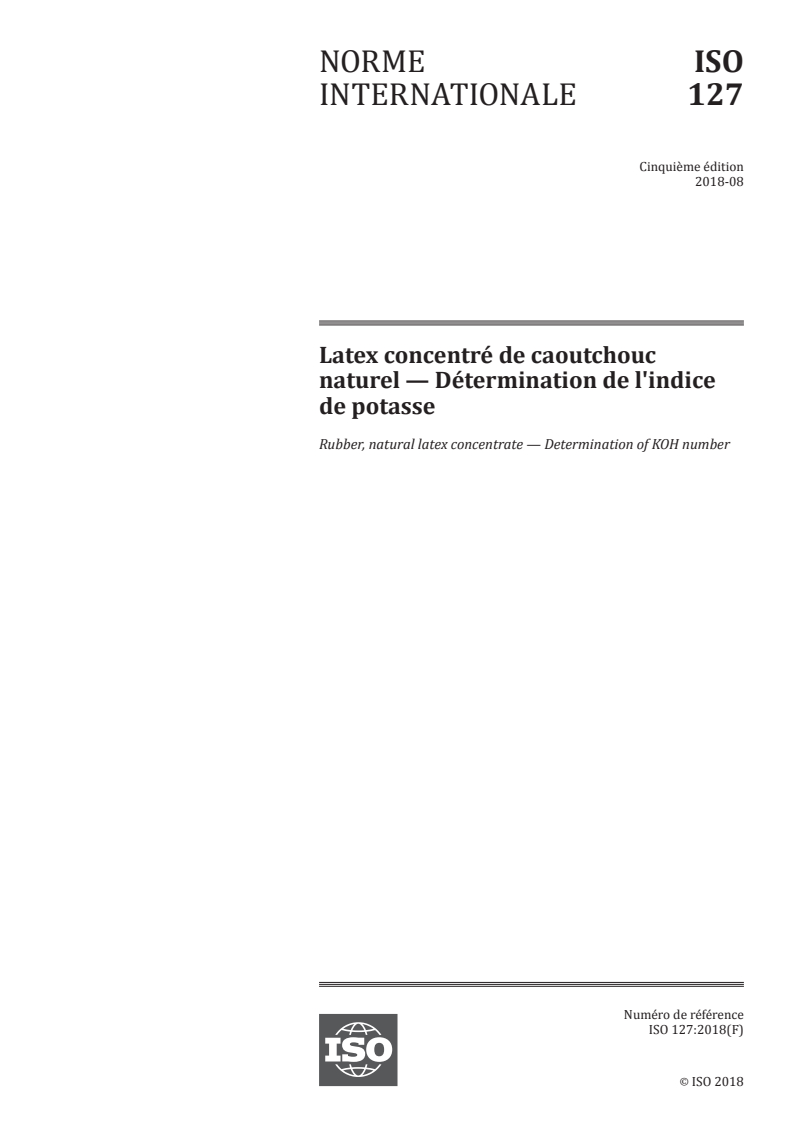

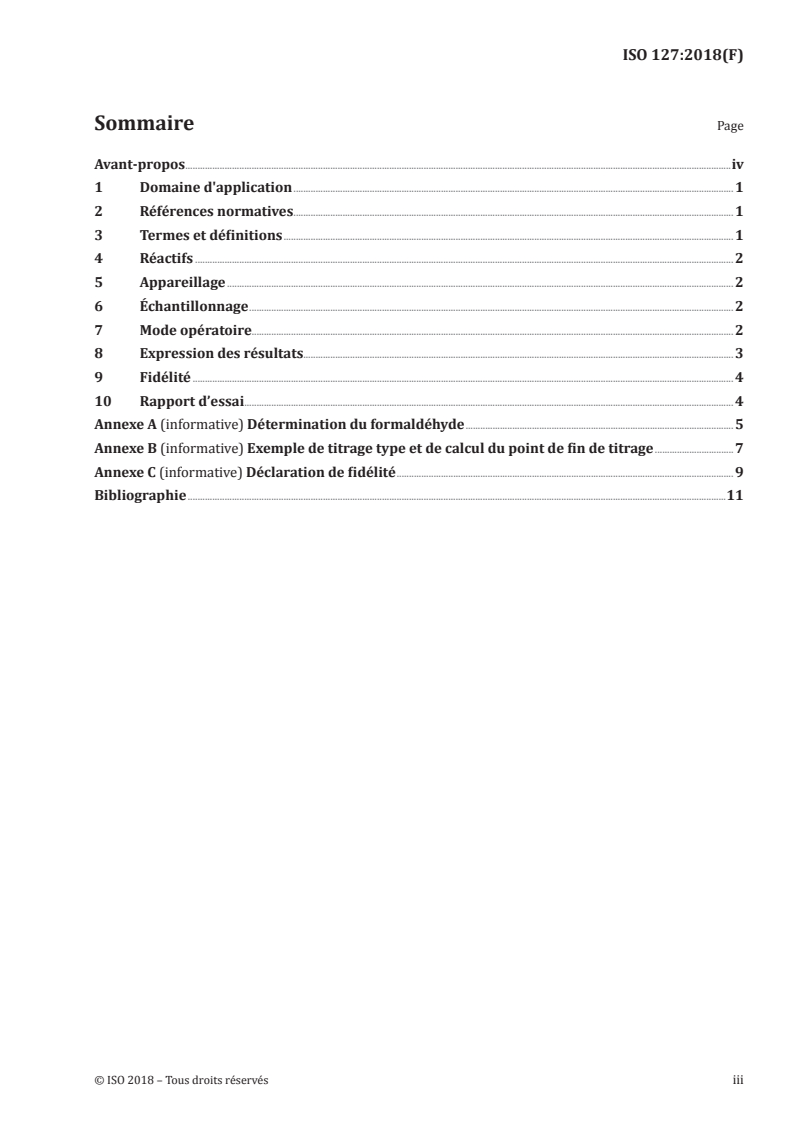
ISO 127:2018 - Latex concentré de caoutchouc naturel — Détermination de l'indice de potasse Released:10/4/2018
Get Certified
Connect with accredited certification bodies for this standard

Smithers Quality Assessments
US management systems and product certification.

DIN CERTCO
DIN Group product certification.
Sponsored listings
Frequently Asked Questions
ISO 127:2018 is a standard published by the International Organization for Standardization (ISO). Its full title is "Rubber, natural latex concentrate — Determination of KOH number". This standard covers: This document specifies a method for the determination of the KOH number of natural rubber latex concentrate which is preserved wholly or in part with ammonia. The method is applicable to latices containing boric acid. The method is not applicable to latices preserved with potassium hydroxide. It is not necessarily suitable for latices from natural sources other than Hevea brasiliensis, or for latices of synthetic rubber, compounded latex, vulcanized latex or artificial dispersions of rubber.
This document specifies a method for the determination of the KOH number of natural rubber latex concentrate which is preserved wholly or in part with ammonia. The method is applicable to latices containing boric acid. The method is not applicable to latices preserved with potassium hydroxide. It is not necessarily suitable for latices from natural sources other than Hevea brasiliensis, or for latices of synthetic rubber, compounded latex, vulcanized latex or artificial dispersions of rubber.
ISO 127:2018 is classified under the following ICS (International Classification for Standards) categories: 83.040.10 - Latex and raw rubber. The ICS classification helps identify the subject area and facilitates finding related standards.
ISO 127:2018 has the following relationships with other standards: It is inter standard links to ISO 127:2012. Understanding these relationships helps ensure you are using the most current and applicable version of the standard.
ISO 127:2018 is available in PDF format for immediate download after purchase. The document can be added to your cart and obtained through the secure checkout process. Digital delivery ensures instant access to the complete standard document.
Standards Content (Sample)
INTERNATIONAL ISO
STANDARD 127
Fifth edition
2018-08
Rubber, natural latex concentrate —
Determination of KOH number
Latex concentré de caoutchouc naturel — Détermination de l'indice
de potasse
Reference number
©
ISO 2018
© ISO 2018
All rights reserved. Unless otherwise specified, or required in the context of its implementation, no part of this publication may
be reproduced or utilized otherwise in any form or by any means, electronic or mechanical, including photocopying, or posting
on the internet or an intranet, without prior written permission. Permission can be requested from either ISO at the address
below or ISO’s member body in the country of the requester.
ISO copyright office
CP 401 • Ch. de Blandonnet 8
CH-1214 Vernier, Geneva
Phone: +41 22 749 01 11
Fax: +41 22 749 09 47
Email: copyright@iso.org
Website: www.iso.org
Published in Switzerland
ii © ISO 2018 – All rights reserved
Contents Page
Foreword .iv
1 Scope . 1
2 Normative references . 1
3 Terms and definitions . 1
4 Reagents . 1
5 Apparatus . 2
6 Sampling . 2
7 Procedure. 2
8 Expression of results . 3
9 Precision . 4
10 Test report . 4
Annex A (informative) Determination of formaldehyde . 5
Annex B (informative) Example of a typical titration and calculation of the end-point .7
Annex C (informative) Precision data . 9
Bibliography .11
Foreword
ISO (the International Organization for Standardization) is a worldwide federation of national standards
bodies (ISO member bodies). The work of preparing International Standards is normally carried out
through ISO technical committees. Each member body interested in a subject for which a technical
committee has been established has the right to be represented on that committee. International
organizations, governmental and non-governmental, in liaison with ISO, also take part in the work.
ISO collaborates closely with the International Electrotechnical Commission (IEC) on all matters of
electrotechnical standardization.
The procedures used to develop this document and those intended for its further maintenance are
described in the ISO/IEC Directives, Part 1. In particular, the different approval criteria needed for the
different types of ISO documents should be noted. This document was drafted in accordance with the
editorial rules of the ISO/IEC Directives, Part 2 (see www .iso .org/directives).
Attention is drawn to the possibility that some of the elements of this document may be the subject of
patent rights. ISO shall not be held responsible for identifying any or all such patent rights. Details of
any patent rights identified during the development of the document will be in the Introduction and/or
on the ISO list of patent declarations received (see www .iso .org/patents).
Any trade name used in this document is information given for the convenience of users and does not
constitute an endorsement.
For an explanation of the voluntary nature of standards, the meaning of ISO specific terms and
expressions related to conformity assessment, as well as information about ISO's adherence to the
World Trade Organization (WTO) principles in the Technical Barriers to Trade (TBT) see www .iso
.org/iso/foreword .html.
This document was prepared by Technical Committee ISO/TC 45, Rubber and rubber products,
Subcommittee SC 3, Raw materials (including latex) for use in the rubber industry.
This fifth edition cancels and replaces the fourth edition (ISO 127:2012), which has been technically
revised to add in Clause 7 the calculation of water required to dilute latex.
Any feedback or questions on this document should be directed to the user’s national standards body. A
complete listing of these bodies can be found at www .iso .org/members .html.
iv © ISO 2018 – All rights reserved
INTERNATIONAL STANDARD ISO 127:2018(E)
Rubber, natural latex concentrate — Determination of
KOH number
WARNING — Persons using this document should be familiar with normal laboratory practice.
This document does not purport to address all of the safety problems, if any, associated with its
use. It is the responsibility of the user to establish appropriate safety and health practices.
1 Scope
This document specifies a method for the determination of the KOH number of natural rubber latex
concentrate which is preserved wholly or in part with ammonia.
The method is applicable to latices containing boric acid.
The method is not applicable to latices preserved with potassium hydroxide. It is not necessarily
suitable for latices from natural sources other than Hevea brasiliensis, or for latices of synthetic rubber,
compounded latex, vulcanized latex or artificial dispersions of rubber.
2 Normative references
The following documents are referred to in the text in such a way that some or all of their content
constitutes requirements of this document. For dated references, only the edition cited applies. For
undated references, the latest edition of the referenced document (including any amendments) applies.
ISO 123, Rubber latex — Sampling
ISO 124, Latex, rubber — Determination of total solids content
ISO 125, Natural rubber latex concentrate — Determination of alkalinity
ISO 976, Rubber and plastics — Polymer dispersions and rubber latices — Determination of pH
ISO 1802, Natural rubber latex concentrate — Determination of boric acid content
3 Terms and definitions
For the purposes of this document, the following terms and definitions apply.
ISO and IEC maintain terminological databases for use in standardization at the following addresses:
— ISO Online browsing platform: available at https: //www .iso .org/obp
— IEC Electropedia: available at http: //www .electropedia .org/
3.1
KOH number
number of grams of potassium hydroxide equivalent to the acid radicals combined with
ammonia in latex containing 100 g of total solids
[SOURCE: ISO 1382:2012, 2.249, modified — Note 1 to entry has been deleted. ]
4 Reagents
During the analysis, use only reagents of recognized analytical grade and only distilled water free of
dissolved carbon dioxide, or water of equivalent purity.
4.1 Potassium hydroxide, standard volumetric solution, c(KOH) = 0,1 mol/dm , carbonate-free.
4.2 Potassium hydroxide, standard volumetric solution, c(KOH) = 0,5 mol/dm , carbonate-free.
3 3 3
4.3 Formaldehyde, 45 g to 50 g in 1 dm of solution [c(HCHO) = 1,5 mol/dm to 1,67 mol/dm ], acid-
free, prepared by diluting concentrated formaldehyde with water and neutralizing with 0,1 mol/dm
potassium hydroxide solution (4.1), using as indicator the faint pink colour of phenolphthalein.
Annex A describes the method to determine the concentration of the formaldehyde solution.
5 Apparatus
Standard laboratory glassware, plus the following.
5.1 pH-meter, in accordance with ISO 976 but capable of being read to 0,01 units.
5.2 Glass electrode, of a type suitable for use in solutions of pH up to 12,0.
5.3 Mechanical stirrer, with earthed motor and glass paddle, or magnetic stirrer.
An automatic titrator may be used provided that it has been proven to give the same result as the
standard method.
6 Sampling
Carry out the sampling in accordance with one of the methods specified in ISO 123.
7 Procedure
Calibrate the pH-meter by the method specified in ISO 976. If the total solids, w , and alkalinity, A, of
TS
the latex are not known, determine them in accordance with ISO 124 and ISO 125, respectively. If the
latex contains boric acid and the content is not known, determine it in accordance with ISO 1802.
Carry out the determination in duplicate.
Weigh, to the nearest 0,1 g, into a 400 cm beaker a test portion (mass m) of the test sample containing
approximately 50 g of total solids. If necessary, adjust the alkalinity to (0,5 ± 0,1) % ammonia calculated
with respect to the water phase by adding, while stirring, the required quantity of formaldehyde
solution (4.3).
Calculate the volume, V , in cubic centimetres, of formaldehyde solution to be added from Formula (1):
f
mw100− A−05,
()()
TS
V = (1)
f
113,4c HCHO
()
where
m is the mass, in grams, of the test portion;
w is the total solids content, expressed as a percentage by mass, of the latex concentrate;
TS
A is the alkali
...
INTERNATIONAL ISO
STANDARD 127
Fifth edition
2018-08
Rubber, natural latex concentrate —
Determination of KOH number
Latex concentré de caoutchouc naturel — Détermination de l'indice
de potasse
Reference number
©
ISO 2018
© ISO 2018
All rights reserved. Unless otherwise specified, or required in the context of its implementation, no part of this publication may
be reproduced or utilized otherwise in any form or by any means, electronic or mechanical, including photocopying, or posting
on the internet or an intranet, without prior written permission. Permission can be requested from either ISO at the address
below or ISO’s member body in the country of the requester.
ISO copyright office
CP 401 • Ch. de Blandonnet 8
CH-1214 Vernier, Geneva
Phone: +41 22 749 01 11
Fax: +41 22 749 09 47
Email: copyright@iso.org
Website: www.iso.org
Published in Switzerland
ii © ISO 2018 – All rights reserved
Contents Page
Foreword .iv
1 Scope . 1
2 Normative references . 1
3 Terms and definitions . 1
4 Reagents . 1
5 Apparatus . 2
6 Sampling . 2
7 Procedure. 2
8 Expression of results . 3
9 Precision . 4
10 Test report . 4
Annex A (informative) Determination of formaldehyde . 5
Annex B (informative) Example of a typical titration and calculation of the end-point .7
Annex C (informative) Precision data . 9
Bibliography .11
Foreword
ISO (the International Organization for Standardization) is a worldwide federation of national standards
bodies (ISO member bodies). The work of preparing International Standards is normally carried out
through ISO technical committees. Each member body interested in a subject for which a technical
committee has been established has the right to be represented on that committee. International
organizations, governmental and non-governmental, in liaison with ISO, also take part in the work.
ISO collaborates closely with the International Electrotechnical Commission (IEC) on all matters of
electrotechnical standardization.
The procedures used to develop this document and those intended for its further maintenance are
described in the ISO/IEC Directives, Part 1. In particular, the different approval criteria needed for the
different types of ISO documents should be noted. This document was drafted in accordance with the
editorial rules of the ISO/IEC Directives, Part 2 (see www .iso .org/directives).
Attention is drawn to the possibility that some of the elements of this document may be the subject of
patent rights. ISO shall not be held responsible for identifying any or all such patent rights. Details of
any patent rights identified during the development of the document will be in the Introduction and/or
on the ISO list of patent declarations received (see www .iso .org/patents).
Any trade name used in this document is information given for the convenience of users and does not
constitute an endorsement.
For an explanation of the voluntary nature of standards, the meaning of ISO specific terms and
expressions related to conformity assessment, as well as information about ISO's adherence to the
World Trade Organization (WTO) principles in the Technical Barriers to Trade (TBT) see www .iso
.org/iso/foreword .html.
This document was prepared by Technical Committee ISO/TC 45, Rubber and rubber products,
Subcommittee SC 3, Raw materials (including latex) for use in the rubber industry.
This fifth edition cancels and replaces the fourth edition (ISO 127:2012), which has been technically
revised to add in Clause 7 the calculation of water required to dilute latex.
Any feedback or questions on this document should be directed to the user’s national standards body. A
complete listing of these bodies can be found at www .iso .org/members .html.
iv © ISO 2018 – All rights reserved
INTERNATIONAL STANDARD ISO 127:2018(E)
Rubber, natural latex concentrate — Determination of
KOH number
WARNING — Persons using this document should be familiar with normal laboratory practice.
This document does not purport to address all of the safety problems, if any, associated with its
use. It is the responsibility of the user to establish appropriate safety and health practices.
1 Scope
This document specifies a method for the determination of the KOH number of natural rubber latex
concentrate which is preserved wholly or in part with ammonia.
The method is applicable to latices containing boric acid.
The method is not applicable to latices preserved with potassium hydroxide. It is not necessarily
suitable for latices from natural sources other than Hevea brasiliensis, or for latices of synthetic rubber,
compounded latex, vulcanized latex or artificial dispersions of rubber.
2 Normative references
The following documents are referred to in the text in such a way that some or all of their content
constitutes requirements of this document. For dated references, only the edition cited applies. For
undated references, the latest edition of the referenced document (including any amendments) applies.
ISO 123, Rubber latex — Sampling
ISO 124, Latex, rubber — Determination of total solids content
ISO 125, Natural rubber latex concentrate — Determination of alkalinity
ISO 976, Rubber and plastics — Polymer dispersions and rubber latices — Determination of pH
ISO 1802, Natural rubber latex concentrate — Determination of boric acid content
3 Terms and definitions
For the purposes of this document, the following terms and definitions apply.
ISO and IEC maintain terminological databases for use in standardization at the following addresses:
— ISO Online browsing platform: available at https: //www .iso .org/obp
— IEC Electropedia: available at http: //www .electropedia .org/
3.1
KOH number
number of grams of potassium hydroxide equivalent to the acid radicals combined with
ammonia in latex containing 100 g of total solids
[SOURCE: ISO 1382:2012, 2.249, modified — Note 1 to entry has been deleted. ]
4 Reagents
During the analysis, use only reagents of recognized analytical grade and only distilled water free of
dissolved carbon dioxide, or water of equivalent purity.
4.1 Potassium hydroxide, standard volumetric solution, c(KOH) = 0,1 mol/dm , carbonate-free.
4.2 Potassium hydroxide, standard volumetric solution, c(KOH) = 0,5 mol/dm , carbonate-free.
3 3 3
4.3 Formaldehyde, 45 g to 50 g in 1 dm of solution [c(HCHO) = 1,5 mol/dm to 1,67 mol/dm ], acid-
free, prepared by diluting concentrated formaldehyde with water and neutralizing with 0,1 mol/dm
potassium hydroxide solution (4.1), using as indicator the faint pink colour of phenolphthalein.
Annex A describes the method to determine the concentration of the formaldehyde solution.
5 Apparatus
Standard laboratory glassware, plus the following.
5.1 pH-meter, in accordance with ISO 976 but capable of being read to 0,01 units.
5.2 Glass electrode, of a type suitable for use in solutions of pH up to 12,0.
5.3 Mechanical stirrer, with earthed motor and glass paddle, or magnetic stirrer.
An automatic titrator may be used provided that it has been proven to give the same result as the
standard method.
6 Sampling
Carry out the sampling in accordance with one of the methods specified in ISO 123.
7 Procedure
Calibrate the pH-meter by the method specified in ISO 976. If the total solids, w , and alkalinity, A, of
TS
the latex are not known, determine them in accordance with ISO 124 and ISO 125, respectively. If the
latex contains boric acid and the content is not known, determine it in accordance with ISO 1802.
Carry out the determination in duplicate.
Weigh, to the nearest 0,1 g, into a 400 cm beaker a test portion (mass m) of the test sample containing
approximately 50 g of total solids. If necessary, adjust the alkalinity to (0,5 ± 0,1) % ammonia calculated
with respect to the water phase by adding, while stirring, the required quantity of formaldehyde
solution (4.3).
Calculate the volume, V , in cubic centimetres, of formaldehyde solution to be added from Formula (1):
f
mw100− A−05,
()()
TS
V = (1)
f
113,4c HCHO
()
where
m is the mass, in grams, of the test portion;
w is the total solids content, expressed as a percentage by mass, of the latex concentrate;
TS
A is the alkali
...
NORME ISO
INTERNATIONALE 127
Cinquième édition
2018-08
Latex concentré de caoutchouc
naturel — Détermination de l'indice
de potasse
Rubber, natural latex concentrate — Determination of KOH number
Numéro de référence
©
ISO 2018
DOCUMENT PROTÉGÉ PAR COPYRIGHT
© ISO 2018
Tous droits réservés. Sauf prescription différente ou nécessité dans le contexte de sa mise en œuvre, aucune partie de cette
publication ne peut être reproduite ni utilisée sous quelque forme que ce soit et par aucun procédé, électronique ou mécanique,
y compris la photocopie, ou la diffusion sur l’internet ou sur un intranet, sans autorisation écrite préalable. Une autorisation peut
être demandée à l’ISO à l’adresse ci-après ou au comité membre de l’ISO dans le pays du demandeur.
ISO copyright office
Case postale 401 • Ch. de Blandonnet 8
CH-1214 Vernier, Genève
Tél.: +41 22 749 01 11
Fax: +41 22 749 09 47
E-mail: copyright@iso.org
Web: www.iso.org
Publié en Suisse
ii © ISO 2018 – Tous droits réservés
Sommaire Page
Avant-propos .iv
1 Domaine d'application . 1
2 Références normatives . 1
3 Termes et définitions . 1
4 Réactifs . 2
5 Appareillage . 2
6 Échantillonnage . 2
7 Mode opératoire. 2
8 Expression des résultats. 3
9 Fidélité . 4
10 Rapport d’essai . 4
Annexe A (informative) Détermination du formaldéhyde . 5
Annexe B (informative) Exemple de titrage type et de calcul du point de fin de titrage .7
Annexe C (informative) Déclaration de fidélité . 9
Bibliographie .11
Avant-propos
L'ISO (Organisation internationale de normalisation) est une fédération mondiale d'organismes
nationaux de normalisation (comités membres de l'ISO). L'élaboration des Normes internationales est
en général confiée aux comités techniques de l'ISO. Chaque comité membre intéressé par une étude
a le droit de faire partie du comité technique créé à cet effet. Les organisations internationales,
gouvernementales et non gouvernementales, en liaison avec l'ISO participent également aux travaux.
L'ISO collabore étroitement avec la Commission électrotechnique internationale (IEC) en ce qui
concerne la normalisation électrotechnique.
Les procédures utilisées pour élaborer le présent document et celles destinées à sa mise à jour sont
décrites dans les Directives ISO/IEC, Partie 1. Il convient, en particulier, de prendre note des différents
critères d'approbation requis pour les différents types de documents ISO. Le présent document a été
rédigé conformément aux règles de rédaction données dans les Directives ISO/IEC, Partie 2 (voir www
.iso .org/directives).
L'attention est attirée sur le fait que certains des éléments du présent document peuvent faire l'objet de
droits de propriété intellectuelle ou de droits analogues. L'ISO ne saurait être tenue pour responsable
de ne pas avoir identifié de tels droits de propriété et averti de leur existence. Les détails concernant
les références aux droits de propriété intellectuelle ou autres droits analogues identifiés lors de
l'élaboration du document sont indiqués dans l'Introduction et/ou dans la liste des déclarations de
brevets reçues par l'ISO (voir www .iso .org/brevets).
Les appellations commerciales éventuellement mentionnées dans le présent document sont données
pour information, par souci de commodité, à l’intention des utilisateurs et ne sauraient constituer un
engagement.
Pour une explication de la nature volontaire des normes, la signification des termes et expressions
spécifiques de l'ISO liés à l'évaluation de la conformité, ou pour toute information au sujet de l'adhésion
de l'ISO aux principes de l’Organisation mondiale du commerce (OMC) concernant les obstacles
techniques au commerce (OTC), voir www .iso .org/avant -propos.
Le présent document a été élaboré par le comité technique ISO/TC 45, Élastomères et produits à base
d'élastomères, sous-comité SC 3, Matières premières (y compris le latex) à l'usage de l'industrie des
élastomères.
Cette cinquième édition annule et remplace la quatrième édition (ISO 127:2012), qui a fait l’objet d’une
révision technique pour ajouter à l’Article 7 le calcul de la quantité d'eau nécessaire pour diluer le latex.
Il convient que l’utilisateur adresse tout retour d’information ou toute question concernant le présent
document à l’organisme national de normalisation de son pays. Une liste exhaustive desdits organismes
se trouve à l’adresse www .iso .org/fr/members .html.
iv © ISO 2018 – Tous droits réservés
NORME INTERNATIONALE ISO 127:2018(F)
Latex concentré de caoutchouc naturel — Détermination
de l'indice de potasse
AVERTISSEMENT — Il convient que l'utilisateur du présent document connaisse bien les
pratiques courantes de laboratoire. Le présent document n'a pas pour but de traiter tous les
problèmes de sécurité qui sont, le cas échéant, liés à son utilisation. Il incombe à l'utilisateur
d'établir des pratiques appropriées en matière d'hygiène et de sécurité.
1 Domaine d'application
Le présent document spécifie une méthode pour la détermination de l’indice de potasse du latex
concentré de caoutchouc naturel préservé complètement ou partiellement à l’ammoniaque.
La méthode est applicable aux latex contenant de l’acide borique.
La méthode n’est pas applicable aux latex préservés à l’hydroxyde de potassium. Elle ne convient pas
nécessairement aux latex d’origine naturelle autres que celui de l’Hevea brasiliensis ou aux dispersions
d’élastomères de synthèse, aux mélanges de latex, au latex vulcanisé ou aux dispersions artificielles de
caoutchouc.
2 Références normatives
Les documents suivants cités dans le texte constituent, pour tout ou partie de leur contenu, des
exigences du présent document. Pour les références datées, seule l’édition citée s’applique. Pour les
références non datées, la dernière édition du document de référence s’applique (y compris les éventuels
amendements).
ISO 123, Latex de caoutchouc — Échantillonnage
ISO 124, Latex de caoutchouc — Détermination des matières solides totales
ISO 125, Latex concentré de caoutchouc naturel — Détermination de l'alcalinité
ISO 976, Caoutchouc et plastiques — Dispersions de polymères et latex de caoutchouc — Détermination du pH
ISO 1802, Latex concentré de caoutchouc naturel — Dosage de l'acide borique
3 Termes et définitions
Pour les besoins du présent document, les termes et définitions suivants s'appliquent.
L’ISO et l’IEC tiennent à jour des bases de données terminologiques destinées à être utilisées en
normalisation, consultables aux adresses suivantes:
— ISO Online browsing platform: disponible à https: //www .iso .org/obp
— IEC Electropedia: disponible à http: //www .electropedia .org/
3.1
indice de potasse
nombre de grammes d'hydroxyde de potassium équivalant aux radicaux acides
combinés à l'ammoniaque dans un latex contenant 100 g de matières solides totales
[SOURCE: ISO 1382:2012, 2.249, modifiée – La Note 1 à l’article a été supprimée.]
4 Réactifs
Au cours de l’analyse, utiliser uniquement des réactifs de qualité analytique reconnue, et uniquement
de l’eau distillée exempte de dioxyde de carbone dissous ou de l’eau de pureté équivalente.
4.1 Hydroxyde de potassium, solution titrée, c(KOH) = 0,1 mol/dm , exempte de carbonate.
4.2 Hydroxyde de potassium, solution titrée, c(KOH) = 0,5 mol/dm , exempte de carbonate.
3 3 3
4.3 Formaldéhyde, solution de 45 g à 50 g dans 1 dm [c(HCHO) = 1,5 mol/dm à 1,67 mol/dm ],
exempte d’acide, préparée par dilution de formaldéhyde concentré avec de l’eau et neutralisation avec
la solution d’hydroxyde de potassium à 0,1 mol/dm (4.1), en utilisant comme indicateur la couleur rose
pâle de la phénolphtaléine.
L’Annexe A décrit la méthode pour déterminer la concentration de la solution de formaldéhyde.
5 Appareillage
Verrerie normalisée de laboratoire, plus ce qui suit.
5.1 pH-mètre, conforme à l’ISO 976 mais permettant la lecture à 0,01 unité.
5.2 Électrode de verre, de type convenant à des solutions jusqu’à pH 12,0.
5.3 Agitateur mécanique, avec moteur à la terre et pale en verre, ou agitateur magnétique.
Un titrateur automatique peut être utilisé à condition d’avoir prouvé qu’il donne le même résultat que la
méthode normalisée.
6 Échantillonnage
Réaliser l’échantillonnage conformément à l’une des méthodes spécifiées dans l’ISO 123.
7 Mode opératoire
Étalonner le pH-mètre conformément à la méthode spécifiée dans l’ISO 976. Si la teneur en matières
solides totales w , et l’alcalinité, A, du latex concentré ne sont pas connues, les déterminer
TS
conformément à l’ISO 124 et l’ISO 125, respectivement. Si le latex contient de l’acide borique dont la
teneur n’est pas connue, la déterminer conformément à l’ISO 1802.
Effectuer la détermination en double.
Peser, à 0,1 g près, dans un bécher de 400 cm , une prise d’essai (masse m) de l’échantillon pour essai
contenant environ 50 g de matières solides totales. Si nécessaire, ajuster l’alcalinité à (0,5 ± 0,1) % en
ammoniaque, calculée par rapport à la phase aqueuse, en ajoutant sous agitation le volume nécessaire
de la solution de formaldéhyde (4.3).
Calculer le volume, V , en centimètres cubes, de solution de formaldéhyde à ajouter à partir de la
f
Formule (1):
mw100− A−05,
()()
TS
V = (1)
f
113,4c HCHO
()
2 © ISO 2018 – Tous droits réservés
où
m est la masse, en grammes, de la prise d’essai;
w est la teneur en matières solides totales, exprimée en pourcentage en masse, du latex
TS
concentré;
A est l’alcalinité (phas
...
NORME ISO
INTERNATIONALE 127
Cinquième édition
2018-08
Latex concentré de caoutchouc
naturel — Détermination de l'indice
de potasse
Rubber, natural latex concentrate — Determination of KOH number
Numéro de référence
©
ISO 2018
DOCUMENT PROTÉGÉ PAR COPYRIGHT
© ISO 2018
Tous droits réservés. Sauf prescription différente ou nécessité dans le contexte de sa mise en œuvre, aucune partie de cette
publication ne peut être reproduite ni utilisée sous quelque forme que ce soit et par aucun procédé, électronique ou mécanique,
y compris la photocopie, ou la diffusion sur l’internet ou sur un intranet, sans autorisation écrite préalable. Une autorisation peut
être demandée à l’ISO à l’adresse ci-après ou au comité membre de l’ISO dans le pays du demandeur.
ISO copyright office
Case postale 401 • Ch. de Blandonnet 8
CH-1214 Vernier, Genève
Tél.: +41 22 749 01 11
Fax: +41 22 749 09 47
E-mail: copyright@iso.org
Web: www.iso.org
Publié en Suisse
ii © ISO 2018 – Tous droits réservés
Sommaire Page
Avant-propos .iv
1 Domaine d'application . 1
2 Références normatives . 1
3 Termes et définitions . 1
4 Réactifs . 2
5 Appareillage . 2
6 Échantillonnage . 2
7 Mode opératoire. 2
8 Expression des résultats. 3
9 Fidélité . 4
10 Rapport d’essai . 4
Annexe A (informative) Détermination du formaldéhyde . 5
Annexe B (informative) Exemple de titrage type et de calcul du point de fin de titrage .7
Annexe C (informative) Déclaration de fidélité . 9
Bibliographie .11
Avant-propos
L'ISO (Organisation internationale de normalisation) est une fédération mondiale d'organismes
nationaux de normalisation (comités membres de l'ISO). L'élaboration des Normes internationales est
en général confiée aux comités techniques de l'ISO. Chaque comité membre intéressé par une étude
a le droit de faire partie du comité technique créé à cet effet. Les organisations internationales,
gouvernementales et non gouvernementales, en liaison avec l'ISO participent également aux travaux.
L'ISO collabore étroitement avec la Commission électrotechnique internationale (IEC) en ce qui
concerne la normalisation électrotechnique.
Les procédures utilisées pour élaborer le présent document et celles destinées à sa mise à jour sont
décrites dans les Directives ISO/IEC, Partie 1. Il convient, en particulier, de prendre note des différents
critères d'approbation requis pour les différents types de documents ISO. Le présent document a été
rédigé conformément aux règles de rédaction données dans les Directives ISO/IEC, Partie 2 (voir www
.iso .org/directives).
L'attention est attirée sur le fait que certains des éléments du présent document peuvent faire l'objet de
droits de propriété intellectuelle ou de droits analogues. L'ISO ne saurait être tenue pour responsable
de ne pas avoir identifié de tels droits de propriété et averti de leur existence. Les détails concernant
les références aux droits de propriété intellectuelle ou autres droits analogues identifiés lors de
l'élaboration du document sont indiqués dans l'Introduction et/ou dans la liste des déclarations de
brevets reçues par l'ISO (voir www .iso .org/brevets).
Les appellations commerciales éventuellement mentionnées dans le présent document sont données
pour information, par souci de commodité, à l’intention des utilisateurs et ne sauraient constituer un
engagement.
Pour une explication de la nature volontaire des normes, la signification des termes et expressions
spécifiques de l'ISO liés à l'évaluation de la conformité, ou pour toute information au sujet de l'adhésion
de l'ISO aux principes de l’Organisation mondiale du commerce (OMC) concernant les obstacles
techniques au commerce (OTC), voir www .iso .org/avant -propos.
Le présent document a été élaboré par le comité technique ISO/TC 45, Élastomères et produits à base
d'élastomères, sous-comité SC 3, Matières premières (y compris le latex) à l'usage de l'industrie des
élastomères.
Cette cinquième édition annule et remplace la quatrième édition (ISO 127:2012), qui a fait l’objet d’une
révision technique pour ajouter à l’Article 7 le calcul de la quantité d'eau nécessaire pour diluer le latex.
Il convient que l’utilisateur adresse tout retour d’information ou toute question concernant le présent
document à l’organisme national de normalisation de son pays. Une liste exhaustive desdits organismes
se trouve à l’adresse www .iso .org/fr/members .html.
iv © ISO 2018 – Tous droits réservés
NORME INTERNATIONALE ISO 127:2018(F)
Latex concentré de caoutchouc naturel — Détermination
de l'indice de potasse
AVERTISSEMENT — Il convient que l'utilisateur du présent document connaisse bien les
pratiques courantes de laboratoire. Le présent document n'a pas pour but de traiter tous les
problèmes de sécurité qui sont, le cas échéant, liés à son utilisation. Il incombe à l'utilisateur
d'établir des pratiques appropriées en matière d'hygiène et de sécurité.
1 Domaine d'application
Le présent document spécifie une méthode pour la détermination de l’indice de potasse du latex
concentré de caoutchouc naturel préservé complètement ou partiellement à l’ammoniaque.
La méthode est applicable aux latex contenant de l’acide borique.
La méthode n’est pas applicable aux latex préservés à l’hydroxyde de potassium. Elle ne convient pas
nécessairement aux latex d’origine naturelle autres que celui de l’Hevea brasiliensis ou aux dispersions
d’élastomères de synthèse, aux mélanges de latex, au latex vulcanisé ou aux dispersions artificielles de
caoutchouc.
2 Références normatives
Les documents suivants cités dans le texte constituent, pour tout ou partie de leur contenu, des
exigences du présent document. Pour les références datées, seule l’édition citée s’applique. Pour les
références non datées, la dernière édition du document de référence s’applique (y compris les éventuels
amendements).
ISO 123, Latex de caoutchouc — Échantillonnage
ISO 124, Latex de caoutchouc — Détermination des matières solides totales
ISO 125, Latex concentré de caoutchouc naturel — Détermination de l'alcalinité
ISO 976, Caoutchouc et plastiques — Dispersions de polymères et latex de caoutchouc — Détermination du pH
ISO 1802, Latex concentré de caoutchouc naturel — Dosage de l'acide borique
3 Termes et définitions
Pour les besoins du présent document, les termes et définitions suivants s'appliquent.
L’ISO et l’IEC tiennent à jour des bases de données terminologiques destinées à être utilisées en
normalisation, consultables aux adresses suivantes:
— ISO Online browsing platform: disponible à https: //www .iso .org/obp
— IEC Electropedia: disponible à http: //www .electropedia .org/
3.1
indice de potasse
nombre de grammes d'hydroxyde de potassium équivalant aux radicaux acides
combinés à l'ammoniaque dans un latex contenant 100 g de matières solides totales
[SOURCE: ISO 1382:2012, 2.249, modifiée – La Note 1 à l’article a été supprimée.]
4 Réactifs
Au cours de l’analyse, utiliser uniquement des réactifs de qualité analytique reconnue, et uniquement
de l’eau distillée exempte de dioxyde de carbone dissous ou de l’eau de pureté équivalente.
4.1 Hydroxyde de potassium, solution titrée, c(KOH) = 0,1 mol/dm , exempte de carbonate.
4.2 Hydroxyde de potassium, solution titrée, c(KOH) = 0,5 mol/dm , exempte de carbonate.
3 3 3
4.3 Formaldéhyde, solution de 45 g à 50 g dans 1 dm [c(HCHO) = 1,5 mol/dm à 1,67 mol/dm ],
exempte d’acide, préparée par dilution de formaldéhyde concentré avec de l’eau et neutralisation avec
la solution d’hydroxyde de potassium à 0,1 mol/dm (4.1), en utilisant comme indicateur la couleur rose
pâle de la phénolphtaléine.
L’Annexe A décrit la méthode pour déterminer la concentration de la solution de formaldéhyde.
5 Appareillage
Verrerie normalisée de laboratoire, plus ce qui suit.
5.1 pH-mètre, conforme à l’ISO 976 mais permettant la lecture à 0,01 unité.
5.2 Électrode de verre, de type convenant à des solutions jusqu’à pH 12,0.
5.3 Agitateur mécanique, avec moteur à la terre et pale en verre, ou agitateur magnétique.
Un titrateur automatique peut être utilisé à condition d’avoir prouvé qu’il donne le même résultat que la
méthode normalisée.
6 Échantillonnage
Réaliser l’échantillonnage conformément à l’une des méthodes spécifiées dans l’ISO 123.
7 Mode opératoire
Étalonner le pH-mètre conformément à la méthode spécifiée dans l’ISO 976. Si la teneur en matières
solides totales w , et l’alcalinité, A, du latex concentré ne sont pas connues, les déterminer
TS
conformément à l’ISO 124 et l’ISO 125, respectivement. Si le latex contient de l’acide borique dont la
teneur n’est pas connue, la déterminer conformément à l’ISO 1802.
Effectuer la détermination en double.
Peser, à 0,1 g près, dans un bécher de 400 cm , une prise d’essai (masse m) de l’échantillon pour essai
contenant environ 50 g de matières solides totales. Si nécessaire, ajuster l’alcalinité à (0,5 ± 0,1) % en
ammoniaque, calculée par rapport à la phase aqueuse, en ajoutant sous agitation le volume nécessaire
de la solution de formaldéhyde (4.3).
Calculer le volume, V , en centimètres cubes, de solution de formaldéhyde à ajouter à partir de la
f
Formule (1):
mw100− A−05,
()()
TS
V = (1)
f
113,4c HCHO
()
2 © ISO 2018 – Tous droits réservés
où
m est la masse, en grammes, de la prise d’essai;
w est la teneur en matières solides totales, exprimée en pourcentage en masse, du latex
TS
concentré;
A est l’alcalinité (phas
...
Questions, Comments and Discussion
Ask us and Technical Secretary will try to provide an answer. You can facilitate discussion about the standard in here.
Loading comments...