

ISO 14820-2:2016
(Main)Fertilizers and liming materials — Sampling and sample preparation — Part 2: Sample preparation
General Information
- Abstract
ISO 14820-2:2016 specifies methods for the reduction and preparation of samples of fertilizers and liming materials and sets out the requirements for sample preparation reports. It also specifies methods for the preparation of test samples and test portions from laboratory samples of fertilizer for subsequent chemical or physical analysis. It does not cover the preparation of samples for certain physical tests which require test portions of more than 2 kg. It is applicable to all fertilizers. NOTE The term "fertilizer" is used throughout the body of this part of ISO 14820 and is taken to include liming materials unless otherwise indicated.
- Status
- Published
- Publication Date
- 10-Apr-2016
- Technical Committee
- ISO/TC 134 - Fertilizers, soil conditioners and beneficial substances
- Drafting Committee
- ISO/TC 134 - Fertilizers, soil conditioners and beneficial substances
- Current Stage
- 9020 - International Standard under periodical review
- Start Date
- 15-Jul-2026
- Completion Date
- 15-Jul-2026
Buy Documents
ISO 14820-2:2016 - Fertilizers and liming materials -- Sampling and sample preparation
ISO 14820-2:2016 - Fertilizers and liming materials — Sampling and sample preparation — Part 2: Sample preparation/11/2016

ISO 14820-2:2016 - Engrais et amendements minéraux basiques -- Échantillonnage et préparation de l'échantillon
ISO 14820-2:2016 - Engrais et amendements minéraux basiques — Échantillonnage et préparation de l'échantillon — Partie 2: Préparation des échantillons/27/2019
Overview
ISO 14820-2:2016, "Fertilizers and liming materials - Sampling and sample preparation - Part 2: Sample preparation", specifies standardized methods for the reduction and preparation of fertilizer and liming-material samples for subsequent chemical and physical testing. The standard covers preparation of test samples and test portions from laboratory samples, requirements for sample preparation reports, and practical apparatus and procedural requirements. It applies to all fertilizers (the term includes liming materials) but does not cover preparation for certain physical tests that require test portions larger than 2 kg.
Key topics and requirements
- Scope and terminology: Defines key terms such as laboratory sample, test sample, reduction, division and test portion.
- General principles: Emphasizes representative reduction/division of laboratory samples to produce test samples and test portions while minimizing moisture loss or gain.
- Apparatus requirements: Specifies suitable equipment including:
- rotary sample divider or riffle divider (per ISO 14820-1),
- sample grinder (preferably enclosed, with screens or mechanisms to avoid over-grinding),
- mortar and pestle,
- test sieves (ISO 3310-1 - nominal apertures 1.0 mm, 0.5 mm and 0.18 mm),
- airtight sample containers (plastic/glass).
- Grinding and temperature control: Grinding must avoid overheating (temperature should not exceed ~45 °C) to prevent loss of volatile components (e.g., ammonium/ammonia). Grinder performance should be checked for fineness, temperature rise and contamination risk.
- Moisture-sensitive handling: Guidance on equipment that can alter moisture content - e.g., single-pass hammer mills are generally acceptable, static “coffee-grinder” types can reduce moisture if used too long, and cyclone mills should not be used for moisture-sensitive samples due to airflow-induced drying.
- Preparation procedures:
- Test samples typically of about 0.5 kg;
- Procedures for preparing test portions for physical testing, moisture analysis, and chemical analysis, including when samples must remain unground (e.g., ammonium nitrate).
- Documentation and labelling: Requirements for sample labelling, storage, and a sample preparation report documenting methods and deviations.
Applications and users
ISO 14820-2 is used by:
- Analytical and agricultural testing laboratories performing fertilizer quality analysis;
- Fertilizer manufacturers and quality control teams for in-plant sampling and sample preparation protocols;
- Regulators and certification bodies that require reproducible, documented sampling and preparation for compliance testing;
- Research institutions and agronomists conducting fertilizer composition or performance studies.
Practical benefits include consistent, reproducible test portions, minimized analytical bias, and documented traceability of sample handling procedures.
Related standards
- ISO 14820-1:2016 - Sampling (companion standard for sampling procedures)
- ISO 3310-1 - Test sieves - technical requirements
- ISO 8157 - referenced for terminology and sample definitions
Keywords: ISO 14820-2, sample preparation, fertilizers and liming materials, test samples, laboratory sample, sample grinder, riffle divider, moisture analysis, chemical analysis, physical testing.
Relations
- Effective Date
- 12-Feb-2026
- Effective Date
- 17-Feb-2024
Buy Documents
ISO 14820-2:2016 - Fertilizers and liming materials -- Sampling and sample preparation
ISO 14820-2:2016 - Fertilizers and liming materials — Sampling and sample preparation — Part 2: Sample preparation/11/2016
ISO 14820-2:2016 - Engrais et amendements minéraux basiques -- Échantillonnage et préparation de l'échantillon
ISO 14820-2:2016 - Engrais et amendements minéraux basiques — Échantillonnage et préparation de l'échantillon — Partie 2: Préparation des échantillons/27/2019
Get Certified
Connect with accredited certification bodies for this standard

Control Union Certifications
Global certification for agriculture and sustainability.

ECOCERT
Organic and sustainability certification.

FSC International
Forest Stewardship Council certification.
Sponsored listings
Frequently Asked Questions
ISO 14820-2:2016 is a standard published by the International Organization for Standardization (ISO). Its full title is "Fertilizers and liming materials — Sampling and sample preparation — Part 2: Sample preparation". This standard covers: ISO 14820-2:2016 specifies methods for the reduction and preparation of samples of fertilizers and liming materials and sets out the requirements for sample preparation reports. It also specifies methods for the preparation of test samples and test portions from laboratory samples of fertilizer for subsequent chemical or physical analysis. It does not cover the preparation of samples for certain physical tests which require test portions of more than 2 kg. It is applicable to all fertilizers. NOTE The term "fertilizer" is used throughout the body of this part of ISO 14820 and is taken to include liming materials unless otherwise indicated.
ISO 14820-2:2016 specifies methods for the reduction and preparation of samples of fertilizers and liming materials and sets out the requirements for sample preparation reports. It also specifies methods for the preparation of test samples and test portions from laboratory samples of fertilizer for subsequent chemical or physical analysis. It does not cover the preparation of samples for certain physical tests which require test portions of more than 2 kg. It is applicable to all fertilizers. NOTE The term "fertilizer" is used throughout the body of this part of ISO 14820 and is taken to include liming materials unless otherwise indicated.
ISO 14820-2:2016 is classified under the following ICS (International Classification for Standards) categories: 65.080 - Fertilizers. The ICS classification helps identify the subject area and facilitates finding related standards.
ISO 14820-2:2016 has the following relationships with other standards: It is inter standard links to EN 1482-2:2007, ISO/IEC 10165-4:1992/Amd 1:1996. Understanding these relationships helps ensure you are using the most current and applicable version of the standard.
ISO 14820-2:2016 is available in PDF format for immediate download after purchase. The document can be added to your cart and obtained through the secure checkout process. Digital delivery ensures instant access to the complete standard document.
Standards Content (Sample)
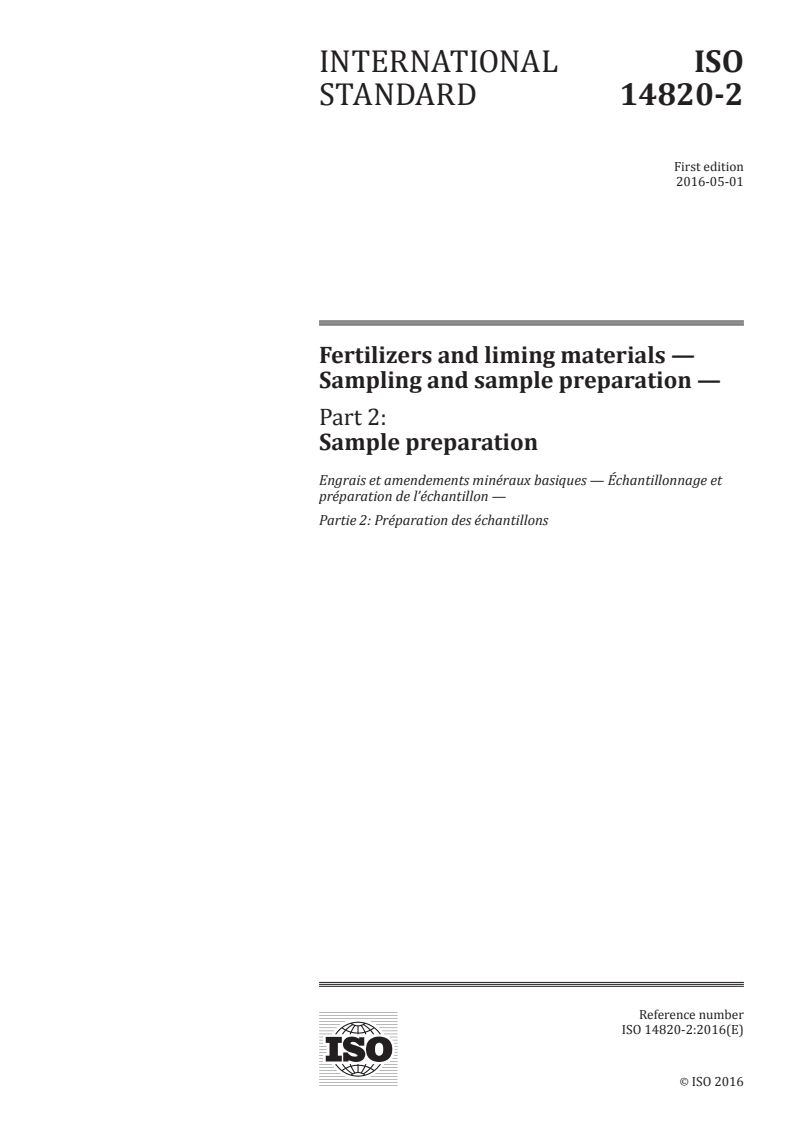
INTERNATIONAL ISO
STANDARD 14820-2
First edition
2016-05-01
Fertilizers and liming materials —
Sampling and sample preparation —
Part 2:
Sample preparation
Engrais et amendements minéraux basiques — Échantillonnage et
préparation de l’échantillon —
Partie 2: Préparation des échantillons
Reference number
©
ISO 2016
© ISO 2016, Published in Switzerland
All rights reserved. Unless otherwise specified, no part of this publication may be reproduced or utilized otherwise in any form
or by any means, electronic or mechanical, including photocopying, or posting on the internet or an intranet, without prior
written permission. Permission can be requested from either ISO at the address below or ISO’s member body in the country of
the requester.
ISO copyright office
Ch. de Blandonnet 8 • CP 401
CH-1214 Vernier, Geneva, Switzerland
Tel. +41 22 749 01 11
Fax +41 22 749 09 47
copyright@iso.org
www.iso.org
ii © ISO 2016 – All rights reserved
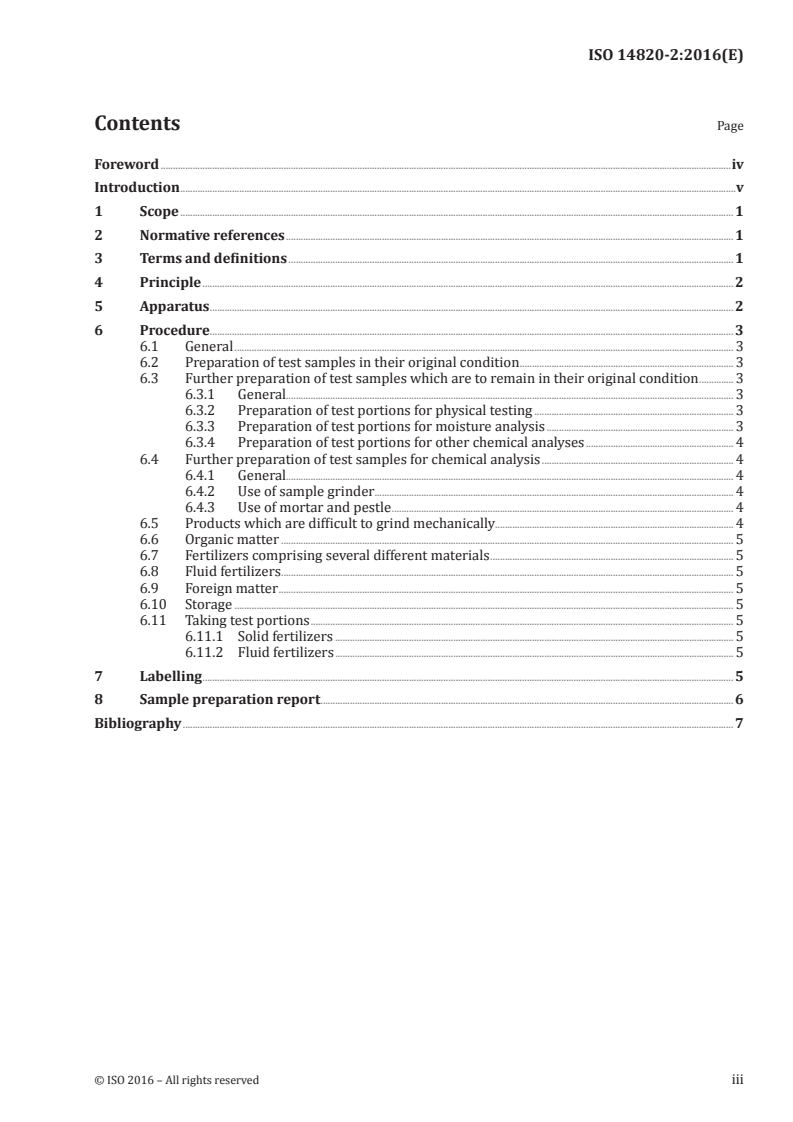
Contents Page
Foreword .iv
Introduction .v
1 Scope . 1
2 Normative references . 1
3 Terms and definitions . 1
4 Principle . 2
5 Apparatus . 2
6 Procedure. 3
6.1 General . 3
6.2 Preparation of test samples in their original condition . 3
6.3 Further preparation of test samples which are to remain in their original condition . 3
6.3.1 General. 3
6.3.2 Preparation of test portions for physical testing . 3
6.3.3 Preparation of test portions for moisture analysis . 3
6.3.4 Preparation of test portions for other chemical analyses . 4
6.4 Further preparation of test samples for chemical analysis . 4
6.4.1 General. 4
6.4.2 Use of sample grinder . . 4
6.4.3 Use of mortar and pestle . 4
6.5 Products which are difficult to grind mechanically. 4
6.6 Organic matter . 5
6.7 Fertilizers comprising several different materials . 5
6.8 Fluid fertilizers . 5
6.9 Foreign matter . 5
6.10 Storage . 5
6.11 Taking test portions . 5
6.11.1 Solid fertilizers . 5
6.11.2 Fluid fertilizers . 5
7 Labelling . 5
8 Sample preparation report . 6
Bibliography . 7
Foreword
ISO (the International Organization for Standardization) is a worldwide federation of national standards
bodies (ISO member bodies). The work of preparing International Standards is normally carried out
through ISO technical committees. Each member body interested in a subject for which a technical
committee has been established has the right to be represented on that committee. International
organizations, governmental and non-governmental, in liaison with ISO, also take part in the work.
ISO collaborates closely with the International Electrotechnical Commission (IEC) on all matters of
electrotechnical standardization.
The procedures used to develop this document and those intended for its further maintenance are
described in the ISO/IEC Directives, Part 1. In particular the different approval criteria needed for the
different types of ISO documents should be noted. This document was drafted in accordance with the
editorial rules of the ISO/IEC Directives, Part 2 (see www.iso.org/directives).
Attention is drawn to the possibility that some of the elements of this document may be the subject of
patent rights. ISO shall not be held responsible for identifying any or all such patent rights. Details of
any patent rights identified during the development of the document will be in the Introduction and/or
on the ISO list of patent declarations received (see www.iso.org/patents).
Any trade name used in this document is information given for the convenience of users and does not
constitute an endorsement.
For an explanation on the meaning of ISO specific terms and expressions related to conformity
assessment, as well as information about ISO’s adherence to the WTO principles in the Technical
Barriers to Trade (TBT) see the following URL: Foreword - Supplementary information
and was adopted without modification other than those stipulated below by ISO/TC 134, Fertilizers and
soil conditioners.
— The EN references (EN 1482-1 and EN 1482-2) have been changed to ISO references (ISO 14820-1
and ISO 14820-2).
— The definition in 3.2 have been modified slightly to align it with that in ISO 8157:2015. ISO 8157 has
been added to the Bibliography.
— Clause 5 has been renumbered.
— In 5.4 (formerly 5.5) and 6.4.2, notes have been changed to full text.
ISO 14820 consists of the following parts, under the general title Fertilizers and liming materials —
Sampling and sample preparation:
— Part 1: Sampling
— Part 2: Sample preparation
iv © ISO 2016 – All rights reserved
Introduction
This part of ISO 14820 covers the following aspects of sample preparation, derived from the
International Standards and documents indicated but presented in a simplified and condensed form.
The titles of these International Standards are given in the Bibliography.
— Reduction and preparation of samples for analysis: ISO 7410, ISO 7742, ISO 8358 and EEC 77/535
(superseded by Regulation (EC) No 2003/2003);
— Sampling reports: ISO 5306 and EEC 77/535 (superseded by Regulation (EC) No 2003/2003).
ISO 14820-1 covers the sampling of fertilizers and liming materials.
Figure 1 gives a schematic diagram of the sampling and sample preparation process for solids.
Figure 1 — Schematic diagram of sampling process for solids
vi © ISO 2016 – All rights reserved
INTERNATIONAL STANDARD ISO 14820-2:2016(E)
Fertilizers and liming materials — Sampling and sample
preparation —
Part 2:
Sample preparation
1 Scope
This part of ISO 14820 specifies methods for the reduction and preparation of samples of fertilizers
and liming materials and sets out the requirements for sample preparation reports. It also specifies
methods for the preparation of test samples and test portions from laboratory samples of fertilizer
for subsequent chemical or physical analysis. It does not cover the preparation of samples for certain
physical tests which require test portions of more than 2 kg. It is applicable to all fertilizers.
NOTE The term “fertilizer” is used throughout the body of this part of ISO 14820 and is taken to include
liming materials unless otherwise indicated.
2 Normative references
The following documents, in whole or in part, are normatively referenced in this document and are
indispensable for its application. For dated references, only the edition cited applies. For undated
references, the latest edition of the referenced document (including any amendments) applies.
ISO 3310-1, Test sieves — Technical requirements and testing — Part 1: Test sieves of metal wire cloth
ISO 14820-1:2016, Fertilizers and liming materials — Sampling and sample preparation — Part 1: Sampling
3 Terms and definitions
For the purposes of this document, the following terms and definitions apply.
3.1
division
process of producing a number of representative smaller portions, approximately equal in mass to each
other, from a larger mass
3.2
final sample
representative part of the reduced sample or, where no intermediate reduction is required, of the
aggregate sample
Note 1 to entry: Often, more than one sample is prepared, at the same time, from the reduced sample (or from
the aggregate sample). One or more of these final samples will be used as a laboratory sample or as laboratory
samples, while others may be stored for reference purposes.
[SOURCE: ISO 8157:2015, 2.6.6]
3.3
laboratory sample
final sample intended for laboratory inspection or testing
3.4
reduction
process of producing a representative smaller mass of fertilizer from a larger mass, with the remainder
being discarded
3.5
test portion
quantity of material taken from the
...
INTERNATIONAL ISO
STANDARD 14820-2
First edition
2016-05-01
Fertilizers and liming materials —
Sampling and sample preparation —
Part 2:
Sample preparation
Engrais et amendements minéraux basiques — Échantillonnage et
préparation de l’échantillon —
Partie 2: Préparation des échantillons
Reference number
©
ISO 2016
© ISO 2016, Published in Switzerland
All rights reserved. Unless otherwise specified, no part of this publication may be reproduced or utilized otherwise in any form
or by any means, electronic or mechanical, including photocopying, or posting on the internet or an intranet, without prior
written permission. Permission can be requested from either ISO at the address below or ISO’s member body in the country of
the requester.
ISO copyright office
Ch. de Blandonnet 8 • CP 401
CH-1214 Vernier, Geneva, Switzerland
Tel. +41 22 749 01 11
Fax +41 22 749 09 47
copyright@iso.org
www.iso.org
ii © ISO 2016 – All rights reserved
Contents Page
Foreword .iv
Introduction .v
1 Scope . 1
2 Normative references . 1
3 Terms and definitions . 1
4 Principle . 2
5 Apparatus . 2
6 Procedure. 3
6.1 General . 3
6.2 Preparation of test samples in their original condition . 3
6.3 Further preparation of test samples which are to remain in their original condition . 3
6.3.1 General. 3
6.3.2 Preparation of test portions for physical testing . 3
6.3.3 Preparation of test portions for moisture analysis . 3
6.3.4 Preparation of test portions for other chemical analyses . 4
6.4 Further preparation of test samples for chemical analysis . 4
6.4.1 General. 4
6.4.2 Use of sample grinder . . 4
6.4.3 Use of mortar and pestle . 4
6.5 Products which are difficult to grind mechanically. 4
6.6 Organic matter . 5
6.7 Fertilizers comprising several different materials . 5
6.8 Fluid fertilizers . 5
6.9 Foreign matter . 5
6.10 Storage . 5
6.11 Taking test portions . 5
6.11.1 Solid fertilizers . 5
6.11.2 Fluid fertilizers . 5
7 Labelling . 5
8 Sample preparation report . 6
Bibliography . 7
Foreword
ISO (the International Organization for Standardization) is a worldwide federation of national standards
bodies (ISO member bodies). The work of preparing International Standards is normally carried out
through ISO technical committees. Each member body interested in a subject for which a technical
committee has been established has the right to be represented on that committee. International
organizations, governmental and non-governmental, in liaison with ISO, also take part in the work.
ISO collaborates closely with the International Electrotechnical Commission (IEC) on all matters of
electrotechnical standardization.
The procedures used to develop this document and those intended for its further maintenance are
described in the ISO/IEC Directives, Part 1. In particular the different approval criteria needed for the
different types of ISO documents should be noted. This document was drafted in accordance with the
editorial rules of the ISO/IEC Directives, Part 2 (see www.iso.org/directives).
Attention is drawn to the possibility that some of the elements of this document may be the subject of
patent rights. ISO shall not be held responsible for identifying any or all such patent rights. Details of
any patent rights identified during the development of the document will be in the Introduction and/or
on the ISO list of patent declarations received (see www.iso.org/patents).
Any trade name used in this document is information given for the convenience of users and does not
constitute an endorsement.
For an explanation on the meaning of ISO specific terms and expressions related to conformity
assessment, as well as information about ISO’s adherence to the WTO principles in the Technical
Barriers to Trade (TBT) see the following URL: Foreword - Supplementary information
and was adopted without modification other than those stipulated below by ISO/TC 134, Fertilizers and
soil conditioners.
— The EN references (EN 1482-1 and EN 1482-2) have been changed to ISO references (ISO 14820-1
and ISO 14820-2).
— The definition in 3.2 have been modified slightly to align it with that in ISO 8157:2015. ISO 8157 has
been added to the Bibliography.
— Clause 5 has been renumbered.
— In 5.4 (formerly 5.5) and 6.4.2, notes have been changed to full text.
ISO 14820 consists of the following parts, under the general title Fertilizers and liming materials —
Sampling and sample preparation:
— Part 1: Sampling
— Part 2: Sample preparation
iv © ISO 2016 – All rights reserved
Introduction
This part of ISO 14820 covers the following aspects of sample preparation, derived from the
International Standards and documents indicated but presented in a simplified and condensed form.
The titles of these International Standards are given in the Bibliography.
— Reduction and preparation of samples for analysis: ISO 7410, ISO 7742, ISO 8358 and EEC 77/535
(superseded by Regulation (EC) No 2003/2003);
— Sampling reports: ISO 5306 and EEC 77/535 (superseded by Regulation (EC) No 2003/2003).
ISO 14820-1 covers the sampling of fertilizers and liming materials.
Figure 1 gives a schematic diagram of the sampling and sample preparation process for solids.
Figure 1 — Schematic diagram of sampling process for solids
vi © ISO 2016 – All rights reserved
INTERNATIONAL STANDARD ISO 14820-2:2016(E)
Fertilizers and liming materials — Sampling and sample
preparation —
Part 2:
Sample preparation
1 Scope
This part of ISO 14820 specifies methods for the reduction and preparation of samples of fertilizers
and liming materials and sets out the requirements for sample preparation reports. It also specifies
methods for the preparation of test samples and test portions from laboratory samples of fertilizer
for subsequent chemical or physical analysis. It does not cover the preparation of samples for certain
physical tests which require test portions of more than 2 kg. It is applicable to all fertilizers.
NOTE The term “fertilizer” is used throughout the body of this part of ISO 14820 and is taken to include
liming materials unless otherwise indicated.
2 Normative references
The following documents, in whole or in part, are normatively referenced in this document and are
indispensable for its application. For dated references, only the edition cited applies. For undated
references, the latest edition of the referenced document (including any amendments) applies.
ISO 3310-1, Test sieves — Technical requirements and testing — Part 1: Test sieves of metal wire cloth
ISO 14820-1:2016, Fertilizers and liming materials — Sampling and sample preparation — Part 1: Sampling
3 Terms and definitions
For the purposes of this document, the following terms and definitions apply.
3.1
division
process of producing a number of representative smaller portions, approximately equal in mass to each
other, from a larger mass
3.2
final sample
representative part of the reduced sample or, where no intermediate reduction is required, of the
aggregate sample
Note 1 to entry: Often, more than one sample is prepared, at the same time, from the reduced sample (or from
the aggregate sample). One or more of these final samples will be used as a laboratory sample or as laboratory
samples, while others may be stored for reference purposes.
[SOURCE: ISO 8157:2015, 2.6.6]
3.3
laboratory sample
final sample intended for laboratory inspection or testing
3.4
reduction
process of producing a representative smaller mass of fertilizer from a larger mass, with the remainder
being discarded
3.5
test portion
quantity of material taken from the
...
NORME ISO
INTERNATIONALE 14820-2
Première édition
2016-05-01
Engrais et amendements minéraux
basiques — Échantillonnage et
préparation de l'échantillon —
Partie 2:
Préparation des échantillons
Fertilizers and liming materials — Sampling and sample
preparation —
Part 2: Sample preparation
Numéro de référence
©
ISO 2016
DOCUMENT PROTÉGÉ PAR COPYRIGHT
© ISO 2016
Tous droits réservés. Sauf prescription différente ou nécessité dans le contexte de sa mise en œuvre, aucune partie de cette
publication ne peut être reproduite ni utilisée sous quelque forme que ce soit et par aucun procédé, électronique ou mécanique,
y compris la photocopie, ou la diffusion sur l’internet ou sur un intranet, sans autorisation écrite préalable. Une autorisation peut
être demandée à l’ISO à l’adresse ci-après ou au comité membre de l’ISO dans le pays du demandeur.
ISO copyright office
Case postale 401 • Ch. de Blandonnet 8
CH-1214 Vernier, Genève
Tél.: +41 22 749 01 11
Fax: +41 22 749 09 47
E-mail: copyright@iso.org
Web: www.iso.org
Publié en Suisse
ii © ISO 2016 – Tous droits réservés
Sommaire Page
Avant-propos .iv
Introduction .v
1 Domaine d'application . 1
2 Références normatives . 1
3 Termes et définitions . 1
4 Principe . 2
5 Appareillage . 2
6 Mode opératoire. 3
6.1 Généralités . 3
6.2 Préparation d’échantillons d’essai dans leur état d’origine . 3
6.3 Préparation supplémentaire d’échantillons d’essai destinés à rester dans leur état
d’origine . 3
6.3.1 Généralités . 3
6.3.2 Préparation de prises d’essai pour essais physiques . 3
6.3.3 Préparation de prises d’essai pour analyse de l’humidité . 4
6.3.4 Préparation de prises d’essai pour autres analyses chimiques . 4
6.4 Préparation supplémentaire d’échantillons d’essai pour analyse chimique . 4
6.4.1 Généralités . 4
6.4.2 Utilisation du broyeur d’échantillon . 4
6.4.3 Utilisation d’un broyeur mortier-pilon . 5
6.5 Produits difficiles à broyer mécaniquement . 5
6.6 Matière organique . 5
6.7 Engrais composés de plusieurs matières différentes . 5
6.8 Engrais liquides . 5
6.9 Corps étrangers . 5
6.10 Stockage . 5
6.11 Prélèvement des prises d’essai . 5
6.11.1 Engrais solides . 5
6.11.2 Engrais liquides . 6
7 Étiquetage . 6
8 Rapport de préparation de l’échantillon . 6
Bibliographie . 7
Avant-propos
L'ISO (Organisation internationale de normalisation) est une fédération mondiale d'organismes
nationaux de normalisation (comités membres de l'ISO). L'élaboration des Normes internationales est
en général confiée aux comités techniques de l'ISO. Chaque comité membre intéressé par une étude
a le droit de faire partie du comité technique créé à cet effet. Les organisations internationales,
gouvernementales et non gouvernementales, en liaison avec l'ISO participent également aux travaux.
L'ISO collabore étroitement avec la Commission électrotechnique internationale (IEC) en ce qui
concerne la normalisation électrotechnique.
Les procédures utilisées pour élaborer le présent document et celles destinées à sa mise à jour sont
décrites dans les Directives ISO/IEC, Partie 1. Il convient, en particulier de prendre note des différents
critères d'approbation requis pour les différents types de documents ISO. Le présent document a été
rédigé conformément aux règles de rédaction données dans les Directives ISO/IEC, Partie 2 (voir www
.iso .org/directives).
L'attention est appelée sur le fait que certains des éléments du présent document peuvent faire l'objet de
droits de propriété intellectuelle ou de droits analogues. L'ISO ne saurait être tenue pour responsable
de ne pas avoir identifié de tels droits de propriété et averti de leur existence. Les détails concernant
les références aux droits de propriété intellectuelle ou autres droits analogues identifiés lors de
l'élaboration du document sont indiqués dans l'Introduction et/ou dans la liste des déclarations de
brevets reçues par l’ISO (voir www .iso .org/brevets).
Les appellations commerciales éventuellement mentionnées dans le présent document sont données
pour information, par souci de commodité à l'intention des utilisateurs et ne sauraient constituer un
engagement.
Pour une explication de la signification des termes et expressions spécifiques de l'ISO liés à l'évaluation
de la conformité, ou pour toute information au sujet de l'adhésion de l'ISO aux principes de l'Organisation
mondiale du commerce (OMC) concernant les obstacles techniques au commerce (OTC) voir le lien
suivant: www .iso .org/iso/fr/foreword .html.
L’ISO 14820-2:2016 a été préparée par le CEN/TC 260, Engrais et amendements minéraux basiques (en
tant que EN 1482-2:2007) et a été adoptée sans aucune autre modification que celles stipulées par
l’ISO/TC 134, Engrais et amendements.
— Les références EN (EN 1482-1 et EN 1482-2) ont été remplacées par les références ISO (ISO 14820-1
et ISO 14820-2).
— La définition en 3.2 a été légèrement modifiée pour s’aligner avec celle de l’ISO 8157:2015. L’ISO 8157
a été ajoutée à la Bibliographie.
— L'Article 5 a été renuméroté.
— En 5.4 (anciennement 5.5) et 6.4.2, les notes ont été intégrées au texte.
L’ISO 14820 est constituée des parties suivantes, sous le titre général Engrais et amendements minéraux
basiques — Échantillonnage et préparation de l’échantillon:
— Partie 1: Échantillonnage
— Partie 2: Préparation de l’échantillon
iv © ISO 2016 – Tous droits réservés
Introduction
La présente partie de l’ISO 14820 couvre les aspects suivants de l’échantillonnage, en se basant sur les
Normes internationales et les documents cités mais présentés sous une forme simplifiée et condensée.
Les titres de ces Normes Internationales sont donnés dans la Bibliographie.
— Réduction et préparation d’échantillons destinés à l’analyse: ISO 7410, ISO 7742, ISO 8358 et
CEE 77/535 (remplacé par le Règlement (CE) No 2003/2003);
— Rapports d’échantillonnage: ISO 5306 et CEE 77/535 (remplacé par le Règlement (CE) No 2003/2003).
L’ISO 14820-1 traite de l’échantillonnage des engrais et des amendements minéraux basiques.
La Figure 1 présente un schéma du procédé d’échantillonnage et de préparation de l’échantillon pour
les solides.o
Figure 1 — Schéma du procédé d’échantillonnage pour les solides
vi © ISO 2016 – Tous droits réservés
NORME INTERNATIONALE ISO 14820-2:2016(F)
Engrais et amendements minéraux basiques —
Échantillonnage et préparation de l'échantillon —
Partie 2:
Préparation des échantillons
1 Domaine d'application
La présente partie de l’ISO 14820 spécifie des méthodes de réduction et de préparation des
échantillons d’engrais et amendements minéraux basiques et établit les exigences relatives aux
rapports d’échantillonnage. Elle spécifie également des méthodes de préparation d’échantillons d’essai
et de prises d’essai issues d’échantillons de laboratoire des engrais en vue d’une analyse physique ou
chimique ultérieure. La présente norme ne couvre pas la préparation d’échantillons destinés à certains
essais physiques nécessitant l’obtention de prises d’essai d’une masse supérieure à 2 kg. Elle s’applique
à tous les engrais.
NOTE Le terme «engrais» est utilisé tout au long de la présente partie de l’ISO 14820 et prend en compte les
amendements minéraux basiques, sauf indication contraire.
2 Références normatives
Les documents suivants, en tout ou partie, sont référencés de façon normative dans le présent document
et sont indispensables à son application. Pour les références datées, seule l'édition citée s'applique.
Pour les références non datées, la dernière édition du document de référence s'applique (y compris les
éventuels amendements).
ISO 3310-1, Tamis de contrôle — Exigences techniques et vérifications — Partie 1: Tamis de contrôle en
tissus métalliques
ISO 14820-1:2016, Engrais et amendements minéraux basiques — Échantillonnage et préparation de
l’échantillon — Partie 1: Échantillonnage
3 Termes et définitions
Pour les besoins du présent document, les termes et définitions suivants s'appliquent.
3.1
division
procédé de production d’un certain nombre de portions représentatives de plus petite taille, environ de
même masse, à partir d’une masse plus importante
3.2
échantillon final
partie représentative de l’échantillon réduit ou, lorsque aucune réduction intermédiaire n’est nécessaire,
de l’échantillon global
Note 1 à l'article: Souvent, plus d’un échantillon est préparé en même temps à partir de l’échantillon réduit
(ou à partir de l’échantillon global). L’un ou plusieurs de ces échantillons finals sera (seront) utilisé(s) comme
échantillon(s) pour laboratoire, les autres pouvant être stockés pour servir de référence.
[SOURCE: ISO 8157:2015, 2.6.6]
3.3
échantillon pour laboratoire
échantillon final destiné aux contrôles ou aux essais de laboratoire
3.4
réduction
procédé consistant à produire une masse représentative moins importante d’engrais, à partir d’une
masse plus importante, le reste étant mis au rebut
3.5
prise d’essai
quantité de matière prélevée sur l’échantillon d’essai (ou sur l’échantillon pour laboratoire, s’il s’agit du
même) et sur laquelle est réellement mené(e) l’essai ou l’observation
3.6
échantillon d’essai
échantillon préparé à partir d’un échantillon pour laboratoire et sur lequel seront prélevées les
prises d’essai
4 Principe
Réduction et division de l’échantillon pour laboratoire, selon ce qui est nécessaire, en vue de produire
des échantillons d’essai. Préparation de prises d’essai à partir d’échantillons d’essai par le biais d’une
division, avec ou sans broyage préalable, ou d’une combinaison, selo
...
NORME ISO
INTERNATIONALE 14820-2
Première édition
2016-05-01
Engrais et amendements minéraux
basiques — Échantillonnage et
préparation de l'échantillon —
Partie 2:
Préparation des échantillons
Fertilizers and liming materials — Sampling and sample
preparation —
Part 2: Sample preparation
Numéro de référence
©
ISO 2016
DOCUMENT PROTÉGÉ PAR COPYRIGHT
© ISO 2016
Tous droits réservés. Sauf prescription différente ou nécessité dans le contexte de sa mise en œuvre, aucune partie de cette
publication ne peut être reproduite ni utilisée sous quelque forme que ce soit et par aucun procédé, électronique ou mécanique,
y compris la photocopie, ou la diffusion sur l’internet ou sur un intranet, sans autorisation écrite préalable. Une autorisation peut
être demandée à l’ISO à l’adresse ci-après ou au comité membre de l’ISO dans le pays du demandeur.
ISO copyright office
Case postale 401 • Ch. de Blandonnet 8
CH-1214 Vernier, Genève
Tél.: +41 22 749 01 11
Fax: +41 22 749 09 47
E-mail: copyright@iso.org
Web: www.iso.org
Publié en Suisse
ii © ISO 2016 – Tous droits réservés
Sommaire Page
Avant-propos .iv
Introduction .v
1 Domaine d'application . 1
2 Références normatives . 1
3 Termes et définitions . 1
4 Principe . 2
5 Appareillage . 2
6 Mode opératoire. 3
6.1 Généralités . 3
6.2 Préparation d’échantillons d’essai dans leur état d’origine . 3
6.3 Préparation supplémentaire d’échantillons d’essai destinés à rester dans leur état
d’origine . 3
6.3.1 Généralités . 3
6.3.2 Préparation de prises d’essai pour essais physiques . 3
6.3.3 Préparation de prises d’essai pour analyse de l’humidité . 4
6.3.4 Préparation de prises d’essai pour autres analyses chimiques . 4
6.4 Préparation supplémentaire d’échantillons d’essai pour analyse chimique . 4
6.4.1 Généralités . 4
6.4.2 Utilisation du broyeur d’échantillon . 4
6.4.3 Utilisation d’un broyeur mortier-pilon . 5
6.5 Produits difficiles à broyer mécaniquement . 5
6.6 Matière organique . 5
6.7 Engrais composés de plusieurs matières différentes . 5
6.8 Engrais liquides . 5
6.9 Corps étrangers . 5
6.10 Stockage . 5
6.11 Prélèvement des prises d’essai . 5
6.11.1 Engrais solides . 5
6.11.2 Engrais liquides . 6
7 Étiquetage . 6
8 Rapport de préparation de l’échantillon . 6
Bibliographie . 7
Avant-propos
L'ISO (Organisation internationale de normalisation) est une fédération mondiale d'organismes
nationaux de normalisation (comités membres de l'ISO). L'élaboration des Normes internationales est
en général confiée aux comités techniques de l'ISO. Chaque comité membre intéressé par une étude
a le droit de faire partie du comité technique créé à cet effet. Les organisations internationales,
gouvernementales et non gouvernementales, en liaison avec l'ISO participent également aux travaux.
L'ISO collabore étroitement avec la Commission électrotechnique internationale (IEC) en ce qui
concerne la normalisation électrotechnique.
Les procédures utilisées pour élaborer le présent document et celles destinées à sa mise à jour sont
décrites dans les Directives ISO/IEC, Partie 1. Il convient, en particulier de prendre note des différents
critères d'approbation requis pour les différents types de documents ISO. Le présent document a été
rédigé conformément aux règles de rédaction données dans les Directives ISO/IEC, Partie 2 (voir www
.iso .org/directives).
L'attention est appelée sur le fait que certains des éléments du présent document peuvent faire l'objet de
droits de propriété intellectuelle ou de droits analogues. L'ISO ne saurait être tenue pour responsable
de ne pas avoir identifié de tels droits de propriété et averti de leur existence. Les détails concernant
les références aux droits de propriété intellectuelle ou autres droits analogues identifiés lors de
l'élaboration du document sont indiqués dans l'Introduction et/ou dans la liste des déclarations de
brevets reçues par l’ISO (voir www .iso .org/brevets).
Les appellations commerciales éventuellement mentionnées dans le présent document sont données
pour information, par souci de commodité à l'intention des utilisateurs et ne sauraient constituer un
engagement.
Pour une explication de la signification des termes et expressions spécifiques de l'ISO liés à l'évaluation
de la conformité, ou pour toute information au sujet de l'adhésion de l'ISO aux principes de l'Organisation
mondiale du commerce (OMC) concernant les obstacles techniques au commerce (OTC) voir le lien
suivant: www .iso .org/iso/fr/foreword .html.
L’ISO 14820-2:2016 a été préparée par le CEN/TC 260, Engrais et amendements minéraux basiques (en
tant que EN 1482-2:2007) et a été adoptée sans aucune autre modification que celles stipulées par
l’ISO/TC 134, Engrais et amendements.
— Les références EN (EN 1482-1 et EN 1482-2) ont été remplacées par les références ISO (ISO 14820-1
et ISO 14820-2).
— La définition en 3.2 a été légèrement modifiée pour s’aligner avec celle de l’ISO 8157:2015. L’ISO 8157
a été ajoutée à la Bibliographie.
— L'Article 5 a été renuméroté.
— En 5.4 (anciennement 5.5) et 6.4.2, les notes ont été intégrées au texte.
L’ISO 14820 est constituée des parties suivantes, sous le titre général Engrais et amendements minéraux
basiques — Échantillonnage et préparation de l’échantillon:
— Partie 1: Échantillonnage
— Partie 2: Préparation de l’échantillon
iv © ISO 2016 – Tous droits réservés
Introduction
La présente partie de l’ISO 14820 couvre les aspects suivants de l’échantillonnage, en se basant sur les
Normes internationales et les documents cités mais présentés sous une forme simplifiée et condensée.
Les titres de ces Normes Internationales sont donnés dans la Bibliographie.
— Réduction et préparation d’échantillons destinés à l’analyse: ISO 7410, ISO 7742, ISO 8358 et
CEE 77/535 (remplacé par le Règlement (CE) No 2003/2003);
— Rapports d’échantillonnage: ISO 5306 et CEE 77/535 (remplacé par le Règlement (CE) No 2003/2003).
L’ISO 14820-1 traite de l’échantillonnage des engrais et des amendements minéraux basiques.
La Figure 1 présente un schéma du procédé d’échantillonnage et de préparation de l’échantillon pour
les solides.o
Figure 1 — Schéma du procédé d’échantillonnage pour les solides
vi © ISO 2016 – Tous droits réservés
NORME INTERNATIONALE ISO 14820-2:2016(F)
Engrais et amendements minéraux basiques —
Échantillonnage et préparation de l'échantillon —
Partie 2:
Préparation des échantillons
1 Domaine d'application
La présente partie de l’ISO 14820 spécifie des méthodes de réduction et de préparation des
échantillons d’engrais et amendements minéraux basiques et établit les exigences relatives aux
rapports d’échantillonnage. Elle spécifie également des méthodes de préparation d’échantillons d’essai
et de prises d’essai issues d’échantillons de laboratoire des engrais en vue d’une analyse physique ou
chimique ultérieure. La présente norme ne couvre pas la préparation d’échantillons destinés à certains
essais physiques nécessitant l’obtention de prises d’essai d’une masse supérieure à 2 kg. Elle s’applique
à tous les engrais.
NOTE Le terme «engrais» est utilisé tout au long de la présente partie de l’ISO 14820 et prend en compte les
amendements minéraux basiques, sauf indication contraire.
2 Références normatives
Les documents suivants, en tout ou partie, sont référencés de façon normative dans le présent document
et sont indispensables à son application. Pour les références datées, seule l'édition citée s'applique.
Pour les références non datées, la dernière édition du document de référence s'applique (y compris les
éventuels amendements).
ISO 3310-1, Tamis de contrôle — Exigences techniques et vérifications — Partie 1: Tamis de contrôle en
tissus métalliques
ISO 14820-1:2016, Engrais et amendements minéraux basiques — Échantillonnage et préparation de
l’échantillon — Partie 1: Échantillonnage
3 Termes et définitions
Pour les besoins du présent document, les termes et définitions suivants s'appliquent.
3.1
division
procédé de production d’un certain nombre de portions représentatives de plus petite taille, environ de
même masse, à partir d’une masse plus importante
3.2
échantillon final
partie représentative de l’échantillon réduit ou, lorsque aucune réduction intermédiaire n’est nécessaire,
de l’échantillon global
Note 1 à l'article: Souvent, plus d’un échantillon est préparé en même temps à partir de l’échantillon réduit
(ou à partir de l’échantillon global). L’un ou plusieurs de ces échantillons finals sera (seront) utilisé(s) comme
échantillon(s) pour laboratoire, les autres pouvant être stockés pour servir de référence.
[SOURCE: ISO 8157:2015, 2.6.6]
3.3
échantillon pour laboratoire
échantillon final destiné aux contrôles ou aux essais de laboratoire
3.4
réduction
procédé consistant à produire une masse représentative moins importante d’engrais, à partir d’une
masse plus importante, le reste étant mis au rebut
3.5
prise d’essai
quantité de matière prélevée sur l’échantillon d’essai (ou sur l’échantillon pour laboratoire, s’il s’agit du
même) et sur laquelle est réellement mené(e) l’essai ou l’observation
3.6
échantillon d’essai
échantillon préparé à partir d’un échantillon pour laboratoire et sur lequel seront prélevées les
prises d’essai
4 Principe
Réduction et division de l’échantillon pour laboratoire, selon ce qui est nécessaire, en vue de produire
des échantillons d’essai. Préparation de prises d’essai à partir d’échantillons d’essai par le biais d’une
division, avec ou sans broyage préalable, ou d’une combinaison, selo
...