


ISO/IEC/IEEE 24748-2:2024
(Main)Systems and software engineering — Life cycle management — Part 2: Guidelines for the application of ISO/IEC/IEEE 15288 (system life cycle processes)
Systems and software engineering — Life cycle management — Part 2: Guidelines for the application of ISO/IEC/IEEE 15288 (system life cycle processes)
The proposed project is a revision of ISO/IEC/IEEE 24748-2:2018, Systems and software engineering — Life cycle management — Part 2: Guidelines for the application of ISO/IEC/IEEE 15288 (System life cycle processes). There are no scope changes. ISO/IEC/IEEE 24748-2 is a guideline for the application of ISO/IEC/IEEE 15288. It addresses system, life cycle, organizational, project, and process, concept application, principally through reference to ISO/IEC/IEEE 24748-1 and ISO/IEC/IEEE 15288. It gives guidance on applying ISO/IEC/IEEE 15288 from the aspects of strategy, planning, application in organizations, and application on projects. It also provides comparison of the differences between ISO/IEC/IEEE 15288 current revision and the prior version, ISO/IEC 15288:2015.
Ingénierie des systèmes et du logiciel — Gestion du cycle de vie — Partie 2: Lignes directrices pour l'application de l'ISO/IEC/IEEE 15288 (processus du cycle de vie du système)
General Information
- Status
- Published
- Publication Date
- 14-Mar-2024
- Technical Committee
- ISO/IEC JTC 1/SC 7 - Software and systems engineering
- Drafting Committee
- ISO/IEC JTC 1/SC 7 - Software and systems engineering
- Current Stage
- 6060 - International Standard published
- Start Date
- 15-Mar-2024
- Due Date
- 24-Jun-2025
- Completion Date
- 15-Mar-2024
Relations
- Effective Date
- 06-Jun-2022
Overview
ISO/IEC/IEEE 24748-2:2024 - Systems and software engineering - Life cycle management - Part 2: Guidelines for the application of ISO/IEC/IEEE 15288 (system life cycle processes) - is a guidance standard for applying the system life cycle processes defined in ISO/IEC/IEEE 15288. The second edition updates and expands the 2018 guidance without changing scope, helping organizations and projects implement life‑cycle, organizational, project and process concepts. It focuses on practical application from strategy and planning through institutionalization, and includes a comparison between ISO/IEC/IEEE 15288:2023 and the prior 2015 version.
Key topics and technical guidance
- Application strategy and planning: guidance on planning adoption, running pilot projects, formalizing and institutionalizing life‑cycle processes.
- System concepts and structure: advice on defining systems, system structure, and how structures map to projects.
- Interfacing, enabling and interoperating systems: reworked guidance and an informative Annex B example to manage system interactions.
- Life‑cycle concepts and decision gates: practical treatment of life‑cycle stages, decision gates and application approaches across projects.
- Organizational and project application: how to use ISO/IEC/IEEE 15288 within organizations, including management commitment, methods, tools and considerations for adoption.
- Process application: detailed guidance on applying agreement processes, organizational project‑enabling processes, technical management processes and technical processes per ISO/IEC/IEEE 15288.
- Conformance and adaptation: principles for conforming to and adapting 15288 processes to organizational needs.
- Contemporary practices: added considerations for agile and DevOps approaches and an informative Annex C on model‑based systems and software engineering (MBSSE).
- Change summary: Annex A summarizes typical revisions from ISO/IEC/IEEE 15288:2015 to the 2023 revision.
Practical applications - who uses it
- Systems engineers and architects seeking practical guidance to apply ISO/IEC/IEEE 15288 in product development.
- Program and project managers implementing life‑cycle governance, decision gates and project processes.
- Process improvement, quality and configuration managers aligning organizational processes with international life‑cycle best practices.
- Acquirers and suppliers aiming to harmonize contractual and technical processes for system acquisition and delivery.
- Organizations adopting MBSSE, agile/DevOps practices, or integrating systems and software life‑cycle management.
Related standards and alignment
- Directly supports and complements ISO/IEC/IEEE 15288 (system life cycle processes) and aligns with ISO/IEC/IEEE 24748-1 (life‑cycle management concepts).
- Companion guidance: ISO/IEC/IEEE 24748-3 (application of ISO/IEC/IEEE 12207 for software life cycle processes).
- For defence‑specific systems engineering see ISO/IEC/IEEE 24748-7.
Keywords: ISO/IEC/IEEE 24748-2:2024, life cycle management, ISO/IEC/IEEE 15288, systems engineering, system life cycle processes, model‑based systems engineering, agile, DevOps, process adaptation.


Get Certified
Connect with accredited certification bodies for this standard

BSI Group
BSI (British Standards Institution) is the business standards company that helps organizations make excellence a habit.

BSCIC Certifications Pvt. Ltd.
Established 2006, accredited by NABCB, JAS-ANZ, EIAC, IAS. CDSCO Notified Body.

Intertek India Pvt. Ltd.
Delivers Assurance, Testing, Inspection & Certification since 1993 with 26 labs and 32 offices.
Sponsored listings
Frequently Asked Questions
ISO/IEC/IEEE 24748-2:2024 is a standard published by the International Organization for Standardization (ISO). Its full title is "Systems and software engineering — Life cycle management — Part 2: Guidelines for the application of ISO/IEC/IEEE 15288 (system life cycle processes)". This standard covers: The proposed project is a revision of ISO/IEC/IEEE 24748-2:2018, Systems and software engineering — Life cycle management — Part 2: Guidelines for the application of ISO/IEC/IEEE 15288 (System life cycle processes). There are no scope changes. ISO/IEC/IEEE 24748-2 is a guideline for the application of ISO/IEC/IEEE 15288. It addresses system, life cycle, organizational, project, and process, concept application, principally through reference to ISO/IEC/IEEE 24748-1 and ISO/IEC/IEEE 15288. It gives guidance on applying ISO/IEC/IEEE 15288 from the aspects of strategy, planning, application in organizations, and application on projects. It also provides comparison of the differences between ISO/IEC/IEEE 15288 current revision and the prior version, ISO/IEC 15288:2015.
The proposed project is a revision of ISO/IEC/IEEE 24748-2:2018, Systems and software engineering — Life cycle management — Part 2: Guidelines for the application of ISO/IEC/IEEE 15288 (System life cycle processes). There are no scope changes. ISO/IEC/IEEE 24748-2 is a guideline for the application of ISO/IEC/IEEE 15288. It addresses system, life cycle, organizational, project, and process, concept application, principally through reference to ISO/IEC/IEEE 24748-1 and ISO/IEC/IEEE 15288. It gives guidance on applying ISO/IEC/IEEE 15288 from the aspects of strategy, planning, application in organizations, and application on projects. It also provides comparison of the differences between ISO/IEC/IEEE 15288 current revision and the prior version, ISO/IEC 15288:2015.
ISO/IEC/IEEE 24748-2:2024 is classified under the following ICS (International Classification for Standards) categories: 35.080 - Software. The ICS classification helps identify the subject area and facilitates finding related standards.
ISO/IEC/IEEE 24748-2:2024 has the following relationships with other standards: It is inter standard links to ISO/IEC/IEEE 24748-2:2018. Understanding these relationships helps ensure you are using the most current and applicable version of the standard.
ISO/IEC/IEEE 24748-2:2024 is available in PDF format for immediate download after purchase. The document can be added to your cart and obtained through the secure checkout process. Digital delivery ensures instant access to the complete standard document.
Standards Content (Sample)
International
Standard
ISO/IEC/IEEE
24748-2
Second edition
Systems and software
2024-03
engineering — Life cycle
management —
Part 2:
Guidelines for the application of
ISO/IEC/IEEE 15288 (system life
cycle processes)
Ingénierie des systèmes et du logiciel — Gestion du cycle de vie —
Partie 2: Lignes directrices pour l'application de l'ISO/IEC/IEEE
15288 (processus du cycle de vie du système)
Reference number © ISO/IEC 2024
© ISO/IEC 2024
© IEEE 2024
All rights reserved. Unless otherwise specified, or required in the context of its implementation, no part of this publication may
be reproduced or utilized otherwise in any form or by any means, electronic or mechanical, including photocopying, or posting
on the internet or an intranet, without prior written permission. Permission can be requested from either ISO or IEEE at the
respective address below or ISO’s member body in the country of the requester.
ISO copyright office Institute of Electrical and Electronics Engineers, Inc
CP 401 • Ch. de Blandonnet 8 3 Park Avenue, New York
CH-1214 Vernier, Geneva NY 10016-5997, USA
Phone: +41 22 749 01 11
Email: copyright@iso.org Email: stds.ipr@ieee.org
Website: www.iso.org Website: www.ieee.org
Published in Switzerland
© ISO/IEC 2024 – All rights reserved
© IEEE 2024 – All rights reserved
ii
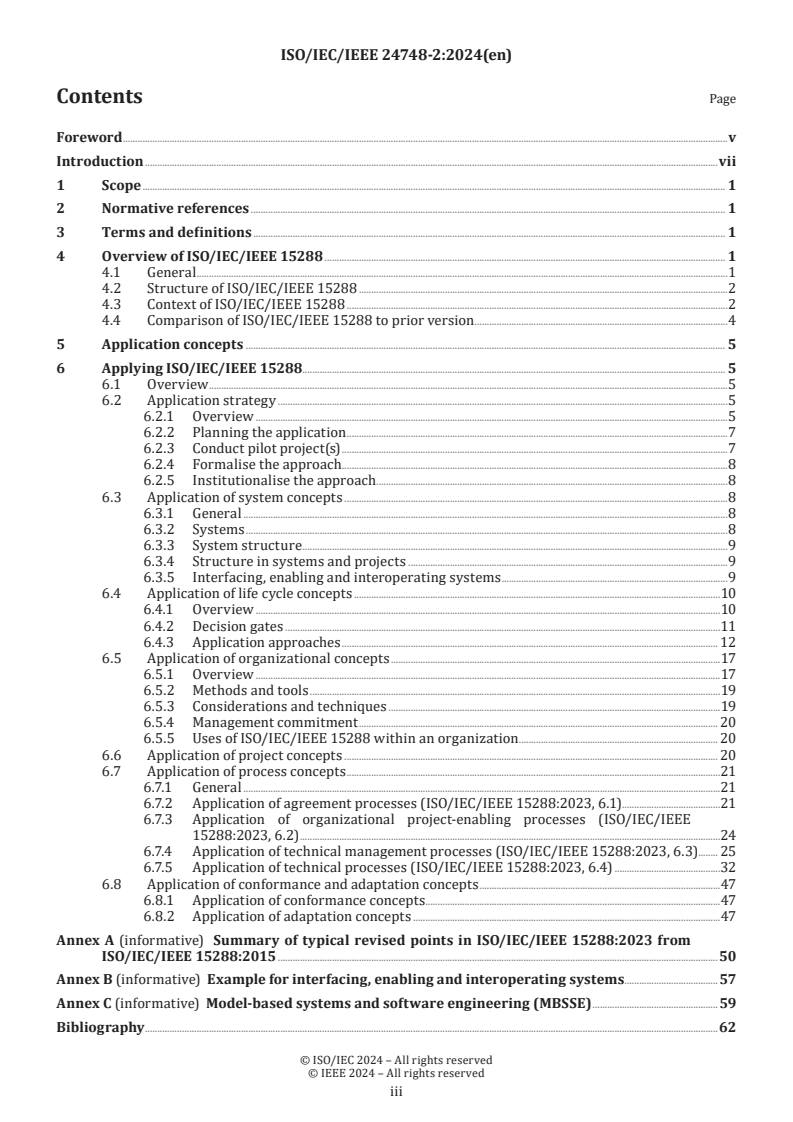
Contents Page
Foreword .v
Introduction .vii
1 Scope . 1
2 Normative references . 1
3 Terms and definitions . 1
4 Overview of ISO/IEC/IEEE 15288 . 1
4.1 General .1
4.2 Structure of ISO/IEC/IEEE 15288 .2
4.3 Context of ISO/IEC/IEEE 15288 .2
4.4 Comparison of ISO/IEC/IEEE 15288 to prior version .4
5 Application concepts . 5
6 Applying ISO/IEC/IEEE 15288. 5
6.1 Overview .5
6.2 Application strategy .5
6.2.1 Overview .5
6.2.2 Planning the application .7
6.2.3 Conduct pilot project(s) .7
6.2.4 Formalise the approach . .8
6.2.5 Institutionalise the approach .8
6.3 Application of system concepts .8
6.3.1 General .8
6.3.2 Systems .8
6.3.3 System structure .9
6.3.4 Structure in systems and projects .9
6.3.5 Interfacing, enabling and interoperating systems .9
6.4 Application of life cycle concepts .10
6.4.1 Overview .10
6.4.2 Decision gates .11
6.4.3 Application approaches . 12
6.5 Application of organizational concepts .17
6.5.1 Overview .17
6.5.2 Methods and tools .19
6.5.3 Considerations and techniques .19
6.5.4 Management commitment . 20
6.5.5 Uses of ISO/IEC/IEEE 15288 within an organization . 20
6.6 Application of project concepts . 20
6.7 Application of process concepts .21
6.7.1 General .21
6.7.2 Application of agreement processes (ISO/IEC/IEEE 15288:2023, 6.1) .21
6.7.3 Application of organizational project-enabling processes (ISO/IEC/IEEE
15288:2023, 6.2) .24
6.7.4 Application of technical management processes (ISO/IEC/IEEE 15288:2023, 6.3) . 25
6.7.5 Application of technical processes (ISO/IEC/IEEE 15288:2023, 6.4) .32
6.8 Application of conformance and adaptation concepts .47
6.8.1 Application of conformance concepts.47
6.8.2 Application of adaptation concepts .47
Annex A (informative) Summary of typical revised points in ISO/IEC/IEEE 15288:2023 from
ISO/IEC/IEEE 15288:2015 .50
Annex B (informative) Example for interfacing, enabling and interoperating systems .57
Annex C (informative) Model-based systems and software engineering (MBSSE) .59
Bibliography .62
© ISO/IEC 2024 – All rights reserved
© IEEE 2024 – All rights reserved
iii
IEEE notices and abstract .64
© ISO/IEC 2024 – All rights reserved
© IEEE 2024 – All rights reserved
iv
Foreword
ISO (the International Organization for Standardization) and IEC (the International Electrotechnical
Commission) form the specialized system for worldwide standardization. National bodies that are
members of ISO or IEC participate in the development of International Standards through technical
committees established by the respective organization to deal with particular fields of technical activity.
ISO and IEC technical committees collaborate in fields of mutual interest. Other international organizations,
governmental and non-governmental, in liaison with ISO and IEC, also take part in the work.
The procedures used to develop this document and those intended for its further maintenance are described
in the ISO/IEC Directives, Part 1. In particular, the different approval criteria needed for the different types
of document should be noted. This document was drafted in accordance with the editorial rules of the ISO/
IEC Directives, Part 2 (see www.iso.org/directives or www.iec.ch/members_experts/refdocs).
IEEE Standards documents are developed within the IEEE Societies and the Standards Coordinating
Committees of the IEEE Standards Association (IEEE-SA) Standards Board. The IEEE develops its standards
through a consensus development process, approved by the American National Standards Institute, which
brings together volunteers representing varied viewpoints and interests to achieve the final product.
Volunteers are not necessarily members of the Institute and serve without compensation. While the IEEE
administers the process and establishes rules to promote fairness in the consensus development process,
the IEEE does not independently evaluate, test or verify the accuracy of any of the information contained in
its standards.
ISO and IEC draw attention to the possibility that the implementation of this document may involve the
use of (a) patent(s). ISO and IEC take no position concerning the evidence, validity or applicability of any
claimed patent rights in respect thereof. As of the date of publication of this document, ISO and IEC had not
received notice of (a) patent(s) which may be required to implement this document. However, implementers
are cautioned that this may not represent the latest information, which may be obtained from the patent
database available at www.iso.org/patents and https://patents.iec.ch. ISO and IEC shall not be held
responsible for identifying any or all such patent rights.
Any trade name used in this document is information given for the convenience of users and does not
constitute an endorsement.
For an explanation of the voluntary nature of standards, the meaning of ISO specific terms and expressions
related to conformity assessment, as well as information about ISO's adherence to the World Trade
Organization (WTO) principles in the Technical Barriers to Trade (TBT), see www.iso.org/iso/foreword.html.
In the IEC, see www.iec.ch/understanding-standards.
This document was prepared by Joint Technical Committee ISO/JTC 1, Information technology, Subcommittee
SC 7, Software and systems engineering, in cooperation with the IEEE Computer Society Systems and Software
Engineering Standards Committee, under the Partner Standards Development Organization cooperation
agreement between ISO and IEEE.
This second edition cancels and replaces the first edition (ISO/IEC/IEEE 24748-2:2018), which has been
technically revised.
The main changes are as follows:
— updated 4.4 to reflect changes to ISO/IEC/IEEE 15288;
— reworked interfacing, enabling and interoperating systems;
— added considerations on agile and DevOps;
— reworked 6.5;
— reworked 6.7 to reflect changes to ISO/IEC/IEEE 15288;
— reworked 6.8 to reflect changes to ISO/IEC/IEEE 15288 and ISO/IEC/IEEE 24748-1;
© ISO/IEC 2024 – All rights reserved
© IEEE 2024 – All rights reserved
v
— removed the former Annex A (guide on transitioning from former version);
— added a new Annex B to include an example on interfacing, enabling and interoperating systems;
— removed the former Annex C (engineering views and the Vee);
— added a new Annex C on model-based systems engineering.
A list of all parts in the ISO/IEC/IEEE 24748 series can be found on the ISO and IEC websites.
Any feedback or questions on this document should be directed to the user’s national standards
body. A complete listing of these bodies can be found at www.iso.org/members.html and
www.iec.ch/national-committees.
© ISO/IEC 2024 – All rights reserved
© IEEE 2024 – All rights reserved
vi
Introduction
This document and its companion, ISO/IEC/IEEE 24748-3, specifically support the use of ISO/IEC/IEEE 15288
and ISO/IEC/IEEE 12207, respectively. This document and ISO/IEC/IEEE 24748-3 reflect the alignment
effort evident in ISO/IEC/IEEE 15288 and ISO/IEC/IEEE 12207. Terminology, structure and content in
this document and ISO/IEC/IEEE 24748-3 are aligned consistent with those in ISO/IEC/IEEE 15288 and
ISO/IEC/IEEE 12207. Consequently, the users of ISO/IEC/IEEE 12207 and ISO/IEC/IEEE 15288 benefit from
having documents complementarily addressing all aspects of services or products over their life cycle.
This document is intended to be consistent with both ISO/IEC/IEEE 24748-1 and ISO/IEC/IEEE 15288 in its
treatment of life cycle concepts and systems engineering processes.
NOTE Systems engineering for defence projects is addressed in ISO/IEC/IEEE 24748-7.
There is also increasing recognition of the importance of ensuring that all life cycle stages, and all aspects
within each stage, are supported with thorough guidance enabling alignment with process documents that
focus on areas besides systems and software. These can include hardware, humans, data, processes (e.g.,
review process), procedures (e.g., operator instructions), facilities and naturally occurring entities (e.g.,
water, organisms, minerals). The concept and structure of the ISO/IEC/IEEE 24748 series is intended to
allow its extension to such additional domains where that will provide value to users.
© ISO/IEC 2024 – All rights reserved
© IEEE 2024 – All rights reserved
vii
International Standard ISO/IEC/IEEE 24748-2:2024(en)
Systems and software engineering — Life cycle
management —
Part 2:
Guidelines for the application of ISO/IEC/IEEE 15288 (system
life cycle processes)
1 Scope
This document provides guidance on the application of ISO/IEC/IEEE 15288. It addresses the application
of system, life cycle, organizational, project, process, and conformance and adaption concepts, principally
through references to ISO/IEC/IEEE 24748-1 and ISO/IEC/IEEE 15288. This document gives guidance on
applying ISO/IEC/IEEE 15288 from the aspects of strategy, planning, application in organizations and
application on projects. It also provides a comparison of the differences between ISO/IEC/IEEE 15288:2023
and ISO/IEC/IEEE 15288:2015.
2 Normative references
The following documents are referred to in the text in such a way that some or all of their content constitutes
requirements of this document. For dated references, only the edition cited applies. For undated references,
the latest edition of the referenced document (including any amendments) applies.
ISO/IEC/IEEE 15288, Systems and software engineering — System life cycle processes
3 Terms and definitions
For the purposes of this document, the terms and definitions given in ISO/IEC/IEEE 15288 apply.
ISO, IEC and IEEE maintain terminology databases for use in standardization at the following addresses:
— ISO Online browsing platform: available at https:// www .iso .org/ obp
— IEC Electropedia: available at https:// www .electropedia .org/
— IEEE Standards Dictionary Online: available at: http:// dictionary .ieee .org
NOTE Definitions for other systems and software engineering terms typically can be found in ISO/IEC/IEEE 24765,
available at www .computer .org/ sevocab.
4 Overview of ISO/IEC/IEEE 15288
4.1 General
ISO/IEC/IEEE 15288 defines a set of processes to facilitate system development and information exchange
among acquirers, suppliers and other stakeholders in the life cycle of a system. It applies to the acquisition
of systems, which can be comprised of products, services or both, as well as to the supply, development,
operation, maintenance and disposal of systems, whether performed internally or externally to an
organization.
© ISO/IEC 2024 – All rights reserved
© IEEE 2024 – All rights reserved
In the context of this document, ISO/IEC/IEEE 15288 and ISO/IEC/IEEE 12207, there is a continuum of
human-made systems from those that use little or no software to those in which software is the primary
interest. When software is the predominant system or element of interest, ISO/IEC/IEEE 12207 should be
used. Both documents have the same process model, share most activities and tasks and differ primarily in
descriptive notes. The determination of the applicability of ISO/IEC/IEEE 15288 and ISO/IEC/IEEE 12207
should be decided by the nature of the system and its enabling systems. Often, a mixed tailoring of each
standard can be appropriate.
The purpose of ISO/IEC/IEEE 15288 is to provide a defined set of processes to facilitate communication
among acquirers, suppliers and other stakeholders in the life cycle of a system. ISO/IEC/IEEE 15288 is
written for acquirers of systems and other stakeholders like suppliers, developers, operators, maintainers,
managers, quality assurance managers and users of systems.
4.2 Structure of ISO/IEC/IEEE 15288
ISO/IEC/IEEE 15288 contains requirements in two clauses:
a) ISO/IEC/IEEE 15288:2023, Clause 6 defines the requirements for the system life cycle processes;
b) ISO/IEC/IEEE 15288:2023, Annex A provides requirements for tailoring of ISO/IEC/IEEE 15288.
See ISO/IEC/IEEE 15288:2023, Clause 5 for key concepts used in that International Standard.
Three informative annexes support the use of ISO/IEC/IEEE 15288:
— ISO/IEC/IEEE 15288:2023, Annex B provides information on possible information items that can be
associated with each process in ISO/IEC/IEEE 15288;
— ISO/IEC/IEEE 15288:2023, Annex C provides information about use of the ISO/IEC/IEEE 15288 system
life cycle processes as a process reference model to support process assessment;
— ISO/IEC/IEEE 15288:2023, Annex D provides an informative description of the implementation of system
life cycle processes in an MBSE approach.
4.3 Context of ISO/IEC/IEEE 15288
ISO/IEC/IEEE 15288 focuses on the processes that are used by or for a project that exists in a defined
relationship with the organization, other projects and enabling systems. Typically, a project is
assigned responsibility that encompasses one or more life cycle stages of the system-of-interest (SoI).
ISO/IEC/IEEE 15288 is applicable to organizations and projects whether they act as the acquirer or the
supplier of a system and whether the system is comprised of products, services or a combination of both.
The ISO/IEC/IEEE 15288 processes are described in relation to a system, see Figure 1. As shown in Figure 1,
a system is composed of a set of interacting system elements. System elements may include software
elements, hardware elements, services, and utilization and support resources.
© ISO/IEC 2024 – All rights reserved
© IEEE 2024 – All rights reserved
NOTE See ISO/IEC/IEEE 15288:2023, Figure 1.
Figure 1 — System and system element relationship
When an organization applies ISO/IEC/IEEE 15288 to a particular system that system becomes the SoI.
The SoI has a life cycle that consists of multiple stages through which the system passes during its lifetime.
These stages are not necessarily sequential and their execution can be completely or partially in parallel, as
well as iterative or recursive. Examples of typical stages are:
— concept;
— development;
— production;
— utilization;
— support;
— retirement.
NOTE 1 Stages are described in ISO/IEC/IEEE 15288:2023, 5.5.2 and in ISO/IEC/IEEE 24748-1:2024, 4.3.2 and
Clause 5.
NOTE 2 The management of the transition from one stage to another is not necessarily a linear, sequential,
progression and engineering activities are associated with providing appropriate work products and decision-making
information in each stage.
A number of enabling systems are deployed throughout the system life cycle to provide the SoI with support
as needed. Each life cycle stage can require one or more enabling systems. An enabling system has its own
life cycle and when ISO/IEC/IEEE 15288 is applied to it, it then becomes an SoI.
NOTE 3 The role and use of enabling systems are described in 6.3.5.
NOTE 4 For related material on enabling systems, see also ISO/IEC/IEEE 15288:2023, 5.2.3 and
ISO/IEC/IEEE 24748-1:2024, 4.2.4.
ISO/IEC/IEEE 15288 is applicable at any level of the structure associated with an SoI. As a system is
decomposed recursively into its system elements, the processes of ISO/IEC/IEEE 15288 may be used for
each system and system element in the system structure, including enabling systems. Each system and
system element has a life cycle of its own and its own set of enabling systems.
NOTE 5 For related material on system structure, see ISO/IEC/IEEE 15288:2023, 5.2.2 and
ISO/IEC/IEEE 24748-1:2024, 4.2.3.
© ISO/IEC 2024 – All rights reserved
© IEEE 2024 – All rights reserved
In order to perform needed operations and transformations upon systems during their life cycles, the
organization creates and monitors projects. Projects have a defined scope, resources (including time) and
focus. The scope can involve managing all of the stages of the life cycle, a subset of the stages, one or more
defined processes or one or more process activities. The time scale can be of varying duration, for example a
few weeks or tens of years. The focus of the project is related to the SoI and its systems and system elements
in some form of system structure or stage partitioning.
NOTE 6 System life cycle concepts are described in ISO/IEC/IEEE 24748-1:2024, 4.3.
Organizations focus on systems that are created or transformed by projects within the organization or in
conjunction with other organizations. Projects have a span of interest that includes the SoI and its related
enabling systems. Some enabling systems are under direct control of the project. The SoI and those enabling
systems make up the project span of control.
The work performed by projects is on or with the SoI within one or more life cycle stages. ISO/IEC/IEEE 15288
includes the requirement to define an appropriate life cycle for a system, the selection of processes to be
applied throughout the life cycle and the application of these processes to fulfil agreements and achieve
customer satisfaction.
ISO/IEC/IEEE 15288 can be applied to all types of product- or service-focused systems and system elements
consisting of one or more of the following: hardware, software, humans, processes, procedures, facilities
and naturally occurring entities. The use of ISO/IEC/IEEE 15288 for systems within this broad scope is one
of its main advantages.
The use of the standard may be adapted to accommodate the varying project requirements in treating
system life cycles.
NOTE 7 This can be performed by adapting the life cycle as described in ISO/IEC/IEEE 24748-1:2024, Clause 5 and
tailoring described in ISO/IEC/IEEE 15288:2023, Annex A.
4.4 Comparison of ISO/IEC/IEEE 15288 to prior version
This subclause compares ISO/IEC/IEEE 15288:2023 with ISO/IEC/IEEE 15288:2015. For a more detailed
comparison, see Annex A. The main changes are:
— improvements to selected technical processes including business or mission analysis process, system
architecture definition process (renamed from architecture definition process), design definition
process, implementation process, integration process and maintenance process;
— improvements to selected technical management processes, including risk management process and
configuration management process;
— except for these changes, the process groups and life cycle processes are the same as the prior version;
— emphasized importance of system of systems (SoS), moved content from ISO/IEC/IEEE 15288:2015,
Annex G to ISO/IEC/IEEE 15288:2023, 5.4 and added several notes throughout the document;
— addition of ISO/IEC/IEEE 15288:2034, Annex D addressing model-based systems engineering (MBSE);
— updates to ISO/IEC/IEEE 15288:2015, Clause 5, including a better description of iteration and recursion
and expanded content on process application and system concepts;
— new content in ISO/IEC/IEEE 15288:2023, Clause 5 on collaborative activities, concept and system
definition, assurance and quality characteristics;
— updates to the terms and definitions;
— removed ISO/IEC/IEEE 15288:2015, Annex D “Process integration and process constructs”, Annex E
“Process views”, Annex F “Architecture modelling” and Annex G “Application of system life cycle processes
to a system of systems”.
© ISO/IEC 2024 – All rights reserved
© IEEE 2024 – All rights reserved
5 Application concepts
This document provides guidelines for life cycle management in the field of systems. This clause lists
essential concepts on which this document is based and provides references for further reading and
applying. Essential concepts are:
— life cycle management: ISO/IEC/IEEE 24748-1 provides more information on concepts related to life
cycle management in general;
— system concepts: system concepts for systems that are any mix of products and services are introduced
in ISO/IEC/IEEE 15288:2023, 5.2; additional discussion is in ISO/IEC/IEEE 24748-1:2024, 4.2;
— organizational concepts: organizational concepts are introduced in ISO/IEC/IEEE 15288:2023, 5.3;
additional discussion is in ISO/IEC/IEEE 24748-1:2024, Annex B;
— system of systems concepts: SoS concepts are introduced in ISO/IEC/IEEE 15288:2023, 5.4; additional
discussion is in ISO/IEC/IEEE 21839, ISO/IEC/IEEE 21840 and ISO/IEC/IEEE 21841;
— life cycle concepts: life cycle concepts are introduced in ISO/IEC/IEEE 15288:2023, 5.5; additional
discussion is in ISO/IEC/IEEE 24748-1:2024, 4.3;
— process concepts: process concepts are introduced in ISO/IEC/IEEE 15288:2023, 5.6; additional
discussion is in ISO/IEC/IEEE 24748-1:2024, Annex A;
— project concepts: project concepts are introduced in ISO/IEC/IEEE 15288:2023, 5.3.2; additional
discussion is in ISO/IEC/IEEE 24748-1:2024, Annex C.
6 Applying ISO/IEC/IEEE 15288
6.1 Overview
Throughout ISO/IEC/IEEE 15288, “shall” is used to express a provision that is binding between two or
more parties, “should” to express a recommendation among possibilities and “may” to indicate a course
of action permissible within the limits of ISO/IEC/IEEE 15288. This document provides guidance to assist
in understanding how the provisions of ISO/IEC/IEEE 15288 apply. No new requirements are introduced
in the guidance text (no “shall”). Where “should” is used, it is a recommendation of a requirement of
ISO/IEC/IEEE 15288.
Understanding concepts does not give the ability to immediately apply them without further thought and
work. 6.2 to 6.8 give guidance on what should be done to bridge the gap between concept and practical use
in different organizational, life cycle and project environments, starting with planning the application of
ISO/IEC/IEEE 15288.
Modern organizations strive to develop a robust set of life cycle processes that are applied repeatedly to the
projects of the organization. To accommodate that need, ISO/IEC/IEEE 15288 is intended to be useful for
application at either the organization level or at the project level. An organization should adopt the standard
and supplement it with appropriate policies, life cycle processes, life cycle models and procedures. A project
of the organization should typically conform to the organization's processes rather than conform directly to
ISO/IEC/IEEE 15288.
In some cases, projects can be executed by an organization that does not have an appropriate set of processes
adopted at the organizational level. Such a project may directly adopt the provisions of ISO/IEC/IEEE 15288.
6.2 Application strategy
6.2.1 Overview
ISO/IEC/IEEE 15288 can be applied for a variety of reasons, such as to:
a) define the processes, activities and tasks required for use on a specific project;
© ISO/IEC 2024 – All rights reserved
© IEEE 2024 – All rights reserved
b) improve processes used by an organization across multiple projects;
c) provide guidance on system life cycle processes usable within a larger process, such as an organization’s
acquisition process or maintenance process.
Whatever the reason for application of ISO/IEC/IEEE 15288 is, a suggested application strategy consists of
the following:
— plan the application;
— adapt ISO/IEC/IEEE 15288, if applicable;
— conduct pilot project(s);
— formalise the approach;
— institutionalise the approach.
This strategy is typical of the approach that should be followed when introducing changes into an
organization or project. The application strategy can be repeated several times across an organization or
within a project as additional processes are addressed or improved.
Whether the basis for the existing system life cycle processes is ISO/IEC 15288:2015 or some other
reference point, the fundamental starting point is to identify all the changes to go from that basis to
ISO/IEC/IEEE 15288.
Coordinating with stakeholders in this effort is critical: even one area left out that should have been in
the planning can materially disrupt applying the new basis. One way of proceeding is for a small group to
develop a high-level list of items that should be considered and changed in applying ISO/IEC/IEEE 15288.
This may include, and possibly will not be limited to:
— process and procedure changes, including flow and nomenclature;
— staff training needs;
— responsibility changes, including need for new or modified agreements;
— impacts on procedures and tools;
— an approach applied across the organization
— improved processes.
A more detailed set of changes should then be developed by a wide group of affected stakeholders.
Once there is a detailed listing of the changes, the time and cost impacts of each should be assessed and
adjusted for the risks of each change and various groupings of change. Changes should be phased to
minimise cost, project disruption and the potential for adverse human reactions. Readiness criteria should
be developed for the phase-in, as well as checks for successful completion of the changes. Quantitative and
qualitative measures should be developed and used.
Throughout, a core group should be maintained to oversee the change from one basis to another, with
periodic coordination with the entire group of stakeholders. This coordination is very important to
repeatedly communicate the goals of the change, to show progress and to recognise progress.
When an organization or project already has established processes that have been institutionalised, then
the implementation strategy can be shortened and should probably include the following:
— plan the application;
— adapt ISO/IEC/IEEE 15288, if applicable (for the risk level of the work);
— conduct the project(s).
© ISO/IEC 2024 – All rights reserved
© IEEE 2024 – All rights reserved
6.2.2 Planning the application
Applying ISO/IEC/IEEE 15288 should be considered as a specific project and planned as such.
The following are examples of items to consider while planning the application project:
a) Define the scope of the application project. Possibilities include the following.
1) A single project that is either internal to an organization or as part of a two-party agreement.
2) Concentration on some key processes or even a single process where there is expected to be
some gain for an organization. This approach can be used where a weakness has been detected
previously. It can lead to a full application of ISO/IEC/IEEE 15288 at some future point. Conversely,
the approach can be of benefit where significant process refinements or additions have been made,
so that in depth revisions of a single process are necessary.
3) Adoption of ISO/IEC/IEEE 15288 within an organization or across a range of projects. This generally
involves a staged introduction. This generally occurs when an organization has multiple processes
that are not aligned with ISO/IEC/IEEE 15288.
4) Adoption of ISO/IEC/IEEE 15288 across all projects and within all parts of the organization. This
sometimes occurs with a new subsidiary of an existing organization that has previously adopted
ISO/IEC/IEEE 15288.
b) Identify the 15288 application project goals and determine how they fit into the organization-wide
business goals. If no obvious link is established between this application project and the organization’s
business focus, then lasting commitment to achieve the application project goals will be difficult if not
impossible to maintain.
c) Identify roles and responsibilities of the application project team, assigning a point of responsibility for
each process.
d) Identify the resources available for the application of ISO/IEC/IEEE 15288, such as time, funding, people
and enabling systems and services. Also estimate the resources and infrastructure needed to sustain
the process development and improvement process once the initial processes are institutionalized.
e) Create and record the application project management strategy for applying ISO/IEC/IEEE 15288.
f) Plan for regular coordination with stakeholders involved in the application project. It is key to every
application project to communicate with stakeholders, in particular those that are supposed to apply
the updated set of processes.
g) Identify the impact of process tailoring on certifications and the impact of certifications on process
tailoring.
6.2.3 Conduct pilot project(s)
When introducing ISO/IEC/IEEE 15288 in an organization across many projects, employing some pilot usage
in key areas and processes helps remove emotional barriers, facilitate adoptions and limit the risk exposure
of the organization. A successful introduction should usually include such approaches as the following.
a) Identify pilot projects that can use the selected processes. These pilot projects should be chosen on
the basis of high priority work that will result in significant improvements, with a high probability of
success, or that can be expected to provide quick, visible results.
b) Select a team of early adopters to conduct the pilot projects then publicise and reward their efforts.
c) Plan the pilot projects and identify critical success factors and measures of success.
d) Train everybody involved. Awareness can be aided by regular communication of progress in the
implementation process, in addition to formal training classes.
© ISO/IEC 2024 – All rights reserved
© IEEE 2024 – All rights reserved
e) For each pilot project, incorporate the selected adapted process or processes into the application
project management strategy. Reference or include as appropriate, the necessary records, including the
adaptation decisions and rationale.
f) Execute the pilot project(s). Track and record performance against the critical success factors.
g) Capture knowledge gained from each pilot project in the knowledge management process, including
lessons learned throughout the pilot project(s). Incorporate the lessons learned into revised processes.
6.2.4 Formalise the approach
Formalizing involves the introduction of a new process across the organization or across several projects.
This includes the development of training, procedures, provision of enabling systems and services, such as
tools for the processes, and the tracking and oversight of the new processes use and acceptance. Planning
for the transition to the new processes should be addressed for any project that is already up and running.
NOTE Improvements can be made within a project by monitoring at the project level. They can also be made by
comparing one project against another to determine approaches which were successful and which can be applicable
and to be incorporated into future projects.
6.2.5 Institutionalise the approach
Institutionalisation involves the introduction of new processes across any areas and remaining projects
of the organization. It includes a focus on ensuring that processes are used consistently and automatically
throughout the organization or project. This also involves measuring performance of the process, and
continuing to implement process improvement as necessary. These can be instituted using process work
product review and approval such as decision gates as described in 6.4.2.
6.3 Application of system concepts
6.3.1 General
ISO/IEC/IEEE 15288 defines a set of processes to facilitate system development and information exchange
among acquirers, suppliers and other stakeholders in the life cycle of a system. It applies to the full life
cycle of systems, including concept, development, production, utilization, support and retirement of
systems, and to the acquisition and supply of systems, whether performed internally or externally to an
organization. This subclause focuses on those processes that most directly apply the system concepts stated
in ISO/IEC/IEEE 15288:2023, 5.2 and expanded in ISO/IEC/IEEE 24748-1:2024, 4.2.
6.3.2 Systems
To determine how to provide products or services for the benefit of users and other stakeholders, the
starting point should be to define the purpose of the system, its boundaries (including human interactions)
and those who should be its stakeholders. The same idea should be followed in case the task is to upgrade or
add capabilities to an existing system. In many cases, the structure or the composition of the final system
are not known, and are not the focus of interest. For those reasons, users of ISO/IEC/IEEE 15288 should
start with an analysis of the business or mission of the proposed system, applying the process defined in
ISO/IEC/IEEE 15288:2023, 6.4.1, then use this as a bounding framework to define stakeholder needs and
requirements, applying the process defined in ISO/IEC/IEEE 15288:2023, 6.4.2. These processes can be
applied iteratively, or recursively and can be applied to new systems, existing systems where changes are
being considered and enabling systems. This work focuses on purpose, scenarios, use cases and user stories.
It is critical to identify and meaningfully involve all who will be stakeholders over the systems life cycle.
Applying a systems concept should mean that the analysis and determination are then used to define the
requirements of some collection of interacting elements. This collection should satisfy the analysis and
determination by applying the system requirements definition process defined in ISO/IEC/IEEE 15288:2023,
6.4.3. The specific structure of the system is not known at this point, nor is the manner in which that
structure will be implemented (i.e. hardware, software, humans, processes, procedures, facilities or
naturally occurring entities). The user should determine, possibly iteratively or recursively, the functional,
© ISO/IEC 2024 – All rights reserved
© IEEE 2024 – All rights reserved
logical, timing, thermal, mass and other properties of the SoI and its enabling systems. Model-based
systems engineering (MBSE), see Annex C, can help understand and specify these properties. Maintaining
stakeholder involvement throughout is still critical. Depending on the results, revision of the work described
in 6.3.2 can be required.
For any of this work, the system analysis process defined in ISO/IEC/IEEE 15288:2023, 6.4.6 can be useful
to apply.
6.3.3 System structure
With a thorough understanding of the purpose and benefits of the SoI, its boundaries and stakeholders,
as well as their needs and requirements, plus the resulting system requirements that have been derived
from these, the user of ISO/IEC/IEEE 15288 should apply the technical processes for system definition (see
6.7.5.3) to progressively define the structure of the system (its architecture) and the specific ways in which
that architecture can be realised.
More specifically, the user of ISO/IEC/IEEE 15288 should apply the system architecture definition process
(ISO/IEC/IEEE 15288:2023, 6.4.4) and the design definition process (ISO/IEC/IEEE 15288:2023, 6.4.5).
In applying these p
...
Questions, Comments and Discussion
Ask us and Technical Secretary will try to provide an answer. You can facilitate discussion about the standard in here.
Loading comments...