


ISO 19349:2019
(Main)Plain bearings with liquid lubrication — Lubricant supply arrangements and monitoring
Plain bearings with liquid lubrication — Lubricant supply arrangements and monitoring
This document provides requirements and guidance on lubricant supply arrangements and monitoring for liquid-lubricated bearings (plain bearing assemblies) such as those specified in ISO 11687 (all parts). This document is intended to assist the design of oil-based lubrication systems for hydrodynamic plain bearings mainly to be used in large-scale rotating machinery for power generation, industry and transportation. This document focuses on the most important requirements and characteristics of lubricant supply arrangements and monitoring for plain bearings. Additional standards such as ISO 10438‑1, ISO 10438‑2 and ISO 10438‑3 would be needed to design complete low-pressure or high-pressure lubrication systems, along with their corresponding components. Wherever this document specifies a particular form of solution, whether design or operation, different solutions can be selected provided they are justified by engineering assessment or reference to similar systems already in operation.
Paliers lisses à lubrification fluide — Equipements de graissage et de surveillance
General Information
- Status
- Published
- Publication Date
- 25-Mar-2019
- Technical Committee
- ISO/TC 123/SC 3 - Dimensions, tolerances and construction details
- Drafting Committee
- ISO/TC 123/SC 3 - Dimensions, tolerances and construction details
- Current Stage
- 9093 - International Standard confirmed
- Start Date
- 13-Jun-2024
- Completion Date
- 14-Feb-2026
Overview
ISO 19349:2019 sets out international requirements and guidance for lubricant supply arrangements and monitoring in liquid-lubricated plain bearings. This standard primarily addresses hydrodynamic plain bearings used in large-scale rotating machinery across power generation, industrial manufacturing, and transportation sectors. The document aids engineers and designers in creating effective oil-based lubrication systems that ensure reliability, efficiency, and longevity of plain bearing assemblies as specified in ISO 11687.
The standard emphasizes practical design criteria for lubricant supply systems, including self-contained and forced lubrication methods, hydrostatic lubrication techniques, and critical monitoring systems. While it focuses on essential supply and monitoring requirements, full system design should also consult complementary standards such as ISO 10438-1, ISO 10438-2, and ISO 10438-3.
Key Topics
Lubrication Arrangements
- Self-contained bearings use internal oil reservoirs with shaft-driven supply, eliminating need for external energy.
- Circulated (Forced) lubrication involves a closed-loop system with pumping, filtering, cooling, and control units to ensure continuous oil flow and quality.
- Hydrostatic lubrication employs high-pressure oil supply for shaft lift, reducing wear during start-up, shutdown, and low-speed operation.
Oil Supply and Return Design
- Flexible connections in oil lines reduce vibrations and thermal stresses.
- Flow velocity should generally not exceed 2 m/s to avoid pressure losses.
- Return lines must have appropriate slopes (minimum 5%) and avoid sharp bends to prevent foaming and ensure efficient drainage.
- Oil reservoirs require adequate capacity, venting, and internal baffles to separate entrained air and contaminants.
Lubricant Selection and Cleanliness
- Suitable lubricants include mineral oils and compatible synthetic variants, with viscosity grades typically between ISO VG 15 and ISO VG 150.
- Cleanliness is critical; solid particle contamination should not exceed ISO 4406 classification 17/15/12.
- Filtration systems must include monitoring to detect blockages and ensure uninterrupted lubrication, with duplex filters recommended for non-stop operations.
Lubricant Heating
- Heating capacity limited to 1.5 W/cm² heating surface to prevent oil degradation and local overheating.
- Heating controls and safety mechanisms should be designed or consulted with the bearing or oil system manufacturer.
Monitoring Systems
- Design and operational monitoring must ensure real-time tracking of lubricant flow, temperature, cleanliness, and pressure to facilitate maintenance and prevent failure.
Applications
ISO 19349:2019 is essential for engineers, maintenance professionals, and system designers working on lubrication of large rotating machinery, including:
- Power Generation Equipment: Turbines, generators, and auxiliary machinery requiring reliable hydrodynamic plain bearing lubrication.
- Industrial Machinery: Heavy-duty motors, compressors, pumps, and mixers with high operational demand.
- Transportation Systems: Rail locomotive components and large marine engines where bearing integrity is critical.
Implementing this standard supports improved machinery uptime, decreased maintenance costs, optimized lubricant life, and enhanced safety through effective monitoring and supply design.
Related Standards
To design comprehensive lubrication systems for plain bearings, ISO 19349:2019 should be used in conjunction with:
- ISO 11687 (all parts): Plain bearing assemblies specifications.
- ISO 10438-1, ISO 10438-2, ISO 10438-3: Detailed guidance on low and high-pressure lubrication systems and components.
- ISO 4406: Cleanliness codes for hydraulic fluids and lubricants.
- ISO 6743-99: Classification of lubricants suitable for plain bearings.
- ISO 8068: Specifications for lubricant performance including moisture control.
Utilizing this network of standards ensures a robust approach to plain bearing lubrication, meeting international quality and safety benchmarks.
Keywords: ISO 19349:2019, plain bearings, liquid lubrication, lubricant supply, lubrication monitoring, hydrodynamic bearings, oil-based lubrication systems, forced lubrication, hydrostatic lubrication, lubricant cleanliness, bearing lubrication standards, oil reservoir design, lubrication system design, large-scale rotating machinery.
Buy Documents
ISO 19349:2019 - Plain bearings with liquid lubrication -- Lubricant supply arrangements and monitoring
ISO 19349:2019 - Plain bearings with liquid lubrication — Lubricant supply arrangements and monitoring Released:3/26/2019
Frequently Asked Questions
ISO 19349:2019 is a standard published by the International Organization for Standardization (ISO). Its full title is "Plain bearings with liquid lubrication — Lubricant supply arrangements and monitoring". This standard covers: This document provides requirements and guidance on lubricant supply arrangements and monitoring for liquid-lubricated bearings (plain bearing assemblies) such as those specified in ISO 11687 (all parts). This document is intended to assist the design of oil-based lubrication systems for hydrodynamic plain bearings mainly to be used in large-scale rotating machinery for power generation, industry and transportation. This document focuses on the most important requirements and characteristics of lubricant supply arrangements and monitoring for plain bearings. Additional standards such as ISO 10438‑1, ISO 10438‑2 and ISO 10438‑3 would be needed to design complete low-pressure or high-pressure lubrication systems, along with their corresponding components. Wherever this document specifies a particular form of solution, whether design or operation, different solutions can be selected provided they are justified by engineering assessment or reference to similar systems already in operation.
This document provides requirements and guidance on lubricant supply arrangements and monitoring for liquid-lubricated bearings (plain bearing assemblies) such as those specified in ISO 11687 (all parts). This document is intended to assist the design of oil-based lubrication systems for hydrodynamic plain bearings mainly to be used in large-scale rotating machinery for power generation, industry and transportation. This document focuses on the most important requirements and characteristics of lubricant supply arrangements and monitoring for plain bearings. Additional standards such as ISO 10438‑1, ISO 10438‑2 and ISO 10438‑3 would be needed to design complete low-pressure or high-pressure lubrication systems, along with their corresponding components. Wherever this document specifies a particular form of solution, whether design or operation, different solutions can be selected provided they are justified by engineering assessment or reference to similar systems already in operation.
ISO 19349:2019 is classified under the following ICS (International Classification for Standards) categories: 21.100.10 - Plain bearings. The ICS classification helps identify the subject area and facilitates finding related standards.
ISO 19349:2019 is available in PDF format for immediate download after purchase. The document can be added to your cart and obtained through the secure checkout process. Digital delivery ensures instant access to the complete standard document.
Standards Content (Sample)
INTERNATIONAL ISO
STANDARD 19349
First edition
2019-03
Plain bearings with liquid
lubrication — Lubricant supply
arrangements and monitoring
Paliers lisses à lubrification fluide — Equipements de graissage et de
surveillance
Reference number
©
ISO 2019
© ISO 2019
All rights reserved. Unless otherwise specified, or required in the context of its implementation, no part of this publication may
be reproduced or utilized otherwise in any form or by any means, electronic or mechanical, including photocopying, or posting
on the internet or an intranet, without prior written permission. Permission can be requested from either ISO at the address
below or ISO’s member body in the country of the requester.
ISO copyright office
CP 401 • Ch. de Blandonnet 8
CH-1214 Vernier, Geneva
Phone: +41 22 749 01 11
Fax: +41 22 749 09 47
Email: copyright@iso.org
Website: www.iso.org
Published in Switzerland
ii © ISO 2019 – All rights reserved
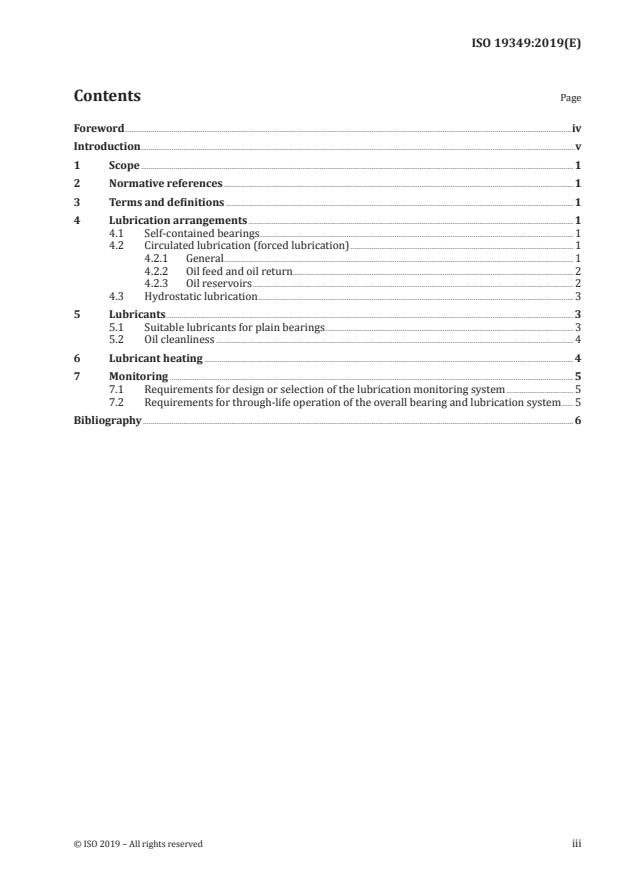
Contents Page
Foreword .iv
Introduction .v
1 Scope . 1
2 Normative references . 1
3 Terms and definitions . 1
4 Lubrication arrangements . 1
4.1 Self-contained bearings . 1
4.2 Circulated lubrication (forced lubrication) . 1
4.2.1 General. 1
4.2.2 Oil feed and oil return . . . 2
4.2.3 Oil reservoirs . 2
4.3 Hydrostatic lubrication . 3
5 Lubricants . 3
5.1 Suitable lubricants for plain bearings . 3
5.2 Oil cleanliness . 4
6 Lubricant heating . 4
7 Monitoring . 5
7.1 Requirements for design or selection of the lubrication monitoring system . 5
7.2 Requirements for through-life operation of the overall bearing and lubrication system . 5
Bibliography . 6
Foreword
ISO (the International Organization for Standardization) is a worldwide federation of national standards
bodies (ISO member bodies). The work of preparing International Standards is normally carried out
through ISO technical committees. Each member body interested in a subject for which a technical
committee has been established has the right to be represented on that committee. International
organizations, governmental and non-governmental, in liaison with ISO, also take part in the work.
ISO collaborates closely with the International Electrotechnical Commission (IEC) on all matters of
electrotechnical standardization.
The procedures used to develop this document and those intended for its further maintenance are
described in the ISO/IEC Directives, Part 1. In particular, the different approval criteria needed for the
different types of ISO documents should be noted. This document was drafted in accordance with the
editorial rules of the ISO/IEC Directives, Part 2 (see www .iso .org/directives).
Attention is drawn to the possibility that some of the elements of this document may be the subject of
patent rights. ISO shall not be held responsible for identifying any or all such patent rights. Details of
any patent rights identified during the development of the document will be in the Introduction and/or
on the ISO list of patent declarations received (see www .iso .org/patents).
Any trade name used in this document is information given for the convenience of users and does not
constitute an endorsement.
For an explanation of the voluntary nature of standards, the meaning of ISO specific terms and
expressions related to conformity assessment, as well as information about ISO's adherence to the
World Trade Organization (WTO) principles in the Technical Barriers to Trade (TBT) see www .iso
.org/iso/foreword .html.
This document was prepared by Technical Committee ISO/TC 123, Plain bearings, Subcommittee SC 3,
Dimensions, tolerances and construction.
Any feedback or questions on this document should be directed to the user’s national standards body. A
complete listing of these bodies can be found at www .iso .org/members .html.
iv © ISO 2019 – All rights reserved
Introduction
This document is based on German standard DIN 31692-1:1996.
INTERNATIONAL STANDARD ISO 19349:2019(E)
Plain bearings with liquid lubrication — Lubricant supply
arrangements and monitoring
1 Scope
This document provides requirements and guidance on lubricant supply arrangements and monitoring
for liquid-lubricated bearings (plain bearing assemblies) such as those specified in ISO 11687 (all parts).
This document is intended to assist the design of oil-based lubrication systems for hydrodynamic
plain bearings mainly to be used in large-scale rotating machinery for power generation, industry and
transportation.
This document focuses on the most important requirements and characteristics of lubricant supply
arrangements and monitoring for plain bearings. Additional standards such as ISO 10438-1, ISO 10438-2
and ISO 10438-3 would be needed to design complete low-pressure or high-pressure lubrication
systems, along with their corresponding components.
Wherever this document specifies a particular form of solution, whether design or operation, different
solutions can be selected provided they are justified by engineering assessment or reference to similar
systems already in operation.
2 Normative references
There are no normative references in this document.
3 Terms and definitions
No terms and definitions are listed in this document.
ISO and IEC maintain terminological databases for use in standardization at the following addresses:
— ISO Online browsing platform: available at https: //www .iso .org/obp
— IEC Electropedia: available at http: //www .electropedia .org/
4 Lubrication arrangements
4.1 Self-contained bearings
The low-pressure lubrication of self-contained bearings is ensured by an internal oil reservoir and a
supply mechanism, driven by the main shaft rotation. Typical self-contained bearing lubrication supply
mechanisms include ring lubrication and viscosity pump lubrication. The lubrication does not require
external energy or equipment. The lubricant does not leave the bearing internal reservoir.
4.2 Circulated lubrication (forced lubrication)
4.2.1 General
The oil supply of forced-lubricated bearings consists of a closed circulation system. The oil supply in
these cases is provided by pumping the lubricant through the bearings. In the supply system, the oil is
pumped out of the reservoir, filtered, cooled and controlled at the desired flow rate or pressure before
being fed to the machine bearings. For this purpose, a complete oil supply system consists of a reservoir,
pumping, filtering, cooling and controlling units. After lubricating the bearings, the oil returns to the
reservoir. Some lube oil units are operated independently of the machine being supplied. Others have
the main lube oil pump being driven by the shaft of the machine.
4.2.2 Oil feed and oil return
To minimize the possibility of vibrations or thermally induced tensile or compressive stresses occurring
in the bearing housing, flexible compensators or connections shall be provided in the oil supply and
drain piping systems if applicable.
For electrically insulated plain bearings, it is necessary to consider whether oil supply and drain pipes
connected to the bearing also need insulating to prevent short circuit of the bearing insulation.
To restrict the pressure losses in the piping system to an economically justifiable amount, the oil mean
flow velocity should not exceed 2 m/s in the supply lines according to experience.
The design of the return fluid flow path from the bearing to the oil reservoir shall be determined by
the technical requirements of the bearing housing and the design requirements of the overall system
installation.
When the return flow is driven by gravity, oil return lines shall have a slope of at least 5 %. According
to ISO 10438-1, oil drains shall be sized to run no more than half full when flowing at normal drain
operating temperature at maximum flow conditions and shall be arranged to ensure good drainage
(recognizing the possibility of foaming conditions). Junctions and changes in the direction of pipes shall
be designed so as not to impair lubricant flow. Sharp bends and down or up loops shall be avoided.
Junctions in return pipes shall be located in the direction of flow. In order to prevent foaming, vertical
slopes exceeding 1 m in length shall be avoided. No devices significantly impeding the flow in the return
line, such as filters, etc. shall be installed.
Where more than one device (bearings, and possibly other consumers) is to be supplied with lubrication
oil, the design of the oil supply and circulation system should mitigate against the potential harmful
interactions in the return lines and oil reservoir caused by differential air pressure conditions.
4.2.3 Oil reservoirs
The basic design requirements for oil reservoirs are given by ISO 4413 in conj
...
INTERNATIONAL ISO
STANDARD 19349
First edition
2019-03
Plain bearings with liquid
lubrication — Lubricant supply
arrangements and monitoring
Paliers lisses à lubrification fluide — Equipements de graissage et de
surveillance
Reference number
©
ISO 2019
© ISO 2019
All rights reserved. Unless otherwise specified, or required in the context of its implementation, no part of this publication may
be reproduced or utilized otherwise in any form or by any means, electronic or mechanical, including photocopying, or posting
on the internet or an intranet, without prior written permission. Permission can be requested from either ISO at the address
below or ISO’s member body in the country of the requester.
ISO copyright office
CP 401 • Ch. de Blandonnet 8
CH-1214 Vernier, Geneva
Phone: +41 22 749 01 11
Fax: +41 22 749 09 47
Email: copyright@iso.org
Website: www.iso.org
Published in Switzerland
ii © ISO 2019 – All rights reserved
Contents Page
Foreword .iv
Introduction .v
1 Scope . 1
2 Normative references . 1
3 Terms and definitions . 1
4 Lubrication arrangements . 1
4.1 Self-contained bearings . 1
4.2 Circulated lubrication (forced lubrication) . 1
4.2.1 General. 1
4.2.2 Oil feed and oil return . . . 2
4.2.3 Oil reservoirs . 2
4.3 Hydrostatic lubrication . 3
5 Lubricants . 3
5.1 Suitable lubricants for plain bearings . 3
5.2 Oil cleanliness . 4
6 Lubricant heating . 4
7 Monitoring . 5
7.1 Requirements for design or selection of the lubrication monitoring system . 5
7.2 Requirements for through-life operation of the overall bearing and lubrication system . 5
Bibliography . 6
Foreword
ISO (the International Organization for Standardization) is a worldwide federation of national standards
bodies (ISO member bodies). The work of preparing International Standards is normally carried out
through ISO technical committees. Each member body interested in a subject for which a technical
committee has been established has the right to be represented on that committee. International
organizations, governmental and non-governmental, in liaison with ISO, also take part in the work.
ISO collaborates closely with the International Electrotechnical Commission (IEC) on all matters of
electrotechnical standardization.
The procedures used to develop this document and those intended for its further maintenance are
described in the ISO/IEC Directives, Part 1. In particular, the different approval criteria needed for the
different types of ISO documents should be noted. This document was drafted in accordance with the
editorial rules of the ISO/IEC Directives, Part 2 (see www .iso .org/directives).
Attention is drawn to the possibility that some of the elements of this document may be the subject of
patent rights. ISO shall not be held responsible for identifying any or all such patent rights. Details of
any patent rights identified during the development of the document will be in the Introduction and/or
on the ISO list of patent declarations received (see www .iso .org/patents).
Any trade name used in this document is information given for the convenience of users and does not
constitute an endorsement.
For an explanation of the voluntary nature of standards, the meaning of ISO specific terms and
expressions related to conformity assessment, as well as information about ISO's adherence to the
World Trade Organization (WTO) principles in the Technical Barriers to Trade (TBT) see www .iso
.org/iso/foreword .html.
This document was prepared by Technical Committee ISO/TC 123, Plain bearings, Subcommittee SC 3,
Dimensions, tolerances and construction.
Any feedback or questions on this document should be directed to the user’s national standards body. A
complete listing of these bodies can be found at www .iso .org/members .html.
iv © ISO 2019 – All rights reserved
Introduction
This document is based on German standard DIN 31692-1:1996.
INTERNATIONAL STANDARD ISO 19349:2019(E)
Plain bearings with liquid lubrication — Lubricant supply
arrangements and monitoring
1 Scope
This document provides requirements and guidance on lubricant supply arrangements and monitoring
for liquid-lubricated bearings (plain bearing assemblies) such as those specified in ISO 11687 (all parts).
This document is intended to assist the design of oil-based lubrication systems for hydrodynamic
plain bearings mainly to be used in large-scale rotating machinery for power generation, industry and
transportation.
This document focuses on the most important requirements and characteristics of lubricant supply
arrangements and monitoring for plain bearings. Additional standards such as ISO 10438-1, ISO 10438-2
and ISO 10438-3 would be needed to design complete low-pressure or high-pressure lubrication
systems, along with their corresponding components.
Wherever this document specifies a particular form of solution, whether design or operation, different
solutions can be selected provided they are justified by engineering assessment or reference to similar
systems already in operation.
2 Normative references
There are no normative references in this document.
3 Terms and definitions
No terms and definitions are listed in this document.
ISO and IEC maintain terminological databases for use in standardization at the following addresses:
— ISO Online browsing platform: available at https: //www .iso .org/obp
— IEC Electropedia: available at http: //www .electropedia .org/
4 Lubrication arrangements
4.1 Self-contained bearings
The low-pressure lubrication of self-contained bearings is ensured by an internal oil reservoir and a
supply mechanism, driven by the main shaft rotation. Typical self-contained bearing lubrication supply
mechanisms include ring lubrication and viscosity pump lubrication. The lubrication does not require
external energy or equipment. The lubricant does not leave the bearing internal reservoir.
4.2 Circulated lubrication (forced lubrication)
4.2.1 General
The oil supply of forced-lubricated bearings consists of a closed circulation system. The oil supply in
these cases is provided by pumping the lubricant through the bearings. In the supply system, the oil is
pumped out of the reservoir, filtered, cooled and controlled at the desired flow rate or pressure before
being fed to the machine bearings. For this purpose, a complete oil supply system consists of a reservoir,
pumping, filtering, cooling and controlling units. After lubricating the bearings, the oil returns to the
reservoir. Some lube oil units are operated independently of the machine being supplied. Others have
the main lube oil pump being driven by the shaft of the machine.
4.2.2 Oil feed and oil return
To minimize the possibility of vibrations or thermally induced tensile or compressive stresses occurring
in the bearing housing, flexible compensators or connections shall be provided in the oil supply and
drain piping systems if applicable.
For electrically insulated plain bearings, it is necessary to consider whether oil supply and drain pipes
connected to the bearing also need insulating to prevent short circuit of the bearing insulation.
To restrict the pressure losses in the piping system to an economically justifiable amount, the oil mean
flow velocity should not exceed 2 m/s in the supply lines according to experience.
The design of the return fluid flow path from the bearing to the oil reservoir shall be determined by
the technical requirements of the bearing housing and the design requirements of the overall system
installation.
When the return flow is driven by gravity, oil return lines shall have a slope of at least 5 %. According
to ISO 10438-1, oil drains shall be sized to run no more than half full when flowing at normal drain
operating temperature at maximum flow conditions and shall be arranged to ensure good drainage
(recognizing the possibility of foaming conditions). Junctions and changes in the direction of pipes shall
be designed so as not to impair lubricant flow. Sharp bends and down or up loops shall be avoided.
Junctions in return pipes shall be located in the direction of flow. In order to prevent foaming, vertical
slopes exceeding 1 m in length shall be avoided. No devices significantly impeding the flow in the return
line, such as filters, etc. shall be installed.
Where more than one device (bearings, and possibly other consumers) is to be supplied with lubrication
oil, the design of the oil supply and circulation system should mitigate against the potential harmful
interactions in the return lines and oil reservoir caused by differential air pressure conditions.
4.2.3 Oil reservoirs
The basic design requirements for oil reservoirs are given by ISO 4413 in conj
...
Questions, Comments and Discussion
Ask us and Technical Secretary will try to provide an answer. You can facilitate discussion about the standard in here.
Loading comments...