


ISO/FDIS 10873
(Main)Dentistry — Denture adhesives
Dentistry — Denture adhesives
This document classifies denture adhesives used by wearers of removable dentures; it also specifies requirements, test methods and instructions to be supplied for the use of such products. This document is applicable to denture adhesives for use by the consumer and excludes the dental lining materials prescribed or applied by dental professionals.
Médecine bucco-dentaire — Adhésifs pour prothèses dentaires
Le présent document classe les adhésifs pour prothèses dentaires utilisés par les porteurs de prothèses amovibles et spécifie leurs exigences et méthodes d'essai. Il spécifie également les exigences par rapport aux instructions devant être fournies pour l'utilisation de ces produits. Le présent document s’applique aux adhésifs pour prothèses dentaires amovibles destinés à être utilisés par le consommateur et exclut les produits pour intrados de prothèse spécifiés ou appliqués par les professionnels dentaires. Pour l’évaluation des éventuels risques biologiques, il est recommandé de se reporter à l’ISO 7405 et à l’ISO 10993‑1.
General Information
- Status
- Not Published
- Technical Committee
- ISO/TC 106/SC 7 - Oral care products
- Drafting Committee
- ISO/TC 106/SC 7/WG 9 - Dentures adhesives
- Current Stage
- 5020 - FDIS ballot initiated: 2 months. Proof sent to secretariat
- Start Date
- 29-Jan-2026
- Completion Date
- 29-Jan-2026
Relations
- Effective Date
- 12-Feb-2026
- Effective Date
- 16-Mar-2024
- Effective Date
- 14-Oct-2023
Overview
ISO/FDIS 10873:2025 is an international standard established by the International Organization for Standardization (ISO) that addresses denture adhesives used by consumers who wear removable dentures. This standard classifies denture adhesives, specifies essential requirements and test methods, and defines the necessary user instructions for these products. ISO 10873 focuses exclusively on consumer-use denture adhesives, distinctly excluding dental lining materials prescribed or applied by dental professionals. The third edition of the standard refines previous versions by updating requirements and removing the pH value specification to reflect current best practices.
Denture adhesives play a vital role in improving the retention and stability of removable dentures on soft supporting tissues. ISO/FDIS 10873 ensures that adhesives meet reliable safety, quality, and performance parameters, contributing to improved user confidence and comfort.
Key Topics
Classification: The standard classifies denture adhesives into two main types:
- Glue type: Powder, cream, sheet, or tape form with water-soluble polymers as the adhesive base.
- Liner type: Non-aqueous denture adhesives.
Requirements: It defines rigorous requirements related to physical and chemical properties essential for the adhesives’ effectiveness and safety.
Test Methods: Comprehensive testing protocols include:
- Stability and aging procedures to assess durability.
- Washability tests for glue-type adhesives.
- Multiple adhesion strength tests tailored to adhesive type.
- Peeling and consistency tests specifically for liner-type adhesives.
Sampling: Guidelines on representative sampling are included to ensure product uniformity.
Packaging and Labelling: Measures ensure that denture adhesives are packaged securely and labelled clearly, facilitating safe and effective consumer use.
Instructions for Use: Detailed instructions must accompany products, guiding consumers on correct application and usage.
Applications
ISO/FDIS 10873:2025 serves as a critical reference for:
Manufacturers and Suppliers: Ensuring denture adhesives comply with international quality and performance standards to meet consumer needs.
Regulatory Bodies: Facilitating product assessment and market surveillance with standardized test methods and classifications.
Retailers and Distributors: Verifying product compliance and accurate labelling to inform customers effectively.
Consumers: Providing confidence in the safety and efficacy of over-the-counter denture adhesives, enabling proper usage for improved denture retention.
This standard ultimately enhances the reliability and user experience of removable denture adhesives by promoting harmonized global minimum requirements and testing protocols.
Related Standards
- ISO 1942: Dentistry - Vocabulary: Defines terminology relevant to dental products including denture adhesives.
- ISO 7405: Evaluation of biocompatibility of medical devices used in dentistry: Assesses biological safety considerations relevant to dental materials.
- ISO 10993-1: Biological evaluation of medical devices - Part 1: Evaluation and testing within a risk management process: Guides biological risk assessment, recommended for complementary review alongside ISO 10873 when evaluating possible hazards.
- ISO 3696: Water for analytical laboratory use - Specification and test methods: Specifies water quality for use in testing protocols.
- ISO 7823-2: Plastics - Poly(methyl methacrylate) sheets: Related to denture base materials, affecting adhesive compatibility.
- ISO 8601-1: Date and time - Representations for information interchange - Part 1: Basic rules: Applies to date formatting on labelling for traceability.
By adhering to ISO/FDIS 10873, stakeholders in the dental products market can ensure denture adhesives are developed, tested, and supplied to deliver safe, consistent, and effective solutions tailored for removable denture wearers worldwide.
Buy Documents
ISO/FDIS 10873 - Dentistry — Denture adhesives Released:15. 01. 2026
REDLINE ISO/FDIS 10873 - Dentistry — Denture adhesives Released:15. 01. 2026
ISO/FDIS 10873 - Médecine bucco-dentaire — Adhésifs pour prothèses dentaires Released:3. 02. 2026
Get Certified
Connect with accredited certification bodies for this standard

ECOCERT
Organic and sustainability certification.

Eurofins Food Testing Global
Global leader in food, environment, and pharmaceutical product testing.

Intertek Bangladesh
Intertek certification and testing services in Bangladesh.
Sponsored listings
Frequently Asked Questions
ISO/FDIS 10873 is a draft published by the International Organization for Standardization (ISO). Its full title is "Dentistry — Denture adhesives". This standard covers: This document classifies denture adhesives used by wearers of removable dentures; it also specifies requirements, test methods and instructions to be supplied for the use of such products. This document is applicable to denture adhesives for use by the consumer and excludes the dental lining materials prescribed or applied by dental professionals.
This document classifies denture adhesives used by wearers of removable dentures; it also specifies requirements, test methods and instructions to be supplied for the use of such products. This document is applicable to denture adhesives for use by the consumer and excludes the dental lining materials prescribed or applied by dental professionals.
ISO/FDIS 10873 is classified under the following ICS (International Classification for Standards) categories: 71.100.70 - Cosmetics. Toiletries. The ICS classification helps identify the subject area and facilitates finding related standards.
ISO/FDIS 10873 has the following relationships with other standards: It is inter standard links to FprEN ISO 10873, ISO 12571:2021, ISO 10873:2021. Understanding these relationships helps ensure you are using the most current and applicable version of the standard.
ISO/FDIS 10873 is available in PDF format for immediate download after purchase. The document can be added to your cart and obtained through the secure checkout process. Digital delivery ensures instant access to the complete standard document.
Standards Content (Sample)
FINAL DRAFT
International
Standard
ISO/TC 106/SC 7
Dentistry — Denture adhesives
Secretariat: JISC
Médecine bucco-dentaire — Adhésifs pour prothèses dentaires
Voting begins on:
2026-01-29
Voting terminates on:
2026-03-26
RECIPIENTS OF THIS DRAFT ARE INVITED TO SUBMIT,
WITH THEIR COMMENTS, NOTIFICATION OF ANY
RELEVANT PATENT RIGHTS OF WHICH THEY ARE AWARE
AND TO PROVIDE SUPPOR TING DOCUMENTATION.
IN ADDITION TO THEIR EVALUATION AS
BEING ACCEPTABLE FOR INDUSTRIAL, TECHNO
ISO/CEN PARALLEL PROCESSING LOGICAL, COMMERCIAL AND USER PURPOSES, DRAFT
INTERNATIONAL STANDARDS MAY ON OCCASION HAVE
TO BE CONSIDERED IN THE LIGHT OF THEIR POTENTIAL
TO BECOME STAN DARDS TO WHICH REFERENCE MAY BE
MADE IN NATIONAL REGULATIONS.
Reference number
FINAL DRAFT
International
Standard
ISO/TC 106/SC 7
Dentistry — Denture adhesives
Secretariat: JISC
Médecine bucco-dentaire — Adhésifs pour prothèses dentaires
Voting begins on:
Voting terminates on:
RECIPIENTS OF THIS DRAFT ARE INVITED TO SUBMIT,
WITH THEIR COMMENTS, NOTIFICATION OF ANY
RELEVANT PATENT RIGHTS OF WHICH THEY ARE AWARE
AND TO PROVIDE SUPPOR TING DOCUMENTATION.
© ISO 2026
IN ADDITION TO THEIR EVALUATION AS
All rights reserved. Unless otherwise specified, or required in the context of its implementation, no part of this publication may
BEING ACCEPTABLE FOR INDUSTRIAL, TECHNO
ISO/CEN PARALLEL PROCESSING
LOGICAL, COMMERCIAL AND USER PURPOSES, DRAFT
be reproduced or utilized otherwise in any form or by any means, electronic or mechanical, including photocopying, or posting on
INTERNATIONAL STANDARDS MAY ON OCCASION HAVE
the internet or an intranet, without prior written permission. Permission can be requested from either ISO at the address below
TO BE CONSIDERED IN THE LIGHT OF THEIR POTENTIAL
or ISO’s member body in the country of the requester.
TO BECOME STAN DARDS TO WHICH REFERENCE MAY BE
MADE IN NATIONAL REGULATIONS.
ISO copyright office
CP 401 • Ch. de Blandonnet 8
CH-1214 Vernier, Geneva
Phone: +41 22 749 01 11
Email: copyright@iso.org
Website: www.iso.org
Published in Switzerland Reference number
ii
Contents Page
Foreword .v
Introduction .vi
1 Scope . 1
2 Normative references . 1
3 Terms and definitions . 1
4 Classification . 2
4.1 General .2
4.2 Types and classes .2
5 Requirements . 2
5.1 General .2
5.1.1 Biocompatibility .2
5.1.2 Microbiology .2
5.1.3 Stability .2
5.2 Specific requirements for Type 1 adhesives .2
5.2.1 Washability.2
5.2.2 Strength of the adhesion to the prosthesis .2
5.3 Specific requirements for Type 2 adhesives .2
5.3.1 Adhesion strength .2
5.3.2 Peeling property .3
5.3.3 Consistency .3
6 Sampling . 3
7 Measurements and test methods . 3
7.1 Test conditions .3
7.2 Determination of stability — Aging procedure .3
7.3 Test of washability (for Type 1 adhesives) .3
7.3.1 Apparatus and materials .3
7.3.2 Reagent .3
7.3.3 Procedure .3
7.4 Adhesion strength test I (for Type 1 adhesives) .3
7.4.1 General .3
7.4.2 Apparatus .4
7.4.3 Procedure .5
7.5 Adhesion strength test II (for Type 1 adhesives) .7
7.5.1 General .7
7.5.2 Apparatus .7
7.5.3 Procedure .7
7.6 Adhesion strength test (for Type 2 adhesives) .8
7.6.1 Apparatus .8
7.6.2 Procedure .9
7.7 Peeling test (for Type 2 adhesives) .9
7.7.1 Apparatus and materials .9
7.7.2 Reagent .10
7.7.3 Procedure .10
7.8 Consistency test (for Type 2 adhesives) .10
7.8.1 Apparatus .10
7.8.2 Procedure . 12
7.9 Assessment . 12
8 Packaging.12
9 Accompanying information .12
9.1 Information to be included in the instructions for use . 12
9.2 Labelling on the package . 13
iii
Bibliography . 14
iv
Foreword
ISO (the International Organization for Standardization) is a worldwide federation of national standards
bodies (ISO member bodies). The work of preparing International Standards is normally carried out through
ISO technical committees. Each member body interested in a subject for which a technical committee
has been established has the right to be represented on that committee. International organizations,
governmental and non-governmental, in liaison with ISO, also take part in the work. ISO collaborates closely
with the International Electrotechnical Commission (IEC) on all matters of electrotechnical standardization.
The procedures used to develop this document and those intended for its further maintenance are described
in the ISO/IEC Directives, Part 1. In particular, the different approval criteria needed for the different types
of ISO documents should be noted. This document was drafted in accordance with the editorial rules of the
ISO/IEC Directives, Part 2 (see www.iso.org/directives).
ISO draws attention to the possibility that the implementation of this document may involve the use of (a)
patent(s). ISO takes no position concerning the evidence, validity or applicability of any claimed patent
rights in respect thereof. As of the date of publication of this document, ISO had not received notice of (a)
patent(s) which may be required to implement this document. However, implementers are cautioned that
this may not represent the latest information, which may be obtained from the patent database available at
www.iso.org/patents. ISO shall not be held responsible for identifying any or all such patent rights.
Any trade name used in this document is information given for the convenience of users and does not
constitute an endorsement.
For an explanation of the voluntary nature of standards, the meaning of ISO specific terms and expressions
related to conformity assessment, as well as information about ISO's adherence to the World Trade
Organization (WTO) principles in the Technical Barriers to Trade (TBT), see www.iso.org/iso/foreword.html.
This document was prepared by Technical Committee ISO/TC 106, Dentistry, Subcommittee SC 7, Oral care
products, in collaboration with the European Committee for Standardization (CEN) Technical Committee
CEN/TC 55, Dentistry, in accordance with the Agreement on technical cooperation between ISO and CEN
(Vienna Agreement).
This third edition cancels and replaces the second edition (ISO 10873:2021), which has been technically
revised.
The main changes are as follows:
— the requirement for pH value (5.1.2) has been deleted;
— pH value measurement (7.2) has been deleted.
Any feedback or questions on this document should be directed to the user’s national standards body. A
complete listing of these bodies can be found at www.iso.org/members.html.
v
Introduction
Denture adhesives are used to improve the retention stability of removable dentures to soft supporting
tissues temporarily. This document is intended to determine the physical and chemical properties of denture
adhesives.
Specific qualitative and quantitative requirements for freedom from biological hazards are not included
in this document. It is recommended that, in assessing possible biological hazards, reference be made to
ISO 7405 and ISO 10993-1.
vi
FINAL DRAFT International Standard ISO/FDIS 10873:2026(en)
Dentistry — Denture adhesives
1 Scope
This document classifies denture adhesives used by wearers of removable dentures. It also specifies
requirements, test methods and instructions to be supplied for the use of such products.
This document is applicable to denture adhesives for use by the consumer and excludes the dental lining
materials prescribed or applied by dental professionals.
2 Normative references
The following documents are referred to in the text in such a way that some or all of their content constitutes
requirements of this document. For dated references, only the edition cited applies. For undated references,
the latest edition of the referenced document (including any amendments) applies.
ISO 1942, Dentistry — Vocabulary
ISO 3696:1987, Water for analytical laboratory use — Specification and test methods
ISO 7823-2, Plastics — Poly(methyl methacrylate) sheets — Types, dimensions and characteristics — Part 2:
Extruded sheets
ISO 8601-1, Date and time — Representations for information interchange — Part 1: Basic rules
3 Terms and definitions
For the purposes of this document, the terms and definitions given in ISO 1942 and the following apply.
ISO and IEC maintain terminology databases for use in standardization at the following addresses:
— ISO Online browsing platform: available at https:// www .iso .org/ obp
— IEC Electropedia: available at https:// www .electropedia .org/
3.1
denture adhesive
dental product placed on the intaglio surface of a removable denture to temporarily improve its retention to
soft supporting tissues
Note 1 to entry: The intaglio surface is also known as the fitting surface.
[SOURCE: ISO 1942:2020, 3.3.1.23, modified — Note 1 to entry has been added.]
3.2
glue type
denture adhesive (3.1) in powder, cream, sheet or tape form with a water-soluble polymer as the adhesive
constituent
3.3
liner type
denture adhesive (3.1) in non-aqueous form
4 Classification
4.1 General
For the purposes of this document, denture adhesives are categorized as one of the following types:
4.2 Types and classes
a) Type 1: glue type:
— Class 1: powder form;
— Class 2: cream form;
— Class 3: sheet or tape form.
b) Type 2: liner type.
5 Requirements
5.1 General
5.1.1 Biocompatibility
Particular attention should be given to assessing the effects on biocompatibility from the release of metallic
ions from the denture adhesive.
5.1.2 Microbiology
Some information concerning the testing for microbiological contamination can be found in ISO 16212,
ISO 18415, ISO 18416, ISO 21148, ISO 21149, ISO 21150, ISO 22717, ISO 22718, ISO 29621 and References [12]
to [15].
5.1.3 Stability
The denture adhesive shall show no signs of deterioration which can affect conformity with this document
after being subjected to one of the aging procedures specified in 7.2.
5.2 Specific requirements for Type 1 adhesives
5.2.1 Washability
There shall be no residual lump on the poly (methyl methacrylate) (PMMA) plate surface when tested in
accordance with 7.3.
5.2.2 Strength of the adhesion to the prosthesis
Adhesion strength shall not be less than 5 kPa when tested in accordance with 7.4 and 7.5.
5.3 Specific requirements for Type 2 adhesives
5.3.1 Adhesion strength
Adhesion strength shall not be less than 5 kPa when tested in accordance with 7.6.
ISO/FDIS 10
...
Style Definition
...
Style Definition
...
Style Definition
...
ISO/FDIS 10873:2025(en)
Style Definition
...
ISO/TC 106/SC 7/WG 9
Style Definition
...
Style Definition
Secretariat: JISC .
Style Definition
...
2025-12-11
Style Definition
...
Date: 2026-01-14 Style Definition
...
Style Definition
...
Style Definition
...
Style Definition
...
Style Definition
...
Style Definition
...
Dentistry — Denture adhesives
Style Definition
...
Style Definition
Médecine bucco-dentaire — Adhésifs pour prothèses dentaires
...
Style Definition
...
Style Definition
...
Style Definition
...
Style Definition
...
Style Definition
...
Style Definition
...
Style Definition
...
Style Definition
...
FDIS stage
Style Definition
...
Style Definition
...
Style Definition
...
Style Definition
...
Style Definition
...
Style Definition
...
Style Definition
...
Style Definition
...
Style Definition
...
Style Definition
...
Style Definition
...
Style Definition
...
Style Definition
...
Style Definition
...
TThhiiss d drraftaft i iss s suubbmmiitttteded t too a pa pararallel vallel vootte e iinn I ISSOO,, C CEENN.
Style Definition
...
Style Definition
...
Style Definition
...
Style Definition
...
Style Definition
...
Style Definition
...
Style Definition
...
Style Definition
...
Style Definition
...
Style Definition
...
Style Definition
...
Style Definition
...
Style Definition
...
Style Definition
...
Style Definition
...
Style Definition
...
Style Definition
...
Style Definition
...
Style Definition
...
St l D fi iti
ISO/FDIS 10873 (Ed.3:2026(en)
Formatted: Font: Bold
Formatted: Font: Bold
Formatted: Font: Bold
Formatted: HeaderCentered, Line spacing: single, Tab stops:
Not at 11.11 cm
All rights reserved. Unless otherwise specified, or required in the context of its implementation, no part of this publication
may be reproduced or utilized otherwise in any form or by any means, electronic or mechanical, including photocopying, Formatted: Adjust space between Latin and Asian text,
Adjust space between Asian text and numbers
or posting on the internet or an intranet, without prior written permission. Permission can be requested from either ISO
at the address below or ISO'sISO’s member body in the country of the requester.
ISO Copyright Office copyright office
CP 401 • Ch. de Blandonnet 8
CH-1214 Vernier, Geneva
Formatted: zzCopyright address, Adjust space between Latin
Phone: + 41 22 749 01 11
and Asian text, Adjust space between Asian text and
numbers
Email: copyright@iso.org
Formatted: French (Switzerland)
E-mail: copyright@iso.org Formatted: French (Switzerland)
Website: www.iso.org www.iso.org
Formatted: Italian (Italy)
Formatted: Italian (Italy)
Published in Switzerland.
Formatted: zzCopyright address, Adjust space between Latin
and Asian text, Adjust space between Asian text and
numbers
Formatted: Font: 11 pt
Formatted: FooterPageRomanNumber, Space Before: 0 pt,
Line spacing: single, Tab stops: Not at 17.2 cm
ii © ISO 2023 – All rights reserved
ii
Formatted: Font: Bold
Formatted: Font: Bold
Formatted: HeaderCentered, Left, Line spacing: single
Contents
Formatted: Adjust space between Latin and Asian text,
Adjust space between Asian text and numbers
Foreword . v
Introduction . vi
1 Scope . 1
2 Normative references . 1
3 Terms and definitions . 1
4 Classification. 2
5 Requirements . 2
6 Sampling . 3
7 Measurements and test methods . 3
8 Packaging . 23
9 Accompanying information . 23
Bibliography . 25
Foreword . iv
Introduction . v
1 Scope . 1
2 Normative references . 1
3 Terms and definitions . 1
4 Classification. 2
4.1 General. 2
4.2 Types and classes . 2
5 Requirements . 2
5.1 General. 2
5.2 Specific requirements for Type 1 adhesives . 2
5.3 Specific requirements for Type 2 adhesives . 3
6 Sampling . 3
7 Measurements and test methods . 3
7.1 Test conditions . 3
7.2 Determination of stability — Aging procedure . 4
7.3 Test of washability (for Type 1 adhesives) . 4
7.4 Adhesion strength test I (for Type 1 adhesives) . 5
7.5 Adhesion strength test II (for Type 1 adhesives) . 9
7.6 Adhesion strength test (for Type 2 adhesives) . 11
7.7 Peeling test (for Type 2 adhesives) . 12
7.8 Consistency test (for Type 2 adhesives) . 13
7.9 Assessment . 15
8 Packaging . 16 Formatted: Font: 11 pt
Formatted: FooterPageRomanNumber, Space Before: 0 pt,
9 Accompanying information . 16
Line spacing: single, Tab stops: Not at 17.2 cm
iii
ISO/FDIS 10873 (Ed.3:2026(en)
Formatted: Font: Bold
Formatted: Font: Bold
Formatted: Font: Bold
9.1 Information to be included in the instructions for use . 16
Formatted: HeaderCentered, Line spacing: single, Tab stops:
9.2 Labelling on the package . 17
Not at 11.11 cm
Bibliography . 18
Formatted: Font: 11 pt
Formatted: FooterPageRomanNumber, Space Before: 0 pt,
Line spacing: single, Tab stops: Not at 17.2 cm
iv © ISO 2023 – All rights reserved
iv
Formatted: Font: Bold
Formatted: Font: Bold
Formatted: HeaderCentered, Left, Line spacing: single
Foreword
Formatted: Adjust space between Latin and Asian text,
Adjust space between Asian text and numbers
ISO (the International Organization for Standardization) is a worldwide federation of national standards
bodies (ISO member bodies). The work of preparing International Standards is normally carried out through
ISO technical committees. Each member body interested in a subject for which a technical committee has been
established has the right to be represented on that committee. International organizations, governmental and
non-governmental, in liaison with ISO, also take part in the work. ISO collaborates closely with the
International Electrotechnical Commission (IEC) on all matters of electrotechnical standardization.
The procedures used to develop this document and those intended for its further maintenance are described
in the ISO/IEC Directives, Part 1. In particular, the different approval criteria needed for the different types of
ISO documents should be noted. This document was drafted in accordance with the editorial rules of the
ISO/IEC Directives, Part 2 (see www.iso.org/directives).
ISO draws attention to the possibility that the implementation of this document may involve the use of (a)
Formatted: Adjust space between Latin and Asian text,
Adjust space between Asian text and numbers
patent(s). ISO takes no position concerning the evidence, validity or applicability of any claimed patent rights
in respect thereof. As of the date of publication of this document, ISO had not received notice of (a) patent(s)
which may be required to implement this document. However, implementers are cautioned that this may not
represent the latest information, which may be obtained from the patent database available at
www.iso.org/patents. ISO shall not be held responsible for identifying any or all such patent rights.
Any trade name used in this document is information given for the convenience of users and does not
constitute an endorsement.
For an explanation of the voluntary nature of standards, the meaning of ISO specific terms and expressions
related to conformity assessment, as well as information about ISO's adherence to the World Trade
Organization (WTO) principles in the Technical Barriers to Trade (TBT), see www.iso.org/iso/foreword.html.
This document was prepared by Technical Committee ISO/TC 106, Dentistry, Subcommittee SC 7, Oral care
products, in collaboration with the European Committee for Standardization (CEN) Technical Committee Formatted: Font: Not Italic
CEN/TC 55, Dentistry, in accordance with the Agreement on technical cooperation between ISO and CEN
Formatted: Font: Not Italic
(Vienna Agreement).
Formatted: Font: Not Italic
This third edition cancels and replaces the second edition (ISO 10873:2021), which has been technically
Formatted: Default Paragraph Font
revised. The main changes compared to the previous edition are as follows:
Formatted: Default Paragraph Font
Formatted: Default Paragraph Font
— The main changes are as follows:
— the requirement for pH value (5.1.2) has been deleted, and;
Formatted: English (United Kingdom)
— pH value measurement (7.2) has been deleted.
Formatted: Adjust space between Latin and Asian text,
Adjust space between Asian text and numbers, Tab stops:
Not at 0.7 cm + 1.4 cm + 2.1 cm + 2.8 cm + 3.5 cm + 4.2
Any feedback or questions on this document should be directed to the user’s national standards body. A
cm + 4.9 cm + 5.6 cm + 6.3 cm + 7 cm
complete listing of these bodies can be found at www.iso.org/members.html.
Formatted: Adjust space between Latin and Asian text,
Adjust space between Asian text and numbers
Formatted: English (United Kingdom)
Formatted: Font: 11 pt
Formatted: FooterPageRomanNumber, Space Before: 0 pt,
Line spacing: single, Tab stops: Not at 17.2 cm
v
ISO/FDIS 10873 (Ed.3:2026(en)
Formatted: Font: Bold
Formatted: Font: Bold
Formatted: Font: Bold
Introduction
Formatted: HeaderCentered, Line spacing: single, Tab stops:
Not at 11.11 cm
Denture adhesives are used forto improve the improvement in retention stability of removable
denturedentures to soft supporting tissues temporarily. This document is intended to determine the physical
and chemical properties of denture adhesives.
Specific qualitative and quantitative requirements for freedom from biological hazards are not included in this
document. It is recommended that, in assessing possible biological hazards, reference be made to ISO 7405 Formatted: Default Paragraph Font
and ISO 10993-1.
Formatted: Default Paragraph Font
Formatted: Default Paragraph Font
Formatted: Default Paragraph Font
Formatted: Default Paragraph Font
Formatted: Tab stops: Not at 2.71 cm
Formatted: Font: 11 pt
Formatted: FooterPageRomanNumber, Space Before: 0 pt,
Line spacing: single, Tab stops: Not at 17.2 cm
vi © ISO 2023 – All rights reserved
vi
INTERNATIONAL STANDARD FDIS 10873 (Ed.3)
Formatted: Font: (Asian) Japanese
Dentistry — Denture adhesives
Formatted: Font: (Asian) Japanese
1 Scope
Formatted: Main Title 1, Adjust space between Latin and
Asian text, Adjust space between Asian text and numbers
This document classifies denture adhesives used by wearers of removable dentures; it. It also specifies
Formatted: Default Paragraph Font
requirements, test methods and instructions to be supplied for the use of such products.
Formatted: Default Paragraph Font
This document is applicable to denture adhesives for use by the consumer and excludes the dental lining
Formatted: Default Paragraph Font
materials prescribed or applied by dental professionals.
Formatted: Adjust space between Latin and Asian text,
Adjust space between Asian text and numbers, Tab stops:
2 Normative references
Not at 0.7 cm + 1.4 cm + 2.1 cm + 2.8 cm + 3.5 cm + 4.2
cm + 4.9 cm + 5.6 cm + 6.3 cm + 7 cm
The following documents are referred to in the text in such a way that some or all of their content constitutes
Formatted: Default Paragraph Font
requirements of this document. For dated references, only the edition cited applies. For undated references,
the latest edition of the referenced document (including any amendments) applies.
Formatted: Default Paragraph Font
Formatted: Default Paragraph Font
ISO 1942, Dentistry — Vocabulary
Formatted: Default Paragraph Font
ISO 3696:1987, Water for analytical laboratory use — Specification and test methods
Formatted: Default Paragraph Font
Formatted: Default Paragraph Font
ISO 7823-2, Plastics — Poly (methyl methacrylate) sheets — Types, dimensions and characteristics — Part 2:
Extruded sheets
Formatted: Default Paragraph Font
Formatted: Default Paragraph Font
ISO 8601-1, Date and time — Representations for information interchange — Part 1: Basic rules
Formatted: Default Paragraph Font
3 Terms and definitions
Formatted: Default Paragraph Font
Formatted: Default Paragraph Font
For the purposes of this document, the terms and definitions given in ISO 1942 and the following apply.
Formatted: Default Paragraph Font
ISO and IEC maintain terminology databases for use in standardization at the following addresses:
Formatted: Default Paragraph Font
Formatted: Adjust space between Latin and Asian text,
— — ISO Online browsing platform: available at https://www.iso.org/obp
Adjust space between Asian text and numbers
— IEC Electropedia: available at https://www.electropedia.org/ Formatted: Default Paragraph Font
Formatted: Default Paragraph Font
3.1
Formatted: TermNum2, Adjust space between Latin and
denture adhesive
Asian text, Adjust space between Asian text and numbers
dental product placed on the intaglio surface of a removable denture to temporarily improve its retention to
soft supporting tissues
Formatted: Adjust space between Latin and Asian text,
Adjust space between Asian text and numbers, Tab stops:
Note 1 to entry: The intaglio surface is also known as the fitting surface. Not at 0.7 cm + 1.4 cm + 2.1 cm + 2.8 cm + 3.5 cm + 4.2
cm + 4.9 cm + 5.6 cm + 6.3 cm + 7 cm
[SOURCE: ISO 1942:2020, 3.3.1.23, modified — Note 1 to entry has been added.]
Formatted: Default Paragraph Font
Formatted: Default Paragraph Font
3.2
glue type
Formatted: Default Paragraph Font
denture adhesive (3.1) in powder, cream, sheet or tape form with a water-soluble polymer as the adhesive
Formatted: Default Paragraph Font
constituent
Formatted: Adjust space between Latin and Asian text,
Adjust space between Asian text and numbers
ISO/FDIS 10873 (Ed.3:2026(en)
Formatted: Font: Bold
Formatted: Font: Bold
Formatted: Font: Bold
3.3 3.3
Formatted: HeaderCentered, Line spacing: single, Tab stops:
liner type
Not at 11.11 cm
denture adhesive (3.1) in non-aqueous form
Formatted: TermNum2, Adjust space between Latin and
Asian text, Adjust space between Asian text and numbers
4 Classification
4.1 General
Formatted: Adjust space between Latin and Asian text,
Adjust space between Asian text and numbers, Tab stops:
Not at 0.71 cm
For the purposes of this document, denture adhesives are categorized as one of the following types:
Formatted: Adjust space between Latin and Asian text,
4.2 Types and classes
Adjust space between Asian text and numbers
Formatted: Adjust space between Latin and Asian text,
a) Type 1: glue type:
Adjust space between Asian text and numbers, Tab stops:
Not at 0.71 cm
— Class 1: powder form;
Formatted: Numbered + Level: 1 + Numbering Style: a, b, c,
— Class 2: cream form; … + Start at: 1 + Alignment: Left + Aligned at: 0 cm + Indent
at: 0 cm, Adjust space between Latin and Asian text, Adjust
space between Asian text and numbers, Tab stops: Not at
— Class 3: sheet or tape form.
0.7 cm + 1.4 cm + 2.1 cm + 2.8 cm + 3.5 cm + 4.2 cm + 4.9
cm + 5.6 cm + 6.3 cm + 7 cm
b) Type 2: liner type.
5 Requirements Formatted: Adjust space between Latin and Asian text,
Adjust space between Asian text and numbers
5.1 General
Formatted: Adjust space between Latin and Asian text,
Adjust space between Asian text and numbers, Tab stops:
5.1.1 Biocompatibility
Not at 0.71 cm
Formatted: Adjust space between Latin and Asian text,
Particular attention should be given to assessing the effects on biocompatibility from the release of metallic
Adjust space between Asian text and numbers, Tab stops:
ions from the denture adhesive.
Not at 0.71 cm + 0.99 cm + 1.27 cm
5.1.2 Microbiology
Formatted: Adjust space between Latin and Asian text,
Adjust space between Asian text and numbers
Some information concerning the testing for microbiological contamination can be found in ISO 16212, ISO
Formatted: Not Strikethrough
18415, ISO 18416, ISO 21148, ISO 21149, ISO 21150, ISO 22717, ISO 22718, ISO 29621 and References [12]
Formatted: Adjust space between Latin and Asian text,
to [15].
Adjust space between Asian text and numbers, Tab stops:
Not at 0.71 cm + 0.99 cm + 1.27 cm
5.1.3 Stability
Formatted
...
The denture adhesive shall show no signs of deterioration which maycan affect conformity with this document
Formatted
...
after being subjected to one of the aging procedures specified in 7.2.
Formatted
...
5.2 Specific requirements for Type 1 adhesives
Formatted
...
5.2.1 Washability
Formatted
...
There shall be no residual lump on the poly (methyl methacrylate) (PMMA) plate surface when tested in Formatted
...
accordance with 7.3.
Formatted
...
5.2.2 Strength of the adhesion to the prosthesis
Formatted
...
Adhesion strength shall not be less than 5 kPa when tested in accordance with 7.4 and 7.5.
Formatted: Font: 11 pt
Formatted
...
2 © ISO 2023 – All rights reserved
Formatted
...
Formatted
...
Formatted
...
5.3 Specific requirements for Type 2 adhesives
Formatted
...
5.3.1 Adhesion strength
Formatted
...
Adhesion strength shall not be less than 5 kPa when tested in accordance with 7.6. Formatted
...
Formatted
...
5.3.2 Peeling property
Formatted
...
There shall be no residual lump on the PMMA plate surface when tested in accordance with 7.7.
Formatted
...
Formatted
5.3.3 Consistency .
Formatted
...
Consistency shall not be less than 15 mm when tested in accordance with 7.8.
Formatted
...
Formatted
6 Sampling
...
Formatted
...
The sample shall be taken from one lot and shall be sufficient to complete all tests specified in Clause 7.
Formatted
...
Formatted
7 Measurements and test methods
...
Formatted
...
7.1 Test conditions
Formatted
...
All tests shall be conducted at a temperature of (23 ± 3) °C.
Formatted
...
Formatted
...
7.2 Determination of stability — Aging procedure
Formatted
...
Store the denture adhesives in their original containers at (40 ± 2) °C at (75 ± 5) % relative humidity for
Formatted
...
3 months or at such conditions of time and temperature as will simulate storage at room temperature for
Formatted
[16] .
30 months .
Formatted
...
7.3 Test of washability (for Type 1 adhesives)
Formatted
...
Formatted
7.3.1 Apparatus and materials
...
Formatted
...
7.3.1.1 Water bath, capable of being maintained at a temperature of (37 ± 2) °C.
Formatted
...
7.3.1.2 Poly (methyl methacrylate) (PMMA) plate, approximately 50 mm × 50 mm, shall be in
Formatted
...
accordance with ISO 7823-2.
Formatted
...
7.3.2 Reagent
Formatted
...
Formatted
7.3.2.1 Water, shall be of grade 3 in accordance with ISO 3696:1987.
...
Formatted
...
7.3.3 Procedure
Formatted
...
Apply the denture adhesive on the PMMA plate (7.3.1.2) evenly following the manufacturer's instructions for
Formatted
...
use and immerse the plate in water for 1 h in the water bath (7.3.1.1) maintained at (37 ± 2) °C.
Formatted
...
Formatted
Wash the PMMA plate following the manufacturer's instructions for use and inspect the PMMA plate surface
...
with the naked eye, without magnification, for residual denture adhesives. Repeat the tests to obtain five test
Formatted
...
results.
Formatted
...
Formatted
...
Formatted
...
ISO/FDIS 10873 (Ed.3:2026(en)
Formatted
...
Formatted: HeaderCentered, Line spacing: single, Tab stops:
Not at 11.11 cm
7.4 Adhesion strength test I (for Type 1 adhesives)
Formatted: Adjust space between Latin and Asian text,
Adjust space between Asian text and numbers, Tab stops:
7.4.1 General
Not at 0.71 cm
Formatted: Adjust space between Latin and Asian text,
Conduct the adhesion strength test within 3 min after removal from the water bath.
Adjust space between Asian text and numbers, Tab stops:
Not at 0.71 cm + 0.99 cm + 1.27 cm
7.4.2 Apparatus
Formatted: Line spacing: single, Adjust space between Latin
7.4.2.1 Adhesion test instrument, having a sample stand, of capacity up to 10 N (for both frame and load
and Asian text, Adjust space between Asian text and
cell), with a cross-head speed up to 5 mm/min. See Figure 1.
numbers
Formatted: Adjust space between Latin and Asian text,
7.4.2.2 Sample holder I, having a hole with a diameter of (22 ± 1) mm, depth of (0,5 ± 0,1) mm and a
Adjust space between Asian text and numbers, Tab stops:
surface roughness of 2,0 μm and below, made of poly (methyl methacrylate)PMMA conforming with
Not at 0.71 cm + 0.99 cm + 1.27 cm
ISO 7823-2. See Figure 2 a).
Formatted: Font: Not Bold, English (United States)
After testing, detergent solution is recommended to remove the denture adhesive left on the sample holder
Formatted: Line spacing: single, Adjust space between Latin
surface.
and Asian text, Adjust space between Asian text and
numbers, Tab stops: Not at 0.7 cm + 1.4 cm + 2.1 cm + 2.8
7.4.2.3 Sample holder II, having a raised circular part with a diameter of (22 ± 1) mm, a height of
cm + 3.5 cm + 4.2 cm + 4.9 cm + 5.6 cm + 6.3 cm + 7 cm
(5,0 ± 0,1) mm and a surface roughness of 2,0 μm and below, made of poly (methyl methacrylate)PMMA
conforming with ISO 7823-2. See Figure 2 b).
Formatted: Font: Not Bold, English (United States)
After testing, detergent solution is recommended to remove the denture adhesive left on the sample holder
Formatted: Font: Not Bold, English (United States)
surface.
Formatted
...
7.4.2.4 Pressure sensitive shaft, having a circular base with a diameter of (20,0 ± 0,5) mm, made of poly
Formatted
...
(methyl methacrylate)PMMA conforming with ISO 7823-2. See Figure 3.
Formatted
...
Formatted: Adjust space between Latin and Asian text,
Adjust space between Asian text and numbers
Formatted: Font: Not Bold, English (United States)
Formatted: Adjust space between Latin and Asian text,
Adjust space between Asian text and numbers, Tab stops:
Not at 0.7 cm + 1.4 cm + 2.1 cm + 2.8 cm + 3.5 cm + 4.2
cm + 4.9 cm + 5.6 cm + 6.3 cm + 7 cm
Formatted
...
Formatted
...
Formatted
...
Formatted: Adjust space between Latin and Asian text,
Adjust space between Asian text and numbers
Formatted: Font: Not Bold, English (United States)
Formatted
...
Formatted
...
Formatted: Font: Not Bold, English (United States)
Formatted: Font: 11 pt
Formatted
...
4 © ISO 2023 – All rights reserved
Formatted: Font: Bold
Formatted: Font: Bold
Formatted: HeaderCentered, Left, Line spacing: single
Formatted: Font: 11 pt
Formatted: FooterPageNumber, Space Before: 0 pt, Line
spacing: single, Tab stops: Not at 17.2 cm
ISO/FDIS 10873 (Ed.3:2026(en)
Formatted: Font: Bold
Formatted: Font: Bold
Formatted: Font: Bold
Formatted: HeaderCentered, Line spacing: single, Tab stops:
Not at 11.11 cm
Key
Formatted: Adjust space between Latin and Asian text,
1 load detecting part Adjust space between Asian text and numbers, Tab stops:
Not at 0.7 cm + 1.4 cm + 2.1 cm + 2.8 cm + 3.5 cm + 4.2
2 pressure sensitive shaft
cm + 4.9 cm + 5.6 cm + 6.3 cm + 7 cm
3 denture adhesive
4 sample holder
5 sample stand
1 load detecting part
2 pressure sensitive shaft
3 denture adhesive
4 sample holder
5 sample stand
Figure 1 — Adhesion test instrument
Formatted: None, Adjust space between Latin and Asian
text, Adjust space between Asian text and numbers
Formatted: Font: 11 pt
Formatted: FooterPageNumber, Space Before: 0 pt, Line
spacing: single, Tab stops: Not at 17.2 cm
6 © ISO 2023 – All rights reserved
Formatted: Font: Bold
Formatted: Font: Bold
Formatted: HeaderCentered, Left, Line spacing: single
Dimensions in millimetres
Formatted: Adjust space between Latin and Asian text,
Adjust space between Asian text and numbers, Tab stops:
Not at 0.7 cm + 1.4 cm + 2.1 cm + 2.8 cm + 3.5 cm + 4.2
cm + 4.9 cm + 5.6 cm + 6.3 cm + 7 cm
Formatted Table
Formatted: Font: Not Bold
Formatted: Font: Not Bold
Formatted: Key Text, Adjust space between Latin and Asian
text, Adjust space between Asian text and numbers
Formatted: None, Space Before: 6 pt, Adjust space between
Latin and Asian text, Adjust space between Asian text and
numbers
a) Sample holder I b) Sample holder II
Formatted: Adjust space between Latin and Asian text,
Figure 2 — Sample holders
Adjust space between Asian text and numbers, Tab stops:
Not at 0.71 cm + 0.99 cm + 1.27 cm
7.4.3 Procedure
Formatted: Adjust space between Latin and Asian text,
Adjust space between Asian text and numbers, Tab stops:
7.4.3.1 Class 1 denture adhesive
Not at 0.71 cm + 0.99 cm + 1.27 cm + 1.55 cm + 1.9 cm
Formatted: Default Paragraph Font
Add water (7.3.2.1) to a Class 1 denture adhesive powder in 1one part classClass 1 denture adhesive with
4four parts water and mix them homogeneously. Leave the mixture in a sealed container for 5 min before
Formatted: Line spacing: single, Adjust space between Latin
using it as a specimen. and Asian text, Adjust space between Asian text and
numbers
Slightly overfill the hole of holder I (7.4.2.2) with the specimen, level the surface, and then immerse the
Formatted: Default Paragraph Font
sample/sample holder I assembly in (300 ± 10) ml of water (7.3.2.1) for 1 min in the water bath (7.3.1.1)
Formatted: Font: 11 pt
maintained at (37 ± 2) °C. Take out the sample/sample holder I assembly from the water bath and shake it
once to remove water from the surface. Set the sample/sample holder I assembly on the sample stand of the
Formatted: FooterPageNumber, Space Before: 0 pt, Line
adhesion test instrument (7.4.2.1) so that the load is applied to the centre of the sample. spacing: single, Tab stops: Not at 17.2 cm
ISO/FDIS 10873 (Ed.3:2026(en)
Formatted: Font: Bold
Formatted: Font: Bold
Formatted: Font: Bold
Apply a load up to (10,0 ± 0,2) N at cross-head speed of 5 mm/min by the pressure sensitive shaft (7.4.2.4) to
Formatted: HeaderCentered, Line spacing: single, Tab stops:
the sample, maintain the load in the position for 30 s and pull it toward the opposite direction at cross-head
Not at 11.11 cm
speed of 5 mm/min. Record the maximum force measured by the pressure sensitive shaft and calculate the
force per unit area as the adhesion strength. See Figure 3 a). Repeat the test four times to obtain five results.
7.4.3.2 Class 2 denture adhesive
Formatted: Adjust space between Latin and Asian text,
Adjust space between Asian text and numbers, Tab stops:
Not at 0.71 cm + 0.99 cm + 1.27 cm + 1.55 cm + 1.9 cm
Slightly overfill the hole of the sample holder I (7.4.2.2) with a Class 2 denture adhesive, level the surface, and
then immerse the sample/sample holder I assembly in (300 ± 10) ml of water (7.3.2.1) for 1 min in the water
Formatted: Line spacing: single, Adjust space between Latin
bath (7.3.1.1) maintained at (37 ± 2) °C. Take out the sample/sample holder I assembly and shake it once to
and Asian text, Adjust space between Asian text and
remove water from the surface. Set the sample/sample holder I assembly on the sample stand of the adhesion
numbers
test instrument (7.4.2.1) so that the load is applied to the centre of the sample.
Formatted: Default Paragraph Font
Apply a load up to (10,0 ± 0,2) N at cross-head speed of 5 mm/min by the pressure sensitive shaft (7.4.2.4) to
the sample, maintain the load in the position for 30 s and pull it toward the opp
...
PROJET FINAL
Norme
internationale
ISO/TC 106/SC 7
Médecine bucco-dentaire —
Secrétariat: JISC
Adhésifs pour prothèses dentaires
Début de vote:
Dentistry — Denture adhesives 2026-01-29
Vote clos le:
2026-03-26
LES DESTINATAIRES DU PRÉSENT PROJET SONT
INVITÉS À PRÉSENTER, AVEC LEURS OBSERVATIONS,
NOTIFICATION DES DROITS DE PROPRIÉTÉ DONT ILS
AURAIENT ÉVENTUELLEMENT CONNAISSANCE ET À
FOURNIR UNE DOCUMENTATION EXPLICATIVE.
OUTRE LE FAIT D’ÊTRE EXAMINÉS POUR
ÉTABLIR S’ILS SONT ACCEPTABLES À DES FINS
INDUSTRIELLES, TECHNOLOGIQUES ET COM-MERCIALES,
AINSI QUE DU POINT DE VUE DES UTILISATEURS, LES
PROJETS DE NORMES
TRAITEMENT PARALLÈLE ISO/CEN
INTERNATIONALES DOIVENT PARFOIS ÊTRE CONSIDÉRÉS
DU POINT DE VUE DE LEUR POSSI BILITÉ DE DEVENIR DES
NORMES POUVANT
SERVIR DE RÉFÉRENCE DANS LA RÉGLEMENTATION
NATIONALE.
Numéro de référence
PROJET FINAL
Norme
internationale
ISO/TC 106/SC 7
Médecine bucco-dentaire —
Secrétariat: JISC
Adhésifs pour prothèses dentaires
Début de vote:
Dentistry — Denture adhesives
2026-01-29
Vote clos le:
2026-03-26
LES DESTINATAIRES DU PRÉSENT PROJET SONT
INVITÉS À PRÉSENTER, AVEC LEURS OBSERVATIONS,
NOTIFICATION DES DROITS DE PROPRIÉTÉ DONT ILS
AURAIENT ÉVENTUELLEMENT CONNAISSANCE ET À
FOURNIR UNE DOCUMENTATION EXPLICATIVE.
DOCUMENT PROTÉGÉ PAR COPYRIGHT
OUTRE LE FAIT D’ÊTRE EXAMINÉS POUR
ÉTABLIR S’ILS SONT ACCEPTABLES À DES FINS
© ISO 2026 INDUSTRIELLES, TECHNOLOGIQUES ET COM-MERCIALES,
AINSI QUE DU POINT DE VUE DES UTILISATEURS, LES
Tous droits réservés. Sauf prescription différente ou nécessité dans le contexte de sa mise en œuvre, aucune partie de cette
PROJETS DE NORMES
TRAITEMENT PARALLÈLE ISO/CEN
INTERNATIONALES DOIVENT PARFOIS ÊTRE CONSIDÉRÉS
publication ne peut être reproduite ni utilisée sous quelque forme que ce soit et par aucun procédé, électronique ou mécanique,
DU POINT DE VUE DE LEUR POSSI BILITÉ DE DEVENIR DES
y compris la photocopie, ou la diffusion sur l’internet ou sur un intranet, sans autorisation écrite préalable. Une autorisation peut
NORMES POUVANT
être demandée à l’ISO à l’adresse ci-après ou au comité membre de l’ISO dans le pays du demandeur.
SERVIR DE RÉFÉRENCE DANS LA RÉGLEMENTATION
NATIONALE.
ISO copyright office
Case postale 401 • Ch. de Blandonnet 8
CH-1214 Vernier, Genève
Tél.: +41 22 749 01 11
E-mail: copyright@iso.org
Web: www.iso.org
Publié en Suisse Numéro de référence
ii
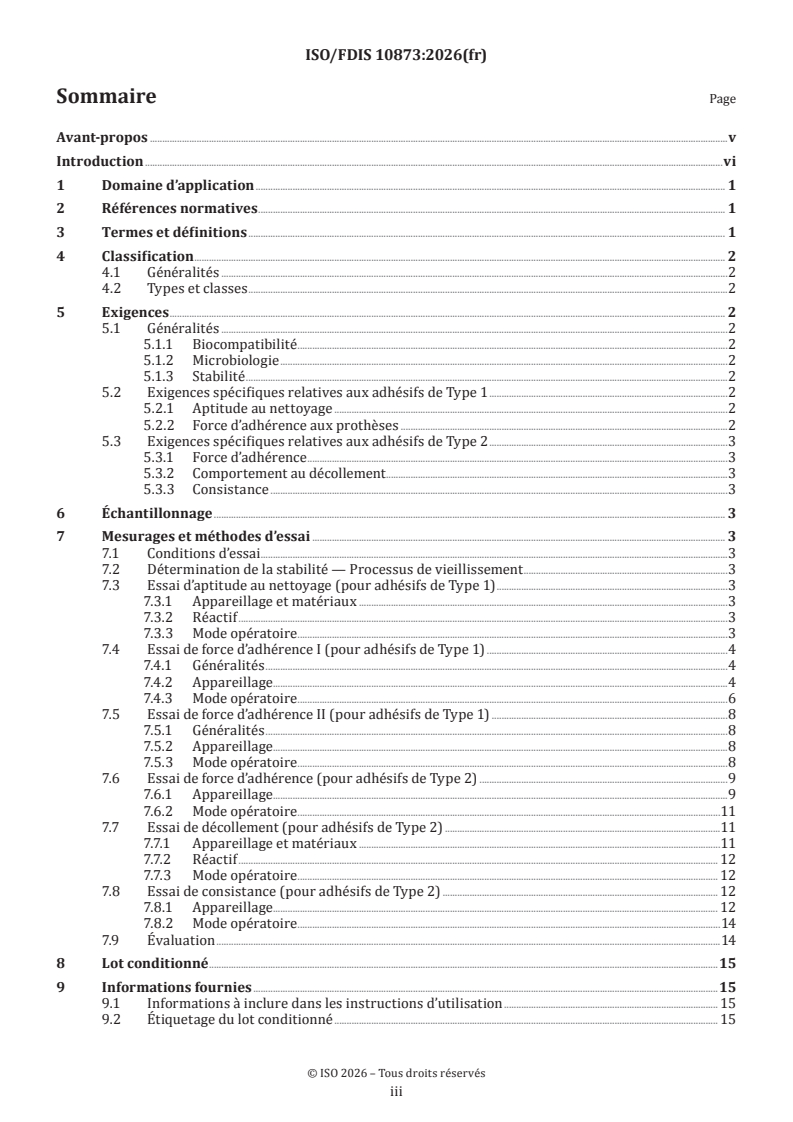
Sommaire Page
Avant-propos .v
Introduction .vi
1 Domaine d’application . 1
2 Références normatives . 1
3 Termes et définitions . 1
4 Classification . 2
4.1 Généralités .2
4.2 Types et classes .2
5 Exigences . 2
5.1 Généralités .2
5.1.1 Biocompatibilité .2
5.1.2 Microbiologie .2
5.1.3 Stabilité .2
5.2 Exigences spécifiques relatives aux adhésifs de Type 1 .2
5.2.1 Aptitude au nettoyage .2
5.2.2 Force d’adhérence aux prothèses .2
5.3 Exigences spécifiques relatives aux adhésifs de Type 2 .3
5.3.1 Force d’adhérence .3
5.3.2 Comportement au décollement .3
5.3.3 Consistance .3
6 Échantillonnage . 3
7 Mesurages et méthodes d’essai . 3
7.1 Conditions d’essai . . .3
7.2 Détermination de la stabilité — Processus de vieillissement .3
7.3 Essai d’aptitude au nettoyage (pour adhésifs de Type 1) .3
7.3.1 Appareillage et matériaux .3
7.3.2 Réactif .3
7.3.3 Mode opératoire . .3
7.4 Essai de force d’adhérence I (pour adhésifs de Type 1) .4
7.4.1 Généralités .4
7.4.2 Appareillage.4
7.4.3 Mode opératoire . .6
7.5 Essai de force d’adhérence II (pour adhésifs de Type 1) .8
7.5.1 Généralités .8
7.5.2 Appareillage.8
7.5.3 Mode opératoire . .8
7.6 Essai de force d’adhérence (pour adhésifs de Type 2) .9
7.6.1 Appareillage.9
7.6.2 Mode opératoire . .11
7.7 Essai de décollement (pour adhésifs de Type 2) .11
7.7.1 Appareillage et matériaux .11
7.7.2 Réactif . 12
7.7.3 Mode opératoire . . 12
7.8 Essai de consistance (pour adhésifs de Type 2) . 12
7.8.1 Appareillage. 12
7.8.2 Mode opératoire . .14
7.9 Évaluation .14
8 Lot conditionné .15
9 Informations fournies .15
9.1 Informations à inclure dans les instructions d’utilisation . 15
9.2 Étiquetage du lot conditionné . 15
iii
Bibliographie .16
iv
Avant-propos
L’ISO (Organisation internationale de normalisation) est une fédération mondiale d’organismes nationaux
de normalisation (comités membres de l’ISO). L’élaboration des Normes internationales est en général
confiée aux comités techniques de l’ISO. Chaque comité membre intéressé par une étude a le droit de faire
partie du comité technique créé à cet effet. Les organisations internationales, gouvernementales et non
gouvernementales, en liaison avec l’ISO participent également aux travaux. L’ISO collabore étroitement avec
la Commission électrotechnique internationale (IEC) en ce qui concerne la normalisation électrotechnique.
Les procédures utilisées pour élaborer le présent document et celles destinées à sa mise à jour sont
décrites dans les Directives ISO/IEC, Partie 1. Il convient, en particulier, de prendre note des différents
critères d’approbation requis pour les différents types de documents ISO. Le présent document
a été rédigé conformément aux règles de rédaction données dans les Directives ISO/IEC, Partie 2
(voir www.iso.org/directives).
L’ISO attire l’attention sur le fait que la mise en application du présent document peut entraîner l’utilisation
d’un ou de plusieurs brevets. L’ISO ne prend pas position quant à la preuve, à la validité et à l’applicabilité de
tout droit de propriété revendiqué à cet égard. À la date de publication du présent document, l’ISO n’avait pas
reçu notification qu’un ou plusieurs brevets pouvaient être nécessaires à sa mise en application. Toutefois,
il y a lieu d’avertir les responsables de la mise en application du présent document que des informations
plus récentes sont susceptibles de figurer dans la base de données de brevets, disponible à l’adresse
www.iso.org/brevets. L’ISO ne saurait être tenue pour responsable de ne pas avoir identifié tout ou partie de
tels droits de propriété.
Les appellations commerciales éventuellement mentionnées dans le présent document sont données pour
information, par souci de commodité, à l’intention des utilisateurs et ne sauraient constituer un engagement.
Pour une explication de la nature volontaire des normes, la signification des termes et expressions
spécifiques de l’ISO liés à l’évaluation de la conformité, ou pour toute information au sujet de l’adhésion de
l’ISO aux principes de l’Organisation mondiale du commerce (OMC) concernant les obstacles techniques au
commerce (OTC), voir www.iso.org/avant-propos.
Le présent document a été élaboré par le comité technique ISO/TC 106, Médecine bucco-dentaire, sous-comité
SC 7, Produits de soins bucco-dentaires, en collaboration avec le comité technique CEN/TC 55, Médecine bucco-
dentaire, du Comité européen de normalisation (CEN), conformément à l’Accord de coopération technique
entre l’ISO et le CEN (Accord de Vienne).
Cette troisième édition annule et remplace la deuxième édition (ISO 10873:2021), qui a fait l’objet d’une
révision technique.
Les principales modifications sont les suivantes:
— suppression des exigences relatives à la valeur du pH (5.1.2);
— suppression du mesurage de la valeur du pH (7.2).
Il convient que l’utilisateur adresse tout retour d’information ou toute question concernant le présent
document à l’organisme national de normalisation de son pays. Une liste exhaustive desdits organismes se
trouve à l’adresse www.iso.org/fr/members.html.
v
Introduction
Les adhésifs pour prothèses dentaires sont utilisés pour améliorer provisoirement la rétention des prothèses
dentaires amovibles sur les tissus mous de soutien. Le présent document a pour objectif de déterminer les
propriétés physiques et chimiques des adhésifs pour prothèses dentaires.
Il ne contient pas d’exigences qualitatives et quantitatives spécifiques concernant l’absence de risques
biologiques. Pour l’évaluation des éventuels risques biologiques, il est recommandé de se reporter à
l’ISO 7405 et à l’ISO 10993-1.
vi
PROJET FINAL Norme internationale ISO/FDIS 10873:2026(fr)
Médecine bucco-dentaire — Adhésifs pour prothèses
dentaires
1 Domaine d’application
Le présent document classe les adhésifs pour prothèses dentaires utilisés par les porteurs de prothèses
amovibles et spécifie leurs exigences et méthodes d’essai.
Le présent document s’applique aux adhésifs pour prothèses dentaires amovibles destinés à être utilisés
par le consommateur et exclut les produits pour intrados de prothèse spécifiés ou appliqués par les
professionnels dentaires.
2 Références normatives
Les documents suivants sont cités dans le texte de sorte qu’ils constituent, pour tout ou partie de leur
contenu, des exigences du présent document. Pour les références datées, seule l’édition citée s’applique. Pour
les références non datées, la dernière édition du document de référence s’applique (y compris les éventuels
amendements).
ISO 1942, Médecine bucco-dentaire — Vocabulaire
ISO 3696:1987, Eau pour laboratoire à usage analytique — Spécification et méthodes d'essai
ISO 7823-2, Plastiques — Plaques en poly(méthacrylate de méthyle) — Types, dimensions et caractéristiques —
Partie 2: Plaques extrudées
ISO 8601-1, Date et heure — Représentations pour l'échange d'information — Partie 1: Règles de base
3 Termes et définitions
Pour les besoins du présent document, les termes et les définitions de l’ISO 1942 ainsi que les suivants
s’appliquent.
L’ISO et l’IEC tiennent à jour des bases de données terminologiques destinées à être utilisées en normalisation,
consultables aux adresses suivantes:
— ISO Online browsing platform: disponible à l’adresse https:// www .iso .org/ obp
— IEC Electropedia: disponible à l’adresse https:// www .electropedia .org/
3.1
adhésif pour prothèses dentaires
fourniture dentaire placée sur l’intrados d’une prothèse amovible pour améliorer provisoirement sa
rétention par les tissus mous de soutien
Note 1 à l'article: L’intrados est également connu sous le nom de surface d’appui.
[SOURCE: ISO 1942:2020, 3.3.1.23, modifiée — La Note 1 à l’article a été ajoutée.]
3.2
type fixatif
adhésif pour prothèses dentaires (3.1) en poudre, crème, feuillet ou languette, avec un polymère soluble dans
l’eau comme constituant adhésif
3.3
type pâte non aqueuse
adhésif pour prothèses dentaires (3.1) sous forme non aqueuse
4 Classification
4.1 Généralités
Pour les besoins du présent document, les adhésifs pour prothèses dentaires sont classés selon les types
suivants:
4.2 Types et classes
a) Type 1: type fixatif:
— Classe 1: sous forme de poudre;
— Classe 2: sous forme de crème;
— Classe 3: sous forme de feuillet ou de languette.
b) Type 2: type pâte non aqueuse.
5 Exigences
5.1 Généralités
5.1.1 Biocompatibilité
Il convient de porter une attention particulière pour évaluer les effets sur la biocompatibilité dus au
relargage des ions métalliques de l’adhésif pour prothèses dentaires.
5.1.2 Microbiologie
Certaines informations concernant les essais relatifs à la contamination microbiologique sont disponibles
dans l’ISO 16212, l’ISO 18415, l’ISO 18416, l’ISO 21148, l’ISO 21149, l’ISO 21150, l’ISO 22717, l’ISO 22718,
l’ISO 29621 et les Références [12] à[15].
5.1.3 Stabilité
Les adhésifs pour prothèses dentaires ne doivent présenter aucun signe de détérioration pouvant affecter la
conformité au présent document après avoir été soumis au processus de vieillissement spécifié en 7.2.
5.2 Exigences spécifiques relatives aux adhésifs de Type 1
5.2.1 Aptitude au nettoyage
Il ne doit pas y avoir de résidu d’adhésif sur la surface de la plaque en poly(méthacrylate de méthyle) (PMMA)
lorsque l’adhésif est soumis à essai conformément à 7.3.
5.2.2 Force d’adhérence aux prothèses
La force d’adhérence ne doit pas être inférieure à 5 kPa lorsque l’adhésif est soumis à essai conformément à
7.4 et 7.5.
5.3 Exigences spécifiques relatives aux adhésifs de Type 2
5.3.1 Force d’adhérence
La force d’adhérence ne doit pas être inférieure à 5 kPa lorsque l’adhésif est soumis à essai conformément à
7.6.
5.3.2 Comportement au décollement
Il ne doit pas y avoir de résidu d’adhésif sur la surface de la plaque en PMMA lorsque l’adhésif est soumis à
essai conformément à 7.7.
5.3.3 Consistance
La consistance ne doit pas être inférieure à 15 mm lorsque l’adhésif est soumis à essai conformément à 7.8.
6 Échantillonnage
L’échantillon doit être prélevé d’un seul lot et doit être suffisant pour effectuer tous les essais spécifiés à
l’Article 7.
7 Mesurages et méthodes d’essai
7.1 Conditions d’essai
Tous les essais doivent être réalisés à une température de (23 ± 3) °C.
7.2 Détermination de la stabilité — Processus de vieillissement
Stocker les adhésifs pour prothèses dentaires dans leur récipient d’origine à (40 ± 2) °C à (75 ± 5) %
d’humidité relative pendant 3 mois, ou dans des conditions d’humidité et de température telles qu’elles
[16]
simuleront un stockage à température ambiante pendant 30 mois .
7.3 Essai d’aptitude au nettoyage (pour adhésifs de Type 1)
7.3.1 Appareillage et matériaux
7.3.1.1 Bain-marie, pouvant être maintenu à une température de (37 ± 2) °C.
7.3.1.2 Plaque en PMMA, d’environ 50 mm × 50 mm, conformément à l’ISO 7823-2.
7.3.2 Réactif
7.3.2.1 Eau, de qualité 3, conformément à l’ISO 3696:1987.
7.3.3 Mode opératoire
Appliquer l’adhésif pour prothèses dentaires sur la plaque en PMMA (7.3.1.2) uniformément en suivant les
instructions d’utilisation du fabricant, puis immerger la plaque dans l’eau pendant 1 h au bain-marie (7.3.1.1)
maintenu à une température de (37 ± 2) °C.
Nettoyer la plaque
...
Questions, Comments and Discussion
Ask us and Technical Secretary will try to provide an answer. You can facilitate discussion about the standard in here.
Loading comments...