

ISO 19822:2018
(Main)Fertilizers and soil conditioners — Determination of humic and hydrophobic fulvic acids concentrations in fertilizer materials
General Information
- Abstract
This document specifies the procedure for the analysis of humic acids and hydrophobic fulvic acids which is applicable to dry and liquid materials used as ingredients in commercial fertilizers, soil amendments, and geological deposits.
- Status
- Published
- Publication Date
- 09-Aug-2018
- Technical Committee
- ISO/TC 134 - Fertilizers, soil conditioners and beneficial substances
- Drafting Committee
- ISO/TC 134 - Fertilizers, soil conditioners and beneficial substances
- Current Stage
- 9060 - Close of review
- Completion Date
- 02-Sep-2030
Buy Documents

ISO 19822:2018 - Fertilizers and soil conditioners -- Determination of humic and hydrophobic fulvic acids concentrations in fertilizer materials


ISO 19822:2018 - Fertilizers and soil conditioners — Determination of humic and hydrophobic fulvic acids concentrations in fertilizer materials/10/2018
Overview
ISO 19822:2018 specifies a laboratory method for the determination of humic acids (HA) and hydrophobic fulvic acids (HFA) in dry and liquid materials used in commercial fertilizers, soil conditioners, and geological deposits. The procedure adapts classical and IHSS preparative extraction techniques into a quantitative, ash‑free gravimetric method using alkali extraction under anoxic conditions, acid precipitation of HA, and selective adsorption of HFA onto a methacrylic‑ester (DAX‑8 type) resin at pH 1.
Key topics and technical requirements
- Scope & definitions: Clear definitions for humic substance, humic acids (HA), fulvic fraction, and hydrophobic fulvic acids (HFA). HFA are defined by elemental sulfur content (<0.75%) and adsorption behavior at pH 1.
- Principles: Alkali extraction of alkaline‑soluble organic material, acidification to precipitate HA, and resin adsorption to isolate HFA from the fulvic fraction.
- Sample preparation: Procedures for drying, homogenizing, sieving (≤75 µm), and weighing samples to avoid moisture uptake (humic materials are hygroscopic).
- Reagents & apparatus: Typical reagents include NaOH (0.1 M, 0.5 M), HCl (0.1–6 M), nitrogen gas, acetone, DAX‑8 methacrylic‑ester resin and Amberlite IR‑120 cation exchange resin. Required equipment: analytical balance, centrifuge, rotary evaporator, pH/conductivity meters, spectrophotometer (350 nm), muffle furnace, chromatography columns.
- Analytical steps: Extraction under anoxic conditions, separation of insoluble HA (gravimetric, ash‑free), determination of ash content, selective adsorption of HFA onto hydrophobic resin, hydrogen ion exchange and final calculations for % analyte in solid and liquid samples.
- Quality & safety warnings:
- Follow good laboratory practices (e.g., ISO/IEC 17025 recommended).
- Do not exceed 65 °C when drying (risk of decomposition).
- Pre‑screen liquids for lignosulfonates (which damage resin and cannot be differentiated from HFA by this method).
- Control moisture strictly during handling.
Applications and users
ISO 19822:2018 is designed for:
- Fertilizer and soil amendment manufacturers performing product characterization and quality control.
- Commercial and regulatory testing laboratories verifying percent HA and HFA in products.
- Agricultural researchers studying humic substances in amendments and geological deposits.
- Buyers and regulators who need standardized, comparable quantification of humic and fulvic fractions in commercial materials.
Practical benefits include reproducible, ash‑free quantification of active humic ingredients and a method that distinguishes hydrophobic fulvic acids from many non‑humic co‑extractives through selective resin adsorption.
Related standards and references
- ISO/IEC 17025 - general requirements for laboratory competence and quality (recommended practice).
- IHSS (International Humic Substances Society) procedures and classical extraction techniques described by Stevenson (background for method development).
- Annexes in ISO 19822:2018: pre‑screening procedure for lignosulfonates and interlaboratory study results for method validation.
Keywords: ISO 19822:2018, humic acids, hydrophobic fulvic acids, fertilizers, soil conditioners, determination method, ash‑free gravimetric, DAX‑8 resin, sample preparation, laboratory analysis.
Relations
- Effective Date
- 24-Jun-2023
Buy Documents
ISO 19822:2018 - Fertilizers and soil conditioners -- Determination of humic and hydrophobic fulvic acids concentrations in fertilizer materials
ISO 19822:2018 - Fertilizers and soil conditioners — Determination of humic and hydrophobic fulvic acids concentrations in fertilizer materials/10/2018
Get Certified
Connect with accredited certification bodies for this standard

Control Union Certifications
Global certification for agriculture and sustainability.

ECOCERT
Organic and sustainability certification.

FSC International
Forest Stewardship Council certification.
Sponsored listings
Frequently Asked Questions
ISO 19822:2018 is a standard published by the International Organization for Standardization (ISO). Its full title is "Fertilizers and soil conditioners — Determination of humic and hydrophobic fulvic acids concentrations in fertilizer materials". This standard covers: This document specifies the procedure for the analysis of humic acids and hydrophobic fulvic acids which is applicable to dry and liquid materials used as ingredients in commercial fertilizers, soil amendments, and geological deposits.
This document specifies the procedure for the analysis of humic acids and hydrophobic fulvic acids which is applicable to dry and liquid materials used as ingredients in commercial fertilizers, soil amendments, and geological deposits.
ISO 19822:2018 is classified under the following ICS (International Classification for Standards) categories: 65.080 - Fertilizers. The ICS classification helps identify the subject area and facilitates finding related standards.
ISO 19822:2018 has the following relationships with other standards: It is inter standard links to ISO 19822:2018/Amd 1:2026. Understanding these relationships helps ensure you are using the most current and applicable version of the standard.
ISO 19822:2018 is available in PDF format for immediate download after purchase. The document can be added to your cart and obtained through the secure checkout process. Digital delivery ensures instant access to the complete standard document.
Standards Content (Sample)
INTERNATIONAL ISO
STANDARD 19822
First edition
2018-08
Fertilizers and soil conditioners —
Determination of humic and
hydrophobic fulvic acids
concentrations in fertilizer materials
Engrais et amendements minéraux basique - Détermination des
acides humique et fulvique
Reference number
©
ISO 2018
© ISO 2018
All rights reserved. Unless otherwise specified, or required in the context of its implementation, no part of this publication may
be reproduced or utilized otherwise in any form or by any means, electronic or mechanical, including photocopying, or posting
on the internet or an intranet, without prior written permission. Permission can be requested from either ISO at the address
below or ISO’s member body in the country of the requester.
ISO copyright office
CP 401 • Ch. de Blandonnet 8
CH-1214 Vernier, Geneva
Phone: +41 22 749 01 11
Fax: +41 22 749 09 47
Email: copyright@iso.org
Website: www.iso.org
Published in Switzerland
ii © ISO 2018 – All rights reserved
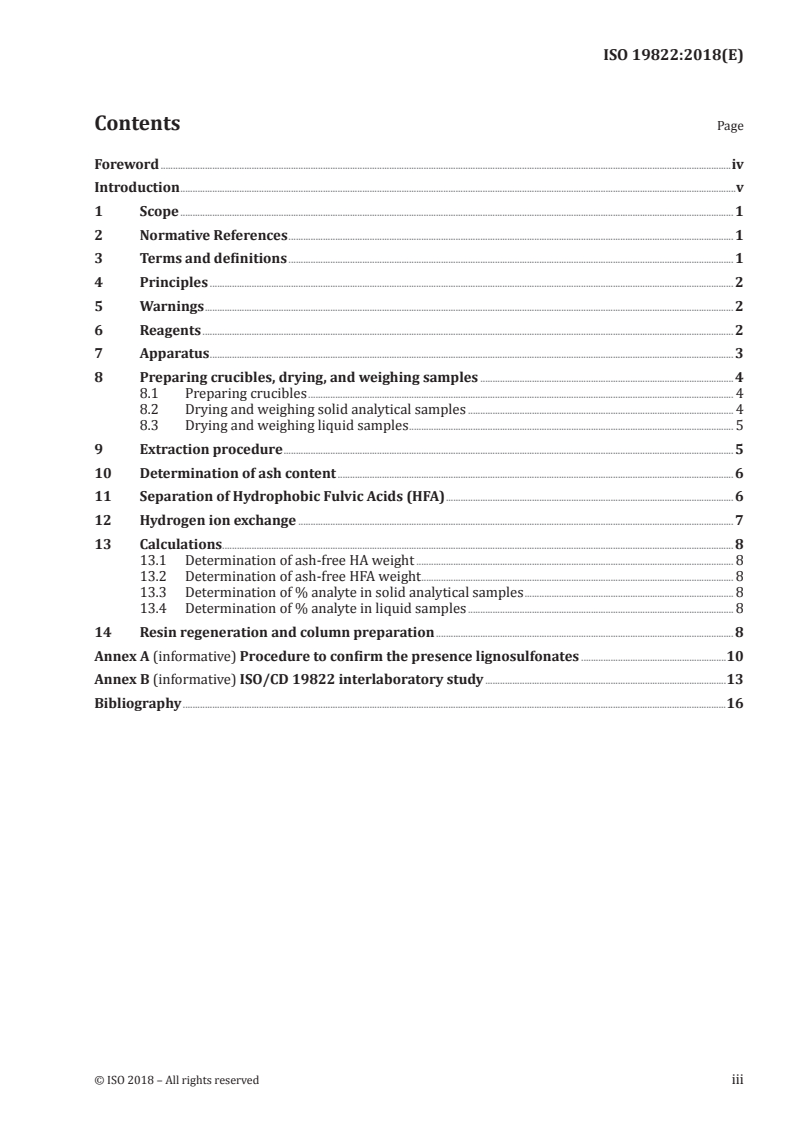
Contents Page
Foreword .iv
Introduction .v
1 Scope . 1
2 Normative References . 1
3 Terms and definitions . 1
4 Principles . 2
5 Warnings . 2
6 Reagents . 2
7 Apparatus . 3
8 Preparing crucibles, drying, and weighing samples . 4
8.1 Preparing crucibles . 4
8.2 Drying and weighing solid analytical samples . 4
8.3 Drying and weighing liquid samples . 5
9 Extraction procedure . 5
10 Determination of ash content . 6
11 Separation of Hydrophobic Fulvic Acids (HFA) . 6
12 Hydrogen ion exchange . 7
13 Calculations. 8
13.1 Determination of ash-free HA weight . 8
13.2 Determination of ash-free HFA weight . 8
13.3 Determination of % analyte in solid analytical samples . 8
13.4 Determination of % analyte in liquid samples . 8
14 Resin regeneration and column preparation . 8
Annex A (informative) Procedure to confirm the presence lignosulfonates .10
Annex B (informative) ISO/CD 19822 interlaboratory study .13
Bibliography .16
Foreword
ISO (the International Organization for Standardization) is a worldwide federation of national standards
bodies (ISO member bodies). The work of preparing International Standards is normally carried out
through ISO technical committees. Each member body interested in a subject for which a technical
committee has been established has the right to be represented on that committee. International
organizations, governmental and non-governmental, in liaison with ISO, also take part in the work.
ISO collaborates closely with the International Electrotechnical Commission (IEC) on all matters of
electrotechnical standardization.
The procedures used to develop this document and those intended for its further maintenance are
described in the ISO/IEC Directives, Part 1. In particular, the different approval criteria needed for the
different types of ISO documents should be noted. This document was drafted in accordance with the
editorial rules of the ISO/IEC Directives, Part 2 (see www .iso .org/directives).
Attention is drawn to the possibility that some of the elements of this document may be the subject of
patent rights. ISO shall not be held responsible for identifying any or all such patent rights. Details of
any patent rights identified during the development of the document will be in the Introduction and/or
on the ISO list of patent declarations received (see www .iso .org/patents).
Any trade name used in this document is information given for the convenience of users and does not
constitute an endorsement.
For an explanation of the voluntary nature of standards, the meaning of ISO specific terms and
expressions related to conformity assessment, as well as information about ISO's adherence to the
World Trade Organization (WTO) principles in the Technical Barriers to Trade (TBT) see www .iso
.org/iso/foreword .html.
This document was prepared by Technical Committee ISO/TC 134, Fertilizers and soil conditioners.
Any feedback or questions on this document should be directed to the user’s national standards body. A
complete listing of these bodies can be found at www .iso .org/members .html.
iv © ISO 2018 – All rights reserved
Introduction
Humic substances are present in all ecosystems: oceans, rivers, lakes, and top soils. Quantifying the
amount of humic material present in these systems is essential for academic research and commercial
applications, specifically agricultural soil and plant management.
The increased use of humic substances in agriculture has generated intense interest among producers,
consumers, and regulators for a reliable method for quantification of the active ingredients in raw
humic ores and commercial fertilizer products; specifically humic and fulvic acids. As both commercial
trade and regulation of humic products are based on percentage (%) of the humic and fulvic acids in
commercial humic products, use of % units instead of SI units is warranted, therefore incorporated
into this standard.
This document establishes a method for the determination of humic acids (HA) and acidic hydrophobic
fulvic acids (HFA). The method is based on an existing preparative procedure use by the International
[1]
Humic Substances Society (IHSS) for extracting high purity HA and HFA from soil samples , which is a
[2]
modified form of the “classical” technique described in detail by Stevenson . The “classical” methods
and the IHSS method were developed as preparative methods for the fractionation of soil organic
matter; they were not intended to be used as quantitative analytical methods. The classical method of
extracting humic acids and fulvic acids from soil humus utilize a “strong base” to extract the alkaline
soluble materials, and then the alkaline extract solution is acidified to flocculate the humic acids, which
appear to precipitate out of solution. The remaining substances in solution after alkaline and acid
treatment were called fulvic acids.
This method modifies the “classical” technique in a number of ways:
— it determines the quantity of humic substances on an “ash free” basis (mineral salts excluded);
— the alkali extraction is done under anoxic conditions to reduce oxidation of the analytical sample
during extraction;
— it defines the materials that are soluble in both alkali and acid as the Fulvic Fraction;
— it can differentiate products containing certain non-humic materials that some manufactures claim
to contain humic substances;
[3] [4]
— it further defines HFA as materials of low sulfur content that bind to a hydrophobic resin at pH 1
[5][6]
, instead the classical, and perhaps more common definition, for fulvic acids as materials that are
defined as soluble in both acid and alkali solution. This stricter definition is necessary to distinguish
HFA from mineral salts, polysaccharides, amino sugars, amino acids, proteins, acids, and carbohydrates
[1][4]
that are extracted along with humic substances when using the “classical” method .
See Annex B for information on ISO/CD 19822 interlaboratory study.
INTERNATIONAL STANDARD ISO 19822:2018(E)
Fertilizers and soil conditioners — Determination of humic
and hydrophobic fulvic acids concentrations in fertilizer
materials
1 Scope
This document specifies the procedure for the analysis of humic acids and hydrophobic fulvic acids
which is applicable to dry and liquid materials used as ingredients in commercial fertilizers, soil
amendments, and geological deposits.
2 Normative References
There are no normative references in this document.
3 Terms and definitions
For the purposes of this document, the following terms and definitions apply.
ISO and IEC maintain terminological databases for use in standardization at the following addresses:
— ISO Online browsing platform: available at https: //www .iso .org/obp
— IEC Electropedia: available at https: //www .electropedia .org/
3.1
hydrophobic fulvic acids
HFA
materials composed of less than 0,75 % elemental sulfur (S) that are soluble in aqueous alkaline and
acid solution and are adsorbed at pH 1 onto a polymeric adsorbent resin of moderate polarity. The resin
is of a type designed for adsorption of amphiphilic compounds having molecular weights typical of
fulvic acids
3.2
fulvic fraction
alkali extracted portions of humic substances that are soluble in both alkali and acid aqueous solutions
3.3
humic acids
HA
alkali extracted humic substances that are insoluble in strongly acidic solution and will precipitate
from the alkali extract in acid solutions of pH 1
3.4
humic substance
major organic constituent of natural organic matter consisting of complex heterogeneous mixtures
of carbon-based substances formed by biochemical reactions during the decay and transformation of
plant and microbial remains
3.5
lignosulfonates
amorphous light to dark brown powder or liquid derived from the sulfite pulping of softwoods. The
lignin framework is a sulfonated random polymer of three aromatic alcohols: coniferyl alcohol,
p-coumaryl alcohol, and sinapyl alcohol, of which coniferyl alcohol is the principle unit
4 Principles
4.1 This method determines ash-free quantities of HA and HFA gravimetrically after separation from
their matrix.
4.2 The method of extracting HA and HFA utilizes a strong base to extract the alkaline-soluble materials,
and then, after removal of non-soluble components, the alkaline solution is acidified to flocculate the HA.
4.3 The liquid supernatant remaining after the removal of the HA is called the Fulvic Fraction. The
Fulvic Fraction, which can contain Hydrophobic Fulvic Acids (HFA), is treated to determine the quantity
of HFA in the Fulvic Fraction by selective adsorption onto a methacrylic-ester resin designed to separate
the HFA from non-humic compounds. The material retained by the hydrophobic resin is referred to in the
[3]
literature as the hydrophobic acid fraction of soluble organic matter .
5 Warnings
5.1 Requirements
5.1.1 Good laboratory practices
Related standards (e.g. ISO/IEC 17025) should be followed at all times in regards to personal protective
equipment (safety glasses, handling strong acids, hydrochloric acid) and alkali (sodium hydroxide).
5.1.2 Moisture control
Humic and fulvic acids are hygroscopic materials; it is critical to prevent absorption of moisture during
the handling of dried materials.
5.3 Lignosulfonates
Lignosulfonates will damage the hydrophobic resin. This analytical method cannot differentiate
between hydrophobic fulvic acids and lignosulfonates, therefore pre-screening for the presence of
lignosulfonates is recommended for liquid products of unknown origin.
See Annex A.
5.4 Temperature control
Do not exceed 65 °C when drying the humic and fulvic analytes. The analytes are subject to
decomposition at higher temperatures.
6 Reagents
6.1 Sodium hydroxide solution, 0,1 M, dilute 3,99 g of 99,99 % purity NaOH in 1 l of deionized water.
6.2 Sodium hydroxide solution, 0,5 M, dilute 19,99 g of 99,99 % purity NaOH in 1 l of deionized water.
6.3 Hydrochloric acid solution, 6 M, dilute 12 M HCl with an equal part of deionized water.
6.4 Hydrochloric acid solution, 1 M, dilute 83,3 ml of 12 M HCl with 1 l of deionized water.
6.5 Hydrochloric acid solution, 0,1 M, perform a 1:10 dilution using 1 M HCl prepared in 6.4 with
final volume of 1 l using deionized water.
2 © ISO 2018 – All rights reserved
6.6 Nitrogen gas (UN1066) 99,9 % purity.
−1
6.7 Methacrylic-ester resin, 40–60 mesh, approximately 0,79 ml·g pore volume, 225 Å mean pore
2 −1
size, 160 m ·g surface area, for adsorption of materials up to 150 000 MW, e.g. Supelite DAX-8 Resin, or
any other available resin meeting equivalent properties.
6.8 Amberlite IR-120 strong cation exchange resin, hydrogen form.
[8]
6.9 Deionized water .
6.10 Acetone.
7 Apparatus
7.1 Analytical balance with draft guard: capacity 210 g, with readability to ±0,000 1 g.
7.2 Drying oven, capable of 120 °C, precision ±3 °C.
7.3 Centrifuge, minimum relative centrifugal force 1 500 × g, capable of 3 900 × g.
7.4 4 ml to 50 ml or 250 ml polyethylene or HDPE centrifuge tubes, or heavy duty high
temperature resistant centrifuge tubes capable of 600 °C (for example; Kimble-Chase, catalog
number 45212-50 KIMAX).
7.5 4 ml to 100 ml wide-form crucibles (for example: Fisher Scientific catalog number FB-965-M).
7.6 Rotary evaporator 400 ml capacity.
7.7 Magnetic stir plates and 5 cm to 7 cm long magnetic stir bars.
7.8 pH meter and electrode.
7.9 Electrical conductivity meter with probe having a calibrated cell constant of approximately
one, as determined using standard protocols.
7.10 Spectrophotometer, capable of measuring ±0,005 absorbance units at 350 nm.
−1
7.11 Peristaltic pump with a minimum flow rate of 1,2 ml·min and tubing.
7.12 Muffle furnace.
7.13 Rotating shaking mixer.
7.14 Desiccator with silica gel (or its equivalent) as desiccant.
7.15 Erlenmeyer flask, 1 000 ml.
7.16 Beaker, 4 l.
7.17 Graduated cylinder, 1 000 ml.
7.18 Glass chromatography column, 4 cm × 25 cm for DAX-8 resin.
7.19 Glass chromatography column, 5 cm × 60 cm for IR120 H+ exchange resin.
7.20 Ceramic mortar and pestle.
7.21 Sieve, 74 µm (#200 US mesh).
1)
7.22 Parafilm® .
8 Preparing crucibles, drying, and weighing samples
8.1 Preparing crucibles
8.1.1 If using new crucibles, first wash them with acetone and then dry them in an oven at 105 °C for
2 hours.
8.1.2 Prepare previously used crucibles by washing in acetone, then firing them in a muffle furnace at
500 °C for 2 hours. Cool the crucibles in a desiccator to room temperature. Remove from desiccator when
cool, record weight of the crucibles to four decimal places.
8.2 Drying and weighing solid analytical samples
8.2.1 If the analytical sample is a solid material, crush and screen approximately 5 g of the analytical
sample to ≤75 µm making sure that the powder becomes well homogenized.
8.2.2 Transfer approximately 5 g analytical sample to a 100 ml crucible prepared according to 8.1.
8.2.3 Place the analytical sample in a drying oven for 24 h at a temperature of 62 ± 3 °C. (do not exceed
65 °C). If any clumping of the sample occurs during drying, break up the clumps with a glass rod. Continue
drying until the sample is dried to a constant weight. This can take up to 24 h;
8.2.4 After achieving constant weight, remove the analytical sample from the drying oven and
immediately place in a desiccator to cool.
NOTE Both humic and fulvic acids are hygroscopic materials, it is critical to prevent absorption of moisture
during the handling of these materials.
8.2.5 Weigh out approximately 2,5 g test portion from the dried analytical sample in a pre-weighed
crucible prepared according to 8.1, taking precautions to prevent moisture adsorption while handling.
Record the test portion + crucible weight to four decimal places. Proceed to 9.1 immediately or return
the crucible with test portion to the desiccator.
8.2.6 Determine the weight of the test portion by subtracting the weight of the crucible from the test
portion + crucible; record the result as the Test Portion Dried Weight.
1) Parafilm® is a trademark of Bemis NA, Neenah, Wisconsin, USA. This information is given for the convenience
of users of this document and does not constitute an endorsement by ISO of the product named. Equivalent products
may be used if they can be shown to lead to the same results. It is commonly used for sealing or protecting vessels.
It is a ductile, malleable, waterproof, odorless, translucent and cohesive thermoplastic.
4 © ISO 2018 – All rights reserved
8.3 Drying and weighing liquid samples
8.3.1 For liquid analytical samples, thoroughly homogenize the analytical sample by shaking the
sample for one minute in the container in which the liquid was delivered. Weigh out approximately
5 g test portion from the liquid analytical sample to four decimal places. Record this as the Liquid Test
Portion Weight.
For liquid analytical samples with an expected HFA content <1 %, use a test portion weight of 10 g.
8.3.2 Follow steps 8.2.2 to 8.2.6 for drying the sample and weighing the test portion of the sample.
9 Extraction procedure
9.1 From this point on, the method is the same for both solid and liquid samples.
Transfer the prepared test portion of the analytical sample to a 1 l Erlenmeyer flask containing a 5 cm
to 7 cm long magnetic stir bar. Add 0,1 M NaOH, constantly stirring on a stir plate, to a final volume of
1 l. Evacuate the head space with N and cover with parafilm (or seal the flask with a similar material).
Then mix vigorously on a stir plate (e.g. 300 rpm to 400 rpm). Stir liquid samples for 1 hour; stir the
solid samples for 16 hours to 18 hours.
NOTE For solid samples, it can be convenient to perform this step late in the day so the solid samples can be
stirred overnight.
9.1.1 After stirring, remove the flask from the stir plate, transfer to suitable centrifuge tubes and
centrifuge the entire volume at 3 900 × g for 30 minutes to separate any insoluble material from the
dissolved materials in the alkaline extract. Carefully transfer the alkaline extract to a clean 1 l Erlenmeyer
flask containing a magnetic stir bar. Discard the insoluble materials.
9.1.2 While gently stirring the solution, adjust the pH of the alkaline extract solution to flocculate
the HA from the acid soluble materials by adding 6 M HCl (1:1) drop-wise to the alkaline extract, until
1,0 ± 0,1 pH is reached.
9.1.3 Cover the flask with parafilm and mix for 1 h. After 1 hour, check the pH and readjust to
pH 1,0 ± 0,05 with additional 6 M HCl, if necessary. If the pH falls below 0,95, adjust the pH back to
1,0 ± 0,05 with 0,5 M NaOH solution. Continue mixing the acidified extract until it stabilizes at
pH 1,0 ± 0,05 for exactly 5 minutes. Do not let the acidified extract sit for longer than 5 minutes after the
pH stabilizes. Remove the pH electrode.
9.2 Separation of HA
9.2.1 Once the pH is stable, remove the flask from the mixer, and cover the flask with parafilm. Allow
the pH-adjusted extract to sit undisturbed for 4 hours ±5 minutes (do not exceed 4 hours). This stage is
critical to prevent further partitioning of the HA and HFA constituents. The flocculated HA will drop out
of solution.
9.2.2 Immediately centrifuge the extract solution at 3 900 × g for 30 minutes using pre-weighed 50 ml
centrifuge tubes to recover the flocculated humic acids portion. Decant the supernatant (Fulvic Fraction),
being careful not to include any of the flocculated HA. Typically, about 500 ml of the clarified extract can
be decanted without disturbing the flocculated HA. If hydrophobic fulvic acids (HFA) analysis is to be
performed, decant the fulvic fraction into a clean 1 l Erlenmeyer flask. [Alternatively: using heavy duty
high temperature centrifuge tubes instead of plastic centrifuge tubes eliminates the need to transfer the
flocculated HA to a crucible, decreasing labor and increasing precision.]
9.2.3 Centrifuge the tubes containing the flocculated HA again at 1,500 × g for 20 minutes to 30 minutes
to further separate the flocculated HA that appears to precipitate from the liquid fulvic fraction. If HFA
analysis is intended, add this supernatant to the decant
...
INTERNATIONAL ISO
STANDARD 19822
First edition
2018-08
Fertilizers and soil conditioners —
Determination of humic and
hydrophobic fulvic acids
concentrations in fertilizer materials
Engrais et amendements minéraux basique - Détermination des
acides humique et fulvique
Reference number
©
ISO 2018
© ISO 2018
All rights reserved. Unless otherwise specified, or required in the context of its implementation, no part of this publication may
be reproduced or utilized otherwise in any form or by any means, electronic or mechanical, including photocopying, or posting
on the internet or an intranet, without prior written permission. Permission can be requested from either ISO at the address
below or ISO’s member body in the country of the requester.
ISO copyright office
CP 401 • Ch. de Blandonnet 8
CH-1214 Vernier, Geneva
Phone: +41 22 749 01 11
Fax: +41 22 749 09 47
Email: copyright@iso.org
Website: www.iso.org
Published in Switzerland
ii © ISO 2018 – All rights reserved
Contents Page
Foreword .iv
Introduction .v
1 Scope . 1
2 Normative References . 1
3 Terms and definitions . 1
4 Principles . 2
5 Warnings . 2
6 Reagents . 2
7 Apparatus . 3
8 Preparing crucibles, drying, and weighing samples . 4
8.1 Preparing crucibles . 4
8.2 Drying and weighing solid analytical samples . 4
8.3 Drying and weighing liquid samples . 5
9 Extraction procedure . 5
10 Determination of ash content . 6
11 Separation of Hydrophobic Fulvic Acids (HFA) . 6
12 Hydrogen ion exchange . 7
13 Calculations. 8
13.1 Determination of ash-free HA weight . 8
13.2 Determination of ash-free HFA weight . 8
13.3 Determination of % analyte in solid analytical samples . 8
13.4 Determination of % analyte in liquid samples . 8
14 Resin regeneration and column preparation . 8
Annex A (informative) Procedure to confirm the presence lignosulfonates .10
Annex B (informative) ISO/CD 19822 interlaboratory study .13
Bibliography .16
Foreword
ISO (the International Organization for Standardization) is a worldwide federation of national standards
bodies (ISO member bodies). The work of preparing International Standards is normally carried out
through ISO technical committees. Each member body interested in a subject for which a technical
committee has been established has the right to be represented on that committee. International
organizations, governmental and non-governmental, in liaison with ISO, also take part in the work.
ISO collaborates closely with the International Electrotechnical Commission (IEC) on all matters of
electrotechnical standardization.
The procedures used to develop this document and those intended for its further maintenance are
described in the ISO/IEC Directives, Part 1. In particular, the different approval criteria needed for the
different types of ISO documents should be noted. This document was drafted in accordance with the
editorial rules of the ISO/IEC Directives, Part 2 (see www .iso .org/directives).
Attention is drawn to the possibility that some of the elements of this document may be the subject of
patent rights. ISO shall not be held responsible for identifying any or all such patent rights. Details of
any patent rights identified during the development of the document will be in the Introduction and/or
on the ISO list of patent declarations received (see www .iso .org/patents).
Any trade name used in this document is information given for the convenience of users and does not
constitute an endorsement.
For an explanation of the voluntary nature of standards, the meaning of ISO specific terms and
expressions related to conformity assessment, as well as information about ISO's adherence to the
World Trade Organization (WTO) principles in the Technical Barriers to Trade (TBT) see www .iso
.org/iso/foreword .html.
This document was prepared by Technical Committee ISO/TC 134, Fertilizers and soil conditioners.
Any feedback or questions on this document should be directed to the user’s national standards body. A
complete listing of these bodies can be found at www .iso .org/members .html.
iv © ISO 2018 – All rights reserved
Introduction
Humic substances are present in all ecosystems: oceans, rivers, lakes, and top soils. Quantifying the
amount of humic material present in these systems is essential for academic research and commercial
applications, specifically agricultural soil and plant management.
The increased use of humic substances in agriculture has generated intense interest among producers,
consumers, and regulators for a reliable method for quantification of the active ingredients in raw
humic ores and commercial fertilizer products; specifically humic and fulvic acids. As both commercial
trade and regulation of humic products are based on percentage (%) of the humic and fulvic acids in
commercial humic products, use of % units instead of SI units is warranted, therefore incorporated
into this standard.
This document establishes a method for the determination of humic acids (HA) and acidic hydrophobic
fulvic acids (HFA). The method is based on an existing preparative procedure use by the International
[1]
Humic Substances Society (IHSS) for extracting high purity HA and HFA from soil samples , which is a
[2]
modified form of the “classical” technique described in detail by Stevenson . The “classical” methods
and the IHSS method were developed as preparative methods for the fractionation of soil organic
matter; they were not intended to be used as quantitative analytical methods. The classical method of
extracting humic acids and fulvic acids from soil humus utilize a “strong base” to extract the alkaline
soluble materials, and then the alkaline extract solution is acidified to flocculate the humic acids, which
appear to precipitate out of solution. The remaining substances in solution after alkaline and acid
treatment were called fulvic acids.
This method modifies the “classical” technique in a number of ways:
— it determines the quantity of humic substances on an “ash free” basis (mineral salts excluded);
— the alkali extraction is done under anoxic conditions to reduce oxidation of the analytical sample
during extraction;
— it defines the materials that are soluble in both alkali and acid as the Fulvic Fraction;
— it can differentiate products containing certain non-humic materials that some manufactures claim
to contain humic substances;
[3] [4]
— it further defines HFA as materials of low sulfur content that bind to a hydrophobic resin at pH 1
[5][6]
, instead the classical, and perhaps more common definition, for fulvic acids as materials that are
defined as soluble in both acid and alkali solution. This stricter definition is necessary to distinguish
HFA from mineral salts, polysaccharides, amino sugars, amino acids, proteins, acids, and carbohydrates
[1][4]
that are extracted along with humic substances when using the “classical” method .
See Annex B for information on ISO/CD 19822 interlaboratory study.
INTERNATIONAL STANDARD ISO 19822:2018(E)
Fertilizers and soil conditioners — Determination of humic
and hydrophobic fulvic acids concentrations in fertilizer
materials
1 Scope
This document specifies the procedure for the analysis of humic acids and hydrophobic fulvic acids
which is applicable to dry and liquid materials used as ingredients in commercial fertilizers, soil
amendments, and geological deposits.
2 Normative References
There are no normative references in this document.
3 Terms and definitions
For the purposes of this document, the following terms and definitions apply.
ISO and IEC maintain terminological databases for use in standardization at the following addresses:
— ISO Online browsing platform: available at https: //www .iso .org/obp
— IEC Electropedia: available at https: //www .electropedia .org/
3.1
hydrophobic fulvic acids
HFA
materials composed of less than 0,75 % elemental sulfur (S) that are soluble in aqueous alkaline and
acid solution and are adsorbed at pH 1 onto a polymeric adsorbent resin of moderate polarity. The resin
is of a type designed for adsorption of amphiphilic compounds having molecular weights typical of
fulvic acids
3.2
fulvic fraction
alkali extracted portions of humic substances that are soluble in both alkali and acid aqueous solutions
3.3
humic acids
HA
alkali extracted humic substances that are insoluble in strongly acidic solution and will precipitate
from the alkali extract in acid solutions of pH 1
3.4
humic substance
major organic constituent of natural organic matter consisting of complex heterogeneous mixtures
of carbon-based substances formed by biochemical reactions during the decay and transformation of
plant and microbial remains
3.5
lignosulfonates
amorphous light to dark brown powder or liquid derived from the sulfite pulping of softwoods. The
lignin framework is a sulfonated random polymer of three aromatic alcohols: coniferyl alcohol,
p-coumaryl alcohol, and sinapyl alcohol, of which coniferyl alcohol is the principle unit
4 Principles
4.1 This method determines ash-free quantities of HA and HFA gravimetrically after separation from
their matrix.
4.2 The method of extracting HA and HFA utilizes a strong base to extract the alkaline-soluble materials,
and then, after removal of non-soluble components, the alkaline solution is acidified to flocculate the HA.
4.3 The liquid supernatant remaining after the removal of the HA is called the Fulvic Fraction. The
Fulvic Fraction, which can contain Hydrophobic Fulvic Acids (HFA), is treated to determine the quantity
of HFA in the Fulvic Fraction by selective adsorption onto a methacrylic-ester resin designed to separate
the HFA from non-humic compounds. The material retained by the hydrophobic resin is referred to in the
[3]
literature as the hydrophobic acid fraction of soluble organic matter .
5 Warnings
5.1 Requirements
5.1.1 Good laboratory practices
Related standards (e.g. ISO/IEC 17025) should be followed at all times in regards to personal protective
equipment (safety glasses, handling strong acids, hydrochloric acid) and alkali (sodium hydroxide).
5.1.2 Moisture control
Humic and fulvic acids are hygroscopic materials; it is critical to prevent absorption of moisture during
the handling of dried materials.
5.3 Lignosulfonates
Lignosulfonates will damage the hydrophobic resin. This analytical method cannot differentiate
between hydrophobic fulvic acids and lignosulfonates, therefore pre-screening for the presence of
lignosulfonates is recommended for liquid products of unknown origin.
See Annex A.
5.4 Temperature control
Do not exceed 65 °C when drying the humic and fulvic analytes. The analytes are subject to
decomposition at higher temperatures.
6 Reagents
6.1 Sodium hydroxide solution, 0,1 M, dilute 3,99 g of 99,99 % purity NaOH in 1 l of deionized water.
6.2 Sodium hydroxide solution, 0,5 M, dilute 19,99 g of 99,99 % purity NaOH in 1 l of deionized water.
6.3 Hydrochloric acid solution, 6 M, dilute 12 M HCl with an equal part of deionized water.
6.4 Hydrochloric acid solution, 1 M, dilute 83,3 ml of 12 M HCl with 1 l of deionized water.
6.5 Hydrochloric acid solution, 0,1 M, perform a 1:10 dilution using 1 M HCl prepared in 6.4 with
final volume of 1 l using deionized water.
2 © ISO 2018 – All rights reserved
6.6 Nitrogen gas (UN1066) 99,9 % purity.
−1
6.7 Methacrylic-ester resin, 40–60 mesh, approximately 0,79 ml·g pore volume, 225 Å mean pore
2 −1
size, 160 m ·g surface area, for adsorption of materials up to 150 000 MW, e.g. Supelite DAX-8 Resin, or
any other available resin meeting equivalent properties.
6.8 Amberlite IR-120 strong cation exchange resin, hydrogen form.
[8]
6.9 Deionized water .
6.10 Acetone.
7 Apparatus
7.1 Analytical balance with draft guard: capacity 210 g, with readability to ±0,000 1 g.
7.2 Drying oven, capable of 120 °C, precision ±3 °C.
7.3 Centrifuge, minimum relative centrifugal force 1 500 × g, capable of 3 900 × g.
7.4 4 ml to 50 ml or 250 ml polyethylene or HDPE centrifuge tubes, or heavy duty high
temperature resistant centrifuge tubes capable of 600 °C (for example; Kimble-Chase, catalog
number 45212-50 KIMAX).
7.5 4 ml to 100 ml wide-form crucibles (for example: Fisher Scientific catalog number FB-965-M).
7.6 Rotary evaporator 400 ml capacity.
7.7 Magnetic stir plates and 5 cm to 7 cm long magnetic stir bars.
7.8 pH meter and electrode.
7.9 Electrical conductivity meter with probe having a calibrated cell constant of approximately
one, as determined using standard protocols.
7.10 Spectrophotometer, capable of measuring ±0,005 absorbance units at 350 nm.
−1
7.11 Peristaltic pump with a minimum flow rate of 1,2 ml·min and tubing.
7.12 Muffle furnace.
7.13 Rotating shaking mixer.
7.14 Desiccator with silica gel (or its equivalent) as desiccant.
7.15 Erlenmeyer flask, 1 000 ml.
7.16 Beaker, 4 l.
7.17 Graduated cylinder, 1 000 ml.
7.18 Glass chromatography column, 4 cm × 25 cm for DAX-8 resin.
7.19 Glass chromatography column, 5 cm × 60 cm for IR120 H+ exchange resin.
7.20 Ceramic mortar and pestle.
7.21 Sieve, 74 µm (#200 US mesh).
1)
7.22 Parafilm® .
8 Preparing crucibles, drying, and weighing samples
8.1 Preparing crucibles
8.1.1 If using new crucibles, first wash them with acetone and then dry them in an oven at 105 °C for
2 hours.
8.1.2 Prepare previously used crucibles by washing in acetone, then firing them in a muffle furnace at
500 °C for 2 hours. Cool the crucibles in a desiccator to room temperature. Remove from desiccator when
cool, record weight of the crucibles to four decimal places.
8.2 Drying and weighing solid analytical samples
8.2.1 If the analytical sample is a solid material, crush and screen approximately 5 g of the analytical
sample to ≤75 µm making sure that the powder becomes well homogenized.
8.2.2 Transfer approximately 5 g analytical sample to a 100 ml crucible prepared according to 8.1.
8.2.3 Place the analytical sample in a drying oven for 24 h at a temperature of 62 ± 3 °C. (do not exceed
65 °C). If any clumping of the sample occurs during drying, break up the clumps with a glass rod. Continue
drying until the sample is dried to a constant weight. This can take up to 24 h;
8.2.4 After achieving constant weight, remove the analytical sample from the drying oven and
immediately place in a desiccator to cool.
NOTE Both humic and fulvic acids are hygroscopic materials, it is critical to prevent absorption of moisture
during the handling of these materials.
8.2.5 Weigh out approximately 2,5 g test portion from the dried analytical sample in a pre-weighed
crucible prepared according to 8.1, taking precautions to prevent moisture adsorption while handling.
Record the test portion + crucible weight to four decimal places. Proceed to 9.1 immediately or return
the crucible with test portion to the desiccator.
8.2.6 Determine the weight of the test portion by subtracting the weight of the crucible from the test
portion + crucible; record the result as the Test Portion Dried Weight.
1) Parafilm® is a trademark of Bemis NA, Neenah, Wisconsin, USA. This information is given for the convenience
of users of this document and does not constitute an endorsement by ISO of the product named. Equivalent products
may be used if they can be shown to lead to the same results. It is commonly used for sealing or protecting vessels.
It is a ductile, malleable, waterproof, odorless, translucent and cohesive thermoplastic.
4 © ISO 2018 – All rights reserved
8.3 Drying and weighing liquid samples
8.3.1 For liquid analytical samples, thoroughly homogenize the analytical sample by shaking the
sample for one minute in the container in which the liquid was delivered. Weigh out approximately
5 g test portion from the liquid analytical sample to four decimal places. Record this as the Liquid Test
Portion Weight.
For liquid analytical samples with an expected HFA content <1 %, use a test portion weight of 10 g.
8.3.2 Follow steps 8.2.2 to 8.2.6 for drying the sample and weighing the test portion of the sample.
9 Extraction procedure
9.1 From this point on, the method is the same for both solid and liquid samples.
Transfer the prepared test portion of the analytical sample to a 1 l Erlenmeyer flask containing a 5 cm
to 7 cm long magnetic stir bar. Add 0,1 M NaOH, constantly stirring on a stir plate, to a final volume of
1 l. Evacuate the head space with N and cover with parafilm (or seal the flask with a similar material).
Then mix vigorously on a stir plate (e.g. 300 rpm to 400 rpm). Stir liquid samples for 1 hour; stir the
solid samples for 16 hours to 18 hours.
NOTE For solid samples, it can be convenient to perform this step late in the day so the solid samples can be
stirred overnight.
9.1.1 After stirring, remove the flask from the stir plate, transfer to suitable centrifuge tubes and
centrifuge the entire volume at 3 900 × g for 30 minutes to separate any insoluble material from the
dissolved materials in the alkaline extract. Carefully transfer the alkaline extract to a clean 1 l Erlenmeyer
flask containing a magnetic stir bar. Discard the insoluble materials.
9.1.2 While gently stirring the solution, adjust the pH of the alkaline extract solution to flocculate
the HA from the acid soluble materials by adding 6 M HCl (1:1) drop-wise to the alkaline extract, until
1,0 ± 0,1 pH is reached.
9.1.3 Cover the flask with parafilm and mix for 1 h. After 1 hour, check the pH and readjust to
pH 1,0 ± 0,05 with additional 6 M HCl, if necessary. If the pH falls below 0,95, adjust the pH back to
1,0 ± 0,05 with 0,5 M NaOH solution. Continue mixing the acidified extract until it stabilizes at
pH 1,0 ± 0,05 for exactly 5 minutes. Do not let the acidified extract sit for longer than 5 minutes after the
pH stabilizes. Remove the pH electrode.
9.2 Separation of HA
9.2.1 Once the pH is stable, remove the flask from the mixer, and cover the flask with parafilm. Allow
the pH-adjusted extract to sit undisturbed for 4 hours ±5 minutes (do not exceed 4 hours). This stage is
critical to prevent further partitioning of the HA and HFA constituents. The flocculated HA will drop out
of solution.
9.2.2 Immediately centrifuge the extract solution at 3 900 × g for 30 minutes using pre-weighed 50 ml
centrifuge tubes to recover the flocculated humic acids portion. Decant the supernatant (Fulvic Fraction),
being careful not to include any of the flocculated HA. Typically, about 500 ml of the clarified extract can
be decanted without disturbing the flocculated HA. If hydrophobic fulvic acids (HFA) analysis is to be
performed, decant the fulvic fraction into a clean 1 l Erlenmeyer flask. [Alternatively: using heavy duty
high temperature centrifuge tubes instead of plastic centrifuge tubes eliminates the need to transfer the
flocculated HA to a crucible, decreasing labor and increasing precision.]
9.2.3 Centrifuge the tubes containing the flocculated HA again at 1,500 × g for 20 minutes to 30 minutes
to further separate the flocculated HA that appears to precipitate from the liquid fulvic fraction. If HFA
analysis is intended, add this supernatant to the decant
...