

ISO/IEC 30173:2023
(Main)Digital twin — Concepts and terminology
General Information
- Abstract
This document establishes terminology for digital twin (DTw) and describes concepts in the field of digital twin, including the terms and definitions of digital twin, concepts of digital twin (e.g. digital twin system context, life cycle process for digital twin, types of digital twin), functional view of digital twin, and digital twin stakeholders. This document can be used in the development of other standards and in support of communications among diverse, interested parties or stakeholders. This document is applicable to all types of organizations (e.g. commercial enterprises, government agencies, not-for-profit organizations).
- Status
- Published
- Publication Date
- 07-Nov-2023
- Technical Committee
- ISO/IEC JTC 1/SC 41 - Internet of things and digital twin
- Drafting Committee
- ISO/IEC JTC 1/SC 41 - Internet of things and digital twin
- Current Stage
- 6060 - International Standard published
- Start Date
- 08-Nov-2023
- Due Date
- 08-Oct-2023
- Completion Date
- 08-Nov-2023

Overview
ISO/IEC 30173:2023 - Digital twin - Concepts and terminology defines a common vocabulary and conceptual framework for digital twins (DTw). Published by ISO/IEC JTC1/SC41 (Internet of Things and Digital Twin), this 2023 international standard establishes terms, definitions and core concepts - such as the digital twin system context, life cycle, types, functional views and stakeholders - to enable consistent communication, interoperability and standards development across domains.
Key topics and technical focus
ISO/IEC 30173:2023 is primarily a terminology and conceptual reference. Key technical topics covered include:
- Terms and definitions for general, data-related, model-related, performance-related and application-related digital twin concepts.
- Digital twin system context - how a digital twin relates to its target entity, services, infrastructure and application domains.
- Life cycle process for digital twin - phases and activities for creating, operating, maintaining and retiring a digital twin.
- Types of digital twin - component, asset, system and process digital twins and their scope.
- Functional view - core functions, information flows and interfaces that compose a digital twin solution.
- Stakeholders and roles - developers, resource providers, integrators, users, operators and ecosystem partners.
- Relationships to related technologies - how digital twins relate to simulation, cyber-physical systems, Internet of Things (IoT) and semiotics for modelling meaning.
This document contains no normative references; its purpose is to provide a common basis for understanding rather than prescriptive technical requirements.
Practical applications and who should use it
ISO/IEC 30173:2023 is useful anywhere digital twins are designed, specified or discussed:
- Standards developers and technical committees seeking consistent definitions for new specifications.
- Architects and system integrators designing digital twin platforms, data models and integration patterns.
- Product managers and engineers building component, asset or system digital twins in manufacturing, energy, healthcare, buildings, cities, agriculture and mining.
- Research teams and educators teaching or evaluating digital twin concepts and life cycles.
- Policy makers and procurement specialists needing a common vocabulary for contracts, compliance and interoperability.
Practical benefits include clearer requirements, reduced ambiguity between stakeholders, improved interoperability planning and a shared foundation for cross‑domain digital twin initiatives.
Related standards and context
- Prepared by ISO/IEC JTC1/SC41 (Internet of Things and Digital Twin), ISO/IEC 30173:2023 is intended to support the development of other standards and to harmonize terminology across existing digital twin, IoT and cyber‑physical system standards. Users should consult domain‑specific standards for normative technical requirements where applicable.
Keywords: ISO/IEC 30173, digital twin concepts and terminology, digital twin life cycle, digital twin stakeholders, digital twin system context, digital twin applications.
Relations
- Effective Date
- 25-Mar-2026
Get Certified
Connect with accredited certification bodies for this standard

BSI Group
BSI (British Standards Institution) is the business standards company that helps organizations make excellence a habit.

NYCE
Mexican standards and certification body.
Sponsored listings
Frequently Asked Questions
ISO/IEC 30173:2023 is a standard published by the International Organization for Standardization (ISO). Its full title is "Digital twin — Concepts and terminology". This standard covers: This document establishes terminology for digital twin (DTw) and describes concepts in the field of digital twin, including the terms and definitions of digital twin, concepts of digital twin (e.g. digital twin system context, life cycle process for digital twin, types of digital twin), functional view of digital twin, and digital twin stakeholders. This document can be used in the development of other standards and in support of communications among diverse, interested parties or stakeholders. This document is applicable to all types of organizations (e.g. commercial enterprises, government agencies, not-for-profit organizations).
This document establishes terminology for digital twin (DTw) and describes concepts in the field of digital twin, including the terms and definitions of digital twin, concepts of digital twin (e.g. digital twin system context, life cycle process for digital twin, types of digital twin), functional view of digital twin, and digital twin stakeholders. This document can be used in the development of other standards and in support of communications among diverse, interested parties or stakeholders. This document is applicable to all types of organizations (e.g. commercial enterprises, government agencies, not-for-profit organizations).
ISO/IEC 30173:2023 is classified under the following ICS (International Classification for Standards) categories: 35.020 - Information technology (IT) in general. The ICS classification helps identify the subject area and facilitates finding related standards.
ISO/IEC 30173:2023 has the following relationships with other standards: It is inter standard links to EN 18162:2026. Understanding these relationships helps ensure you are using the most current and applicable version of the standard.
ISO/IEC 30173:2023 is available in PDF format for immediate download after purchase. The document can be added to your cart and obtained through the secure checkout process. Digital delivery ensures instant access to the complete standard document.
Standards Content (Sample)
ISO/IEC 30173
Edition 1.0 2023-11
INTERNATIONAL
STANDARD
colour
inside
Digital twin – Concepts and terminology
All rights reserved. Unless otherwise specified, no part of this publication may be reproduced or utilized in any form or
by any means, electronic or mechanical, including photocopying and microfilm, without permission in writing from either
IEC or IEC's member National Committee in the country of the requester. If you have any questions about ISO/IEC
copyright or have an enquiry about obtaining additional rights to this publication, please contact the address below or
your local IEC member National Committee for further information.
IEC Secretariat Tel.: +41 22 919 02 11
3, rue de Varembé info@iec.ch
CH-1211 Geneva 20 www.iec.ch
Switzerland
About the IEC
The International Electrotechnical Commission (IEC) is the leading global organization that prepares and publishes
International Standards for all electrical, electronic and related technologies.
About IEC publications
The technical content of IEC publications is kept under constant review by the IEC. Please make sure that you have the
latest edition, a corrigendum or an amendment might have been published.
IEC publications search - webstore.iec.ch/advsearchform IEC Products & Services Portal - products.iec.ch
The advanced search enables to find IEC publications by a Discover our powerful search engine and read freely all the
variety of criteria (reference number, text, technical publications previews. With a subscription you will always have
committee, …). It also gives information on projects, replaced access to up to date content tailored to your needs.
and withdrawn publications.
Electropedia - www.electropedia.org
IEC Just Published - webstore.iec.ch/justpublished
The world's leading online dictionary on electrotechnology,
Stay up to date on all new IEC publications. Just Published
containing more than 22 300 terminological entries in English
details all new publications released. Available online and once
and French, with equivalent terms in 19 additional languages.
a month by email.
Also known as the International Electrotechnical Vocabulary
(IEV) online.
IEC Customer Service Centre - webstore.iec.ch/csc
If you wish to give us your feedback on this publication or need
further assistance, please contact the Customer Service
Centre: sales@iec.ch.
ISO/IEC 30173
Edition 1.0 2023-11
INTERNATIONAL
STANDARD
colour
inside
Digital twin – Concepts and terminology
INTERNATIONAL
ELECTROTECHNICAL
COMMISSION
ICS 35.020 ISBN 978-2-8322-7680-8
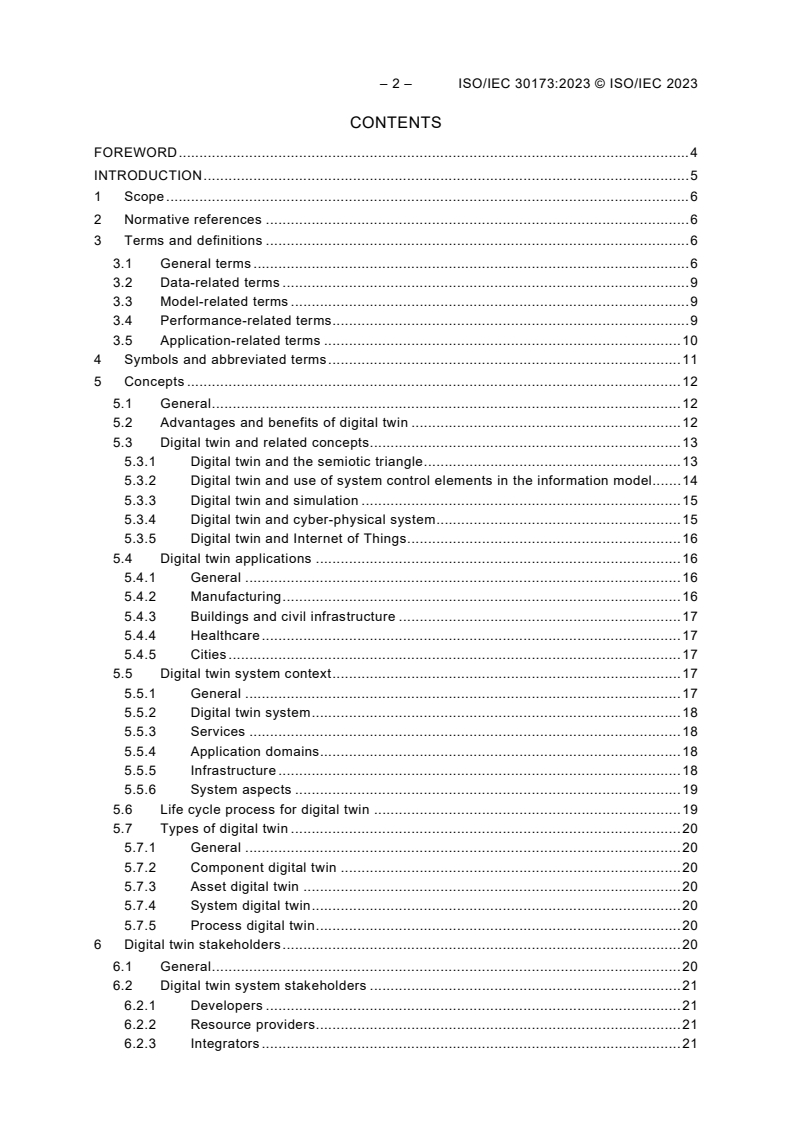
– 2 – ISO/IEC 30173:2023 © ISO/IEC 2023
CONTENTS
FOREWORD . 4
INTRODUCTION . 5
1 Scope . 6
2 Normative references . 6
3 Terms and definitions . 6
3.1 General terms . 6
3.2 Data-related terms . 9
3.3 Model-related terms . 9
3.4 Performance-related terms . 9
3.5 Application-related terms . 10
4 Symbols and abbreviated terms . 11
5 Concepts . 12
5.1 General . 12
5.2 Advantages and benefits of digital twin . 12
5.3 Digital twin and related concepts. 13
5.3.1 Digital twin and the semiotic triangle . 13
5.3.2 Digital twin and use of system control elements in the information model. 14
5.3.3 Digital twin and simulation . 15
5.3.4 Digital twin and cyber-physical system . 15
5.3.5 Digital twin and Internet of Things . 16
5.4 Digital twin applications . 16
5.4.1 General . 16
5.4.2 Manufacturing . 16
5.4.3 Buildings and civil infrastructure . 17
5.4.4 Healthcare . 17
5.4.5 Cities . 17
5.5 Digital twin system context . 17
5.5.1 General . 17
5.5.2 Digital twin system . 18
5.5.3 Services . 18
5.5.4 Application domains. 18
5.5.5 Infrastructure . 18
5.5.6 System aspects . 19
5.6 Life cycle process for digital twin . 19
5.7 Types of digital twin . 20
5.7.1 General . 20
5.7.2 Component digital twin . 20
5.7.3 Asset digital twin . 20
5.7.4 System digital twin . 20
5.7.5 Process digital twin . 20
6 Digital twin stakeholders . 20
6.1 General . 20
6.2 Digital twin system stakeholders . 21
6.2.1 Developers . 21
6.2.2 Resource providers. 21
6.2.3 Integrators . 21
6.2.4 Users . 21
6.2.5 Operators . 21
6.3 Ecosystem partners . 22
6.3.1 Infrastructure provider . 22
6.3.2 Service provider . 22
6.3.3 Standards development organization . 22
6.3.4 Government and community . 22
7 Functional view of digital twin . 22
Annex A (informative) Definition of digital twin in different standards . 24
Annex B (informative) Semiotics . 25
B.1 Introduction of the semiotics . 25
B.2 Digital twin and the semiotic morphisms . 26
B.3 Relationship between digital twin system context and semiotic triangle . 27
Bibliography . 28
Figure 1 – Digital twin system context diagram . 18
Figure 2 – Digital twin life cycle phases . 19
Figure 3 – Digital twin stakeholders . 21
Figure 4 – Functional view of digital twin . 22
Figure B.1 – Use case ‘Jaguar in the garage’ mapped onto the three semiotic domains . 25
Table A.1 – Definition of digital twin in different standards . 24
– 4 – ISO/IEC 30173:2023 © ISO/IEC 2023
DIGITAL TWIN – CONCEPTS AND TERMINOLOGY
FOREWORD
1) ISO (the International Organization for Standardization) and IEC (the International Electrotechnical Commission)
form the specialized system for worldwide standardization. National bodies that are members of ISO or IEC
participate in the development of International Standards through technical committees established by the
respective organization to deal with particular fields of technical activity. ISO and IEC technical committees
collaborate in fields of mutual interest. Other international organizations, governmental and non-governmental,
in liaison with ISO and IEC, also take part in the work.
2) The formal decisions or agreements of IEC and ISO on technical matters express, as nearly as possible, an
international consensus of opinion on the relevant subjects since each technical committee has representation
from all interested IEC and ISO National bodies.
3) IEC and ISO documents have the form of recommendations for international use and are accepted by IEC and
ISO National bodies in that sense. While all reasonable efforts are made to ensure that the technical content of
IEC and ISO documents is accurate, IEC and ISO cannot be held responsible for the way in which they are used
or for any misinterpretation by any end user.
4) In order to promote international uniformity, IEC and ISO National bodies undertake to apply IEC and
ISO documents transparently to the maximum extent possible in their national and regional publications. Any
divergence between any IEC and ISO document and the corresponding national or regional publication shall be
clearly indicated in the latter.
5) IEC and ISO do not provide any attestation of conformity. Independent certification bodies provide conformity
assessment services and, in some areas, access to IEC and ISO marks of conformity. IEC and ISO are not
responsible for any services carried out by independent certification bodies.
6) All users should ensure that they have the latest edition of this document.
7) No liability shall attach to IEC and ISO or their directors, employees, servants or agents including individual
experts and members of its technical committees and IEC and ISO National bodies for any personal injury,
property damage or other damage of any nature whatsoever, whether direct or indirect, or for costs (including
legal fees) and expenses arising out of the publication, use of, or reliance upon, this ISO/IEC document or any
other IEC and ISO documents.
8) Attention is drawn to the Normative references cited in this document. Use of the referenced publications is
indispensable for the correct application of this document.
9) IEC and ISO draw attention to the possibility that the implementation of this document may involve the use of (a)
patent(s). IEC and ISO take no position concerning the evidence, validity or applicability of any claimed patent
rights in respect thereof. As of the date of publication of this document, IEC and ISO had not received notice of
(a) patent(s), which may be required to implement this document. However, implementers are cautioned that this
may not represent the latest information, which may be obtained from the patent database available at
https://patents.iec.ch and www.iso.org/patents. IEC and ISO shall not be held responsible for identifying any or
all such patent rights.
ISO/IEC 30173 has been prepared by subcommittee 41: Internet of Things and Digital Twin, of
ISO/IEC joint technical committee 1: Information technology. It is an International Standard.
The text of this International Standard is based on the following documents:
Draft Report on voting
JTC1-SC41/362/FDIS JTC1-SC41/372/RVD
Full information on the voting for its approval can be found in the report on voting indicated in
the above table.
The language used for the development of this International Standard is English.
This document was drafted in accordance with ISO/IEC Directives, Part 2, and developed in
accordance with ISO/IEC Directives, Part 1, available at www.iec.ch/members_experts/refdocs
and www.iso.org/directives.
IMPORTANT – The "colour inside" logo on the cover page of this document indicates
that it contains colours which are considered to be useful for the correct understanding
of its contents. Users should therefore print this document using a colour printer.
INTRODUCTION
Digital transformation continues to reshape the world at multiple scales, from a city to a building,
a factory, an automobile, a process and so on. The concept of a digital twin (DTw) is not new.
The concept of twinning in aerospace has been in use for over 50 years. Advances in
digitalization, for example those related to the industrial Internet of Things, have enabled the
concept to develop and spread outside of capital-intensive industries.
Digital twin has the potential to be widely used in multiple domains such as smart manufacturing,
smart cities, smart agriculture, smart energy, smart buildings, smart health care, smart mining
and many other fields. However, different fields have developed in isolation, leading to different
concepts and terminology. The benefits that can be derived from the use of a digital twin will
depend on the use case or cases that it has been conceived to satisfy. The degree to which the
benefits are realized is dependent on the implementation of the digital twin and the degree to
which it can be trusted to represent the behaviour of the target entity it represents. For example,
it can help:
a) simulate and predict products or production lines, resulting in production cycle reduction
and cost reduction for manufacturing companies;
b) optimize city construction based on simulation models, and realize visualization,
convenience and intelligent city management for city planners;
c) monitor and optimize production operations, and perform predictive diagnosis on machinery
and equipment for agricultural producers;
d) achieve visual monitoring management of energy production and transmission processes,
as well as fault analysis and remote operation and maintenance for energy managers;
e) monitor patients' real-time conditions, provide personalized medical solutions, dynamically
optimize medical resources for doctors, and so on.
The essence of digital twin is a pairing of two things:
– something that provides a functional purpose in reality, for example, an automobile or a
petrochemical platform, designated as a target entity in this document;
– a representation of that target entity as a digital entity for the purpose of connection,
integration, analysis, simulation, visualization, optimization, collaboration or, when
necessary, providing external management for that target entity.
In view of the increased interest in and potential applications of the digital twin technologies,
there is a need to establish a common basis and terminology to enable collaboration and
cooperation, and to promote a common understanding of the concept.
The purpose of this document is to:
1) provide a common basis for understanding the concept and composition of a digital twin
through definitions of digital twin-related concepts;
2) provide an overview of the life cycle of a digital twin in relation to the target entity it
represents;
3) provide a basis for the development of standards, specifications and use of digital twins.
This document provides generic digital twin concepts and terminology that can be applied in
any domain or across domains.
– 6 – ISO/IEC 30173:2023 © ISO/IEC 2023
DIGITAL TWIN – CONCEPTS AND TERMINOLOGY
1 Scope
This document establishes terminology for digital twin (DTw) and describes concepts in the field
of digital twin, including the terms and definitions of digital twin, concepts of digital twin
(e.g. digital twin system context, life cycle process for digital twin, types of digital twin),
functional view of digital twin, and digital twin stakeholders.
This document can be used in the development of other standards and in support of
communications among diverse, interested parties or stakeholders.
This document is applicable to all types of organizations (e.g., commercial enterprises,
government agencies, and not-for-profit organizations).
2 Normative references
There are no normative references in this document.
3 Terms and definitions
For the purposes of this document, the following terms and definitions apply.
ISO and IEC maintain terminological databases for use in standardization at the following
addresses:
• IEC Electropedia: available at http://www.electropedia.org/
• ISO Online browsing platform: available at http://www.iso.org/obp
3.1 General terms
3.1.1
digital twin
DTw
digital representation (3.1.8) of a target entity (3.1.3) with data connections that enable
convergence between the physical and digital states at an appropriate rate of synchronization
Note 1 to entry: Digital twin has some or all of the capabilities of connection, integration, analysis, simulation,
visualization, optimization, collaboration, etc.
Note 2 to entry: Digital twin can provide an integrated view throughout the life cycle of the target entity.
3.1.2
entity
thing (physical or non-physical) having a distinct existence
EXAMPLE Person, object, event, idea, process, etc.
[SOURCE: ISO/IEC 20924:2021, 3.1.18, modified – The example has been added.]
3.1.3
target entity
entity (3.1.2) providing a functional purpose in reality which is the subject of digital
representation (3.1.8)
Note 1 to entry: The target entity, which provides some functional purpose in reality, can be either physical or digital
under consideration.
3.1.4
physical entity
entity (3.1.2) in the physical world that can be the subject of sensing and/or actuating
[SOURCE: ISO/IEC 20924:2021, 3.1.27]
3.1.5
digital entity
computational entitiy comprising data elements and procedural elements
3.1.6
physical domain
classification of physical entities under consideration
3.1.7
digital domain
classification of digital entities under consideration
Note 1 to entry: Entities in the digital domain can be embedded in a physical domain.
3.1.8
digital representation
digital entity representing either a set of properties or behaviours or both of one or more
observable elements
3.1.9
modelling
using symbolic paradigms or formal languages to create an abstract representation of a thing
3.1.10
ecosystem
infrastructure and services based on a network of organizations and stakeholders
Note 1 to entry: Organizations can include public bodies.
[SOURCE: ISO/IEC TS 27570:2021, 3.8]
3.1.11
life cycle
evolution of a system, product, service, project or other human-made entity from conception
through retirement
[SOURCE: ISO/IEC/IEEE 15288:2023, 3.21]
3.1.12
semantics
rules that provide the intended meaning of entities or things to construct, deploy and use
– 8 – ISO/IEC 30173:2023 © ISO/IEC 2023
3.1.13
semiotics
study of signs and their properties including the relationships between the domains of symbols,
concepts and cyber-physical phenomena
3.1.14
control loop
feedback link between digital entities and target entities whereby the digital entity
receives data from the target entity (3.1.3) and issues back to the target entity data that are
used to modify the behaviour of the target entity
Note 1 to entry: Control loops use engineering control methods for the purpose of automation, e.g. to keep the
temperature on an engine under control of a certain limit.
3.1.15
concept
semantic artifact that represents meaning of a symbol, a thing or a phenomenon
3.1.16
symbol
ontological artifact that denotes a certain meaning, a thing or a phenomenon
3.1.17
phenomenon
thing artifact that is symbolized by an ontological symbol and has implemented
certain concepts
3.1.18
asset
entity (3.1.2) that has potential or actual value to an organization
[SOURCE: ISO 6707-4:2021, 3.1.2, modified- In the definition, "item, thing or" has been
deleted.]
3.1.19
object
concept or a physical thing existing in the real world
[SOURCE: ISO 15531-31:2004 3.5.7, modified – In the definition, "which may" has been
deleted.]
3.1.20
synchronization
action of making the states of target entity and digital entity synchronized, using
network for real time system
3.1.21
digital twin system
system providing functionalities for the digital twin composed of inter-operating target entities,
digital entities, data connections, and models, data and interfaces involved in the data
connection process
3.2 Data-related terms
3.2.1
data
reinterpretable representation of information in a formalized manner suitable for
communication, interpretation, or processing
[SOURCE: ISO/IEC 2382:2015, 2121272, modified – Notes have been deleted.]
3.2.2
asset data
facts, concepts or instructions pertaining to an asset (3.1.18)
3.2.3
big data
data set(s) with characteristics (e.g. volume, velocity, variety, variability, veracity, etc.) that for
a particular problem domain at a given point in time cannot be efficiently processed using
traditional technologies and techniques in order to extract value
Note 1 to entry: The term Big Data is commonly used in many different ways, for example as the name of the
scalable technology used to handle big data extensive datasets.
[SOURCE: ISO/IEC 38505-1:2017, 3.2, modified – In the definition,
"current/existing/established/" has been deleted.]
3.3 Model-related terms
3.3.1
statistics model
model that uses mathematical analysis tools to build a representation of the data for the purpose
of conducting analysis to infer any relationships between variables or discover insights
3.3.2
engineering model
model that includes geometry, materials, components and behaviour relevant throughout the
entity life cycle
3.3.3
information model
model of a set of facts, concepts or instructions to meet a specific requirement
[SOURCE: ISO 6707-2:2017, 3.2.35]
3.4 Performance-related terms
3.4.1
verification
confirmation, through the provision of objective evidence, that specified requirements have
been fulfilled
[SOURCE: ISO 9000:2015, 3.8.12, modified – The notes to entry have been deleted.]
3.4.2
validation
confirmation, through the provision of objective evidence, that the requirements for a specific
intended use or application have been fulfilled
[SOURCE: ISO 9000:2015, 3.8.13, modified – The notes to entry have been deleted.]
– 10 – ISO/IEC 30173:2023 © ISO/IEC 2023
3.4.3
interoperability
ability of two or more different systems to exchange information and to use the information that
has been exchanged
[SOURCE: ISO/TS 27790:2009, 3.39, modified – In the definition, "or components" has been
deleted.]
3.5 Application-related terms
3.5.1
visualization
use of computer graphics and image processing to present models or characteristics of
processes or objects
Note 1 to entry: Visualization tools are provided to support human understanding.
[SOURCE: ISO 23247-4:2021, 3.4, modified – "for supporting human understanding" has been
moved from the definition to a new Note 1 to entry.]
3.5.2
optimization
design and operation of a system or process to improve its efficiency or effectiveness
3.5.3
prediction
process of computation used to obtain the predicted value(s) of a quantity
Note 1 to entry: The term “prediction” can also be used to denote the predicted value(s) of a quantity.
[SOURCE: IEC 62059-31-1:2008, 3.27]
3.5.4
simulation
use of a similar or equivalent system to imitate a real system, so that it behaves like or appears
to be the real system
Note 1 to entry: Simulation serves the purpose of analysing the future behaviour of a system, i.e. making
predictions, or the purpose of reasoning on the past behaviour in order to analyse failures. For performing
simulations, a model is needed together with actualized sets of data and a platform able to execute the simulation.
[SOURCE: ISO 16781:2021, 3.1.9, modified – Note 1 to entry has been added.]
3.5.5
monitoring
means of providing automatic or manual performance supervision and alarming of the status of
the target entity (3.1.3)
[SOURCE: IEC 62270:2013, 2.34, modified – In the definition, the words "process to personnel
and control programs" have been replaced with "target entity", and the words "or manual" have
been added.]
3.5.6
augmented reality
AR
virtual objects superimposed upon or composited with the real world
Note 1 to entry: Virtual and real-world objects co-exist in augmented reality systems.
[SOURCE: ISO/IEC TR 23843:2020, 3.3]
3.5.7
virtual reality
VR
artificial environment presented in the computer
[SOURCE: ISO/IEC TR 18121:2015, 3.6]
3.5.8
analytics
predicting, reasoning, and controlling the behaviour (current and future) of an asset or process
via both physics and artificial intelligence or machine learning models
3.5.9
Internet of Things
IoT
infrastructure of interconnected entities, people, systems and information resources together
with services which processes and reacts to information from the physical world and digital
world
[SOURCE: ISO/IEC 20924:2021, 3.2.4, modified – In the definition, "virtual" has been replaced
by "digital".]
3.5.10
cyber-physical system
smart system that includes engineered interacting networks of physical and computational
components
[SOURCE: ISO/IEC TR 15067-3-8:2020, 3.8]
3.5.11
infrastructure
system of facilities, equipment and services needed for the operation of an entity (3.1.2)
[SOURCE: ISO 9000:2015, 3.5.2, modified – In the definition, "organization" has been replaced
by "entity".]
4 Symbols and abbreviated terms
AAS asset administration shell
AI artificial intelligence
API application programming interface
CPS cyber-physical system
DTw digital twin
ML machine learning
IT information technology
OT operational technology
– 12 – ISO/IEC 30173:2023 © ISO/IEC 2023
5 Concepts
5.1 General
In a typical physical scenario, the entity being studied – for example, a wind turbine – is fitted
with various sensors related to vital areas of functionality. These sensors produce data relating
to the target entity, such as energy output, nearby temperature, and weather conditions. This
data is then relayed to a processing system and applied to the corresponding entity. As for the
non-physical scenario, the digital entity of IT network is established, and the control of the
original target entity is realized to achieve remote management.
When provided with data, the digital entity can be used to run simulations, study performance
issues, and generate possible actionable recommendations for improvements, all with the goal
of generating valuable hindsight, insights, and foresight – which may then be applied back to
the target entity.
Clause 5 includes advantages and benefits of the digital twin (5.2), the digital twin and related
concepts (5.3), digital twin applications (5.4), digital twin system context (5.5), life cycle process
(5.6) and types of digital twin (5.7). Among them, digital twin system context, life cycle process
of digital twin and types of digital twin are part of the concept of digital twin that can help users
better understand the definition of digital twin. Definitions of digital twin in different published
standards are shown in Annex A.
5.2 Advantages and benefits of digital twin
Digital twin technology includes the advantages and benefits for the digital entity and target
entity system as follows.
• Test or investigate target entity behaviour in various scenarios: for example, find the cause
of the failure of the target entity by tracing the historical state of the target entity.
• Test simulations of system enhancement or configuration schemes: for example, simulation
in the product design phase to improve the design in a precise manner.
• Troubleshoot incidents in the operational target entity: that is, through the control of the
target entity by the digital entity to eliminate the fault of the target entity in operation.
• Reduce the need for on-site attention: that is, by focusing on the digital entity to reflect the
operating state of the target entity, in order to reduce the on-site attention that is not easy
to achieve, such as a spacecraft in operation.
• Lower the operating costs of assets and services: for example, remote operation and
maintenance can be achieved through digital entities to save costs.
• Build competitive advantage and export potential: for example, simulate and refine products
(target entity) to iterate on its design and packaging (digital entity), to shorten production
cycles and reduce costs.
• Accelerate productivity dividends: drive digitization and automation of target entities to
unlock productivity dividends with technology.
• Unlock value across industries and across supply chains: through data collection, sharing,
and upstream and downstream linkages, the digital twin supply chain can realize global
optimization and decision-making, realize cross-link and cross-ecological supply chain
collaborative optimization, and accelerate the integration and upgrading of the industry.
• Bring different industries, functions, and concepts together: for example, through the digital
twin of the city, people, things and their relationships, behaviours and activities are mapped
and connected.
• Enhance transparency, accountability, and trust: digital twin can help companies improve
transparency and visibility, and strengthen managers' capabilities.
• Reduce risk in project and programme delivery: when creating a digital twin, project teams
and asset owners can learn more about the performance of the project and the resulting
assets, enabling better-informed decisions and improved predictability of deliverables.
• Foster innovation within and across ecosystems.
• Facilitate more modern methods of digital engagement and experience within the
community.
• Enhance community service delivery.
• Facilitate easier transactions between government and the community.
• Provide access to more and better feedback from the community.
5.3 Digital twin and related concepts
5.3.1 Digital twin and the semiotic triangle
5.3.1.1 General
To understand and gain knowledge from the concept of a digital twin, and to utilize that idea in
practice, developers and users of systems apply the principle of semiotics, most often without
realizing they are doing so.
EXAMPLE For each concept expressed in this document, a description of the associated phenomenon or
phenomena, along with a symbol or symbols that identify the concept in practice, are also given. By this mechanism,
this document provides the understanding and knowledge that are integral to digital twin.
The practice of design and fabrication, whether physical or logical, includes the assignment of
symbols, signs, or other distinguishing labels to each of the phenomena identified as relevant
to the target entity or to its digital entity. In most circumstances, these symbols do not refer to
exactly the same concept because they exist in different contexts.
One context has a symbol for a target entity artifact, a piece of hardware or software component,
while the corresponding symbol in the digital twin partner is most often a logical construct.
Sometimes this logical construct is an exact replica of a corresponding target entity construct
but most often the correspondence is as a digital representation of the target entity construct –
two different phenomena, one in reality and one virtually, using the same symbol and having
corresponding but rather different conceptualization.
The explicit expression of concept, phenomenon and symbol are necessary to define structure
and behaviour of a target entity by using some sort of 'tools' such as semantics + engineering
+ ontologies. If these tools are not utilized, the life cycle of the target entity has unavoidable
gaps.
The above-mentioned tools which are outlined by means of the semiotic triangle represent a
holistic view on system deployment, operation and maintenance throughout the whole system
life cycle. The holistic view comprises the concepts to understand, cyber-physical machinery to
construct, and formal standards and informal ontologies to describe the characteristic behaviour
of the target system respectively entity. Further information about semiotics is given in Annex B.
5.3.1.2 General introduction to the method of the semiotic triangle
The semiotic triangle is a visualization of the relationships between the phenomenon of interest
and the intended semantic concept, that is, the conceptual meaning of that phenomenon, and
the intended semantics of the phenomenon of interest. These three semiotic elements and their
three relationships should always be considered during the whole life cycle of a thing from
conceptualization to its decommissioning.
For that purpose, the digital twin is set up with an abstract model, also called valid type model,
by which the dynamic behaviour exhibited by continuous variables either of the wild cat or of
the engineered car is modelled. When a new unknown model – that is, a valid labelled
proposition – is encountered, it shall be evaluated against the given valid type model. If the
proposition "a Jaguar is in your garage" describes a car in the garage, then everything is fine
and the "jaguar in your garage" is a valid model of type "car".
– 14 – ISO/IEC 30173:2023 © ISO/IEC 2023
5.3.1.3 Semiotic elements domains applied
The three coloured corners of the semiotic triangle of Figure B.1 depict the three-fold basics of
the semiotic domains of phenomena described that comprise:
1) the physical phenomenon of an engineered or a living thing;
2) the ontologies describing a car or a cat both labelled Jaguar, and
3) the contextual meanings (semantics) of the contexts of a car or a cat.
These basics are called semiotic domains, which are sets of disjoint artifacts.
Example, if the proposition a "Jaguar in the garage" – the semiotic domains are not sufficient.
Each semiotic domain is a set of ordered artifacts. The artifacts from the three semiotic domains
must be pairwise related and ordered to derive a possible path through the type model that this
semiotic triangle represents. The type representation is achieved by ordering the semiotic
relationships of the labelling, analysis and decision-taking. Examples of such artifact pairs are:
a) moving car, car labelled with stop sign; b) stop sign identified with 50 % trustworthiness, etc.,
car type situations alternatives available; c) cause – stop sign recognized, effect – stop car at
junction. For a new situation, the labelling, analysis and decision-taking relationship process
continues iteratively until sufficient labelling precision occurs.
5.3.1.4 Static and dynamic behaviour of the digital twin
Since all cooperating processes are described by continuous variables, the digital twin gains
the semantic concept for a phenomenon from the differential equations that can be transformed
to linearized functions for implementing a thing that is explained by ontological propositions.
NOTE In differential equations the continuous variables are equal to differential variables.
When basing the design or use of some phenomenon on variables, the semantic analysis should
occur in a stateful mode. The state transition model should be easily operationalized and
simulated by a computer. The simulation can be part of the digital twin and the constraints and
results of the simulation can be administered by sub-models of the asset administration shell
(AAS).
In semiotics, a variable has three kinds of incarnations: first is the variable type related to
semantics, that is the nature of the variable; second is the state of the variable related to a
situation in a real-world environment, that is the phenomenon like a moving car; and third is the
set of valid values related to an ontology, that is the scope of a variable.
The static behaviour of the digital twin is characterized by the structural information resulting
from using appropriate reference models like Reference Architecture Model Industrie 4.0 or
smart gird reference architecture (SGRA), which is achieved by a state-less representation
without the need of a simulation capability.
5.3.2 Digital twin and use of system control elements in the information model
An information model has the purpose to acquire asset data and information about state, quality
and performance, etc. to evaluate and to decide upon during all stages of the asset life cycle.
Thus, the role of the digital twin is to keep control on all relevant information acquired from the
operation technology to be fed into appropriate stages of the asset life cycle that makes a
system more safe, more secure, or more performant. To achieve its task the digital twin may
use system external tools such as modal logic evaluators, semantic analysers, e.g. based on
graph theory, visualizers, augmented reality tools, etc.
A common use for a digital twin takes advantage of system control theory to manage its
corresponding target entity. This utilization takes the state of the target entity received by the
digital twin as synchronizing data transfer, performs a relevant calculation or analysis, and
transfers control signals back to the target entity to modify its behaviour, forming a control loop.
Another variety of interaction occurs when the target entity senses that it has reached a set-
point or alarm condition, prompts the digital twin for appropriate action and awaits instructions.
The pairing of a digital twin with its target entity offers many control loop opportunities for
utilizing the synchronization of state to manage the actions of the target entity and understand
the consequences of those actions with subsequent digital twin analysis. These opportunities
can occur during development of either the target entity or its target, or during operation of
either the target entity or its target.
EXAMPLE During product development, feed-back information about product testing performance can be used to
improve subsequent development efforts about the target entity.
During digital twin system operation, performance related tasks for functional components and
interoperation tasks with the system's environment occur. For both kinds of tasks, data,
information and knowledge about the state of the system or its components are analysed to
generate either a signal for a system internal actuator or to learn a new pattern of interoperation
that can make the system more mature.
In operation the system can perform adjustments to functionality that is internal to the system
or perform adjustments to functionality as a consequence of external observation and
interoperations. Whereas the former can be executed autonomously, the latter is dependent
upon interoperation that is not known in advance. A digital twin can make assumptions and
provide predictions about expected target system state behaviour that improve further target
system autonomous performance adjustments.
5.3.3 Digital twin and simulation
A simulation and a digital twin both replicate a system’s various processes by digital
representations, such as statistics models, engineering models and so on. However, a digital
twin runs in a virtual environment. A digital twin has more opportunities for examination and
evaluation of target system performance. A digital twin shares two important aspects with a
simulation.
a) A typical simulation is a programme that studies through examining and evaluating a
particular entity. However, a digital twin can execute any number of useful simulations to
study multiple entities. By utilizing continuously updated data related to a wide range of
areas, combined with the added computational power that accompanies a virtual
environment, a digital twin is able to study more issues from more vantage points than an
offline simulation can – with greater ultimate potential to improve products and processes.
b) Simulation programmes can simulate entities in an offline or online manner, which depends
on the capabilities of the simulator. However, a digital twin should comprise specific
synchronization and feedback characteristics. For example, digital twins are conceptually
designed around a loop between the physical entity and the digital represe
...