

ISO 18457:2016
(Main)Biomimetics — Biomimetic materials, structures and components
General Information
- Abstract
ISO 18457:2016 provides a framework of biomimetics for the development of materials, structures, surfaces, components, and manufacturing technologies. ISO 18457:2016 specifies the principles of biological systems, and especially the performance of biological materials, structures, surfaces, components, and manufacturing technologies that provide the motivation and reasons for biomimetic approaches. It specifies the methodology based on analysis of biological systems, which lead to analogies, and abstractions. The transfer process from biology to technology is described based on examples of biomimetic materials, structures, surfaces, components, and manufacturing technologies. This International Standard describes measurement methods and parameters for the characterization of properties of biomimetic materials. This International Standard provides information on the relevance of biomimetic materials, structures, surfaces, components, and manufacturing technologies for industry. ISO 18457:2016 also links to other subareas in biomimetics because fundamental developments in materials, structures, surfaces, components, and manufacturing technologies often form the basis for a wide variety of additional innovations. It provides guidance and support for all those who develop, design, process, or use biomimetic materials, structures, surfaces, components, and manufacturing technologies. This International Standard can also serve for those who want to learn about and investigate these topics.
- Status
- Published
- Publication Date
- 01-Sep-2016
- Technical Committee
- ISO/TC 266 - Biomimetics
- Drafting Committee
- ISO/TC 266 - Biomimetics
- Current Stage
- 9093 - International Standard confirmed
- Start Date
- 19-Jul-2022
- Completion Date
- 29-Aug-2026
Buy Documents

ISO 18457:2016 - Biomimetics -- Biomimetic materials, structures and components

ISO 18457:2016 - Biomimetics — Biomimetic materials, structures and components/2/2016
Overview
ISO 18457:2016 - Biomimetics: Biomimetic materials, structures and components provides a practical framework for translating biological principles into engineered solutions. The standard specifies how to analyze biological systems, derive analogies and abstractions, and transfer those insights into materials, surfaces, structures, components and manufacturing technologies. It also describes measurement methods and parameters for the characterization of biomimetic materials and explains their industrial relevance.
Keywords: biomimetics, biomimetic materials, biomimetic structures, ISO 18457:2016, biomimetic components, biomimetic surfaces, biomimetic manufacturing.
Key Topics
- Principles of biological systems: Characteristics such as multifunctionality, hierarchy, adaptivity, redundancy (resilience), modularity, gradients and self‑x properties that motivate biomimetic design.
- Methodology for biomimetic development:
- Analysis of biological models and measurement/characterization of natural surfaces and materials.
- Examination of analogies to identify feasible biological-to-technical correspondences.
- Abstraction and modelling to convert biological functions into technical specifications.
- Material selection and integration into manufacturing workflows, including generative (additive) processes.
- Transfer process: Practical guidance and examples showing how biological insights become technical materials, structures and components.
- Measurement and characterization: Defined parameters and methods to evaluate biomimetic properties (performance, compatibility, gradients, multifunctionality), enabling reproducible testing and comparison.
- Industrial relevance: Guidance on when and why biomimetic approaches are beneficial across sectors.
Applications
ISO 18457:2016 supports practical innovation where nature-inspired solutions provide performance, efficiency or sustainability improvements:
- Lightweight, hierarchical structural materials (aerospace, automotive)
- Self-cleaning and anti-fouling surfaces (building materials, medical devices)
- Adaptive or multifunctional components (robotics, wearable devices)
- Resource-efficient manufacturing processes leveraging biomimetic design (additive manufacturing, rapid tooling)
- Material characterization labs developing test methods specific to bioinspired properties
Who uses this standard
- Materials scientists and engineers developing bioinspired materials
- Product designers and R&D teams applying biomimetic principles
- Manufacturing engineers integrating biomimetic components into production
- Quality and testing labs characterizing biomimetic properties
- Educators, researchers and standards bodies working in biomimetics
Related Standards
- ISO 18458:2015 - Biomimetics: Terminology, concepts and methodology (normative reference) - provides terminology and foundational methodology that complements ISO 18457:2016.
- ISO/TC 266 (Biomimetics) - technical committee responsible for standards development in the biomimetics domain.
This standard is a practical resource for translating biological mechanisms into measurable, manufacturable and industry‑relevant technologies.
Buy Documents
ISO 18457:2016 - Biomimetics -- Biomimetic materials, structures and components
ISO 18457:2016 - Biomimetics — Biomimetic materials, structures and components/2/2016
Frequently Asked Questions
ISO 18457:2016 is a standard published by the International Organization for Standardization (ISO). Its full title is "Biomimetics — Biomimetic materials, structures and components". This standard covers: ISO 18457:2016 provides a framework of biomimetics for the development of materials, structures, surfaces, components, and manufacturing technologies. ISO 18457:2016 specifies the principles of biological systems, and especially the performance of biological materials, structures, surfaces, components, and manufacturing technologies that provide the motivation and reasons for biomimetic approaches. It specifies the methodology based on analysis of biological systems, which lead to analogies, and abstractions. The transfer process from biology to technology is described based on examples of biomimetic materials, structures, surfaces, components, and manufacturing technologies. This International Standard describes measurement methods and parameters for the characterization of properties of biomimetic materials. This International Standard provides information on the relevance of biomimetic materials, structures, surfaces, components, and manufacturing technologies for industry. ISO 18457:2016 also links to other subareas in biomimetics because fundamental developments in materials, structures, surfaces, components, and manufacturing technologies often form the basis for a wide variety of additional innovations. It provides guidance and support for all those who develop, design, process, or use biomimetic materials, structures, surfaces, components, and manufacturing technologies. This International Standard can also serve for those who want to learn about and investigate these topics.
ISO 18457:2016 provides a framework of biomimetics for the development of materials, structures, surfaces, components, and manufacturing technologies. ISO 18457:2016 specifies the principles of biological systems, and especially the performance of biological materials, structures, surfaces, components, and manufacturing technologies that provide the motivation and reasons for biomimetic approaches. It specifies the methodology based on analysis of biological systems, which lead to analogies, and abstractions. The transfer process from biology to technology is described based on examples of biomimetic materials, structures, surfaces, components, and manufacturing technologies. This International Standard describes measurement methods and parameters for the characterization of properties of biomimetic materials. This International Standard provides information on the relevance of biomimetic materials, structures, surfaces, components, and manufacturing technologies for industry. ISO 18457:2016 also links to other subareas in biomimetics because fundamental developments in materials, structures, surfaces, components, and manufacturing technologies often form the basis for a wide variety of additional innovations. It provides guidance and support for all those who develop, design, process, or use biomimetic materials, structures, surfaces, components, and manufacturing technologies. This International Standard can also serve for those who want to learn about and investigate these topics.
ISO 18457:2016 is classified under the following ICS (International Classification for Standards) categories: 07.080 - Biology. Botany. Zoology. The ICS classification helps identify the subject area and facilitates finding related standards.
ISO 18457:2016 is available in PDF format for immediate download after purchase. The document can be added to your cart and obtained through the secure checkout process. Digital delivery ensures instant access to the complete standard document.
Standards Content (Sample)
INTERNATIONAL ISO
STANDARD 18457
First edition
2016-09-15
Biomimetics — Biomimetic materials,
structures and components
Biomimétisme — Matériaux, structures et composants biomimétiques
Reference number
©
ISO 2016
© ISO 2016, Published in Switzerland
All rights reserved. Unless otherwise specified, no part of this publication may be reproduced or utilized otherwise in any form
or by any means, electronic or mechanical, including photocopying, or posting on the internet or an intranet, without prior
written permission. Permission can be requested from either ISO at the address below or ISO’s member body in the country of
the requester.
ISO copyright office
Ch. de Blandonnet 8 • CP 401
CH-1214 Vernier, Geneva, Switzerland
Tel. +41 22 749 01 11
Fax +41 22 749 09 47
copyright@iso.org
www.iso.org
ii © ISO 2016 – All rights reserved
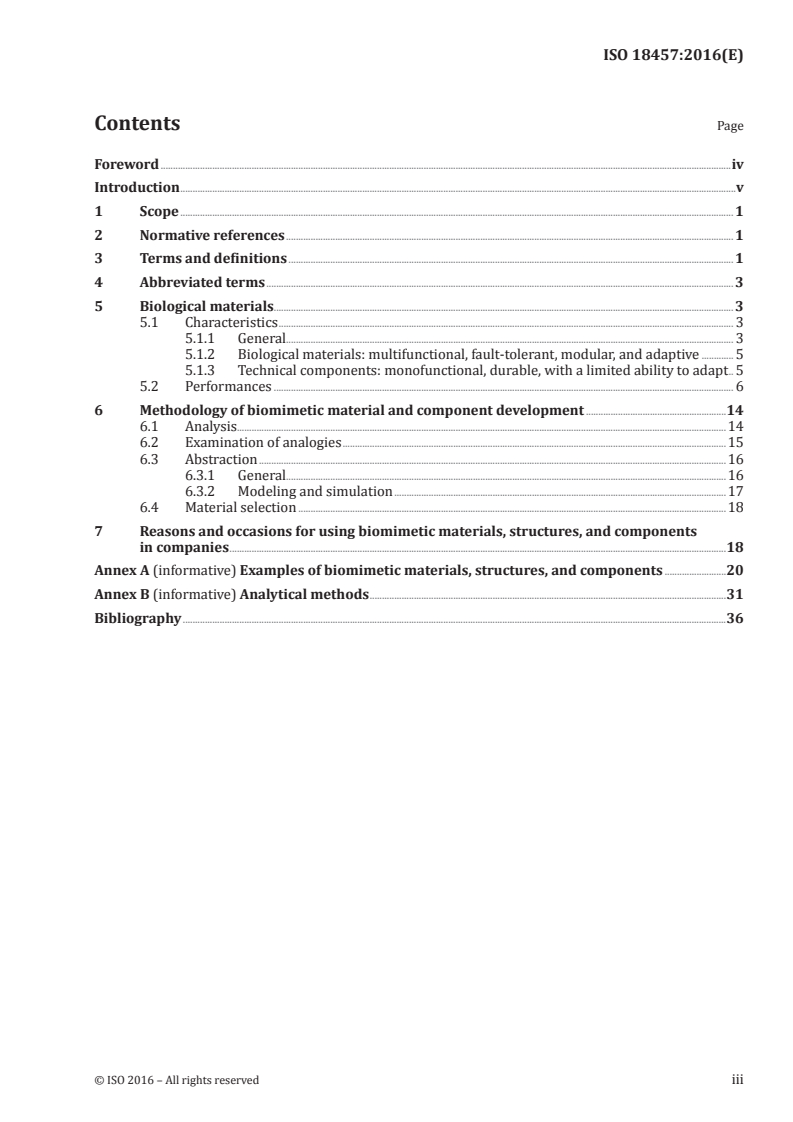
Contents Page
Foreword .iv
Introduction .v
1 Scope . 1
2 Normative references . 1
3 Terms and definitions . 1
4 Abbreviated terms . 3
5 Biological materials. 3
5.1 Characteristics . 3
5.1.1 General. 3
5.1.2 Biological materials: multifunctional, fault-tolerant, modular, and adaptive . 5
5.1.3 Technical components: monofunctional, durable, with a limited ability to adapt . 5
5.2 Performances . 6
6 Methodology of biomimetic material and component development .14
6.1 Analysis.14
6.2 Examination of analogies .15
6.3 Abstraction .16
6.3.1 General.16
6.3.2 Modeling and simulation .17
6.4 Material selection .18
7 Reasons and occasions for using biomimetic materials, structures, and components
in companies .18
Annex A (informative) Examples of biomimetic materials, structures, and components .20
Annex B (informative) Analytical methods .31
Bibliography .36
Foreword
ISO (the International Organization for Standardization) is a worldwide federation of national standards
bodies (ISO member bodies). The work of preparing International Standards is normally carried out
through ISO technical committees. Each member body interested in a subject for which a technical
committee has been established has the right to be represented on that committee. International
organizations, governmental and non-governmental, in liaison with ISO, also take part in the work.
ISO collaborates closely with the International Electrotechnical Commission (IEC) on all matters of
electrotechnical standardization.
The procedures used to develop this document and those intended for its further maintenance are
described in the ISO/IEC Directives, Part 1. In particular the different approval criteria needed for the
different types of ISO documents should be noted. This document was drafted in accordance with the
editorial rules of the ISO/IEC Directives, Part 2 (see www.iso.org/directives).
Attention is drawn to the possibility that some of the elements of this document may be the subject of
patent rights. ISO shall not be held responsible for identifying any or all such patent rights. Details of
any patent rights identified during the development of the document will be in the Introduction and/or
on the ISO list of patent declarations received (see www.iso.org/patents).
Any trade name used in this document is information given for the convenience of users and does not
constitute an endorsement.
For an explanation on the meaning of ISO specific terms and expressions related to conformity assessment,
as well as information about ISO’s adherence to the World Trade Organization (WTO) principles in the
Technical Barriers to Trade (TBT) see the following URL: www.iso.org/iso/foreword.html.
The committee responsible for this document is ISO/TC 266, Biomimetics.
iv © ISO 2016 – All rights reserved
Introduction
The increasing complexity of technical solutions and products requires new approaches. Classic
research and development methods and innovation approaches often reach their limits, especially
in the development and optimization of materials, structures, and components. The identification of
suitable biological principles and their transfer to technical applications in the sense of biomimetics,
therefore, can make an important contribution to the development of functional, adaptive, efficient
(in terms of resources), and safe (in terms of toxicity to humans and the environment) materials,
structures, components and manufacturing techniques.
INTERNATIONAL STANDARD ISO 18457:2016(E)
Biomimetics — Biomimetic materials, structures and
components
1 Scope
This International Standard provides a framework of biomimetics for the development of materials,
structures, surfaces, components, and manufacturing technologies.
This International Standard specifies the principles of biological systems, and especially the performance
of biological materials, structures, surfaces, components, and manufacturing technologies that provide
the motivation and reasons for biomimetic approaches. It specifies the methodology based on analysis
of biological systems, which lead to analogies, and abstractions. The transfer process from biology to
technology is described based on examples of biomimetic materials, structures, surfaces, components,
and manufacturing technologies. This International Standard describes measurement methods and
parameters for the characterization of properties of biomimetic materials. This International Standard
provides information on the relevance of biomimetic materials, structures, surfaces, components, and
manufacturing technologies for industry.
This International Standard also links to other subareas in biomimetics because fundamental
developments in materials, structures, surfaces, components, and manufacturing technologies often
form the basis for a wide variety of additional innovations. It provides guidance and support for all
those who develop, design, process, or use biomimetic materials, structures, surfaces, components, and
manufacturing technologies. This International Standard can also serve for those who want to learn
about and investigate these topics.
2 Normative references
The following documents, in whole or in part, are normatively referenced in this document and are
indispensable for its application. For dated references, only the edition cited applies. For undated
references, the latest edition of the referenced document (including any amendments) applies.
ISO 18458, Biomimetics — Terminology, concepts and methodology
3 Terms and definitions
For the purposes of this document, the terms and definitions given in ISO 18458 and the following apply.
3.1
adaptivity
ability to adapt to variable environmental conditions
3.2
efficiency
relationship between the useful outputs to all inputs of a system
3.3
generative manufacturing process
manufacturing process in which three-dimensional components are produced, for instance, by applying
material layer-by-layer
Note 1 to entry: These technologies can be used in four different levels of manufacturing:
— Concept model (additive manufacturing): A mechanical load cannot be applied to these models and they only
serve to provide a three-dimensional view.
— Functional models (additive manufacturing): These models have properties similar to those available in the
components manufactured later on in mass-production.
— Tools (rapid tooling): Tools are created that can be combined with other manufacturing processes.
— Low volume production (rapid manufacturing): The properties of the geometries manufactured correspond
to those desired in actual use.
3.4
gradient transition
gradual transition
direction-dependent, continuous change of a chemical, physical, or mechanical property
Note 1 to entry: Biological materials are often characterized by gradual transitions in terms of their physical
and mechanical properties, which are achieved through structural changes at various hierarchical levels, among
other things.
3.5
compatibility
recyclability and adaptability of a material flow or a technology in the environment
3.6
modularity
composition of an overall system from individual modules
3.7
multifunctionality
structure and properties of a material and component allowing several functions necessary for the
organism or technically desired to be realized at a high level and in equilibrium
3.8
redundancy
existence of functionally comparable systems, whereby one system alone is sufficient to maintain the
corresponding function (multiplicity in systems)
3.9
resilience
fault tolerance
tolerance of a system to malfunctions or capacity to recover functionality after stress
3.10
Self-X property
property and information existing in a material or on a surface proceed processes autonomously
without requiring special control
Note 1 to entry: Self-X properties are widespread in biological materials and surfaces and are of great interest for
transfer to technical products. Examples include self-organization, self-assembly, self-repair, self-healing, self-
cleaning, and self-sharpening.
3.11
stereoregularity
tacticity
certain geometric regularity in the molecular structure of polymer chains
Note 1 to entry: Macromolecular materials with identical chemical compositions can have significantly different
mechanical properties due to differences in the spatial arrangement of their atoms and groups of atoms. In
chemical production techniques, the molecular geometry of polymer chains is determined during polymerization
by the reaction temperature selected and the catalyst used.
Note 2 to entry: A classic example from nature is polyisoprene, which can be elastic (natural rubber), as well as
hard (balata, gutta-percha).
2 © ISO 2016 – All rights reserved
4 Abbreviated terms
AES Auger Electron Spectroscopy
AFM Atomic Force Microscope
CT Computed Tomography
DSC Differential Scanning Calorimetry
DTA Differential Thermal Analysis
GC Gas Chromatography
GC-MS/MS Gas Chromatography-tandem Mass Spectrometry
GPC Gel Permeation Chromatography
HPLC High performance liquid chromatography
IR Infrared Spectroscopy
LC-MS/MS Liquid Chromatography-tandem Mass Spectrometry
MALDI-MS Matrix Assisted Laser Desorption/Ionization-Mass Spectrometry
NMR Nuclear Magnetic Resonance
OM Optical microscope
SEM Scanning Electron Microscope
SEM-EDS Scanning Electron Microscopy-Energy Dispersion Spectroscopy
SIM Structured Illumination Microscopy
SIMS Secondary Ion Mass Spectrometry
SPM Scanning Probe Microscope
TEM Transmission Electron Microscope
TOF-SIMS Time-of-Flight Secondary Mass Spectrometry
UVVIS Ultra Violet Visible
XPS X-ray Photoelectron Spectroscopy
XRF X-ray Fluorescence Analysis
5 Biological materials
5.1 Characteristics
5.1.1 General
The terms material and structure sometimes have different meanings in biology and in technology.
Classic technical materials are often considered to be homogeneous, so that it is reasonable and
permissible to assume in calculations and for manufacturing purposes that the model is isotropic.
Technical materials rely mostly on chemistry for their properties whereas biological materials rely on
structure and are almost invariably composite.
Owing to their hierarchical structure from the molecular to the macroscopic level, it is not possible to
clearly distinguish between the terms “material” and “structure” in the field of biology. For this reason,
the term “material” is used in the following as a general term for all biological materials with their
respective structures.
Some characteristics of biological materials that are relevant to biomimetic implementations are listed
in Table 1.
Table 1 — Characteristics of biological materials
Characteristics Biological Example Explanations
Properties
Multifunctionality Wood: integration of water Biological materials are often multicriteria-optimized
pipes, strength, damping, and possess a high-function density, and they often
storage, among other things combine supposedly conflicting functions.
Hierarchy Wood: at least five A special feature of the hierarchical design of biological
structural levels, from the materials is that structural or (bio) chemical changes in
molecular structure of the one level lead to specific adaptations in the other
cell wall to the structure of hierarchy levels. This level spanning adaptability
the tree trunk permits a wide variety of different functions.
Fault and failure Bones: ample breaking Biological materials can handle a high level of faults and
tolerance (resilience strength, tolerance to damage before they fail as a whole.
and redundancy) micro-cracks, crack
stoppers
Self-X Rubber tree: self-repair Biological materials are able to generate and maintain
their complex functions autonomously, meaning,
Teeth of rodents:
without external control.
self-sharpening
Surface of leaves:
self-cleaning
Adaptivity Bones: load adaptivity Biological materials can react to changes in
environmental conditions by changing their form or
Plant motion: for
through growth and restructuring processes.
example, nastic movements
and tropism
Compatibility Walls of plant cells: Availability/biodegradability of the biological build-
consist almost exclusively ing blocks.
of carbon, oxygen and
The waste products produced are rarely pollutants. The
hydrogen
waste products are in fact biodegradable and recyclable.
Modularity Organization of organs: Repetition of identical basic units at different
composition of several hierarchical levels.
different tissues
Lifespan according to Tree: dropping of leaves Important properties are maintained through renewal.
needs The lifespans of individual components match, and the
components are renewed.
Gradual transitions Many biological materials, Prevention of sudden transitions between properties to
for example, plant stems increase the lifespan and tolerance to damage.
(e.g. fibre/substrate tissue
transitions), long bones
(such as cortical/cancellous
bone transitions), bone/
tendon/ muscle transitions
4 © ISO 2016 – All rights reserved
Table 1 (continued)
Characteristics Biological Example Explanations
Manufacture
Growth Many biological Biological materials and organisms are created through
materials, as well as, for genetically controlled self-organization. Living
example, self-cleaning leaf organisms are formed using molecules, organelles, cells,
surfaces: self-assembly of tissues and organs, i.e. by growing from small to large.
the genetically coded wax
molecules
Opportunism (use of Photosynthesis: In biology, a few predominantly light elements that are
readily available utilization of solar energy available locally and in large quantities are used (C, H, O,
resources) N, S, Ca, P, Si).
Mild environmental Enzymes: catalysis at Adequate conversion of material at low ambient
conditions ambient temperatures temperatures.
5.1.2 Biological materials: multifunctional, fault-tolerant, modular, and adaptive
The characteristics of biological materials listed in Table 1 can be divided into properties and
manufacturing characteristics. The properties of biological materials include multifunctionality,
fault and failure tolerance, the Self-X properties, adaptivity, and modularity, only to name a few.
Manufacturing characteristics such as biological growth, meaning, genetically controlled self-
organization from the level of molecules to the level of the living organism itself, and resource-oriented
construction under mild environmental conditions are further examples of the abilities of biological
materials. Furthermore, biological materials have a limited lifespan. After the organism dies, they
are generally completely broken down and return into the natural material cycle. When applied to
the “lifespans” of technical applications, this property is also of interest and is studied in biomimetic
research and development projects.
Tree trunks are a biological example of multicriteria optimization in nature in which numerous and
sometimes conflicting functions are executed simultaneously with high reliability. They combine
mechanical stability against working loads (such as the weight of its own tree trunk and crown, as well
as wind and snow loads) with transport functions for water and metabolic products, storage functions,
[1]
and photosynthesis .
Another characteristic of living organisms is their ability to adapt to variable environmental conditions
(adaptivity), which enables them to survive. The high tolerance of biological materials to damage
shall also be mentioned in this context, as well as the ability of many living organisms to quickly and
efficiently repair damage. The capability for self-repair and adaptivity are characteristics of living
[2]
organisms that are particularly interesting for biomimetic developments .
5.1.3 Technical components: monofunctional, durable, with a limited ability to adapt
Technical components are generally developed and optimized with the focus on a single dominant
function. In technical systems such as vehicles, though, they often fulfil many other boundary conditions
and constraints such as a limited design space, multiple mechanical loads, connection of additional
components, manufacturing and component joining restrictions, but also limited development times.
This often results in compromised solutions or oversized components that are not ideal. Components
are often manufactured based on the material, meaning, they are manufactured from the large (work
piece blank) to the small (product), and are not adaptive or self-repairing as a rule. The durability of a
component can be problematic once it has passed its normal lifespan, and it is often difficult to return it
to geo-ecological material cycles.
While living organisms shall function continuously in order to ensure their survival and successful
reproduction, machines can be taken out of operation for maintenance, modification, and
reconstruction. It is therefore possible to optimize machine components quickly and for a specific
function, and all resources, materials, and technologies available (e.g. high temperature processes in
metal processing and silicon technologies) can be used for this purpose. In comparison to evolutionary
processes, these conditions allow very short development stages, and sometimes old technologies are
even completely replaced by new technologies (for example, the replacement of analog technologies by
digital technologies).
These differences cause biological evolution and human technology to reach very different solutions to
comparable “problems” in some cases even though they are subject to the same physical laws and share
[3]
the same physical environment .
5.2 Performances
Performances of biological systems are rich in variety. Examples of 151 biological systems are shown in
[4]
Table 2 . Performances of biological systems are classified into eight categories:
a) materials;
b) process;
c) Self-X;
d) sensors;
e) hydrodynamics;
f) saving energy/saving resources;
g) adaptability to the environment;
h) behaviour/ecology.
The categories contain 56 kinds of specific examples. 43 expected fields of applications are summarized
in Table 2 to see the overview of performance of biological systems. Especially, the interfaces of
biological systems demonstrate particularly interesting properties that have a high potential to lead
to new technological developments; examples are optics, anti-reflection, wettability, adhesion, fluid
dynamics, surface tension, self-organization, self-cleaning, lift, fluid resistance, friction control.
Some examples of biomimetic products are introduced in Annex A.
Table 2 — Performances of biological systems and possible applications in different categories
No. Performances Biological example Possible application areas
a) Materials
1 Anti-reflection, structural Morpho butterfly (see A.9), moth eyes Liquid crystal, decoration,
colour, photonics (see A.10), blue damselfish, maranta, electronics, functional film, cosmetics
fish scales (see A.4)
2 Luminescence Fire fly, squid, jellyfish Automobile, household electric
appliances, decoration
3 Lightweight structure Bamboo, plant stem, winter horsetail Architecture, automobile, structural
(see A.6), boxfish, diatom, bone material
4 Wettability Lotus (see A.12), land snail, wings of Texture, coating material,
butterfly, wings of cicadas, rose, architecture, automobile, glass, water
Namibian desert beetle, pitcher plant harvesting, (marine industry)
5 Mechanical properties Abalone(see A.3), bone, tree, bamboo, Texture, architecture, medicine,
spider silk sports industry
6a Dynamics of a bistable Venus flytrap Switching structures
system
6b Torsional buckling Strelitzia Architecture
6 © ISO 2016 – All rights reserved
Table 2 (continued)
No. Performances Biological example Possible application areas
7 Adhesion and attachment Blue mussel, gecko (see A.11), leaf Architecture, medicine, manufacture
beetle, land snail, burdock seeds,
octopus suckers, sea urchin, slime
mould
8 Fluid dynamics Shark skin, dolphin, bluefin tuna, Aircraft, ship, household electric
penguin, bird, dragonfly, maple seeds appliances, coating materials, sports
industry
9 Electrical properties/ Electric eel, dried shells, dried trees Ceramic industry, electric industry
isolator, electricity
generation
10 Impact absorption Pomelo, cashew, joint, rhinoceros Automobile, medicine, defence
beetle industry
11 Bio-template Tobacco mosaic virus, DNA, wings of Electronics, semiconductor industry
butterflies, spirulina
12 Tube structure Mosquito, butterfly, wharf roach Medicine
13 Surface tension Whirligig beetle, backswimmer Coating materials
14 Unidirectional Mouth of snake, earthworm, bee, Machine parts
pitcher plant
b) Process
15 Bio-mineral Shells, teeth, bone, diatom Medicine, decoration, ceramic
industry
16 Photosynthesis Plant Energy industry, agriculture, food
industry
17 Organic synthesis Spider silk, blue mussel, plant wax, Medicine, chemical industry
pine resin, Para rubber tree, liga-
ments of grasshopper (see A.2)
18 Processing Shipworm Civil engineering
19 Metabolism Cellulose degradation, silk, amino- Food industry, energy industry,
acid fermentation, alcohol plastics industry
fermentation, entomophagy,
stockbreeding
20 Micro-mist Bombardier beetle Machine parts, internal-combustion
engine, coating materials
21 Abscission Leaf fall Manufacture
22 Scattering Poppy Household electric appliances
c) Self-X
23 Self-organization Organisms Medicine, electronics, films
24 Self-healing, self-repair Skin, bone, teeth, lizard, plant leaves, Medicine, coating materials,
shark teeth, planarian automobile, electronics, household
electric appliances
25 Self-assembly Cell membrane Medicine, coating
26 Self-cleaning Lotus leaf, land snail, wings of Architecture, automobile, coating
butterflies, wings of cicadas materials
27 Self-sharpening Teeth of rodents (see A.5) Tools
d) Sensor
28 Ocular vision/visible Eyes, compound eyes, photoreceptors Sensor, architecture, household
light, infrared, specific in crown-of-thorn starfish, tube feet electric appliances, automobile,
wavelength urchin, Melanophila beetle, cabbage aircraft
white butterfly
29 Olfaction Ant, dog, insect, deep-sea fish Sensor, household electric appliances,
automobile
Table 2 (continued)
No. Performances Biological example Possible application areas
30 Tactile sense, mechanore- Cat whiskers, gravity sensors of plant Sensor, household electric appliances,
ceptor automobile
31 Chemosensation Ant, fly, bee Sensor, food industry
32 Auditory sense/ultrasonic Bats, longhorn beetle, dolphin, gecko Aircraft, sensor, agriculture (pest
waves, low frequency control)
33 Magnetic sensor Migratory bird, sea turtles, pigeon, Aircraft, sensor, ship
spiny lobster, shark, honeybee
34 Force sensor Cricket Sensor, household electric appliances
e) Hydrodynamics
35 Buoyancy Nautilus, cuttlefish, jellyfish Ship
36 Lift Wings of bird, dragonfly Aircraft, power generation
37 Driving force Jellyfish, Paramecium Robot industry
38 Fluid resistance Shark skin, dolphin, Bluefin tuna, Ship, sports industry, automobile,
penguin, kingfisher, boxfish, wings of aircraft
owl, eel
f) Saving energy, saving resources
39 Friction control Snake, sand skink, joint Machine parts, robot industry,
automobile, medicine, welfare
40 Temperature control Shade of trees, polar bear, swan, Architecture, texture, automobile
skunk cabbage, zebra, anthill,
mammalian sweat, transpiration
41 Moisture control Anthill Architecture
42 Circulatory Food web, leaf fall, fungi, termite Energy industry, agriculture
(sustainability)/
adaptability for recycling,
degradability
g) Adaptability to the environment
43 Desiccation tolerance Plant stomata, chironomid, cactus Medicine, texture
44 Cold-resistance Polar bear, Trematomus fish, Tenebrio Medicine, food industry, battery
beetle, reindeer
45 Acid or alkali tolerant Helicobacter pylori, microbes in Fuel cell
submarine volcano, bacteria in hot
spring/alkaliphile
46 High-temperature Microbes in submarine hydrothermal
tolerance polymetallic ore
47 High-temperature use Eucalyptus, Banksia, Melanophila beetle Sensor
48 Ultraviolet resistance Edelweiss Cosmetics
h) Behaviour, ecology
49 Mimicry/colour, shape, Octopus, flatfish, squid, chameleon, Defence industry, decoration, pest
chemical camouflage insects like dead leaves, seahorse, control
mantidfly, Kallima butterfly, termite
eggs
50 Manipulation Elephant nose, octopus arm, fish’s fin Robot industry, machine parts, tools
51 Energy saving School of fish, flock of birds/sardines, Aircraft, automobile
migratory birds
52 Clash avoidance Swarm of bees/ants, bats Aircraft, automobile
53 Pollinator Insect, bat Agriculture, food industry
8 © ISO 2016 – All rights reserved
Table 2 (continued)
No. Performances Biological example Possible application areas
54 Sociality Honeybee, colony of social insects Agriculture, food industry
55 Natural enemy Spider mite vs. predator mite, Biotic pesticide, agriculture
biopesticide
56 Defence Zebra, shoal of sardines, shoal of Design, decoration
striped eel catfish
The performance of biological materials as compared to technical materials can be illustrated
[5]
quantitatively using material properties diagrams created based on information from Ashby (see
Figures 1 to 4). Since cells produce biological materials, they are assembled from the molecule upwards.
This requires that the molecules can assemble themselves into larger structures and that the resulting
structures can themselves assemble into even larger structures. Thus, a tree can have as many as 15
levels of hierarchy of structure. The interface between each level of the hierarchy controls the transfer
of loads between the levels, introducing a degree of control of material properties, which is unattainable
in technical materials (see Figure 5).
A comparison of specific properties of biological and engineering materials is given in Figure 5. Both
groups of materials are plotted, showing that they cover nearly the same ranges except for high
[5][6]
performance ceramics and alloys (constructed from data by Wegst and Ashby) .
Key
ρ density (kg/m )
σ strength (MPa)
1 guidelines for minimum mass design
2 foams
3 natural materials
4 polymers and elastomers
5 composites
6 ceramics
7 metals
NOTE In the diagram, the materials strength is graphed against the density to identify materials with a high
resistance to plastic flow stress (permanent deformation) and the lowest possible weight, for example.
Figure 1 — Material properties diagram based on density and strength from Reference [5]
10 © ISO 2016 – All rights reserved
Key
ρ density (kg/m )
E Young’s modulus (GPa)
1 guidelines for minimum mass design
2 foams
3 natural materials
4 composites
5 technical ceramics
6 metals
7 non-technical ceramics
8 polymers
9 elastomers
NOTE In the diagram, the modulus of elasticity is graphed against the density to identify materials with high
stiffness and the lowest possible weight, for example.
Figure 2 — Material properties diagram based on density and elasticity from Reference [5]
Key
E Young’s modulus (GPa)
Y’ toughness (kJ/m )
1 natural cellular materials
2 trabecular bone
3 soft tissue
4 woods
5 dense mineralized tissue
6 parenchyma
7 bio-ceramics
a
Fracture toughness.
NOTE In the diagram, the toughness is graphed against the modulus of elasticity to identify the stiffest
possible materials with a high resistance to progressive crack growth for fatigue-resistant components, for
example.
Figure 3 — Material properties diagram based on elasticity and toughness from Reference [5]
12 © ISO 2016 – All rights reserved
Key
X specific strength
Y specific stiffness
Figure 4 — Specific stiffness vs. specific strength of biological materials (information from
Reference [6]) overlaid onto technical materials (information from Reference [5])
Figure 5 — Typical analysis methods at various hierarchy levels shown at the example of
[8]
wood/fibres (see B.2)
6 Methodology of biomimetic material and component development
6.1 Analysis
Biological materials are generally composites, and their hierarchical and modular design requires
analysis at several different length scales (see Figure 5).
Newer light microscopic methods are suitable for studying biological materials, including living tissues.
These methods are collectively referred to as “multiphoton microscopy”, “higher harmonic generation
(HHG)”, or “3D-SIM microscopy”. The resolution of these methods is significantly below the Abbé limit
[9][10][11]
of classic light microscopy of approximately 200 nm .
The high variability of properties of biological materials requires a relatively large number of samples
to be taken. Macroscopic analyses in particular are difficult due to local variations in the properties
and the resulting lack of homogeneity in a sample object. The possibility that this variability serves
a certain function shall be considered and shall not be “averaged out” (for example, in the case of the
effective contact area of a rough surface). When analysing and assessing a specific structure/property
relationship, though, it is also necessary to take the multifunctionality of biological systems into
account.
If possible, the analyses should be suitable for the examination of the materials in their native state
(humidity, pressure, temperature, other ambient conditions). For this reason, the existing testing
standards can only be used as basic standards when designing a test setup. As a general rule, it is
impossible to apply the testing standards directly since biological materials usually place very specific
requirements on the analysis methods in terms of the sample geometry, ambient conditions, etc.
14 © ISO 2016 – All rights reserved
Biological research frequently does not answer the questions posed by engineers. However, the
techniques biologists use are relevant and are contained in Annex B.
6.2 Examination of analogies
The focus of a biomimetic process is placed on the examination of an analogy or a similarity between
a biological system and a technical target system. Before the biological system is used and its details
are transferred, the model shall be tested and analysed systematically. These tests and analyses should
determine if the function, parameters, parameter ratios, and quality criteria are equally relevant to the
biological system — reduced to the actual object to be transferred — and the technical target system
(see Figure 6).
Figure 6 — Algorithm for examination of the analogy
(The figure is revised according to Reference [12])
The first step of the examination of the analogy is to check if the function of the biological system
matches the function of the technical target system. A function in this case is a task that a certain object
in the biological or technical context shall perform.
In the next step, it is necessary to identify all parameters and determine their relevance to the problem.
When a factor will not be taken into account due to its lack of relevance, a reason should be provided.
These parameters are determined intuitively or systematically, for example, based on (differential)
system of equations that describe the problem. The abstraction phase (see 6.3) can then be performed
after this step.
Based on the parameters determined to be relevant to the problem, dimensioned or dimensionless
similarity scales (parameter ratios) are formed in the second step. To accomplish this, the individual
parameters are converted to a series of related ratios (scales, proportions). It is important in this case
not only to derive scales for the geometric similarity (e.g. the ratio of the length to the diameter of a
reinforcement fibre), but also to derive scales of dynamic similarity. Examples include the ratio of the
frictional forces to the inertia forces, the ratio of the Young’s modulus to the density, or the ratio of two
Young’s moduli (the matrix and dispersed phases in a composite).
[13]
Dimensionless numbers can be formed using a dimensional analysis . In this case, there are standard
values describing the technically important ratios and whose use has become so widespread that they
are named after actual researchers. This applies especially to the field of heat and material transport
(Reynolds number, Nusselt number, etc.). According to Buckingham’s pi theorem, it is also possible,
using dimensional analysis, to reduce the number of parameters describing the problem by the
number of basic variables (basic units) used. This is especially relevant in cases where the number of
test parameters shall be reduced to create a manageable test plan. If dimensionless numbers shall be
derived from a set of parameters but it is determined in the framework of the dimensional analysis that
this is impossible, then either too many, too few, or the wrong factors were determined (the converse is
not true).
Full similarity between a biological system and a technical target system in terms of the object to be
transferred exists when all ratios specified as relevant are the same in the model and in the target
system. This is almost always impossible. It is therefore necessary to consider which ratios are
especially important and shall be kept as constant as possible and for which ratios deviations are
acceptable.
Examples of important parameters and ratios in the area of biomimetic materials, structures, and
components include the following:
— all geometric ratios of a structure;
— mechanical material parameters related to the density;
— force ratios, especially those relating to the force due to weight;
— relative section moduli and form factors.
In the last step, it is necessary to check if the quality criteria used to evaluate the technical target system
also apply to the biological system. For example, the quality criteria could require certain maximum or
minimum values to be met, but also the minimization of the difference between a given value and a
defined target value. If the function of a biological system and a technical target system is to “disperse
a powder”, then the quality criteria for a poppy head (widest possible dispersion) and a salt shaker
(ability to spread salt on an egg) will be very different.
6.3 Abstraction
6.3.1 General
The abstraction process, meaning, the extraction and generalization of the principles found in the
biological system, is one of the most important steps but also one of the most difficult steps in a
biomimetic project. New knowledge can only be formulated using a general term through abstraction.
A prerequisite for abstraction is to separate the important influencing factors from the irrelevant
influencing factors for a given effect and then determine the type of relationship that exists between
the influencing factors. The validity of the generalization of the results of the abstraction process can be
confirmed through observation, analysis, and specific experiments — and in biomimetics, especially on
technical prototypes. A particularity of the biomimetic abstraction process is that the formulation of the
relationship between the influencing factors and the effects shall be formulated in an interdisciplinary
manner. The fact that simplifications are inevitable in many cases when transferring from biology to
technology is beneficial to the abstraction process. The results of the biomimetic abstraction process
16 © ISO 2016 – All rights reserved
can come in the form of relationships formulated in writing, mathematical models, functional models,
function diagrams, circuit diagrams, or construction plans.
6.3.2 Modeling and simulation
6.3.2.1 General
Reality can also be abstracted by creating a model and applying various simulation techniques. At
the same time, modelling and simulations offer capabilities for predicting the properties of materials,
structures, and components simply and quickly in advance, and therefore, at less expense. For example,
it is possible to make predictions of the service life of components based on how materials will respond
to mechanical loads. The reduction of development and production costs and the optimization of
development processes are often the driving forces behind the use of simulations from the point of view
of the industry. One requirement for the profitable use of simulations is a model that has been adapted
to the problem to be solved.
Currently available methods allow good descriptions and predictions of the properties of real material
systems, but computer-based methods can only describe a portion of reality, and there are still gaps
in the understanding of the wide variety of phenomena of complex materials, especially biological
materials. This is primarily due to the fact that the time and length scales in which the corresponding
material properties are formed, and therefore determine the functionality of the material, span many
orders of magnitude. The application of the simulation models at the various time and length scales
and the validation of these models is a costly, time-consuming, and complex process. In addition to
requiring a further increase in computing power and new analysis methods, this process also requires
innovative interdisciplinary strategies in order to connect simulation techniques to experimental
material analysis and development.
Biomimetics offers the advantage that there is basically a living prototype available in the form of a
biological system that can be used to adapt and validate the technical model. At the same time, it is
possible to study structures, especially anisotropic structures and structures spanning multiple scales,
and the properties resulting from these structures on biological systems, as well as test modern multi-
scale approaches in material simulations.
6.3.2.2 Stress simulation
Most of the studies on biomechanical simulation deal with biological design rules and the development
of numerical optimization approaches based on stress-controlled biological growth. In this case, the
[1]
shapes of components are optimized according to biomimetic principles .
6.3.2.3 Material simulation
In addition to the optimization of the shape at a lower hierarchy level, nature also utilizes optimization
of the inner structure of the material, for example, using a
...
INTERNATIONAL ISO
STANDARD 18457
First edition
2016-09-15
Biomimetics — Biomimetic materials,
structures and components
Biomimétisme — Matériaux, structures et composants biomimétiques
Reference number
©
ISO 2016
© ISO 2016, Published in Switzerland
All rights reserved. Unless otherwise specified, no part of this publication may be reproduced or utilized otherwise in any form
or by any means, electronic or mechanical, including photocopying, or posting on the internet or an intranet, without prior
written permission. Permission can be requested from either ISO at the address below or ISO’s member body in the country of
the requester.
ISO copyright office
Ch. de Blandonnet 8 • CP 401
CH-1214 Vernier, Geneva, Switzerland
Tel. +41 22 749 01 11
Fax +41 22 749 09 47
copyright@iso.org
www.iso.org
ii © ISO 2016 – All rights reserved
Contents Page
Foreword .iv
Introduction .v
1 Scope . 1
2 Normative references . 1
3 Terms and definitions . 1
4 Abbreviated terms . 3
5 Biological materials. 3
5.1 Characteristics . 3
5.1.1 General. 3
5.1.2 Biological materials: multifunctional, fault-tolerant, modular, and adaptive . 5
5.1.3 Technical components: monofunctional, durable, with a limited ability to adapt . 5
5.2 Performances . 6
6 Methodology of biomimetic material and component development .14
6.1 Analysis.14
6.2 Examination of analogies .15
6.3 Abstraction .16
6.3.1 General.16
6.3.2 Modeling and simulation .17
6.4 Material selection .18
7 Reasons and occasions for using biomimetic materials, structures, and components
in companies .18
Annex A (informative) Examples of biomimetic materials, structures, and components .20
Annex B (informative) Analytical methods .31
Bibliography .36
Foreword
ISO (the International Organization for Standardization) is a worldwide federation of national standards
bodies (ISO member bodies). The work of preparing International Standards is normally carried out
through ISO technical committees. Each member body interested in a subject for which a technical
committee has been established has the right to be represented on that committee. International
organizations, governmental and non-governmental, in liaison with ISO, also take part in the work.
ISO collaborates closely with the International Electrotechnical Commission (IEC) on all matters of
electrotechnical standardization.
The procedures used to develop this document and those intended for its further maintenance are
described in the ISO/IEC Directives, Part 1. In particular the different approval criteria needed for the
different types of ISO documents should be noted. This document was drafted in accordance with the
editorial rules of the ISO/IEC Directives, Part 2 (see www.iso.org/directives).
Attention is drawn to the possibility that some of the elements of this document may be the subject of
patent rights. ISO shall not be held responsible for identifying any or all such patent rights. Details of
any patent rights identified during the development of the document will be in the Introduction and/or
on the ISO list of patent declarations received (see www.iso.org/patents).
Any trade name used in this document is information given for the convenience of users and does not
constitute an endorsement.
For an explanation on the meaning of ISO specific terms and expressions related to conformity assessment,
as well as information about ISO’s adherence to the World Trade Organization (WTO) principles in the
Technical Barriers to Trade (TBT) see the following URL: www.iso.org/iso/foreword.html.
The committee responsible for this document is ISO/TC 266, Biomimetics.
iv © ISO 2016 – All rights reserved
Introduction
The increasing complexity of technical solutions and products requires new approaches. Classic
research and development methods and innovation approaches often reach their limits, especially
in the development and optimization of materials, structures, and components. The identification of
suitable biological principles and their transfer to technical applications in the sense of biomimetics,
therefore, can make an important contribution to the development of functional, adaptive, efficient
(in terms of resources), and safe (in terms of toxicity to humans and the environment) materials,
structures, components and manufacturing techniques.
INTERNATIONAL STANDARD ISO 18457:2016(E)
Biomimetics — Biomimetic materials, structures and
components
1 Scope
This International Standard provides a framework of biomimetics for the development of materials,
structures, surfaces, components, and manufacturing technologies.
This International Standard specifies the principles of biological systems, and especially the performance
of biological materials, structures, surfaces, components, and manufacturing technologies that provide
the motivation and reasons for biomimetic approaches. It specifies the methodology based on analysis
of biological systems, which lead to analogies, and abstractions. The transfer process from biology to
technology is described based on examples of biomimetic materials, structures, surfaces, components,
and manufacturing technologies. This International Standard describes measurement methods and
parameters for the characterization of properties of biomimetic materials. This International Standard
provides information on the relevance of biomimetic materials, structures, surfaces, components, and
manufacturing technologies for industry.
This International Standard also links to other subareas in biomimetics because fundamental
developments in materials, structures, surfaces, components, and manufacturing technologies often
form the basis for a wide variety of additional innovations. It provides guidance and support for all
those who develop, design, process, or use biomimetic materials, structures, surfaces, components, and
manufacturing technologies. This International Standard can also serve for those who want to learn
about and investigate these topics.
2 Normative references
The following documents, in whole or in part, are normatively referenced in this document and are
indispensable for its application. For dated references, only the edition cited applies. For undated
references, the latest edition of the referenced document (including any amendments) applies.
ISO 18458, Biomimetics — Terminology, concepts and methodology
3 Terms and definitions
For the purposes of this document, the terms and definitions given in ISO 18458 and the following apply.
3.1
adaptivity
ability to adapt to variable environmental conditions
3.2
efficiency
relationship between the useful outputs to all inputs of a system
3.3
generative manufacturing process
manufacturing process in which three-dimensional components are produced, for instance, by applying
material layer-by-layer
Note 1 to entry: These technologies can be used in four different levels of manufacturing:
— Concept model (additive manufacturing): A mechanical load cannot be applied to these models and they only
serve to provide a three-dimensional view.
— Functional models (additive manufacturing): These models have properties similar to those available in the
components manufactured later on in mass-production.
— Tools (rapid tooling): Tools are created that can be combined with other manufacturing processes.
— Low volume production (rapid manufacturing): The properties of the geometries manufactured correspond
to those desired in actual use.
3.4
gradient transition
gradual transition
direction-dependent, continuous change of a chemical, physical, or mechanical property
Note 1 to entry: Biological materials are often characterized by gradual transitions in terms of their physical
and mechanical properties, which are achieved through structural changes at various hierarchical levels, among
other things.
3.5
compatibility
recyclability and adaptability of a material flow or a technology in the environment
3.6
modularity
composition of an overall system from individual modules
3.7
multifunctionality
structure and properties of a material and component allowing several functions necessary for the
organism or technically desired to be realized at a high level and in equilibrium
3.8
redundancy
existence of functionally comparable systems, whereby one system alone is sufficient to maintain the
corresponding function (multiplicity in systems)
3.9
resilience
fault tolerance
tolerance of a system to malfunctions or capacity to recover functionality after stress
3.10
Self-X property
property and information existing in a material or on a surface proceed processes autonomously
without requiring special control
Note 1 to entry: Self-X properties are widespread in biological materials and surfaces and are of great interest for
transfer to technical products. Examples include self-organization, self-assembly, self-repair, self-healing, self-
cleaning, and self-sharpening.
3.11
stereoregularity
tacticity
certain geometric regularity in the molecular structure of polymer chains
Note 1 to entry: Macromolecular materials with identical chemical compositions can have significantly different
mechanical properties due to differences in the spatial arrangement of their atoms and groups of atoms. In
chemical production techniques, the molecular geometry of polymer chains is determined during polymerization
by the reaction temperature selected and the catalyst used.
Note 2 to entry: A classic example from nature is polyisoprene, which can be elastic (natural rubber), as well as
hard (balata, gutta-percha).
2 © ISO 2016 – All rights reserved
4 Abbreviated terms
AES Auger Electron Spectroscopy
AFM Atomic Force Microscope
CT Computed Tomography
DSC Differential Scanning Calorimetry
DTA Differential Thermal Analysis
GC Gas Chromatography
GC-MS/MS Gas Chromatography-tandem Mass Spectrometry
GPC Gel Permeation Chromatography
HPLC High performance liquid chromatography
IR Infrared Spectroscopy
LC-MS/MS Liquid Chromatography-tandem Mass Spectrometry
MALDI-MS Matrix Assisted Laser Desorption/Ionization-Mass Spectrometry
NMR Nuclear Magnetic Resonance
OM Optical microscope
SEM Scanning Electron Microscope
SEM-EDS Scanning Electron Microscopy-Energy Dispersion Spectroscopy
SIM Structured Illumination Microscopy
SIMS Secondary Ion Mass Spectrometry
SPM Scanning Probe Microscope
TEM Transmission Electron Microscope
TOF-SIMS Time-of-Flight Secondary Mass Spectrometry
UVVIS Ultra Violet Visible
XPS X-ray Photoelectron Spectroscopy
XRF X-ray Fluorescence Analysis
5 Biological materials
5.1 Characteristics
5.1.1 General
The terms material and structure sometimes have different meanings in biology and in technology.
Classic technical materials are often considered to be homogeneous, so that it is reasonable and
permissible to assume in calculations and for manufacturing purposes that the model is isotropic.
Technical materials rely mostly on chemistry for their properties whereas biological materials rely on
structure and are almost invariably composite.
Owing to their hierarchical structure from the molecular to the macroscopic level, it is not possible to
clearly distinguish between the terms “material” and “structure” in the field of biology. For this reason,
the term “material” is used in the following as a general term for all biological materials with their
respective structures.
Some characteristics of biological materials that are relevant to biomimetic implementations are listed
in Table 1.
Table 1 — Characteristics of biological materials
Characteristics Biological Example Explanations
Properties
Multifunctionality Wood: integration of water Biological materials are often multicriteria-optimized
pipes, strength, damping, and possess a high-function density, and they often
storage, among other things combine supposedly conflicting functions.
Hierarchy Wood: at least five A special feature of the hierarchical design of biological
structural levels, from the materials is that structural or (bio) chemical changes in
molecular structure of the one level lead to specific adaptations in the other
cell wall to the structure of hierarchy levels. This level spanning adaptability
the tree trunk permits a wide variety of different functions.
Fault and failure Bones: ample breaking Biological materials can handle a high level of faults and
tolerance (resilience strength, tolerance to damage before they fail as a whole.
and redundancy) micro-cracks, crack
stoppers
Self-X Rubber tree: self-repair Biological materials are able to generate and maintain
their complex functions autonomously, meaning,
Teeth of rodents:
without external control.
self-sharpening
Surface of leaves:
self-cleaning
Adaptivity Bones: load adaptivity Biological materials can react to changes in
environmental conditions by changing their form or
Plant motion: for
through growth and restructuring processes.
example, nastic movements
and tropism
Compatibility Walls of plant cells: Availability/biodegradability of the biological build-
consist almost exclusively ing blocks.
of carbon, oxygen and
The waste products produced are rarely pollutants. The
hydrogen
waste products are in fact biodegradable and recyclable.
Modularity Organization of organs: Repetition of identical basic units at different
composition of several hierarchical levels.
different tissues
Lifespan according to Tree: dropping of leaves Important properties are maintained through renewal.
needs The lifespans of individual components match, and the
components are renewed.
Gradual transitions Many biological materials, Prevention of sudden transitions between properties to
for example, plant stems increase the lifespan and tolerance to damage.
(e.g. fibre/substrate tissue
transitions), long bones
(such as cortical/cancellous
bone transitions), bone/
tendon/ muscle transitions
4 © ISO 2016 – All rights reserved
Table 1 (continued)
Characteristics Biological Example Explanations
Manufacture
Growth Many biological Biological materials and organisms are created through
materials, as well as, for genetically controlled self-organization. Living
example, self-cleaning leaf organisms are formed using molecules, organelles, cells,
surfaces: self-assembly of tissues and organs, i.e. by growing from small to large.
the genetically coded wax
molecules
Opportunism (use of Photosynthesis: In biology, a few predominantly light elements that are
readily available utilization of solar energy available locally and in large quantities are used (C, H, O,
resources) N, S, Ca, P, Si).
Mild environmental Enzymes: catalysis at Adequate conversion of material at low ambient
conditions ambient temperatures temperatures.
5.1.2 Biological materials: multifunctional, fault-tolerant, modular, and adaptive
The characteristics of biological materials listed in Table 1 can be divided into properties and
manufacturing characteristics. The properties of biological materials include multifunctionality,
fault and failure tolerance, the Self-X properties, adaptivity, and modularity, only to name a few.
Manufacturing characteristics such as biological growth, meaning, genetically controlled self-
organization from the level of molecules to the level of the living organism itself, and resource-oriented
construction under mild environmental conditions are further examples of the abilities of biological
materials. Furthermore, biological materials have a limited lifespan. After the organism dies, they
are generally completely broken down and return into the natural material cycle. When applied to
the “lifespans” of technical applications, this property is also of interest and is studied in biomimetic
research and development projects.
Tree trunks are a biological example of multicriteria optimization in nature in which numerous and
sometimes conflicting functions are executed simultaneously with high reliability. They combine
mechanical stability against working loads (such as the weight of its own tree trunk and crown, as well
as wind and snow loads) with transport functions for water and metabolic products, storage functions,
[1]
and photosynthesis .
Another characteristic of living organisms is their ability to adapt to variable environmental conditions
(adaptivity), which enables them to survive. The high tolerance of biological materials to damage
shall also be mentioned in this context, as well as the ability of many living organisms to quickly and
efficiently repair damage. The capability for self-repair and adaptivity are characteristics of living
[2]
organisms that are particularly interesting for biomimetic developments .
5.1.3 Technical components: monofunctional, durable, with a limited ability to adapt
Technical components are generally developed and optimized with the focus on a single dominant
function. In technical systems such as vehicles, though, they often fulfil many other boundary conditions
and constraints such as a limited design space, multiple mechanical loads, connection of additional
components, manufacturing and component joining restrictions, but also limited development times.
This often results in compromised solutions or oversized components that are not ideal. Components
are often manufactured based on the material, meaning, they are manufactured from the large (work
piece blank) to the small (product), and are not adaptive or self-repairing as a rule. The durability of a
component can be problematic once it has passed its normal lifespan, and it is often difficult to return it
to geo-ecological material cycles.
While living organisms shall function continuously in order to ensure their survival and successful
reproduction, machines can be taken out of operation for maintenance, modification, and
reconstruction. It is therefore possible to optimize machine components quickly and for a specific
function, and all resources, materials, and technologies available (e.g. high temperature processes in
metal processing and silicon technologies) can be used for this purpose. In comparison to evolutionary
processes, these conditions allow very short development stages, and sometimes old technologies are
even completely replaced by new technologies (for example, the replacement of analog technologies by
digital technologies).
These differences cause biological evolution and human technology to reach very different solutions to
comparable “problems” in some cases even though they are subject to the same physical laws and share
[3]
the same physical environment .
5.2 Performances
Performances of biological systems are rich in variety. Examples of 151 biological systems are shown in
[4]
Table 2 . Performances of biological systems are classified into eight categories:
a) materials;
b) process;
c) Self-X;
d) sensors;
e) hydrodynamics;
f) saving energy/saving resources;
g) adaptability to the environment;
h) behaviour/ecology.
The categories contain 56 kinds of specific examples. 43 expected fields of applications are summarized
in Table 2 to see the overview of performance of biological systems. Especially, the interfaces of
biological systems demonstrate particularly interesting properties that have a high potential to lead
to new technological developments; examples are optics, anti-reflection, wettability, adhesion, fluid
dynamics, surface tension, self-organization, self-cleaning, lift, fluid resistance, friction control.
Some examples of biomimetic products are introduced in Annex A.
Table 2 — Performances of biological systems and possible applications in different categories
No. Performances Biological example Possible application areas
a) Materials
1 Anti-reflection, structural Morpho butterfly (see A.9), moth eyes Liquid crystal, decoration,
colour, photonics (see A.10), blue damselfish, maranta, electronics, functional film, cosmetics
fish scales (see A.4)
2 Luminescence Fire fly, squid, jellyfish Automobile, household electric
appliances, decoration
3 Lightweight structure Bamboo, plant stem, winter horsetail Architecture, automobile, structural
(see A.6), boxfish, diatom, bone material
4 Wettability Lotus (see A.12), land snail, wings of Texture, coating material,
butterfly, wings of cicadas, rose, architecture, automobile, glass, water
Namibian desert beetle, pitcher plant harvesting, (marine industry)
5 Mechanical properties Abalone(see A.3), bone, tree, bamboo, Texture, architecture, medicine,
spider silk sports industry
6a Dynamics of a bistable Venus flytrap Switching structures
system
6b Torsional buckling Strelitzia Architecture
6 © ISO 2016 – All rights reserved
Table 2 (continued)
No. Performances Biological example Possible application areas
7 Adhesion and attachment Blue mussel, gecko (see A.11), leaf Architecture, medicine, manufacture
beetle, land snail, burdock seeds,
octopus suckers, sea urchin, slime
mould
8 Fluid dynamics Shark skin, dolphin, bluefin tuna, Aircraft, ship, household electric
penguin, bird, dragonfly, maple seeds appliances, coating materials, sports
industry
9 Electrical properties/ Electric eel, dried shells, dried trees Ceramic industry, electric industry
isolator, electricity
generation
10 Impact absorption Pomelo, cashew, joint, rhinoceros Automobile, medicine, defence
beetle industry
11 Bio-template Tobacco mosaic virus, DNA, wings of Electronics, semiconductor industry
butterflies, spirulina
12 Tube structure Mosquito, butterfly, wharf roach Medicine
13 Surface tension Whirligig beetle, backswimmer Coating materials
14 Unidirectional Mouth of snake, earthworm, bee, Machine parts
pitcher plant
b) Process
15 Bio-mineral Shells, teeth, bone, diatom Medicine, decoration, ceramic
industry
16 Photosynthesis Plant Energy industry, agriculture, food
industry
17 Organic synthesis Spider silk, blue mussel, plant wax, Medicine, chemical industry
pine resin, Para rubber tree, liga-
ments of grasshopper (see A.2)
18 Processing Shipworm Civil engineering
19 Metabolism Cellulose degradation, silk, amino- Food industry, energy industry,
acid fermentation, alcohol plastics industry
fermentation, entomophagy,
stockbreeding
20 Micro-mist Bombardier beetle Machine parts, internal-combustion
engine, coating materials
21 Abscission Leaf fall Manufacture
22 Scattering Poppy Household electric appliances
c) Self-X
23 Self-organization Organisms Medicine, electronics, films
24 Self-healing, self-repair Skin, bone, teeth, lizard, plant leaves, Medicine, coating materials,
shark teeth, planarian automobile, electronics, household
electric appliances
25 Self-assembly Cell membrane Medicine, coating
26 Self-cleaning Lotus leaf, land snail, wings of Architecture, automobile, coating
butterflies, wings of cicadas materials
27 Self-sharpening Teeth of rodents (see A.5) Tools
d) Sensor
28 Ocular vision/visible Eyes, compound eyes, photoreceptors Sensor, architecture, household
light, infrared, specific in crown-of-thorn starfish, tube feet electric appliances, automobile,
wavelength urchin, Melanophila beetle, cabbage aircraft
white butterfly
29 Olfaction Ant, dog, insect, deep-sea fish Sensor, household electric appliances,
automobile
Table 2 (continued)
No. Performances Biological example Possible application areas
30 Tactile sense, mechanore- Cat whiskers, gravity sensors of plant Sensor, household electric appliances,
ceptor automobile
31 Chemosensation Ant, fly, bee Sensor, food industry
32 Auditory sense/ultrasonic Bats, longhorn beetle, dolphin, gecko Aircraft, sensor, agriculture (pest
waves, low frequency control)
33 Magnetic sensor Migratory bird, sea turtles, pigeon, Aircraft, sensor, ship
spiny lobster, shark, honeybee
34 Force sensor Cricket Sensor, household electric appliances
e) Hydrodynamics
35 Buoyancy Nautilus, cuttlefish, jellyfish Ship
36 Lift Wings of bird, dragonfly Aircraft, power generation
37 Driving force Jellyfish, Paramecium Robot industry
38 Fluid resistance Shark skin, dolphin, Bluefin tuna, Ship, sports industry, automobile,
penguin, kingfisher, boxfish, wings of aircraft
owl, eel
f) Saving energy, saving resources
39 Friction control Snake, sand skink, joint Machine parts, robot industry,
automobile, medicine, welfare
40 Temperature control Shade of trees, polar bear, swan, Architecture, texture, automobile
skunk cabbage, zebra, anthill,
mammalian sweat, transpiration
41 Moisture control Anthill Architecture
42 Circulatory Food web, leaf fall, fungi, termite Energy industry, agriculture
(sustainability)/
adaptability for recycling,
degradability
g) Adaptability to the environment
43 Desiccation tolerance Plant stomata, chironomid, cactus Medicine, texture
44 Cold-resistance Polar bear, Trematomus fish, Tenebrio Medicine, food industry, battery
beetle, reindeer
45 Acid or alkali tolerant Helicobacter pylori, microbes in Fuel cell
submarine volcano, bacteria in hot
spring/alkaliphile
46 High-temperature Microbes in submarine hydrothermal
tolerance polymetallic ore
47 High-temperature use Eucalyptus, Banksia, Melanophila beetle Sensor
48 Ultraviolet resistance Edelweiss Cosmetics
h) Behaviour, ecology
49 Mimicry/colour, shape, Octopus, flatfish, squid, chameleon, Defence industry, decoration, pest
chemical camouflage insects like dead leaves, seahorse, control
mantidfly, Kallima butterfly, termite
eggs
50 Manipulation Elephant nose, octopus arm, fish’s fin Robot industry, machine parts, tools
51 Energy saving School of fish, flock of birds/sardines, Aircraft, automobile
migratory birds
52 Clash avoidance Swarm of bees/ants, bats Aircraft, automobile
53 Pollinator Insect, bat Agriculture, food industry
8 © ISO 2016 – All rights reserved
Table 2 (continued)
No. Performances Biological example Possible application areas
54 Sociality Honeybee, colony of social insects Agriculture, food industry
55 Natural enemy Spider mite vs. predator mite, Biotic pesticide, agriculture
biopesticide
56 Defence Zebra, shoal of sardines, shoal of Design, decoration
striped eel catfish
The performance of biological materials as compared to technical materials can be illustrated
[5]
quantitatively using material properties diagrams created based on information from Ashby (see
Figures 1 to 4). Since cells produce biological materials, they are assembled from the molecule upwards.
This requires that the molecules can assemble themselves into larger structures and that the resulting
structures can themselves assemble into even larger structures. Thus, a tree can have as many as 15
levels of hierarchy of structure. The interface between each level of the hierarchy controls the transfer
of loads between the levels, introducing a degree of control of material properties, which is unattainable
in technical materials (see Figure 5).
A comparison of specific properties of biological and engineering materials is given in Figure 5. Both
groups of materials are plotted, showing that they cover nearly the same ranges except for high
[5][6]
performance ceramics and alloys (constructed from data by Wegst and Ashby) .
Key
ρ density (kg/m )
σ strength (MPa)
1 guidelines for minimum mass design
2 foams
3 natural materials
4 polymers and elastomers
5 composites
6 ceramics
7 metals
NOTE In the diagram, the materials strength is graphed against the density to identify materials with a high
resistance to plastic flow stress (permanent deformation) and the lowest possible weight, for example.
Figure 1 — Material properties diagram based on density and strength from Reference [5]
10 © ISO 2016 – All rights reserved
Key
ρ density (kg/m )
E Young’s modulus (GPa)
1 guidelines for minimum mass design
2 foams
3 natural materials
4 composites
5 technical ceramics
6 metals
7 non-technical ceramics
8 polymers
9 elastomers
NOTE In the diagram, the modulus of elasticity is graphed against the density to identify materials with high
stiffness and the lowest possible weight, for example.
Figure 2 — Material properties diagram based on density and elasticity from Reference [5]
Key
E Young’s modulus (GPa)
Y’ toughness (kJ/m )
1 natural cellular materials
2 trabecular bone
3 soft tissue
4 woods
5 dense mineralized tissue
6 parenchyma
7 bio-ceramics
a
Fracture toughness.
NOTE In the diagram, the toughness is graphed against the modulus of elasticity to identify the stiffest
possible materials with a high resistance to progressive crack growth for fatigue-resistant components, for
example.
Figure 3 — Material properties diagram based on elasticity and toughness from Reference [5]
12 © ISO 2016 – All rights reserved
Key
X specific strength
Y specific stiffness
Figure 4 — Specific stiffness vs. specific strength of biological materials (information from
Reference [6]) overlaid onto technical materials (information from Reference [5])
Figure 5 — Typical analysis methods at various hierarchy levels shown at the example of
[8]
wood/fibres (see B.2)
6 Methodology of biomimetic material and component development
6.1 Analysis
Biological materials are generally composites, and their hierarchical and modular design requires
analysis at several different length scales (see Figure 5).
Newer light microscopic methods are suitable for studying biological materials, including living tissues.
These methods are collectively referred to as “multiphoton microscopy”, “higher harmonic generation
(HHG)”, or “3D-SIM microscopy”. The resolution of these methods is significantly below the Abbé limit
[9][10][11]
of classic light microscopy of approximately 200 nm .
The high variability of properties of biological materials requires a relatively large number of samples
to be taken. Macroscopic analyses in particular are difficult due to local variations in the properties
and the resulting lack of homogeneity in a sample object. The possibility that this variability serves
a certain function shall be considered and shall not be “averaged out” (for example, in the case of the
effective contact area of a rough surface). When analysing and assessing a specific structure/property
relationship, though, it is also necessary to take the multifunctionality of biological systems into
account.
If possible, the analyses should be suitable for the examination of the materials in their native state
(humidity, pressure, temperature, other ambient conditions). For this reason, the existing testing
standards can only be used as basic standards when designing a test setup. As a general rule, it is
impossible to apply the testing standards directly since biological materials usually place very specific
requirements on the analysis methods in terms of the sample geometry, ambient conditions, etc.
14 © ISO 2016 – All rights reserved
Biological research frequently does not answer the questions posed by engineers. However, the
techniques biologists use are relevant and are contained in Annex B.
6.2 Examination of analogies
The focus of a biomimetic process is placed on the examination of an analogy or a similarity between
a biological system and a technical target system. Before the biological system is used and its details
are transferred, the model shall be tested and analysed systematically. These tests and analyses should
determine if the function, parameters, parameter ratios, and quality criteria are equally relevant to the
biological system — reduced to the actual object to be transferred — and the technical target system
(see Figure 6).
Figure 6 — Algorithm for examination of the analogy
(The figure is revised according to Reference [12])
The first step of the examination of the analogy is to check if the function of the biological system
matches the function of the technical target system. A function in this case is a task that a certain object
in the biological or technical context shall perform.
In the next step, it is necessary to identify all parameters and determine their relevance to the problem.
When a factor will not be taken into account due to its lack of relevance, a reason should be provided.
These parameters are determined intuitively or systematically, for example, based on (differential)
system of equations that describe the problem. The abstraction phase (see 6.3) can then be performed
after this step.
Based on the parameters determined to be relevant to the problem, dimensioned or dimensionless
similarity scales (parameter ratios) are formed in the second step. To accomplish this, the individual
parameters are converted to a series of related ratios (scales, proportions). It is important in this case
not only to derive scales for the geometric similarity (e.g. the ratio of the length to the diameter of a
reinforcement fibre), but also to derive scales of dynamic similarity. Examples include the ratio of the
frictional forces to the inertia forces, the ratio of the Young’s modulus to the density, or the ratio of two
Young’s moduli (the matrix and dispersed phases in a composite).
[13]
Dimensionless numbers can be formed using a dimensional analysis . In this case, there are standard
values describing the technically important ratios and whose use has become so widespread that they
are named after actual researchers. This applies especially to the field of heat and material transport
(Reynolds number, Nusselt number, etc.). According to Buckingham’s pi theorem, it is also possible,
using dimensional analysis, to reduce the number of parameters describing the problem by the
number of basic variables (basic units) used. This is especially relevant in cases where the number of
test parameters shall be reduced to create a manageable test plan. If dimensionless numbers shall be
derived from a set of parameters but it is determined in the framework of the dimensional analysis that
this is impossible, then either too many, too few, or the wrong factors were determined (the converse is
not true).
Full similarity between a biological system and a technical target system in terms of the object to be
transferred exists when all ratios specified as relevant are the same in the model and in the target
system. This is almost always impossible. It is therefore necessary to consider which ratios are
especially important and shall be kept as constant as possible and for which ratios deviations are
acceptable.
Examples of important parameters and ratios in the area of biomimetic materials, structures, and
components include the following:
— all geometric ratios of a structure;
— mechanical material parameters related to the density;
— force ratios, especially those relating to the force due to weight;
— relative section moduli and form factors.
In the last step, it is necessary to check if the quality criteria used to evaluate the technical target system
also apply to the biological system. For example, the quality criteria could require certain maximum or
minimum values to be met, but also the minimization of the difference between a given value and a
defined target value. If the function of a biological system and a technical target system is to “disperse
a powder”, then the quality criteria for a poppy head (widest possible dispersion) and a salt shaker
(ability to spread salt on an egg) will be very different.
6.3 Abstraction
6.3.1 General
The abstraction process, meaning, the extraction and generalization of the principles found in the
biological system, is one of the most important steps but also one of the most difficult steps in a
biomimetic project. New knowledge can only be formulated using a general term through abstraction.
A prerequisite for abstraction is to separate the important influencing factors from the irrelevant
influencing factors for a given effect and then determine the type of relationship that exists between
the influencing factors. The validity of the generalization of the results of the abstraction process can be
confirmed through observation, analysis, and specific experiments — and in biomimetics, especially on
technical prototypes. A particularity of the biomimetic abstraction process is that the formulation of the
relationship between the influencing factors and the effects shall be formulated in an interdisciplinary
manner. The fact that simplifications are inevitable in many cases when transferring from biology to
technology is beneficial to the abstraction process. The results of the biomimetic abstraction process
16 © ISO 2016 – All rights reserved
can come in the form of relationships formulated in writing, mathematical models, functional models,
function diagrams, circuit diagrams, or construction plans.
6.3.2 Modeling and simulation
6.3.2.1 General
Reality can also be abstracted by creating a model and applying various simulation techniques. At
the same time, modelling and simulations offer capabilities for predicting the properties of materials,
structures, and components simply and quickly in advance, and therefore, at less expense. For example,
it is possible to make predictions of the service life of components based on how materials will respond
to mechanical loads. The reduction of development and production costs and the optimization of
development processes are often the driving forces behind the use of simulations from the point of view
of the industry. One requirement for the profitable use of simulations is a model that has been adapted
to the problem to be solved.
Currently available methods allow good descriptions and predictions of the properties of real material
systems, but computer-based methods can only describe a portion of reality, and there are still gaps
in the understanding of the wide variety of phenomena of complex materials, especially biological
materials. This is primarily due to the fact that the time and length scales in which the corresponding
material properties are formed, and therefore determine the functionality of the material, span many
orders of magnitude. The application of the simulation models at the various time and length scales
and the validation of these models is a costly, time-consuming, and complex process. In addition to
requiring a further increase in computing power and new analysis methods, this process also requires
innovative interdisciplinary strategies in order to connect simulation techniques to experimental
material analysis and development.
Biomimetics offers the advantage that there is basically a living prototype available in the form of a
biological system that can be used to adapt and validate the technical model. At the same time, it is
possible to study structures, especially anisotropic structures and structures spanning multiple scales,
and the properties resulting from these structures on biological systems, as well as test modern multi-
scale approaches in material simulations.
6.3.2.2 Stress simulation
Most of the studies on biomechanical simulation deal with biological design rules and the development
of numerical optimization approaches based on stress-controlled biological growth. In this case, the
[1]
shapes of components are optimized according to biomimetic principles .
6.3.2.3 Material simulation
In addition to the optimization of the shape at a lower hierarchy level, nature also utilizes optimization
of the inner structure of the material, for example, using a
...