


ISO 240:2016
(Main)Milling cutters - Interchangeability dimensions for cutter arbors or cutter mandrels
Milling cutters - Interchangeability dimensions for cutter arbors or cutter mandrels
ISO 240:2016 specifies the dimensions for interchangeability between the cutter and the arbor or mandrel, i.e. the diameter of the bore and the arbor or mandrel and elements of the drive, whether by keying or tenon. It applies to all types of milling cutters mounted on cutter arbors or mandrels.
Fraises à métaux — Dimensions d'interchangeabilité avec les arbres porte-fraises ou les mandrins porte-fraise
L'ISO 240 :2016 prescrit les dimensions d'interchangeabilité de la fraise et de l'arbre ou du mandrin, c'est-à-dire le diamètre de l'alésage et de l'arbre ou du mandrin et les caractéristiques du mode d'entraînement, soit par clavetage, soit par tenons. Elle est applicable à tous les types de fraises à métaux montées sur les arbres porte-fraises ou sur les mandrins porte-fraise.
General Information
- Status
- Published
- Publication Date
- 27-Jul-2016
- Current Stage
- 9093 - International Standard confirmed
- Start Date
- 20-Jun-2024
- Completion Date
- 13-Dec-2025
Relations
- Revises
ISO 240:1994 - Milling cutters - Interchangeability dimensions for cutter arbors or cutter mandrels - Effective Date
- 03-Nov-2011
Overview
ISO 240:2016, titled "Milling cutters - Interchangeability dimensions for cutter arbors or cutter mandrels", is an international standard developed by the International Organization for Standardization (ISO). This third edition standard specifies precise dimensional criteria ensuring the interchangeability between milling cutters and their corresponding arbors or mandrels. It covers essential parameters such as the diameter of the bore, the arbor or mandrel, and the drive elements used for mounting, whether by keying or tenon methods. Applicable to all types of milling cutters mounted on arbors or mandrels, ISO 240:2016 facilitates compatibility and standardization in tooling components.
Key Topics
- Interchangeability Dimensions: Defines the exact measurements for cutter bore diameters and corresponding arbor or mandrel sizes.
- Drive Elements: Specifies tolerance and dimension requirements for key drive and tenon drive systems, ensuring secure and standardized mounting.
- Key Drive Dimensions:
- Includes bore diameter, key width, and height.
- Tolerances outlined for fitting precision (e.g., H7 for cutters and h6 for arbors).
- Detailed dimensional tables and figures supporting manufacturing accuracy.
- Tenon Drive Dimensions:
- Specifies measurements for tenon arbors and cutters including shoulder dimensions and tolerances.
- Ensures reliable assembly and mechanical engagement between components.
- Relation to ISO 13399: Annex A connects ISO 240 designations with ISO 13399 symbols, promoting standardized data representation and exchange in cutting tool technology.
Applications
ISO 240:2016 is essential for manufacturers and users of milling cutters and tooling systems seeking compatibility and interchangeability in tooling interfaces. Its practical applications include:
- Tool Design and Manufacturing: Assists machining tool manufacturers in creating components that fit universally, reducing the need for custom fittings.
- Machine Shops and Production Facilities: Enables quick, standardized replacement of milling cutters which minimizes downtime and maintains machining precision.
- Quality Control and Inspection: Provides clear measurement standards for assessing whether arbor and cutter interfaces meet international conformity.
- Supply Chain Optimization: Simplifies inventory management by standardizing mounting interfaces, enabling interchangeability across different machine and cutter brands.
- Technical Communication: Facilitates clear specifications and communication between manufacturers, engineers, and end-users via standards-compliant dimensions.
Related Standards
- ISO 13399 Series: Focuses on cutting tool data representation and exchange, providing a digital dictionary for tool designation and properties. ISO 240:2016 aligns with ISO 13399 to support consistent tooling data management.
- ISO/TS 13399-4: A technical specification within ISO 13399 addressing reference dictionaries specifically for adaptive tooling items, complementing ISO 240's dimensional details.
- Other ISO Standards in Small Tools (ISO/TC 29/SC 2): These cover various holding tools, adaptive components, and interfaces ensuring cohesive development in tooling standardization.
By adhering to ISO 240:2016, professionals in manufacturing and tooling gain assurance in the mechanical compatibility of milling cutters and their mounting systems, enhancing efficiency and precision in machining processes while ensuring global interoperability of standardized tooling components.
ISO 240:2016 - Milling cutters — Interchangeability dimensions for cutter arbors or cutter mandrels Released:28. 07. 2016
ISO 240:2016 - Fraises à métaux — Dimensions d'interchangeabilité avec les arbres porte-fraises ou les mandrins porte-fraise Released:28. 07. 2016
Frequently Asked Questions
ISO 240:2016 is a standard published by the International Organization for Standardization (ISO). Its full title is "Milling cutters - Interchangeability dimensions for cutter arbors or cutter mandrels". This standard covers: ISO 240:2016 specifies the dimensions for interchangeability between the cutter and the arbor or mandrel, i.e. the diameter of the bore and the arbor or mandrel and elements of the drive, whether by keying or tenon. It applies to all types of milling cutters mounted on cutter arbors or mandrels.
ISO 240:2016 specifies the dimensions for interchangeability between the cutter and the arbor or mandrel, i.e. the diameter of the bore and the arbor or mandrel and elements of the drive, whether by keying or tenon. It applies to all types of milling cutters mounted on cutter arbors or mandrels.
ISO 240:2016 is classified under the following ICS (International Classification for Standards) categories: 25.100.20 - Milling tools. The ICS classification helps identify the subject area and facilitates finding related standards.
ISO 240:2016 has the following relationships with other standards: It is inter standard links to ISO 240:1994. Understanding these relationships helps ensure you are using the most current and applicable version of the standard.
You can purchase ISO 240:2016 directly from iTeh Standards. The document is available in PDF format and is delivered instantly after payment. Add the standard to your cart and complete the secure checkout process. iTeh Standards is an authorized distributor of ISO standards.
Standards Content (Sample)
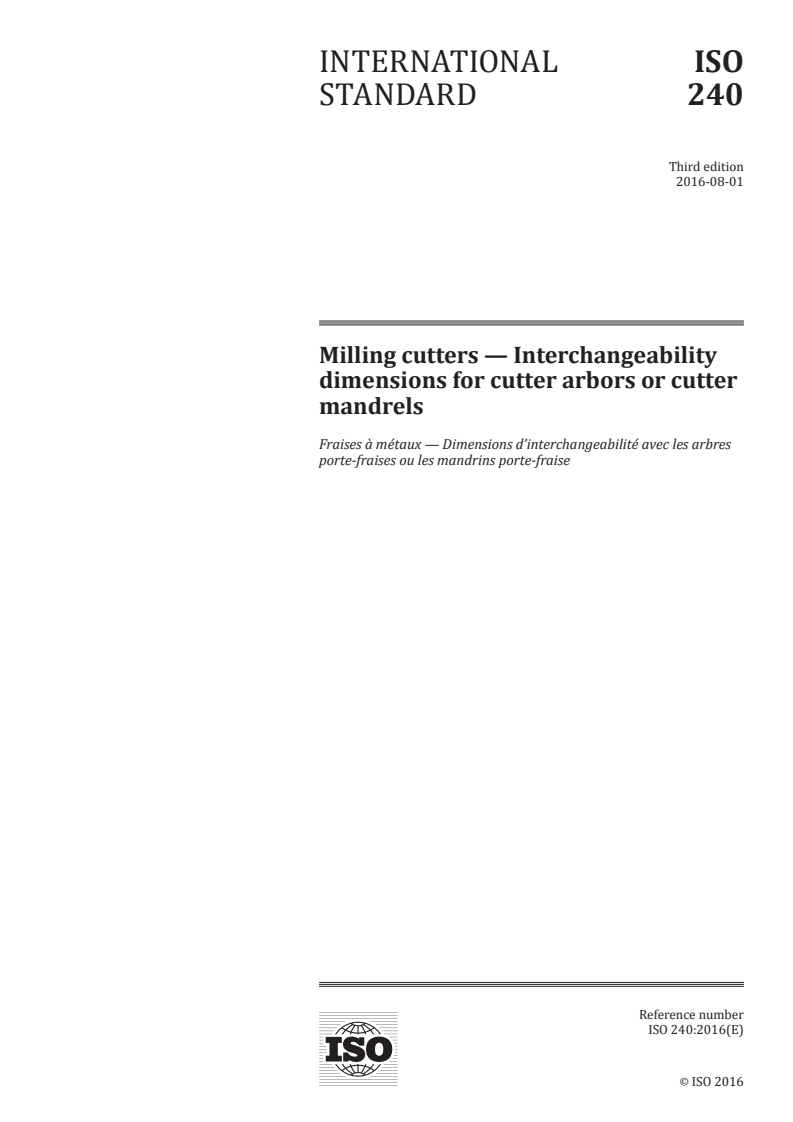
INTERNATIONAL ISO
STANDARD 240
Third edition
2016-08-01
Milling cutters — Interchangeability
dimensions for cutter arbors or cutter
mandrels
Fraises à métaux — Dimensions d’interchangeabilité avec les arbres
porte-fraises ou les mandrins porte-fraise
Reference number
©
ISO 2016
© ISO 2016, Published in Switzerland
All rights reserved. Unless otherwise specified, no part of this publication may be reproduced or utilized otherwise in any form
or by any means, electronic or mechanical, including photocopying, or posting on the internet or an intranet, without prior
written permission. Permission can be requested from either ISO at the address below or ISO’s member body in the country of
the requester.
ISO copyright office
Ch. de Blandonnet 8 • CP 401
CH-1214 Vernier, Geneva, Switzerland
Tel. +41 22 749 01 11
Fax +41 22 749 09 47
copyright@iso.org
www.iso.org
ii © ISO 2016 – All rights reserved
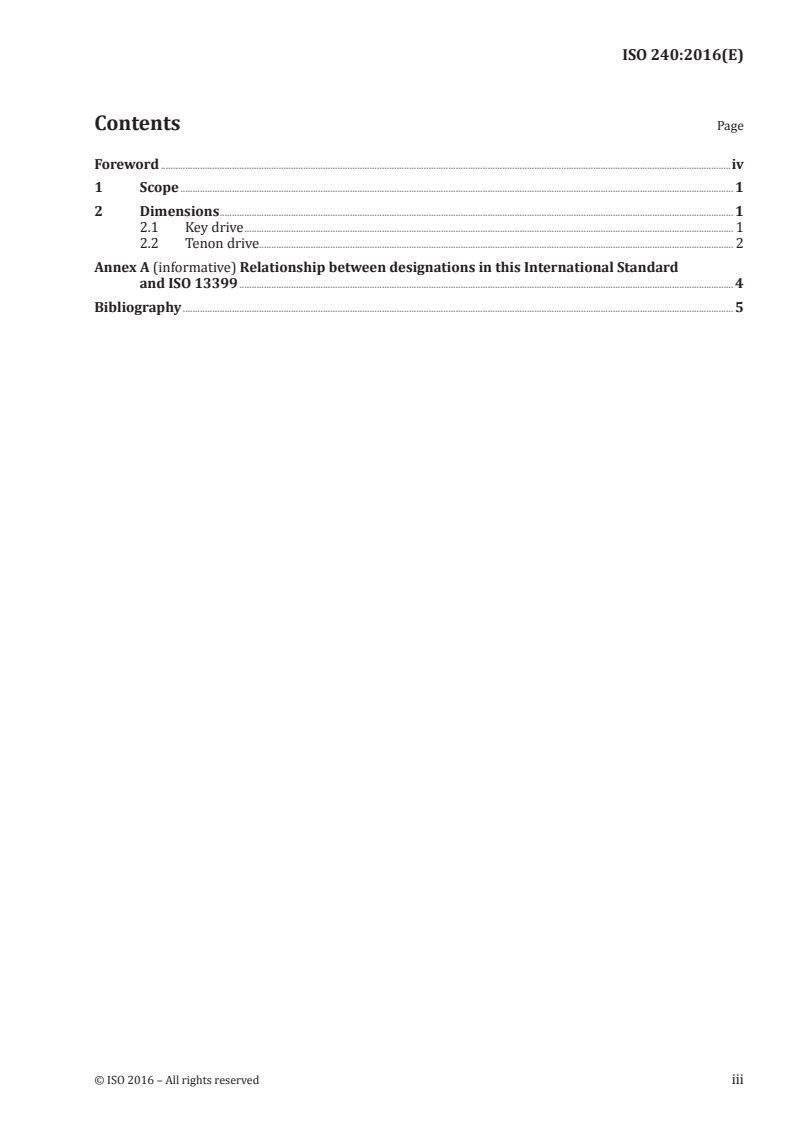
Contents Page
Foreword .iv
1 Scope . 1
2 Dimensions . 1
2.1 Key drive . 1
2.2 Tenon drive. 2
Annex A (informative) Relationship between designations in this International Standard
and ISO 13399 . 4
Bibliography . 5
Foreword
ISO (the International Organization for Standardization) is a worldwide federation of national standards
bodies (ISO member bodies). The work of preparing International Standards is normally carried out
through ISO technical committees. Each member body interested in a subject for which a technical
committee has been established has the right to be represented on that committee. International
organizations, governmental and non-governmental, in liaison with ISO, also take part in the work.
ISO collaborates closely with the International Electrotechnical Commission (IEC) on all matters of
electrotechnical standardization.
The procedures used to develop this document and those intended for its further maintenance are
described in the ISO/IEC Directives, Part 1. In particular the different approval criteria needed for the
different types of ISO documents should be noted. This document was drafted in accordance with the
editorial rules of the ISO/IEC Directives, Part 2 (see www.iso.org/directives).
Attention is drawn to the possibility that some of the elements of this document may be the subject of
patent rights. ISO shall not be held responsible for identifying any or all such patent rights. Details of
any patent rights identified during the development of the document will be in the Introduction and/or
on the ISO list of patent declarations received (see www.iso.org/patents).
Any trade name used in this document is information given
...
NORME ISO
INTERNATIONALE 240
Troisième édition
2016-08-01
Fraises à métaux — Dimensions
d’interchangeabilité avec les arbres
porte-fraises ou les mandrins porte-
fraise
Milling cutters — Interchangeability dimensions for cutter arbors or
cutter mandrels
Numéro de référence
©
ISO 2016
DOCUMENT PROTÉGÉ PAR COPYRIGHT
© ISO 2016, Publié en Suisse
Droits de reproduction réservés. Sauf indication contraire, aucune partie de cette publication ne peut être reproduite ni utilisée
sous quelque forme que ce soit et par aucun procédé, électronique ou mécanique, y compris la photocopie, l’affichage sur
l’internet ou sur un Intranet, sans autorisation écrite préalable. Les demandes d’autorisation peuvent être adressées à l’ISO à
l’adresse ci-après ou au comité membre de l’ISO dans le pays du demandeur.
ISO copyright office
Ch. de Blandonnet 8 • CP 401
CH-1214 Vernier, Geneva, Switzerland
Tel. +41 22 749 01 11
Fax +41 22 749 09 47
copyright@iso.org
www.iso.org
ii © ISO 2016 – Tous droits réservés
Sommaire Page
Avant-propos .iv
1 Domaine d’application . 1
2 Dimensions . 1
2.1 Entraînement par clavette. 1
2.2 Entraînement par tenons . 2
Annexe A (informative) Relation entre les désignations de la présente Norme
internationale et l’ISO 13399 . 4
Bibliographie . 5
Avant-propos
L’ISO (Organisation internationale de normalisation) est une fédération mondiale d’organismes
nationaux de normalisation (comités membres de l’ISO). L’élaboration des Normes internationales est
en général confiée aux comités techniques de l’ISO. Chaque comité membre intéressé par une étude
a le droit de faire partie du comité technique créé à cet effet. Les organisations internationales,
gouvernementales et non gouvernementales, en liaison avec l’ISO participent également aux travaux.
L’ISO collabore étroitement avec la Commission électrotechnique internationale (IEC) en ce qui
concerne la normalisation électrotechnique.
Les procédures utilisées pour élaborer le présent document et celles destinées à sa mise à jour sont
décrites dans les Directives ISO/IEC, Partie 1. Il convient, en particulier de prendre note des différents
critères d’approbation requis pour les différents types de documents ISO. Le présent document a été
rédigé conformément aux règles de rédaction données dans les Directives ISO/IEC, Partie 2 (voir www.
iso.org/directives).
L’attention est appelée sur le fait que certains des éléments du présent document peuvent faire l’objet de
droits de propriété intellectuelle ou de droits analogues. L’ISO ne saurait être tenue pour responsable
de ne pas avoir identifié de tels droits de propriété et averti de leur existence. Les détails concernant
les références aux droits de propriété intellectuelle ou autres droits analogues identifiés lors de
l’élaboration du document sont indiqués dans l’Introduction et/ou dans la liste des déclarations de
brevets reçues par l’ISO (voir www.iso.org/brevets).
Les appellations commerciales éventuellement mentionnées dans le présent document sont données
pour information, par souci de commodité, à l’intention des utilisateurs et ne sauraient constituer un
engagement.
Pour une explication de la signification des termes et expression
...
Questions, Comments and Discussion
Ask us and Technical Secretary will try to provide an answer. You can facilitate discussion about the standard in here.
Loading comments...