

ISO/IEC 21990:2002
(Main)Information technology — Telecommunications and information exchange between systems — Private Integrated Services Network — Inter-exchange signalling protocol — Short message service
General Information
- Abstract
ISO/IEC 21990:2002 specifies the signalling protocol for the support of the Short Message Service (SMS) at the Q reference point between Private Integrated services Network eXchanges (PINXs) connected together within a Private Integrated Services Network (PISN). This service is based on GSM 03.40. The Service Centre functionality described in ISO/IEC 21990:2002 is equal to the functionality of a Service Centre in GSM 03.40. Thus, for interoperability with a GSM network, it is only necessary to implement a QSIG interface. NOTE 1 The interworking with other air interfaces is not precluded, but is outside the scope of ISO/IEC 21990:2002. NOTE 2 The Short Message Service is a special type of basic service but is described in the present document as a supplementary service. The Short Message Service is a service which permits a served user to send a message of limited size to another user in the same PISN or another network. The Q reference point is defined in ISO/IEC 11579-1. Service specifications are produced in three stages and according to the method specified in ETS 300 387. ISO/IEC 21990:2002 contains the stage 3 specification for the Q reference point and satisfies the requirements identified by the stage 1 and stage 2 specifications in ISO/IEC 21989. The signalling protocol for SMS operates on top of the signalling protocol for the connection oriented call independent APDU transport mechanism and uses certain further aspects of the generic procedures for the control of supplementary services specified in ISO/IEC 11582. ISO/IEC 21990:2002 also specifies additional signalling protocol requirements for the support of interactions at the Q reference point between SMS and supplementary services and ANFs. ISO/IEC 21990:2002 is applicable to PINXs which can be interconnected to form a PISN.
- Status
- Published
- Publication Date
- 21-Aug-2002
- Current Stage
- 9060 - Close of review
- Completion Date
- 04-Jun-2031
Buy Documents

ISO/IEC 21990:2002 - Information technology — Telecommunications and information exchange between systems — Private Integrated Services Network — Inter-exchange signalling protocol — Short message service Released:8/22/2002
Overview
ISO/IEC 21990:2002 - "Information technology - Telecommunications and information exchange between systems - Private Integrated Services Network - Inter‑exchange signalling protocol - Short message service" specifies the signalling protocol for supporting the Short Message Service (SMS) at the Q reference point between Private Integrated services Network eXchanges (PINXs) in a Private Integrated Services Network (PISN). This stage‑3 specification (QSIG part of PSS1) is based on GSM 03.40 and defines Service Centre functionality equivalent to a GSM SMSC, enabling interoperability with GSM networks via a QSIG interface.
Key topics and technical requirements
- QSIG signalling for SMS at the Q reference point between PINXs forming a PISN.
- Service Centre (SMSC) equivalence to GSM 03.40 - only a QSIG interface is needed for GSM interworking.
- Protocol layering: SMS signalling operates on top of the connection‑oriented, call‑independent APDU transport and reuses generic procedures from ISO/IEC 11582 for supplementary services.
- State definitions and procedures for sending/receiving PINX, message centres and service centres (sending/receiving states, timers T1–T7).
- Encoding and ASN.1 operations for SMS operations, information elements and PDUs.
- Interactions with supplementary services and ANFs (e.g., CLIP/CLIR, call forwarding, message waiting indication, private user mobility).
- Conformance and testability: Protocol Implementation Conformance Statement (PICS) proforma in Annex A; examples and SDL representations in other annexes; mapping of QSIG‑PDUs to GSM‑PDUs.
Practical applications
- Enabling SMS delivery and routing inside enterprise telephony networks (PISNs) across multiple PINXs.
- Interworking private PBX/SIP gateways with public GSM networks where SMS transport over QSIG is required.
- Implementing SMS support in enterprise switching equipment, message centres and service centres to deliver short messages between internal users and external mobile subscribers.
- Supporting supplementary service interactions (e.g., message waiting, call forwarding) that affect SMS handling in private networks.
- Providing a standards‑based basis for interoperability testing, conformance certification and product development.
Who should use this standard
- Telecom equipment manufacturers and PBX/PINX vendors implementing QSIG SMS support.
- System integrators deploying enterprise messaging across interconnected exchanges.
- Network architects and operators managing PISN interconnects and GSM interworking.
- Test labs and standards engineers producing PICS and conformance test suites.
Related standards (selected)
- ISO/IEC 21989 (SMS functional model, stages 1–2)
- ISO/IEC 11579‑1 (PINX reference configuration)
- ISO/IEC 11582 (generic supplementary‑services signalling)
- ETSI TS 100 901 / GSM 03.40 (SMSC / SMS technical realization)
Keywords: ISO/IEC 21990:2002, Short Message Service, QSIG, PINX, PISN, SMSC, GSM 03.40, inter‑exchange signalling, APDU, supplementary services.
Relations
- Effective Date
- 06-Jun-2022
Buy Documents
ISO/IEC 21990:2002 - Information technology — Telecommunications and information exchange between systems — Private Integrated Services Network — Inter-exchange signalling protocol — Short message service Released:8/22/2002
Get Certified
Connect with accredited certification bodies for this standard

ANCE
Mexican certification and testing association.

Intertek Slovenia
Intertek testing, inspection, and certification services in Slovenia.

LNE (Laboratoire National de Métrologie et d'Essais)
French national laboratory for metrology and testing.
Sponsored listings
Frequently Asked Questions
ISO/IEC 21990:2002 is a standard published by the International Organization for Standardization (ISO). Its full title is "Information technology — Telecommunications and information exchange between systems — Private Integrated Services Network — Inter-exchange signalling protocol — Short message service". This standard covers: ISO/IEC 21990:2002 specifies the signalling protocol for the support of the Short Message Service (SMS) at the Q reference point between Private Integrated services Network eXchanges (PINXs) connected together within a Private Integrated Services Network (PISN). This service is based on GSM 03.40. The Service Centre functionality described in ISO/IEC 21990:2002 is equal to the functionality of a Service Centre in GSM 03.40. Thus, for interoperability with a GSM network, it is only necessary to implement a QSIG interface. NOTE 1 The interworking with other air interfaces is not precluded, but is outside the scope of ISO/IEC 21990:2002. NOTE 2 The Short Message Service is a special type of basic service but is described in the present document as a supplementary service. The Short Message Service is a service which permits a served user to send a message of limited size to another user in the same PISN or another network. The Q reference point is defined in ISO/IEC 11579-1. Service specifications are produced in three stages and according to the method specified in ETS 300 387. ISO/IEC 21990:2002 contains the stage 3 specification for the Q reference point and satisfies the requirements identified by the stage 1 and stage 2 specifications in ISO/IEC 21989. The signalling protocol for SMS operates on top of the signalling protocol for the connection oriented call independent APDU transport mechanism and uses certain further aspects of the generic procedures for the control of supplementary services specified in ISO/IEC 11582. ISO/IEC 21990:2002 also specifies additional signalling protocol requirements for the support of interactions at the Q reference point between SMS and supplementary services and ANFs. ISO/IEC 21990:2002 is applicable to PINXs which can be interconnected to form a PISN.
ISO/IEC 21990:2002 specifies the signalling protocol for the support of the Short Message Service (SMS) at the Q reference point between Private Integrated services Network eXchanges (PINXs) connected together within a Private Integrated Services Network (PISN). This service is based on GSM 03.40. The Service Centre functionality described in ISO/IEC 21990:2002 is equal to the functionality of a Service Centre in GSM 03.40. Thus, for interoperability with a GSM network, it is only necessary to implement a QSIG interface. NOTE 1 The interworking with other air interfaces is not precluded, but is outside the scope of ISO/IEC 21990:2002. NOTE 2 The Short Message Service is a special type of basic service but is described in the present document as a supplementary service. The Short Message Service is a service which permits a served user to send a message of limited size to another user in the same PISN or another network. The Q reference point is defined in ISO/IEC 11579-1. Service specifications are produced in three stages and according to the method specified in ETS 300 387. ISO/IEC 21990:2002 contains the stage 3 specification for the Q reference point and satisfies the requirements identified by the stage 1 and stage 2 specifications in ISO/IEC 21989. The signalling protocol for SMS operates on top of the signalling protocol for the connection oriented call independent APDU transport mechanism and uses certain further aspects of the generic procedures for the control of supplementary services specified in ISO/IEC 11582. ISO/IEC 21990:2002 also specifies additional signalling protocol requirements for the support of interactions at the Q reference point between SMS and supplementary services and ANFs. ISO/IEC 21990:2002 is applicable to PINXs which can be interconnected to form a PISN.
ISO/IEC 21990:2002 is classified under the following ICS (International Classification for Standards) categories: 33.040.35 - Telephone networks. The ICS classification helps identify the subject area and facilitates finding related standards.
ISO/IEC 21990:2002 has the following relationships with other standards: It is inter standard links to ISO 3233-2:2014. Understanding these relationships helps ensure you are using the most current and applicable version of the standard.
ISO/IEC 21990:2002 is available in PDF format for immediate download after purchase. The document can be added to your cart and obtained through the secure checkout process. Digital delivery ensures instant access to the complete standard document.
Standards Content (Sample)
INTERNATIONAL ISO/IEC
STANDARD 21990
First edition
2002-07-15
Information technology —
Telecommunications and information
exchange between systems — Private
Integrated Services Network —
Inter-exchange signalling protocol —
Short message service
Technologies de l'information — Télécommunications et échange
d'information entre systèmes — Réseaux privés avec intégration de
services — Protocole de signalisation entre commutateurs — Service de
message court
Reference number
©
ISO/IEC 2002
PDF disclaimer
This PDF file may contain embedded typefaces. In accordance with Adobe's licensing policy, this file may be printed or viewed but shall not
be edited unless the typefaces which are embedded are licensed to and installed on the computer performing the editing. In downloading this
file, parties accept therein the responsibility of not infringing Adobe's licensing policy. The ISO Central Secretariat accepts no liability in this
area.
Adobe is a trademark of Adobe Systems Incorporated.
Details of the software products used to create this PDF file can be found in the General Info relative to the file; the PDF-creation parameters
were optimized for printing. Every care has been taken to ensure that the file is suitable for use by ISO member bodies. In the unlikely event
that a problem relating to it is found, please inform the Central Secretariat at the address given below.
© ISO/IEC 2002
All rights reserved. Unless otherwise specified, no part of this publication may be reproduced or utilized in any form or by any means, electronic
or mechanical, including photocopying and microfilm, without permission in writing from either ISO at the address below or ISO's member body
in the country of the requester.
ISO copyright office
Case postale 56 • CH-1211 Geneva 20
Tel. + 41 22 749 01 11
Fax + 41 22 749 09 47
E-mail copyright@iso.ch
Web www.iso.ch
Printed in Switzerland
ii © ISO/IEC 2002 – All rights reserved
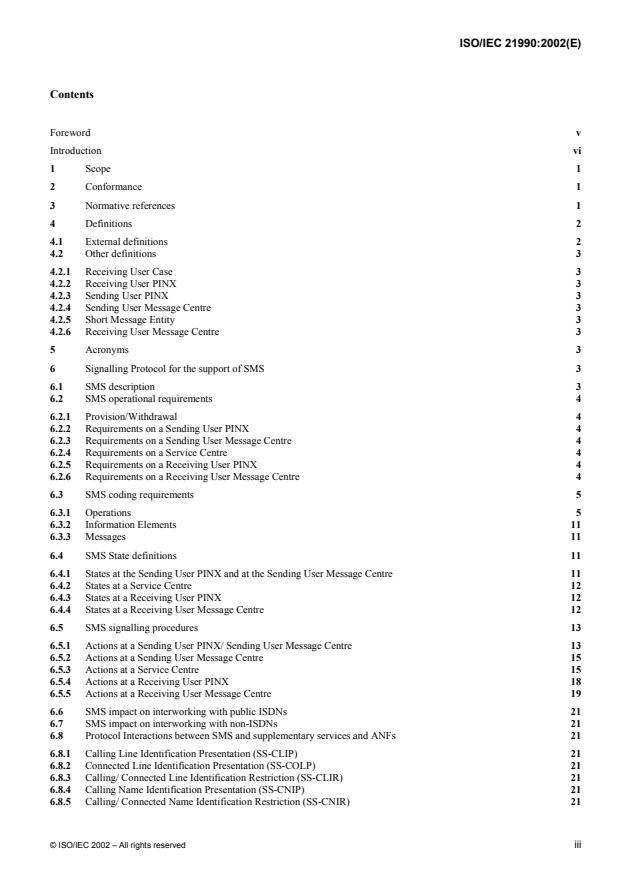
Contents
Foreword v
Introduction vi
1 Scope 1
2 Conformance 1
3 Normative references 1
4 Definitions 2
4.1 External definitions 2
4.2 Other definitions 3
4.2.1 Receiving User Case 3
4.2.2 Receiving User PINX 3
4.2.3 Sending User PINX 3
4.2.4 Sending User Message Centre 3
4.2.5 Short Message Entity 3
4.2.6 Receiving User Message Centre 3
5 Acronyms 3
6 Signalling Protocol for the support of SMS 3
6.1 SMS description 3
6.2 SMS operational requirements 4
6.2.1 Provision/Withdrawal 4
6.2.2 Requirements on a Sending User PINX 4
6.2.3 Requirements on a Sending User Message Centre 4
6.2.4 Requirements on a Service Centre 4
6.2.5 Requirements on a Receiving User PINX 4
6.2.6 Requirements on a Receiving User Message Centre 4
6.3 SMS coding requirements 5
6.3.1 Operations 5
6.3.2 Information Elements 11
6.3.3 Messages 11
6.4 SMS State definitions 11
6.4.1 States at the Sending User PINX and at the Sending User Message Centre 11
6.4.2 States at a Service Centre 12
6.4.3 States at a Receiving User PINX 12
6.4.4 States at a Receiving User Message Centre 12
6.5 SMS signalling procedures 13
6.5.1 Actions at a Sending User PINX/ Sending User Message Centre 13
6.5.2 Actions at a Sending User Message Centre 15
6.5.3 Actions at a Service Centre 15
6.5.4 Actions at a Receiving User PINX 18
6.5.5 Actions at a Receiving User Message Centre 19
6.6 SMS impact on interworking with public ISDNs 21
6.7 SMS impact on interworking with non-ISDNs 21
6.8 Protocol Interactions between SMS and supplementary services and ANFs 21
6.8.1 Calling Line Identification Presentation (SS-CLIP) 21
6.8.2 Connected Line Identification Presentation (SS-COLP) 21
6.8.3 Calling/ Connected Line Identification Restriction (SS-CLIR) 21
6.8.4 Calling Name Identification Presentation (SS-CNIP) 21
6.8.5 Calling/ Connected Name Identification Restriction (SS-CNIR) 21
© ISO/IEC 2002 – All rights reserved iii
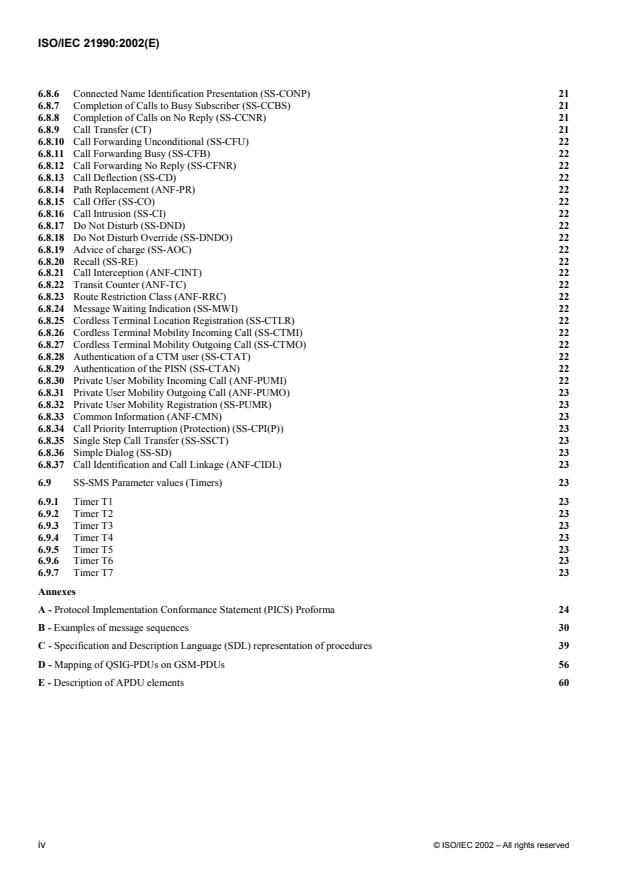
6.8.6 Connected Name Identification Presentation (SS-CONP) 21
6.8.7 Completion of Calls to Busy Subscriber (SS-CCBS) 21
6.8.8 Completion of Calls on No Reply (SS-CCNR) 21
6.8.9 Call Transfer (CT) 21
6.8.10 Call Forwarding Unconditional (SS-CFU) 22
6.8.11 Call Forwarding Busy (SS-CFB) 22
6.8.12 Call Forwarding No Reply (SS-CFNR) 22
6.8.13 Call Deflection (SS-CD) 22
6.8.14 Path Replacement (ANF-PR) 22
6.8.15 Call Offer (SS-CO) 22
6.8.16 Call Intrusion (SS-CI) 22
6.8.17 Do Not Disturb (SS-DND) 22
6.8.18 Do Not Disturb Override (SS-DNDO) 22
6.8.19 Advice of charge (SS-AOC) 22
6.8.20 Recall (SS-RE) 22
6.8.21 Call Interception (ANF-CINT) 22
6.8.22 Transit Counter (ANF-TC) 22
6.8.23 Route Restriction Class (ANF-RRC) 22
6.8.24 Message Waiting Indication (SS-MWI) 22
6.8.25 Cordless Terminal Location Registration (SS-CTLR) 22
6.8.26 Cordless Terminal Mobility Incoming Call (SS-CTMI) 22
6.8.27 Cordless Terminal Mobility Outgoing Call (SS-CTMO) 22
6.8.28 Authentication of a CTM user (SS-CTAT) 22
6.8.29 Authentication of the PISN (SS-CTAN) 22
6.8.30 Private User Mobility Incoming Call (ANF-PUMI) 22
6.8.31 Private User Mobility Outgoing Call (ANF-PUMO) 23
6.8.32 Private User Mobility Registration (SS-PUMR) 23
6.8.33 Common Information (ANF-CMN) 23
6.8.34 Call Priority Interruption (Protection) (SS-CPI(P)) 23
6.8.35 Single Step Call Transfer (SS-SSCT) 23
6.8.36 Simple Dialog (SS-SD) 23
6.8.37 Call Identification and Call Linkage (ANF-CIDL) 23
6.9 SS-SMS Parameter values (Timers) 23
6.9.1 Timer T1 23
6.9.2 Timer T2 23
6.9.3 Timer T3 23
6.9.4 Timer T4 23
6.9.5 Timer T5 23
6.9.6 Timer T6 23
6.9.7 Timer T7 23
Annexes
A - Protocol Implementation Conformance Statement (PICS) Proforma 24
B - Examples of message sequences 30
C - Specification and Description Language (SDL) representation of procedures 39
D - Mapping of QSIG-PDUs on GSM-PDUs 56
E - Description of APDU elements 60
iv © ISO/IEC 2002 – All rights reserved
Foreword
ISO (the International Organization for Standardization) and IEC (the International Electrotechnical Commission) form the
specialized system for worldwide standardization. National bodies that are members of ISO or IEC participate in the
development of International Standards through technical committees established by the respective organization to deal with
particular fields of technical activity. ISO and IEC technical committees collaborate in fields of mutual interest. Other
international organizations, governmental and non-governmental, in liaison with ISO and IEC, also take part in the work. In the
field of information technology, ISO and IEC have established a joint technical committee, ISO/IEC JTC 1.
International Standards are drafted in accordance with the rules given in the ISO/IEC Directives, Part 3.
The main task of the joint technical committee is to prepare International Standards. Draft International Standards adopted by
the joint technical committee are circulated to national bodies for voting. Publication as an International Standard requires
approval by at least 75 % of the national bodies casting a vote.
Attention is drawn to the possibility that some of the elements of this International Standard may be the subject of patent rights.
ISO and IEC shall not be held responsible for identifying any or all such patent rights.
ISO/IEC 21990 was prepared by ECMA (as ECMA-325) and was adopted, under a special “fast-track procedure”, by Joint
Technical Committee ISO/IEC JTC 1, Information technology, in parallel with its approval by national bodies of ISO and IEC.
Annexes A and E form a normative part of this International Standard. Annexes B, C and D are for information only.
© ISO/IEC 2002 – All rights reserved v
Introduction
This International Standard is one of a series of Standards defining services and signalling protocols applicable to Private
Integrated Services Digital Networks (PISNs). The series uses ISDN concepts as developed by ITU-T and conforms to the
framework of International Standards on Open Systems Interconnection as defined by ISO/IEC.
This International Standard specifies the signalling protocol for use at the Q reference point in support of the Short Message
Service. The protocol defined in this Standard forms part of the PSS1 protocol (informally known as QSIG).
This International Standard is based upon the practical experience of ECMA member companies and the results of their active
and continuous participation in the work of ISO/IEC JTC 1, ITU-T, ETSI and other international and national standardization
bodies. It represents a pragmatic and widely based consensus.
vi © ISO/IEC 2002 – All rights reserved
INTERNATIONAL STANDARD ISO/IEC 21990:2002(E)
Information technology — Telecommunications and information
exchange between systems — Private Integrated Services Network —
Inter-exchange signalling protocol — Short message service
1 Scope
This International Standard specifies the signalling protocol for the support of the Short Message Service (SMS) at the Q
reference point between Private Integrated services Network eXchanges (PINXs) connected together within a Private
Integrated Services Network (PISN).
This service is based on GSM 03.40. The Service Centre functionality described in this International Standard is equal to the
functionality of a Service Centre in GSM 03.40. Thus, for interoperability with a GSM network, it is only necessary to
implement a QSIG interface.
NOTE 1 - The interworking with other air interfaces is not precluded, but is outside the scope of this International Standard.
NOTE 2 - The Short Message Service is a special type of basic service but is described in the present document as a supplementary service.
The Short Message Service is a service which permits a served user to send a message of limited size to another user in the
same PISN or another network.
The Q reference point is defined in ISO/IEC 11579-1.
Service specifications are produced in three stages and according to the method specified in ETS 300 387. This International
Standard contains the stage 3 specification for the Q reference point and satisfies the requirements identified by the stage 1 and
stage 2 specifications in ISO/IEC 21989.
The signalling protocol for SMS operates on top of the signalling protocol for the connection oriented call independent APDU
transport mechanism and uses certain further aspects of the generic procedures for the control of supplementary services
specified in ISO/IEC 11582.
This International Standard also specifies additional signalling protocol requirements for the support of interactions at the Q
reference point between SMS and supplementary services and ANFs.
This International Standard is applicable to PINXs which can be interconnected to form a PISN.
2 Conformance
In order to conform to this International Standard, a PINX shall satisfy the requirements identified in the Protocol
Implementation Conformance Statement (PICS) proforma in annex A.
3 Normative references
The following normative documents contain provisions which, through reference in this text, constitute provisions of this
International Standard. For dated references, subsequent amendments to, or revisions of, any of these publications do not
apply. However, parties to agreements based on this International Standard are encouraged to investigate the possibility of
applying the most recent editions of the normative documents indicated below. For undated references, the latest edition of the
normative document referred to applies. Members of ISO and IEC maintain registers of currently valid International Standards.
ISO 8601:2000, Data elements and interchange formats - Information interchange - Representation of dates and times
ISO/IEC 10646-1:2000, Information technology - Universal Multiple-Octet Coded Character Set (UCS) - Part 1: Architecture
and Basic Multilingual Plane
ISO/IEC 11572:2000, Information technology - Telecommunications and information exchange between systems - Private
Integrated Services Network - Circuit mode bearer services - Inter-exchange signalling procedures and protocol
ISO/IEC 11579-1:1994, Information technology - Telecommunications and information exchange between systems - Private
Integrated Services Network - Part 1: Reference configuration for PISN exchanges (PINX)
© ISO/IEC 2002 – All rights reserved 1
ISO/IEC 11582:1995, Information technology - Telecommunications and information exchange between systems - Private
Integrated Services Network - Generic functional protocol for the support of supplementary services - Inter-exchange
signalling procedures and protocol
ISO/IEC 13868:1995, Information technology - Telecommunications and information exchange between systems - Private
Integrated Services Network - Inter-exchange signalling protocol - Name identification supplementary services
ISO/IEC 15506:2000, Information technology - Telecommunications and information exchange between systems - Private
Integrated Services Network (PISN) - Inter-Exchange Signalling Protocol - Message Waiting Indication Supplementary
Service
ISO/IEC 21989:2002, Information technology - Telecommunications and information exchange between systems - Private
Integrated Services Network - Specification, functional model and information flows - Short message service
ETSI GTS GSM 03.38, Digital cellular telecommunications systems (Phase 2+) (GSM); Alphabets and language-specific
information
ETSI TS 100 901, Digital cellular telecommunications systems (Phase 2+); Technical realization of the Short Message Service
(SMS) (GSM 03.40)
ETSI TS 100 942, Digital cellular telecommunications systems (Phase 2+) (GSM); Point-to-Point (PP) Short Message Service
(SMS) support on mobile radio interface (GSM 04.11)
ETSI TS 101 032, Digital cellular telecommunications systems (Phase 2+) (GSM); Compression algorithm for text messaging
services (GSM 03.42)
ETSI ETS 300 387, Private Telecommunication Network (PTN); Method for the specification of basic and supplementary
services
ETSI ETS 300 599, Digital cellular telecommunications systems (Phase 2) (GSM); Mobile Application Part (MAP)
specification (GSM 09.02)
ITU-T Rec. I.112:1993, Vocabulary of terms for ISDNs
ITU-T Rec. I.210:1993, Principles of telecommunication services supported by an ISDN and the means to describe them
ITU-T Rec. Z.100:1999, Specification and description language (SDL)
4 Definitions
For the purposes of this International Standard, the following definitions apply.
4.1 External definitions
This International Standard uses the following terms defined in other documents:
– Application Protocol Data Unit (APDU) (ISO/IEC 11582)
– Call, Basic Call (ISO/IEC 11582)
– Call Independent Signalling Connection (ISO/IEC 11582)
– Command (ISO/IEC 21989)
– End PINX (ISO/IEC 11582)
– Message Centre (ISO/IEC 21989)
– Message Centre Case (ISO/IEC 21989)
– Private Integrated services Network eXchange (PINX) (ISO/IEC 11579-1)
– Private Integrated Services Network (PISN) (ISO/IEC 11579-1)
– Receiving User (ISO/IEC 21989)
– Sending User (ISO/IEC 21989)
– Service Centre (ISO/IEC 21989)
– Short Message (ISO/IEC 21989)
– Short Message Waiting Data (ISO/IEC 21989)
– Status Report (ISO/IEC 21989)
2 © ISO/IEC 2002 – All rights reserved
– Signalling (ITU-T Rec. I.112)
– Supplementary Service (ITU-T Rec. I.210)
– Terminal Case (ISO/IEC 21989)
4.2 Other definitions
4.2.1 Receiving User Case
The configuration when the Terminal Case is provided for the Receiving User, i.e. no Receiving User Message Centre is
involved in the SMS procedures.
4.2.2 Receiving User PINX
The Receiving User PINX is the PINX serving the Receiving User.
4.2.3 Sending User PINX
The Sending User PINX is the PINX serving the Sending User.
4.2.4 Sending User Message Centre
The Message Centre serving the Sending User.
4.2.5 Short Message Entity
A generic term for an entity that is capable of handling one or more SMS specific procedures. This can be either the Sending
Users terminal, the Sending User PINX, the Sending User Message Centre, the Service Centre, the Receiving User Message
Centre, the Receiving User PINX or the Receiving Users terminal.
4.2.6 Receiving User Message Centre
The Message Centre serving the Receiving User.
5 Acronyms
APDU Application Protocol Data Unit
ASN.1 Abstract Syntax Notation One
GSM Global System for Mobile communication
ISDN Integrated Services Digital Network
PICS Protocol Implementation Conformance Statement
PINX Private Integrated services Network eXchange
PISN Private Integrated Services Network
SDL Specification and Description Language
SIM Subscriber Identity Module
SM Short Message
SMS Short Message Service
SMSC Short Message Service Centre
SMWD Short Message Waiting Data
SS Supplementary Service
TE Terminal Equipment
UDH User Data Header
6 Signalling Protocol for the support of SMS
6.1 SMS description
Short Message Service is a service which is offered to a user in a PISN and which enables the user to send and receive Short
Messages to and from another user in a PISN or in another (e.g. GSM) network.
The PISN transfers the Short Message from the Sending User to an SC and from the SC to the Receiving User.
© ISO/IEC 2002 – All rights reserved 3
6.2 SMS operational requirements
6.2.1 Provision/Withdrawal
Provision and withdrawal shall be in accordance with 6.2.1 of ISO/IEC 21989.
6.2.2 Requirements on a Sending User PINX
Generic procedures for the call independent control (connection oriented) of supplementary services, as specified in
ISO/IEC 11582 for an Originating-PINX and for a Terminating-PINX, shall apply.
6.2.3 Requirements on a Sending User Message Centre
Generic procedures for the call independent control (connection oriented) of supplementary services, as specified in
ISO/IEC 11582 for an Originating-PINX and for a Terminating-PINX, shall apply.
6.2.4 Requirements on a Service Centre
Generic procedures for the call independent control (connection oriented) of supplementary services, as specified in
ISO/IEC 11582 for an Originating-PINX and for a Terminating-PINX, shall apply.
6.2.5 Requirements on a Receiving User PINX
Generic procedures for the call independent control (connection oriented) of supplementary services, as specified in
ISO/IEC 11582 for an Originating-PINX and for a Terminating-PINX , shall apply.
6.2.6 Requirements on a Receiving User Message Centre
Generic procedures for the call independent control (connection oriented) of supplementary services, as specified in
ISO/IEC 11582 for an Originating-PINX and for a Terminating-PINX, shall apply.
4 © ISO/IEC 2002 – All rights reserved
6.3 SMS coding requirements
6.3.1 Operations
The following operations defined in Abstract Syntax Notation One (ASN.1) in table 1 shall apply.
Table 1 - Operations in Support of SMS
Short-Message-Service-Operations-asn1-97
{iso(1) identified-organization(3) icd-ecma(12) standard(0) qsig-short-message-service(325) short-message-service-
operations-asn1-97(1)}
DEFINITIONS::=
BEGIN
IMPORTS
OPERATION,
ERROR
FROM Remote-Operations-Information-Objects
{joint-iso-itu-t (2) remote-operations(4) informationObjects(5) version1(0)}
EXTENSION, Extension{}
FROM Manufacturer-specific-service-extension-class-asn1-97
{iso(1) standard(0) pss1-generic-procedures(11582) msi-class-asn1-97(11)}
Name
FROM Name-Operations-asn1-97
{iso(1) standard(0) pss1-name(13868) name-operations-asn1-97(1)}
supplementaryServiceInteractionNotAllowed
FROM General-Error-List
{ccitt recommendation q 950 general-error-list(1)}
PartyNumber
FROM Addressing-Data-Elements-asn1-97
{iso(1) standard(0) pss1-generic-procedures(11582) addressing-data-elements-asn1-97(20)};
--TYPE DEFINITIONS FOR SMS OPERATIONS FOLLOW
Sms-Operations OPERATION ::={
smsSubmit | smsDeliver | smsStatusReport | smsCommand | scAlert}
smsSubmit OPERATION ::= {
-- sent from the Sending User PINX/ Sending User Message Centre to the Service Centre
ARGUMENT SmsSubmitArg
RESULT SmsSubmitRes
ERRORS {smsSubmitError |
unspecified}
CODE local:107}
smsDeliver OPERATION ::= {
-- sent from the Service Centre to the Receiving User PINX or to the Receiving User Message Centre
ARGUMENT SmsDeliverArg
RESULT SmsDeliverRes
ERRORS {smsDeliverError |
unspecified}
CODE local:108}
© ISO/IEC 2002 – All rights reserved 5
Table 1 - Operations in Support of SMS (continued)
smsStatusReport OPERATION ::= {
-- sent from the Service Centre to the Sending User PINX or to the Sending User Message Centre
ARGUMENT SmsStatusReportArg
RESULT SmsStatusReportRes
ERRORS {smsStatusReportError |
unspecified}
CODE local:109}
smsCommand OPERATION ::= {
-- sent from the Sending User PINX or the Sending User Message Centre to the Service Centre
ARGUMENT SmsCommandArg
RESULT SmsCommandRes
ERRORS {smsCommandError |
unspecified}
CODE local:110}
scAlert OPERATION ::= {
-- sent from the Receiving User PINX or the Receiving User Message Centre to the Service Centre
ARGUMENT ScAlertArg
RESULT DummyRes
ERRORS {unspecified}
CODE local:111}
--TYPE DEFINITIONS FOR SMS DATA TYPES FOLLOW
SmsSubmitArg ::= SEQUENCE {
destinationAddress PartyNumber,
originatingAddress PartyNumber,
messageReference MessageReference,
smSubmitParameter SmSubmitParameter,
userData UserData,
smsExtension SmsExtension OPTIONAL}
SmsSubmitRes ::= SEQUENCE {
serviceCentreTimeStamp ServiceCentreTimeStamp,
protocolIdentifier [3] IMPLICIT ProtocolIdentifier OPTIONAL,
userData [4] IMPLICIT UserData OPTIONAL,
smsExtension SmsExtension OPTIONAL}
SmsDeliverArg ::= SEQUENCE {
originatingAddress PartyNumber,
destinationAddress PartyNumber,
originatingName Name OPTIONAL,
smDeliverParameter SmDeliverParameter,
userData UserData,
smsExtension SmsExtension OPTIONAL}
SmsDeliverRes ::= SEQUENCE {
smsDeliverResponseChoice SmsDeliverResChoice,
smsExtension SmsExtension OPTIONAL}
6 © ISO/IEC 2002 – All rights reserved
Table 1 - Operations in Support of SMS (continued)
SmsStatusReportArg ::= SEQUENCE {
messageReference MessageReference,
serviceCentreTimeStamp ServiceCentreTimeStamp,
dischargeTime DischargeTime,
recipientAddress PartyNumber,
recipientName [10] Name OPTIONAL,
destinationAddress PartyNumber,
status Status,
priority [11] IMPLICIT BOOLEAN DEFAULT FALSE,
moreMessagesToSend [12] IMPLICIT BOOLEAN DEFAULT FALSE,
statusReportQualifier [13] IMPLICIT BOOLEAN DEFAULT FALSE,
protocolIdentifier ProtocolIdentifier OPTIONAL,
userData UserData OPTIONAL,
smsExtension SmsExtension OPTIONAL}
SmsStatusReportRes ::= SEQUENCE {
smsStatusReportResponseChoice SmsStatusReportResponseChoice,
smsExtension SmsExtension OPTIONAL}
SmsCommandArg ::= SEQUENCE {
destinationAddress PartyNumber,
messageReference MessageReference,
messageNumber MessageReference,
protocolIdentifier ProtocolIdentifier,
commandType CommandType,
commandData CommandData OPTIONAL,
statusReportRequest BOOLEAN OPTIONAL,
smsExtension SmsExtension OPTIONAL}
SmsCommandRes ::= SEQUENCE {
serviceCentreTimeStamp ServiceCentreTimeStamp,
protocolIdentifier ProtocolIdentifier OPTIONAL,
userData UserData OPTIONAL,
smsExtension SmsExtension OPTIONAL}
ScAlertArg ::= SEQUENCE {
originatingAddress PartyNumber,
smsExtension SmsExtension OPTIONAL}
DummyRes ::= CHOICE{
null NULL,
smsExtension SmsExtension}
SmSubmitParameter ::= SEQUENCE {
protocolIdentifier ProtocolIdentifier,
validityPeriod ValidityPeriod OPTIONAL,
statusReportRequest [11] IMPLICIT BOOLEAN DEFAULT FALSE,
replyPath [12] IMPLICIT BOOLEAN DEFAULT FALSE,
rejectDuplicates [13] IMPLICIT BOOLEAN DEFAULT FALSE}
© ISO/IEC 2002 – All rights reserved 7
Table 1 - Operations in Support of SMS (continued)
SmDeliverParameter ::= SEQUENCE {
protocolIdentifier ProtocolIdentifier,
serviceCentreTimeStamp ServiceCentreTimeStamp,
priority [11] IMPLICIT BOOLEAN DEFAULT FALSE,
moreMessagesToSend [12] IMPLICIT BOOLEAN DEFAULT FALSE,
statusReportIndication [13] IMPLICIT BOOLEAN DEFAULT FALSE,
replyPath [14] IMPLICIT BOOLEAN DEFAULT FALSE}
SmsDeliverResChoice ::= CHOICE {
null NULL,
protocolIdentifier ProtocolIdentifier,
userData [0] IMPLICIT UserData,
resChoiceSeq [1] IMPLICIT ResChoiceSeq}
ResChoiceSeq ::= SEQUENCE {
protocolIdentifier ProtocolIdentifier,
userData UserData}
SmsStatusReportResponseChoice ::= CHOICE {
null NULL,
protocolIdentifier ProtocolIdentifier,
userData [0] IMPLICIT UserData,
resChoiceSeq [1] IMPLICIT ResChoiceSeq}
MessageReference ::= INTEGER(0.255)
SmsExtension ::= CHOICE{
single [1]IMPLICIT Extension{{SmsExtSet}},
multiple [2]IMPLICIT SEQUENCE OF
Extension{{SmsExtSet}}
}
SmsExtSet EXTENSION ::= {.}
ProtocolIdentifier ::= INTEGER (0.127)
-- definition of the ProtocolIdentifier values and default value can be found in annex E section
-- E.1.2.1
ServiceCentreTimeStamp ::= GeneralizedTime(SIZE(12.19))
-- this date and time representation follows ISO 8601
DischargeTime ::= GeneralizedTime(SIZE(12.19))
-- this date and time representation follows ISO 8601
ValidityPeriod ::= CHOICE{
validityPeriodRel [0] IMPLICIT ValidityPeriodRel,
validityPeriodAbs [1] IMPLICIT ValidityPeriodAbs,
validityPeriodEnh [2] IMPLICIT ValidityPeriodEnh}
ValidityPeriodAbs ::= GeneralizedTime(SIZE(12.19))
-- this date and time representation follows ISO 8601
ValidityPeriodRel ::= INTEGER(0.255)
-- the rules for the encoding of ValidityPeriodRel are shown in annex E section E.1.2.2
8 © ISO/IEC 2002 – All rights reserved
Table 1 - Operations in Support of SMS (continued)
ValidityPeriodEnh ::= SEQUENCE{
singleShotSM BOOLEAN DEFAULT FALSE,
enhancedVP EnhancedVP OPTIONAL}
EnhancedVP ::= CHOICE{
validityPeriodRel [0] IMPLICIT ValidityPeriodRel,
validityPeriodSec [1] IMPLICIT INTEGER(0.255),
validityPeriodSemi [2] IMPLICIT ValidityPeriodSemi}
ValidityPeriodSemi ::= OCTET STRING (SIZE(3))
-- Validity Period is relative in semi-octet representation, see ETSI TS 100 901, section 9.1.2.3
-- and section 9.2.3.12.3
UserData ::= SEQUENCE{
userDataHeader [0] IMPLICIT UserDataHeader OPTIONAL,
class [1] IMPLICIT INTEGER (0.3) OPTIONAL,
compressed [2] IMPLICIT BOOLEAN DEFAULT FALSE,
shortMessageText ShortMessageText}
ShortMessageText ::= SEQUENCE{
shortMessageTextType ShortMessageTextType,
shortMessageTextData ShortMessageTextData}
ShortMessageTextType ::= INTEGER{
iA5Coded (0), -- ShortMessageTextData shall contain data according to
octetCoded (1), -- the type given in ShortMessageTextType, for further
uniCoded (2), -- details see annex E. 1.3.4.
compressedCoded (3)} (0.8)
ShortMessageTextData ::= OCTET STRING (SIZE(0.140))
Status ::= INTEGER (0.255)
-- definition of status values can be found in section E.7.6 in annex E
CommandType ::= INTEGER{
enquiry (0),
cancelSRR (1),
deletePreviouslySubmittedSM (2),
enableSRRrelatingToPreviouslySubmittedSM (3)} (0.255)
CommandData ::= OCTET STRING (SIZE(0.157))
FailureCause ::= INTEGER (0.255)
-- definition for failureCause values can be found in section E.3.1 in annex E
UserDataHeader ::= SEQUENCE OF UserDataHeaderChoice
© ISO/IEC 2002 – All rights reserved 9
Table 1 - Operations in Support of SMS (continued)
UserDataHeaderChoice ::= CHOICE{
smscControlParameterHeader [0] IMPLICIT SmscControlParameterHeader,
concatenated8BitSMHeader [1] IMPLICIT Concatenated8BitSMHeader,
concatenated16BitSMHeader [2] IMPLICIT Concatenated16BitSMHeader,
applicationPort8BitHeader [3] IMPLICIT ApplicationPort8BitHeader,
applicationPort16BitHeader [4] IMPLICIT ApplicationPort16BitHeader,
dataHeaderSourceIndicator [5] IMPLICIT DataHeaderSourceIndicator,
wirelessControlHeader [6] IMPLICIT WirelessControlHeader,
genericUserValue [99] IMPLICIT GenericUserValue}
SmscControlParameterHeader ::= BIT STRING {
sRforTransactionCompleted (0),
sRforPermanentError (1),
sRforTempErrorSCnotTrying (2),
sRforTempErrorSCstillTrying (3),
cancelSRRforConcatenatedSM (6),
includeOrigUDHintoSR (7)} (SIZE(8))
Concatenated8BitSMHeader ::= SEQUENCE{
concatenated8BitSMReferenceNumber INTEGER(0.255),
maximumNumberOf8BitSMInConcatenatedSM INTEGER(0.255),
sequenceNumberOf8BitSM INTEGER(0.255)}
Concatenated16BitSMHeader ::= SEQUENCE{
concatenated16BitSMReferenceNumber INTEGER(0.65536),
maximumNumberOf16BitSMInConcatenatedSM INTEGER(0.255),
sequenceNumberOf16BitSM INTEGER(0.255)}
ApplicationPort8BitHeader ::= SEQUENCE{
destination8BitPort INTEGER(0.255),
originator8BitPort INTEGER(0.255)}
ApplicationPort16BitHeader ::= SEQUENCE{
destination16BitPort INTEGER(0.65536),
originator16BitPort INTEGER(0.65536)}
DataHeaderSourceIndicator ::= INTEGER{
originalSender (1), -- valid in case of Status Report
originalReceiver (2), -- valid in case of Status Report
sMSC (3)}(0.255) -- can occur in any message or report
WirelessControlHeader ::= OCTET STRING
GenericUserValue ::= SEQUENCE{
parameterValue INTEGER(0.255),
genericUserData OCTET STRING}
smsDeliverError ERROR ::= {
PARAMETER SEQUENCE{
failureCause FailureCause,
protocolIdentifier [0] IMPLICIT ProtocolIdentifier OPTIONAL,
userData [1] IMPLICIT UserData OPTIONAL,
scAddressSaved [2] IMPLICIT BOOLEAN DEFAULT FALSE}
CODE local:1026}
10 © ISO/IEC 2002 – All rights reserved
Table 1 - Operations in Support of SMS (concluded)
smsSubmitError ERROR ::= {
PARAMETER SEQUENCE{
failureCause FailureCause,
serviceCentreTimeStamp ServiceCentreTimeStamp,
protocolIdentifier [0] IMPLICIT ProtocolIdentifier OPTIONAL,
userData [1] IMPLICIT UserData OPTIONAL}
CODE local:1027}
smsStatusReportError ERROR ::= {
PARAMETER SEQUENCE{
failureCause FailureCause,
protocolIdentifier [0] IMPLICIT ProtocolIdentifier OPTIONAL,
userData [1] IMPLICIT UserData OPTIONAL,
scAddressSaved [2] IMPLICIT BOOLEAN DEFAULT FALSE}
CODE local: 1028}
smsCommandError ERROR ::= {
PARAMETER SEQUENCE{
failureCause FailureCause,
serviceCentreTimeStamp ServiceCentreTimeStamp,
protocolIdentifier [0] IMPLICIT ProtocolIdentifier OPTIONAL,
userData [1] IMPLICIT UserData OPTIONAL}
CODE local:1029}
unspecified ERROR ::= {
PARAMETER SmsExtension
CODE local: 1008}
END -- of Short-Message-Service-Operations-asn1-97
6.3.2 Information Elements
6.3.2.1 Facility information element
The operations defined in 6.3.1 for the support of SMS shall be coded in the Facility information element in accordance with
ISO/IEC 11582.
When conveying the invoke APDU of the operations defined in 6.3.1 the destinationEntity data element of the NFE shall
contain value endPINX. The Interpretation APDU in the Facility information element shall be omitted or have the value
“rejectAnyUnrecognizedInvokeAPDU (0)”.
6.3.2.2 Other information elements
Any other information elements shall be coded in accordance with ISO/IEC 11572.
6.3.3 Messages
The Facility information element shall be conveyed in messages as specified in clause 10 of ISO/IEC 11582.
6.4 SMS State definitions
6.4.1 States at the Sending User PINX and at the Sending User Message Centre
The procedures at the Sending User PINX/ Sending User Message Centre are written in terms of the following conceptual
states existing within the SMS control entity in that Sending User PINX/ Sending User Message Centre in association with a
particular request from the Sending User.
6.4.1.1 SMS-Send-Idle
SMS is not operating.
6.4.1.2 SMS-Send-Submit-Wait
An smsSubmit invoke APDU has been sent to the Service Centre. The Sending User PINX/Sending User Message Centre is
waiting for a response.
© ISO/IEC 2002 – All rights reserved 11
6.4.1.3 SMS-Send-Command-Wait
The Sending User-PINX/Sending User Message Centre has received a command request from the Sending User, has sent an
smsCommand invoke APDU to the Service Centre and is waiting for receipt of an smsCommand return result, return error or
reject APDU.
6.4.2 States at a Service Centre
The procedures at the Service Centre are written in terms of the following conceptual states existing within the SMS control
entity in that Service Centre.
6.4.2.1 States for Short Message Transfer
6.4.2.1.1 SMS-SC-Idle
SMS is not operating.
6.4.2.1.2 SMS-SC-Deliver-Wait
The Service Centre has sent an smsDeliver invoke APDU to the Receiving User PINX and is waiting for receipt of an
smsDeliver return result, return error or reject APDU.
6.4.2.1.3 SMS-SC-Await-Alert
The Service Centre has received an smsDeliver return error APDU with failureCause “memoryCapacityExceeded” or
“simSmsStorageFull” or with an additional Cause Information Element and is now waiting for receipt of an scAlert invoke
APDU from the Receiving User PINX.
6.4.2.2 States for Status Report Transfer
The following states exist in parallel and independently of other states in the Service Centre, if the procedures for Status Report
are supported.
6.4.2.2.1 SMS-SC-SR-Wait
The Service Centre has sent an smsStatusReport invoke APDU to the Sending User PINX/Sending User Message Centre and is
waiting for receipt of an smsStatusReport return result, return error or reject APDU.
6.4.2.2.2 SMS-SC-SR-Idle
The Service Centre is waiting for an internal request to send a Status Report.
6.4.3 States at a Receiving User PINX
The procedures at the Receiving User PINX are written in terms of the following conceptual states existing within the SMS
control entity in that PINX.
6.4.3.1 SMS-Rec-User-case-Idle
SMS is not operating.
6.4.3.2 SMS-Rec-User-case-AlertWait
The Receiving User PINX unsuccessfully attempted to deliver a Short Message to a terminal and is waiting for an internal
indication that the Receiving User is available again for further smsDeliver invoke APDUs.
6.4.3.3 SMS-Rec-User-case-AlertResp
The Receiving User PINX has sent an scAlert invoke APDU to the Service Centre and is now waiting for receipt of an scAlert
return result, return error or reject APDU from the Service Centre.
6.4.3.4 SMS-Rec-MC-case-Idle
The Receiving User PINX is waiting to forward received APDUs from the Service to the Receiving User Message Centre and
vice versa. This state is maintained as long as SMS is provided in the Message Centre Case to the Receiving User.
6.4.4 States at a Receiving User Message Centre
The procedures at the Sending User Message Centre are written in terms of the following conceptual states existing within the
SMS control entity in that Message Centre.
6.4.4.1 SMS-Rec-MC-Idle
SMS is not operating.
6.4.4.2 SMS-Rec-MC-AlertWait
The Message Centre has unsuccessfully attempted to save a Short Message, has sent an smsDeliver return error APDU to the
Receiving User PINX and is waiting for an internal indication that memory is available again.
12 © ISO/IEC 2002 – All rights reserved
6.4.4.3 SMS-Rec-MC-AlertResp
The Message Centre has sent an scAlert invoke APDU to the Receiving User PINX and is waiting for receipt of an scAlert
return result, return error or reject APDU from the Receiving User PINX.
6.5 SMS signalling procedures
References in this clause to protocol states refer to protocol states defined in section 7.3 of ISO/IEC 11582.
The APDU elements refered to in the following subclauses are described in annex E.
6.5.1 Actions at a Sending User PINX/ Sending User Message Centre
All invoke, return error, return result and reject APDUs shall be transported using the Call Reference of Call Independent
Signalling Connections (CISC). Therefore the Sending User PINX/Sending User Message Centre shall set up a call
independent signalling connection in accordance with the procedures described in 7.3 in ISO/IEC 11582. The Sending User
PINX/Sending User Message Centre is responsible for the clearing of this call independent signalling connection.
6.5.1.1 Normal procedures
6.5.1.1.1 Short Message
In state SMS-Send-Idle upon request of the Sending User to send a Short Message the Sending User PINX/ Sending User
Message Centre shall
1) check if the Sending User is permitted to use the SMS; if so
2) generate an smsSubmit invoke APDU, based on the Short Message elements received from the Sending User, which shall
include the following mandatory elements:
- the PartyNumber of the Receiving User in element destinationAddress,
- the PartyNumber of the Sending User in element originating Address,
- a Message Reference in element messageReference which is allocated by the Sending User PINX/Sending User
Message Centre for each new Short Message or Command that is sent (see annex E for further details),
- Short Message specific parameters in element smsSubmitParameters (see annex E for further details),
- the Short Message Text and related information in element userData (see annex E for further details),
3) send the smsSubmit invoke APDU to the Service Centre;
4) start timer T1 and enter state SMS-Send-Submit-Wait.
On receipt in state SMS-Send-Submit-Wait of an smsSubmit return result APDU the Sending User PINX shall
1) stop timer T1;
2) send an indication to the Sending User that the submission of the Short Message was successful and
3) enter state SMS-Send-Idle.
6.5.1.1.2 Command
On request in state SMS-Send-Idle of the Sending User to send a Command the Sending User PINX/ Sending User Message
Centre shall
1) check if the Sending User is permitted to use the SMS, if so
2) generate an smsCommand invoke APDU based on the Command information received from the Sending User, which shall
include the following elements:
- the PartyNumber of the Receiving User of the Short Message to which the Command refers in element
destinationAddress,
- a Message Reference in element messageReference which is allocated by the Sending User PINX/Sending User
Message Centre for each new Short Message or Command that is sent (see annex E for further details),
- the Message Reference of the Short Message to which the Command refers in element messageNumber,
- the Protocol Identifier identifying the higher layer protocol in element protocolIdentifier (see annex E for further
details),
- the Command Type in element commandType (see annex E for further details),
- optional elements as described in annex E;
© ISO/IEC 2002 – All rights reserved 13
3) send the smsCommand invoke APDU to the Service Centre;
4) start timer T2 and enter state SMS-Send-Command-Wait.
On receipt in state SMS-Send-Command-Wait of an smsCommand return result APDU the Sending User PINX/ Sending User
Message Centre shall
1) stop timer T2;
2) send an indication to the Sending User that the submission of the Command was successful and
3) enter state SMS-Send-Idle.
6.5.1.1.3 Status Report
On receipt in state SMS-Send-Idle of an smsStatusReport invoke APDU the Sending User PINX/ Sending User Message
Centre shall
1) indicate the content of the received smsStatusReport invoke APDU to the Sending User;
2) send an smsStatusReport return result APDU (see annex E) to the Service Centre and
3) enter state SMS-Send-Idle.
6.5.1.2 Exceptional procedures
In state SMS-Send-Idle upon a request from the Sending User to submit a Short Message or a Command, the Sending User
PINX/Sending User Message Centre shall return an error indication to the Sending User if
1) the Sending User is not permitted to use the SMS;
2) the smsSubmit/smsCommand elements are incorrect or if mandatory elements are missing.
6.5.1.2.1 Short Message
On receipt in state SMS-Send-Submit-Wait of an smsSubmit reject or return error APDU the Sending User PINX/ Sending
User Message Centre shall
1) stop timer T1;
2) send an indication including the error reason to the Sending User and
3) enter state SMS-Send-Idle.
On expiry of timer T1 in state SMS-Send-Submit-Wait the Sending User PINX/ Sending User Message Centre shall either
- re-send the smsSubmit invoke ADPU, start timer T1 and re-enter state SMS-Send-Submit-Wait or
- send an indication including the error reason to the Sending User and enter state SMS-Send-Idle.
NOTE 3 - The number of times the Sending User PINX may repeat the smsSubmit is an implementation matter.
6.5.1.2.2 Command
On receipt in state SMS-Send-Command-Wait of an smsCommand reject or return error APDU the Sending User PINX/
Sending User Message Centre shall
1) stop timer T2;
2) send an indication including the error reason to the Sending User and
3) enter state SMS-Send-Idle.
On expiry of timer T2 in state SMS-Send-Command-Wait the Sending User PINX/ Sending User Message Centre shall either
- re-send the smsCommand invoke APDU, start timer T2 and re-enter state SMS-Send-Command-Wait or
- send an indication including the error reason to the Sending User and enter state SMS-Send-Idle.
NOTE 4 - The number of times the Sending User PINX may repeat the smsCommand is an implementation matter.
6.5.1.2.3 Status Report
On receipt in state SMS-Send-Idle of an smsStatusReport invoke APDU the Sending User PINX/ Sending User Message
Centre shall in case of an error send an smsStatusReport return error APDU with an appropriate error indication in element
failureCause, to the Service Centre and enter state SMS-Send-Idle. Elements of the smsStatusReport error APDU and specific
error reasons and related failureCause values are described in annex E.
14 © ISO/IEC 2002 – All rights reserved
6.5.2 Actions at a Sending User Message Centre
The procedures for the Sending User Message Centre are as described in 6.5.1.
6.5.3 Actions at a Service Centre
All invoke, return error, return result and reject APDUs shall be transported using the Call Reference of Call Independent
Signalling Connections (CISC).Therefore the Service Centre shall set up a call independent signalling connection in
accordance with the procedures described in 7.3 in ISO/IEC 11582. The Service Centre is responsible for the clearing of this
call independent signalling connection.
6.5.3.1 Normal procedures
6.5.3.1.1 Short Message
On receipt in state SMS-SC-Idle of an smsSubmit invoke APDU from the Sending User PINX/Sending User Message Centre
the Service Centre shall check if the received smsSubmit invoke APDU contains a Short Message with the same
messageReference and destinationAddress as a previously received Short Message from the same originatingAddress.
In case such a Short Message exists and the rejectDuplicates APDU element is set to FALSE or in case that the
messageReference is different to the messageReference of the previously received Short Message the Service Centre shall
1) chec
...