

ISO 105-A02:1993
(Main)Textiles — Tests for colour fastness — Part A02: Grey scale for assessing change in colour
General Information
- Abstract
Describes the grey scale for determining changes in colour of textiles in colour fastness tests, and its use. A precise colorimetric specification of the scale is given as a permanent record against which newly prepared working standards and standards that may have changed can be compared. The essential scale (5 steps) consists of pairs of non-glossy grey colour chips (or swatches of grey cloth). In addition, an augmented scale includes four half-steps and, thus, 9 steps.
- Status
- Published
- Publication Date
- 25-Aug-1993
- Technical Committee
- ISO/TC 38/SC 1 - Tests for coloured textiles and colorants
- Drafting Committee
- ISO/TC 38/SC 1 - Tests for coloured textiles and colorants
- Current Stage
- 9093 - International Standard confirmed
- Start Date
- 16-Oct-2025
- Completion Date
- 29-Aug-2026
Buy Documents
ISO 105-A02:1993 - Textiles — Tests for colour fastness — Part A02: Grey scale for assessing change in colour Released:8/26/1993
ISO 105-A02:1993 - Textiles — Essais de solidité des teintures — Partie A02: Échelle de gris pour l'évaluation des dégradations Released:8/26/1993
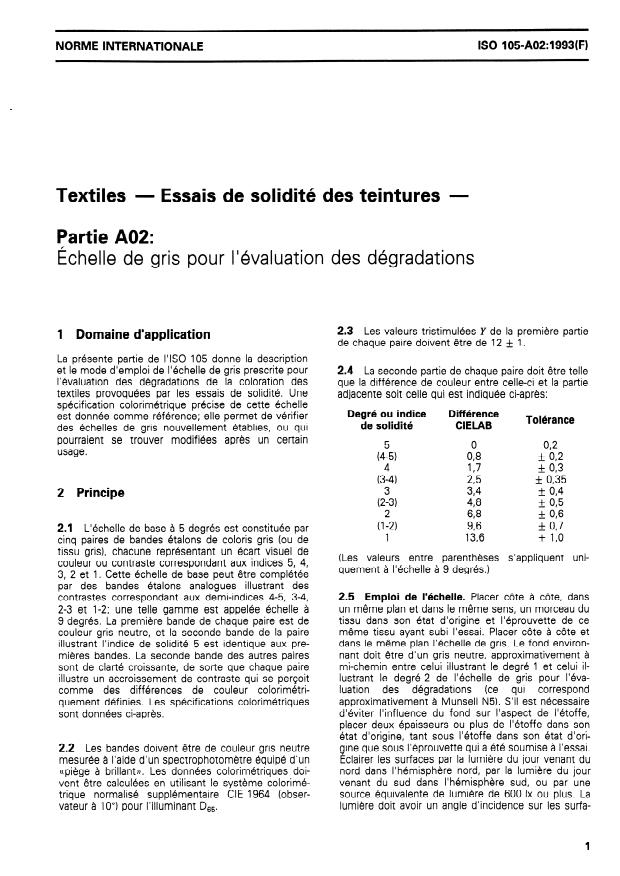
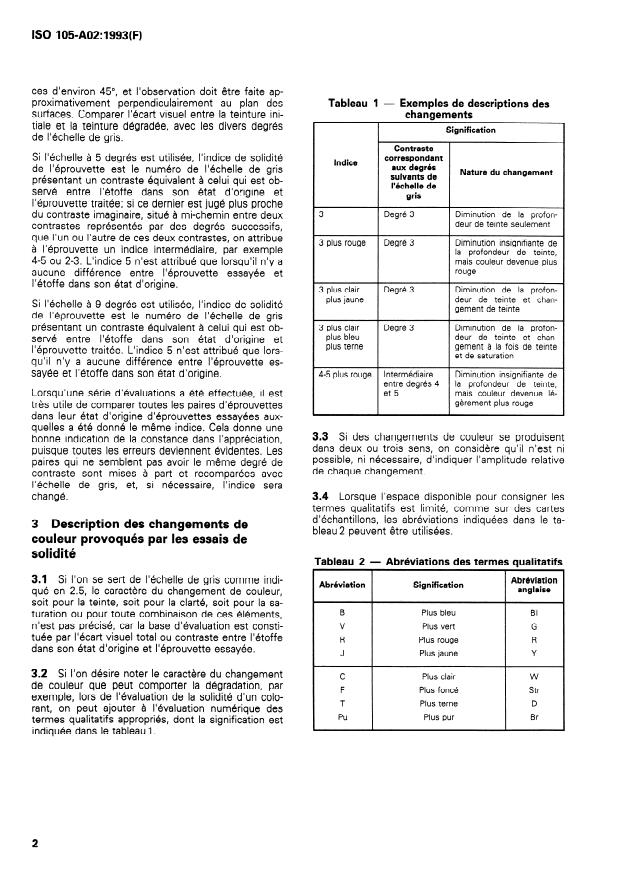
ISO 105-A02:1993 - Textiles — Essais de solidité des teintures — Partie A02: Échelle de gris pour l'évaluation des dégradations Released:8/26/1993
Overview
ISO 105-A02:1993 is an international standard developed by the International Organization for Standardization (ISO) that specifies the grey scale for assessing changes in colour of textiles during colour fastness tests. This standard provides a precise and reproducible colourimetric framework to determine the degree of colour change in textiles after they undergo various treatments or environmental conditions.
The grey scale consists of paired grey chips or swatches used as reference points to visually compare and evaluate the colour difference between original and tested textile specimens. The scale includes an essential 5-step version and an augmented 9-step version with half-steps to allow for more detailed differentiation in colour change.
Key Topics
- Colour Fastness Testing: ISO 105-A02 focuses on evaluating how textile colours hold up against influences such as washing, light exposure, rubbing, and other environmental factors.
- Grey Scale Description: The scale consists of pairs of non-glossy neutral grey chips with defined colourimetric values. The first chip in each pair is neutral grey, while the second reflects increasing degrees of lightness to indicate greater colour change.
- Scale Grades:
- Essential scale: 5 levels correspond to fastness ratings from 5 (no change) to 1 (severe change).
- Augmented scale: Adds four intermediate half-step levels for ratings like 4-5, 3-4, etc., totaling 9 steps.
- Colour Difference and Measurement: Uses calorimetric data based on the CIELAB colour system and CIE 1964 supplemental standard observer data, ensuring precise and objective evaluations.
- Application Procedure: Textiles are compared side-by-side with the grey scale under controlled lighting conditions such as natural daylight or equivalent illumination at approximately 600 lux, viewed at specific angles to minimize visual bias.
Applications
- Textile Industry Quality Control: Enables manufacturers to consistently assess colour durability of fabrics and finished garments, ensuring product quality meets customer expectations.
- Research and Development: Supports dye formulation and fabric treatment developments by providing standardized assessment methods for colour stability.
- Certification and Compliance: Used by laboratories and certification bodies to verify compliance with textile colour fastness requirements set by buyers, regulators, and industry standards.
- Comparison Benchmarking: Provides a permanent, reproducible reference against which newly prepared or aging grey scale standards can be validated to maintain accuracy over time.
Related Standards
- ISO 105 Series: ISO 105-A02 is part of the broader ISO 105 set of standards addressing various tests for colour fastness of textiles and colourants, including light fastness, washing, and rubbing.
- ISO 105-A01: Provides the general introduction and classification of the ISO 105 series tests.
- Other Colour Fastness Tests: Standards specifying detailed methods to expose textiles to specific conditions such as ISO 105-C06 (colour fastness to domestic and commercial laundering) or ISO 105-B02 (colour fastness to artificial light).
- CIE Standards: The colour measurement principles refer to CIE (Commission Internationale de l'Éclairage) standards such as CIE 1964 observer functions and illuminant D65 for lighting conditions.
Keywords: ISO 105-A02, colour fastness, grey scale, textiles, colour change assessment, colour difference, colour fastness testing, textile quality control, colour durability, colourimetric specification, textile standards.
Relations
- Effective Date
- 25-Aug-2026
- Effective Date
- 25-Aug-2026
- Effective Date
- 25-Aug-2026
- Effective Date
- 25-Aug-2026
- Effective Date
- 25-Aug-2026
- Effective Date
- 25-Aug-2026
- Effective Date
- 25-Aug-2026
- Effective Date
- 25-Aug-2026
- Effective Date
- 25-Aug-2026
- Effective Date
- 25-Aug-2026
- Effective Date
- 25-Aug-2026
- Effective Date
- 25-Aug-2026
- Effective Date
- 25-Aug-2026
- Effective Date
- 25-Aug-2026
- Effective Date
- 25-Aug-2026
Buy Documents
ISO 105-A02:1993 - Textiles — Tests for colour fastness — Part A02: Grey scale for assessing change in colour Released:8/26/1993
ISO 105-A02:1993 - Textiles — Essais de solidité des teintures — Partie A02: Échelle de gris pour l'évaluation des dégradations Released:8/26/1993
ISO 105-A02:1993 - Textiles — Essais de solidité des teintures — Partie A02: Échelle de gris pour l'évaluation des dégradations Released:8/26/1993
Get Certified
Connect with accredited certification bodies for this standard

Control Union Certifications
Global certification for agriculture and sustainability.

Hohenstein Institut
Textile testing and certification.

Bureau Veritas Bangladesh
Bureau Veritas certification services in Bangladesh.
Sponsored listings
Frequently Asked Questions
ISO 105-A02:1993 is a standard published by the International Organization for Standardization (ISO). Its full title is "Textiles — Tests for colour fastness — Part A02: Grey scale for assessing change in colour". This standard covers: Describes the grey scale for determining changes in colour of textiles in colour fastness tests, and its use. A precise colorimetric specification of the scale is given as a permanent record against which newly prepared working standards and standards that may have changed can be compared. The essential scale (5 steps) consists of pairs of non-glossy grey colour chips (or swatches of grey cloth). In addition, an augmented scale includes four half-steps and, thus, 9 steps.
Describes the grey scale for determining changes in colour of textiles in colour fastness tests, and its use. A precise colorimetric specification of the scale is given as a permanent record against which newly prepared working standards and standards that may have changed can be compared. The essential scale (5 steps) consists of pairs of non-glossy grey colour chips (or swatches of grey cloth). In addition, an augmented scale includes four half-steps and, thus, 9 steps.
ISO 105-A02:1993 is classified under the following ICS (International Classification for Standards) categories: 59.080.01 - Textiles in general. The ICS classification helps identify the subject area and facilitates finding related standards.
ISO 105-A02:1993 has the following relationships with other standards: It is inter standard links to EN ISO 105-B06:2004, EN ISO 17700:2019, EN 13558:2003, EN ISO 105-C06:2010, EN ISO 105-E05:2010, EN 14225-3:2005, EN ISO 14113:2013, EN ISO 12947-2:1998, EN ISO 5674:2009, EN ISO 11378-2:2001, EN ISO 25649-1:2024, EN ISO 12947-4:1998, EN ISO 105-B07:2009, EN ISO 105-E03:2010, EN ISO 105-D01:2010. Understanding these relationships helps ensure you are using the most current and applicable version of the standard.
ISO 105-A02:1993 is available in PDF format for immediate download after purchase. The document can be added to your cart and obtained through the secure checkout process. Digital delivery ensures instant access to the complete standard document.
Standards Content (Sample)
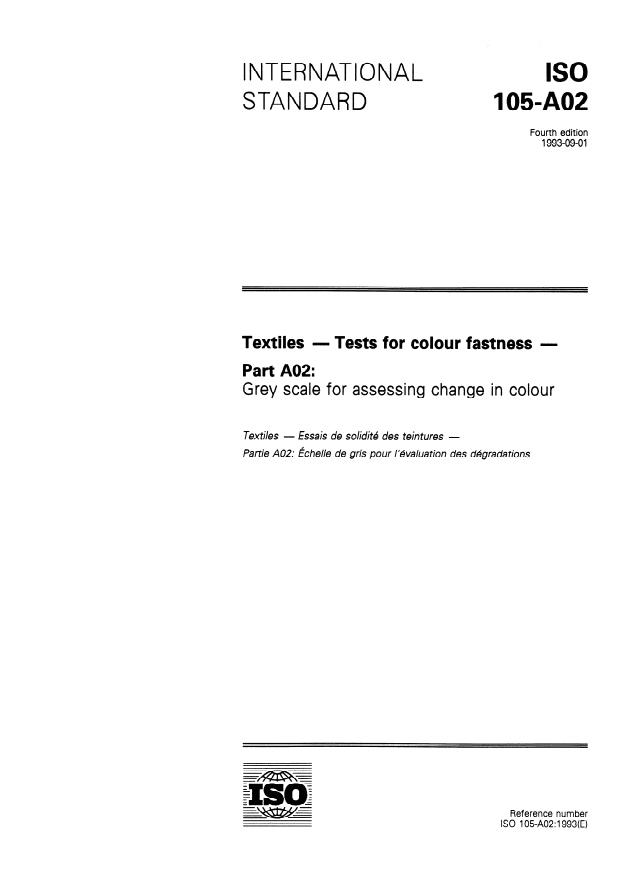
Is0
INTERNATIONAL
STANDARD 105-A02
Fourth edition
1993-09-01
Textiles - Tests for colour fastness -
Part A02:
Grey scale for assessing change in colour
- Essais de solidit des teintures -
Textiles
Partie A02: &he//e de gris pour Mvaluation des d6gradations
Reference number
IS0 105A02: 1993(E)
IS0 105-A02:1993(E)
Foreword
IS0 (the International Organization for Standardization) is a worldwide
federation of national standards bodies (IS0 member bodies). The work
of preparing International Standards is normally carried out through IS0
technical committees. Each member body interested in a subject for
which a technical committee has been established has the right to be
represented on that committee. International organizations, governmental
and non-governmental, in liaison with ISO, also take part in the work. IS0
collaborates closely with the International Electrotechnical Commission
(IEC) on all matters of electrotechnical standardization.
Draft International Standards adopted by the technical committees are
circulated to the member bodies for voting. Publication as an International
Standard requires approval by at least 75 % of the member bodies casting
a vote.
International Standard IS0 105.A02 was prepared by Technical Committee
ISO/TC 38, Textiles, Sub-Committee SC 1, Tests for co/owed textiles and
colorants.
This fourth edition cancels and replaces the third edition
(IS0 105-A02:1987), of which it constitutes a minor revision.
IS0 105 was previously published in thirteen “parts”, each designated by
a letter (e.g.
“Part A”), with publication dates between 1978 and 1985.
Each part contained a series of “sections”, each designated by the re-
spective part letter and by a two-digit serial number (e.g. “Section A01 “).
These sections are now being republished as separate documents, them-
selves designated “parts” but retaining their earlier alphanumeric desig-
nations. A complete list of these parts is given in IS0 105-AOI .
0 IS0 1993
All rights reserved. No part of this publication may be reproduced or utilized in any form or
by any means, electronic or mechanical, including photocopying and microfilm, without per-
mission in writing from the publisher.
International Organization for Standardization
Case Postale 56 l CH-1211 Geneve 20 l Switzerland
Printed in Switzerland
ii
IS0 1059A02:1993(E)
INTERNATIONAL STANDARD
Textiles - Tests for colour fastness -
Part A02:
Grey scale for assessing change in colour
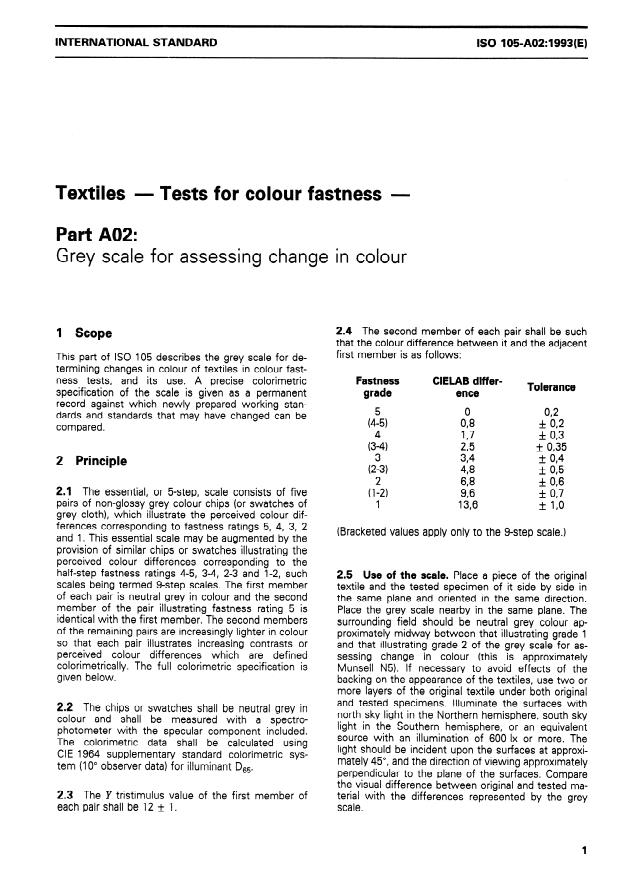
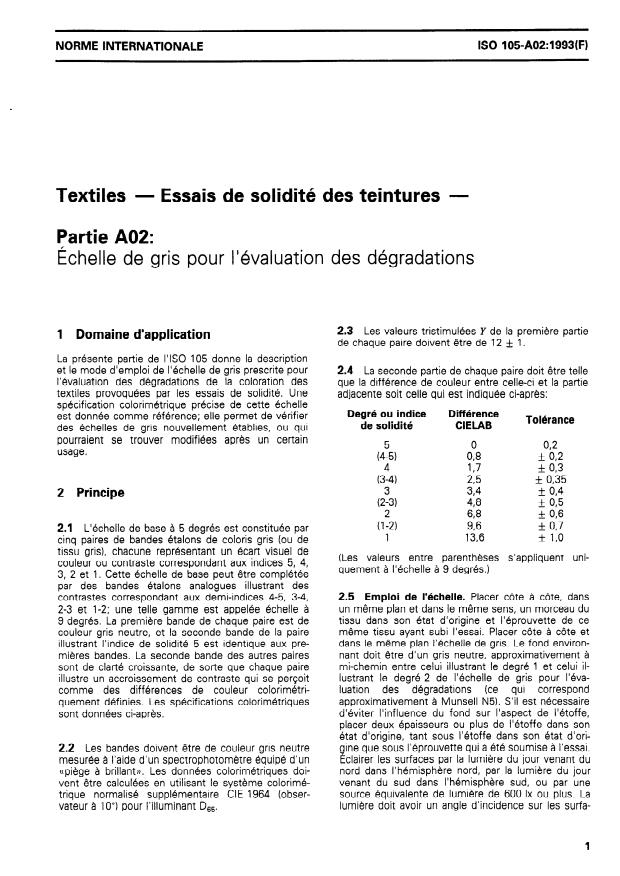
2.4 The second member of each pair shall be such
1 Scope
that the colour difference between it and the adjacent
first member is as follows:
This part of IS0 105 describes the grey scale for de-
termining changes in colour of textiles in colour fast-
Fastness CIELAB differ-
ness tests, and its use. A precise calorimetric
Tolerance
ence
specification of the scale is given as a permanent grade
record against which newly prepared working stan-
5 0
dards and standards that may have changed can be
08 * b,2
(4-5) I
compared.
I * 0,3
4 17
I!I 0,35
(3-4) 25 I
3 34 I + 0’4
2 Principle
2-3
(: 48 I * 0,5
68 I k 0,6
2.1 The essential, or 5-step, scale consists of five l-2
‘1 96 + 0,7
pairs of non-glossy grey colour chips (or swatches of 1 136
I * LO
grey cloth), which illustrate the perceived colour dif-
ferences corresponding to fastness ratings 5, 4, 3, 2
(Bracketed values apply only to the g-step scale.)
and 1. This essential scale may be augmented by the
provision of similar chips or swatches illustrating the
perceived colour differences corresponding to the
half-step fastness ratings 4-5, 3-4, 2-3 and l-2, such
2.5 Use of the scale. Place a piece of the original
scales being termed g-step scales. The first member textile and the tested specimen of it side by side in
of each pair is neutral grey in colour and the second the same plane and oriented in the same direction.
member of the pair illustrating fastness rating 5 is
Place the grey scale nearby in the same plane. The
identical with the first member. The second members
surrounding field should be neutral grey colour ap-
of the remaining pairs are increasingly lighter in colour
proximately midway between that illustrating grade 1
so that each pair illustrates increasing contrasts or
and that illustrating grade 2 of the grey scale for as-
perceived colour differences which are defined
sessing change in colour (this is approximately
calorimetrically. The full calorimetric specification is
Munsell N5). If necessary to avoid effec
...
NORME Iso
INTERNATIONALE 185-A02
Quatrième édition
1993-09-01
- Essais de solidité des
Textiles
teintures -
Partie A02:
Échelle de gris pour l’évaluation des
dégradations
Textiles - Tests for colour fastness -
Part A02: Grey scale for assessing change in colour
Numéro de référence
ISO 105-A02 1993(F)
Avant-propos
L’ISO (Organisation internationale de normalisation) est une fédération
mondiale d’organismes nationaux de normalisation (comités membres de
I’ISO). L’elaboration des Normes internationales est en général confiée aux
comites techniques de I’ISO. Chaque comite membre intéresse par une
étude a le droit de faire partie du comité technique créé à cet effet. Les
organisations internationales, gouvernementales et non gouvernemen-
tales, en liaison avec I’ISO participent également aux travaux. L’ISO colla-
bore étroitement avec la Commission électrotechnique internationale (CEI)
en ce qui concerne la normalisation électrotechnique.
Les projets de Normes internationales adoptes par les comites techniques
sont soumis aux comités membres pour vote. Leur publication comme
Normes internationales requiert l’approbation de 75 % au moins des co-
mites membres votants.
La Norme internationale ISO 105-A02 a éte élaborée par le comité tech-
nique lSO/TC 38, Textiles, sous-comite SC 1, Essais des textiles colorés
et des colorants.
Cette quatrième édition annule et remplace la troisième édition
(ISO 105-AO2:1987), dont elle constitue une revision mineure.
L’ISO 105 a été auparavant publiée en 13 ((parties), chacune désignée par
une lettre (par exemple ((Partie A))), avec des dates de publication allant
de 1978 à 1985. Chaque partie contenait une série de «Sections» dont
chacune était désignée par la lettre correspondant a la partie respective
et par un numéro de serie a deux chiffres (par exemple (Section A01 ))).
Ces sections sont a présent publiées à nouveau comme documents sé-
parés, eux-mêmes désignés ((parties) mais en conservant leurs dési-
gnations alphanumériques anterieures. Une liste complète de ces parties
est donnée dans I’ISO 105-AOI.
CD 60 1993
Droits de reproduction r&ervés. Aucune partie de cette publication ne peut être reproduite
ni utilisbe sous quelque forme que ce soit et par aucun procédé, électronique ou mécanique,
y compris la photocopie et les microfilms, sans l’accord écrit de l’éditeur.
Organisation internationale de normalisation
Case Postale 56 l CH-l 211 Genéve 20 l Suisse
Imprimé en Suisse
ii
ISO i05-A02:1993(F)
NORME INTERNATIONALE
Textiles - Essais de solidité des teintures -
Partie A02:
Échelle de gris pour l’évaluation des dégradations
23 Les valeurs tristimulees Y de la première partie
1 Domaine d’application
dé c laque paire doivent être de 12 + 1.
-
La présente partie de I’ISO 105 donne la description
et le mode d’emploi de l’échelle de gris prescrite pour
24 La seconde partie de chaque paire doit être telle
l’évaluation des dégradations de la coloration des
que a différence de couleur entre celle-ci et la partie
1.
textiles provoquées par les essais de solidite. Une aajacente soit celle qui est indiquée ci-après:
spécification calorimétrique précise de cette échelle
Degré ou indice Différence
est donnee comme référence; elle permet de vérifier
Tolérance
de solidité CIELAB
des échelles de gris nouvellement établies, ou qui
pourraient se trouver modifiées après un certain
5 0 02
usage.
08 +k2
(4-5) I
4 17 s 013
I
25 TO,35
(3-4) I
3 34 ? 0,4
I
2 Principe
48 ; 0,5
P-3) I
2 68 + 0,6
I
96 i 0,7
(1-2)
2.1 L’échelle de base a 5 degrés est constituée par
1 136 T l,o
I -
cinq paires de bandes étalons de coloris gris (ou de
tissu gris), chacune représentant un écart visuel de
(Les valeurs entre parenthèses s’appliquent uni-
couleur ou contraste correspondant aux indices 5, 4,
quement a l’échelle à 9 degrés.)
3, 2 et 1. Cette echelle de base peut être complétée
par des bandes etalons analogues illustrant des
2.5 Emploi de l’échelle. Placer côte a côte, dans
contrastes correspondant aux demi-indices 4-5, 3-4,
un même plan et dans le même sens, un morceau du
2-3 et l-2; une telle gamme est appelée echelle à
tissu dans son état d’origine et l’eprouvette de ce
9 degrés. La Premiere bande de chaque paire est de
même tissu ayant subi l’essai. Placer côte a côte et
couleur gris neutre, et la seconde bande de la paire
dans le même plan l’échelle de gris. Le fond environ-
illustrant l’indice de solidité 5 est identique aux pre-
nant doit être d’un gris neutre, approximativement a
mières bandes. La seconde bande des autres paires
mi-chemin entre celui illustrant le degré 1 et celui il-
sont de clarté croissante, de sorte que chaque paire
lustrant le degré 2 de l’echelle de gris pour I’eva-
illustre un accroissement de contraste qui se perçoit
comme des différences de couleur colorimétri- luation des dégradations (ce qui correspond
approximativement à Munsell N5). S’il est nécessaire
quement définies. Les spécifications calorimétriques
sont donnees ci-aprés. d’eviter l
...
NORME Iso
INTERNATIONALE 185-A02
Quatrième édition
1993-09-01
- Essais de solidité des
Textiles
teintures -
Partie A02:
Échelle de gris pour l’évaluation des
dégradations
Textiles - Tests for colour fastness -
Part A02: Grey scale for assessing change in colour
Numéro de référence
ISO 105-A02 1993(F)
Avant-propos
L’ISO (Organisation internationale de normalisation) est une fédération
mondiale d’organismes nationaux de normalisation (comités membres de
I’ISO). L’elaboration des Normes internationales est en général confiée aux
comites techniques de I’ISO. Chaque comite membre intéresse par une
étude a le droit de faire partie du comité technique créé à cet effet. Les
organisations internationales, gouvernementales et non gouvernemen-
tales, en liaison avec I’ISO participent également aux travaux. L’ISO colla-
bore étroitement avec la Commission électrotechnique internationale (CEI)
en ce qui concerne la normalisation électrotechnique.
Les projets de Normes internationales adoptes par les comites techniques
sont soumis aux comités membres pour vote. Leur publication comme
Normes internationales requiert l’approbation de 75 % au moins des co-
mites membres votants.
La Norme internationale ISO 105-A02 a éte élaborée par le comité tech-
nique lSO/TC 38, Textiles, sous-comite SC 1, Essais des textiles colorés
et des colorants.
Cette quatrième édition annule et remplace la troisième édition
(ISO 105-AO2:1987), dont elle constitue une revision mineure.
L’ISO 105 a été auparavant publiée en 13 ((parties), chacune désignée par
une lettre (par exemple ((Partie A))), avec des dates de publication allant
de 1978 à 1985. Chaque partie contenait une série de «Sections» dont
chacune était désignée par la lettre correspondant a la partie respective
et par un numéro de serie a deux chiffres (par exemple (Section A01 ))).
Ces sections sont a présent publiées à nouveau comme documents sé-
parés, eux-mêmes désignés ((parties) mais en conservant leurs dési-
gnations alphanumériques anterieures. Une liste complète de ces parties
est donnée dans I’ISO 105-AOI.
CD 60 1993
Droits de reproduction r&ervés. Aucune partie de cette publication ne peut être reproduite
ni utilisbe sous quelque forme que ce soit et par aucun procédé, électronique ou mécanique,
y compris la photocopie et les microfilms, sans l’accord écrit de l’éditeur.
Organisation internationale de normalisation
Case Postale 56 l CH-l 211 Genéve 20 l Suisse
Imprimé en Suisse
ii
ISO i05-A02:1993(F)
NORME INTERNATIONALE
Textiles - Essais de solidité des teintures -
Partie A02:
Échelle de gris pour l’évaluation des dégradations
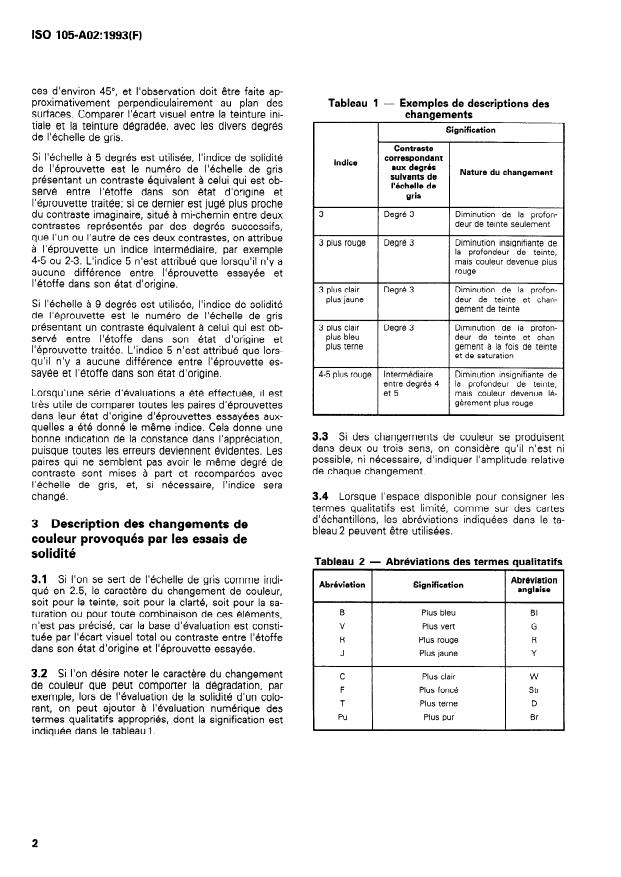
23 Les valeurs tristimulees Y de la première partie
1 Domaine d’application
dé c laque paire doivent être de 12 + 1.
-
La présente partie de I’ISO 105 donne la description
et le mode d’emploi de l’échelle de gris prescrite pour
24 La seconde partie de chaque paire doit être telle
l’évaluation des dégradations de la coloration des
que a différence de couleur entre celle-ci et la partie
1.
textiles provoquées par les essais de solidite. Une aajacente soit celle qui est indiquée ci-après:
spécification calorimétrique précise de cette échelle
Degré ou indice Différence
est donnee comme référence; elle permet de vérifier
Tolérance
de solidité CIELAB
des échelles de gris nouvellement établies, ou qui
pourraient se trouver modifiées après un certain
5 0 02
usage.
08 +k2
(4-5) I
4 17 s 013
I
25 TO,35
(3-4) I
3 34 ? 0,4
I
2 Principe
48 ; 0,5
P-3) I
2 68 + 0,6
I
96 i 0,7
(1-2)
2.1 L’échelle de base a 5 degrés est constituée par
1 136 T l,o
I -
cinq paires de bandes étalons de coloris gris (ou de
tissu gris), chacune représentant un écart visuel de
(Les valeurs entre parenthèses s’appliquent uni-
couleur ou contraste correspondant aux indices 5, 4,
quement a l’échelle à 9 degrés.)
3, 2 et 1. Cette echelle de base peut être complétée
par des bandes etalons analogues illustrant des
2.5 Emploi de l’échelle. Placer côte a côte, dans
contrastes correspondant aux demi-indices 4-5, 3-4,
un même plan et dans le même sens, un morceau du
2-3 et l-2; une telle gamme est appelée echelle à
tissu dans son état d’origine et l’eprouvette de ce
9 degrés. La Premiere bande de chaque paire est de
même tissu ayant subi l’essai. Placer côte a côte et
couleur gris neutre, et la seconde bande de la paire
dans le même plan l’échelle de gris. Le fond environ-
illustrant l’indice de solidité 5 est identique aux pre-
nant doit être d’un gris neutre, approximativement a
mières bandes. La seconde bande des autres paires
mi-chemin entre celui illustrant le degré 1 et celui il-
sont de clarté croissante, de sorte que chaque paire
lustrant le degré 2 de l’echelle de gris pour I’eva-
illustre un accroissement de contraste qui se perçoit
comme des différences de couleur colorimétri- luation des dégradations (ce qui correspond
approximativement à Munsell N5). S’il est nécessaire
quement définies. Les spécifications calorimétriques
sont donnees ci-aprés. d’eviter l
...