

ISO 1388-9:1981
(Main)Ethanol for industrial use — Methods of test — Part 9: Determination of esters content — Titrimetric method after saponification
General Information
- Abstract
The method is applicable to products having esters contents in the range 0.005 % (m/m) to 0.15 % (m/m). The principle consists in the saponification of esters present in a test portion by boiling with excess standard volumetric sodium hydroxide solution; determination of the residual sodium hydroxide, and hence the amount used for saponification, by titration with standard volumetric hydrochloric acid solution in the presence of phenolphthalein as indicator. - International Standards ISO 1388/1 to ISO 1377/12 cancel and replace ISO Recommendation R 1388-1970 of which they constitute a technical revision.
- Status
- Published
- Publication Date
- 30-Nov-1981
- Technical Committee
- ISO/TC 47 - Chemistry
- Drafting Committee
- ISO/TC 47 - Chemistry
- Current Stage
- 9093 - International Standard confirmed
- Start Date
- 29-Nov-2023
- Completion Date
- 29-Aug-2026
Buy Documents
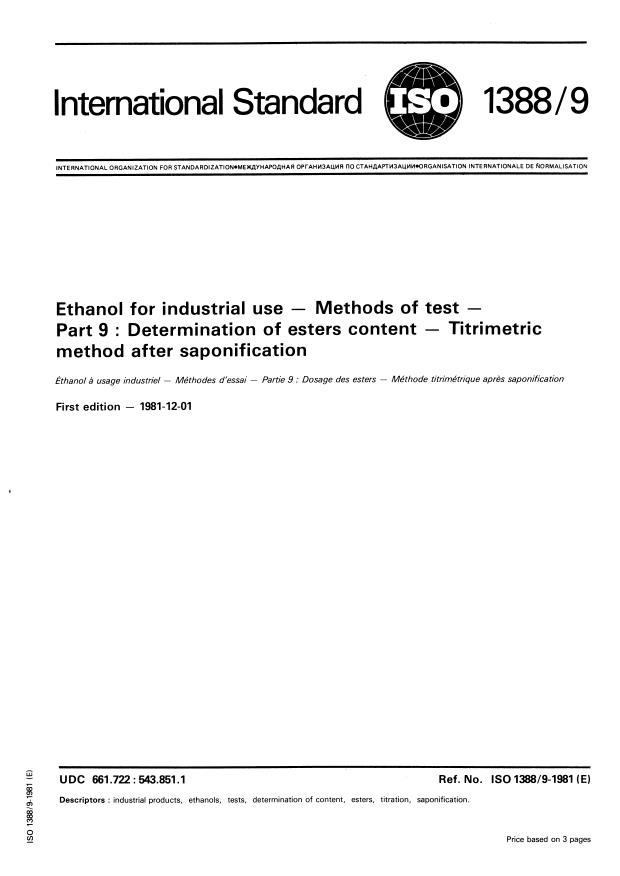
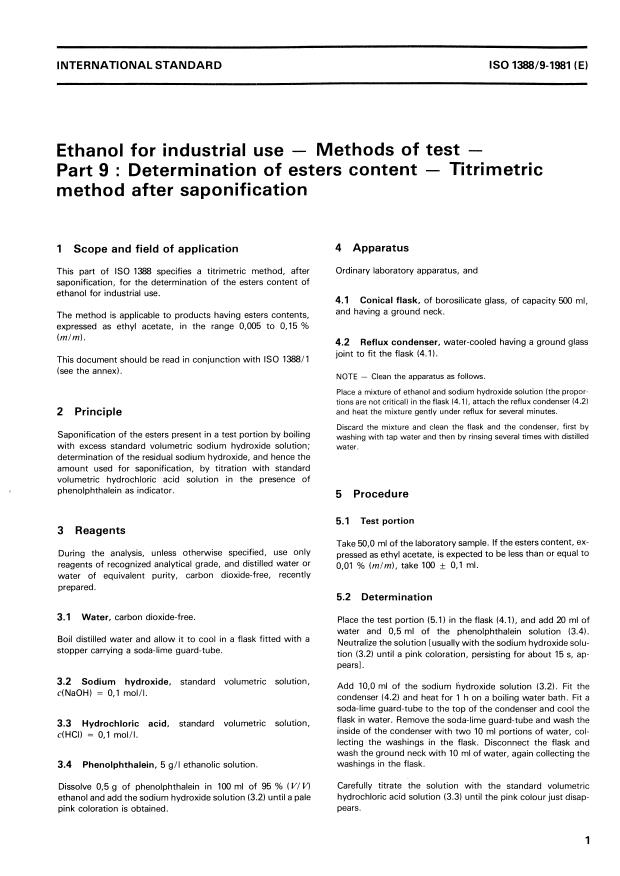
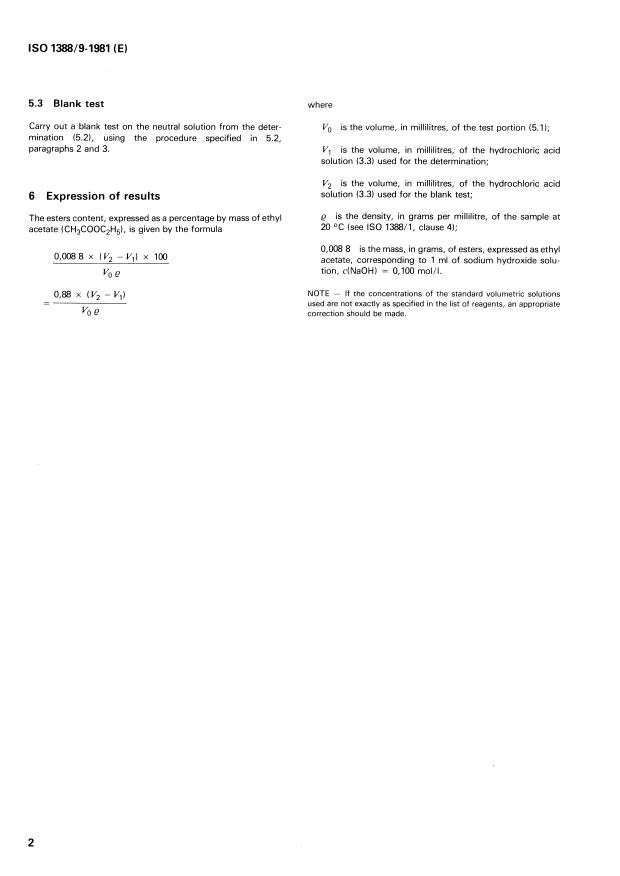
ISO 1388-9:1981 - Ethanol for industrial use — Methods of test — Part 9: Determination of esters content — Titrimetric method after saponification Released:12/1/1981
ISO 1388-9:1981 - Éthanol a usage industriel — Méthodes d'essai — Partie 9: Dosage des esters — Méthode titrimétrique apres saponification Released:12/1/1981
ISO 1388-9:1981 - Éthanol a usage industriel — Méthodes d'essai — Partie 9: Dosage des esters — Méthode titrimétrique apres saponification Released:12/1/1981
Overview
ISO 1388-9:1981 specifies a titrimetric method after saponification for determining the esters content in ethanol for industrial use. Applicable to ethanol products with ester concentrations ranging from 0.005% to 0.15% (mass/mass), this standard outlines a precise chemical test to accurately quantify esters, expressed as ethyl acetate. The method involves boiling the test sample with excess sodium hydroxide solution to saponify the esters, followed by titrating the residual sodium hydroxide with hydrochloric acid in the presence of phenolphthalein indicator.
This international standard was developed by ISO Technical Committee ISO/TC 47 (Chemistry) and replaces the earlier ISO Recommendation R 1388-1970 as a technical revision.
Key Topics
- Scope and applicability: Suitable for industrial ethanol with esters content between 0.005% and 0.15% (m/m).
- Principle:
- Saponification of esters by boiling with excess sodium hydroxide.
- Determination of unreacted sodium hydroxide by titration with hydrochloric acid.
- Use of phenolphthalein as indicator for endpoint detection.
- Apparatus:
- Borosilicate conical flask (500 ml) with ground glass joint.
- Water-cooled reflux condenser with adapter.
- Standard laboratory glassware and titration equipment.
- Reagents:
- Titrated sodium hydroxide solution (0.1 mol/l).
- Titrated hydrochloric acid solution (0.1 mol/l).
- Phenolphthalein ethanol solution (5 g/L).
- Distilled water free of carbon dioxide.
- Procedure:
- Sample aliquot is neutralized and saponified by reflux with sodium hydroxide.
- The residual sodium hydroxide is back-titrated with hydrochloric acid.
- A blank test is performed for accuracy.
- Calculation: Esters content expressed as percentage in mass of ethyl acetate, calculated based on titration volumes, sample mass density, and reagent concentrations.
Applications
ISO 1388-9:1981 is essential for quality control laboratories and industries utilizing industrial ethanol as a raw material or solvent where ester content affects performance and compliance. Typical applications include:
- Chemical manufacturing: Ensuring ester levels in ethanol meet process specifications.
- Pharmaceutical industry: Controlling purity of ethanol used in formulations.
- Food and beverage sector: Monitoring industrial ethanol additives.
- Environmental testing: Assessing ester contamination or degradation in ethanol batches.
- Regulatory compliance: Meeting international standards for ethanol purity and safety.
By providing a reliable, standardized titrimetric method, this standard helps manufacturers and laboratories maintain consistent quality and adhere to international industrial and safety regulations.
Related Standards
ISO 1388-9:1981 is part of a comprehensive series focusing on industrial ethanol testing methods:
- ISO 1388/1 – General principles including detection of alkalinity/acidity using phenolphthalein.
- ISO 1388/2 to ISO 1388/12 – Methods covering analysis of carbonyl compounds, aldehydes, methanol, hydrocarbons, furfural, and other impurities.
- ISO 1388/8 – Another titrimetric method for methanol determination.
- ISO 1388/10 to ISO 1388/12 – Additional procedures such as hydrocarbon evaluation by distillation and permanganate time determination.
Together, these standards enable comprehensive chemical characterization of industrial ethanol, ensuring product integrity and facilitating international trade.
Keywords: ISO 1388-9, industrial ethanol, esters content determination, titrimetric method, saponification, ethyl acetate, sodium hydroxide titration, hydrochloric acid, phenolphthalein indicator, quality control, chemical testing, ethanol purity standards.
Relations
- Effective Date
- 06-Jun-2022
- Effective Date
- 15-Apr-2008
Buy Documents
ISO 1388-9:1981 - Ethanol for industrial use — Methods of test — Part 9: Determination of esters content — Titrimetric method after saponification Released:12/1/1981
ISO 1388-9:1981 - Éthanol a usage industriel — Méthodes d'essai — Partie 9: Dosage des esters — Méthode titrimétrique apres saponification Released:12/1/1981
ISO 1388-9:1981 - Éthanol a usage industriel — Méthodes d'essai — Partie 9: Dosage des esters — Méthode titrimétrique apres saponification Released:12/1/1981
Get Certified
Connect with accredited certification bodies for this standard

ECOCERT
Organic and sustainability certification.

Eurofins Food Testing Global
Global leader in food, environment, and pharmaceutical product testing.

Intertek Bangladesh
Intertek certification and testing services in Bangladesh.
Sponsored listings
Frequently Asked Questions
ISO 1388-9:1981 is a standard published by the International Organization for Standardization (ISO). Its full title is "Ethanol for industrial use — Methods of test — Part 9: Determination of esters content — Titrimetric method after saponification". This standard covers: The method is applicable to products having esters contents in the range 0.005 % (m/m) to 0.15 % (m/m). The principle consists in the saponification of esters present in a test portion by boiling with excess standard volumetric sodium hydroxide solution; determination of the residual sodium hydroxide, and hence the amount used for saponification, by titration with standard volumetric hydrochloric acid solution in the presence of phenolphthalein as indicator. - International Standards ISO 1388/1 to ISO 1377/12 cancel and replace ISO Recommendation R 1388-1970 of which they constitute a technical revision.
The method is applicable to products having esters contents in the range 0.005 % (m/m) to 0.15 % (m/m). The principle consists in the saponification of esters present in a test portion by boiling with excess standard volumetric sodium hydroxide solution; determination of the residual sodium hydroxide, and hence the amount used for saponification, by titration with standard volumetric hydrochloric acid solution in the presence of phenolphthalein as indicator. - International Standards ISO 1388/1 to ISO 1377/12 cancel and replace ISO Recommendation R 1388-1970 of which they constitute a technical revision.
ISO 1388-9:1981 is classified under the following ICS (International Classification for Standards) categories: 71.080.60 - Alcohols. Ethers. The ICS classification helps identify the subject area and facilitates finding related standards.
ISO 1388-9:1981 has the following relationships with other standards: It is inter standard links to ISO 15877-5:2003, ISO/R 1388:1970. Understanding these relationships helps ensure you are using the most current and applicable version of the standard.
ISO 1388-9:1981 is available in PDF format for immediate download after purchase. The document can be added to your cart and obtained through the secure checkout process. Digital delivery ensures instant access to the complete standard document.
Standards Content (Sample)
This page intentionally left blank
This page intentionally left blank
-------
...
‘1
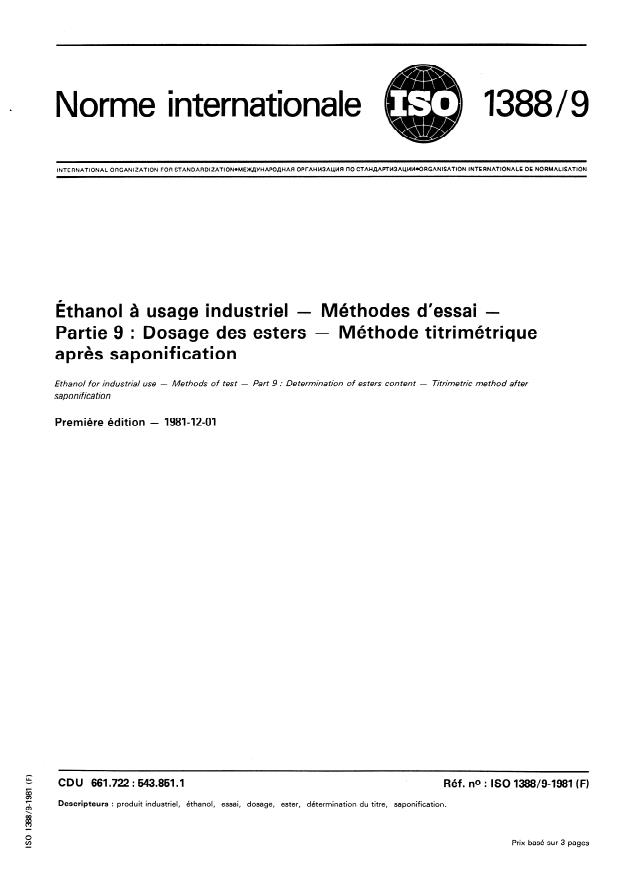
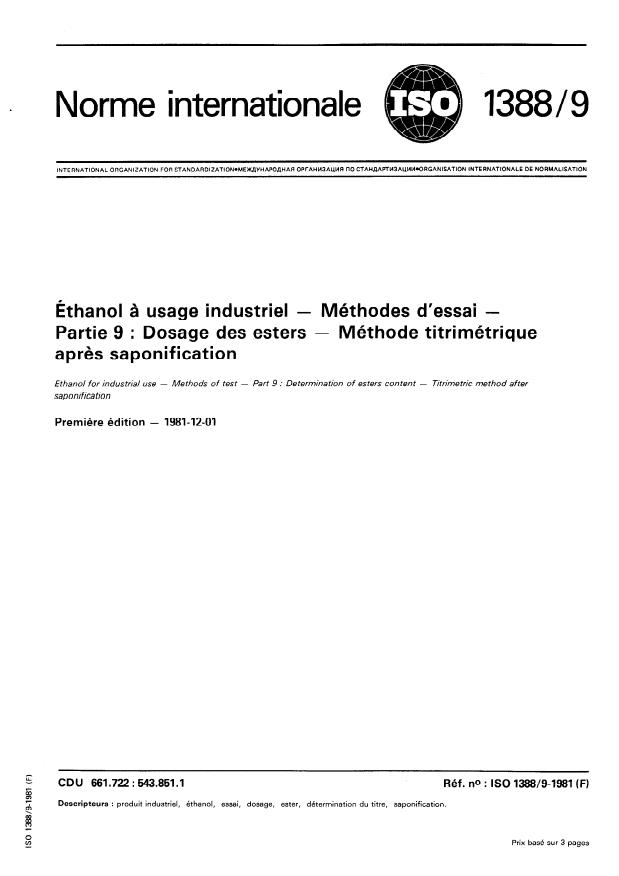
Norme internationale 138819
INTERNATIONAL ORGANIZATION FOR STANDARDIZATION.ME)YHAPO~HAfI OPTAHM3AlJblR fl0 CTAH~APTH3A~WWORGANISATION INTERNATIONALE DE NORMALISATION
Éthanol à usage industriel - Méthodes d’essai -
Partie 9 : Dosage des esters - Méthode titrimétrique
après saponification
Ethanol for industrial use - Methods of test - Fart 9 : De termina tion of esters content - Titrime trie method after
saponification
Première édition - 1981-12-01
CDU 661.722 : 543.851.1 Réf. no : ISO 1388/9-1981 (F)
Descripteurs : produit industriel, éthanol, essai, dosage,
ester, détermination du titre, saponification.
Prix basé sur 3 pages
Avant-propos
L’ISO (Organisation internationale de normalisation) est une fédération mondiale
d’organismes nationaux de normalisation (comités membres de I’ISO). L’élaboration
des Normes internationales est confiée aux comités techniques de I’ISO. Chaque
comité membre intéressé par une étude a le droit de faire partie du comité technique
correspondant. Les organisations internationales, gouvernementales et non gouverne-
mentales, en liaison avec I’ISO, participent également aux travaux.
Les projets de Normes internationales adoptés par les comités techniques sont soumis
aux comités membres pour approbation, avant leur acceptation comme Normes inter-
nationales par le Conseil de I’ISO.
La Norme internationale ISO l388/9 a été élaborée par le comité technique ISO/TC 47,
Chimie, et a été soumise aux comités membres en février 1980.
Les comités membres des pays suivants l’ont approuvée :
Afrique du Sud, Rép. d’ Corée, Rép. de Roumanie
Allemagne, R. F. France Royaume-Uni
Australie Hongrie Suisse
Autriche Inde Tchécoslovaquie
Belgique Italie Thaïlande
Brésil Pays- Bas URSS
Bulgarie Philippines
Chine Pologne
Aucun comité membre ne l’a désapprouvée.
Cette Norme internationale a également été approuvée par l’Union internationale de
chimie pure et appliquée (UICPA).
Les Normes internationales ISO 13881’1 à ISO 1388/12 annulent et remplacent la
Recommandation ISO/R 1388-1970, dont elles constituent une révision technique.
0 Organisation internationale de normalisation, 1981
imprimé en Suisse
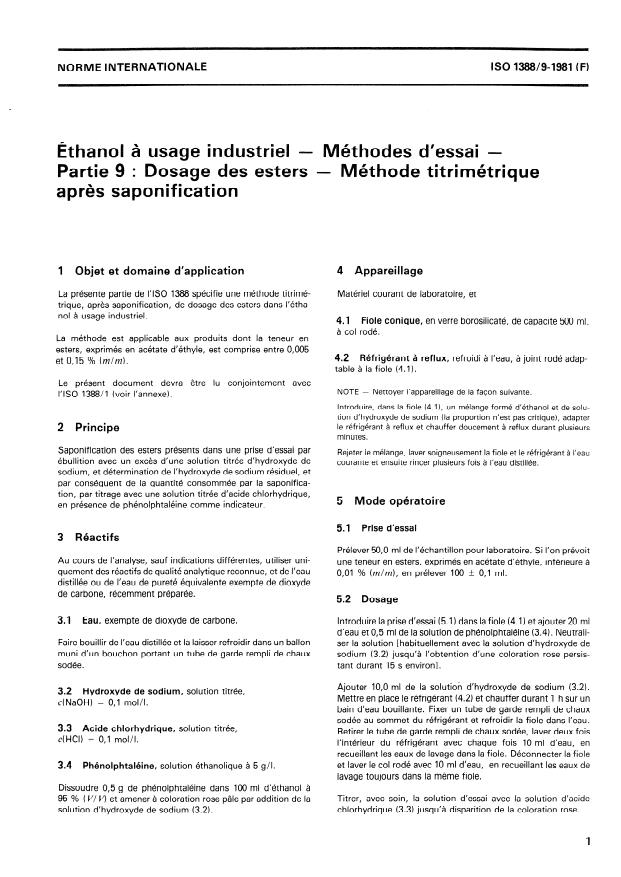
NORME INTERNATIONALE IN) 1388/9-198’1 (F)
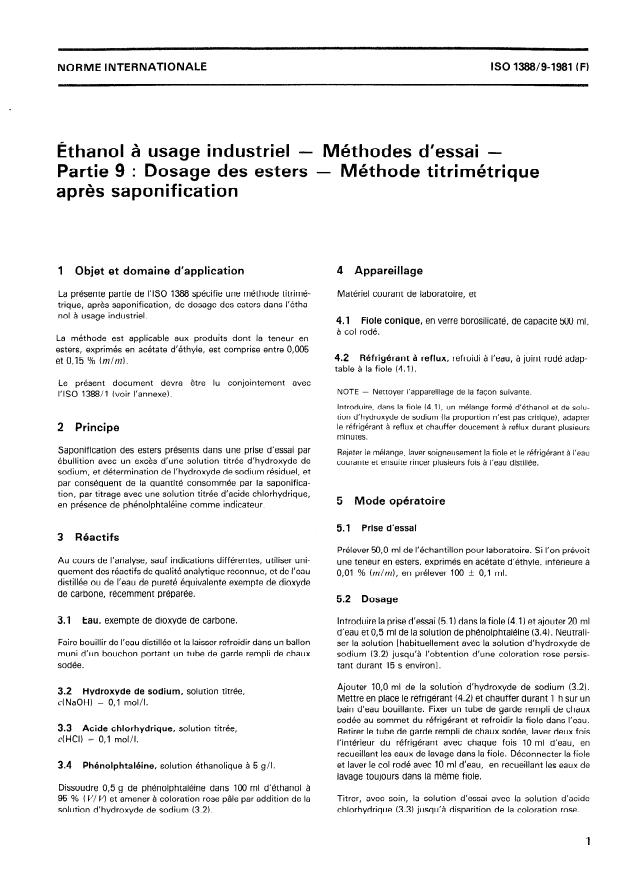
Éthanol à usage industriel - Méthodes d’essai -
éthode titrimétrique
Partie 9 : Dosage des esters -
après saponification
4 Appareillage
1 Objet et domaine d’application
La présente partie de I’ISO 1388 spécifie une méthode titrimé- Matériel courant de laboratoire, et
trique, après saponification, de dosage des esters dans I’étha-
nol à usage industriel.
4.1 Fiole conique, en verre borosilicaté, de capacité 500 ml,
à col rodé.
La méthode est applicable aux produits dont la teneur en
esters, exprimés en acétate d’éthyle, est comprise entre 0,005
4.2 Réfrigérant à reflux, refroidi à l’eau, à joint rodé adap-
et 0,15 % (mlm).
table à la fiole (4.1).
Le présent document devra être lu conjointement avec
NOTE - Nettoyer l’appareillage de la facon suivante.
I’ISO 1388/ 1 (voir l’annexe).
Introduire, dans la fiole (4.1), un mélange formé d’éthanol et de solu-
tion d’hydroxyde de sodium (la proportion n’est pas critique), adapter
le réfrigérant à reflux et chauffer doucement à reflux durant plusieurs
2 Principe
minutes.
Saponification des esters présents dans une prise d’essai par
Rejeter le mélange, laver soigneusement la fiole et le réfrigérant à l’eau
ébullition avec un excès d’une solution titrée d’hydroxyde de courante et ensuite rincer plusieurs fois à l’eau distillée.
sodium, et détermination de l’hydroxyde de sodium résiduel, et
par conséquent de la quantité consommée par la saponifica-
tion, par titrage avec une solution titrée d’acide chlorhydrique,
5 Mode opératoire
en présence de phénolphtaléine comme indicateur.
5.1 Prise d’essai
3 Réactifs
Prélever 50,O ml de l’échantillon pour laboratoire. Si l’on prévoit
Au cours de l’analyse, sauf indications différentes, utiliser uni-
une teneur en esters, exprimés en acétate d’éthyle, inférieure à
quement des réactifs de qualité analyt
...
‘1
Norme internationale 138819
INTERNATIONAL ORGANIZATION FOR STANDARDIZATION.ME)YHAPO~HAfI OPTAHM3AlJblR fl0 CTAH~APTH3A~WWORGANISATION INTERNATIONALE DE NORMALISATION
Éthanol à usage industriel - Méthodes d’essai -
Partie 9 : Dosage des esters - Méthode titrimétrique
après saponification
Ethanol for industrial use - Methods of test - Fart 9 : De termina tion of esters content - Titrime trie method after
saponification
Première édition - 1981-12-01
CDU 661.722 : 543.851.1 Réf. no : ISO 1388/9-1981 (F)
Descripteurs : produit industriel, éthanol, essai, dosage,
ester, détermination du titre, saponification.
Prix basé sur 3 pages
Avant-propos
L’ISO (Organisation internationale de normalisation) est une fédération mondiale
d’organismes nationaux de normalisation (comités membres de I’ISO). L’élaboration
des Normes internationales est confiée aux comités techniques de I’ISO. Chaque
comité membre intéressé par une étude a le droit de faire partie du comité technique
correspondant. Les organisations internationales, gouvernementales et non gouverne-
mentales, en liaison avec I’ISO, participent également aux travaux.
Les projets de Normes internationales adoptés par les comités techniques sont soumis
aux comités membres pour approbation, avant leur acceptation comme Normes inter-
nationales par le Conseil de I’ISO.
La Norme internationale ISO l388/9 a été élaborée par le comité technique ISO/TC 47,
Chimie, et a été soumise aux comités membres en février 1980.
Les comités membres des pays suivants l’ont approuvée :
Afrique du Sud, Rép. d’ Corée, Rép. de Roumanie
Allemagne, R. F. France Royaume-Uni
Australie Hongrie Suisse
Autriche Inde Tchécoslovaquie
Belgique Italie Thaïlande
Brésil Pays- Bas URSS
Bulgarie Philippines
Chine Pologne
Aucun comité membre ne l’a désapprouvée.
Cette Norme internationale a également été approuvée par l’Union internationale de
chimie pure et appliquée (UICPA).
Les Normes internationales ISO 13881’1 à ISO 1388/12 annulent et remplacent la
Recommandation ISO/R 1388-1970, dont elles constituent une révision technique.
0 Organisation internationale de normalisation, 1981
imprimé en Suisse
NORME INTERNATIONALE IN) 1388/9-198’1 (F)
Éthanol à usage industriel - Méthodes d’essai -
éthode titrimétrique
Partie 9 : Dosage des esters -
après saponification
4 Appareillage
1 Objet et domaine d’application
La présente partie de I’ISO 1388 spécifie une méthode titrimé- Matériel courant de laboratoire, et
trique, après saponification, de dosage des esters dans I’étha-
nol à usage industriel.
4.1 Fiole conique, en verre borosilicaté, de capacité 500 ml,
à col rodé.
La méthode est applicable aux produits dont la teneur en
esters, exprimés en acétate d’éthyle, est comprise entre 0,005
4.2 Réfrigérant à reflux, refroidi à l’eau, à joint rodé adap-
et 0,15 % (mlm).
table à la fiole (4.1).
Le présent document devra être lu conjointement avec
NOTE - Nettoyer l’appareillage de la facon suivante.
I’ISO 1388/ 1 (voir l’annexe).
Introduire, dans la fiole (4.1), un mélange formé d’éthanol et de solu-
tion d’hydroxyde de sodium (la proportion n’est pas critique), adapter
le réfrigérant à reflux et chauffer doucement à reflux durant plusieurs
2 Principe
minutes.
Saponification des esters présents dans une prise d’essai par
Rejeter le mélange, laver soigneusement la fiole et le réfrigérant à l’eau
ébullition avec un excès d’une solution titrée d’hydroxyde de courante et ensuite rincer plusieurs fois à l’eau distillée.
sodium, et détermination de l’hydroxyde de sodium résiduel, et
par conséquent de la quantité consommée par la saponifica-
tion, par titrage avec une solution titrée d’acide chlorhydrique,
5 Mode opératoire
en présence de phénolphtaléine comme indicateur.
5.1 Prise d’essai
3 Réactifs
Prélever 50,O ml de l’échantillon pour laboratoire. Si l’on prévoit
Au cours de l’analyse, sauf indications différentes, utiliser uni-
une teneur en esters, exprimés en acétate d’éthyle, inférieure à
quement des réactifs de qualité analyt
...