


ISO/IEC 26551:2012
(Main)Software and systems engineering — Tools and methods for product line requirements engineering
Software and systems engineering — Tools and methods for product line requirements engineering
ISO/IEC 26551:2012 provides the capabilities of tools and methods that support Software and Systems Product Line (SSPL) requirements engineering. In SSPL requirements engineering, there are three core processes: Product Line scoping, Domain Requirements Engineering, and Application Requirements Engineering. The major purpose of Product Line Scoping estimates the costs and benefits of a product line, and thereby lets an organization make a go/no-go decision.The costs and benefits estimation results play a pivotal role as an indicator for assessing the effectiveness and efficiency of a product line. The major purpose of the Domain Requirements Engineering is to analyze commonality and variability for the product line based on the initial features defined in Product Line Scoping, where the major purpose of the Application Requirements Engineering is to define application requirements based on domain requirements assets by reusing, selecting, or newly adding application specific requirements. For producing multiple products in a product line, the above processes need to be adequately integrated centered around core assets, which is causing the management of domain/application requirements complexities. Thus, the proper supports of methods and tools are essential, and the product line specific capabilities of methods and tools have to be defined. ISO/IEC 26551:2012 can be used in the following modes: - By the users: to benefit people who develop, operate, and manage requirements engineering for software and systems product lines. - By a product line organization: to provide guidance in the evaluation and selection for tools and methods for product line requirements engineering. - By providers of tools and methods: to provide guidance in implementing or developing tools and methods by providing a comprehensive set of the capabilities of tools and methods for product line requirements engineering.
Ingénierie du logiciel et des systèmes — Outils et méthodes pour l'ingénierie d'exigences pour gammes de produits
General Information
- Status
- Withdrawn
- Publication Date
- 03-Dec-2012
- Withdrawal Date
- 03-Dec-2012
- Technical Committee
- ISO/IEC JTC 1/SC 7 - Software and systems engineering
- Drafting Committee
- ISO/IEC JTC 1/SC 7/WG 4 - Tools and environment
- Current Stage
- 9599 - Withdrawal of International Standard
- Start Date
- 27-Apr-2016
- Completion Date
- 14-Feb-2026
Relations
- Effective Date
- 05-Nov-2015
Get Certified
Connect with accredited certification bodies for this standard

BSI Group
BSI (British Standards Institution) is the business standards company that helps organizations make excellence a habit.
BSCIC Certifications Pvt. Ltd.
Established 2006, accredited by NABCB, JAS-ANZ, EIAC, IAS. CDSCO Notified Body.

Intertek India Pvt. Ltd.
Delivers Assurance, Testing, Inspection & Certification since 1993 with 26 labs and 32 offices.
Sponsored listings
Frequently Asked Questions
ISO/IEC 26551:2012 is a standard published by the International Organization for Standardization (ISO). Its full title is "Software and systems engineering — Tools and methods for product line requirements engineering". This standard covers: ISO/IEC 26551:2012 provides the capabilities of tools and methods that support Software and Systems Product Line (SSPL) requirements engineering. In SSPL requirements engineering, there are three core processes: Product Line scoping, Domain Requirements Engineering, and Application Requirements Engineering. The major purpose of Product Line Scoping estimates the costs and benefits of a product line, and thereby lets an organization make a go/no-go decision.The costs and benefits estimation results play a pivotal role as an indicator for assessing the effectiveness and efficiency of a product line. The major purpose of the Domain Requirements Engineering is to analyze commonality and variability for the product line based on the initial features defined in Product Line Scoping, where the major purpose of the Application Requirements Engineering is to define application requirements based on domain requirements assets by reusing, selecting, or newly adding application specific requirements. For producing multiple products in a product line, the above processes need to be adequately integrated centered around core assets, which is causing the management of domain/application requirements complexities. Thus, the proper supports of methods and tools are essential, and the product line specific capabilities of methods and tools have to be defined. ISO/IEC 26551:2012 can be used in the following modes: - By the users: to benefit people who develop, operate, and manage requirements engineering for software and systems product lines. - By a product line organization: to provide guidance in the evaluation and selection for tools and methods for product line requirements engineering. - By providers of tools and methods: to provide guidance in implementing or developing tools and methods by providing a comprehensive set of the capabilities of tools and methods for product line requirements engineering.
ISO/IEC 26551:2012 provides the capabilities of tools and methods that support Software and Systems Product Line (SSPL) requirements engineering. In SSPL requirements engineering, there are three core processes: Product Line scoping, Domain Requirements Engineering, and Application Requirements Engineering. The major purpose of Product Line Scoping estimates the costs and benefits of a product line, and thereby lets an organization make a go/no-go decision.The costs and benefits estimation results play a pivotal role as an indicator for assessing the effectiveness and efficiency of a product line. The major purpose of the Domain Requirements Engineering is to analyze commonality and variability for the product line based on the initial features defined in Product Line Scoping, where the major purpose of the Application Requirements Engineering is to define application requirements based on domain requirements assets by reusing, selecting, or newly adding application specific requirements. For producing multiple products in a product line, the above processes need to be adequately integrated centered around core assets, which is causing the management of domain/application requirements complexities. Thus, the proper supports of methods and tools are essential, and the product line specific capabilities of methods and tools have to be defined. ISO/IEC 26551:2012 can be used in the following modes: - By the users: to benefit people who develop, operate, and manage requirements engineering for software and systems product lines. - By a product line organization: to provide guidance in the evaluation and selection for tools and methods for product line requirements engineering. - By providers of tools and methods: to provide guidance in implementing or developing tools and methods by providing a comprehensive set of the capabilities of tools and methods for product line requirements engineering.
ISO/IEC 26551:2012 is classified under the following ICS (International Classification for Standards) categories: 35.080 - Software. The ICS classification helps identify the subject area and facilitates finding related standards.
ISO/IEC 26551:2012 has the following relationships with other standards: It is inter standard links to ISO/IEC 26551:2016. Understanding these relationships helps ensure you are using the most current and applicable version of the standard.
ISO/IEC 26551:2012 is available in PDF format for immediate download after purchase. The document can be added to your cart and obtained through the secure checkout process. Digital delivery ensures instant access to the complete standard document.
Standards Content (Sample)
INTERNATIONAL ISO/IEC
STANDARD 26551
First edition
2012-12-01
Software and systems engineering —
Tools and methods for product line
requirements engineering
Ingénierie du logiciel et des systèmes — Outils et méthodes pour
l'ingénierie d'exigences pour gammes de produits
Reference number
©
ISO/IEC 2012
© ISO/IEC 2012
All rights reserved. Unless otherwise specified, no part of this publication may be reproduced or utilized in any form or by any means,
electronic or mechanical, including photocopying and microfilm, without permission in writing from either ISO at the address below or
ISO's member body in the country of the requester.
ISO copyright office
Case postale 56 CH-1211 Geneva 20
Tel. + 41 22 749 01 11
Fax + 41 22 749 09 47
E-mail copyright@iso.org
Web www.iso.org
Published in Switzerland
ii © ISO/IEC 2012 – All rights reserved
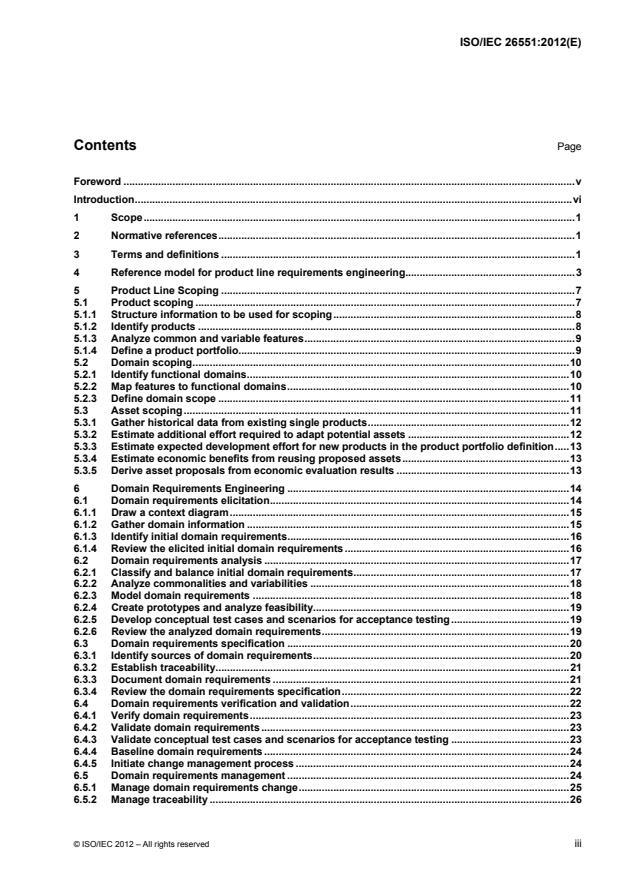
Contents Page
Foreword . v
Introduction . vi
1 Scope . 1
2 Normative references . 1
3 Terms and definitions . 1
4 Reference model for product line requirements engineering . 3
5 Product Line Scoping . 7
5.1 Product scoping . 7
5.1.1 Structure information to be used for scoping . 8
5.1.2 Identify products . 8
5.1.3 Analyze common and variable features . 9
5.1.4 Define a product portfolio. 9
5.2 Domain scoping . 10
5.2.1 Identify functional domains . 10
5.2.2 Map features to functional domains . 10
5.2.3 Define domain scope . 11
5.3 Asset scoping . 11
5.3.1 Gather historical data from existing single products . 12
5.3.2 Estimate additional effort required to adapt potential assets . 12
5.3.3 Estimate expected development effort for new products in the product portfolio definition . 13
5.3.4 Estimate economic benefits from reusing proposed assets . 13
5.3.5 Derive asset proposals from economic evaluation results . 13
6 Domain Requirements Engineering . 14
6.1 Domain requirements elicitation . 14
6.1.1 Draw a context diagram . 15
6.1.2 Gather domain information . 15
6.1.3 Identify initial domain requirements . 16
6.1.4 Review the elicited initial domain requirements . 16
6.2 Domain requirements analysis . 17
6.2.1 Classify and balance initial domain requirements . 17
6.2.2 Analyze commonalities and variabilities . 18
6.2.3 Model domain requirements . 18
6.2.4 Create prototypes and analyze feasibility. 19
6.2.5 Develop conceptual test cases and scenarios for acceptance testing . 19
6.2.6 Review the analyzed domain requirements . 19
6.3 Domain requirements specification . 20
6.3.1 Identify sources of domain requirements . 20
6.3.2 Establish traceability . 21
6.3.3 Document domain requirements . 21
6.3.4 Review the domain requirements specification . 22
6.4 Domain requirements verification and validation . 22
6.4.1 Verify domain requirements . 23
6.4.2 Validate domain requirements . 23
6.4.3 Validate conceptual test cases and scenarios for acceptance testing . 23
6.4.4 Baseline domain requirements . 24
6.4.5 Initiate change management process . 24
6.5 Domain requirements management . 24
6.5.1 Manage domain requirements change . 25
6.5.2 Manage traceability . 26
© ISO/IEC 2012 – All rights reserved iii
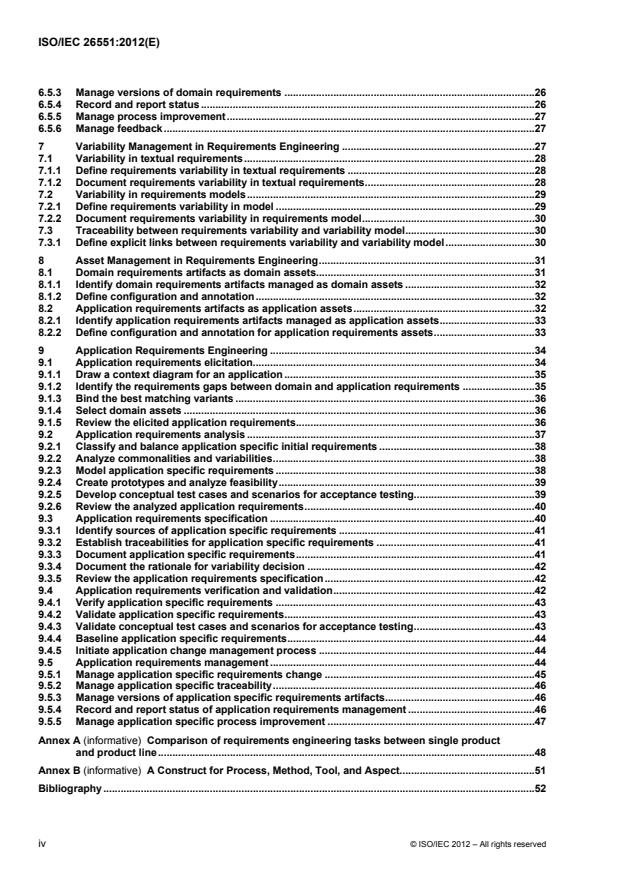
6.5.3 Manage versions of domain requirements .26
6.5.4 Record and report status .26
6.5.5 Manage process improvement .27
6.5.6 Manage feedback .27
7 Variability Management in Requirements Engineering .27
7.1 Variability in textual requirements .28
7.1.1 Define requirements variability in textual requirements .28
7.1.2 Document requirements variability in textual requirements .28
7.2 Variability in requirements models .29
7.2.1 Define requirements variability in model .29
7.2.2 Document requirements variability in requirements model .30
7.3 Traceability between requirements variability and variability model .30
7.3.1 Define explicit links between requirements variability and variability model .30
8 Asset Management in Requirements Engineering .31
8.1 Domain requirements artifacts as domain assets .31
8.1.1 Identify domain requirements artifacts managed as domain assets .32
8.1.2 Define configuration and annotation .32
8.2 Application requirements artifacts as application assets .32
8.2.1 Identify application requirements artifacts managed as application assets .33
8.2.2 Define configuration and annotation for application requirements assets .33
9 Application Requirements Engineering .34
9.1 Application requirements elicitation.34
9.1.1 Draw a context diagram for an application .35
9.1.2 Identify the requirements gaps between domain and application requirements .35
9.1.3 Bind the best matching variants .36
9.1.4 Select domain assets .36
9.1.5 Review the elicited application requirements .36
9.2 Application requirements analysis .37
9.2.1 Classify and balance application specific initial requirements .38
9.2.2 Analyze commonalities and variabilities .38
9.2.3 Model application specific requirements .38
9.2.4 Create prototypes and analyze feasibility .39
9.2.5 Develop conceptual test cases and scenarios for acceptance testing .39
9.2.6 Review the analyzed application requirements .40
9.3 Application requirements specification .40
9.3.1 Identify sources of application specific requirements .41
9.3.2 Establish traceabilities for application specific requirements .41
9.3.3 Document application specific requirements .41
9.3.4 Document the rationale for variability decision .42
9.3.5 Review the application requirements specification .42
9.4 Application requirements verification and validation .42
9.4.1 Verify application specific requirements .43
9.4.2 Validate application specific requirements .43
9.4.3 Validate conceptual test cases and scenarios for acceptance testing .43
9.4.4 Baseline application specific requirements .44
9.4.5 Initiate application change management process .44
9.5 Application requirements management .44
9.5.1 Manage application specific requirements change .45
9.5.2 Manage application specific traceability .46
9.5.3 Manage versions of application specific requirements artifacts .46
9.5.4 Record and report status of application requirements management .46
9.5.5 Manage application specific process improvement .47
Annex A (informative) Comparison of requirements engineering tasks between single product
and product line .48
Annex B (informative) A Construct for Process, Method, Tool, and Aspect .51
Bibliography .52
iv © ISO/IEC 2012 – All rights reserved
Foreword
ISO (the International Organization for Standardization) is a worldwide federation of national standards bodies
(ISO member bodies). The work of preparing International Standards is normally carried out through ISO
technical committees. Each member body interested in a subject for which a technical committee has been
established has the right to be represented on that committee. International organizations, governmental and
non-governmental, in liaison with ISO also take part in the work. ISO collaborates closely with the International
Electrotechnical Commission (IEC) on all matters of electro-technical standardization.
International Standards are drafted in accordance with the rules given in the ISO/IEC Directives, Part 3.
Draft International Standards adopted by the technical committees are circulated to the member bodies for
voting. Publication as an International Standard requires approval by at least 75 % of the member bodies
casting a vote.
Attention is drawn to the possibility that some of the elements of this document may be the subject of patent
rights. ISO shall not be held responsible for identifying any or all such patent rights.
ISO/IEC 26551 was prepared by Joint Technical Committee ISO/IEC JTC 1, Information technology,
Subcommittee SC 7, Software and systems engineering.
© ISO/IEC 2012 – All rights reserved v
Introduction
The major purpose of this International Standard is to deal with the capabilities of tools and methods of
software and systems product line (SSPL) requirements engineering. This International Standard defines how
the tools and methods can support for the software and systems product line-specific requirements
engineering processes.
Decision for the initial boundaries of domain is conducted in advance by defining a product line scope before
initiating domain requirements engineering processes. Domain requirements engineering will be carried out in
a comprehensive manner because common and variable requirements and captured variabilities have
consequential impacts on member products in a product line. The outcomes of domain requirements
engineering processes are transferred into the requirements of a family of products at the application
requirements engineering processes. Therefore requirements engineering tools and methods should consider
both engineering processes namely domain requirements engineering and application requirements
engineering.
Product line requirements engineering can be differentiated from a single product requirement engineering
because of the following aspects:
There are two core processes in requirements engineering: domain requirements engineering and
application requirements engineering. The major aims of the domain requirements engineering processes
are to analyze commonality and variability for a family of products, and to prepare necessary variability
information for variability modelling. The major aims of the application requirements engineering
processes are to define application specific requirements and bind variability defined in domain
requirements engineering processes.
It is essential to analyse the costs and benefits estimation of a product line and thereby an organization
can make a go/no-go decision. Moreover, the costs and benefits estimation plays a pivotal role as an
indicator for assessing the effectiveness and efficiency of a product line.
This International Standard can be used in the following modes:
By the users of this International Standard – to benefit people who develop, operate, and manage
requirements engineering for software and systems product lines.
By a product line organization – to provide guidance in the evaluation and selection for tools and methods
for product line requirements engineering.
By providers of tools and methods – to provide guidance in implementing or developing tools and
methods by providing a comprehensive set of the capabilities of tools and methods for product line
requirements engineering.
ISO/IEC 26550 (ISO/IEC 26550, Software and systems engineering — Reference model for product line
engineering and management) addresses both engineering and management processes and covers the key
characteristics of product line development. ISO/IEC 26550 provides an overview of the consecutive
international standards (i.e., ISO/IEC 26551 through ISO/IEC 26556) as well as the structure of the model:
Processes and capabilities of methods and tools for product line scoping, domain requirements
engineering, and application requirements engineering are provided as ISO/IEC 26551, Software and
systems engineering — Tools and methods for product line requirements engineering.
Processes and capabilities of methods and tools for domain design and application design are provided
as ISO/IEC 26552, Software and systems engineering — Tools and methods for product line architecture
design.
vi © ISO/IEC 2012 – All rights reserved
Processes and capabilities of methods and tools for domain realization and application realization are
provided as ISO/IEC 26553, Software and systems engineering — Tools and methods for product line
realization.
Processes and capabilities of methods and tools for domain verification and validation and application
verification and validation are provided as ISO/IEC 26554, Software and systems engineering — Tools
and methods for product line verification and validation.
Processes and capabilities of methods and tools for technical management are provided as
ISO/IEC 26555, Software and systems engineering — Tools and methods for product line technical
management.
Processes and capabilities of methods and tools for organizational management are provided as
ISO/IEC 26556, Software and systems engineering — Tools and methods for product line organizational
management.
© ISO/IEC 2012 – All rights reserved vii
INTERNATIONAL STANDARD ISO/IEC 26551:2012(E)
Software and systems engineering — Tools and methods for
product line requirements engineering
1 Scope
This International Standard deals with the tools and methods of requirements engineering for software and
systems product line. The scope of this International Standard is as follows:
provide the terms and definitions specific to requirements engineering for software and systems
product lines.
define process groups and their processes performed during product line requirements engineering.
Those processes are described in terms of purpose, inputs, tasks, and outcomes.
define method capabilities to support the defined tasks of each process.
define tool capabilities to automate/semi-automate tasks or defined method capabilities.
This International Standard does not concern processes and capabilities of requirements tools and methods
for a single system but rather deals with those for a family of products.
NOTE This International Standard is not suitable for handling physical artifacts. In the Systems arena, the word
"Product" must be understood as System-level artefacts, such as requirement documents, architectural data, validation
plans, Behavioral Models, etc. In any case, the word "Product" must not be understood as physical items such as
electronic boards, mechanical parts or qualified human operators. In the case of the Software components of a Systems,
this International Standard can apply twice: once to handle the System-Level Product Line and a second time to handle
the Software Part Product Line, if any. The Product Line processes are recursive within the different levels of Products.
2 Normative references
The following referenced documents are indispensable for the application of this document. For dated
references, only the edition cited applies. For undated references, the latest edition of the referenced
document (including any amendments) applies.
ISO/IEC 26550, Software and systems engineering ― Reference model for product line engineering and
management
3 Terms and definitions
For the purposes of this document, the terms and definitions given in ISO/IEC 26550 and the following apply
following terms and definitions apply.
3.1
application assets in requirements
application specific artifacts produced during application requirements engineering such as application
requirements specifications and application requirements models
3.2
application requirements elicitation
identifies stakeholders relevant to an application, elicits application specific requirements, and binds the
appropriate variants
© ISO/IEC 2012 – All rights reserved 1
3.3
application requirements analysis
ensures that all application specific requirements are understood, and scrutinizes incorrect and inconsistent
application requirements through modeling. And application requirements that cannot be satisfied through the
domain requirements are then analyzed and negotiated
3.4
application requirements specification
documents the application specific requirements and integrates it with the domain requirements specification
whose variants are bound
3.5
application requirements verification and validation
confirms that the application specific requirements are consistent and feasible, and ensures that the bound
variants satisfy the specific product’s requirements
3.6
application requirements management
manages traceability and changes on application requirements
3.7
asset proposal
includes major assets (functional areas and high-level common and variable features of all applications) that
will be included in a product line with their quantified costs and benefits, and estimation results
3.8
application specific requirements
requirements specific to an application or requirements not covered in domain requirements
3.9
domain assets in requirements
reusable artifacts produced during domain requirements engineering such as asset proposals, domain
requirements specifications and domain requirements models
3.10
domain requirements elicitation
identifies initial requirements from domain stakeholders for a product line
3.11
domain requirements analysis
models domain requirements so as to analyze and scrutinize commonality/variability of a product line in
requirements
3.12
domain requirements specification
documents domain requirements for a product line based on domain analysis results
3.13
domain requirements verification and validation
confirms that domain requirements are corrective, consistent, and complete
3.14
domain requirements management
manages traceability and changes with respect to domain requirements and their relevant domain/application
artifacts
3.15
functional domain
categorized functions that are generally used together
2 © ISO/IEC 2012 – All rights reserved
3.16
production plan
description of how domain assets are to be used to develop member products in a product line
3.17
requirements traceability
covers traceabilities in domain and application requirements respectively, and those between them
3.18
variability in requirements
deals with both external and internal variability in requirements engineering phase. Also variability modeling
and traceability with domain requirements artifacts are addressed
4 Reference model for product line requirements engineering
The methods and tools for product line requirements engineering should support systematic management and
interaction of the domain and application requirements engineering processes. They also need to be
adequately integrated with the subsequent processes of product line engineering lifecycle processes in order
to enable traceability between all requirements artifacts and the related design, realization, and testing
artifacts. In the rest of this document, product line requirements engineering practices, methods, and tools are
described in accordance with a framework focusing on product line requirements engineering (Figure 1).
Product line scoping leads and controls all work on a product line by creating and maintaining the product line
scope through ongoing interactions with the domain and application requirements engineering.
Domain requirements engineering serves to:
decompose features defined in Product Line Scoping into initial requirements and elicit additional
requirements and derived requirements from stakeholders and domain experts;
analyze domain requirements with the variabilities of those;
model and simulate the static and behavioral constructs of domain requirements;
document domain requirements specifications that can be bound by specific member products of a
product line.
The complexity of variability grows higher in accordance with the complexity of a product line. Separating
variability from domain requirements engineering mitigates this problem. Defining variability in requirements
independently leads to a clear understanding of the necessary capabilities of tools and methods, and thus
helps in selecting tools that support product line requirements engineering.
Application requirements engineering serves to:
identify gaps between domain features and application specific features
reuse domain requirements from the asset repository and elicit application specific requirements;
define application variability model by binding domain variability model and adding application specific
variability;
analyze and document application specific requirements;
provide feedback to product line scoping and domain requirements engineering for the evolution of a
product line.
© ISO/IEC 2012 – All rights reserved 3
The reference model for product line requirements engineering in Figure 1 is structured into five processes,
product line scoping, domain requirements engineering, variability management in requirements engineering,
asset management in requirements engineering, and application requirements engineering. Each process is
divided into subprocesses to address product line requirements issues, and each subprocess is described in
terms of the following attributes:
The title of the subprocess
The purpose of the subprocess
The inputs to produce the outcomes
The tasks to achieve the outcomes
The outcomes of the subprocess
The capabilities of tools and methods are a list of the required support of tools and methods for
performing the tasks properly
Variability
Product
Domain Requirements Engineering
Management in
Line
Requirements
Scoping
Domain Requirements Domain Requirements Domain Requirements Domain Requirements
Engineering
Verification and Validation
Elicitation Analysis Specification
Product
Variability in
Domain Requirements Management
Scoping
textual
requirements
Asset Management in Requirements Engineering
Domain
Scoping
Domain requirements artifacts
Application requirements Variability in
as domain assets artifacts as application assets requirements
models
Asset
Application Requirements Engineering
Scoping
Traceability
between
Application
Application Application Requirements
Application Requirements
requirements
Requirements
Verification and Validation
Requirements Elicitation Analysis
variability and
Specification
variability
model
Application Requirements Management
Figure 1 — Product line requirements engineering
Product line scoping defines the member products and their major (externally visible) features, analyzes the
products from an economic point of view, and controls and schedules producing the product line and its
products. The major result of this process is the asset proposals. Asset proposal includes major assets
(functional domains and high-level common and variable features) for a product line with their quantified costs
and benefits, and ROIs expected from a product line development. More than one asset proposals can be
made to find out an optimal set of products and assets. Domain and application requirements engineering
start from the features defined in the asset proposals. Product line scoping shall serve to do the following and
to define the capabilities of tools and methods for supporting them:
Product scoping determines the product portfolio definition, and provides a roadmap for releasing
specific applications to customers or to market.
Domain scoping identifies and bounds the functional domains to provide sufficient reuse potential.
Asset scoping identifies reusable assets, calculates the cost/benefit estimates to justify the product
line initiation.
Domain requirements engineering begins with using the outcomes of product line scoping. It comprehensively
captures the initial domain requirements for a product line, and constructs an initial-requirements specification
including a variability model. It also provides feedback on the changes required in the feature sets and the
product roadmap as a whole to Organizational Business Management process group. Domain requirements
engineering documents domain requirements specifications for the later use in domain design and in
application requirements engineering. Domain requirements engineering shall serve to do the following and to
define the capabilities of tools and methods for supporting them:
4 © ISO/IEC 2012 – All rights reserved
Domain requirements elicitation captures initial domain requirements and anticipated variations of
those.
Domain requirements analysis identifies functional and non-functional requirements with the
variabilities of those.
Domain requirements specification documents domain requirements based on analysis results.
Domain requirements validation and verification confirms that the specified domain requirements are
consistent and feasible, and ensures that all products’ requirements within a product line are well
understood.
Domain requirements management provides management services for the dual nature of the
requirements engineering, i.e. domain and application requirements engineering.
Variability management in requirements engineering should be conducted in parallel with domain
requirements engineering because variability models are clarified and modified gradually together with the
domain and application requirements. Variability modeling starts in the domain requirements elicitation phase
and continuously evolves throughout the product line life-cycle. This process is responsible for a variability
model which documents the external variability explicitly. As domain requirements engineering activities
proceed, some additional internal variabilities may be added to the variability model. Variability management
in requirements engineering shall serve to do the following and to define the capabilities of tools and methods
for supporting them.
Variability in textual requirements expresses and documents variability in requirements using natural
language and makes them explicit.
Variability in requirements model expresses and documents variability in requirements using modeling
language and makes them explicit.
Traceability between requirements variability and a variability model establishes and maintains links
between textual requirements /requirements models and a variability model.
During asset management in requirements engineering, requirements artifacts resulting from domain
requirements engineering are structured as domain assets. Variability as well as commonality in requirements
is managed as domain assets. In addition, application requirements artifacts with high reusability potentials
are identified as potential domain assets. Asset management in requirements engineering adds or develops
extra elaborations and glues to requirements assets to be used effectively and efficiently. The relationship
among requirements domain assets for being reused successfully or managing changes on them are also
analyzed in this process area. Processes for configuring domain assets and managing them in asset
repository refer to asset management of ISO/IEC 26555. Asset management in requirements engineering
shall serve to do the following and to define the capabilities of tools and methods for supporting them.
Domain requirements artifacts as domain assets identify and develop necessary information to help
application engineers reuse requirements assets in their application development.
Application requirements artifacts as application assets identify and manage application requirements
artifacts as assets to be referred by the application later.
Application requirements engineering identifies specific requirements for each product line member. It starts to
assess the reusability of existing common and variable requirements to fully leverage a product line platform.
It also can provide feedback to domain requirements engineering so as to make a decision on incorporating
application requirements assets into domain assets. Application requirements engineering shall serve to do
the following and to define the capabilities of tools and methods for supporting them:
Application requirements elicitation identifies gaps between domain features and application specific
features, reuses domain requirements from the asset repository, and elicits application specific
requirements.
Application requirements analysis abstracts, organizes, and models application specific requirements.
And this subprocess has to ensure that all requirements of the application stakeholders are
understood, and has to scrutinize the correctness, completeness, and consistencies of application
requirements.
Application requirements specification documents the analyzed application specific requirements with
the bound portion of domain requirements specification.
© ISO/IEC 2012 – All rights reserved 5
Application requirements verification and validation confirms that the specific product requirements
are consistent and feasible, and ensures that the bound variants are relevant to the specific product
requirements.
Application requirements management provides management services for subsequent changes of the
member product’s requirements.
The identification and analysis of the aspects for the product line requirements engineering will enable an
organization to understand the requirements engineering processes and to formulate a strategy for the
successful implementation of the concept. Requirements engineering processes for product lines should be
defined in terms of these aspects, and capabilities of tools and methods for supporting these processes
should be identified on the bases of these aspects:
The following table shows the key aspects for each characteristic of product line requirements engineering.
Category aspects
application engineering, domain assets, domain engineering, product
Reuse management
management, platform, reusability
Variability management binding, variability
collaboration, configuration, domain architecture, enabling technology
Complexity management
support, texture, traceability
Quality management measurement & tracking, verification & validation
Application engineering: Domain requirements should be reused and external variability for specific
application should be bound. As a result, application requirements are specified.
Asset: Domain requirements engineering provides a common portion of requirements (domain
requirements) to application engineering through asset repository. Therefore the domain assets of
requirements engineering and management is a distinguished aspect.
Binding: Binding in requirements engineering should consider to reflect the external variability. Thus,
binding is a distinct aspect of the product line development.
Collaboration: Since the domain requirements engineering and application requirements engineering
can be performed in parallel, collaborations are necessary between engineering teams as well as
those among processes such as domain assets, variability management, product management,
scoping, etc. This makes collaboration as an important aspect in a product line development
environment.
Configuration: Configuration of products and artifacts of product line requirements engineering can be
multidimensional, i.e., exist in time and space. Maintaining the integrity of those dimensions is an
important aspect.
Domain architecture: Domain requirements engineering provides domain requirements as a major
input for establishing reference architecture.
Domain engineering: Domain requirements engineering process does not exist in a single product
development. However, this process is necessary for a product line.
Enabling technology support: Technologies that are needed to enable product line requirements
engineering are a key success factor of product line implementation.
Measurement & tracking: In product line requirements engineering, data collection, measures, and
tracking need to consider domain engineering, application engineering, product management, and
domain assets. This means that the measurements for product line are multidimensional and thus the
required activities, roles, procedures, tools, and methods should be considered.
Platform: Platform enables to reuse common elements (e.g., artifacts, components, connectors, etc.)
among products. Product line requirements engineering artifacts are key elements of a platform.
6 © ISO/IEC 2012 – All rights reserved
Product management: Requirements engineering should deal with reusability of the product line from
the foreseen product line strategy. Since requirements continuously evolve in accordance with risks
and opportunities, product management should monitor and support the evolution of requirements.
Reusability: The reusability of assets from requirements engineering processes is closely related to
achieve the overall goal of a product line. Achieving reusability throughout the product line
requirements engineering is a differentiating aspect.
Texture: Product line requirements are major inputs for establishing texture. Especially, for reflecting
functional and non-functional requirements, corresponding architectural texture shall be established.
Traceability: There exist various kinds of trace links between variabilities and the artifacts from
domain/application requirements engineering. It is necessary to develop a traceability scheme to
handle tracing.
Validation and verification: In product line development environments, provisioning of objective
evidences for validation and verification of requirements from various viewpoints (e.g., domain,
application, variability, domain assets, etc.) is an important aspect, so differentiated schemes with
single product development should be provided.
Variability: Variability in requirements engineering mainly deals with external variability related to a
reusability strategy, which is not a concern of single product development.
5 Product Line Scoping
A product line organization needs to determine with which products and features will consist of a product line,
and thereafter the organization determines which features will be implemented by reusing or adapting legacy
assets or which of them will be newly developed. Using objective and quantitative endeavours the
organization estimates economic benefits expected from a product line and makes a go/no-go decision for
product lineinitiation base on the economic benefits. A product line scoping process includes three key sub
processes:
Product scoping determines the potential member products and initial common and variable features
of those base on market inputs.
Domain scoping decomposes domains into subdomains (or functional domains) and maps the initial
features determined in product scoping to the subdomains.
Asset scoping identifies reusable assets, calculates the cost/benefit estimates to justify the product
line initiation, and provides a roadmap of a product line.
The above three types of scoping can be iterative.
5.1 Product scoping
Purpose of product scoping
The purpose of product scoping is to determine product portfolio definition:
1) The products that the product line organization should be developing, producing, marketing, and
selling;
2) The common and variable features that the products should provide in satisfying customer needs and
reaching the long and short
...
Questions, Comments and Discussion
Ask us and Technical Secretary will try to provide an answer. You can facilitate discussion about the standard in here.
Loading comments...