


ISO 6517:2013
(Main)Air cargo - Certified lower deck containers - Design and testing
Air cargo - Certified lower deck containers - Design and testing
ISO 6517:2013 covers the minimum design and operational testing requirements for general purpose base-restrained containers exclusively intended for the lower deck compartments of main line civil transport aircraft, capable of being used by either airlines or shippers and requiring airworthiness authority approval (certification). ISO 6517:2013 does not cover the performance requirements and ultimate load testing parameters for approval by airworthiness authorities (certification), which are covered in ISO 21100 or, for units approved prior to 2012, ISO 8097:2001. The design and operational testing requirements of ISO 6517:2013 are additional to those of these standards.
Fret aérien — Conteneurs certifiés de pont inférieur — Conception et essais
General Information
- Status
- Published
- Publication Date
- 14-Jul-2013
- Technical Committee
- ISO/TC 20/SC 9 - Air cargo and ground equipment
- Drafting Committee
- ISO/TC 20/SC 9 - Air cargo and ground equipment
- Current Stage
- 9093 - International Standard confirmed
- Start Date
- 05-Sep-2024
- Completion Date
- 13-Dec-2025
Relations
- Effective Date
- 04-Jul-2009
Overview
ISO 6517:2013 - "Air cargo - Certified lower deck containers - Design and testing" defines minimum design and operational testing requirements for general-purpose, base-restrained containers intended exclusively for the lower deck compartments of mainline civil transport aircraft. It specifies container sizes, construction and material expectations, testing types (ultimate load and operational), markings, sealing and manufacturer documentation. ISO 6517:2013 supplements - but does not replace - airworthiness performance and ultimate load parameters covered by ISO 21100 (or ISO 8097:2001 for pre‑2012 approvals).
Key topics and technical requirements
- Scope and intended use: Applies to certified containers used by airlines or shippers in lower deck compartments and requiring airworthiness approval.
- Container sizes and contours: Defines two base sizes - Size K (1 562 × 1 534 mm) and Size L (3 175 × 1 534 mm) - and seven contours (C, E, F, G, H, P, U) with nominal overall widths. Type codes (e.g., ALP) follow ISO 21100 configuration rules and must be visibly marked.
- Design and construction: Requires aircraft‑quality materials and construction, corrosion protection, sealed non‑absorbent non‑metallic materials, fire resistance and maintainability to minimize tare weight and simplify repairs. Design shall maximize usable internal cross‑section while allowing necessary latching and restraint features.
- Airworthiness approval: Manufacturers must obtain approval (e.g., TSO/CTSO/ETSO C90d or equivalent) and follow national/regional certification procedures (EASA, FAA, CAAC, etc.). ISO 6517:2013 complements regulatory performance standards.
- Testing: Includes ultimate load tests and operation tests as part of operational qualification. The standard details testing scope but defers specific certification load parameters to ISO 21100/ISO 8097.
- Operational documentation: Mandates manufacturer instructions for installation, operation, servicing, maintenance/repair and centre‑of‑gravity/load distribution guidance.
- Markings, sealing and quality control: Specifies identification marking, customs/security sealing provisions and design/production quality control procedures.
Applications and users
ISO 6517:2013 is used by:
- Container manufacturers designing certified lower deck ULDs (unit load devices)
- Airlines and cargo handlers procuring and operating certified lower deck containers
- Airworthiness authorities and certification engineers assessing compliance
- Maintenance organizations and MROs ensuring continuing airworthiness
- Shippers and freight forwarders specifying certified lower deck ULDs
Implementing ISO 6517:2013 helps ensure safe, maintainable, lightweight lower deck cargo containers that meet regulatory approval pathways and operational needs.
Related standards
- ISO 21100 - Air cargo unit load devices (performance & test parameters)
- ISO 8097:2001 - Pre‑2012 certified ULD performance requirements
- ISO 10327, ISO 11242 and other ISO references cited for compatibility, pressure equalization and contour definitions
- Regional certification frameworks: FAA 14 CFR Part 21/25, EASA CS‑25, CAAC regulations, TSO/ETSO/CTSO C90d
Keywords: ISO 6517:2013, air cargo, lower deck containers, certified containers, design and testing, airworthiness approval, unit load device, ULD.
Frequently Asked Questions
ISO 6517:2013 is a standard published by the International Organization for Standardization (ISO). Its full title is "Air cargo - Certified lower deck containers - Design and testing". This standard covers: ISO 6517:2013 covers the minimum design and operational testing requirements for general purpose base-restrained containers exclusively intended for the lower deck compartments of main line civil transport aircraft, capable of being used by either airlines or shippers and requiring airworthiness authority approval (certification). ISO 6517:2013 does not cover the performance requirements and ultimate load testing parameters for approval by airworthiness authorities (certification), which are covered in ISO 21100 or, for units approved prior to 2012, ISO 8097:2001. The design and operational testing requirements of ISO 6517:2013 are additional to those of these standards.
ISO 6517:2013 covers the minimum design and operational testing requirements for general purpose base-restrained containers exclusively intended for the lower deck compartments of main line civil transport aircraft, capable of being used by either airlines or shippers and requiring airworthiness authority approval (certification). ISO 6517:2013 does not cover the performance requirements and ultimate load testing parameters for approval by airworthiness authorities (certification), which are covered in ISO 21100 or, for units approved prior to 2012, ISO 8097:2001. The design and operational testing requirements of ISO 6517:2013 are additional to those of these standards.
ISO 6517:2013 is classified under the following ICS (International Classification for Standards) categories: 55.180.30 - Air mode containers, pallets and nets. The ICS classification helps identify the subject area and facilitates finding related standards.
ISO 6517:2013 has the following relationships with other standards: It is inter standard links to ISO 6517:1992. Understanding these relationships helps ensure you are using the most current and applicable version of the standard.
ISO 6517:2013 is available in PDF format for immediate download after purchase. The document can be added to your cart and obtained through the secure checkout process. Digital delivery ensures instant access to the complete standard document.
Standards Content (Sample)
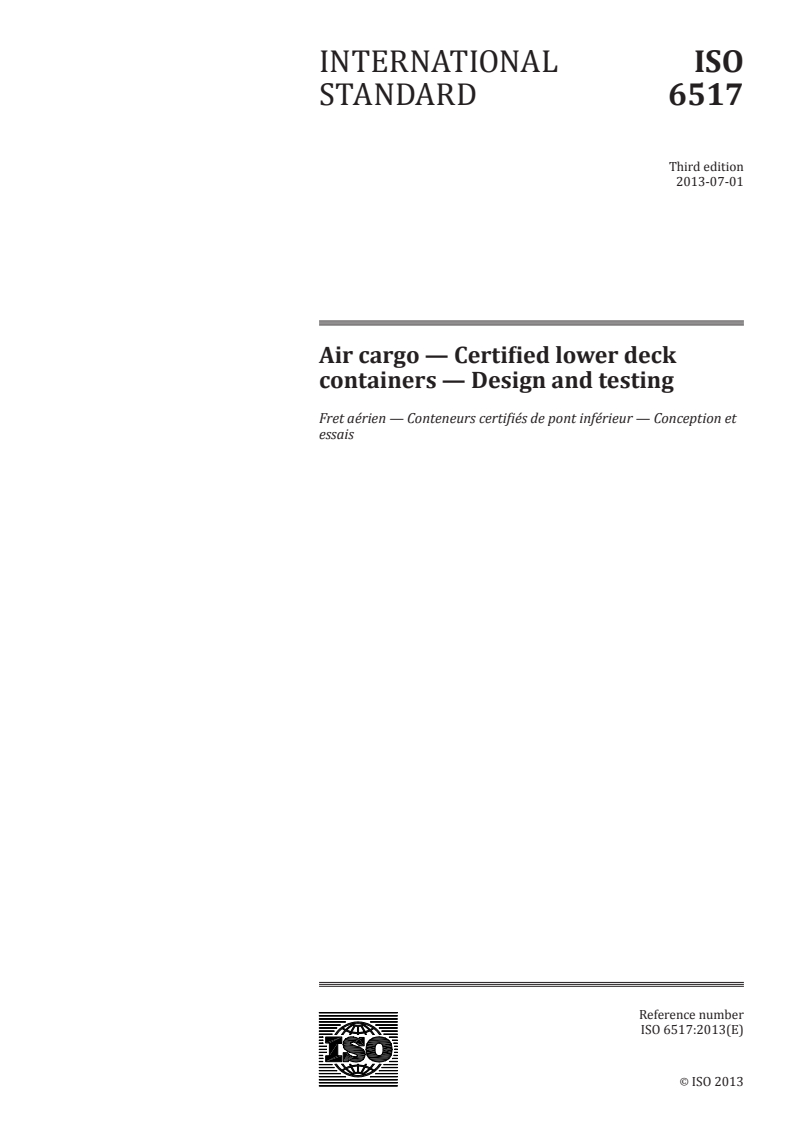
INTERNATIONAL ISO
STANDARD 6517
Third edition
2013-07-01
Air cargo — Certified lower deck
containers — Design and testing
Fret aérien — Conteneurs certifiés de pont inférieur — Conception et
essais
Reference number
©
ISO 2013
© ISO 2013
All rights reserved. Unless otherwise specified, no part of this publication may be reproduced or utilized otherwise in any form
or by any means, electronic or mechanical, including photocopying, or posting on the internet or an intranet, without prior
written permission. Permission can be requested from either ISO at the address below or ISO’s member body in the country of
the requester.
ISO copyright office
Case postale 56 • CH-1211 Geneva 20
Tel. + 41 22 749 01 11
Fax + 41 22 749 09 47
E-mail copyright@iso.org
Web www.iso.org
Published in Switzerland
ii © ISO 2013 – All rights reserved
Contents Page
Foreword .iv
Introduction .v
1 Scope . 1
2 Normative references . 1
3 Container sizes and identification . 3
4 Requirements . 3
4.1 General . 3
4.2 Airworthiness approval . 4
4.3 Materials . 4
4.4 Construction . 4
4.5 Performance . 7
4.6 Design loads . 8
4.7 Environment . 8
5 Testing . 9
5.1 Ultimate load tests . 9
5.2 Operation tests . 9
6 Markings .11
7 Customs/security sealing .12
8 Manufacturer’s instructions .13
9 Quality control .13
9.1 Design and production .13
9.2 Operations .14
Bibliography .21
Foreword
ISO (the International Organization for Standardization) is a worldwide federation of national standards
bodies (ISO member bodies). The work of preparing International Standards is normally carried out
through ISO technical committees. Each member body interested in a subject for which a technical
committee has been established has the right to be represented on that committee. International
organizations, governmental and non-governmental, in liaison with ISO, also take part in the work.
ISO collaborates closely with the International Electrotechnical Commission (IEC) on all matters of
electrotechnical standardization.
The procedures used to develop this document and those intended for its further maintenance are
described in the ISO/IEC Directives, Part 1. In particular the different approval criteria needed for the
different types of ISO documents should be noted. This document was drafted in accordance with the
editorial rules of the ISO/IEC Directives, Part 2. www.iso.org/directives
Attention is drawn to the possibility that some of the elements of this document may be the subject of
patent rights. ISO shall not be held responsible for identifying any or all such patent rights. Details of
any patent rights identified during the development of the document will be in the Introduction and/or
on the ISO list of patent declarations received. www.iso.org/patents
Any trade name used in this document is information given for the convenience of users and does not
constitute an endorsement.
The committee responsible for this document is ISO/TC 20, Aircraft and space vehicles, Subcommittee
SC 9, Air cargo and ground equipment.
This third edition cancels and replaces the second edition (ISO 6517:1992), which has been technically
revised to take into account ISO 21100 and TSO/ETSO C90d.
iv © ISO 2013 – All rights reserved
Introduction
The basic functions of lower deck air cargo containers are:
a) the unitization of baggage, cargo or mail during ground handling and transportation, and
b) the restraint of their contents against accelerations encountered in flight.
Throughout this International Standard, the minimum essential criteria are identified by use of the key
word “shall”. Recommended criteria are identified by use of the key word “should” and, while not mandatory,
are considered to be of primary importance in providing safe, economical and usable containers. Deviation
from recommended criteria should only occur after careful consideration and thorough service evaluation
have shown alternate methods to provide an equivalent level of quality and safety.
The requirements of this International Standard are expressed in the applicable SI units, with
approximate inch-pound units conversion between brackets for convenience in those countries using
that system. Where it is deemed necessary to use exact values, the SI unit ones are to be used. Per
exception, the exact figures are those in inches for container base overall outside dimensions.
INTERNATIONAL STANDARD ISO 6517:2013(E)
Air cargo — Certified lower deck containers — Design and
testing
1 Scope
1.1 This International Standard covers the minimum design and operational testing requirements
for general purpose base-restrained containers exclusively intended for the lower deck compartments
of main line civil transport aircraft, capable of being used by either airlines or shippers and requiring
airworthiness authority approval (certification).
NOTE 1 The metric equivalents for dimensions have been rounded up or down to the nearest millimetre, except
in critical dimensions. Masses have been rounded up to the nearest kilogram and forces have been rounded up to
the nearest 10 N.
NOTE 2 Containers with other base sizes than those specified by this International Standard can also be built
to a lower deck contour, but they need not be carried exclusively on the lower deck. See ISO 10327.
1.2 This International Standard does not cover the performance requirements and ultimate load
testing parameters for approval by airworthiness authorities (certification), which are covered in
ISO 21100 or, for units approved prior to 2012, ISO 8097:2001. The design and operational testing
requirements of this International Standard are additional to those of these standards.
2 Normative references
The following documents, in whole or in part, are normatively referenced in this document and are
indispensable for its application. For dated references, only the edition cited applies. For undated
references, the latest edition of the referenced document (including any amendments) applies.
ISO 4116:1986, Air cargo equipment — Ground equipment requirements for compatibility with aircraft
unit load devices
ISO 7166:1985, Aircraft — Rail and stud configuration for passenger equipment and cargo restraint
ISO 8097:2001, Aircraft — Minimum airworthiness requirements and test conditions for certified air cargo
unit load devices (Endorsement of NAS 3610 10th edition)
ISO/TR 8647:1990, Environmental degradation of textiles used in air cargo restraint equipment
ISO 10046:1996, Aircraft — Methodology of calculating cargo compartment volumes
ISO 10327:1995, Aircraft — Certified aircraft container for air cargo — Specification and testing
ISO 11242:1996, Aircraft — Pressure equalization requirements for cargo containers
1)
ISO 21100:— , Air cargo unit load devices — Performance requirements and test parameters
2)
CAAC CCAR-21, Certification Procedures for Products and Parts
CAAC CCAR-25, Airworthiness Standards – Transport Category Airplanes, paragraph 25.855, Cargo or
2)
baggage compartments, and Appendix F
2)
CAAC CCAR-121, Air Carriers Certification and Operations system
1) To be published. (Technical revision of ISO/PAS 21100:2011.)
2) The Civil Aviation Administration of China (CAAC) listed documents constitute the Chinese government
transport aircraft airworthiness approval Regulations.
2)
CAAC Chinese Technical Standard Order CTSO C90d — Cargo pallets, nets and containers
EASA Part 21 — Certification of aircraft and related products, parts and appliances, and of design and
3)
production organisations (Commission Regulation (EU) No 748/2012)
EASA CS-25 — Certification Specifications for Large Aeroplanes, paragraph 25.855, Cargo or baggage
3)
compartments, and Appendix F
3)
EASA (European Aviation Safety Agency) EU-OPS 1.035 — Quality system
EASA European Technical Standard Order ETSO C90d — Cargo pallets, nets and containers (Unit
3)
Load Devices)
4)
Japanese Airworthiness Standard Part 3 (Civil Aeronautics Law Article 10 § 4)
5)
U.S. Code of Federal Regulations Title 14 CFR Part 21 — Certification Procedures for Products and Parts
U.S. Code of Federal Regulations Title 14 Part 25 — Airworthiness Standards: Transport Category Airplanes
5)
(“14 CFR Part 25”), paragraph 25.855, Cargo or baggage compartments, and Appendix F
5)
U.S. Code of Federal Regulations Title 14 CFR Part 121 — Air carriers certification and operation
U.S. Federal Aviation Administration Advisory Circular AC 120-59 — Air carriers internal evaluation
5)
programs
U.S. Federal Aviation Administration Technical Standard Order TSO C90d — Cargo Pallets, Nets and
5)
Containers
6)
EUROCAE ED-14G, Environmental conditions and test procedures for airborne equipment
NOTE 3 Also see informative references in Bibliography.
3) The listed EASA documents constitute the European governments transport aircraft airworthiness approval
Regulations, and can be obtained from the European Aviation Safety Agency (EASA), Otto Platz 1, Postfach 101253,
D-50452 Cologne, Germany, or its website at www.easa.europa.eu.int.
4) Japanese Airworthiness Standard Part 3 (ISBN 4-89279-661-1) constitutes the Japanese government transport
aircraft airworthiness approval Regulations, and can be obtained from the Civil Aviation Bureau (CAB) of the
Ministry of Land, Infrastructure and Transport, Tokyo, Japan, or its website at www.mlit.go.jp/en.
5) The listed FAA documents constitute the U.S.A. government transport aircraft airworthiness approval
Regulations, and can be obtained from the U.S. Government Printing Office, Mail Stop SSOP, Washington DC 20402-
9328, or its website at www.gpoaccess.gov.
6) EUROCAE ED-14G can be obtained from the European Organisation for Civil Aviation Equipment, 102 rue
Etienne Dolet, 92240 Malakoff, France, or its website at www.eurocae.eu.
2 © ISO 2013 – All rights reserved
3 Container sizes and identification
3.1 The overall maximum dimensions of the containers are shown in Figures 2 to 6.
They embrace two base sizes:
— Size K: 1 562 mm × 1 534 mm (61,5 in × 60,4 in),
— Size L: 3 175 mm × 1 534 mm (125 in × 60,4 in).
and seven contours (see 3.2 NOTE):
— Contour C: nominal overall width 2 337 mm (92 in) (see Figure 3),
— Contour E: nominal overall width 2 007 mm (79 in) (see Figure 2),
— Contour F: nominal overall width 4 064 mm (160 in) (see Figure 4),
— Contour G: nominal overall width 2 007 mm (79 in) (see Figure 6),
— Contour H: nominal overall width 2 438 mm (96 in) (see Figure 6),
— Contour P: nominal overall width 3 175 mm (125 in) (see Figure 4),
— Contour U: nominal overall width 4 724 mm (186 in) (see Figure 5).
3.2 Container types complying with this International Standard are identified according to their
7)
ISO 21100 configuration by a type code composed of three letters :
a) the first letter A denoting a certified aircraft container complying with the performance requirements
of ISO 21100 type 2 or, for units approved prior to 2012, ISO 8097 type II;
b) the second letter denoting the base size in accordance with ISO 21100;
c) the third letter denoting the contour determined in accordance with ISO 10046 (see NOTE 3).
The identification code shall be prominently marked on two opposite sides of the container (see 6.3).
EXAMPLE A certified aircraft container (A) of base size 3 175 mm × 1 534 mm (125 in × 60,4 in) (size L) and
of nominal overall width 3 175 mm (125 in) (contour P) shall be designated as follows: ALP.
NOTE The container type code’s third (contour) digit is subject to change to accommodate evolving airline
needs. Check the latest yearly edition of IATA Unit Load Devices Regulations Standard Specifications 40/1 and
[6] [7]
50/0 Appendix E (references and in Bibliography) for any code changes.
4 Requirements
4.1 General
4.1.1 The container shall consist of a complete structural enclosure meeting ISO 21100 type 2 or
ISO 8097 type II performance requirements, and all the requirements of the present clause.
4.1.2 The container manufacturer shall provide the user instructions for the maintenance and repair
of the container necessary to maintain its continuing airworthiness qualification (see 9.1).
7) The type code is, by industry consensus, under custody of and assigned by the International Air Transport
Association (IATA), ULD Registrar, 800 Place Victoria, P.O. Box 113, Montréal, Québec H4Z 1M1, Canada, website
www.iata.org.
4.1.3 The manufacturer shall provide the user instructions for installation, operation and servicing
of the container (see 8.2), which shall comply with load distribution and centre of gravity conditions of
ISO 21100 and refer to methods to achieve the centre of gravity location control requirements.
4.1.4 The design, materials and construction of the container shall be of aircraft quality. Maintainability
and reparability shall be a factor in the design to ensure the minimum need for maintenance, and shall
ensure that such maintenance and repair can be accomplished with ease and at minimum cost.
4.1.5 The structure shall be designed to make the maximum internal cross-section available for
loading cargo, within the limits of structural design and the space required for latching.
4.1.6 The materials and design shall be selected to provide for an empty (tare) weight as low as
possible, consistent with maintainability objectives (see 4.1.4).
NOTE A direct environmental impact of container use is that their weight results in additional fuel burn by
aircraft. Therefore, apart from economic advantages, reducing container weight as much as possible to still meet
performance objectives is a highly effective environmental contribution and must be pursued.
4.2 Airworthiness approval
4.2.1 The container manufacturer shall apply to the appropriate airworthiness authority to obtain
approval (certification) for use of the container in aircraft whose cargo compartments require the use
of base-restrained certified containers (see also 4.2.2).
4.2.2 The mostly used method for this purpose is applying for a TSO/CTSO/ETSO/JTSO C90d Technical
Standard Order authorization in reference to ISO 21100 (containers certified prior to 2012 were
approved under TSO C90c in reference to ISO 8097). In special instances, other approval methods may
be used. Airworthiness approval procedures and requirements shall in any event be in accordance with
CCAR/EASA/14 CFR Part 21 Regulations.
4.3 Materials
4.3.1 The materials and processes selected shall provide for maximum service life by giving
consideration to the extremely hard usage to which the container will be subjected. All metal parts
shall be suitably protected against corrosion. All non-metallic liquid absorbent materials shall be sealed
or treated to prevent liquid absorption. Materials shall be fire resistant per 4.3.2 and shall withstand
environmental degradation (see 4.7).
4.3.2 All container and component materials shall meet the requirements of CS-25, CCAR-25, JAS Part 3
or 14 CFR Part 25 Appendix F, Part I, paragraphs (a)(1)(v) and (a)(2)(iv), i.e. shall not have a burn rate
greater than 100 mm (4 in) per minute when flame tested horizontally in accordance with Appendix F,
Part I paragraphs (b)(5), (b)(2), (b)(3) and (b)(8). The test specified therein shall be performed on each
material and results recorded.
4.4 Construction
4.4.1 Base
4.4.1.1 The base shall be enclosed on all four sides by an aluminium extrusion. The corner’s integrity
with its edges shall be a prime concern. The base shall not contain rough or sharp edges potentially
dangerous to personnel, cargo, aircraft or terminal handling equipment. The construction of the base
shall be designed for strength and durability to withstand harsh treatment in service. The base shall be
structurally attached to, and be an integral part of, the container assembly. The base shall be removable
with hand tools and shall be interchangeable.
4.4.1.2 The base shall comply with the indentation performance requirements of 4.5.1. The minimum
2 2
core stiffness shall be 429 N·m /m (3 800 lbf·in /in) width/length of core. It shall have a minimum area
load capacity of 10 kPa (209 lb/ft ). This load shall be applicable to any area representing at least 10 %
4 © ISO 2013 – All rights reserved
of the total base area, and the base shall not exhibit any significant deformation of this area while the
container is supported by the aircraft restraint system.
4.4.1.3 The base edges shall conform with the dimensional requirements shown in Figure 7 for size K
and Figure 8 for size L. The recess over the base edge shall be maintained continuous all around the base
periphery. The required minimum clearance shall be provided under the sloped (overhanging) panel on
the outboard side(s).
4.4.1.4 Where optional fork-lift capability is provided, the minimum aperture size shall be 100 mm
(4 in) high by 300 mm (12 in) wide, with chamfered protected edges.
4.4.1.5 Where provided, there shall be fork-lift pockets at least on the two long sides, although three-
way entry is preferred on size K units.
4.4.1.6 On size L units, the distance between the inner edges of the optional fork-lift pockets shall be not
less than 815 mm (32 in), and on size K units not less than 355 mm (14 in).
4.4.2 Body
4.4.2.1 The container’s body shall not contain rough or sharp edges potentially dangerous to personnel,
cargo, airplane or terminal handling equipment. Any attachments between the base and the panels shall
be designed to have a minimum intrusion into the door area, and none in the continuous recess all around
the base periphery (see Figures 7 and 8). Gussets are allowed at the junctions of panels and base or top to
allow the transfer of bending moments. The size of all gussets, particularly in the door opening, shall be
the minimum consistent with structural requirements.
The top of the container shall be self-draining. The top surface shall be designed to be easily cleared of snow.
To facilitate repair and assembly, component parts shall be readily removable with hand tools and shall
be interchangeable.
4.4.2.2 In addition to those on the door (see 4.4.3.2), two non-protruding handles or straps shall be
located on each side panel for manual movement of the container by one person. Each handle shall
provide 150 mm (6 in) wide by 75 mm (3 in) deep space for gripping with a gloved hand, and shall have
a local attachment strength of 450 daN (1 000 lbf) in any direction.
4.4.2.3 One or more placard holders shall be fitted to the body to accommodate a destination placard of
standard size A5 [210 mm × 148 mm (8 1/4 in × 5 7/8 in)].
4.4.3 Doors
4.4.3.1 The door opening should be designed to make the maximum possible cross-section available for
loading. It shall be possible for one person to open or close the door and any associated net or hardware in no
more than 1 min for full-width units (base size L), and no more than 15 s for half-width units (base size K).
It shall be possible to open any type of door without exceeding a height of 2,5 m (98 in), measured from
the underside of the base. The door shall be capable of being opened with a 102 mm (4 in) high obstacle
adjacent to the base.
Where hinges are used, the design shall not allow fingers to be trapped.
In general, containers have only one door situated on a long side of the unit. In some cases, for operational
reasons, size K units may have a door on each long side.
Doors are generally rectangular, but may vary to suit the container contour, the choice of structural
shape, or to provide enhanced or full-width door opening.
On contour G and H containers (see Clause 3 and Figure 6), the door design shall provide a horizontal
opening over half the depth of the roof panel in order to allow a man standing in the opening for container
build-up and break-down. In the interest of ergonomic conditions improvement, it is recommended to
also consider such an opening for other contours covered by this International Standard.
4.4.3.2 Handles, straps or hand-holds shall be provided on each door for handling the door and for
manual movement of the container. These devices shall be able to withstand a 450 daN (1 000 lbf) pull
in any direction, and shall provide 150 mm (6 in) wide by 75 mm (3 in) deep space for gripping with a
gloved hand. These devices shall be designed not to exceed the maximum outer contour, and to cause no
damage to adjacent units.
4.4.3.3 Door latch and restraint hardware design shall preclude damage to the shell or door during
stowage and installation/removal of the door.
No tools shall be required to open and close the doors or latches.
The door latching and installation mechanisms shall be designed to allow door opening and closure while
the container is sitting on uneven surfaces varying by as much as 13 mm (0,5 in) over the length of the base.
4.4.3.4 The door shall be stowable on top of the container. Means of retention in the open position shall
be provided, which shall be able to maintain the door in the open and stowed position in wind and blast
up to a minimum of 110 km/h (60 kn).
4.4.3.5 It shall be possible to lock (to discourage entry) and to seal the door so as to give visual indications
of unauthorized entry. See Clause 7 hereafter.
4.4.4 Shelves (optional)
Shelves may be fitted into non-rectangular containers that have extended contours with an overhang.
In such units, the shelves are usually located at the junction of the outboard side panel and the sloping
panel. In some instances, the shelf is hinged at the outboard edge so that it can be lowered to lie on the
sloping panel.
Alternatively, full-width shelves may be fitted at half the unit height.
4.4.5 Cargo restraint
Securing points shall be provided around the interior walls spaced approximately 500 mm (20 in) apart
at the following points:
— near the base (not required if equivalent provisions are available at the base); and
— at half height, except for size K units, which shall have securing points at or near the base only.
Each of these points shall be capable of withstanding an omni-directional load of 2 225 daN (5 000 lbf)
near or at the base, and 890 daN (2 000 lbf) at half height for L size units only.
These points shall comply with ISO 7166.
4.4.6 Pressure equalization
The container design shall comply with the specifications of ISO 11242, as follows.
4.4.6.1 Normal f
...
Questions, Comments and Discussion
Ask us and Technical Secretary will try to provide an answer. You can facilitate discussion about the standard in here.
Loading comments...