

ISO/IEC 25024:2015
(Main)Systems and software engineering — Systems and software Quality Requirements and Evaluation (SQuaRE) — Measurement of data quality
General Information
- Abstract
ISO/IEC 25024:2015 defines data quality measures for quantitatively measuring the data quality in terms of characteristics defined in ISO/IEC 25012. ISO/IEC 25024:2015 contains the following: - a basic set of data quality measures for each characteristic; - a basic set of target entities to which the quality measures are applied during the data-life-cycle; - an explanation of how to apply data quality measures; - a guidance for organizations defining their own measures for data quality requirements and evaluation. It includes, as informative annexes, a synoptic table of quality measure elements defined in this International standard (Annex A), a table of quality measures associated to each quality measure element and target entitiy (Annex B), considerations about specific quality measure elements (Annex C), a list of quality measures in alphabetic order (Annex D), and a table of quality measures grouped by characteristics and target entities (Annex E). This International Standard does not define ranges of values of these quality measures to rate levels or grades because these values are defined for each system by its nature depending on the system context and users' needs. This International Standard can be applied to any kind of data retained in a structured format within a computer system used for any kinds of applications. People managing data and services including data are the primary beneficiaries of the quality measures. This International Standard is intended to be used by people who need to produce and/or use data quality measures while pursuing their responsibilities. - Acquirer (an individual or organization that acquires or procures data from a supplier). - Evaluator (an individual or organization that performs an evaluation, which can, for example, be a testing laboratory, the quality department of an organization, a government organization, or a user). - Developer (an individual or organization that performs development activities including requirements, analysis, design, implementation, and testing data during the data-life-cycle). - Maintainer (an individual or organization that performs operation and maintenance activities of data). - Supplier (an individual or organization that enters into a contract with the acquirer for the supply of data or service under the terms of the contract). - User (an individual or organization that uses data to perform a specific function). - Quality manager (an individual or organization that performs a systematic examination of the data). - Owner (an individual or organization that takes responsibility for the management and financial value of the data with the legal authority and responsibility to establish for them evaluation, collections, access, dissemination, storage, security, and cancellation). ISO/IEC 25024:2015 takes into account a large range of data of target entities. It can be applied in many types of information systems, for example, such as follows: - legacy information system; - data warehouse; - distributed information system; - cooperative information system; - world wide web. The scope does not include the following: - knowledge representation; - data mining techniques; - statistical significance for random sample.
- Status
- Published
- Publication Date
- 19-Oct-2015
- Technical Committee
- ISO/IEC JTC 1/SC 7 - Software and systems engineering
- Drafting Committee
- ISO/IEC JTC 1/SC 7 - Software and systems engineering
- Current Stage
- 9093 - International Standard confirmed
- Start Date
- 24-May-2022
- Completion Date
- 29-Aug-2026
Overview
ISO/IEC 25024:2015 - "Systems and software engineering - SQuaRE - Measurement of data quality" defines a basic, practical set of data quality measures for quantitatively assessing data quality in accordance with the data quality characteristics of ISO/IEC 25012. The standard provides guidance on selecting target entities across the data-life-cycle, applying measurement methods, and tailoring measures to organizational needs. Informative annexes (A–E) map quality measure elements, measures, and target entities to simplify implementation.
Key technical topics and requirements
- Defines a core set of data quality measures mapped to data quality characteristics (for example: accuracy, completeness, consistency, credibility, currentness, accessibility, compliance, confidentiality, efficiency, precision, traceability, understandability, availability, portability, recoverability).
- Specifies target entities to which measures apply (data fields, records, data sets, databases, services) across the data-life-cycle.
- Describes the format for documenting quality measures and the approach to measurement (selection of characteristics, target entity, and measures).
- Requires users to justify modifications and to list any additional measures when deviating from the standard.
- Notes that the standard does not define value ranges or grading thresholds - those must be set per system context and user needs.
- Includes informative annexes:
- Annex A: synoptic table of quality measure elements
- Annex B: mapping of measures to elements and target entities
- Annex C: considerations for specific measure elements
- Annex D: alphabetic list of measures
- Annex E: grouped measures by characteristic and entity
Practical applications
- Use ISO/IEC 25024:2015 to:
- Design measurable data quality requirements for contracts, SLAs, or development specifications.
- Implement data quality monitoring and reporting in data warehouses, legacy systems, distributed systems, cooperative systems, or web platforms.
- Guide data quality evaluation during testing, quality assurance, audits, or third‑party assessment.
- Tailor organization‑specific metrics by combining provided quality measure elements.
Who should use this standard
- Acquirers, suppliers, developers, maintainers, evaluators, quality managers, owners, and users involved in producing, managing, evaluating, or procuring structured data.
- Data governance teams, architects, QA/test teams, and auditors seeking a standards-based measurement approach.
- Beneficial for projects across sectors that require repeatable, auditable data quality measurement methods.
Related standards
- Part of the SQuaRE family (ISO/IEC 2500n). Work in conjunction with ISO/IEC 25012 (data quality model) and other measurement standards in ISO/IEC 2502n (e.g., ISO/IEC 25020, 25021, 25022, 25023) for comprehensive quality measurement and evaluation.
Keywords: ISO/IEC 25024:2015, data quality measures, SQuaRE, ISO/IEC 25012, measurement of data quality, quality measure elements, data-life-cycle.
Relations
- Effective Date
- 08-Apr-2026
- Revised
ISO/IEC TR 9126-4:2004 - Software engineering — Product quality — Part 4: Quality in use metrics - Effective Date
- 07-May-2011
Get Certified
Connect with accredited certification bodies for this standard

BSI Group
BSI (British Standards Institution) is the business standards company that helps organizations make excellence a habit.

BSCIC Certifications Pvt. Ltd.
Established 2006, accredited by NABCB, JAS-ANZ, EIAC, IAS. CDSCO Notified Body.

Intertek India Pvt. Ltd.
Delivers Assurance, Testing, Inspection & Certification since 1993 with 26 labs and 32 offices.
Sponsored listings
Frequently Asked Questions
ISO/IEC 25024:2015 is a standard published by the International Organization for Standardization (ISO). Its full title is "Systems and software engineering — Systems and software Quality Requirements and Evaluation (SQuaRE) — Measurement of data quality". This standard covers: ISO/IEC 25024:2015 defines data quality measures for quantitatively measuring the data quality in terms of characteristics defined in ISO/IEC 25012. ISO/IEC 25024:2015 contains the following: - a basic set of data quality measures for each characteristic; - a basic set of target entities to which the quality measures are applied during the data-life-cycle; - an explanation of how to apply data quality measures; - a guidance for organizations defining their own measures for data quality requirements and evaluation. It includes, as informative annexes, a synoptic table of quality measure elements defined in this International standard (Annex A), a table of quality measures associated to each quality measure element and target entitiy (Annex B), considerations about specific quality measure elements (Annex C), a list of quality measures in alphabetic order (Annex D), and a table of quality measures grouped by characteristics and target entities (Annex E). This International Standard does not define ranges of values of these quality measures to rate levels or grades because these values are defined for each system by its nature depending on the system context and users' needs. This International Standard can be applied to any kind of data retained in a structured format within a computer system used for any kinds of applications. People managing data and services including data are the primary beneficiaries of the quality measures. This International Standard is intended to be used by people who need to produce and/or use data quality measures while pursuing their responsibilities. - Acquirer (an individual or organization that acquires or procures data from a supplier). - Evaluator (an individual or organization that performs an evaluation, which can, for example, be a testing laboratory, the quality department of an organization, a government organization, or a user). - Developer (an individual or organization that performs development activities including requirements, analysis, design, implementation, and testing data during the data-life-cycle). - Maintainer (an individual or organization that performs operation and maintenance activities of data). - Supplier (an individual or organization that enters into a contract with the acquirer for the supply of data or service under the terms of the contract). - User (an individual or organization that uses data to perform a specific function). - Quality manager (an individual or organization that performs a systematic examination of the data). - Owner (an individual or organization that takes responsibility for the management and financial value of the data with the legal authority and responsibility to establish for them evaluation, collections, access, dissemination, storage, security, and cancellation). ISO/IEC 25024:2015 takes into account a large range of data of target entities. It can be applied in many types of information systems, for example, such as follows: - legacy information system; - data warehouse; - distributed information system; - cooperative information system; - world wide web. The scope does not include the following: - knowledge representation; - data mining techniques; - statistical significance for random sample.
ISO/IEC 25024:2015 defines data quality measures for quantitatively measuring the data quality in terms of characteristics defined in ISO/IEC 25012. ISO/IEC 25024:2015 contains the following: - a basic set of data quality measures for each characteristic; - a basic set of target entities to which the quality measures are applied during the data-life-cycle; - an explanation of how to apply data quality measures; - a guidance for organizations defining their own measures for data quality requirements and evaluation. It includes, as informative annexes, a synoptic table of quality measure elements defined in this International standard (Annex A), a table of quality measures associated to each quality measure element and target entitiy (Annex B), considerations about specific quality measure elements (Annex C), a list of quality measures in alphabetic order (Annex D), and a table of quality measures grouped by characteristics and target entities (Annex E). This International Standard does not define ranges of values of these quality measures to rate levels or grades because these values are defined for each system by its nature depending on the system context and users' needs. This International Standard can be applied to any kind of data retained in a structured format within a computer system used for any kinds of applications. People managing data and services including data are the primary beneficiaries of the quality measures. This International Standard is intended to be used by people who need to produce and/or use data quality measures while pursuing their responsibilities. - Acquirer (an individual or organization that acquires or procures data from a supplier). - Evaluator (an individual or organization that performs an evaluation, which can, for example, be a testing laboratory, the quality department of an organization, a government organization, or a user). - Developer (an individual or organization that performs development activities including requirements, analysis, design, implementation, and testing data during the data-life-cycle). - Maintainer (an individual or organization that performs operation and maintenance activities of data). - Supplier (an individual or organization that enters into a contract with the acquirer for the supply of data or service under the terms of the contract). - User (an individual or organization that uses data to perform a specific function). - Quality manager (an individual or organization that performs a systematic examination of the data). - Owner (an individual or organization that takes responsibility for the management and financial value of the data with the legal authority and responsibility to establish for them evaluation, collections, access, dissemination, storage, security, and cancellation). ISO/IEC 25024:2015 takes into account a large range of data of target entities. It can be applied in many types of information systems, for example, such as follows: - legacy information system; - data warehouse; - distributed information system; - cooperative information system; - world wide web. The scope does not include the following: - knowledge representation; - data mining techniques; - statistical significance for random sample.
ISO/IEC 25024:2015 is classified under the following ICS (International Classification for Standards) categories: 35.080 - Software. The ICS classification helps identify the subject area and facilitates finding related standards.
ISO/IEC 25024:2015 has the following relationships with other standards: It is inter standard links to EN ISO/IEC 5259-2:2025, ISO/IEC TR 9126-4:2004. Understanding these relationships helps ensure you are using the most current and applicable version of the standard.
ISO/IEC 25024:2015 is available in PDF format for immediate download after purchase. The document can be added to your cart and obtained through the secure checkout process. Digital delivery ensures instant access to the complete standard document.
Standards Content (Sample)
INTERNATIONAL ISO/IEC
STANDARD 25024
First edition
2015-10-15
Systems and software engineering —
Systems and software Quality
Requirements and Evaluation
(SQuaRE) — Measurement of data
quality
Ingénierie des systèmes et du logiciel — Exigences et évaluation de
la qualité des systèmes et du logiciel (SQuaRE) — Mesurage de la
qualité des données
Reference number
©
ISO/IEC 2015
© ISO/IEC 2015, Published in Switzerland
All rights reserved. Unless otherwise specified, no part of this publication may be reproduced or utilized otherwise in any form
or by any means, electronic or mechanical, including photocopying, or posting on the internet or an intranet, without prior
written permission. Permission can be requested from either ISO at the address below or ISO’s member body in the country of
the requester.
ISO copyright office
Ch. de Blandonnet 8 • CP 401
CH-1214 Vernier, Geneva, Switzerland
Tel. +41 22 749 01 11
Fax +41 22 749 09 47
copyright@iso.org
www.iso.org
ii © ISO/IEC 2015 – All rights reserved
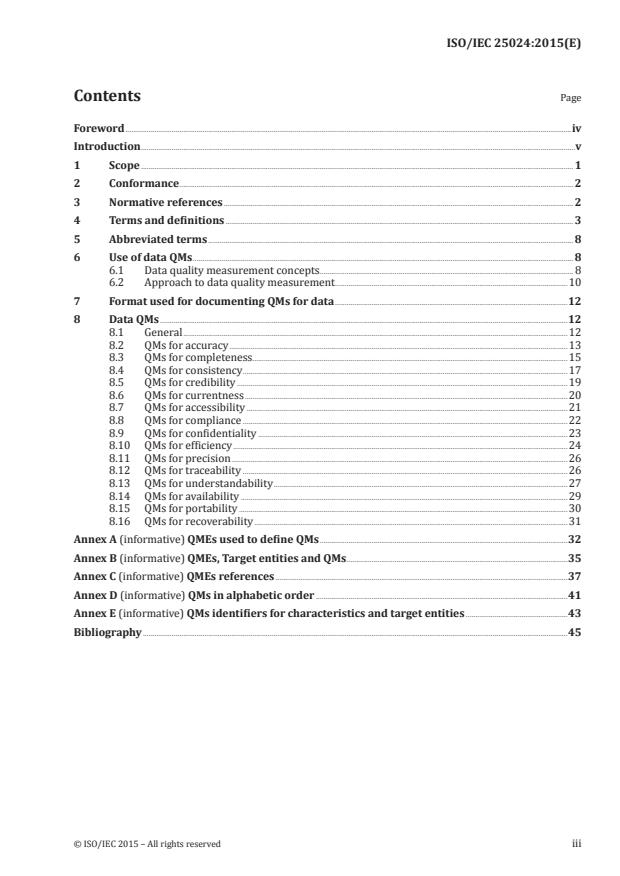
Contents Page
Foreword .iv
Introduction .v
1 Scope . 1
2 Conformance . 2
3 Normative references . 2
4 Terms and definitions . 3
5 Abbreviated terms . 8
6 Use of data QMs . 8
6.1 Data quality measurement concepts . . 8
6.2 Approach to data quality measurement .10
7 Format used for documenting QMs for data .12
8 Data QMs .12
8.1 General .12
8.2 QMs for accuracy .13
8.3 QMs for completeness .15
8.4 QMs for consistency .17
8.5 QMs for credibility .19
8.6 QMs for currentness .20
8.7 QMs for accessibility .21
8.8 QMs for compliance .22
8.9 QMs for confidentiality .23
8.10 QMs for efficiency .24
8.11 QMs for precision .26
8.12 QMs for traceability .26
8.13 QMs for understandability .27
8.14 QMs for availability .29
8.15 QMs for portability .30
8.16 QMs for recoverability .31
Annex A (informative) QMEs used to define QMs .32
Annex B (informative) QMEs, Target entities and QMs .35
Annex C (informative) QMEs references .37
Annex D (informative) QMs in alphabetic order .41
Annex E (informative) QMs identifiers for characteristics and target entities .43
Bibliography .45
© ISO/IEC 2015 – All rights reserved iii
Foreword
ISO (the International Organization for Standardization) and IEC (the International Electrotechnical
Commission) form the specialized system for worldwide standardization. National bodies that are
members of ISO or IEC participate in the development of International Standards through technical
committees established by the respective organization to deal with particular fields of technical
activity. ISO and IEC technical committees collaborate in fields of mutual interest. Other international
organizations, governmental and non-governmental, in liaison with ISO and IEC, also take part in the
work. In the field of information technology, ISO and IEC have established a joint technical committee,
ISO/IEC JTC 1.
The procedures used to develop this document and those intended for its further maintenance are
described in the ISO/IEC Directives, Part 1. In particular the different approval criteria needed for
the different types of document should be noted. This document was drafted in accordance with the
editorial rules of the ISO/IEC Directives, Part 2 (see www.iso.org/directives).
Attention is drawn to the possibility that some of the elements of this document may be the subject
of patent rights. ISO and IEC shall not be held responsible for identifying any or all such patent
rights. Details of any patent rights identified during the development of the document will be in the
Introduction and/or on the ISO list of patent declarations received (see www.iso.org/patents).
Any trade name used in this document is information given for the convenience of users and does not
constitute an endorsement.
For an explanation on the meaning of ISO specific terms and expressions related to conformity
assessment, as well as information about ISO’s adherence to the WTO principles in the Technical
Barriers to Trade (TBT) see the following URL: Foreword - Supplementary information
The committee responsible for this document is ISO/IEC JTC 1, Information technology, Subcommittee
SC 7, Software and systems engineering.
The SQuaRE series of standards consists of the following divisions, under the general title Systems and
software Quality Requirements and Evaluation:
— ISO/IEC 2500n — Quality Management Division;
— ISO/IEC 2501n — Quality Model Division;
— ISO/IEC 2502n — Quality Measurement Division;
— ISO/IEC 2503n — Quality Requirements Division;
— ISO/IEC 2504n — Quality Evaluation Division;
— ISO/IEC 25050 to ISO/IEC 25099 — SQuaRE Extension Division.
Annexes A, B, C, and D are for information only.
iv © ISO/IEC 2015 – All rights reserved
Introduction
This International Standard is a part of the SQuaRE series of International Standards. It provides a set
of data quality measures that can be used for measuring and evaluating data quality by referring other
SQuaRE series of standards, especially ISO/IEC 25012.
The set of data quality measures in this International Standard is selected based on their practical
value. They are not intended to be exhaustive and users of this International Standard are encouraged
to refine them if necessary.
Quality measurement division
This International Standard is a part of ISO/IEC 2502n series that currently consists of the following
International Standards:
— ISO/IEC 25020 — Measurement reference model and guide: provides a reference model and
guide for measuring the quality characteristics defined in ISO/IEC 2501n.
— ISO/IEC 25021 — Quality measure elements: provides a format for specifying quality measure
elements and some examples of quality measure elements that can be used to construct software
quality measures.
— ISO/IEC 25022 — Measurement of quality in use: provides measures including associated
measurement methods and quality measure elements for the quality characteristics in the quality
in use model.
— ISO/IEC 25023 — Measurement of system and software product quality: provides measures
including associated measurement methods and quality measure elements for the quality
characteristics in the product quality model.
— ISO/IEC 25024 — Measurement of data quality: provides measures including associated
measurement methods and quality measure elements for the quality characteristics in the data
quality model.
Figure 1 depicts the relationship between this International Standard and the other standards in
ISO/IEC 2502n.
Figure 1 — Structure of the Quality Measurement Division
© ISO/IEC 2015 – All rights reserved v
Outline and organization of SQuaRe series
The SQuaRE series consists of five main divisions and extension division. Outline of each divisions
within SQuaRE series are as follows.
— ISO/IEC 2500n — Quality Management Division. The standards that form this division define all
common models, terms, and definitions referred further by all other standards from SQuaRE series.
The division also provides requirements and guidance for the planning and management of a project.
— ISO/IEC 2501n — Quality Model Division. The standards that form this division present
quality models for system/software products, quality in use, and data. A service quality is under
development. Practical guidance on the use of the quality model is also provided.
— ISO/IEC 2502n — Quality Measurement Division. The standards that form this division include
a system/software product quality measurement reference model, definitions of quality measures,
and practical guidance for their application. This division presents internal measures of software
quality, external measures of software quality, quality in use measures, data quality measures from
“Inherent”, and “System dependent” point of view. Quality measure elements forming foundations
for the quality measures are defined and presented.
— ISO/IEC 2503n — Quality Requirements Division. The standards that form this division help
specify quality requirements. These quality requirements can be used in the process of quality
requirements elicitation for a system/software product to be developed designing a process for
achieving necessary quality or as inputs for an evaluation process.
— ISO/IEC 2504n — Quality Evaluation Division. The standards that form this division provide
requirements, recommendations, and guidelines for system/software product evaluation whether
performed by independent evaluators, acquirers, or developers. The support for documenting a
quality measure as an evaluation module is also presented.
ISO/IEC 25050 to ISO/IEC 25099 are reserved for SQuaRE extension International Standards which
currently includes ISO/IEC 25051 and ISO/IEC 25060 to ISO/IEC 25069.
vi © ISO/IEC 2015 – All rights reserved
INTERNATIONAL STANDARD ISO/IEC 25024:2015(E)
Systems and software engineering — Systems and software
Quality Requirements and Evaluation (SQuaRE) —
Measurement of data quality
1 Scope
This International Standard defines data quality measures for quantitatively measuring the data
quality in terms of characteristics defined in ISO/IEC 25012.
This International Standard contains the following:
— a basic set of data quality measures for each characteristic;
— a basic set of target entities to which the quality measures are applied during the data-life-cycle;
— an explanation of how to apply data quality measures;
— a guidance for organizations defining their own measures for data quality requirements and evaluation.
It includes, as informative annexes, a synoptic table of quality measure elements defined in this
International standard (Annex A), a table of quality measures associated to each quality measure
element and target entitiy (Annex B), considerations about specific quality measure elements (Annex
C), a list of quality measures in alphabetic order (Annex D), and a table of quality measures grouped by
characteristics and target entities (Annex E).
This International Standard does not define ranges of values of these quality measures to rate levels or
grades because these values are defined for each system by its nature depending on the system context
and users’ needs.
This International Standard can be applied to any kind of data retained in a structured format within a
computer system used for any kinds of applications.
People managing data and services including data are the primary beneficiaries of the quality measures.
This International Standard is intended to be used by people who need to produce and/or use data
quality measures while pursuing their responsibilities.
— Acquirer (an individual or organization that acquires or procures data from a supplier).
— Evaluator (an individual or organization that performs an evaluation, which can, for example, be a
testing laboratory, the quality department of an organization, a government organization, or a user).
— Developer (an individual or organization that performs development activities including
requirements, analysis, design, implementation, and testing data during the data-life-cycle).
— Maintainer (an individual or organization that performs operation and maintenance activities of data).
— Supplier (an individual or organization that enters into a contract with the acquirer for the supply
of data or service under the terms of the contract).
— User (an individual or organization that uses data to perform a specific function).
— Quality manager (an individual or organization that performs a systematic examination of the data).
— Owner (an individual or organization that takes responsibility for the management and financial
value of the data with the legal authority and responsibility to establish for them evaluation,
collections, access, dissemination, storage, security, and cancellation).
© ISO/IEC 2015 – All rights reserved 1
This International Standard takes into account a large range of data of target entities.
It can be applied in many types of information systems, for example, such as follows:
— legacy information system;
— data warehouse;
— distributed information system;
— cooperative information system;
— world wide web.
The scope does not include the following:
— knowledge representation;
— data mining techniques;
— statistical significance for random sample.
2 Conformance
Any measurement process for requirement, implementation, or evaluation of data quality shall be
conformed to this International Standard:
a) selecting data quality characteristics to be specified or evaluated as defined in ISO/IEC 25012;
b) selecting a target entity for which data quality characteristic shall be measured;
c) selecting the appropriate data quality measures defined in Clause 8 by each data quality
characteristic concerning a target entity;
d) providing the rationale for any changes when modify the data quality measures;
e) listing any additional quality measures or quality measure elements used that are not included in
this International Standard.
Order of items a) and b) can be applied in reverse.
When using modified or new data quality measures, the user shall specify the target entities,
measurement method, and related data quality characteristics of ISO/IEC 25012 or specifying any other
data quality model that is being used. This International Standard does not provide a complete list of
quality measure related to data defined during the data-life-cycle. The user may also identify some
other quality measures depending on the technology applied. Even if a number of quality measures
included in this International Standard have not been empirically validated and some of them are not
based yet on best practices observed in industry, this International Standard is still a good base and an
opportunity to improve the data quality measures.
3 Normative references
The following documents, in whole or in part, are normatively referenced in this document and are
indispensable for its application. For dated references, only the edition cited applies. For undated
references, the latest edition of the referenced document (including any amendments) applies.
ISO/IEC 25000, Systems and software engineering — Systems and software Quality Requirements and
Evaluation (SQuaRE) — Guide to SQuaRE
ISO/IEC 25012:2008, Software engineering — Software product Quality Requirements and Evaluation
(SQuaRE) — Data quality model
2 © ISO/IEC 2015 – All rights reserved
ISO/IEC 25021, Systems and software engineering — Systems and software Quality Requirements and
Evaluation (SQuaRE) — Quality measure elements
4 Terms and definitions
For the purposes of this document, the terms and definitions given in ISO/IEC 25000, ISO/IEC 25012,
ISO/IEC 25021, and the following apply.
NOTE The essential definitions from ISO/IEC 25000 SQuaRE series and the other ISO standards are
reproduced here.
4.1
architecture
fundamental concepts or properties of a system in its environment embodied in its elements
(4.19), relationships, and in the principles of its design and evolution
[SOURCE: ISO/IEC 42010:2011]
Note 1 to entry: In this International Standard, the term “architecture” is intended as “architecture of data”, a
particular view of the architecture being the work products considered expression of the perspective of a specific
system that concerns data (4.5). Architecture of data includes architecture elements such as contextual schema
(4.4), conceptual, logical, physical data models, data dictionary (4.6), and documents. In practice architecture of
data and data modelling, from the beginning of software engineering, have many levels, such as external model
(view), conceptual, and physical (see ANSI/X3/SPARK Three Level Architecture, 1975).
Note 2 to entry: The term “environment” is used in ISO/IEC 42010 to refer (system) context determining the
setting and circumstances of all influences upon a system that includes developmental, technological, business,
operational, organizational, political, economic, legal, regulatory, ecological, and social influences (in this
International Standard, the (system) context, where data models (4.10) are applied, can be represented by the
contextual schema (4.4)).
Note 3 to entry: In ISO/IEC 42010, 4.2.4, Note 1, “the architecture of a system is a holistic conception of that
system’s fundamental properties best understood via multiple views of that architecture”.
4.2
attribute
inherent property or characteristic of a target entity (4.36) that can be distinguished quantitatively or
qualitatively by human or automated means
[SOURCE: ISO/IEC 25000:2014]
4.3
computer system
system containing one or more components and elements (4.19) such as computers (hardware),
associated software, and data (4.5)
4.4
contextual schema
formal description of the boundary of the context of use where data models (4.10) are applied
Note 1 to entry: It is a high-level description of the business’ informational needs. It is more general than a
conceptual model (see Note 1 in 4.10) as it includes a holistic vision of a (system) context of the architecture (4.1).
4.5
data
reinterpretable representation of information in a formalized manner suitable for communication,
interpretation, or processing
Note 1 to entry: Data can be processed by humans or by automatic means.
© ISO/IEC 2015 – All rights reserved 3
[SOURCE: ISO/TS 19104:2008, B.103]
Note 2 to entry: The definition does not make reference to the one in ISO/IEC 25000 relative to the result of the
measurement (4.27).
4.6
data dictionary
collection of information (4.21) about data (4.5) such as name, description, creator, owner, provenance,
translation in different languages, and usage
4.7
data file
set of related data records (4.15) treated as a unit
Note 1 to entry: In this International Standard, data set is a synonym of data file.
4.8
data format
arrangement of data (4.5) for storage or display
Note 1 to entry: Format can be referred to data type (4.16) and length of data item (4.9).
4.9
data item
smallest identifiable unit of data (4.5) within a certain context for which the definition, identification,
permissible values, and other information (4.21) is specified by means of a set of properties
[SOURCE: ISO/IEC 25021:2012, Annex A]
Note 1 to entry: Field is considered a synonym of data item.
Note 2 to entry: Data item is a physical object “container” of data values (4.17).
4.10
data model
graphical and textual representation of analysis that identifies the data (4.5) needed by an organization
to achieve its mission, functions, goals, objectives, and strategies and to manage and rate the
organization.
[SOURCE: ISO/IEC/IEEE 31320-2:2012, 3.1.44]
Note 1 to entry: It is usual to distinguish conceptual model (a model of the concepts relevant to some endeavor),
logical, and physical when they represent data at different level of abstraction from high to low.
Note 2 to entry: The formal description of the boundary of the context of use where data models are applied is
called contextual schema (4.4).
Note 3 to entry: A data model identifies the entities, domains (attributes) (4.2), and relationships (associations)
with other data and provides the conceptual view of the data and the relationships among data.
4.11
data quality
degree to which the characteristics of data (4.5) satisfy stated and implied needs when used under
specified conditions
4.12
data quality characteristic
category of data quality attributes that bears on data quality (4.11)
[SOURCE: ISO/IEC 25012:2008, 4.4]
4 © ISO/IEC 2015 – All rights reserved
4.13
data quality measure
variable to which a value is assigned as the result of measurement (4.27) of a data quality
characteristic (4.12)
[SOURCE: ISO/IEC 25012:2008, 4.5]
4.14
data quality model
defined set of characteristics which provides a framework for specifying data quality requirements and
evaluating data quality (4.11)
[SOURCE: ISO/IEC 25012:2008, 4.6]
4.15
data record
set of related data items (4.9) treated as a unit
[SOURCE: ISO/IEC/IEEE 15289:2015, 5.22]
4.16
data type
categorization of an abstract set of possible values, characteristics, and set of operations for an
attribute (4.2)
Note 1 to entry: Examples of data types are character strings, texts, dates, numbers, images, sounds, etc.
[SOURCE: ISO/IEC 25012:2008, 4.7]
4.17
data value
content of data item (4.9)
Note 1 to entry: In ISO/IEC 25012, 5.1.1, it is specified that from the “Inherent” point of view, data quality (4.11)
refers to data (4.5) itself such as data domain values and possible restrictions.
Note 2 to entry: Number or category assigned to an attribute (4.2) of a target entity (4.36) by making a
measurement (4.27).
[SOURCE: ISO/IEC 25000:2005]
4.18
database management system
organized collection of structured data
Note 1 to entry: In order to use database management systems (DBMS), it is necessary to represent data (4.5)
and the relative operations on it in terms of a data model (4.10), a data definition and manipulation language (see
Table C.3.1).
4.19
element
smaller part of an architecture (4.1)
Note 1 to entry: In this International Standard, the term is used with reference to the architecture of data and to
the computer program domain such as data model (4.10) or data dictionary (4.6).
4.20
form
module or formulary to collect data (4.5)
Note 1 to entry: It can be paper-based (paper form) or digital.
© ISO/IEC 2015 – All rights reserved 5
4.21
information
in information processing, knowledge concerning objects, such as facts, events, things, processes, or
ideas, including concepts, that within a certain context have a particular meaning
[SOURCE: ISO/IEC 25012:2008, 4.10]
Note 1 to entry: Information will necessarily have a representation form to make it communicable. It is the
interpretation of this representation (the meaning) that is relevant in the first place.
4.22
information item
separately identifiable body of information (4.21) that is produced, stored, and delivered for human use
[SOURCE: ISO/IEC/IEEE 15289:2015, 5.13]
Note 1 to entry: Information product is a synonym.
Note 2 to entry: Information item can be produced in several versions during a project data-life-cycle.
4.23
information item content
information (4.21) included in an information item (4.22), associated with a system, product, or service
to satisfy a requirement or need
[SOURCE: ISO/IEC/IEEE 15289:2015, 5.14]
4.24
information system
one or more computer systems (4.3) and communication systems together with associated organizational
resources such as human, technical, and financial resources that provide and distribute information (4.21)
[SOURCE: ISO/IEC 25012:2008, 4.14]
4.25
master data
data (4.5) held by an organization that describes the entities that are both independent and fundamental
for an enterpirse that it needs to reference in order to perform its transaction
[SOURCE: ISO 22745-2:2010, 14.9, modified]
Note 1 to entry: Master data is a subset of data of a computer system (4.3), identified, categorized, and managed
that are essential for the core business of an enterprise.
4.26
measure
variable to which a value is assigned as the result of measurement (4.27)
Note 1 to entry: The term “measures” is used to refer collectively to base measures, derived measures, and
indicators.
[SOURCE: ISO/IEC 25010:2011, 4.4.5]
4.27
measurement
set of operations having the object of determining a value of a measure (4.26)
[SOURCE: ISO/IEC 25010:2011, 4.4.7]
6 © ISO/IEC 2015 – All rights reserved
4.28
measurement function
algorithm or calculation performed to combine two or more quality measure elements (4.32)
[SOURCE: ISO/IEC 25021:2012, 4.7]
4.29
metadata
data (4.5) that describe other data
[SOURCE: ISO/IEC 25012:2008, 4.13]
4.30
presentation device
device used to present data (4.5) to the intended user of a system
4.31
quality measure
measure (4.26) that is defined as a measurement function (4.28) of two or more values of quality measure
elements (4.32)
[SOURCE: ISO/IEC 25010:2011, 4.3.10]
4.32
quality measure element
measure (4.26) defined in terms of a property and the measurement method for quantifying it, including
optionally the transformation by mathematical function
[SOURCE: ISO/IEC 25021:2012, 4.14]
4.33
quality model
defined set of characteristics, and of relationships between them, which provides a framework for
specifying quality requirements and evaluating quality
[SOURCE: ISO/IEC 25010:2011, 4.4.8]
4.34
relational database management system
management system for relational database
Note 1 to entry: In order to use relational data base management systems (RDBMS), it is necessary to represent
relational model of data that organizes data (4.5) with specific characteristics (tables or relations, unique key,
etc.) (see Table C.3.1).
4.35
semantics
meaning of the syntactic components of a language
[SOURCE: ISO/IEC/IEEE 31320-2:2012, 3.1.175]
4.36
target entity
fundamental thing of relevance to the user, about which information (4.21) is kept, and need to be measured
[SOURCE: ISO/IEC 25021:2012, 4.17]
Note 1 to entry: Possible synonyms of target entity are input to information product and work product.
Note 2 to entry: Examples of target entities are architecture (4.1), contextual schema (4.4), conceptual and logical
and physical data models, data dictionary (4.6), document, data file (4.7), database management, relational
database management system, form (4.20), and presentation device (4.30).
© ISO/IEC 2015 – All rights reserved 7
Note 3 to entry: Target entities are precisely defined by properties. Examples of properties are attribute (4.2),
element (4.19), information, metadata (4.29), vocabulary (4.38), data format (4.8), data item (4.9), data value (4.17),
information item (4.22), information item content (4.23), and data record (4.15).
4.37
tuple
set of fields or data items (4.9)
Note 1 to entry: Tuple can be used in place of record.
4.38
vocabulary
collection of information (4.21) related to a specific subset of terms related to a specific domain
Note 1 to entry: Vocabulary is generally used to keep consistency, to avoid duplication, and to support synonyms.
5 Abbreviated terms
The following abbreviations are used in this International Standard.
QM Quality Measure
QME Quality Measure Element
DLC Data-Life-Cycle
DBMS Database Management System
RDBMS Relational Database Management System
6 Use of data QMs
6.1 Data quality measurement concepts
Stated and implied needs of system/software quality are represented in the SQuaRE series of standards
by quality models that categorise system/software product quality, quality in use and data quality
characteristics. The concept of data quality characteristics is defined in ISO/IEC 25012 that categorizes
data quality into 15 characteristics.
The measurable quality-related properties of a data are called properties to quantify, with associated
QMs. These properties are measured by applying a measurement method. A measurement method
is a logical sequence of operations used to quantify properties with respect to a specified scale. The
application of a measurement method is called a QME.
The data quality characteristics can be quantified by applying measurement functions. A measurement
function is an algorithm used to combine QMEs. The result of applying a measurement function derives
QM. In this way, QMs become quantifications of the data quality characteristics. More than one QM can
be used for the measurement of a data quality characteristic (see ISO/IEC 25021, Figure 5).
8 © ISO/IEC 2015 – All rights reserved
Figure 2 — Relationship among quality models, QM, QME, property to quantify, target entity
Figure 2 describes the relationship among quality models, QMs, QMEs, properties to quantify, and target
entities. Referring to the data quality model described in ISO/IEC 25012, the arrows indicate the following:
— data quality model outlines quality characteristics;
— quality characteristics can be evaluated using QMs that are defined by applying a measurement
function to QMEs;
— each QME is defined by applying a measurement method to a property to quantify;
— properties are attributes of related target entities.
According to ISO/IEC 25012, data quality can be measured from ”Inherent” and “System-dependent”
points of view.
The QMs from “Inherent” point of view may be applied to data itself, in particular to the following:
— data domain values and possible restrictions (e.g. business rules governing the quality required for
the characteristic in a given application);
— relationships of data values (e.g. consistency);
— metadata.
The QMs from the “System dependent” point of view may be used to quantify the influence on data of
computer systems components, such as hardware devices, computer system software and other software.
QMs on data are expected to be correlated with other QMs and other target entities of quality. The
relationship between data QMs and other types of QMs related to “process quality” and “quality in use”
is shown in Figure 3.
© ISO/IEC 2015 – All rights reserved 9
Figure 3 — Relationship between types of QMs
High quality of the development and maintenance process is able to realize high quality of data,
considered as a product. Moreover, data quality influences quality in use which represents the effect
perceived by the final user.
6.2 Approach to data quality measurement
The QMs described in this International Standard are concerning data and can be used over all DLC
stages and for other processes, for example:
— to establish data quality requirements;
— to evaluate data quality;
— to support and implement data governance, data management, data documentation process;
— to support and implement IT services management processes;
— to support improvement of data quality and effectiveness of business decisions process;
— to benchmark data quality of different data management solutions during investigation process;
— to evaluate the quality of system and/or software components that produce data as an outcome.
In each stage of a DLC, data quality can be assessed by measuring characteristics from target entities.
In this International Standard, target entities are the work products of DLC and target entities are
precisely defined by properties.
Target entities are represented in different types and they can be managed and stored with different
technologies, sometimes they may even be “paper-based”.
Target entities are produced and/or managed by processes in each stage of DLC, as it is for system and
software life-cycle.
An example of DLC is represented in Figure 4.
10 © ISO/IEC 2015 – All rights reserved
Figure 4 — Example of DLC
The following target entities are considered.
Target entities related to the Data design stage:
— architecture;
— contextual schema;
— data models (conceptual, logical, physical);
— data dictionary;
— document.
Properties specified for these target entities:
— attribute;
— element;
— information;
— metadata;
— vocabulary
Target entities related to the other stages of DLC Data collection, External data acquisition, Data
integration, Data processing, Presentation, Other use, Data store, Delete:
— data file;
— DBMS;
— RDBMS;
— form;
— presentation device.
Properties specified for these target entities:
— data format;
— data item;
— data value;
— information item;
© ISO/IEC 2015 – All rights reserved 11
— information item content;
— data record.
The data QMs listed in this International Standard were selected based on the different practices of
stakeholders and are related to the following:
— the practical use by organizations;
— innovative perspectives coming from academic institutions, experts, and national regulators;
— the experimental use by researchers.
7 Format used for documenting QMs for data
The data QMs listed in Clause 8 are categorised by the data quality characteristics in ISO/IEC 25012.
For each data QM the following information is provided:
a) ID: identification code (or identifier) of a data QM; each ID consists of the following three parts:
— abbreviated alphabetic code representing the quality characteristics;
— I (“Inherent”) or D (“System dependent”) expressing the point of view of data quality characteristics;
— serial number of sequential order within data quality characteristics and point of view;
b) Name: QM name related to data;
c) Description: the information provided by the data QM and (when useful) the purpose of the measure;
d) Measurement function: formula showing how the QMEs are combined to produce the QM;
e) DLC, Target entities, Properties: DLC includes stages of the DLC where the data QMEs are
applicable, target entities and properties of target entities;
f) Note: in the note, additional information such as an acceptable range of values, reference to other
standards, explanations or interpretation or criteria, measurement method used to obtain the
measures can be defined (i.e. automatic tools, customized software, activities such as inspections,
audits, reviews, etc.).
8 Data QMs
8.1 General
This International Standard provides a basic set of data QMs generated by a measurement function
applied to the QMEs connected to target entities identified in the DLC.
Generally, the measurement function normalizes the value within a range from 0,0 to 1,0 (or
greater); growing values toward 1,0 (or greater value, e.g. in the case of a lack of upper value) means
that requirements for better quality are increasingly met. For specific cases, value interpretation is
described in a NOTE.
The QMs defined in this clause are listed by data quality characteristics defined in ISO/IEC 25012, in
the same order introduced in ISO/IEC 25012. The data QMs listed in ISO/IEC 25012 were only intended
as examples; a more extensive list of data QMs is in this International Standard, although it cannot
be considered to be an exhaustive set. In this International Standard, all the examples described in
ISO/IEC 25012 are taken up again with the necessary changes, quoting in a NOTE the original clause
of ISO/IEC 25012. In coherence with ISO/IEC 25012, data QMs, likewise corresponding data quality
characteristics, will be varying in importance and priority to different stakeholders, depending on the
specific context of use and the DLC stage.
12 © ISO/IEC 2015 – All rights reserved
A QME can be considered in more than one QM, with different qualifiers. The same QM can be considered
for several entities.
In this Clause, the word “measures” always refers to QMs unless otherwise mentioned.
Additional information and synoptic tables, concerning QMs and QMEs, are in the Annexes.
Annex A provides QMEs used to define data QMs.
Annex B provides for each QME and Target entitiy the correspondent QMs.
Annex C provides QMEs references.
Annex D provides QMs listed in alphabetic order.
Annex E provides QMs identifiers for data quality characteristics and target entities
8.2 QMs for accuracy
Accuracy measures provide the degree to which data has attributes that correctly represent the true
value of the intended attribute of a concept or event in a specific context of use.
Accuracy can be measured from the “Inherent” point of view only. Accuracy implies in some cases that
the values agree with an identified source of validated information.
Table 1 — Accuracy measures: “Inherent” point of view
ID Name Description Measurement function DLC
Target entities
Properties
Acc-I-1 Syntactic Ratio of closeness of X=A/B All DLC except Data design
data the data values to a set A= number of data items
Data file
accuracy of values defined in a which have related values
domain syntactically accurate Data item, data value
B= number of data items for
which syntactic accuracy is
required
NOTE 1 A single value is considered “syntactically accurate” when it is the same as one from an identified
source of validated information: the result is “yes” or “no”.
NOTE 2 An example of a low degree of syntactic accuracy is when the word Mary is stored as Marj.
NOTE 3 See ISO/IEC 25012, 5.3.1.1.
Acc-I-2 Semantic Ratio of how accurate X=A/B All DLC except Data design
data are the data values in
A= number of data values Data file
accuracy terms of semantics in
semantically accurate
a specific context
Data value
B= number of data values for
which semantic accuracy is
required
NOTE 1 A single value is considered “semantically accurate” when the meaning (the content) corresponds to
the reality.
NOTE 2 An example of a low degree of semantic accuracy is when the name of John is recorded instead of
George; both names are syntactically accurate, so only George is semantically accurate.
NOTE 3 See ISO/IEC 25012, 5.3.1.1.
Acc-I-3 Data Ratio of measurement X=A/B All DLC except Data design
accuracy coverage for accurate A= number of data items
Data file
assurance data measured for accuracy
B= number of data items for Data item
which measurement is
required for accuracy
© ISO/IEC 2015 – All rights reserved 13
Table 1 (continued)
ID Name Description Measurement function DLC
Target entities
Properties
NOTE This measure is relevant to control data quality, if applied on the raw data, especially when a software
program for data error attenuation is not available. This QM does not measure the quality of the data, but
it measures the thoroughness and application of the accuracy measures. It is a measure of the attention given to
the accuracy matter.
Acc-I-4 Risk of The number of X=A/B All DLC except Data design
data set outliers in values is A= number of data values
Data file
inaccuracy indicating a risk of that are outliers
inaccuracy for data B= number of data values to Data value
values i
...