

ISO 19746:2017
(Main)Determination of urea content in urea-based fertilizers by high performance liquid chromatography (HPLC)
General Information
- Abstract
ISO 19746:2017 specifies the test procedure for determining the urea content in urea-based fertilizers, including urea, urea aldehydes [methylene urea fertilizers, isobutylene diurea (IBDU), crotonylidene diurea (CDU)], urea triazone fertilizers, urea ammonium nitrate (UAN), sulfur- and polymer-coated urea (SCU and PCU), as well as compound fertilizers containing urea. The method is based on High Performance Liquid Chromatography (HPLC). The proposed method is an extension of the AOAC Official Method 2003.14 which was collaboratively studied for the "Determination of Urea in Water-Soluble Urea-Formaldehyde Fertilizer Products and in Aqueous Urea Solutions" in 2003. The method was published in the Journal of AOAC in 2004[4] and was granted the First Action in 2003 and the Final Action in 2008. This method also applies to the determination of biuret content in urea containing fertilizer with the results published in the J. AOAC in 2014[5]. This method was adopted by the International Organization for Standardization (ISO) as a Committee Draft (ISO/CD 18643) in 2014, and after review and the Ring Test Analyses[6].
- Status
- Published
- Publication Date
- 22-Feb-2017
- Technical Committee
- ISO/TC 134 - Fertilizers, soil conditioners and beneficial substances
- Drafting Committee
- ISO/TC 134/WG 1 - Fertilizers
- Current Stage
- 9093 - International Standard confirmed
- Start Date
- 19-Jun-2022
- Completion Date
- 29-Aug-2026
Buy Documents


ISO 19746:2017 - Determination of urea content in urea-based fertilizers by high performance liquid chromatography (HPLC)
ISO 19746:2017 - Determination of urea content in urea-based fertilizers by high performance liquid chromatography (HPLC)/23/2017
Overview
ISO 19746:2017 specifies a standardized HPLC method for the determination of urea content in urea-based fertilizers. The scope covers pure urea, urea aldehydes (methylene urea, IBDU, CDU), urea triazone, UAN (urea ammonium nitrate), sulfur- and polymer-coated urea (SCU, PCU), and compound fertilizers containing urea. The method is based on High Performance Liquid Chromatography (HPLC) and is an extension of the AOAC Official Method 2003.14. Keywords: ISO 19746:2017, urea content, urea-based fertilizers, HPLC, urea determination.
Key topics and technical requirements
- Analytical principle: Extraction of urea with an aqueous acetonitrile mobile phase and separation on an aminopropyl HPLC column with UV detection.
- Mobile phase: Recommended composition is 850 ml acetonitrile + 150 ml water (LC grade acetonitrile); filter (0.22 μm) and degas before use.
- Standards and calibration: Urea standard solution (0.5 mg/ml) and a multi‑level working standard series to prepare a standard curve; at least two replicates per level.
- HPLC conditions: Typical settings include aminopropyl column, flow rate around 1.0 ml/min (other rates may be used), column temperature ~35 °C, injection volumes (e.g., 10 μl), and UV detection near 195–200 nm.
- Sample preparation: Grinding/sieving for solids (0.5 mm), ultrasonic dissolution, filtration (2.0 μm for sample particles; 0.22 μm for HPLC), and dilution to volumetric flasks per method.
- Calculations and reporting: Mass fraction of urea (%) calculated from the standard curve; report must include sample ID, method reference (ISO 19746), test results, sampling/analysis dates and repeatability assessment.
- Precision: Repeatability and reproducibility are addressed; users are directed to AOAC collaborative study data for statistical detail.
Applications and who uses it
- Quality control laboratories in fertilizer manufacturing to verify labeled urea content.
- Regulatory authorities verifying compliance with product specifications and nitrogen availability.
- Research and development teams characterizing modified and controlled‑release urea products (e.g., SCU, PCU, methylene ureas).
- Independent testing labs performing contract analyses for producers and distributors. Practical benefits include distinguishing free (readily available) urea from reacted/slow‑release urea forms and enabling consistent inter‑laboratory comparisons.
Related standards and references
- AOAC Official Method 2003.14 (basis for method development)
- ISO 3696 (water for analytical laboratory use)
- EN 15705 (related analyses for IBDU/CDU in fertilizers)
- ISO draft history: ISO/CD 18643 and ring test analyses are part of the method’s validation path.
ISO 19746:2017 provides a reproducible HPLC procedure for accurate urea quantification across diverse urea‑based fertilizer formulations, supporting product quality, regulatory compliance, and research.
Relations
- Effective Date
- 09-Feb-2026
Buy Documents
ISO 19746:2017 - Determination of urea content in urea-based fertilizers by high performance liquid chromatography (HPLC)
ISO 19746:2017 - Determination of urea content in urea-based fertilizers by high performance liquid chromatography (HPLC)/23/2017
Get Certified
Connect with accredited certification bodies for this standard

Control Union Certifications
Global certification for agriculture and sustainability.

ECOCERT
Organic and sustainability certification.

FSC International
Forest Stewardship Council certification.
Sponsored listings
Frequently Asked Questions
ISO 19746:2017 is a standard published by the International Organization for Standardization (ISO). Its full title is "Determination of urea content in urea-based fertilizers by high performance liquid chromatography (HPLC)". This standard covers: ISO 19746:2017 specifies the test procedure for determining the urea content in urea-based fertilizers, including urea, urea aldehydes [methylene urea fertilizers, isobutylene diurea (IBDU), crotonylidene diurea (CDU)], urea triazone fertilizers, urea ammonium nitrate (UAN), sulfur- and polymer-coated urea (SCU and PCU), as well as compound fertilizers containing urea. The method is based on High Performance Liquid Chromatography (HPLC). The proposed method is an extension of the AOAC Official Method 2003.14 which was collaboratively studied for the "Determination of Urea in Water-Soluble Urea-Formaldehyde Fertilizer Products and in Aqueous Urea Solutions" in 2003. The method was published in the Journal of AOAC in 2004[4] and was granted the First Action in 2003 and the Final Action in 2008. This method also applies to the determination of biuret content in urea containing fertilizer with the results published in the J. AOAC in 2014[5]. This method was adopted by the International Organization for Standardization (ISO) as a Committee Draft (ISO/CD 18643) in 2014, and after review and the Ring Test Analyses[6].
ISO 19746:2017 specifies the test procedure for determining the urea content in urea-based fertilizers, including urea, urea aldehydes [methylene urea fertilizers, isobutylene diurea (IBDU), crotonylidene diurea (CDU)], urea triazone fertilizers, urea ammonium nitrate (UAN), sulfur- and polymer-coated urea (SCU and PCU), as well as compound fertilizers containing urea. The method is based on High Performance Liquid Chromatography (HPLC). The proposed method is an extension of the AOAC Official Method 2003.14 which was collaboratively studied for the "Determination of Urea in Water-Soluble Urea-Formaldehyde Fertilizer Products and in Aqueous Urea Solutions" in 2003. The method was published in the Journal of AOAC in 2004[4] and was granted the First Action in 2003 and the Final Action in 2008. This method also applies to the determination of biuret content in urea containing fertilizer with the results published in the J. AOAC in 2014[5]. This method was adopted by the International Organization for Standardization (ISO) as a Committee Draft (ISO/CD 18643) in 2014, and after review and the Ring Test Analyses[6].
ISO 19746:2017 is classified under the following ICS (International Classification for Standards) categories: 65.080 - Fertilizers. The ICS classification helps identify the subject area and facilitates finding related standards.
ISO 19746:2017 has the following relationships with other standards: It is inter standard links to EN 18103:2025. Understanding these relationships helps ensure you are using the most current and applicable version of the standard.
ISO 19746:2017 is available in PDF format for immediate download after purchase. The document can be added to your cart and obtained through the secure checkout process. Digital delivery ensures instant access to the complete standard document.
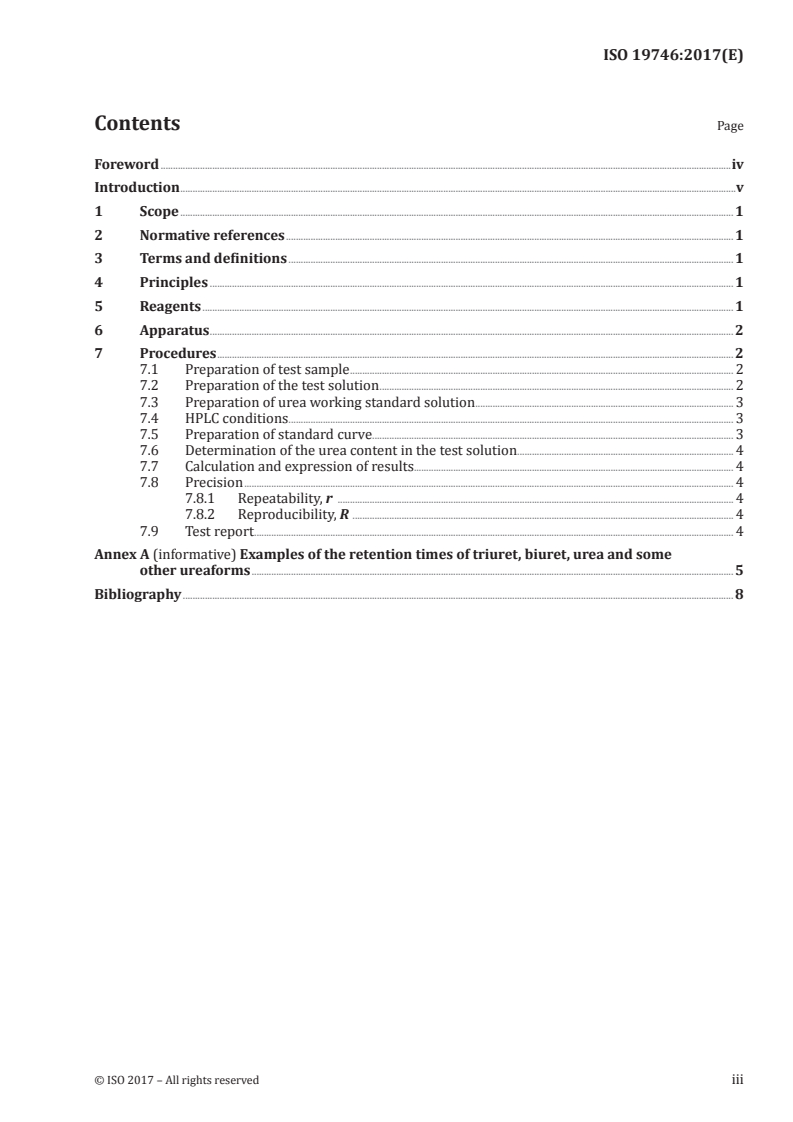
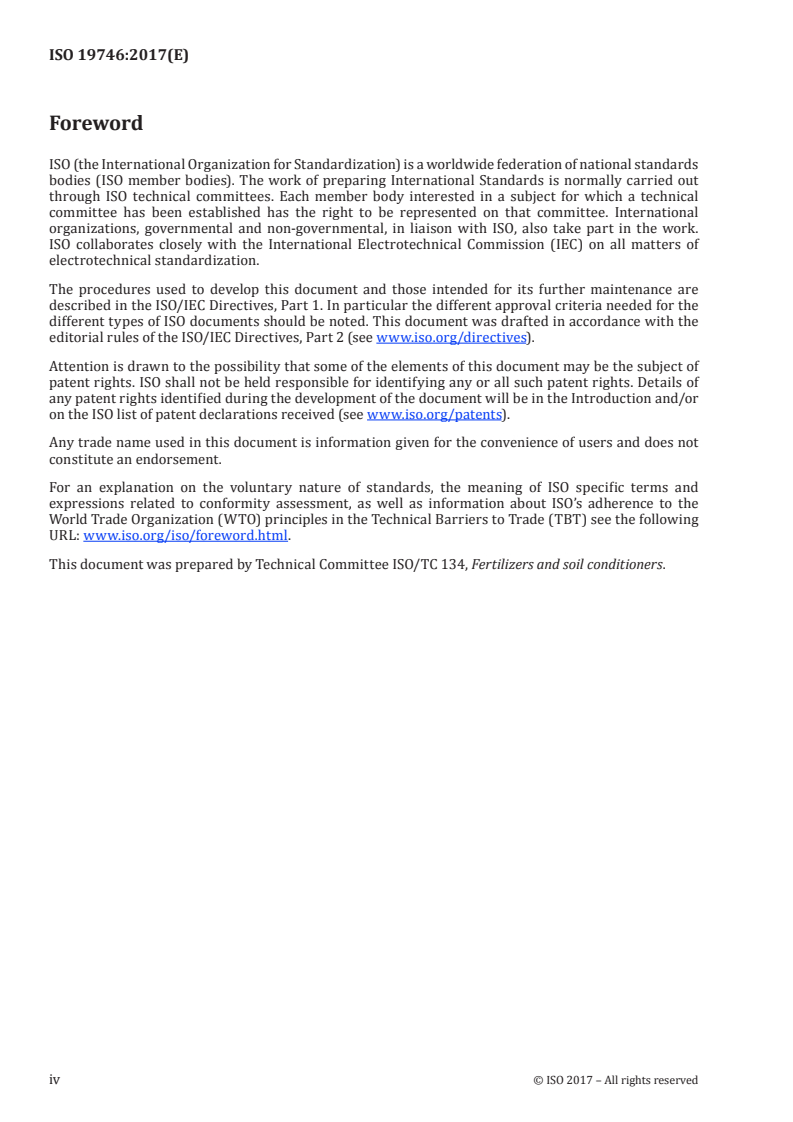
Standards Content (Sample)
INTERNATIONAL ISO
STANDARD 19746
First edition
2017-02
Determination of urea content in urea-
based fertilizers by high performance
liquid chromatography (HPLC)
Détermination de la teneur en urée dans les engrais à base d’urée par
chromatographie liquide à haute performance (CLHP)
Reference number
©
ISO 2017
© ISO 2017, Published in Switzerland
All rights reserved. Unless otherwise specified, no part of this publication may be reproduced or utilized otherwise in any form
or by any means, electronic or mechanical, including photocopying, or posting on the internet or an intranet, without prior
written permission. Permission can be requested from either ISO at the address below or ISO’s member body in the country of
the requester.
ISO copyright office
Ch. de Blandonnet 8 • CP 401
CH-1214 Vernier, Geneva, Switzerland
Tel. +41 22 749 01 11
Fax +41 22 749 09 47
copyright@iso.org
www.iso.org
ii © ISO 2017 – All rights reserved
Contents Page
Foreword .iv
Introduction .v
1 Scope . 1
2 Normative references . 1
3 Terms and definitions . 1
4 Principles . 1
5 Reagents . 1
6 Apparatus . 2
7 Procedures . 2
7.1 Preparation of test sample . 2
7.2 Preparation of the test solution . 2
7.3 Preparation of urea working standard solution . 3
7.4 HPLC conditions . 3
7.5 Preparation of standard curve . 3
7.6 Determination of the urea content in the test solution . . 4
7.7 Calculation and expression of results. 4
7.8 Precision . 4
7.8.1 Repeatability, r . 4
7.8.2 Reproducibility, R . 4
7.9 Test report . 4
Annex A (informative) Examples of the retention times of triuret, biuret, urea and some
other ureaforms . 5
Bibliography . 8
Foreword
ISO (the International Organization for Standardization) is a worldwide federation of national standards
bodies (ISO member bodies). The work of preparing International Standards is normally carried out
through ISO technical committees. Each member body interested in a subject for which a technical
committee has been established has the right to be represented on that committee. International
organizations, governmental and non-governmental, in liaison with ISO, also take part in the work.
ISO collaborates closely with the International Electrotechnical Commission (IEC) on all matters of
electrotechnical standardization.
The procedures used to develop this document and those intended for its further maintenance are
described in the ISO/IEC Directives, Part 1. In particular the different approval criteria needed for the
different types of ISO documents should be noted. This document was drafted in accordance with the
editorial rules of the ISO/IEC Directives, Part 2 (see www .iso .org/ directives).
Attention is drawn to the possibility that some of the elements of this document may be the subject of
patent rights. ISO shall not be held responsible for identifying any or all such patent rights. Details of
any patent rights identified during the development of the document will be in the Introduction and/or
on the ISO list of patent declarations received (see www .iso .org/ patents).
Any trade name used in this document is information given for the convenience of users and does not
constitute an endorsement.
For an explanation on the voluntary nature of standards, the meaning of ISO specific terms and
expressions related to conformity assessment, as well as information about ISO’s adherence to the
World Trade Organization (WTO) principles in the Technical Barriers to Trade (TBT) see the following
URL: w w w . i s o .org/ iso/ foreword .html.
This document was prepared by Technical Committee ISO/TC 134, Fertilizers and soil conditioners.
iv © ISO 2017 – All rights reserved
Introduction
Urea is the most widely used source of nitrogen fertilizers worldwide and is used in a variety of
forms such as pure urea, in combination with other nutrients, in complex fertilizers, and as reacted or
[2]
modified ureas .
[3]
Due to the rapid hydrolysis of urea in the environment, especially when applied at the soil surface ,
efforts have been made to modify urea to slow down this loss process. Slow release nitrogen fertilizers
such as methylene urea compounds, controlled release N fertilizers such as sulfur-coated urea (SCU)
or polymer-coated urea (PCU), and stabilized N fertilizers containing additives (urease inhibitors and
nitrification inhibitors) are examples of products aimed at containing the rapid hydrolyses of urea in
the soil.
Accurate determination of urea in urea-based fertilizers is desirable for regulatory and product
quality purposes. This is especially true for those fertilizers in which the urea content is physically or
chemically modified. Most of these modified fertilizers contain some amounts of free and unreacted
urea which is readily available N and therefore could not be accounted as part of the slow or controlled
[5]
release N component .
INTERNATIONAL STANDARD ISO 19746:2017(E)
Determination of urea content in urea-based fertilizers by
high performance liquid chromatography (HPLC)
1 Scope
This document specifies the test procedure for determining the urea content in urea-based fertilizers,
including urea, urea aldehydes [methylene urea fertilizers, isobutylene diurea (IBDU), crotonylidene
diurea (CDU)], urea triazone fertilizers, urea ammonium nitrate (UAN), sulfur- and polymer-coated
urea (SCU and PCU), as well as compound fertilizers containing urea. The method is based on High
Performance Liquid Chromatography (HPLC).
The proposed method is an extension of the AOAC Official Method 2003.14 which was collaboratively
studied for the “Determination of Urea in Water-Soluble Urea-Formaldehyde Fertilizer Products and in
[4]
Aqueous Urea Solutions” in 2003. The method was published in the Journal of AOAC in 2004 and was
granted the First Action in 2003 and the Final Action in 2008.
This method also applies to the determination of biuret content in urea containing fertilizer with the
[5]
results published in the J. AOAC in 2014 . This method was adopted by the International Organization
for Standardization (ISO) as a Committee Draft (ISO/CD 18643) in 2014, and after review and the Ring
[6]
Test Analyses .
NOTE This HPLC method can also be utilized to analyse Crotonylidene diurea (CDU) and Isobutylidene
[1]
diurea (IBDU) contents within those above-mentioned fertilizers, in addition to EN 15705 .
2 Normative references
The fo
...
INTERNATIONAL ISO
STANDARD 19746
First edition
2017-02
Determination of urea content in urea-
based fertilizers by high performance
liquid chromatography (HPLC)
Détermination de la teneur en urée dans les engrais à base d’urée par
chromatographie liquide à haute performance (CLHP)
Reference number
©
ISO 2017
© ISO 2017, Published in Switzerland
All rights reserved. Unless otherwise specified, no part of this publication may be reproduced or utilized otherwise in any form
or by any means, electronic or mechanical, including photocopying, or posting on the internet or an intranet, without prior
written permission. Permission can be requested from either ISO at the address below or ISO’s member body in the country of
the requester.
ISO copyright office
Ch. de Blandonnet 8 • CP 401
CH-1214 Vernier, Geneva, Switzerland
Tel. +41 22 749 01 11
Fax +41 22 749 09 47
copyright@iso.org
www.iso.org
ii © ISO 2017 – All rights reserved
Contents Page
Foreword .iv
Introduction .v
1 Scope . 1
2 Normative references . 1
3 Terms and definitions . 1
4 Principles . 1
5 Reagents . 1
6 Apparatus . 2
7 Procedures . 2
7.1 Preparation of test sample . 2
7.2 Preparation of the test solution . 2
7.3 Preparation of urea working standard solution . 3
7.4 HPLC conditions . 3
7.5 Preparation of standard curve . 3
7.6 Determination of the urea content in the test solution . . 4
7.7 Calculation and expression of results. 4
7.8 Precision . 4
7.8.1 Repeatability, r . 4
7.8.2 Reproducibility, R . 4
7.9 Test report . 4
Annex A (informative) Examples of the retention times of triuret, biuret, urea and some
other ureaforms . 5
Bibliography . 8
Foreword
ISO (the International Organization for Standardization) is a worldwide federation of national standards
bodies (ISO member bodies). The work of preparing International Standards is normally carried out
through ISO technical committees. Each member body interested in a subject for which a technical
committee has been established has the right to be represented on that committee. International
organizations, governmental and non-governmental, in liaison with ISO, also take part in the work.
ISO collaborates closely with the International Electrotechnical Commission (IEC) on all matters of
electrotechnical standardization.
The procedures used to develop this document and those intended for its further maintenance are
described in the ISO/IEC Directives, Part 1. In particular the different approval criteria needed for the
different types of ISO documents should be noted. This document was drafted in accordance with the
editorial rules of the ISO/IEC Directives, Part 2 (see www .iso .org/ directives).
Attention is drawn to the possibility that some of the elements of this document may be the subject of
patent rights. ISO shall not be held responsible for identifying any or all such patent rights. Details of
any patent rights identified during the development of the document will be in the Introduction and/or
on the ISO list of patent declarations received (see www .iso .org/ patents).
Any trade name used in this document is information given for the convenience of users and does not
constitute an endorsement.
For an explanation on the voluntary nature of standards, the meaning of ISO specific terms and
expressions related to conformity assessment, as well as information about ISO’s adherence to the
World Trade Organization (WTO) principles in the Technical Barriers to Trade (TBT) see the following
URL: w w w . i s o .org/ iso/ foreword .html.
This document was prepared by Technical Committee ISO/TC 134, Fertilizers and soil conditioners.
iv © ISO 2017 – All rights reserved
Introduction
Urea is the most widely used source of nitrogen fertilizers worldwide and is used in a variety of
forms such as pure urea, in combination with other nutrients, in complex fertilizers, and as reacted or
[2]
modified ureas .
[3]
Due to the rapid hydrolysis of urea in the environment, especially when applied at the soil surface ,
efforts have been made to modify urea to slow down this loss process. Slow release nitrogen fertilizers
such as methylene urea compounds, controlled release N fertilizers such as sulfur-coated urea (SCU)
or polymer-coated urea (PCU), and stabilized N fertilizers containing additives (urease inhibitors and
nitrification inhibitors) are examples of products aimed at containing the rapid hydrolyses of urea in
the soil.
Accurate determination of urea in urea-based fertilizers is desirable for regulatory and product
quality purposes. This is especially true for those fertilizers in which the urea content is physically or
chemically modified. Most of these modified fertilizers contain some amounts of free and unreacted
urea which is readily available N and therefore could not be accounted as part of the slow or controlled
[5]
release N component .
INTERNATIONAL STANDARD ISO 19746:2017(E)
Determination of urea content in urea-based fertilizers by
high performance liquid chromatography (HPLC)
1 Scope
This document specifies the test procedure for determining the urea content in urea-based fertilizers,
including urea, urea aldehydes [methylene urea fertilizers, isobutylene diurea (IBDU), crotonylidene
diurea (CDU)], urea triazone fertilizers, urea ammonium nitrate (UAN), sulfur- and polymer-coated
urea (SCU and PCU), as well as compound fertilizers containing urea. The method is based on High
Performance Liquid Chromatography (HPLC).
The proposed method is an extension of the AOAC Official Method 2003.14 which was collaboratively
studied for the “Determination of Urea in Water-Soluble Urea-Formaldehyde Fertilizer Products and in
[4]
Aqueous Urea Solutions” in 2003. The method was published in the Journal of AOAC in 2004 and was
granted the First Action in 2003 and the Final Action in 2008.
This method also applies to the determination of biuret content in urea containing fertilizer with the
[5]
results published in the J. AOAC in 2014 . This method was adopted by the International Organization
for Standardization (ISO) as a Committee Draft (ISO/CD 18643) in 2014, and after review and the Ring
[6]
Test Analyses .
NOTE This HPLC method can also be utilized to analyse Crotonylidene diurea (CDU) and Isobutylidene
[1]
diurea (IBDU) contents within those above-mentioned fertilizers, in addition to EN 15705 .
2 Normative references
The fo
...