

ISO 7383-1:2024
(Main)Fine bubble technology — Evaluation method for determining gas content in fine bubble dispersions in water — Part 1: Oxygen content
General Information
- Abstract
This document specifies evaluation methods for the oxygen content in fine bubble dispersion in water. Three test methods which are adopted include the optical sensor, the electrochemical probe and the iodometric method. The first two methods have an advantage in availability of in situ and real-time measurement, and high accessibility to commercially available instruments. The last one, composed of a well-established chemical analysis procedure, is advantageous in the situation where the instruments to be used in the first two methods are unavailable. The detection limits of the electrochemical and optical sensor methods are stated in the instruction manuals of the instruments, in most cases 0,1 mg/l or 0,2 mg/l. The upper limit depends on the specification of the instrument used. Most instruments allow measurement of a supersaturated sample. Measurement range of the iodometric method is between 0,2 mg/l and 20 mg/l. NOTE Chemical analysis methods other than the iodometric method can be applied[1] as an alternative.
- Status
- Published
- Publication Date
- 12-Mar-2024
- Technical Committee
- ISO/TC 281 - Fine bubble technology
- Drafting Committee
- ISO/TC 281 - Fine bubble technology
- Current Stage
- 6060 - International Standard published
- Start Date
- 13-Mar-2024
- Due Date
- 22-Apr-2025
- Completion Date
- 13-Mar-2024
Overview
ISO 7383-1:2024 - Fine bubble technology - Evaluation method for determining gas content in fine bubble dispersions in water - Part 1: Oxygen content defines standardized methods to measure oxygen content in water containing fine bubbles. The document specifies three accepted measurement approaches: optical sensor, electrochemical probe, and the iodometric (chemical) method. It addresses practical measurement ranges, interferences, sampling and calibration requirements, and interpretation of results when microbubbles (MB) or ultrafine bubbles (UFB) are present.
Key topics and requirements
- Three measurement methods
- Optical sensor: in situ, real-time, widely available; check instrument range for supersaturation.
- Electrochemical probe: in situ, real-time; detection limits typically 0.1–0.2 mg/L depending on the instrument.
- Iodometric method: laboratory chemical analysis; measurement range 0.2–20 mg/L; useful where sensor instruments are unavailable.
- Detection limits and ranges
- Electrochemical and optical sensors: detection limits commonly 0.1 mg/L or 0.2 mg/L; upper limit depends on instrument specification (many handle supersaturated samples).
- Iodometric: 0.2–20 mg/L.
- Sampling and handling
- Minimize oxygen uptake and stripping during sampling, transport and storage.
- Follow instrument calibration and sampling precautions; be aware of bubble attachment to sensors.
- Interferences
- Iodometric: oxidizable organic matter (tannins, humic substances), sulfides and other reducing agents can interfere.
- Electrochemical: gases/vapors (chlorine, H2S, ammonia), solvents, oils, biofilms and membrane deterioration can affect readings.
- Salinity correction
- For saline waters, input salinity into instruments or apply compensating procedures referenced from ISO 17289 / ISO 5814.
- Result interpretation
- MBs that remain in sample can change dissolved oxygen as they dissolve; UFBs typically contribute negligibly to dissolved oxygen but affect how results are interpreted. Presence of UFBs should be verified (see ISO/TR 23015).
Applications
- Aquaculture and fish farming (oxygen control in tanks)
- Food-processing and storage where oxygen affects oxidation
- Environmental and water-quality monitoring where fine bubble aeration is used
- R&D and process control for fine bubble generation systems
- Calibration and testing services, instrument manufacturers and quality control labs
Who should use this standard?
- Environmental and water-quality laboratories
- Aquaculture operators and food-processing engineers
- Instrument suppliers and manufacturers of oxygen sensors
- Researchers and consultants working with fine bubble technology and ultrafine bubble (UFB) dispersions
Related standards
- ISO 17289:2014 - Optical sensor method for dissolved oxygen
- ISO 5814:2012 - Electrochemical probe method
- ISO 5813:1983 - Iodometric method (dissolved oxygen)
- ISO 20480-1 - Fine bubble terminology
- ISO/TR 23015 - Measurement techniques for fine bubbles
Keywords: ISO 7383-1:2024, fine bubble technology, oxygen content, optical sensor, electrochemical probe, iodometric method, dissolved oxygen, ultrafine bubbles, in situ measurement.
Frequently Asked Questions
ISO 7383-1:2024 is a standard published by the International Organization for Standardization (ISO). Its full title is "Fine bubble technology — Evaluation method for determining gas content in fine bubble dispersions in water — Part 1: Oxygen content". This standard covers: This document specifies evaluation methods for the oxygen content in fine bubble dispersion in water. Three test methods which are adopted include the optical sensor, the electrochemical probe and the iodometric method. The first two methods have an advantage in availability of in situ and real-time measurement, and high accessibility to commercially available instruments. The last one, composed of a well-established chemical analysis procedure, is advantageous in the situation where the instruments to be used in the first two methods are unavailable. The detection limits of the electrochemical and optical sensor methods are stated in the instruction manuals of the instruments, in most cases 0,1 mg/l or 0,2 mg/l. The upper limit depends on the specification of the instrument used. Most instruments allow measurement of a supersaturated sample. Measurement range of the iodometric method is between 0,2 mg/l and 20 mg/l. NOTE Chemical analysis methods other than the iodometric method can be applied[1] as an alternative.
This document specifies evaluation methods for the oxygen content in fine bubble dispersion in water. Three test methods which are adopted include the optical sensor, the electrochemical probe and the iodometric method. The first two methods have an advantage in availability of in situ and real-time measurement, and high accessibility to commercially available instruments. The last one, composed of a well-established chemical analysis procedure, is advantageous in the situation where the instruments to be used in the first two methods are unavailable. The detection limits of the electrochemical and optical sensor methods are stated in the instruction manuals of the instruments, in most cases 0,1 mg/l or 0,2 mg/l. The upper limit depends on the specification of the instrument used. Most instruments allow measurement of a supersaturated sample. Measurement range of the iodometric method is between 0,2 mg/l and 20 mg/l. NOTE Chemical analysis methods other than the iodometric method can be applied[1] as an alternative.
ISO 7383-1:2024 is classified under the following ICS (International Classification for Standards) categories: 07.030 - Physics. Chemistry. The ICS classification helps identify the subject area and facilitates finding related standards.
ISO 7383-1:2024 is available in PDF format for immediate download after purchase. The document can be added to your cart and obtained through the secure checkout process. Digital delivery ensures instant access to the complete standard document.
Standards Content (Sample)
International
Standard
ISO 7383-1
First edition
Fine bubble technology —
2024-03
Evaluation method for determining
gas content in fine bubble
dispersions in water —
Part 1:
Oxygen content
Technologie des fines bulles — Méthode d'évaluation pour
déterminer la teneur en gaz dans les dispersions de fines bulles
dans l'eau —
Partie 1: Teneur en oxygène
Reference number
© ISO 2024
All rights reserved. Unless otherwise specified, or required in the context of its implementation, no part of this publication may
be reproduced or utilized otherwise in any form or by any means, electronic or mechanical, including photocopying, or posting on
the internet or an intranet, without prior written permission. Permission can be requested from either ISO at the address below
or ISO’s member body in the country of the requester.
ISO copyright office
CP 401 • Ch. de Blandonnet 8
CH-1214 Vernier, Geneva
Phone: +41 22 749 01 11
Email: copyright@iso.org
Website: www.iso.org
Published in Switzerland
ii
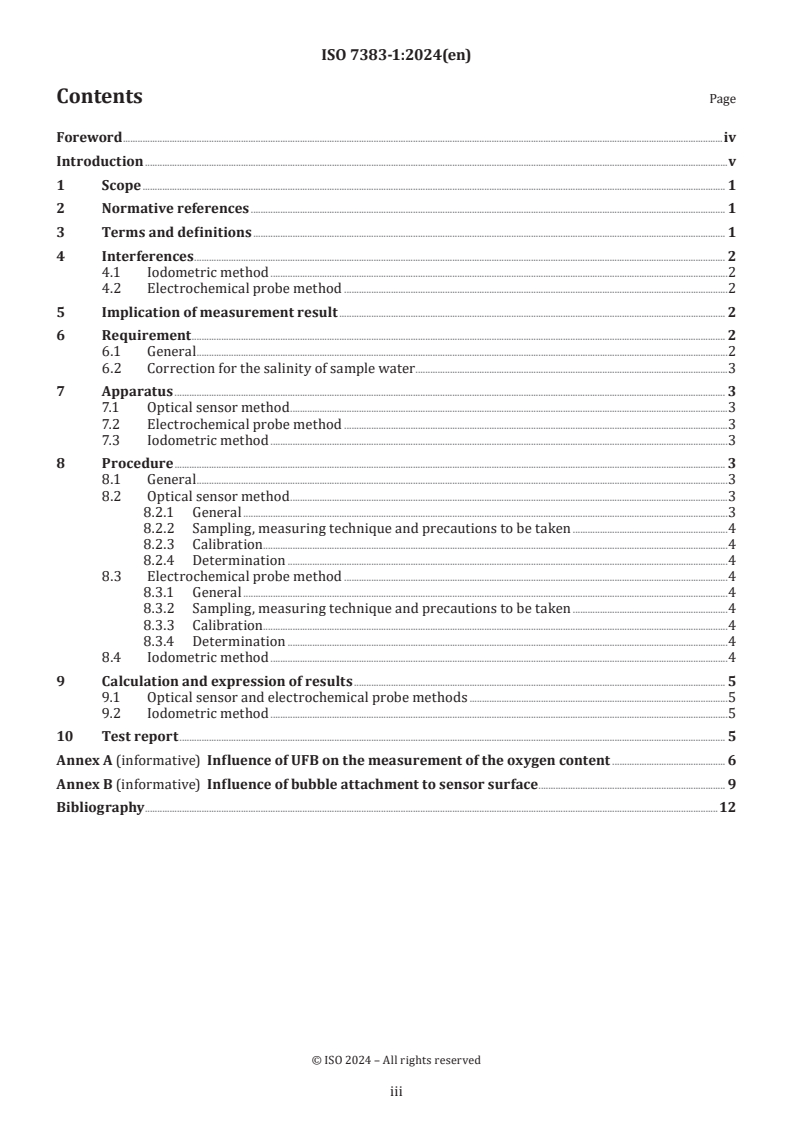
Contents Page
Foreword .iv
Introduction .v
1 Scope . 1
2 Normative references . 1
3 Terms and definitions . 1
4 Interferences . 2
4.1 Iodometric method .2
4.2 Electrochemical probe method .2
5 Implication of measurement result . 2
6 Requirement . 2
6.1 General .2
6.2 Correction for the salinity of sample water .3
7 Apparatus . 3
7.1 Optical sensor method .3
7.2 Electrochemical probe method .3
7.3 Iodometric method .3
8 Procedure . 3
8.1 General .3
8.2 Optical sensor method .3
8.2.1 General .3
8.2.2 Sampling, measuring technique and precautions to be taken .4
8.2.3 Calibration . . .4
8.2.4 Determination .4
8.3 Electrochemical probe method .4
8.3.1 General .4
8.3.2 Sampling, measuring technique and precautions to be taken .4
8.3.3 Calibration . . .4
8.3.4 Determination .4
8.4 Iodometric method .4
9 Calculation and expression of results . 5
9.1 Optical sensor and electrochemical probe methods .5
9.2 Iodometric method .5
10 Test report . 5
Annex A (informative) Influence of UFB on the measurement of the oxygen content . 6
Annex B (informative) Influence of bubble attachment to sensor surface . 9
Bibliography .12
iii
Foreword
ISO (the International Organization for Standardization) is a worldwide federation of national standards
bodies (ISO member bodies). The work of preparing International Standards is normally carried out through
ISO technical committees. Each member body interested in a subject for which a technical committee
has been established has the right to be represented on that committee. International organizations,
governmental and non-governmental, in liaison with ISO, also take part in the work. ISO collaborates closely
with the International Electrotechnical Commission (IEC) on all matters of electrotechnical standardization.
The procedures used to develop this document and those intended for its further maintenance are described
in the ISO/IEC Directives, Part 1. In particular, the different approval criteria needed for the different types
of ISO document should be noted. This document was drafted in accordance with the editorial rules of the
ISO/IEC Directives, Part 2 (see www.iso.org/directives).
ISO draws attention to the possibility that the implementation of this document may involve the use of (a)
patent(s). ISO takes no position concerning the evidence, validity or applicability of any claimed patent
rights in respect thereof. As of the date of publication of this document, ISO had not received notice of (a)
patent(s) which may be required to implement this document. However, implementers are cautioned that
this may not represent the latest information, which may be obtained from the patent database available at
www.iso.org/patents. ISO shall not be held responsible for identifying any or all such patent rights.
Any trade name used in this document is information given for the convenience of users and does not
constitute an endorsement.
For an explanation of the voluntary nature of standards, the meaning of ISO specific terms and expressions
related to conformity assessment, as well as information about ISO's adherence to the World Trade
Organization (WTO) principles in the Technical Barriers to Trade (TBT), see www.iso.org/iso/foreword.html.
This document was prepared by Technical Committee ISO/TC 281, Fine bubble technology.
A list of all parts in the ISO 7383 series can be found on the ISO website.
Any feedback or questions on this document should be directed to the user’s national standards body. A
complete listing of these bodies can be found at www.iso.org/members.html.
iv
Introduction
Fine bubble dispersion in water has been used in various industries in recent years. Particularly in the
fishery and food-processing industries, fine bubble technology is widely accepted as means for controlling
dissolved oxygen level. For example, air fine bubbles are used to prevent oxygen depletion in the water of
aquafarm and nitrogen fine bubbles are applied to reduce oxidization of fresh fish fillet.
The determination of the oxygen content in water is necessary to monitor the quality of object to be
controlled by fine bubble dispersion in water. In the measurement of the oxygen content in fine bubble
dispersion in water, however, attention should be paid to the possibility that the presence of fine bubbles
themselves influences the measurement results.
In the case of air microbubble, air inside the bubbles is being dissolved during their slow floatation resulting
in the increase in the oxygen content when oxygen is not oversaturated. In contrast, ultrafine bubbles (UFBs)
have little influence on the oxygen content because the total amount of oxygen in UFBs is negligibly small
compared to the intrinsic dissolved oxygen content in raw water. Furthermore, there is a possibility that
the precipitation of visible bubbles on the surface of oxygen sensor, which is originated from dissolved gas,
influences its measurement result.
Therefore, to evaluate the oxygen content of fine bubble dispersion in water, the state of bubbles in a sample
water during the measurement is figured out.
This document is intended to specify the evaluation method of the oxygen content in fine bubble dispersion
in water by three measurement methods: optical sensor, electrochemical probe and iodometric methods,
which are widely accepted in industries. The standardized evaluation method for the oxygen content enables
easy and solid comparison among fine bubble dispersion in various states.
v
International Standard ISO 7383-1:2024(en)
Fine bubble technology — Evaluation method for determining
gas content in fine bubble dispersions in water —
Part 1:
Oxygen content
WARNING — Persons using this document should be familiar with normal laboratory practice. This
document does not purport to address all of the safety problems, if any, associated with its use. It
is the responsibility of the user to establish appropriate safety and health practices and to ensure
compliance with any national regulatory conditions.
IMPORTANT — It is essential that tests conducted in accordance with this document be carried out
by suitably trained staff.
1 Scope
This document specifies evaluation methods for the oxygen content in fine bubble dispersion in water.
Three test methods which are adopted include the optical sensor, the electrochemical probe and the
iodometric method. The first two methods have an advantage in availability of in situ and real-time
measurement, and high accessibility to commercially available instruments. The last one, composed of a
well-established chemical analysis procedure, is advantageous in the situation where the instruments to be
used in the first two methods are unavailable.
The detection limits of the electrochemical and optical sensor methods are stated in the instruction manuals
of the instruments, in most cases 0,1 mg/l or 0,2 mg/l. The upper limit depends on the specification of the
instrument used. Most instruments allow measurement of a supersaturated sample.
Measurement range of the iodometric method is between 0,2 mg/l and 20 mg/l.
[1]
NOTE Chemical analysis methods other than the iodometric method can be applied as an alternative.
2 Normative references
The following documents are referred to in the text in such a way that some or all of their content constitutes
requirements of this document. For dated references, only the edition cited applies. For undated references,
the latest edition of the referenced document (including any amendments) applies.
ISO 5813:1983, Water quality — Determination of dissolved oxygen — Iodometric method
ISO 5814:2012, Water quality — Determination of dissolved oxygen — Electrochemical probe method
ISO 17289:2014, Water quality — Determination of dissolved oxygen — Optical sensor method
ISO 20480-1, Fine bubble technology — General principles for usage and measurement of fine bubbles — Part 1:
Terminology
ISO/TR 23015, Fine bubble technology — Measurement technique matrix for the characterization of fine bubbles
3 Terms and definitions
For the purposes of this document, the terms and definitions given in ISO 20480-1 apply.
ISO and IEC maintain terminology databases for use in standardization at the following addresses:
— ISO Online browsing platform: available at https:// www .iso .org/ obp
— IEC Electropedia: available at https:// www .electropedia .org/
3.1
UFB dispersion
UFBD
liquid which contains ultrafine bubbles
[2]
[SOURCE: ISO 21255:2018, 3.2 ]
4 Interferences
4.1 Iodometric method
Readily oxidizable organic substances such as tannins, humic acid and lignins, interfere. Oxidizable sulfur
compounds such as sulfides and thiourea also interfere.
To avoid such interferences, it is preferable to use the electrochemical probe, or the optical sensor method
described in ISO 5714 or ISO 17289 respectively.
In the presence of suspended matter capable of fixing or consuming iodine, or if in doubt about the presence
of such matter, the modified procedure described in ISO 5813:1983, Annex, shall be used.
Preferably, however, determine the oxygen content with the electrochemical probe or the optical s
...