


ISO/IEC TR 19760:2003
(Main)Systems engineering — A guide for the application of ISO/IEC 15288 (System life cycle processes)
Systems engineering — A guide for the application of ISO/IEC 15288 (System life cycle processes)
ISO/IEC TR 19760:2003 is a Technical Report that provides guidance for application of the International Standard ISO/IEC 15288 Systems Engineering - System life cycle processes in regard to systems and projects irrespective of size and type. ISO/IEC TR 19760:2003 can be used as a companion document to the International Standard by those who: apply the International Standard within their organization; use the International Standard in regard to a specific system; prepare organizational and domain specific standards based on the International Standard. ISO/IEC TR 19760:2003 elaborates on factors that should be considered when applying the International Standard. It does this in the context of the various ways in which ISO/IEC 15288 may be applied. ISO/IEC TR 19760:2003 provides example application concerns lists for user consideration. However, ISO/IEC TR 19760:2003 is not intended to provide how-to guidance for each application area of the International Standard. Guidance is provided for appropriate tailoring of the International Standard for application to specific systems or projects. ISO/IEC TR 19760:2003 also provides appropriate links to other ISO documents for supporting application of the International Standard and to aid in assessing the effectiveness of the application of the International Standard.
Ingénierie systèmes — Un guide pour l'application de l'ISO/CEI 15288 (processus de cycle de vie des systèmes)
General Information
- Status
- Withdrawn
- Publication Date
- 12-Nov-2003
- Withdrawal Date
- 12-Nov-2003
- Technical Committee
- ISO/IEC JTC 1/SC 7 - Software and systems engineering
- Drafting Committee
- ISO/IEC JTC 1/SC 7/WG 7 - Life cycle management
- Current Stage
- 9599 - Withdrawal of International Standard
- Start Date
- 26-Aug-2011
- Completion Date
- 12-Feb-2026
Relations
- Effective Date
- 23-Jul-2011
Get Certified
Connect with accredited certification bodies for this standard

BSI Group
BSI (British Standards Institution) is the business standards company that helps organizations make excellence a habit.

BSCIC Certifications Pvt. Ltd.
Established 2006, accredited by NABCB, JAS-ANZ, EIAC, IAS. CDSCO Notified Body.

Intertek India Pvt. Ltd.
Delivers Assurance, Testing, Inspection & Certification since 1993 with 26 labs and 32 offices.
Sponsored listings
Frequently Asked Questions
ISO/IEC TR 19760:2003 is a technical report published by the International Organization for Standardization (ISO). Its full title is "Systems engineering — A guide for the application of ISO/IEC 15288 (System life cycle processes)". This standard covers: ISO/IEC TR 19760:2003 is a Technical Report that provides guidance for application of the International Standard ISO/IEC 15288 Systems Engineering - System life cycle processes in regard to systems and projects irrespective of size and type. ISO/IEC TR 19760:2003 can be used as a companion document to the International Standard by those who: apply the International Standard within their organization; use the International Standard in regard to a specific system; prepare organizational and domain specific standards based on the International Standard. ISO/IEC TR 19760:2003 elaborates on factors that should be considered when applying the International Standard. It does this in the context of the various ways in which ISO/IEC 15288 may be applied. ISO/IEC TR 19760:2003 provides example application concerns lists for user consideration. However, ISO/IEC TR 19760:2003 is not intended to provide how-to guidance for each application area of the International Standard. Guidance is provided for appropriate tailoring of the International Standard for application to specific systems or projects. ISO/IEC TR 19760:2003 also provides appropriate links to other ISO documents for supporting application of the International Standard and to aid in assessing the effectiveness of the application of the International Standard.
ISO/IEC TR 19760:2003 is a Technical Report that provides guidance for application of the International Standard ISO/IEC 15288 Systems Engineering - System life cycle processes in regard to systems and projects irrespective of size and type. ISO/IEC TR 19760:2003 can be used as a companion document to the International Standard by those who: apply the International Standard within their organization; use the International Standard in regard to a specific system; prepare organizational and domain specific standards based on the International Standard. ISO/IEC TR 19760:2003 elaborates on factors that should be considered when applying the International Standard. It does this in the context of the various ways in which ISO/IEC 15288 may be applied. ISO/IEC TR 19760:2003 provides example application concerns lists for user consideration. However, ISO/IEC TR 19760:2003 is not intended to provide how-to guidance for each application area of the International Standard. Guidance is provided for appropriate tailoring of the International Standard for application to specific systems or projects. ISO/IEC TR 19760:2003 also provides appropriate links to other ISO documents for supporting application of the International Standard and to aid in assessing the effectiveness of the application of the International Standard.
ISO/IEC TR 19760:2003 is classified under the following ICS (International Classification for Standards) categories: 35.080 - Software. The ICS classification helps identify the subject area and facilitates finding related standards.
ISO/IEC TR 19760:2003 has the following relationships with other standards: It is inter standard links to ISO/IEC TR 24748-2:2011. Understanding these relationships helps ensure you are using the most current and applicable version of the standard.
ISO/IEC TR 19760:2003 is available in PDF format for immediate download after purchase. The document can be added to your cart and obtained through the secure checkout process. Digital delivery ensures instant access to the complete standard document.
Standards Content (Sample)
TECHNICAL ISO/IEC
REPORT TR
First edition
2003-11-15
Systems engineering — A guide for the
application of ISO/IEC 15288 (System life
cycle processes)
Ingénierie systèmes — Un guide pour l'application de l'ISO/CEI 15288
(processus de cycle de vie des systèmes)
Reference number
©
ISO/IEC 2003
PDF disclaimer
This PDF file may contain embedded typefaces. In accordance with Adobe's licensing policy, this file may be printed or viewed but
shall not be edited unless the typefaces which are embedded are licensed to and installed on the computer performing the editing. In
downloading this file, parties accept therein the responsibility of not infringing Adobe's licensing policy. The ISO Central Secretariat
accepts no liability in this area.
Adobe is a trademark of Adobe Systems Incorporated.
Details of the software products used to create this PDF file can be found in the General Info relative to the file; the PDF-creation
parameters were optimized for printing. Every care has been taken to ensure that the file is suitable for use by ISO member bodies. In
the unlikely event that a problem relating to it is found, please inform the Central Secretariat at the address given below.
© ISO/IEC 2003
All rights reserved. Unless otherwise specified, no part of this publication may be reproduced or utilized in any form or by any means,
electronic or mechanical, including photocopying and microfilm, without permission in writing from either ISO at the address below or
ISO's member body in the country of the requester.
ISO copyright office
Case postale 56 • CH-1211 Geneva 20
Tel. + 41 22 749 01 11
Fax + 41 22 749 09 47
E-mail copyright@iso.org
Web www.iso.org
Published in Switzerland
ii © ISO/IEC 2003 — All rights reserved
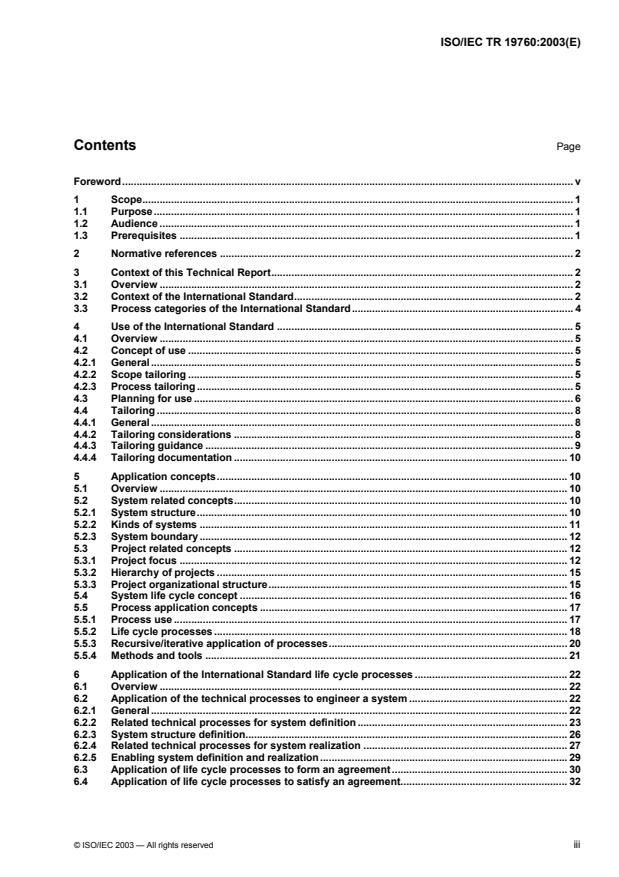
Contents Page
Foreword. v
1 Scope. 1
1.1 Purpose. 1
1.2 Audience . 1
1.3 Prerequisites . 1
2 Normative references . 2
3 Context of this Technical Report. 2
3.1 Overview . 2
3.2 Context of the International Standard. 2
3.3 Process categories of the International Standard. 4
4 Use of the International Standard . 5
4.1 Overview . 5
4.2 Concept of use . 5
4.2.1 General. 5
4.2.2 Scope tailoring . 5
4.2.3 Process tailoring . 5
4.3 Planning for use . 6
4.4 Tailoring . 8
4.4.1 General. 8
4.4.2 Tailoring considerations . 8
4.4.3 Tailoring guidance . 9
4.4.4 Tailoring documentation . 10
5 Application concepts. 10
5.1 Overview . 10
5.2 System related concepts. 10
5.2.1 System structure. 10
5.2.2 Kinds of systems . 11
5.2.3 System boundary . 12
5.3 Project related concepts . 12
5.3.1 Project focus . 12
5.3.2 Hierarchy of projects . 15
5.3.3 Project organizational structure. 15
5.4 System life cycle concept . 16
5.5 Process application concepts . 17
5.5.1 Process use . 17
5.5.2 Life cycle processes . 18
5.5.3 Recursive/iterative application of processes. 20
5.5.4 Methods and tools . 21
6 Application of the International Standard life cycle processes . 22
6.1 Overview . 22
6.2 Application of the technical processes to engineer a system . 22
6.2.1 General. 22
6.2.2 Related technical processes for system definition . 23
6.2.3 System structure definition. 26
6.2.4 Related technical processes for system realization . 27
6.2.5 Enabling system definition and realization.29
6.3 Application of life cycle processes to form an agreement. 30
6.4 Application of life cycle processes to satisfy an agreement. 32
© ISO/IEC 2003 — All rights reserved iii
7 Application of International Standard processes using the system life cycle .33
7.1 Overview.33
7.2 Enterprise view.34
7.2.1 Approaches.34
7.2.2 Sequential approach .36
7.2.3 Incremental approach .37
7.2.4 Evolutionary approach .38
7.3 Engineering view.39
7.3.1 General .39
7.3.2 Technical reviews.41
7.3.3 Configuration audits .42
8 Application by organizations .42
8.1 Overview.42
8.2 Uses of the International Standard within an organization .43
Annex A (informative) Relationship between ISO/IEC 15288 and other more detailed standards.45
Annex B (informative) References for design related special factors.47
Annex C (informative) Notes for application of ISO/IEC 15288 processes .51
iv © ISO/IEC 2003 — All rights reserved
Foreword
ISO (the International Organization for Standardization) and IEC (the International Electrotechnical
Commission) form the specialized system for worldwide standardization. National bodies that are members of
ISO or IEC participate in the development of International Standards through technical committees
established by the respective organization to deal with particular fields of technical activity. ISO and IEC
technical committees collaborate in fields of mutual interest. Other international organizations, governmental
and non-governmental, in liaison with ISO and IEC, also take part in the work. In the field of information
technology, ISO and IEC have established a joint technical committee, ISO/IEC JTC 1.
International Standards are drafted in accordance with the rules given in the ISO/IEC Directives, Part 2.
The main task of the joint technical committee is to prepare International Standards. Draft International
Standards adopted by the joint technical committee are circulated to national bodies for voting. Publication as
an International Standard requires approval by at least 75 % of the national bodies casting a vote.
In exceptional circumstances, the joint technical committee may propose the publication of a Technical Report
of one of the following types:
type 1, when the required support cannot be obtained for the publication of an International Standard,
despite repeated efforts;
type 2, when the subject is still under technical development or where for any other reason there is the
future but not immediate possibility of an agreement on an International Standard;
type 3, when the joint technical committee has collected data of a different kind from that which is
normally published as an International Standard (“state of the art”, for example).
Technical Reports of types 1 and 2 are subject to review within three years of publication, to decide whether
they can be transformed into International Standards. Technical Reports of type 3 do not necessarily have to
be reviewed until the data they provide are considered to be no longer valid or useful.
Attention is drawn to the possibility that some of the elements of this document may be the subject of patent
rights. ISO and IEC shall not be held responsible for identifying any or all such patent rights.
ISO/IEC TR 19760, which is a Technical Report of type 3, was prepared by Joint Technical Committee
ISO/IEC JTC 1, Information technology, Subcommittee SC 7, Software and system engineering.
© ISO/IEC 2003 — All rights reserved v
TECHNICAL REPORT ISO/IEC TR 19760:2003(E)
Systems engineering — A guide for the application of
ISO/IEC 15288 (System life cycle processes)
1 Scope
1.1 Purpose
This Technical Report provides guidance for the application of ISO/IEC 15288 Systems engineering —
System life cycle processes (referred to as the International Standard) to systems and projects of various size
and type. This Technical Report can be used as a companion document to the International Standard.
This Technical Report elaborates on factors that should be considered when applying the International
Standard. It does this in the context of the various illustrative ways in which the International Standard may be
applied. Also, lists within this Technical Report are not meant to be exhaustive but to provide the user with
examples to consider.
The guidance contained in this Technical Report may be tailored as appropriate to the system and project
using guidance in Annex A of the International Standard and 4.4 of this Technical Report.
This Technical Report is intended to provide appropriate links to other ISO documents for supporting
application of the International Standard and to aid in assessing the effectiveness of the application of the
International Standard.
Not all areas of the International Standard are meant to have equal treatment in this Technical Report. More
specific information is provided where providing such information will help in the application of the
International Standard. This Technical Report is not meant to provide how-to guidance for each area of the
International Standard.
1.2 Audience
This Technical Report is applicable to audiences such as identified below:
a) those who apply the International Standard;
b) those who use the International Standard for a specific system;
c) those who prepare organizational and specific domain standards based on the International Standard.
1.3 Prerequisites
The list below provides prerequisites for users of this Technical Report:
a) availability of ISO/IEC 15288;
b) familiarity with ISO/IEC 15288;
c) familiarity with relevant organizational and project policies;
d) general knowledge of project management, systems engineering and system life cycle models.
© ISO/IEC 2003 — All rights reserved 1
2 Normative references
The following referenced documents are indispensable for the application of this document. For dated
references, only the edition cited applies. For undated references, the latest edition of the referenced
document (including any amendments) applies.
ISO/IEC 15288, Systems engineering — System life cycle processes
ISO/IEC 12207, Information technology — Software life cycle processes
ISO/IEC TR 15271, Information technology — Guide for ISO/IEC 12207 (Software life cycle processes)
ISO/IEC 15504 (all parts), Information technology — Software process assessment
ISO 9001:2000, Quality management systems — Requirements
3 Context of this Technical Report
3.1 Overview
This clause has two objectives. The first objective is to provide an overview of the dynamic utilization of the
International Standard with respect to key concepts and processes. Illustrated in this clause are the
relationships between types of systems, system life cycles and the application of agreement, enterprise,
project and technical processes. The second objective is to give pointers to the various clauses of this
Technical Report that provide guidance to a user for applying the International Standard concepts and
processes.
3.2 Context of the International Standard
Organizations need to be able to conduct commerce in systems (including their associated products and
services). The International Standard facilitates commerce by providing the common framework for
establishing and executing agreements between system acquirers and suppliers with respect to developing,
using, and managing a system within the defined life cycle of that system. The International Standard is
applicable to organizations, enterprises and projects whether they act as the acquirer or the supplier of a
system.
The context of the International Standard is illustrated in Figure 1.
A single project may involve multiple organizations working together as partners. Such a project should use
the International Standard to establish common terminology, information flows and interfaces among the
several organizations to enhance communications.
When an organization applies the International Standard to a particular system, that system becomes the
system-of-interest. The system-of-interest has a life cycle that consists of multiple stages through which the
system passes during its lifetime, denoted s1, s2, … sn. Typical stages, as described in Annex B of the
International Standard, are concept, development, production, utilization, support and retirement. The
management of the progression from one stage to another and the engineering activities associated with
providing appropriate work products and decision-making information is described in Clause 6 of this
Technical Report.
A number of enabling systems are deployed throughout the system life cycle to provide the system-of-interest
with support as needed. Each life cycle stage prior to system use (concept stage, development stage, and
production stage) can require an enabling system. Enabling systems that cooperate with the system-of-
interest during its utilization, support and retirement stages can be needed, as well. It is important to note that
an enabling system has its own life cycle and that when the International Standard is applied to it, it then
becomes a system-of-interest. The role and use of enabling systems are described in 5.2.3, 5.3.1.4, and 6.2.5
of this Technical Report.
2 © ISO/IEC 2003 — All rights reserved
hhaavvee ssppaann ooff
iinntteerreesstt
The International Standard is applicable at any level of the structure associated with a system-of-interest. As a
system is decomposed recursively into its system elements, the processes of the International Standard may
be used for each system and system element in the system structure. Each system and system element has a
life cycle of its own and its own set of enabling systems. This system structure is described in 5.2.1 of this
Technical Report.
PrProjeojecct st sppaann
ofof control control
PrProojjeecctt
PrProojjeecctt
SSyyststemem--ooff-- OrOrgaganinizzaattiioonnss
iinntteerrestest
EnaEnabblliinngg
ssyyststemem
CrCreateeate a anndd
monitor projectsmonitor projects
PrProojjeecctt
PrProojjeecctt
PePerfrfororm rem reqquuirireded
PrProojjeeccttss
worwork ok onn or or with with
SySyststeemm-o-of-f-
sysyststeemm-o-of-f-iinntteererestst
intinteerreestst
withiwithinn lif lifee c cyyclecle
ststaaggeses
Life cycLife cycle sle sttaagesges
(s(s , s, s , . , . ,s,s ))
11 22 nn
Figure 1 — Context of the International Standard
In order to perform needed operations and transformations upon systems during their life cycles, the
organization creates and monitors projects. Projects have defined scope, resources (including time) and focus.
The scope can involve managing all of the stages of the life cycle, a subset of the stages, one or more defined
processes or one or more process activities. The time scale can be of varying duration, for example one hour
or tens of years. The focus of the project is related to the system-of-interest and its systems and system
elements in some form of system structure or stage partitioning. Related project concepts are described in 5.3
of this Technical Report and system life cycle concepts are described in 5.4.
Organizations focus on systems that are created by projects within the organization or in conjunction with
other organizations. Projects have a span of interest that includes the system-of-interest and its related
enabling systems. Some enabling systems are under direct control of the project. The system-of-interest and
those enabling systems make up the project span of control. The span of interest is described in 5.3.1.4.
The work performed by projects is on or with the system-of-interest within one or more system life cycle
stages. The scope of the International Standard includes the definition of an appropriate life cycle for a system,
the selection of processes to be applied throughout the life cycle and the application of these processes to
fulfil agreements and achieve customer satisfaction.
The International Standard can be applied to all types of systems and system elements consisting of one or
more of the following: hardware, software, humans, processes, procedures, facilities, and naturally occurring
entities. The use of the International Standard for systems within this broad scope is one of its main
advantages.
The use of the International Standard may be adapted to accommodate the varying project requirements in
treating system life cycles. This may be performed by adjusting the scope as described in 4.2 and tailoring
described in 4.4 of this Technical Report and Annex A of the International Standard.
© ISO/IEC 2003 — All rights reserved 3
hhaavvee ssyysstteemm
ffooccuuss
3.3 Process categories of the International Standard
The four process groups of the International Standard as well as the primary relationships between the groups
are portrayed in Figure 2. The role of the Enterprise and Project group processes is to achieve the project
goals within applicable life cycle stages to satisfy an agreement. Enterprise processes provide enabling
resources and infrastructure that are used to create, support, and monitor projects and to assess project
effectiveness. The project processes ensure that adequate planning, assessment, and control activities are
performed to manage processes and life cycle stages.
Appropriate processes are selected from the Technical Processes and used to populate projects in order for
the project to perform life cycle related work.
AgAgrreeeemmeenntt UsedUsed to a to arrivrrivee at aat anndd
sasattiisfy asfy ann ag agrereeemmeenntt
PPrroocceessessess
DDeelliiveverarabbllee th thaatt
ssaatitisfisfiees as aggrereeemmeenntt
UsUseedd to es to esttaablblisish rh reequirquireemmenentsts
UUsseedd to to asseassess ss EEnntteerprpririssee
qquualalitityy an andd prprooggrreessss
PrProocceesssseess
UseUsedd to cre to creaatete,, ssuupport pport
anand monid monitortor pr projeojecctsts
SySysstteemm-o-off--
inintetereresstt
PrProojjeecctt
UseUsedd to mana to managege
lliiffee cycle cycle stagstageess PPrroocceessessess
LLiife cfe cyycle stagcle stageses
(s(s , s, s , . , . ,s,s )) UsUseedd t too mamannaaggee
11 22 nn
tteechnichnicacall proce processsseess
OutcomOutcomeess use usedd to to
aasssseess pss prrogogrreessss
UUsseedd toto cre creaatete p prroodducts ucts and and
TTeecchnihniccaall
servserviceicess o off l liiffee cycl cycle e ssttaagge e
PPrroocceessessess
tthhatat me meetet r reeququiirremeemennttss
Figure 2 — Role of International Standard processes
Projects may need to establish relationships with other projects within the organization, as well as those in
other organizations. Such relationships are established through the agreement processes of acquisition and
supply as shown in Figure 3. The degree of formality of the agreement is adapted to the internal or external
business relationships between projects. An example and discussion of the use of the agreement processes is
provided in 5.3.1.3 of this Technical Report.
PrProojjeecctt sp spaann
SystSysteemm-o-off--
ofof con controltrol
inintteerreesstt
EnEnaabblliinngg
sysyststemem
AcAcqquuiirriinngg
SuSuppppllyyiinngg
oorrgaganinizzaattiioonnss
ororggaanniizzaattiiononss
UseUsedd to agr to agree toee to
UUsseded t too a accququireire
AAggrreemeemeenntt
tteerrmms os off supp supplylyiningg
a proa prodduucct or set or servicervice
prproocceesssseess
a pa prrodoductuct o orr s seervicrvicee
Figure 3 — Use of agreement processes
4 © ISO/IEC 2003 — All rights reserved
4 Use of the International Standard
4.1 Overview
The International Standard can be used for one or more of the following reasons.
a) A specific project can use the International Standard for engineering, utilizing, supporting or retiring a
system-of-interest.
b) An organization can use the International Standard for supporting and controlling the operation of one or
more of the system life cycle stages.
c) A domain organization or other organization can use the International Standard for developing domain-
specific or organization-specific standards. These can address the engineering of systems, the
management of engineering activities or the operation of one of the system life cycle stages.
d) Multiple organizations can use the International Standard as a basis for joint projects.
4.2 Concept of use
4.2.1 General
Each organization is driven by the nature of its business, its social responsibilities, and its business strategy.
These provide constraints on available business opportunities that the organization and its enterprises can
exploit. To help exploit opportunities the enterprise establishes policies and procedures to guide the
performance of projects. To help establish these policies and procedures, and to determine the resources
needed by the enterprise, the International Standard can be used to provide specific standardized processes
for use within one or more life cycle models.
A suggested use concept is illustrated in Figure 4. This figure provided the basis for tailoring the scope of the
International Standard for one of the specific uses of 4.1.
4.2.2 Scope tailoring
For example, if an enterprise that does development only and is not involved in the utilization, support, or
retirement life cycle stages, that enterprise could tailor the scope of the International Standard accordingly.
The policies and procedures called for in the non-applicable parts of the International Standard would not be
included in the organization's policies and procedures. Additionally, inputs such as those listed below can help
shape the policies and procedures of an enterprise:
a) life cycle model and related entry or exit criteria used by the enterprise for decision making as well as for
establishing milestone reviews of a project;
b) resource availability and the resources the enterprise is willing to commit;
c) expertise and skills available to the enterprise to provide enterprise products and services;
d) technology available for enterprise products and services.
4.2.3 Process tailoring
When a project is established to satisfy a set of stakeholder requirements or acquirer specifications,
processes included in the enterprise policies and procedures or in the International Standard itself can be
tailored according to the scope, size and funding of the work to be done. Planning the work of the project can
be dependent on factors such as the following:
© ISO/IEC 2003 — All rights reserved 5
a) the team structure required by enterprise policy and procedures or by the acquirer and the enterprise
culture in which teams exist and perform;
b) requirements and schedules established in the agreement with the acquirer;
c) the specific life cycle model to be used for performing the processes of the life cycle;
d) the resources made available to the project by the enterprise.
Figure 4 illustrates application of tailored technical and management processes from the International
Standard within a project context. The enterprise processes of the International Standard can also be selected
for application at the enterprise level.
OrOrgganianizzaatitionon
NaNaturturee of of bubussiinenessss
SSoocciial Real Respsponsonsiibbililititieiess DoDomamain ofin of prprooducductsts
ReRegulgulatoatorryy c coonsnsididereraattioionsns
BuBusinsineess sss sttrarateteggyy
CoConsnstrtraiaintntss
ScScopope e
EEnnteterprpririsese co connttrorollss
ISOISO/IEC 15288/IEC 15288 EnEntteerprpririssee
TaTaililoorriningg
ISOISO/IEC 15288/IEC 15288
DeDecciissiioonn g gaatetess an and md miileslesttoneoness
PoPolilicciieses and and
SysSysttem life cycem life cyclele
SysSysttem life cycem life cyclele
ReRessooururccee av avaaiillabiliabilittyy
PrPrococeedurdureses
PrProcessesocesses ExExperperttiissee and and sskkiillllss av availailabiabililittyy
PPrrocessesocesses
ReResosouurrcecess TTeecchnohnologlogyy a avvaailailabibilitlityy
StStagesages
SSttagesages
PrProceocessss
TaTaililoorriningg
TTeameamss
StStrruucturcturee
SSyyssttemem l liiffee c cyycclle e mmodeodell
PrProjojeecctt
ApApplplicicablable se sttagageses
PlanPlanninningg
AAggrereememenentt
RRequiequirreemmententss
ScSchehedulduleses
LeLegegendnd::
IInnititiaiattiionon
SSyyssttemem Lif Life Cye Cyccllee
PriPrimmaaryry F Fllooww
ApApplipliccatationion
CConsonsttrraiaintnt
PrProceocesssesess
IInnffluencluencee
PrPrococeedurdureses
Figure 4 — Concept of use
4.3 Planning for use
The International Standard can be considered for a specific project with a set duration or for a continuous
work effort conducted by an organization.
The following are examples of items to consider while planning use of the International Standard.
a) The scope of the work effort such as:
1) a single project either internal to the organization or an enterprise within the organization, or as part
of a multi-party agreement;
2) concentration on some key processes or a single process where there is expected to be some gain
for the organization or enterprise;
3) concentration on a single life cycle stage to carry out the operation of that stage.
6 © ISO/IEC 2003 — All rights reserved
b) Identification and listing of stakeholders such as:
1) intended users or customers of the work products, applicable systems or services;
2) providers of enabling systems;
3) other interested parties who have an interest or stake in the products or services;
4) sources of requirements (including constraints).
c) Desired outcomes such as:
1) work products (for example system-of-interest, paper report, digital data, hardware or software
configuration item, waste material or procedure document);
2) services or capabilities to be delivered or demonstrated at the end of the project and at specific
milestones.
d) Special considerations such as:
1) systems technologies that focus on software, hardware, humans, processes or procedures;
2) system utilization including single use, repeated use and continuous use;
3) system fabrication, for example one-of-a-kind, replicated or mass-produced;
4) system topologies such as networks (for example a corporate global network), system of systems
(for example a command and control or telecommunication system) and long-lived systems (for
example those that never reach an end of use life such as electric power service);
5) methods and tools that enable implementation of the processes throughout the life cycle.
e) Goals and objectives of the project such as:
1) specific objectives identified by milestones;
2) long-term utilization goals related to the work and work products, especially with respect to the use of
a system.
f) Project strategy such as:
1) how the project will be carried out, including any agreement considerations;
2) how work packages will be planned, assessed and controlled;
3) how work products will be planned, evaluated and controlled;
4) how work and changes will be authorized;
5) major milestone decision or event points (for example management reviews, meetings, pilot tests,
deployments and deliveries) with milestone entry or exit criteria.
g) Requirements and constraints such as:
1) specific functional and performance requirements for capabilities of or data from a system, including
special attributes and usability expectations or concerns;
2) policies, priorities and constraints that will affect meeting the cost, schedule and quality requirements
and objectives of the project;
© ISO/IEC 2003 — All rights reserved 7
3) core organizational technologies that will affect system requirements or other work product
requirements and constraints; applicable organizational processes, standards and specifications
(including source and availability); product implementation risks; and how information of required
quality (including different product versions) will be captured, stored and controlled;
4) applicable system life cycle stage activities (for example development, pilot testing, full production,
retirement) and expected outputs (for example. deliverables, work products and management
reviews);
5) relevant stage entry or exit criteria, including expected level of system maturity, level of acceptable
risks and management review concerns;
6) project start-up and end dates, including milestone dates associated with approval and progress
reviews and pilot tests, as applicable;
7) management structure, including participants and their roles;
8) exclusions of organizations or persons (if applicable), including when the exclusion is or is not valid;
9) level of security classification and other security considerations, if applicable;
10) expected deliverables at milestones, at end of project and during project performance;
11) environment, recycling and reuse issues.
The information from a) through g) above should be appropriately documented. Based on the above
documented information, appropriate detailed action planning should be performed to generate appropriate
plans that can guide application of the International Standard.
4.4 Tailoring
4.4.1 General
When the International Standard is used by an enterprise to form a set of policies and procedures governing
project work, then tailoring may be used to appropriately reduce or extend the scope of the International
Standard as necessary for the business strategy and kind of business for which the policies and procedures
are framed.
When the International Standard is used by a project, then tailoring may be used to appropriately consider the
peculiar characteristics of the project, life cycle stage or agreement. Since each project has to consider and
demonstrate the benefits of what it does to satisfy stakeholder requirements, there is a need to concentrate on
the relevant processes and activities and the expected outcomes, including specific output documentation.
Tailoring takes the form of deletion, alteration or addition. Careful consideration should be given to dropping
factors of the International Standard that do not add value to the process, system-of-interest or system
element.
When tailoring is done, it may be important to ensure that applicable conformance requirements of the
International Standard are met (see Clause 2 of the International Standard).
4.4.2 Tailoring considerations
The objectives and requirements of an agreement should define the context of application of the International
Standard. To assist in defining the level of detail and effort required for execution of some processes, the
following should be considered in tailoring:
a) the life cycle stage and the applicable exit criteria;
8 © ISO/IEC 2003 — All rights reserved
b) the mission profiles, operational scenarios and operational concepts for each major functional
requirement of the system-of-interest;
c) the set of measures of effectiveness, with relative importance, by which the acquirer typically determines
satisfaction of the requirements;
d) empirical data that describes the constraints and risks that could affect the project and enterprise,
including budget, resources, competition and schedule;
e) the technology base and any limitations on the use of technologies.
Additional tailoring considerations can be found in the conformance requirements of Clause 2 and Annex A of
the International Standard.
4.4.3 Tailoring guidance
Either the organizational unit responsible for forming policies and procedures, or the project team or individual
assigned to plan the project can be responsible for completing appropriate tailoring. To aid tailoring the
following factors affecting the project effort should be helpful.
a) Project requirements such as the required work, schedule, funding and technical requirements (for
example functional requirements, performance requirements and interface requirements) can drive stage
timing and the definition of the system under consideration. These can also drive the criticality of the
system and its enabling systems.
b) The applicable processes of the International Standard that apply to the domain, business of the
organization and type of enterprise (for example supplier, user, acquirer, or other stakeholder) should be
included in project plans. Other processes that are not in the International Standard can be required by an
agreement, or they can be required by the nature of the project, the applicable system or the type of
organization. These processes may be added, complete with their purpose, outcomes and activities.
c) Activities for each applicable process and the expected outcomes of each activity should be selected.
Depending on the size and scope of the project, the type of enterprise and whether an unprecedented
system is the object of the project, one or more of the International Standard activities for a process could
possibly not apply. Likewise, outcomes and activities may be added to a process when needed to meet
agreement requirements or to meet unique requirements for a system. See Annex A of this Technical
Report for sources of such additional activity detail.
d) Tasks, methods and tools required for activity completion should be determined. The applicable tasks,
methods and available tools are not included in the International Standard. These may be added by the
project or organization during planning for an adopted process. See Annex A of this Technical Report for
sources of additional task detail.
e) Reporting and technical review requirements applicable to the life cycle stage or stipulated in the
governing agreement or in organizational policies and procedures should be considered.
f) Project measurement requirement provisions should be included for the collection and reporting of key
measures by which project progress will be evaluated.
g) Requirements related to activities and tasks involving specialty engineering and functional disciplines may
be integrated in appropriate processes. These processes include requirements (special requirements or
critical project and system requirements) and life cycle stage entry or exit criteria (for example safety,
security, human factor engineering, design, software development, production, test and logistics).
Specialty and functional plans that are needed to ensure completion of project work may be included in
work definition.
h) Applicable standards, policies and procedures, regulations and laws can be the source of additional
process and activity requirements to add to the work definition, even though not included in the
© ISO/IEC 2003 — All rights reserved 9
International Standard process requirements. Some reference standards for special factors that should be
designed into architectural solutions are provided in Annex B of this Technical Report.
4.4.4 Tailoring documentation
According to the International Standard tailoring is required to be documented for the benefit of all who
execute or assess the resulting set of processes. Tailoring records should be established and maintained.
Some suggestions to follow in documenting tailoring are given below.
a) Explicit process, activity and task descriptions and output document descriptions should be documented
in the project management plan, engineering plan, operation plan or similar high-level plan.
b) Where tailoring does not need to be formally documented, an annotated copy of the standard showing
additions and deletions can be used.
c) Templates or worksheets for each International Standard process and life cycle stage can be developed
to prescribe the depth of detail required for particular project documentation.
d) A matrix can be developed to show the level of conformance (full, tailored, none or not applicable), a
description of tailoring and the rationale for deletions and traceability of the organization, enterprise or
project documentation to the requirements of the International Standard.
5 Application concepts
5.1 Overview
This clause extends Annex D of the International Standard to provide the basis for application of the system
life-cycle processes to a system within the constraints of system boundaries and applicable life cycle models.
5.2 System related concepts
5.2.1 System structure
Figure D.4 of the International Standard identifies three views of a system structure. The view on the left
provides a hierarchical view of a system structure with a system composed of multiple systems. In this view, at
some lower level of the hierarchy a system can be realized by being built, bought or reused. All systems in the
hierarchy above this level are integrated composites of lower level systems.
The view in the middle of Figure D.4 is where the top system in the system structure is called a system-of-
interest and consists of lower level systems. At the lowest level of the system structure are system elements.
Identification and understanding of the system structure is important in that in order to engineer a system-of-
interest, each subordinate system and system element has to be engineered. The unique difference between
the two system structures is that each system element has to be implemented whereas all othe
...
Questions, Comments and Discussion
Ask us and Technical Secretary will try to provide an answer. You can facilitate discussion about the standard in here.
Loading comments...