


ISO/IEC 26557:2016
(Main)Software and systems engineering — Methods and tools for variability mechanisms in software and systems product line
Software and systems engineering — Methods and tools for variability mechanisms in software and systems product line
ISO/IEC 26557:2016, within the context of tools and methods of variability mechanisms for software and system product lines: - provides the terms and definitions related to variability mechanisms for software and systems product lines; - defines processes and their subprocesses for operating variability mechanisms at each product line life cycle stages and those for providing managerial supports. Those processes are described in terms of purpose, inputs, tasks and outcomes; - defines method capabilities to support the defined tasks of each process; - defines tool capabilities to automate/semi-automate tasks or defined method capabilities. ISO/IEC 26557:2016 does not concern processes and capabilities of tools and methods for a single system, but rather deals with those for a family of products.
Ingénierie du logiciel et des systèmes — Méthodes et outils pour les mécanismes de variabilité dans les chaînes de production de logiciels et de systèmes
General Information
- Status
- Published
- Publication Date
- 11-Dec-2016
- Technical Committee
- ISO/IEC JTC 1/SC 7 - Software and systems engineering
- Drafting Committee
- ISO/IEC JTC 1/SC 7/WG 4 - Tools and environment
- Current Stage
- 9093 - International Standard confirmed
- Start Date
- 24-May-2022
- Completion Date
- 12-Feb-2026
Overview
ISO/IEC 26557:2016 defines a structured approach for variability mechanisms in software and systems product lines. It standardizes terms and definitions, specifies processes (with purpose, inputs, tasks, outcomes) across product-line life‑cycle stages, and describes the method capabilities and tool capabilities needed to support and (semi-)automate variability-related tasks. The standard applies to families of products (product lines), not to single-system variability.
Key topics and technical requirements
- Terms and definitions for variability mechanisms to ensure consistent vocabulary across teams and tools.
- Reference model for variability mechanisms in product-line engineering.
- Variability mechanism management: planning, enabling, and tracking activities including resource estimation, responsibilities, quality measures, guidance, and measurement infrastructure.
- Operationalization across life‑cycle stages:
- Requirements variability
- Domain design and architecture (including binding time decisions)
- Detailed design and realization (implementation-level configurability)
- Compile-time, post‑compile (link/load/deploy), and run‑time variability mechanisms
- Test artefacts and test-level variability support
- Support functions: relating mechanisms to variability models, quality assurance, binding‑time decision support, and application configuration support.
- Tool and method capabilities: the standard defines capabilities that methods should provide and what tools should automate or semi-automate to support each task or method capability.
- Non‑scope: explicitly focuses on product-line (family-level) mechanisms rather than mechanisms for a single product or system.
Practical applications and users
This standard is practical for organizations implementing or evolving a software or systems product-line practice. Typical users include:
- Product-line architects and systems engineers - to choose and document binding times and architectural variability strategies.
- Requirements engineers - to categorize and bind requirements-level variability.
- Implementation teams and developers - to enable implementation-level configurability, compile/post‑compile mechanisms, and runtime reconfiguration.
- Tool vendors and method providers - to design tool capabilities that automate variability tasks and provide decision support.
- Project managers and QA/assurance teams - for planning, tracking, and quality assurance of variability operationalization. Practical benefits: improved reuse, predictable configurability, clearer traceability between variability model and implementations, and automated support for product derivation and configuration.
Related standards
- Other ISO/IEC software and systems engineering standards developed under ISO/IEC JTC 1/SC 7 (product-line engineering and lifecycle management). Consult ISO and IEC catalogs for complementary standards on product-line processes, architecture, and quality assurance.
Keywords: ISO/IEC 26557:2016, variability mechanisms, software product line, systems product line, variability management, binding time, configurability, tool capabilities, method capabilities.
Get Certified
Connect with accredited certification bodies for this standard

BSI Group
BSI (British Standards Institution) is the business standards company that helps organizations make excellence a habit.

BSCIC Certifications Pvt. Ltd.
Established 2006, accredited by NABCB, JAS-ANZ, EIAC, IAS. CDSCO Notified Body.

Intertek India Pvt. Ltd.
Delivers Assurance, Testing, Inspection & Certification since 1993 with 26 labs and 32 offices.
Sponsored listings
Frequently Asked Questions
ISO/IEC 26557:2016 is a standard published by the International Organization for Standardization (ISO). Its full title is "Software and systems engineering — Methods and tools for variability mechanisms in software and systems product line". This standard covers: ISO/IEC 26557:2016, within the context of tools and methods of variability mechanisms for software and system product lines: - provides the terms and definitions related to variability mechanisms for software and systems product lines; - defines processes and their subprocesses for operating variability mechanisms at each product line life cycle stages and those for providing managerial supports. Those processes are described in terms of purpose, inputs, tasks and outcomes; - defines method capabilities to support the defined tasks of each process; - defines tool capabilities to automate/semi-automate tasks or defined method capabilities. ISO/IEC 26557:2016 does not concern processes and capabilities of tools and methods for a single system, but rather deals with those for a family of products.
ISO/IEC 26557:2016, within the context of tools and methods of variability mechanisms for software and system product lines: - provides the terms and definitions related to variability mechanisms for software and systems product lines; - defines processes and their subprocesses for operating variability mechanisms at each product line life cycle stages and those for providing managerial supports. Those processes are described in terms of purpose, inputs, tasks and outcomes; - defines method capabilities to support the defined tasks of each process; - defines tool capabilities to automate/semi-automate tasks or defined method capabilities. ISO/IEC 26557:2016 does not concern processes and capabilities of tools and methods for a single system, but rather deals with those for a family of products.
ISO/IEC 26557:2016 is classified under the following ICS (International Classification for Standards) categories: 35.080 - Software. The ICS classification helps identify the subject area and facilitates finding related standards.
ISO/IEC 26557:2016 is available in PDF format for immediate download after purchase. The document can be added to your cart and obtained through the secure checkout process. Digital delivery ensures instant access to the complete standard document.
Standards Content (Sample)
INTERNATIONAL ISO/IEC
STANDARD 26557
First edition
2016-12-15
Software and systems engineering —
Methods and tools for variability
mechanisms in software and systems
product line
Ingénierie du logiciel et des systèmes — Méthodes et outils pour les
mécanismes de variabilité dans les chaînes de production de logiciels
et de systèmes
Reference number
©
ISO/IEC 2016
© ISO/IEC 2016, Published in Switzerland
All rights reserved. Unless otherwise specified, no part of this publication may be reproduced or utilized otherwise in any form
or by any means, electronic or mechanical, including photocopying, or posting on the internet or an intranet, without prior
written permission. Permission can be requested from either ISO at the address below or ISO’s member body in the country of
the requester.
ISO copyright office
Ch. de Blandonnet 8 • CP 401
CH-1214 Vernier, Geneva, Switzerland
Tel. +41 22 749 01 11
Fax +41 22 749 09 47
copyright@iso.org
www.iso.org
ii © ISO/IEC 2016 – All rights reserved
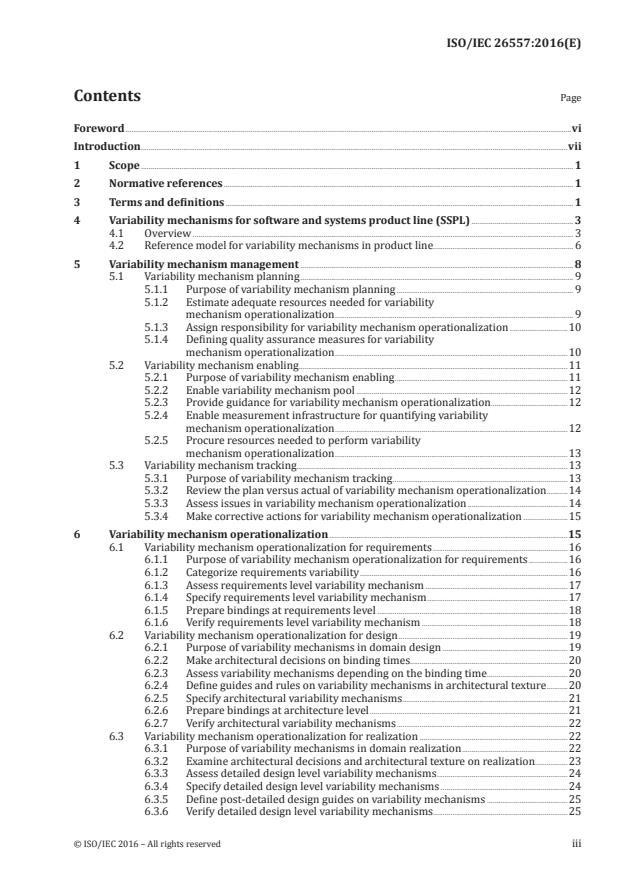
Contents Page
Foreword .vi
Introduction .vii
1 Scope . 1
2 Normative references . 1
3 Terms and definitions . 1
4 Variability mechanisms for software and systems product line (SSPL) .3
4.1 Overview . 3
4.2 Reference model for variability mechanisms in product line. 6
5 Variability mechanism management . 8
5.1 Variability mechanism planning . 9
5.1.1 Purpose of variability mechanism planning . 9
5.1.2 Estimate adequate resources needed for variability
mechanism operationalization . 9
5.1.3 Assign responsibility for variability mechanism operationalization .10
5.1.4 Defining quality assurance measures for variability
mechanism operationalization .10
5.2 Variability mechanism enabling.11
5.2.1 Purpose of variability mechanism enabling .11
5.2.2 Enable variability mechanism pool .12
5.2.3 Provide guidance for variability mechanism operationalization .12
5.2.4 Enable measurement infrastructure for quantifying variability
mechanism operationalization .12
5.2.5 Procure resources needed to perform variability
mechanism operationalization .13
5.3 Variability mechanism tracking.13
5.3.1 Purpose of variability mechanism tracking .13
5.3.2 Review the plan versus actual of variability mechanism operationalization .14
5.3.3 Assess issues in variability mechanism operationalization .14
5.3.4 Make corrective actions for variability mechanism operationalization .15
6 Variability mechanism operationalization .15
6.1 Variability mechanism operationalization for requirements .16
6.1.1 Purpose of variability mechanism operationalization for requirements .16
6.1.2 Categorize requirements variability .16
6.1.3 Assess requirements level variability mechanism .17
6.1.4 Specify requirements level variability mechanism .17
6.1.5 Prepare bindings at requirements level .18
6.1.6 Verify requirements level variability mechanism .18
6.2 Variability mechanism operationalization for design .19
6.2.1 Purpose of variability mechanisms in domain design .19
6.2.2 Make architectural decisions on binding times.20
6.2.3 Assess variability mechanisms depending on the binding time .20
6.2.4 Define guides and rules on variability mechanisms in architectural texture .20
6.2.5 Specify architectural variability mechanisms .21
6.2.6 Prepare bindings at architecture level .21
6.2.7 Verify architectural variability mechanisms .22
6.3 Variability mechanism operationalization for realization .22
6.3.1 Purpose of variability mechanisms in domain realization .22
6.3.2 Examine architectural decisions and architectural texture on realization .23
6.3.3 Assess detailed design level variability mechanisms .24
6.3.4 Specify detailed design level variability mechanisms .24
6.3.5 Define post-detailed design guides on variability mechanisms .25
6.3.6 Verify detailed design level variability mechanisms .25
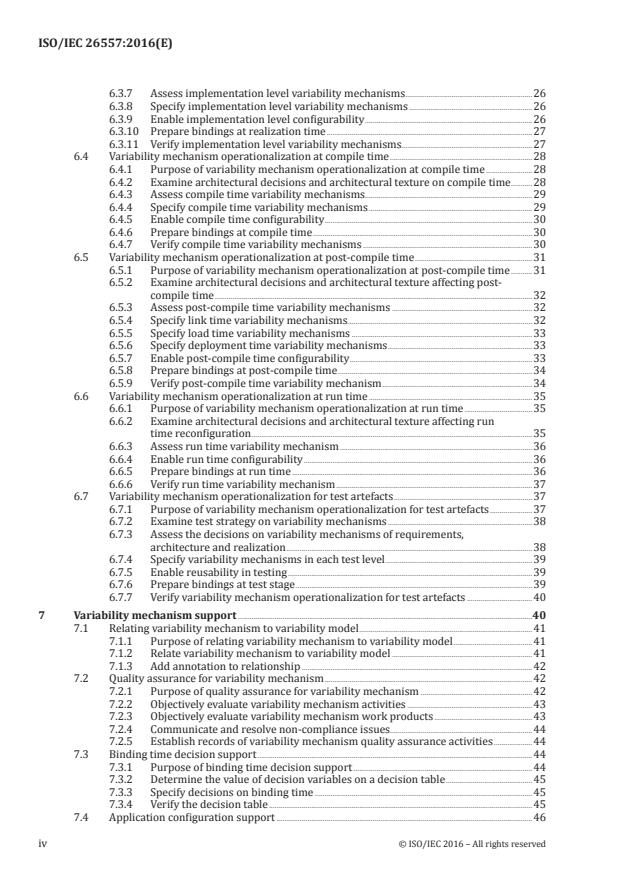
© ISO/IEC 2016 – All rights reserved iii
6.3.7 Assess implementation level variability mechanisms .26
6.3.8 Specify implementation level variability mechanisms .26
6.3.9 Enable implementation level configurability .26
6.3.10 Prepare bindings at realization time .27
6.3.11 Verify implementation level variability mechanisms.27
6.4 Variability mechanism operationalization at compile time .28
6.4.1 Purpose of variability mechanism operationalization at compile time .28
6.4.2 Examine architectural decisions and architectural texture on compile time .28
6.4.3 Assess compile time variability mechanisms.29
6.4.4 Specify compile time variability mechanisms .29
6.4.5 Enable compile time configurability .30
6.4.6 Prepare bindings at compile time .30
6.4.7 Verify compile time variability mechanisms .30
6.5 Variability mechanism operationalization at post-compile time .31
6.5.1 Purpose of variability mechanism operationalization at post-compile time .31
6.5.2 Examine architectural decisions and architectural texture affecting post-
compile time .32
6.5.3 Assess post-compile time variability mechanisms .32
6.5.4 Specify link time variability mechanisms .32
6.5.5 Specify load time variability mechanisms .33
6.5.6 Specify deployment time variability mechanisms .33
6.5.7 Enable post-compile time configurability .33
6.5.8 Prepare bindings at post-compile time .34
6.5.9 Verify post-compile time variability mechanism .34
6.6 Variability mechanism operationalization at run time .35
6.6.1 Purpose of variability mechanism operationalization at run time .35
6.6.2 Examine architectural decisions and architectural texture affecting run
time reconfiguration .35
6.6.3 Assess run time variability mechanism .36
6.6.4 Enable run time configurability .36
6.6.5 Prepare bindings at run time .36
6.6.6 Verify run time variability mechanism .37
6.7 Variability mechanism operationalization for test artefacts .37
6.7.1 Purpose of variability mechanism operationalization for test artefacts .37
6.7.2 Examine test strategy on variability mechanisms .38
6.7.3 Assess the decisions on variability mechanisms of requirements,
architecture and realization .38
6.7.4 Specify variability mechanisms in each test level .39
6.7.5 Enable reusability in testing .39
6.7.6 Prepare bindings at test stage .39
6.7.7 Verify variability mechanism operationalization for test artefacts .40
7 Variability mechanism support .40
7.1 Relating variability mechanism to variability model .41
7.1.1 Purpose of relating variability mechanism to variability model .41
7.1.2 Relate variability mechanism to variability model .41
7.1.3 Add annotation to relationship .42
7.2 Quality assurance for variability mechanism .42
7.2.1 Purpose of quality assurance for variability mechanism .42
7.2.2 Objectively evaluate variability mechanism activities .43
7.2.3 Objectively evaluate variability mechanism work products .43
7.2.4 Communicate and resolve non-compliance issues.44
7.2.5 Establish records of variability mechanism quality assurance activities .44
7.3 Binding time decision support .44
7.3.1 Purpose of binding time decision support .44
7.3.2 Determine the value of decision variables on a decision table .45
7.3.3 Specify decisions on binding time .45
7.3.4 Verify the decision table .45
7.4 Application configuration support .46
iv © ISO/IEC 2016 – All rights reserved
7.4.1 Purpose of application configuration support .46
7.4.2 Support realizing configurability .46
7.4.3 Apply decision rules for configuration .47
7.4.4 Improve configurability .47
Annex A (informative) Variability mechanisms in software development activities .48
Annex B (informative) Binding time decision from variability types .49
Bibliography .50
© ISO/IEC 2016 – All rights reserved v
Foreword
ISO (the International Organization for Standardization) and IEC (the International Electrotechnical
Commission) form the specialized system for worldwide standardization. National bodies that are
members of ISO or IEC participate in the development of International Standards through technical
committees established by the respective organization to deal with particular fields of technical
activity. ISO and IEC technical committees collaborate in fields of mutual interest. Other international
organizations, governmental and non-governmental, in liaison with ISO and IEC, also take part in the
work. In the field of information technology, ISO and IEC have established a joint technical committee,
ISO/IEC JTC 1.
The procedures used to develop this document and those intended for its further maintenance are
described in the ISO/IEC Directives, Part 1. In particular the different approval criteria needed for the
different types of ISO documents should be noted. This document was drafted in accordance with the
editorial rules of the ISO/IEC Directives, Part 2 (see www.iso.org/directives).
Attention is drawn to the possibility that some of the elements of this document may be the subject of
patent rights. ISO shall not be held responsible for identifying any or all such patent rights. Details of
any patent rights identified during the development of the document will be in the Introduction and/or
on the ISO list of patent declarations received (see www.iso.org/patents).
Any trade name used in this document is information given for the convenience of users and does not
constitute an endorsement.
For an explanation on the meaning of ISO specific terms and expressions related to conformity assessment,
as well as information about ISO’s adherence to the World Trade Organization (WTO) principles in the
Technical Barriers to Trade (TBT) see the following URL: www.iso.org/iso/foreword.html.
The committee responsible for this document is ISO/IEC JTC 1, Information technology, Subcommittee
SC 7, Software and systems engineering.
vi © ISO/IEC 2016 – All rights reserved
Introduction
Software and systems product line (SSPL) engineering and management creates, exploits and manages
a common platform to develop a family of products (e.g. software products, systems architectures) at
lower cost, reduced time to market and with better quality. As a result, it has gained increasing global
attention since 1990s.
Variability, which differentiates a member product from other products within a product line, plays
an important role in SSPL. Variability mechanism means ways to implement variability; it realizes
variability in the product line artefacts. Variability mechanisms differ in accordance with the binding
time of variability, and variability of a product line is introduced from product line scoping through
product line testing and its binding can occur at any stages of product line development. Thus, variability
mechanism should be systematically managed for the right operation in domain engineering and for
the right binding in application engineering. Furthermore, variability mechanisms should support easy
variability management and traceability management. Accordingly, this document provides processes
with their supporting methods and tools capabilities for variability mechanism operationalization and
for managerial supports for the right use of variability mechanisms at domain engineering stages and
the right bindings at application engineering stages.
This document can be used in the following modes:
— by the users of this document: to benefit people who want to adopt SSPL for producing their
products by guiding variability mechanism operationalization, variability mechanism management
and variability mechanism supports;
— by a product line organization: to provide guidance in the evaluation and selection for methods and
tools for the tasks of providing variability mechanism operationalization, variability mechanism
management and variability mechanism supports;
— by providers of tools and methods: to provide guidance in implementing or developing tools and
methods by providing a comprehensive set of the capabilities of methods and tools for supporting
variability mechanism operationalization, variability mechanism management and variability
mechanism supports.
The ISO/IEC 26550 family of standards addresses both engineering and management processes and
capabilities of methods and tools in terms of the key characteristics of product line development. This
document provides processes and capabilities of methods and tools for variability mechanisms in
product lines. Other ISO/IEC 26550 family of standards are as follows.
ISO/IEC 26550, ISO/IEC 26551 and ISO/IEC 26555 are published. ISO/IEC 26558 and ISO/IEC 26559
are under preparation. ISO/IEC 26552, ISO/IEC 26553, ISO/IEC 26554, ISO/IEC 26556, ISO/IEC 26560,
ISO/IEC 26561, ISO/IEC 26562 and ISO/IEC 26563 are planned.
— Processes and capabilities of methods and tools for domain requirements engineering and
application requirements engineering are provided in ISO/IEC 26551.
— Processes and capabilities of methods and tools for domain design and application design are
provided in ISO/IEC 26552 (planned).
— Processes and capabilities of methods and tools for domain realization and application realization
are provided in ISO/IEC 26553 (planned).
— Processes and capabilities of methods and tools for domain testing and application testing are
provided in ISO/IEC 26554 (planned).
— Processes and capabilities of methods and tools for technical management are provided in
ISO/IEC 26555.
— Processes and capabilities of methods and tools for organizational management are provided in
ISO/IEC 26556 (planned).
© ISO/IEC 2016 – All rights reserved vii
— Processes and capabilities of methods and tools for variability modelling are provided in
ISO/IEC 26558.
— Processes and capabilities of methods and tools for variability traceability are provided in
ISO/IEC 26559.
— Processes and capabilities of methods and tools for product management are provided in
ISO/IEC 26560 (planned).
— Processes and capabilities of methods and tools for technical probe are provided in ISO/IEC 26561
(planned).
— Processes and capabilities of methods and tools for transition management are provided in
ISO/IEC 26562 (planned).
— Processes and capabilities of methods and tools for configuration management of asset are provided
in ISO/IEC 26563 (planned).
— Others (ISO/IEC 26564 to ISO/IEC 26599): planned.
viii © ISO/IEC 2016 – All rights reserved
INTERNATIONAL STANDARD ISO/IEC 26557:2016(E)
Software and systems engineering — Methods and tools
for variability mechanisms in software and systems
product line
1 Scope
This document, within the context of tools and methods of variability mechanisms for software and
system product lines:
— provides the terms and definitions related to variability mechanisms for software and systems
product lines;
— defines processes and their subprocesses for operating variability mechanisms at each product line
life cycle stages and those for providing managerial supports. Those processes are described in
terms of purpose, inputs, tasks and outcomes;
— defines method capabilities to support the defined tasks of each process;
— defines tool capabilities to automate/semi-automate tasks or defined method capabilities.
This document does not concern processes and capabilities of tools and methods for a single system,
but rather deals with those for a family of products.
2 Normative references
There are no normative references in this document.
3 Terms and definitions
For the purposes of this document, the following terms and definitions apply.
ISO and IEC maintain terminological databases for use in standardization at the following addresses:
— IEC Electropedia: available at http://www.electropedia.org/
— ISO Online browsing platform: available at https://www.iso.org/obp/
3.1
application configuration
derivation for a member product specific executables from domain assets in realization (3.10)
Note 1 to entry: The specific configuration of an application is the binding (3.3) results for the variation points
(3.19) with the selected variants (3.17).
3.2
aspect
special consideration within product line engineering process groups and tasks to which we can
associate specialized methods and tools
3.3
binding
task for making a decision (3.7) on relevant variants (3.17) using domain variability model (3.16) and
decision tables (3.8)
© ISO/IEC 2016 – All rights reserved 1
3.4
binding time
moment of variability resolution
Note 1 to entry: The choice of binding time is independent from variability modelling. It is the consequence of
decisions (3.7) made from requirements through run time (3.11). Demands for flexibility and the support of tools
allow late binding times or even the use of variable binding times.
3.5
binding time decision
selection for variability (3.13) defined in platforms in accordance with the functional distinction
between variability in time and variability in space
3.6
configurability
degree of how well a variability mechanism (3.14) supports the configuration of a member product
3.7
decision
types of statements in which a choice between two or more possible outcomes controls which set of
actions will result
3.8
decision table
table that specifies decision variables
Note 1 to entry: It also includes rules, constraints and relevancy among variables.
3.9
post-compile time
collective name for link time and load time that are right after the compilation of components
3.10
realization
stage for detailed design and construction
3.11
run time
stage that a member product is executed
Note 1 to entry: Components can be developed, compiled, linked and loaded separately. Only at run time are they
combined into a working system.
3.12
texture
architectural texture
collection of common development rules and constraints for realizing the applications of a product line
3.13
variability
characteristics that may differ among members of a product line
Note 1 to entry: The differences between members may be captured from multiple viewpoints such as
functionality, quality attributes, environments in which the members are used, users, constraints and internal
mechanisms that realize functionality and quality attributes.
Note 2 to entry: It is important to distinguish between the concepts of system and software variability and
product line variability. Any system partially or fully composed of software can be considered to possess
software variability because software systems are inherently malleable, extendable or configurable for specific
use contexts. Product line variability is concerned with the variability that is explicitly defined by product
management. This document is primarily concerned with product line variability.
2 © ISO/IEC 2016 – All rights reserved
EXAMPLE 1 In the case of a home automation system, in accordance with business strategy, the use of a LAN
as an alternative to the European Installation Bus (EIB) in a home automation system might be a competitive
advantage for the company since it allows the use of low-cost components.
EXAMPLE 2 Annex B provides variability examples in accordance with variability types.
3.14
variability mechanism
variability representation/implementation technique for the product line variability
Note 1 to entry: It deals with variabilities based on the binding time (3.4) at the specific life cycle stage.
3.15
variability mechanism operationalization
VMO
adequate provision or binding (3.3) of variability mechanisms (3.14) at each specific domain or
application engineering life cycle stage
3.16
variability model
explicit definition for product line variability
Note 1 to entry: It introduces variation points (3.19), types of variation for the variation points, variants (3.17)
offered by the variation points, variability dependencies and variability constraints. Variability models may
be orthogonal to or integrated in other models such as requirements or design models. There are two types of
variability models: application variability models and domain variability models.
3.17
variant
option or an alternative that may be used to realize particular variation points (3.19)
Note 1 to entry: One or more variants should correspond to each variation point to represent V_VP relationship.
Selection and binding (3.3) of variants for a specific product determine the characteristics of the particular
variability (3.13) for the product.
3.18
variant selection
decision making for a choice of a variant (3.17) in a variation point (3.19)
Note 1 to entry: binding (3.3), variability resolution.
3.19
variation point
representation corresponding to particular variable characteristics of products, domain assets and
application assets in the context of a product line
Note 1 to entry: Variation points show which of the product line element varies. Each variation point can have
multiple V_VP relationships.
4 Variability mechanisms for software and systems product line (SSPL)
4.1 Overview
Variability mechanism means a method for implementing the variability of a product line and it
incorporates variability into the product line development artefacts. Because variability is introduced
at the whole product line life cycle stages and so binding does, variability mechanisms for implementing
variability in accordance with its binding time should be provided. It is necessary to classify variability
mechanisms by binding times so the users of this document can choose proper variability mechanisms
in accordance with the binding time decisions. This subclause provides a set of variability mechanisms
used at given binding times.
© ISO/IEC 2016 – All rights reserved 3
Bindings can occur at requirements stage. In the case of requirements, binding decisions for whether
external requirements variabilities exist or not, are made. Variability mechanism operationalization
for requirements differ in accordance with requirements artefacts. Variability mechanism
operationalization for requirements can be summarized as follows:
— SSPL specifically defined mechanism: feature variability notation;
— language extension mechanism: stereotype in activity diagram, sequence diagram and state
machine diagram, coloured notations in state machine diagram;
— language supported mechanism: extends and includes in use case model, swim lane and notes in
activity diagram, notes in textual specification and sequence diagram, tags or markups in textural
use case scenario.
During architecture design, bindings also occur. In the case of design time, binding elements that
compose architectural structure such as components, ports and connectors are selectable. In
accordance with the variant selection, architectural structure differs. Components and interfaces are
also substituted with another. Variability mechanism operationalization for design can be summarized
as follows:
— SSPL specifically defined mechanism: plug-ins in component framework diagram, composite
structure diagram, package diagram and deployment diagram, architecture reorganization in
process table;
— language extension mechanism: stereotype in component diagram, class diagram, E-R diagram and
communication diagram;
— language supported mechanism: notes or tagged values in component diagram, frameworks, pre-
and post-conditions in Object Constraint Language (OCL).
At realization stage, additional variation points can be introduced and bindings can occur, so
variability mechanisms supporting variability in realization stage are required. Variability mechanism
operationalization for realization can be summarized as follows:
— SSPL specifically defined mechanism: orthogonal feature set in model-driven approaches (e.g. KobrA);
— language extension mechanism: stereotype in entity model, stereotype in detailed design level model;
— language supported mechanism: generalization/specialization (extension) in classes, aggregation
(optional) in class, abstract class designed as parameterized class (template) and concrete classes
(optional), tagged values in entity model, generics in codes, pointcut and advice concepts in Aspect
Oriented Programming (AOP), framework implementation methods (e.g. hotspots and hooks) in
framework.
There exists variability binding during compilation and in some cases, all bindings can be delayed after
compilation. Most bindings occurred when compilation are difficult to change in subsequent stage.
Variability mechanism operationalization at compile time can be summarized as follows:
— SSPL specifically defined mechanism: break (variation point), adapt (include) and select (variants)
in XVCL, Markup (vp, insert_before, insert_after, insert) and highlighted variant elements code in
frame technology;
— language extension mechanism: none;
— language supported mechanism: macro, #ifdef and directives mark in codes for conditional
compilation, parameters in makefile.
4 © ISO/IEC 2016 – All rights reserved
After compilation, bindings can occur for generating different linked configurations. Such bindings at
compile time and at link time are also difficult to change in subsequent stage. Variability mechanism
operationalization at link time can be summarized as follows:
— SSPL specifically defined mechanism: configuration space including rules and constraints for
different bindings at link time;
— language extension mechanism: none;
— language supported mechanism: configuration files or linker directives for linking static libraries,
parameters in makefiles.
Bindings also occur for loading different executable files. Variability mechanism operationalization at
load time can be summarized as follows:
— SSPL specifically defined mechanism: rules and constraints description for bindings at load time;
— language extension mechanism: none;
— language supported mechanism: import in source code or external makefile for load time dynamic
linking.
For supporting different installation in accordance with the customer preferences or system
environments, bindings occur at deployment/installation time. Variability mechanisms at
deployment/installation time can be summarized as follows:
— SSPL specifically defined mechanism: rules and constraints description for bindings at
deployment/installation time;
— language extension mechanism: none;
— language supported mechanism: options for conditional installation.
Some variabilities are bound at run time. In the case of highly reconfigurable systems, bindings occur
only at run time. In normal case, bindings occur at run time for reflecting the running conditions.
Variability that is bound at run time tends to be easily rebound or unbound in accordance with the user
selections or context conditions. Unlike binding at compile or link time, bindings at run time can easily
be changed. Variability mechanism operationalization at run time can be summarized as follows:
— SSPL specifically defined mechanism: rules and constraints description for bindings at run time;
— language extension mechanism: none;
— language supported mechanism: dynamic libraries.
Variabilities should be encoded into test artefacts for addressing test variations among member
products. Bindings at testing stage are closely related to the bindings of member product’s development
stage. Variabilities can also be added for achieving test variations among member products. Variability
mechanism operationalization for test artefacts can be summarized as follows:
— SSPL specifically defined mechanism: segmentation and fragmentation mechanisms with notes for
test case scenario in sequence diagram;
— language extension mechanism: decision point and its branches for test model in extended activity
diagram;
— language supported mechanism: note for test plan in natural language.
NOTE 1 Variability mechanisms for the selected software development activities are depicted in Annex A.
NOTE 2 Binding time suggestions in accordance with variability types and their exemplar variability are
depicted in Annex B.
© ISO/IEC 2016 – All rights reserved 5
4.2 Reference model for variability mechanisms in product line
The methods and tools for variability mechanisms for software and systems product line should
support systematic implementation and management of variability mechanisms in accordance with
the determined binding times. They also need to adequately be used in domain engineering life cycle
processes in order to enable right bindings in application engineering life cycle processes.
The reference model specifies the structure of supporting processes and subprocesses for variability
mechanisms in product line. As shown in Figure 1, variability mechanism in product line can
be structured into three processes: variability mechanism management, variability mechanism
operationalization and variability mechanism support. In the rest of this document, tasks, methods and
tools are described in terms of processes and subprocesses defined in the reference model.
Each process is divided into subprocesses and each subprocess is described in terms of the following
attributes:
— the title of the subprocess;
— the purpose of the subprocess;
— the inputs to produce the outcomes;
— the tasks to achieve the outcomes;
— the outcomes of the subprocess;
— the capabilities of methods and tools required for performing the tasks effectively and efficiently.
Variability mechanism
Variability mechanism operationalization(VMO)
management
Variability
VMO for VMO for VMO for
mechanism requirements design realization
planning
Variability
VMO at
VMO at VMO at post-
mechanism
run time
compile time compile time
enabling
Variability
VMO for test
mechanism
artifacts
tracking
Variability Mechanism Support
Relating VM to Binding time Application
Quality assurance
Figure 1 — Variability mechanisms for SSPL
Variability mechanism management shall serve to do the following and to define the capabilities of
tools and methods for supporting them.
— Variability mechanism planning establishes an organization level plan to utilize variability
mechanisms.
— Variability mechanism enabling defines, maintains and assures the availability of strategies for
variability mechanism operationalization, guidance for variability mechanism selection and
enabling supports such as human skills and tools for variability mechanism operationalization.
— Variability mechanism tracking provides integrated management for variability mechanism
operationalization in both domain engineering and application engineering.
6 © ISO/IEC 2016 – All rights reserved
Variability mechanism operationalization shall serve to do the following and to define the capabilities
of tools and methods for supporting them.
— Variability mechanism operationalization for requirements provides variability mechanisms used for
dealing with the variabilities that will be bound at requirements stage.
— Variability mechanism operationalization for design provides variability mechanisms used for dealing
with the variabilities at architecture design stage.
— Variability mechanism operationalization for realization provides variability mechanisms used for
dealing with the variabilities that will be bound at detailed design and implementation stage;
— Variability mechanism in compilation provides variability mechanisms used for dealing with the
variabilities that will be bound at pre-compile and compile time.
— Variability mechanism operationalization at post-compile time provides variability mechanisms used
for dealing with the variabilities defined for different sequence of linkages, for loading different
executable files and for installing or deploying different configurations.
— Variability mechanism operationalization at run time provides variability mechanisms used for dealing
with the variabilities defined for accessing different files (or components, interfaces) at run time.
— Variability mechanism operationalization for test artefacts provides variability mechanisms used for
dealing with variabilities that should be realized in test assets.
Variability mechanism support shall serve to do the following and to define the capabilities of tools and
methods for supporting them.
— Relating variability mechanism to variability model establishes and maintains information (e.g. binding
time, rules and constraints adhered) necessary to conduct right binding and right configuration by
using right variability mechanisms.
— Quality assurance for variability mechanism helps ensure whether the artefacts and processes of
variability mechanism management and operation comply with predefined provisions and plans.
— Binding time decision support deals with the required provisions necessary to conduct the right
binding at the planned binding stages (e.g. architecture rules to constrain the use of macro or
makefile parameters).
— Application configuration support deals with the realization of configurability by determining ways
to derive a member product such as compiler parameters.
The identification and analysis of the key differentiators between single-system engineering and
management and product line engineering and management can help organizations to understand the
product line and to formulate a strategy for successful implementation of product line engineering and
management. The key aspects have been defined in ISO/IEC 26550 and Table 1 shows the category of
the key aspects.
Table 1 — Key aspects for identifying product line-specific variability mechanism tasks
Category Aspects
application engineering, domain assets, domain engineering, product management,
Reuse management
platform, reusability
Variability
binding, variability
management
Complexity collaboration, configuration, enabling technology support, reference architecture,
management texture, traceability
Quality management measurement and tracking, cross functional verification and validation
The following are the descriptions for each aspect concerning variability mechanisms for product
lines. The variability mechanism relevant processes and tasks shall the identified on the basis of these
© ISO/IEC 2016 – All rights reserved 7
...
Questions, Comments and Discussion
Ask us and Technical Secretary will try to provide an answer. You can facilitate discussion about the standard in here.
Loading comments...