


ISO 301:1981
(Main)Zinc alloy ingots intended for casting
Zinc alloy ingots intended for casting
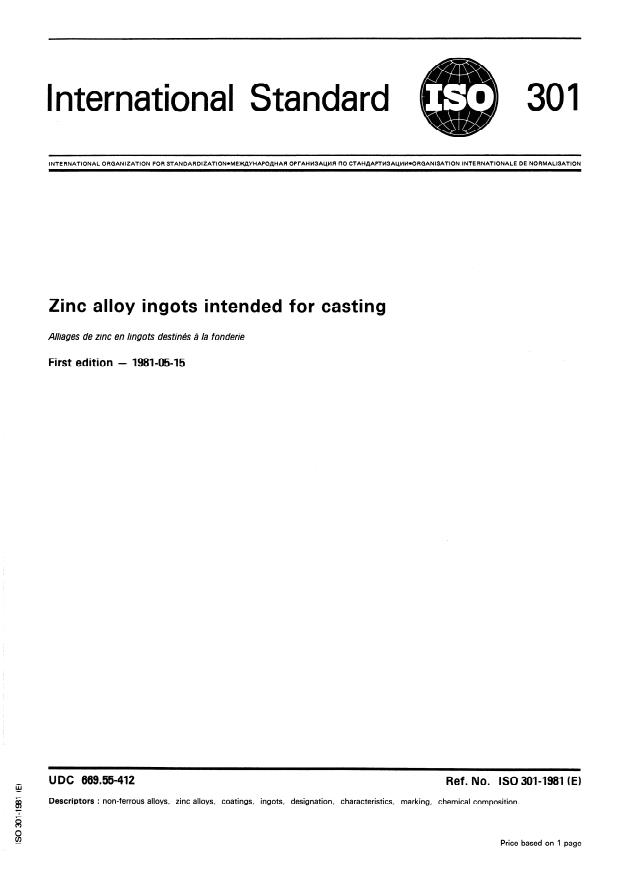
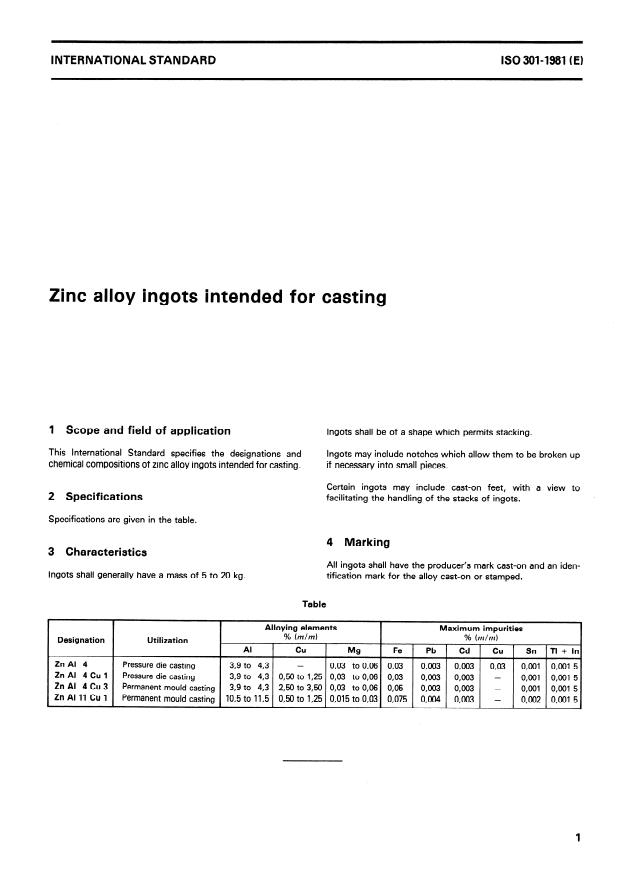
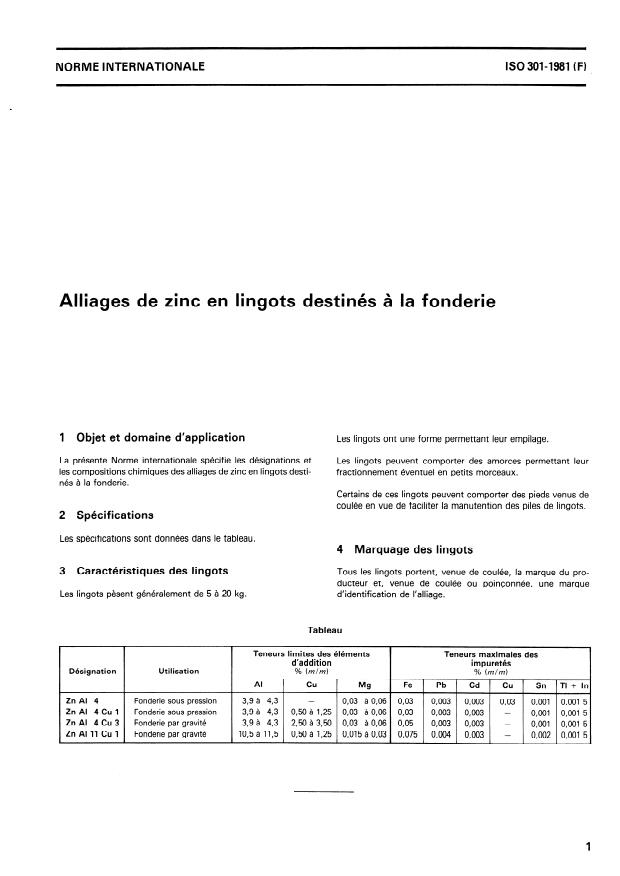
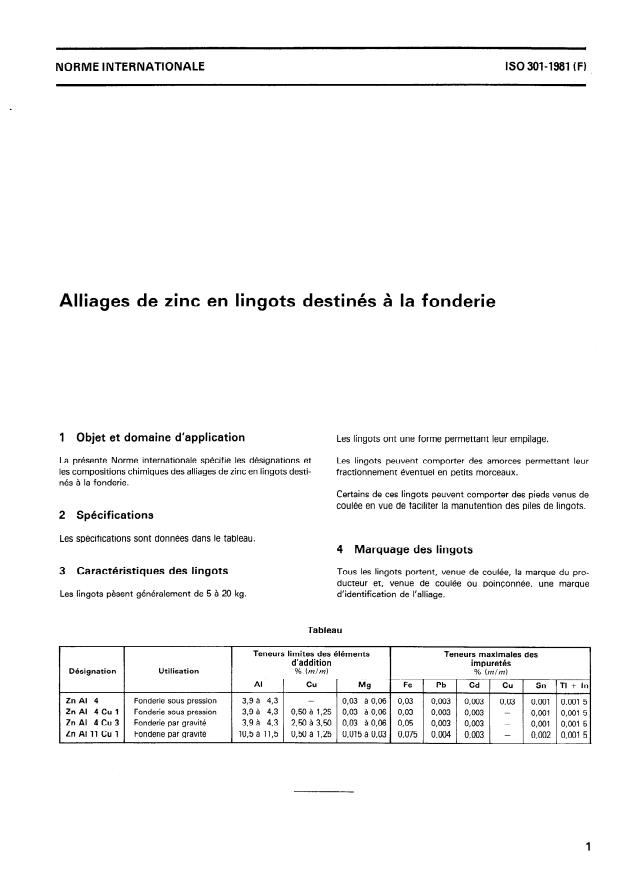
The ingots shall have a mass of 5 to 20 kg, shall be of a shape which permits stacking, may include notches which allow them to be broken up if necessary into small pieces and may include cast-on feet. The marking is specified. Designations and chemical compositions of ingots are given in a table.
Alliages de zinc en lingots destinés à la fonderie
General Information
- Status
- Withdrawn
- Publication Date
- 30-Apr-1981
- Withdrawal Date
- 30-Apr-1981
- Technical Committee
- ISO/TC 18 - Zinc and zinc alloys
- Drafting Committee
- ISO/TC 18 - Zinc and zinc alloys
- Current Stage
- 9599 - Withdrawal of International Standard
- Start Date
- 01-Sep-2006
- Completion Date
- 12-Feb-2026
Relations
- Effective Date
- 10-Feb-2026
- Effective Date
- 15-Apr-2008

ISO 301:1981 - Zinc alloy ingots intended for casting

ISO 301:1981 - Alliages de zinc en lingots destinés a la fonderie

ISO 301:1981 - Alliages de zinc en lingots destinés a la fonderie
Get Certified
Connect with accredited certification bodies for this standard

Element Materials Technology
Materials testing and product certification.

Inštitut za kovinske materiale in tehnologije
Institute of Metals and Technology. Materials testing, metallurgical analysis, NDT.
Sponsored listings
Frequently Asked Questions
ISO 301:1981 is a standard published by the International Organization for Standardization (ISO). Its full title is "Zinc alloy ingots intended for casting". This standard covers: The ingots shall have a mass of 5 to 20 kg, shall be of a shape which permits stacking, may include notches which allow them to be broken up if necessary into small pieces and may include cast-on feet. The marking is specified. Designations and chemical compositions of ingots are given in a table.
The ingots shall have a mass of 5 to 20 kg, shall be of a shape which permits stacking, may include notches which allow them to be broken up if necessary into small pieces and may include cast-on feet. The marking is specified. Designations and chemical compositions of ingots are given in a table.
ISO 301:1981 is classified under the following ICS (International Classification for Standards) categories: 77.120.60 - Lead, zinc, tin and their alloys. The ICS classification helps identify the subject area and facilitates finding related standards.
ISO 301:1981 has the following relationships with other standards: It is inter standard links to EN 60730-2-19:2002, ISO 301:2006. Understanding these relationships helps ensure you are using the most current and applicable version of the standard.
ISO 301:1981 is available in PDF format for immediate download after purchase. The document can be added to your cart and obtained through the secure checkout process. Digital delivery ensures instant access to the complete standard document.
Standards Content (Sample)
International Standard
INTERNATIONAL ORGANIZATION FOR STANDARDIZATlON*ME~YHAPOflHAfI OPrAHM3Al&lR fl0 CTAH,QAPTM3AlJMM.ORGANlSATION INTERNATIONALE DE NORMALISATION
Zinc alloy ingots intended for casting
Alll’ages de zinc en lingo ts destint% ;i la fonderie
First edition - 1981-05-15
U DC 669.55-412 Ref. No. IS0 301-1981 (E)
Descriptors : non-ferrous alloys, zinc alloys, coatings, ingots, designation, characteristics, marking, chemical composition.
Price based on 1 page
Foreword
IS0 (the International Organization for Standardization) is a worldwide federation of
national standards institutes (IS0 member bodies). The work of developing Inter-
national Standards is carried out through IS0 technical committees. Every member
body interested in a subject for which a technical committee has been set up has the
right to be represented on that committee. International organizations, governmental
and non-governmental, in liaison with ISO, also take part in the work.
Draft International Standards adopted by the technical committees are circulated to
the member bodies for approval before their acceptance as International Standards by
the IS0 Council.
International Standard IS0 301 was developed by Technical Committee ISO/TC 18,
Znc and zinc alloys, and was circulated in November 1979.
It has been approved by the member bodies of the following countries :
Belgium Germany, F. R. Portugal
Brazil India Romania
Bulgaria Italy South Africa, Rep. of
Canada Korea, Rep. of Spain
Netherlands USSR
China
Czechoslovakia Norway Yugoslavia
France Poland
The member bodies of the following countries expressed disapproval of the document
on technical grounds :
Australia
United Kingdom
0 International Organization for Standardization, 1981
Printed in Switzerland
...
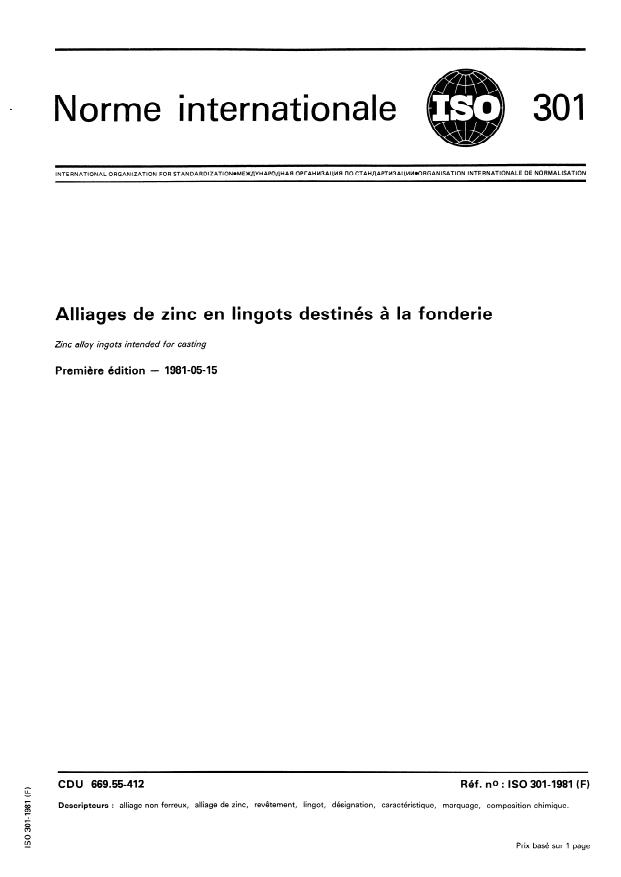
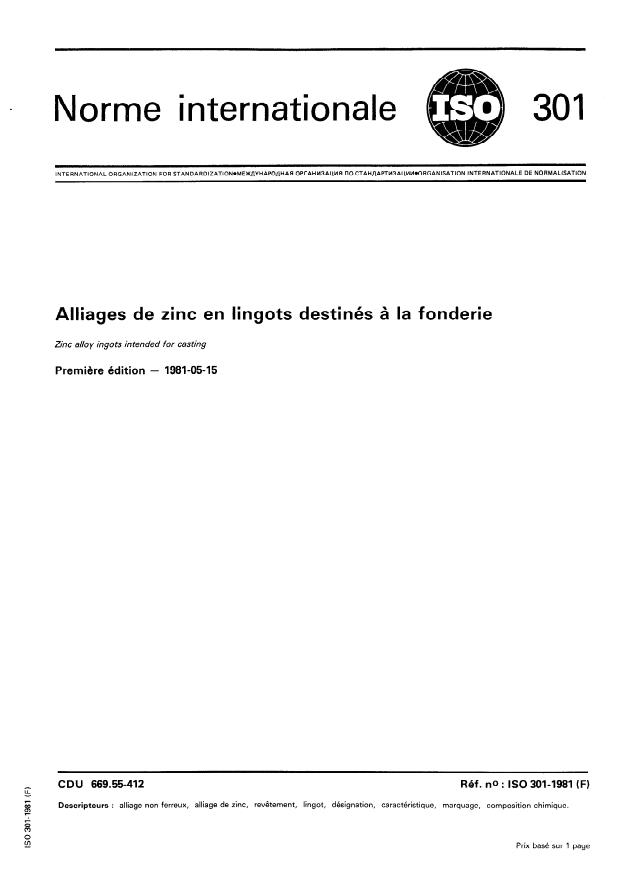
Norme internationale
INTERNATIONAL ORGANIZATION FOR STANDARDIZATlON*ME)KLZYHAPOflHAR OPTAHM3Al&lR l-IO CTAH~APTt43AL(Ml4.ORGANlSATlON INTERNATIONALE DE NORMALISATION
Alliages de zinc en lingots destines 6 la fonderie
Zinc alloy ingots intended for casting
Premihe 6dition - 1981-05-15
Ref. no : IS0 301-1981 (F)
CDU 669.55-412
revetement, lingot, dbsignation, caractkristique, marquage, composition chimique.
Descripteurs : aGage non ferreux, alliage de zinc,
Prix bask sur 1 page
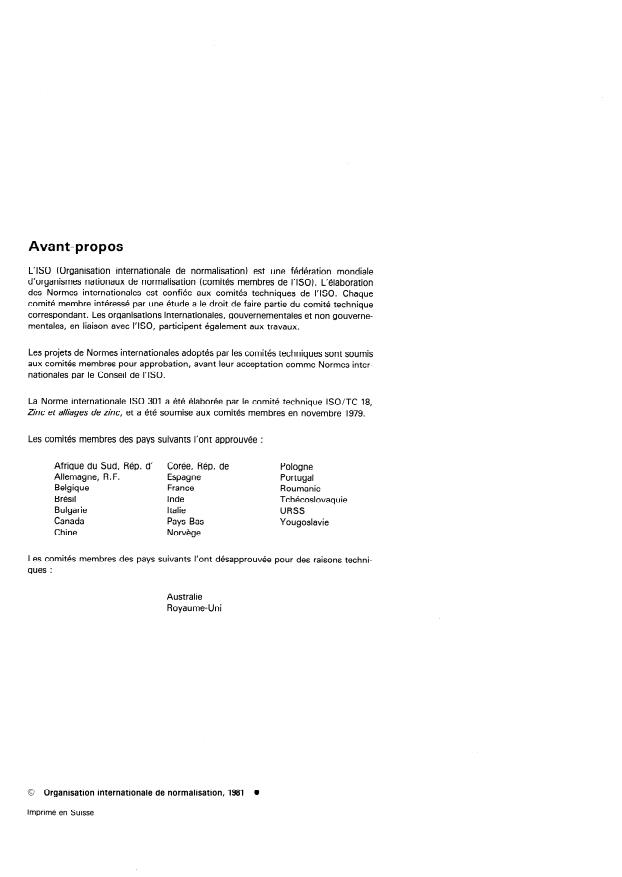
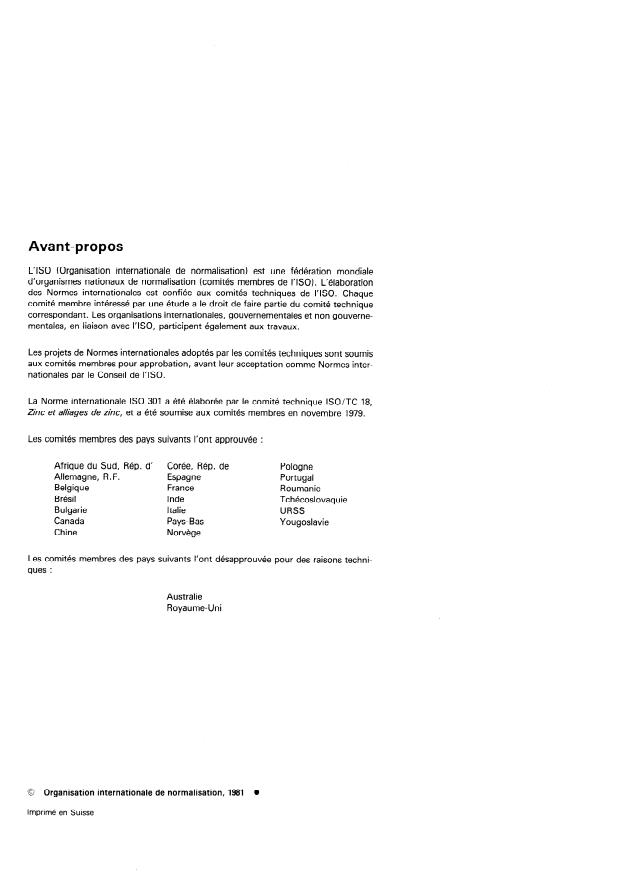
Avant-propos
L’ISO (Organisation internationale de normalisation) est une federation mondiale
d’organismes nationaux de normalisation (comites membres de I’ISO). L’elaboration
des Normes internationales est confide aux comites techniques de I’ISO. Chaque
comite membre interesse par une etude a le droit de faire partie du comite technique
correspondant. Les organisations internationales, gouvernementales et non gouverne-
mentales, en liaison avec I’ISO, participent egalement aux travaux.
Les projets de Normes internationales adopt& par les comites techniques sont soumis
aux comites membres pour approbation, avant leur acceptation comme Normes inter-
nationales par le Conseil de I’ISO.
La Norme internationale IS0 301 a ete elaboree par le comite technique ISO/TC 18,
Zinc et alliages de zinc, et a ete soumise aux comites membres en novembre 1979.
Les comites membres des pays suivants l’ont approuvee :
Co&e, Rep. de
Afrique du Sud, Rep. d’ Pologne
Allemagne, R. F. Espagne Portugai
France
Belgique Roumanie
Bresil lnde
Tchecoslovaquie
Bulgarie ltalie URSS
Pays- Bas
Canada Yougoslavie
Chine Norvege
Les comites membres des pays suivants l’ont desapprouvee pour de
...
Norme internationale
INTERNATIONAL ORGANIZATION FOR STANDARDIZATlON*ME)KLZYHAPOflHAR OPTAHM3Al&lR l-IO CTAH~APTt43AL(Ml4.ORGANlSATlON INTERNATIONALE DE NORMALISATION
Alliages de zinc en lingots destines 6 la fonderie
Zinc alloy ingots intended for casting
Premihe 6dition - 1981-05-15
Ref. no : IS0 301-1981 (F)
CDU 669.55-412
revetement, lingot, dbsignation, caractkristique, marquage, composition chimique.
Descripteurs : aGage non ferreux, alliage de zinc,
Prix bask sur 1 page
Avant-propos
L’ISO (Organisation internationale de normalisation) est une federation mondiale
d’organismes nationaux de normalisation (comites membres de I’ISO). L’elaboration
des Normes internationales est confide aux comites techniques de I’ISO. Chaque
comite membre interesse par une etude a le droit de faire partie du comite technique
correspondant. Les organisations internationales, gouvernementales et non gouverne-
mentales, en liaison avec I’ISO, participent egalement aux travaux.
Les projets de Normes internationales adopt& par les comites techniques sont soumis
aux comites membres pour approbation, avant leur acceptation comme Normes inter-
nationales par le Conseil de I’ISO.
La Norme internationale IS0 301 a ete elaboree par le comite technique ISO/TC 18,
Zinc et alliages de zinc, et a ete soumise aux comites membres en novembre 1979.
Les comites membres des pays suivants l’ont approuvee :
Co&e, Rep. de
Afrique du Sud, Rep. d’ Pologne
Allemagne, R. F. Espagne Portugai
France
Belgique Roumanie
Bresil lnde
Tchecoslovaquie
Bulgarie ltalie URSS
Pays- Bas
Canada Yougoslavie
Chine Norvege
Les comites membres des pays suivants l’ont desapprouvee pour de
...
Questions, Comments and Discussion
Ask us and Technical Secretary will try to provide an answer. You can facilitate discussion about the standard in here.
Loading comments...