


ISO/IEC 11582:2002
(Main)Information technology — Telecommunications and information exchange between systems — Private Integrated Services Network — Generic functional protocol for the support of supplementary services — Inter-exchange signalling procedures and protocol
Information technology — Telecommunications and information exchange between systems — Private Integrated Services Network — Generic functional protocol for the support of supplementary services — Inter-exchange signalling procedures and protocol
ISO/IEC 11582:2002 defines the signalling protocol for the control of Supplementary Services and Additional Network Features (ANFs) at the Q reference point. The protocol is part of Private Signalling System no. 1 (PSS1), known informally as QSIG. The Q reference point exists between Private Integrated services Network eXchanges (PINXs) connected together within a Private Integrated Services Network (PISN) and is defined in ISO/IEC 11579-1. Detailed procedures applicable to individual supplementary services and ANFs are beyond the scope of ISO/IEC 11582:2002 and will be specified by other standards for those services which are standardised and by individual manufacturers for proprietary services using the capabilities defined in ISO/IEC 11582:2002. ISO/IEC 11572 defines the Layer 3 protocol for circuit-switched call control at the Q reference point. ISO/IEC 11582:2002 defines additional protocol procedures, to be used in conjunction with those defined in ISO/IEC 11572 for the control of supplementary services and ANFs. NOTE 1 Typical examples of the application of these generic functional procedures to some supplementary services are provided in annex C, for explanatory and illustrative purposes only. NOTE 2 Specific supplementary services and Additional Network Features may require additional information transfer mechanisms which are service or feature specific and are beyond the scope of ISO/IEC 11582:2002.
Technologies de l'information — Télécommunications et échange d'information entre systèmes — Réseau privé à intégration de services — Protocole générique fonctionnel pour le support de compléments de service — Procédures et protocole de signalisation entre commutateurs
General Information
- Status
- Published
- Publication Date
- 24-Jul-2002
- Current Stage
- 9060 - Close of review
- Completion Date
- 04-Jun-2031
Relations
- Effective Date
- 06-Jun-2022
- Effective Date
- 15-Apr-2008
- Effective Date
- 15-Apr-2008
- Effective Date
- 15-Apr-2008
Overview
ISO/IEC 11582:2002 specifies the generic signalling protocol used at the Q reference point between Private Integrated services Network eXchanges (PINXs) in a Private Integrated Services Network (PISN). Part of Private Signalling System No. 1 (PSS1), commonly known as QSIG, this standard defines inter‑exchange procedures and protocol elements for the control of Supplementary Services and Additional Network Features (ANFs). It provides generic, flexible transport and dialogue mechanisms (APDUs) to support both call‑related and call‑independent signalling across multi‑vendor enterprise networks.
Key Topics and Requirements
- Scope and conformance: Defines signalling requirements at the Q reference point; conformance is demonstrated via the Protocol Implementation Conformance Statement (PICS) in Annex A.
- Protocol model: Application association, dialogue management and generic functional transport control (GFT‑Control) layered with ACSE, ROSE and DSE service elements.
- APDU transport: Procedures for connection‑oriented and connectionless transport of Application Protocol Data Units (APDUs), including call‑related and call‑independent mechanisms.
- Dialogue and notifications: Dialogue identification protocol to tie information flows into dialogues and support for notification services across PINXs.
- Information encoding: ASN.1 definitions and BER/CER/DER encoding rules for information elements (Annex B and related clauses).
- Manufacturer specifics: Mechanisms to include proprietary operations and manufacturer‑specific notifications while maintaining interoperability.
- Interoperation with call control: Designed to be used in conjunction with ISO/IEC 11572 (Layer 3 circuit‑switched call control) and ISO/IEC 11579‑1 (PINX reference configuration).
- Referenced service elements: Uses ACSE, ROSE and DSE service definitions; normative references include ITU‑T Q.932 and relevant ISO/IEC OSI documents.
Applications and Who Uses It
- Enterprise telephony architects and network designers deploying PISNs and multi‑site PBX interconnects.
- PBX and IP‑PBX manufacturers, gateway vendors and equipment implementers building QSIG‑compliant signalling stacks.
- Systems integrators and interoperability test labs validating supplementary services (e.g., call transfer, forwarding, display features) across vendor boundaries.
- Standards engineers mapping ISDN/OSI signalling to manufacturer‑specific ANFs while preserving cross‑network transparency.
Practical benefits include enabling transparent supplementary service behaviour across enterprise exchanges, coexistence of standard and proprietary features, and a structured approach to signalling for call‑independent services.
Related Standards
- ISO/IEC 11572 - Layer 3 circuit‑switched call control at Q reference point
- ISO/IEC 11579‑1 - PINX reference configuration for PISN exchanges
- ISO/IEC 11571, 11574 - Addressing and bearer service descriptions
- ITU‑T Q.932 - Generic procedures for ISDN supplementary services
- ASN.1 and OSI service references (ITU‑T X.680/X.690, X.217/X.227; ISO/IEC 8824/8825, 8649/8650)
Keywords: ISO/IEC 11582:2002, QSIG, Q reference point, PINX, PISN, supplementary services, ANF, APDU, ROSE, ACSE, DSE, ASN.1, PICS, signalling protocol.
Buy Documents

ISO/IEC 11582:2002 - Information technology — Telecommunications and information exchange between systems — Private Integrated Services Network — Generic functional protocol for the support of supplementary services — Inter-exchange signalling procedures and protocol Released:7/25/2002
Get Certified
Connect with accredited certification bodies for this standard

TL 9000 QuEST Forum
Telecommunications quality management system.

ANCE
Mexican certification and testing association.

Intertek Slovenia
Intertek testing, inspection, and certification services in Slovenia.
Sponsored listings
Frequently Asked Questions
ISO/IEC 11582:2002 is a standard published by the International Organization for Standardization (ISO). Its full title is "Information technology — Telecommunications and information exchange between systems — Private Integrated Services Network — Generic functional protocol for the support of supplementary services — Inter-exchange signalling procedures and protocol". This standard covers: ISO/IEC 11582:2002 defines the signalling protocol for the control of Supplementary Services and Additional Network Features (ANFs) at the Q reference point. The protocol is part of Private Signalling System no. 1 (PSS1), known informally as QSIG. The Q reference point exists between Private Integrated services Network eXchanges (PINXs) connected together within a Private Integrated Services Network (PISN) and is defined in ISO/IEC 11579-1. Detailed procedures applicable to individual supplementary services and ANFs are beyond the scope of ISO/IEC 11582:2002 and will be specified by other standards for those services which are standardised and by individual manufacturers for proprietary services using the capabilities defined in ISO/IEC 11582:2002. ISO/IEC 11572 defines the Layer 3 protocol for circuit-switched call control at the Q reference point. ISO/IEC 11582:2002 defines additional protocol procedures, to be used in conjunction with those defined in ISO/IEC 11572 for the control of supplementary services and ANFs. NOTE 1 Typical examples of the application of these generic functional procedures to some supplementary services are provided in annex C, for explanatory and illustrative purposes only. NOTE 2 Specific supplementary services and Additional Network Features may require additional information transfer mechanisms which are service or feature specific and are beyond the scope of ISO/IEC 11582:2002.
ISO/IEC 11582:2002 defines the signalling protocol for the control of Supplementary Services and Additional Network Features (ANFs) at the Q reference point. The protocol is part of Private Signalling System no. 1 (PSS1), known informally as QSIG. The Q reference point exists between Private Integrated services Network eXchanges (PINXs) connected together within a Private Integrated Services Network (PISN) and is defined in ISO/IEC 11579-1. Detailed procedures applicable to individual supplementary services and ANFs are beyond the scope of ISO/IEC 11582:2002 and will be specified by other standards for those services which are standardised and by individual manufacturers for proprietary services using the capabilities defined in ISO/IEC 11582:2002. ISO/IEC 11572 defines the Layer 3 protocol for circuit-switched call control at the Q reference point. ISO/IEC 11582:2002 defines additional protocol procedures, to be used in conjunction with those defined in ISO/IEC 11572 for the control of supplementary services and ANFs. NOTE 1 Typical examples of the application of these generic functional procedures to some supplementary services are provided in annex C, for explanatory and illustrative purposes only. NOTE 2 Specific supplementary services and Additional Network Features may require additional information transfer mechanisms which are service or feature specific and are beyond the scope of ISO/IEC 11582:2002.
ISO/IEC 11582:2002 is classified under the following ICS (International Classification for Standards) categories: 33.040.35 - Telephone networks. The ICS classification helps identify the subject area and facilitates finding related standards.
ISO/IEC 11582:2002 has the following relationships with other standards: It is inter standard links to ISO 13129:2012, ISO/IEC 11582:1995/Cor 2:2000, ISO/IEC 11582:1995/Cor 1:1999, ISO/IEC 11582:1995. Understanding these relationships helps ensure you are using the most current and applicable version of the standard.
ISO/IEC 11582:2002 is available in PDF format for immediate download after purchase. The document can be added to your cart and obtained through the secure checkout process. Digital delivery ensures instant access to the complete standard document.
Standards Content (Sample)
INTERNATIONAL ISO/IEC
STANDARD 11582
Second edition
2002-07-01
Information technology —
Telecommunications and information
exchange between systems — Private
Integrated Services Network — Generic
functional protocol for the support of
supplementary services — Inter-exchange
signalling procedures and protocol
Technologies de l'information — Télécommunications et échange
d'information entre systèmes — Réseau privé à intégration de services —
Protocole générique fonctionnel pour le support de compléments de
service — Procédures et protocole de signalisation entre commutateurs
Reference number
©
ISO/IEC 2002
PDF disclaimer
This PDF file may contain embedded typefaces. In accordance with Adobe's licensing policy, this file may be printed or viewed but shall not
be edited unless the typefaces which are embedded are licensed to and installed on the computer performing the editing. In downloading this
file, parties accept therein the responsibility of not infringing Adobe's licensing policy. The ISO Central Secretariat accepts no liability in this
area.
Adobe is a trademark of Adobe Systems Incorporated.
Details of the software products used to create this PDF file can be found in the General Info relative to the file; the PDF-creation parameters
were optimized for printing. Every care has been taken to ensure that the file is suitable for use by ISO member bodies. In the unlikely event
that a problem relating to it is found, please inform the Central Secretariat at the address given below.
© ISO/IEC 2002
All rights reserved. Unless otherwise specified, no part of this publication may be reproduced or utilized in any form or by any means, electronic
or mechanical, including photocopying and microfilm, without permission in writing from either ISO at the address below or ISO's member body
in the country of the requester.
ISO copyright office
Case postale 56 • CH-1211 Geneva 20
Tel. + 41 22 749 01 11
Fax + 41 22 749 09 47
E-mail copyright@iso.ch
Web www.iso.ch
Printed in Switzerland
ii © ISO/IEC 2002 – All rights reserved
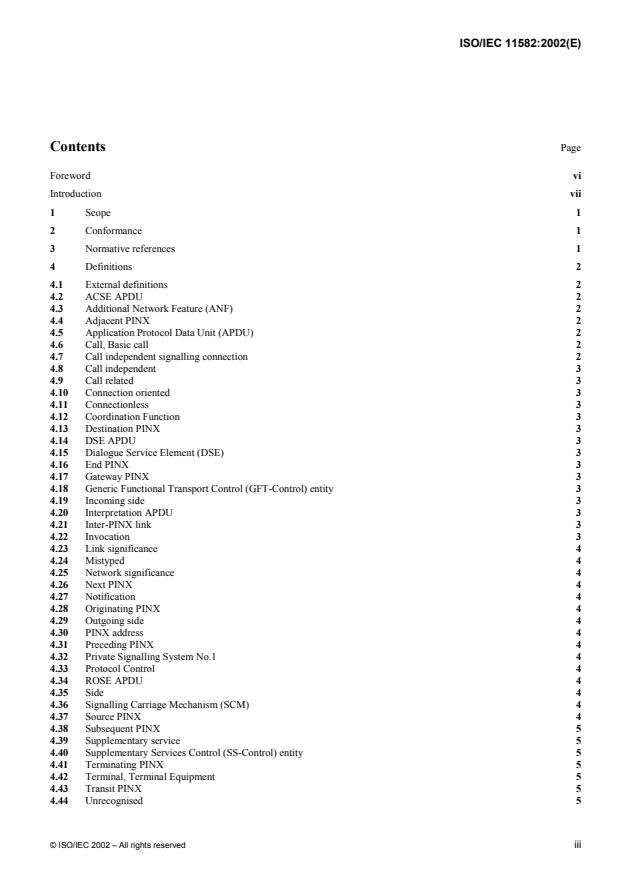
Contents Page
Foreword vi
Introduction vii
1 Scope 1
2 Conformance 1
3 Normative references 1
4 Definitions 2
4.1 External definitions 2
4.2 ACSE APDU 2
4.3 Additional Network Feature (ANF) 2
4.4 Adjacent PINX 2
4.5 Application Protocol Data Unit (APDU) 2
4.6 Call, Basic call 2
4.7 Call independent signalling connection 2
4.8 Call independent 3
4.9 Call related 3
4.10 Connection oriented 3
4.11 Connectionless 3
4.12 Coordination Function 3
4.13 Destination PINX 3
4.14 DSE APDU 3
4.15 Dialogue Service Element (DSE) 3
4.16 End PINX 3
4.17 Gateway PINX 3
4.18 Generic Functional Transport Control (GFT-Control) entity 3
4.19 Incoming side 3
4.20 Interpretation APDU 3
4.21 Inter-PINX link 3
4.22 Invocation 3
4.23 Link significance 4
4.24 Mistyped 4
4.25 Network significance 4
4.26 Next PINX 4
4.27 Notification 4
4.28 Originating PINX 4
4.29 Outgoing side 4
4.30 PINX address 4
4.31 Preceding PINX 4
4.32 Private Signalling System No.1 4
4.33 Protocol Control 4
4.34 ROSE APDU 4
4.35 Side 4
4.36 Signalling Carriage Mechanism (SCM) 4
4.37 Source PINX 4
4.38 Subsequent PINX 5
4.39 Supplementary service 5
4.40 Supplementary Services Control (SS-Control) entity 5
4.41 Terminating PINX 5
4.42 Terminal, Terminal Equipment 5
4.43 Transit PINX 5
4.44 Unrecognised 5
© ISO/IEC 2002 – All rights reserved iii
5 List of acronyms 5
6 General principles 6
6.1 Application Association 6
6.2 Protocol Model 6
6.3 Application of the protocol model to communication between SS-Control entities in non-Adjacent PINXs 8
6.4 Services provided by ROSE 9
6.5 Services provided by ACSE 9
6.6 Services provided by DSE 9
6.7 Services provided by GFT-Control 10
6.7.1 Connection oriented services 10
6.7.2 Connectionless transport services 11
6.7.3 Notification services 11
6.8 Services provided by Protocol Control to GFT-Control 11
6.8.1 Connection oriented transport services 11
6.8.2 Connectionless transport service 12
6.8.3 Notification services 12
6.9 Services required of the Signalling Carriage Mechanism 12
7 Protocol Control and GFT-Control Requirements 12
7.1 Call related Procedures for the transport of APDUs 12
7.1.1 Protocol Control requirements 12
7.1.2 GFT-Control requirements 13
7.2 Connectionless APDU Transport Mechanism 20
7.2.1 Protocol Control requirements 20
7.2.2 Control requirements 20
7.3 Connection oriented call independent APDU transport mechanism 21
7.3.1 Protocol Control requirements 21
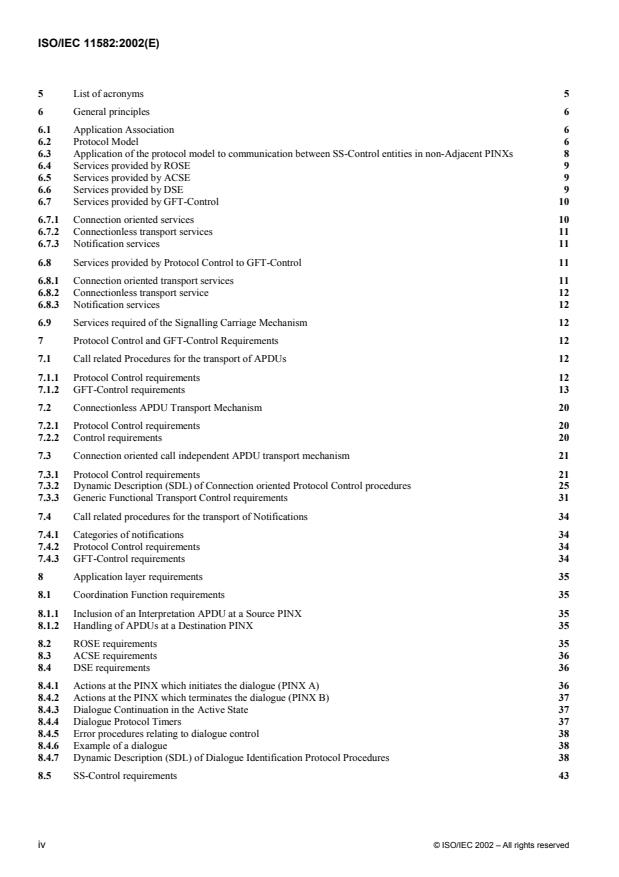
7.3.2 Dynamic Description (SDL) of Connection oriented Protocol Control procedures 25
7.3.3 Generic Functional Transport Control requirements 31
7.4 Call related procedures for the transport of Notifications 34
7.4.1 Categories of notifications 34
7.4.2 Protocol Control requirements 34
7.4.3 GFT-Control requirements 34
8 Application layer requirements 35
8.1 Coordination Function requirements 35
8.1.1 Inclusion of an Interpretation APDU at a Source PINX 35
8.1.2 Handling of APDUs at a Destination PINX 35
8.2 ROSE requirements 35
8.3 ACSE requirements 36
8.4 DSE requirements 36
8.4.1 Actions at the PINX which initiates the dialogue (PINX A) 36
8.4.2 Actions at the PINX which terminates the dialogue (PINX B) 37
8.4.3 Dialogue Continuation in the Active State 37
8.4.4 Dialogue Protocol Timers 37
8.4.5 Error procedures relating to dialogue control 38
8.4.6 Example of a dialogue 38
8.4.7 Dynamic Description (SDL) of Dialogue Identification Protocol Procedures 38
8.5 SS-Control requirements 43
iv © ISO/IEC 2002 – All rights reserved
9 Manufacturer Specific Information 43
9.1 Manufacturer specific operations 43
9.2 Manufacturer specific additions to standardised operations 43
9.3 Manufacturer specific notifications 44
10 Message functional definitions and contents 45
10.1 ALERTING 45
10.2 CALL PROCEEDING 45
10.3 CONNECT 46
10.4 SETUP 46
10.5 DISCONNECT 46
10.6 RELEASE 46
10.7 RELEASE COMPLETE 47
10.8 FACILITY 47
10.9 NOTIFY 48
10.10 PROGRESS 48
11 General message format and information element coding 48
11.1 Message Type 48
11.2 Call reference 49
11.3 Other information elements 49
11.3.1 Bearer capability 49
11.3.2 Channel identification 50
11.3.3 Facility 50
11.3.4 Notification indicator 58
11.4 Encoding of information described using ASN.1 60
Annexes
A - Protocol Implementation Conformance Statement (PICS) for ISO/IEC 11582 61
B - ASN.1 definitions of generic parameters 70
C - Application of the functional protocol 75
D - Remote operations protocol and application association control 82
E - Formal ROSE Definitions 83
F - Examples of the use of Manufacturer specific information 84
G - Problem code definitions 91
H - Bibliography 92
I - Object identifiers defined in ISO/IEC 11582 93
J - “Recipe” for migration of X.208 / X.209 based QSIG ASN.1 modules to X.680 / X.690 ASN.1 95
K - ASN.1 definitions according to ITU-T Recs. X.208 / X.209 100
L - Technical changes since third edition of ECMA-165 112
© ISO/IEC 2002 – All rights reserved v
Foreword
ISO (the International Organization for Standardization) and IEC (the International Electrotechnical Commission) form the
specialized system for worldwide standardization. National bodies that are members of ISO or IEC participate in the
development of International Standards through technical committees established by the respective organization to deal with
particular fields of technical activity. ISO and IEC technical committees collaborate in fields of mutual interest. Other
international organizations, governmental and non-governmental, in liaison with ISO and IEC, also take part in the work. In the
field of information technology, ISO and IEC have established a joint technical committee, ISO/IEC JTC 1.
International Standards are drafted in accordance with the rules given in the ISO/IEC Directives, Part 3.
The main task of the joint technical committee is to prepare International Standards. Draft International Standards adopted by
the joint technical committee are circulated to national bodies for voting. Publication as an International Standard requires
approval by at least 75 % of the national bodies casting a vote.
Attention is drawn to the possibility that some of the elements of this International Standard may be the subject of patent rights.
ISO and IEC shall not be held responsible for identifying any or all such patent rights.
ISO/IEC 11582 was prepared by ECMA (as ECMA-165) and was adopted, under a special “fast-track procedure”, by Joint
Technical Committee ISO/IEC JTC 1, Information technology, in parallel with its approval by national bodies of ISO and IEC.
This second edition cancels and replaces the first edition (ISO/IEC 11582:1995), which has been technically revised.
Annexes A and B form a normative part of this International Standard. Annexes C to L are for information only.
vi © ISO/IEC 2002 – All rights reserved
Introduction
This International Standard is one of a series of Standards defining services and signalling protocols applicable to Private
Integrated Services Digital Networks (PISNs). The series uses ISDN concepts as developed by ITU-T and conforms to the
framework of International Standards on Open Systems Interconnection as defined by ISO/IEC.
This International Standard defines the signalling protocol for use at the Q reference point between two PINXs for the transport
of protocol information as part of Supplementary Services and/or Additional Network Features (ANFs) within a PISN. The
protocol defined in this International Standard forms part of the PSS1 protocol (informally known as QSIG).
The generic functional procedures provide a flexible and open ended approach to the provision of supplementary service and
ANF protocols. These procedures provide:
– generic protocols which may be utilised in the provision of supplementary services and ANFs, both related to existing calls
and separate from existing calls where appropriate to the capability required;
– a dialogue identification protocol to enable supplementary service or ANF information flows to be tied together to form a
dialogue;
– supplementary service and ANF transparency across a PISN, whereby transit PINXs need have no knowledge of the
capability provided to the PISN user or PISN itself unless involved in the provision of that capability; and
– the capability for standardised and manufacturer specific capabilities to coexist in both single and multi-vendor PISNs.
The protocol defined in this International Standard is based upon that described in ITU-T Recommendation Q.932 (1993).
This International Standard is based upon the practical experience of ECMA member companies and the results of their active
and continuous participation in the work of ISO/IEC JTC 1, ITU-T, ETSI and other international and national standardization
bodies. It represents a pragmatic and widely based consensus.
© ISO/IEC 2002 – All rights reserved vii
INTERNATIONAL STANDARD ISO/IEC 11582:2002(E)
Information technology — Telecommunications and information exchange between
systems — Private Integrated Services Network — Generic functional protocol for
the support of supplementary services — Inter-exchange signalling procedures and
protocol
1 Scope
This International Standard defines the signalling protocol for the control of Supplementary Services and Additional Network
Features (ANFs) at the Q reference point. The protocol is part of Private Signalling System no. 1 (PSS1), known informally as
QSIG. The Q reference point exists between Private Integrated services Network eXchanges (PINXs) connected together
within a Private Integrated Services Network (PISN) and is defined in ISO/IEC 11579-1. Detailed procedures applicable to
individual supplementary services and ANFs are beyond the scope of this International Standard and will be specified by other
standards for those services which are standardised and by individual manufacturers for proprietary services using the
capabilities defined in this International Standard.
ISO/IEC 11572 defines the Layer 3 protocol for circuit-switched call control at the Q reference point. This International
Standard defines additional protocol procedures, to be used in conjunction with those defined in ISO/IEC 11572 for the control
of supplementary services and ANFs.
NOTE 1 - Typical examples of the application of these generic functional procedures to some supplementary services are provided in
annex C, for explanatory and illustrative purposes only.
NOTE 2 - Specific supplementary services and Additional Network Features may require additional information transfer mechanisms which
are service or feature specific and are beyond the scope of this International Standard.
2 Conformance
In order to conform to this International Standard, a PINX shall satisfy the requirements identified in the Protocol
Implementation Conformance Statement (PICS) proforma in annex A.
3 Normative references
The following normative documents contain provisions which, through reference in this text, constitute provisions of this
International Standard. For dated references, subsequent amendments to, or revisions of, any of these publications do not
apply. However, parties to agreements based on this International Standard are encouraged to investigate the possibility of
applying the most recent editions of the normative documents indicated below. For undated references, the latest edition of the
normative document referred to applies. Members of ISO and IEC maintain registers of currently valid International Standards.
ISO/IEC 11579-1:1994, Information technology — Telecommunications and information exchange between systems — Private
integrated services network — Part 1: Reference configuration for PISN Exchanges (PINX)
ISO/IEC 11574:2000, Information technology — Telecommunications and information exchange between systems — Private
Integrated Services Network — Circuit-mode 64 kbit/s bearer services — Service description, functional capabilities and
information flows
ISO/IEC 11572:2000, Information technology — Telecommunications and information exchange between systems — Private
Integrated Services Network — Circuit mode bearer services — Inter-exchange signalling procedures and protocol
ISO/IEC 11571:1998, Information technology — Telecommunications and information exchange between systems — Private
Integrated Services Networks — Addressing
ISO/IEC 15056:1997, Information technology — Telecommunications and information exchange between systems — Private
Integrated Services Network — Inter-exchange signalling protocol — Transit counter additional network feature
ISO/IEC 6523-1:1998, Information technology — Structure for the identification of organizations and organization parts —
Part 1: Identification of organization identification schemes
ISO/IEC 6523-2:1998, Information technology — Structure for the identification of organizations and organization parts —
Part 2: Registration of organization identification schemes
ITU-T Rec. I.112:1993, Vocabulary of terms for ISDNs
ITU-T Rec. I.210:1993, Principles of telecommunication services supported by an ISDN and the means to describe them
ITU-T Rec. Q.932:1998, Digital subscriber signalling system No. 1 — Generic procedures for the control of ISDN
supplementary services
© ISO/IEC 2002 – All rights reserved 1
ITU-T Rec. X.217:1995 ISO/IEC 8649:1996, Information technology — Open Systems Interconnection — Service definition
for the Association Control Service Element
ITU-T Rec. X.227:1995 ISO/IEC 8650-1:1996, Information technology — Open Systems Interconnection — Connection-
oriented protocol for the Association Control Service Element: Protocol specification
ITU-T Rec. X.680:1997 ISO/IEC 8824-1:1998, Information technology — Abstract Syntax Notation One (ASN.1):
Specification of basic notation
ITU-T Rec. X.681:1997 ISO/IEC 8824-2:1998, Information technology — Abstract Syntax Notation One (ASN.1):
Information object specification
ITU-T Rec. X.682:1997 ISO/IEC 8824-3:1998, Information technology — Abstract Syntax Notation One (ASN.1):
Constraint specification
ITU-T Rec. X.683:1997 ISO/IEC 8824-4:1998, Information technology — Abstract Syntax Notation One (ASN.1):
Parameterization of ASN.1 specifications
ITU-T Rec. X.690:1997 ISO/IEC 8825-1:1998, Information technology — ASN.1 encoding rules: Specification of Basic
Encoding Rules (BER), Canonical Encoding Rules (CER) and Distinguished Encoding Rules (DER)
ITU-T Rec. X.880:1994 ISO/IEC 13712-1:1995, Information technology — Remote Operations: Concepts, model and notation
ITU-T Rec. X.881:1994 ISO/IEC 13712-2:1995, Information technology — Remote Operations: OSI realizations — Remote
Operations Service Element (ROSE) service definition
ITU-T Rec. X.882:1994 ISO/IEC 13712-3:1995, Information technology — Remote Operations: OSI realizations — Remote
Operations Service Element (ROSE) protocol specification
4 Definitions
For the purposes of this International Standard, the following definitions apply.
4.1 External definitions
This International Standard uses the following terms defined in other documents:
– Object Identifier (ITU-T Rec. X.680)
– Private Integrated services Network eXchange (PINX) (ISO/IEC 11579-1)
– Private Integrated Services Network (ISO/IEC 11579-1)
– Service (ITU-T Rec. I.112)
– Signalling (ITU-T Rec. I.112)
– User (ISO/IEC 11574)
4.2 ACSE APDU
An APDU defined by the Association Control Service Element (ACSE).
4.3 Additional Network Feature (ANF)
A capability provided by a PISN, not generally directly to a User, over and above that of the Basic call.
4.4 Adjacent PINX
A PINX as considered from another PINX to which it is directly connected via one or more inter-PINX links.
4.5 Application Protocol Data Unit (APDU)
A sequence of data elements exchanged between peer application layer entities, e.g. ACSE APDUs, DSE APDUs and ROSE
APDUs.
4.6 Call, Basic call
An instance of the use of a basic service.
4.7 Call independent signalling connection
A signalling connection established between SS-Control entities located in different PINXs that does not have an associated
user-information connection.
2 © ISO/IEC 2002 – All rights reserved
4.8 Call independent
A property of information which is conveyed across the Q reference point in a message which does not use a call reference
which has an associated user-information connection (that is, using a Connectionless or Connection oriented transport
mechanism as defined in 7.2 or 7.3).
4.9 Call related
A property of information which is conveyed across the Q reference point in a message which uses a call reference which has
an associated user-information connection.
4.10 Connection oriented
Communication between peer protocol entities by means of a connection or association established by an underlying layer.
4.11 Connectionless
Communication between peer protocol entities by means of an unacknowledged, unidirectional transport mechanism provided
by an underlying layer.
4.12 Coordination Function
An entity which provides coordination between various SS-Control entities, ROSE, ACSE, DSE, GFT-Control and Call
Control for different supplementary services (see clause 6).
4.13 Destination PINX
In the context of a single one-way exchange of information between two SS-Control entities, the PINX where the receiving SS-
Control entity is located.
4.14 DSE APDU
An APDU defined by the Dialogue Service Element.
4.15 Dialogue Service Element (DSE)
A service element which provides services to SS-Control via the Coordination Function that associate ROSE or ACSE APDUs
which are not implicitly associated by an underlying network layer connection.
4.16 End PINX
In the context of a particular call, an Originating or Terminating PINX. It can also be a Gateway PINX, dependent on the
capabilities of the signalling system being interworked (i.e. unless it transports APDUs unchanged to or from the other
signalling system).
4.17 Gateway PINX
Sub-clause 4.6 of ISO/IEC 11572 shall apply. Dependent on the capabilities of the signalling system being interworked by the
Gateway PINX, it can act as a Transit or an End PINX in the context of the supplementary services APDUs. That is, it can
either transport the APDUs unchanged to or from the other signalling system, perhaps embedded in some other protocol unit,
or process the APDUs and perform an interworking function of the information flows and encoding of the supplementary
service concerned.
4.18 Generic Functional Transport Control (GFT-Control) entity
The entity that exists within a PINX and provides a range of services (defined in clause 6) to SS-Control, ROSE, ACSE and
DSE via the Coordination Function.
4.19 Incoming side
In the context of a Call independent signalling connection, the Side which receives the request for connection establishment
from the Preceding PINX.
4.20 Interpretation APDU
An APDU defined by the Coordination Function.
4.21 Inter-PINX link
The totality of a signalling channel and a number (≥ 0) of user information channels (which may have different characteristics)
at the Q reference point.
4.22 Invocation
A request by a SS-Control entity to perform an operation in a remote SS-Control entity.
© ISO/IEC 2002 – All rights reserved 3
4.23 Link significance
A property of a Facility information element which does not contain a Network Facility Extension octet group. It indicates that
the element has only significance on a single inter-PINX link - i.e. only between two Adjacent PINXs.
4.24 Mistyped
A property of an APDU whose structure does not conform to the structure defined in clause 11 of this International Standard or
the structure defined for a particular supplementary service.
4.25 Network significance
A property of a Facility information element which includes a Network Facility Extension octet group. It indicates that the
element has significance between two PINXs which are not necessarily Adjacent.
4.26 Next PINX
An Adjacent PINX to which an APDU is to be sent in the context of an existing signalling connection (related to a call or
independent of a call).
4.27 Notification
A piece of protocol information which has the following properties:
– it is intended to be delivered only to terminals and is therefore passed on transparently by PINXs;
– it does not cause a change of state on either side of the Q reference point;
– it represents a one-way flow of information that requires no response; and
– it provides additional information that can be discarded without the need for significant error recovery if it is unrecognised
by the terminal.
4.28 Originating PINX
Sub-clause 4.5 of ISO/IEC 11572 shall apply. In addition, the term is also applied to a PINX which originates a Call
independent signalling connection.
4.29 Outgoing side
In the context of a Call independent signalling connection, the Side which sends the request for connection establishment to the
Next PINX.
4.30 PINX address
A PISN number as defined in ISO/IEC 11571 that is a complete number and that unambiguously identifies the addressed PINX
or an addressable entity associated with that PINX.
4.31 Preceding PINX
Sub-clause 4.7 of ISO/IEC 11572 shall apply. In addition, the term is also applied in a similar way to a PINX participating in a
Call independent signalling connection.
4.32 Private Signalling System No.1
The generic name given to the signalling protocol that exists conceptually at the ‘Q’ reference point and is defined in this and
other Standards. This protocol is visible and indirectly testable at the ‘C’ reference point (see ISO/IEC 11579-1).
4.33 Protocol Control
An entity which exists within a PINX and provides a range of services (defined in clause 6) to the Generic Functional
Transport Control entity.
4.34 ROSE APDU
An APDU defined by the Remote Operations Service Element (ROSE).
4.35 Side
The Protocol Control entity within a PINX at one end of an inter-PINX link.
4.36 Signalling Carriage Mechanism (SCM)
The infrastructure that transports messages between Protocol Control entities in two interconnected PINXs.
4.37 Source PINX
In the context of a single one-way exchange of information between two SS-Control entities, the PINX where the sending SS-
Control entity is located.
4 © ISO/IEC 2002 – All rights reserved
4.38 Subsequent PINX
Sub-clause 4.7 of ISO/IEC 11572 shall apply. In addition, the term is also applied in a similar way to a PINX participating in a
Call independent signalling connection.
4.39 Supplementary service
Section 2.4 of ITU-T Recommendation I.210 shall apply.
For the purpose of this International Standard, ANFs shall be regarded as supplementary services.
4.40 Supplementary Services Control (SS-Control) entity
An entity that exists within a PINX and provides the procedures associated with the support of a particular supplementary
service.
4.41 Terminating PINX
Sub-clause 4.5 of ISO/IEC 11572 shall apply. In addition, the term is also applied to a PINX which terminates a Call
independent signalling connection.
4.42 Terminal, Terminal Equipment
An item of equipment attached to a telecommunication network to provide access for a user to one or more services.
4.43 Transit PINX
Sub-clause 4.5 of ISO/IEC 11572 shall apply. In addition, the term is also applied to a PINX which participates in the
provision of a Call independent signalling connection, but does not originate or terminate that connection.
4.44 Unrecognised
A property of a message, information element, APDU or operation value whose type identifier is not one supported by the
Destination PINX.
5 List of acronyms
ACSE Association Control Service Element
AE Application Entity
ANF Additional Network Feature
APDU Application Protocol Data Unit
ASN.1 Abstract Syntax Notation One
BER Basic Encoding Rules
DSE Dialogue Service Element
DSS1 Digital Subscriber Signalling no. 1
FIE Facility information element
GFT Generic Functional Transport
ICD International Code Designator
MSI Manufacturer Specific Information
NFE Network Facility Extension
PC Protocol Control
PICS Protocol Implementation Conformance Statement
PINX Private Integrated services Network eXchange
PISN Private Integrated Services Network
PSS1 Private Signalling System no. 1
RO Remote Operations
ROSE Remote Operations Service Element
RTSE Reliable Transfer Service Element
SCM Signalling Carriage Mechanism
SS Supplementary Service
© ISO/IEC 2002 – All rights reserved 5
6 General principles
The generic functional protocol defined in this International Standard provides the means to exchange signalling information
for the control of supplementary services over a PISN. It does not by itself control any supplementary service but rather
provides generic services to specific SS-Control entities. Procedures for individual supplementary services based on these
generic procedures are defined in other standards or may be manufacturer-specific.
The generic functional protocol operates at the Q reference point between two PINXs in conjunction with a Layer 3 protocol
for Basic call control (ISO/IEC 11572). Together these use the services of the Signalling Carriage Mechanism (SCM).
The generic functional protocol provides mechanisms for the support of supplementary services which relate to existing basic
calls or are entirely independent of any existing basic calls. In performing a supplementary service, whether Call independent
or Call related, use may be made of both the Call related (7.1) and Call independent (7.2 and 7.3) information transfer
procedures.
If a particular supplementary service comprises Call related and Call independent information transfer procedures or relates to
several basic calls at the same time it is - for the purpose of this International Standard - deemed to consist of separate
instances of Call related (one for each call) and Call independent services respectively. The combined use of two or more
instances of Call related and/or Call independent procedures in support of a particular supplementary service is outside the
scope of this International Standard.
6.1 Application Association
Supplementary service operations require an association between the respective peer SS-Control entities. This International
Standard provides three means by which this association can be achieved:
a) implicitly by the network layer connection in the case of Call related connections and for call-independent signalling
connections;
b) implicitly by the application layer dialogue service, in which case the association is independent of the underlying network
layer connections and can use a combination of different mechanisms, including Call independent Connectionless
information transfer or,
c) explicitly by use of the Association Control Service Element (ACSE, X.217/227) in conjunction with the underlying
mechanisms provided in (a) and (b).
6.2 Protocol Model
Figure 1 shows the conceptual model for the generic functional protocol and its relation to the Basic call model defined in
ISO/IEC 11572.
6 © ISO/IEC 2002 – All rights reserved
SS-Control #1
•
•
•
•
Coordination
Call
Function
Control
SS-Control #n
ROSE
ACSE
DSE
GFT Control
Protocol Control
Signalling Carriage
Mechanism (SCM)
NOTE - The capabilities defined in this International Standard are indicated by shading, i.e. GFT-Control, DSE, ACSE, ROSE and
extensions to Protocol Control. Part of the functions of the Coordination Function are also defined in this International Standard, but the
remainder of this element governs supplementary service specific interactions which are beyond the scope of this International Standard.
Figure 1 — PSS1 Protocol Model
At the top layer (the application layer) the actual supplementary service protocol operates between peer Supplementary
Services Control (SS-Control) entities which are service-specific. The operation of specific SS-Control entities is beyond the
scope of this International Standard.
SS-Control entities use the services of the Remote Operations Service Element (ROSE), the Association Control Service
Element (ACSE) and the Dialogue Service Element (DSE) at the application layer via the Coordination Function. These
entities use the services of Generic Functional Transport Control (GFT-Control) at the network layer via the Coordination
Function. GFT-Control uses the services of Protocol Control at the network layer.
The Remote Operations Service Element (ROSE) is defined in ITU-T Rec. X.881.
The Association Control Service Element (ACSE) is defined in ITU-T Rec. X.217.
NOTE - In the application of ROSE for the support of supplementary services in PSS1 the underlying services used by ROSE are those
provided by GFT-Control or those provided by the Association Control Service Entity (ACSE). No use is made of the services of the
Reliable Transport Service Element (RTSE).
The Dialogue Service Element (DSE) provides a means of associating ACSE or ROSE APDUs which are not implicitly
associated by an underlying network layer connection.
The Coordination Function provides coordination between GFT-Control, the various SS-Control entities, ROSE, ACSE, DSE
and Call Control for different supplementary services. The relationships it coordinates are beyond the scope of this
International Standard. It also provides functions to support the handling of unrecognised APDUs.
© ISO/IEC 2002 – All rights reserved 7
Coordination Function
GFT-Control provides two distinct types of service via the Coordination Function:
– transport services for the carriage of Notifications, ROSE APDUs, ACSE APDUs and DSE APDUs between SS-Control
entities in different PINXs, including transparent relaying through Transit PINXs. These services can be related to a Call
or independent of a Call; and,
– establishment and release of Call independent signalling connections.
Protocol Control is an extension of the existing Protocol Control entity. It provides services to GFT-Control for:
– the transport of APDUs between Adjacent PINXs;
– the establishment and release of signalling connections (Call independent Connection oriented service) between Adjacent
PINXs.
This entity builds on the ISO/IEC 11572 (Basic call) Protocol Control in the following way:
– the Call related transfer of APDUs uses the call reference established for the call by Protocol Control. This can be either
by:
• the combination of Basic call control information and APDUs in the same ISO/IEC 11572 message if they appear
concurrently at the Protocol Control service access points; or,
• the transfer of APDUs in a message defined in this International Standard associated with the call reference, when no
Call Control primitive appears at the Protocol Control service access point.
– Call independent signalling connections use the call reference mechanism of Protocol Control and some of the messages
and procedures.
6.3 Application of the protocol model to communication between SS-Control entities in non-Adjacent PINXs
Figure 2 shows the application of the protocol model to the case where communication occurs between SS-Control entities in
two PINXs via a single Transit PINX. It may be applied to communication via more than one Transit PINX by simple
replication.
End PINX Transit PINX End PINX
SS-C SS-C
ROSE ROSE
Application layer protocol
ACSE ACSE
DSE DSE
GFT GFT GFT
Control Control Control
Network
Network
Layer
Layer
Protocol
Protocol
Protocol Protocol Protocol Protocol
Control Control Control Control
SCM SCM SCM SCM
SS-C = SS-Control
Figure 2 — Application of the protocol model to communication between non-Adjacent PINXs
In figure 2, relaying functions at the Transit PINX are performed by GFT-Control.
8 © ISO/IEC 2002 – All rights reserved
Coordination Function
If communication is Call related, each of the PINXs in which the SS-Control entities are located may be either an End or a
Transit PINX. For simplicity, the Call Control entities are not shown.
If communication is in the context of a Call independent signalling connection, one of the PINXs in which the SS-Control
entities are located is the Originating PINX and the other is the Terminating PINX.
The Signalling Carriage Mechanism (SCM) is described in ISO/IEC 11572.
6.4 Services provided by ROSE
ROSE provides a set of services to SS-Control to support the ROSE protocol. Primitives for these services are specified in
X.881 and relate to the following ROSE APDUs: Invoke, ReturnResult, ReturnError and Reject.
6.5 Services provided by ACSE
ACSE provides a set of services to establish and release an explicit Application association. Primitives for these services are
specified in X.217 and relate to the following ACSE APDUs: Associate request, Associate response, Release request, Release
response and Abort.
6.6 Services provided by DSE
DSE provides the services shown in table 1 to SS-Control via the Coordination Function, with their contents indicated as either
Mandatory (M) or Optional (O). These services are used for creating and terminating a Dialogue which associates peer SS-
Control entities and for exchanging ACSE or ROSE APDUs within such an association.
© ISO/IEC 2002 – All rights reserved 9
Table 1 — Services provided by DSE
– Dialog Begin Req/Ind
Originating Dialog Identifier M
ROSE APDU(s) (Note) O
– Dialog Continue Req/Ind
Originating Dialog Identifier M
Destination Dialog Identifier M
ROSE APDU(s) (Note) O
– Dialog End Req/Ind
Destination Dialog Identifier M
ROSE APDU(s) (Note) O
– Dialog Abort Req/Ind
Destination Dialog Identifier M
User Abort Cause M
NOTE - This element can contain one or more ACSE or ROSE APDUs.
6.7 Services provided by GFT-Control
This entity provides the following services to SS-Control, ACSE, ROSE and DSE via the Coordination Function, with their
contents indicated as either Mandatory (M) or Optional (O).
6.7.1 Connection oriented services
The services shown in table 2 are provided for the control of the establishment and clearing of a Call independent signalling
connection between the PINXs in which the peer SS-Control entities exist.
NOTE 1 - It is envisaged that the majority of supplementary services requiring call independent APDU transport will make use of a Call
independent signalling connection via the use of the services shown in tables 2 and 3.
Table 2 — Connection oriented services
– GF-Setup Req/Ind Resp/Conf
Origination Address O -
Destination Address M O
Data (Note 2) O O
– GF-Release Req/Ind
Cause M
Data (Note 2) O
– GF-Reject Req/Ind
Cause M
Data (Note 2) O
NOTE 2 - This element shall contain one or more APDUs and an indication of the destination of these APDUs on the connection path.
APDUs may be ACSE APDUs, DSE APDUs or ROSE APDUs. It may also contain an interpretationAPDU generated by the Coordination
Function.
The service shown in table 3 is provided and is used for the conveyance of APDUs on a signalling connection (Call related or
Call independent) between the PINXs in which the peer SS-Control entities exist.
Table 3 — Connection oriented services
– GF-Data Req/Ind
Data (Note 3) M
Basic Call Correlation (Note 4) O
NOTE 3 - This element shall contain one or more APDUs and an indication of the destination of these APDUs on the connection path.
APDUs may be ACSE APDUs, DSE APDUs or ROSE APDUs. It may also contain an interpretationAPDU generated by the Coordination
Function.
NOTE 4 - This element shall be included if SS-Control requires that the Data to be conveyed is to be conveyed in conjunction with a specific
basic call control message.
10 © ISO/IEC 2002 – All rights reserved
6.7.2 Connectionless transport services
The service shown in table 4 is provided to effect the transport of APDUs between two peer SS-Control entities without the use
of a network layer connection. It is an unconfirmed service.
Table 4 — Connectionless services
– GF-Unitdata Req/Ind
Origination Address M
Destination Address M
Data (Note) M
NOTE - This element shall contain one or more APDUs. APDUs may be ACSE APDUs, DSE APDUs or ROSE APDUs. It may also contain
an interpretationAPDU generated by the Coordination Function.
6.7.3 Notification services
The service in table 5 is provided to SS-Control via the Coordination Function. This service is used to effect the transport of
notifications associated with the network layer signalling connection of a Call.
Table 5 — Notification services
– GF-Notify Req/Ind
Notification M
Basic Call Correlation (Note) O
NOTE - This element shall be included if SS-Control requires that the Notification is conveyed in conjunction with a specific basic call
control message.
6.8 Services provided by Protocol Control to GFT-Control
The following services are provided, with their contents indicated as either Mandatory (M) or Optional (O).
6.8.1 Connection oriented transport services
The services in table 6 provide the Connection oriented network service for Call independent supplementary service control.
These services are used for the establishment and clearing of Call independent signalling connections between Adjacent
PINXs.
Table 6 — Connection oriented transport services
– PC-Setup Req/Ind Resp/Conf
Origination Address O -
Destination Address M O
Data (Note 1) O O
– PC-Release Req/Ind
Cause M
Data (Note 1) O
– PC-Reject Req/Ind
Cause M
Data (Note 1) O
NOTE 1 - This element shall contain one or more APDUs and an indication of the destination of these APDUs on the connection path.
NOTE 2 - These primitives are similar to the primitives defined in 6.2 of ISO/IEC 11572 for provision of services to Call Control.
The service in table 7 is provided to GFT-Control for the conveyance of APDUs between Adjacent PINXs in association with a
Basic call or Call independent signalling connection.
Table 7 — Connection oriented transport services
– PC-Data Req/Ind
Data (Note 3) M
Basic Call Correlation (Note 4) O
NOTE 3 - This element shall contain one or more APDUs and an indication of the destination of these APDUs on the connection path.
NOTE 4 - This element shall be included if the APDUs to be conveyed are to be conveyed in conjunction with a specific basic call control
message.
© ISO/IEC 2002 – All rights reserved 11
6.8.2 Connectionless transport service
The service in table 8 is provided to GFT-Control to effect the transport of APDUs between two Adjacent PINXs without the
use of a network layer connection.
Table 8 — Connectionless transport services
– PC-Unitdata Req/Ind
Origination Address M
Destination Address M
Data (Note) M
NOTE - This element shall contain one or more APDUs.
6.8.3 Notification services
The service in table 9 is provided to GFT-Control. This service is used to effect the transport of notifications between Adjacent
PINXs in association with the network layer signalling connection of a Call.
Table 9 — Notification transport services
– PC-Notify Req/Ind
Notification M
Basic Call Correlation (Note) O
NOTE - This element shall be included if the Notification is to be conveyed in conjunction with a specific basic call control message.
6.9 Services required of the Signalling Carriage Mechanism
The services required by Protocol Control are as specified in 6.3 of ISO/IEC 11572.
7 Protocol Control and GFT-Control Requirements
7.1 Call related Procedures for the transport of APDUs
This clause describes the procedures required to transport Call related APDUs.
NOTE - The APDUs need not directly relate to the provision or state of the Call which provides the signalling connection over which the
information is carried. If the Call fails and the connection is cleared down for any reason, APDUs that are in the process of being sent may
never reach their destination. In such a case, the APDUs will be discarded. It is the responsibility of the supplementary service protocol to
cater for this eventuality.
7.1.1 Protocol Control requirements
7.1.1.1 Sending the Facility information element
When requested by GFT-Control, the Facility information element may be sent at any time during a call (i.e. where a call
reference exists) subject to the following conditions:
– If a call establishment or a call clearing message that may contain a Facility information element (see clause 10) or a
PROGRESS message is to be sent in the context of a Basic call and GFT-Control has requested that the Facility
information element be carried in that message, the Facility information element shall be included in that message.
– otherwise, the Facility information element shall be carried in a FACILITY message.
Four exceptions where the Facility information element shall not be sent in a FACILITY message and an indication of
transmission failure given to GFT-Control are:
– when no response has been received to a previously sent SETUP message (as defined in 10.1 of ISO/IEC 11572);
– when no response has been sent to a previously received SETUP message (as defined in 10.1 of ISO/IEC 11572);
– when the Facility information element is of network signif
...
Questions, Comments and Discussion
Ask us and Technical Secretary will try to provide an answer. You can facilitate discussion about the standard in here.
Loading comments...